

- Industry Size (2025)
- USD 1.4 Bn
- Forecast (2035)
- USD 2.4 Bn
- CAGR (2025 to 2035)
- 5.4%
Radiation Protection Cabins Market Size and Share Forecast Outlook 2025 to 2035
The Radiation Protection Cabins Market is estimated to be valued at USD 1.4 billion in 2025 and is projected to reach USD 2.4 billion by 2035, registering a compound annual growth rate (CAGR) of 5.4% over the forecast period.
Quick Stats for Radiation Protection Cabins Market
- Radiation Protection Cabins Market Value (2025): USD 1.4 billion
- Radiation Protection Cabins Market Forecast Value (2035): USD 2.4 billion
- Radiation Protection Cabins Market Forecast CAGR: 5.4%
- Leading Segment in Radiation Protection Cabins Market in 2025: Suspended Cabins (60.0%)
- Key Growth Regions in Radiation Protection Cabins Market: North America, Asia-Pacific, Europe
- Top Key Players in Radiation Protection Cabins Market: International Paper Company, Georgia-Pacific LLC, Smurfit Kappa, Mondi Group, Amcor Limited, Nichols Paper Products Company, Inc., Uflex Ltd., Moore Packaging Corporation, Dynapac Co., Ltd.
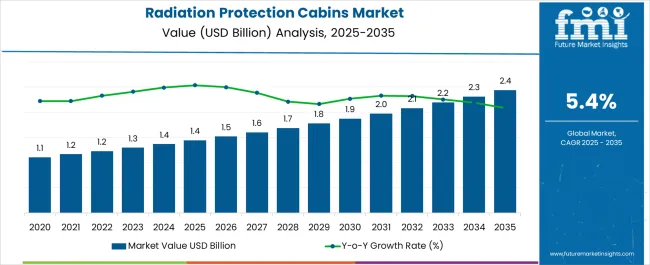
Radiation Protection Cabins Market Key Takeaways
| Metric | Value |
|---|---|
| Radiation Protection Cabins Market Estimated Value in (2025 E) | USD 1.4 billion |
| Radiation Protection Cabins Market Forecast Value in (2035 F) | USD 2.4 billion |
| Forecast CAGR (2025 to 2035) | 5.4% |
Why is the Radiation Protection Cabins Market Growing?
The Radiation Protection Cabins market is witnessing significant growth due to increasing demand for safe radiation handling environments across healthcare and industrial sectors. The market is being driven by heightened awareness about occupational safety and regulatory compliance in radiation-intensive environments. In hospitals and diagnostic centers, the adoption of radiation protection cabins is expanding rapidly to ensure the safety of staff and patients during imaging procedures such as X-rays, CT scans, and interventional radiology.
Rising investments in healthcare infrastructure, coupled with the increasing number of diagnostic procedures globally, are contributing to the expanding market. Technological advancements in cabin materials, including lightweight lead composites and enhanced shielding solutions, are further encouraging adoption.
Additionally, the emphasis on minimizing radiation exposure in workplaces and stringent enforcement of safety protocols by regulatory bodies are positively impacting market growth The growing focus on modernizing healthcare facilities, along with an increasing number of diagnostic centers in emerging economies, is expected to create long-term opportunities for the Radiation Protection Cabins market, ensuring continued expansion over the next decade.
Segmental Analysis
The radiation protection cabins market is segmented by product type, end users, and geographic regions. By product type, radiation protection cabins market is divided into Suspended Cabins and Mobile Cabins. In terms of end users, radiation protection cabins market is classified into Hospitals, Cathlabs, and Others. Regionally, the radiation protection cabins industry is classified into North America, Latin America, Western Europe, Eastern Europe, Balkan & Baltic Countries, Russia & Belarus, Central Asia, East Asia, South Asia & Pacific, and the Middle East & Africa.
Insights into the Suspended Cabins Segment
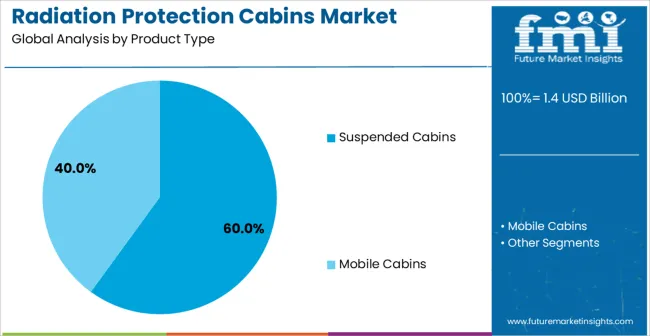
The Suspended Cabins product type is projected to hold 60.00% of the Radiation Protection Cabins market revenue share in 2025, establishing it as the leading product segment. The dominance of this segment is being attributed to its design flexibility, which allows easy installation over imaging tables and operation areas without consuming floor space. Suspended cabins provide effective radiation shielding while maintaining optimal ergonomics and visibility for operators, which has driven widespread adoption in hospitals and diagnostic centers.
The market growth has been further supported by the increasing deployment of advanced imaging modalities and interventional procedures that require precise radiation protection. Hospitals are prioritizing cabins that allow integration with modern imaging equipment while providing comfort and operational efficiency for medical staff.
Additionally, the ability to retrofit suspended cabins into existing diagnostic setups without major structural modifications has accelerated uptake As healthcare facilities continue to expand and modernize, the Suspended Cabins segment is expected to maintain its leadership, driven by the combination of operational convenience, high safety standards, and compatibility with evolving imaging technologies.
Insights into the Hospitals Segment
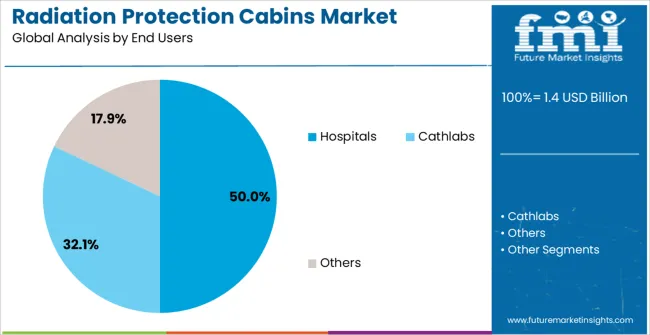
The Hospitals end-use industry is anticipated to hold 50.00% of the Radiation Protection Cabins market revenue in 2025, making it the leading consumer segment. This dominance is being driven by the increasing number of diagnostic procedures and interventional radiology applications requiring strict radiation safety measures. Hospitals are investing in modern radiation protection cabins to safeguard staff and patients from prolonged exposure during routine imaging and treatment processes.
The preference for high-quality shielding solutions has been reinforced by regulatory guidelines and safety protocols, which mandate minimal radiation exposure in clinical settings. The market growth has been supported by the integration of these cabins with advanced diagnostic equipment, providing operational efficiency, enhanced ergonomics, and improved workflow management.
Additionally, hospitals in both developed and emerging economies are prioritizing facility upgrades to meet patient safety and operational standards, further boosting demand The trend toward minimizing occupational exposure and ensuring compliance with radiation safety standards is expected to sustain the Hospitals segment’s market leadership, positioning it for continued growth in line with increasing healthcare infrastructure development globally.
Market Overview
Radiation Protection Cabins Market Introducion
In the past decade catheterization based interventional procedures are becoming increasingly popular over conventional surgeries. This has increased the radiation dose to healthcare professionals that increases their risk of developing diseases associated to radiation.
To address this issue manufacturers have developed radiation protection cabins that reduces the exposure to radiation considerably. There are two significant manufacturers of radiation protection cabins namely, Lemer Pax and Biotronik.
Biotronik’s Zero-Gravity products are body shielding device/cabin that is suspended either through monorail on the wall or ceiling. In order to increase mobility the company also launched a radiation protection cabins that has a floor trolley that supports the suspended radiation protection cabins.
The Zero-Gravity radiation protection cabins is made of 1.0 mm lead shield that protects the torso, legs, and upper arms. The cabin engages with the vest worn by the operator through magnetic properties.
The Lemer Pax’s Cathpax product range is also known as mobile radiation protection cabins these cabins are adjustable and designed for the comfort of the operator. Thus these radiation protection cabins offer more mobility and option of siting during the procedure. The Cathpax range of ration protection cabins ensure optimal radiation protection that is equivalent to 2.0 mm lead shielding.
These radiation protection cabins are available in various forms that are suitable for the operator. For an instance, radiation protection cabins are available for performing standing procedures as well as has accommodation for the operator to sit during the procedure.
The siting cabins are flexible and have adjustments for increasing or decreasing leg room within the radiation protection cabins. The radiation protection cabins are also available for two operators such as the Cathpax CRM Double, which can accommodate two operators at once.
Factors such as increased healthcare spending, improved healthcare infrastructure, significant funding for healthcare are some of the factors that drive the growth of the radiation protection cabins market. However, factors such as lack of availability in low income regions, lack of awareness, and high cost of radiation protection cabins significantly hinder the growth of the radiation protection cabins market during the forecast period.
Analysis of Radiation Protection Cabins Market By Key Countries
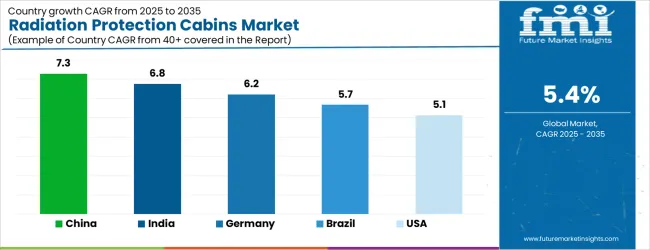
| Country | CAGR |
|---|---|
| China | 7.3% |
| India | 6.8% |
| Germany | 6.2% |
| Brazil | 5.7% |
| USA | 5.1% |
| UK | 4.6% |
| Japan | 4.1% |
Country-wise Analysis
The Radiation Protection Cabins Market is expected to register a CAGR of 5.4% during the forecast period, exhibiting varied country level momentum. China leads with the highest CAGR of 7.3%, followed by India at 6.8%. Developed markets such as Germany, France, and the UK continue to expand steadily, while the USA is likely to grow at consistent rates. Japan posts the lowest CAGR at 4.1%, yet still underscores a broadly positive trajectory for the global Radiation Protection Cabins Market. In 2024, Germany held a dominant revenue in the Western Europe market and is expected to grow with a CAGR of 6.2%. The USA Radiation Protection Cabins Market is estimated to be valued at USD 531.4 million in 2025 and is anticipated to reach a valuation of USD 531.4 million by 2035. Sales are projected to rise at a CAGR of 0.0% over the forecast period between 2025 and 2035. While Japan and South Korea markets are estimated to be valued at USD 69.8 million and USD 38.4 million respectively in 2025.
Key Players in the Radiation Protection Cabins Market
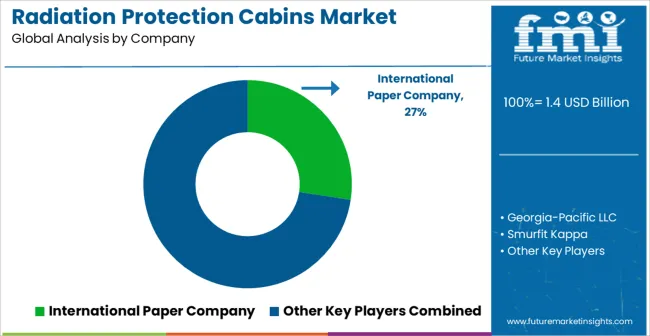
- International Paper Company
- Georgia-Pacific LLC
- Smurfit Kappa
- Mondi Group
- Amcor Limited
- Nichols Paper Products Company, Inc.
- Uflex Ltd.
- Moore Packaging Corporation
- Dynapac Co., Ltd.
Scope of the Report
| Item | Value |
|---|---|
| Quantitative Units | USD 1.4 Billion |
| Product Type | Suspended Cabins and Mobile Cabins |
| End Users | Hospitals, Cathlabs, and Others |
| Regions Covered | North America, Europe, Asia-Pacific, Latin America, Middle East & Africa |
| Country Covered | United States, Canada, Germany, France, United Kingdom, China, Japan, India, Brazil, South Africa |
| Key Companies Profiled | International Paper Company, Georgia-Pacific LLC, Smurfit Kappa, Mondi Group, Amcor Limited, Nichols Paper Products Company, Inc., Uflex Ltd., Moore Packaging Corporation, and Dynapac Co., Ltd. |
Radiation Protection Cabins Market by Segments
Product Type:
- Suspended Cabins
- Mobile Cabins
End Users:
- Hospitals
- Cathlabs
- Others
Region:
- North America
- USA
- Canada
- Mexico
- Latin America
- Brazil
- Chile
- Rest of Latin America
- Western Europe
- Germany
- UK
- Italy
- Spain
- France
- Nordic
- BENELUX
- Rest of Western Europe
- Eastern Europe
- Russia
- Poland
- Hungary
- Balkan & Baltic
- Rest of Eastern Europe
- East Asia
- China
- Japan
- South Korea
- South Asia and Pacific
- India
- ASEAN
- Australia & New Zealand
- Rest of South Asia and Pacific
- Middle East & Africa
- Kingdom of Saudi Arabia
- Other GCC Countries
- Turkiye
- South Africa
- Other African Union
- Rest of Middle East & Africa
Frequently Asked Questions
How big is the radiation protection cabins market in 2025?
The global radiation protection cabins market is estimated to be valued at USD 1.4 billion in 2025.
What will be the size of radiation protection cabins market in 2035?
The market size for the radiation protection cabins market is projected to reach USD 2.4 billion by 2035.
How much will be the radiation protection cabins market growth between 2025 and 2035?
The radiation protection cabins market is expected to grow at a 5.4% CAGR between 2025 and 2035.
What are the key product types in the radiation protection cabins market?
The key product types in radiation protection cabins market are suspended cabins and mobile cabins.
Which end users segment to contribute significant share in the radiation protection cabins market in 2025?
In terms of end users, hospitals segment to command 50.0% share in the radiation protection cabins market in 2025.
Preview the report firsthand - request a free sample
Get SampleGet the brochure for pricing and purchase details.
Get PDFTable of Content
- Executive Summary
- Global Market Outlook
- Demand-side Trends
- Supply-side Trends
- Technology Roadmap Analysis
- Analysis and Recommendations
- Market Overview
- Market Coverage / Taxonomy
- Market Definition / Scope / Limitations
- Market Background
- Market Dynamics
- Drivers
- Restraints
- Opportunity
- Trends
- Scenario Forecast
- Demand in Optimistic Scenario
- Demand in Likely Scenario
- Demand in Conservative Scenario
- Opportunity Map Analysis
- Product Life Cycle Analysis
- Supply Chain Analysis
- Investment Feasibility Matrix
- Value Chain Analysis
- PESTLE and Porter’s Analysis
- Regulatory Landscape
- Regional Parent Market Outlook
- Production and Consumption Statistics
- Import and Export Statistics
- Market Dynamics
- Global Market Analysis 2020 to 2024 and Forecast, 2025 to 2035
- Historical Market Size Value (USD Million) Analysis, 2020 to 2024
- Current and Future Market Size Value (USD Million) Projections, 2025 to 2035
- Y-o-Y Growth Trend Analysis
- Absolute $ Opportunity Analysis
- Global Market Pricing Analysis 2020 to 2024 and Forecast 2025 to 2035
- Global Market Analysis 2020 to 2024 and Forecast 2025 to 2035, By Product Type
- Introduction / Key Findings
- Historical Market Size Value (USD Million) Analysis By Product Type , 2020 to 2024
- Current and Future Market Size Value (USD Million) Analysis and Forecast By Product Type , 2025 to 2035
- Suspended Cabins
- Mobile Cabins
- Y-o-Y Growth Trend Analysis By Product Type , 2020 to 2024
- Absolute $ Opportunity Analysis By Product Type , 2025 to 2035
- Global Market Analysis 2020 to 2024 and Forecast 2025 to 2035, By End Users
- Introduction / Key Findings
- Historical Market Size Value (USD Million) Analysis By End Users, 2020 to 2024
- Current and Future Market Size Value (USD Million) Analysis and Forecast By End Users, 2025 to 2035
- Hospitals
- Cathlabs
- Others
- Y-o-Y Growth Trend Analysis By End Users, 2020 to 2024
- Absolute $ Opportunity Analysis By End Users, 2025 to 2035
- Global Market Analysis 2020 to 2024 and Forecast 2025 to 2035, By Region
- Introduction
- Historical Market Size Value (USD Million) Analysis By Region, 2020 to 2024
- Current Market Size Value (USD Million) Analysis and Forecast By Region, 2025 to 2035
- North America
- Latin America
- Western Europe
- Eastern Europe
- East Asia
- South Asia and Pacific
- Middle East & Africa
- Market Attractiveness Analysis By Region
- North America Market Analysis 2020 to 2024 and Forecast 2025 to 2035, By Country
- Historical Market Size Value (USD Million) Trend Analysis By Market Taxonomy, 2020 to 2024
- Market Size Value (USD Million) Forecast By Market Taxonomy, 2025 to 2035
- By Country
- USA
- Canada
- Mexico
- By Product Type
- By End Users
- By Country
- Market Attractiveness Analysis
- By Country
- By Product Type
- By End Users
- Key Takeaways
- Latin America Market Analysis 2020 to 2024 and Forecast 2025 to 2035, By Country
- Historical Market Size Value (USD Million) Trend Analysis By Market Taxonomy, 2020 to 2024
- Market Size Value (USD Million) Forecast By Market Taxonomy, 2025 to 2035
- By Country
- Brazil
- Chile
- Rest of Latin America
- By Product Type
- By End Users
- By Country
- Market Attractiveness Analysis
- By Country
- By Product Type
- By End Users
- Key Takeaways
- Western Europe Market Analysis 2020 to 2024 and Forecast 2025 to 2035, By Country
- Historical Market Size Value (USD Million) Trend Analysis By Market Taxonomy, 2020 to 2024
- Market Size Value (USD Million) Forecast By Market Taxonomy, 2025 to 2035
- By Country
- Germany
- UK
- Italy
- Spain
- France
- Nordic
- BENELUX
- Rest of Western Europe
- By Product Type
- By End Users
- By Country
- Market Attractiveness Analysis
- By Country
- By Product Type
- By End Users
- Key Takeaways
- Eastern Europe Market Analysis 2020 to 2024 and Forecast 2025 to 2035, By Country
- Historical Market Size Value (USD Million) Trend Analysis By Market Taxonomy, 2020 to 2024
- Market Size Value (USD Million) Forecast By Market Taxonomy, 2025 to 2035
- By Country
- Russia
- Poland
- Hungary
- Balkan & Baltic
- Rest of Eastern Europe
- By Product Type
- By End Users
- By Country
- Market Attractiveness Analysis
- By Country
- By Product Type
- By End Users
- Key Takeaways
- East Asia Market Analysis 2020 to 2024 and Forecast 2025 to 2035, By Country
- Historical Market Size Value (USD Million) Trend Analysis By Market Taxonomy, 2020 to 2024
- Market Size Value (USD Million) Forecast By Market Taxonomy, 2025 to 2035
- By Country
- China
- Japan
- South Korea
- By Product Type
- By End Users
- By Country
- Market Attractiveness Analysis
- By Country
- By Product Type
- By End Users
- Key Takeaways
- South Asia and Pacific Market Analysis 2020 to 2024 and Forecast 2025 to 2035, By Country
- Historical Market Size Value (USD Million) Trend Analysis By Market Taxonomy, 2020 to 2024
- Market Size Value (USD Million) Forecast By Market Taxonomy, 2025 to 2035
- By Country
- India
- ASEAN
- Australia & New Zealand
- Rest of South Asia and Pacific
- By Product Type
- By End Users
- By Country
- Market Attractiveness Analysis
- By Country
- By Product Type
- By End Users
- Key Takeaways
- Middle East & Africa Market Analysis 2020 to 2024 and Forecast 2025 to 2035, By Country
- Historical Market Size Value (USD Million) Trend Analysis By Market Taxonomy, 2020 to 2024
- Market Size Value (USD Million) Forecast By Market Taxonomy, 2025 to 2035
- By Country
- Kingdom of Saudi Arabia
- Other GCC Countries
- Turkiye
- South Africa
- Other African Union
- Rest of Middle East & Africa
- By Product Type
- By End Users
- By Country
- Market Attractiveness Analysis
- By Country
- By Product Type
- By End Users
- Key Takeaways
- Key Countries Market Analysis
- USA
- Pricing Analysis
- Market Share Analysis, 2024
- By Product Type
- By End Users
- Canada
- Pricing Analysis
- Market Share Analysis, 2024
- By Product Type
- By End Users
- Mexico
- Pricing Analysis
- Market Share Analysis, 2024
- By Product Type
- By End Users
- Brazil
- Pricing Analysis
- Market Share Analysis, 2024
- By Product Type
- By End Users
- Chile
- Pricing Analysis
- Market Share Analysis, 2024
- By Product Type
- By End Users
- Germany
- Pricing Analysis
- Market Share Analysis, 2024
- By Product Type
- By End Users
- UK
- Pricing Analysis
- Market Share Analysis, 2024
- By Product Type
- By End Users
- Italy
- Pricing Analysis
- Market Share Analysis, 2024
- By Product Type
- By End Users
- Spain
- Pricing Analysis
- Market Share Analysis, 2024
- By Product Type
- By End Users
- France
- Pricing Analysis
- Market Share Analysis, 2024
- By Product Type
- By End Users
- India
- Pricing Analysis
- Market Share Analysis, 2024
- By Product Type
- By End Users
- ASEAN
- Pricing Analysis
- Market Share Analysis, 2024
- By Product Type
- By End Users
- Australia & New Zealand
- Pricing Analysis
- Market Share Analysis, 2024
- By Product Type
- By End Users
- China
- Pricing Analysis
- Market Share Analysis, 2024
- By Product Type
- By End Users
- Japan
- Pricing Analysis
- Market Share Analysis, 2024
- By Product Type
- By End Users
- South Korea
- Pricing Analysis
- Market Share Analysis, 2024
- By Product Type
- By End Users
- Russia
- Pricing Analysis
- Market Share Analysis, 2024
- By Product Type
- By End Users
- Poland
- Pricing Analysis
- Market Share Analysis, 2024
- By Product Type
- By End Users
- Hungary
- Pricing Analysis
- Market Share Analysis, 2024
- By Product Type
- By End Users
- Kingdom of Saudi Arabia
- Pricing Analysis
- Market Share Analysis, 2024
- By Product Type
- By End Users
- Turkiye
- Pricing Analysis
- Market Share Analysis, 2024
- By Product Type
- By End Users
- South Africa
- Pricing Analysis
- Market Share Analysis, 2024
- By Product Type
- By End Users
- USA
- Market Structure Analysis
- Competition Dashboard
- Competition Benchmarking
- Market Share Analysis of Top Players
- By Regional
- By Product Type
- By End Users
- Competition Analysis
- Competition Deep Dive
- International Paper Company
- Overview
- Product Portfolio
- Profitability by Market Segments (Product/Age /Sales Channel/Region)
- Sales Footprint
- Strategy Overview
- Marketing Strategy
- Product Strategy
- Channel Strategy
- Georgia-Pacific LLC
- Smurfit Kappa
- Mondi Group
- Amcor Limited
- Nichols Paper Products Company, Inc.
- Uflex Ltd.
- Moore Packaging Corporation
- Dynapac Co., Ltd.
- International Paper Company
- Competition Deep Dive
- Assumptions & Acronyms Used
- Research Methodology


