

- Market Size (2026)
- USD 260.4 Mn
- Forecast (2036)
- USD 594.3 Mn
- CAGR (2026 to 2036)
- 8.6%
How big is Radiotherapy Support Nutrition Market in 2026?
USD 260.4 Million in 2026 and USD 594.3 Million by 2036, expanding at 8.6% CAGR.
Sales of radiotherapy support nutrition products are estimated to grow at 8.6% from 2026 to 2036, rising from USD 239.8 million in 2025 to USD 260.4 million in 2026 and USD 594.3 million by 2036. Demand comes from a practical problem during cancer treatment: some patients can no longer eat enough ordinary food as radiotherapy progresses. Treatment involving the head, neck, chest, or gastrointestinal tract can make swallowing harder, reduce appetite, change taste, or affect tolerance to food. Nutrition support therefore often starts with concentrated oral products and moves to texture-modified or tube-fed options when eating becomes more difficult.
This makes radiotherapy support nutrition a distinct part of the wider clinical nutrition market. A patient may begin treatment with a high-protein drink, switch to a smoother product when swallowing becomes painful, and later require enteral feeding if oral intake falls further. The commercial opportunity is therefore spread across several stages of the treatment journey. Companies that can keep products available as needs change are better placed to retain demand, but reimbursement rules, formularies, patient tolerance, and access after discharge still shape repeat purchasing.
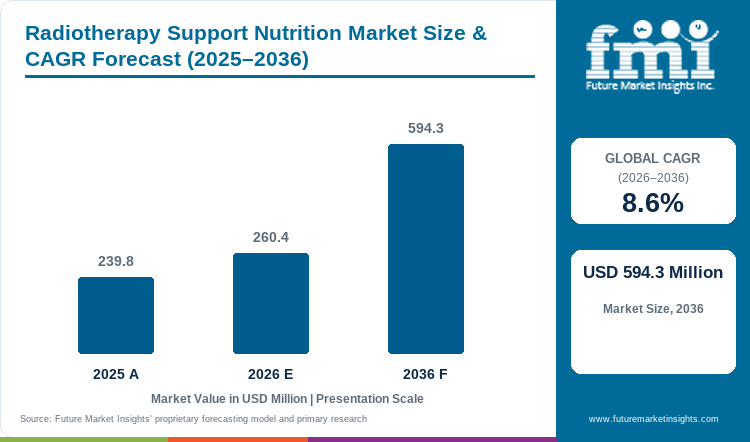
Key Takeaways
- Radiotherapy-related swallowing difficulty, appetite loss, taste change, and gastrointestinal symptoms create recurring demand for concentrated nutritional support.
- High-Protein ONS is projected to lead Product Type with 40.6% share in 2026 because it can supplement intake while oral feeding remains possible.
- Head & Neck is estimated to account for 41.7% of Radiation Site demand, reflecting the direct effect of treatment on eating and swallowing.
- Clinical evidence, patient tolerance, formulary access, and reimbursement requirements can slow conversion from nutrition need to regular product use.
- South Korea is forecast to expand at 8.7% CAGR through 2036, followed by the USA at 8.1%, among the countries profiled.
- Nestlé Health Science, Danone Nutricia, Abbott, Fresenius Kabi, Medtrition, Victus, B. Braun, and Lyons Health Labs are notable participants in specialized nutrition.
Analyst Perspective
“Radiotherapy support nutrition works best commercially when a supplier can stay relevant as the patient's condition changes. A high-protein product alone is not enough. The stronger position comes from supporting the move from oral nutrition to texture-modified products or enteral feeding, and then making sure patients can continue using suitable products after leaving the cancer center.”
- Anurag Sharma, Principal Consultant, Future Market Insights
How is the radiotherapy support nutrition market segmented?
Radiotherapy Support Nutrition Market is segmented by Product Type, Radiation Site, Phase, End User, Sales Channel, and Region.
The market is segmented by Product Type into High-Protein ONS, Glutamine & Mucosal-Support Blends, Enteral Tube Feeds (Head & Neck), Soothing Texture-Adapted Products, and Others. Radiation Site includes Head & Neck, GI / Pelvic, Thoracic, and Others. Phase covers During Treatment, Early Recovery (0-3 Months), and Late Recovery. End User includes Cancer Centers, Hospitals, Homecare, and Others. Sales Channel covers Hospital Pharmacy, Retail Pharmacy, Online, Institutional Tender, and Others.
Why does High-Protein ONS lead demand within the Product Type category?
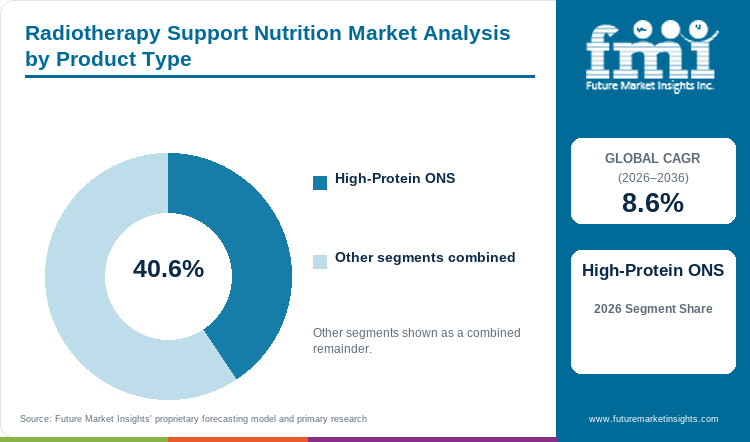
High-Protein ONS is useful at the stage when regular meals are no longer enough but the patient can still drink. It provides more protein and energy without asking the patient to consume a large meal, which is important when appetite falls or swallowing becomes uncomfortable. Dietitians can also change serving size or frequency before moving to tube feeding. This creates a natural link with the broader enteral nutrition market when oral intake eventually becomes insufficient. Medtrition's 2025 launch of ProSource Cup and ProSource Cup Plant shows how suppliers are responding with compact protein formats that can fit both oral and tube-fed care.
- High-Protein ONS is projected to account for 40.6% of Product Type demand in 2026.
- Compact oral products can provide additional energy and protein while swallowing remains sufficient for supervised oral intake.
Why does Head & Neck lead demand within the Radiation Site category?
Head and neck radiotherapy affects the parts of the body most directly involved in eating. Patients may develop dry mouth, changes in taste, oral discomfort, or difficulty swallowing, all of which can reduce how much and what type of food they can manage. These problems can change quickly during treatment, so nutrition products may need to change as well. That makes calorie-dense drinks, smoother textures, and tube-feeding products particularly relevant in this group.
- Head & Neck is estimated to account for 41.7% of Radiation Site demand in 2026.
- The category favors products that can address declining meal volume and changing swallowing tolerance without disrupting the nutritional plan.
Why does During Treatment lead demand within the Phase category?
Nutrition problems are often easiest to identify while radiotherapy is still being delivered. Clinical teams can track weight, food intake, swallowing, gastrointestinal tolerance, and treatment side effects over repeated visits. When a problem appears, the nutrition plan can be changed immediately rather than waiting until treatment ends. This creates more product starts and switches during active therapy than in later recovery. The same need to manage treatment side effects links nutrition support with the broader cancer supportive care products market.
- During Treatment is projected to account for 49.3% of Phase demand in 2026.
- Early Recovery remains commercially relevant when mucosal, swallowing, taste, or gastrointestinal problems continue after the final radiation session.
Why do Cancer Centers lead demand within the End User category?
Cancer Centers bring radiotherapy and nutrition care together in one setting. Dietitians can work with oncologists, nurses, swallowing specialists, and enteral-feeding teams while treatment is underway. This allows nutrition problems to be picked up earlier and products to be adjusted before the patient's intake deteriorates further. The cancer center can therefore influence product choice even when the patient later buys or receives the same nutrition at home.
- Cancer Centers are estimated to account for 47.1% of End User demand in 2026.
- Their purchasing influence extends beyond products consumed on-site because the nutrition plan established during treatment can determine later home use.
Why does Hospital Pharmacy lead demand within the Sales Channel category?
Hospital Pharmacy plays a central role when specialized nutrition is introduced through a formulary or a medically supervised treatment plan. Hospitals can standardize which products are used, manage supply around treatment schedules, and support consistent ordering across oncology services. Once a patient knows which product is tolerated, repeat purchases may shift toward retail or home channels. The same route also overlaps with the wider oral clinical nutrition desserts market, particularly where softer or easier-to-consume formats are needed.
- Hospital Pharmacy is projected to account for 40.2% of Sales Channel demand in 2026.
- Retail and online purchasing become more important after the product, serving size, and tolerance profile are established during clinical care.
What are the drivers, restraints and opportunities in the Radiotherapy Support Nutrition Market?
Radiotherapy-related loss of normal food intake drives demand, evidence and payment conditions restrain uniform adoption, while symptom-adapted portfolios and smoother care transitions create expansion opportunities.
- Driver: Radiation-related swallowing, taste, appetite, and gastrointestinal problems increase the need for concentrated oral or enteral nutrition.
- Restraint: Product tolerance, ingredient-specific evidence, reimbursement requirements, and institutional formularies can delay or restrict adoption.
- Opportunity: Suppliers can build stronger continuity between oral supplementation, texture-adapted nutrition, tube feeding, and post-discharge replenishment.
Treatment-related intake loss turns nutritional support into an active-care requirement
Radiotherapy creates demand when treatment makes normal eating harder. A head and neck patient may struggle to swallow, while someone receiving thoracic or gastrointestinal radiation may face a different set of tolerance problems. Once food intake starts to fall, the nutrition plan may need to become more intensive during the same treatment course. This supports repeat use of products that can deliver enough protein and calories in smaller, easier-to-manage servings.
Clinical suitability and payment conditions can interrupt adoption
A product can look suitable on paper and still fail in day-to-day use. Taste, thickness, serving volume, stomach tolerance, or swallowing difficulty may stop a patient from consuming it regularly. The process can become more complicated if care moves to enteral feeding, where ordering and reimbursement rules may apply. In the USA, Medicare coverage conditions make documentation particularly important. Suppliers therefore need products that work for the patient and fit the way institutions and payers authorize nutrition support.
Care-transition portfolios create a monetizable expansion route
The better commercial opportunity is to support the patient through several stages instead of relying on one format. A patient may start with ordinary food plus an ONS, move to a more concentrated product, require a different texture, and later need tube feeding. The sequence can reverse as recovery begins. Companies that cover more of this journey can make switching easier for clinical teams and retain more of the patient's nutrition spending after discharge. Compact servings, better taste, adaptable textures, and simple home replenishment can all improve that continuity.
Which country CAGRs are profiled in the Radiotherapy Support Nutrition Market?
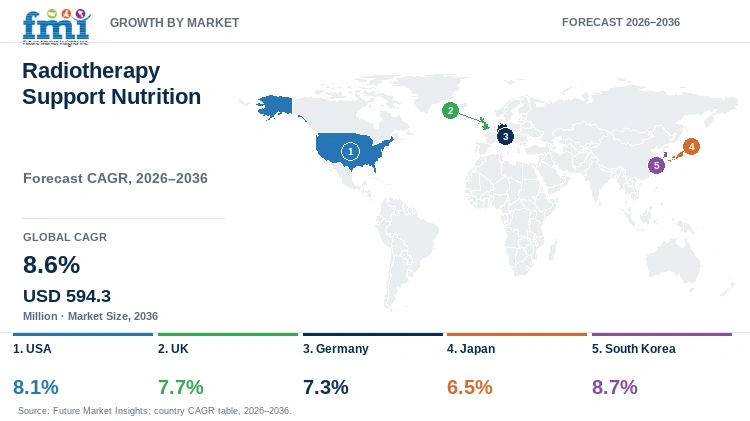
| Country | CAGR |
|---|---|
| USA | 8.1% |
| UK | 7.7% |
| Germany | 7.3% |
| Japan | 6.5% |
| South Korea | 8.7% |
How do country-level CAGRs compare in the Radiotherapy Support Nutrition Market?
South Korea has the highest profiled growth rate at 8.7% CAGR from 2026 to 2036, followed by the USA at 8.1%. The UK is forecast at 7.7%, Germany at 7.3%, and Japan at 6.5%. The 2.2 percentage-point gap between South Korea and Japan does not mean the markets operate in the same way. Each country has a different mix of cancer-center care, nutrition guidance, reimbursement, rehabilitation practices, and post-discharge supply. These differences shape how quickly a clinical nutrition need turns into regular product use.
- South Korea: Cancer-center nutrition services and continued investment in advanced radiotherapy infrastructure support closer integration between treatment and nutrition care.
- USA: Large clinical nutrition channels coexist with detailed coverage requirements once patients move from oral supplementation to qualifying enteral feeding.
- UK: Dietitian-led NHS pathways support structured nutrition intervention during and after radiotherapy.
- Germany: Updated oncology nutrition guidance strengthens the case for coordinated nutritional care across treatment settings.
- Japan: Rehabilitation, swallowing support, food texture, and sensory acceptance influence product selection over a potentially lengthy recovery period.
Country-wise Analysis
- USA: Demand for Radiotherapy Support Nutrition in the USA is forecast to increase at 8.1% CAGR from 2026 to 2036. Cancer centers can initiate oral supplementation while patients are still receiving radiation, but the commercial path changes if inadequate intake requires enteral feeding. Medicare compliance requirements make medical-necessity documentation and accurate ordering important where enteral nutrition is reimbursed. Suppliers participating in the USA oral clinical nutrition supplement market can benefit from established institutional and outpatient replenishment channels when they maintain continuity as feeding routes change.
- UK: Demand is projected to expand at 7.7% CAGR from 2026 to 2036. NHS pathways give dietitians an active role during radiation treatment rather than waiting for severe weight loss to develop. Head and neck radiotherapy pathways use nutrition supplements and tube feeding when oral intake becomes inadequate, with support able to continue after radiotherapy. The commercial requirement is therefore a product that fits clinical pathways during treatment and remains practical when patients return home.
- Germany: Radiotherapy Support Nutrition demand in Germany is forecast to grow at 7.3% CAGR from 2026 to 2036. Updated oncology nutrition guidance emphasizes prevention of undernutrition and coordinated care across the disease course. This strengthens the operating environment for systematic nutrition assessment. Suppliers must translate that clinical structure into products suitable for oral and enteral use while keeping formulation claims aligned with their clinical role.
- Japan: Demand is estimated to increase at 6.5% CAGR from 2026 to 2036. Nutrition support is closely connected with rehabilitation where oral cancer treatment affects eating and swallowing. Multidisciplinary care can involve dietitians and swallowing specialists, while persistent dry mouth and taste change can complicate recovery. Compact volume, manageable texture, and sensory acceptability therefore matter alongside nutrient density.
- South Korea: The market is projected to expand at 8.7% CAGR from 2026 to 2036, the highest rate among the five profiled countries. Cancer-center services provide individualized clinical nutrition and multidisciplinary support when patients cannot eat adequately. Continued investment in radiotherapy delivery infrastructure increases the number of treatment settings in which nutrition deterioration can be recognized and managed. Commercial growth depends on embedding nutrition assessment into treatment pathways and maintaining access after discharge.
Who are the notable companies in the Radiotherapy Support Nutrition Market?
Nestlé Health Science, Danone Nutricia, Abbott, Fresenius Kabi, Lyons Health Labs, Medtrition, Victus, and B. Braun are notable companies in the Radiotherapy Support Nutrition Market.
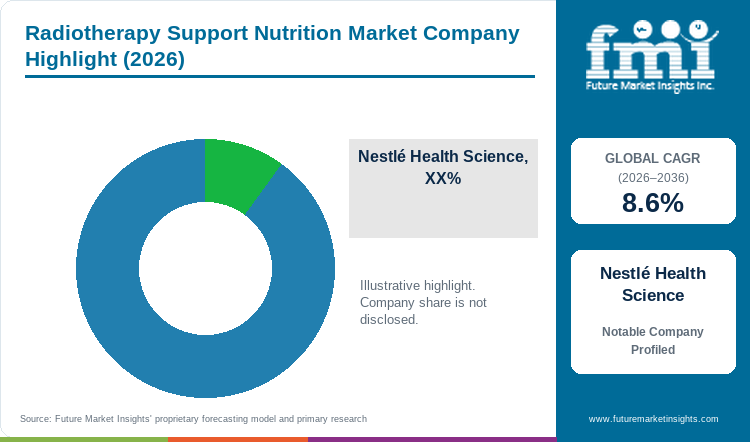
Competition looks different depending on where the patient is in the nutrition pathway. Large medical nutrition companies can cover both concentrated oral products and enteral feeding. Smaller specialists can compete more narrowly through compact protein formats, altered textures, dysphagia-focused products, or nutrition designed for particular clinical needs. The strongest position depends less on company size than on whether the product fits the problem a cancer center is trying to solve.
- Broad specialized-nutrition platforms: Nestlé Health Science, Danone Nutricia, and Abbott combine extensive medical nutrition portfolios with hospital and homecare channels.
- Clinical enteral specialists: Fresenius Kabi and B. Braun support feeding-route escalation through clinical nutrition portfolios designed for institutional use.
- Focused nutrition suppliers: Lyons Health Labs, Medtrition, and Victus compete around concentrated protein, dysphagia support, gastrointestinal tolerance, and other specific nutrition tasks.
Competitive Benchmarking: Radiotherapy Support Nutrition Market
| Company | High-Protein / Calorie-Dense Oral Support | Escalation-Path Coverage | Care-Setting Continuity | Geographic Reach |
|---|---|---|---|---|
| Nestlé Health Science | High | Medium | High | Global; broad medical-nutrition presence |
| Danone Nutricia | High | High | High | Global; strong Europe and North America |
| Abbott | High | High | High | Global; institutional and consumer nutrition channels |
| Fresenius Kabi | High | High | High | Global; strong European and clinical-nutrition reach |
| Lyons Health Labs | High | High | Medium | Primarily North America through institutional and direct channels |
| Medtrition | High | High | Medium | USA plus documented use in more than 50 countries |
| Victus | Medium | Medium | Medium | USA direct channel with selected specialized products |
| B. Braun | High | High | Medium | Global clinical-nutrition presence |
High-Protein / Calorie-Dense Oral Support measures availability of concentrated medically supervised oral nutrition. Escalation-Path Coverage considers whether a supplier can address more than one step as intake worsens, including sip feeding, tube feeding, or swallowing-adapted formats. Care-Setting Continuity considers access across institutional channels and later replenishment settings. High indicates broad capability within the benchmark dimension, while Medium indicates credible but narrower coverage.
Key Developments in the Radiotherapy Support Nutrition Market
- In July 2025, Danone completed its acquisition of a majority stake in Kate Farms, extending its specialized nutrition presence across hospital, home, online, and retail settings.
- In March 2025, Medtrition launched ProSource Cup and ProSource Cup Plant, providing 20 g of complete protein in compact formats intended for oral and tube-fed patients.
- In June 2026, B. Braun updated its catalog listing for Nutricomp Drink 2.0 kcals fibre, a high-energy medical nutrition product for disease-related malnutrition.
Key Players in the Radiotherapy Support Nutrition Market
Broad Specialized Nutrition Platforms
- Nestlé Health Science
- Danone Nutricia
- Abbott
Clinical Enteral and Feeding-Route Specialists
- Fresenius Kabi
- B. Braun
Concentrated and Symptom-Adapted Nutrition Specialists
- Lyons Health Labs
- Medtrition
- Victus
Radiotherapy Support Nutrition Market - Report Scope
| Coverage field | Report scope |
|---|---|
| Market breakdown | Product Type; Radiation Site; Phase; End User; Sales Channel; Region |
| Quantitative Units | USD Million |
| Market Definition | Revenue from commercially sold nutrition products used to support patients during or after radiotherapy, including eligible oral nutrition supplements, mucosal-support formulations, enteral tube feeds, and texture-adapted products. |
| Product Boundary | Covers nutrition products directly used to manage radiotherapy-related nutritional requirements. Parenteral nutrition, oncology drugs, feeding devices, and unrelated general nutrition products are outside the market definition. |
| Regions Covered | North America; Latin America; Western Europe; Eastern Europe; East Asia; South Asia and Pacific; Middle East and Africa |
| Countries Covered | USA, UK, Germany, Japan, South Korea, and additional countries covered in the full market assessment |
| Key Companies Profiled | Nestlé Health Science; Danone Nutricia; Abbott; Fresenius Kabi; Lyons Health Labs; Medtrition; Victus; B. Braun |
| Forecast Period | 2026 to 2036 |
Radiotherapy Support Nutrition Market - Research Methodology
| Method | Approach |
|---|---|
| Primary Research | Discussions with medical nutrition manufacturers, distributors, oncology dietitians, hospital procurement teams, cancer-care stakeholders, and industry specialists support assessment of purchasing triggers, treatment pathways, product substitution, and channel behavior. |
| Desk Research | Analysis covers clinical guidance, payer information, cancer-center materials, company documentation, regulatory information, and dated corporate developments relevant to nutrition support during radiotherapy. |
| Market Sizing and Forecasting | Market sizing evaluates product demand across radiotherapy-related nutritional needs, product mix, treatment phase, care setting, feeding route, channel conditions, and country adoption. |
| Data Validation | Market findings are compared across clinical use, product availability, treatment pathways, country conditions, and commercial channels to maintain consistency with the defined market scope. |
Radiotherapy Support Nutrition Market by Segments
Radiotherapy Support Nutrition Market segmented by Product Type:
- High-Protein ONS
- Glutamine & Mucosal-Support Blends
- Enteral Tube Feeds (Head & Neck)
- Soothing Texture-Adapted Products
- Others
Radiotherapy Support Nutrition Market segmented by Radiation Site:
- Head & Neck
- GI / Pelvic
- Thoracic
- Others
Radiotherapy Support Nutrition Market segmented by Phase:
- During Treatment
- Early Recovery (0-3 Months)
- Late Recovery
Radiotherapy Support Nutrition Market segmented by End User:
- Cancer Centers
- Hospitals
- Homecare
- Others
Radiotherapy Support Nutrition Market segmented by Sales Channel:
- Hospital Pharmacy
- Retail Pharmacy
- Online
- Institutional Tender
- Others
Radiotherapy Support Nutrition Market by Region:
- North America
- United States
- Canada
- Latin America
- Brazil
- Mexico
- Argentina
- Chile
- Western Europe
- Germany
- France
- United Kingdom
- Italy
- Spain
- Benelux
- Nordics
- Eastern Europe
- Poland
- Czech Republic
- Romania
- Hungary
- East Asia
- China
- Japan
- South Korea
- South Asia and Pacific
- India
- ASEAN
- Australia and New Zealand
- Middle East and Africa
- GCC Countries
- South Africa
- Türkiye
- Israel
Research Sources and Bibliography
- European Society for Clinical Nutrition and Metabolism (2021, May). ESPEN practical guideline: Clinical Nutrition in cancer.
- Centers for Medicare & Medicaid Services (2026, February 11). Enteral Nutrition.
- Leeds Teaching Hospitals NHS Trust (2025, June 4). Radiotherapy treatment for Head & Neck cancer - Tube feeding options.
- Arbeitsgemeinschaft der Wissenschaftlichen Medizinischen Fachgesellschaften (2026, February 19). Klinische Ernährung in der Onkologie.
- National Cancer Center Japan (2025, May 9). [Living with oral cancer].
- National Cancer Center Korea (2026, September 1). [Clinical Nutrition Room], accessed September 1, 2026.
- National Cancer Center Korea (2025, August 12). [NCC implements SGRT across radiotherapy rooms].
- Nestle Health Science (2024, February 2). My Cancer, My Nutrition Provides Support Through Credible Information for People Living with Cancer.
- Danone (2025, July 1). Danone completes the acquisition of Kate Farms, enhancing its U.S. specialized nutrition offerings.
- Abbott Nutrition (2026, September 1). Ensure Plus High Protein Therapeutic Nutrition Shake, accessed September 1, 2026.
- Fresenius Kabi (2026, September 1). Fresubin Onco, accessed September 1, 2026.
- Lyons Magnus (2024, October 23). Lyons Magnus Establishes Lyons Health Labs with Addition of Hormel Health Labs.
- Medtrition (2025, March 25). Medtrition, Inc. Launches the ProSource Cup Portfolio.
- Victus (2026, September 1). Glutapak-10, accessed September 1, 2026.
- B. Braun (2026, June 3). Nutricomp Drink 2.0 kcals fibre.
This bibliography is provided for reader reference and is not exhaustive. The full report contains the complete reference list and detailed citations.
This Report Answers
- What is the Radiotherapy Support Nutrition Market size in 2026 and what value is forecast for 2036?
- Which radiotherapy-related clinical pressures support demand for nutrition intervention during treatment?
- Why does High-Protein ONS hold the leading position in Product Type?
- How does Head & Neck radiotherapy influence demand for oral, texture-adapted, and enteral nutrition?
- Why does During Treatment hold the leading position within Phase?
- How do growth rates differ across USA, UK, Germany, Japan, and South Korea from 2026 to 2036?
- Which product and channel roles do major radiotherapy support nutrition companies occupy?
- What clinical, tolerance, and reimbursement frictions can limit adoption?
Frequently Asked Questions
How big is the Radiotherapy Support Nutrition Market in 2026?
The market is estimated at USD 260.4 million in 2026 and is forecast to reach USD 594.3 million by 2036.
What is the CAGR of the Radiotherapy Support Nutrition Market?
The market is projected to expand at 8.6% CAGR from 2026 to 2036.
Which Product Type leads the Radiotherapy Support Nutrition Market?
High-Protein ONS is expected to lead Product Type with 40.6% share in 2026, supported by its role when patients need concentrated nutrition but remain able to consume products orally.
Which Radiation Site accounts for the largest share?
Head & Neck is projected to account for 41.7% of Radiation Site demand in 2026 because treatment can directly affect swallowing, taste, oral comfort, and meal volume.
Which country has the highest profiled CAGR?
South Korea has the highest profiled CAGR at 8.7% from 2026 to 2036, followed by the USA at 8.1%.
Who are the key players in the Radiotherapy Support Nutrition Market?
Notable companies include Nestlé Health Science, Danone Nutricia, Abbott, Fresenius Kabi, Lyons Health Labs, Medtrition, Victus, and B. Braun.
Preview the report firsthand - request a free sample
Get SampleGet the brochure for pricing and purchase details.
Get PDFTable of Content
- Key Takeaways
- Market Size and CAGR
- Top Growth Driver
- Fastest Growing Segment
- Leading Region
- Key Companies
- Emerging Opportunities
- Executive Summary
- Global Market Outlook
- Demand-side Trends
- Supply-side Trends
- Technology Roadmap Analysis
- Analysis and Recommendations
- Analyst Perspective (What is happening? Why now? What should investors know?)
- Key Questions Answered
- How large is the market?
- What is the CAGR?
- What are key trends?
- Which region dominates?
- Who are the leaders?
- Market Overview
- Market Coverage / Taxonomy
- Market Definition / Scope / Limitations
- Research Methodology
- Chapter Orientation
- Analytical Lens and Working Hypotheses
- Market Structure, Signals, and Trend Drivers
- Benchmarking and Cross-market Comparability
- Market Sizing, Forecasting, and Opportunity Mapping
- Research Design and Evidence Framework
- Desk Research Programme (Secondary Evidence)
- Expert Input and Fieldwork (Primary Evidence)
- Tooling, Models, and Reference Databases
- Data Engineering and Model Build
- Quality Assurance and Audit Trail
- Market Background
- Market Dynamics (Drivers, Restraints, Opportunity, Trends)
- Scenario Forecast (Optimistic, Likely, Conservative)
- Impact Analysis
- AI Impact
- Sustainability Impact
- Regulatory Impact
- Technology Impact
- Consumer / Buyer Analysis
- Purchase Drivers
- Adoption Barriers
- Buyer Journey
- Opportunity Map Analysis
- Product Life Cycle Analysis
- Supply Chain Analysis
- Investment Feasibility Matrix
- Value Chain Analysis
- PESTLE and Porter's Analysis
- Regulatory Landscape
- Regional Parent Market Outlook
- Production and Consumption Statistics
- Import and Export Statistics
- Global Market Analysis and Forecast, 2021 to 2036
- Historical Market Size Value (USD Million) Analysis, 2021 to 2025
- Current and Future Market Size Value (USD Million) Projections, 2026 to 2036
- Y-o-Y Growth Trend Analysis
- Absolute $ Opportunity Analysis
- Global Market Pricing Analysis, 2021 to 2036
- Global Market Analysis and Forecast, By Product Type, 2021 to 2036
- Introduction / Key Findings
- Historical Market Size Value (USD Million) Analysis By Product Type, 2021 to 2025
- Current and Future Market Size Value (USD Million) Analysis and Forecast By Product Type, 2026 to 2036
- High-Protein ONS
- Glutamine & Mucosal-Support Blends
- Enteral Tube Feeds (Head & Neck)
- Soothing Texture-Adapted Products
- Others
- Y-o-Y Growth Trend Analysis By Product Type, 2021 to 2025
- Absolute $ Opportunity Analysis By Product Type, 2026 to 2036
- Global Market Analysis and Forecast, By Radiation Site, 2021 to 2036
- Introduction / Key Findings
- Historical Market Size Value (USD Million) Analysis By Radiation Site, 2021 to 2025
- Current and Future Market Size Value (USD Million) Analysis and Forecast By Radiation Site, 2026 to 2036
- Head & Neck
- GI / Pelvic
- Thoracic
- Others
- Y-o-Y Growth Trend Analysis By Radiation Site, 2021 to 2025
- Absolute $ Opportunity Analysis By Radiation Site, 2026 to 2036
- Global Market Analysis and Forecast, By Phase, 2021 to 2036
- Introduction / Key Findings
- Historical Market Size Value (USD Million) Analysis By Phase, 2021 to 2025
- Current and Future Market Size Value (USD Million) Analysis and Forecast By Phase, 2026 to 2036
- During Treatment
- Early Recovery (0-3 Months)
- Late Recovery
- Y-o-Y Growth Trend Analysis By Phase, 2021 to 2025
- Absolute $ Opportunity Analysis By Phase, 2026 to 2036
- Global Market Analysis and Forecast, By End User, 2021 to 2036
- Introduction / Key Findings
- Historical Market Size Value (USD Million) Analysis By End User, 2021 to 2025
- Current and Future Market Size Value (USD Million) Analysis and Forecast By End User, 2026 to 2036
- Cancer Centers
- Hospitals
- Homecare
- Others
- Y-o-Y Growth Trend Analysis By End User, 2021 to 2025
- Absolute $ Opportunity Analysis By End User, 2026 to 2036
- Global Market Analysis and Forecast, By Sales Channel, 2021 to 2036
- Introduction / Key Findings
- Historical Market Size Value (USD Million) Analysis By Sales Channel, 2021 to 2025
- Current and Future Market Size Value (USD Million) Analysis and Forecast By Sales Channel, 2026 to 2036
- Hospital Pharmacy
- Retail Pharmacy
- Online
- Institutional Tender
- Others
- Y-o-Y Growth Trend Analysis By Sales Channel, 2021 to 2025
- Absolute $ Opportunity Analysis By Sales Channel, 2026 to 2036
- Global Market Analysis and Forecast, By Region, 2021 to 2036
- Introduction
- Historical Market Size Value (USD Million) Analysis By Region, 2021 to 2025
- Current Market Size Value (USD Million) Analysis and Forecast By Region, 2026 to 2036
- North America
- Latin America
- Western Europe
- Eastern Europe
- East Asia
- South Asia and Pacific
- Middle East and Africa
- Market Attractiveness Analysis By Region
- North America Market Analysis and Forecast, By Country, 2021 to 2036
- Historical Market Size Value (USD Million) Trend Analysis By Market Taxonomy, 2021 to 2025
- Market Size Value (USD Million) Forecast By Market Taxonomy, 2026 to 2036
- By Country
- United States
- Canada
- By Product Type
- By Radiation Site
- By Phase
- By End User
- By Sales Channel
- By Country
- Market Attractiveness Analysis
- By Country
- By Product Type
- By Radiation Site
- By Phase
- By End User
- By Sales Channel
- Key Takeaways
- Latin America Market Analysis and Forecast, By Country
- Historical Market Size Value (USD Million) Trend Analysis By Market Taxonomy, 2021 to 2025
- Market Size Value (USD Million) Forecast By Market Taxonomy, 2026 to 2036
- By Country
- Brazil
- Mexico
- Argentina
- Chile
- By Product Type
- By Radiation Site
- By Phase
- By End User
- By Sales Channel
- By Country
- Market Attractiveness Analysis
- By Country
- By Product Type
- By Radiation Site
- By Phase
- By End User
- By Sales Channel
- Key Takeaways
- Western Europe Market Analysis and Forecast, By Country
- Historical Market Size Value (USD Million) Trend Analysis By Market Taxonomy, 2021 to 2025
- Market Size Value (USD Million) Forecast By Market Taxonomy, 2026 to 2036
- By Country
- Germany
- France
- United Kingdom
- Italy
- Spain
- Benelux
- Nordics
- By Product Type
- By Radiation Site
- By Phase
- By End User
- By Sales Channel
- By Country
- Market Attractiveness Analysis
- By Country
- By Product Type
- By Radiation Site
- By Phase
- By End User
- By Sales Channel
- Key Takeaways
- Eastern Europe Market Analysis and Forecast, By Country
- Historical Market Size Value (USD Million) Trend Analysis By Market Taxonomy, 2021 to 2025
- Market Size Value (USD Million) Forecast By Market Taxonomy, 2026 to 2036
- By Country
- Poland
- Czech Republic
- Romania
- Hungary
- By Product Type
- By Radiation Site
- By Phase
- By End User
- By Sales Channel
- By Country
- Market Attractiveness Analysis
- By Country
- By Product Type
- By Radiation Site
- By Phase
- By End User
- By Sales Channel
- Key Takeaways
- East Asia Market Analysis and Forecast, By Country
- Historical Market Size Value (USD Million) Trend Analysis By Market Taxonomy, 2021 to 2025
- Market Size Value (USD Million) Forecast By Market Taxonomy, 2026 to 2036
- By Country
- China
- Japan
- South Korea
- By Product Type
- By Radiation Site
- By Phase
- By End User
- By Sales Channel
- By Country
- Market Attractiveness Analysis
- By Country
- By Product Type
- By Radiation Site
- By Phase
- By End User
- By Sales Channel
- Key Takeaways
- South Asia and Pacific Market Analysis and Forecast, By Country
- Historical Market Size Value (USD Million) Trend Analysis By Market Taxonomy, 2021 to 2025
- Market Size Value (USD Million) Forecast By Market Taxonomy, 2026 to 2036
- By Country
- India
- ASEAN
- Australia and New Zealand
- By Product Type
- By Radiation Site
- By Phase
- By End User
- By Sales Channel
- By Country
- Market Attractiveness Analysis
- By Country
- By Product Type
- By Radiation Site
- By Phase
- By End User
- By Sales Channel
- Key Takeaways
- Middle East and Africa Market Analysis and Forecast, By Country
- Historical Market Size Value (USD Million) Trend Analysis By Market Taxonomy, 2021 to 2025
- Market Size Value (USD Million) Forecast By Market Taxonomy, 2026 to 2036
- By Country
- GCC Countries
- South Africa
- Türkiye
- Israel
- By Product Type
- By Radiation Site
- By Phase
- By End User
- By Sales Channel
- By Country
- Market Attractiveness Analysis
- By Country
- By Product Type
- By Radiation Site
- By Phase
- By End User
- By Sales Channel
- Key Takeaways
- Key Countries Market Analysis
- United States
- Pricing Analysis
- Market Share Analysis, 2025
- By Product Type
- By Radiation Site
- By Phase
- By End User
- By Sales Channel
- Canada
- Pricing Analysis
- Market Share Analysis, 2025
- By Product Type
- By Radiation Site
- By Phase
- By End User
- By Sales Channel
- Mexico
- Pricing Analysis
- Market Share Analysis, 2025
- By Product Type
- By Radiation Site
- By Phase
- By End User
- By Sales Channel
- Brazil
- Pricing Analysis
- Market Share Analysis, 2025
- By Product Type
- By Radiation Site
- By Phase
- By End User
- By Sales Channel
- Chile
- Pricing Analysis
- Market Share Analysis, 2025
- By Product Type
- By Radiation Site
- By Phase
- By End User
- By Sales Channel
- Germany
- Pricing Analysis
- Market Share Analysis, 2025
- By Product Type
- By Radiation Site
- By Phase
- By End User
- By Sales Channel
- United Kingdom
- Pricing Analysis
- Market Share Analysis, 2025
- By Product Type
- By Radiation Site
- By Phase
- By End User
- By Sales Channel
- Italy
- Pricing Analysis
- Market Share Analysis, 2025
- By Product Type
- By Radiation Site
- By Phase
- By End User
- By Sales Channel
- Spain
- Pricing Analysis
- Market Share Analysis, 2025
- By Product Type
- By Radiation Site
- By Phase
- By End User
- By Sales Channel
- France
- Pricing Analysis
- Market Share Analysis, 2025
- By Product Type
- By Radiation Site
- By Phase
- By End User
- By Sales Channel
- India
- Pricing Analysis
- Market Share Analysis, 2025
- By Product Type
- By Radiation Site
- By Phase
- By End User
- By Sales Channel
- ASEAN
- Pricing Analysis
- Market Share Analysis, 2025
- By Product Type
- By Radiation Site
- By Phase
- By End User
- By Sales Channel
- Australia and New Zealand
- Pricing Analysis
- Market Share Analysis, 2025
- By Product Type
- By Radiation Site
- By Phase
- By End User
- By Sales Channel
- China
- Pricing Analysis
- Market Share Analysis, 2025
- By Product Type
- By Radiation Site
- By Phase
- By End User
- By Sales Channel
- Japan
- Pricing Analysis
- Market Share Analysis, 2025
- By Product Type
- By Radiation Site
- By Phase
- By End User
- By Sales Channel
- South Korea
- Pricing Analysis
- Market Share Analysis, 2025
- By Product Type
- By Radiation Site
- By Phase
- By End User
- By Sales Channel
- Poland
- Pricing Analysis
- Market Share Analysis, 2025
- By Product Type
- By Radiation Site
- By Phase
- By End User
- By Sales Channel
- Hungary
- Pricing Analysis
- Market Share Analysis, 2025
- By Product Type
- By Radiation Site
- By Phase
- By End User
- By Sales Channel
- Türkiye
- Pricing Analysis
- Market Share Analysis, 2025
- By Product Type
- By Radiation Site
- By Phase
- By End User
- By Sales Channel
- South Africa
- Pricing Analysis
- Market Share Analysis, 2025
- By Product Type
- By Radiation Site
- By Phase
- By End User
- By Sales Channel
- United States
- Market Structure Analysis
- Competition Dashboard
- Competition Benchmarking
- Market Share Analysis of Top Players
- By Regional
- By Product Type
- By Radiation Site
- By Phase
- By End User
- By Sales Channel
- Emerging Startups
- Innovation Benchmarking
- Competition Analysis
- Competition Deep Dive
- Nestlé Health Science
- Overview
- Product Portfolio
- Profitability by Market Segments
- Sales Footprint
- Strategy Overview
- Marketing Strategy
- Product Strategy
- Channel Strategy
- Danone Nutricia
- Abbott
- Fresenius Kabi
- Lyons Health Labs
- Medtrition
- Victus
- B. Braun
- Nestlé Health Science
- Case Studies
- Success Stories
- Recent Developments
- Competition Deep Dive
- Assumptions & Acronyms Used


