

- Market Size (2026)
- USD 930.9 Mn
- Forecast (2036)
- USD 1831.2 Mn
- CAGR (2026 to 2036)
- 7.0%
How big is the recycled PET glycolysis catalysts market in 2026?
USD 930.9 million in 2026 and USD 1,831.2 million by 2036 at a 7.0% CAGR.
The recycled PET glycolysis catalysts industry value is forecast to grow from USD 870.0 million in 2025 to USD 1,831.2 million by 2036 at 7.0% CAGR as PET waste processors shift toward chemical depolymerization routes that recover higher-value intermediates from bottles, films, and polyester-rich textiles. Packaging is forecast to represent 44.0% share in 2026 because food and beverage converters need stronger purity control for recycled PET feedstock. Process aid is expected to secure 41.0% share in 2026, led by buyer focus on conversion yield, catalyst reuse, and residue reduction.
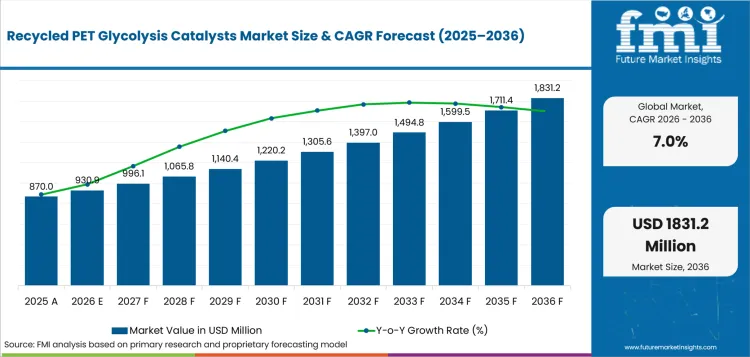
Recycled PET Glycolysis Catalysts Market Overview: Size and Forecast
- 2025 Market Size: USD 870.0 million
- 2026 Market Size: USD 930.9 million
- 2036 Market Size: USD 1,831.2 million
- Forecast CAGR: 7.0% from 2026 to 2036
- Leading End-use Industry: Packaging
- Packaging Share in 2026: 44.0%
- Leading Function: Process Aid
- Process Aid Share in 2026: 41.0%
- Fastest-growing Country: India
- India CAGR: 8.4% by 2036
Summary of the Recycled PET Glycolysis Catalysts Market
- Demand and Growth Drivers
- PET recyclers are using glycolysis routes to recover value from bottle flake, colored PET, trays, and polyester textile waste.
- Packaging buyers are giving more attention to catalyst systems that support cleaner intermediates and stronger recycled-content records.
- Chemical recyclers are qualifying process aids that improve conversion yield and reduce purification pressure.
- Product and Segment View
- Packaging is projected to lead End-use Industry with 44.0% share in 2026 as bottle-grade recycled PET requires cleaner intermediates.
- Process aid is expected to lead Function with 41.0% share in 2026 as plant economics depend on conversion yield and residue control.
- Recycled chemistry is anticipated to secure 38.0% share in 2026 as recoverable catalyst loops help lower reagent loss and wastewater burden.
- Geography and Competitive Outlook
- India is projected to record 8.4% CAGR through 2036 as EPR registration creates a larger formal processor network.
- China is expected to grow at 8.1% CAGR through 2036 with scale advantages in PET and polyester feedstock aggregation.
- BASF, Mitsubishi Chemical Group and LANXESS compete through catalyst know-how, chemical supply depth and polymer customer access.
- Eastman, Loop Industries and Ioniqa influence buyer expectations through chemical recycling process routes and scale-up learning.
- Analyst Opinion
- Nikhil Kaitwade, Associate Vice President for Chemicals and Materials at FMI, observes, “Recycled PET glycolysis catalysts are no longer evaluated as commodity additives. Buyers want repeatable depolymerization, cleaner BHET output, lower impurity carryover, and practical evidence that catalyst residues do not create downstream resin issues. The winning suppliers will be those that combine chemistry, pilot testing, residue analytics, and recovery economics into one qualification package.”
Quality control is the main pressure point as catalyst buyers move from lab-scale depolymerization claims toward plant-level proof. The European Commission stated in July 2025 that PET beverage bottles need 25.0% recycled plastic from 2025 and 30.0% recycled plastic for all single-use beverage bottles from 2030. OECD reported in 2026 that at least 16,325 chemicals may be used or present in plastics, including more than 4,200 chemicals of concern. Eastman’s Kingsport molecular recycling facility has capacity to recycle 110,000 metric tons annually, giving catalyst suppliers a stronger scale reference for PET and polyester recovery.
Which factors support expansion in the recycled PET glycolysis catalysts market?
Catalyst performance, recovered PET purity, and verified chemical-recycling output support market value across packaging, textile, and industrial recycling routes.
- Market value is supported by catalyst demand from PET depolymerization systems that convert waste streams into reusable intermediates.
- Supplier pricing improves when catalyst systems reduce reaction time and lower downstream purification cost for recycled PET producers.
- Revenue strengthens as packaging converters demand traceable recycled PET streams with lower residue risk and stronger food-contact readiness.
- Technical service becomes more valuable when suppliers help recyclers test feedstock variability, catalyst reuse, and final monomer quality.
Why is the recycled PET glycolysis catalysts market growing?
Packaging and polyester recovery needs are moving catalyst demand toward high-purity chemical recycling systems with stronger process documentation.
The market is growing because mechanical recycling cannot address every contaminated, colored, multilayer, or textile-linked PET stream. Glycolysis gives recyclers a route to recover monomer-grade or intermediate-grade material from feedstocks that lose value under washing and melt filtration. The European Commission confirmed that separate collection targets require 77.0% of single-use plastic bottles to be collected by 2025 and 90.0% by 2029. This policy pressure supports catalyst demand because collected PET must still be upgraded, purified, and verified before it can move into packaging, textile, and industrial polymer applications.
How is the recycled PET glycolysis catalysts market segmented?
The recycled PET glycolysis catalysts industry is segmented by chemistry type, function, application, end-use industry, and catalyst format.
- Recycled chemistry is projected to secure 38.0% share in 2026, led by recoverable catalyst systems that help PET recyclers lower reagent losses and improve cost visibility across repeated glycolysis batches.
- Process aid products are anticipated to hold 41.0% share in 2026, supported by buyer preference for catalyst packages that shorten reaction cycles, stabilize BHET recovery, and reduce residue-related purification steps.
- Textiles are expected to capture 34.0% share in 2026 due to polyester-rich garments and blended fabric streams that require chemical routes when mechanical recycling delivers lower-quality output.
- Packaging is forecast to represent 44.0% share in 2026, guided by beverage, food, and consumer goods converters seeking recycled PET with stronger purity, traceability, and polymer-performance assurance.
- Solid recoverable catalysts are projected to account for 32.5% share in 2026, reflected by operator interest in reuse cycles, easier separation, and lower wastewater treatment exposure.
Why does recycled chemistry dominate the recycled PET glycolysis catalysts market?
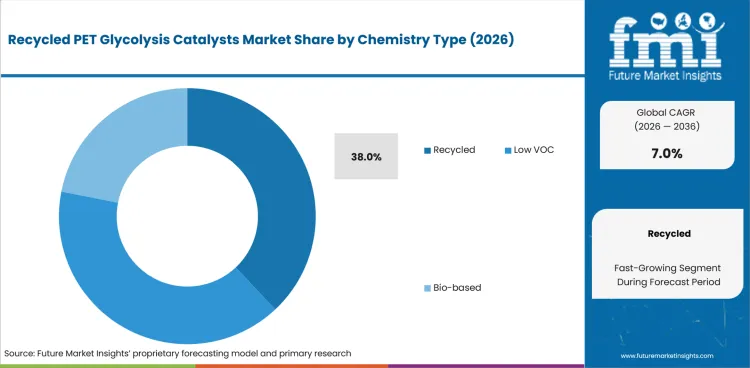
Recycled chemistry is projected to account for 38.0% share in 2026, influenced by catalyst recovery needs and buyer preference for systems that reduce reagent loss during repeated PET depolymerization.
Bio-based catalyst concepts gain research attention, while industrial users still prioritize conversion yield, residue control, and compatibility with commercial glycolysis reactors.
Which function leads the recycled PET glycolysis catalysts market?
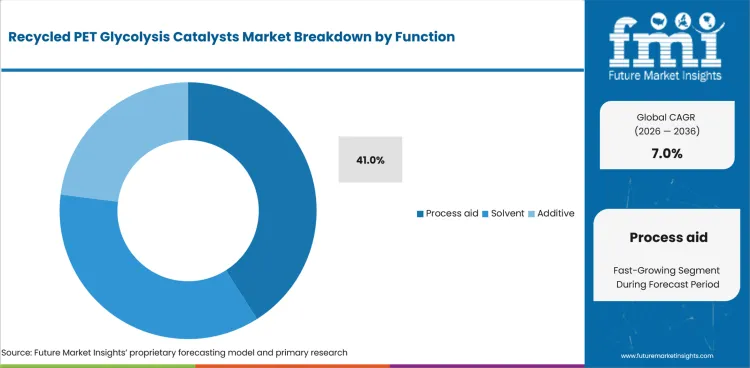
- Process aid is anticipated to hold 41.0% share in 2026 through reaction support, BHET yield improvement, and lower purification pressure across waste PET streams.
- Solvent functions remain relevant where glycol-assisted process design requires controlled dissolution, heat transfer, and reaction consistency in recycled PET systems.
Which application leads the recycled PET glycolysis catalysts market?
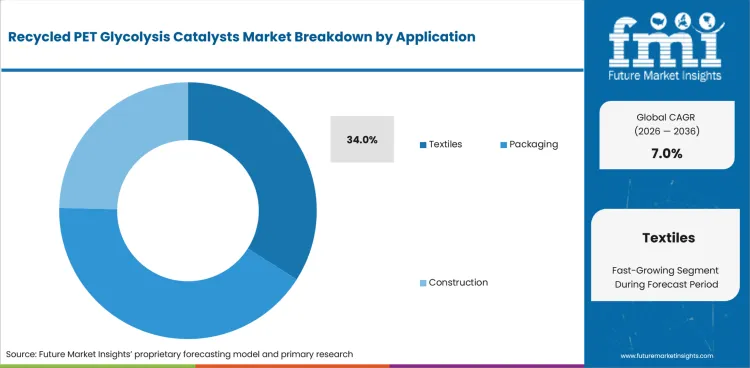
- Textiles are forecast to secure 34.0% share in 2026, supported by polyester apparel waste and fabric blends that require selective depolymerization beyond standard flake extrusion.
- Packaging applications gain value where bottle-grade output requires careful catalyst selection, impurity tracking, and chain-of-custody evidence before converter qualification.
Which end-use industry leads the recycled PET glycolysis catalysts market?
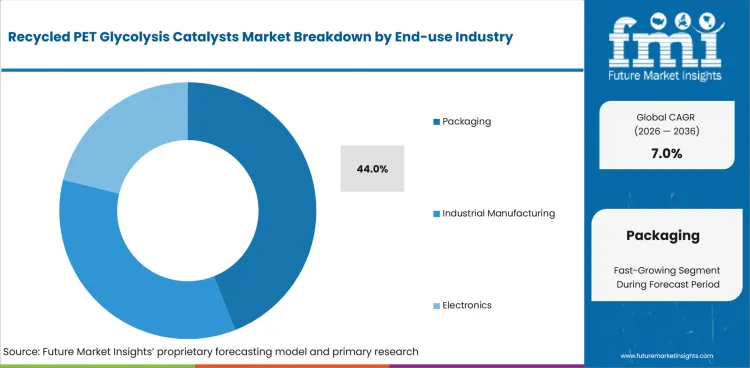
- Packaging is expected to represent 44.0% share in 2026, shaped by food and beverage users seeking high-purity recycled PET for bottle and container applications.
- Industrial manufacturing creates added demand where PET scrap from components, films, and specialty materials needs chemical recovery before reuse.
Which catalyst format leads the recycled PET glycolysis catalysts market?
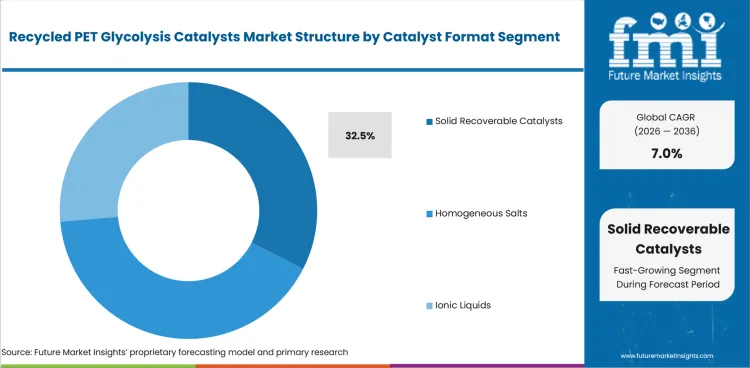
- Solid recoverable catalysts are projected to account for 32.5% share in 2026, led by easier catalyst separation and reuse economics across continuous or semi-continuous recycling lines.
- Homogeneous salts remain widely used in development work because they offer simple dosing, although separation and residue management can limit premium commercial adoption.
What are the drivers, restraints, and opportunities in the recycled PET glycolysis catalysts market?
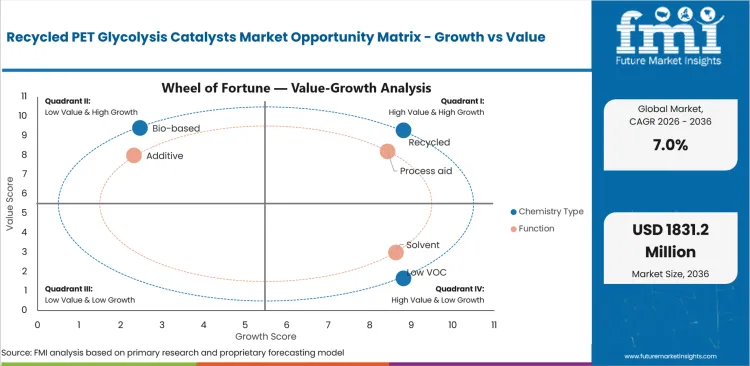
Recycled-content rules and polymer purity needs support demand while feedstock inconsistency and residue validation restrict faster qualification.
- Packaging converters and polyester processors need catalyst systems that raise recycled PET purity beyond mechanical recovery, especially when brand owners require higher-quality circular feedstock.
- Feedstock contamination increases purification burden and can delay buyer approval because commercial recycled PET output must meet tighter clarity, color, and contaminant expectations.
- Catalyst suppliers can create value through recoverable systems, residue testing, and plant-level support that helps recyclers move from pilot batches to reliable output.
Bottle-Grade Purity Pressure
Bottle-grade recycled PET demand shapes catalyst selection because converters cannot accept high residue risk or inconsistent polymer performance. OECD’s 2026 chemical-content validation report noted that at least 16,325 chemicals are potentially used in or unintentionally present in plastics, including more than 4,200 chemicals of concern. That rule gives recyclers a clearer commercial reason to invest in controlled glycolysis. Catalyst suppliers then face a tighter performance test as buyers ask whether depolymerization products can meet downstream resin requirements.
Feedstock Variability Restricts Plant Qualification
Feedstock inconsistency restrains catalyst adoption because dyes, multilayer materials, adhesives, labels, and textile finishes create unpredictable impurity profiles. Eurostat reported in October 2025 that the EU generated 35.3 kilograms of plastic packaging waste per person in 2023, while only 14.8 kilograms per person were recycled. This gap keeps recyclers focused on sorting loss and recovery efficiency. PET glycolysis operators must prove that catalyst cost, energy use, yield, and purification burden can work together under real waste-stream conditions.
Food-Contact Qualification Opens Catalyst Upside
Bottle-grade recycled PET demand shapes catalyst selection because converters cannot accept high residue risk or inconsistent polymer performance. OECD’s 2026 chemical-content validation report noted that at least 16,325 chemicals are potentially used in or unintentionally present in plastics, including more than 4,200 chemicals of concern. That rule gives recyclers a clearer commercial reason to invest in controlled glycolysis. Catalyst suppliers then face a tighter performance test as buyers ask whether depolymerization products can meet downstream resin requirements.
Which countries are growing fastest in the recycled PET glycolysis catalysts market?
India 8.4% CAGR, China 8.1% CAGR, South Korea 7.8% CAGR, France 7.6% CAGR, Germany 7.4% CAGR, Japan 6.8% CAGR, United States 6.5% CAGR, and United Kingdom 6.3% CAGR through 2036.
.webp "Top Country Growth Comparison Recycled Pet Glycolysis Catalysts Market Cagr (2026 2036)")
| Country | CAGR |
|---|---|
| India | 8.4% |
| China | 8.1% |
| South Korea | 7.8% |
| France | 7.6% |
| Germany | 7.4% |
| Japan | 6.8% |
| United States | 6.5% |
| United Kingdom | 6.3% |
Source: Future Market Insights, 2026.
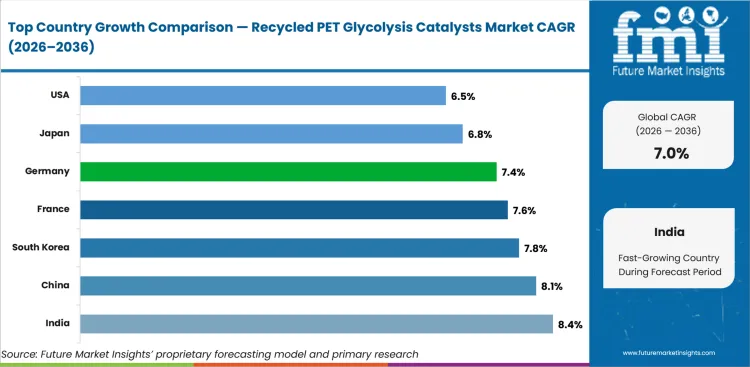
How do country-level CAGRs compare in the recycled PET glycolysis catalysts market?
India leads country growth while the United Kingdom records the most cautious expansion outlook among profiled markets.
- India is forecast to record 8.4% CAGR by 2036 as formal EPR systems and rPET food-contact pathways support catalyst qualification.
- China is forecast to record 8.1% CAGR by 2036 due to polyester processing scale and PET waste aggregation.
- South Korea is forecast to record 7.8% CAGR by 2036 as recycled-content obligations support PET bottle recycling systems.
- France is forecast to record 7.6% CAGR by 2036 with recycled-content policy and plastic packaging recovery gaps supporting chemical recovery.
- Germany is forecast to record 7.4% CAGR by 2036 as EU packaging rules tighten recycler performance expectations.
- Japan is forecast to record 6.8% CAGR by 2036 as high collection discipline supports selective chemical recycling of tougher streams.
- United States is forecast to record 6.5% CAGR by 2036 as large chemical recycling references guide catalyst trials.
- United Kingdom is forecast to record 6.3% CAGR by 2036 through tax-driven recycled-content demand and packaging compliance.
How fast is the recycled PET glycolysis catalysts market growing in India?
A 8.4% CAGR through 2036 reflects fast EPR formalization and growing rPET approval pathways for food-contact packaging across commercial recycling channels.
| Parameter | Value |
|---|---|
| Market Size in 2025 (Value) | USD 99.6 million |
| Market Size in 2026 (Value) | USD 108.0 million |
| Market Forecast in 2036 (Value) | USD 241.9 million |
| CAGR (2026 to 2036) | 8.4% |
| Years Considered | 2021 to 2036 |
| Base Year | 2025 |
| Forecast Period | 2026 to 2036 |
| Units Considered | Value (USD million) |
| Leading Sub-Region | Gujarat and Maharashtra recycling corridors |
India Recycled PET Glycolysis Catalysts Market Outlook
India recycled PET glycolysis catalyst demand is shaped by EPR formalization, rPET food-contact guidance, and expanding processor registration. Catalyst suppliers can benefit as recyclers seek higher-value output from PET packaging and polyester waste.
Packaging converters and approved rPET manufacturers are expected to drive qualification needs. Suppliers with local testing support, residue-control data, and links to recycling processors should gain early advantages.
Key Growth Drivers
- Formal EPR systems are widening the recycler base. India reported 60,128 registered PIBOs and 3,012 registered Plastic Waste Processors on the national EPR portal.
- Food-contact acceptance is improving. FSSAI listed 17 approved food-grade rPET manufacturers as of September 10, 2025, expanding the domestic approval base for packaging-grade recycled PET.
- Packaging converters are creating stronger demand for recycled PET streams with documented quality and process controls.
- Polyester textiles and bottle waste give glycolysis catalyst suppliers multiple feedstock routes beyond mechanical flake recycling.
Key Restraints
- Compliance scale remains demanding. India’s environment ministry reported EPR certificates equivalent to 180.64 lakh tonnes generated by registered Plastic Waste Processors by March 2026.
- Fragmented collection can raise contamination risk and increase catalyst testing needs across local plants.
- Smaller processors may delay higher-cost catalyst packages until buyer qualification creates clear price premiums.
What makes India unique
India is unique due to fast EPR formalization and growing rPET approval pathways for food-contact packaging.
Key Companies
- Reliance Industries Limited
- Ganesha Ecopet Private Limited
- Polygenta Technologies Limited
- Shakti Plastic Industries
- Banyan Nation
- Gravita India Limited
- Loop Industries India JV partners
Sales & Marketing Channels
- Direct sales to registered recyclers
- Packaging converter qualification
- EPR compliance networks
- Specialty chemical distributors
- Polymer producer partnerships
- Engineering contractor support
Country Segment Breakdown Table
| Segment | Sub-Segments |
|---|---|
| By Chemistry Type | Recycled · Bio-based · Low VOC · Halogen Free · Waterborne |
| By Function | Process Aid · Solvent · Additive · Binder · Coating |
| By Application | Textiles · Packaging · Construction · Batteries · Water Treatment |
| By End-use Industry | Packaging · Industrial Manufacturing · Automotive · Electronics · Agriculture |
| By Catalyst Format | Solid Recoverable Catalysts · Homogeneous Salts · Ionic Liquids · Organocatalysts · Supported Metal Catalysts |
| Key Sub-Regions Covered, Packaging and Polyester Corridors | Gujarat · Maharashtra · Delhi NCR · Tamil Nadu · Karnataka · Telangana |
Frequently Asked Questions
How fast is India recycled PET glycolysis catalysts market growing?
Sales in India are ready to scale at 8.4% CAGR from 2026 to 2036, guided by recycled PET qualification.
Who leads India recycled PET glycolysis catalysts market?
Reliance Industries Limited, Ganesha Ecopet Private Limited, Polygenta Technologies Limited, Shakti Plastic Industries compete through recycling access, polymer expertise, and technical service channels.
What is driving adoption in India recycled PET glycolysis catalysts market?
Recycled-content compliance and harder PET waste streams are moving catalyst systems toward commercial chemical recovery routes.
How is the recycled PET glycolysis catalysts market expanding in China?
A 8.1% CAGR through 2036 reflects PET and polyester feedstock scale combined with large recycling and manufacturing clusters across commercial recycling channels.
| Parameter | Value |
|---|---|
| Market Size in 2025 (Value) | USD 194.3 million |
| Market Size in 2026 (Value) | USD 210.0 million |
| Market Forecast in 2036 (Value) | USD 458.4 million |
| CAGR (2026 to 2036) | 8.1% |
| Years Considered | 2021 to 2036 |
| Base Year | 2025 |
| Forecast Period | 2026 to 2036 |
| Units Considered | Value (USD million) |
| Leading Sub-Region | Yangtze River Delta and Guangdong polyester clusters |
China Recycled PET Glycolysis Catalysts Market Outlook
China demand is tied to polyester manufacturing depth, PET waste aggregation, and large recycling clusters. Catalyst suppliers compete on cost, feedstock tolerance, and ability to support high-throughput depolymerization.
The market is price sensitive but offers scale advantages for suppliers that can prove purification savings. Local technical service and integration with recycling operators are important for sustained catalyst sales.
Key Growth Drivers
- Solid waste policy supports recycling capacity. China expects annual utilization of bulk solid waste to reach 4.5 billion tonnes by 2030.
- Waste sorting systems are improving feedstock control. China reported waste sorting facilities in 98.5% of residential compounds in prefecture-level cities by the end of 2024.
- Large polyester manufacturing clusters create a sizable textile waste pool for glycolysis trials.
- Provincial recycling networks give catalyst suppliers faster access to plant trials and process-tuning work.
Key Restraints
- Recycling quality still needs stronger precision. China’s 2026 solid waste plan calls for a major renewable-resource recycling volume of 510 million tonnes by 2030, creating a large coordination task.
- Food-contact recycled plastics pathways remain cautious, which can slow bottle-grade approval for chemically recycled output.
- Local price competition can make premium catalyst systems difficult to position without strong yield evidence.
What makes China unique
China is unique due to PET and polyester feedstock scale combined with large recycling and manufacturing clusters.
Key Companies
- Sinopec
- China Resources Chemical Materials
- Zhejiang Jiaren New Materials
- Wankai New Materials
- Zhejiang Hengyi Petrochemical
- Yizheng Chemical Fibre
- Kingfa Sci. & Tech.
Sales & Marketing Channels
- Direct sales to chemical recycling plants
- Polyester producer procurement networks
- Regional recycling clusters
- Specialty chemical distributors
- Engineering contractor partnerships
- Packaging converter qualification
Country Segment Breakdown Table
| Segment | Sub-Segments |
|---|---|
| By Chemistry Type | Recycled · Bio-based · Low VOC · Halogen Free · Waterborne |
| By Function | Process Aid · Solvent · Additive · Binder · Coating |
| By Application | Textiles · Packaging · Construction · Batteries · Water Treatment |
| By End-use Industry | Packaging · Industrial Manufacturing · Automotive · Electronics · Agriculture |
| By Catalyst Format | Solid Recoverable Catalysts · Homogeneous Salts · Ionic Liquids · Organocatalysts · Supported Metal Catalysts |
| Key Sub-Regions Covered, Packaging and Polyester Corridors | Yangtze River Delta · Guangdong · Shandong · Fujian · Jiangsu · Zhejiang |
Frequently Asked Questions
How fast is China recycled PET glycolysis catalysts market growing?
Sales in China are ready to scale at 8.1% CAGR from 2026 to 2036, guided by recycled PET qualification.
Who leads China recycled PET glycolysis catalysts market?
Sinopec, China Resources Chemical Materials, Zhejiang Jiaren New Materials, Wankai New Materials compete through recycling access, polymer expertise, and technical service channels.
What is driving adoption in China recycled PET glycolysis catalysts market?
Recycled-content compliance and harder PET waste streams are moving catalyst systems toward commercial chemical recovery routes.
What is the recycled PET glycolysis catalysts market outlook in South Korea?
A 7.8% CAGR through 2036 reflects PET bottle recycled-content obligations and strong domestic petrochemical expertise across commercial recycling channels.
| Parameter | Value |
|---|---|
| Market Size in 2025 (Value) | USD 66.8 million |
| Market Size in 2026 (Value) | USD 72.0 million |
| Market Forecast in 2036 (Value) | USD 152.6 million |
| CAGR (2026 to 2036) | 7.8% |
| Years Considered | 2021 to 2036 |
| Base Year | 2025 |
| Forecast Period | 2026 to 2036 |
| Units Considered | Value (USD million) |
| Leading Sub-Region | Seoul Capital Area and Ulsan-Gyeonggi petrochemical corridors |
South Korea Recycled PET Glycolysis Catalysts Market Outlook
South Korea demand is shaped by PET bottle recycled-content obligations and strong petrochemical capabilities. Catalyst suppliers can benefit when beverage, packaging, and polyester players move toward cleaner recycled material streams.
Local buyers expect strict quality consistency and supply reliability. Suppliers with application testing, polymer expertise, and links to packaging producers should gain stronger traction.
Key Growth Drivers
- Recycled-content obligations are increasing demand for PET recycling inputs. Korea’s Ministry of Environment said around 10 companies are expected to use about 20,000 tons of recycled materials annually.
- Large beverage users face a clearer recycled-material route. Korea’s policy covers manufacturers using more than 5,000 tons of PET resin each year.
- Local petrochemical and materials companies can support catalyst qualification through polymer processing expertise.
- Bottle-to-bottle recycling programs give catalyst suppliers a practical route into packaging-grade validation.
Key Restraints
- Higher recycled-content ambitions raise qualification pressure. South Korea is moving toward a 30.0% recycled-material use target by 2030 for eligible PET bottle systems.
- Food-contact and color-performance requirements can lengthen testing cycles for chemically recycled PET.
- Smaller recyclers may face cost pressure when catalyst recovery and residue testing are required.
What makes South Korea unique
South Korea is unique due to PET bottle recycled-content obligations and strong domestic petrochemical expertise.
Key Companies
- SK Chemicals
- Lotte Chemical
- LG Chem
- Hyosung TNC
- Kolon Industries
- Samyang Packaging
- Jeju Samdasoo supply partners
Sales & Marketing Channels
- Direct sales to PET recyclers
- Beverage packaging qualification
- Petrochemical producer partnerships
- Specialty chemical distributors
- Engineering and pilot-plant channels
- Brand-owner sustainability programs
Country Segment Breakdown Table
| Segment | Sub-Segments |
|---|---|
| By Chemistry Type | Recycled · Bio-based · Low VOC · Halogen Free · Waterborne |
| By Function | Process Aid · Solvent · Additive · Binder · Coating |
| By Application | Textiles · Packaging · Construction · Batteries · Water Treatment |
| By End-use Industry | Packaging · Industrial Manufacturing · Automotive · Electronics · Agriculture |
| By Catalyst Format | Solid Recoverable Catalysts · Homogeneous Salts · Ionic Liquids · Organocatalysts · Supported Metal Catalysts |
| Key Sub-Regions Covered, Packaging and Polyester Corridors | Seoul Capital Area · Ulsan · Gyeonggi · Busan · Daegu · Incheon |
Frequently Asked Questions
How fast is South Korea recycled PET glycolysis catalysts market growing?
Sales in South Korea are ready to scale at 7.8% CAGR from 2026 to 2036, guided by recycled PET qualification.
Who leads South Korea recycled PET glycolysis catalysts market?
SK Chemicals, Lotte Chemical, LG Chem, Hyosung TNC compete through recycling access, polymer expertise, and technical service channels.
What is driving adoption in South Korea recycled PET glycolysis catalysts market?
Recycled-content compliance and harder PET waste streams are moving catalyst systems toward commercial chemical recovery routes.
How fast is the recycled PET glycolysis catalysts market growing in France?
A 7.6% CAGR through 2036 reflects recycled-content policy pressure and demand for higher-value recycled PET output across commercial recycling channels.
| Parameter | Value |
|---|---|
| Market Size in 2025 (Value) | USD 50.2 million |
| Market Size in 2026 (Value) | USD 54.0 million |
| Market Forecast in 2036 (Value) | USD 112.4 million |
| CAGR (2026 to 2036) | 7.6% |
| Years Considered | 2021 to 2036 |
| Base Year | 2025 |
| Forecast Period | 2026 to 2036 |
| Units Considered | Value (USD million) |
| Leading Sub-Region | Île-de-France and Auvergne-Rhône-Alpes packaging corridors |
France Recycled PET Glycolysis Catalysts Market Outlook
France demand is shaped by the gap between recycled-content ambition and plastic packaging recycling performance. Catalyst suppliers gain relevance when chemical recycling can recover value from PET streams that mechanical systems cannot upgrade easily.
Packaging and textile recovery projects create a practical demand route for glycolysis catalysts. Suppliers must support local validation, residue testing, and converter-ready recycled PET claims before wider use develops.
Key Growth Drivers
- EU recycled-content rules strengthen French packaging demand. PET beverage bottles need 25.0% recycled plastic from 2025 under the Single-use Plastics Directive.
- Overall packaging recovery gives chemical recyclers a base to target harder materials. Eurostat reported France among countries with total packaging recycling rates between 68.5% and 69.5% in 2023.
- French packaging companies are using circular material programs to strengthen recycled PET supply security.
- Textile recovery interest gives glycolysis catalysts a demand route beyond beverage bottle recycling.
Key Restraints
- Plastic packaging recovery remains weak. Eurostat reported France’s plastic packaging recycling rate at 25.7% in 2023.
- Permitting and public scrutiny can slow commercial-scale chemical recycling decisions.
- Recycled PET buyers require proof that catalyst residues do not affect packaging safety or polymer appearance.
What makes France unique
France is unique due to recycled-content policy pressure and demand for higher-value recycled PET output.
Key Companies
- Carbios
- Veolia France
- SUEZ Recycling and Recovery
- TotalEnergies Corbion
- Arkema
- Indorama Ventures France
- Eastman France channels
Sales & Marketing Channels
- Packaging producer responsibility networks
- Beverage converter qualification
- Textile recycling partnerships
- Specialty chemical distributors
- Public-private recycling projects
- Polymer producer procurement teams
Country Segment Breakdown Table
| Segment | Sub-Segments |
|---|---|
| By Chemistry Type | Recycled · Bio-based · Low VOC · Halogen Free · Waterborne |
| By Function | Process Aid · Solvent · Additive · Binder · Coating |
| By Application | Textiles · Packaging · Construction · Batteries · Water Treatment |
| By End-use Industry | Packaging · Industrial Manufacturing · Automotive · Electronics · Agriculture |
| By Catalyst Format | Solid Recoverable Catalysts · Homogeneous Salts · Ionic Liquids · Organocatalysts · Supported Metal Catalysts |
| Key Sub-Regions Covered, Chemical and Recycling Clusters | Île-de-France · Auvergne-Rhône-Alpes · Hauts-de-France · Grand Est · Nouvelle-Aquitaine · Provence-Alpes-Côte d’Azur |
Frequently Asked Questions
How fast is France recycled PET glycolysis catalysts market growing?
Sales in France are ready to scale at 7.6% CAGR from 2026 to 2036, guided by recycled PET qualification.
Who leads France recycled PET glycolysis catalysts market?
Carbios, Veolia France, SUEZ Recycling and Recovery, TotalEnergies Corbion compete through recycling access, polymer expertise, and technical service channels.
What is driving adoption in France recycled PET glycolysis catalysts market?
Recycled-content compliance and harder PET waste streams are moving catalyst systems toward commercial chemical recovery routes.
What is driving recycled PET glycolysis catalysts growth in Germany?
A 7.4% CAGR through 2036 reflects high-performing recovery infrastructure and demanding technical validation standards across commercial recycling channels.
| Parameter | Value |
|---|---|
| Market Size in 2025 (Value) | USD 56.8 million |
| Market Size in 2026 (Value) | USD 61.0 million |
| Market Forecast in 2036 (Value) | USD 124.6 million |
| CAGR (2026 to 2036) | 7.4% |
| Years Considered | 2021 to 2036 |
| Base Year | 2025 |
| Forecast Period | 2026 to 2036 |
| Units Considered | Value (USD million) |
| Leading Sub-Region | North Rhine-Westphalia and Baden-Württemberg chemical-materials clusters |
Germany Recycled PET Glycolysis Catalysts Market Outlook
Germany starts from a mature packaging recovery base, so glycolysis catalysts must prove added value against established recycling systems. Buyers focus on difficult PET streams that require impurity control beyond mechanical processing.
Technical validation is especially important because German recyclers and converters expect strong evidence before changing approved inputs. Catalyst suppliers with residue analytics, German technical service, and polymer testing support should gain better access.
Key Growth Drivers
- Mature packaging recovery creates cleaner feedstock for higher-value recycling trials. UBA reported German packaging consumption at 19.0 million tonnes in 2022.
- Plastic packaging recovery gives chemical recycling a higher starting benchmark. ZSVR said the mechanical plastic recovery rate increased from 42.0% in 2018 to 70.0% in 2024.
- German chemical and polymer suppliers can support catalyst qualification through established technical-service networks.
- Automotive, packaging, and industrial polymer users create additional PET recovery needs beyond beverage bottle streams.
Key Restraints
- Cross-border waste controls add another qualification burden. The German Federal Statistical Office recorded 40,000 tonnes of waste packaging exports from Germany in 2024.
- Strong mechanical recycling performance can delay chemical recycling demand for clean deposit PET bottle streams.
- Regulatory scrutiny increases the evidence burden for chemical recycling claims and recycled-content accounting.
What makes Germany unique
Germany is unique due to high-performing recovery infrastructure and demanding technical validation standards.
Key Companies
- BASF SE
- LANXESS AG
- Evonik Industries AG
- Covestro AG
- REMONDIS Recycling
- ALBA Group
- Veolia Deutschland
Sales & Marketing Channels
- Direct sales to chemical recyclers
- Technical service through specialty chemical suppliers
- Packaging compliance networks
- Automotive materials qualification
- Research institute pilot collaborations
- Distributor-led chemical supply
Country Segment Breakdown Table
| Segment | Sub-Segments |
|---|---|
| By Chemistry Type | Recycled · Bio-based · Low VOC · Halogen Free · Waterborne |
| By Function | Process Aid · Solvent · Additive · Binder · Coating |
| By Application | Textiles · Packaging · Construction · Batteries · Water Treatment |
| By End-use Industry | Packaging · Industrial Manufacturing · Automotive · Electronics · Agriculture |
| By Catalyst Format | Solid Recoverable Catalysts · Homogeneous Salts · Ionic Liquids · Organocatalysts · Supported Metal Catalysts |
| Key Sub-Regions Covered, Chemical and Recycling Clusters | North Rhine-Westphalia · Baden-Württemberg · Bavaria · Hesse · Lower Saxony · Saxony |
Frequently Asked Questions
How fast is Germany recycled PET glycolysis catalysts market growing?
Sales in Germany are ready to scale at 7.4% CAGR from 2026 to 2036, guided by recycled PET qualification.
Who leads Germany recycled PET glycolysis catalysts market?
BASF SE, LANXESS AG, Evonik Industries AG, Covestro AG compete through recycling access, polymer expertise, and technical service channels.
What is driving adoption in Germany recycled PET glycolysis catalysts market?
Recycled-content compliance and harder PET waste streams are moving catalyst systems toward commercial chemical recovery routes.
What is the recycled PET glycolysis catalysts market forecast for Japan?
A 6.8% CAGR through 2036 reflects high-quality PET collection and strict proof requirements before chemical recycling gains wider use across commercial recycling channels.
| Parameter | Value |
|---|---|
| Market Size in 2025 (Value) | USD 60.9 million |
| Market Size in 2026 (Value) | USD 65.0 million |
| Market Forecast in 2036 (Value) | USD 125.5 million |
| CAGR (2026 to 2036) | 6.8% |
| Years Considered | 2021 to 2036 |
| Base Year | 2025 |
| Forecast Period | 2026 to 2036 |
| Units Considered | Value (USD million) |
| Leading Sub-Region | Kanto and Kansai PET bottle recycling corridors |
Japan Recycled PET Glycolysis Catalysts Market Outlook
Japan demand develops from high collection discipline, careful packaging design, and conservative buyer qualification. Glycolysis catalysts compete where mechanical bottle-to-bottle recycling cannot address additives, labels, colors, or polyester textile waste.
Buyers expect long testing cycles and strong evidence before approving new catalyst systems. Suppliers with Japanese technical support and polymer testing relationships are better positioned for adoption.
Key Growth Drivers
- Corporate recycled-resin targets support PET circularity. Kirin set a 40.0% recycled resin use target for PET bottles in Japan by 2025.
- High PET bottle collection supports feedstock quality. The Council for PET Bottle Recycling reported Japan’s designated PET bottle collection rate at 91.9% in 2024.
- Japanese converters value stable resin appearance and polymer performance, which supports careful catalyst qualification.
- Polyester textile recovery creates a route beyond beverage bottle streams for chemical depolymerization systems.
Key Restraints
- Certification expectations are tightening. Japan’s recycled-content design criteria include a 15.0% recycled-content threshold for eligible colorless PET beverage bottles from January 2026.
- Mechanical bottle-to-bottle recycling already holds strong buyer trust for clean feedstock.
- Supplier qualification cycles are long for food-contact and brand-sensitive packaging uses.
What makes Japan unique
Japan is unique due to high-quality PET collection and strict proof requirements before chemical recycling gains wider use.
Key Companies
- Mitsubishi Chemical Group Corporation
- JEPLAN, Inc.
- Toyobo Co., Ltd.
- Toray Industries, Inc.
- Teijin Limited
- Asahi Kasei Corporation
- DIC Corporation
Sales & Marketing Channels
- Direct sales to PET recyclers
- Polymer producer partnerships
- Beverage industry recycling groups
- Textile recovery projects
- Technical licensing channels
- Specialty chemical distributors
Country Segment Breakdown Table
| Segment | Sub-Segments |
|---|---|
| By Chemistry Type | Recycled · Bio-based · Low VOC · Halogen Free · Waterborne |
| By Function | Process Aid · Solvent · Additive · Binder · Coating |
| By Application | Textiles · Packaging · Construction · Batteries · Water Treatment |
| By End-use Industry | Packaging · Industrial Manufacturing · Automotive · Electronics · Agriculture |
| By Catalyst Format | Solid Recoverable Catalysts · Homogeneous Salts · Ionic Liquids · Organocatalysts · Supported Metal Catalysts |
Market Taxonomy and Sub-Regions Covered
Key Sub-Regions Covered, Packaging and Polyester Corridors
Kanto · Kansai · Chubu · Kyushu · Tohoku · Chugoku
Frequently Asked Questions
How fast is Japan recycled PET glycolysis catalysts market growing?
Sales in Japan are ready to scale at 6.8% CAGR from 2026 to 2036, guided by recycled PET qualification.
Who leads Japan recycled PET glycolysis catalysts market?
Mitsubishi Chemical Group Corporation, JEPLAN, Inc., Toyobo Co., Ltd., Toray Industries, Inc. compete through recycling access, polymer expertise, and technical service channels.
What is driving adoption in Japan recycled PET glycolysis catalysts market?
Recycled-content compliance and harder PET waste streams are moving catalyst systems toward commercial chemical recovery routes.
What is the recycled PET glycolysis catalysts market outlook in the United States?
A 6.5% CAGR through 2036 reflects large chemical recycling references and fragmented local collection quality across commercial recycling channels.
| Parameter | Value |
|---|---|
| Market Size in 2025 (Value) | USD 145.5 million |
| Market Size in 2026 (Value) | USD 155.0 million |
| Market Forecast in 2036 (Value) | USD 291.2 million |
| CAGR (2026 to 2036) | 6.5% |
| Years Considered | 2021 to 2036 |
| Base Year | 2025 |
| Forecast Period | 2026 to 2036 |
| Units Considered | Value (USD million) |
| Leading Sub-Region | Southeast and Great Lakes PET recovery corridors |
United States Recycled PET Glycolysis Catalysts Market Outlook
United States recycled PET glycolysis catalyst demand is shaped by scale references and cautious buyer qualification. PET recyclers, packaging converters, and polymer processors evaluate catalyst systems through operating proof rather than broad circularity claims.
Large chemical recycling projects are improving buyer familiarity with depolymerization, although feedstock variability keeps commercial adoption selective. Catalyst suppliers with local testing, residue analysis, and plant-support capability should gain stronger access to recycling operators.
Key Growth Drivers
- Chemical recycling capacity references give catalyst suppliers a clearer route into commercial PET depolymerization trials. NIST reported in October 2024 that 11 chemical recycling facilities had been constructed in the United States by September 2023.
- Plant-scale polyester recovery supports catalyst evaluation. Eastman’s Kingsport facility has capacity to recycle 110,000 metric tons annually.
- Packaging buyers are using resin qualification and food-contact expectations to push recyclers toward cleaner depolymerization intermediates.
- Engineering contractors and technology licensors are helping catalyst suppliers enter recycling projects through process-design and trial-support channels.
Key Restraints
- Recycling infrastructure investment remains a barrier. EPA estimated that USD 36.5 billion to USD 43.4 billion is needed to modernize U.S. recycling infrastructure by 2030.
- State-level collection differences can create uneven bottle-flake quality and higher testing needs for catalyst suppliers.
- High capital intensity makes recyclers cautious about changing catalyst systems after process validation is completed.
What makes United States unique
The United States is unique due to large chemical recycling references and fragmented local collection quality.
Key Companies
- Eastman Chemical Company
- Loop Industries, Inc.
- Indorama Ventures
- DOW Inc.
- ExxonMobil Chemical
- Honeywell UOP
- Agilyx Corporation
Sales & Marketing Channels
- Direct enterprise sales to chemical recyclers
- Technical trials with PET reclaimers
- Engineering contractor qualification
- Specialty chemical distribution
- Brand-owner sustainability programs
- Polymer producer partnerships
Country Segment Breakdown Table
| Segment | Sub-Segments |
|---|---|
| By Chemistry Type | Recycled · Bio-based · Low VOC · Halogen Free · Waterborne |
| By Function | Process Aid · Solvent · Additive · Binder · Coating |
| By Application | Textiles · Packaging · Construction · Batteries · Water Treatment |
| By End-use Industry | Packaging · Industrial Manufacturing · Automotive · Electronics · Agriculture |
| By Catalyst Format | Solid Recoverable Catalysts · Homogeneous Salts · Ionic Liquids · Organocatalysts · Supported Metal Catalysts |
| Key Sub-Regions Covered, PET Recovery and Packaging Corridors | Southeast · Great Lakes · Texas Gulf Coast · California · Northeast · Pacific Northwest |
Frequently Asked Questions
How fast is United States recycled PET glycolysis catalysts market growing?
Sales in United States are ready to scale at 6.5% CAGR from 2026 to 2036, guided by recycled PET qualification.
Who leads United States recycled PET glycolysis catalysts market?
Eastman Chemical Company, Loop Industries, Inc., Indorama Ventures, DOW Inc. compete through recycling access, polymer expertise, and technical service channels.
What is driving adoption in United States recycled PET glycolysis catalysts market?
Recycled-content compliance and harder PET waste streams are moving catalyst systems toward commercial chemical recovery routes.
How is the recycled PET glycolysis catalysts market performing in the United Kingdom?
A 6.3% CAGR through 2036 reflects tax-driven recycled-content demand that affects domestic packaging producers and importers across commercial recycling channels.
| Parameter | Value |
|---|---|
| Market Size in 2025 (Value) | USD 46.1 million |
| Market Size in 2026 (Value) | USD 49.0 million |
| Market Forecast in 2036 (Value) | USD 90.2 million |
| CAGR (2026 to 2036) | 6.3% |
| Years Considered | 2021 to 2036 |
| Base Year | 2025 |
| Forecast Period | 2026 to 2036 |
| Units Considered | Value (USD million) |
| Leading Sub-Region | Midlands and South East packaging conversion corridors |
United Kingdom Recycled PET Glycolysis Catalysts Market Outlook
United Kingdom demand is driven by packaging compliance and importer documentation. Catalyst demand enters through recyclers and resin suppliers that can support higher recycled-content proof for domestic producers and imported packaging.
Local demand is less about commodity catalyst purchase and more about supply-chain assurance. Suppliers that help recyclers document residue control, recycled-content quality, and process reliability should gain stronger qualification access.
Key Growth Drivers
- Tax compliance strengthens demand for traceable recycled PET. HMRC recorded 4,927 businesses registered for Plastic Packaging Tax as of August 2025.
- Workplace recycling changes improve separated waste handling. Recycle Now stated that from April 2025 businesses and non-domestic premises in England with more than 10 full-time equivalent staff must separate dry recyclable and food waste from residual waste.
- Importers and converters are improving documentation systems for recycled inputs used in packaging portfolios.
- Brand-owner procurement teams are asking recycled resin suppliers for stronger quality records before changing approved packaging materials.
Key Restraints
- Reporting complexity can slow converter decisions. Environment Agency 2024 obligation tables listed 6,941 producers and 40 compliance schemes in the UK packaging system.
- Limited domestic chemical recycling scale restricts direct catalyst consumption in comparison with larger PET processing countries.
- Smaller converters may delay adoption when recycled-content documentation raises procurement and audit work.
What makes United Kingdom unique
The United Kingdom is unique due to tax-driven recycled-content demand that affects domestic packaging producers and importers.
Key Companies
- Viridor Polymers
- Biffa Polymers
- Indorama Ventures
- Plastipak UK
- Alpek Polyester UK
- Dow Chemical Company Limited
- Loop Industries UK partners
Sales & Marketing Channels
- Packaging converter qualification
- Recycled resin supplier tenders
- Importer compliance advisory routes
- Specialty chemical distribution
- Brand-owner procurement programs
- Engineering contractor channels
Country Segment Breakdown Table
| Segment | Sub-Segments |
|---|---|
| By Chemistry Type | Recycled · Bio-based · Low VOC · Halogen Free · Waterborne |
| By Function | Process Aid · Solvent · Additive · Binder · Coating |
| By Application | Textiles · Packaging · Construction · Batteries · Water Treatment |
| By End-use Industry | Packaging · Industrial Manufacturing · Automotive · Electronics · Agriculture |
| By Catalyst Format | Solid Recoverable Catalysts · Homogeneous Salts · Ionic Liquids · Organocatalysts · Supported Metal Catalysts |
| Key Sub-Regions Covered, PET Recovery and Packaging Corridors | Midlands · South East England · Greater London · North West England · Yorkshire · Scotland Central Belt |
Frequently Asked Questions
How fast is United Kingdom recycled PET glycolysis catalysts market growing?
Sales in United Kingdom are ready to scale at 6.3% CAGR from 2026 to 2036, guided by recycled PET qualification.
Who leads United Kingdom recycled PET glycolysis catalysts market?
Viridor Polymers, Biffa Polymers, Indorama Ventures, Plastipak UK compete through recycling access, polymer expertise, and technical service channels.
What is driving adoption in United Kingdom recycled PET glycolysis catalysts market?
Recycled-content compliance and harder PET waste streams are moving catalyst systems toward commercial chemical recovery routes.
Who are the leading companies in the recycled PET glycolysis catalysts market?
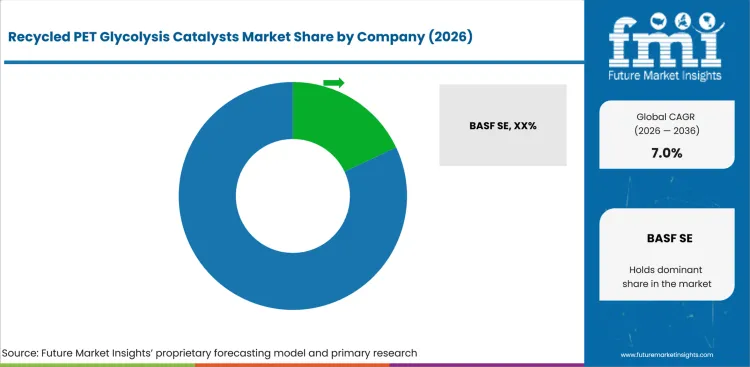
BASF, Mitsubishi Chemical Group, LANXESS, Eastman and Loop Industries.
- Established specialty chemical companies hold an advantage through catalyst know-how and polymer customer relationships.
- Chemical recycling technology developers influence buyer expectations through process integration and plant-level references.
- Polymer producers gain better qualification access where they can connect catalyst trials with recycled PET output testing.
- Technical service capacity supports adoption by helping recyclers manage residue control, feedstock variability and recovery economics.
Chemical groups in the market compete by combining process knowledge with residue control and customer testing. BASF, Mitsubishi Chemical Group and LANXESS have strong relevance through specialty chemical supply, polymer customer access, and technical service networks. Their advantage depends on whether catalyst systems can support plant-level glycolysis performance rather than only laboratory conversion.
Technology developers shape market expectations by demonstrating how chemical recycling can manage colored PET, mixed polyester streams and hard-to-recycle packaging. Eastman’s Kingsport molecular recycling facility achieved initial production in March 2024 and has capacity to process 110,000 metric tons annually. Loop Industries and Ioniqa influence buyer discussions around depolymerization routes, purification systems, and food-grade recycled output. These companies may not all sell standalone catalysts, but they define performance benchmarks for catalyst suppliers.
Smaller suppliers can win through recoverable catalyst formats and customer-specific testing packages. Solid catalysts, supported metal systems and low-residue process aids can gain attention when they reduce wastewater burden or simplify separation. Suppliers that only compete on input price may face weaker acceptance as recycled-content verification and food-contact qualification become stricter.
How do top recycled PET glycolysis catalysts companies compare?
Specialty chemical suppliers lead on catalyst know-how while recycling technology developers shape process benchmarks.
| Company | Relevance to Market Title | Catalyst/Process Depth | Recycled PET Exposure | Technical Service Strength | Channel Reach | Geographic Footprint |
|---|---|---|---|---|---|---|
| BASF SE | Very High | Very Strong | Strong | Very Strong | Very Strong | Global |
| Mitsubishi Chemical Group | Very High | Strong | Very Strong | Strong | Strong | Japan and Global |
| LANXESS AG | High | Strong | Moderate | Strong | Strong | Global |
| Eastman Chemical Company | Very High | Very Strong | Very Strong | Very Strong | Strong | United States and Europe |
| Loop Industries | High | Strong | Very Strong | Moderate | Moderate | North America and Asia |
| Ioniqa Technologies | High | Strong | Strong | Moderate | Moderate | Europe |
| SK Chemicals | High | Moderate | Strong | Strong | Strong | South Korea and Asia |
| Carbios | Moderate to High | Strong | Strong | Moderate | Moderate | Europe |
| JEPLAN, Inc. | Moderate to High | Moderate | Strong | Moderate | Moderate | Japan |
| Indorama Ventures | High | Moderate | Very Strong | Strong | Very Strong | Global |
Source: Future Market Insights competitive analysis, 2026.
Who are the key players in the recycled PET glycolysis catalysts market?
BASF, Mitsubishi Chemical Group and LANXESS are listed with Eastman and Loop Industries among other suppliers and process influencers.
Key global companies leading the recycled PET glycolysis catalysts market include:
- BASF SE
- Mitsubishi Chemical Group Corporation
- LANXESS AG
- Eastman Chemical Company
- Loop Industries, Inc.
- Ioniqa Technologies
- SK Chemicals
- Carbios
- JEPLAN, Inc.
- Indorama Ventures
Key Developments in Recycled PET Glycolysis Catalysts Market
- In March 2024, Eastman said its Kingsport molecular recycling facility achieved on-spec initial production and started generating revenue from polyester waste recycling.
- In August 2025, Loop Industries announced that its India joint venture reached an agreement to acquire a strategic site in Gujarat for an Infinite Loop technology facility.
- In January 2026, China released an action plan for comprehensive solid waste treatment, including stronger recycled-material use and intensified research in key solid waste recycling technologies.
Key Players in the Recycled PET Glycolysis Catalysts Market
Specialty Chemical and Catalyst Suppliers
- BASF SE
- Mitsubishi Chemical Group
- LANXESS AG
- Evonik Industries
- Arkema
Chemical Recycling and Depolymerization Companies
- Eastman Chemical Company
- Loop Industries
- Ioniqa Technologies
- Carbios
- JEPLAN
Recycling and Polymer Processing Companies
- Indorama Ventures
- Plastipak
- Veolia
- SUEZ Recycling and Recovery
- SK Chemicals
Recycled PET Glycolysis Catalysts Market - Report Scope
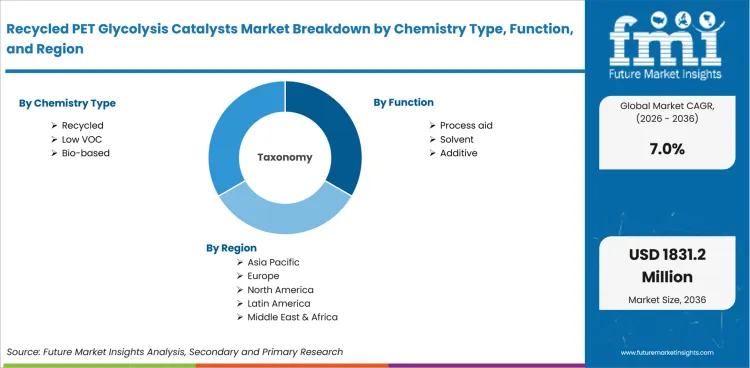
| Parameter | Details |
|---|---|
| Forecast period | 2026 to 2036 |
| Historical period | 2021 to 2025 |
| Quantitative unit | Revenue in USD million |
| By chemistry type | Recycled, bio-based, low VOC, halogen free, waterborne |
| By function | Process aid, solvent, additive, binder, coating |
| By application | Textiles, packaging, construction, batteries, water treatment |
| By end-use industry | Packaging, industrial manufacturing, automotive, electronics, agriculture |
| By catalyst format | Solid recoverable catalysts, homogeneous salts, ionic liquids, organocatalysts, supported metal catalysts |
| Regions covered | North America, Latin America, Europe, East Asia, South Asia and Pacific, Middle East and Africa |
| Countries covered | India, China, South Korea, France, Germany, Japan, United States, United Kingdom |
| Key companies profiled | BASF, Mitsubishi Chemical Group, LANXESS, Eastman, Loop Industries, Ioniqa, SK Chemicals, Carbios |
| Approach | Bottom-up catalyst consumption approach using PET glycolysis capacity, catalyst load, recycled PET feedstock, and end-use qualification |
Source: Future Market Insights, 2026.
Recycled PET Glycolysis Catalysts Market - Scope & Definition
| Attribute | Detail |
|---|---|
| Market Definition | Catalysts and catalyst-assisted process aids used to depolymerize waste PET with glycols into reusable intermediates, including systems used in bottle, packaging, film, and polyester textile recovery. |
| Functions Covered | Reaction support, process acceleration, catalyst recovery, residue reduction, impurity control, and conversion-yield improvement. |
| Applications Covered | Textiles, packaging, construction, batteries, and water treatment uses involving recycled PET intermediates or PET-derived material streams. |
| End-Use Industries | Packaging, industrial manufacturing, automotive, electronics, and agriculture. |
| Grades Covered | Recycled, bio-based, low VOC, halogen free, and waterborne catalyst or process-aid systems. |
| Inclusions | Commercial catalysts, recovered catalyst systems, process aids, solvents, additive packages, and supported catalysts used in PET glycolysis-based chemical recycling. |
| Exclusions | Mechanical PET washing, flake extrusion, virgin PET polymerization catalysts, pyrolysis oil upgrading catalysts, enzymatic depolymerization systems, and general waste collection services. |
Recycled PET Glycolysis Catalysts Market - Research Methodology
| Method | Description |
|---|---|
| Primary Research | FMI analyst interviews with PET recyclers, specialty chemical suppliers, polyester processors, packaging converters, and engineering contractors across key markets. |
| Desk Research | Review of government data, regulatory publications, company disclosures, standards references, chemical recycling policy documents, and peer-reviewed recycling evidence related to recycled PET. |
| Market Sizing & Forecasting | Bottom-up modelling using catalyst consumption per tonne of PET processed, glycolysis capacity, feedstock mix, end-use purity requirements, and country-level recycling policy pressure. |
| Data Validation | Cross-verification using PET packaging demand, recycled-content rules, chemical depolymerization activity, company process claims, and country recycling systems. |
Recycled PET Glycolysis Catalysts Market Breakdown by Chemistry Type, Function, Application, End-use Industry, Catalyst Format, and Region
Recycled PET Glycolysis Catalysts Market Segmented by Chemistry Type:
- Recycled
- Bio-based
- Low VOC
- Halogen Free
- Waterborne
Recycled PET Glycolysis Catalysts Market Segmented by Function:
- Process Aid
- Solvent
- Additive
- Binder
- Coating
Recycled PET Glycolysis Catalysts Market Segmented by Application:
- Textiles
- Packaging
- Construction
- Batteries
- Water Treatment
Recycled PET Glycolysis Catalysts Market Segmented by End-use Industry:
- Packaging
- Industrial Manufacturing
- Automotive
- Electronics
- Agriculture
Recycled PET Glycolysis Catalysts Market Segmented by Catalyst Format:
- Solid Recoverable Catalysts
- Homogeneous Salts
- Ionic Liquids
- Organocatalysts
- Supported Metal Catalysts
Recycled PET Glycolysis Catalysts Market by Region:
- North America
- Latin America
- Europe
- East Asia
- South Asia and Pacific
- Middle East and Africa
Research Sources and Bibliography
- China State Council. (2026, January 14). China to ramp up solid waste management in green transition push.
- China State Council. (2025, November 8). Full text: Carbon peaking and carbon neutrality: China’s plans and solutions.
- Eastman Chemical Company. (2024, March 21). Eastman molecular recycling facility achieves on-spec initial production and is generating revenue.
- Eastman Chemical Company. (2026). Tennessee molecular recycling facility.
- European Commission. (2025, July 1). 5 things you should know about single-use plastics.
- European Commission. (2025, July 8). Commission consults on new rules for chemically recycled content in plastic bottles.
- Eurostat. (2025, October 10). Packaging waste statistics.
- Eurostat. (2025, October 22). Plastic packaging waste in the EU: 35.3 kg per person.
- Food Packaging Forum. (2025, October 8). South Korea and Japan publish criteria for recycled content in PET bottles.
- Food Safety and Standards Authority of India. (2025, April 2). Food Safety and Standards (Packaging) Regulations, 2018: Compendium.
- HM Revenue & Customs. (2025, August 28). Plastic Packaging Tax statistics commentary.
- Kirin Holdings Company, Limited. (2025). Environmental report 2025.
- Loop Industries, Inc. (2025, August 13). Loop Industries’ India joint venture reaches agreement to acquire strategic site in Gujarat, India.
- Ministry of Environment, Forest and Climate Change. (2026). Annual report 2025-26.
- Ministry of Environment of Korea. (2025, February 20). Full-scale use of recycled materials in bottled water and beverage PET bottles.
- National Institute of Standards and Technology. (2024, October 30). The U.S. plastics recycling economy: Current state, challenges, and opportunities.
- Organisation for Economic Co-operation and Development. (2026). Chemical content validation of recycled plastics.
- Press Information Bureau. (2026, March 23). Plastic waste management.
- Recycle Now. (2025). Workplace recycling in England is changing.
- Umweltbundesamt. (2024, December 5). Packaging consumption decreased in 2022 and recycling rate increased slightly.
- U.S. Environmental Protection Agency. (2025, August 6). U.S. recycling infrastructure assessment and state data collection reports.
- Zentrale Stelle Verpackungsregister. (2026, January 27). Fighting myths with facts: Recycling packaging waste in Germany works.
- Council for PET Bottle Recycling. (2025). Actual volume of collected PET bottles and collection rate.
- Environment Agency. (2025, March 27). UK producer obligation data tables for 2024.
- German Federal Statistical Office. (2025, August 27). Waste management: Waste disposal 2024.
- Food Safety and Standards Authority of India. (2025, May 26). Guidelines for acceptance of recycled polyethylene terephthalate (PET) as food contact material (FCM-rPET).
- Food Safety and Standards Authority of India. (2025, September 10). List of approved rPET manufacturer as on 10.09.2025.
This bibliography is provided for reader reference and is not exhaustive. The full report contains the complete reference list and detailed citations.
This Report Answers
- Market size estimates for 2026 and forecasts through 2036 for the recycled PET glycolysis catalysts market.
- Insights across more than 30 regional and country-level markets.
- Analysis of demand drivers, feedstock patterns, catalyst usage trends, and purchasing behavior.
- Evaluation of key chemistry types and catalyst functions across PET glycolysis systems.
- Assessment of recycled-content rules, verification requirements, and food-contact qualification impacts on market development.
- Identification of growth opportunities across chemistry type, function, application, end-use industry, and catalyst format.
- Evaluation of supply chain dynamics, product innovation trends, and technical service channel structures.
- Country-level growth analysis covering India, China, South Korea, France, Germany, Japan, the United States, and the United Kingdom.
- Assessment of the competitive landscape, including specialty chemical suppliers and chemical recycling technology companies.
- Analysis of catalyst recovery economics, residue control, and emerging commercial qualification needs.
- Regional outlooks across North America, Europe, East Asia, South Asia and Pacific, Latin America, and the Middle East and Africa.
- Delivery of market data, forecasts, and supporting analysis in PDF and Excel formats.
Frequently Asked Questions
What is the growth prospect for recycled PET glycolysis catalysts?
Demand for recycled PET glycolysis catalysts is expected to rise at a considerable pace as chemical recycling routes gain use in packaging and polyester recovery.
Which companies are expected to shape the recycled PET glycolysis catalysts market?
BASF, Mitsubishi Chemical Group, LANXESS, Eastman, Loop Industries, Ioniqa, and SK Chemicals are expected to shape market competition through catalyst capability, process know-how, and recycled PET qualification support.
Why are chemical companies investing in recycled PET glycolysis catalysts?
Chemical companies are investing in recycled PET glycolysis catalysts to support cleaner depolymerization, better recovery economics, and stronger recycled-content compliance.
Why is catalyst recovery important in this market?
Catalyst recovery is important because reagent reuse can reduce waste treatment cost and lower residue concerns in recycled PET production.
Which applications are gaining attention in recycled PET glycolysis catalysts?
Textiles and packaging are gaining attention as polyester waste and bottle-grade recycled PET needs create stronger demand for chemical recovery.
How do regulations influence catalyst qualification?
Regulations influence catalyst qualification through recycled-content verification, packaging safety rules, and food-contact material requirements.
Why is feedstock quality important for recycled PET glycolysis catalysts?
Feedstock quality is important since dyes, labels, multilayer materials, and textile finishes can increase purification burden and affect catalyst performance.
What role does technical service play in recycled PET glycolysis catalyst adoption?
Technical service supports adoption by helping recyclers test feedstock variability, catalyst reuse, residue control, and final polymer quality.
Preview the report firsthand - request a free sample
Get SampleGet the brochure for pricing and purchase details.
Get PDFTable of Content
- Key Takeaways
- Market Size and CAGR
- Top Growth Driver
- Fastest Growing Segment
- Leading Region
- Key Companies
- Emerging Opportunities
- Executive Summary
- Global Market Outlook
- Demand-side Trends
- Supply-side Trends
- Technology Roadmap Analysis
- Analysis and Recommendations
- Analyst Perspective (What is happening? Why now? What should investors know?)
- Key Questions Answered
- How large is the market?
- What is the CAGR?
- What are key trends?
- Which region dominates?
- Who are the leaders?
- Market Overview
- Market Coverage / Taxonomy
- Market Definition / Scope / Limitations
- Research Methodology
- Chapter Orientation
- Analytical Lens and Working Hypotheses
- Market Structure, Signals, and Trend Drivers
- Benchmarking and Cross-market Comparability
- Market Sizing, Forecasting, and Opportunity Mapping
- Research Design and Evidence Framework
- Desk Research Programme (Secondary Evidence)
- Expert Input and Fieldwork (Primary Evidence)
- Tooling, Models, and Reference Databases
- Data Engineering and Model Build
- Quality Assurance and Audit Trail
- Market Background
- Market Dynamics (Drivers, Restraints, Opportunity, Trends)
- Scenario Forecast (Optimistic, Likely, Conservative)
- Impact Analysis
- AI Impact
- Sustainability Impact
- Regulatory Impact
- Technology Impact
- Consumer / Buyer Analysis
- Purchase Drivers
- Adoption Barriers
- Buyer Journey
- Opportunity Map Analysis
- Product Life Cycle Analysis
- Supply Chain Analysis
- Investment Feasibility Matrix
- Value Chain Analysis
- PESTLE and Porter's Analysis
- Regulatory Landscape
- Regional Parent Market Outlook
- Production and Consumption Statistics
- Import and Export Statistics
- Global Market Analysis and Forecast, 2021 to 2036
- Historical Market Size Value (USD Million) & Volume (Unit) Analysis, 2021 to 2025
- Current and Future Market Size Value (USD Million) & Volume (Unit) Projections, 2026 to 2036
- Y-o-Y Growth Trend Analysis
- Absolute $ Opportunity Analysis
- Global Market Pricing Analysis, 2021 to 2036
- Global Market Analysis and Forecast, By Chemistry Type, 2021 to 2036
- Introduction / Key Findings
- Historical Market Size Value (USD Million) & Volume (Unit) Analysis By Chemistry Type, 2021 to 2025
- Current and Future Market Size Value (USD Million) & Volume (Unit) Analysis and Forecast By Chemistry Type, 2026 to 2036
- Recycled
- Bio-based
- Low VOC
- Halogen Free
- Waterborne
- Recycled
- Y-o-Y Growth Trend Analysis By Chemistry Type, 2021 to 2025
- Absolute $ Opportunity Analysis By Chemistry Type, 2026 to 2036
- Global Market Analysis and Forecast, By Function, 2021 to 2036
- Introduction / Key Findings
- Historical Market Size Value (USD Million) & Volume (Unit) Analysis By Function, 2021 to 2025
- Current and Future Market Size Value (USD Million) & Volume (Unit) Analysis and Forecast By Function, 2026 to 2036
- Process Aid
- Solvent
- Additive
- Binder
- Coating
- Process Aid
- Y-o-Y Growth Trend Analysis By Function, 2021 to 2025
- Absolute $ Opportunity Analysis By Function, 2026 to 2036
- Global Market Analysis and Forecast, By Application, 2021 to 2036
- Introduction / Key Findings
- Historical Market Size Value (USD Million) & Volume (Unit) Analysis By Application, 2021 to 2025
- Current and Future Market Size Value (USD Million) & Volume (Unit) Analysis and Forecast By Application, 2026 to 2036
- Textiles
- Packaging
- Construction
- Batteries
- Water Treatment
- Textiles
- Y-o-Y Growth Trend Analysis By Application, 2021 to 2025
- Absolute $ Opportunity Analysis By Application, 2026 to 2036
- Global Market Analysis and Forecast, By End-use Industry, 2021 to 2036
- Introduction / Key Findings
- Historical Market Size Value (USD Million) & Volume (Unit) Analysis By End-use Industry, 2021 to 2025
- Current and Future Market Size Value (USD Million) & Volume (Unit) Analysis and Forecast By End-use Industry, 2026 to 2036
- Packaging
- Industrial Manufacturing
- Automotive
- Electronics
- Agriculture
- Packaging
- Y-o-Y Growth Trend Analysis By End-use Industry, 2021 to 2025
- Absolute $ Opportunity Analysis By End-use Industry, 2026 to 2036
- Global Market Analysis and Forecast, By Catalyst Format, 2021 to 2036
- Introduction / Key Findings
- Historical Market Size Value (USD Million) & Volume (Unit) Analysis By Catalyst Format, 2021 to 2025
- Current and Future Market Size Value (USD Million) & Volume (Unit) Analysis and Forecast By Catalyst Format, 2026 to 2036
- Solid Recoverable Catalysts
- Homogeneous Salts
- Ionic Liquids
- Organocatalysts
- Supported Metal Catalysts
- Solid Recoverable Catalysts
- Y-o-Y Growth Trend Analysis By Catalyst Format, 2021 to 2025
- Absolute $ Opportunity Analysis By Catalyst Format, 2026 to 2036
- Global Market Analysis and Forecast, By Region, 2021 to 2036
- Introduction
- Historical Market Size Value (USD Million) & Volume (Unit) Analysis By Region, 2021 to 2025
- Current Market Size Value (USD Million) & Volume (Unit) Analysis and Forecast By Region, 2026 to 2036
- North America
- Latin America
- Western Europe
- Eastern Europe
- East Asia
- South Asia and Pacific
- Middle East & Africa
- Market Attractiveness Analysis By Region
- North America Market Analysis and Forecast, By Country, 2021 to 2036
- Historical Market Size Value (USD Million) & Volume (Unit) Trend Analysis By Market Taxonomy, 2021 to 2025
- Market Size Value (USD Million) & Volume (Unit) Forecast By Market Taxonomy, 2026 to 2036
- By Country
- USA
- Canada
- Mexico
- By Chemistry Type
- By Function
- By Application
- By End-use Industry
- By Catalyst Format
- By Country
- Market Attractiveness Analysis
- By Country
- By Chemistry Type
- By Function
- By Application
- By End-use Industry
- By Catalyst Format
- Key Takeaways
- Latin America Market Analysis and Forecast, By Country
- Historical Market Size Value (USD Million) & Volume (Unit) Trend Analysis By Market Taxonomy, 2021 to 2025
- Market Size Value (USD Million) & Volume (Unit) Forecast By Market Taxonomy, 2026 to 2036
- By Country
- Brazil
- Chile
- Rest of Latin America
- By Chemistry Type
- By Function
- By Application
- By End-use Industry
- By Catalyst Format
- By Country
- Market Attractiveness Analysis
- By Country
- By Chemistry Type
- By Function
- By Application
- By End-use Industry
- By Catalyst Format
- Key Takeaways
- Western Europe Market Analysis and Forecast, By Country
- Historical Market Size Value (USD Million) & Volume (Unit) Trend Analysis By Market Taxonomy, 2021 to 2025
- Market Size Value (USD Million) & Volume (Unit) Forecast By Market Taxonomy, 2026 to 2036
- By Country
- Germany
- UK
- Italy
- Spain
- France
- Nordic
- BENELUX
- Rest of Western Europe
- By Chemistry Type
- By Function
- By Application
- By End-use Industry
- By Catalyst Format
- By Country
- Market Attractiveness Analysis
- By Country
- By Chemistry Type
- By Function
- By Application
- By End-use Industry
- By Catalyst Format
- Key Takeaways
- Eastern Europe Market Analysis and Forecast, By Country
- Historical Market Size Value (USD Million) & Volume (Unit) Trend Analysis By Market Taxonomy, 2021 to 2025
- Market Size Value (USD Million) & Volume (Unit) Forecast By Market Taxonomy, 2026 to 2036
- By Country
- Russia
- Poland
- Hungary
- Balkan & Baltic
- Rest of Eastern Europe
- By Chemistry Type
- By Function
- By Application
- By End-use Industry
- By Catalyst Format
- By Country
- Market Attractiveness Analysis
- By Country
- By Chemistry Type
- By Function
- By Application
- By End-use Industry
- By Catalyst Format
- Key Takeaways
- East Asia Market Analysis and Forecast, By Country
- Historical Market Size Value (USD Million) & Volume (Unit) Trend Analysis By Market Taxonomy, 2021 to 2025
- Market Size Value (USD Million) & Volume (Unit) Forecast By Market Taxonomy, 2026 to 2036
- By Country
- China
- Japan
- South Korea
- By Chemistry Type
- By Function
- By Application
- By End-use Industry
- By Catalyst Format
- By Country
- Market Attractiveness Analysis
- By Country
- By Chemistry Type
- By Function
- By Application
- By End-use Industry
- By Catalyst Format
- Key Takeaways
- South Asia and Pacific Market Analysis and Forecast, By Country
- Historical Market Size Value (USD Million) & Volume (Unit) Trend Analysis By Market Taxonomy, 2021 to 2025
- Market Size Value (USD Million) & Volume (Unit) Forecast By Market Taxonomy, 2026 to 2036
- By Country
- India
- ASEAN
- Australia & New Zealand
- Rest of South Asia and Pacific
- By Chemistry Type
- By Function
- By Application
- By End-use Industry
- By Catalyst Format
- By Country
- Market Attractiveness Analysis
- By Country
- By Chemistry Type
- By Function
- By Application
- By End-use Industry
- By Catalyst Format
- Key Takeaways
- Middle East & Africa Market Analysis and Forecast, By Country
- Historical Market Size Value (USD Million) & Volume (Unit) Trend Analysis By Market Taxonomy, 2021 to 2025
- Market Size Value (USD Million) & Volume (Unit) Forecast By Market Taxonomy, 2026 to 2036
- By Country
- Kingdom of Saudi Arabia
- Other GCC Countries
- Türkiye
- South Africa
- Other African Union
- Rest of Middle East & Africa
- By Chemistry Type
- By Function
- By Application
- By End-use Industry
- By Catalyst Format
- By Country
- Market Attractiveness Analysis
- By Country
- By Chemistry Type
- By Function
- By Application
- By End-use Industry
- By Catalyst Format
- Key Takeaways
- Key Countries Market Analysis
- USA
- Pricing Analysis
- Market Share Analysis, 2025
- By Chemistry Type
- By Function
- By Application
- By End-use Industry
- By Catalyst Format
- Canada
- Pricing Analysis
- Market Share Analysis, 2025
- By Chemistry Type
- By Function
- By Application
- By End-use Industry
- By Catalyst Format
- Mexico
- Pricing Analysis
- Market Share Analysis, 2025
- By Chemistry Type
- By Function
- By Application
- By End-use Industry
- By Catalyst Format
- Brazil
- Pricing Analysis
- Market Share Analysis, 2025
- By Chemistry Type
- By Function
- By Application
- By End-use Industry
- By Catalyst Format
- Chile
- Pricing Analysis
- Market Share Analysis, 2025
- By Chemistry Type
- By Function
- By Application
- By End-use Industry
- By Catalyst Format
- Germany
- Pricing Analysis
- Market Share Analysis, 2025
- By Chemistry Type
- By Function
- By Application
- By End-use Industry
- By Catalyst Format
- UK
- Pricing Analysis
- Market Share Analysis, 2025
- By Chemistry Type
- By Function
- By Application
- By End-use Industry
- By Catalyst Format
- Italy
- Pricing Analysis
- Market Share Analysis, 2025
- By Chemistry Type
- By Function
- By Application
- By End-use Industry
- By Catalyst Format
- Spain
- Pricing Analysis
- Market Share Analysis, 2025
- By Chemistry Type
- By Function
- By Application
- By End-use Industry
- By Catalyst Format
- France
- Pricing Analysis
- Market Share Analysis, 2025
- By Chemistry Type
- By Function
- By Application
- By End-use Industry
- By Catalyst Format
- India
- Pricing Analysis
- Market Share Analysis, 2025
- By Chemistry Type
- By Function
- By Application
- By End-use Industry
- By Catalyst Format
- ASEAN
- Pricing Analysis
- Market Share Analysis, 2025
- By Chemistry Type
- By Function
- By Application
- By End-use Industry
- By Catalyst Format
- Australia & New Zealand
- Pricing Analysis
- Market Share Analysis, 2025
- By Chemistry Type
- By Function
- By Application
- By End-use Industry
- By Catalyst Format
- China
- Pricing Analysis
- Market Share Analysis, 2025
- By Chemistry Type
- By Function
- By Application
- By End-use Industry
- By Catalyst Format
- Japan
- Pricing Analysis
- Market Share Analysis, 2025
- By Chemistry Type
- By Function
- By Application
- By End-use Industry
- By Catalyst Format
- South Korea
- Pricing Analysis
- Market Share Analysis, 2025
- By Chemistry Type
- By Function
- By Application
- By End-use Industry
- By Catalyst Format
- Russia
- Pricing Analysis
- Market Share Analysis, 2025
- By Chemistry Type
- By Function
- By Application
- By End-use Industry
- By Catalyst Format
- Poland
- Pricing Analysis
- Market Share Analysis, 2025
- By Chemistry Type
- By Function
- By Application
- By End-use Industry
- By Catalyst Format
- Hungary
- Pricing Analysis
- Market Share Analysis, 2025
- By Chemistry Type
- By Function
- By Application
- By End-use Industry
- By Catalyst Format
- Kingdom of Saudi Arabia
- Pricing Analysis
- Market Share Analysis, 2025
- By Chemistry Type
- By Function
- By Application
- By End-use Industry
- By Catalyst Format
- Türkiye
- Pricing Analysis
- Market Share Analysis, 2025
- By Chemistry Type
- By Function
- By Application
- By End-use Industry
- By Catalyst Format
- South Africa
- Pricing Analysis
- Market Share Analysis, 2025
- By Chemistry Type
- By Function
- By Application
- By End-use Industry
- By Catalyst Format
- USA
- Market Structure Analysis
- Competition Dashboard
- Competition Benchmarking
- Market Share Analysis of Top Players
- By Regional
- By Chemistry Type
- By Function
- By Application
- By End-use Industry
- By Catalyst Format
- Emerging Startups
- Innovation Benchmarking
- Competition Analysis
- Competition Deep Dive
- Reliance Industries Limited
- Overview
- Product Portfolio
- Profitability by Market Segments (Product/Region/Sales Channel)
- Sales Footprint
- Strategy Overview
- Marketing Strategy
- Product Strategy
- Channel Strategy
- Ganesha Ecopet Private Limited
- Polygenta Technologies Limited
- Shakti Plastic Industries
- Banyan Nation
- Gravita India Limited
- Loop Industries India JV partners
- Reliance Industries Limited
- Case Studies
- Success Stories
- Recent Developments
- Competition Deep Dive
- Assumptions & Acronyms Used


