

- Market Size (2026)
- USD 1860.8 Mn
- Forecast (2036)
- USD 3301.1 Mn
- CAGR (2026 to 2036)
- 5.9%
How big is the ammonia catalysts market in 2026?
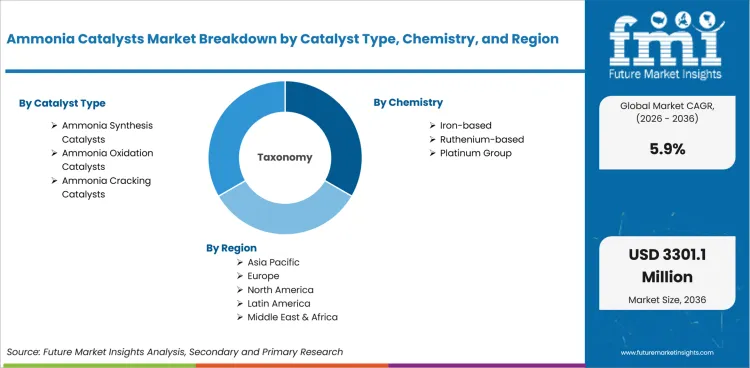
USD 1,860.8 million in 2026 and USD 3,301.1 million by 2036 at a 5.9% CAGR.
The ammonia catalysts industry value is forecast to grow from USD 1,757.1294 million in 2025 to USD 3,301.1 million by 2036 at 5.9% CAGR as plant owners protect ammonia loop efficiency and new low-carbon projects raise specification requirements. Replacement sales are expected to hold 72.0% share in 2026 because operating ammonia plants buy catalysts around scheduled turnarounds. Direct sales are projected to secure 68.0% share in 2026, led by catalyst qualification, activation support, and converter performance assurance.
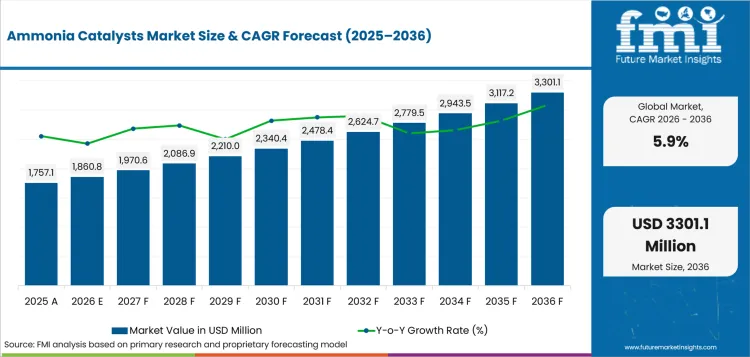
Ammonia Catalysts Market Overview: Size and Forecast
- 2026 Market Size: USD 1,860.8 million
- 2036 Market Size: USD 3,301.1 million
- Forecast CAGR: 5.9% from 2026 to 2036
- Leading Sales Mix: Replacement
- Replacement Share in 2026: 72.0%
- Leading Sales Channel: Direct
- Direct Sales Share in 2026: 68.0%
- Fastest-growing Country: China
- China CAGR: 6.7% by 2036
Summary of the Ammonia Catalysts Market
- Demand and Growth Drivers
- Ammonia plant operators are replacing catalyst charges during planned shutdowns to protect conversion efficiency and limit unplanned output loss.
- Low-carbon ammonia projects are increasing interest in catalyst beds that can tolerate variable hydrogen supply and renewable power swings.
- Nitric acid producers continue using platinum group gauzes where ammonia oxidation yield and recovery discipline influence operating economics.
- Product and Segment View
- Replacement is forecast to represent 72.0% share in 2026, supported by recurring catalyst changeouts across mature production assets.
- Direct sales are projected to hold 68.0% share in 2026, influenced by technical service, loading support, and performance guarantees.
- Ammonia plants are estimated to account for 64.0% end-use share in 2026 as fertilizer producers remain the largest catalyst buyers.
- Geography and Competitive Outlook
- China is projected to record 6.7% CAGR by 2036 as fertilizer scale and hydrogen derivative planning support catalyst procurement.
- India is expected to expand at 6.5% CAGR by 2036 as urea capacity additions and green ammonia projects support demand.
- Topsoe, KBR, Johnson Matthey, and thyssenkrupp Uhde compete through ammonia technology, catalyst packages, and process guarantees.
- BASF, Clariant, Casale, and Sinopec Catalyst focus on chemistry depth, regional access, and replacement service coverage.
- Analyst Opinion
- Nikhil Kaitwade, Principal Consultant at Future Market Insights for chemicals domain, observes, “Ammonia catalysts are moving from routine replacement purchases toward process-performance decisions. Conventional ammonia producers still need long campaign life and stable conversion. Low-carbon ammonia projects add a second route because load flexibility and catalyst stability now affect project economics. In nitric acid plants, platinum group gauze choice remains tied to yield and metal recovery. In ammonia cracking, buyers are comparing hydrogen purity against catalyst cost. Suppliers with catalyst chemistry, converter know-how, and fast field support should gain stronger customer retention.”
Market outlook is supported by a large operating base and early hydrogen-carrier demand. The U.S. Geological Survey reported ammonia production by 18 companies at 38 plants in 19 states during 2025, with 57% of U.S. capacity located in Louisiana, Oklahoma, and Texas. The International Energy Agency reported renewable and low-carbon hydrogen at 0.8 Mt in 2024, while low-carbon supply still represented less than 1% of global hydrogen production. Topsoe stated in January 2026 that its dynamic ammonia technology would support the Yanbu green ammonia project by delivering engineering, proprietary equipment, and catalysts. These signals support higher-value catalyst demand across conventional synthesis, low-carbon ammonia, and future ammonia cracking applications.
Which factors support expansion in the ammonia catalysts market?
Replacement revenue, catalyst-service depth, and low-carbon project specifications support market value across process catalyst applications.
- Market value is supported by replacement catalyst charges before new ammonia projects add higher-specification demand.
- Supplier pricing reflects catalyst life, converter support, activation assistance, and technical guarantees before commodity metal costs are considered.
- Revenue improves as ammonia producers connect catalyst selection with energy use, pressure-drop control, and planned turnaround discipline.
- Low-carbon project activity strengthens cross-selling with green ammonia, hydrogen electrolyzer, and power-to-X project planning.
Why is the ammonia catalysts market growing?
Ammonia producers are treating catalyst performance as an uptime tool while hydrogen carriers create a new specification path.
Demand is widening as conventional plants continue catalyst replacement programs and low-carbon hydrogen projects add future ammonia synthesis and cracking requirements. The International Energy Agency stated in 2025 that global hydrogen demand increased to almost 100 million tonnes in 2024, up 2% from 2023, while refining and industry remained the largest users. This demand base shows why industrial hydrogen conversion routes are important for catalyst suppliers. It also highlights why ammonia cracking catalysts must prove purity, heat integration, and campaign life before large hydrogen-carrier projects convert into recurring catalyst orders. Downstream nitrogen chemistry and emissions-linked catalyst needs add further support from nitric acid and low-ammonia NOx reduction applications.
How is the ammonia catalysts market segmented?
The ammonia catalysts industry is segmented by catalyst type, chemistry, end use, sales mix, and sales channel.
- Ammonia synthesis catalysts are projected to secure 58.0% share in 2026, led by large catalyst bed volumes in Haber-Bosch loops and planned replacement programs across mature plants.
- Iron-based chemistry is expected to capture 61.0% share in 2026 due to proven campaign life, cost balance, and operating familiarity in high-pressure synthesis converters.
- Ammonia plants are anticipated to hold 64.0% share in 2026 as fertilizer producers remain the largest users of synthesis catalyst charges and converter support services.
- Replacement sales are forecast to represent 72.0% share in 2026, supported by turnaround planning, catalyst deactivation management, and recurring procurement cycles.
- Direct sales are estimated to account for 68.0% share in 2026, guided by supplier engineering support, catalyst loading assistance, and performance assurance needs.
Why do ammonia synthesis catalysts dominate the ammonia catalysts market?
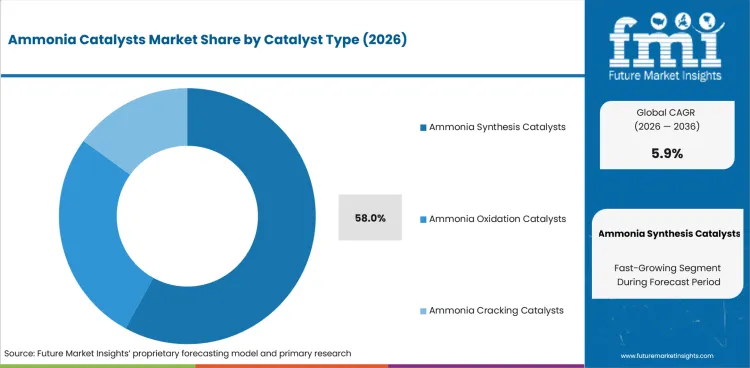
- Ammonia synthesis catalysts are projected to account for 58.0% share in 2026, influenced by large bed volumes and long operating campaigns in ammonia converters.
- Ammonia oxidation and cracking catalysts serve smaller pools, although they carry stronger specification pressure due to platinum exposure and hydrogen purity requirements.
Which chemistry leads the ammonia catalysts market?
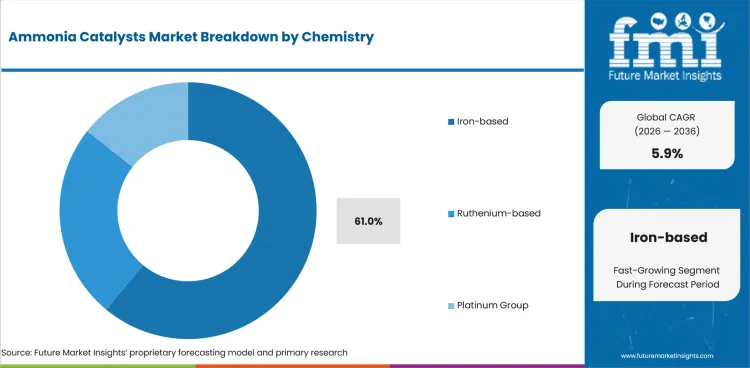
- Iron-based chemistry is expected to hold 61.0% share in 2026 through proven life, broad operator familiarity, and a lower cost base than precious metal alternatives.
- Ruthenium-based catalysts gain selective use where lower-temperature activity is valuable, but metal cost and qualification risk limit broad plant-level replacement.
Which end use leads the ammonia catalysts market?
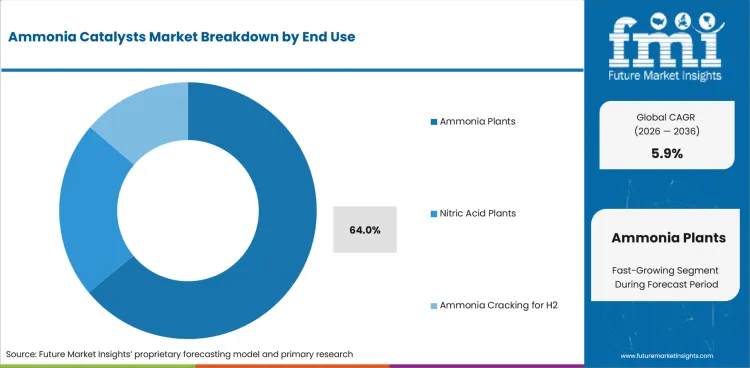
- Ammonia plants are forecast to represent 64.0% share in 2026, reflected by fertilizer producers buying synthesis catalyst charges to protect loop output.
- Nitric acid plants remain relevant because platinum group gauzes affect ammonia oxidation yield, emissions control, and precious metal recovery discipline.
Which sales mix leads the ammonia catalysts market?
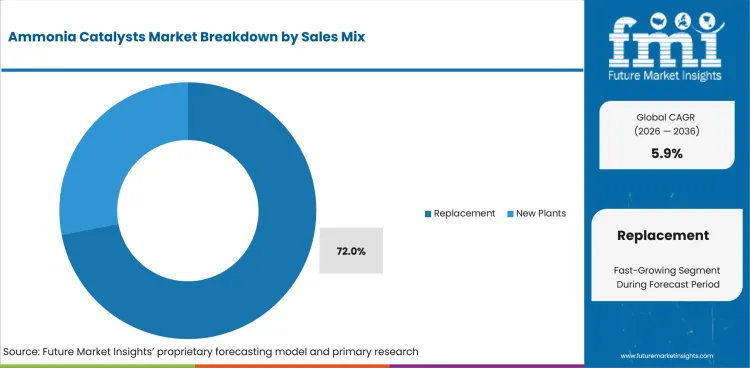
- Replacement is estimated to account for 72.0% share in 2026 as existing plants schedule catalyst changeouts during turnarounds and equipment inspections.
- New plant sales are more project-linked since low-carbon ammonia awards depend on financing, renewable power access, and final investment decisions.
Which sales channel leads the ammonia catalysts market?
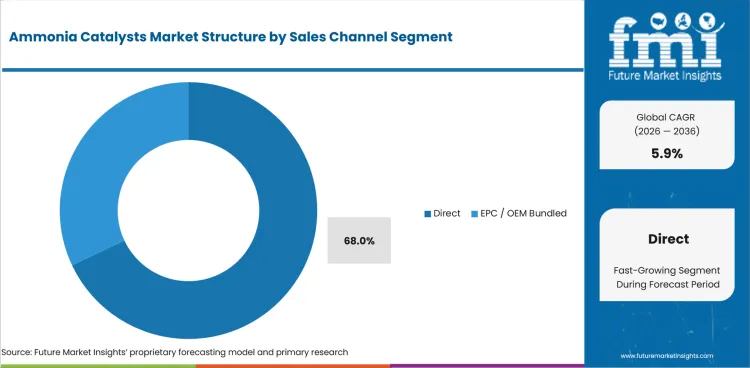
- Direct sales are projected to secure 68.0% share in 2026 because catalyst suppliers support loading, activation, performance checks, and converter troubleshooting.
- EPC and OEM bundled sales gain importance in new plants where licensors package process guarantees, proprietary engineering, and catalyst supply under one scope.
What are the driver, restraints, and opportunities in the ammonia catalysts market?
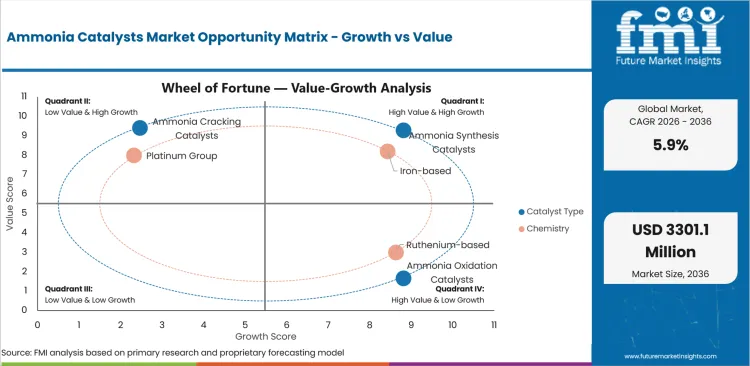
Loop reliability and low-carbon project specifications support demand while metal exposure and project timing limit faster expansion.
- Driver: Existing ammonia plants need catalyst replacement and activation support to protect loop efficiency during long operating campaigns.
- Restraint: Precious metal exposure and low-carbon project delays can slow procurement decisions for oxidation and cracking catalysts.
- Opportunity: Ammonia cracking and green ammonia plants can create premium catalyst demand when hydrogen carrier projects scale.
Ammonia Catalysts Market Demand Outlook
Demand outlook is moving toward catalyst systems that combine long operating life with higher proof requirements for flexible low-carbon ammonia. USGS reported that about 88% of U.S. ammonia production was used for fertilizer during 2025, showing why fertilizer-linked uptime remains central to replacement purchasing. Conventional ammonia producers will continue to buy iron-based catalyst charges for reliability. Newer projects will ask suppliers to prove behavior across startup, turndown, and feed-quality changes before large catalyst packages are approved.
Catalyst Cost and Qualification Restraint Analysis
Cost and timing pressures restrain faster adoption in oxidation and emerging cracking applications. EIA reported that the 2025 average Henry Hub natural gas spot price increased 56% from the prior year to USD 3.52 per MMBtu, raising feedstock sensitivity for ammonia producers. Nitric acid buyers also manage platinum group gauze cost and recovery discipline before switching suppliers. The result is a qualification-heavy market with cautious procurement decisions and extended approval cycles.
Ammonia Cracking Opportunity Outlook
Ammonia cracking creates a new opportunity as hydrogen buyers evaluate ammonia as a transport and storage molecule. The International Energy Agency states that meeting its net-zero pathway would require about 50 Mt of electrolytic hydrogen and more than 15 Mt of fossil-based hydrogen with carbon capture by 2030. That scale requirement makes carrier logistics and hydrogen conversion technology commercially important. Catalyst suppliers that can support purity, heat balance, and long operating cycles should gain early project positions.
Which countries are growing fastest in the ammonia catalysts market?
China 6.7% CAGR, India 6.5% CAGR, South Korea 6.4% CAGR, Japan 6.2% CAGR, United States 5.8% CAGR, Germany 5.6% CAGR, France 5.2% CAGR, and United Kingdom 4.9% CAGR through 2036.
.webp "Top Country Growth Comparison Ammonia Catalysts Market Cagr (2026 2036)")
| Country | CAGR |
|---|---|
| United States | 5.8% |
| United Kingdom | 4.9% |
| Germany | 5.6% |
| France | 5.2% |
| Japan | 6.2% |
| China | 6.7% |
| South Korea | 6.4% |
| India | 6.5% |
Source: Future Market Insights, 2026.
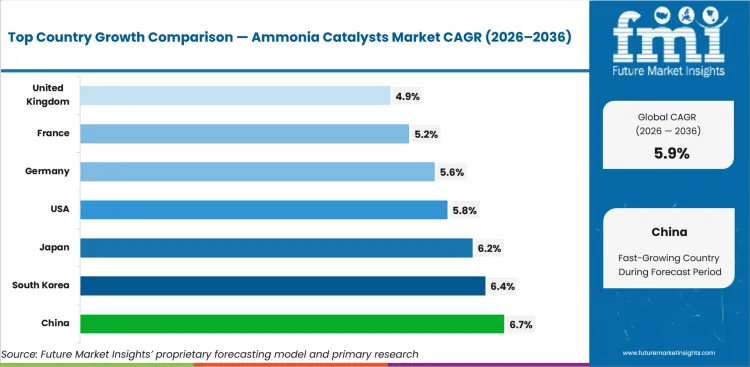
How do country-level CAGRs compare in the ammonia catalysts market?
China leads country expansion while the United Kingdom records the most selective project-led outlook among profiled markets.
- China is forecast to record 6.7% CAGR by 2036 through large fertilizer capacity and hydrogen derivative planning.
- India is forecast to record 6.5% CAGR by 2036 through urea capacity additions and green hydrogen mission activity.
- South Korea is forecast to record 6.4% CAGR by 2036 through clean hydrogen power tenders and ammonia fuel planning.
- Japan is forecast to record 6.2% CAGR by 2036 through fuel-ammonia and hydrogen carrier programs.
- United States is forecast to record 5.8% CAGR by 2036 through mature Gulf Coast ammonia assets and low-carbon export projects.
- Germany is forecast to record 5.6% CAGR by 2036 through hydrogen import planning and chemical-cluster decarbonization.
- France is forecast to record 5.2% CAGR by 2036 through low-carbon hydrogen policy and nitrogen chemistry demand.
- United Kingdom is forecast to record 4.9% CAGR by 2036 through engineering influence and low-carbon hydrogen project specification.
How fast is the ammonia catalysts market growing in the United States?
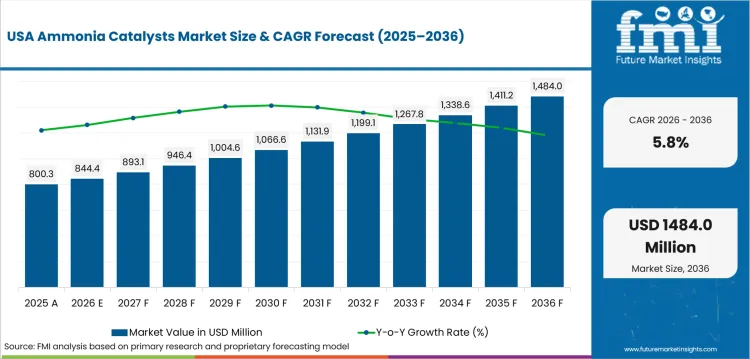
A 5.8% CAGR through 2036 reflects catalyst replacement and low-carbon ammonia project activity in United States.
Country Market Snapshot Table
| Parameter | Value |
|---|---|
| Market Size in 2025 (Value) | USD 316.6 million |
| Market Size in 2026 (Value) | USD 334.9 million |
| Market Forecast in 2036 (Value) | USD 588.6 million |
| CAGR (2026 to 2036) | 5.8% |
| Years Considered | 2021 to 2036 |
| Base Year | 2025 |
| Forecast Period | 2026 to 2036 |
| Units Considered | Value (USD million) |
| Leading Sub-Region | Gulf Coast and connected industrial corridors |
United States Ammonia Catalysts Market Outlook
United States ammonia catalyst demand is shaped by plant reliability, process-engineering standards, and project-specific qualification requirements. Buyers favor catalyst suppliers that can connect product chemistry with converter operation and field support.
Procurement teams in United States are expected to keep evaluating catalyst life, energy-use impact, poisoning resistance, and technical service before widening supplier lists. Low-carbon ammonia and hydrogen carrier projects can add future demand if offtake, power supply, and infrastructure planning stay aligned.
Key Growth Drivers
- USGS reported 38 ammonia plants across 19 states in 2025, supporting recurring catalyst changeouts in mature production clusters.
- The energy department announced up to USD 2.2 billion for two regional hydrogen hubs in November 2024, widening hydrogen infrastructure relevance for ammonia project reviews.
- Low-carbon export projects are increasing interest in bundled synthesis-loop technology and catalyst packages for blue ammonia facilities.
- Mature plant owners prefer direct supplier relationships because catalyst loading and reduction support must match turnaround windows.
Key Restraints
- EIA monthly data show Henry Hub natural gas prices ranged from USD 2.91 to USD 4.26 per MMBtu during 2025, so feedstock volatility can delay discretionary ammonia plant upgrades.
- Carbon capture permitting timelines can slow blue ammonia catalyst awards before technology packages move into procurement.
- Direct replacement buyers may postpone non-critical catalyst optimization when plant operators prioritize maintenance work with clearer payback.
What makes United States unique
The United States is unique because mature ammonia plants and export-facing low-carbon projects sit in the same procurement environment.
Key Companies
- KBR
- Topsoe
- Johnson Matthey
- Casale
- Clariant Catalysts
- BASF Catalysts
- LSB Industries
Sales & Marketing Channels
- Direct plant sales
- EPC technology bundles
- Licensing-linked catalyst supply
- Turnaround service contracts
- Distributor-supported technical sales
- Industrial project tenders
Country Segment Breakdown Table
| Segment | Sub-Segments |
|---|---|
| By Catalyst Type | Ammonia Synthesis Catalysts · Ammonia Oxidation Catalysts · Ammonia Cracking Catalysts · Other |
| By Chemistry | Iron-based · Ruthenium-based · Platinum Group · Mixed / Other |
| By End Use | Ammonia Plants · Nitric Acid Plants · Ammonia Cracking for H2 · Other |
| By Sales Mix | Replacement · New Plants |
| By Sales Channel | Direct · EPC / OEM Bundled |
| Key Sub-Regions Covered, Gulf Coast and national ammonia production networks | Gulf Coast · Midwest ammonia corridors · Texas · Louisiana · Oklahoma · Iowa |
Frequently Asked Questions
How fast is United States ammonia catalysts market growing?
Sales in United States are projected to grow at 5.8% from 2026 to 2036, guided by catalyst replacement and project-specific demand.
Who leads United States ammonia catalysts market?
KBR, Topsoe, Johnson Matthey, and Casale compete through catalyst technology, service support, and process references.
What is driving adoption in United States ammonia catalysts market?
Adoption in United States is supported by ammonia plant reliability needs, low-carbon project reviews, and supplier support during catalyst loading and operation.
What is the ammonia catalysts market outlook in the United Kingdom?
A 4.9% CAGR through 2036 reflects catalyst replacement and low-carbon ammonia project activity in United Kingdom.
Country Market Snapshot Table
| Parameter | Value |
|---|---|
| Market Size in 2025 (Value) | USD 53.2 million |
| Market Size in 2026 (Value) | USD 55.8 million |
| Market Forecast in 2036 (Value) | USD 90.1 million |
| CAGR (2026 to 2036) | 4.9% |
| Years Considered | 2021 to 2036 |
| Base Year | 2025 |
| Forecast Period | 2026 to 2036 |
| Units Considered | Value (USD million) |
| Leading Sub-Region | Teesside and connected industrial corridors |
United Kingdom Ammonia Catalysts Market Outlook
United Kingdom ammonia catalyst demand is shaped by plant reliability, process-engineering standards, and project-specific qualification requirements. Buyers favor catalyst suppliers that can connect product chemistry with converter operation and field support.
Procurement teams in United Kingdom are expected to keep evaluating catalyst life, energy-use impact, poisoning resistance, and technical service before widening supplier lists. Low-carbon ammonia and hydrogen carrier projects can add future demand if offtake, power supply, and infrastructure planning stay aligned.
Key Growth Drivers
- The July 2025 hydrogen market update stated that 27 projects were shortlisted under HAR2, creating a broader hydrogen project funnel for catalyst specification.
- The 2025 hydrogen market update also stated that agreements had been signed with 10 of 11 HAR1 projects, improving visibility for early hydrogen project execution.
- Engineering consultants and technology licensors in the United Kingdom influence ammonia project specifications beyond local consumption volume.
- Maritime fuel and industrial decarbonization studies create selective demand for ammonia cracking and hydrogen carrier evaluation.
Key Restraints
- The investment roadmap stated that the first electrolytic allocation round offered 125 MW across 11 projects, showing limited early scale against broader ambition.
- Limited domestic ammonia production narrows recurring synthesis-catalyst replacement compared with the United States, China, and India.
- Project sponsors may delay ammonia-linked specifications when end-use offtake contracts remain incomplete.
What makes United Kingdom unique
The United Kingdom is unique because catalyst relevance comes through engineering influence and project specification rather than high local ammonia volume.
Key Companies
- Johnson Matthey
- thyssenkrupp Uhde UK project teams
- KBR UK engineering teams
- Topsoe UK-facing project teams
- Clariant Catalysts
- BASF Catalysts
- Casale
Sales & Marketing Channels
- Direct plant sales
- EPC technology bundles
- Licensing-linked catalyst supply
- Turnaround service contracts
- Distributor-supported technical sales
- Industrial project tenders
Country Segment Breakdown Table
| Segment | Sub-Segments |
|---|---|
| By Catalyst Type | Ammonia Synthesis Catalysts · Ammonia Oxidation Catalysts · Ammonia Cracking Catalysts · Other |
| By Chemistry | Iron-based · Ruthenium-based · Platinum Group · Mixed / Other |
| By End Use | Ammonia Plants · Nitric Acid Plants · Ammonia Cracking for H2 · Other |
| By Sales Mix | Replacement · New Plants |
| By Sales Channel | Direct · EPC / OEM Bundled |
| Key Sub-Regions Covered, Teesside and hydrogen project design corridors | Teesside · Humber · Scotland industrial clusters · Wales · North West England · London engineering offices |
Frequently Asked Questions
How fast is United Kingdom ammonia catalysts market growing?
Sales in United Kingdom are projected to grow at 4.9% from 2026 to 2036, guided by catalyst replacement and project-specific demand.
Who leads United Kingdom ammonia catalysts market?
Johnson Matthey, thyssenkrupp Uhde UK project teams, KBR UK engineering teams, and Topsoe UK-facing project teams compete through catalyst technology, service support, and process references.
What is driving adoption in United Kingdom ammonia catalysts market?
Adoption in United Kingdom is supported by ammonia plant reliability needs, low-carbon project reviews, and supplier support during catalyst loading and operation.
How is the ammonia catalysts market performing in Germany?
A 5.6% CAGR through 2036 reflects catalyst replacement and low-carbon ammonia project activity in Germany.
Country Market Snapshot Table
| Parameter | Value |
|---|---|
| Market Size in 2025 (Value) | USD 141.0 million |
| Market Size in 2026 (Value) | USD 148.9 million |
| Market Forecast in 2036 (Value) | USD 256.7 million |
| CAGR (2026 to 2036) | 5.6% |
| Years Considered | 2021 to 2036 |
| Base Year | 2025 |
| Forecast Period | 2026 to 2036 |
| Units Considered | Value (USD million) |
| Leading Sub-Region | North Rhine-Westphalia and connected industrial corridors |
Germany Ammonia Catalysts Market Outlook
Germany ammonia catalyst demand is shaped by plant reliability, process-engineering standards, and project-specific qualification requirements. Buyers favor catalyst suppliers that can connect product chemistry with converter operation and field support.
Procurement teams in Germany are expected to keep evaluating catalyst life, energy-use impact, poisoning resistance, and technical service before widening supplier lists. Low-carbon ammonia and hydrogen carrier projects can add future demand if offtake, power supply, and infrastructure planning stay aligned.
Key Growth Drivers
- Germany expects 95 to 130 TWh of hydrogen and derivative demand by 2030, supporting ammonia derivative infrastructure planning.
- The UK-Germany feasibility study reported that Germany could import 50% to 70% of hydrogen needs by 2030, strengthening ammonia carrier interest.
- Chemical clusters in North Rhine-Westphalia and Lower Saxony evaluate catalyst vendors through cycle life and service guarantees.
- BASF and thyssenkrupp Uhde add domestic process credibility for high-specification catalyst selection and project packaging.
Key Restraints
- The German federal audit office warned in October 2025 that domestic electrolysis capacity would probably be less than 5 GW by 2030, reducing near-term green ammonia certainty.
- High electricity prices and permitting timelines can slow investment in low-carbon ammonia and cracking infrastructure.
- Import dependency can shift catalyst demand toward overseas production sites rather than German replacement volumes.
What makes Germany unique
Germany is unique because hydrogen import planning, chemical clusters, and process-technology vendors make catalyst evidence highly important.
Key Companies
- BASF Catalysts
- thyssenkrupp Uhde
- Clariant Catalysts
- Johnson Matthey
- Topsoe
- Casale
- Sinopec Catalyst export teams
Sales & Marketing Channels
- Direct plant sales
- EPC technology bundles
- Licensing-linked catalyst supply
- Turnaround service contracts
- Distributor-supported technical sales
- Industrial project tenders
Country Segment Breakdown Table
| Segment | Sub-Segments |
|---|---|
| By Catalyst Type | Ammonia Synthesis Catalysts · Ammonia Oxidation Catalysts · Ammonia Cracking Catalysts · Other |
| By Chemistry | Iron-based · Ruthenium-based · Platinum Group · Mixed / Other |
| By End Use | Ammonia Plants · Nitric Acid Plants · Ammonia Cracking for H2 · Other |
| By Sales Mix | Replacement · New Plants |
| By Sales Channel | Direct · EPC / OEM Bundled |
| Key Sub-Regions Covered, North Rhine-Westphalia and hydrogen import corridors | North Rhine-Westphalia · Lower Saxony · Hamburg import corridors · Bavaria · Saxony-Anhalt · Brandenburg |
Frequently Asked Questions
How fast is Germany ammonia catalysts market growing?
Sales in Germany are projected to grow at 5.6% from 2026 to 2036, guided by catalyst replacement and project-specific demand.
Who leads Germany ammonia catalysts market?
BASF Catalysts, thyssenkrupp Uhde, Clariant Catalysts, and Johnson Matthey compete through catalyst technology, service support, and process references.
What is driving adoption in Germany ammonia catalysts market?
Adoption in Germany is supported by ammonia plant reliability needs, low-carbon project reviews, and supplier support during catalyst loading and operation.
What is the ammonia catalysts market forecast for France?
A 5.2% CAGR through 2036 reflects catalyst replacement and low-carbon ammonia project activity in France.
Country Market Snapshot Table
| Parameter | Value |
|---|---|
| Market Size in 2025 (Value) | USD 79.6 million |
| Market Size in 2026 (Value) | USD 83.7 million |
| Market Forecast in 2036 (Value) | USD 139.0 million |
| CAGR (2026 to 2036) | 5.2% |
| Years Considered | 2021 to 2036 |
| Base Year | 2025 |
| Forecast Period | 2026 to 2036 |
| Units Considered | Value (USD million) |
| Leading Sub-Region | Normandy and connected industrial corridors |
France Ammonia Catalysts Market Outlook
France ammonia catalyst demand is shaped by plant reliability, process-engineering standards, and project-specific qualification requirements. Buyers favor catalyst suppliers that can connect product chemistry with converter operation and field support.
Procurement teams in France are expected to keep evaluating catalyst life, energy-use impact, poisoning resistance, and technical service before widening supplier lists. Low-carbon ammonia and hydrogen carrier projects can add future demand if offtake, power supply, and infrastructure planning stay aligned.
Key Growth Drivers
- France’s 2025 hydrogen strategy said up to 4.5 GW of electrolysis capacity could be operating by 2030, supporting low-carbon hydrogen pathways for ammonia derivatives.
- The European Commission adopted a 70% greenhouse-gas savings threshold for low-carbon hydrogen and fuels in July 2025, creating clearer certification conditions.
- Nitric acid and fertilizer-linked chemistry keep oxidation catalyst demand relevant where emissions and metal recovery affect plant economics.
- Qualified European suppliers gain preference when buyers need documentation, safety support, and long-campaign evidence.
Key Restraints
- France Hydrogene stated in April 2025 that the revised strategy targets 8 GW of electrolysis by 2035, showing a longer project runway for suppliers.
- Smaller domestic ammonia capacity limits broad synthesis-catalyst replacement compared with Asian fertilizer hubs.
- Capital cost sensitivity can slow final investment decisions for ammonia cracking and derivative handling infrastructure.
What makes France unique
France is unique because low-carbon power availability and nitrogen-chemistry demand create selective catalyst opportunities.
Key Companies
- BASF Catalysts
- Johnson Matthey
- Clariant Catalysts
- Topsoe
- KBR project teams
- Casale
- thyssenkrupp Uhde
Sales & Marketing Channels
- Direct plant sales
- EPC technology bundles
- Licensing-linked catalyst supply
- Turnaround service contracts
- Distributor-supported technical sales
- Industrial project tenders
Country Segment Breakdown Table
| Segment | Sub-Segments |
|---|---|
| By Catalyst Type | Ammonia Synthesis Catalysts · Ammonia Oxidation Catalysts · Ammonia Cracking Catalysts · Other |
| By Chemistry | Iron-based · Ruthenium-based · Platinum Group · Mixed / Other |
| By End Use | Ammonia Plants · Nitric Acid Plants · Ammonia Cracking for H2 · Other |
| By Sales Mix | Replacement · New Plants |
| By Sales Channel | Direct · EPC / OEM Bundled |
| Key Sub-Regions Covered, Normandy and low-carbon industrial corridors | Normandy · Hauts-de-France · Grand Est · Auvergne-Rhone-Alpes · Occitanie · Marseille-Fos |
Frequently Asked Questions
How fast is France ammonia catalysts market growing?
Sales in France are projected to grow at 5.2% from 2026 to 2036, guided by catalyst replacement and project-specific demand.
Who leads France ammonia catalysts market?
BASF Catalysts, Johnson Matthey, Clariant Catalysts, and Topsoe compete through catalyst technology, service support, and process references.
What is driving adoption in France ammonia catalysts market?
Adoption in France is supported by ammonia plant reliability needs, low-carbon project reviews, and supplier support during catalyst loading and operation.
What is the ammonia catalysts market outlook in Japan?
A 6.2% CAGR through 2036 reflects catalyst replacement and low-carbon ammonia project activity in Japan.
Country Market Snapshot Table
| Parameter | Value |
|---|---|
| Market Size in 2025 (Value) | USD 105.1 million |
| Market Size in 2026 (Value) | USD 111.6 million |
| Market Forecast in 2036 (Value) | USD 203.7 million |
| CAGR (2026 to 2036) | 6.2% |
| Years Considered | 2021 to 2036 |
| Base Year | 2025 |
| Forecast Period | 2026 to 2036 |
| Units Considered | Value (USD million) |
| Leading Sub-Region | Tokyo Bay and connected industrial corridors |
Japan Ammonia Catalysts Market Outlook
Japan ammonia catalyst demand is shaped by plant reliability, process-engineering standards, and project-specific qualification requirements. Buyers favor catalyst suppliers that can connect product chemistry with converter operation and field support.
Procurement teams in Japan are expected to keep evaluating catalyst life, energy-use impact, poisoning resistance, and technical service before widening supplier lists. Low-carbon ammonia and hydrogen carrier projects can add future demand if offtake, power supply, and infrastructure planning stay aligned.
Key Growth Drivers
- Japan targets up to 3 million tons of hydrogen supply per year by 2030, supporting fuel-ammonia and carrier-chain planning.
- Japan’s strategic energy material calls for 20% ammonia co-firing in coal power generation by 2030 with burners that suppress NOx.
- Utilities evaluate catalyst and process suppliers through full-chain reliability from imported ammonia to hydrogen or power applications.
- Trading houses can accelerate procurement when import contracts and storage plans align with fuel-ammonia programs.
Key Restraints
- Japan’s ammonia supply cost target is 15 to 20 yen per normal cubic meter, showing why imported fuel-ammonia economics can restrain wide procurement.
- Fuel-ammonia projects need long qualification cycles because NOx behavior, burner design, and supply logistics must be verified together.
- Limited local ammonia feedstock narrows conventional synthesis catalyst replacement volume compared with large fertilizer-producing countries.
What makes Japan unique
Japan is unique because fuel-ammonia programs turn ammonia catalysts into part of a wider hydrogen carrier system.
Key Companies
- Topsoe
- KBR
- Johnson Matthey
- thyssenkrupp Uhde
- Casale
- Mitsubishi Heavy Industries project teams
- JGC project teams
Sales & Marketing Channels
- Direct plant sales
- EPC technology bundles
- Licensing-linked catalyst supply
- Turnaround service contracts
- Distributor-supported technical sales
- Industrial project tenders
Country Segment Breakdown Table
| Segment | Sub-Segments |
|---|---|
| By Catalyst Type | Ammonia Synthesis Catalysts · Ammonia Oxidation Catalysts · Ammonia Cracking Catalysts · Other |
| By Chemistry | Iron-based · Ruthenium-based · Platinum Group · Mixed / Other |
| By End Use | Ammonia Plants · Nitric Acid Plants · Ammonia Cracking for H2 · Other |
| By Sales Mix | Replacement · New Plants |
| By Sales Channel | Direct · EPC / OEM Bundled |
| Key Sub-Regions Covered, Tokyo Bay and fuel-ammonia corridors | Tokyo Bay · Chubu power corridor · Kansai · Kyushu · Hokkaido · Setouchi industrial belt |
Frequently Asked Questions
How fast is Japan ammonia catalysts market growing?
Sales in Japan are projected to grow at 6.2% from 2026 to 2036, guided by catalyst replacement and project-specific demand.
Who leads Japan ammonia catalysts market?
Topsoe, KBR, Johnson Matthey, and thyssenkrupp Uhde compete through catalyst technology, service support, and process references.
What is driving adoption in Japan ammonia catalysts market?
Adoption in Japan is supported by ammonia plant reliability needs, low-carbon project reviews, and supplier support during catalyst loading and operation.
How fast is the ammonia catalysts market growing in China?
A 6.7% CAGR through 2036 reflects catalyst replacement and low-carbon ammonia project activity in China.
Country Market Snapshot Table
| Parameter | Value |
|---|---|
| Market Size in 2025 (Value) | USD 453.4 million |
| Market Size in 2026 (Value) | USD 483.8 million |
| Market Forecast in 2036 (Value) | USD 925.4 million |
| CAGR (2026 to 2036) | 6.7% |
| Years Considered | 2021 to 2036 |
| Base Year | 2025 |
| Forecast Period | 2026 to 2036 |
| Units Considered | Value (USD million) |
| Leading Sub-Region | Shandong and connected industrial corridors |
China Ammonia Catalysts Market Outlook
China ammonia catalyst demand is shaped by plant reliability, process-engineering standards, and project-specific qualification requirements. Buyers favor catalyst suppliers that can connect product chemistry with converter operation and field support.
Procurement teams in China are expected to keep evaluating catalyst life, energy-use impact, poisoning resistance, and technical service before widening supplier lists. Low-carbon ammonia and hydrogen carrier projects can add future demand if offtake, power supply, and infrastructure planning stay aligned.
Key Growth Drivers
- China produced 60.061 million tons of chemical fertilizer on a 100% nutrient basis in 2024, supporting large nitrogen-chain catalyst demand.
- China’s hydrogen plan set a 100,000 to 200,000 tonnes per year green hydrogen production target for 2025, supporting future ammonia derivative demand.
- Domestic EPC groups and approved supplier lists support bundled catalyst procurement for large state-linked chemical projects.
- Local catalyst makers compete on cost and supply assurance while international suppliers compete where process guarantees are decisive.
Key Restraints
- Industrial statistics reported petroleum and petroleum product retail sales down 5.7% in 2025, signaling wider commodity caution that can affect chemical investment timing.
- Coal-based ammonia exposure creates decarbonization pressure for producers that must balance cost, emissions, and reliability.
- Local sourcing preferences can limit foreign catalyst access unless advanced process guarantees justify selection.
What makes China unique
China is unique because large fertilizer production and domestic hydrogen planning create both replacement and new-plant catalyst demand.
Key Companies
- Sinopec Catalyst
- BASF Catalysts
- Clariant Catalysts
- Topsoe
- KBR
- Casale
- thyssenkrupp Uhde
Sales & Marketing Channels
- Direct plant sales
- EPC technology bundles
- Licensing-linked catalyst supply
- Turnaround service contracts
- Distributor-supported technical sales
- Industrial project tenders
Country Segment Breakdown Table
| Segment | Sub-Segments |
|---|---|
| By Catalyst Type | Ammonia Synthesis Catalysts · Ammonia Oxidation Catalysts · Ammonia Cracking Catalysts · Other |
| By Chemistry | Iron-based · Ruthenium-based · Platinum Group · Mixed / Other |
| By End Use | Ammonia Plants · Nitric Acid Plants · Ammonia Cracking for H2 · Other |
| By Sales Mix | Replacement · New Plants |
| By Sales Channel | Direct · EPC / OEM Bundled |
| Key Sub-Regions Covered, Shandong and large nitrogen chemical corridors | Shandong · Inner Mongolia · Jiangsu · Guangdong · Xinjiang · Yangtze River Delta |
Frequently Asked Questions
How fast is China ammonia catalysts market growing?
Sales in China are projected to grow at 6.7% from 2026 to 2036, guided by catalyst replacement and project-specific demand.
Who leads China ammonia catalysts market?
Sinopec Catalyst, BASF Catalysts, Clariant Catalysts, and Topsoe compete through catalyst technology, service support, and process references.
What is driving adoption in China ammonia catalysts market?
Adoption in China is supported by ammonia plant reliability needs, low-carbon project reviews, and supplier support during catalyst loading and operation.
What is driving ammonia catalysts growth in South Korea?
A 6.4% CAGR through 2036 reflects catalyst replacement and low-carbon ammonia project activity in South Korea.
Country Market Snapshot Table
| Parameter | Value |
|---|---|
| Market Size in 2025 (Value) | USD 96.2 million |
| Market Size in 2026 (Value) | USD 102.3 million |
| Market Forecast in 2036 (Value) | USD 190.3 million |
| CAGR (2026 to 2036) | 6.4% |
| Years Considered | 2021 to 2036 |
| Base Year | 2025 |
| Forecast Period | 2026 to 2036 |
| Units Considered | Value (USD million) |
| Leading Sub-Region | Ulsan and connected industrial corridors |
South Korea Ammonia Catalysts Market Outlook
South Korea ammonia catalyst demand is shaped by plant reliability, process-engineering standards, and project-specific qualification requirements. Buyers favor catalyst suppliers that can connect product chemistry with converter operation and field support.
Procurement teams in South Korea are expected to keep evaluating catalyst life, energy-use impact, poisoning resistance, and technical service before widening supplier lists. Low-carbon ammonia and hydrogen carrier projects can add future demand if offtake, power supply, and infrastructure planning stay aligned.
Key Growth Drivers
- Korean clean hydrogen planning includes a 2.1% hydrogen-to-ammonia ratio target for power generation by 2030, equal to 13 TWh of output.
- The June 2026 power bidding notice proposed 500 GWh per year of clean hydrogen power bidding volume for 2026.
- Refining, petrochemical, and power companies evaluate ammonia as a clean hydrogen carrier and fuel input.
- Project consortia can favor licensors with catalyst packages, ammonia process evidence, and safe operating references.
Key Restraints
- South Korea targets 3.9 million tons of clean hydrogen supply by 2030, increasing the scale of import and certification challenges for ammonia-linked buyers.
- Imported ammonia supply security remains a concern when buyers compare long-distance fuel logistics and storage requirements.
- Certification and safety rules can extend procurement timelines before catalyst and technology packages are finalized.
What makes South Korea unique
South Korea is unique because clean hydrogen power procurement links ammonia carriers with power-sector fuel planning.
Key Companies
- KBR
- Topsoe
- Johnson Matthey
- thyssenkrupp Uhde
- Casale
- BASF Catalysts
- Lotte Chemical project teams
Sales & Marketing Channels
- Direct plant sales
- EPC technology bundles
- Licensing-linked catalyst supply
- Turnaround service contracts
- Distributor-supported technical sales
- Industrial project tenders
Country Segment Breakdown Table
| Segment | Sub-Segments |
|---|---|
| By Catalyst Type | Ammonia Synthesis Catalysts · Ammonia Oxidation Catalysts · Ammonia Cracking Catalysts · Other |
| By Chemistry | Iron-based · Ruthenium-based · Platinum Group · Mixed / Other |
| By End Use | Ammonia Plants · Nitric Acid Plants · Ammonia Cracking for H2 · Other |
| By Sales Mix | Replacement · New Plants |
| By Sales Channel | Direct · EPC / OEM Bundled |
| Key Sub-Regions Covered, Ulsan and clean hydrogen power corridors | Ulsan · Yeosu · Incheon · Gyeonggi · Busan · Chungcheong industrial areas |
Frequently Asked Questions
How fast is South Korea ammonia catalysts market growing?
Sales in South Korea are projected to grow at 6.4% from 2026 to 2036, guided by catalyst replacement and project-specific demand.
Who leads South Korea ammonia catalysts market?
KBR, Topsoe, Johnson Matthey, and thyssenkrupp Uhde compete through catalyst technology, service support, and process references.
What is driving adoption in South Korea ammonia catalysts market?
Adoption in South Korea is supported by ammonia plant reliability needs, low-carbon project reviews, and supplier support during catalyst loading and operation.
What is the ammonia catalysts market outlook in India?
A 6.5% CAGR through 2036 reflects catalyst replacement and low-carbon ammonia project activity in India.
Country Market Snapshot Table
| Parameter | Value |
|---|---|
| Market Size in 2025 (Value) | USD 235.9 million |
| Market Size in 2026 (Value) | USD 251.2 million |
| Market Forecast in 2036 (Value) | USD 471.6 million |
| CAGR (2026 to 2036) | 6.5% |
| Years Considered | 2021 to 2036 |
| Base Year | 2025 |
| Forecast Period | 2026 to 2036 |
| Units Considered | Value (USD million) |
| Leading Sub-Region | Gujarat and connected industrial corridors |
India Ammonia Catalysts Market Outlook
India ammonia catalyst demand is shaped by plant reliability, process-engineering standards, and project-specific qualification requirements. Buyers favor catalyst suppliers that can connect product chemistry with converter operation and field support.
Procurement teams in India are expected to keep evaluating catalyst life, energy-use impact, poisoning resistance, and technical service before widening supplier lists. Low-carbon ammonia and hydrogen carrier projects can add future demand if offtake, power supply, and infrastructure planning stay aligned.
Key Growth Drivers
- Indian government reporting said six new urea plants added 76.2 LMT of domestic production capacity, supporting catalyst replacement and startup demand.
- India targets 5 MMT of green hydrogen production annually by 2030, supporting green ammonia project interest.
- Fertilizer self-reliance programs keep ammonia plant availability important for domestic nutrient supply and procurement planning.
- Green ammonia export projects in Odisha and western India raise demand for technology-linked catalyst packages.
Key Restraints
- Indian government reporting placed urea production at 306.67 LMT in 2024-25, below the 314.07 LMT record in 2023-24, showing operating variability for catalyst planning.
- Natural gas sourcing and subsidy exposure can delay plant modernization decisions when producers prioritize output stability.
- Project financing and renewable-power availability can slow final investment decisions for green ammonia complexes.
What makes India unique
India is unique because fertilizer self-reliance and green ammonia exports can develop at the same time.
Key Companies
- KBR
- Topsoe
- Casale
- thyssenkrupp Uhde
- Johnson Matthey
- BASF Catalysts
- Clariant Catalysts
Sales & Marketing Channels
- Direct plant sales
- EPC technology bundles
- Licensing-linked catalyst supply
- Turnaround service contracts
- Distributor-supported technical sales
- Industrial project tenders
Country Segment Breakdown Table
| Segment | Sub-Segments |
|---|---|
| By Catalyst Type | Ammonia Synthesis Catalysts · Ammonia Oxidation Catalysts · Ammonia Cracking Catalysts · Other |
| By Chemistry | Iron-based · Ruthenium-based · Platinum Group · Mixed / Other |
| By End Use | Ammonia Plants · Nitric Acid Plants · Ammonia Cracking for H2 · Other |
| By Sales Mix | Replacement · New Plants |
| By Sales Channel | Direct · EPC / OEM Bundled |
| Key Sub-Regions Covered, Gujarat and green ammonia export corridors | Gujarat · Odisha · Maharashtra · Uttar Pradesh · Andhra Pradesh · Rajasthan green hydrogen corridors |
Frequently Asked Questions
How fast is India ammonia catalysts market growing?
Sales in India are projected to grow at 6.5% from 2026 to 2036, guided by catalyst replacement and project-specific demand.
Who leads India ammonia catalysts market?
KBR, Topsoe, Casale, and thyssenkrupp Uhde compete through catalyst technology, service support, and process references.
What is driving adoption in India ammonia catalysts market?
Adoption in India is supported by ammonia plant reliability needs, low-carbon project reviews, and supplier support during catalyst loading and operation.
Who are the leading companies in the ammonia catalysts market?
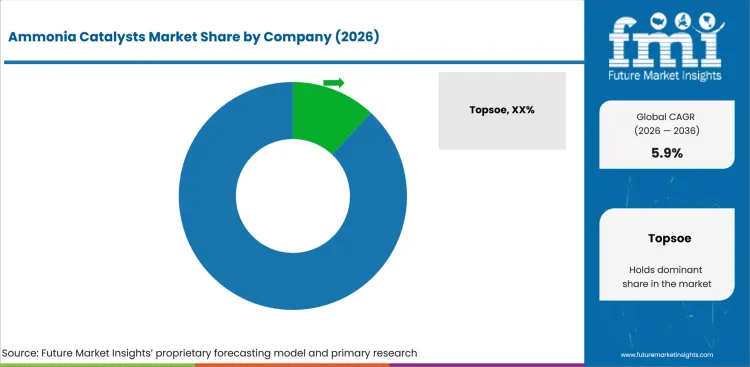
Topsoe, KBR, Johnson Matthey, thyssenkrupp Uhde, BASF, Clariant, Casale, and Sinopec Catalyst lead the competitive field.
- Integrated ammonia technology licensors hold an advantage when catalyst supply is tied to process guarantees and converter performance.
- Synthesis catalyst suppliers compete through campaign life, activation support, and proven operating references across large ammonia plants.
- Oxidation catalyst suppliers gain value when precious metal recovery, gauze management, and emissions control support are included.
- Ammonia cracking specialists can build premium positions by proving hydrogen purity, heat integration, and catalyst durability.
The competitive landscape is led by companies that combine catalyst chemistry with ammonia process knowledge. Topsoe and KBR have strong positions in green ammonia and ammonia cracking technology because they link proprietary catalysts with licensed process packages. Johnson Matthey and thyssenkrupp Uhde strengthen the market through integrated ammonia revamp and blue ammonia concepts. Buyers view these suppliers as lower-risk partners when catalyst performance must connect with converter hardware and plant guarantees.
Replacement markets create a separate contest around service responsiveness and catalyst campaign life. BASF, Clariant, Casale, and Sinopec Catalyst compete through chemistry depth, local relationships, and technical support. Mature ammonia plants often choose suppliers that can help during loading, activation, turnaround planning, and troubleshooting. This makes field service almost as important as material chemistry in repeat orders.
Emerging ammonia cracking and low-carbon ammonia projects are changing how suppliers position themselves. Companies with proven dynamic loop references, cracking technology, and project engineering support can reach early-stage specifications before procurement opens. Regional suppliers can win cost-sensitive replacement orders, but global licensors are better placed when new plants require bankable performance evidence. The strongest winners are expected to combine catalyst products, converter expertise, and fast technical support.
How do top ammonia catalysts companies compare?
Topsoe and KBR score strongest on ammonia technology depth, while Johnson Matthey and thyssenkrupp Uhde strengthen revamp and integrated low-carbon ammonia support.
| Company | Relevance to Market Title | Process Technology Depth | Catalyst Portfolio | Project / Service Support | Channel Reach | Geographic Footprint |
|---|---|---|---|---|---|---|
| Topsoe | Very High | Very Strong | Very Strong | Very Strong | Very Strong | Global |
| KBR | Very High | Very Strong | Strong | Very Strong | Very Strong | Global |
| Johnson Matthey | Very High | Strong | Very Strong | Strong | Strong | Global |
| thyssenkrupp Uhde | Very High | Very Strong | Moderate | Very Strong | Strong | Global |
| BASF Catalysts | High | Strong | Strong | Strong | Very Strong | Global |
| Clariant Catalysts | High | Strong | Strong | Strong | Strong | Global |
| Casale | High | Very Strong | Moderate | Strong | Moderate | Europe and Asia |
| Sinopec Catalyst | High | Strong | Strong | Strong | Strong | China and export markets |
| Linde Engineering | Moderate to High | Strong | Moderate | Strong | Strong | Global |
| Umicore catalyst service networks | Moderate | Moderate | Strong | Moderate | Moderate | Europe and global accounts |
Source: Future Market Insights competitive analysis, 2026.
Who are the key players in the ammonia catalysts market?
Topsoe, KBR, Johnson Matthey, thyssenkrupp Uhde, BASF, Clariant, Casale, and Sinopec Catalyst are listed with other suppliers and engineering-linked participants.
Key global companies leading the ammonia catalysts market include:
- Topsoe
- KBR
- Johnson Matthey
- thyssenkrupp Uhde
- BASF Catalysts
- Clariant Catalysts
- Casale
- Sinopec Catalyst
- Linde Engineering
- Umicore catalyst service networks
Key Developments in Ammonia Catalysts Market
- In June 2026, thyssenkrupp Uhde completed an ammonia converter cartridge and catalyst replacement for IGSAS in Turkey with Johnson Matthey, restoring the 1,200 mtpd nameplate capacity and achieving a 13% production increase.
- In May 2026, KBR reported that Japan’s first green ammonia plant based on its K-GreeN process was fully operational after commissioning in early 2026, with KBR licensing technology and providing proprietary equipment.
- In January 2026, Topsoe said it would support the Yanbu green ammonia project in Saudi Arabia by delivering dynamic ammonia technology, engineering, proprietary equipment, and catalysts.
Key Players in the Ammonia Catalysts Market
Synthesis and Loop Technology Leaders
- Topsoe
- KBR
- Casale
- thyssenkrupp Uhde
- Johnson Matthey
Oxidation and Precious Metal Specialists
- Johnson Matthey
- BASF Catalysts
- Clariant Catalysts
- Umicore catalyst service networks
Regional and Integrated Chemical Suppliers
- Sinopec Catalyst
- BASF Catalysts
- Clariant Catalysts
- KBR regional project teams
Ammonia Catalysts Market - Report Scope
| Parameter | Details |
|---|---|
| Forecast period | 2026 to 2036 |
| Historical period | 2021 to 2025 |
| Quantitative unit | Revenue in USD million |
| By catalyst type | Ammonia synthesis catalysts, ammonia oxidation catalysts, ammonia cracking catalysts, other |
| By chemistry | Iron-based, ruthenium-based, platinum group, mixed / other |
| By end use | Ammonia plants, nitric acid plants, ammonia cracking for H2, other |
| By sales mix | Replacement, new plants |
| By sales channel | Direct, EPC / OEM bundled |
| Regions covered | North America, Latin America, Western Europe, Eastern Europe, East Asia, South Asia and Pacific, Middle East and Africa |
| Countries covered | United States, United Kingdom, Germany, France, Japan, China, South Korea, India |
| Key companies profiled | Topsoe, KBR, Johnson Matthey, thyssenkrupp Uhde, BASF, Clariant, Casale, Sinopec Catalyst |
| Approach | Bottom-up catalyst-boundary approach using replacement cycles, plant capacity signals, project activity, catalyst pricing, and country-level adoption |
Source: Future Market Insights, 2026.
Ammonia Catalysts Market Breakdown by Catalyst Type, Chemistry, End Use, Sales Mix, Sales Channel, and Region
Ammonia Catalysts Market Segmented by Catalyst Type:
- Ammonia Synthesis Catalysts
- Ammonia Oxidation Catalysts
- Ammonia Cracking Catalysts
- Other
Ammonia Catalysts Market Segmented by Chemistry:
- Iron-based
- Ruthenium-based
- Platinum Group
- Mixed / Other
Ammonia Catalysts Market Segmented by End Use:
- Ammonia Plants
- Nitric Acid Plants
- Ammonia Cracking for H2
- Other
Ammonia Catalysts Market Segmented by Sales Mix:
- Replacement
- New Plants
Ammonia Catalysts Market Segmented by Sales Channel:
- Direct
- EPC / OEM Bundled
Ammonia Catalysts Market by Region:
- North America
- Latin America
- Western Europe
- Eastern Europe
- East Asia
- South Asia and Pacific
- Middle East and Africa
Research Sources and Bibliography
- U.S. Geological Survey. (2026, February). Mineral commodity summaries 2026: Nitrogen fixed ammonia. U.S. Geological Survey.
- U.S. Department of Energy. (2024, November 20). Biden-Harris administration announces awards for up to USD 2.2 billion for two Regional Clean Hydrogen Hubs. U.S. Department of Energy.
- U.S. Energy Information Administration. (2026, January 9). In 2025, U.S. natural gas spot prices increased from 2024’s record lows. U.S. Energy Information Administration.
- U.S. Energy Information Administration. (2026, June 3). Henry Hub natural gas spot price monthly data. U.S. Energy Information Administration.
- International Energy Agency. (2025, September). Breakthrough Agenda Report 2025: Hydrogen. International Energy Agency.
- International Energy Agency. (2025, September 12). Global Hydrogen Review 2025. International Energy Agency.
- International Energy Agency. (2025, September 5). Hydrogen Industry Development Plan 2021-2035: China. International Energy Agency.
- Topsoe. (2025, December 22). World’s first dynamic green ammonia plant starts operations in Denmark. Topsoe.
- Topsoe. (2026, January 27). Topsoe to support green ammonia flagship project in Saudi Arabia. Topsoe.
- KBR. (2025, April 15). KBR’s ammonia cracking technology selected by Hanwha for a hydrogen project in Korea. KBR.
- KBR. (2025, December 15). KBR awarded green ammonia project by IGNIS in Spain. KBR.
- KBR. (2026, May 14). Japan’s first green ammonia plant based on KBR’s K-GreeN process now fully operational. KBR.
- KBR. (2025, July 16). KBR awarded FEED contract for KEPPT’s fertilizer facility in Iraq. KBR.
- KBR. (2026, April). KBR response for modern-day challenges: Ammonia revamps. KBR.
- Thyssenkrupp Uhde. (2025, February 20). MOPCO to enhance sustainable urea and ammonia production with carbon capture and green ammonia solutions. thyssenkrupp Uhde.
- Thyssenkrupp Uhde. (2026, June 16). Efficiency boost: thyssenkrupp Uhde successfully completes ammonia converter cartridge and catalyst replacement for IGSAS. thyssenkrupp Uhde.
- Government of the United Kingdom. (2025, July). Hydrogen update to the market: July 2025. Department for Energy Security and Net Zero.
- Government of the United Kingdom. (2024, February 27). Hydrogen net zero investment roadmap. Department for Energy Security and Net Zero.
- Federal Ministry for Economic Affairs and Climate Action. (2024, July 24). Federal Cabinet adopts import strategy for hydrogen and hydrogen derivatives. Government of Germany.
- Federal Ministry for Economic Affairs and Energy. (2025, April 23). UK-Germany joint feasibility study on the trade of hydrogen. Government of Germany.
- Federal Court of Audit. (2025, October 28). Implementation of the Federal Government’s hydrogen strategy. Government of Germany.
- Government of France. (2025, September 30). National strategy for the development of decarbonised hydrogen in France. Government of France.
- European Commission. (2025, July 8). Hydrogen: Low-carbon hydrogen methodology. European Commission.
- France Hydrogene. (2025, April 16). France’s revised hydrogen strategy: A clear roadmap for the industry sector. France Hydrogene.
- Japan External Trade Organization. (2025, February 17). Japan’s hydrogen revolution attracts global players. Japan External Trade Organization.
- Ministry of Economy, Trade and Industry, Asian Development Bank, and Economic Research Institute for ASEAN and East Asia. (2025, October 1). Decarbonising Southeast Asia’s hard-to-abate and high-emission sectors. Ministry of Economy, Trade and Industry.
- CSIRO HyResource. (2025, August). Japan hydrogen policy and ammonia supply cost targets. CSIRO HyResource.
- Invest Korea. (2024, May 9). Korea setting its eyes on creating a clean hydrogen market. Korea Trade-Investment Promotion Agency.
- Ministry of Climate, Energy and Environment. (2026, June 8). Public notice of proposed 2026 hydrogen power generation bidding market volumes. Government of the Republic of Korea.
- Research Institute for Sustainability. (2025, December). Hydrogen strategies in Asia-Pacific economies and supply targets. Research Institute for Sustainability.
- National Bureau of Statistics of China. (2025, February 28). Statistical communiqué of the People’s Republic of China on the 2024 national economic and social development. National Bureau of Statistics of China.
- National Bureau of Statistics of China. (2026, February 28). Statistical communiqué of the People’s Republic of China on the 2025 national economic and social development. National Bureau of Statistics of China.
- Press Information Bureau. (2025, August 3). Empowering India’s farmers through strategic fertilizer policy. Government of India.
- Press Information Bureau. (2025, November 12). Unlocking India’s green hydrogen production potential. Government of India.
- Press Information Bureau. (2026, March 13). No shortage of chemical fertilizers. Government of India.
This bibliography is provided for reader reference and is not exhaustive. The full report contains the complete reference list and detailed citations.
Ammonia Catalysts Market - Scope & Definition
| Attribute | Detail |
|---|---|
| Market Definition | Process catalysts used in ammonia synthesis, ammonia oxidation, and ammonia cracking systems across industrial plants. |
| Functions Covered | Ammonia synthesis conversion, ammonia oxidation, ammonia decomposition, hydrogen generation, emissions-linked process support. |
| Applications Covered | Haber-Bosch synthesis loops, nitric acid oxidation systems, ammonia cracking for H2, catalyst replacement programs, and new ammonia plant packages. |
| End-Use Industries | Fertilizer production, nitric acid production, hydrogen carrier systems, chemical processing, and low-carbon ammonia projects. |
| Grades Covered | Iron-based, ruthenium-based, platinum group, and mixed catalyst systems used in industrial process environments. |
| Inclusions | Ammonia synthesis catalysts, ammonia oxidation catalysts, ammonia cracking catalysts, replacement sales, new plant sales, direct supply, and EPC or OEM bundled sales. |
| Exclusions | Generic refinery catalysts, laboratory-only catalysts, fertilizer additives, ammonia storage systems, ammonia detectors, and equipment without a catalyst charge. |
Ammonia Catalysts Market - Research Methodology
| Method | Description |
|---|---|
| Primary Research | FMI analyst interviews with ammonia producers, nitric acid plant operators, EPC engineers, catalyst suppliers, and procurement teams across selected markets. |
| Desk Research | Review of government fertilizer data, hydrogen policy sources, company technology references, plant literature, and process-catalyst documentation related to ammonia and nitrogen chemistry. |
| Market Sizing & Forecasting | Bottom-up catalyst-boundary approach using replacement cycles, plant capacity signals, project activity, catalyst pricing bands, segment shares, and country-level end-use differences. |
| Data Validation | Cross-verification using ammonia production capacity, low-carbon hydrogen project activity, company developments, public ammonia policy signals, and selected country demand indicators. |
This Report Answers
- Market size estimates for 2026 and forecasts through 2036 for the ammonia catalysts market.
- Insights across selected country-level markets including the United States, United Kingdom, Germany, France, Japan, China, South Korea, and India.
- Analysis of demand drivers, catalyst replacement cycles, technology adoption patterns, and purchasing behavior.
- Evaluation of key end-use groups and sales channels, including direct and EPC-bundled procurement.
- Assessment of low-carbon ammonia, ammonia cracking, and hydrogen carrier impacts on catalyst selection.
- Identification of opportunities across catalyst type, chemistry, end use, sales mix, and sales channel.
- Evaluation of supply chain dynamics, project licensing, catalyst support, and process technology partnerships.
- Country-level growth analysis covering all profiled countries and selected sub-regions.
- Assessment of the competitive landscape, including leading ammonia catalyst manufacturers and ammonia technology licensors.
- Analysis of customer decision factors including campaign life, poisoning resistance, converter support, and project references.
- Regional outlooks across North America, Europe, East Asia, South Asia and Pacific, and other global regions.
- Delivery of market data, forecasts, and supporting analysis in PDF and Excel formats.
Frequently Asked Questions
What is the growth prospect for ammonia catalysts?
Demand for ammonia catalysts is expected to rise at a steady pace as operating ammonia plants continue replacement programs and low-carbon projects add specification pressure.
Which companies are expected to shape the ammonia catalysts market?
Topsoe, KBR, Johnson Matthey, thyssenkrupp Uhde, BASF, Clariant, Casale, and Sinopec Catalyst are expected to shape market competition.
Why are leading catalyst companies investing in ammonia catalyst technologies?
Leading companies are investing in ammonia catalyst technologies to support longer campaign life, dynamic ammonia production, and hydrogen carrier applications.
Why are direct sales important in the ammonia catalysts market?
Direct sales are important because catalyst suppliers often support loading, activation, troubleshooting, and performance checks during plant turnarounds.
Which catalyst type is gaining attention in ammonia catalysts?
Ammonia synthesis catalysts remain the largest category, while cracking catalysts are gaining attention through hydrogen carrier applications.
How do low-carbon projects influence ammonia catalyst demand?
Low-carbon projects influence demand by requiring catalyst systems that can operate under flexible hydrogen supply and tighter process-performance guarantees.
Why is catalyst service important for ammonia producers?
Catalyst service is important because converter performance, pressure drop, poisoning risk, and shutdown timing affect plant output.
What role does ammonia cracking play in market development?
Ammonia cracking creates a future route for hydrogen production from ammonia carriers, making purity and catalyst durability important buying factors.
How do EPC channels support ammonia catalysts in new plants?
EPC channels support catalyst demand by bundling process technology, proprietary equipment, and catalyst packages within project specifications.
Preview the report firsthand - request a free sample
Get SampleGet the brochure for pricing and purchase details.
Get PDFTable of Content
- Executive Summary
- Global Market Outlook
- Demand to side Trends
- Supply to side Trends
- Technology Roadmap Analysis
- Analysis and Recommendations
- Market Overview
- Market Coverage / Taxonomy
- Market Definition / Scope / Limitations
- Research Methodology
- Chapter Orientation
- Analytical Lens and Working Hypotheses
- Market Structure, Signals, and Trend Drivers
- Benchmarking and Cross-market Comparability
- Market Sizing, Forecasting, and Opportunity Mapping
- Research Design and Evidence Framework
- Desk Research Programme (Secondary Evidence)
- Company Annual and Sustainability Reports
- Peer-reviewed Journals and Academic Literature
- Corporate Websites, Product Literature, and Technical Notes
- Earnings Decks and Investor Briefings
- Statutory Filings and Regulatory Disclosures
- Technical White Papers and Standards Notes
- Trade Journals, Industry Magazines, and Analyst Briefs
- Conference Proceedings, Webinars, and Seminar Materials
- Government Statistics Portals and Public Data Releases
- Press Releases and Reputable Media Coverage
- Specialist Newsletters and Curated Briefings
- Sector Databases and Reference Repositories
- FMI Internal Proprietary Databases and Historical Market Datasets
- Subscription Datasets and Paid Sources
- Social Channels, Communities, and Digital Listening Inputs
- Additional Desk Sources
- Expert Input and Fieldwork (Primary Evidence)
- Primary Modes
- Qualitative Interviews and Expert Elicitation
- Quantitative Surveys and Structured Data Capture
- Blended Approach
- Why Primary Evidence is Used
- Field Techniques
- Interviews
- Surveys
- Focus Groups
- Observational and In-context Research
- Social and Community Interactions
- Stakeholder Universe Engaged
- C-suite Leaders
- Board Members
- Presidents and Vice Presidents
- R&D and Innovation Heads
- Technical Specialists
- Domain Subject-matter Experts
- Scientists
- Physicians and Other Healthcare Professionals
- Governance, Ethics, and Data Stewardship
- Research Ethics
- Data Integrity and Handling
- Primary Modes
- Tooling, Models, and Reference Databases
- Desk Research Programme (Secondary Evidence)
- Data Engineering and Model Build
- Data Acquisition and Ingestion
- Cleaning, Normalisation, and Verification
- Synthesis, Triangulation, and Analysis
- Quality Assurance and Audit Trail
- Market Background
- Market Dynamics
- Drivers
- Restraints
- Opportunity
- Trends
- Scenario Forecast
- Demand in Optimistic Scenario
- Demand in Likely Scenario
- Demand in Conservative Scenario
- Opportunity Map Analysis
- Product Life Cycle Analysis
- Supply Chain Analysis
- Investment Feasibility Matrix
- Value Chain Analysis
- PESTLE and Porter’s Analysis
- Regulatory Landscape
- Regional Parent Market Outlook
- Production and Consumption Statistics
- Import and Export Statistics
- Market Dynamics
- Global Market Analysis 2021 to 2025 and Forecast, 2026 to 2036
- Historical Market Size Value (USD Million) Analysis, 2021 to 2025
- Current and Future Market Size Value (USD Million) Projections, 2026 to 2036
- Y to o to Y Growth Trend Analysis
- Absolute $ Opportunity Analysis
- Global Market Pricing Analysis 2021 to 2025 and Forecast 2026 to 2036
- Global Market Analysis 2021 to 2025 and Forecast 2026 to 2036, By Catalyst Type
- Introduction / Key Findings
- Historical Market Size Value (USD Million) Analysis By Catalyst Type , 2021 to 2025
- Current and Future Market Size Value (USD Million) Analysis and Forecast By Catalyst Type , 2026 to 2036
- Ammonia Synthesis Catalysts
- Ammonia Oxidation Catalysts
- Ammonia Cracking Catalysts
- Ammonia Synthesis Catalysts
- Y to o to Y Growth Trend Analysis By Catalyst Type , 2021 to 2025
- Absolute $ Opportunity Analysis By Catalyst Type , 2026 to 2036
- Global Market Analysis 2021 to 2025 and Forecast 2026 to 2036, By Chemistry
- Introduction / Key Findings
- Historical Market Size Value (USD Million) Analysis By Chemistry, 2021 to 2025
- Current and Future Market Size Value (USD Million) Analysis and Forecast By Chemistry, 2026 to 2036
- Iron-based
- Ruthenium-based
- Platinum Group
- Iron-based
- Y to o to Y Growth Trend Analysis By Chemistry, 2021 to 2025
- Absolute $ Opportunity Analysis By Chemistry, 2026 to 2036
- Global Market Analysis 2021 to 2025 and Forecast 2026 to 2036, By End Use
- Introduction / Key Findings
- Historical Market Size Value (USD Million) Analysis By End Use, 2021 to 2025
- Current and Future Market Size Value (USD Million) Analysis and Forecast By End Use, 2026 to 2036
- Ammonia Plants
- Nitric Acid Plants
- Ammonia Cracking for H2
- Ammonia Plants
- Y to o to Y Growth Trend Analysis By End Use, 2021 to 2025
- Absolute $ Opportunity Analysis By End Use, 2026 to 2036
- Global Market Analysis 2021 to 2025 and Forecast 2026 to 2036, By Sales Mix
- Introduction / Key Findings
- Historical Market Size Value (USD Million) Analysis By Sales Mix, 2021 to 2025
- Current and Future Market Size Value (USD Million) Analysis and Forecast By Sales Mix, 2026 to 2036
- Replacement
- New Plants
- Replacement
- Y to o to Y Growth Trend Analysis By Sales Mix, 2021 to 2025
- Absolute $ Opportunity Analysis By Sales Mix, 2026 to 2036
- Global Market Analysis 2021 to 2025 and Forecast 2026 to 2036, By Sales Channel
- Introduction / Key Findings
- Historical Market Size Value (USD Million) Analysis By Sales Channel, 2021 to 2025
- Current and Future Market Size Value (USD Million) Analysis and Forecast By Sales Channel, 2026 to 2036
- Direct
- EPC / OEM Bundled
- Direct
- Y to o to Y Growth Trend Analysis By Sales Channel, 2021 to 2025
- Absolute $ Opportunity Analysis By Sales Channel, 2026 to 2036
- Global Market Analysis 2021 to 2025 and Forecast 2026 to 2036, By Region
- Introduction
- Historical Market Size Value (USD Million) Analysis By Region, 2021 to 2025
- Current Market Size Value (USD Million) Analysis and Forecast By Region, 2026 to 2036
- North America
- Latin America
- Western Europe
- Eastern Europe
- East Asia
- South Asia and Pacific
- Middle East & Africa
- Market Attractiveness Analysis By Region
- North America Market Analysis 2021 to 2025 and Forecast 2026 to 2036, By Country
- Historical Market Size Value (USD Million) Trend Analysis By Market Taxonomy, 2021 to 2025
- Market Size Value (USD Million) Forecast By Market Taxonomy, 2026 to 2036
- By Country
- USA
- Canada
- Mexico
- By Catalyst Type
- By Chemistry
- By End Use
- By Sales Mix
- By Sales Channel
- By Country
- Market Attractiveness Analysis
- By Country
- By Catalyst Type
- By Chemistry
- By End Use
- By Sales Mix
- By Sales Channel
- Key Takeaways
- Latin America Market Analysis 2021 to 2025 and Forecast 2026 to 2036, By Country
- Historical Market Size Value (USD Million) Trend Analysis By Market Taxonomy, 2021 to 2025
- Market Size Value (USD Million) Forecast By Market Taxonomy, 2026 to 2036
- By Country
- Brazil
- Chile
- Rest of Latin America
- By Catalyst Type
- By Chemistry
- By End Use
- By Sales Mix
- By Sales Channel
- By Country
- Market Attractiveness Analysis
- By Country
- By Catalyst Type
- By Chemistry
- By End Use
- By Sales Mix
- By Sales Channel
- Key Takeaways
- Western Europe Market Analysis 2021 to 2025 and Forecast 2026 to 2036, By Country
- Historical Market Size Value (USD Million) Trend Analysis By Market Taxonomy, 2021 to 2025
- Market Size Value (USD Million) Forecast By Market Taxonomy, 2026 to 2036
- By Country
- Germany
- UK
- Italy
- Spain
- France
- Nordic
- BENELUX
- Rest of Western Europe
- By Catalyst Type
- By Chemistry
- By End Use
- By Sales Mix
- By Sales Channel
- By Country
- Market Attractiveness Analysis
- By Country
- By Catalyst Type
- By Chemistry
- By End Use
- By Sales Mix
- By Sales Channel
- Key Takeaways
- Eastern Europe Market Analysis 2021 to 2025 and Forecast 2026 to 2036, By Country
- Historical Market Size Value (USD Million) Trend Analysis By Market Taxonomy, 2021 to 2025
- Market Size Value (USD Million) Forecast By Market Taxonomy, 2026 to 2036
- By Country
- Russia
- Poland
- Hungary
- Balkan & Baltic
- Rest of Eastern Europe
- By Catalyst Type
- By Chemistry
- By End Use
- By Sales Mix
- By Sales Channel
- By Country
- Market Attractiveness Analysis
- By Country
- By Catalyst Type
- By Chemistry
- By End Use
- By Sales Mix
- By Sales Channel
- Key Takeaways
- East Asia Market Analysis 2021 to 2025 and Forecast 2026 to 2036, By Country
- Historical Market Size Value (USD Million) Trend Analysis By Market Taxonomy, 2021 to 2025
- Market Size Value (USD Million) Forecast By Market Taxonomy, 2026 to 2036
- By Country
- China
- Japan
- South Korea
- By Catalyst Type
- By Chemistry
- By End Use
- By Sales Mix
- By Sales Channel
- By Country
- Market Attractiveness Analysis
- By Country
- By Catalyst Type
- By Chemistry
- By End Use
- By Sales Mix
- By Sales Channel
- Key Takeaways
- South Asia and Pacific Market Analysis 2021 to 2025 and Forecast 2026 to 2036, By Country
- Historical Market Size Value (USD Million) Trend Analysis By Market Taxonomy, 2021 to 2025
- Market Size Value (USD Million) Forecast By Market Taxonomy, 2026 to 2036
- By Country
- India
- ASEAN
- Australia & New Zealand
- Rest of South Asia and Pacific
- By Catalyst Type
- By Chemistry
- By End Use
- By Sales Mix
- By Sales Channel
- By Country
- Market Attractiveness Analysis
- By Country
- By Catalyst Type
- By Chemistry
- By End Use
- By Sales Mix
- By Sales Channel
- Key Takeaways
- Middle East & Africa Market Analysis 2021 to 2025 and Forecast 2026 to 2036, By Country
- Historical Market Size Value (USD Million) Trend Analysis By Market Taxonomy, 2021 to 2025
- Market Size Value (USD Million) Forecast By Market Taxonomy, 2026 to 2036
- By Country
- Kingdom of Saudi Arabia
- Other GCC Countries
- Turkiye
- South Africa
- Other African Union
- Rest of Middle East & Africa
- By Catalyst Type
- By Chemistry
- By End Use
- By Sales Mix
- By Sales Channel
- By Country
- Market Attractiveness Analysis
- By Country
- By Catalyst Type
- By Chemistry
- By End Use
- By Sales Mix
- By Sales Channel
- Key Takeaways
- Key Countries Market Analysis
- USA
- Pricing Analysis
- Market Share Analysis, 2025
- By Catalyst Type
- By Chemistry
- By End Use
- By Sales Mix
- By Sales Channel
- Canada
- Pricing Analysis
- Market Share Analysis, 2025
- By Catalyst Type
- By Chemistry
- By End Use
- By Sales Mix
- By Sales Channel
- Mexico
- Pricing Analysis
- Market Share Analysis, 2025
- By Catalyst Type
- By Chemistry
- By End Use
- By Sales Mix
- By Sales Channel
- Brazil
- Pricing Analysis
- Market Share Analysis, 2025
- By Catalyst Type
- By Chemistry
- By End Use
- By Sales Mix
- By Sales Channel
- Chile
- Pricing Analysis
- Market Share Analysis, 2025
- By Catalyst Type
- By Chemistry
- By End Use
- By Sales Mix
- By Sales Channel
- Germany
- Pricing Analysis
- Market Share Analysis, 2025
- By Catalyst Type
- By Chemistry
- By End Use
- By Sales Mix
- By Sales Channel
- UK
- Pricing Analysis
- Market Share Analysis, 2025
- By Catalyst Type
- By Chemistry
- By End Use
- By Sales Mix
- By Sales Channel
- Italy
- Pricing Analysis
- Market Share Analysis, 2025
- By Catalyst Type
- By Chemistry
- By End Use
- By Sales Mix
- By Sales Channel
- Spain
- Pricing Analysis
- Market Share Analysis, 2025
- By Catalyst Type
- By Chemistry
- By End Use
- By Sales Mix
- By Sales Channel
- France
- Pricing Analysis
- Market Share Analysis, 2025
- By Catalyst Type
- By Chemistry
- By End Use
- By Sales Mix
- By Sales Channel
- India
- Pricing Analysis
- Market Share Analysis, 2025
- By Catalyst Type
- By Chemistry
- By End Use
- By Sales Mix
- By Sales Channel
- ASEAN
- Pricing Analysis
- Market Share Analysis, 2025
- By Catalyst Type
- By Chemistry
- By End Use
- By Sales Mix
- By Sales Channel
- Australia & New Zealand
- Pricing Analysis
- Market Share Analysis, 2025
- By Catalyst Type
- By Chemistry
- By End Use
- By Sales Mix
- By Sales Channel
- China
- Pricing Analysis
- Market Share Analysis, 2025
- By Catalyst Type
- By Chemistry
- By End Use
- By Sales Mix
- By Sales Channel
- Japan
- Pricing Analysis
- Market Share Analysis, 2025
- By Catalyst Type
- By Chemistry
- By End Use
- By Sales Mix
- By Sales Channel
- South Korea
- Pricing Analysis
- Market Share Analysis, 2025
- By Catalyst Type
- By Chemistry
- By End Use
- By Sales Mix
- By Sales Channel
- Russia
- Pricing Analysis
- Market Share Analysis, 2025
- By Catalyst Type
- By Chemistry
- By End Use
- By Sales Mix
- By Sales Channel
- Poland
- Pricing Analysis
- Market Share Analysis, 2025
- By Catalyst Type
- By Chemistry
- By End Use
- By Sales Mix
- By Sales Channel
- Hungary
- Pricing Analysis
- Market Share Analysis, 2025
- By Catalyst Type
- By Chemistry
- By End Use
- By Sales Mix
- By Sales Channel
- Kingdom of Saudi Arabia
- Pricing Analysis
- Market Share Analysis, 2025
- By Catalyst Type
- By Chemistry
- By End Use
- By Sales Mix
- By Sales Channel
- Turkiye
- Pricing Analysis
- Market Share Analysis, 2025
- By Catalyst Type
- By Chemistry
- By End Use
- By Sales Mix
- By Sales Channel
- South Africa
- Pricing Analysis
- Market Share Analysis, 2025
- By Catalyst Type
- By Chemistry
- By End Use
- By Sales Mix
- By Sales Channel
- USA
- Market Structure Analysis
- Competition Dashboard
- Competition Benchmarking
- Market Share Analysis of Top Players
- By Regional
- By Catalyst Type
- By Chemistry
- By End Use
- By Sales Mix
- By Sales Channel
- Competition Analysis
- Competition Deep Dive
- Topsoe
- Overview
- Product Portfolio
- Profitability by Market Segments (Product/Age /Sales Channel/Region)
- Sales Footprint
- Strategy Overview
- Marketing Strategy
- Product Strategy
- Channel Strategy
- KBR
- Johnson Matthey
- thyssenkrupp Uhde
- BASF Catalysts
- Clariant Catalysts
- Topsoe
- Competition Deep Dive
- Assumptions & Acronyms Used


