

- Market Size (2026)
- USD 2140.7 Mn
- Forecast (2036)
- USD 4056.3 Mn
- CAGR (2026 to 2036)
- 6.6%
Methanol Catalysts Market Size, Market Forecast and Outlook By FMI
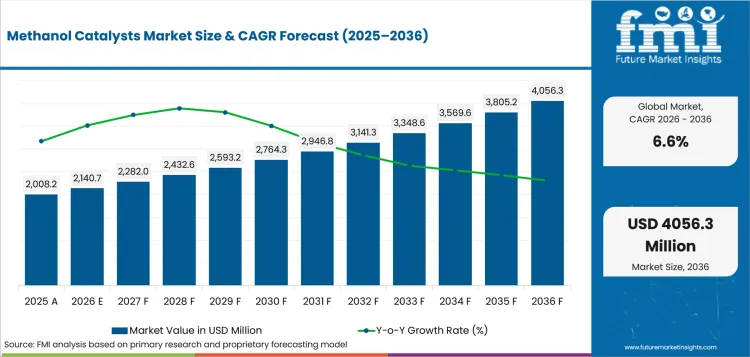
USD 2,140.7 million in 2026 and USD 4,056.3 million by 2036 at a 6.6% CAGR.
The methanol catalysts market is expected to grow from USD 2,008.2 million in 2025 to USD 4,056.3 million by 2036 at 6.6% CAGR. Methanol synthesis catalysts are forecast to represent 46.0% share in 2026. Cu / Zn / Al chemistry is estimated to hold 63.0% share in 2026. Replacement sales are expected to secure 68.0% share in 2026, led by planned catalyst changeouts and output-risk management.
| Metric | Value |
|---|---|
| 2026 Market Size | USD 2,140.7 million |
| 2036 Market Size | USD 4,056.3 million |
| Forecast CAGR | 6.6% from 2026 to 2036 |
| Leading Catalyst Type | Methanol Synthesis Catalysts |
| Methanol Synthesis Catalysts Share in 2026 | 46.0% |
| Leading Chemistry | Cu / Zn / Al |
| Cu / Zn / Al Share in 2026 | 63.0% |
| Fastest-growing Country | China |
| China CAGR | 7.4% by 2036 |
| Market Signal | Commercial Impact |
|---|---|
| Demand and Growth Drivers | Methanol catalyst demand is expanding through replacement cycles while e-methanol projects create new opportunities for advanced catalyst technologies.
|
| Product and Segment View | Methanol synthesis catalysts, Cu/Zn/Al chemistry, commodity methanol production, and replacement sales lead their respective market segments.
|
| Geography and Growth Outlook | China and India are expected to remain the key growth markets for methanol catalysts.
|
| Competitive Landscape | Competition is shifting toward catalyst performance, process optimization, and support for low-carbon methanol production.
|
| Analyst Perspective | Methanol catalyst selection is increasingly driven by operational reliability and the transition toward low-carbon production pathways.
- Nikhil Kaitwade, Principa Analyst at Future Market Insights |
Catalyst buying is moving from routine replacement toward reactor performance checks and feedstock-specific validation. The USA Department of Energy describes methanol production through synthesis gas and a reactor catalyst. Methanol Institute reported in March 2026 that 263 renewable methanol projects were tracked globally. BASF launched SYNSPIRE Methanol ZERO commercially in 2024 for eMethanol using CO2 and green hydrogen. Clariant announced in April 2025 that MegaMax 900 started at European Energy’s e-methanol plant in Denmark. These developments make activity retention and feed cleanup central to supplier selection.
Which factors support expansion in the methanol catalysts market?
Replacement cycles and CO2-to-methanol project screening support market value across conventional and low-carbon methanol routes.
- Market value is supported by replacement catalyst charges that protect plant output during long operating cycles.
- Buyer spending improves when catalyst suppliers connect activity retention with lower operating risk.
- E-methanol project screening is expected to add demand for catalysts tested against water-rich synthesis conditions.
- MTO / MTP conversion demand is expected to keep methanol conversion catalyst buying active beyond synthesis plants.
Why is the methanol catalysts market growing?
Methanol producers are giving catalyst performance more weight in plant economics and shutdown planning.
Growth outlook is expected to be driven by two buying patterns. Existing plants need replacement catalyst loads when activity loss raises energy use and lowers conversion. Low-carbon projects need catalysts that can tolerate CO2-rich feeds and variable hydrogen supply. Methanol Institute reported 263 renewable methanol projects with 48.5 Mt of announced capacity by 2031. This project list does not convert into immediate catalyst orders. It shows why supplier development is focused on dynamic operation and water-rich synthesis duty.
How is the methanol catalysts market segmented?
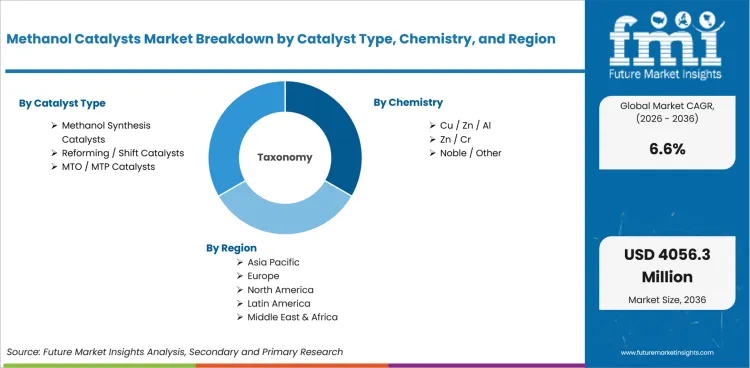
The methanol catalysts industry is segmented by catalyst type, chemistry, feedstock route, end use and sales mix.
- Methanol synthesis catalysts are projected to account for 46.0% share in 2026, led by direct impact on conversion and output stability.
- Cu / Zn / Al chemistry is anticipated to hold 63.0% share in 2026, supported by established low-pressure synthesis use.
- Natural Gas is forecast to represent 54.0% feedstock route share in 2026, guided by reforming-based methanol production.
- Commodity methanol is expected to secure 49.0% end-use share in 2026, driven by bulk units with recurring catalyst needs.
- Replacement is estimated to account for 68.0% sales mix share in 2026, reflecting scheduled changeouts at existing plants.
Why do methanol synthesis catalysts dominate the methanol catalysts market?
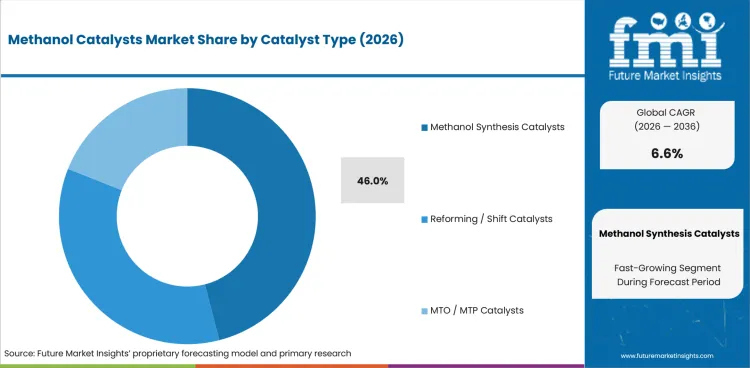
- Methanol synthesis catalysts are projected to account for 46.0% share in 2026, with conversion control keeping them ahead of other catalyst groups.
- Reforming and shift catalysts retain value through feed preparation that protects the downstream synthesis bed.
Which chemistry leads the methanol catalysts market?
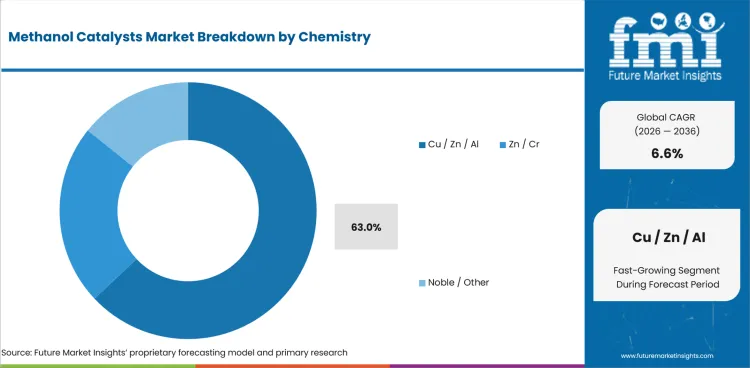
- Cu / Zn / Al chemistry is forecast to hold 63.0% share in 2026 through established use in low-pressure synthesis loops.
- Zn / Cr systems remain relevant where buyers need specific operating tolerance and older route compatibility.
Which feedstock route leads the methanol catalysts market?
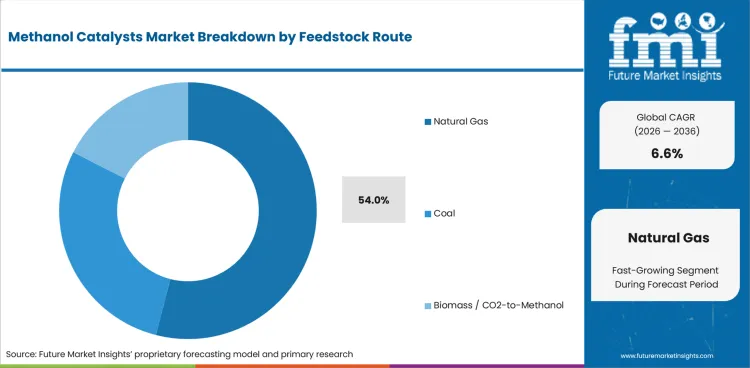
- Natural Gas is projected to account for 54.0% share in 2026 through reforming-based methanol production.
- Biomass / CO2-to-Methanol gains attention when project developers test renewable methanol and fuel offtake options.
Which end use leads the methanol catalysts market?
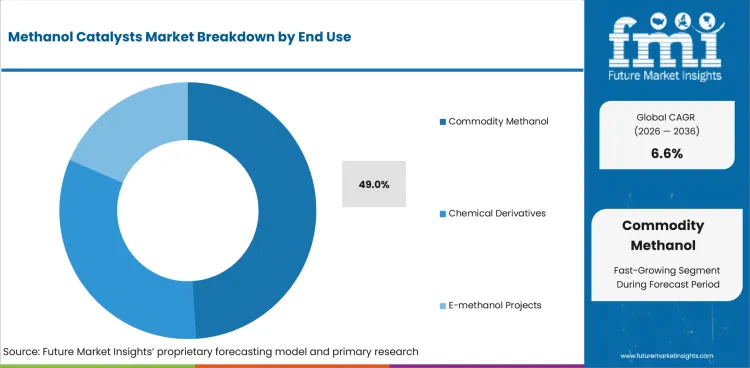
- Commodity methanol is anticipated to represent 49.0% share in 2026 through high-volume plants and recurring replacement cycles.
- E-methanol projects create higher technical screening demand for CO2-rich feeds and water tolerance.
Which sales mix leads the methanol catalysts market?
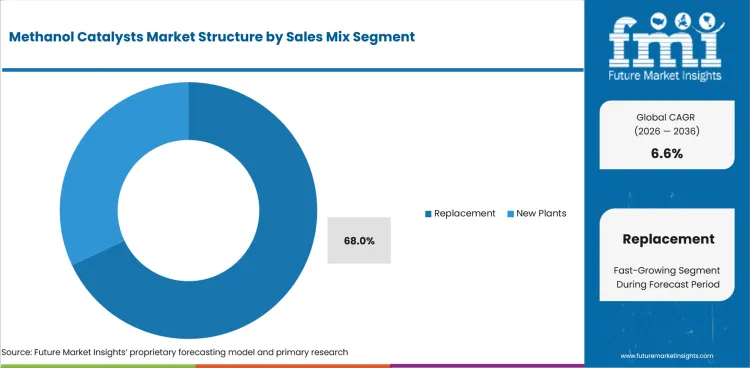
- Replacement sales are expected to hold 68.0% share in 2026 through catalyst activity loss and planned turnaround buying.
- New plant catalyst loads are likely to gain value when e-methanol projects reach final investment and engineering closure.
What are the drivers, restraints and opportunities in the methanol catalysts market?
Reactor productivity and e-methanol screening support growth while feed impurity and project cost limit buyer decisions.
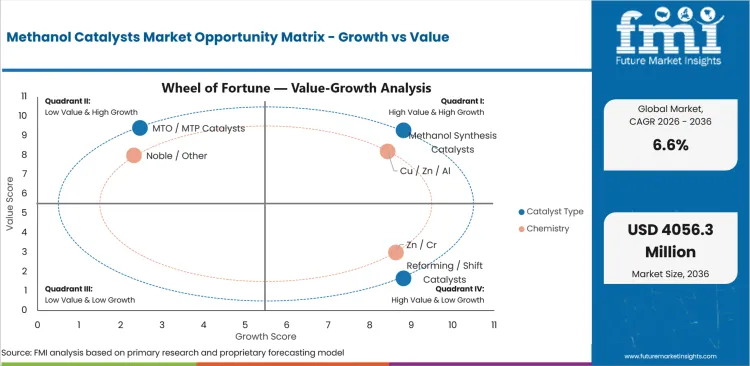
- Driver: Synthesis-loop efficiency is expected to increase catalyst demand by linking activity retention with output and energy cost.
- Restraint: Feed impurity risk can shorten catalyst life when sulfur and chlorine cleanup remains weak.
- Opportunity: CO2-to-methanol projects are expected to create demand for grades that tolerate water-rich operation.
How does synthesis-loop productivity support catalyst replacement?
Catalyst activity has a direct effect on conversion and loop pressure. Clariant states that MegaMax 900 can provide up to 18% higher relative activity than the previous generation under its test conditions. Buyers use this type of evidence to compare lifetime output and shutdown risk. Supplier value is strongest when the activity claim is supported by field references and loading service.
Why do CO2-rich feeds change catalyst selection?
CO2-to-methanol projects change the water balance inside the reactor. BASF identifies SYNSPIRE Methanol ZERO as commercially launched in 2024 for eMethanol from CO2 and green hydrogen. This turns hydrothermal stability into a buying requirement instead of a technical extra. Suppliers with proof under variable feed conditions are expected to gain better project access.
Why does feed cleanup restrain supplier switching?
Methanol synthesis beds are sensitive to upstream contamination. Axens highlights syngas purification needs for sulfur compounds and mercury in trace contaminant removal. Weak cleanup can shorten catalyst life and reduce buyer trust in a new supplier. Integrated cleanup and synthesis support therefore becomes a practical advantage.
Who are the leading companies in the methanol catalysts market?
Synthesis catalyst leaders and syngas technology firms shape the competitive structure of this market.
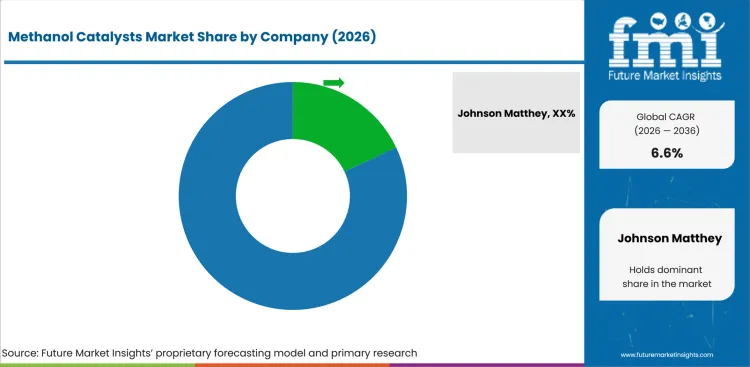
- Johnson Matthey and Topsoe compete through synthesis catalyst depth and route-specific technical support.
- BASF and Clariant stand out through e-methanol catalyst launches and startup evidence from 2024 onward.
- Axens and Shell Catalysts & Technologies support the adjacent syngas cleanup and guard-bed layer.
- Sinopec Catalyst gains relevance in China through methanol-to-olefin conversion applications.
Competition is centered on plant reliability over catalog breadth. Johnson Matthey and Topsoe hold strong positions through synthesis loop experience and technical service during shutdowns. BASF and Clariant are better placed in e-methanol discussions that require CO2-rich operation and water tolerance proof.
Syngas cleanup creates a second competitive layer. Axens and Shell Catalysts & Technologies are relevant where feed impurities can damage downstream synthesis catalysts. Buyers with complex feedstocks often prefer suppliers that explain cleanup and synthesis performance together.
Regional suppliers can win selective accounts when local service and price control carry more weight than global references. Sinopec Catalyst is relevant in China through SMTO activity. New entrants need field trials and credible service teams ahead of buyer acceptance in large synthesis loops.
Key Developments in Methanol Catalysts Market
- In January 2024, BASF and Envision Energy entered a collaboration to support green hydrogen and CO2 conversion into e-methanol. The collaboration supports catalyst demand for dynamic e-methanol process design.
- In April 2025, Clariant announced that MegaMax 900 started at European Energy’s e-methanol plant in Denmark. The facility targets up to 42,000 tons of green methanol annually.
- In October 2025, Topsoe signed an agreement to provide SOEC technology for Forestal’s Triskelion e-methanol plant. The agreement strengthened the project’s hydrogen-to-methanol route.
Which countries are growing rapidly in the methanol catalysts market?
China 7.4% CAGR, India 7.2% CAGR, South Korea 6.9% CAGR, United States 6.5% CAGR, Japan 6.4% CAGR, Germany 6.3% CAGR, France 6.0% CAGR, and United Kingdom 5.8% CAGR through 2036.
.webp "Top Country Growth Comparison Methanol Catalysts Market Cagr (2026 2036)")
| Country | CAGR |
|---|---|
| China | 7.4% |
| India | 7.2% |
| South Korea | 6.9% |
| United States | 6.5% |
| Japan | 6.4% |
| Germany | 6.3% |
| France | 6.0% |
| United Kingdom | 5.8% |
Source: Future Market Insights, 2026.
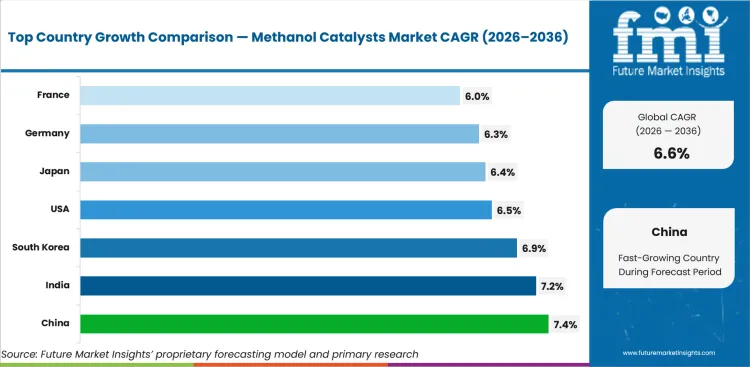
How do country-level CAGRs compare in the methanol catalysts market?
China leads the country outlook while the United Kingdom records the most selective growth pattern among the profiled markets.
- China is forecast to record 7.4% CAGR by 2036, driven by coal-to-methanol and MTO catalyst demand.
- India is projected to expand at 7.2% CAGR during the forecast period, supported by hydrogen and port fuel project screening.
- South Korea is estimated to grow at 6.9% CAGR over the assessment period, guided by shipbuilding and marine fuel planning.
- The United States is expected to advance at 6.5% CAGR by the end of 2036, led by gas-based methanol and Gulf Coast replacement cycles.
- Japan is forecast to reach 6.4% CAGR across the forecast decade through trading-house influence and e-fuel project participation.
- Germany is projected to post 6.3% CAGR during 2026 to 2036, supported by hydrogen network planning and chemical clusters.
- France is expected to rise at 6.0% CAGR over the ten-year period, led by syngas cleanup expertise and selective low-carbon projects.
- The United Kingdom is anticipated to grow at 5.8% CAGR by 2036 through technology support and project screening demand.
How fast is the methanol catalysts market growing in China?
A 7.4% CAGR through 2036 reflects coal-based methanol scale and MTO catalyst demand.
Country Market Snapshot Table
| Parameter | Value |
|---|---|
| Market Size in 2025 (Value) | USD 484.2 million |
| Market Size in 2026 (Value) | USD 520.0 million |
| Market Forecast in 2036 (Value) | USD 1061.8 million |
| CAGR (2026 to 2036) | 7.4% |
| Years Considered | 2021 to 2036 |
| Base Year | 2025 |
| Forecast Period | 2026 to 2036 |
| Units Considered | Value (USD million) |
| Leading Sub-Region | Shandong and Inner Mongolia coal chemical clusters |
China Methanol Catalysts Market Outlook
China demand is anchored in coal-based methanol and downstream olefin conversion. State chemical groups keep catalyst procurement close to production reliability and service response.
Catalyst suppliers must support synthesis beds and gas cleanup under high-throughput plant conditions. Buyers are expected to reward local service and field evidence during replacement cycles.
Key Growth Drivers
- Coal-based methanol keeps synthesis and cleanup catalyst demand active. Zhengzhou Commodity Exchange stated in March 2024 that coal-made methanol represented 75.0% of China’s methanol production capacity in 2023.
- Industrial output gives local buyers a broad chemical production base. China’s National Bureau of Statistics reported that raw chemical materials and chemical products output rose 9.4% in December 2024.
- MTO and MTP units are expected to keep conversion catalyst demand active for olefin chains.
- Local service coverage is attributable to large chemical clusters that need quick support during catalyst changeouts.
Key Restraints
- Coal route emissions can slow new project approvals. China’s National Bureau of Statistics reported 4.78 billion tons of coal output in 2024.
- Price competition can limit premium catalyst adoption when field data does not show clear output gains.
- State procurement can extend supplier approval timelines for new catalyst grades.
What makes China unique
China is unique for coal-to-methanol scale and MTO units that create synthesis and conversion catalyst demand.
Key Companies
- Sinopec Catalyst
- China National Chemical Engineering
- Wison Engineering
- Johnson Matthey
- Topsoe
- BASF
- Clariant
Sales & Marketing Channels
- Direct sales to chemical groups
- State procurement channels
- Local technical service networks
- EPC and licensor packages
- Distributor support for regional plants
Country Segment Breakdown Table
| Segment | Sub-Segments |
|---|---|
| By Catalyst Type | Methanol Synthesis Catalysts · Reforming / Shift Catalysts · MTO / MTP Catalysts · Other |
| By Chemistry | Cu / Zn / Al · Zn / Cr · Noble / Other |
| By Feedstock Route | Natural Gas · Coal · Biomass / CO2-to-Methanol |
| By End Use | Commodity Methanol · Chemical Derivatives · E-methanol Projects · Other |
| By Sales Mix | Replacement · New Plants |
| Key Sub-Regions Covered, Shandong Corridors | Shandong and Inner Mongolia coal chemical clusters |
Frequently Asked Questions
How fast is China methanol catalysts market growing?
A 7.4% CAGR through 2036 reflects coal-based methanol scale and MTO catalyst demand.
Who leads China methanol catalysts market?
The listed Chinese and global suppliers compete through catalyst portfolios and local service channels.
What is driving adoption in China methanol catalysts market?
Coal-based methanol keeps synthesis and cleanup catalyst demand active across replacement cycles.
What is driving methanol catalyst growth in India?
A 7.2% CAGR through 2036 reflects hydrogen policy and port fuel project screening.
Country Market Snapshot Table
| Parameter | Value |
|---|---|
| Market Size in 2025 (Value) | USD 172.6 million |
| Market Size in 2026 (Value) | USD 185.0 million |
| Market Forecast in 2036 (Value) | USD 370.8 million |
| CAGR (2026 to 2036) | 7.2% |
| Years Considered | 2021 to 2036 |
| Base Year | 2025 |
| Forecast Period | 2026 to 2036 |
| Units Considered | Value (USD million) |
| Leading Sub-Region | Gujarat ports and western chemical corridors |
India Methanol Catalysts Market Outlook
India demand is moving from conventional chemical buying toward port fuel and hydrogen project planning. Public buyers and EPC firms are expected to influence early catalyst package selection.
Supplier shortlists will favor firms that can explain CO2-to-methanol performance in plain operating terms. Cost control remains central with hydrogen economics still deciding project timing.
Key Growth Drivers
- Green hydrogen policy supports future CO2-to-methanol screening. India’s Ministry of New and Renewable Energy reported in May 2025 that incentives covered 862,000 tonnes per annum of green hydrogen production capacity.
- Electrolyzer capacity gives project developers a stronger domestic equipment base. PIB reported in December 2025 that 15 companies received 3,000 MW per annum of electrolyzer manufacturing awards.
- Port-led clean fuel plans are expected to create demand for new plant catalyst packages.
- Public-sector buying is expected to help validated suppliers move from feasibility studies into commercial tenders.
Key Restraints
- Hydrogen cost remains a direct limit on e-methanol project approval. India’s Green Hydrogen Certification Scheme set a 5 MMT annual green hydrogen capacity target for 2030 in April 2025.
- Domestic supplier evidence remains limited for high-performance methanol synthesis catalysts.
- CO2 sourcing and offtake certainty can slow final investment decisions for port fuel projects.
What makes India unique
India is unique for green shipping policy and public-sector routes that can convert fuel planning into catalyst package demand.
Key Companies
- Engineers India Limited
- Thermax
- Larsen & Toubro
- Johnson Matthey
- Topsoe
- BASF
- Clariant
Sales & Marketing Channels
- Public-sector procurement
- Port authority projects
- EPC partnerships
- Direct enterprise sales
- Technology licensor packages
Country Segment Breakdown Table
| Segment | Sub-Segments |
|---|---|
| By Catalyst Type | Methanol Synthesis Catalysts · Reforming / Shift Catalysts · MTO / MTP Catalysts · Other |
| By Chemistry | Cu / Zn / Al · Zn / Cr · Noble / Other |
| By Feedstock Route | Natural Gas · Coal · Biomass / CO2-to-Methanol |
| By End Use | Commodity Methanol · Chemical Derivatives · E-methanol Projects · Other |
| By Sales Mix | Replacement · New Plants |
| Key Sub-Regions Covered, Gujarat Corridors | Gujarat ports and western chemical corridors |
Frequently Asked Questions
How fast is India methanol catalysts market growing?
A 7.2% CAGR through 2036 reflects hydrogen policy and port fuel project screening.
Who leads India methanol catalysts market?
The listed Indian and global suppliers compete through project access and local service channels.
What is driving adoption in India methanol catalysts market?
Green hydrogen policy supports future CO2-to-methanol screening and catalyst package evaluation.
How is the methanol catalysts market performing in South Korea?
A 6.9% CAGR through 2036 reflects shipbuilding influence and methanol fuel planning.
Country Market Snapshot Table
| Parameter | Value |
|---|---|
| Market Size in 2025 (Value) | USD 126.3 million |
| Market Size in 2026 (Value) | USD 135.0 million |
| Market Forecast in 2036 (Value) | USD 263.1 million |
| CAGR (2026 to 2036) | 6.9% |
| Years Considered | 2021 to 2036 |
| Base Year | 2025 |
| Forecast Period | 2026 to 2036 |
| Units Considered | Value (USD million) |
| Leading Sub-Region | Ulsan and Busan marine fuel corridors |
South Korea Methanol Catalysts Market Outlook
Large domestic methanol output is not the main demand anchor in South Korea. Shipbuilding and marine fuel planning shape low-carbon fuel offtake and catalyst project timing.
Chemical buyers still need reliable imported methanol and derivative feedstock continuity. This makes catalyst quality and fuel supply confidence part of the same buying discussion.
Key Growth Drivers
- Shipbuilding scale supports methanol fuel supply chains. OECD reported in April 2026 that Korea accounted for about 27.0% of global ship completions in 2024.
- Project finance and marine fuel readiness are expected to support e-methanol demand. Korea’s cultural service reported 11.26 million CGT in ship completions for 2025.
- Hydrogen planning is expected to create links between green hydrogen and e-methanol project screening.
- Chemical users need reliable imported methanol and derivative feedstock continuity for downstream production.
Key Restraints
- Domestic low-carbon methanol output remains limited against potential fuel demand. The USA International Trade Administration reported about 400 hydrogen refueling stations in Korea in early 2025.
- Green methanol price risk can delay buyer commitments when conventional marine fuels remain cheaper.
- Long qualification cycles can slow catalyst switching in chemical plants and ship-fuel projects.
What makes South Korea unique
South Korea is unique for shipyards and marine fuel buyers that influence methanol supply plans beyond local methanol output.
Key Companies
- HD Hyundai Heavy Industries
- Samsung Heavy Industries
- Hanwha Ocean
- Lotte Chemical
- Johnson Matthey
- Topsoe
- BASF
Sales & Marketing Channels
- Shipyard fuel projects
- Direct industrial procurement
- Port fuel consortiums
- Technology licensor packages
- Trading and import channels
Country Segment Breakdown Table
| Segment | Sub-Segments |
|---|---|
| By Catalyst Type | Methanol Synthesis Catalysts · Reforming / Shift Catalysts · MTO / MTP Catalysts · Other |
| By Chemistry | Cu / Zn / Al · Zn / Cr · Noble / Other |
| By Feedstock Route | Natural Gas · Coal · Biomass / CO2-to-Methanol |
| By End Use | Commodity Methanol · Chemical Derivatives · E-methanol Projects · Other |
| By Sales Mix | Replacement · New Plants |
| Key Sub-Regions Covered, Ulsan Corridors | Ulsan and Busan marine fuel corridors |
Frequently Asked Questions
How fast is South Korea methanol catalysts market growing?
A 6.9% CAGR through 2036 reflects shipbuilding influence and methanol fuel planning.
Who leads South Korea methanol catalysts market?
The listed Korean industrial groups compete through project access and marine fuel channels.
What is driving adoption in South Korea methanol catalysts market?
Shipbuilding scale supports methanol fuel planning and catalyst package screening.
What is the methanol catalysts market outlook in the United States?
A 6.5% CAGR through 2036 reflects gas-based methanol capacity and Gulf Coast replacement cycles.
Country Market Snapshot Table
| Parameter | Value |
|---|---|
| Market Size in 2025 (Value) | USD 352.1 million |
| Market Size in 2026 (Value) | USD 375.0 million |
| Market Forecast in 2036 (Value) | USD 703.9 million |
| CAGR (2026 to 2036) | 6.5% |
| Years Considered | 2021 to 2036 |
| Base Year | 2025 |
| Forecast Period | 2026 to 2036 |
| Units Considered | Value (USD million) |
| Leading Sub-Region | Gulf Coast methanol and syngas corridor |
United States Methanol Catalysts Market Outlook
United States demand is supported by gas-based methanol assets and replacement buying along the Gulf Coast. Buyers often approve catalysts through direct technical sales and planned turnaround budgets.
Low-carbon fuel pilots are expected to add screening work for CO2-rich synthesis systems. Commercial orders will depend on offtake quality and stable project economics.
Key Growth Drivers
- Gas-based methanol remains supported by domestic feedstock strength. EIA reported in March 2026 that USA marketed natural gas production averaged 118.5 Bcf per day in 2025.
- Export energy scale supports Gulf Coast chemical production and methanol logistics. EIA reported in August 2025 that the United States exported about 30.0% of domestic primary energy production in 2024.
- DOE marine fuel research is expected to keep methanol visible in clean fuel planning.
- Direct supplier service is expected to support replacement catalyst buying during planned shutdowns.
Key Restraints
- Project risk can slow new e-methanol catalyst loads. DOE reported in January 2025 a USD 1.66 billion loan guarantee for clean hydrogen production.
- Permitting and offtake reviews can delay final plant orders for low-carbon methanol projects.
- Buyers may avoid supplier changes when the existing catalyst has acceptable field performance.
What makes United States unique
The United States is unique for large gas access and supplier support that reduce exposure to overseas logistics.
Key Companies
- Johnson Matthey
- BASF
- Topsoe
- Clariant
- Linde Engineering
- KBR
- Shell Catalysts & Technologies
Sales & Marketing Channels
- Direct enterprise sales
- Technology licensor packages
- EPC and process engineering channels
- Planned turnaround procurement
- Distributor support for smaller chemical plants
Country Segment Breakdown Table
| Segment | Sub-Segments |
|---|---|
| By Catalyst Type | Methanol Synthesis Catalysts · Reforming / Shift Catalysts · MTO / MTP Catalysts · Other |
| By Chemistry | Cu / Zn / Al · Zn / Cr · Noble / Other |
| By Feedstock Route | Natural Gas · Coal · Biomass / CO2-to-Methanol |
| By End Use | Commodity Methanol · Chemical Derivatives · E-methanol Projects · Other |
| By Sales Mix | Replacement · New Plants |
| Key Sub-Regions Covered, Gulf Corridors | Gulf Coast methanol and syngas corridor |
Frequently Asked Questions
How fast is United States methanol catalysts market growing?
A 6.5% CAGR through 2036 reflects gas-based methanol capacity and Gulf Coast replacement cycles.
Who leads United States methanol catalysts market?
The listed USA suppliers compete through catalyst portfolios and technical service channels.
What is driving adoption in United States methanol catalysts market?
Gas-based methanol supports replacement demand through Gulf Coast feedstock strength.
How fast is Japan methanol catalysts market growing?
A 6.4% CAGR through 2036 reflects trading-house influence and careful supplier qualification.
Country Market Snapshot Table
| Parameter | Value |
|---|---|
| Market Size in 2025 (Value) | USD 159.8 million |
| Market Size in 2026 (Value) | USD 170.0 million |
| Market Forecast in 2036 (Value) | USD 316.1 million |
| CAGR (2026 to 2036) | 6.4% |
| Years Considered | 2021 to 2036 |
| Base Year | 2025 |
| Forecast Period | 2026 to 2036 |
| Units Considered | Value (USD million) |
| Leading Sub-Region | Tokyo Bay and Kansai chemical import corridors |
Japan Methanol Catalysts Market Outlook
Japan demand reflects careful supplier approval and overseas project participation. Trading houses can influence methanol offtake even when local production capacity is selective.
Catalyst suppliers need strong service support and stable performance evidence. Marine fuel planning makes CO2-to-methanol expertise more useful to Japanese buyers.
Key Growth Drivers
- Hydrogen supply planning supports e-fuel screening. Japan’s 2025 Strategic Energy Plan retained a 12 million ton annual hydrogen target for 2040.
- Price-gap support can help early hydrogen derivative projects. Japan’s 2025 Strategic Energy Plan described about 3 trillion yen in support for low-carbon hydrogen supply chains.
- Japanese trading houses are expected to support overseas e-methanol offtake and project participation.
- Chemical producers maintain quality-led procurement standards for synthesis and cleanup catalysts.
Key Restraints
- Import dependence can raise feedstock and fuel supply risk. Japan’s 2025 Strategic Energy Plan cited a 3 million ton annual hydrogen target for 2030.
- Supplier approval cycles remain long for high-risk catalyst changes.
- Local methanol catalyst volume is narrower than China or the United States due to limited domestic feedstock scale.
What makes Japan unique
Japan is unique for trading houses that influence overseas e-methanol projects and fuel offtake decisions.
Key Companies
- Mitsui & Co.
- Mitsubishi Corporation
- ENEOS
- IHI
- Johnson Matthey
- Topsoe
- Clariant
Sales & Marketing Channels
- Trading house relationships
- Direct enterprise sales
- Licensor-backed projects
- Ship fuel consortium channels
- Chemical producer procurement
Country Segment Breakdown Table
| Segment | Sub-Segments |
|---|---|
| By Catalyst Type | Methanol Synthesis Catalysts · Reforming / Shift Catalysts · MTO / MTP Catalysts · Other |
| By Chemistry | Cu / Zn / Al · Zn / Cr · Noble / Other |
| By Feedstock Route | Natural Gas · Coal · Biomass / CO2-to-Methanol |
| By End Use | Commodity Methanol · Chemical Derivatives · E-methanol Projects · Other |
| By Sales Mix | Replacement · New Plants |
| Key Sub-Regions Covered, Tokyo Corridors | Tokyo Bay and Kansai chemical import corridors |
Frequently Asked Questions
How fast is Japan methanol catalysts market growing?
A 6.4% CAGR through 2036 reflects trading-house influence and careful supplier qualification.
Who leads Japan methanol catalysts market?
The listed Japanese companies compete through trading relationships and fuel project access.
What is driving adoption in Japan methanol catalysts market?
Hydrogen supply planning supports e-fuel screening and careful catalyst qualification.
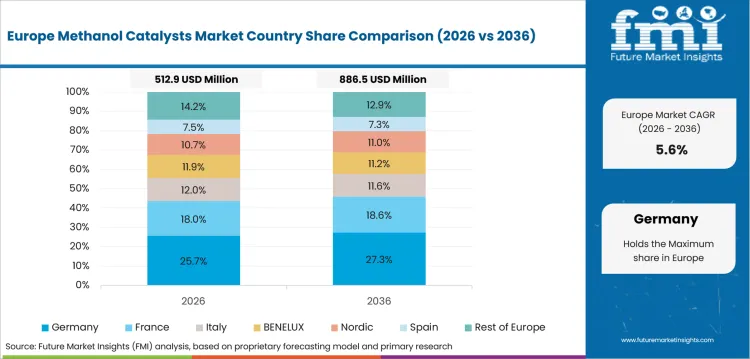
What supports methanol catalyst demand in Germany?
A 6.3% CAGR through 2036 reflects chemical cluster demand and hydrogen infrastructure planning.
Country Market Snapshot Table
| Parameter | Value |
|---|---|
| Market Size in 2025 (Value) | USD 197.6 million |
| Market Size in 2026 (Value) | USD 210.0 million |
| Market Forecast in 2036 (Value) | USD 386.9 million |
| CAGR (2026 to 2036) | 6.3% |
| Years Considered | 2021 to 2036 |
| Base Year | 2025 |
| Forecast Period | 2026 to 2036 |
| Units Considered | Value (USD million) |
| Leading Sub-Region | Rhine-Ruhr and chemical park networks |
Germany Methanol Catalysts Market Outlook
Germany demand is shaped by chemical decarbonization and high validation standards. Catalyst buyers need proof on stability and process fit during e-fuel scale-up.
Hydrogen network planning gives suppliers a clearer infrastructure signal. Power cost and certification requirements still shape the pace of catalyst orders.
Key Growth Drivers
- Hydrogen infrastructure strengthens e-methanol project readiness. Germany’s Federal Network Agency approved 9,040 kilometres of hydrogen core network measures in October 2024.
- Investment depth supports industrial demand planning. The Federal Network Agency reported expected hydrogen core network investment costs of EUR 18.9 billion.
- German chemical clusters are expected to support catalyst trials for lower-carbon methanol derivatives.
- BASF’s SYNSPIRE Methanol portfolio gives local buyers a direct catalyst reference for e-methanol development.
Key Restraints
- Power and network cost can slow project approval. Germany’s approved hydrogen core network includes around 60.0% converted natural gas pipelines.
- Certification rules can delay catalyst orders when offtake terms remain unclear.
- Buyers may extend supplier qualification where plant-risk tolerance is low.
What makes Germany unique
Germany is unique for catalyst supplier depth and hydrogen network planning that support strict validation for e-fuel projects.
Key Companies
- BASF
- Clariant
- Topsoe
- Johnson Matthey
- thyssenkrupp Uhde
- Linde Engineering
- Siemens Energy
Sales & Marketing Channels
- Direct technical sales
- Chemical cluster procurement
- EPC and licensor routes
- EU project consortium channels
- Long-term service agreements
Country Segment Breakdown Table
| Segment | Sub-Segments |
|---|---|
| By Catalyst Type | Methanol Synthesis Catalysts · Reforming / Shift Catalysts · MTO / MTP Catalysts · Other |
| By Chemistry | Cu / Zn / Al · Zn / Cr · Noble / Other |
| By Feedstock Route | Natural Gas · Coal · Biomass / CO2-to-Methanol |
| By End Use | Commodity Methanol · Chemical Derivatives · E-methanol Projects · Other |
| By Sales Mix | Replacement · New Plants |
| Key Sub-Regions Covered, Rhine-Ruhr Corridors | Rhine-Ruhr and chemical park networks |
Frequently Asked Questions
How fast is Germany methanol catalysts market growing?
A 6.3% CAGR through 2036 reflects chemical cluster demand and hydrogen infrastructure planning.
Who leads Germany methanol catalysts market?
The listed German and global suppliers compete through catalyst portfolios and service channels.
What is driving adoption in Germany methanol catalysts market?
Hydrogen infrastructure strengthens e-methanol readiness and catalyst validation work.
How is France positioned in the methanol catalysts market?
A 6.0% CAGR through 2036 reflects syngas cleanup expertise and selective low-carbon project development.
Country Market Snapshot Table
| Parameter | Value |
|---|---|
| Market Size in 2025 (Value) | USD 122.6 million |
| Market Size in 2026 (Value) | USD 130.0 million |
| Market Forecast in 2036 (Value) | USD 232.8 million |
| CAGR (2026 to 2036) | 6.0% |
| Years Considered | 2021 to 2036 |
| Base Year | 2025 |
| Forecast Period | 2026 to 2036 |
| Units Considered | Value (USD million) |
| Leading Sub-Region | Hauts-de-France and southern industrial clusters |
France Methanol Catalysts Market Outlook
France demand is selective and centered on engineering-led catalyst decisions. Syngas cleanup and low-carbon fuel studies shape the most visible demand pockets.
Local relevance is strongest where Axens and engineering firms support process packages. Large commodity methanol replacement volume remains more limited than in China or the United States.
Key Growth Drivers
- Industrial recovery supports chemical project review. INSEE reported in April 2025 that French manufacturing output increased 1.4% in February 2025.
- EU fuel rules support low-carbon hydrogen and e-fuel screening. The European Commission stated in July 2025 that low-carbon hydrogen must reach 70.0% greenhouse gas savings.
- Axens supports syngas purification and catalyst systems for methanol-related process trains.
- French industrial clusters are expected to sustain demand for impurity-control systems and engineering support.
Key Restraints
- Manufacturing volatility can delay catalyst project timing. INSEE reported in July 2025 that French manufacturing output declined 1.0% in May 2025.
- Smaller commodity methanol production narrows replacement catalyst volume compared with China.
- Hydrogen supply and certified CO2 sourcing can slow e-methanol investment decisions.
What makes France unique
France is unique for syngas cleanup expertise and engineering channels that shape catalyst decisions more than local commodity capacity.
Key Companies
- Axens
- Air Liquide Engineering & Construction
- TotalEnergies
- Technip Energies
- Johnson Matthey
- Topsoe
- BASF
Sales & Marketing Channels
- EPC-led process packages
- Direct engineering sales
- Industrial cluster procurement
- Technology licensing channels
- EU-funded project consortia
Country Segment Breakdown Table
| Segment | Sub-Segments |
|---|---|
| By Catalyst Type | Methanol Synthesis Catalysts · Reforming / Shift Catalysts · MTO / MTP Catalysts · Other |
| By Chemistry | Cu / Zn / Al · Zn / Cr · Noble / Other |
| By Feedstock Route | Natural Gas · Coal · Biomass / CO2-to-Methanol |
| By End Use | Commodity Methanol · Chemical Derivatives · E-methanol Projects · Other |
| By Sales Mix | Replacement · New Plants |
| Key Sub-Regions Covered, Hauts-de-France Corridors | Hauts-de-France and southern industrial clusters |
Frequently Asked Questions
How fast is France methanol catalysts market growing?
A 6.0% CAGR through 2036 reflects syngas cleanup expertise and selective low-carbon project development.
Who leads France methanol catalysts market?
The listed French and global suppliers compete through engineering access and catalyst service channels.
What is driving adoption in France methanol catalysts market?
Industrial recovery supports chemical project review and syngas catalyst screening.
What is the United Kingdom methanol catalysts market outlook?
A 5.8% CAGR through 2036 reflects technology-led project screening and specialist chemical demand.
Country Market Snapshot Table
| Parameter | Value |
|---|---|
| Market Size in 2025 (Value) | USD 108.7 million |
| Market Size in 2026 (Value) | USD 115.0 million |
| Market Forecast in 2036 (Value) | USD 202.1 million |
| CAGR (2026 to 2036) | 5.8% |
| Years Considered | 2021 to 2036 |
| Base Year | 2025 |
| Forecast Period | 2026 to 2036 |
| Units Considered | Value (USD million) |
| Leading Sub-Region | Teesside and Humber low-carbon project corridors |
United Kingdom Methanol Catalysts Market Outlook
United Kingdom demand is more project-led than capacity-led. Technology licensors and engineering firms influence catalyst choice in global methanol and e-methanol projects.
Domestic replacement volume is limited. Catalyst demand is expected to come from decarbonization studies and specialist chemical buyers.
Key Growth Drivers
- Hydrogen project screening supports future e-methanol concepts. The UK government reported in July 2025 that 27 HAR2 projects entered the next stage.
- The funding route gives project developers a larger pipeline to test. GOV.UK reported a second allocation round aim to support up to 875 MW of hydrogen capacity.
- Johnson Matthey’s methanol catalyst portfolio gives the UK a strong technology reference point.
- Specialty chemical users are expected to keep targeted catalyst and service demand active.
Key Restraints
- Limited domestic methanol production reduces local replacement volume. GOV.UK reported HAR2 support of up to 875 MW for hydrogen capacity and not methanol capacity.
- Project economics remain sensitive to hydrogen cost and low-carbon fuel offtake quality.
- Engineering-led procurement can lengthen supplier approval for new catalyst grades.
What makes United Kingdom unique
The United Kingdom is unique for technology support and project screening that matter more than domestic methanol production volume.
Key Companies
- Johnson Matthey
- KBR
- Shell Catalysts & Technologies
- Topsoe
- BASF
- Clariant
- Wood plc
Sales & Marketing Channels
- Licensor-led catalyst selection
- Engineering consulting relationships
- Direct technical sales
- Industrial decarbonization project tenders
- Specialty chemical procurement
Country Segment Breakdown Table
| Segment | Sub-Segments |
|---|---|
| By Catalyst Type | Methanol Synthesis Catalysts · Reforming / Shift Catalysts · MTO / MTP Catalysts · Other |
| By Chemistry | Cu / Zn / Al · Zn / Cr · Noble / Other |
| By Feedstock Route | Natural Gas · Coal · Biomass / CO2-to-Methanol |
| By End Use | Commodity Methanol · Chemical Derivatives · E-methanol Projects · Other |
| By Sales Mix | Replacement · New Plants |
| Key Sub-Regions Covered, Teesside Corridors | Teesside and Humber low-carbon project corridors |
Frequently Asked Questions
How fast is United Kingdom methanol catalysts market growing?
A 5.8% CAGR through 2036 reflects technology-led project screening and specialist chemical demand.
Who leads United Kingdom methanol catalysts market?
The listed United Kingdom suppliers compete through technology support and project access.
What is driving adoption in United Kingdom methanol catalysts market?
Hydrogen project screening supports future e-methanol concepts and specialist catalyst review.
Report Scope and Coverage
| Parameter | Details |
|---|---|
| Market Definition | Catalysts used to make methanol or convert methanol into downstream products across synthesis, reforming, shift, guard-bed and MTO / MTP service. |
| Quantitative Units | USD 2,140.7 million in 2026 to USD 4,056.3 million by 2036 at 6.6% CAGR. |
| Segments Covered | Catalyst Type · Chemistry · Feedstock Route · End Use · Sales Mix · Region |
| Regions Covered | North America · Latin America · Europe · East Asia · South Asia and Pacific · Middle East and Africa |
| Countries Covered | China · India · South Korea · United States · Japan · Germany · France · United Kingdom |
| Key Companies Profiled | Johnson Matthey · Topsoe · BASF · Clariant · Axens · Sinopec Catalyst · KBR · JGC · Shell Catalysts & Technologies · W. R. Grace |
| Forecast Period | 2026 to 2036 |
| Approach | Hybrid bottom-up and top-down method using catalyst replacement timing, route mix, project activity and supplier evidence. |
Methanol Catalysts Market Research Methodology
| Method Stage | How it was applied |
|---|---|
| Primary Research | FMI analysts reviewed catalyst procurement behavior across methanol producers, EPC firms, technology licensors and specialty chemical buyers. |
| Desk Research | Desk research reviewed regulator pages, government energy sources, company catalyst portfolios and public methanol project evidence. |
| Market Sizing | The model combined catalyst charge value, replacement frequency, reactor route, feedstock mix and country-level project activity. |
| Data Validation | Forecasts were checked against supplier portfolios, hydrogen policy signals, project pipelines and downstream chemical production trends. |
Methanol Catalysts Market by Segments
Methanol Catalysts Market Segmented by By Catalyst Type:
- Methanol Synthesis Catalysts
- Reforming / Shift Catalysts
- MTO / MTP Catalysts
- Other
Methanol Catalysts Market Segmented by By Chemistry:
- Cu / Zn / Al
- Zn / Cr
- Noble / Other
Methanol Catalysts Market Segmented by By Feedstock Route:
- Natural Gas
- Coal
- Biomass / CO2-to-Methanol
Methanol Catalysts Market Segmented by By End Use:
- Commodity Methanol
- Chemical Derivatives
- E-methanol Projects
- Other
Methanol Catalysts Market Segmented by By Sales Mix:
- Replacement
- New Plants
Methanol Catalysts Market by Region:
- North America
- United States
- Canada
- Mexico
- Latin America
- Brazil
- Chile
- Rest of Latin America
- Western Europe
- Germany
- UK
- Italy
- Spain
- France
- Nordic
- BENELUX
- Rest of Western Europe
- Eastern Europe
- Russia
- Poland
- Hungary
- Balkan & Baltic
- Rest of Eastern Europe
- East Asia
- China
- Japan
- South Korea
- South Asia and Pacific
- India
- ASEAN
- Australia & New Zealand
- Rest of South Asia and Pacific
- Middle East & Africa
- Kingdom of Saudi Arabia
- Other GCC Countries
- Turkiye
- South Africa
- Other African Union
- Rest of Middle East & Africa
Research Sources and Bibliography
- USA Department of Energy. (2026). Methanol. Alternative Fuels Data Center.
- USA Energy Information Administration. (2026, March 13). USA natural gas production reached a new record in 2025. Today in Energy.
- USA Energy Information Administration. (2025, August 12). The United States exported 30% of the energy it produced in 2024. Today in Energy.
- Methanol Institute. (2026, March). Renewable methanol.
- BASF. (2024, January 29). BASF and Envision Energy enter a collaboration to drive conversion of green hydrogen and CO2 into e-methanol.
- Clariant. (2025, April 3). Clariant’s MegaMax 900 catalyst: Powerful start at European Energy’s e-methanol plant.
- European Commission. (2025, July 7). Questions and answers on the Delegated Act defining low-carbon hydrogen.
- Bundesnetzagentur. (2024, October 22). Hydrogen core network.
- National Bureau of Statistics of China. (2025, February 28). Statistical communiqué of the People’s Republic of China on the 2024 national economic and social development.
- National Bureau of Statistics of China. (2025, January 24). Industrial production operation in December 2024.
- Zhengzhou Commodity Exchange. (2024, March 26). Methanol futures and options.
- Press Information Bureau. (2025, May 20). Ministry of New & Renewable Energy participates in World Hydrogen Summit 2025. Government of India.
- Press Information Bureau. (2025, December 16). National Green Hydrogen Mission. Government of India.
- Press Information Bureau. (2025, April 29). Green Hydrogen Certification Scheme. Government of India.
- Government of the United Kingdom. (2025, July). Hydrogen update to the market: July 2025.
- Government of the United Kingdom. (2025, January 16). Funding mechanism for the Hydrogen Production Business Model.
- INSEE. (2025, April 4). In February 2025, manufacturing output bounced back.
- INSEE. (2025, July 4). In May 2025, manufacturing output went down by 1.0%.
- Ministry of Economy, Trade and Industry. (2025). Strategic Energy Plan.
- Organisation for Economic Co-operation and Development. (2026, April 8). Peer review of the Korean shipbuilding industry 2026.
- USA International Trade Administration. (2025, September 30). South Korea hydrogen economy.
- Topsoe. (2026). Methanol catalysts for all methanol pathways.
- Topsoe. (2025, October 28). Forestal selects Topsoe’s breakthrough SOEC technology for e-methanol production
This Report Answers
- What is the current and future value outlook for the Methanol Catalysts Market from 2026 to 2036?
- Which catalyst type is projected to lead methanol catalyst demand during the forecast period?
- How does Cu / Zn / Al chemistry shape supplier positioning in methanol synthesis applications?
- Which feedstock route drives the largest share of catalyst demand in 2026?
- Why do replacement catalyst cycles account for the largest sales mix share?
- How do CO2-to-methanol projects affect catalyst performance requirements?
- Which countries are projected to grow fastest in methanol catalyst demand through 2036?
- Which companies are most relevant in methanol synthesis catalysts and syngas systems?
- What is included and excluded in the Methanol Catalysts Market scope?
- How does FMI forecast methanol catalyst demand across replacement and new plant sales?
Frequently Asked Questions
What is the global market demand for Methanol Catalysts Market in 2026?
The global Methanol Catalysts Market is expected to be worth USD 2,140.7 million in 2026 across catalyst types and feedstock routes.
What will the Methanol Catalysts Market be worth by 2036?
The Methanol Catalysts Market is projected to reach USD 4,056.3 million by 2036 as replacement and e-methanol demand expands.
What is the forecast CAGR for the Methanol Catalysts Market?
The Methanol Catalysts Market is projected to grow at a 6.6% CAGR from 2026 to 2036.
Which catalyst type is projected to lead in 2026?
Methanol Synthesis Catalysts are projected to account for 46.0% share in 2026 due to direct reactor performance exposure.
Which feedstock route is projected to lead in 2026?
Natural Gas is projected to account for 54.0% share in 2026 through reforming-based methanol production.
Which country is projected to grow fastest through 2036?
China is projected to record 7.4% CAGR through 2036 due to coal chemistry and MTO catalyst demand.
What is included in the Methanol Catalysts Market?
The market includes methanol synthesis catalysts and reforming systems. It also covers MTO / MTP catalysts and guard systems.
How does FMI forecast this market?
FMI combines catalyst replacement timing and route mix to forecast market value. Feedstock exposure and supplier evidence are used for validation.
Which methanol catalyst is best for CO2-to-methanol projects?
CO2-to-methanol projects need synthesis catalysts designed for CO2-rich feeds and water tolerance under variable hydrogen supply.
What are the main disadvantages of methanol catalysts?
The main disadvantages are deactivation risk, feed impurity sensitivity and high switching risk for large plants.
Preview the report firsthand - request a free sample
Get SampleGet the brochure for pricing and purchase details.
Get PDFTable of Content
- Key Takeaways
- Market Size and CAGR
- Top Growth Driver
- Fastest Growing Segment
- Leading Region
- Key Companies
- Emerging Opportunities
- Executive Summary
- Global Market Outlook
- Demand-side Trends
- Supply-side Trends
- Technology Roadmap Analysis
- Analysis and Recommendations
- Analyst Perspective (What is happening? Why now? What should investors know?)
- Key Questions Answered
- How large is the market?
- What is the CAGR?
- What are key trends?
- Which region dominates?
- Who are the leaders?
- Market Overview
- Market Coverage / Taxonomy
- Market Definition / Scope / Limitations
- Research Methodology
- Chapter Orientation
- Analytical Lens and Working Hypotheses
- Market Structure, Signals, and Trend Drivers
- Benchmarking and Cross-market Comparability
- Market Sizing, Forecasting, and Opportunity Mapping
- Research Design and Evidence Framework
- Desk Research Programme (Secondary Evidence)
- Expert Input and Fieldwork (Primary Evidence)
- Tooling, Models, and Reference Databases
- Data Engineering and Model Build
- Quality Assurance and Audit Trail
- Market Background
- Market Dynamics (Drivers, Restraints, Opportunity, Trends)
- Scenario Forecast (Optimistic, Likely, Conservative)
- Impact Analysis
- AI Impact
- Sustainability Impact
- Regulatory Impact
- Technology Impact
- Consumer / Buyer Analysis
- Purchase Drivers
- Adoption Barriers
- Buyer Journey
- Opportunity Map Analysis
- Product Life Cycle Analysis
- Supply Chain Analysis
- Investment Feasibility Matrix
- Value Chain Analysis
- PESTLE and Porter's Analysis
- Regulatory Landscape
- Regional Parent Market Outlook
- Production and Consumption Statistics
- Import and Export Statistics
- Global Market Analysis and Forecast, 2021 to 2036
- Historical Market Size Value (USD Million) Analysis, 2021 to 2025
- Current and Future Market Size Value (USD Million) Projections, 2026 to 2036
- Y-o-Y Growth Trend Analysis
- Absolute $ Opportunity Analysis
- Global Market Pricing Analysis, 2021 to 2036
- Global Market Analysis and Forecast, By Catalyst Type, 2021 to 2036
- Introduction / Key Findings
- Historical Market Size Value (USD Million) Analysis By Catalyst Type, 2021 to 2025
- Current and Future Market Size Value (USD Million) Analysis and Forecast By Catalyst Type, 2026 to 2036
- Methanol Synthesis Catalysts
- Reforming / Shift Catalysts
- MTO / MTP Catalysts
- Methanol Synthesis Catalysts
- Y-o-Y Growth Trend Analysis By Catalyst Type, 2021 to 2025
- Absolute $ Opportunity Analysis By Catalyst Type, 2026 to 2036
- Global Market Analysis and Forecast, By Chemistry, 2021 to 2036
- Introduction / Key Findings
- Historical Market Size Value (USD Million) Analysis By Chemistry, 2021 to 2025
- Current and Future Market Size Value (USD Million) Analysis and Forecast By Chemistry, 2026 to 2036
- Cu / Zn / Al
- Zn / Cr
- Noble / Other
- Cu / Zn / Al
- Y-o-Y Growth Trend Analysis By Chemistry, 2021 to 2025
- Absolute $ Opportunity Analysis By Chemistry, 2026 to 2036
- Global Market Analysis and Forecast, By Feedstock Route, 2021 to 2036
- Introduction / Key Findings
- Historical Market Size Value (USD Million) Analysis By Feedstock Route, 2021 to 2025
- Current and Future Market Size Value (USD Million) Analysis and Forecast By Feedstock Route, 2026 to 2036
- Natural Gas
- Coal
- Biomass / CO2-to-Methanol
- Natural Gas
- Y-o-Y Growth Trend Analysis By Feedstock Route, 2021 to 2025
- Absolute $ Opportunity Analysis By Feedstock Route, 2026 to 2036
- Global Market Analysis and Forecast, By End Use, 2021 to 2036
- Introduction / Key Findings
- Historical Market Size Value (USD Million) Analysis By End Use, 2021 to 2025
- Current and Future Market Size Value (USD Million) Analysis and Forecast By End Use, 2026 to 2036
- Commodity Methanol
- Chemical Derivatives
- E-methanol Projects
- Commodity Methanol
- Y-o-Y Growth Trend Analysis By End Use, 2021 to 2025
- Absolute $ Opportunity Analysis By End Use, 2026 to 2036
- Global Market Analysis and Forecast, By Sales Mix, 2021 to 2036
- Introduction / Key Findings
- Historical Market Size Value (USD Million) Analysis By Sales Mix, 2021 to 2025
- Current and Future Market Size Value (USD Million) Analysis and Forecast By Sales Mix, 2026 to 2036
- Replacement
- New Plants
- Replacement
- Y-o-Y Growth Trend Analysis By Sales Mix, 2021 to 2025
- Absolute $ Opportunity Analysis By Sales Mix, 2026 to 2036
- Global Market Analysis and Forecast, By Region, 2021 to 2036
- Introduction
- Historical Market Size Value (USD Million) Analysis By Region, 2021 to 2025
- Current Market Size Value (USD Million) Analysis and Forecast By Region, 2026 to 2036
- North America
- Latin America
- Western Europe
- Eastern Europe
- East Asia
- South Asia and Pacific
- Middle East & Africa
- Market Attractiveness Analysis By Region
- North America Market Analysis and Forecast, By Country, 2021 to 2036
- Historical Market Size Value (USD Million) Trend Analysis By Market Taxonomy, 2021 to 2025
- Market Size Value (USD Million) Forecast By Market Taxonomy, 2026 to 2036
- By Country
- USA
- Canada
- Mexico
- By Catalyst Type
- By Chemistry
- By Feedstock Route
- By End Use
- By Sales Mix
- By Country
- Market Attractiveness Analysis
- By Country
- By Catalyst Type
- By Chemistry
- By Feedstock Route
- By End Use
- By Sales Mix
- Key Takeaways
- Latin America Market Analysis and Forecast, By Country
- Historical Market Size Value (USD Million) Trend Analysis By Market Taxonomy, 2021 to 2025
- Market Size Value (USD Million) Forecast By Market Taxonomy, 2026 to 2036
- By Country
- Brazil
- Chile
- Rest of Latin America
- By Catalyst Type
- By Chemistry
- By Feedstock Route
- By End Use
- By Sales Mix
- By Country
- Market Attractiveness Analysis
- By Country
- By Catalyst Type
- By Chemistry
- By Feedstock Route
- By End Use
- By Sales Mix
- Key Takeaways
- Western Europe Market Analysis and Forecast, By Country
- Historical Market Size Value (USD Million) Trend Analysis By Market Taxonomy, 2021 to 2025
- Market Size Value (USD Million) Forecast By Market Taxonomy, 2026 to 2036
- By Country
- Germany
- UK
- Italy
- Spain
- France
- Nordic
- BENELUX
- Rest of Western Europe
- By Catalyst Type
- By Chemistry
- By Feedstock Route
- By End Use
- By Sales Mix
- By Country
- Market Attractiveness Analysis
- By Country
- By Catalyst Type
- By Chemistry
- By Feedstock Route
- By End Use
- By Sales Mix
- Key Takeaways
- Eastern Europe Market Analysis and Forecast, By Country
- Historical Market Size Value (USD Million) Trend Analysis By Market Taxonomy, 2021 to 2025
- Market Size Value (USD Million) Forecast By Market Taxonomy, 2026 to 2036
- By Country
- Russia
- Poland
- Hungary
- Balkan & Baltic
- Rest of Eastern Europe
- By Catalyst Type
- By Chemistry
- By Feedstock Route
- By End Use
- By Sales Mix
- By Country
- Market Attractiveness Analysis
- By Country
- By Catalyst Type
- By Chemistry
- By Feedstock Route
- By End Use
- By Sales Mix
- Key Takeaways
- East Asia Market Analysis and Forecast, By Country
- Historical Market Size Value (USD Million) Trend Analysis By Market Taxonomy, 2021 to 2025
- Market Size Value (USD Million) Forecast By Market Taxonomy, 2026 to 2036
- By Country
- China
- Japan
- South Korea
- By Catalyst Type
- By Chemistry
- By Feedstock Route
- By End Use
- By Sales Mix
- By Country
- Market Attractiveness Analysis
- By Country
- By Catalyst Type
- By Chemistry
- By Feedstock Route
- By End Use
- By Sales Mix
- Key Takeaways
- South Asia and Pacific Market Analysis and Forecast, By Country
- Historical Market Size Value (USD Million) Trend Analysis By Market Taxonomy, 2021 to 2025
- Market Size Value (USD Million) Forecast By Market Taxonomy, 2026 to 2036
- By Country
- India
- ASEAN
- Australia & New Zealand
- Rest of South Asia and Pacific
- By Catalyst Type
- By Chemistry
- By Feedstock Route
- By End Use
- By Sales Mix
- By Country
- Market Attractiveness Analysis
- By Country
- By Catalyst Type
- By Chemistry
- By Feedstock Route
- By End Use
- By Sales Mix
- Key Takeaways
- Middle East & Africa Market Analysis and Forecast, By Country
- Historical Market Size Value (USD Million) Trend Analysis By Market Taxonomy, 2021 to 2025
- Market Size Value (USD Million) Forecast By Market Taxonomy, 2026 to 2036
- By Country
- Kingdom of Saudi Arabia
- Other GCC Countries
- Türkiye
- South Africa
- Other African Union
- Rest of Middle East & Africa
- By Catalyst Type
- By Chemistry
- By Feedstock Route
- By End Use
- By Sales Mix
- By Country
- Market Attractiveness Analysis
- By Country
- By Catalyst Type
- By Chemistry
- By Feedstock Route
- By End Use
- By Sales Mix
- Key Takeaways
- Key Countries Market Analysis
- USA
- Pricing Analysis
- Market Share Analysis, 2025
- By Catalyst Type
- By Chemistry
- By Feedstock Route
- By End Use
- By Sales Mix
- Canada
- Pricing Analysis
- Market Share Analysis, 2025
- By Catalyst Type
- By Chemistry
- By Feedstock Route
- By End Use
- By Sales Mix
- Mexico
- Pricing Analysis
- Market Share Analysis, 2025
- By Catalyst Type
- By Chemistry
- By Feedstock Route
- By End Use
- By Sales Mix
- Brazil
- Pricing Analysis
- Market Share Analysis, 2025
- By Catalyst Type
- By Chemistry
- By Feedstock Route
- By End Use
- By Sales Mix
- Chile
- Pricing Analysis
- Market Share Analysis, 2025
- By Catalyst Type
- By Chemistry
- By Feedstock Route
- By End Use
- By Sales Mix
- Germany
- Pricing Analysis
- Market Share Analysis, 2025
- By Catalyst Type
- By Chemistry
- By Feedstock Route
- By End Use
- By Sales Mix
- UK
- Pricing Analysis
- Market Share Analysis, 2025
- By Catalyst Type
- By Chemistry
- By Feedstock Route
- By End Use
- By Sales Mix
- Italy
- Pricing Analysis
- Market Share Analysis, 2025
- By Catalyst Type
- By Chemistry
- By Feedstock Route
- By End Use
- By Sales Mix
- Spain
- Pricing Analysis
- Market Share Analysis, 2025
- By Catalyst Type
- By Chemistry
- By Feedstock Route
- By End Use
- By Sales Mix
- France
- Pricing Analysis
- Market Share Analysis, 2025
- By Catalyst Type
- By Chemistry
- By Feedstock Route
- By End Use
- By Sales Mix
- India
- Pricing Analysis
- Market Share Analysis, 2025
- By Catalyst Type
- By Chemistry
- By Feedstock Route
- By End Use
- By Sales Mix
- ASEAN
- Pricing Analysis
- Market Share Analysis, 2025
- By Catalyst Type
- By Chemistry
- By Feedstock Route
- By End Use
- By Sales Mix
- Australia & New Zealand
- Pricing Analysis
- Market Share Analysis, 2025
- By Catalyst Type
- By Chemistry
- By Feedstock Route
- By End Use
- By Sales Mix
- China
- Pricing Analysis
- Market Share Analysis, 2025
- By Catalyst Type
- By Chemistry
- By Feedstock Route
- By End Use
- By Sales Mix
- Japan
- Pricing Analysis
- Market Share Analysis, 2025
- By Catalyst Type
- By Chemistry
- By Feedstock Route
- By End Use
- By Sales Mix
- South Korea
- Pricing Analysis
- Market Share Analysis, 2025
- By Catalyst Type
- By Chemistry
- By Feedstock Route
- By End Use
- By Sales Mix
- Russia
- Pricing Analysis
- Market Share Analysis, 2025
- By Catalyst Type
- By Chemistry
- By Feedstock Route
- By End Use
- By Sales Mix
- Poland
- Pricing Analysis
- Market Share Analysis, 2025
- By Catalyst Type
- By Chemistry
- By Feedstock Route
- By End Use
- By Sales Mix
- Hungary
- Pricing Analysis
- Market Share Analysis, 2025
- By Catalyst Type
- By Chemistry
- By Feedstock Route
- By End Use
- By Sales Mix
- Kingdom of Saudi Arabia
- Pricing Analysis
- Market Share Analysis, 2025
- By Catalyst Type
- By Chemistry
- By Feedstock Route
- By End Use
- By Sales Mix
- Türkiye
- Pricing Analysis
- Market Share Analysis, 2025
- By Catalyst Type
- By Chemistry
- By Feedstock Route
- By End Use
- By Sales Mix
- South Africa
- Pricing Analysis
- Market Share Analysis, 2025
- By Catalyst Type
- By Chemistry
- By Feedstock Route
- By End Use
- By Sales Mix
- USA
- Market Structure Analysis
- Competition Dashboard
- Competition Benchmarking
- Market Share Analysis of Top Players
- By Regional
- By Catalyst Type
- By Chemistry
- By Feedstock Route
- By End Use
- By Sales Mix
- Emerging Startups
- Innovation Benchmarking
- Competition Analysis
- Competition Deep Dive
- Johnson Matthey
- Overview
- Product Portfolio
- Profitability by Market Segments (Product/Region/Sales Channel)
- Sales Footprint
- Strategy Overview
- Marketing Strategy
- Product Strategy
- Channel Strategy
- Topsoe
- BASF
- Clariant
- Axens
- Johnson Matthey
- Case Studies
- Success Stories
- Recent Developments
- Competition Deep Dive
- Assumptions & Acronyms Used


