

- Market Size (2026)
- USD 720.6 Mn
- Forecast (2036)
- USD 2.6 Bn
- CAGR (2026 to 2036)
- 13.6%
How big is the hydrogen sealants market in 2026?
USD 0.72 billion in 2026 (USD 720.6 Mn) and USD 2.6 billion by 2036 at a 13.6% CAGR.
The hydrogen sealants industry value was USD 634.3 million in 2025.
It is forecast to grow from USD 0.72 billion in 2026 (USD 720.6 Mn) to USD 2.6 billion by 2036 at a 13.6% CAGR. OEM sales are forecast to represent 68.0% share in 2026 because equipment makers qualify sealants before system release. Storage and distribution is expected to secure 39.0% share in 2026, led by tanks, valves, regulators, and pipeline fittings.
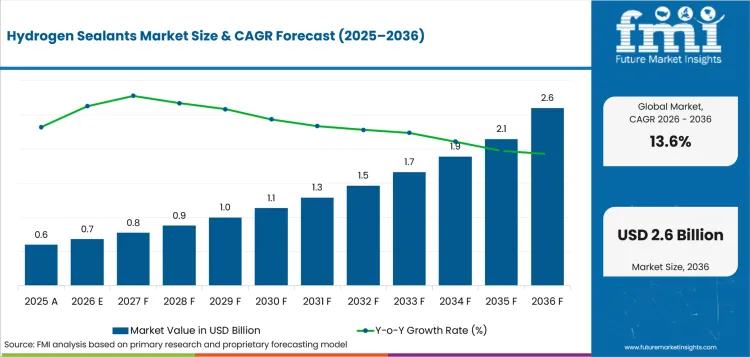
Hydrogen Sealants Market Overview: Size and Forecast
- 2025 Market Size: USD 634.3 million
- 2026 Market Size: USD 720.6 million
- 2036 Market Size: USD 2.6 billion
- Forecast CAGR: 13.6% from 2026 to 2036
- Leading Sealant Type: Elastomeric Sealants
- Elastomeric Sealants Share in 2026: 46.5%
- Leading Application: Storage and Distribution
- Storage and Distribution Share in 2026: 39.0%
- Fastest-growing Country: China
- China CAGR: 15.2% by 2036
Summary of the Hydrogen Sealants Market
- Demand and Growth Drivers
- Electrolyzer manufacturers are adding repeatable sealing processes for stack plates and balance-of-plant interfaces.
- Storage operators are specifying low-permeation sealants for valves, couplings, regulators, and tank fittings.
- Mobility applications are raising demand for products validated under high pressure and rapid gas decompression.
- Product and Segment View
- Elastomeric sealants are forecast to represent 46.5% share in 2026, supported by compression recovery under cyclic pressure.
- Storage and distribution is projected to hold 39.0% share in 2026, driven by frequent sealed points in hydrogen transfer systems.
- The 100-350 bar class is expected to secure 44.0% share in 2026, led by production and industrial gas equipment.
- Geography and Competitive Outlook
- China is projected to record 15.2% CAGR by 2036 as refueling networks and fuel cell vehicle programs scale.
- South Korea is expected to expand at 14.6% CAGR by 2036 through clean hydrogen power procurement and mobility programs.
- Parker Hannifin, Freudenberg, Trelleborg, DuPont, Saint-Gobain, and Hutchinson compete through material validation and engineering support.
- Greene Tweed and Garlock compete in demanding service applications where pressure data and engineered polymers influence specification.
- Analyst Opinion
- Nikhil Kaitwade, Associate Vice President at FMI says, “Hydrogen sealants are becoming a qualification business before they become a volume business. Buyers want proof against permeation, oxygen exposure, pressure cycling, and rapid gas decompression in the same part family. Suppliers with test data and application support should win design-in positions before price competition becomes decisive.”
Sealant qualification is the main pressure point because hydrogen moves through small leak paths and exposes weak materials during pressure cycling. The International Energy Agency reported almost 520 GW of announced electrolysis capacity in its 2024 review. The U.S. Department of Energy selected USD 750 million for hydrogen electrolysis and manufacturing projects in March 2024. Buyers are therefore asking sealant suppliers for permeation data, rapid gas decompression results, and batch records before commercial approval.
Which factors support expansion in the hydrogen sealants market?
Finished hydrogen equipment revenue and recurring maintenance work support market value across production, storage, distribution, and mobility systems.
- Market value is supported by OEM-approved sealants used in electrolyzers, compressors, tanks, valves, and fuel cell modules.
- Supplier pricing reflects material testing and documentation before volume orders lower qualification cost per program.
- Revenue improves as early hydrogen stations and production sites move into scheduled seal replacement cycles.
- Buyer trust rises when sealant suppliers provide batch traceability and pressure-test evidence for safety reviews.
Why is the hydrogen sealants market growing?
Hydrogen production equipment uses many sealed media paths as electrolyzer stacks scale from pilot modules to factory-built systems.
Growth outlook is moving from pilot work into procurement programs because buyers need materials that pass repeated hydrogen-service checks. Announced electrolysis capacity creates demand around electrolysis liquid hydrogen systems and factory-built stacks. DOE project selections create a buyer base for USA hydrogen electrolyzers and manufacturing equipment. Pipeline conversion also connects sealant demand with hydrogen hubs where storage, compression, and transfer systems need verified sealing materials.
High-pressure storage and mobility use cases create a second sealing requirement around pressure cycling and rapid gas decompression. Hydrogen fueling systems expose seals to fast fill events and cold operating conditions. China reported over 450 hydrogen fueling stations nationwide by the end of 2023 in its August 2024 energy transition white paper. This expands the service environment for O-rings, gaskets, and liquid sealants.
How is the hydrogen sealants market segmented?
The hydrogen sealants industry is segmented by sealant type, application, pressure class, end use, and sales mix.
- Elastomeric sealants are projected to secure 46.5% share in 2026, led by flexible recovery in static and semi-dynamic hydrogen interfaces.
- Storage and distribution is anticipated to hold 39.0% share in 2026 since tanks, valves, regulators, and fittings create many sealed points per project.
- The 100-350 bar class is expected to capture 44.0% share in 2026 due to common use across production and industrial gas systems.
- Hydrogen production is forecast to represent 37.0% share in 2026, guided by stack sealing and balance-of-plant component needs.
- OEM sales are projected to account for 68.0% share in 2026, reflected by approved material lists and design-in purchasing.
Why do elastomeric sealants lead the hydrogen sealants market?
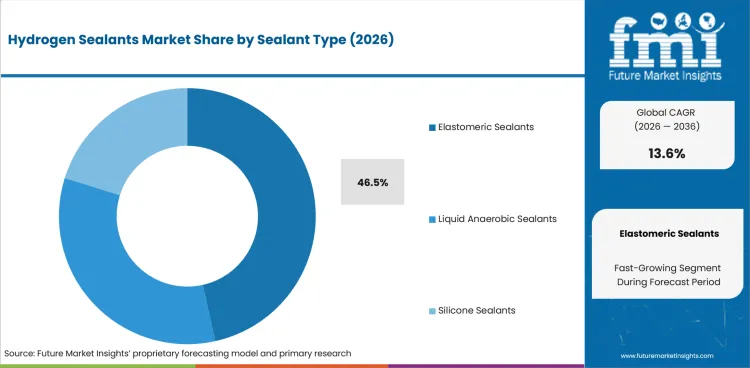
- Elastomeric sealants are projected to account for 46.5% share in 2026, influenced by compression recovery under cyclic hydrogen pressure.
- Liquid anaerobic sealants gain use in threaded and metal-joint applications where small leak paths must be closed.
Which application leads hydrogen sealant demand?
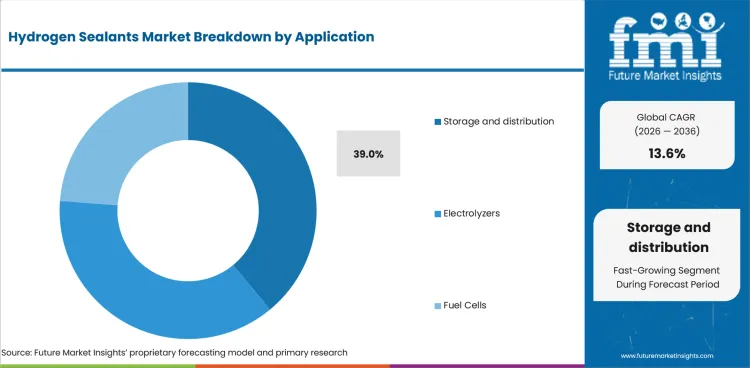
- Storage and distribution is expected to represent 39.0% share in 2026, shaped by valves, regulators, cylinders, tanks, and pipeline fittings.
- Electrolyzer applications gain value as stack assembly moves toward higher-volume production and tighter leakage control.
Which pressure class leads the hydrogen sealants market?
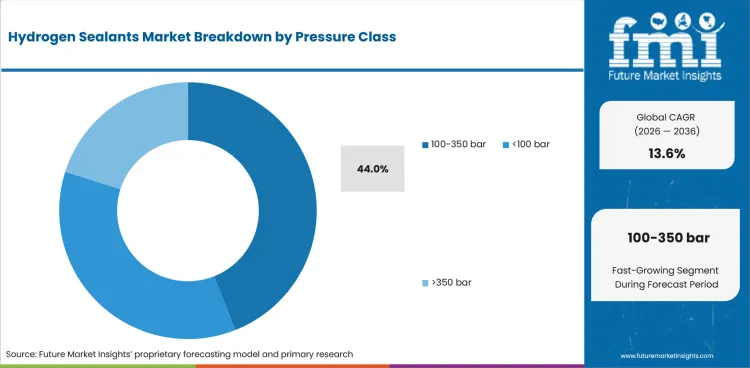
- The 100-350 bar class is forecast to hold 44.0% share in 2026 through industrial gas and hydrogen production equipment.
- The above 350 bar class gains demand where mobility and refueling systems need pressure-tested compounds.
Which end use leads the hydrogen sealants market?
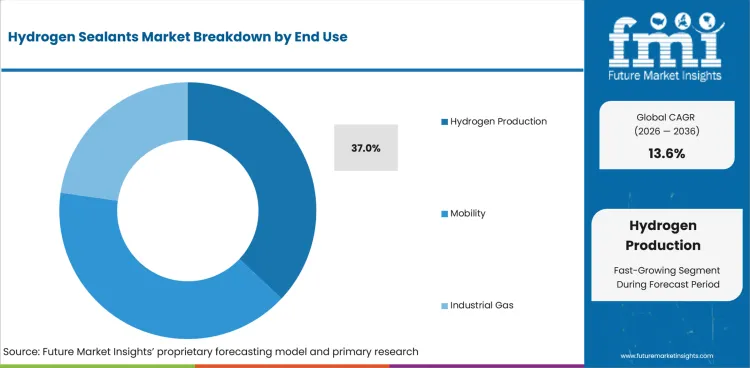
- Hydrogen production is projected to account for 37.0% share in 2026 as electrolyzers and reforming equipment need repeatable sealing.
- Mobility applications increase demand for validated products in refueling stations and onboard hydrogen supply systems.
Which sales mix leads the hydrogen sealants market?
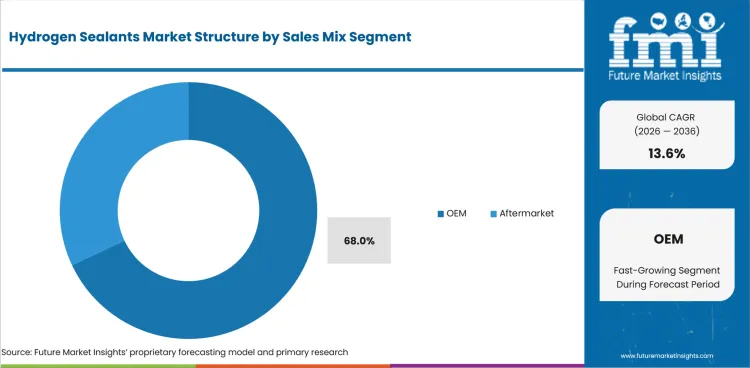
- OEM sales are expected to represent 68.0% share in 2026, led by equipment makers locking sealants into bills of material.
- Aftermarket sales rise as early hydrogen stations and production assets enter scheduled maintenance cycles.
What are the drivers, restraints, and opportunities in the hydrogen sealants market?
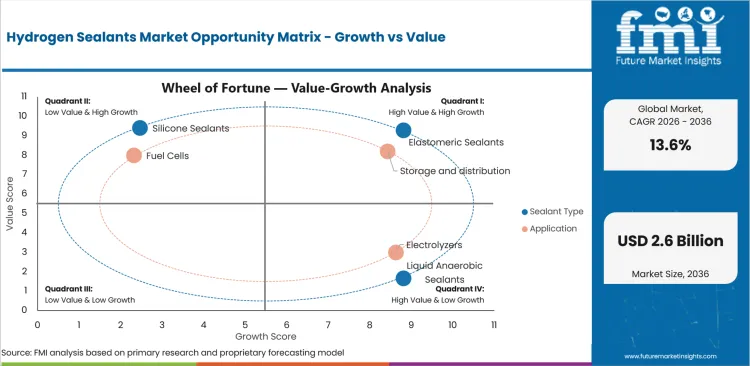
Electrolyzer scale and high-pressure storage support growth while testing cost and project timing limit supplier entry.
- Driver: Electrolyzer stack scale is expected to raise demand for repeatable liquid and elastomer sealing processes.
- Driver: Refueling pressure requirements are projected to lift demand for products tested against permeation and rapid gas decompression.
- Restraint: High material testing cost limits smaller suppliers that lack hydrogen rigs and certification documentation.
- Opportunity: Converted pipeline assets create gasket and sealant replacement work during hydrogen readiness upgrades.
- Opportunity: Digital traceability supports suppliers that can provide material data, batch records, and certification files.
Hydrogen Sealants Market Demand Outlook
Demand outlook is moving toward validated materials that can prove sealing performance before channel expansion. The U.S. Department of Energy selected USD 750 million in March 2024 for hydrogen electrolysis and manufacturing projects. That funding supports the equipment base where sealants must pass process and lifetime checks. Sealant suppliers benefit when they join design work early with data on compression set, chemical exposure, and pressure cycling.
Consumer Segmentation and Purchase Behavior Analysis
Hydrogen sealant buyers are equipment engineers, EPC contractors, industrial gas operators, and maintenance teams. Their purchase decisions are less brand-led than proof-led. They compare sealants by pressure class, media exposure, material traceability, and service history. OEM-approved materials usually win first orders because unapproved substitutions can create leak risk and warranty exposure.
Voice of Customer and Decision-driver Analysis
Buyers describe documentation as a purchasing filter. They want sealants that match the pressure class, surface condition, and media chemistry in the equipment. Trelleborg launched its H2Pro range in August 2024 with over 20 sealing compounds and a hydrogen test center in Fort Wayne. This shows why large suppliers are investing in validation capacity before wider hydrogen equipment volumes arrive.
Which countries are growing fastest in the hydrogen sealants market?
China 15.2% CAGR, South Korea 14.6% CAGR, India 14.4% CAGR, Germany 13.9% CAGR, Japan 13.4% CAGR, United States 13.2% CAGR, France 12.8% CAGR, and United Kingdom 12.1% CAGR through 2036.
.webp "Top Country Growth Comparison Hydrogen Sealants Market Cagr (2026 2036)")
| Country | CAGR |
|---|---|
| China | 15.2% |
| South Korea | 14.6% |
| India | 14.4% |
| Germany | 13.9% |
| Japan | 13.4% |
| United States | 13.2% |
| France | 12.8% |
| United Kingdom | 12.1% |
Source: Future Market Insights, 2026.
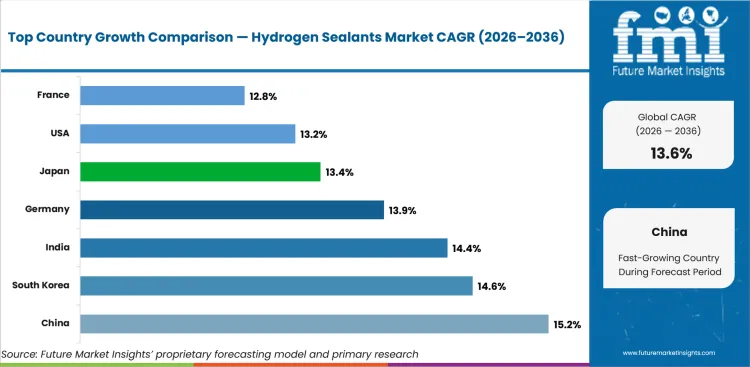
How do country-level CAGRs compare in the hydrogen sealants market?
China leads country growth while the United Kingdom records the most cautious expansion outlook among profiled markets.
- China is forecast to record 15.2% CAGR by 2036 as refueling stations and fuel cell vehicles raise sealed equipment demand.
- South Korea is expected to expand at 14.6% CAGR through 2036 due to clean hydrogen power procurement.
- India is projected to grow at 14.4% CAGR by 2036 as electrolyzer localization supports stack and plant sealing demand.
- Germany is estimated to rise at 13.9% CAGR through 2036 with pipeline conversion shaping retrofit sealing work.
- Japan is anticipated to advance at 13.4% CAGR over the forecast period due to mobility and liquid hydrogen requirements.
- The United States is forecast to grow at 13.2% CAGR through 2036 as hubs and manufacturing programs expand.
- France is projected to post 12.8% CAGR by 2036 as industrial hydrogen clusters move toward equipment sourcing.
- The United Kingdom is expected to record 12.1% CAGR through 2036 as allocation timing screens project starts.
How fast is the hydrogen sealants market growing in United States?
A 13.2% CAGR through 2036 reflects country-specific hydrogen production, storage, mobility, and equipment qualification demand.
Country Market Snapshot Table
| Parameter | Value |
|---|---|
| Market Size in 2025 (Value) | USD 131.6 million |
| Market Size in 2026 (Value) | USD 149.0 million |
| Market Forecast in 2036 (Value) | USD 514.8 million |
| CAGR (2026 to 2036) | 13.2% |
| Years Considered | 2021 to 2036 |
| Base Year | 2025 |
| Forecast Period | 2026 to 2036 |
| Units Considered | Value (USD million) |
| Leading Sub-Region | Gulf Coast and Midwest hydrogen hubs |
United States Hydrogen Sealants Market Outlook
United States hydrogen sealant demand is shaped by project-backed equipment programs and long qualification cycles. Sealants are purchased first by OEMs and engineering contractors building stacks, compressors, regulators, and storage systems.
Buyers prefer suppliers with local application engineering and distributor access. Parker, Greene Tweed, Garlock, and SKF have relevant U.S. channels or product exposure in hydrogen equipment.
Key Growth Drivers
- United States electrolyzer and manufacturing projects create sealant pull because DOE selected USD 750 million for clean hydrogen work in March 2024.
- United States production economics support OEM qualification because Treasury finalized a clean hydrogen credit worth up to USD 3.00/kg in January 2025.
- United States industrial gas and compressor buyers require sealants with documented permeation testing before approved vendor listing.
- United States sealing suppliers gain local advantage through application engineering near hydrogen hubs and component factories.
Key Restraints
- United States projects face qualification friction because Federal Register rules use a 4 kgCO2e/kgH2 lifecycle emissions ceiling for credit eligibility.
- United States aftermarket buyers remain cautious when field technicians lack hydrogen-specific replacement training.
- United States project timelines can delay sealant orders when offtake agreements and hub buildouts move slower than equipment design.
What makes United States unique
United States is unique due to federal funding breadth and deep engineered sealing supplier coverage across polymers, gaskets, and motion equipment.
Key Companies
- Parker Hannifin
- Greene Tweed
- Garlock
- SKF USA
- DuPont
- Freudenberg-NOK Sealing Technologies
- Trelleborg Sealing Solutions USA
Sales & Marketing Channels
- Direct OEM qualification programs
- EPC-approved vendor lists
- Industrial distributor networks
- Refueling equipment service routes
- Hydrogen trade exhibitions
- Engineering design support teams
Country Segment Breakdown Table
| Segment | Sub-Segments |
|---|---|
| By Sealant Type | Elastomeric Sealants · Liquid Anaerobic Sealants · Silicone Sealants · Other |
| By Application | Storage and Distribution · Electrolyzers · Fuel Cells · Hydrogen Engines and Other |
| By Pressure Class | <100 bar · 100-350 bar · >350 bar |
| By End Use | Hydrogen Production · Mobility · Industrial Gas · Power and Other |
| By Sales Mix | OEM · Aftermarket |
| Key Sub-Regions Covered, Hydrogen Equipment and Industrial Corridors | Gulf Coast · Midwest · California · Appalachian corridor · Pacific Northwest · Northeast hubs |
Frequently Asked Questions
How fast is United States hydrogen sealants market growing?
The sector in United States is projected to grow at 13.2% from 2026 to 2036 due to country-specific hydrogen equipment demand.
Who leads United States hydrogen sealants market?
Parker Hannifin, Greene Tweed, Garlock, and SKF USA compete through sealing materials, OEM access, and technical support.
What is driving adoption in United States hydrogen sealants market?
Hydrogen production, storage, distribution, and mobility projects are moving buyers toward materials that can prove hydrogen compatibility before purchase.
How fast is the hydrogen sealants market growing in United Kingdom?
A 12.1% CAGR through 2036 reflects country-specific hydrogen production, storage, mobility, and equipment qualification demand.
Country Market Snapshot Table
| Parameter | Value |
|---|---|
| Market Size in 2025 (Value) | USD 42.8 million |
| Market Size in 2026 (Value) | USD 48.0 million |
| Market Forecast in 2036 (Value) | USD 150.4 million |
| CAGR (2026 to 2036) | 12.1% |
| Years Considered | 2021 to 2036 |
| Base Year | 2025 |
| Forecast Period | 2026 to 2036 |
| Units Considered | Value (USD million) |
| Leading Sub-Region | Teesside and Humber project corridors |
United Kingdom Hydrogen Sealants Market Outlook
United Kingdom demand is tied to project allocation rather than broad component stocking. Hydrogen sealants enter through OEM packages, plant contractors, and specialist distributors after projects gain stronger revenue visibility.
Sealant suppliers need to support technical tenders rather than rely only on catalog sales. The local channel favors European sealing firms, industrial distributors, and OEM imports.
Key Growth Drivers
- United Kingdom production projects create plant-side sealing pull because GOV.UK stated HAR2 aimed to award up to 875 MW in 2024.
- United Kingdom roadmap support creates equipment demand because GOV.UK retained an ambition for up to 10 GW by 2030.
- United Kingdom industrial clusters need sealing materials for storage skids and balance-of-plant packages.
- United Kingdom EPC teams create design-in demand when they specify hydrogen-compatible sealants during front-end engineering.
Key Restraints
- United Kingdom awards remain value-screened because GOV.UK said HAR2 applications closed on April 19, 2024 before final contract decisions.
- United Kingdom component stocking remains narrow where distributor inventory is still tied to conventional industrial sealing.
- United Kingdom project buyers delay purchasing when revenue support is not aligned with EPC procurement windows.
What makes United Kingdom unique
United Kingdom is unique because sealants follow allocation awards and contractor design choices in a policy-screened project market.
Key Companies
- James Walker Group
- Trelleborg Sealing Solutions UK
- Freudenberg Sealing Technologies UK
- Parker Hannifin UK
- ERIKS UK
- AESSEAL
- Flexitallic UK
Sales & Marketing Channels
- OEM equipment packages
- EPC purchasing teams
- Industrial sealing distributors
- Hydrogen project tender channels
- Plant maintenance contractors
- Cluster procurement teams
Country Segment Breakdown Table
| Segment | Sub-Segments |
|---|---|
| By Sealant Type | Elastomeric Sealants · Liquid Anaerobic Sealants · Silicone Sealants · Other |
| By Application | Storage and Distribution · Electrolyzers · Fuel Cells · Hydrogen Engines and Other |
| By Pressure Class | <100 bar · 100-350 bar · >350 bar |
| By End Use | Hydrogen Production · Mobility · Industrial Gas · Power and Other |
| By Sales Mix | OEM · Aftermarket |
| Key Sub-Regions Covered, Hydrogen Equipment and Industrial Corridors | Teesside · Humber · Merseyside · Scotland · South Wales · Southampton |
Frequently Asked Questions
How fast is United Kingdom hydrogen sealants market growing?
The sector in United Kingdom is projected to grow at 12.1% from 2026 to 2036 due to country-specific hydrogen equipment demand.
Who leads United Kingdom hydrogen sealants market?
James Walker Group, Trelleborg Sealing Solutions UK, Freudenberg Sealing Technologies UK, and Parker Hannifin UK compete through sealing materials, OEM access, and technical support.
What is driving adoption in United Kingdom hydrogen sealants market?
Hydrogen production, storage, distribution, and mobility projects are moving buyers toward materials that can prove hydrogen compatibility before purchase.
How fast is the hydrogen sealants market growing in Germany?
A 13.9% CAGR through 2036 reflects country-specific hydrogen production, storage, mobility, and equipment qualification demand.
Country Market Snapshot Table
| Parameter | Value |
|---|---|
| Market Size in 2025 (Value) | USD 66.7 million |
| Market Size in 2026 (Value) | USD 76.0 million |
| Market Forecast in 2036 (Value) | USD 279.3 million |
| CAGR (2026 to 2036) | 13.9% |
| Years Considered | 2021 to 2036 |
| Base Year | 2025 |
| Forecast Period | 2026 to 2036 |
| Units Considered | Value (USD million) |
| Leading Sub-Region | Ruhr and northern pipeline corridors |
Germany Hydrogen Sealants Market Outlook
Germany demand is anchored in infrastructure conversion and industrial hydrogen use. Sealants are specified for converted pipelines, compressor stations, electrolyzer interfaces, and fuel cell components.
Converted gas assets need sealants that work with older flanges and new hydrogen leakage limits. This favors suppliers with test capability and field support.
Key Growth Drivers
- Germany pipeline conversion creates direct sealing demand because Bundesnetzagentur approved a 9,040 km hydrogen core network in October 2024.
- Germany retrofit work supports gasket replacement because FNB Gas stated around 60% of the approved network uses converted natural gas pipelines.
- Germany electrolyzer programs increase demand for stack sealing and balance-of-plant components.
- Germany local sealing suppliers shorten engineering cycles for industrial buyers that need documentation in German and EU formats.
Key Restraints
- Germany retrofit work raises documentation burden because core network investment is expected at €18.9 billion through 2032.
- Germany buyers may stretch replacement timing when converted assets need surface checks before sealant selection.
- Germany electricity-cost exposure can slow electrolyzer commissioning and defer sealing orders.
What makes Germany unique
Germany is unique because hydrogen compatibility must be proven across converted gas infrastructure and industrial networks.
Key Companies
- Freudenberg Sealing Technologies
- Parker Prädifa
- Trelleborg Sealing Solutions Germany
- ElringKlinger
- SKF Economos Germany
- EagleBurgmann
- Klinger Germany
Sales & Marketing Channels
- Pipeline operator procurement
- OEM design-in programs
- Industrial gas maintenance routes
- Electrolyzer supplier partnerships
- German distributor networks
- Hydrogen trade events
Country Segment Breakdown Table
| Segment | Sub-Segments |
|---|---|
| By Sealant Type | Elastomeric Sealants · Liquid Anaerobic Sealants · Silicone Sealants · Other |
| By Application | Storage and Distribution · Electrolyzers · Fuel Cells · Hydrogen Engines and Other |
| By Pressure Class | <100 bar · 100-350 bar · >350 bar |
| By End Use | Hydrogen Production · Mobility · Industrial Gas · Power and Other |
| By Sales Mix | OEM · Aftermarket |
| Key Sub-Regions Covered, Hydrogen Equipment and Industrial Corridors | Ruhr · Hamburg · Lower Saxony · Bavaria · Baden-Württemberg · Berlin-Brandenburg |
Frequently Asked Questions
How fast is Germany hydrogen sealants market growing?
The sector in Germany is projected to grow at 13.9% from 2026 to 2036 due to country-specific hydrogen equipment demand.
Who leads Germany hydrogen sealants market?
Freudenberg Sealing Technologies, Parker Prädifa, Trelleborg Sealing Solutions Germany, and ElringKlinger compete through sealing materials, OEM access, and technical support.
What is driving adoption in Germany hydrogen sealants market?
Hydrogen production, storage, distribution, and mobility projects are moving buyers toward materials that can prove hydrogen compatibility before purchase.
How fast is the hydrogen sealants market growing in France?
A 12.8% CAGR through 2036 reflects country-specific hydrogen production, storage, mobility, and equipment qualification demand.
Country Market Snapshot Table
| Parameter | Value |
|---|---|
| Market Size in 2025 (Value) | USD 40.8 million |
| Market Size in 2026 (Value) | USD 46.0 million |
| Market Forecast in 2036 (Value) | USD 153.4 million |
| CAGR (2026 to 2036) | 12.8% |
| Years Considered | 2021 to 2036 |
| Base Year | 2025 |
| Forecast Period | 2026 to 2036 |
| Units Considered | Value (USD million) |
| Leading Sub-Region | Fos-sur-Mer and Dunkirk industrial hubs |
France Hydrogen Sealants Market Outlook
France demand is clustered around industrial decarbonization and hub-based hydrogen infrastructure. Sealants are selected through OEMs, industrial gas contractors, and energy project integrators.
Suppliers with French engineering access gain an advantage during qualification. Buyers remain cautious about untested materials in safety-critical hydrogen service.
Key Growth Drivers
- France industrial demand supports sealant pull because the 2025 national strategy placed decarbonized hydrogen needs at 520 kt/year by 2030.
- France pipeline planning creates storage and transfer needs because the European Hydrogen Observatory cites a 500 km hydrogen pipeline target by 2030.
- France domestic sealing expertise supports co-engineering with OEMs and system integrators.
- France industrial hubs need sealants for production, storage, and distribution equipment across refineries and chemical sites.
Key Restraints
- France project timing is cautious because the revised strategy lowered the 2030 electrolyzer target to 4.5 GW in 2025.
- France buyers demand strong qualification files before accepting substitute sealants in safety-critical hydrogen service.
- France industrial offtake timing can delay purchases when hydrogen supply contracts are not finalized.
What makes France unique
France is unique because domestic materials expertise meets industrial hydrogen hub planning around refining, chemicals, and mobility.
Key Companies
- Saint-Gobain Omniseal Solutions
- Hutchinson Precision Sealing Systems
- Parker Hannifin France
- Trelleborg Sealing Solutions France
- Freudenberg France
- Technetics Group France
- John Crane France
Sales & Marketing Channels
- Industrial cluster procurement
- OEM co-development programs
- Energy contractor channels
- Direct sealing engineering teams
- Distributor and maintenance networks
- Hydrogen mobility pilots
Country Segment Breakdown Table
| Segment | Sub-Segments |
|---|---|
| By Sealant Type | Elastomeric Sealants · Liquid Anaerobic Sealants · Silicone Sealants · Other |
| By Application | Storage and Distribution · Electrolyzers · Fuel Cells · Hydrogen Engines and Other |
| By Pressure Class | <100 bar · 100-350 bar · >350 bar |
| By End Use | Hydrogen Production · Mobility · Industrial Gas · Power and Other |
| By Sales Mix | OEM · Aftermarket |
| Key Sub-Regions Covered, Hydrogen Equipment and Industrial Corridors | Fos-sur-Mer · Dunkirk · Le Havre · Lyon Chemical Valley · Normandy · Occitanie |
Frequently Asked Questions
How fast is France hydrogen sealants market growing?
The sector in France is projected to grow at 12.8% from 2026 to 2036 due to country-specific hydrogen equipment demand.
Who leads France hydrogen sealants market?
Saint-Gobain Omniseal Solutions, Hutchinson Precision Sealing Systems, Parker Hannifin France, and Trelleborg Sealing Solutions France compete through sealing materials, OEM access, and technical support.
What is driving adoption in France hydrogen sealants market?
Hydrogen production, storage, distribution, and mobility projects are moving buyers toward materials that can prove hydrogen compatibility before purchase.
How fast is the hydrogen sealants market growing in Japan?
A 13.4% CAGR through 2036 reflects country-specific hydrogen production, storage, mobility, and equipment qualification demand.
Country Market Snapshot Table
| Parameter | Value |
|---|---|
| Market Size in 2025 (Value) | USD 48.5 million |
| Market Size in 2026 (Value) | USD 55.0 million |
| Market Forecast in 2036 (Value) | USD 193.4 million |
| CAGR (2026 to 2036) | 13.4% |
| Years Considered | 2021 to 2036 |
| Base Year | 2025 |
| Forecast Period | 2026 to 2036 |
| Units Considered | Value (USD million) |
| Leading Sub-Region | Kobe, Tokyo Bay, and Kansai corridors |
Japan Hydrogen Sealants Market Outlook
Japan demand is quality-led and shaped by supply-chain buildout. Sealants must perform in fuel cells, refueling stations, storage systems, and liquid hydrogen transfer equipment.
The market favors suppliers that document performance in cold and high-pressure use. Japan has a distinct role in cryogenic and high-specification sealing.
Key Growth Drivers
- Japan supply-chain policy supports qualified components because METI said the Hydrogen Society Promotion Act was enacted in May 2024.
- Japan demand visibility supports cryogenic sealing because METI maintained a 12 million tons/year hydrogen target for 2040 in the 2025 Strategic Energy Plan.
- Japan refueling and mobility systems require seals with high pressure and low leak rates.
- Japan liquid hydrogen handling creates demand for cryogenic sealing materials and tighter documentation.
Key Restraints
- Japan qualification costs rise because IEA policy tracking lists a 15-year CfD support option for low-carbon hydrogen projects.
- Japan imported supply chains add cost and logistics risk to local component planning.
- Japan strict quality qualification raises entry costs for smaller suppliers without local testing support.
What makes Japan unique
Japan is unique because mobility experience and liquid hydrogen handling make seal validation more demanding.
Key Companies
- NOK Corporation
- EagleBurgmann Japan
- Saint-Gobain Omniseal Japan
- Parker Hannifin Japan
- Trelleborg Sealing Solutions Japan
- Nippon Pillar Packing
- Valqua
Sales & Marketing Channels
- OEM qualification programs
- Refueling equipment suppliers
- Industrial gas engineering routes
- Trading-house procurement channels
- Hydrogen supply-chain consortia
- Cryogenic equipment service teams
Country Segment Breakdown Table
| Segment | Sub-Segments |
|---|---|
| By Sealant Type | Elastomeric Sealants · Liquid Anaerobic Sealants · Silicone Sealants · Other |
| By Application | Storage and Distribution · Electrolyzers · Fuel Cells · Hydrogen Engines and Other |
| By Pressure Class | <100 bar · 100-350 bar · >350 bar |
| By End Use | Hydrogen Production · Mobility · Industrial Gas · Power and Other |
| By Sales Mix | OEM · Aftermarket |
| Key Sub-Regions Covered, Hydrogen Equipment and Industrial Corridors | Tokyo Bay · Kansai · Kobe · Chubu · Fukuoka · Hokkaido import corridors |
Frequently Asked Questions
How fast is Japan hydrogen sealants market growing?
The sector in Japan is projected to grow at 13.4% from 2026 to 2036 due to country-specific hydrogen equipment demand.
Who leads Japan hydrogen sealants market?
NOK Corporation, EagleBurgmann Japan, Saint-Gobain Omniseal Japan, and Parker Hannifin Japan compete through sealing materials, OEM access, and technical support.
What is driving adoption in Japan hydrogen sealants market?
Hydrogen production, storage, distribution, and mobility projects are moving buyers toward materials that can prove hydrogen compatibility before purchase.
How fast is the hydrogen sealants market growing in China?
A 15.2% CAGR through 2036 reflects country-specific hydrogen production, storage, mobility, and equipment qualification demand.
Country Market Snapshot Table
| Parameter | Value |
|---|---|
| Market Size in 2025 (Value) | USD 151.0 million |
| Market Size in 2026 (Value) | USD 174.0 million |
| Market Forecast in 2036 (Value) | USD 716.3 million |
| CAGR (2026 to 2036) | 15.2% |
| Years Considered | 2021 to 2036 |
| Base Year | 2025 |
| Forecast Period | 2026 to 2036 |
| Units Considered | Value (USD million) |
| Leading Sub-Region | Shanghai, Guangdong, Hebei, and Shandong clusters |
China Hydrogen Sealants Market Outlook
China demand is scale-driven and mobility-oriented. Refueling stations, fuel cell vehicles, electrolyzer plants, and industrial gas projects create a broad sealing environment.
Suppliers must balance price competitiveness with documented safety performance. Global suppliers work through OEM channels and local technical teams.
Key Growth Drivers
- China refueling infrastructure creates replacement demand because SCIO reported over 450 hydrogen fueling stations by the end of 2023.
- China hydrogen output scale expands addressable equipment because a 2025 partnership review placed actual production at 37 Mt in 2024.
- China fuel cell commercial vehicle programs increase demand for gaskets and stack sealing materials.
- China local electrolyzer manufacturing supports demand for repeatable sealing processes and technical service.
Key Restraints
- China imported premium sealants face pressure because electrolysis contributed only 0.5 Mt of hydrogen output in 2024.
- China local qualification rules and OEM preferences can slow new foreign supplier entry.
- China price competition limits premium imports unless suppliers prove safety or service gains.
What makes China unique
China is unique because refueling scale overlaps with fuel cell vehicles and equipment manufacturing depth.
Key Companies
- DuPont China
- Trelleborg Sealing Solutions China
- Parker Hannifin China
- Freudenberg Sealing Technologies China
- NOK-Freudenberg China
- Saint-Gobain China
- Garlock China
Sales & Marketing Channels
- OEM fuel cell programs
- Refueling station integrators
- Local distributor networks
- Industrial gas project channels
- Hydrogen equipment exhibitions
- Direct technical sales offices
Country Segment Breakdown Table
| Segment | Sub-Segments |
|---|---|
| By Sealant Type | Elastomeric Sealants · Liquid Anaerobic Sealants · Silicone Sealants · Other |
| By Application | Storage and Distribution · Electrolyzers · Fuel Cells · Hydrogen Engines and Other |
| By Pressure Class | <100 bar · 100-350 bar · >350 bar |
| By End Use | Hydrogen Production · Mobility · Industrial Gas · Power and Other |
| By Sales Mix | OEM · Aftermarket |
| Key Sub-Regions Covered, Hydrogen Equipment and Industrial Corridors | Shanghai · Guangdong · Hebei · Shandong · Beijing-Tianjin · Inner Mongolia |
Frequently Asked Questions
How fast is China hydrogen sealants market growing?
The sector in China is projected to grow at 15.2% from 2026 to 2036 due to country-specific hydrogen equipment demand.
Who leads China hydrogen sealants market?
DuPont China, Trelleborg Sealing Solutions China, Parker Hannifin China, and Freudenberg Sealing Technologies China compete through sealing materials, OEM access, and technical support.
What is driving adoption in China hydrogen sealants market?
Hydrogen production, storage, distribution, and mobility projects are moving buyers toward materials that can prove hydrogen compatibility before purchase.
How fast is the hydrogen sealants market growing in South Korea?
A 14.6% CAGR through 2036 reflects country-specific hydrogen production, storage, mobility, and equipment qualification demand.
Country Market Snapshot Table
| Parameter | Value |
|---|---|
| Market Size in 2025 (Value) | USD 53.2 million |
| Market Size in 2026 (Value) | USD 61.0 million |
| Market Forecast in 2036 (Value) | USD 238.3 million |
| CAGR (2026 to 2036) | 14.6% |
| Years Considered | 2021 to 2036 |
| Base Year | 2025 |
| Forecast Period | 2026 to 2036 |
| Units Considered | Value (USD million) |
| Leading Sub-Region | Ulsan and Incheon hydrogen corridors |
South Korea Hydrogen Sealants Market Outlook
South Korea demand is shaped by power procurement and industrial buyers. Sealants enter through fuel cell systems, hydrogen handling equipment, and power plant conversion packages.
Buyers prefer suppliers already qualified by global OEMs. Clean hydrogen certification raises the importance of reliable documentation and traceability.
Key Growth Drivers
- South Korea power procurement creates demand because the Ministry proposed a 2026 clean hydrogen bidding volume of 500 GWh/year.
- South Korea clean hydrogen auctions support long-cycle equipment demand because CSIRO HyResource cites a 6,500 GWh bidding volume for 2024.
- South Korea fuel cell mobility programs require gaskets and sealants around stacks and hydrogen supply.
- South Korea industrial conglomerates favor suppliers with global OEM references and local technical support.
Key Restraints
- South Korea purchasing remains selective because the Ministry proposed a 2026 general hydrogen bidding volume of 930 GWh/year.
- South Korea imported hydrogen cost can reduce awarded project volumes and delay equipment orders.
- South Korea certification complexity raises documentation needs for sealant suppliers.
What makes South Korea unique
South Korea is unique because hydrogen policy is converted into power procurement that creates a buyer pathway for validated components.
Key Companies
- EagleBurgmann Korea
- Parker Korea
- Trelleborg Sealing Solutions Korea
- Freudenberg Sealing Technologies Korea
- SKF Korea
- Hyundai Kefico
- Doosan Fuel Cell suppliers
Sales & Marketing Channels
- Power generation procurement
- Fuel cell OEM supply chains
- Industrial group purchasing
- Hydrogen project consortia
- Technical distributor channels
- Power utility tenders
Country Segment Breakdown Table
| Segment | Sub-Segments |
|---|---|
| By Sealant Type | Elastomeric Sealants · Liquid Anaerobic Sealants · Silicone Sealants · Other |
| By Application | Storage and Distribution · Electrolyzers · Fuel Cells · Hydrogen Engines and Other |
| By Pressure Class | <100 bar · 100-350 bar · >350 bar |
| By End Use | Hydrogen Production · Mobility · Industrial Gas · Power and Other |
| By Sales Mix | OEM · Aftermarket |
| Key Sub-Regions Covered, Hydrogen Equipment and Industrial Corridors | Ulsan · Incheon · Seoul Capital Area · Busan · Jeonnam · Chungnam |
Frequently Asked Questions
How fast is South Korea hydrogen sealants market growing?
The sector in South Korea is projected to grow at 14.6% from 2026 to 2036 due to country-specific hydrogen equipment demand.
Who leads South Korea hydrogen sealants market?
EagleBurgmann Korea, Parker Korea, Trelleborg Sealing Solutions Korea, and Freudenberg Sealing Technologies Korea compete through sealing materials, OEM access, and technical support.
What is driving adoption in South Korea hydrogen sealants market?
Hydrogen production, storage, distribution, and mobility projects are moving buyers toward materials that can prove hydrogen compatibility before purchase.
How fast is the hydrogen sealants market growing in India?
A 14.4% CAGR through 2036 reflects country-specific hydrogen production, storage, mobility, and equipment qualification demand.
Country Market Snapshot Table
| Parameter | Value |
|---|---|
| Market Size in 2025 (Value) | USD 50.7 million |
| Market Size in 2026 (Value) | USD 58.0 million |
| Market Forecast in 2036 (Value) | USD 222.7 million |
| CAGR (2026 to 2036) | 14.4% |
| Years Considered | 2021 to 2036 |
| Base Year | 2025 |
| Forecast Period | 2026 to 2036 |
| Units Considered | Value (USD million) |
| Leading Sub-Region | Gujarat, Odisha, and Tamil Nadu hubs |
India Hydrogen Sealants Market Outlook
India demand is emerging from electrolyzer manufacturing and green hydrogen production awards. Sealants enter through electrolyzer stacks, balance-of-plant equipment, ammonia projects, and pilot mobility systems.
The market should reward suppliers able to localize support and training. Buyers are likely to start with OEM-approved materials before local substitution grows.
Key Growth Drivers
- India electrolyzer demand is supported because PIB reported 4.12 lakh tons per annum of green hydrogen production awards in February 2024.
- India equipment localization supports sealant demand because SECI lists 450,000 MT/annum total green ammonia production capacity under NGHM tenders.
- India EPC contractors need vendor documentation for safety-critical hydrogen interfaces.
- India green ammonia tenders pull hydrogen equipment into fertilizer-linked industrial projects.
Key Restraints
- India local qualification capacity can lag because PIB reported 3,000 MW annual electrolyzer manufacturing capacity awarded by May 2025.
- India cost-sensitive projects may delay premium sealant purchases until OEM approval is mandatory.
- India limited field history in hydrogen service can slow domestic sealant substitution.
What makes India unique
India is unique because sealant demand follows electrolyzer localization and green ammonia procurement.
Key Companies
- Parker Hannifin India
- Trelleborg Sealing Solutions India
- Freudenberg Sealing Technologies India
- SKF India
- EagleBurgmann India
- Garlock India
- Klinger India
Sales & Marketing Channels
- Electrolyzer OEM sourcing
- EPC procurement teams
- Industrial gas distributors
- Green ammonia tender channels
- Engineering consultants
- Direct technical support teams
Country Segment Breakdown Table
| Segment | Sub-Segments |
|---|---|
| By Sealant Type | Elastomeric Sealants · Liquid Anaerobic Sealants · Silicone Sealants · Other |
| By Application | Storage and Distribution · Electrolyzers · Fuel Cells · Hydrogen Engines and Other |
| By Pressure Class | <100 bar · 100-350 bar · >350 bar |
| By End Use | Hydrogen Production · Mobility · Industrial Gas · Power and Other |
| By Sales Mix | OEM · Aftermarket |
| Key Sub-Regions Covered, Hydrogen Equipment and Industrial Corridors | Gujarat · Odisha · Tamil Nadu · Andhra Pradesh · Rajasthan · Maharashtra |
Frequently Asked Questions
How fast is India hydrogen sealants market growing?
The sector in India is projected to grow at 14.4% from 2026 to 2036 due to country-specific hydrogen equipment demand.
Who leads India hydrogen sealants market?
Parker Hannifin India, Trelleborg Sealing Solutions India, Freudenberg Sealing Technologies India, and SKF India compete through sealing materials, OEM access, and technical support.
What is driving adoption in India hydrogen sealants market?
Hydrogen production, storage, distribution, and mobility projects are moving buyers toward materials that can prove hydrogen compatibility before purchase.
Who are the leading players in the hydrogen sealants market?
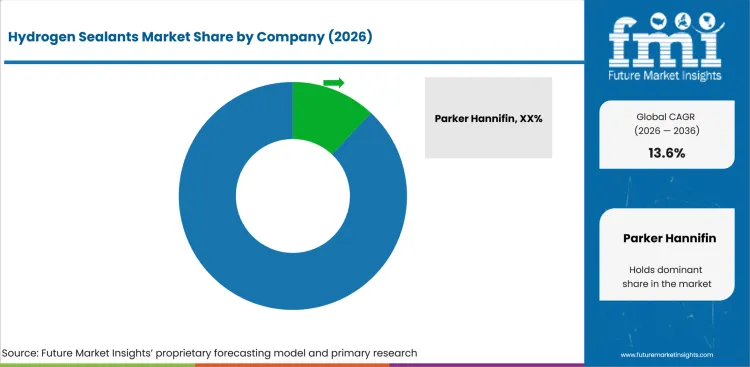
The market is moderately concentrated because global sealing suppliers hold the deepest hydrogen test capabilities and material libraries.
- Global suppliers win by proving permeation resistance, rapid gas decompression behavior, and pressure-cycle reliability.
- Specialist firms compete in high-pressure service with PTFE, engineered plastics, and application-specific gasket designs.
- Entry barriers remain high because buyers require hydrogen test data, batch control, and engineering support.
Competition centers on proof rather than product breadth alone. Parker, Freudenberg, Trelleborg, DuPont, and Saint-Gobain are best positioned where buyers need documented hydrogen service suitability. Trelleborg’s August 2024 H2Pro launch covered over 20 sealing compounds and a 93 square-meter U.S. hydrogen test center. Freudenberg’s November 2024 update described added test equipment for hydrogen applications. Greene Tweed and Garlock hold relevance where difficult pressure and pipeline interfaces need engineered solutions.
Key Companies in the Hydrogen Sealants Market
The competitive structure is built around global sealing specialists, engineered polymer firms, and fuel cell component suppliers.
- Global Leaders: Parker Hannifin, Freudenberg Sealing Technologies, Trelleborg Sealing Solutions, DuPont, and Saint-Gobain Omniseal Solutions lead through broad material libraries, hydrogen-specific sealing pages, and engineering support.
- Specialist Engineered Sealing Firms: Greene Tweed, Garlock, and Hutchinson compete through demanding service applications, high-pressure products, and co-engineered sealing interfaces.
- Hydrogen Component and Adjacent Specialists: SKF and ElringKlinger support hydrogen equipment through rotating equipment, specialized sealing solutions, and fuel cell components.
Competitive Benchmarking: Hydrogen Sealants Market
| Company | Relevance to Market Title | Hydrogen Testing Depth | High-Pressure Design Range | OEM Co-Engineering Support | Geographic Footprint |
|---|---|---|---|---|---|
| Parker Hannifin | Very High | High | High | Very Strong | Global |
| Freudenberg Sealing Technologies | Very High | High | Strong | Strong | Global |
| Trelleborg Sealing Solutions | Very High | High | High | Strong | Global |
| DuPont | High | Medium | Strong | Strong | Global |
| Saint-Gobain Omniseal Solutions | High | High | High | Strong | Global |
| Hutchinson | High | Medium | Strong | Strong | Europe and Global |
| Greene Tweed | High | High | High | Medium | Global |
| Garlock | High | Medium | High | Medium | Global |
| SKF | Medium | Medium | Medium | Strong | Global |
| ElringKlinger / EKPO | Medium | Medium | Medium | Strong | Europe and Asia |
Source: Future Market Insights competitive analysis, 2026.
Key Developments in Hydrogen Sealants Market
- In August 2024, Trelleborg launched its H2Pro range of over 20 sealing compounds for hydrogen applications.
- In June 2024, Trelleborg opened a 93 square-meter hydrogen test center in Fort Wayne, Indiana.
- In November 2024, Freudenberg described investment in new test equipment for hydrogen applications.
- In June 2024, DuPont demonstrated hydrogen value-chain solutions at FCVC 2024 in Shanghai.
- In September 2024, EKPO unveiled the NM20 fuel cell stack module for IAA Transportation.
- In December 2025, Greene Tweed announced a hydrogen compression breakthrough using a record-speed composite impeller.
Hydrogen Sealants Market - Report Scope
| Parameter | Details |
|---|---|
| Forecast period | 2026 to 2036 |
| Historical period | 2021 to 2025 |
| Market size in 2026 | USD 720.6 million |
| Market forecast in 2036 | USD 2.6 billion |
| Forecast CAGR | 13.6% |
| Quantitative units | Value in USD million |
| Segments covered | Sealant Type, Application, Pressure Class, End Use, Sales Mix, and Region |
| Countries covered | United States, United Kingdom, Germany, France, Japan, China, South Korea, and India |
| Companies profiled | Parker Hannifin, Freudenberg, Trelleborg, DuPont, Saint-Gobain, Hutchinson, Greene Tweed, Garlock, SKF, and ElringKlinger |
Hydrogen Sealants Market - Scope & Definition
| Attribute | Detail |
|---|---|
| Market Definition | Specialized sealing materials and compounds used to prevent hydrogen leakage across production, storage, distribution, fuel cell, electrolyzer, engine, and industrial gas systems. |
| Functions Covered | Leak prevention, permeation control, pressure cycling support, rapid gas decompression resistance, chemical compatibility, and sealing recovery under hydrogen service. |
| Applications Covered | Storage and distribution, electrolyzers, fuel cells, hydrogen engines, valves, regulators, tanks, fittings, production equipment, and industrial gas systems. |
| End-Use Industries | Hydrogen production, mobility, industrial gas, power generation, energy storage, electrolyzer manufacturing, fuel cell systems, and hydrogen infrastructure service providers. |
| Grades Covered | Elastomeric sealants, liquid anaerobic sealants, silicone sealants, specialty gasket materials, high-pressure compounds, and OEM-approved sealing kits. |
| Inclusions | Hydrogen-compatible elastomeric, anaerobic, silicone, and specialty sealants used in OEM systems, EPC packages, aftermarket repairs, storage assets, distribution systems, and industrial applications. |
| Exclusions | Finished electrolyzers, complete fuel cell stacks, tanks, compressors, valves, hoses, sensors, civil construction caulks, unrelated adhesives, and conventional sealants without hydrogen-service relevance. |
Hydrogen Sealants Market - Research Methodology
| Method | Description |
|---|---|
| Primary Research | FMI analyst interviews with sealant formulators, hydrogen equipment OEMs, EPC contractors, industrial gas buyers, distributors, and service providers across key markets. |
| Desk Research | Review of government hydrogen programs, official standards bodies, company product pages, official announcements, equipment references, policy documents, and energy-agency publications. |
| Market Sizing & Forecasting | Bottom-up sizing based on hydrogen equipment output, sealant replacement intensity, application mix, pressure class, OEM qualification, aftermarket demand, and country-level project readiness. |
| Data Validation | Cross-verification using hydrogen infrastructure programs, country policy signals, supplier portfolios, company announcements, and observed investment in hydrogen test capability. |
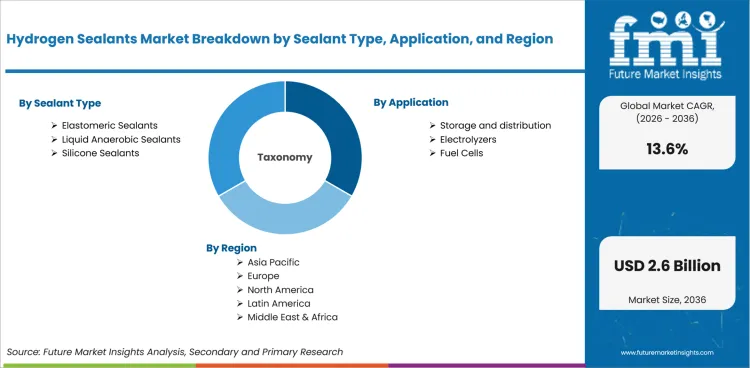
Hydrogen Sealants Market Breakdown by Sealant Type, Application, Pressure Class, End Use, Sales Mix, and Region
Hydrogen Sealants Market Segmented by Sealant Type:
- Elastomeric Sealants
- Liquid Anaerobic Sealants
- Silicone Sealants
- Other
Hydrogen Sealants Market Segmented by Application:
- Storage and Distribution
- Electrolyzers
- Fuel Cells
- Hydrogen Engines and Other
Hydrogen Sealants Market Segmented by Pressure Class:
- <100 bar
- 100-350 bar
- >350 bar
Hydrogen Sealants Market Segmented by End Use:
- Hydrogen Production
- Mobility
- Industrial Gas
- Power and Other
Hydrogen Sealants Market Segmented by Sales Mix:
- OEM
- Aftermarket
Hydrogen Sealants Market by Region:
- North America
- United States
- Canada
- Europe
- Germany
- United Kingdom
- France
- Italy
- Spain
- Asia Pacific
- China
- Japan
- South Korea
- Taiwan
- Singapore
- Latin America
- Brazil
- Mexico
- Argentina
- Middle East & Africa
- GCC Countries
- South Africa
- Israel
Research Sources and Bibliography
- International Energy Agency. (2024, September). Global Hydrogen Review 2024: Executive summary. IEA.
- U.S. Department of Energy. (2024, March 13). Bipartisan Infrastructure Law: Clean Hydrogen Electrolysis, Manufacturing, and Recycling Program selections. DOE.
- U.S. Department of the Treasury. (2025, January 3). U.S. Department of the Treasury releases final rules for clean hydrogen production tax credit.
- Federal Register. (2025, January 10). Credit for production of clean hydrogen and energy credit.
- Department for Energy Security and Net Zero. (2024, February 27). Hydrogen net zero investment roadmap: Leading the way to net zero. GOV.UK.
- Department for Energy Security and Net Zero. (2025, April 7). Hydrogen Allocation Round 2 closed to applications. GOV.UK.
- Bundesnetzagentur. (2024, October 22). Hydrogen core network.
- FNB Gas. (2024, October 22). Hydrogen core network.
- French Ministry of Economy. (2025, September 30). National strategy for the development of decarbonised hydrogen in France.
- Clean Hydrogen Observatory. (2025, June 23). France: National strategies. European Commission.
- Ministry of Economy, Trade and Industry. (2024, September 10). Hydrogen Society Promotion Act enacted toward a hydrogen society. METI.
- Ministry of Economy, Trade and Industry. (2025, February 18). Strategic Energy Plan.
- State Council Information Office of China. (2024, August 29). China’s energy transition.
- China-Germany Energy Partnership. (2025, July 1). China’s hydrogen sector 2025: Balancing growth and challenges.
- Ministry of Climate, Energy and Environment. (2026, June 8). Public Notice of proposed 2026 hydrogen power generation bidding market volumes. Republic of Korea.
- International Energy Agency. (2026, May 26). Hydrogen Power Generation Bidding Market - General.
- Press Information Bureau. (2024, February 7). Tenders awarded for green hydrogen production and electrolyzer manufacturing under National Green Hydrogen Mission. Ministry of New and Renewable Energy.
- Solar Energy Corporation of India. (2026, June 12). National Green Hydrogen Mission.
- Press Information Bureau. (2025, May 29). National Green Hydrogen Mission progress update. Ministry of New and Renewable Energy.
- Trelleborg Sealing Solutions. (2024, August 7). Trelleborg launches range of proven H2Pro solutions for hydrogen.
- Freudenberg Sealing Technologies. (2024, November 5). The material is the foundation for the best possible seals.
- DuPont. (2024, June 4). DuPont demonstrates solutions for the hydrogen value chain at FCVC 2024.
- EKPO Fuel Cell Technologies. (2024, September 16). EKPO to unveil the NM20 – its most powerful fuel cell stack module.
- Greene Tweed. (2025, December 11). Greene Tweed achieves hydrogen compression breakthrough with record-speed composite impeller.
This bibliography is provided for reader reference and is not exhaustive. The full report contains the complete reference list and detailed citations.
This Report Answers
- What is the current and forecast value of the Hydrogen Sealants Market during 2026 to 2036?
- What CAGR is expected for hydrogen sealants across the ten-year forecast period?
- Which sealant type is projected to lead demand in 2026 and why?
- Which application creates the largest demand for hydrogen-compatible sealants in 2026?
- How do pressure classes shape buyer choice across storage, mobility, and production systems?
- Which countries are expected to grow fastest in hydrogen sealants and what drives them?
- Which companies are most relevant in hydrogen sealants and engineered sealing systems?
- What makes hydrogen sealants different from conventional industrial sealants?
- How does FMI forecast demand using equipment volume, pressure class, and OEM qualification?
Frequently Asked Questions
What is driving demand in the Hydrogen Sealants Market?
Demand for hydrogen sealants is being driven by the expansion of hydrogen production, storage, transportation, and fueling infrastructure, along with the need for leak-resistant sealing solutions in high-pressure hydrogen environments.
Which applications are creating opportunities for Hydrogen Sealants Market growth?
Hydrogen storage systems, electrolyzers, fuel cells, pipelines, compressors, and refueling stations are among the key applications generating growth opportunities for hydrogen sealant manufacturers.
Which end-use industries are the primary consumers of hydrogen sealants?
The primary consumers of hydrogen sealants include the energy and utilities sector, chemical processing industry, industrial gas suppliers, transportation companies, and hydrogen equipment manufacturers.
Which sealant type is expected to lead in 2026?
Elastomeric Sealants are projected to account for 46.5% share in 2026 due to flexibility and pressure-cycle recovery.
Which application is expected to lead hydrogen sealant demand?
Storage and Distribution is expected to represent 39.0% share in 2026 as tanks, valves, regulators, and pipelines need tight sealing.
Which country is forecast to grow fastest in hydrogen sealants?
China is forecast to grow at 15.2% CAGR through 2036 as refueling stations and fuel cell vehicles support component demand.
What products are included in the Hydrogen Sealants Market?
The market includes elastomeric, liquid anaerobic, silicone, and specialty sealants used in hydrogen production, storage, distribution, and end-use systems.
How does FMI forecast the Hydrogen Sealants Market?
FMI combines equipment demand, sealant use intensity, pressure class, application mix, country readiness, and OEM qualification patterns.
Which hydrogen sealant is best for high-pressure storage?
High-pressure storage usually needs elastomeric or PTFE-based sealing systems validated for permeation, extrusion, and rapid gas decompression.
What is the difference between elastomeric and liquid anaerobic hydrogen sealants?
Elastomeric sealants act as flexible seals or gaskets. Liquid anaerobic sealants cure inside metal joints to seal threads and close small leak paths.
Preview the report firsthand - request a free sample
Get SampleGet the brochure for pricing and purchase details.
Get PDFTable of Content
- Executive Summary
- Global Market Outlook
- Demand-side Trends
- Supply-side Trends
- Technology Roadmap Analysis
- Analysis and Recommendations
- Market Overview
- Market Coverage / Taxonomy
- Market Definition / Scope / Limitations
- Research Methodology
- Research Design
- Primary Research
- Desk Research
- Market Sizing and Forecasting
- Data Validation
- Global Market Analysis 2021 to 2025 and Forecast, 2026 to 2036
- Historical Market Size Value (USD Million) Analysis, 2021 to 2025
- Current and Future Market Size Value (USD Million) Projections, 2026 to 2036
- Y-o-Y Growth Trend Analysis
- Absolute $ Opportunity Analysis
- Global Market Pricing Analysis 2021 to 2025 and Forecast 2026 to 2036
- Global Market Analysis 2021 to 2025 and Forecast 2026 to 2036, By Sealant Type
- Introduction / Key Findings
- Historical Market Size Value (USD Million) Analysis By Sealant Type, 2021 to 2025
- Current and Future Market Size Value (USD Million) Analysis By Sealant Type, 2026 to 2036
- Global Market Analysis 2021 to 2025 and Forecast 2026 to 2036, By Application
- Introduction / Key Findings
- Historical Market Size Value (USD Million) Analysis By Application, 2021 to 2025
- Current and Future Market Size Value (USD Million) Analysis By Application, 2026 to 2036
- Global Market Analysis 2021 to 2025 and Forecast 2026 to 2036, By Pressure Class
- Introduction / Key Findings
- Historical Market Size Value (USD Million) Analysis By Pressure Class, 2021 to 2025
- Current and Future Market Size Value (USD Million) Analysis By Pressure Class, 2026 to 2036
- Global Market Analysis 2021 to 2025 and Forecast 2026 to 2036, By End Use
- Introduction / Key Findings
- Historical Market Size Value (USD Million) Analysis By End Use, 2021 to 2025
- Current and Future Market Size Value (USD Million) Analysis By End Use, 2026 to 2036
- Global Market Analysis 2021 to 2025 and Forecast 2026 to 2036, By Sales Mix
- Introduction / Key Findings
- Historical Market Size Value (USD Million) Analysis By Sales Mix, 2021 to 2025
- Current and Future Market Size Value (USD Million) Analysis By Sales Mix, 2026 to 2036
- Global Market Analysis 2021 to 2025 and Forecast 2026 to 2036, By Region
- Introduction / Key Findings
- Historical Market Size Value (USD Million) Analysis By Region, 2021 to 2025
- Current and Future Market Size Value (USD Million) Analysis By Region, 2026 to 2036
- North America Market Analysis 2021 to 2025 and Forecast 2026 to 2036
- Pricing Analysis
- Market Share Analysis, 2025
- By Country
- By Sealant Type
- By Application
- By Pressure Class
- By End Use
- By Sales Mix
- Country-level Analysis
- United States
- Canada
- Latin America Market Analysis 2021 to 2025 and Forecast 2026 to 2036
- Pricing Analysis
- Market Share Analysis, 2025
- By Country
- By Sealant Type
- By Application
- By Pressure Class
- By End Use
- By Sales Mix
- Country-level Analysis
- Brazil
- Mexico
- Rest of Latin America
- Western Europe Market Analysis 2021 to 2025 and Forecast 2026 to 2036
- Pricing Analysis
- Market Share Analysis, 2025
- By Country
- By Sealant Type
- By Application
- By Pressure Class
- By End Use
- By Sales Mix
- Country-level Analysis
- Germany
- France
- United Kingdom
- Italy
- Spain
- BENELUX
- Nordics
- Rest of Western Europe
- Eastern Europe Market Analysis 2021 to 2025 and Forecast 2026 to 2036
- Pricing Analysis
- Market Share Analysis, 2025
- By Country
- By Sealant Type
- By Application
- By Pressure Class
- By End Use
- By Sales Mix
- Country-level Analysis
- Russia
- Poland
- Rest of Eastern Europe
- East Asia Market Analysis 2021 to 2025 and Forecast 2026 to 2036
- Pricing Analysis
- Market Share Analysis, 2025
- By Country
- By Sealant Type
- By Application
- By Pressure Class
- By End Use
- By Sales Mix
- Country-level Analysis
- China
- Japan
- South Korea
- South Asia and Pacific Market Analysis 2021 to 2025 and Forecast 2026 to 2036
- Pricing Analysis
- Market Share Analysis, 2025
- By Country
- By Sealant Type
- By Application
- By Pressure Class
- By End Use
- By Sales Mix
- Country-level Analysis
- India
- ASEAN
- Australia & New Zealand
- Rest of South Asia and Pacific
- Middle East & Africa Market Analysis 2021 to 2025 and Forecast 2026 to 2036
- Pricing Analysis
- Market Share Analysis, 2025
- By Country
- By Sealant Type
- By Application
- By Pressure Class
- By End Use
- By Sales Mix
- Country-level Analysis
- GCC Countries
- South Africa
- Turkey
- Rest of Middle East & Africa
- Market Structure Analysis
- Competition Dashboard
- Competition Benchmarking
- Market Share Analysis of Top Players
- By Region
- By Sealant Type
- By Application
- By Pressure Class
- By End Use
- By Sales Mix
- Emerging Startups
- Innovation Benchmarking
- Competition Analysis
- Competition Deep Dive
- Company Profiles
- Case Studies
- Success Stories
- Recent Developments
- Assumptions & Acronyms Used
- List of Tables: Hydrogen Sealants Market
- List of Figures: Hydrogen Sealants Market


