

- Market Size (2026)
- USD 967.6 Mn
- Forecast (2036)
- USD 1644.4 Mn
- CAGR (2026 to 2036)
- 5.4%
How big is LNG Tank Sealants Market in 2026?
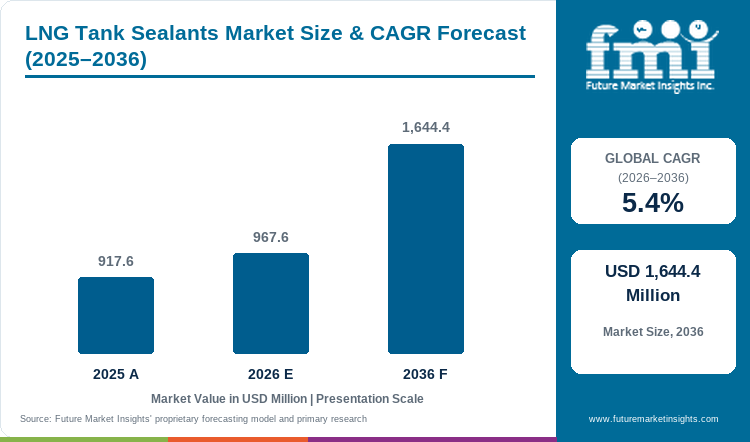
USD 967.6 million in 2026 and USD 1,644.4 million by 2036, expanding at 5.4% CAGR.
Sales of LNG tank sealants are estimated to rise at 5.4% CAGR through 2036, increasing valuation from USD 917.6 million in 2025 to USD 967.6 million in 2026 and reaching USD 1,644.4 million by 2036. IEA said in June 2026 that post-FID projects could add about 345 bcm of export capacity each year by 2030. EPC teams check tank joints and insulation during design. Projects need seals at insulation ends and vapor stops plus repair points. The same review covers industrial adhesives because work packages need surface and site records. Approval places products on lists before later buying stages.
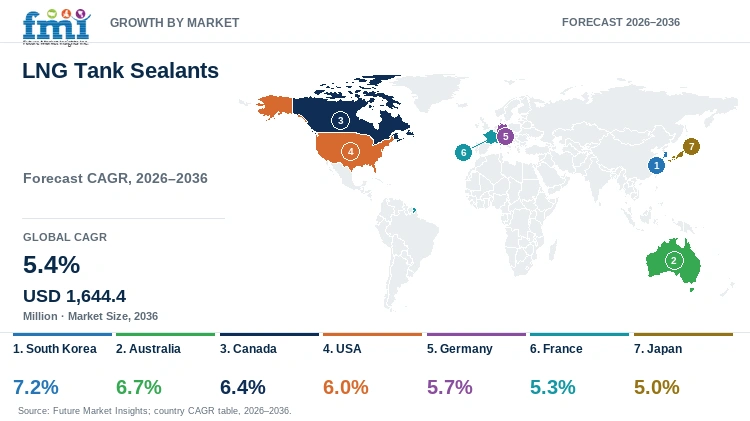
South Korea is projected at 7.2% CAGR through 2036 and Japan at 5.0%. In May 2026 KOGAS listed seven 270,000 kl tanks under construction at Dangjin. JOGMEC said Japanese companies handled about 110 million tonnes of LNG in fiscal 2024. Suppliers plan around different dates even when cold insulation and sealing use similar steps.
Key Takeaways
- LNG projects past final investment decision can add sealants to design lists years before first cargo.
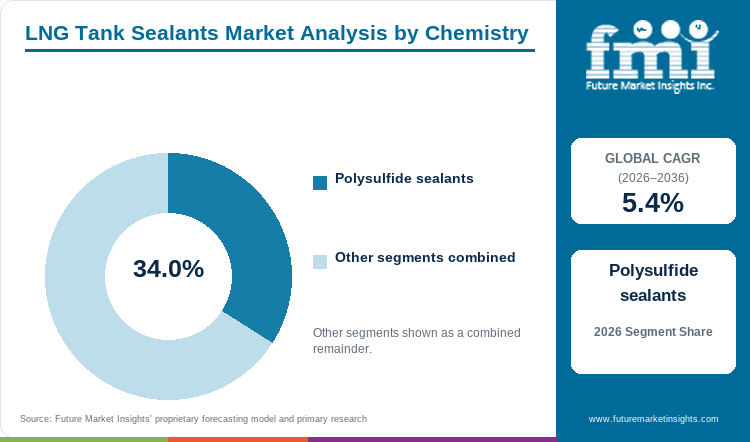
- Polysulfide sealants are estimated to hold 34.0% of chemistry demand in 2026 as elastic joints use them across many tank areas.
- Full containment tanks are estimated to hold 29.0% of application demand in 2026 because layered designs contain many sealed joints.
- LNG terminals are expected to lead end use with 31.0% share in 2026 since new tanks create years of repair work.
- Cold-service checks and cure control can delay a product switch even when the sealant has a modest price.
- Key players include PPG and 3M with Sika and Henkel. H.B. Fuller and Bostik compete with Dow and Wacker Chemie plus Trelleborg and Momentive.
Analyst Perspective
"Tank sealant choices start early because approved material lists limit later changes. Suppliers need cold-service proof and traceable batch records. They also need field help for each joint and surface."
- Nikhil Kaitwade, Principal Consultant, Future Market Insights
How is the LNG tank sealants market segmented?
The LNG tank sealants market is segmented by Chemistry, Application, End Use, Temperature Rating, Sales Channel and Region.
The LNG tank sealants market is segmented by chemistry, application, end use, temperature rating, sales channel and region through 2036. Chemistry includes polysulfide, silicone, polyurethane, epoxy and hybrid cryogenic sealants. Application includes full containment tanks, membrane tanks, tank penetrations, joint sealing and repair or retrofit. End use includes terminals, carriers, small-scale LNG, peak shaving plants and bunkering stations. Temperature rating covers below -160°C, -160°C to -100°C, thermal cycling and fire-safe grades. Sales channels include EPC contractors, tank builders, marine yards and MRO/distributors.
What supports polysulfide sealants within the chemistry category?
Polysulfide sealants work well in elastic joints that may contact oil or gas. Henkel launched Teroson MS 940 in September 2026 for hard elastic bonding. The launch adds another silane-modified choice for industrial bonding. silicone adhesives and sealants compete when weather resistance or cure time becomes the main need.
- Based on chemistry, polysulfide sealants are projected to account for 34.0% in 2026, supported by their use in elastic secondary tank joints.
- Silicone and polyurethane serve other needs in tank joints. Epoxy and hybrid systems gain use when heat cycling or stronger bonding becomes the main test.
Why do full containment tanks shape application demand?
Full containment tanks place many sealing jobs inside one asset. Civil joints and insulation ends need separate checks. FERC described two proposed 220,000 cubic meter LNG tanks at Corpus Christi in September 2026. Larger tanks create more sealed joints around aboveground storage tanks and nearby containment systems.
- By application, full containment tanks are estimated to hold 29.0% in 2026, driven by the many sealed joints in layered tank designs.
- Membrane tanks and repair jobs also need careful sealing. Their work is spread across ships and older operating sites.
How do LNG terminals sustain end-use demand?
LNG terminals combine large construction jobs with years of repair work. Tank joints and insulated openings may need fresh sealing after start-up. The IEA buildout adds more sites that will enter service. Marine transfer work also connects terminal upkeep with LNG bunkering operations.
- In 2026, LNG terminals are expected to lead end use with 31.0% share, influenced by new tank packages and repeat repair needs.
- Carriers and small LNG sites use special sealant packs. Terminal owners manage more civil joints and insulation openings across larger sites.
What makes below -160°C the key temperature-rating category?
LNG storage near -162°C makes cold-service proof a basic approval check. PHMSA's January 2026 inspection questions require material records and site-acceptance records. Engineers test bond strength and heat cycling on each surface. Similar checks apply to cryogenic insulation films used near equipment at cryogenic temperatures.
- Below -160°C products are set to lead the temperature-rating category with 37.0% share in 2026, attributable to LNG storage near its boiling point.
- One tank can use warmer grades and thermal-cycle products in different areas. Fire-safe grades serve locations that face a separate fire risk.
Why do EPC contractors lead the sales channel?
EPC contractors turn owner rules into approved product lists before site work starts. In May 2026, Natural Resources Canada said LNG Canada Phase 2 included engineering work and possible long-lead items before final investment. That early work brings industrial tapes and sealants into package reviews sooner.
- The sales-channel category is forecast to be led by EPC contractors at 38.0% share in 2026, supported by their approval role.
- Tank builders and marine yards help choose approved products. MRO distributors matter more for repair orders while EPC contractors handle larger project packages.
What are the drivers, restraints and opportunities in the LNG Tank Sealants Market?
Post-FID LNG construction expands sealing specifications, qualification controls restrict substitution and installed assets support recurring repair demand.
- Driver: New LNG export projects put tank sealants into design and build packages years before site work starts.
- Restraint: Product records and field checks can delay orders when a project has a short buying window.
- Opportunity: Repair work at LNG terminals creates repeat orders for products that protect insulation and sealed joints.
Early project approval moves sealant buying into the design stage
Large LNG projects buy special materials long before first cargo because design teams lock many choices early. The IEA said in June 2026 that post-FID projects could add about 345 bcm of export capacity each year through 2030. Front-end engineering sets joint and insulation details before site work. Approved suppliers can follow a project from civil joints into later repair work. construction sealants also enter design reviews at controlled infrastructure joints. Tank schedules leave little room for material changes once field work is planned. Local stock helps crews keep construction moving during busy build periods. Suppliers that clear design review early can serve the first build and later service orders.
Cold-service checks can last longer than the buying window
Cold LNG service cuts the list of products that a project can use because site method matters with chemistry. PHMSA's January 2026 inspection questions require material and construction records under Part 193. Owners and EPC teams add surface and cure checks before they approve field use. They also review fire behavior and worker application methods for each joint type. A sealant may pass a lab test but still fail field review if crews cannot repeat the approved method. Technical review can slow marine sealants approval and a late switch can restart checks. Owners may ask for mockups before field use to confirm the method. Suppliers need clear records and repeatable site steps so approval stays inside the project buying window.
Older LNG sites create steady repair demand
Operating terminals need sealed joints to survive weather and repeated cold cycles over years. NaTran said in January 2026 that LNG terminals supplied 64% of French gas inflows during 2025. Active sites create repair windows that do not depend on project approval or new tank construction. Fast-curing systems can shorten work near insulation ends and changed openings during planned outages. Repair crews also need primers that bond to old surfaces without long cure delays. epoxy adhesives or hybrid systems can help when crews need stronger bonding beside elastic sealing. Local stock and trained crews can turn short outages into repeat service orders for approved repair systems. Clear service records let crews reuse repair steps that owners accepted on earlier work.
Which country CAGRs are profiled in the LNG Tank Sealants Market?
| Country | CAGR |
|---|---|
| South Korea | 7.2% |
| Australia | 6.7% |
| Canada | 6.4% |
| USA | 6.0% |
| Germany | 5.7% |
| France | 5.3% |
| Japan | 5.0% |
How do country-level CAGRs compare in the LNG Tank Sealants Market?
The country outlook rates range from 5.0% to 7.2% by 2036. New tanks change some country rates while repair needs shape others. Similar CAGRs can still create different orders because each country has its own projects and buying rules.
- South Korea links large tank orders to KOGAS build schedules and local approval steps for each project package.
- Australia combines mature export sites with remote repair work that raises the need for stock and field support.
- Canada is moving from first exports toward more projects that need early supplier checks and remote supply planning.
- U.S. project pipelines create repeat review work under federal inspection rules and owner-approved material lists.
- Germany combines floating-terminal work with regulated network upgrades instead of relying on one large onshore tank cycle.
- France relies on LNG for a large share of gas inflows and creates steady repair work at operating terminals.
- Japan has a mature LNG system where detailed records and stable local service can slow quick supplier changes.
Comparable CAGRs show forecast pace instead of current market size. The full report covers North America and Latin America. It also covers Western Europe and Eastern Europe. The report also covers East Asia and South Asia and Pacific with Middle East and Africa.
Country-wise Analysis
- U.S. terminal developers put sealants on approved EPC lists before site work begins. The USA is estimated to post 6.0% CAGR over the forecast period, supported by its large export-terminal base. In February 2026, the U.S. Energy Information Administration said eight LNG export terminals were operating. It also said capacity could almost double by 2031 from the December 2025 level. Part 193 inspections add checks on products and site work. Owners also apply their own site approval rules. Suppliers need clear submittals and traceable batch records. Local stock and field help reduce schedule risk when crews need material during key work periods.
- Germany uses floating import terminals and plans network upgrades plus possible land-based sites. Germany's LNG tank sealants outlook is anticipated to advance at 5.7% CAGR over the assessment period, shaped by regulated northern terminal investment. In March 2026, Bundesnetzagentur approved an investment measure for more LNG-terminal entry capacity in northern Germany. Floating terminals need a different sealant mix from full containment tanks. Repair work also follows port access and outage plans. Suppliers need products that bond to old surfaces and meet operator rules. Local service helps crews finish repairs inside fixed work windows without delaying gas flow or terminal use.
- Japanese utilities and trading groups use long review cycles for materials used in LNG storage and transfer. Adoption of LNG tank sealants in Japan is estimated to expand at 5.0% CAGR through 2036, influenced by a mature terminal base. In February 2026, JOGMEC said Japanese companies handled about 110 million tonnes of LNG in fiscal 2024. It also said about 40% of contract volume kept destination limits. Mature sites create more repair demand than new-tank demand. Suppliers need proof for heat cycling and clear Japanese records. Good repair fit and steady local supply can support repeat orders during planned service.
- South Korean LNG buying centers on KOGAS terminal programs and major EPC contractors with formal technical reviews. LNG tank sealant demand in South Korea is forecast to rise at 7.2% CAGR over the forecast period, linked to active storage-tank construction. KOGAS listed four 270,000 kl tanks in Dangjin Phase 1 and three more in Phase 2 as of May 2026. The first group is due through May 2027. The second group is due through December 2029. Large packages need owner approval and site approval. Korean-language files and local quality support can speed review. Timely batches help contractors protect the build sequence during large tank work.
- Australian LNG sites sit far apart and long supply routes affect material choice. LNG tank sealant sales in Australia are forecast to expand at 6.7% CAGR by 2036, reinforced by a large national LNG operating base. Geoscience Australia said in August 2026 that the country exported 81.2 million tonnes of LNG in 2024. It also listed 13 committed major LNG and gas projects as of October 2024. Remote work raises the cost of rejected material and slow cure times. Suppliers need long shelf life and regional stock. Approved repair methods can cut travel and setup pressure during short maintenance windows. Local technical help can reduce rework at remote sites.
- Canadian LNG projects need early supplier work because engineering plans must match remote British Columbia supply routes. Canada's LNG tank sealants outlook is anticipated to advance at 6.4% CAGR over the assessment period, supported by new export assets. In July 2026, the Government of Canada said LNG Canada Phase 2 was moving through permits and financing with build planning. Phase 1 shipped its first cargo in June 2025. Later project timing still depends on business and legal decisions. Suppliers need proof for cold-weather use and local stock. Early approval can keep them on later build packages and long-lead product lists.
- French terminal work focuses on regulated operations and planned maintenance with controlled contractor access. The French LNG tank sealants sector is projected to record 5.3% CAGR during the assessment period, tied to national LNG inflows. NaTran said in January 2026 that LNG terminals supplied 64% of French gas inflows during 2025. The installed network creates repeat repair work even without a new tank wave. Outage windows limit the time available for repairs. Suppliers need matching primers and fast-curing repair systems. Clear service records can help teams reuse accepted repair methods at known terminal joints. Port schedules can also shape product delivery times.
Who are the notable companies in the LNG Tank Sealants Market?
PPG, 3M, Sika, Henkel, H.B. Fuller, Bostik, Dow, Wacker Chemie, Trelleborg and Momentive
The field includes cold-service bonding specialists and broad sealant groups. Marine-interface firms and silicone makers also compete for projects. Entry depends on exact-joint proof and reliable site work. Public evidence must connect each company to a real sealing task.
- 3M and H.B. Fuller bring bonding know-how for demanding work. Trelleborg adds marine-interface sealing experience for LNG projects.
- Sika and Henkel offer broad adhesive and sealant lines. PPG and Bostik also sell through project and industrial channels.
- Dow and Wacker Chemie supply silicone materials for formulators. Momentive adds more choices for demanding service conditions.
Competitive Benchmarking: LNG Tank Sealants Market
| Company | Cryogenic Evidence | Sealant Breadth | Field Access | Geographic Reach |
|---|---|---|---|---|
| PPG | Medium | High | High | Global |
| 3M | High | High | High | Global |
| Sika | Medium | High | High | Global |
| Henkel | Medium | High | High | Global |
| H.B. Fuller | High | High | High | Global |
| Bostik | Low | High | Medium | Global through Arkema |
| Dow | Medium | High | Medium | Global |
| Wacker Chemie | Medium | High | Medium | Europe, Asia and Americas |
| Trelleborg | High | Medium | High | Global marine and infrastructure |
| Momentive | Medium | High | Medium | Global |
Scoring basis: High means direct proof for cold or extreme service. Medium means related low-temperature proof and Low means broader sealant proof. High breadth needs proof across several sealant routes. High field access needs project or marine channels plus technical service.
Key Developments in the LNG Tank Sealants Market
- In September 2026, Henkel launched Teroson MS 940 for elastic rail and industrial bonding with a silane-modified polymer.
- In September 2026, Sika completed its purchase of Akkim. The deal added adhesive and sealant capacity plus wider sales reach.
- In June 2026, Dow announced investment through 2027 to add specialty-silicone output and new customer test sites.
Key Players in the LNG Tank Sealants Market
Cryogenic bonding and critical-interface specialists
- 3M
- H.B. Fuller
- Trelleborg
Tank, marine and infrastructure sealing platforms
- PPG
- Sika
- Henkel
- Bostik
Silicone and hybrid formulation platforms
- Dow
- Wacker Chemie
- Momentive
LNG Tank Sealants Market - Report Scope
| Coverage field | Report scope |
|---|---|
| Market breakdown | By chemistry, application, end use, temperature rating, sales channel and region. |
| Quantitative Units | USD million. |
| Market Definition | Commercial sealants, sealing adhesives, mastics, sealing tapes and liquid-applied barrier compounds used on LNG tank joints, penetrations, insulation terminations, vapor stops, weather barriers and repair interfaces. Finished tanks, insulation materials, mechanical gaskets, valves, pumps and downstream LNG sales are excluded. |
| Regions Covered | North America, Latin America, Western Europe, Eastern Europe, East Asia, South Asia and Pacific and Middle East and Africa. |
| Countries Covered | USA, Germany, Japan, South Korea, Australia, Canada, France and 20+ countries included in the full report. |
| Key Companies Profiled | PPG, 3M, Sika, Henkel, H.B. Fuller, Bostik, Dow, Wacker Chemie, Trelleborg and Momentive. |
| Forecast Period | 2026 to 2036. |
| Approach | Primary and secondary research with market triangulation. |
LNG Tank Sealants Market - Research Methodology
| Method | Approach |
|---|---|
| Primary Research | FMI analysts gathered input from manufacturers, service providers, technology developers, distributors, end users, procurement teams and subject-matter experts. Interviews examined purchasing decisions, product or service evaluation, adoption barriers, approval requirements, pricing considerations and expectations for technical or commercial support. Respondents were also asked what evidence is required before a trial, pilot, or initial order develops into regular purchasing. |
| Desk Research | Desk research covered government statistics, regulatory publications, trade data, industry associations, technical literature, standards, company filings, product information and official corporate announcements. Sources were reviewed for relevance, publication date, geographic coverage and consistency with the defined market scope. Claims relating to performance, applications, approvals, capacity, investment and commercial activity were retained only when supported by credible public evidence. |
| Market Sizing and Forecasting | The market model combined the baseline value with historical performance, segment structure, pricing and volume indicators, adoption levels, company participation and country-level demand conditions. Forecast assumptions considered economic activity, investment trends, regulatory developments, technology adoption, purchasing cycles, supply availability and barriers to wider market use. Segment and regional estimates were reconciled before the final market total was calculated. |
| Data Validation | Estimates were checked against multiple independent indicators, including public data, company activity, trade patterns, industry developments and findings from primary interviews. Validation also tested whether products, services, applications and company revenues fell within the defined market boundaries. Adjacent categories, unsupported claims, overlapping revenues and activities without direct market relevance were excluded to reduce double counting and maintain consistency across segments and countries. |
LNG Tank Sealants Market by Segments
LNG Tank Sealants Market segmented by Chemistry:
- Polysulfide sealants
- Silicone sealants
- Polyurethane sealants
- Epoxy sealants
- Hybrid cryogenic sealants
LNG Tank Sealants Market segmented by Application:
- Full containment tanks
- Membrane tanks
- Tank penetrations
- Joint sealing
- Repair and retrofit
LNG Tank Sealants Market segmented by End Use:
- LNG terminals
- LNG carriers
- Small-scale LNG
- Peak shaving plants
- Bunkering stations
LNG Tank Sealants Market segmented by Temperature Rating:
- Below -160°C
- -160°C to -100°C
- Thermal cycling grade
- Fire-safe grade
LNG Tank Sealants Market segmented by Sales Channel:
- EPC contractors
- Tank builders
- Marine yards
- MRO/distributors
LNG Tank Sealants Market by Region:
- North America
- United States
- Canada
- Latin America
- Brazil
- Mexico
- Chile
- Rest of Latin America
- Western Europe
- Germany
- United Kingdom
- Italy
- Spain
- France
- Nordics
- Benelux
- Rest of Western Europe
- Eastern Europe
- Russia
- Poland
- Hungary
- Balkan and Baltic States
- Rest of Eastern Europe
- East Asia
- China
- Japan
- South Korea
- South Asia and Pacific
- India
- ASEAN
- Australia and New Zealand
- Rest of South Asia and Pacific
- Middle East and Africa
- Kingdom of Saudi Arabia
- Other GCC Countries
- Türkiye
- South Africa
- Other African Union Countries
- Rest of Middle East and Africa
Research Sources and Bibliography
- International Energy Agency. (2026, June 12). Global LNG Capacity Tracker.
- Korea Gas Corporation. (2026, May 31). Status of LNG Terminal Construction.
- Japan Organization for Metals and Energy Security. (2026, February 18). Results of the FY2025 Surveys: LNG Handling Volume and Destination Restrictions in SPAs by Japanese Companies.
- Henkel. (2026, September 21). Henkel launches new adhesive and sealant for high-performance bonding in rail and industrial applications.
- Federal Energy Regulatory Commission. (2026, September 18). FERC staff issues the draft environmental impact statement for the Corpus Christi Liquefaction Stage 4 and the CCPL Expansion Projects.
- Pipeline and Hazardous Materials Safety Administration. (2026, January). PHMSA LNG (LNG.2026.01) IA Question Set - January 2026.
- Natural Resources Canada. (2026, May 14). Enhanced Investment Co-operation Advances Efforts Around LNG Canada's Proposed Phase 2 Expansion.
- NaTran. (2026, January 28). 2025 overview.
- U.S. Energy Information Administration. (2026, February 24). Ten years after first Sabine Pass cargo, U.S. LNG exports are still on the rise.
- Bundesnetzagentur. (2026, March 3). BK4-19-068A02 Genehmigung von Investitionsmaßnahmen - Gasbereich.
- Geoscience Australia. (2026, August 10). Australia's Energy Commodity Resources 2026: Gas.
- Government of Canada Major Projects Office. (2026, July 2). LNG Canada Phase 2.
- Sika. (2026, September 3). Sika closes acquisition of Akkim - Accelerating global expansion in adhesives and sealants.
- Dow. (2026, June 23). Dow expands product and innovation capabilities to support continued growth in specialty silicones markets.
- PPG. (2026, June 9). PPG showcases aerospace innovations driving long-term organic sales growth, delivering customer productivity.
- 3M. (2026, August 24). 3M and BOE launch joint laboratory to accelerate display technology innovation.
- H.B. Fuller. (2026, June 15). H.B. Fuller sets 2030 sustainability targets, with nearly 60% of innovation focused on sustainable solutions.
- Bostik. (2026, April 21). XL Brands introduces InnoStix PSA, a bio-based pressure sensitive adhesive for high-performance flooring applications.
- Arkema. (2026, February 24). Arkema at JEC World 2026: lighter, more efficient and sustainable innovations in specialty materials.
- Wacker Chemie AG / American Coatings Association. (2026, July 15). WACKER opens new production site for specialty silicones.
- Trelleborg Marine & Infrastructure. (2026, September 11). Trelleborg expands strategic partnership with SimWave through new transfer equipment training program.
- Trelleborg Sealing Solutions. (2026, April 13). Trelleborg Sealing Solutions in India breaks ground on expanded new manufacturing facility in Bengaluru.
- Momentive Performance Materials. (2026, February 24). Momentive advances NRX and NXT silane technologies at Tire Technology Expo 2026.
- Momentive Performance Materials. (2026, March 17). New reactive silicone solutions for enabling UV-coil coatings webinar.
- Sika. (2026, February 13). Sika to acquire Akkim: Marking a major step in accelerating global expansion in adhesives and sealants.
- Henkel. (2026, March 5). Henkel engineers new fire-retardant, sustainable interior and exterior adhesive sealant for rail applications.
- Dow. (2026, September 2). Dow to showcase chip-to-system materials innovation for AI and advanced packaging at SEMICON Taiwan 2026.
This bibliography gives readers the sources used for this article. The full report contains the complete reference list and detailed citations.
This Report Answers
- What values are forecast for 2026 and 2036?
- Why does LNG construction create early sealant demand?
- Why do polysulfide sealants lead the chemistry category?
- Why do full containment tanks need more sealing work?
- Why do LNG terminals lead end-use demand?
- How does service below -160°C change approval checks?
- Why do EPC contractors lead the sales channel?
- How do country growth conditions change order patterns?
- Which companies are active in LNG tank sealing?
Frequently Asked Questions
How big is the LNG Tank Sealants Market in 2026?
The LNG Tank Sealants Market is valued at USD 967.6 million in 2026 and is projected to reach USD 1,644.4 million by 2036. Demand is supported by new LNG tank construction projects and repair activities across existing storage infrastructure.
What is the CAGR of the LNG Tank Sealants Market from 2026 to 2036?
The LNG Tank Sealants Market is expected to grow at 5.4% CAGR between 2026 and 2036. Growth is driven by expanding LNG storage capacity and the need for approved sealant materials capable of performing in cryogenic service conditions.
Which chemistry leads the LNG Tank Sealants Market?
Polysulfide sealants are expected to hold 34.0% of chemistry demand in the LNG Tank Sealants Market in 2026. Their established use in elastic joint applications supports adoption, although direct LNG-contact applications may require separate product qualification and approval.
Which end use leads the LNG Tank Sealants Market?
LNG terminals are expected to account for 31.0% of end-use demand in the LNG Tank Sealants Market in 2026. New tank construction and repair work at operating terminals support their leading market position.
How much value will the LNG Tank Sealants Market add by 2036?
The LNG Tank Sealants Market is expected to add USD 676.8 million in value between 2026 and 2036. Continued investment in LNG infrastructure and maintenance of existing assets support this growth.
Which country is expected to record the highest growth in the LNG Tank Sealants Market?
South Korea is expected to grow at 7.2% CAGR through 2036 among the profiled countries. Strong LNG tank development activity supports growth, while Australia and Canada are projected to grow at 6.7% and 6.4% CAGR, respectively.
Which companies are active in the LNG Tank Sealants Market?
Key companies include PPG, 3M, Sika, Henkel, H.B. Fuller, Bostik, Dow, Wacker Chemie, Trelleborg and Momentive. Their offerings cover sealants, bonding technologies, marine-joint solutions and silicone-based materials used in LNG infrastructure applications.
What should EPC teams evaluate before selecting an LNG tank sealant?
EPC teams should assess cold-service performance data, bond strength on specified substrates, cure characteristics, fire-safety requirements, batch traceability and field-support capabilities before approval. Repair compatibility, shelf life and the availability of trained applicators are also important considerations during project execution.
Preview the report firsthand - request a free sample
Get SampleGet the brochure for pricing and purchase details.
Get PDFTable of Content
- Key Takeaways
- Market Size and CAGR
- Top Growth Driver
- Fastest Growing Segment
- Leading Region
- Key Companies
- Emerging Opportunities
- Executive Summary
- Global Market Outlook
- Demand-side Trends
- Supply-side Trends
- Technology Roadmap Analysis
- Analysis and Recommendations
- Analyst Perspective (What is happening? Why now? What should investors know?)
- Key Questions Answered
- How large is the market?
- What is the CAGR?
- What are key trends?
- Which region dominates?
- Who are the leaders?
- Market Overview
- Market Coverage / Taxonomy
- Market Definition / Scope / Limitations
- Research Methodology
- Chapter Orientation
- Analytical Lens and Working Hypotheses
- Market Structure, Signals, and Trend Drivers
- Benchmarking and Cross-market Comparability
- Market Sizing, Forecasting, and Opportunity Mapping
- Research Design and Evidence Framework
- Desk Research Programme (Secondary Evidence)
- Expert Input and Fieldwork (Primary Evidence)
- Tooling, Models, and Reference Databases
- Data Engineering and Model Build
- Quality Assurance and Audit Trail
- Market Background
- Market Dynamics (Drivers, Restraints, Opportunity, Trends)
- Scenario Forecast (Optimistic, Likely, Conservative)
- Impact Analysis
- AI Impact
- Sustainability Impact
- Regulatory Impact
- Technology Impact
- Consumer / Buyer Analysis
- Purchase Drivers
- Adoption Barriers
- Buyer Journey
- Opportunity Map Analysis
- Product Life Cycle Analysis
- Supply Chain Analysis
- Investment Feasibility Matrix
- Value Chain Analysis
- PESTLE and Porter's Analysis
- Regulatory Landscape
- Regional Parent Market Outlook
- Production and Consumption Statistics
- Import and Export Statistics
- Global Market Analysis and Forecast, 2021 to 2036
- Historical Market Size Value (USD Million) Analysis, 2021 to 2025
- Current and Future Market Size Value (USD Million) Projections, 2026 to 2036
- Y-o-Y Growth Trend Analysis
- Absolute $ Opportunity Analysis
- Global Market Pricing Analysis, 2021 to 2036
- Global Market Analysis and Forecast, By Chemistry, 2021 to 2036
- Introduction / Key Findings
- Historical Market Size Value (USD Million) Analysis By Chemistry, 2021 to 2025
- Current and Future Market Size Value (USD Million) Analysis and Forecast By Chemistry, 2026 to 2036
- Polysulfide sealants
- Silicone sealants
- Polyurethane sealants
- Epoxy sealants
- Hybrid cryogenic sealants
- Y-o-Y Growth Trend Analysis By Chemistry, 2021 to 2025
- Absolute $ Opportunity Analysis By Chemistry, 2026 to 2036
- Global Market Analysis and Forecast, By Application, 2021 to 2036
- Introduction / Key Findings
- Historical Market Size Value (USD Million) Analysis By Application, 2021 to 2025
- Current and Future Market Size Value (USD Million) Analysis and Forecast By Application, 2026 to 2036
- Full containment tanks
- Membrane tanks
- Tank penetrations
- Joint sealing
- Repair and retrofit
- Y-o-Y Growth Trend Analysis By Application, 2021 to 2025
- Absolute $ Opportunity Analysis By Application, 2026 to 2036
- Global Market Analysis and Forecast, By End Use, 2021 to 2036
- Introduction / Key Findings
- Historical Market Size Value (USD Million) Analysis By End Use, 2021 to 2025
- Current and Future Market Size Value (USD Million) Analysis and Forecast By End Use, 2026 to 2036
- LNG terminals
- LNG carriers
- Small-scale LNG
- Peak shaving plants
- Bunkering stations
- Y-o-Y Growth Trend Analysis By End Use, 2021 to 2025
- Absolute $ Opportunity Analysis By End Use, 2026 to 2036
- Global Market Analysis and Forecast, By Temperature Rating, 2021 to 2036
- Introduction / Key Findings
- Historical Market Size Value (USD Million) Analysis By Temperature Rating, 2021 to 2025
- Current and Future Market Size Value (USD Million) Analysis and Forecast By Temperature Rating, 2026 to 2036
- Below -160°C
- -160°C to -100°C
- Thermal cycling grade
- Fire-safe grade
- Y-o-Y Growth Trend Analysis By Temperature Rating, 2021 to 2025
- Absolute $ Opportunity Analysis By Temperature Rating, 2026 to 2036
- Global Market Analysis and Forecast, By Sales Channel, 2021 to 2036
- Introduction / Key Findings
- Historical Market Size Value (USD Million) Analysis By Sales Channel, 2021 to 2025
- Current and Future Market Size Value (USD Million) Analysis and Forecast By Sales Channel, 2026 to 2036
- EPC contractors
- Tank builders
- Marine yards
- MRO/distributors
- Y-o-Y Growth Trend Analysis By Sales Channel, 2021 to 2025
- Absolute $ Opportunity Analysis By Sales Channel, 2026 to 2036
- Global Market Analysis and Forecast, By Region, 2021 to 2036
- Introduction
- Historical Market Size Value (USD Million) Analysis By Region, 2021 to 2025
- Current Market Size Value (USD Million) Analysis and Forecast By Region, 2026 to 2036
- North America
- Latin America
- Western Europe
- Eastern Europe
- East Asia
- South Asia and Pacific
- Middle East and Africa
- Market Attractiveness Analysis By Region
- North America Market Analysis and Forecast, By Country, 2021 to 2036
- Historical Market Size Value (USD Million) Trend Analysis By Market Taxonomy, 2021 to 2025
- Market Size Value (USD Million) Forecast By Market Taxonomy, 2026 to 2036
- By Country
- United States
- Canada
- By Chemistry
- By Application
- By End Use
- By Temperature Rating
- By Sales Channel
- By Country
- Market Attractiveness Analysis
- By Country
- By Chemistry
- By Application
- By End Use
- By Temperature Rating
- By Sales Channel
- Key Takeaways
- Latin America Market Analysis and Forecast, By Country
- Historical Market Size Value (USD Million) Trend Analysis By Market Taxonomy, 2021 to 2025
- Market Size Value (USD Million) Forecast By Market Taxonomy, 2026 to 2036
- By Country
- Brazil
- Mexico
- Chile
- Rest of Latin America
- By Chemistry
- By Application
- By End Use
- By Temperature Rating
- By Sales Channel
- By Country
- Market Attractiveness Analysis
- By Country
- By Chemistry
- By Application
- By End Use
- By Temperature Rating
- By Sales Channel
- Key Takeaways
- Western Europe Market Analysis and Forecast, By Country
- Historical Market Size Value (USD Million) Trend Analysis By Market Taxonomy, 2021 to 2025
- Market Size Value (USD Million) Forecast By Market Taxonomy, 2026 to 2036
- By Country
- Germany
- United Kingdom
- Italy
- Spain
- France
- Nordics
- Benelux
- Rest of Western Europe
- By Chemistry
- By Application
- By End Use
- By Temperature Rating
- By Sales Channel
- By Country
- Market Attractiveness Analysis
- By Country
- By Chemistry
- By Application
- By End Use
- By Temperature Rating
- By Sales Channel
- Key Takeaways
- Eastern Europe Market Analysis and Forecast, By Country
- Historical Market Size Value (USD Million) Trend Analysis By Market Taxonomy, 2021 to 2025
- Market Size Value (USD Million) Forecast By Market Taxonomy, 2026 to 2036
- By Country
- Russia
- Poland
- Hungary
- Balkan and Baltic States
- Rest of Eastern Europe
- By Chemistry
- By Application
- By End Use
- By Temperature Rating
- By Sales Channel
- By Country
- Market Attractiveness Analysis
- By Country
- By Chemistry
- By Application
- By End Use
- By Temperature Rating
- By Sales Channel
- Key Takeaways
- East Asia Market Analysis and Forecast, By Country
- Historical Market Size Value (USD Million) Trend Analysis By Market Taxonomy, 2021 to 2025
- Market Size Value (USD Million) Forecast By Market Taxonomy, 2026 to 2036
- By Country
- China
- Japan
- South Korea
- By Chemistry
- By Application
- By End Use
- By Temperature Rating
- By Sales Channel
- By Country
- Market Attractiveness Analysis
- By Country
- By Chemistry
- By Application
- By End Use
- By Temperature Rating
- By Sales Channel
- Key Takeaways
- South Asia and Pacific Market Analysis and Forecast, By Country
- Historical Market Size Value (USD Million) Trend Analysis By Market Taxonomy, 2021 to 2025
- Market Size Value (USD Million) Forecast By Market Taxonomy, 2026 to 2036
- By Country
- India
- ASEAN
- Australia and New Zealand
- Rest of South Asia and Pacific
- By Chemistry
- By Application
- By End Use
- By Temperature Rating
- By Sales Channel
- By Country
- Market Attractiveness Analysis
- By Country
- By Chemistry
- By Application
- By End Use
- By Temperature Rating
- By Sales Channel
- Key Takeaways
- Middle East and Africa Market Analysis and Forecast, By Country
- Historical Market Size Value (USD Million) Trend Analysis By Market Taxonomy, 2021 to 2025
- Market Size Value (USD Million) Forecast By Market Taxonomy, 2026 to 2036
- By Country
- Kingdom of Saudi Arabia
- Other GCC Countries
- Türkiye
- South Africa
- Other African Union Countries
- Rest of Middle East and Africa
- By Chemistry
- By Application
- By End Use
- By Temperature Rating
- By Sales Channel
- By Country
- Market Attractiveness Analysis
- By Country
- By Chemistry
- By Application
- By End Use
- By Temperature Rating
- By Sales Channel
- Key Takeaways
- Key Countries Market Analysis
- United States
- Pricing Analysis
- Market Share Analysis, 2025
- By Chemistry
- By Application
- By End Use
- By Temperature Rating
- By Sales Channel
- Canada
- Pricing Analysis
- Market Share Analysis, 2025
- By Chemistry
- By Application
- By End Use
- By Temperature Rating
- By Sales Channel
- Mexico
- Pricing Analysis
- Market Share Analysis, 2025
- By Chemistry
- By Application
- By End Use
- By Temperature Rating
- By Sales Channel
- Brazil
- Pricing Analysis
- Market Share Analysis, 2025
- By Chemistry
- By Application
- By End Use
- By Temperature Rating
- By Sales Channel
- Chile
- Pricing Analysis
- Market Share Analysis, 2025
- By Chemistry
- By Application
- By End Use
- By Temperature Rating
- By Sales Channel
- Germany
- Pricing Analysis
- Market Share Analysis, 2025
- By Chemistry
- By Application
- By End Use
- By Temperature Rating
- By Sales Channel
- United Kingdom
- Pricing Analysis
- Market Share Analysis, 2025
- By Chemistry
- By Application
- By End Use
- By Temperature Rating
- By Sales Channel
- Italy
- Pricing Analysis
- Market Share Analysis, 2025
- By Chemistry
- By Application
- By End Use
- By Temperature Rating
- By Sales Channel
- Spain
- Pricing Analysis
- Market Share Analysis, 2025
- By Chemistry
- By Application
- By End Use
- By Temperature Rating
- By Sales Channel
- France
- Pricing Analysis
- Market Share Analysis, 2025
- By Chemistry
- By Application
- By End Use
- By Temperature Rating
- By Sales Channel
- India
- Pricing Analysis
- Market Share Analysis, 2025
- By Chemistry
- By Application
- By End Use
- By Temperature Rating
- By Sales Channel
- ASEAN
- Pricing Analysis
- Market Share Analysis, 2025
- By Chemistry
- By Application
- By End Use
- By Temperature Rating
- By Sales Channel
- Australia and New Zealand
- Pricing Analysis
- Market Share Analysis, 2025
- By Chemistry
- By Application
- By End Use
- By Temperature Rating
- By Sales Channel
- China
- Pricing Analysis
- Market Share Analysis, 2025
- By Chemistry
- By Application
- By End Use
- By Temperature Rating
- By Sales Channel
- Japan
- Pricing Analysis
- Market Share Analysis, 2025
- By Chemistry
- By Application
- By End Use
- By Temperature Rating
- By Sales Channel
- South Korea
- Pricing Analysis
- Market Share Analysis, 2025
- By Chemistry
- By Application
- By End Use
- By Temperature Rating
- By Sales Channel
- Russia
- Pricing Analysis
- Market Share Analysis, 2025
- By Chemistry
- By Application
- By End Use
- By Temperature Rating
- By Sales Channel
- Poland
- Pricing Analysis
- Market Share Analysis, 2025
- By Chemistry
- By Application
- By End Use
- By Temperature Rating
- By Sales Channel
- Hungary
- Pricing Analysis
- Market Share Analysis, 2025
- By Chemistry
- By Application
- By End Use
- By Temperature Rating
- By Sales Channel
- Kingdom of Saudi Arabia
- Pricing Analysis
- Market Share Analysis, 2025
- By Chemistry
- By Application
- By End Use
- By Temperature Rating
- By Sales Channel
- Türkiye
- Pricing Analysis
- Market Share Analysis, 2025
- By Chemistry
- By Application
- By End Use
- By Temperature Rating
- By Sales Channel
- South Africa
- Pricing Analysis
- Market Share Analysis, 2025
- By Chemistry
- By Application
- By End Use
- By Temperature Rating
- By Sales Channel
- Australia
- Pricing Analysis
- Market Share Analysis, 2025
- By Chemistry
- By Application
- By End Use
- By Temperature Rating
- By Sales Channel
- United States
- Market Structure Analysis
- Competition Dashboard
- Competition Benchmarking
- Market Share Analysis of Top Players
- By Regional
- By Chemistry
- By Application
- By End Use
- By Temperature Rating
- By Sales Channel
- Emerging Startups
- Innovation Benchmarking
- Competition Analysis
- Competition Deep Dive
- PPG
- Overview
- Product Portfolio
- Profitability by Market Segments
- Sales Footprint
- Strategy Overview
- Marketing Strategy
- Product Strategy
- Channel Strategy
- 3M
- Sika
- Henkel
- H.B. Fuller
- Bostik
- Dow
- Wacker Chemie
- Trelleborg
- Momentive
- PPG
- Case Studies
- Success Stories
- Recent Developments
- Competition Deep Dive
- Assumptions & Acronyms Used


