

- Market Size (2026)
- USD 1.7 Bn
- Forecast (2036)
- USD 3.0 Bn
- CAGR (2026 to 2036)
- 6.1%
How big is the One-Component Epoxy Adhesives Market in 2026?
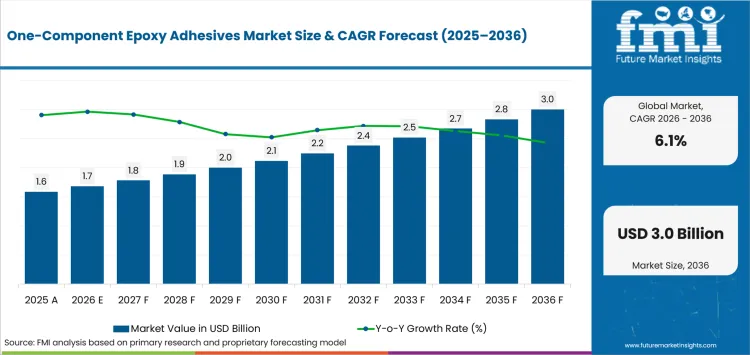
USD 1.7 billion in 2026 and USD 3.0 billion by 2036 at a 6.1% CAGR.
Demand for one-component epoxy adhesives is projected to expand at a 6.1% CAGR between 2026 and 2036, driven by growing demand for streamlined manufacturing processes. In March 2026, Master Bond introduced EP6STC-80, a non-frozen one-component silver-filled epoxy adhesive that cures at 80°C. The single-component format eliminates the need for line-side resin and hardener mixing while delivering the thermal and electrical performance required in automated assembly operations.
New semiconductor facilities add material qualification work because each plant establishes approved materials for its own process conditions. In October 2025 the European Commission granted IPF or OEF status to four semiconductor projects, including two in Germany. Those German projects increase the number of nearby production programs that may need local application support before adhesive specifications become fixed.
Key Takeaways of One-Component Epoxy Adhesives Market
- Device and vehicle assembly raises demand for premixed epoxies that remove line-side mixing from repeatable dispensing steps.
- By cure method heat-cure epoxies are estimated to hold 39.0% in 2026, driven by latent formulations that fit defined industrial heating steps.
- In 2026 liquid is expected to lead form with 34.0% share, supported by automated dispensing into narrow or irregular bond geometries.
- Electronics assembly is projected to hold 31.0% share in 2026, attributable to small bond lines that require controlled placement and cure exposure.
- Thermal exposure and qualification can delay production approval because premixed formulations still need controlled storage and a validated production cure window.
- Some of the key players in this market include Henkel, 3M, H.B. Fuller, Master Bond, Hoenle Adhesives GmbH, DELO Industrial Adhesives, Parker Hannifin (LORD), Permabond, Nagase ChemteX Corporation, and Sika.
Analyst Perspective
"Production teams should confirm the cure window and dispensing process before they compare material price. Commercial value comes from reducing line variation without forcing another reliability test or a longer thermal cycle."
- Nikhil Kaitwade, Principal Consultant, Future Market Insights
How is the One-Component Epoxy Adhesives Market segmented?
The market is segmented by cure method, form, application, performance and sales channel.
Cure method covers heat-cure, UV - heat dual-cure, moisture-assisted, latent-cure and snap-cure epoxies. Form includes liquid, paste, film, pre-applied adhesive and microdispense grade while applications cover electronics assembly, automotive components, medical devices, industrial bonding and aerospace interiors. Performance separates high strength, thermally conductive, electrically insulating, flexible - toughened and low-outgassing grades. Sales channels include direct OEM supply, industrial distributors, electronics materials channels and contract manufacturers.
What makes heat-cure epoxies central to the cure method category?
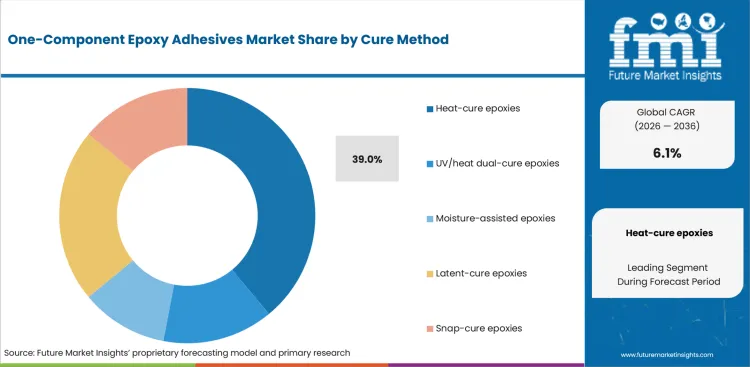
Heat-cure grades fit automated lines that can hold a defined thermal step without on-line mixing. Engineers compare latent formulations with heat-resistant epoxy adhesives to balance cure temperature against cycle time during industrial qualification.
- By cure method heat-cure epoxies are estimated to hold 39.0% in 2026, driven by established oven and localized-heating steps in structural assembly.
- Master Bond released LED422DC90 in September 2025 as a one-component system that uses LED fixturing before a 90°C to 95°C secondary heat cure for electronics and optical assemblies.
How does liquid influence selection within the form category?
Liquid grades fit automated needles and valves that meter small volumes into narrow gaps without a separate mixing head. Engineers compare industrial adhesives by viscosity stability because flow control changes bead geometry and final bond-line thickness during serial production.
- Liquid is projected to hold 34.0% share in 2026, supported by controlled deposition into narrow gaps and compact components.
- Master Bond introduced EP3HTSDA-2Med in May 2025 as a true one-component silver-filled epoxy with controlled dispensing behavior and ISO 10993-5 cytotoxicity compliance for medical assembly.
What supports demand for electronics assembly within the application category?
Electronics assembly places adhesive beside compact sensors and circuit features where placement error or excess heat can reject a functional joint. Electronics adhesives therefore compete on cure access and electrical behavior alongside mechanical strength.
- In 2026 electronics assembly is expected to lead the application category with 31.0% share, attributable to repeatable placement around compact components and circuit features.
- Master Bond released EP55TCFL in August 2026 with a one-part premixed-frozen option for thin bond lines requiring thermal conductivity and electrical insulation in compact assemblies.
How do manufacturing teams evaluate high strength within the performance category?
High-strength grades serve joints that must retain load after vibration and repeated thermal cycling in service. Engineers compare structural adhesives under representative aging conditions because nominal lap-shear strength alone does not establish long-term service durability.
- High strength is set to lead the performance category with 27.0% share in 2026, driven by joints that must retain load after heat and vibration exposure.
- Master Bond released Supreme 10HTLV in December 2025 as a one-part non-frozen heat-cured epoxy engineered for demanding structural bonding under shock and thermal cycling.
What drives direct OEM supply within the sales channel category?
Manufacturers rely on direct OEM supply once an adhesive enters a validated specification because any material change must remain traceable to approved line data. Engineering teams benchmark one-component systems against 2K epoxy adhesives before choosing the handling route that fits plant controls.
- Direct OEM supply is likely to capture 36.0% share in 2026, attributable to application trials and change control before production approval.
- H.B. Fuller announced an aerospace manufacturing center in May 2026 that will consolidate specialized manufacturing and qualification testing for long-life aviation and defense programs.
What are the drivers, restraints and opportunities in the One-Component Epoxy Adhesives Market?
Complex electronics assembly increases qualification activity while thermal cure limits some conversions and lower-temperature process options widen addressable production conditions.
- Driver: More semiconductor and electronic-device programs increase the number of production lines that must qualify precise structural or functional bonding materials.
- Restraint: Heat exposure and cure duration can block otherwise suitable formulations on temperature-sensitive components or production lines with limited thermal capacity.
- Opportunity: Lower-temperature and light-assisted grades can reach assemblies that need fast placement control without a conventional high-temperature batch cure.
Device complexity increases the number of functional joints that need controlled bonding on automated lines and documented reliability performance. The Semiconductor Industry Association reported in May 2026 that first-quarter global semiconductor sales rose 25% from the fourth quarter of 2025. Electrically conductive adhesives can provide electrical function in the same bonded joint and reduce separate attachment steps in compact electronic assemblies.
Thermal qualification limits conversion because conventional heat-curing can expose sensitive parts to temperatures or residence times that plant engineers cannot accept. DELO stated in August 2026 that traditional consumer-electronics heat cure often requires at least 80°C or 90 to 120 minutes at 60°C. Lower-temperature chemistry reduces the thermal burden, but every replacement still needs reliability approval in the intended assembly.
Lower-temperature and light-assisted chemistry can extend one-component use into medical or optical assemblies that cannot tolerate a conventional oven sequence. Master Bond released UV16Med-FD in July 2026 as a one-part epoxy-based UV-curable system with fluorescent placement inspection and ISO 10993-5 compliance. Conductive adhesive materials offer another route for compact assemblies that need electrical function and repeatable placement from the bonded joint.
Which country CAGRs are profiled in the One-Component Epoxy Adhesives Market?
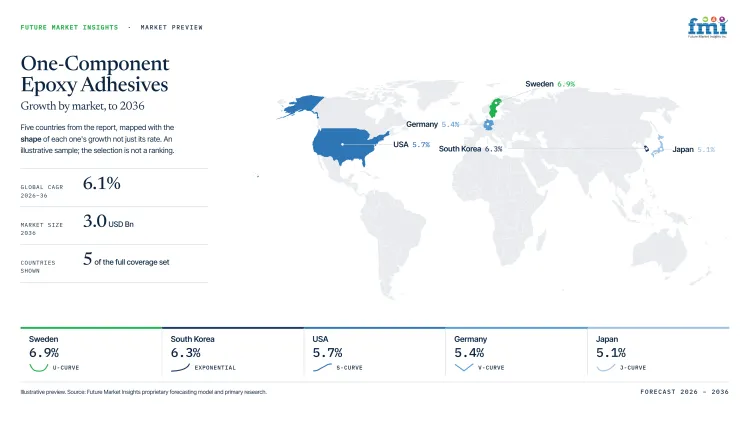
| Country | CAGR |
|---|---|
| Sweden | 6.9% |
| South Korea | 6.3% |
| Mexico | 5.9% |
| USA | 5.7% |
| Germany | 5.4% |
| France | 5.2% |
| Japan | 5.1% |
How do country-level CAGRs compare in the One-Component Epoxy Adhesives Market?
The 1.8 percentage-point spread separates Sweden and South Korea from the compact group extending from Mexico to Japan. The difference reflects how often manufacturers open new material qualifications instead of current revenue alone. Sweden has research-led pilot activity and South Korea has dense semiconductor production, so each market generates qualification work through a different route.
- Sweden’s position reflects concentrated electronics research and a base that can expand quickly.
- South Korea’s semiconductor density gives adhesive companies access to high-volume electronics qualification work.
- Mexico’s export mix ties automotive and electronics plants to North American production programs.
- US growth spans semiconductor and vehicle plants plus medical-device manufacturing with separate qualification cycles.
- Germany’s automotive and electronics base sustains qualification work despite tighter economics for thermal processing cycles.
- France’s aerospace and medical manufacturing mix places weight on traceability and reliability evidence.
- Japan’s precision manufacturing base sustains repeat programs despite product cycles slowing material switching.
Similar growth rates carry different sales-cycle costs because local qualification practice varies between countries. The full report provides country-level CAGR analysis across North America, Latin America, Western Europe, Eastern Europe, East Asia, South Asia and Pacific and the Middle East and Africa.
Country-wise Analysis
- Swedish electronics qualification is concentrated in research-led programs with smaller production runs that make pilot access more useful than domestic manufacturing scale. Vinnova opened a February 2026 call that gives Swedish SMEs access to five Chips JU pilot lines for semiconductor process and material validation. One-component epoxy adhesive demand in Sweden is projected to expand at 6.9% CAGR through 2036, supported by material trials that favor premixed handling during repeated test cycles. Pilot access lowers early qualification cost but commercial conversion still depends on small-batch supply and application engineers who can carry electronic packaging adhesives from prototype work into repeat manufacturing.
- South Korean electronics factories put strong time pressure on each bonding step because high-volume lines lose output during extended cure cycles. Adoption in South Korea is estimated to expand at 6.3% CAGR through 2036, driven by semiconductor and electronics production that favors fast cure with controlled contamination. The Ministry of Trade Industry and Resources reported in January 2026 that semiconductor exports rose 22.2% during 2025. Dense customer clusters make local engineering support practical but new adhesives must match dispensing and fixture behavior during plant-specific qualification. Application teams need snap-cure or precision-dispense grades that resolve line issues without interrupting serial production.
- Mexican automotive and electronics plants often reproduce North American process specifications and depend on local inventory to keep export production continuous. Mexico’s Secretariat of Economy reported in May 2025 that 16 of 30 Semiconductor Master Plan goals had been completed. Site-to-site qualification stays difficult because adhesive performance and support must match customer specifications approved elsewhere in the regional network. The Mexican one-component epoxy adhesives sector is projected to record 5.9% CAGR during the assessment period, supported by localization and semiconductor program development. Regional warehousing can shorten replenishment time once local plants reproduce those approved processes under customer change controls.
- US one-component epoxy use spans semiconductor fabrication and automotive plants with separate material approval processes plus medical adhesives programs requiring distinct reliability records. NIST stated in July 2026 that planned TSMC expansion would bring the company to 12 advanced semiconductor and packaging facilities in the United States. The USA is forecast to grow at 5.7% CAGR through 2036, driven by additional electronics capacity that generates fresh qualification work at individual sites. Domestic technical teams can shorten trial response times but the same formulation still needs plant-specific evidence before transfer between programs with different cure, dispensing and reliability requirements.
- German automotive and electronics plants qualify structural materials under mature quality systems that weigh cure energy against reliability documentation. Higher-temperature cure can weaken project economics on energy-sensitive lines unless lower-temperature alternatives provide equivalent mechanical evidence before substitution. Destatis reported in November 2025 that September order backlogs rose 1.8% in electronic and optical products and 0.7% in automotive manufacturing. Demand in Germany is predicted to advance at 5.4% CAGR through 2036, supported by electronics and vehicle programs that sustain material qualification. Local engineering teams can run detailed trials but plants still require reliability records matched to the intended thermal cycle.
- French electronics and high-reliability manufacturing programs place traceability beside bond performance during production material approval. Demand for one-component epoxy adhesives in France is forecast to rise at 5.2% CAGR over the forecast period, driven by electronics output and qualification-heavy aerospace or medical applications. Low-outgassing or sterilization requirements can extend validation because each formulation must satisfy application-specific records before routine manufacturing approval. Insee reported in October 2025 that national computer electronic and optical manufacturing output rose 5.0% from July to August. Established documentation practices support repeat specifications once production teams accept the material under formal change procedures at each site.
- Japanese electronics plants impose narrow dispensing and storage limits before a new adhesive enters serial production. METI reported in July 2025 that manufacturing capacity for electronic parts and devices rose 1.5% in May from the prior month. Sales of one-component epoxy adhesives in Japan are forecast to expand at 5.1% CAGR by 2036, attributable to precision assembly programs that reuse qualified materials. Existing process discipline favors repeatable thermal interface materials and adhesive handling but companies must document stable cure behavior before changing long-running automated specifications. Local application teams therefore need test records that preserve narrow performance tolerances during production transfer.
Who are the notable companies in the One-Component Epoxy Adhesives Market?
Henkel, 3M, H.B. Fuller, Master Bond, Hoenle Adhesives GmbH, DELO Industrial Adhesives, Parker Hannifin (LORD), Permabond, Nagase ChemteX Corporation, and Sika are notable companies serving this market.
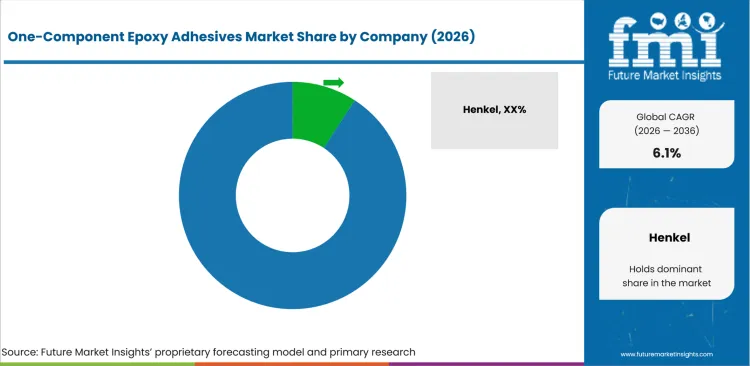
Competition depends on how closely each company ties adhesive performance to qualification support at OEM plants. Diversified groups serve several industries while specialists focus on cure control where material changes reopen reliability testing.
- Henkel, 3M and H.B. Fuller serve multi-industry adhesive programs with broad OEM access and application engineering for several end uses.
- Master Bond, Hoenle Adhesives GmbH and DELO Industrial Adhesives focus on precision formulation where cure control affects electronics qualification.
- Parker Hannifin (LORD) and Permabond work alongside Nagase ChemteX Corporation and Sika on engineering-led bonding programs with structural or functional performance requirements.
Competitive Benchmarking: One-Component Epoxy Adhesives Market
| Company | One-Component Epoxy Evidence | Precision Process Support | Functional Adhesive Specialization | Geographic Reach |
|---|---|---|---|---|
| Henkel | High | High | High | Global |
| 3M | Medium | High | Medium | Global |
| H.B. Fuller | Low | High | Medium | Global |
| Master Bond | High | High | High | North America with international sales |
| Hoenle Adhesives GmbH | High | High | High | Europe, North America and Asia |
| DELO Industrial Adhesives | Medium | High | High | Europe, North America and Asia |
| Parker Hannifin (LORD) | Medium | High | High | Global |
| Permabond | High | Medium | High | North America, Europe and Asia |
| Nagase ChemteX Corporation | High | Medium | High | Japan, East Asia and North America |
| Sika | Low | Medium | Medium | Global |
Key Developments in the One-Component Epoxy Adhesives Market
- In May 2026, Henkel introduced the heat-curing one-component Teroson EP 52 Series for automotive structural bonding with automated pump dispensing and integrated vibration damping.
- In February 2025, Panacol-Elosol GmbH introduced Structalit 5859 for e-motor magnet bonding before the company became Hoenle Adhesives GmbH in September 2025.
- In March 2025, Permabond introduced ES5516 as a single-part heat-curing epoxy for electric-motor magnet bonding with 180°C hot-strength performance and UV tacking before thermal cure.
Key Players in the One-Component Epoxy Adhesives Market
Multi-Industry Adhesive Groups and Specialist Formulators
- Henkel
- 3M
- H.B. Fuller
- Master Bond
Precision Formulation and Electronics Specialists
- Hoenle Adhesives GmbH
- DELO Industrial Adhesives
- Parker Hannifin (LORD)
Engineering and Materials Suppliers
- Permabond
- Nagase ChemteX Corporation
- Sika
One-Component Epoxy Adhesives Market - Report Scope
| Coverage field | Report scope |
|---|---|
| Market breakdown | By cure method, form, application, performance, sales channel and region. |
| Quantitative Units | Revenue in USD billion and CAGR in %. |
| Market Definition | Revenue from premixed one-component epoxy adhesive materials within the defined segmentation axes. The scope excludes two-component epoxies, non-epoxy substitutes, separate potting or coating compounds outside the adhesive boundary, dispensing or curing equipment and downstream finished-product revenue. |
| Regions Covered | North America, Latin America, Western Europe, Eastern Europe, East Asia, South Asia and Pacific and Middle East and Africa. |
| Countries Covered | Sweden, South Korea, Mexico, USA, Germany, France, Japan and more than twenty-five additional countries in the full report. |
| Key Companies Profiled | Henkel, 3M, H.B. Fuller, Master Bond, Hoenle Adhesives GmbH, DELO Industrial Adhesives, Parker Hannifin (LORD), Permabond, Nagase ChemteX Corporation, Sika. |
| Forecast Period | 2026 to 2036. |
| Approach | Primary and secondary research with market triangulation. |
One-Component Epoxy Adhesives Market - Research Methodology
| Method | Approach |
|---|---|
| Primary Research | FMI analysts gathered input from manufacturers, service providers, technology developers, distributors, end users, procurement teams, and subject-matter experts. Interviews examined purchasing decisions, product or service evaluation, adoption barriers, approval requirements, pricing considerations, and expectations for technical or commercial support. Respondents were also asked what evidence is required before a trial, pilot, or initial order develops into regular purchasing. |
| Desk Research | Desk research covered government statistics, regulatory publications, trade data, industry associations, technical literature, standards, company filings, product information, and official corporate announcements. Sources were reviewed for relevance, publication date, geographic coverage, and consistency with the defined market scope. Claims relating to performance, applications, approvals, capacity, investment, and commercial activity were retained only when supported by credible public evidence. |
| Market Sizing and Forecasting | The market model combined the baseline value with historical performance, segment structure, pricing and volume indicators, adoption levels, company participation, and country-level demand conditions. Forecast assumptions considered economic activity, investment trends, regulatory developments, technology adoption, purchasing cycles, supply availability, and barriers to wider market use. Segment and regional estimates were reconciled before the final market total was calculated. |
| Data Validation | Estimates were checked against multiple independent indicators, including public data, company activity, trade patterns, industry developments, and findings from primary interviews. Validation also tested whether products, services, applications, and company revenues fell within the defined market boundaries. Adjacent categories, unsupported claims, overlapping revenues, and activities without direct market relevance were excluded to reduce double counting and maintain consistency across segments and countries. |
One-Component Epoxy Adhesives Market by Segments
One-Component Epoxy Adhesives Market segmented by Cure Method:
- Heat-cure epoxies
- UV - heat dual-cure epoxies
- Moisture-assisted epoxies
- Latent-cure epoxies
- Snap-cure epoxies
One-Component Epoxy Adhesives Market segmented by Form:
- Liquid
- Paste
- Film
- Pre-applied adhesive
- Microdispense grade
One-Component Epoxy Adhesives Market segmented by Application:
- Electronics assembly
- Automotive components
- Medical devices
- Industrial bonding
- Aerospace interiors
One-Component Epoxy Adhesives Market segmented by Performance:
- High strength
- Thermally conductive
- Electrically insulating
- Flexible - toughened
- Low-outgassing
One-Component Epoxy Adhesives Market segmented by Sales Channel:
- Direct OEM supply
- Industrial distributors
- Electronics materials channel
- Contract manufacturers
One-Component Epoxy Adhesives Market by Region:
- North America
- United States
- Canada
- Latin America
- Brazil
- Mexico
- Argentina
- Chile
- Western Europe
- Germany
- France
- United Kingdom
- Italy
- Spain
- Benelux
- Nordics
- Eastern Europe
- Poland
- Czech Republic
- Romania
- Hungary
- East Asia
- China
- Japan
- South Korea
- South Asia and Pacific
- India
- ASEAN
- Australia and New Zealand
- Middle East and Africa
- GCC Countries
- South Africa
- Türkiye
- Israel
Research Sources and Bibliography
- Master Bond. (2026, March 30). Non-Frozen, Silver Filled Epoxy Features High Thermal and Electrical Conductivity.
- European Commission. (2025, October 13). Commission Decisions on strengthening Europe’s semiconductor manufacturing capacity under the Chips Act.
- Master Bond. (2025, September 22). Nanosilica Filled, Dual Curable Adhesive Offers Rapid Fixturing with LED Light.
- Master Bond. (2025, May 19). One Part Silver Filled Electrically Conductive Epoxy Passes ISO 10993-5 Standard.
- Master Bond. (2026, August 27). Thermally Conductive, Low Modulus Epoxy Meets NASA Low Outgassing Specifications.
- Master Bond. (2025, December 18). Structural One Part Epoxy for High-Performance Bonding Applications.
- H.B. Fuller. (2026, May 6). H.B. Fuller Announces Aerospace Manufacturing Center of Excellence.
- Semiconductor Industry Association. (2026, May 4). Global Semiconductor Sales Increase 25% from Q4 2025 to Q1 2026.
- DELO Industrial Adhesives. (2026, August 18). Less Heat, More Speed: DELO Pushes Low Temperature Curing Further.
- Master Bond. (2026, July 10). UV Curable System with a Fluorescent Dye Meets ISO 10993-5 Testing.
- Vinnova. (2026, February 25). Chips JU: Testing and validation of new semiconductor technology in pilot lines.
- Ministry of Trade, Industry and Resources. (2026, January 2). Korea’s Annual Exports Reach New Highs in 2025.
- Secretaría de Economía. (2025, May 14). Preside Marcelo Ebrard reunión de seguimiento del Plan Maestro de Semiconductores 2024-2030.
- National Institute of Standards and Technology. (2026, July 16). Trump Administration Secures an Additional $100 Billion USA Semiconductor Manufacturing Investment for a Total of $265 Billion from TSMC.
- Federal Statistical Office of Germany. (2025, November 19). Stock of orders in manufacturing in September 2025: +0.6% on the previous month.
- Insee. (2025, October 3). In August 2025, manufacturing output fell by 0.7%.
- Ministry of Economy, Trade and Industry, Japan. (2025, July 14). Indices of Industrial Production: Summary of Results for May 2025.
- Henkel. (2026, May 12). New Henkel automotive adhesive: one product, twice the power.
- Hoenle Adhesives GmbH. (2025, February 10). Panacol introduces new magnet bonder for e-motors.
- Permabond. (2025, March 24). Permabond introduces high-temperature magnet adhesive, ES5516.
- Hoenle Adhesives GmbH. (2025, September 5). Panacol is now Hoenle Adhesives.
- Henkel. (2026, July 31). Henkel marks Silicon Valley Application Center growth with move to larger site with expanded technology.
- DELO Industrial Adhesives. (2026, May 20). DELO Introduces Next-Generation Light-Activatable Adhesives for High-Volume LiDAR Production.
- 3M. (2025, September 30). 3M participates in JOINT3, a next-generation semiconductor packaging consortium.
- Master Bond. (2026, January 14). Electrically Insulating Epoxy Features Ultra-High Thermal Conductivity.
- Permabond. (2025, February 4). Introducing high temperature aerospace epoxy, Permabond ET5424.
- Henkel. (2026, March 24). Henkel launches advanced customer application center for electronics solutions in India.
- 3M. (2025, December 30). 3M™ Adhesive Mix Monitor reimagines two-part adhesive dispensing for manufacturers.
- H.B. Fuller. (2025, May 16). H.B. Fuller Expands Manufacturing Capabilities in IMEA Region.
- Master Bond. (2026, February 18). Dual Cure Medical Adhesive Features High Tg and Autoclave Resistance.
- Hoenle Adhesives GmbH. (2025, December 18). New REACH compliant and CMR-free medical grade adhesives.
- DELO Industrial Adhesives. (2026, April 15). IATF Certification Confirms Highest Standards.
- Parker Hannifin Corporation. (2025, April 28). Parker Expands CoolTherm Line with New TC-850 Adhesive for Battery Pack Applications.
- Permabond. (2026, July 28). Permabond launches long open time adhesive, TA4213.
- Nagase ChemteX Corporation. (2026, April 1). Notice Regarding Merger with Fukui Yamada Chemical Co., Ltd. and Establishment of Fukui Plant.
- Sika. (2026, September 3). Sika closes acquisition of Akkim - Accelerating global expansion in adhesives and sealants.
This bibliography is provided for reader reference and is not exhaustive. The full report contains the complete reference list and detailed citations
This Report Answers
- What is the one-component epoxy adhesives market size in 2026 and what value is forecast by 2036?
- Why do heat-cure epoxies account for 39.0% of the cure method category in 2026?
- How does liquid form influence automated dispensing and material qualification decisions during serial production?
- Why does electronics assembly account for 31.0% of application demand in 2026 production planning?
- How do approved country growth rates differ from Sweden through Japan during the forecast period?
- Which companies participate in structural and precision one-component epoxy adhesive applications requiring technical qualification support?
- Which thermal and qualification constraints can delay adoption despite simpler premixed handling during serial production?
- How do current company developments change technical support and qualification options for industrial customers?
Frequently Asked Questions
How big is the One-Component Epoxy Adhesives Market in 2026?
The one-component epoxy adhesives market is valued at USD 1.7 billion in 2026 and is projected to reach USD 3.0 billion by 2036. Premixed formats reduce mixing variation on electronics and automotive assembly lines that use repeatable automated deposition.
What is the CAGR of the One-Component Epoxy Adhesives Market from 2026 to 2036?
The one-component epoxy adhesives market is projected to grow at a CAGR of 6.1% between 2026 and 2036. Growth is tied to electronics production and automated assembly programs that repeatedly qualify premixed adhesives for controlled dispensing and thermal cure routines.
Which cure method segment leads the One-Component Epoxy Adhesives Market?
Heat-cure epoxies are expected to hold 39.0% of the one-component epoxy adhesives market in 2026, driven by latent systems suited to controlled industrial heating. Production teams must validate thermal exposure and cure duration against part sensitivity before approving each formulation for serial manufacturing.
Which form segment leads the One-Component Epoxy Adhesives Market?
Liquid is projected to hold 34.0% of the one-component epoxy adhesives market in 2026, supported by controlled dispensing into narrow bond geometries. Automated needles and valves place repeatable volumes without a separate mixing head during high-volume serial assembly.
Which companies are active in the One-Component Epoxy Adhesives Market?
Key companies active in the one-component epoxy adhesives market include Henkel, 3M, H.B. Fuller, Master Bond, Hoenle Adhesives GmbH and DELO Industrial Adhesives. Parker Hannifin (LORD), Permabond, Nagase ChemteX Corporation and Sika also serve structural or precision assembly applications that require technical qualification support.
Preview the report firsthand - request a free sample
Get SampleGet the brochure for pricing and purchase details.
Get PDFTable of Content
- Key Takeaways
- Market Size and CAGR
- Top Growth Driver
- Fastest Growing Segment
- Leading Region
- Key Companies
- Emerging Opportunities
- Executive Summary
- Global Market Outlook
- Demand-side Trends
- Supply-side Trends
- Technology Roadmap Analysis
- Analysis and Recommendations
- Analyst Perspective (What is happening? Why now? What should investors know?)
- Key Questions Answered
- How large is the market?
- What is the CAGR?
- What are key trends?
- Which region dominates?
- Who are the leaders?
- Market Overview
- Market Coverage / Taxonomy
- Market Definition / Scope / Limitations
- Research Methodology
- Chapter Orientation
- Analytical Lens and Working Hypotheses
- Market Structure, Signals, and Trend Drivers
- Benchmarking and Cross-market Comparability
- Market Sizing, Forecasting, and Opportunity Mapping
- Research Design and Evidence Framework
- Desk Research Programme (Secondary Evidence)
- Expert Input and Fieldwork (Primary Evidence)
- Tooling, Models, and Reference Databases
- Data Engineering and Model Build
- Quality Assurance and Audit Trail
- Market Background
- Market Dynamics (Drivers, Restraints, Opportunity, Trends)
- Scenario Forecast (Optimistic, Likely, Conservative)
- Impact Analysis
- AI Impact
- Sustainability Impact
- Regulatory Impact
- Technology Impact
- Consumer / Buyer Analysis
- Purchase Drivers
- Adoption Barriers
- Buyer Journey
- Opportunity Map Analysis
- Product Life Cycle Analysis
- Supply Chain Analysis
- Investment Feasibility Matrix
- Value Chain Analysis
- PESTLE and Porter's Analysis
- Regulatory Landscape
- Regional Parent Market Outlook
- Production and Consumption Statistics
- Import and Export Statistics
- Global Market Analysis and Forecast, 2021 to 2036
- Historical Market Size Value (USD Billion) Analysis, 2021 to 2025
- Current and Future Market Size Value (USD Billion) Projections, 2026 to 2036
- Y-o-Y Growth Trend Analysis
- Absolute $ Opportunity Analysis
- Global Market Pricing Analysis, 2021 to 2036
- Global Market Analysis and Forecast, By Cure Method, 2021 to 2036
- Introduction / Key Findings
- Historical Market Size Value (USD Billion) Analysis By Cure Method, 2021 to 2025
- Current and Future Market Size Value (USD Billion) Analysis and Forecast By Cure Method, 2026 to 2036
- Heat-cure epoxies
- UV/heat dual-cure epoxies
- Moisture-assisted epoxies
- Latent-cure epoxies
- Snap-cure epoxies
- Heat-cure epoxies
- Y-o-Y Growth Trend Analysis By Cure Method, 2021 to 2025
- Absolute $ Opportunity Analysis By Cure Method, 2026 to 2036
- Global Market Analysis and Forecast, By Form, 2021 to 2036
- Introduction / Key Findings
- Historical Market Size Value (USD Billion) Analysis By Form, 2021 to 2025
- Current and Future Market Size Value (USD Billion) Analysis and Forecast By Form, 2026 to 2036
- Liquid
- Paste
- Film
- Pre-applied adhesive
- Microdispense grade
- Liquid
- Y-o-Y Growth Trend Analysis By Form, 2021 to 2025
- Absolute $ Opportunity Analysis By Form, 2026 to 2036
- Global Market Analysis and Forecast, By Application, 2021 to 2036
- Introduction / Key Findings
- Historical Market Size Value (USD Billion) Analysis By Application, 2021 to 2025
- Current and Future Market Size Value (USD Billion) Analysis and Forecast By Application, 2026 to 2036
- Electronics assembly
- Automotive components
- Medical devices
- Industrial bonding
- Aerospace interiors
- Electronics assembly
- Y-o-Y Growth Trend Analysis By Application, 2021 to 2025
- Absolute $ Opportunity Analysis By Application, 2026 to 2036
- Global Market Analysis and Forecast, By Performance, 2021 to 2036
- Introduction / Key Findings
- Historical Market Size Value (USD Billion) Analysis By Performance, 2021 to 2025
- Current and Future Market Size Value (USD Billion) Analysis and Forecast By Performance, 2026 to 2036
- High strength
- Thermally conductive
- Electrically insulating
- Flexible/toughened
- Low-outgassing
- High strength
- Y-o-Y Growth Trend Analysis By Performance, 2021 to 2025
- Absolute $ Opportunity Analysis By Performance, 2026 to 2036
- Global Market Analysis and Forecast, By Sales Channel, 2021 to 2036
- Introduction / Key Findings
- Historical Market Size Value (USD Billion) Analysis By Sales Channel, 2021 to 2025
- Current and Future Market Size Value (USD Billion) Analysis and Forecast By Sales Channel, 2026 to 2036
- Direct OEM supply
- Industrial distributors
- Electronics materials channel
- Contract manufacturers
- Direct OEM supply
- Y-o-Y Growth Trend Analysis By Sales Channel, 2021 to 2025
- Absolute $ Opportunity Analysis By Sales Channel, 2026 to 2036
- Global Market Analysis and Forecast, By Region, 2021 to 2036
- Introduction
- Historical Market Size Value (USD Billion) Analysis By Region, 2021 to 2025
- Current Market Size Value (USD Billion) Analysis and Forecast By Region, 2026 to 2036
- North America
- Latin America
- Western Europe
- Eastern Europe
- East Asia
- South Asia and Pacific
- Middle East & Africa
- Market Attractiveness Analysis By Region
- North America Market Analysis and Forecast, By Country, 2021 to 2036
- Historical Market Size Value (USD Billion) Trend Analysis By Market Taxonomy, 2021 to 2025
- Market Size Value (USD Billion) Forecast By Market Taxonomy, 2026 to 2036
- By Country
- USA
- Canada
- By Cure Method
- By Form
- By Application
- By Performance
- By Sales Channel
- By Country
- Market Attractiveness Analysis
- By Country
- By Cure Method
- By Form
- By Application
- By Performance
- By Sales Channel
- Key Takeaways
- Latin America Market Analysis and Forecast, By Country
- Historical Market Size Value (USD Billion) Trend Analysis By Market Taxonomy, 2021 to 2025
- Market Size Value (USD Billion) Forecast By Market Taxonomy, 2026 to 2036
- By Country
- Brazil
- Mexico
- Chile
- Rest of Latin America
- By Cure Method
- By Form
- By Application
- By Performance
- By Sales Channel
- By Country
- Market Attractiveness Analysis
- By Country
- By Cure Method
- By Form
- By Application
- By Performance
- By Sales Channel
- Key Takeaways
- Western Europe Market Analysis and Forecast, By Country
- Historical Market Size Value (USD Billion) Trend Analysis By Market Taxonomy, 2021 to 2025
- Market Size Value (USD Billion) Forecast By Market Taxonomy, 2026 to 2036
- By Country
- Germany
- UK
- Italy
- Spain
- France
- Nordic
- BENELUX
- Rest of Western Europe
- By Cure Method
- By Form
- By Application
- By Performance
- By Sales Channel
- By Country
- Market Attractiveness Analysis
- By Country
- By Cure Method
- By Form
- By Application
- By Performance
- By Sales Channel
- Key Takeaways
- Eastern Europe Market Analysis and Forecast, By Country
- Historical Market Size Value (USD Billion) Trend Analysis By Market Taxonomy, 2021 to 2025
- Market Size Value (USD Billion) Forecast By Market Taxonomy, 2026 to 2036
- By Country
- Russia
- Poland
- Hungary
- Balkan & Baltic
- Rest of Eastern Europe
- By Cure Method
- By Form
- By Application
- By Performance
- By Sales Channel
- By Country
- Market Attractiveness Analysis
- By Country
- By Cure Method
- By Form
- By Application
- By Performance
- By Sales Channel
- Key Takeaways
- East Asia Market Analysis and Forecast, By Country
- Historical Market Size Value (USD Billion) Trend Analysis By Market Taxonomy, 2021 to 2025
- Market Size Value (USD Billion) Forecast By Market Taxonomy, 2026 to 2036
- By Country
- China
- Japan
- South Korea
- By Cure Method
- By Form
- By Application
- By Performance
- By Sales Channel
- By Country
- Market Attractiveness Analysis
- By Country
- By Cure Method
- By Form
- By Application
- By Performance
- By Sales Channel
- Key Takeaways
- South Asia and Pacific Market Analysis and Forecast, By Country
- Historical Market Size Value (USD Billion) Trend Analysis By Market Taxonomy, 2021 to 2025
- Market Size Value (USD Billion) Forecast By Market Taxonomy, 2026 to 2036
- By Country
- India
- ASEAN
- Australia & New Zealand
- Rest of South Asia and Pacific
- By Cure Method
- By Form
- By Application
- By Performance
- By Sales Channel
- By Country
- Market Attractiveness Analysis
- By Country
- By Cure Method
- By Form
- By Application
- By Performance
- By Sales Channel
- Key Takeaways
- Middle East & Africa Market Analysis and Forecast, By Country
- Historical Market Size Value (USD Billion) Trend Analysis By Market Taxonomy, 2021 to 2025
- Market Size Value (USD Billion) Forecast By Market Taxonomy, 2026 to 2036
- By Country
- Kingdom of Saudi Arabia
- Other GCC Countries
- Türkiye
- South Africa
- Other African Union
- Rest of Middle East & Africa
- By Cure Method
- By Form
- By Application
- By Performance
- By Sales Channel
- By Country
- Market Attractiveness Analysis
- By Country
- By Cure Method
- By Form
- By Application
- By Performance
- By Sales Channel
- Key Takeaways
- Key Countries Market Analysis
- USA
- Pricing Analysis
- Market Share Analysis, 2025
- By Cure Method
- By Form
- By Application
- By Performance
- By Sales Channel
- Canada
- Pricing Analysis
- Market Share Analysis, 2025
- By Cure Method
- By Form
- By Application
- By Performance
- By Sales Channel
- Mexico
- Pricing Analysis
- Market Share Analysis, 2025
- By Cure Method
- By Form
- By Application
- By Performance
- By Sales Channel
- Brazil
- Pricing Analysis
- Market Share Analysis, 2025
- By Cure Method
- By Form
- By Application
- By Performance
- By Sales Channel
- Chile
- Pricing Analysis
- Market Share Analysis, 2025
- By Cure Method
- By Form
- By Application
- By Performance
- By Sales Channel
- Germany
- Pricing Analysis
- Market Share Analysis, 2025
- By Cure Method
- By Form
- By Application
- By Performance
- By Sales Channel
- UK
- Pricing Analysis
- Market Share Analysis, 2025
- By Cure Method
- By Form
- By Application
- By Performance
- By Sales Channel
- Italy
- Pricing Analysis
- Market Share Analysis, 2025
- By Cure Method
- By Form
- By Application
- By Performance
- By Sales Channel
- Spain
- Pricing Analysis
- Market Share Analysis, 2025
- By Cure Method
- By Form
- By Application
- By Performance
- By Sales Channel
- France
- Pricing Analysis
- Market Share Analysis, 2025
- By Cure Method
- By Form
- By Application
- By Performance
- By Sales Channel
- India
- Pricing Analysis
- Market Share Analysis, 2025
- By Cure Method
- By Form
- By Application
- By Performance
- By Sales Channel
- ASEAN
- Pricing Analysis
- Market Share Analysis, 2025
- By Cure Method
- By Form
- By Application
- By Performance
- By Sales Channel
- Australia & New Zealand
- Pricing Analysis
- Market Share Analysis, 2025
- By Cure Method
- By Form
- By Application
- By Performance
- By Sales Channel
- China
- Pricing Analysis
- Market Share Analysis, 2025
- By Cure Method
- By Form
- By Application
- By Performance
- By Sales Channel
- Japan
- Pricing Analysis
- Market Share Analysis, 2025
- By Cure Method
- By Form
- By Application
- By Performance
- By Sales Channel
- South Korea
- Pricing Analysis
- Market Share Analysis, 2025
- By Cure Method
- By Form
- By Application
- By Performance
- By Sales Channel
- Russia
- Pricing Analysis
- Market Share Analysis, 2025
- By Cure Method
- By Form
- By Application
- By Performance
- By Sales Channel
- Poland
- Pricing Analysis
- Market Share Analysis, 2025
- By Cure Method
- By Form
- By Application
- By Performance
- By Sales Channel
- Hungary
- Pricing Analysis
- Market Share Analysis, 2025
- By Cure Method
- By Form
- By Application
- By Performance
- By Sales Channel
- Kingdom of Saudi Arabia
- Pricing Analysis
- Market Share Analysis, 2025
- By Cure Method
- By Form
- By Application
- By Performance
- By Sales Channel
- Türkiye
- Pricing Analysis
- Market Share Analysis, 2025
- By Cure Method
- By Form
- By Application
- By Performance
- By Sales Channel
- South Africa
- Pricing Analysis
- Market Share Analysis, 2025
- By Cure Method
- By Form
- By Application
- By Performance
- By Sales Channel
- USA
- Market Structure Analysis
- Competition Dashboard
- Competition Benchmarking
- Market Share Analysis of Top Players
- By Regional
- By Cure Method
- By Form
- By Application
- By Performance
- By Sales Channel
- Emerging Startups
- Innovation Benchmarking
- Competition Analysis
- Competition Deep Dive
- Henkel
- Overview
- Product Portfolio
- Profitability by Market Segments
- Sales Footprint
- Strategy Overview
- Marketing Strategy
- Product Strategy
- Channel Strategy
- 3M
- H.B. Fuller
- Master Bond
- Panacol-Elosol
- DELO Industrial Adhesives
- Parker LORD
- Permabond
- Nagase ChemteX
- Sika
- Henkel
- Case Studies
- Success Stories
- Recent Developments
- Competition Deep Dive
- Assumptions & Acronyms Used


