

- Market Size (2026)
- USD 920.7 Mn
- Forecast (2036)
- USD 1648.8 Mn
- CAGR (2026 to 2036)
- 6.0%
How big is Heat-Resistant Epoxy Adhesives Market in 2026?
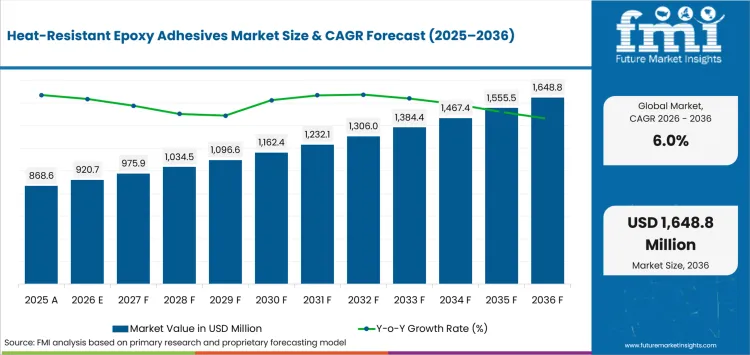
USD 920.7 million in 2026 and USD 1,648.8 million by 2036 at a 6.0% CAGR.
Sales of heat-resistant epoxy adhesives are forecast to rise from USD 920.7 million in 2026 to USD 1,648.8 million by 2036 at a 6.0% CAGR. The ten-year interval represents USD 728.1 million of modeled incremental value before application mix shifts are considered. Thermal cycling can weaken joints or distort compact assemblies that cannot accept heavier mechanical fastening. Master Bond introduced EP55TCFL in August 2026 with thermal conductivity, electrical insulation and NASA low-outgassing compliance for thin bondlines. The release gives electronics and aerospace engineers a defined qualification route for joints that must conduct heat without electrical leakage.
Country demand diverges with the density and mix of high-reliability manufacturing accounts. Canada has semiconductor fabrication and a large aerospace base, so adhesive companies face different test records and release cycles within the same geography. ISED documented 225,000 aerospace jobs in 2024 in its December 2025 committee briefing. The sector breadth supports qualified demand but raises technical-service cost because aircraft and electronics programs do not accept the same evidence package.
Key Takeaways
- Higher thermal loads in electronics, electric motors and aerospace assemblies are shifting heat-resistant epoxy selection into formal reliability qualification.
- Based on temperature rating, 150-200°C is projected to account for 24.0% in 2026 due to its fit with Class H motors and under-hood electronics.
- By chemistry, bisphenol-A epoxy is estimated to hold 28.0% in 2026 owing to familiar formulation and qualification routes.
- In 2026, two-part paste is expected to lead form with 31.0% share because adjustable working time and gap filling suit irregular structural joints.
- Long qualification cycles can delay switching because cure equipment, dispensing control and thermal-cycle evidence must be revalidated before production release.
- Some of the key players in this market include Master Bond, Henkel, 3M, Parker LORD, Huntsman, Hoenle Adhesives GmbH, Aremco Products, Cotronics, Permabond, and ITW Performance Polymers.
Analyst Perspective
"Heat-resistant epoxy wins programs once thermal-cycle data, bondline behavior and cure conditions are proven on the customer's actual assembly. A higher service-temperature claim earns little premium if it forces new dispensing equipment or extends validation without a measurable reliability gain."
- Nikhil Kaitwade, Principal Consultant, Future Market Insights
How is the heat-resistant epoxy adhesives market segmented?
The heat-resistant epoxy adhesives market is segmented by temperature rating, chemistry, form, end use, sales channel and region.
Temperature rating covers 150-200°C, 200-300°C, 300-400°C, above 400°C and thermal-cycling resistant systems. Chemistry includes bisphenol-A epoxy, novolac epoxy, ceramic-filled epoxy, silicone-modified epoxy and metal-filled epoxy. Form covers two-part paste, one-part heat cure, film adhesive, potting adhesive and dispensable liquid. End use includes electronics, aerospace, automotive, industrial equipment and oil & gas. Sales channels comprise direct OEM supply, industrial distributors, electronics materials channels and custom formulators.
How does Bisphenol-A epoxy influence selection within the chemistry category?
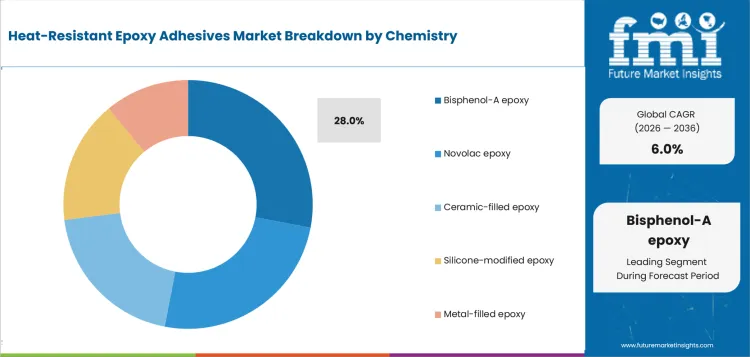
Bisphenol-A epoxy gives formulators a familiar base for adjusting viscosity and filler loading without changing the resin family. industrial adhesives using established epoxy chemistry can be easier to compare during qualification because process history and substrate behavior are already understood.
- By chemistry, bisphenol-A epoxy is estimated to hold 28.0% in 2026 owing to familiar formulation routes for structural and electronics bonding.
- Food-contact applications add a separate substance-screening constraint to an otherwise familiar chemistry. The European Commission's March 2025 guidance confirms that the BPA ban covers adhesives in food-contact materials from 20 January 2025, so regulated programs need chemistry records before a formulation proceeds.
What makes 150-200°C central to the temperature rating category?
Motor and electronics assemblies often need thermal margin above normal operating temperature without the process burden of ultra-high-temperature materials. Electric vehicle battery adhesives face the same qualification problem because cure behavior and bondline stability must stay repeatable during serial production.
- Based on temperature rating, 150-200°C is projected to account for 24.0% in 2026 due to its fit with Class H motors and under-hood electronics.
- Permabond introduced ES5516 in March 2025 for Class H motor magnets and documented structural strength at 180°C. UV tacking secures alignment before the final heat cure, so the material addresses production control as well as temperature resistance.
Why does two-part paste lead the form category?
Irregular structural joints need gap filling without losing control of working time or mix ratio. Two-part paste matches the handling logic of 2K epoxy adhesives and lets engineers adjust dispense volume before cure without relying on premixed flow.
- In 2026, two-part paste is expected to lead form with 31.0% share because its rheology suits irregular joints and thicker bondlines.
- Master Bond released EP64 in May 2026 with a 210-215°C glass-transition range and NASA low-outgassing compliance. Its two-component cure route requires defined heat schedules, which makes process validation part of the purchase decision instead of a secondary production detail.
What supports electronics as the leading end use?
Electronics assemblies place thin bondlines between materials that expand at different rates during heating and cooling. A bondline can fail if cure shrinkage or thermal mismatch transfers stress into the package. electronic packaging adhesives therefore need controlled flow and stress management before package engineers release a material into production.
- By end use, electronics is forecast to represent 28.0% in 2026 driven by thermal cycling and dimensional-control requirements in compact packages.
- USA Commerce finalized advanced-packaging awards in January 2025 that fund material validation and pilot-scale manufacturing. The awards expand domestic test infrastructure, giving adhesive formulators more places to prove reliability before high-volume package release.
What are the drivers, restraints and opportunities in the Heat-Resistant Epoxy Adhesives Market?
Higher thermal loads increase demand, qualification and process change slow switching, and easier-to-integrate formulations can widen adoption.
- Driver: Higher power density makes thermal cycling a material-selection issue in electronics and electrified equipment.
- Restraint: Mixing control and validated cure behavior can extend approval work before a new adhesive reaches routine production.
- Opportunity: Formulations that reduce cure or dispensing disruption can shorten conversion work while retaining required thermal performance.
Higher thermal stress is moving epoxy selection into package-reliability qualification where thin bondlines sit beside high-power components. The Semiconductor Industry Association recorded 25.6% growth in worldwide semiconductor sales during 2025, increasing the number of assemblies exposed to thermal-cycle and dimensional-control requirements. More production does not guarantee adhesive conversion, but it expands the number of semiconductor packaging programs that must document bond integrity under heat.
Process approval becomes the limiting step once a formulation meets its thermal target in a qualified production line. 3M introduced the Adhesive Mix Monitor in December 2025 to give real-time feedback on two-part dispensing quality. The system addresses a qualification problem because mix ratio must be repeatable before an OEM releases a new adhesive during high-volume serial assembly.
Reducing process change during qualification is the most defensible route to conversion. Henkel expanded its Brandon facility in September 2025 from 35,000 to 70,000 square feet and added mixing capacity for adhesives and thermal-management materials. Potting compounds that fit existing dispensing and cure equipment reduce validation work because customers do not have to change material and process together.
Which country CAGRs are profiled in the Heat-Resistant Epoxy Adhesives Market?
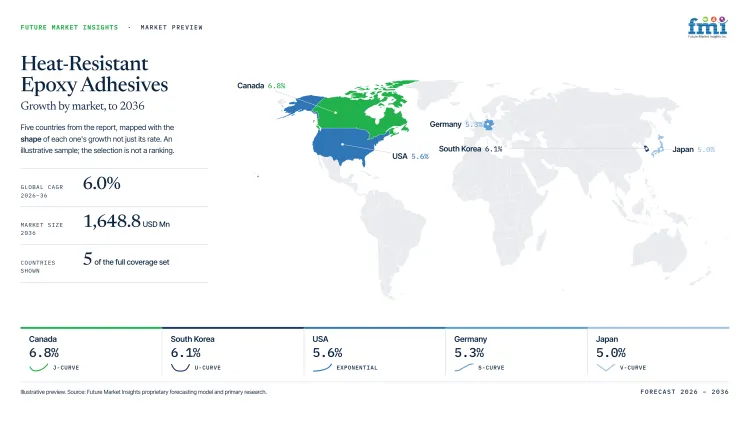
| Country | CAGR |
|---|---|
| Canada | 6.8% |
| South Korea | 6.1% |
| Mexico | 5.7% |
| USA | 5.6% |
| Germany | 5.3% |
| France | 5.2% |
| Japan | 5.0% |
How do country-level CAGRs compare in the Heat-Resistant Epoxy Adhesives Market?
The 1.8-point spread separates Canada and South Korea from a tightly grouped middle. Mexico and USA follow, with Germany and France below them. Japan at 5.0% sets the lower bound. Qualification intensity matters more than the small forecast gaps.
- Canada's provincial dispersion raises specialist application-service cost.
- South Korea's dense fab clusters shorten travel between customer trials.
- Mexico's export plants often inherit North American program approval rules.
- USA accounts spread qualification work among several high-reliability manufacturing regimes.
- Germany's serial-production release process rewards deeper technical documentation before substitution.
- France's aerospace programs make traceable change control part of material approval.
- Japan's long process histories discourage rapid substitution after program qualification.
Similar CAGRs therefore conceal different sales-cycle costs and technical-support requirements. The full report provides country-level CAGR analysis across North America, Latin America, Western Europe, Eastern Europe, East Asia, South Asia and Pacific, and Middle East and Africa.
Country-wise Analysis
- Canadian semiconductor and aerospace accounts sit in several provincial clusters, so heat-resistant epoxy qualification needs technical coverage beyond one electronics corridor. ISED stated in March 2025 that Teledyne's 200 mm wafer conversion will produce 1.8 times more chips and improve productivity by about 40%. Demand is forecast to expand at 6.8% CAGR through 2036 owing to that manufacturing depth and the number of reliability-critical assemblies. Local electronics adhesives laboratories can shorten sampling cycles, though aerospace programs still require low-outgassing records and thermal-cycle evidence before program release. Those dispersed calendars also raise the cost of specialist field coverage.
- South Korean semiconductor lines operate inside dense manufacturing clusters that place material trials, failure analysis and qualified inventory close to high-volume packaging programs. Heat-resistant epoxy adhesive sales are projected to grow at 6.1% CAGR during the assessment period driven by advanced packaging and power-electronics production. The Ministry of Trade, Industry and Resources documented 22.2% growth in semiconductor exports during 2025 in its January 2026 release. Local thermal interface materials expertise speeds sampling, yet electronics-grade cleanliness and traceability requirements keep formulation changes under tight production control. Major fabs also expect rapid failure analysis near the production line during qualification.
- Mexican electronics and automotive plants frequently qualify materials against North American platform specifications, so local orders often depend on approvals made outside the individual factory. Regional inventory and trained distributors shorten replenishment for approved formulations, but imported specialty materials still face customs timing and cross-border paperwork. Mexico is estimated to post 5.7% CAGR through 2036 attributable to deeper semiconductor and vehicle manufacturing. The Secretaría de Economía reported in May 2025 that 16 of 30 semiconductor master-plan goals had been completed, giving adhesive companies a clearer local route without removing parent-program qualification requirements. Local inventory becomes valuable once the regional approval is already secured.
- USA demand spans semiconductor fabrication, advanced packaging and aerospace assembly with different release procedures for materials that operate under sustained heat. Domestic application laboratories improve trial access, though high-reliability programs often require long evidence histories before approving a new cure schedule. The Department of Commerce finalized three CHIPS awards in January 2025 and amended a GlobalFoundries award for advanced packaging, expanding domestic qualification sites. Adoption of heat-resistant epoxy adhesives is estimated to expand at 5.6% CAGR through 2036 supported by more packaging and aerospace programs entering local production. The wide account base increases travel and support cost for specialist teams.
- German adhesive programs sit beside automotive, power-electronics and industrial engineering centers that review material changes against serial-production controls and detailed chemistry records. Heat-resistant epoxy adhesive demand is set to post 5.3% CAGR over the assessment period tied to more heat-sensitive joints in electrified equipment. The Federal Government reported in July 2026 that Infineon's Smart Power Fab would create 1,000 jobs and double Dresden production capacity. Local automotive adhesives and sealants expertise shortens trials, but a new cure route or substance profile can reopen approval work before an OEM accepts serial production. Teams with documented process equivalence can enter plant trials with less repeat testing.
- French demand draws on aerospace programs, transport electronics and semiconductor production where material performance must remain traceable from laboratory qualification to line release. INSEE documented 5.1% year-on-year growth in computer, electronic and optical product output for the latest three-month period in its August 2026 release. Sales of heat-resistant epoxy adhesives are forecast to expand at 5.2% CAGR by 2036 given stronger electronics output beside an established aerospace base. Engineering partners can support custom validation for large programs, though smaller industrial accounts still depend on distributor stock and responsive technical support during early qualification. Aerospace accounts also make lot traceability a routine part of supplier review.
- Japanese electronics and automotive manufacturers place strong weight on stable process histories, so a higher temperature rating rarely justifies a material change in qualified production. Close technical communication can build confidence during repeated trials, but long-standing approvals make rapid substitution difficult without a clear reliability or production benefit. Japan is projected to grow at 5.0% CAGR during the forecast period aided by semiconductor and mobility programs that require high-reliability bonding. METI stated in October 2025 that JASM's first Kumamoto fab equipment was operating at full capacity and that regional manufacturing investment had roughly doubled since TSMC entered Kyushu.
Who are the notable companies in the Heat-Resistant Epoxy Adhesives Market?
Master Bond, Henkel, 3M, Parker LORD, Huntsman, Hoenle Adhesives GmbH, Aremco Products, Cotronics, Permabond, and ITW Performance Polymers are notable companies serving this market.
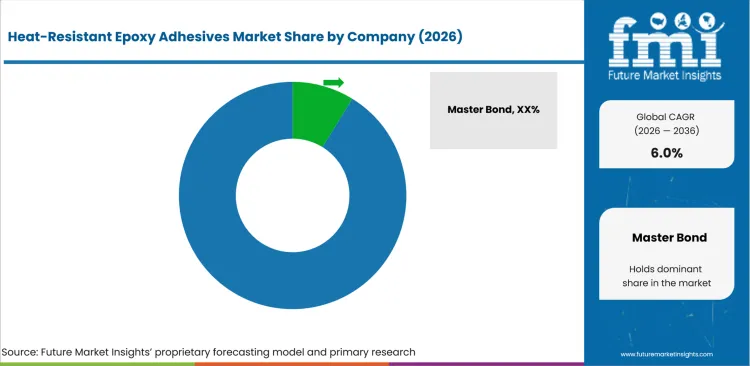
Qualification requirements divide this field more clearly than company scale. Electronics programs emphasize flow control and thermal-cycle records while aerospace programs require outgassing and long-service evidence. Industrial accounts treat structural adhesives as engineered process materials because new cure or dispensing equipment raises the cost of switching.
- Master Bond, Parker LORD, Huntsman and Permabond compete most directly in structural or aerospace-oriented high-temperature bonding programs.
- Henkel, 3M and Hoenle Adhesives GmbH have deeper electronics application resources for controlled production and package-level qualification.
- Aremco Products, Cotronics and ITW Performance Polymers concentrate more heavily on severe-temperature industrial bonding and maintenance applications.
Competitive Benchmarking: Heat-Resistant Epoxy Adhesives Market
| Company | Thermal Epoxy Focus | Qualification & Technical Support | Relevant End-Use Breadth | Geographic Reach |
|---|---|---|---|---|
| Master Bond | High | High | High | North America; international |
| Henkel | High | High | High | Global |
| 3M | Medium | High | High | Global |
| Parker LORD | Medium | High | High | North America; Europe; Asia-Pacific |
| Huntsman | High | Medium | High | Global |
| Hoenle Adhesives GmbH | High | High | High | Europe; North America; Asia |
| Aremco Products | High | High | High | North America; international |
| Cotronics | High | Medium | High | North America; international |
| Permabond | High | High | High | Americas; Europe; Asia-Pacific |
| ITW Performance Polymers | Medium | Medium | High | North America; international |
Scoring basis: High thermal-epoxy focus requires several documented elevated-temperature routes. High technical support requires dedicated application or qualification resources. Geographic reach records current commercial coverage.
Key Developments in the Heat-Resistant Epoxy Adhesives Market
- In December 2025, Master Bond introduced Supreme 10HTLV as a one-part heat-cured structural epoxy rated for service temperatures up to 204°C and severe thermal cycling.
- In September 2025, Huntsman launched reformulated ARALDITE epoxy adhesives without intentionally added BPA or CMR-classified substances under EU CLP rules while retaining equivalency support for customer requalification.
- In February 2025, Permabond introduced ET5424 as a two-part aerospace epoxy that cures at room temperature and is rated for elevated-temperature service up to 230°C.
Key Players in the Heat-Resistant Epoxy Adhesives Market
High-Temperature Structural and Aerospace Specialists
- Master Bond
- Parker LORD
- Huntsman
- Permabond
Electronics and Precision Assembly Platforms
- Henkel
- 3M
- Hoenle Adhesives GmbH
Extreme-Temperature Industrial Formulators
- Aremco Products
- Cotronics
- ITW Performance Polymers
Heat-Resistant Epoxy Adhesives Market - Report Scope
| Coverage field | Report scope |
|---|---|
| Market breakdown | By temperature rating, chemistry, form, end use, sales channel and region. |
| Quantitative Units | USD million. |
| Market Definition | Commercial heat-resistant epoxy adhesive systems used for bonding, sealing, potting and structural assembly where elevated-temperature performance is required. |
| Regions Covered | North America, Latin America, Western Europe, Eastern Europe, East Asia, South Asia and Pacific and Middle East and Africa. |
| Countries Covered | Canada, South Korea, Mexico, USA, Germany, France, Japan, and 20+ countries included in the full report. |
| Key Companies Profiled | Master Bond, Henkel, 3M, Parker LORD, Huntsman, Hoenle Adhesives GmbH, Aremco Products, Cotronics, Permabond, ITW Performance Polymers. |
| Forecast Period | 2026 to 2036. |
| Approach | Primary and secondary research with market triangulation. |
Heat-Resistant Epoxy Adhesives Market - Research Methodology
| Method | Approach |
|---|---|
| Primary Research | FMI analysts gathered input from manufacturers, service providers, technology developers, distributors, end users, procurement teams, and subject-matter experts. Interviews examined purchasing decisions, product or service evaluation, adoption barriers, approval requirements, pricing considerations, and expectations for technical or commercial support. Respondents were also asked what evidence is required before a trial, pilot, or initial order develops into regular purchasing. |
| Desk Research | Desk research covered government statistics, regulatory publications, trade data, industry associations, technical literature, standards, company filings, product information, and official corporate announcements. Sources were reviewed for relevance, publication date, geographic coverage, and consistency with the defined market scope. Claims relating to performance, applications, approvals, capacity, investment, and commercial activity were retained only when supported by credible public evidence. |
| Market Sizing and Forecasting | The market model combined the baseline value with historical performance, segment structure, pricing and volume indicators, adoption levels, company participation, and country-level demand conditions. Forecast assumptions considered economic activity, investment trends, regulatory developments, technology adoption, purchasing cycles, supply availability, and barriers to wider market use. Segment and regional estimates were reconciled before the final market total was calculated. |
| Data Validation | Estimates were checked against multiple independent indicators, including public data, company activity, trade patterns, industry developments, and findings from primary interviews. Validation also tested whether products, services, applications, and company revenues fell within the defined market boundaries. Adjacent categories, unsupported claims, overlapping revenues, and activities without direct market relevance were excluded to reduce double counting and maintain consistency across segments and countries. |
Heat-Resistant Epoxy Adhesives Market by Segments
Heat-Resistant Epoxy Adhesives Market segmented by Temperature Rating:
- 150-200°C
- 200-300°C
- 300-400°C
- Above 400°C
- Thermal-cycling resistant
Heat-Resistant Epoxy Adhesives Market segmented by Chemistry:
- Bisphenol-A epoxy
- Novolac epoxy
- Ceramic-filled epoxy
- Silicone-modified epoxy
- Metal-filled epoxy
Heat-Resistant Epoxy Adhesives Market segmented by Form:
- Two-part paste
- One-part heat cure
- Film adhesive
- Potting adhesive
- Dispensable liquid
Heat-Resistant Epoxy Adhesives Market segmented by End Use:
- Electronics
- Aerospace
- Automotive
- Industrial equipment
- Oil & gas
Heat-Resistant Epoxy Adhesives Market segmented by Sales Channel:
- Direct OEM supply
- Industrial distributors
- Electronics materials channel
- Custom formulators
Heat-Resistant Epoxy Adhesives Market by Region:
- North America
- United States
- Canada
- Latin America
- Brazil
- Mexico
- Argentina
- Chile
- Western Europe
- Germany
- France
- United Kingdom
- Italy
- Spain
- Benelux
- Nordics
- Eastern Europe
- Poland
- Czech Republic
- Romania
- Hungary
- East Asia
- China
- Japan
- South Korea
- South Asia and Pacific
- India
- ASEAN
- Australia and New Zealand
- Middle East and Africa
- GCC Countries
- South Africa
- Türkiye
- Israel
Research Sources and Bibliography
- Master Bond. (2026, August 27). Thermally Conductive, Low Modulus Epoxy Meets NASA Low Outgassing Specifications.
- Innovation, Science and Economic Development Canada. (2025, December 4). Appearance before the Standing Committee on International Trade (CIIT) by Minister of Industry and Minister responsible for Canada Economic Development for Quebec Regions.
- Permabond. (2025, March 24). Permabond introduces high-temperature magnet adhesive, ES5516.
- European Commission. (2025, March 7). EU prohibition on the use and trade of Bisphenol A from 20 January 2025.
- Master Bond. (2026, May 1). NASA Low Outgassing, Chemically Resistant Epoxy Features High Tg.
- National Institute of Standards and Technology. (2025, January 16). USA Department of Commerce Announces $1.4 Billion in Final Awards to Support the Next Generation of USA Semiconductor Advanced Packaging.
- 3M. (2025, February 3). 3M joins consortium to accelerate semiconductor technology in the US.
- Semiconductor Industry Association. (2026, February 6). Global Annual Semiconductor Sales Increase 25.6% in 2025.
- 3M. (2025, December 30). 3M Adhesive Mix Monitor reimagines two-part adhesive dispensing for manufacturers.
- Henkel. (2025, September 25). Henkel celebrates expansion of flagship manufacturing facility in Brandon to advance mobility and electronics innovations.
- Innovation, Science and Economic Development Canada. (2025, March 21). Canada to invest in Teledyne to further advance Canada’s semiconductor industry.
- Ministry of Trade, Industry and Resources, Republic of Korea. (2026, January 2). Korea’s Annual Exports Reach New Highs in 2025.
- Secretaría de Economía, Mexico. (2025, May 14). Preside Marcelo Ebrard reunión de seguimiento del Plan Maestro de Semiconductores 2024-2030.
- USA Department of Commerce. (2025, January 17). USA Department of Commerce Announces CHIPS Incentives Awards with Corning, Edwards Vacuum, and Infinera.
- The Federal Government of Germany. (2026, July 2). Weltgrößte Fabrik für Leistungshalbleiter in Dresden eröffnet.
- INSEE. (2026, August 5). En juin 2026, la production manufacturière baisse de nouveau nettement.
- Ministry of Economy, Trade and Industry, Japan. (2025, October 24). Press Conference by Minister Akazawa (Excerpt).
- Master Bond. (2025, December 18). Structural One Part Epoxy for High-Performance Bonding Applications.
- Huntsman Corporation. (2025, September 17). Huntsman Launches New Range of Safer, More Sustainable ARALDITE Epoxy Adhesives.
- Permabond. (2025, February 4). Heat resistant epoxy for aerospace and other industrial applications.
- Parker Hannifin Corporation. (2025, May 28). Parker Expands CoolTherm Line with New TC-850 Adhesive for Battery Pack Applications.
- Hoenle Adhesives GmbH. (2025, September 5). Panacol is now Hoenle Adhesives.
- Aremco Products Inc. (n.d.). High Temperature Materials Manufacturer. Retrieved September 6, 2026.
- Cotronics Corp. (n.d.). Cotronics Corp. Retrieved September 6, 2026.
- ITW Performance Polymers. (n.d.). About ITW Performance Polymers. Retrieved September 6, 2026.
- Henkel. (2026, March 24). Henkel launches advanced customer application center for electronics solutions in India.
- Master Bond. (2026, March 30). Non-Frozen, Silver Filled Epoxy Features High Thermal and Electrical Conductivity.
- Henkel. (2026, August 19). Henkel launches LOCTITE ABLESTIK CDF900 series conductive die attach film.
- 3M. (2026, August 24). 3M and BOE launch joint laboratory to accelerate display technology innovation.
- Master Bond. (2026, January 14). Electrically Insulating Epoxy Features Ultra-High Thermal Conductivity.
- Henkel. (2026, May 12). Henkel launches thermal gap filler and thermally conductive adhesive to improve EV battery thermal management.
- 3M. (2025, September 30). 3M participates in JOINT3, a next-generation semiconductor packaging consortium.
This bibliography is provided for reader reference and is not exhaustive. The full report contains the complete reference list and detailed citations.
This Report Answers
- How large is the heat-resistant epoxy adhesives market in 2026 and 2036?
- Which thermal and manufacturing conditions are increasing demand for heat-resistant epoxy adhesives?
- Why does the 150-200°C band lead the temperature rating category?
- How does bisphenol-A epoxy shape chemistry selection and qualification?
- Why does two-part paste hold the largest current form share?
- How do country growth rates differ among the seven profiled markets?
- Which companies compete in high-temperature structural, electronics and industrial applications?
- What slows material changes after an adhesive enters a qualified OEM process?
Frequently Asked Questions
How big is the heat-resistant epoxy adhesives market in 2026?
The heat-resistant epoxy adhesives market is valued at USD 920.7 million in 2026 and is projected to reach USD 1,648.8 million by 2036. Higher thermal stress raises qualification demand.
What is the CAGR of the heat-resistant epoxy adhesives market from 2026 to 2036?
The heat-resistant epoxy adhesives market is projected to grow at 6.0% CAGR between 2026 and 2036. Expansion depends on thermal-cycle reliability plus compatible dispensing and cure processes.
Which temperature rating leads the heat-resistant epoxy adhesives market?
The 150–200°C segment is expected to hold 24.0% in 2026 driven by Class H motors and electronics assemblies. It provides thermal headroom without extreme-temperature processing.
Which form has the largest 2026 share in the heat-resistant epoxy adhesives market?
Two-part paste is expected to hold 31.0% in 2026 attributable to controllable working time and gap filling. The format suits structural joints with irregular geometry.
How much value will the heat-resistant epoxy adhesives market add between 2026 and 2036?
The market is expected to add USD 728.1 million between 2026 and 2036. Wider qualification in electronics, mobility, aerospace and industrial equipment supports the increase.
Which countries are projected to record the highest growth in the heat-resistant epoxy adhesives market?
Canada is projected at 6.8% CAGR followed by South Korea at 6.1% and Mexico at 5.7% through 2036. Their forecasts reflect different regional advanced-manufacturing mixes.
Which companies are active in the heat-resistant epoxy adhesives market?
Key companies operating in the heat-resistant epoxy adhesives market include Master Bond, Henkel, 3M, Parker LORD, Huntsman, Hoenle Adhesives GmbH, Aremco Products, Cotronics, Permabond, and ITW Performance Polymers. They compete on thermal range, cure fit, qualification support and application coverage.
Preview the report firsthand - request a free sample
Get SampleGet the brochure for pricing and purchase details.
Get PDFTable of Content
- Key Takeaways
- Market Size and CAGR
- Top Growth Driver
- Fastest Growing Segment
- Leading Region
- Key Companies
- Emerging Opportunities
- Executive Summary
- Global Market Outlook
- Demand-side Trends
- Supply-side Trends
- Technology Roadmap Analysis
- Analysis and Recommendations
- Analyst Perspective (What is happening? Why now? What should investors know?)
- Key Questions Answered
- How large is the market?
- What is the CAGR?
- What are key trends?
- Which region dominates?
- Who are the leaders?
- Market Overview
- Market Coverage / Taxonomy
- Market Definition / Scope / Limitations
- Research Methodology
- Chapter Orientation
- Analytical Lens and Working Hypotheses
- Market Structure, Signals, and Trend Drivers
- Benchmarking and Cross-market Comparability
- Market Sizing, Forecasting, and Opportunity Mapping
- Research Design and Evidence Framework
- Desk Research Programme (Secondary Evidence)
- Expert Input and Fieldwork (Primary Evidence)
- Tooling, Models, and Reference Databases
- Data Engineering and Model Build
- Quality Assurance and Audit Trail
- Market Background
- Market Dynamics (Drivers, Restraints, Opportunity, Trends)
- Scenario Forecast (Optimistic, Likely, Conservative)
- Impact Analysis
- AI Impact
- Sustainability Impact
- Regulatory Impact
- Technology Impact
- Consumer / Buyer Analysis
- Purchase Drivers
- Adoption Barriers
- Buyer Journey
- Opportunity Map Analysis
- Product Life Cycle Analysis
- Supply Chain Analysis
- Investment Feasibility Matrix
- Value Chain Analysis
- PESTLE and Porter's Analysis
- Regulatory Landscape
- Regional Parent Market Outlook
- Production and Consumption Statistics
- Import and Export Statistics
- Global Market Analysis and Forecast, 2021 to 2036
- Historical Market Size Value (USD Million) Analysis, 2021 to 2025
- Current and Future Market Size Value (USD Million) Projections, 2026 to 2036
- Y-o-Y Growth Trend Analysis
- Absolute $ Opportunity Analysis
- Global Market Pricing Analysis, 2021 to 2036
- Global Market Analysis and Forecast, By Temperature Rating, 2021 to 2036
- Introduction / Key Findings
- Historical Market Size Value (USD Million) Analysis By Temperature Rating, 2021 to 2025
- Current and Future Market Size Value (USD Million) Analysis and Forecast By Temperature Rating, 2026 to 2036
- 150-200°C
- 200-300°C
- 300-400°C
- Above 400°C
- Thermal-cycling resistant
- 150-200°C
- Y-o-Y Growth Trend Analysis By Temperature Rating, 2021 to 2025
- Absolute $ Opportunity Analysis By Temperature Rating, 2026 to 2036
- Global Market Analysis and Forecast, By Chemistry, 2021 to 2036
- Introduction / Key Findings
- Historical Market Size Value (USD Million) Analysis By Chemistry, 2021 to 2025
- Current and Future Market Size Value (USD Million) Analysis and Forecast By Chemistry, 2026 to 2036
- Bisphenol-A epoxy
- Novolac epoxy
- Ceramic-filled epoxy
- Silicone-modified epoxy
- Metal-filled epoxy
- Bisphenol-A epoxy
- Y-o-Y Growth Trend Analysis By Chemistry, 2021 to 2025
- Absolute $ Opportunity Analysis By Chemistry, 2026 to 2036
- Global Market Analysis and Forecast, By Form, 2021 to 2036
- Introduction / Key Findings
- Historical Market Size Value (USD Million) Analysis By Form, 2021 to 2025
- Current and Future Market Size Value (USD Million) Analysis and Forecast By Form, 2026 to 2036
- Two-part paste
- One-part heat cure
- Film adhesive
- Potting adhesive
- Dispensable liquid
- Two-part paste
- Y-o-Y Growth Trend Analysis By Form, 2021 to 2025
- Absolute $ Opportunity Analysis By Form, 2026 to 2036
- Global Market Analysis and Forecast, By End Use, 2021 to 2036
- Introduction / Key Findings
- Historical Market Size Value (USD Million) Analysis By End Use, 2021 to 2025
- Current and Future Market Size Value (USD Million) Analysis and Forecast By End Use, 2026 to 2036
- Electronics
- Aerospace
- Automotive
- Industrial equipment
- Oil & gas
- Electronics
- Y-o-Y Growth Trend Analysis By End Use, 2021 to 2025
- Absolute $ Opportunity Analysis By End Use, 2026 to 2036
- Global Market Analysis and Forecast, By Sales Channel, 2021 to 2036
- Introduction / Key Findings
- Historical Market Size Value (USD Million) Analysis By Sales Channel, 2021 to 2025
- Current and Future Market Size Value (USD Million) Analysis and Forecast By Sales Channel, 2026 to 2036
- Direct OEM supply
- Industrial distributors
- Electronics materials channel
- Custom formulators
- Direct OEM supply
- Y-o-Y Growth Trend Analysis By Sales Channel, 2021 to 2025
- Absolute $ Opportunity Analysis By Sales Channel, 2026 to 2036
- Global Market Analysis and Forecast, By Region, 2021 to 2036
- Introduction
- Historical Market Size Value (USD Million) Analysis By Region, 2021 to 2025
- Current Market Size Value (USD Million) Analysis and Forecast By Region, 2026 to 2036
- North America
- Latin America
- Western Europe
- Eastern Europe
- East Asia
- South Asia and Pacific
- Middle East & Africa
- Market Attractiveness Analysis By Region
- North America Market Analysis and Forecast, By Country, 2021 to 2036
- Historical Market Size Value (USD Million) Trend Analysis By Market Taxonomy, 2021 to 2025
- Market Size Value (USD Million) Forecast By Market Taxonomy, 2026 to 2036
- By Country
- USA
- Canada
- By Temperature Rating
- By Chemistry
- By Form
- By End Use
- By Sales Channel
- By Country
- Market Attractiveness Analysis
- By Country
- By Temperature Rating
- By Chemistry
- By Form
- By End Use
- By Sales Channel
- Key Takeaways
- Latin America Market Analysis and Forecast, By Country
- Historical Market Size Value (USD Million) Trend Analysis By Market Taxonomy, 2021 to 2025
- Market Size Value (USD Million) Forecast By Market Taxonomy, 2026 to 2036
- By Country
- Brazil
- Mexico
- Chile
- Rest of Latin America
- By Temperature Rating
- By Chemistry
- By Form
- By End Use
- By Sales Channel
- By Country
- Market Attractiveness Analysis
- By Country
- By Temperature Rating
- By Chemistry
- By Form
- By End Use
- By Sales Channel
- Key Takeaways
- Western Europe Market Analysis and Forecast, By Country
- Historical Market Size Value (USD Million) Trend Analysis By Market Taxonomy, 2021 to 2025
- Market Size Value (USD Million) Forecast By Market Taxonomy, 2026 to 2036
- By Country
- Germany
- UK
- Italy
- Spain
- France
- Nordic
- BENELUX
- Rest of Western Europe
- By Temperature Rating
- By Chemistry
- By Form
- By End Use
- By Sales Channel
- By Country
- Market Attractiveness Analysis
- By Country
- By Temperature Rating
- By Chemistry
- By Form
- By End Use
- By Sales Channel
- Key Takeaways
- Eastern Europe Market Analysis and Forecast, By Country
- Historical Market Size Value (USD Million) Trend Analysis By Market Taxonomy, 2021 to 2025
- Market Size Value (USD Million) Forecast By Market Taxonomy, 2026 to 2036
- By Country
- Russia
- Poland
- Hungary
- Balkan & Baltic
- Rest of Eastern Europe
- By Temperature Rating
- By Chemistry
- By Form
- By End Use
- By Sales Channel
- By Country
- Market Attractiveness Analysis
- By Country
- By Temperature Rating
- By Chemistry
- By Form
- By End Use
- By Sales Channel
- Key Takeaways
- East Asia Market Analysis and Forecast, By Country
- Historical Market Size Value (USD Million) Trend Analysis By Market Taxonomy, 2021 to 2025
- Market Size Value (USD Million) Forecast By Market Taxonomy, 2026 to 2036
- By Country
- China
- Japan
- South Korea
- By Temperature Rating
- By Chemistry
- By Form
- By End Use
- By Sales Channel
- By Country
- Market Attractiveness Analysis
- By Country
- By Temperature Rating
- By Chemistry
- By Form
- By End Use
- By Sales Channel
- Key Takeaways
- South Asia and Pacific Market Analysis and Forecast, By Country
- Historical Market Size Value (USD Million) Trend Analysis By Market Taxonomy, 2021 to 2025
- Market Size Value (USD Million) Forecast By Market Taxonomy, 2026 to 2036
- By Country
- India
- ASEAN
- Australia & New Zealand
- Rest of South Asia and Pacific
- By Temperature Rating
- By Chemistry
- By Form
- By End Use
- By Sales Channel
- By Country
- Market Attractiveness Analysis
- By Country
- By Temperature Rating
- By Chemistry
- By Form
- By End Use
- By Sales Channel
- Key Takeaways
- Middle East & Africa Market Analysis and Forecast, By Country
- Historical Market Size Value (USD Million) Trend Analysis By Market Taxonomy, 2021 to 2025
- Market Size Value (USD Million) Forecast By Market Taxonomy, 2026 to 2036
- By Country
- Kingdom of Saudi Arabia
- Other GCC Countries
- Türkiye
- South Africa
- Other African Union
- Rest of Middle East & Africa
- By Temperature Rating
- By Chemistry
- By Form
- By End Use
- By Sales Channel
- By Country
- Market Attractiveness Analysis
- By Country
- By Temperature Rating
- By Chemistry
- By Form
- By End Use
- By Sales Channel
- Key Takeaways
- Key Countries Market Analysis
- USA
- Pricing Analysis
- Market Share Analysis, 2025
- By Temperature Rating
- By Chemistry
- By Form
- By End Use
- By Sales Channel
- Canada
- Pricing Analysis
- Market Share Analysis, 2025
- By Temperature Rating
- By Chemistry
- By Form
- By End Use
- By Sales Channel
- Mexico
- Pricing Analysis
- Market Share Analysis, 2025
- By Temperature Rating
- By Chemistry
- By Form
- By End Use
- By Sales Channel
- Brazil
- Pricing Analysis
- Market Share Analysis, 2025
- By Temperature Rating
- By Chemistry
- By Form
- By End Use
- By Sales Channel
- Chile
- Pricing Analysis
- Market Share Analysis, 2025
- By Temperature Rating
- By Chemistry
- By Form
- By End Use
- By Sales Channel
- Germany
- Pricing Analysis
- Market Share Analysis, 2025
- By Temperature Rating
- By Chemistry
- By Form
- By End Use
- By Sales Channel
- UK
- Pricing Analysis
- Market Share Analysis, 2025
- By Temperature Rating
- By Chemistry
- By Form
- By End Use
- By Sales Channel
- Italy
- Pricing Analysis
- Market Share Analysis, 2025
- By Temperature Rating
- By Chemistry
- By Form
- By End Use
- By Sales Channel
- Spain
- Pricing Analysis
- Market Share Analysis, 2025
- By Temperature Rating
- By Chemistry
- By Form
- By End Use
- By Sales Channel
- France
- Pricing Analysis
- Market Share Analysis, 2025
- By Temperature Rating
- By Chemistry
- By Form
- By End Use
- By Sales Channel
- India
- Pricing Analysis
- Market Share Analysis, 2025
- By Temperature Rating
- By Chemistry
- By Form
- By End Use
- By Sales Channel
- ASEAN
- Pricing Analysis
- Market Share Analysis, 2025
- By Temperature Rating
- By Chemistry
- By Form
- By End Use
- By Sales Channel
- Australia & New Zealand
- Pricing Analysis
- Market Share Analysis, 2025
- By Temperature Rating
- By Chemistry
- By Form
- By End Use
- By Sales Channel
- China
- Pricing Analysis
- Market Share Analysis, 2025
- By Temperature Rating
- By Chemistry
- By Form
- By End Use
- By Sales Channel
- Japan
- Pricing Analysis
- Market Share Analysis, 2025
- By Temperature Rating
- By Chemistry
- By Form
- By End Use
- By Sales Channel
- South Korea
- Pricing Analysis
- Market Share Analysis, 2025
- By Temperature Rating
- By Chemistry
- By Form
- By End Use
- By Sales Channel
- Russia
- Pricing Analysis
- Market Share Analysis, 2025
- By Temperature Rating
- By Chemistry
- By Form
- By End Use
- By Sales Channel
- Poland
- Pricing Analysis
- Market Share Analysis, 2025
- By Temperature Rating
- By Chemistry
- By Form
- By End Use
- By Sales Channel
- Hungary
- Pricing Analysis
- Market Share Analysis, 2025
- By Temperature Rating
- By Chemistry
- By Form
- By End Use
- By Sales Channel
- Kingdom of Saudi Arabia
- Pricing Analysis
- Market Share Analysis, 2025
- By Temperature Rating
- By Chemistry
- By Form
- By End Use
- By Sales Channel
- Türkiye
- Pricing Analysis
- Market Share Analysis, 2025
- By Temperature Rating
- By Chemistry
- By Form
- By End Use
- By Sales Channel
- South Africa
- Pricing Analysis
- Market Share Analysis, 2025
- By Temperature Rating
- By Chemistry
- By Form
- By End Use
- By Sales Channel
- USA
- Market Structure Analysis
- Competition Dashboard
- Competition Benchmarking
- Market Share Analysis of Top Players
- By Regional
- By Temperature Rating
- By Chemistry
- By Form
- By End Use
- By Sales Channel
- Emerging Startups
- Innovation Benchmarking
- Competition Analysis
- Competition Deep Dive
- Master Bond
- Overview
- Product Portfolio
- Profitability by Market Segments
- Sales Footprint
- Strategy Overview
- Marketing Strategy
- Product Strategy
- Channel Strategy
- Henkel
- 3M
- Parker LORD
- Huntsman
- Panacol-Elosol
- Aremco Products
- Cotronics
- Permabond
- ITW Performance Polymers
- Master Bond
- Case Studies
- Success Stories
- Recent Developments
- Competition Deep Dive
- Assumptions & Acronyms Used


