

- Market Size (2026)
- USD 1240.6 Mn
- Forecast (2036)
- USD 3247.2 Mn
- CAGR (2026 to 2036)
- 10.1%
Solar Sealants Market Size, Market Forecast and Outlook By FMI
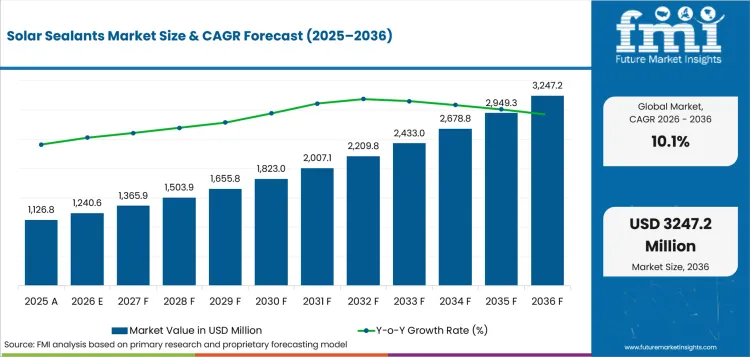
USD 1,240.6 million in 2026 and USD 3,247.2 million by 2036 at a 10.1% CAGR.
The solar sealants industry value is forecast to rise from USD 1,126.8 million in 2025 to USD 3,247.2 million by 2036 at 10.1% CAGR as module factories, rooftop installers, and utility-scale EPCs increase use of qualified sealing materials. New Installations are forecast to represent 81.0% share in 2026 because fresh module production and solar project commissioning create the main volume pool. Direct to OEM / EPC is expected to secure 67.0% share in 2026, led by qualification files, warranty checks, and direct project specification.
Solar Sealants Market Overview: Size and Forecast
- 2025 Market Size: USD 1,126.8 million
- 2026 Market Size: USD 1,240.6 million
- 2036 Market Size: USD 3,247.2 million
- Forecast CAGR: 10.1% from 2026 to 2036
- Leading End Use: New Installations
- New Installations Share in 2026: 81.0%
- Leading Sales Channel: Direct to OEM / EPC
- Direct to OEM / EPC Share in 2026: 67.0%
- Fastest-growing Country: China
- China CAGR: 11.8% by 2036
Summary of the Solar Sealants Market
The solar sealants market is expected to witness steady expansion through 2036, driven by module production, utility-scale solar buildout, rooftop sealing needs, and repair demand. Market expansion is further supported by growing attention to waterproofing, UV durability, thermal movement, and factory-approved sealant systems.
- Demand and Growth Drivers
- Module manufacturers are shifting toward validated adhesive-sealants that support frame sealing, junction box bonding, and line-speed control.
- Rooftop installers are using solar-specific sealants to reduce water intrusion risks around mounting points and roof penetrations.
- EPCs are giving preference to sealant suppliers that can provide test data, product traceability, and application support.
- Product and Segment View
- New Installations are projected to account for 81.0% share in 2026, led by fresh module output and newly commissioned PV systems.
- Direct to OEM / EPC is expected to represent 67.0% share in 2026, influenced by qualification-based buying and project specification control.
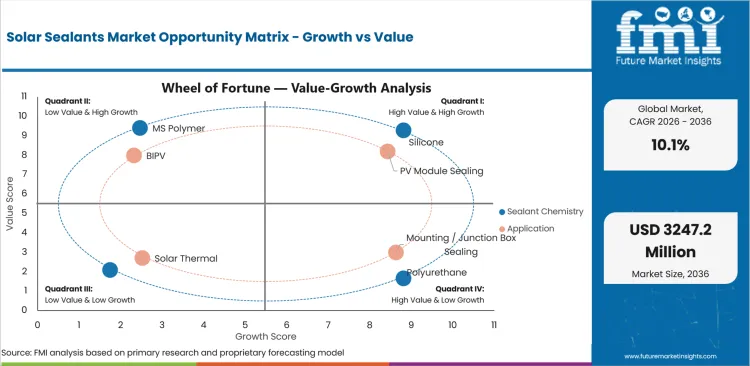
- Silicone is anticipated to hold 58.5% share in 2026, supported by UV resistance, outdoor flexibility, and damp-heat performance.
- Geography and Competitive Outlook
- China is projected to record 11.8% CAGR by 2036, backed by module manufacturing scale and high utility-solar additions.
- India is expected to expand at 11.5% CAGR by 2036, supported by utility-scale projects, rooftop programs, and local module capacity.
- Dow and WACKER compete through silicone depth, PV product portfolios, and global technical support.
- Sika, H.B. Fuller, Henkel, Momentive, and Shin-Etsu Chemical focus on solar roof bonding, installation channels, and specialty sealant capabilities.
- Analyst Opinion
- Nikhil Kaitwade, Associate Vice President at FMI, says, “Solar sealants are becoming a reliability purchase rather than a simple consumable purchase. Buyers first ask whether the material can withstand UV load, damp heat, glass movement, and automated dispensing without field failures. Suppliers that provide test evidence, local stock, and application support should gain stronger access to module plants and EPC projects.”
Solar sealant demand is being shaped by larger PV deployment, tighter factory qualification, and stronger field reliability expectations. The International Energy Agency stated in 2026 that solar PV capacity additions in 2025 surpassed 600 GW for the first time and lifted cumulative solar PV capacity to around 2,800 GW. IRENA reported in March 2026 that renewable power capacity increased by 692 GW in 2025, while solar energy contributed roughly three-quarters of the expansion. Company-side capacity support is also improving. WACKER opened an approximately 2,300-square-meter specialty silanes technology center in China in December 2025 for coatings and adhesives applications. These trends make sealant validation, cure control, damp-heat resistance, and local technical support more important before suppliers win module and EPC orders.
Which factors support expansion in the solar sealants market?
Validated module assembly, rooftop waterproofing, and EPC specification discipline support market value across solar manufacturing and installation channels.
- Market value is supported by solar-specific sealant revenue before distributor repair sales add incremental volume.
- Supplier pricing reflects cure speed, adhesion performance, and testing evidence before packaging size affects repeat buying.
- Revenue improves as module makers qualify materials for frame sealing, rail bonding, and junction box protection.
- Retail and contractor trust rises as product data sheets make substrate fit, cure conditions, and service limitations easier to compare.
Why is the solar sealants market growing?
Solar sealant demand is growing because module factories and installers need materials that protect PV systems from moisture, UV exposure, thermal movement, and long warranty risks. IRENA reported in 2026 that solar capacity increased by 511 GW in 2025, equal to 27.2% annual expansion. This scale raises demand for qualified sealing at module edges, junction boxes, rooftop penetrations, and repair points. Solar projects are also becoming more performance-sensitive as EPCs seek fewer leakage failures and lower rework exposure. Sealants that can prove adhesion on glass, aluminum, backsheets, and roof substrates therefore gain value beyond chemistry cost.
How is the solar sealants market segmented?
The solar sealants industry is segmented by sealant chemistry, application, installation type, end use, and sales channel.
- Silicone is projected to account for 58.5% share in 2026, led by outdoor PV modules needing UV-stable sealing that remains flexible under glass and aluminum movement.
- PV Module Sealing is anticipated to hold 46.0% share in 2026 because frame edges, junction boxes, and rail-bonding areas need repeatable protection during module assembly.
- Utility-scale is expected to represent 51.5% share in 2026 due to higher panel counts per project and direct EPC specification for bulk sealant use.
- New Installations are projected to capture 81.0% share in 2026 as fresh module production and new solar project commissioning outweigh repair demand.
- Direct to OEM / EPC is forecast to hold 67.0% share in 2026, shaped by qualification files, factory trials, and project-level warranty expectations.
Why does silicone dominate the solar sealants market?
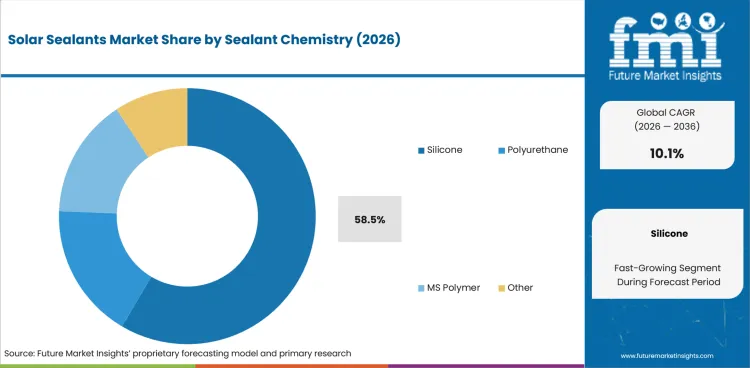
- Silicone is projected to account for 58.5% share in 2026, influenced by its UV resistance, elastic recovery, and compatibility with PV frame and junction box sealing.
- Polyurethane and MS polymer gain use in mounting and roof penetration areas when installers need strong adhesion on metal, concrete, and roofing substrates.
Which application leads the solar sealants market?
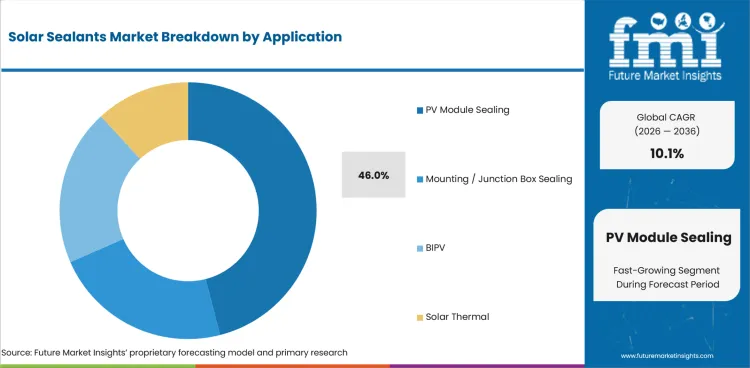
- PV Module Sealing is expected to represent 46.0% share in 2026, supported by edge sealing, frame sealing, and junction box protection in module factories.
- Mounting / Junction Box Sealing gains value as EPCs seek materials that reduce water ingress and electrical enclosure risk.
Which installation type leads the solar sealants market?
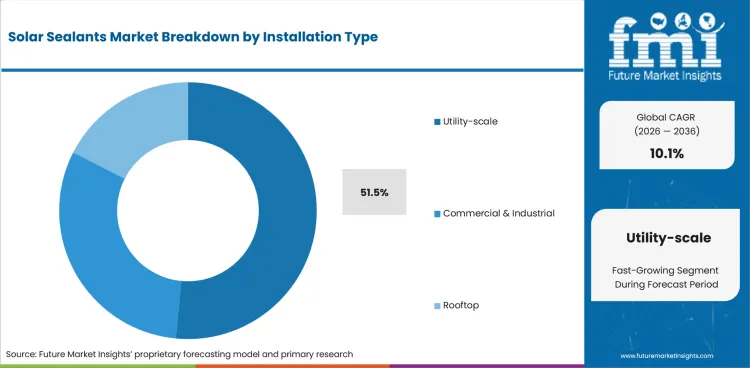
- Utility-scale is anticipated to hold 51.5% share in 2026, reflected by high module volume and specification-led material buying across large projects.
- Rooftop installations create steady demand for cartridges and field-applied products where installers manage penetration sealing and roof movement.
Which end use leads the solar sealants market?
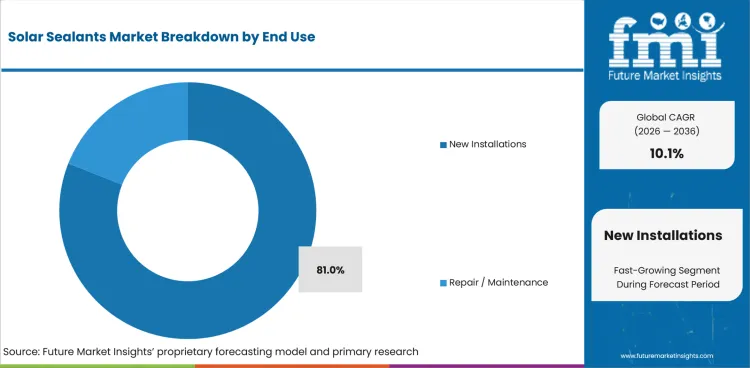
- New Installations are forecast to account for 81.0% share in 2026, led by module output, project commissioning, and new rooftop solar activity.
- Repair / Maintenance remains smaller but technically important because backsheet cracks, junction box leaks, and roof penetrations require field-ready materials.
Which sales channel leads the solar sealants market?
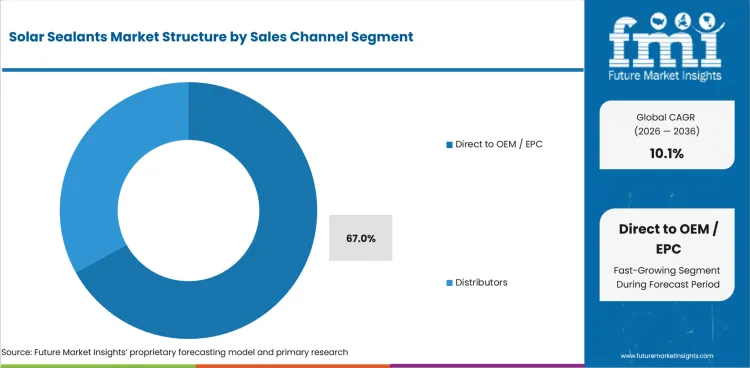
- Direct to OEM / EPC is projected to hold 67.0% share in 2026, shaped by factory qualification, bulk buying, and project-level approval.
- Distributors remain important for rooftop repair and small installers that need quick local access to compatible sealants.
What are the driver, restraints, and opportunities in the solar sealants market?
Factory qualification and rooftop reliability support demand while price pressure and installation variability limit wider premium adoption.
- Module manufacturers need fast-cure materials that support automated frame sealing and junction box bonding without slowing line throughput or warranty testing.
- Low-cost module and EPC buying can reduce willingness to pay for premium sealants unless suppliers show warranty evidence, outdoor durability, and installation savings.
- Solar roofs, BIPV systems, and repair channels create premium demand for sealants that prove adhesion, weather resistance, and long-term field reliability.
Fast-Cure PV Module Assembly
Module producers need sealants that align with faster production lines and reduce waiting time before handling. The IEA projected in 2025 that renewable electricity capacity additions from 2025 to 2030 would reach nearly 4,600 GW, with utility-scale and distributed solar PV representing almost 80% of global renewable electricity capacity expansion. This reinforces the need for sealants that support high-volume module assembly. Suppliers with two-part systems, automated dispensing compatibility, and tested damp-heat performance can secure stronger positions with module makers.
Cost Pressure in Qualification Cycles
Sealant switching remains restrained because module makers compare material cost against warranty exposure and plant downtime. SEIA reported in June 2026 that the USA solar industry installed 7.8 GWdc in Q1 2026, down 27% from Q1 2025 and down 42% from Q4 2025. Such demand fluctuation can make buyers cautious about premium material inventory. Low-cost producers may delay higher-priced sealant adoption unless suppliers show direct savings through lower rework, fewer leaks, and shorter process cycles.
BIPV and Rooftop Reliability Opportunity
BIPV and rooftop solar create an opportunity because sealing performance must protect both the energy system and the building envelope. The UK government reported in May 2026 that 269,000 solar installations were completed in 2025, the highest annual total recorded and 37% larger than the year before. This rooftop momentum increases demand for products that manage water intrusion, thermal movement, and substrate variation. Sealant suppliers that support installer training and clear application guidance can build a stronger position outside module factories.
Which countries are growing fastest in the solar sealants market?
China 11.8% CAGR, India 11.5% CAGR, South Korea 10.6% CAGR, United States 9.8% CAGR, France 9.5% CAGR, Germany 9.4% CAGR, United Kingdom 8.9% CAGR, and Japan 7.6% CAGR through 2036.
.webp "Top Country Growth Comparison Solar Sealants Market Cagr (2026 2036)")
| Country | CAGR |
| China | 11.8% |
| India | 11.5% |
| South Korea | 10.6% |
| United States | 9.8% |
| France | 9.5% |
| Germany | 9.4% |
| United Kingdom | 8.9% |
| Japan | 7.6% |
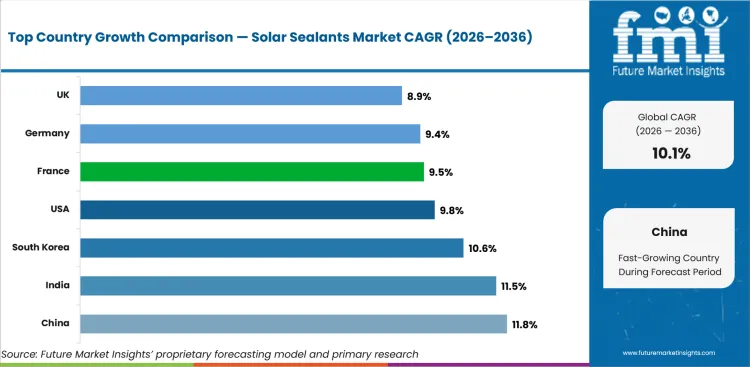
Source: Future Market Insights, 2026.
How do country-level CAGRs compare in the solar sealants market?
China leads country growth while Japan records the most cautious expansion outlook among profiled markets.
- China is forecast to record 11.8% CAGR by 2036 as module manufacturing scale supports high-volume sealant demand.
- India is expected to expand at 11.5% CAGR from 2026 to 2036 due to utility-scale projects and rooftop solar expansion.
- South Korea is projected to grow at 10.6% CAGR through 2036 as specification-led projects and module carbon checks support premium materials.
- The United States is estimated to rise at 9.8% CAGR by 2036 through domestic module qualification and utility-scale solar demand.
- France is expected to advance at 9.5% CAGR over the forecast period as ground-mounted projects and BIPV opportunities support certified sealants.
- Germany is forecast to grow at 9.4% CAGR through 2036 as rooftop, balcony, and utility PV channels widen installation-linked demand.
- The United Kingdom is projected to post 8.9% CAGR by 2036 as rooftop installations and commercial retrofits guide distributor sales.
- Japan is expected to grow at 7.6% CAGR through 2036 as quality standards and limited land availability keep adoption more selective.
How fast is the solar sealants market growing in China?
An 11.8% CAGR through 2036 reflects module manufacturing scale, direct factory qualification, and high utility-solar deployment.
Country Market Snapshot Table
| Parameter | Value |
|---|---|
| Market Size in 2025 (Value) | USD 341.4 million |
| Market Size in 2026 (Value) | USD 381.7 million |
| Market Forecast in 2036 (Value) | USD 1,164.5 million |
| CAGR (2026 to 2036) | 11.8% |
| Years Considered | 2021 to 2036 |
| Base Year | 2025 |
| Forecast Period | 2026 to 2036 |
| Units Considered | Value (USD million) |
| Leading Sub-Region | Jiangsu, Zhejiang, and western utility-solar corridors |
China Solar Sealants Market Outlook
China solar sealants demand is influenced by module manufacturing scale, automated factory lines, and large utility-solar project pipelines. Suppliers compete on cure speed, local technical service, and cost discipline across direct OEM channels.
Retail and distributor demand remains smaller than factory demand, but project sites still require mounting and repair materials. Sealant suppliers that combine fast local availability with product validation should gain better access to module plants and EPC buyers.
Key Growth Drivers
- Module factory demand gives solar sealants a high-volume base. IEA reported that China commissioned nearly 370 GW of solar PV in 2025, which keeps frame sealing and junction box bonding close to large production runs.
- Utility and distributed deployment support bulk EPC purchasing. China’s government reported that wind and solar cumulative grid-connected capacity reached 1.84 billion kW in 2025, equal to 47.3% of total installed power capacity.
- Jiangsu and Zhejiang module clusters support direct technical selling because manufacturers need fast supplier response during qualification and production-line adjustment.
- Domestic and global suppliers compete around automated dispensing support, which makes process reliability a key purchase factor for high-speed module lines.
Key Restraints
- Variable generation and grid integration can complicate project timing. China’s statistics agency reported that solar power generation increased 23.4% year on year in November 2025, after monthly growth rates shifted through the year.
- Module price pressure can force sealant suppliers into lower-margin contracts when buyers focus on cost per module.
- Policy shifts from fixed pricing to competitive mechanisms can change project timing and reduce short-term purchasing visibility.
What makes China unique
China is unique because sealant suppliers must serve both large module factories and fast-moving project pipelines at high speed.
Key Companies
- Dow
- WACKER
- Sika
- H.B. Fuller
- Momentive
- Shin-Etsu Chemical
- Guangzhou Baiyun Chemical Industry Co. Ltd.
Sales & Marketing Channels
- Direct module OEM supply
- EPC bulk purchasing
- Industrial adhesive distributors
- Automation equipment partners
- Regional technical service teams
- Online B2B procurement channels
Country Segment Breakdown Table
| Segment | Sub-Segments |
|---|---|
| By Sealant Chemistry | Silicone · Polyurethane · MS Polymer · Other |
| By Application | PV Module Sealing · Mounting / Junction Box Sealing · BIPV · Solar Thermal |
| By Installation Type | Rooftop · Utility-scale · Commercial & Industrial |
| By End Use | New Installations · Repair / Maintenance |
| By Sales Channel | Direct to OEM / EPC · Distributors |
| Key Sub-Regions Covered, Manufacturing and Utility Clusters | Jiangsu · Zhejiang · Anhui · Guangdong · Inner Mongolia · Xinjiang |
Frequently Asked Questions
How fast is China solar sealants market growing?
Sales in China are ready to scale at 11.8% CAGR from 2026 to 2036, guided by module manufacturing and utility project scale.
Who leads China solar sealants market?
Dow, WACKER, Sika, H.B. Fuller, Momentive, and local formulators compete based on PV sealant qualification and local support.
What is driving adoption in China solar sealants market?
High-volume module assembly and utility-scale solar projects are moving buyers toward fast-cure and validated sealant systems.
What is driving solar sealants growth in India?
An 11.5% CAGR through 2036 is supported by utility-scale solar additions, rooftop programs, and expanding domestic module capacity.
Country Market Snapshot Table
| Parameter | Value |
|---|---|
| Market Size in 2025 (Value) | USD 157.1 million |
| Market Size in 2026 (Value) | USD 175.2 million |
| Market Forecast in 2036 (Value) | USD 520.3 million |
| CAGR (2026 to 2036) | 11.5% |
| Years Considered | 2021 to 2036 |
| Base Year | 2025 |
| Forecast Period | 2026 to 2036 |
| Units Considered | Value (USD million) |
| Leading Sub-Region | Rajasthan, Gujarat, and Maharashtra solar corridors |
India Solar Sealants Market Outlook
India solar sealants demand is shaped by utility-scale project volume and rooftop programs that require weatherproofing materials. EPCs compare products by cure speed, hot-climate durability, and cost per module.
Local adhesive and sealant capacity gives buyers better access to technical support. Suppliers that can balance price discipline with warranty evidence should gain stronger acceptance across module factories and state project channels.
Key Growth Drivers
- Utility and rooftop solar create two clear sealant pools. MNRE reported 157.05 GW cumulative solar capacity as of 31 May 2026, including 118.79 GW of ground-mounted solar and 27.88 GW of grid-connected rooftop solar.
- Domestic module manufacturing supports direct material qualification. PIB reported that India reached 150.26 GW cumulative installed solar capacity as of 31 March 2026, while FY 2025-26 recorded 44.61 GW of solar capacity addition.
- Rajasthan and Gujarat utility projects create high-volume demand for module sealing, frame protection, and EPC-level material supply.
- Rooftop programs increase need for penetration sealants in urban residential and commercial installations.
Key Restraints
- Transmission bottlenecks can delay project conversion. IEEFA reported in October 2025 that around 50 GW of renewable energy capacity remained stranded across India due to transmission constraints.
- EPC price pressure can reduce premium sealant uptake when project awards prioritize lower upfront cost.
- Heat and dust exposure require careful installer training because poor surface preparation can weaken field performance.
What makes India unique
India is unique because it combines fast utility-scale solar additions with a large price-sensitive rooftop installation channel.
Key Companies
- Henkel India
- Dow India
- WACKER Chemie India
- Sika India
- H.B. Fuller India
- Pidilite Industries Ltd.
- Anabond Limited
Sales & Marketing Channels
- EPC direct contracts
- Module maker approvals
- Electrical distributors
- Rooftop installer networks
- State tender channels
- Industrial adhesive dealers
Country Segment Breakdown Table
| Segment | Sub-Segments |
|---|---|
| By Sealant Chemistry | Silicone · Polyurethane · MS Polymer · Other |
| By Application | PV Module Sealing · Mounting / Junction Box Sealing · BIPV · Solar Thermal |
| By Installation Type | Rooftop · Utility-scale · Commercial & Industrial |
| By End Use | New Installations · Repair / Maintenance |
| By Sales Channel | Direct to OEM / EPC · Distributors |
| Key Sub-Regions Covered, Utility and Rooftop Clusters | Rajasthan · Gujarat · Maharashtra · Tamil Nadu · Karnataka · Uttar Pradesh |
Frequently Asked Questions
How fast is India solar sealants market growing?
Demand in India is ready to rise at 11.5% CAGR from 2026 to 2036, supported by utility-scale and rooftop solar deployment.
Who leads India solar sealants market?
Henkel, Dow, WACKER, Sika, H.B. Fuller, Pidilite, and Anabond compete through adhesive technology and local distribution.
What is driving adoption in India solar sealants market?
Utility solar projects, rooftop installations, and domestic module manufacturing are moving buyers toward qualified sealing materials.
How is the solar sealants market performing in South Korea?
A 10.6% CAGR through 2036 reflects utility-focused PV ownership, quality-sensitive buying, and carbon-aware module procurement.
Country Market Snapshot Table
| Parameter | Value |
|---|---|
| Market Size in 2025 (Value) | USD 68.6 million |
| Market Size in 2026 (Value) | USD 75.9 million |
| Market Forecast in 2036 (Value) | USD 207.9 million |
| CAGR (2026 to 2036) | 10.6% |
| Years Considered | 2021 to 2036 |
| Base Year | 2025 |
| Forecast Period | 2026 to 2036 |
| Units Considered | Value (USD million) |
| Leading Sub-Region | Jeolla, Chungcheong, and industrial solar corridors |
South Korea Solar Sealants Market Outlook
South Korea demand is smaller than China and India, but it is more specification-sensitive. Utility and commercial project owners review product performance, carbon documentation, and moisture resistance before approving materials.
Floating solar and constrained land use increase the need for sealants that can manage UV exposure, humidity, and long field service. Suppliers with regional specialty silicone support should benefit from tender-linked and module-maker requirements.
Key Growth Drivers
- Power generation businesses shape many sealant specifications. IEA PVPS reported that Korea had 32 GW cumulative installed solar capacity in 2024, with 27.4 GW or about 86% held by power generation businesses.
- Solar-led renewable generation supports material demand. IEA reported in 2025 that Korea’s solar PV generation accounted for 33 TWh in 2024, leading the increase in renewable generation.
- Floating solar and wet-site exposure create demand for sealants that can protect modules and junction boxes against moisture stress.
- Carbon documentation requirements encourage suppliers to provide stronger material records for module qualification.
Key Restraints
- Limited land availability can restrict solar project siting. IEA reported in 2025 that Korea’s installed solar PV capacity per non-forested land area was around 780 kW/km² in 2023, which was far higher than many larger markets.
- Tender price pressure can reduce willingness to pay for premium sealant systems.
- Grid and siting constraints can delay project conversion, especially outside established industrial solar corridors.
What makes South Korea unique
South Korea is unique because tender rules and module carbon checks can connect sealant documentation with upstream material selection.
Key Companies
- WACKER Korea
- Momentive Korea
- Dow Korea
- Sika Korea
- H.B. Fuller Korea
- KCC Corporation
- Shin-Etsu Chemical Korea
Sales & Marketing Channels
- Fixed-price tender channels
- Direct utility project supply
- Module maker approvals
- Industrial adhesive distributors
- Floating solar integrators
- Technical service teams
Country Segment Breakdown Table
| Segment | Sub-Segments |
|---|---|
| By Sealant Chemistry | Silicone · Polyurethane · MS Polymer · Other |
| By Application | PV Module Sealing · Mounting / Junction Box Sealing · BIPV · Solar Thermal |
| By Installation Type | Rooftop · Utility-scale · Commercial & Industrial |
| By End Use | New Installations · Repair / Maintenance |
| By Sales Channel | Direct to OEM / EPC · Distributors |
| Key Sub-Regions Covered, Utility and Industrial Clusters | Jeolla · South Chungcheong · Gyeonggi · Ulsan · Busan · Incheon |
Frequently Asked Questions
How fast is South Korea solar sealants market growing?
Industry in South Korea is projected to increase at 10.6% CAGR from 2026 to 2036 through specification-led solar projects.
Who leads South Korea solar sealants market?
WACKER, Momentive, Dow, Sika, H.B. Fuller, KCC, and Shin-Etsu compete based on silicone depth and technical support.
What is driving adoption in South Korea solar sealants market?
Utility PV ownership, floating solar exposure, and module documentation needs are moving buyers toward premium sealants.
What is the solar sealants market outlook in the United States?
A 9.8% CAGR through 2036 is supported by utility-scale additions, domestic module capacity, and direct EPC specification.
Country Market Snapshot Table
| Parameter | Value |
|---|---|
| Market Size in 2025 (Value) | USD 188.5 million |
| Market Size in 2026 (Value) | USD 207.0 million |
| Market Forecast in 2036 (Value) | USD 527.2 million |
| CAGR (2026 to 2036) | 9.8% |
| Years Considered | 2021 to 2036 |
| Base Year | 2025 |
| Forecast Period | 2026 to 2036 |
| Units Considered | Value (USD million) |
| Leading Sub-Region | Texas, California, Arizona, and Southeast manufacturing corridors |
United States Solar Sealants Market Outlook
United States solar sealants demand is shaped by utility-scale solar, domestic module assembly, and qualification-heavy buying. Module makers and EPCs prefer suppliers with product data files, warranty support, and local technical response.
Rooftop repair and residential installation channels continue to support distributor sales. Solar-specific sealants gain value when installers need water resistance, roof compatibility, and clear application guidance.
Key Growth Drivers
- Utility-scale additions create strong EPC demand. EIA reported in February 2026 that developers planned to add 43.4 GW of new utility-scale solar capacity in 2026, a 60% increase from the prior year if realized.
- Domestic module supply improves direct qualification opportunities. SEIA reported 69.9 GW of domestic module manufacturing capacity online in 2026.
- Texas, California, and Arizona utility projects support high-volume sealant demand for modules, racking interfaces, and repair materials.
- Residential and commercial rooftop installers need weatherproof sealants that reduce leak risk and callbacks.
Key Restraints
- Installation swings can affect material planning. SEIA reported that USA solar installations reached 7.8 GWdc in Q1 2026, down 27% from Q1 2025.
- Tariff and tax-credit uncertainty can delay module procurement and EPC material ordering.
- State-level permitting delays can shift project timing and create uneven distributor demand.
What makes the United States unique
The United States is unique because domestic-content documentation can influence material selection before performance comparison begins.
Key Companies
- Dow
- H.B. Fuller
- Sika Corporation
- WACKER Chemical Corporation
- Momentive Performance Materials
- 3M
- Henkel Corporation
Sales & Marketing Channels
- Direct module maker accounts
- EPC specification selling
- Solar racking partnerships
- Roofing distributor networks
- Contractor training programs
- Technical data sheet portals
Country Segment Breakdown Table
| Segment | Sub-Segments |
|---|---|
| By Sealant Chemistry | Silicone · Polyurethane · MS Polymer · Other |
| By Application | PV Module Sealing · Mounting / Junction Box Sealing · BIPV · Solar Thermal |
| By Installation Type | Rooftop · Utility-scale · Commercial & Industrial |
| By End Use | New Installations · Repair / Maintenance |
| By Sales Channel | Direct to OEM / EPC · Distributors |
| Key Sub-Regions Covered, Solar and Manufacturing Networks | Texas · California · Arizona · Georgia · Ohio · Southeast |
Frequently Asked Questions
How fast is United States solar sealants market growing?
Sector in the United States is anticipated to grow at 9.8% CAGR from 2026 to 2036, reflecting utility-scale and domestic module demand.
Who leads United States solar sealants market?
Dow, H.B. Fuller, Sika, WACKER, Momentive, 3M, and Henkel compete based on solar portfolios and technical documentation.
What is driving adoption in United States solar sealants market?
Utility-scale solar, domestic module assembly, and EPC qualification are moving buyers toward certified solar sealant systems.
How is the solar sealants market performing in France?
A 9.5% CAGR through 2036 reflects ground-mounted projects, commercial rooftops, and BIPV-oriented building demand.
Country Market Snapshot Table
| Parameter | Value |
|---|---|
| Market Size in 2025 (Value) | USD 62.0 million |
| Market Size in 2026 (Value) | USD 67.9 million |
| Market Forecast in 2036 (Value) | USD 168.3 million |
| CAGR (2026 to 2036) | 9.5% |
| Years Considered | 2021 to 2036 |
| Base Year | 2025 |
| Forecast Period | 2026 to 2036 |
| Units Considered | Value (USD million) |
| Leading Sub-Region | Southern France, Île-de-France, and western commercial rooftop corridors |
France Solar Sealants Market Outlook
France demand reflects utility solar, commercial rooftops, and building-integrated applications. Sealant suppliers must address weather durability, glass bonding, and building envelope requirements.
BIPV remains important because solar roofs need discreet bonding and reliable waterproofing. Suppliers that support technical validation and local installer education should gain wider project acceptance.
Key Growth Drivers
- New PV connections are expanding the application base for solar sealants. IEA PVPS reported that France added 7.6 GWDC of PV capacity in 2025 and reached 38.3 GWDC by year-end.
- Distribution-grid solar expansion supports rooftop and commercial channels. Enedis projected 42 GW of solar generation capacity connected to the public distribution grid by 2032.
- Southern France utility projects increase demand for bulk sealant supply through EPC purchasing.
- Public and commercial building renovations create opportunities for BIPV adhesive-sealant systems.
Key Restraints
- Grid planning can lengthen project timelines. RTE’s 2025 network strategy stated that its approach offered 10 GW to 20 GW of additional grid capacity while saving EUR 1.5 billion in investment between 2019 and 2025.
- French building approvals can extend validation cycles for roof-integrated solar products.
- Connection timing can shift EPC buying schedules across project portfolios.
What makes France unique
France is unique because BIPV interest meets a regulated building culture that rewards validated solar materials.
Key Companies
- Sika France
- Dow France
- H.B. Fuller France
- WACKER France
- Henkel France
- Arkema
- Bostik
Sales & Marketing Channels
- EPC direct supply
- Roofing contractors
- Building envelope consultants
- Solar distributor networks
- Public procurement routes
- BIPV partnerships
Country Segment Breakdown Table
| Segment | Sub-Segments |
|---|---|
| By Sealant Chemistry | Silicone · Polyurethane · MS Polymer · Other |
| By Application | PV Module Sealing · Mounting / Junction Box Sealing · BIPV · Solar Thermal |
| By Installation Type | Rooftop · Utility-scale · Commercial & Industrial |
| By End Use | New Installations · Repair / Maintenance |
| By Sales Channel | Direct to OEM / EPC · Distributors |
| Key Sub-Regions Covered, Solar and Building Clusters | Occitanie · Nouvelle-Aquitaine · Provence-Alpes-Côte d’Azur · Île-de-France · Auvergne-Rhône-Alpes · Grand Est |
Frequently Asked Questions
How fast is France solar sealants market growing?
Demand in France is ready to rise at 9.5% CAGR from 2026 to 2036 with utility solar and BIPV support.
Who leads France solar sealants market?
Sika, Dow, H.B. Fuller, WACKER, Henkel, Arkema, and Bostik compete through solar and building-envelope channels.
What is driving adoption in France solar sealants market?
Ground-mounted solar, commercial rooftops, and BIPV projects are moving buyers toward validated adhesive-sealants.
How is the solar sealants market performing in Germany?
A 9.4% CAGR through 2036 reflects rooftop, balcony, and utility PV demand supported by local silicone capability.
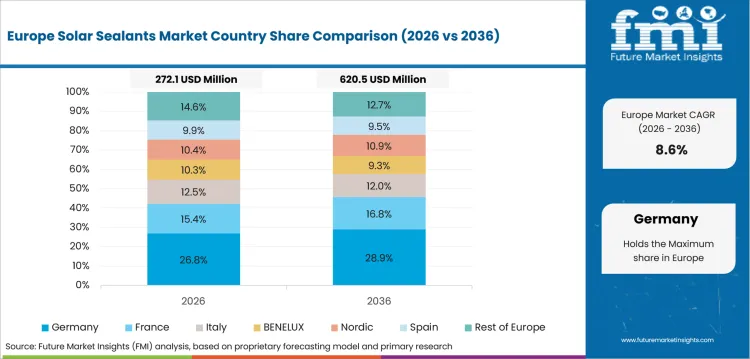
Country Market Snapshot Table
| Parameter | Value |
|---|---|
| Market Size in 2025 (Value) | USD 87.1 million |
| Market Size in 2026 (Value) | USD 95.3 million |
| Market Forecast in 2036 (Value) | USD 234.0 million |
| CAGR (2026 to 2036) | 9.4% |
| Years Considered | 2021 to 2036 |
| Base Year | 2025 |
| Forecast Period | 2026 to 2036 |
| Units Considered | Value (USD million) |
| Leading Sub-Region | Bavaria, North Rhine-Westphalia, and Saxony solar corridors |
Germany Solar Sealants Market Outlook
Germany combines rooftop solar, balcony systems, utility PV, and local specialty silicone supply. Buyers often compare sealants through standards, test history, and building-envelope compatibility.
Solar-specific sealants gain value in BIPV, rooftop waterproofing, and premium installation systems. Local silicone capacity also supports supply confidence for distributors and OEM accounts.
Key Growth Drivers
- Balcony PV creates small-pack and installer-channel demand. Bundesnetzagentur registered about 430,000 new plug-in balcony solar installations in 2025, equal to 3.2% of Germany’s new solar capacity.
- Germany remains a large annual PV market. IEA PVPS reported that Germany installed 17.2 GW in 2024, leading the European Union’s annual solar additions.
- Bavarian and North Rhine-Westphalia rooftop activity supports cartridge, distributor, and contractor purchases.
- Domestic silicone production strengthens local supply confidence for qualified solar and building-envelope sealants.
Key Restraints
- Curtailment and grid limits can weaken project economics. Clean Energy Wire reported in March 2026 that compensation costs for renewable curtailment fell by 22% to EUR 435 million in 2025, after EUR 554 million in 2024.
- Rooftop demand can soften when incentive visibility and household budgets become uncertain.
- Skilled installer availability limits fast project conversion in some federal states.
What makes Germany unique
Germany is unique because it combines large installation demand with a domestic silicone sealant production anchor.
Key Companies
- WACKER
- Sika Germany
- Dow Germany
- H.B. Fuller Germany
- Henkel
- Otto-Chemie
- Momentive
Sales & Marketing Channels
- Electrical contractor distributors
- Roofing merchants
- OEM direct supply
- BIPV manufacturer partnerships
- Building envelope consultants
- DIY and prosumer retail
Country Segment Breakdown Table
| Segment | Sub-Segments |
|---|---|
| By Sealant Chemistry | Silicone · Polyurethane · MS Polymer · Other |
| By Application | PV Module Sealing · Mounting / Junction Box Sealing · BIPV · Solar Thermal |
| By Installation Type | Rooftop · Utility-scale · Commercial & Industrial |
| By End Use | New Installations · Repair / Maintenance |
| By Sales Channel | Direct to OEM / EPC · Distributors |
| Key Sub-Regions Covered, Rooftop and Industrial Clusters | Bavaria · North Rhine-Westphalia · Saxony · Baden-Württemberg · Lower Saxony · Berlin-Brandenburg |
Frequently Asked Questions
How fast is Germany solar sealants market growing?
Industry in Germany is projected to increase at 9.4% CAGR from 2026 to 2036 through rooftop and utility PV demand.
Who leads Germany solar sealants market?
WACKER, Sika, Dow, H.B. Fuller, Henkel, Otto-Chemie, and Momentive compete through silicone and building channels.
What is driving adoption in Germany solar sealants market?
Balcony PV, rooftop modernization, and BIPV interest are moving buyers toward weather-resistant sealants.
What is the solar sealants market outlook in the United Kingdom?
An 8.9% CAGR through 2036 is supported by rooftop solar installations, commercial retrofit work, and distributor-led buying.
Country Market Snapshot Table
| Parameter | Value |
|---|---|
| Market Size in 2025 (Value) | USD 51.8 million |
| Market Size in 2026 (Value) | USD 56.4 million |
| Market Forecast in 2036 (Value) | USD 132.3 million |
| CAGR (2026 to 2036) | 8.9% |
| Years Considered | 2021 to 2036 |
| Base Year | 2025 |
| Forecast Period | 2026 to 2036 |
| Units Considered | Value (USD million) |
| Leading Sub-Region | London, Southeast England, and national rooftop installer networks |
United Kingdom Solar Sealants Market Outlook
United Kingdom solar sealants demand is led by rooftop and commercial building work rather than large local module production. Installers need products that can handle damp weather, roof movement, and penetration sealing.
Distributor availability matters more in the United Kingdom than in factory-led countries. Sealant suppliers that provide contractor training and clear technical documentation should benefit from rooftop and retrofit activity.
Key Growth Drivers
- Rooftop solar momentum supports installation sealants. UK Department for Energy Security and Net Zero reported 269,000 solar installations completed in 2025, the highest annual total recorded and 37% larger than the year before.
- Solar deployment has crossed a larger installation base. UK Department for Energy Security and Net Zero stated that total UK solar capacity surpassed 2 million installations in March 2026 across rooftops, solar farms, and community systems.
- Commercial rooftops in London and Southeast England create steady demand for penetration sealants.
- Installer accreditation channels lift demand for products with clear technical documentation.
Key Restraints
- Weather can limit cure windows and raise rework risk. UK Department for Energy Security and Net Zero data showed 23,000 new solar installations in April 2026, which keeps installers sensitive to seasonal scheduling and application conditions.
- Rooftop labor shortages can delay installation and reduce short-term material pull.
- Wet roof conditions can restrict sealant selection unless suppliers provide clear use limits and application guidance.
What makes the United Kingdom unique
The United Kingdom is unique because many sealant decisions are made by rooftop installers rather than module manufacturers.
Key Companies
- Sika UK
- H.B. Fuller UK
- Dow UK
- WACKER UK
- Henkel UK
- Everbuild
- Geocel
Sales & Marketing Channels
- Roofing distributors
- Electrical wholesalers
- Installer training networks
- Commercial retrofit contractors
- EPC specification routes
- Online contractor portals
Country Segment Breakdown Table
| Segment | Sub-Segments |
|---|---|
| By Sealant Chemistry | Silicone · Polyurethane · MS Polymer · Other |
| By Application | PV Module Sealing · Mounting / Junction Box Sealing · BIPV · Solar Thermal |
| By Installation Type | Rooftop · Utility-scale · Commercial & Industrial |
| By End Use | New Installations · Repair / Maintenance |
| By Sales Channel | Direct to OEM / EPC · Distributors |
| Key Sub-Regions Covered, Rooftop Retail Clusters | London · Southeast England · Midlands · Manchester · Leeds · Scotland |
Frequently Asked Questions
How fast is United Kingdom solar sealants market growing?
Demand in the United Kingdom is ready to rise at 8.9% CAGR from 2026 to 2036 with rooftop solar support.
Who leads United Kingdom solar sealants market?
Sika UK, H.B. Fuller, Dow, WACKER, Henkel, Everbuild, and Geocel compete through roofing and contractor channels.
What is driving adoption in United Kingdom solar sealants market?
Rooftop solar installations and commercial retrofits are moving contractors toward durable waterproofing sealants.
What is the solar sealants market forecast for Japan?
A 7.6% CAGR through 2036 reflects premium material requirements, rooftop limitations, and emerging perovskite-related sealing needs.
Country Market Snapshot Table
| Parameter | Value |
|---|---|
| Market Size in 2025 (Value) | USD 62.2 million |
| Market Size in 2026 (Value) | USD 66.9 million |
| Market Forecast in 2036 (Value) | USD 139.2 million |
| CAGR (2026 to 2036) | 7.6% |
| Years Considered | 2021 to 2036 |
| Base Year | 2025 |
| Forecast Period | 2026 to 2036 |
| Units Considered | Value (USD million) |
| Leading Sub-Region | Tokyo, Kansai, and compact rooftop solar corridors |
Japan Solar Sealants Market Outlook
Japan solar sealants demand is shaped by quality-sensitive buying and limited installation space. Buyers focus on long service life, material reliability, and technical review before supplier switching.
Perovskite and compact rooftop systems may lift demand for flexible sealing around lightweight formats. Suppliers with Japanese technical support and electronics-grade material discipline should gain stronger acceptance.
Key Growth Drivers
- Japan has a large mature PV base. IEA PVPS estimated that cumulative PV installed capacity exceeded 100 GW as of 2025, with annual installations near 5.7 GW.
- Perovskite development creates demand for flexible materials. NEDO’s next-generation solar cell project targets electricity costs of 14 yen/kWh or less by 2030 for perovskite solar cells.
- Tokyo and Kansai commercial rooftops support compact sealing and mounting materials.
- Shin-Etsu and other local material suppliers support confidence in high-performance silicone chemistries.
Key Restraints
- Mature market stagnation limits faster adoption. IEA PVPS stated that Japan’s annual installations have nearly halved from the 10.8 GW peak recorded in 2015.
- Land scarcity limits large utility-scale project expansion compared with China and India.
- Long qualification cycles can slow entry for new sealant suppliers.
What makes Japan unique
Japan is unique because premium material reliability often outweighs low upfront price in supplier selection.
Key Companies
- Shin-Etsu Chemical
- WACKER Japan
- Dow Japan
- Sika Japan
- Momentive Japan
- ThreeBond
- Cemedine Co. Ltd.
Sales & Marketing Channels
- Direct OEM material approval
- Technical distributor networks
- Rooftop installer channels
- Electronics material suppliers
- Construction material wholesalers
- Research-led pilot programs
Country Segment Breakdown Table
| Segment | Sub-Segments |
|---|---|
| By Sealant Chemistry | Silicone · Polyurethane · MS Polymer · Other |
| By Application | PV Module Sealing · Mounting / Junction Box Sealing · BIPV · Solar Thermal |
| By Installation Type | Rooftop · Utility-scale · Commercial & Industrial |
| By End Use | New Installations · Repair / Maintenance |
| By Sales Channel | Direct to OEM / EPC · Distributors |
| Key Sub-Regions Covered, Rooftop and Technology Clusters | Tokyo · Kansai · Chubu · Kyushu · Tohoku · Hokkaido |
Frequently Asked Questions
How fast is Japan solar sealants market growing?
Sales in Japan are expected to rise at 7.6% CAGR from 2026 to 2036, guided by premium materials and compact solar systems.
Who leads Japan solar sealants market?
Shin-Etsu Chemical, WACKER Japan, Dow Japan, Sika Japan, Momentive, ThreeBond, and Cemedine compete through technical qualification.
What is driving adoption in Japan solar sealants market?
Quality-sensitive rooftop systems and perovskite-related material needs are moving buyers toward reliable flexible sealants.
Who are the leading companies in the solar sealants market?
Dow, WACKER, Sika, H.B. Fuller, Henkel, Momentive, and Shin-Etsu Chemical.
- Established silicone suppliers hold an advantage through PV module material experience and validation support.
- Construction sealant companies gain project access through roofing distributors, BIPV suppliers, and installer-facing channels.
- Industrial adhesive suppliers compete by offering dispensing support, cure-speed guidance, and factory qualification documents.
- Regional formulators gain limited opportunities through local stock, repair support, and lower-cost distributor access.
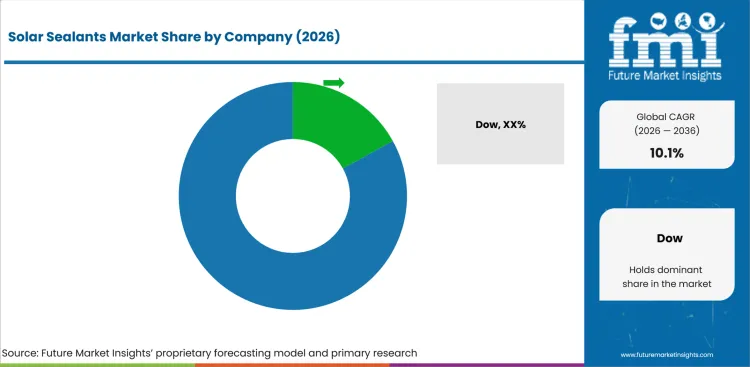
Solar sealants companies compete by combining chemistry depth with PV-specific application proof. Dow and WACKER hold strong positions because module factories need silicone products with data on UV exposure, damp heat, and outdoor durability. Sika and H.B. Fuller gain value in rooftop and installation channels because project teams also need weatherproofing support. Buyers compare suppliers by technical files and field application evidence before price.
Manufacturing support has become a competitive separator as solar module lines move toward faster assembly and tighter warranty expectations. Momentive and Shin-Etsu Chemical strengthen competition through silicone expertise and electronics-material experience. Henkel and 3M compete through industrial bonding knowledge and specification-led customer support. Suppliers that can support automated dispensing, local stock, and substrate testing should gain stronger repeat access with OEM and EPC buyers.
Smaller and regional players can win through repair materials, local availability, and installer guidance. India, the United Kingdom, and Germany create distributor opportunities because rooftop and field repair channels need cartridge formats and technical instructions. China and the United States remain more direct-account oriented because factory approval and project specification shape large orders. Companies relying only on low price are expected to face weaker acceptance when warranty exposure becomes visible.
How do top solar sealants companies compare?
Dow and WACKER score strongest on PV silicone depth while Sika and H.B. Fuller lead installer-channel relevance.
| Company | Relevance to Market Title | PV Sealant Portfolio Depth | Module Factory Qualification Support | Installer Channel Reach | Geographic Footprint |
|---|---|---|---|---|---|
| Dow | Very High | Very Strong | Very Strong | Strong | Global |
| WACKER | Very High | Very Strong | Very Strong | Moderate | Global |
| Sika | High | Strong | Strong | Very Strong | Global |
| H.B. Fuller | High | Strong | Strong | Very Strong | North America, Europe, Asia |
| Momentive | High | Very Strong | Strong | Moderate | Global |
| Shin-Etsu Chemical | High | Strong | Strong | Moderate | Asia, Europe, North America |
| Henkel | Moderate to High | Moderate | Strong | Strong | Global |
| 3M | Moderate | Moderate | Moderate | Very Strong | Global |
| Bostik | Moderate | Moderate | Moderate | Strong | Europe and Americas |
| Pidilite Industries | Moderate | Moderate | Moderate | Strong | India |
Source: Future Market Insights competitive analysis, 2026.
Who are the key players in the solar sealants market?
Dow, WACKER, Sika, H.B. Fuller, and Henkel are listed with Momentive and Shin-Etsu Chemical among other suppliers.
Key global companies leading the solar sealants market include:
- Dow
- WACKER
- Sika
- H.B. Fuller
- Henkel
- Momentive
- Shin-Etsu Chemical
- 3M
- Bostik
- Pidilite Industries
Key Developments in Solar Sealants Market
- In December 2025, WACKER and SICO opened an approximately 2,300-square-meter application development center for organofunctional silanes in Jining, China.
- In February 2026, Sika agreed to acquire Akkim, a global adhesives and sealants manufacturer based in Turkey.
- In February 2026, Henkel announced a collaboration with Sekab to support bio-based raw material sourcing for high-performance industrial adhesives.
Key Players in the Solar Sealants Market
Global Silicone and Adhesive Leaders
- Dow
- WACKER
- Momentive
- Shin-Etsu Chemical
Construction and Solar Installation Specialists
- Sika
- H.B. Fuller
- Bostik
- Everbuild
Industrial Adhesive Systems Providers
- Henkel
- 3M
- Pidilite Industries
- ThreeBond
Solar Sealants Market - Report Scope
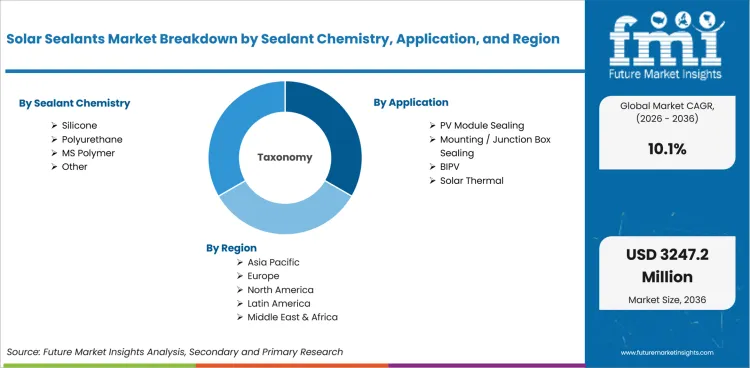
| Parameter | Details |
|---|---|
| Forecast period | 2026 to 2036 |
| Historical period | 2021 to 2025 |
| Quantitative unit | Revenue in USD million |
| By sealant chemistry | Silicone, polyurethane, MS polymer, other |
| By application | PV module sealing, mounting / junction box sealing, BIPV, solar thermal |
| By installation type | Rooftop, utility-scale, commercial & industrial |
| By end use | New installations, repair / maintenance |
| By sales channel | Direct to OEM / EPC, distributors |
| Regions covered | North America, Latin America, Europe, East Asia, South Asia and Pacific, Middle East and Africa |
| Countries covered | China, India, South Korea, United States, France, Germany, United Kingdom, Japan |
| Key companies profiled | Dow, WACKER, Sika, H.B. Fuller, Henkel, Momentive, Shin-Etsu Chemical, 3M |
| Approach | Bottom-up product-boundary approach using eligible sealant revenue, PV installation activity, module output, repair demand, channel presence, and country-level adoption |
Source: Future Market Insights, 2026.
Solar Sealants Market - Scope & Definition
| Attribute | Detail |
|---|---|
| Market Definition | Sealants and adhesive-sealants used in photovoltaic modules, solar roof systems, junction boxes, mounting areas, BIPV systems, and solar thermal components |
| Functions Covered | Sealing, bonding, potting, moisture protection, UV resistance support, roof waterproofing, and field repair |
| Applications Covered | PV module sealing, mounting / junction box sealing, BIPV, and solar thermal sealing applications |
| End-Use Industries | Solar module manufacturing, utility-scale solar EPC, rooftop solar installation, commercial solar installation, solar thermal systems, and repair services |
| Grades Covered | Silicone, polyurethane, MS polymer, and other solar-compatible sealant chemistries |
| Inclusions | All commercially available solar sealants used across chemistry, application, installation type, end use, sales channel, and regional demand |
| Exclusions | PV encapsulant films, solar cells, modules, racking hardware, inverters, cables, glass coatings, and general construction sealants without solar use |
Solar Sealants Market - Research Methodology
| Method | Description |
|---|---|
| Primary Research | FMI analyst interviews with module manufacturers, EPC contractors, rooftop installers, sealant distributors, and industrial adhesive formulators across key markets |
| Desk Research | Review of solar capacity data, product data sheets, official company material pages, certification references, renewable energy policy documents, and country-level PV deployment statistics |
| Market Sizing & Forecasting | Bottom-up product-boundary approach using eligible sealant revenue, installed solar capacity additions, module output, repair demand, average price bands, and channel participation |
| Data Validation | Cross-verification using solar PV capacity additions, company portfolios, installation channel behavior, certification evidence, and country-level procurement patterns |
Solar Sealants Market Breakdown by Sealant Chemistry, Application, Installation Type, End Use, Sales Channel, and Region
Solar Sealants Market Segmented by Sealant Chemistry
- Silicone
- Polyurethane
- MS Polymer
- Other
Solar Sealants Market Segmented by Application
- PV Module Sealing
- Mounting / Junction Box Sealing
- BIPV
- Solar Thermal
Solar Sealants Market Segmented by Installation Type
- Rooftop
- Utility-scale
- Commercial & Industrial
Solar Sealants Market Segmented by End Use
- New Installations
- Repair / Maintenance
Solar Sealants Market Segmented by Sales Channel
- Direct to OEM / EPC
- Distributors
Solar Sealants Market by Region
- North America
- Latin America
- Europe
- East Asia
- South Asia and Pacific
- Middle East and Africa
Research Sources and Bibliography
- Bundesnetzagentur. (2026, January 8). Growth in renewable energy in 2025. Bundesnetzagentur.
- Clean Energy Wire. (2026, March 24). Renewable curtailment compensation costs in Germany decrease 22% in 2025. Clean Energy Wire.
- Department for Energy Security and Net Zero. (2026, April 30). Britain embraces solar revolution following war in Iran. UK Department for Energy Security and Net Zero.
- Department for Energy Security and Net Zero. (2026, May 28). Britain continues to break clean power records. UK Department for Energy Security and Net Zero.
- Dow. (2026). DOWSIL PV-8301 fast cure sealant. Dow.
- Enedis. (2025). New electric France 2027 and 2032: Enedis publishes the preliminary document on its future network. Enedis.
- H.B. Fuller. (2025). Integrated sealants in solar. H.B. Fuller.
- Henkel AG & Co. KGaA. (2026, February 5). Henkel and Sekab are shaping the future with bio-based raw materials. Henkel.
- IEA PVPS. (2025). Snapshot of global PV markets 2025. International Energy Agency Photovoltaic Power Systems Programme.
- IEA PVPS. (2025). Trends in photovoltaic applications 2025. International Energy Agency Photovoltaic Power Systems Programme.
- IEA PVPS. (2026). France: Industry and market development. International Energy Agency Photovoltaic Power Systems Programme.
- IEA PVPS. (2026). Japan: Industry and market development. International Energy Agency Photovoltaic Power Systems Programme.
- IEA PVPS. (2026). Korea: Industry and market development. International Energy Agency Photovoltaic Power Systems Programme.
- Institute for Energy Economics and Financial Analysis. (2025, October 16). Green power transmission: The invisible barrier in India’s clean energy growth. IEEFA.
- International Energy Agency. (2025). Renewables 2025: Renewable electricity. International Energy Agency.
- International Energy Agency. (2025, November 25). Korea 2025. International Energy Agency.
- International Energy Agency. (2026, March). Technology: Solar PV and wind - Global Energy Review 2026. International Energy Agency.
- International Renewable Energy Agency. (2026, March 31). Renewable capacity highlights 2026. IRENA.
- Ministry of New and Renewable Energy. (2026, May 31). Physical achievements. Government of India.
- National Bureau of Statistics of China. (2025, December 16). Energy production in November 2025. National Bureau of Statistics of China.
- National Energy Administration. (2026, February 12). China’s newly installed wind, solar power capacity up 22 percent in 2025. The State Council of the People’s Republic of China.
- New Energy and Industrial Technology Development Organization. (2025). Development of next-generation solar cells. NEDO.
- Press Information Bureau. (2026, April 8). India ranks third globally in renewable energy installed capacity. Government of India.
- RTE. (2025, April 28). Strategic development plan for the French transmission network: Executive summary. RTE.
- RTE. (2026). Solar power generation in France. RTE.
- SEIA. (2026, June 10). Solar market insight report Q2 2026. Solar Energy Industries Association.
- SEIA. (2026). Solar & storage supply chain dashboard. Solar Energy Industries Association.
- Sika AG. (2026, February 13). Sika to acquire Akkim: Marking a major step in accelerating growth in adhesives and sealants. Sika.
- U.S. Energy Information Administration. (2026, February 20). New U.S. electric generating capacity expected to reach a record high in 2026. EIA.
- WACKER Chemie AG. (2025, December 1). WACKER strengthens silicone business in China with new technology center for specialty silanes. WACKER.
This bibliography is provided for reader reference and is not exhaustive. The full report contains the complete reference list and detailed citations.
This Report Answers
- Market size estimates for 2026 and forecasts through 2036 for the solar sealants market.
- Insights across more than 30 regional and country-level markets.
- Analysis of demand drivers, installation behavior, module assembly needs, and repair trends.
- Evaluation of key sealant chemistries, applications, installation types, end uses, and sales channels.
- Assessment of factory qualification, damp-heat resistance, UV exposure, and cure-speed requirements.
- Identification of growth opportunities across BIPV, rooftop sealing, utility-scale projects, and repair channels.
- Evaluation of supply chain dynamics, company developments, and distributor channel structures.
- Country-level growth analysis covering China, India, South Korea, the United States, France, Germany, the United Kingdom, and Japan.
- Assessment of the competitive landscape, including leading silicone and industrial sealant suppliers.
- Analysis of product inclusions, exclusions, and solar-specific sealant boundaries.
- Regional outlooks across North America, Europe, East Asia, South Asia and Pacific, Latin America, and Middle East and Africa.
- Delivery of market data, forecasts, and supporting analysis in PDF and Excel formats.
Frequently Asked Questions
What is the growth prospect for solar sealants?
Demand for solar sealants is expected to rise at a considerable pace as module makers, EPCs, and rooftop installers shift toward validated sealing systems.
Which companies are expected to shape the solar sealants market?
Dow, WACKER, Sika, Henkel, H.B. Fuller, Momentive, Shin-Etsu Chemical, and 3M are expected to shape market competition through solar materials and technical support.
Why are leading chemical companies investing in solar sealants?
Leading chemical companies are investing in solar sealants to serve module factories, BIPV manufacturers, and installers that need qualified weatherproofing materials.
Why are OEM and EPC channels important in the solar sealants market?
OEM and EPC channels support controlled qualification, bulk purchasing, and project-level documentation across module factories and utility projects.
Which sealant chemistries are gaining attention in solar sealants?
Silicone, polyurethane, and MS polymer sealants are gaining attention as buyers seek UV stability, flexibility, and substrate-specific adhesion.
How do regulations and standards influence solar sealant launches?
Regulations and standards influence launches through safety testing, product documentation, building approval, and warranty requirements.
Why is packaging important for solar sealants?
Packaging is important because cartridges, pails, and drums must match installer workflow, factory dispensing equipment, and field repair needs.
What role does BIPV play in solar sealant adoption?
BIPV supports adoption by requiring discreet bonding, weather resistance, and building-envelope compatibility.
How do distributor channels support solar sealants in some countries?
Distributor channels support solar sealants by supplying rooftop installers, repair contractors, and smaller EPCs with compatible products and technical guidance.
Preview the report firsthand - request a free sample
Get SampleGet the brochure for pricing and purchase details.
Get PDFTable of Content
- Key Takeaways
- Market Size and CAGR
- Top Growth Driver
- Fastest Growing Segment
- Leading Region
- Key Companies
- Emerging Opportunities
- Executive Summary
- Global Market Outlook
- Demand-side Trends
- Supply-side Trends
- Technology Roadmap Analysis
- Analysis and Recommendations
- Analyst Perspective (What is happening? Why now? What should investors know?)
- Key Questions Answered
- How large is the market?
- What is the CAGR?
- What are key trends?
- Which region dominates?
- Who are the leaders?
- Market Overview
- Market Coverage / Taxonomy
- Market Definition / Scope / Limitations
- Research Methodology
- Chapter Orientation
- Analytical Lens and Working Hypotheses
- Market Structure, Signals, and Trend Drivers
- Benchmarking and Cross-market Comparability
- Market Sizing, Forecasting, and Opportunity Mapping
- Research Design and Evidence Framework
- Desk Research Programme (Secondary Evidence)
- Expert Input and Fieldwork (Primary Evidence)
- Tooling, Models, and Reference Databases
- Data Engineering and Model Build
- Quality Assurance and Audit Trail
- Market Background
- Market Dynamics (Drivers, Restraints, Opportunity, Trends)
- Scenario Forecast (Optimistic, Likely, Conservative)
- Impact Analysis
- AI Impact
- Sustainability Impact
- Regulatory Impact
- Technology Impact
- Consumer / Buyer Analysis
- Purchase Drivers
- Adoption Barriers
- Buyer Journey
- Opportunity Map Analysis
- Product Life Cycle Analysis
- Supply Chain Analysis
- Investment Feasibility Matrix
- Value Chain Analysis
- PESTLE and Porter's Analysis
- Regulatory Landscape
- Regional Parent Market Outlook
- Production and Consumption Statistics
- Import and Export Statistics
- Global Market Analysis and Forecast, 2021 to 2036
- Historical Market Size Value (USD Million) & Volume (Unit) Analysis, 2021 to 2025
- Current and Future Market Size Value (USD Million) & Volume (Unit) Projections, 2026 to 2036
- Y-o-Y Growth Trend Analysis
- Absolute $ Opportunity Analysis
- Global Market Pricing Analysis, 2021 to 2036
- Global Market Analysis and Forecast, By Sealant Chemistry, 2021 to 2036
- Introduction / Key Findings
- Historical Market Size Value (USD Million) & Volume (Unit) Analysis By Sealant Chemistry, 2021 to 2025
- Current and Future Market Size Value (USD Million) & Volume (Unit) Analysis and Forecast By Sealant Chemistry, 2026 to 2036
- Silicone
- Polyurethane
- MS Polymer
- Other
- Silicone
- Y-o-Y Growth Trend Analysis By Sealant Chemistry, 2021 to 2025
- Absolute $ Opportunity Analysis By Sealant Chemistry, 2026 to 2036
- Global Market Analysis and Forecast, By Application, 2021 to 2036
- Introduction / Key Findings
- Historical Market Size Value (USD Million) & Volume (Unit) Analysis By Application, 2021 to 2025
- Current and Future Market Size Value (USD Million) & Volume (Unit) Analysis and Forecast By Application, 2026 to 2036
- PV Module Sealing
- Mounting / Junction Box Sealing
- BIPV
- Solar Thermal
- PV Module Sealing
- Y-o-Y Growth Trend Analysis By Application, 2021 to 2025
- Absolute $ Opportunity Analysis By Application, 2026 to 2036
- Global Market Analysis and Forecast, By Installation Type, 2021 to 2036
- Introduction / Key Findings
- Historical Market Size Value (USD Million) & Volume (Unit) Analysis By Installation Type, 2021 to 2025
- Current and Future Market Size Value (USD Million) & Volume (Unit) Analysis and Forecast By Installation Type, 2026 to 2036
- Utility-scale
- Commercial & Industrial
- Rooftop
- Utility-scale
- Y-o-Y Growth Trend Analysis By Installation Type, 2021 to 2025
- Absolute $ Opportunity Analysis By Installation Type, 2026 to 2036
- Global Market Analysis and Forecast, By End Use, 2021 to 2036
- Introduction / Key Findings
- Historical Market Size Value (USD Million) & Volume (Unit) Analysis By End Use, 2021 to 2025
- Current and Future Market Size Value (USD Million) & Volume (Unit) Analysis and Forecast By End Use, 2026 to 2036
- New Installations
- Repair / Maintenance
- New Installations
- Y-o-Y Growth Trend Analysis By End Use, 2021 to 2025
- Absolute $ Opportunity Analysis By End Use, 2026 to 2036
- Global Market Analysis and Forecast, By Sales Channel, 2021 to 2036
- Introduction / Key Findings
- Historical Market Size Value (USD Million) & Volume (Unit) Analysis By Sales Channel, 2021 to 2025
- Current and Future Market Size Value (USD Million) & Volume (Unit) Analysis and Forecast By Sales Channel, 2026 to 2036
- Direct to OEM / EPC
- Distributors
- Direct to OEM / EPC
- Y-o-Y Growth Trend Analysis By Sales Channel, 2021 to 2025
- Absolute $ Opportunity Analysis By Sales Channel, 2026 to 2036
- Global Market Analysis and Forecast, By Region, 2021 to 2036
- Introduction
- Historical Market Size Value (USD Million) & Volume (Unit) Analysis By Region, 2021 to 2025
- Current Market Size Value (USD Million) & Volume (Unit) Analysis and Forecast By Region, 2026 to 2036
- North America
- Latin America
- Western Europe
- Eastern Europe
- East Asia
- South Asia and Pacific
- Middle East & Africa
- Market Attractiveness Analysis By Region
- North America Market Analysis and Forecast, By Country, 2021 to 2036
- Historical Market Size Value (USD Million) & Volume (Unit) Trend Analysis By Market Taxonomy, 2021 to 2025
- Market Size Value (USD Million) & Volume (Unit) Forecast By Market Taxonomy, 2026 to 2036
- By Country
- USA
- Canada
- Mexico
- By Sealant Chemistry
- By Application
- By Installation Type
- By End Use
- By Sales Channel
- By Country
- Market Attractiveness Analysis
- By Country
- By Sealant Chemistry
- By Application
- By Installation Type
- By End Use
- By Sales Channel
- Key Takeaways
- Latin America Market Analysis and Forecast, By Country
- Historical Market Size Value (USD Million) & Volume (Unit) Trend Analysis By Market Taxonomy, 2021 to 2025
- Market Size Value (USD Million) & Volume (Unit) Forecast By Market Taxonomy, 2026 to 2036
- By Country
- Brazil
- Chile
- Rest of Latin America
- By Sealant Chemistry
- By Application
- By Installation Type
- By End Use
- By Sales Channel
- By Country
- Market Attractiveness Analysis
- By Country
- By Sealant Chemistry
- By Application
- By Installation Type
- By End Use
- By Sales Channel
- Key Takeaways
- Western Europe Market Analysis and Forecast, By Country
- Historical Market Size Value (USD Million) & Volume (Unit) Trend Analysis By Market Taxonomy, 2021 to 2025
- Market Size Value (USD Million) & Volume (Unit) Forecast By Market Taxonomy, 2026 to 2036
- By Country
- Germany
- UK
- Italy
- Spain
- France
- Nordic
- BENELUX
- Rest of Western Europe
- By Sealant Chemistry
- By Application
- By Installation Type
- By End Use
- By Sales Channel
- By Country
- Market Attractiveness Analysis
- By Country
- By Sealant Chemistry
- By Application
- By Installation Type
- By End Use
- By Sales Channel
- Key Takeaways
- Eastern Europe Market Analysis and Forecast, By Country
- Historical Market Size Value (USD Million) & Volume (Unit) Trend Analysis By Market Taxonomy, 2021 to 2025
- Market Size Value (USD Million) & Volume (Unit) Forecast By Market Taxonomy, 2026 to 2036
- By Country
- Russia
- Poland
- Hungary
- Balkan & Baltic
- Rest of Eastern Europe
- By Sealant Chemistry
- By Application
- By Installation Type
- By End Use
- By Sales Channel
- By Country
- Market Attractiveness Analysis
- By Country
- By Sealant Chemistry
- By Application
- By Installation Type
- By End Use
- By Sales Channel
- Key Takeaways
- East Asia Market Analysis and Forecast, By Country
- Historical Market Size Value (USD Million) & Volume (Unit) Trend Analysis By Market Taxonomy, 2021 to 2025
- Market Size Value (USD Million) & Volume (Unit) Forecast By Market Taxonomy, 2026 to 2036
- By Country
- China
- Japan
- South Korea
- By Sealant Chemistry
- By Application
- By Installation Type
- By End Use
- By Sales Channel
- By Country
- Market Attractiveness Analysis
- By Country
- By Sealant Chemistry
- By Application
- By Installation Type
- By End Use
- By Sales Channel
- Key Takeaways
- South Asia and Pacific Market Analysis and Forecast, By Country
- Historical Market Size Value (USD Million) & Volume (Unit) Trend Analysis By Market Taxonomy, 2021 to 2025
- Market Size Value (USD Million) & Volume (Unit) Forecast By Market Taxonomy, 2026 to 2036
- By Country
- India
- ASEAN
- Australia & New Zealand
- Rest of South Asia and Pacific
- By Sealant Chemistry
- By Application
- By Installation Type
- By End Use
- By Sales Channel
- By Country
- Market Attractiveness Analysis
- By Country
- By Sealant Chemistry
- By Application
- By Installation Type
- By End Use
- By Sales Channel
- Key Takeaways
- Middle East & Africa Market Analysis and Forecast, By Country
- Historical Market Size Value (USD Million) & Volume (Unit) Trend Analysis By Market Taxonomy, 2021 to 2025
- Market Size Value (USD Million) & Volume (Unit) Forecast By Market Taxonomy, 2026 to 2036
- By Country
- Kingdom of Saudi Arabia
- Other GCC Countries
- Türkiye
- South Africa
- Other African Union
- Rest of Middle East & Africa
- By Sealant Chemistry
- By Application
- By Installation Type
- By End Use
- By Sales Channel
- By Country
- Market Attractiveness Analysis
- By Country
- By Sealant Chemistry
- By Application
- By Installation Type
- By End Use
- By Sales Channel
- Key Takeaways
- Key Countries Market Analysis
- USA
- Pricing Analysis
- Market Share Analysis, 2025
- By Sealant Chemistry
- By Application
- By Installation Type
- By End Use
- By Sales Channel
- Canada
- Pricing Analysis
- Market Share Analysis, 2025
- By Sealant Chemistry
- By Application
- By Installation Type
- By End Use
- By Sales Channel
- Mexico
- Pricing Analysis
- Market Share Analysis, 2025
- By Sealant Chemistry
- By Application
- By Installation Type
- By End Use
- By Sales Channel
- Brazil
- Pricing Analysis
- Market Share Analysis, 2025
- By Sealant Chemistry
- By Application
- By Installation Type
- By End Use
- By Sales Channel
- Chile
- Pricing Analysis
- Market Share Analysis, 2025
- By Sealant Chemistry
- By Application
- By Installation Type
- By End Use
- By Sales Channel
- Germany
- Pricing Analysis
- Market Share Analysis, 2025
- By Sealant Chemistry
- By Application
- By Installation Type
- By End Use
- By Sales Channel
- UK
- Pricing Analysis
- Market Share Analysis, 2025
- By Sealant Chemistry
- By Application
- By Installation Type
- By End Use
- By Sales Channel
- Italy
- Pricing Analysis
- Market Share Analysis, 2025
- By Sealant Chemistry
- By Application
- By Installation Type
- By End Use
- By Sales Channel
- Spain
- Pricing Analysis
- Market Share Analysis, 2025
- By Sealant Chemistry
- By Application
- By Installation Type
- By End Use
- By Sales Channel
- France
- Pricing Analysis
- Market Share Analysis, 2025
- By Sealant Chemistry
- By Application
- By Installation Type
- By End Use
- By Sales Channel
- India
- Pricing Analysis
- Market Share Analysis, 2025
- By Sealant Chemistry
- By Application
- By Installation Type
- By End Use
- By Sales Channel
- ASEAN
- Pricing Analysis
- Market Share Analysis, 2025
- By Sealant Chemistry
- By Application
- By Installation Type
- By End Use
- By Sales Channel
- Australia & New Zealand
- Pricing Analysis
- Market Share Analysis, 2025
- By Sealant Chemistry
- By Application
- By Installation Type
- By End Use
- By Sales Channel
- China
- Pricing Analysis
- Market Share Analysis, 2025
- By Sealant Chemistry
- By Application
- By Installation Type
- By End Use
- By Sales Channel
- Japan
- Pricing Analysis
- Market Share Analysis, 2025
- By Sealant Chemistry
- By Application
- By Installation Type
- By End Use
- By Sales Channel
- South Korea
- Pricing Analysis
- Market Share Analysis, 2025
- By Sealant Chemistry
- By Application
- By Installation Type
- By End Use
- By Sales Channel
- Russia
- Pricing Analysis
- Market Share Analysis, 2025
- By Sealant Chemistry
- By Application
- By Installation Type
- By End Use
- By Sales Channel
- Poland
- Pricing Analysis
- Market Share Analysis, 2025
- By Sealant Chemistry
- By Application
- By Installation Type
- By End Use
- By Sales Channel
- Hungary
- Pricing Analysis
- Market Share Analysis, 2025
- By Sealant Chemistry
- By Application
- By Installation Type
- By End Use
- By Sales Channel
- Kingdom of Saudi Arabia
- Pricing Analysis
- Market Share Analysis, 2025
- By Sealant Chemistry
- By Application
- By Installation Type
- By End Use
- By Sales Channel
- Türkiye
- Pricing Analysis
- Market Share Analysis, 2025
- By Sealant Chemistry
- By Application
- By Installation Type
- By End Use
- By Sales Channel
- South Africa
- Pricing Analysis
- Market Share Analysis, 2025
- By Sealant Chemistry
- By Application
- By Installation Type
- By End Use
- By Sales Channel
- USA
- Market Structure Analysis
- Competition Dashboard
- Competition Benchmarking
- Market Share Analysis of Top Players
- By Regional
- By Sealant Chemistry
- By Application
- By Installation Type
- By End Use
- By Sales Channel
- Emerging Startups
- Innovation Benchmarking
- Competition Analysis
- Competition Deep Dive
- Dow
- Overview
- Product Portfolio
- Profitability by Market Segments (Product/Region/Sales Channel)
- Sales Footprint
- Strategy Overview
- Marketing Strategy
- Product Strategy
- Channel Strategy
- WACKER
- Sika
- H.B. Fuller
- Henkel
- Momentive
- Shin-Etsu Chemical
- 3M
- Bostik
- Pidilite Industries
- Dow
- Case Studies
- Success Stories
- Recent Developments
- Competition Deep Dive
- Assumptions & Acronyms Used


