

- Industry Size (2026)
- USD 133.03 Bn
- Forecast (2036)
- USD 206.59 Bn
- CAGR (2026 to 2036)
- 4.5%
Rooftop Solar Epc Market Size, Market Forecast and Outlook By FMI
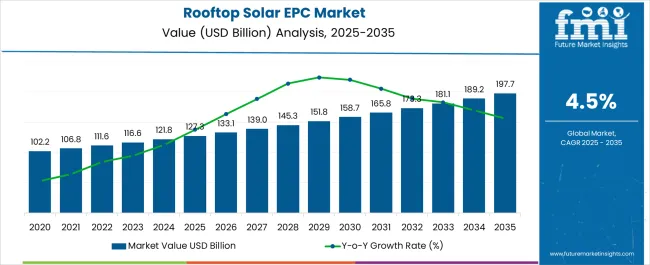
The rooftop solar epc market was valued at USD 127.30 billion in 2025, projected to reach USD 133.03 billion in 2026, and is forecast to expand to USD 206.59 billion by 2036 at a 4.5% CAGR. Based on Future Market Insights' analysis, this expansion translates to an incremental opportunity of USD 73.56 billion over the ten-year forecast window. FMI projects that demand patterns are shifting from standardized procurement cycles toward specification-driven purchasing, where buyers increasingly require product performance certifications and supply chain traceability documentation before approving orders. As per FMI, the structural transition underway is recalibrating supplier qualification criteria and contract renewal timelines across all major consuming regions.
Summary of Rooftop Solar Epc Market
- Projected market value stands at USD 206.59 billion heading into 2036.
- The market is set to advance at a 4.5% CAGR during the 2026–2036 period.
- The market stood at USD 127.30 billion in 2025.
- Over the projection window, an additional USD 73.56 billion in value is expected to materialize.
- 1 to 10 kW leads by Capacity with 38% share in 2026.
- Commercial & industrial leads by End Use with 61% share in 2026.
- The market is a renewable energy services category where declining module costs, favorable policy frameworks, and electricity cost arbitrage drive adoption across commercial, industrial, and residential building segments.
- Among key countries, China at 6.1%, India at 5.6%, Germany at 5.2%, France at 4.7%, UK at 4.3%, USA at 3.8%, Brazil at 3.4% CAGR through 2036.
Rooftop Solar Epc Market Key Takeaways
| Metric | Details |
|---|---|
| Industry Size (2026) | USD 133.03 billion |
| Industry Value (2036) | USD 206.59 billion |
| CAGR (2026-2036) | 4.5% |
Source: Future Market Insights, 2026
Declining solar module costs and favorable net metering policies are accelerating rooftop solar adoption across commercial, industrial, and residential segments. National renewable energy targets in India, China, and the European Union are supported by capital subsidy programs and accelerated depreciation benefits that improve project economics for building owners. Commercial and industrial rooftop installations account for the majority of installed capacity, driven by electricity cost arbitrage between grid tariff rates and levelized solar generation costs that deliver payback periods under five years in high-irradiance markets.
Country-level growth trajectories reflect divergent industrial maturity and regulatory timelines. China leads with a 6.1% CAGR through 2036, supported by scaled manufacturing infrastructure and government procurement programs. Other key markets include India (5.6%), Germany (5.2%), France (4.7%), UK (4.3%), USA (3.8%), Brazil (3.4%). Mature markets such as Brazil maintain steady replacement demand cycles anchored by established supply contracts and quality compliance frameworks.
Rooftop Solar Epc Market Definition
Rooftop solar EPC (engineering, procurement, and construction) encompasses the design, equipment sourcing, installation, and commissioning of photovoltaic power generation systems mounted on building rooftops. Project capacities range from sub-1 kW residential installations to 1 MW commercial and industrial systems. EPC services include structural assessment, electrical system design, module and inverter procurement, mounting system installation, grid interconnection, and performance commissioning for building owners seeking on-site renewable electricity generation.
Rooftop Solar Epc Market Inclusions
Market scope includes rooftop solar EPC services across up to 1 kW, 1 to 10 kW, 10 to 50 kW, and 50 kW to 1 MW capacity categories. End-use coverage spans commercial and industrial and residential segments. Regional market sizing and competitive landscape assessment are included.
Rooftop Solar Epc Market Exclusions
The scope excludes ground-mounted utility-scale solar EPC, standalone battery energy storage system installations, and solar thermal collector systems. Solar module and inverter manufacturing operations are omitted; only the EPC service layer is included.
Rooftop Solar Epc Market Research Methodology
- Primary Research: Analysts conducted structured interviews with procurement managers, engineers, and supply chain directors across key rooftop solar epc operations to map decision triggers and specification requirements.
- Desk Research: Data collection aggregated publicly available trade statistics, regulatory filings, industry association reports, and company annual disclosures relevant to rooftop solar epc production and consumption patterns.
- Market-Sizing and Forecasting: Baseline values derive from a bottom-up aggregation of production volume data and average selling price benchmarks, applying region-specific adoption curves to project demand through 2036.
- Data Validation and Update Cycle: Projections are cross-validated against publicly reported financial disclosures from leading market participants and verified against national trade data registries.
Why is the Rooftop Solar EPC Market growing?
Increased focus on distributed renewable energy solutions has placed rooftop solar at the forefront of clean energy adoption. This growth has been supported by favorable government policies, declining photovoltaic module prices, and improved financing options.
Urban centers are witnessing higher adoption rates due to space utilization efficiency and long-term cost savings for end users. EPC players are increasingly offering integrated solutions that combine design, procurement, installation, and maintenance, enhancing market value for residential, commercial, and industrial consumers.
Innovations in inverter technology, energy storage integration, and digital monitoring platforms are also elevating the reliability and scalability of rooftop solar systems. As demand for net-zero infrastructure intensifies across developed and developing economies, the rooftop solar EPC segment is poised to grow steadily, anchored by rising environmental awareness, supportive regulations, and increased private sector participation in renewable energy deployment.
Segmental Analysis
The rooftop solar EPC market is segmented by capacity, end use, and geographic regions. The capacity of the rooftop solar EPC market is divided into Up to 1 kW, 1 to 10 kW, 10 to 50 kW, and 50 kW to 1 MW. In terms of end use, the rooftop solar EPC market is classified into Residential and Commercial & industrial. Regionally, the rooftop solar EPC industry is classified into North America, Latin America, Western Europe, Eastern Europe, Balkan & Baltic Countries, Russia & Belarus, Central Asia, East Asia, South Asia & Pacific, and the Middle East & Africa.
Insights into the Up to 1 kW Capacity Segment
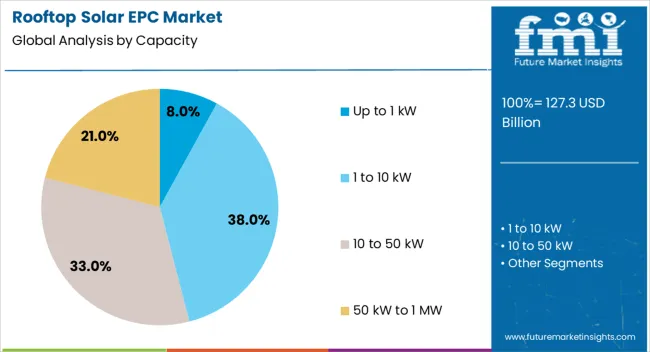
The Up to 1 kW capacity segment is expected to contribute 8% of the Rooftop Solar EPC market revenue share in 2026. This segment has seen consistent uptake due to its suitability for individual households and small-scale users, particularly in urban and semi-urban areas with limited roof space. Adoption has been supported by government incentives and subsidies aimed at promoting residential solar usage for energy self-sufficiency and grid load reduction.
The segment has benefited from simplified permitting processes and lower capital investment requirements, which make it accessible to a larger consumer base. Technological improvements in panel efficiency and compact system designs have further strengthened its appeal.
Growth in this segment has also been driven by increased awareness of environmental benefits and long-term electricity cost savings. As rooftop solar adoption continues to expand across the residential sector, systems in the Up to 1 kW range are expected to play a key role in democratizing solar access and supporting the energy transition at the household level..
Insights into the Residential End Use Segment
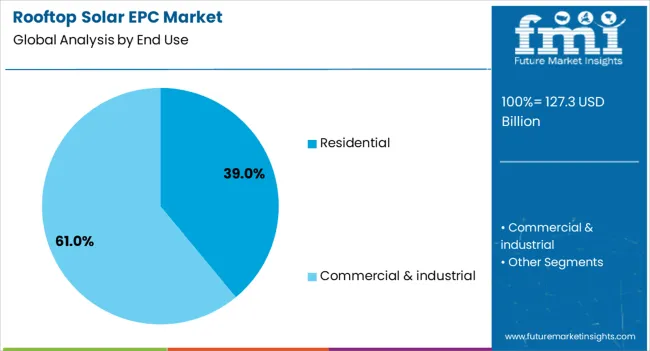
The residential segment is projected to lead the Rooftop Solar EPC market with a 39% revenue share in 2026. This dominance has been driven by increasing electricity costs, favorable net metering policies, and growing public awareness around sustainable living. Homeowners have increasingly adopted rooftop solar systems as a means to achieve energy independence while reducing monthly utility bills.
EPC contractors have responded to this demand with standardized, scalable offerings that simplify the installation process and enhance after-sales service. Residential installations have also been boosted by rising demand for energy resilience through storage-integrated systems, especially in regions facing frequent grid instability. Technological advancements in modular system design and smart energy management tools have improved system performance and usability.
Financial innovations such as solar leasing and pay-as-you-go models have further improved affordability, encouraging broader adoption. As sustainability becomes a core consideration in housing development and renovation, the residential sector is expected to maintain its leadership in rooftop solar EPC deployments..
What are the Drivers, Restrain, and Key Trends of the Rooftop Solar Epc Market?
The rooftop solar EPC market is expanding due to increased adoption of decentralized energy systems and favorable policy incentives. Growth is supported by rising installations in residential and commercial sectors, driven by reduced installation costs and energy independence goals. Opportunities are emerging in hybrid solar systems, storage integration, and industrial-scale rooftop projects. Key trends include digital project monitoring, modular mounting solutions, and performance-linked service contracts. However, restraints include high initial costs, policy uncertainties, and rooftop structural limitations. The overall outlook suggests sustained growth supported by government programs and consumer preference for low-cost energy solutions.
Government Incentives and Falling Costs Driving Growth
The primary growth driver is the implementation of supportive government policies and declining installation costs. In 2024 and 2025, net metering policies and tax incentives in regions like Asia-Pacific and North America accelerated rooftop solar deployment across residential and commercial segments. Competitive module pricing and standardized EPC packages have made rooftop systems more accessible to small businesses and households. Corporate energy buyers also initiated large-scale installations to secure cost savings and predictable energy expenses. These developments indicate that financial incentives and affordability improvements will continue to shape the market positively.
Opportunities in Hybrid Systems and Industrial Projects
Significant opportunities have been identified in hybrid solar systems and energy storage integration for rooftops. In 2025, industrial facilities and warehouses adopted large-scale rooftop solar systems combined with battery solutions to enhance power reliability. EPC providers offering turnkey solutions for such hybrid projects attracted new contracts from manufacturing sectors seeking operational cost control. Growth was also observed in developing markets where grid reliability issues boosted demand for off-grid and backup-enabled rooftop installations. These opportunities underscore the strategic advantage for EPC firms specializing in customized, storage-ready solar solutions for energy-intensive industries.
Digital Platforms and Modular Solutions Leading Trends
Emerging trends point toward the growing adoption of digital monitoring platforms and modular rooftop mounting systems. In 2024, cloud-based analytics for performance tracking became a standard feature in EPC service portfolios, enabling predictive maintenance and optimized energy output. Modular designs that allow quick installations without heavy structural changes gained traction among commercial users with time-sensitive project schedules. Additionally, EPC players began offering financing-linked service contracts to attract cost-conscious customers. These trends demonstrate an industry shift toward technology-driven operations and user-focused flexibility, strengthening EPC competitiveness in a rapidly evolving energy landscape.
Policy Uncertainty and Structural Barriers Restricting Growth
Market restraints are influenced by inconsistent regulatory frameworks, high upfront investment, and building structural challenges. In 2024 and 2025, uncertainty in net metering rules and tariff adjustments discouraged long-term investment in certain regions. Rooftop load limitations in older commercial buildings posed design challenges for EPC providers, leading to increased engineering costs. Complex permitting processes further delayed project execution, reducing profitability for installers. These constraints highlight the need for regulatory stability, simplified approval procedures, and innovative lightweight mounting systems to accelerate rooftop solar adoption across diverse infrastructure profiles.
Analysis of Rooftop Solar Epc Market By Key Countries
.webp "Top Country Growth Comparison Rooftop Solar Epc Market Cagr (2026 2036)")
| Country | CAGR |
|---|---|
| China | 6.1% |
| India | 5.6% |
| Germany | 5.2% |
| France | 4.7% |
| UK | 4.3% |
| USA | 3.8% |
| Brazil | 3.4% |
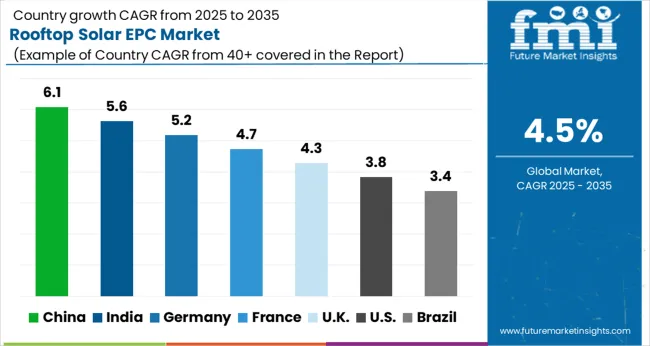
The global rooftop solar EPC market is projected to grow at 4.5% CAGR between 2026 and 2036. China leads with 6.1% CAGR, driven by aggressive renewable energy targets and government subsidies for decentralized solar installations. India follows at 5.6%, supported by rooftop solar programs and net-metering policies promoting self-consumption. Germany posts 5.2% CAGR, leveraging strong policy frameworks and residential energy storage integration. The UK records 4.3%, while the United States grows at 3.8%, reflecting moderate adoption in a mature solar market with emphasis on battery-paired rooftop solutions. Asia-Pacific dominates due to favorable economics and large-scale deployment, whereas Western markets focus on premium EPC services and smart energy systems.
Growth Analysis of Rooftop Solar EPC Market in China
China remains the global leader with an expected 6.1% CAGR, driven by extensive adoption of rooftop solar under national carbon neutrality goals. Residential and commercial building segments lead installations, aided by subsidies and low-interest financing for distributed solar projects. EPC firms focus on integrating high-efficiency modules with AI-based monitoring systems to enhance yield optimization. The rise of solar-plus-storage solutions is accelerating in urban and industrial hubs, providing energy security and reducing peak load dependency. Partnerships between EPC firms and real estate developers further expand penetration in new constructions.
- Government subsidies and financing options strengthen rooftop adoption.
- AI-powered monitoring enhances performance of residential installations.
- Integration of solar-plus-storage systems drives EPC service demand.
Demand Forecast for Rooftop Solar EPC Market in India
The market in India is projected to grow at 5.6% CAGR, supported by rooftop solar mandates for commercial buildings and net-metering regulations. State-level programs and renewable purchase obligations encourage adoption across industries and educational institutions. EPC contractors focus on cost-effective design and modular installation solutions for small and mid-sized projects. The residential segment gains momentum due to decreasing panel costs and government-backed financing schemes. Integration of hybrid solar systems combining storage and grid connectivity offers growth potential for EPC players targeting reliability-focused users.
- Net-metering policies and state incentives accelerate rooftop solar deployment.
- Cost reductions in PV modules strengthen adoption in residential segments.
- Hybrid rooftop systems combining storage and grid connectivity gain traction.
Analysis of Rooftop Solar EPC Market in Germany
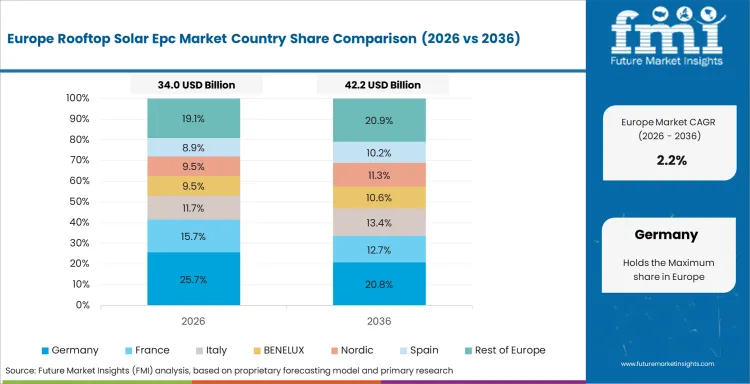
Germany records a 5.2% CAGR, supported by strong regulatory frameworks under the Renewable Energy Sources Act and incentives for rooftop PV integration. Growing adoption of solar-plus-storage solutions in residential and commercial properties drives demand for specialized EPC services. EPC providers increasingly leverage digital design tools and remote performance monitoring for system optimization. The country’s focus on energy independence and carbon neutrality accelerates investment in decentralized energy solutions. Expansion of community solar and shared rooftop projects opens new revenue streams for EPC firms.
- Energy storage integration boosts EPC demand in residential solar projects.
- Digital design and remote monitoring enhance system efficiency.
- Community solar initiatives create opportunities for EPC partnerships.
Demand Forecast for Rooftop Solar EPC Market in the United Kingdom
The United Kingdom is forecasted to grow at 4.3% CAGR, supported by government programs promoting solar adoption and carbon-neutral building standards. EPC players target commercial real estate and public infrastructure projects requiring sustainable energy solutions. Growth in residential installations is driven by rising electricity costs and demand for smart home energy management systems. Premium EPC services featuring advanced monitoring platforms and predictive maintenance are gaining traction among large-scale commercial clients. Integration of rooftop solar with EV charging stations presents additional opportunities.
- Commercial and public infrastructure projects lead EPC market expansion.
- Smart home energy systems drive adoption in residential rooftop installations.
- EPC offerings integrated with EV charging solutions strengthen future demand.
Rooftop Solar EPC Market Growth Outlook in the United States
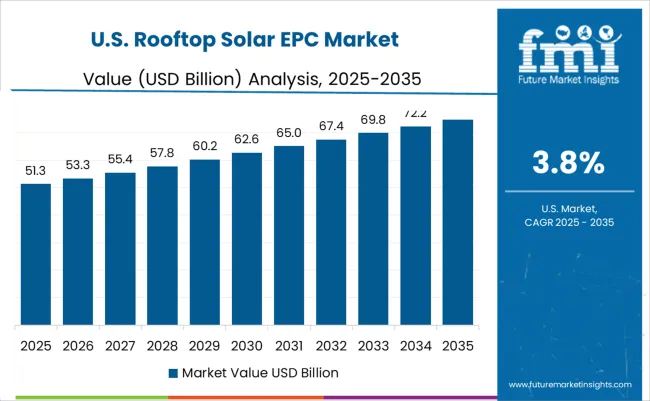
The United States market is expected to grow at 3.8% CAGR, reflecting moderate but steady demand. Growth is driven by solar tax credits, net-metering programs, and corporate sustainability commitments. EPC players emphasize turnkey solutions for commercial clients, integrating rooftop PV with energy storage and demand response systems. Residential adoption faces regional disparities due to policy variations but remains strong in states like California and New York. Technological innovations in module efficiency and IoT-based monitoring tools enhance the value proposition of EPC services in a competitive market.
- Federal tax incentives support continued rooftop solar installations.
- Integration of PV systems with storage and demand response boosts EPC value.
- IoT-enabled monitoring and predictive maintenance improve operational reliability.
Competitive Landscape of Rooftop Solar Epc Market
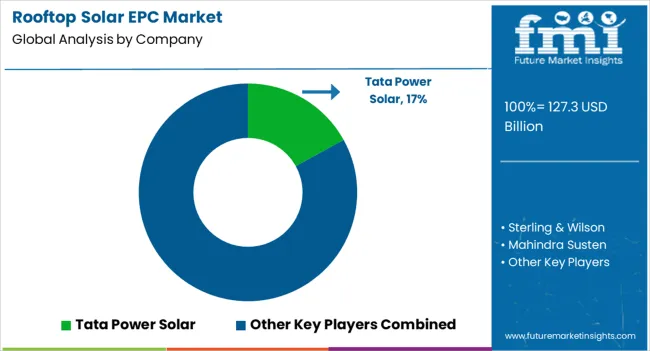
The rooftop solar EPC market in India is moderately consolidated, with Tata Power Solar recognized as a leading player due to its strong track record in residential, commercial, and industrial rooftop installations. The company’s expertise in engineering, procurement, and construction (EPC) services, combined with advanced solar solutions and strong after-sales support, reinforces its leadership in the sector. Key players include Sterling & Wilson, Mahindra Susten, Jakson Group, Vikram Solar, and Waaree Energies. These companies specialize in designing and implementing turnkey rooftop solar projects, offering services that encompass site assessment, customized system design, procurement of high-quality modules and inverters, installation, and maintenance.
Their focus is on optimizing energy output, reducing lifecycle costs, and ensuring regulatory compliance. Market growth is driven by increasing adoption of renewable energy, government incentives for distributed solar generation, and rising awareness among commercial and industrial consumers about reducing energy costs.
Leading EPC companies are investing in digital monitoring platforms, energy storage integration, and modular system designs for enhanced efficiency and scalability. Emerging trends include hybrid rooftop systems combining solar with battery storage, performance-based service models, and adoption of smart inverters for grid stability. India’s rooftop solar segment continues to expand rapidly, driven by supportive policies such as net metering and capital subsidies for residential consumers.
Key Developments in Rooftop Solar Epc Market
- In January 2025, Enstall finalized its acquisition of Schletter, a major German rooftop mounting systems manufacturer. The deal, announced in August 2024, significantly expands Enstall’s presence in Germany and Central Europe, strengthening its EPC supply chain and accelerating deployment capacity for rooftop solar installations across the region.
- In June 2025, Indian fintech firm Fibe introduced a rooftop solar financing platform serving middle-income households. They partnered with over 100 EPC companies to provide collateral-free loans up to ₹5 lakh covering full project costs, boosting residential solar access in Tier II/III cities across India.
Scope of the Report
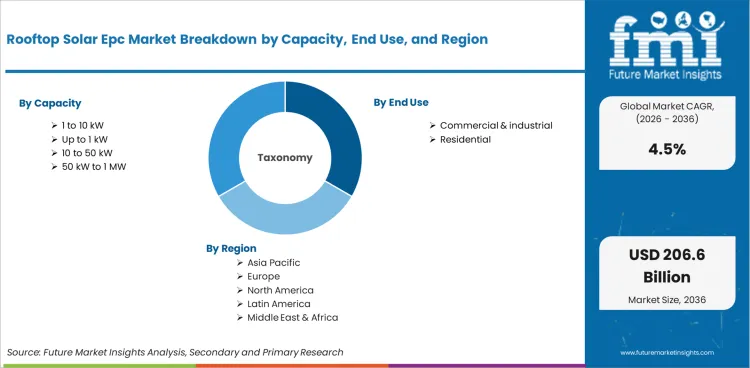
| Metric | Value |
|---|---|
| Quantitative Units | USD 133.03 billion to USD 206.59 billion, at a CAGR of 4.5% |
| Market Definition | Rooftop solar EPC (engineering, procurement, and construction) encompasses the design, equipment sourcing, installation, and commissioning of photovoltaic power generation systems mounted on building rooftops. Project capacities range from sub-1 kW residential installations to 1 MW commercial and industrial systems. EPC services include structural assessment, electrical system design, module and inverter procurement, mounting system installation, grid interconnection, and performance commissioning for building owners seeking on-site renewable electricity generation. |
| Capacity, End Use Segmentation | Capacity: 1 to 10 kW, Up to 1 kW, 10 to 50 kW, 50 kW to 1 MW; End Use: Commercial & industrial, Residential |
| Regions Covered | North America, Latin America, Europe, East Asia, South Asia, Oceania, Middle East & Africa |
| Countries Covered | China, India, Germany, France, UK, USA, Brazil, and 40 plus countries |
| Key Companies Profiled | Tata Power Solar, Sterling & Wilson, Mahindra Susten, Jakson Group, Vikram Solar, Waaree Energies |
| Forecast Period | 2026 to 2036 |
| Approach | Forecasting models apply a bottom-up methodology starting with production volume benchmarks and average selling price data, cross-validated against public financial disclosures and trade statistics. |
Rooftop Solar Epc Market by Segments
Capacity:
- Up to 1 kW
- 1 to 10 kW
- 10 to 50 kW
- 50 kW to 1 MW
End Use:
- Residential
- Commercial & industrial
Region:
- North America
- USA
- Canada
- Mexico
- Latin America
- Brazil
- Chile
- Rest of Latin America
- Western Europe
- Germany
- UK
- Italy
- Spain
- France
- Nordic
- BENELUX
- Rest of Western Europe
- Eastern Europe
- Russia
- Poland
- Hungary
- Balkan & Baltic
- Rest of Eastern Europe
- East Asia
- China
- Japan
- South Korea
- South Asia and Pacific
- India
- ASEAN
- Australia & New Zealand
- Rest of South Asia and Pacific
- Middle East & Africa
- Kingdom of Saudi Arabia
- Other GCC Countries
- Turkiye
- South Africa
- Other African Union
- Rest of Middle East & Africa
Bibliography
- International Energy Agency. (2024). World energy outlook: Solar PV deployment. IEA.
- International Renewable Energy Agency. (2024). Renewable capacity statistics. IRENA.
- Ministry of New and Renewable Energy, Government of India. (2024). Annual report: Solar rooftop programme. MNRE.
- European Commission, Directorate-General for Energy. (2024). EU solar energy strategy implementation. European Commission.
- World Bank Group. (2024). Solar resource mapping and financing. World Bank.
This bibliography is provided for reader reference. The full Future Market Insights report contains the complete reference list with primary research documentation.
Frequently Asked Questions
How large is the demand for Rooftop Solar Epc in the global market in 2026?
Demand for rooftop solar epc in the global market is estimated to be valued at USD 133.03 billion in 2026.
What will be the market size of Rooftop Solar Epc in the global market by 2036?
Market size for rooftop solar epc is projected to reach USD 206.59 billion by 2036.
What is the expected demand growth for Rooftop Solar Epc in the global market between 2026 and 2036?
Demand for rooftop solar epc is expected to grow at a CAGR of 4.5% between 2026 and 2036.
Which Capacity is poised to lead global sales by 2026?
1 to 10 kW accounts for 38% share in 2026, as it remains the primary specification across established procurement channels.
How is the End Use segment structured in 2026?
Commercial & industrial leads with 61% of segment share in 2026, driven by established buyer preference and supply chain compatibility.
What is China's growth outlook in this report?
China is projected to grow at a CAGR of 6.1% during 2026 to 2036.
What is Rooftop Solar Epc and what is it mainly used for?
Rooftop solar EPC (engineering, procurement, and construction) encompasses the design, equipment sourcing, installation, and commissioning of photovoltaic power generation systems mounted on building rooftops. Project capacities range from sub-1 kW residential installations to 1 MW commercial and industrial systems.
What is included in the scope of this Rooftop Solar Epc report?
Market scope includes rooftop solar EPC services across up to 1 kW, 1 to 10 kW, 10 to 50 kW, and 50 kW to 1 MW capacity categories. End-use coverage spans commercial and industrial and residential segments.
Preview the report firsthand - request a free sample
Get SampleGet the brochure for pricing and purchase details.
Get PDFTable of Content
- Executive Summary
- Global Market Outlook
- Demand-side Trends
- Supply-side Trends
- Technology Roadmap Analysis
- Analysis and Recommendations
- Market Overview
- Market Coverage / Taxonomy
- Market Definition / Scope / Limitations
- Research Methodology
- Chapter Orientation
- Analytical Lens and Working Hypotheses
- Market Structure, Signals, and Trend Drivers
- Benchmarking and Cross-market Comparability
- Market Sizing, Forecasting, and Opportunity Mapping
- Research Design and Evidence Framework
- Desk Research Programme (Secondary Evidence)
- Company Annual and Sustainability Reports
- Peer-reviewed Journals and Academic Literature
- Corporate Websites, Product Literature, and Technical Notes
- Earnings Decks and Investor Briefings
- Statutory Filings and Regulatory Disclosures
- Technical White Papers and Standards Notes
- Trade Journals, Industry Magazines, and Analyst Briefs
- Conference Proceedings, Webinars, and Seminar Materials
- Government Statistics Portals and Public Data Releases
- Press Releases and Reputable Media Coverage
- Specialist Newsletters and Curated Briefings
- Sector Databases and Reference Repositories
- FMI Internal Proprietary Databases and Historical Market Datasets
- Subscription Datasets and Paid Sources
- Social Channels, Communities, and Digital Listening Inputs
- Additional Desk Sources
- Expert Input and Fieldwork (Primary Evidence)
- Primary Modes
- Qualitative Interviews and Expert Elicitation
- Quantitative Surveys and Structured Data Capture
- Blended Approach
- Why Primary Evidence is Used
- Field Techniques
- Interviews
- Surveys
- Focus Groups
- Opportunity
- Trends
- Scenario Forecast
- Demand in Optimistic Scenario
- Demand in Likely Scenario
- Demand in Conservative Scenario
- Opportunity Map Analysis
- Product Life Cycle Analysis
- Supply Chain Analysis
- Investment Feasibility Matrix
- Value Chain Analysis
- PESTLE and Porter’s Analysis
- Regulatory Landscape
- Regional Parent Market Outlook
- Production and Consumption Statistics
- Import and Export Statistics
- Primary Modes
- Global Market Analysis 2021 to 2025 and Forecast, 2026 to 2036
- Historical Market Size Value (USD Million) Analysis, 2021 to 2025
- Current and Future Market Size Value (USD Million) Projections, 2026 to 2036
- Y-o-Y Growth Trend Analysis
- Absolute $ Opportunity Analysis
- Global Market Pricing Analysis 2021 to 2025 and Forecast 2026 to 2036
- Global Market Analysis 2021 to 2025 and Forecast 2026 to 2036, By Capacity
- Introduction / Key Findings
- Historical Market Size Value (USD Million) Analysis By Capacity , 2021 to 2025
- Current and Future Market Size Value (USD Million) Analysis and Forecast By Capacity , 2026 to 2036
- 1 to 10 kW
- Up to 1 kW
- 10 to 50 kW
- 50 kW to 1 MW
- 1 to 10 kW
- Y-o-Y Growth Trend Analysis By Capacity , 2021 to 2025
- Absolute $ Opportunity Analysis By Capacity , 2026 to 2036
- Global Market Analysis 2021 to 2025 and Forecast 2026 to 2036, By End Use
- Introduction / Key Findings
- Historical Market Size Value (USD Million) Analysis By End Use, 2021 to 2025
- Current and Future Market Size Value (USD Million) Analysis and Forecast By End Use, 2026 to 2036
- Commercial & industrial
- Residential
- Commercial & industrial
- Y-o-Y Growth Trend Analysis By End Use, 2021 to 2025
- Absolute $ Opportunity Analysis By End Use, 2026 to 2036
- Global Market Analysis 2021 to 2025 and Forecast 2026 to 2036, By Region
- Introduction
- Historical Market Size Value (USD Million) Analysis By Region, 2021 to 2025
- Current Market Size Value (USD Million) Analysis and Forecast By Region, 2026 to 2036
- North America
- Latin America
- Western Europe
- Eastern Europe
- East Asia
- South Asia and Pacific
- Middle East & Africa
- Market Attractiveness Analysis By Region
- North America Market Analysis 2021 to 2025 and Forecast 2026 to 2036, By Country
- Historical Market Size Value (USD Million) Trend Analysis By Market Taxonomy, 2021 to 2025
- Market Size Value (USD Million) Forecast By Market Taxonomy, 2026 to 2036
- By Country
- USA
- Canada
- Mexico
- By Capacity
- By End Use
- By Country
- Market Attractiveness Analysis
- By Country
- By Capacity
- By End Use
- Key Takeaways
- Latin America Market Analysis 2021 to 2025 and Forecast 2026 to 2036, By Country
- Historical Market Size Value (USD Million) Trend Analysis By Market Taxonomy, 2021 to 2025
- Market Size Value (USD Million) Forecast By Market Taxonomy, 2026 to 2036
- By Country
- Brazil
- Chile
- Rest of Latin America
- By Capacity
- By End Use
- By Country
- Market Attractiveness Analysis
- By Country
- By Capacity
- By End Use
- Key Takeaways
- Western Europe Market Analysis 2021 to 2025 and Forecast 2026 to 2036, By Country
- Historical Market Size Value (USD Million) Trend Analysis By Market Taxonomy, 2021 to 2025
- Market Size Value (USD Million) Forecast By Market Taxonomy, 2026 to 2036
- By Country
- Germany
- UK
- Italy
- Spain
- France
- Nordic
- BENELUX
- Rest of Western Europe
- By Capacity
- By End Use
- By Country
- Market Attractiveness Analysis
- By Country
- By Capacity
- By End Use
- Key Takeaways
- Eastern Europe Market Analysis 2021 to 2025 and Forecast 2026 to 2036, By Country
- Historical Market Size Value (USD Million) Trend Analysis By Market Taxonomy, 2021 to 2025
- Market Size Value (USD Million) Forecast By Market Taxonomy, 2026 to 2036
- By Country
- Russia
- Poland
- Hungary
- Balkan & Baltic
- Rest of Eastern Europe
- By Capacity
- By End Use
- By Country
- Market Attractiveness Analysis
- By Country
- By Capacity
- By End Use
- Key Takeaways
- East Asia Market Analysis 2021 to 2025 and Forecast 2026 to 2036, By Country
- Historical Market Size Value (USD Million) Trend Analysis By Market Taxonomy, 2021 to 2025
- Market Size Value (USD Million) Forecast By Market Taxonomy, 2026 to 2036
- By Country
- China
- Japan
- South Korea
- By Capacity
- By End Use
- By Country
- Market Attractiveness Analysis
- By Country
- By Capacity
- By End Use
- Key Takeaways
- South Asia and Pacific Market Analysis 2021 to 2025 and Forecast 2026 to 2036, By Country
- Historical Market Size Value (USD Million) Trend Analysis By Market Taxonomy, 2021 to 2025
- Market Size Value (USD Million) Forecast By Market Taxonomy, 2026 to 2036
- By Country
- India
- ASEAN
- Australia & New Zealand
- Rest of South Asia and Pacific
- By Capacity
- By End Use
- By Country
- Market Attractiveness Analysis
- By Country
- By Capacity
- By End Use
- Key Takeaways
- Middle East & Africa Market Analysis 2021 to 2025 and Forecast 2026 to 2036, By Country
- Historical Market Size Value (USD Million) Trend Analysis By Market Taxonomy, 2021 to 2025
- Market Size Value (USD Million) Forecast By Market Taxonomy, 2026 to 2036
- By Country
- Kingdom of Saudi Arabia
- Other GCC Countries
- Turkiye
- South Africa
- Other African Union
- Rest of Middle East & Africa
- By Capacity
- By End Use
- By Country
- Market Attractiveness Analysis
- By Country
- By Capacity
- By End Use
- Key Takeaways
- Key Countries Market Analysis
- USA
- Pricing Analysis
- Market Share Analysis, 2025
- By Capacity
- By End Use
- Canada
- Pricing Analysis
- Market Share Analysis, 2025
- By Capacity
- By End Use
- Mexico
- Pricing Analysis
- Market Share Analysis, 2025
- By Capacity
- By End Use
- Brazil
- Pricing Analysis
- Market Share Analysis, 2025
- By Capacity
- By End Use
- Chile
- Pricing Analysis
- Market Share Analysis, 2025
- By Capacity
- By End Use
- Germany
- Pricing Analysis
- Market Share Analysis, 2025
- By Capacity
- By End Use
- UK
- Pricing Analysis
- Market Share Analysis, 2025
- By Capacity
- By End Use
- Italy
- Pricing Analysis
- Market Share Analysis, 2025
- By Capacity
- By End Use
- Spain
- Pricing Analysis
- Market Share Analysis, 2025
- By Capacity
- By End Use
- France
- Pricing Analysis
- Market Share Analysis, 2025
- By Capacity
- By End Use
- India
- Pricing Analysis
- Market Share Analysis, 2025
- By Capacity
- By End Use
- ASEAN
- Pricing Analysis
- Market Share Analysis, 2025
- By Capacity
- By End Use
- Australia & New Zealand
- Pricing Analysis
- Market Share Analysis, 2025
- By Capacity
- By End Use
- China
- Pricing Analysis
- Market Share Analysis, 2025
- By Capacity
- By End Use
- Japan
- Pricing Analysis
- Market Share Analysis, 2025
- By Capacity
- By End Use
- South Korea
- Pricing Analysis
- Market Share Analysis, 2025
- By Capacity
- By End Use
- Russia
- Pricing Analysis
- Market Share Analysis, 2025
- By Capacity
- By End Use
- Poland
- Pricing Analysis
- Market Share Analysis, 2025
- By Capacity
- By End Use
- Hungary
- Pricing Analysis
- Market Share Analysis, 2025
- By Capacity
- By End Use
- Kingdom of Saudi Arabia
- Pricing Analysis
- Market Share Analysis, 2025
- By Capacity
- By End Use
- Turkiye
- Pricing Analysis
- Market Share Analysis, 2025
- By Capacity
- By End Use
- South Africa
- Pricing Analysis
- Market Share Analysis, 2025
- By Capacity
- By End Use
- USA
- Market Structure Analysis
- Competition Dashboard
- Competition Benchmarking
- Market Share Analysis of Top Players
- By Regional
- By Capacity
- By End Use
- Competition Analysis
- Competition Deep Dive
- Tata Power Solar
- Overview
- Product Portfolio
- Profitability by Market Segments (Product/Age /Sales Channel/Region)
- Sales Footprint
- Strategy Overview
- Marketing Strategy
- Product Strategy
- Channel Strategy
- Sterling & Wilson
- Mahindra Susten
- Jakson Group
- Vikram Solar
- Waaree Energies
- Tata Power Solar
- Competition Deep Dive
- Desk Research Programme (Secondary Evidence)
- Assumptions & Acronyms Used


