

- Market Size (2026)
- USD 2850.6 Mn
- Forecast (2036)
- USD 6504.8 Mn
- CAGR (2026 to 2036)
- 8.6%
Syngas Cleanup Market Size, Market Forecast and Outlook By FMI
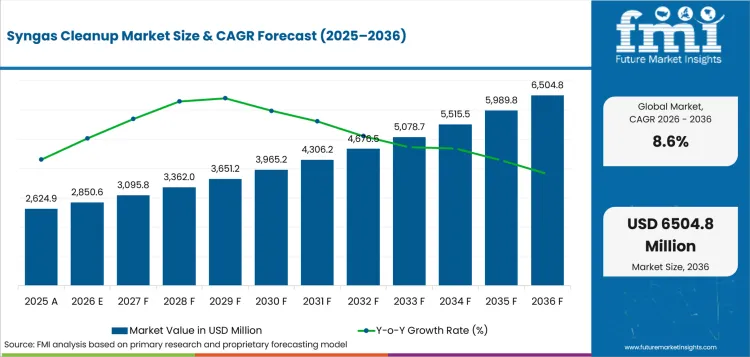
USD 2,850.6 million in 2026 and USD 6,504.8 million by 2036 at an 8.6% CAGR.
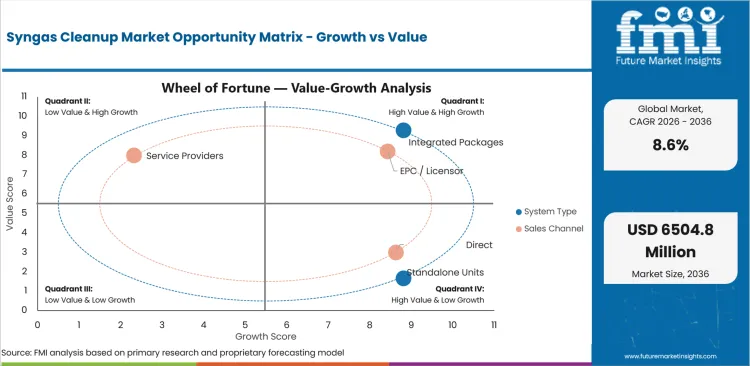
The syngas cleanup industry value is forecast to rise from USD 2,624.9 million in 2025 to USD 6,504.8 million by 2036 at 8.6% CAGR as hydrogen, ammonia, methanol, and Fischer-Tropsch projects require cleaner process gas before conversion. Integrated Packages are forecast to represent 61.0% share in 2026 because project owners prefer one warranty path across cooling, scrubbing, absorption, sulfur control, and polishing. EPC / Licensor sales are expected to secure 54.0% share in 2026, led by early technology selection during front-end engineering and process guarantee negotiations.
Syngas Cleanup Market Overview: Size and Forecast
- 2025 Market Size: USD 2,624.9 million
- 2026 Market Size: USD 2,850.6 million
- 2036 Market Size: USD 6,504.8 million
- Forecast CAGR: 8.6% from 2026 to 2036
- Leading System Type: Integrated Packages
- Integrated Packages Share in 2026: 61.0%
- Leading Sales Channel: EPC / Licensor
- EPC / Licensor Share in 2026: 54.0%
- Fastest-growing Country: China
- China CAGR: 9.6% by 2036
Summary of the Syngas Cleanup Market
- Demand and Growth Drivers
- Hydrogen and ammonia projects are raising demand for cleanup systems that protect downstream catalysts and carbon capture units.
- Biomass, coal, and waste gasification routes are increasing the need for tar, ash, sulfur, chloride, and trace metal control.
- EPC firms are specifying cleanup systems earlier as process warranties become tied to synthesis gas quality.
- Product and Segment View
- Integrated Packages are forecast to represent 61.0% share in 2026, supported by buyer preference for bundled process guarantees.
- EPC / Licensor sales are projected to hold 54.0% share in 2026, influenced by front-end engineering decisions.
- Natural Gas Reforming is expected to secure 46.0% share in 2026, led by blue hydrogen and ammonia projects.
- Geography and Competitive Outlook
- China is projected to record 9.6% CAGR by 2036, backed by coal-to-chemicals and green methanol project activity.
- India is expected to expand at 9.1% CAGR by 2036 through coal gasification incentives and import-substitution projects.
- Linde, BASF, Honeywell UOP, Shell Catalysts & Technologies, Topsoe, Air Liquide, and Technip Energies compete through syngas treatment and process integration capabilities.
- Competitive advantage is tied to contaminant warranty depth, pilot references, solvent performance, and integration with hydrogen, ammonia, and methanol synthesis loops.
- Analyst Opinion
- Nikhil Kaitwade, Associate Vice President at FMI, says, "Syngas cleanup is becoming a project-risk decision rather than a simple equipment purchase. Buyers want proof that the full cleanup train can protect catalyst beds, stabilize carbon capture performance, and limit unplanned shutdowns. Mixed feedstocks are making raw gas more difficult to treat, while low-carbon hydrogen buyers need stronger proof of carbon and impurity control. Suppliers with process simulation depth, pilot references, and licensor-level integration should gain the strongest position."
Market outlook is being shaped by clean hydrogen scale, alternative feedstock gasification, and carbon capture integration. The International Energy Agency reported that global hydrogen demand increased to almost 100 million tonnes in 2024, while low-emissions hydrogen still accounted for less than 1.0% of global production. The U.S. Department of Energy's September 2024 funding notice offered USD 15.0 million for projects converting coal, biomass, petcoke, household waste, industrial waste, and waste plastics into syngas for clean hydrogen. The UK Public Accounts Committee reported in February 2025 that government support for early CCUS projects had increased to GBP 21.7 billion over 25 years, creating another demand signal for capture-ready syngas cleanup systems.
Which factors support expansion in the syngas cleanup market?
Clean process gas, catalyst protection, and integrated project warranties support market value across hydrogen, ammonia, methanol, and fuel synthesis applications.
- Market value is supported by finished cleanup package revenue before service, catalyst, and solvent replacement revenue add incremental sales.
- Supplier pricing reflects contaminant load, gas flow, pressure, and required purity before downstream synthesis economics affect final equipment choice.
- Revenue improves as project owners shift from standalone impurity removal toward bundled cleanup systems with process guarantees.
- Buyer confidence rises when cleanup suppliers can document sulfur control, tar removal, acid gas capture, and trace contaminant polishing performance.
Why is the syngas cleanup market growing?
Mixed feedstock gasification and low-carbon hydrogen projects are raising the need for cleaner synthesis gas.
Syngas cleanup demand is increasing because project owners need higher-purity synthesis gas before hydrogen purification, ammonia synthesis, methanol production, or Fischer-Tropsch conversion. The International Energy Agency reported in 2025 that more than 200 low-emissions hydrogen production projects had reached final investment decision since 2020, while only a handful of demonstration projects were operating at the start of that period. This expands the number of projects that require gas conditioning, contaminant monitoring, and carbon capture integration. IEA Bioenergy stated in April 2025 that raw producer gas contains tar, sulfur compounds, ammonia, particulates, and heavy metals that can damage catalysts and reduce conversion efficiency. Cleanup systems therefore move from auxiliary equipment into the main process guarantee for hydrogen, methanol, and biofuel projects.
How is the syngas cleanup market segmented?
The syngas cleanup industry is segmented by system type, sales channel, feedstock route, cleanup technology, and end use.
- Integrated Packages are projected to account for 61.0% share in 2026, led by buyer preference for single-source warranty coverage across scrubbers, absorbers, filters, and polishing beds.
- EPC / Licensor sales are expected to hold 54.0% share in 2026, supported by early process selection and engineering integration.
- Natural Gas Reforming is anticipated to represent 46.0% share in 2026, shaped by blue hydrogen and low-carbon ammonia projects.
- Acid Gas Removal is forecast to secure 38.5% share in 2026, guided by CO2 and H2S removal needs before synthesis or capture.
- Hydrogen is projected to account for 38.0% share in 2026, reflected by purification requirements and carbon intensity targets.
Why do integrated packages dominate the syngas cleanup market?
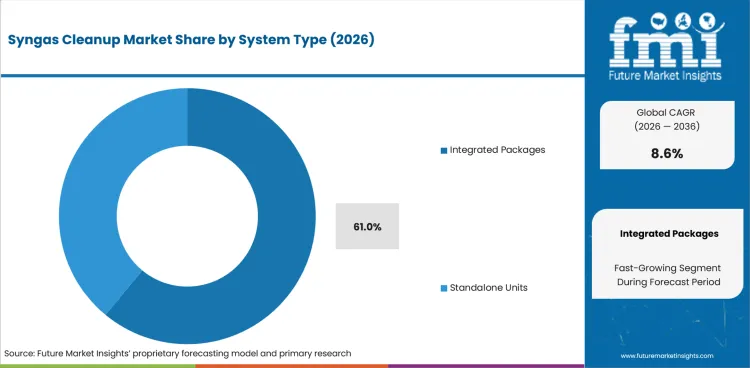
- Integrated Packages are projected to account for 61.0% share in 2026, influenced by project owners seeking one process guarantee across cooling, scrubbing, absorption, sulfur control, and final polishing.
- Standalone units gain use in retrofit projects where a plant already has core gas treating assets but needs targeted tar, particulate, or trace contaminant removal.
Which sales channel leads the syngas cleanup market?
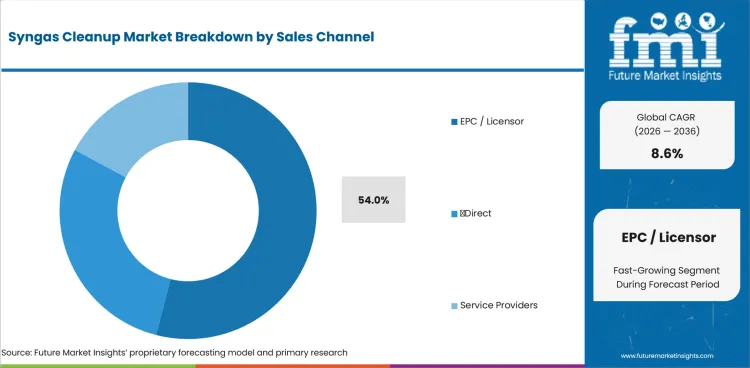
- EPC / Licensor sales are expected to represent 54.0% share in 2026, shaped by the fact that cleanup choices are locked during front-end engineering and process licensing decisions.
- Direct sales remain important for plant upgrades where operators buy replacement solvents, adsorbents, filters, and sulfur control systems outside large EPC packages.
Which feedstock route leads the syngas cleanup market?
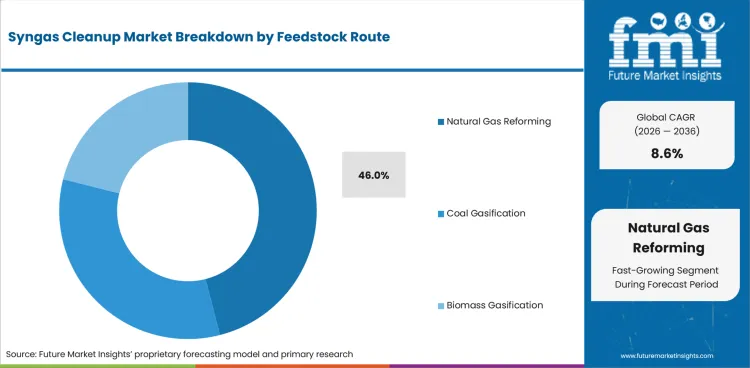
- Natural Gas Reforming is forecast to secure 46.0% share in 2026, supported by blue hydrogen and ammonia projects that use reformer-based syngas trains with carbon capture.
- Biomass and waste gasification routes gain attention as feedstock variability increases the need for stronger tar, chlorine, sulfur, and alkali-metal control.
Which cleanup technology leads the syngas cleanup market?
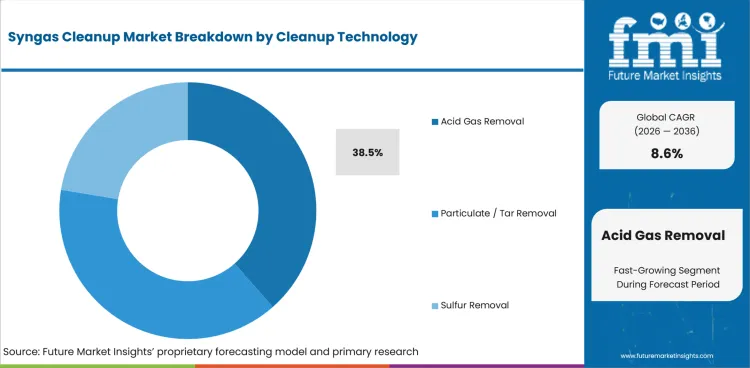
- Acid Gas Removal is projected to hold 38.5% share in 2026, led by CO2 and H2S removal requirements across hydrogen, ammonia, and methanol synthesis routes.
- Particulate and tar removal gains value in biomass and waste gasification because raw gas can carry heavier organic compounds and ash before polishing.
Which end use leads the syngas cleanup market?
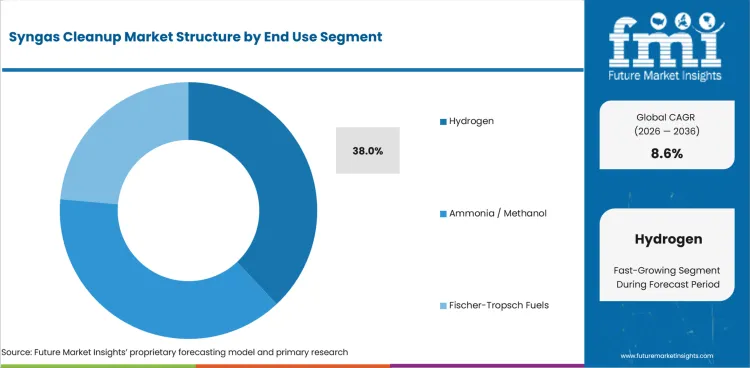
- Hydrogen is expected to account for 38.0% share in 2026, driven by the need to stabilize feed gas before pressure swing adsorption, membrane separation, or carbon capture.
- Ammonia and methanol applications remain strong because sulfur, chloride, and trace metal slip can shorten catalyst life and reduce synthesis loop reliability.
What are the driver, restraints, and opportunities in the syngas cleanup market?
Mixed feedstock use and clean hydrogen projects support demand, while cost, waste handling, and process complexity limit faster adoption.
- Mixed feedstock gasification increases demand for cleanup trains that manage tar, sulfur, particulates, and trace contaminants before syngas enters downstream equipment.
- Cleanup systems raise capital cost, pressure drop, wastewater handling, solvent duty, and maintenance needs, so project developers scrutinize total operating impact.
- Modular cleanup packages can support smaller biomass, waste, and distributed hydrogen projects by lowering engineering complexity and shortening installation planning.
Mixed Feedstock Cleanup Load
Mixed feedstocks change cleanup design because gas composition varies before operators can stabilize the synthesis loop. The USA Department of Energy stated that its alternative feedstock gasification notice expected up to 5 awards and required at least 20.0% awardee cost share. This shows that public funding is moving toward integrated gasification systems rather than isolated impurity removal. Feedstock preparation, gasification, syngas cleanup, tar mitigation, and ash handling must work as one train. Suppliers with pilot testing and feedstock-flexible designs can win projects that standard gas treating packages cannot cover.
Project Pipeline and Cost Restraint
Project uncertainty remains a restraint because cleanup equipment is ordered only when hydrogen, ammonia, or methanol projects move beyond early engineering. The International Energy Agency reported in 2025 that potential low-emissions hydrogen production from announced projects by 2030 had fallen to 37.0 million tonnes per year, down from 49.0 million tonnes per year in the prior review. This gap reflects cancellations, delays, and uncertain demand creation. Cleanup suppliers therefore face slower conversion from proposals into purchase orders, especially for first-of-a-kind gasification and CCUS-linked plants.
Modular Cleanup Opportunity
Modular cleanup creates an opportunity for biomass and waste gasification projects that cannot justify world-scale custom engineering. The Methanol Institute's renewable methanol database tracked 263 renewable methanol projects globally as of March 2026, with total announced anticipated capacity of 48.5 million tonnes by 2031. Smaller developers in this pipeline need cleanup systems that simplify tar removal, sulfur polishing, and catalyst protection without requiring a fully bespoke gas treatment island. Suppliers that standardize compact scrubbers, filters, absorbers, and adsorbent beds can convert early-stage project interest into repeatable equipment sales.
Which countries are growing fastest in the syngas cleanup market?
China 9.6% CAGR, India 9.1% CAGR, South Korea 8.4% CAGR, United States 8.2% CAGR, Germany 8.1% CAGR, United Kingdom 7.8% CAGR, France 7.6% CAGR, and Japan 7.4% CAGR through 2036.
.webp "Top Country Growth Comparison Syngas Cleanup Market Cagr (2026 2036)")
| Country | CAGR |
|---|---|
| China | 9.6% |
| India | 9.1% |
| South Korea | 8.4% |
| United States | 8.2% |
| Germany | 8.1% |
| United Kingdom | 7.8% |
| France | 7.6% |
| Japan | 7.4% |
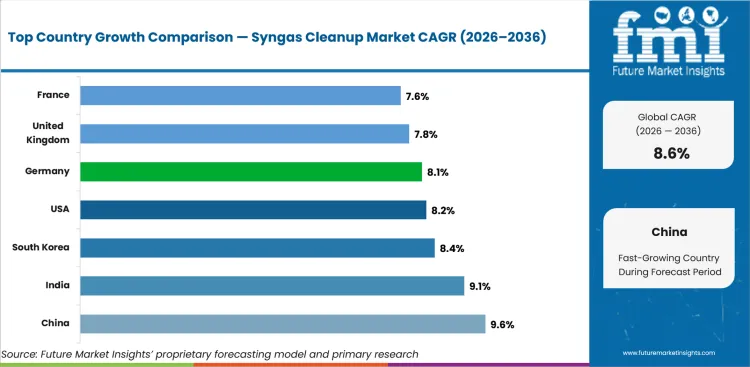
Source: Future Market Insights, 2026.
How do country-level CAGRs compare in the syngas cleanup market?
China leads country expansion while Japan records the most cautious outlook among profiled markets.
- China is forecast to record 9.6% CAGR by 2036 as coal chemicals and green methanol projects create high cleanup intensity.
- India is expected to expand at 9.1% CAGR from 2026 to 2036 through coal gasification incentives and syngas-based chemical projects.
- South Korea is projected to grow at 8.4% CAGR through 2036 as hydrogen power bidding and ammonia fuel demand shape purification needs.
- United States is estimated to rise at 8.2% CAGR by 2036 with DOE-backed gasification and low-carbon ammonia projects supporting sales.
- Germany is expected to advance at 8.1% CAGR over the forecast period as hydrogen derivative imports and chemical clusters guide demand.
- United Kingdom is forecast to grow at 7.8% CAGR through 2036 as CCUS clusters and blue hydrogen projects pull cleanup systems into FEED.
- France is projected to post 7.6% CAGR by 2036 as refinery, chemical, and low-carbon hydrogen projects remain selective but active.
- Japan is expected to grow at 7.4% CAGR by 2036 as ammonia cracking and hydrogen carrier processing become important cleanup routes.
What is the syngas cleanup market outlook in China?
A 9.6% CAGR through 2036 reflects coal-to-chemicals scale and green methanol project activity across gasification-linked industrial clusters.
Country Market Snapshot Table
| Parameter | Value |
|---|---|
| Market Size in 2025 (Value) | USD 711.7 million |
| Market Size in 2026 (Value) | USD 780.0 million |
| Market Forecast in 2036 (Value) | USD 1,950.7 million |
| CAGR (2026 to 2036) | 9.6% |
| Years Considered | 2021 to 2036 |
| Base Year | 2025 |
| Forecast Period | 2026 to 2036 |
| Units Considered | Value (USD million) |
| Leading Sub-Region | Inner Mongolia and Northeast industrial corridors |
China Syngas Cleanup Market Outlook
China syngas cleanup demand is shaped by coal-to-chemicals, methanol synthesis, and emerging green methanol projects. Buyers need cleanup systems that can handle ash, sulfur, tar, and acid gas across large gasification trains.
Local EPC execution remains important because project owners focus on scale, uptime, and lifecycle cost. Suppliers with gasification cleanup references and local service partners should gain stronger access to coal chemical and methanol projects.
Key Growth Drivers
- Coal-to-methanol routes support high cleanup intensity. Zhengzhou Commodity Exchange stated in March 2024 that coal-made methanol represented 75.0% of China's methanol production capacity in 2023.
- Green methanol projects create new gas conditioning demand. IEA Bioenergy Task 33 reported that China had planned more than 90 green methanol projects by the end of August 2024.
- Industrial parks in Inner Mongolia and Northeast China provide concentrated demand for large cleanup packages tied to methanol and chemicals.
- Domestic EPC capability helps global cleanup suppliers convert technology references into local execution partnerships.
Key Restraints
- Coal conversion faces carbon pressure. China's Ministry of Ecology and Environment reported that non-fossil energy accounted for 19.8% of total energy consumption in 2024, while coal still accounted for 53.2%.
- Water and wastewater scrutiny can raise the total cost of large coal gasification projects in inland industrial clusters.
- Local competition can reduce margins for imported solvent, adsorbent, catalyst, and filtration technologies.
What makes China unique
China is unique due to coal-derived syngas scale, methanol demand, and a broad green methanol project pipeline.
Key Companies
- Linde
- BASF
- Honeywell UOP
- Topsoe
- Air Liquide
- Shell Catalysts & Technologies
- Technip Energies
Sales & Marketing Channels
- Domestic EPC partnerships
- Direct sales to coal chemical producers
- Licensor agreements for methanol and ammonia projects
- Industrial park procurement
- State-owned enterprise project tenders
- Local service and maintenance networks
Country Segment Breakdown Table
| Segment | Sub-Segments |
|---|---|
| By System Type | Integrated Packages - Standalone Units |
| By Sales Channel | EPC / Licensor - Direct - Service Providers |
| By Feedstock Route | Natural Gas Reforming - Biomass Gasification - Coal Gasification - Waste Gasification |
| By Cleanup Technology | Acid Gas Removal - Particulate / Tar Removal - Sulfur Removal - Trace Contaminant Removal |
| By End Use | Hydrogen - Ammonia / Methanol - Fischer-Tropsch Fuels - Industrial Gas |
| Key Sub-Regions Covered, Industrial Clusters | Inner Mongolia - Shandong - Ningxia - Shaanxi - Liaoning - Hebei |
Frequently Asked Questions
How fast is China syngas cleanup market growing?
Sales in China are expected to scale at 9.6% CAGR from 2026 to 2036, guided by coal chemicals and green methanol.
Who leads China syngas cleanup market?
Linde, BASF, Honeywell UOP, Topsoe, Air Liquide, and Shell Catalysts & Technologies compete through gas treating and process integration.
What is driving adoption in China syngas cleanup market?
Coal-based methanol and green methanol projects are moving buyers toward larger tar, sulfur, particulate, and acid gas control systems.
What is driving syngas cleanup growth in India?
A 9.1% CAGR through 2036 is supported by coal gasification policy, import-substitution goals, and demand for syngas-based chemicals.
Country Market Snapshot Table
| Parameter | Value |
|---|---|
| Market Size in 2025 (Value) | USD 275.0 million |
| Market Size in 2026 (Value) | USD 300.0 million |
| Market Forecast in 2036 (Value) | USD 716.8 million |
| CAGR (2026 to 2036) | 9.1% |
| Years Considered | 2021 to 2036 |
| Base Year | 2025 |
| Forecast Period | 2026 to 2036 |
| Units Considered | Value (USD million) |
| Leading Sub-Region | Eastern and central coal-bearing states |
India Syngas Cleanup Market Outlook
India syngas cleanup demand is shaped by coal gasification, fertilizer feedstock needs, methanol production, and industrial fuel substitution. Buyers need systems that can treat high-ash coal-derived gas before synthesis or downstream purification.
Policy-backed tenders are expected to support EPC-led sales. Suppliers with local partners, coal gasification references, and particulate control expertise should gain stronger traction.
Key Growth Drivers
- Coal gasification creates a defined project funnel. India's Press Information Bureau stated in July 2024 that the Coal Gasification Mission aims to gasify 100.0 million tonnes of coal by 2030.
- Financial incentives support project movement. India's Ministry of Coal stated that an INR 8,500 crore coal gasification scheme was approved in January 2024.
- Urea, methanol, ammonia, and hydrogen import substitution create a stronger business case for syngas-based chemical routes.
- Coal-bearing states create regional clusters where EPC firms can build service and spares networks around cleanup packages.
Key Restraints
- Indian coal quality raises design complexity. A 2025 NITI Aayog-linked technology paper noted Indian coal ash content can range from 30.0% to 45.0%, making gasification technology selection more difficult.
- Wastewater, slag, and particulate management can raise project cost before offtake contracts are secured.
- Smaller project sponsors can delay cleanup orders when commodity price assumptions and financing terms remain uncertain.
What makes India unique
India is unique due to policy-driven coal gasification and the need to adapt cleanup systems to high-ash domestic coal.
Key Companies
- Topsoe
- Air Liquide
- Linde
- Honeywell UOP
- BASF
- Technip Energies
- Shell Catalysts & Technologies
Sales & Marketing Channels
- Ministry-linked project tenders
- Coal company joint ventures
- EPC partnerships
- Direct sales to fertilizer and chemical plants
- Technology licensor packages
- Local service and spares networks
Country Segment Breakdown Table
| Segment | Sub-Segments |
|---|---|
| By System Type | Integrated Packages - Standalone Units |
| By Sales Channel | EPC / Licensor - Direct - Service Providers |
| By Feedstock Route | Natural Gas Reforming - Biomass Gasification - Coal Gasification - Waste Gasification |
| By Cleanup Technology | Acid Gas Removal - Particulate / Tar Removal - Sulfur Removal - Trace Contaminant Removal |
| By End Use | Hydrogen - Ammonia / Methanol - Fischer-Tropsch Fuels - Industrial Gas |
| Key Sub-Regions Covered, Coal and Chemical Corridors | Odisha - Jharkhand - Chhattisgarh - West Bengal - Gujarat - Maharashtra |
Frequently Asked Questions
How fast is India syngas cleanup market growing?
Demand in India is projected to grow at 9.1% CAGR from 2026 to 2036 through coal gasification and chemical feedstock projects.
Who leads India syngas cleanup market?
Topsoe, Air Liquide, Linde, Honeywell UOP, BASF, and Technip Energies compete through EPC and licensor relationships.
What is driving adoption in India syngas cleanup market?
Coal gasification incentives and import-substitution goals are moving buyers toward ash, sulfur, tar, and acid gas control packages.
How is the syngas cleanup market performing in South Korea?
An 8.4% CAGR through 2036 reflects clean hydrogen bidding, ammonia fuel planning, and utility-led demand for certified fuel handling.
Country Market Snapshot Table
| Parameter | Value |
|---|---|
| Market Size in 2025 (Value) | USD 119.9 million |
| Market Size in 2026 (Value) | USD 130.0 million |
| Market Forecast in 2036 (Value) | USD 291.2 million |
| CAGR (2026 to 2036) | 8.4% |
| Years Considered | 2021 to 2036 |
| Base Year | 2025 |
| Forecast Period | 2026 to 2036 |
| Units Considered | Value (USD million) |
| Leading Sub-Region | Ulsan and western power-industrial corridors |
South Korea Syngas Cleanup Market Outlook
South Korea syngas cleanup demand is shaped by power-sector hydrogen bidding and ammonia-linked fuel transition planning. Utilities and fuel suppliers need purification systems that can support certified hydrogen and derivative fuels.
Sales are likely to move through utility procurement, fuel qualification, and EPC relationships. Suppliers that document emissions and impurity control should be better positioned in auction-led projects.
Key Growth Drivers
- Hydrogen power bidding creates a defined demand channel. South Korea's Ministry of Climate, Energy and Environment proposed 500 GWh/year for clean hydrogen power and 930 GWh/year for general hydrogen power in June 2026.
- Certification rules create a performance target. IEA policy tracking states that Korea's clean hydrogen threshold is 4 kgCO2e/kg H2 under a well-to-gate scope.
- Utility-scale fuel switching supports demand for hydrogen purification, ammonia handling, and derivative cleanup systems.
- Domestic certification processes encourage suppliers to provide auditable impurity and carbon intensity documentation.
Key Restraints
- Earlier clean hydrogen bidding showed scale before fuel economics settled. The Green Hydrogen Organisation reported that South Korea's 2024 clean hydrogen power bidding volume was 6,500 GWh with 15-year contracts.
- Imported hydrogen and ammonia prices can reduce bidder confidence when fuel costs exceed auction assumptions.
- Coal-ammonia support limits can narrow near-term demand for ammonia fuel systems in power generation.
What makes South Korea unique
South Korea is unique because hydrogen policy converts into power bidding volumes, making cleanup demand tied to bid rules and certification proof.
Key Companies
- Air Liquide
- Linde
- Shell Catalysts & Technologies
- Technip Energies
- Topsoe
- Hyundai Engineering
- Korea Electric Power-linked EPC buyers
Sales & Marketing Channels
- Hydrogen power auctions
- Utility procurement channels
- EPC partnerships with power generators
- Fuel supplier qualification routes
- Certification advisory sales
- Long-term service agreements
Country Segment Breakdown Table
| Segment | Sub-Segments |
|---|---|
| By System Type | Integrated Packages - Standalone Units |
| By Sales Channel | EPC / Licensor - Direct - Service Providers |
| By Feedstock Route | Natural Gas Reforming - Biomass Gasification - Coal Gasification - Waste Gasification |
| By Cleanup Technology | Acid Gas Removal - Particulate / Tar Removal - Sulfur Removal - Trace Contaminant Removal |
| By End Use | Hydrogen - Ammonia / Methanol - Fischer-Tropsch Fuels - Industrial Gas |
| Key Sub-Regions Covered, Industrial and Utility Corridors | Ulsan - Incheon - South Jeolla - Chungnam - Busan - Gyeonggi |
Frequently Asked Questions
How fast is South Korea syngas cleanup market growing?
Industry in South Korea is estimated to expand at 8.4% CAGR from 2026 to 2036 through certified hydrogen and ammonia-linked power demand.
Who leads South Korea syngas cleanup market?
Air Liquide, Linde, Shell Catalysts & Technologies, Technip Energies, and Topsoe compete through technology and EPC channels.
What is driving adoption in South Korea syngas cleanup market?
Hydrogen power auctions and certification thresholds are moving buyers toward documented purification and emissions-control systems.
What is the syngas cleanup market outlook in the United States?
An 8.2% CAGR through 2036 is supported by alternative feedstock gasification, hydrogen hubs, and low-carbon ammonia projects.
Country Market Snapshot Table
| Parameter | Value |
|---|---|
| Market Size in 2025 (Value) | USD 480.6 million |
| Market Size in 2026 (Value) | USD 520.0 million |
| Market Forecast in 2036 (Value) | USD 1,143.6 million |
| CAGR (2026 to 2036) | 8.2% |
| Years Considered | 2021 to 2036 |
| Base Year | 2025 |
| Forecast Period | 2026 to 2036 |
| Units Considered | Value (USD million) |
| Leading Sub-Region | Gulf Coast hydrogen and ammonia corridor |
United States Syngas Cleanup Market Outlook
United States demand is shaped by hydrogen, ammonia, methanol, and alternative feedstock gasification projects. Buyers evaluate cleanup suppliers on contaminant guarantees, carbon capture compatibility, and ability to support project finance.
The Gulf Coast remains central due to chemical infrastructure and carbon storage access. Retrofit and new-build projects should favor licensors and EPC firms that can integrate cleanup with hydrogen purification and CO2 handling.
Key Growth Drivers
- Low-carbon ammonia scale supports cleanup demand. CF Industries' Blue Point Complex is planned with approximately 1.4 million metric tons of annual low-carbon ammonia capacity.
- Carbon handling strengthens acid gas removal demand. The same Blue Point project plans approximately 2.3 million metric tons of annual CO2 sequestration.
- Gulf Coast industrial clusters provide existing buyer familiarity with reforming, PSA, solvents, sulfur recovery, and carbon capture.
- Federal tax credit rules encourage project teams to document lifecycle emissions and process design before equipment purchase.
Key Restraints
- Clean hydrogen qualification can limit project economics. The USA Treasury stated in January 2025 that qualified clean hydrogen must have lifecycle greenhouse gas emissions of no more than 4.0 kgCO2e per kilogram of hydrogen and falls into four credit tiers.
- Carbon transport, sequestration access, and offtake certainty can delay final investment decisions for blue hydrogen projects.
- Waste gasification developers face higher upfront cleanup costs before proving stable syngas quality and bankable offtake.
What makes the United States unique
The United States is unique due to Gulf Coast chemical infrastructure, carbon storage access, and large low-carbon ammonia projects.
Key Companies
- Linde
- Honeywell UOP
- BASF
- Shell Catalysts & Technologies
- Topsoe
- Technip Energies
- Air Liquide
Sales & Marketing Channels
- EPC and licensor specifications
- Direct enterprise sales to hydrogen developers
- Catalyst supplier partnerships
- Industrial gas outsourcing contracts
- Refinery and chemical plant upgrades
- Carbon capture project consortia
Country Segment Breakdown Table
| Segment | Sub-Segments |
|---|---|
| By System Type | Integrated Packages - Standalone Units |
| By Sales Channel | EPC / Licensor - Direct - Service Providers |
| By Feedstock Route | Natural Gas Reforming - Biomass Gasification - Coal Gasification - Waste Gasification |
| By Cleanup Technology | Acid Gas Removal - Particulate / Tar Removal - Sulfur Removal - Trace Contaminant Removal |
| By End Use | Hydrogen - Ammonia / Methanol - Fischer-Tropsch Fuels - Industrial Gas |
| Key Sub-Regions Covered, Hydrogen and Chemical Corridors | Gulf Coast - Midwest - Appalachia - California - Pacific Northwest - Rocky Mountains |
Frequently Asked Questions
How fast is United States syngas cleanup market growing?
Sector in the United States is anticipated to grow at 8.2% CAGR from 2026 to 2036 reflecting hydrogen and ammonia investment.
Who leads United States syngas cleanup market?
Linde, Honeywell UOP, BASF, Shell Catalysts & Technologies, Topsoe, and Technip Energies compete through process integration.
What is driving adoption in United States syngas cleanup market?
Hydrogen, methanol, ammonia, and alternative feedstock gasification projects are increasing demand for integrated cleanup systems.
How is the syngas cleanup market performing in Germany?
An 8.1% CAGR through 2036 reflects chemical cluster demand, hydrogen derivative imports, and domestic gas treating technology strength.
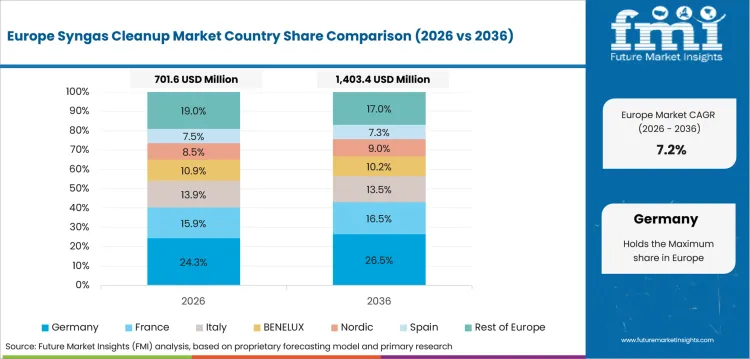
Country Market Snapshot Table
| Parameter | Value |
|---|---|
| Market Size in 2025 (Value) | USD 194.3 million |
| Market Size in 2026 (Value) | USD 210.0 million |
| Market Forecast in 2036 (Value) | USD 457.6 million |
| CAGR (2026 to 2036) | 8.1% |
| Years Considered | 2021 to 2036 |
| Base Year | 2025 |
| Forecast Period | 2026 to 2036 |
| Units Considered | Value (USD million) |
| Leading Sub-Region | Rhine-Ruhr and Ludwigshafen chemical corridors |
Germany Syngas Cleanup Market Outlook
Germany syngas cleanup demand is driven by chemical clusters, import planning for hydrogen derivatives, and local gas treatment technology expertise. Buyers focus on purity, certification, and integration with ammonia, methanol, and industrial gas routes.
Suppliers with European references and solvent service capability should gain stronger buyer trust. Procurement teams are expected to prefer systems that connect cleanup, derivative processing, and plant-level emissions accounting.
Key Growth Drivers
- Hydrogen derivative planning creates demand for cleanup and conditioning. Germany's hydrogen strategy expects 95 to 130 TWh of hydrogen and derivative demand by 2030.
- Import dependence supports derivative processing equipment. Germany expects around 50.0% to 70.0% of hydrogen products to be imported by 2030.
- Chemical clusters in Ludwigshafen, Leuna, and the Ruhr support demand for syngas treatment expertise and service depth.
- Domestic suppliers such as BASF and Linde strengthen confidence in solvent, purification, and industrial gas integration.
Key Restraints
- High-performance solvent requirements can increase specification work. BASF states that OASE white can target process gas CO2 capture rates up to 99.99 mol% in blue hydrogen and ammonia applications.
- Cross-border certification rules can delay buyer approval for imported hydrogen derivatives and ammonia carriers.
- Domestic hydrogen project timing can slow when power costs and industrial competitiveness concerns affect investment.
What makes Germany unique
Germany is unique because it combines hydrogen derivative demand with a strong gas treating technology base.
Key Companies
- BASF
- Linde
- Air Liquide
- Shell Catalysts & Technologies
- Technip Energies
- Topsoe
- Thyssenkrupp Uhde
Sales & Marketing Channels
- Chemical cluster direct sales
- EPC framework agreements
- Licensor-led ammonia and methanol projects
- Industrial gas outsourcing contracts
- EU-funded decarbonization programs
- Port and import terminal partnerships
Country Segment Breakdown Table
| Segment | Sub-Segments |
|---|---|
| By System Type | Integrated Packages - Standalone Units |
| By Sales Channel | EPC / Licensor - Direct - Service Providers |
| By Feedstock Route | Natural Gas Reforming - Biomass Gasification - Coal Gasification - Waste Gasification |
| By Cleanup Technology | Acid Gas Removal - Particulate / Tar Removal - Sulfur Removal - Trace Contaminant Removal |
| By End Use | Hydrogen - Ammonia / Methanol - Fischer-Tropsch Fuels - Industrial Gas |
| Key Sub-Regions Covered, Chemical and Import Corridors | Rhine-Ruhr - Ludwigshafen - Leuna - Hamburg - Lower Saxony - Bremen |
Frequently Asked Questions
How fast is Germany syngas cleanup market growing?
Demand in Germany is ready to rise at 8.1% CAGR from 2026 to 2036 with hydrogen derivative processing.
Who leads Germany syngas cleanup market?
BASF, Linde, Air Liquide, Technip Energies, Shell Catalysts & Technologies, and Topsoe compete through gas treating and engineering channels.
What is driving adoption in Germany syngas cleanup market?
Chemical clusters and hydrogen derivative import planning are moving buyers toward purification and acid gas removal systems.
What is the syngas cleanup market outlook in the United Kingdom?
A 7.8% CAGR through 2036 is supported by CCUS clusters, blue hydrogen projects, and FEED-stage procurement.
Country Market Snapshot Table
| Parameter | Value |
|---|---|
| Market Size in 2025 (Value) | USD 157.7 million |
| Market Size in 2026 (Value) | USD 170.0 million |
| Market Forecast in 2036 (Value) | USD 360.3 million |
| CAGR (2026 to 2036) | 7.8% |
| Years Considered | 2021 to 2036 |
| Base Year | 2025 |
| Forecast Period | 2026 to 2036 |
| Units Considered | Value (USD million) |
| Leading Sub-Region | Teesside and Merseyside industrial clusters |
United Kingdom Syngas Cleanup Market Outlook
United Kingdom demand is tied to cluster-based hydrogen and CCUS projects. Cleanup suppliers need to support carbon capture readiness, hydrogen purification, and process guarantees in early engineering stages.
Teesside and Merseyside remain important demand centers. EPC-led procurement should favor suppliers that can reduce interface risk between reforming, acid gas removal, CO2 handling, and final purification.
Key Growth Drivers
- CCUS cluster funding supports project movement. The UK Public Accounts Committee reported GBP 21.7 billion over 25 years for the first five Track 1 projects.
- H2Teesside creates a direct FEED route. Redcar and Cleveland Borough Council planning material in March 2024 described the project as a 1.2 GW thermal facility able to produce approximately 160,000 tonnes of low-carbon hydrogen per year and capture up to 2.0 million tonnes of CO2 each year.
- Cluster-based procurement concentrates cleanup demand around carbon transport and storage infrastructure.
- Buyers value suppliers that can integrate hydrogen production with CO2 capture and final purification.
Key Restraints
- Cost exposure remains a concern. The UK Public Accounts Committee stated that around 75.0% of early CCUS support costs would be met by consumer levies.
- Contract timing and cluster sequencing can delay cleanup equipment orders until government-backed terms are finalized.
- Public scrutiny of blue hydrogen and CCUS performance can raise the proof burden for capture-ready cleanup systems.
What makes the United Kingdom unique
The United Kingdom is unique due to cluster-led hydrogen demand and strong FEED-stage integration with CCUS projects.
Key Companies
- Technip Energies
- bp
- Linde
- Shell Catalysts & Technologies
- Air Liquide
- Mitsubishi Heavy Industries
- Wood
Sales & Marketing Channels
- CCUS cluster procurement
- FEED-stage engineering awards
- Hydrogen producer contracts
- Industrial decarbonization tenders
- Technology licensor partnerships
- Service contracts for operating plants
Country Segment Breakdown Table
| Segment | Sub-Segments |
|---|---|
| By System Type | Integrated Packages - Standalone Units |
| By Sales Channel | EPC / Licensor - Direct - Service Providers |
| By Feedstock Route | Natural Gas Reforming - Biomass Gasification - Coal Gasification - Waste Gasification |
| By Cleanup Technology | Acid Gas Removal - Particulate / Tar Removal - Sulfur Removal - Trace Contaminant Removal |
| By End Use | Hydrogen - Ammonia / Methanol - Fischer-Tropsch Fuels - Industrial Gas |
| Key Sub-Regions Covered, CCUS Clusters | Teesside - Merseyside - Humber - Scotland - South Wales - Midlands |
Frequently Asked Questions
How fast is United Kingdom syngas cleanup market growing?
Industry in the United Kingdom is projected to increase at 7.8% CAGR from 2026 to 2036 through CCUS-linked hydrogen projects.
Who leads United Kingdom syngas cleanup market?
Technip Energies, bp, Linde, Shell Catalysts & Technologies, Air Liquide, and Wood compete through FEED and project integration.
What is driving adoption in United Kingdom syngas cleanup market?
CCUS clusters and blue hydrogen engineering are moving buyers toward capture-ready syngas cleanup systems.
How is the syngas cleanup market performing in France?
A 7.6% CAGR through 2036 reflects selective hydrogen investment, refinery decarbonization, and domestic engineering capability.
Country Market Snapshot Table
| Parameter | Value |
|---|---|
| Market Size in 2025 (Value) | USD 139.4 million |
| Market Size in 2026 (Value) | USD 150.0 million |
| Market Forecast in 2036 (Value) | USD 312.0 million |
| CAGR (2026 to 2036) | 7.6% |
| Years Considered | 2021 to 2036 |
| Base Year | 2025 |
| Forecast Period | 2026 to 2036 |
| Units Considered | Value (USD million) |
| Leading Sub-Region | Normandy and southern refinery-chemical corridors |
France Syngas Cleanup Market Outlook
France demand is shaped by refining, chemicals, low-carbon hydrogen, and domestic engineering champions. Buyers are selective, with stronger interest in projects that combine purification, capture, and synthesis efficiency.
Air Liquide and Technip Energies give France a strong technology export position. Suppliers can gain when they connect cleanup systems to low-carbon hydrogen and ammonia process designs.
Key Growth Drivers
- Low-carbon hydrogen planning remains active. The European Hydrogen Observatory stated in June 2025 that France's updated strategy targets 4.5 GW of electrolysis capacity by 2030 and up to 8.0 GW by 2035.
- France's official hydrogen strategy notes that mainland grid electricity can enable hydrogen production below 3.1 kgCO2/kgH2 in direct grid connection cases.
- Refining and chemical users need cleanup systems that support hydrogen, methanol, and low-carbon fuel pathways.
- Domestic engineering capacity helps French suppliers participate in international syngas, ammonia, and carbon capture projects.
Key Restraints
- Target revisions make buyers more cautious. CSIRO's HyResource summary states that France lowered its 2030 electrolyser target from 6.5 GW to 4.5 GW in the revised strategy.
- Low-carbon hydrogen cost competition can slow equipment orders when customers compare projects with established fossil hydrogen.
- Project sponsors may prioritize fewer, better-qualified projects before ordering specialized cleanup systems.
What makes France unique
France is unique due to domestic engineering strength and a more selective approach to hydrogen project execution.
Key Companies
- Air Liquide
- Technip Energies
- Linde
- BASF
- Shell Catalysts & Technologies
- Topsoe
- TotalEnergies
Sales & Marketing Channels
- EPC-led project awards
- Direct sales to refinery and chemical operators
- Industrial gas service contracts
- European grant-backed projects
- Technology licensing packages
- Strategic partnerships with hydrogen developers
Country Segment Breakdown Table
| Segment | Sub-Segments |
|---|---|
| By System Type | Integrated Packages - Standalone Units |
| By Sales Channel | EPC / Licensor - Direct - Service Providers |
| By Feedstock Route | Natural Gas Reforming - Biomass Gasification - Coal Gasification - Waste Gasification |
| By Cleanup Technology | Acid Gas Removal - Particulate / Tar Removal - Sulfur Removal - Trace Contaminant Removal |
| By End Use | Hydrogen - Ammonia / Methanol - Fischer-Tropsch Fuels - Industrial Gas |
| Key Sub-Regions Covered, Industrial Corridors | Normandy - Dunkirk - Lyon - Fos-sur-Mer - Grand Est - Ile-de-France |
Frequently Asked Questions
How fast is France syngas cleanup market growing?
Demand in France is expected to rise at 7.6% CAGR from 2026 to 2036 through selective hydrogen and chemical projects.
Who leads France syngas cleanup market?
Air Liquide, Technip Energies, Linde, BASF, Shell Catalysts & Technologies, and Topsoe compete through engineering and gas treatment expertise.
What is driving adoption in France syngas cleanup market?
Refinery decarbonization, low-carbon hydrogen planning, and domestic engineering strength are supporting syngas cleanup adoption.
What is the syngas cleanup market forecast for Japan?
A 7.4% CAGR through 2036 reflects ammonia cracking, hydrogen carrier processing, and power-sector fuel transition planning.
Country Market Snapshot Table
| Parameter | Value |
|---|---|
| Market Size in 2025 (Value) | USD 130.4 million |
| Market Size in 2026 (Value) | USD 140.0 million |
| Market Forecast in 2036 (Value) | USD 285.9 million |
| CAGR (2026 to 2036) | 7.4% |
| Years Considered | 2021 to 2036 |
| Base Year | 2025 |
| Forecast Period | 2026 to 2036 |
| Units Considered | Value (USD million) |
| Leading Sub-Region | Tokyo Bay and Kansai industrial corridors |
Japan Syngas Cleanup Market Outlook
Japan demand is derivative-led because hydrogen and ammonia carriers are central to energy security planning. Cleanup demand extends beyond syngas generation into ammonia cracking gas treatment and high-purity hydrogen production.
Utilities and industrial buyers value reliability, purity, and long-term fuel supply security. Suppliers with ammonia, membrane separation, and hydrogen purification capabilities should gain stronger positions.
Key Growth Drivers
- Hydrogen and ammonia targets create long-run demand. Japan's 2025 Strategic Energy Plan continues stated goals of 3.0 million tons/year in 2030 and 12.0 million tons/year in 2040 for hydrogen supply.
- Ammonia fuel transition creates a direct purification route. Japan's Agency for Natural Resources and Energy reported in 2025 that stable combustion and NOx suppression had been achieved with 20.0% ammonia co-firing.
- Utility fuel transition plans support demand for purification systems tied to ammonia and hydrogen carriers.
- Japanese buyers prioritize systems that can document purity, stability, and safe handling across imported derivative supply chains.
Key Restraints
- Transport cost remains a barrier. Renewable Energy Institute stated in June 2025 that about 90.0% of hydrogen costs in Japan can come from transport-related activities.
- Imported ammonia and hydrogen can remain costlier than fossil fuels without long-term support mechanisms.
- Project timing depends on carrier infrastructure, fuel offtake, and acceptance of ammonia use in power generation.
What makes Japan unique
Japan is unique because ammonia cracking and hydrogen carrier processing are as important as primary syngas generation.
Key Companies
- Mitsubishi Heavy Industries
- NGK Insulators
- Air Liquide
- Shell Catalysts & Technologies
- Technip Energies
- Topsoe
- JERA
Sales & Marketing Channels
- Utility technology pilots
- Strategic offtake partnerships
- EPC and technology licensing
- Ammonia carrier infrastructure projects
- Direct industrial gas contracts
- Government-backed demonstration programs
Country Segment Breakdown Table
| Segment | Sub-Segments |
|---|---|
| By System Type | Integrated Packages - Standalone Units |
| By Sales Channel | EPC / Licensor - Direct - Service Providers |
| By Feedstock Route | Natural Gas Reforming - Biomass Gasification - Coal Gasification - Waste Gasification |
| By Cleanup Technology | Acid Gas Removal - Particulate / Tar Removal - Sulfur Removal - Trace Contaminant Removal |
| By End Use | Hydrogen - Ammonia / Methanol - Fischer-Tropsch Fuels - Industrial Gas |
| Key Sub-Regions Covered, Hydrogen and Ammonia Corridors | Tokyo Bay - Osaka - Kobe - Nagoya - Fukuoka - Hokkaido |
Frequently Asked Questions
How fast is Japan syngas cleanup market growing?
Sector in Japan is projected to grow at 7.4% CAGR from 2026 to 2036 through hydrogen carriers and ammonia cracking.
Who leads Japan syngas cleanup market?
Mitsubishi Heavy Industries, NGK Insulators, Air Liquide, Technip Energies, Shell Catalysts & Technologies, and Topsoe compete through purification and carrier-processing expertise.
What is driving adoption in Japan syngas cleanup market?
Hydrogen supply targets and ammonia cracking development are moving buyers toward high-purity cleanup and separation systems.
Who are the leading companies in the syngas cleanup market?
Linde, BASF, Honeywell UOP, Shell Catalysts & Technologies, Topsoe, Air Liquide, and Technip Energies.
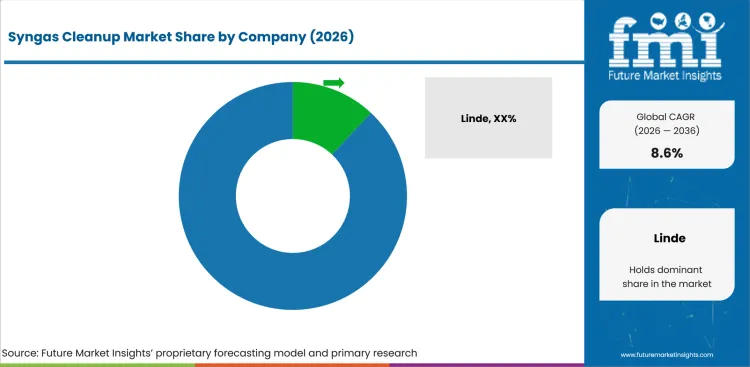
- Established gas treatment companies hold an advantage through hydrogen, ammonia, methanol, and carbon capture project references.
- Process licensors gain position by shaping cleanup specifications during front-end engineering and synthesis loop design.
- Industrial gas suppliers benefit from long-term operating contracts and direct access to hydrogen production assets.
- Solvent and catalyst suppliers support buyer trust through contaminant warranties and technical service programs.
The syngas cleanup market is led by process licensors, gas treatment specialists, industrial gas suppliers, and engineering integrators. Linde, Air Liquide, Honeywell UOP, Shell Catalysts & Technologies, Topsoe, BASF, and Technip Energies hold strong positions because their portfolios connect syngas generation, gas treatment, hydrogen purification, ammonia synthesis, methanol production, and carbon capture.
Technology ownership has become a competitive separator as project owners seek one process guarantee across reforming, gasification, acid gas removal, and downstream purification. Linde and Air Liquide compete through industrial gas integration and hydrogen project execution. BASF competes through OASE gas treatment technologies and solvent service depth. Honeywell UOP and Shell Catalysts & Technologies compete through gas processing and catalyst-linked process know-how.
Smaller and specialized suppliers can win through focused contaminant control, replacement media, and retrofit service. Topsoe and Technip Energies gain where ammonia, methanol, and low-carbon hydrogen process design is central to the buying case. Regional EPC partners also matter because projects need local fabrication, field service, and long-run maintenance support.
How do top syngas cleanup companies compare?
Linde and Air Liquide score strongest on gas integration while BASF leads solvent depth.
| Company | Relevance to Market Title | Acid Gas Integration Depth | Tar and Particulate Treatment Fit | Synthesis Loop Protection Capability | Geographic Footprint |
|---|---|---|---|---|---|
| Linde | Very High | Strong | Medium | Strong | Global |
| Air Liquide | Very High | Strong | Medium | Strong | Global |
| BASF | Very High | Very Strong | Medium | Strong | Global |
| Honeywell UOP | Very High | Strong | Medium | Strong | Global |
| Shell Catalysts & Technologies | Very High | Strong | Medium | Strong | Global |
| Topsoe | Very High | Strong | Medium | Very Strong | Global |
| Technip Energies | Very High | Strong | Medium | Strong | Global |
| Mitsubishi Heavy Industries | High | Medium | Medium | Strong | Japan and global projects |
| John Wood Group | Moderate to High | Medium | Medium | Moderate | Global |
| Clariant | Moderate to High | Medium | Medium | Strong | Global |
Source: Future Market Insights competitive analysis, 2026.
Who are the key players in the syngas cleanup market?
Linde, BASF, Honeywell UOP, Shell Catalysts & Technologies, and Topsoe are listed with Air Liquide and Technip Energies among other suppliers.
Key global companies leading the syngas cleanup market include:
- Linde
- Air Liquide
- Honeywell UOP
- BASF
- Shell Catalysts & Technologies
- Topsoe
- Technip Energies
- Mitsubishi Heavy Industries
- John Wood Group
- Clariant
Key Developments in Syngas Cleanup Market
- In January 2024, Linde started supplying clean hydrogen and captured carbon dioxide to Celanese from its Clear Lake, Texas facility.
- In April 2025, Technip Energies was awarded a major contract for the Blue Point Number One ATR project, which is expected to enable greater than 95.0% CO2 recovery in low-carbon ammonia production.
- In October 2025, BASF and ANDRITZ signed a license agreement for BASF's OASE blue gas treatment technology in a carbon capture project planned in Aarhus, Denmark, with expected annual capture of approximately 435,000 tons of CO2.
Key Players in the Syngas Cleanup Market
Process Licensors
- Linde
- Air Liquide
- Honeywell UOP
- Shell Catalysts & Technologies
- Topsoe
Gas Treatment Specialists
- BASF
- Clariant
Engineering Integrators
- Technip Energies
- John Wood Group
- Mitsubishi Heavy Industries
Syngas Cleanup Market - Report Scope
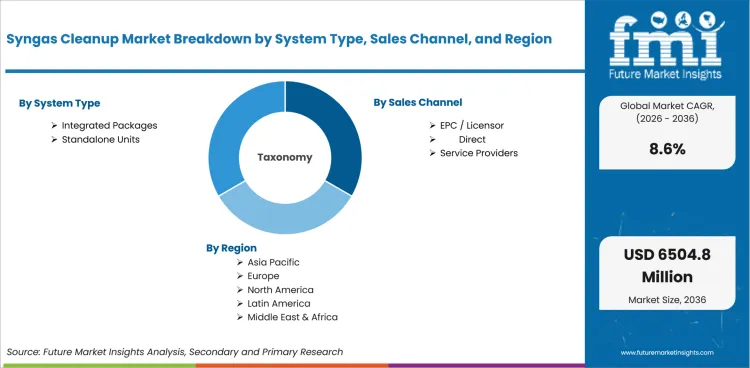
| Parameter | Details |
|---|---|
| Forecast period | 2026 to 2036 |
| Historical period | 2021 to 2025 |
| Quantitative unit | Revenue in USD million |
| By system type | Integrated packages, standalone units |
| By sales channel | EPC / licensor, direct, service providers |
| By feedstock route | Natural gas reforming, biomass gasification, coal gasification, waste gasification |
| By cleanup technology | Acid gas removal, particulate / tar removal, sulfur removal, trace contaminant removal |
| By end use | Hydrogen, ammonia / methanol, Fischer-Tropsch fuels, industrial gas |
| Regions covered | North America, Western Europe, East Asia, South Asia and Pacific |
| Countries covered | China, India, South Korea, United States, Germany, United Kingdom, France, Japan |
| Key companies profiled | Linde, Air Liquide, Honeywell UOP, BASF, Shell Catalysts & Technologies, Topsoe, Technip Energies |
| Approach | Hybrid bottom-up and top-down methodology using project-level demand, cleanup package intensity, feedstock route mix, and company portfolio validation |
Source: Future Market Insights, 2026.
Syngas Cleanup Market - Scope & Definition
| Attribute | Detail |
|---|---|
| Market Definition | The market covers systems, solvents, catalysts, adsorbents, filters, scrubbers, reactors, and integrated packages used to remove contaminants from syngas before downstream conversion. |
| Functions Covered | Acid gas removal, tar removal, particulate filtration, sulfur removal, trace contaminant polishing, ammonia removal, chloride control, and catalyst protection. |
| Applications Covered | Hydrogen, ammonia, methanol, Fischer-Tropsch fuels, industrial gas, and derivative processing. |
| End-Use Industries | Chemicals, fertilizers, refining, power generation, industrial gases, synthetic fuels, and low-carbon fuel production. |
| Grades Covered | Integrated packages, standalone units, EPC-specified cleanup systems, direct equipment sales, and service-provider solutions. |
| Inclusions | Syngas cleanup equipment, integrated packages, adsorbents, solvents, catalysts, replacement media, EPC-specified cleanup trains, and service provider channels. |
| Exclusions | General flue gas desulfurization, ambient air filtration, pipeline natural gas dehydration, standalone odor control, and post-combustion cleanup outside syngas processing. |
Syngas Cleanup Market - Research Methodology
| Method | Description |
|---|---|
| Primary Research | FMI analyst interviews with hydrogen developers, gasification project owners, ammonia producers, methanol operators, EPC firms, catalyst suppliers, and gas treatment specialists across key markets. |
| Desk Research | Review of government funding notices, hydrogen policy documents, gasification technical papers, official company technology pages, public project announcements, and process technology references. |
| Market Sizing & Forecasting | Hybrid bottom-up and top-down model using project counts, cleanup package pricing, feedstock route mix, end-use intensity, country-level policy signals, and supplier portfolio evidence. |
| Data Validation | Cross-verification using hydrogen, ammonia, methanol, gas treating, carbon capture, industrial gas demand patterns, project announcements, and company portfolio checks. |
Syngas Cleanup Market Breakdown by System Type, Sales Channel, Feedstock Route, Cleanup Technology, End Use, and Region
Syngas Cleanup Market Segmented by System Type
- Integrated Packages
- Standalone Units
Syngas Cleanup Market Segmented by Sales Channel
- EPC / Licensor
- Direct
- Service Providers
Syngas Cleanup Market Segmented by Feedstock Route
- Natural Gas Reforming
- Biomass Gasification
- Coal Gasification
- Waste Gasification
Syngas Cleanup Market Segmented by Cleanup Technology
- Acid Gas Removal
- Particulate / Tar Removal
- Sulfur Removal
- Trace Contaminant Removal
Syngas Cleanup Market Segmented by End Use
- Hydrogen
- Ammonia / Methanol
- Fischer-Tropsch Fuels
- Industrial Gas
Syngas Cleanup Market by Region
- North America
- Western Europe
- East Asia
- South Asia and Pacific
Research Sources and Bibliography
- USA Department of Energy. (2024, September). Funding notice: Gasification of alternative feedstocks. USA Department of Energy.
- International Energy Agency. (2025, September). Global Hydrogen Review 2025: Executive summary. International Energy Agency.
- IEA Bioenergy. (2025, April). Gas cleaning from gasification for production of biofuels and biochemicals. IEA Bioenergy.
- House of Commons Committee of Public Accounts. (2025, February). Carbon capture, usage and storage. UK Parliament.
- Methanol Institute. (2026, March). Renewable methanol project database. Methanol Institute.
- Zhengzhou Commodity Exchange. (2024, March). Methanol futures and options. Zhengzhou Commodity Exchange.
- IEA Bioenergy Task 33. (2024, November). Update on the gasification activities in China. IEA Bioenergy.
- Ministry of Ecology and Environment of the People's Republic of China. (2025, November). China's policies and actions for addressing climate change. Ministry of Ecology and Environment.
- Press Information Bureau. (2024, July). Financial incentives to coal gasification projects. Government of India.
- Ministry of Coal. (2024, December). Ministry of Coal's year end review 2024. Government of India.
- NITI Aayog. (2025, October). Coal gasification technology for Indian high ash content coal. Government of India.
- Ministry of Climate, Energy and Environment. (2026, June). Public notice of proposed 2026 hydrogen power generation bidding market volumes. Republic of Korea.
- International Energy Agency. (2026, May). Clean hydrogen certification scheme: Korea. International Energy Agency.
- Green Hydrogen Organisation. (2024, June). Accelerating the truly low-carbon hydrogen transition in South Korea. Green Hydrogen Organisation.
- CF Industries. (2025, April). Blue Point Complex. CF Industries.
- USA Department of the Treasury. (2025, January). USA Department of the Treasury releases final rules for clean hydrogen production tax credit. USA Department of the Treasury.
- Federal Ministry for Economic Affairs and Climate Action. (2024, July). National hydrogen strategy and import strategy for hydrogen and derivatives. Government of Germany.
- BASF. (2025). OASE white for treatment of syngas, ammonia, and HYCO. BASF.
- Redcar and Cleveland Borough Council. (2024, March). H2Teesside Project planning statement. Redcar and Cleveland Borough Council.
- Technip Energies. (2024, August). Technip Energies to design low-carbon hydrogen facility for bp in the United Kingdom. Technip Energies.
- European Hydrogen Observatory. (2025, June). France national hydrogen strategy. European Commission.
- French Ministry of Economy, Finance and Industrial and Digital Sovereignty. (2025, September). National hydrogen strategy. Government of France.
- CSIRO. (2025). France hydrogen policy profile. HyResource.
- Agency for Natural Resources and Energy. (2025). Strategic Energy Plan. Ministry of Economy, Trade and Industry, Japan.
- Agency for Natural Resources and Energy. (2025). Japan's energy: 10 questions for understanding the current energy situation. Ministry of Economy, Trade and Industry, Japan.
- NGK Insulators and Mitsubishi Heavy Industries. (2024, April). NGK and Mitsubishi Heavy Industries to jointly develop hydrogen purification system from ammonia cracking gas. NGK Insulators.
- Renewable Energy Institute. (2025, June). Is Japan's 2040 near-zero emissions target for thermal power feasible? Renewable Energy Institute.
- Linde. (2024, January). Linde starts up supply of clean hydrogen and captured carbon dioxide to Celanese. Linde.
- Technip Energies. (2025, April). Technip Energies awarded major contract for Blue Point Number One ATR project. Technip Energies.
- BASF. (2025, October). BASF and ANDRITZ sign license agreement for OASE blue. BASF.
This bibliography is provided for reader reference and is not exhaustive. The full report contains the complete reference list and detailed citations.
This Report Answers
- Market size estimates for 2026 and forecasts through 2036 for the syngas cleanup market.
- Insights across regional and country-level markets linked to hydrogen, ammonia, methanol, and gasification demand.
- Analysis of demand drivers, contaminant control requirements, project behavior, and purchasing patterns.
- Evaluation of key system types and sales channels, including integrated packages and EPC / licensor dynamics.
- Assessment of feedstock routes, including natural gas reforming, biomass gasification, coal gasification, and waste gasification.
- Identification of opportunities across cleanup technologies, end-use applications, and modular systems.
- Evaluation of supply chain dynamics, solvent and catalyst integration, and service channel structures.
- Country-level growth analysis covering China, India, South Korea, the United States, Germany, the United Kingdom, France, and Japan.
- Assessment of the competitive landscape, including leading syngas cleanup technology suppliers and engineering integrators.
- Analysis of catalyst protection, carbon capture readiness, and synthesis gas quality requirements.
- Regional outlooks across North America, Western Europe, East Asia, and South Asia and Pacific.
- Delivery of market data, forecasts, and supporting analysis in PDF and Excel formats.
Frequently Asked Questions
What is the growth prospect for syngas cleanup?
Demand for syngas cleanup is expected to rise at a considerable pace as hydrogen, ammonia, methanol, and gasification projects require cleaner process gas.
Which companies are expected to shape the syngas cleanup market?
Linde, BASF, Honeywell UOP, Shell Catalysts & Technologies, Topsoe, Air Liquide, and Technip Energies are expected to shape market competition through gas treatment and process integration portfolios.
Why are leading process companies investing in syngas cleanup?
Leading process companies are investing in syngas cleanup to support low-carbon hydrogen, ammonia, methanol, and carbon capture projects.
Why are EPC and licensor channels important in the syngas cleanup market?
EPC and licensor channels are important because cleanup technologies are selected during early engineering and process guarantee negotiations.
Which cleanup formats are gaining attention in syngas cleanup?
Integrated cleanup packages are gaining attention as buyers seek bundled acid gas removal, sulfur control, tar removal, filtration, and polishing systems.
How do regulations influence syngas cleanup project launches?
Regulations influence project launches through carbon intensity rules, hydrogen certification requirements, emissions targets, and CCUS permitting.
Why is contaminant control important for syngas cleanup?
Contaminant control is important because sulfur, particulates, tar, chlorides, and trace metals can damage downstream catalysts and reduce plant availability.
What role does feedstock variability play in syngas cleanup adoption?
Feedstock variability increases adoption by forcing buyers to specify cleanup systems that can manage changing tar, ash, sulfur, and trace contaminant loads.
How do service channels support syngas cleanup in operating plants?
Service channels support operating plants through solvent replacement, adsorbent changeouts, catalyst protection, filtration upgrades, and maintenance planning.
Preview the report firsthand - request a free sample
Get SampleGet the brochure for pricing and purchase details.
Get PDFTable of Content
- Key Takeaways
- Market Size and CAGR
- Top Growth Driver
- Fastest Growing Segment
- Leading Region
- Key Companies
- Emerging Opportunities
- Executive Summary
- Global Market Outlook
- Demand-side Trends
- Supply-side Trends
- Technology Roadmap Analysis
- Analysis and Recommendations
- Analyst Perspective (What is happening? Why now? What should investors know?)
- Key Questions Answered
- How large is the market?
- What is the CAGR?
- What are key trends?
- Which region dominates?
- Who are the leaders?
- Market Overview
- Market Coverage / Taxonomy
- Market Definition / Scope / Limitations
- Research Methodology
- Chapter Orientation
- Analytical Lens and Working Hypotheses
- Market Structure, Signals, and Trend Drivers
- Benchmarking and Cross-market Comparability
- Market Sizing, Forecasting, and Opportunity Mapping
- Research Design and Evidence Framework
- Desk Research Programme (Secondary Evidence)
- Expert Input and Fieldwork (Primary Evidence)
- Tooling, Models, and Reference Databases
- Data Engineering and Model Build
- Quality Assurance and Audit Trail
- Market Background
- Market Dynamics (Drivers, Restraints, Opportunity, Trends)
- Scenario Forecast (Optimistic, Likely, Conservative)
- Impact Analysis
- AI Impact
- Sustainability Impact
- Regulatory Impact
- Technology Impact
- Consumer / Buyer Analysis
- Purchase Drivers
- Adoption Barriers
- Buyer Journey
- Opportunity Map Analysis
- Product Life Cycle Analysis
- Supply Chain Analysis
- Investment Feasibility Matrix
- Value Chain Analysis
- PESTLE and Porter's Analysis
- Regulatory Landscape
- Regional Parent Market Outlook
- Production and Consumption Statistics
- Import and Export Statistics
- Global Market Analysis and Forecast, 2021 to 2036
- Historical Market Size Value (USD Million) Analysis, 2021 to 2025
- Current and Future Market Size Value (USD Million) Projections, 2026 to 2036
- Y-o-Y Growth Trend Analysis
- Absolute $ Opportunity Analysis
- Global Market Pricing Analysis, 2021 to 2036
- Global Market Analysis and Forecast, By System Type, 2021 to 2036
- Introduction / Key Findings
- Historical Market Size Value (USD Million) Analysis By System Type, 2021 to 2025
- Current and Future Market Size Value (USD Million) Analysis and Forecast By System Type, 2026 to 2036
- Integrated Packages
- Standalone Value (USD Million)s
- Integrated Packages
- Y-o-Y Growth Trend Analysis By System Type, 2021 to 2025
- Absolute $ Opportunity Analysis By System Type, 2026 to 2036
- Global Market Analysis and Forecast, By Sales Channel, 2021 to 2036
- Introduction / Key Findings
- Historical Market Size Value (USD Million) Analysis By Sales Channel, 2021 to 2025
- Current and Future Market Size Value (USD Million) Analysis and Forecast By Sales Channel, 2026 to 2036
- EPC / Licensor
- Direct
- Service Providers
- EPC / Licensor
- Y-o-Y Growth Trend Analysis By Sales Channel, 2021 to 2025
- Absolute $ Opportunity Analysis By Sales Channel, 2026 to 2036
- Global Market Analysis and Forecast, By Feedstock Route, 2021 to 2036
- Introduction / Key Findings
- Historical Market Size Value (USD Million) Analysis By Feedstock Route, 2021 to 2025
- Current and Future Market Size Value (USD Million) Analysis and Forecast By Feedstock Route, 2026 to 2036
- Natural Gas Reforming
- Coal Gasification
- Biomass Gasification
- Natural Gas Reforming
- Y-o-Y Growth Trend Analysis By Feedstock Route, 2021 to 2025
- Absolute $ Opportunity Analysis By Feedstock Route, 2026 to 2036
- Global Market Analysis and Forecast, By Cleanup Technology, 2021 to 2036
- Introduction / Key Findings
- Historical Market Size Value (USD Million) Analysis By Cleanup Technology, 2021 to 2025
- Current and Future Market Size Value (USD Million) Analysis and Forecast By Cleanup Technology, 2026 to 2036
- Acid Gas Removal
- Particulate / Tar Removal
- Sulfur Removal
- Acid Gas Removal
- Y-o-Y Growth Trend Analysis By Cleanup Technology, 2021 to 2025
- Absolute $ Opportunity Analysis By Cleanup Technology, 2026 to 2036
- Global Market Analysis and Forecast, By End Use, 2021 to 2036
- Introduction / Key Findings
- Historical Market Size Value (USD Million) Analysis By End Use, 2021 to 2025
- Current and Future Market Size Value (USD Million) Analysis and Forecast By End Use, 2026 to 2036
- Hydrogen
- Ammonia / Methanol
- Fischer-Tropsch Fuels
- Hydrogen
- Y-o-Y Growth Trend Analysis By End Use, 2021 to 2025
- Absolute $ Opportunity Analysis By End Use, 2026 to 2036
- Global Market Analysis and Forecast, By Region, 2021 to 2036
- Introduction
- Historical Market Size Value (USD Million) Analysis By Region, 2021 to 2025
- Current Market Size Value (USD Million) Analysis and Forecast By Region, 2026 to 2036
- North America
- Latin America
- Western Europe
- Eastern Europe
- East Asia
- South Asia and Pacific
- Middle East & Africa
- Market Attractiveness Analysis By Region
- North America Market Analysis and Forecast, By Country, 2021 to 2036
- Historical Market Size Value (USD Million) Trend Analysis By Market Taxonomy, 2021 to 2025
- Market Size Value (USD Million) Forecast By Market Taxonomy, 2026 to 2036
- By Country
- USA
- Canada
- Mexico
- By System Type
- By Sales Channel
- By Feedstock Route
- By Cleanup Technology
- By End Use
- By Country
- Market Attractiveness Analysis
- By Country
- By System Type
- By Sales Channel
- By Feedstock Route
- By Cleanup Technology
- By End Use
- Key Takeaways
- Latin America Market Analysis and Forecast, By Country
- Historical Market Size Value (USD Million) Trend Analysis By Market Taxonomy, 2021 to 2025
- Market Size Value (USD Million) Forecast By Market Taxonomy, 2026 to 2036
- By Country
- Brazil
- Chile
- Rest of Latin America
- By System Type
- By Sales Channel
- By Feedstock Route
- By Cleanup Technology
- By End Use
- By Country
- Market Attractiveness Analysis
- By Country
- By System Type
- By Sales Channel
- By Feedstock Route
- By Cleanup Technology
- By End Use
- Key Takeaways
- Western Europe Market Analysis and Forecast, By Country
- Historical Market Size Value (USD Million) Trend Analysis By Market Taxonomy, 2021 to 2025
- Market Size Value (USD Million) Forecast By Market Taxonomy, 2026 to 2036
- By Country
- Germany
- UK
- Italy
- Spain
- France
- Nordic
- BENELUX
- Rest of Western Europe
- By System Type
- By Sales Channel
- By Feedstock Route
- By Cleanup Technology
- By End Use
- By Country
- Market Attractiveness Analysis
- By Country
- By System Type
- By Sales Channel
- By Feedstock Route
- By Cleanup Technology
- By End Use
- Key Takeaways
- Eastern Europe Market Analysis and Forecast, By Country
- Historical Market Size Value (USD Million) Trend Analysis By Market Taxonomy, 2021 to 2025
- Market Size Value (USD Million) Forecast By Market Taxonomy, 2026 to 2036
- By Country
- Russia
- Poland
- Hungary
- Balkan & Baltic
- Rest of Eastern Europe
- By System Type
- By Sales Channel
- By Feedstock Route
- By Cleanup Technology
- By End Use
- By Country
- Market Attractiveness Analysis
- By Country
- By System Type
- By Sales Channel
- By Feedstock Route
- By Cleanup Technology
- By End Use
- Key Takeaways
- East Asia Market Analysis and Forecast, By Country
- Historical Market Size Value (USD Million) Trend Analysis By Market Taxonomy, 2021 to 2025
- Market Size Value (USD Million) Forecast By Market Taxonomy, 2026 to 2036
- By Country
- China
- Japan
- South Korea
- By System Type
- By Sales Channel
- By Feedstock Route
- By Cleanup Technology
- By End Use
- By Country
- Market Attractiveness Analysis
- By Country
- By System Type
- By Sales Channel
- By Feedstock Route
- By Cleanup Technology
- By End Use
- Key Takeaways
- South Asia and Pacific Market Analysis and Forecast, By Country
- Historical Market Size Value (USD Million) Trend Analysis By Market Taxonomy, 2021 to 2025
- Market Size Value (USD Million) Forecast By Market Taxonomy, 2026 to 2036
- By Country
- India
- ASEAN
- Australia & New Zealand
- Rest of South Asia and Pacific
- By System Type
- By Sales Channel
- By Feedstock Route
- By Cleanup Technology
- By End Use
- By Country
- Market Attractiveness Analysis
- By Country
- By System Type
- By Sales Channel
- By Feedstock Route
- By Cleanup Technology
- By End Use
- Key Takeaways
- Middle East & Africa Market Analysis and Forecast, By Country
- Historical Market Size Value (USD Million) Trend Analysis By Market Taxonomy, 2021 to 2025
- Market Size Value (USD Million) Forecast By Market Taxonomy, 2026 to 2036
- By Country
- Kingdom of Saudi Arabia
- Other GCC Countries
- Türkiye
- South Africa
- Other African Union
- Rest of Middle East & Africa
- By System Type
- By Sales Channel
- By Feedstock Route
- By Cleanup Technology
- By End Use
- By Country
- Market Attractiveness Analysis
- By Country
- By System Type
- By Sales Channel
- By Feedstock Route
- By Cleanup Technology
- By End Use
- Key Takeaways
- Key Countries Market Analysis
- USA
- Pricing Analysis
- Market Share Analysis, 2025
- By System Type
- By Sales Channel
- By Feedstock Route
- By Cleanup Technology
- By End Use
- Canada
- Pricing Analysis
- Market Share Analysis, 2025
- By System Type
- By Sales Channel
- By Feedstock Route
- By Cleanup Technology
- By End Use
- Mexico
- Pricing Analysis
- Market Share Analysis, 2025
- By System Type
- By Sales Channel
- By Feedstock Route
- By Cleanup Technology
- By End Use
- Brazil
- Pricing Analysis
- Market Share Analysis, 2025
- By System Type
- By Sales Channel
- By Feedstock Route
- By Cleanup Technology
- By End Use
- Chile
- Pricing Analysis
- Market Share Analysis, 2025
- By System Type
- By Sales Channel
- By Feedstock Route
- By Cleanup Technology
- By End Use
- Germany
- Pricing Analysis
- Market Share Analysis, 2025
- By System Type
- By Sales Channel
- By Feedstock Route
- By Cleanup Technology
- By End Use
- UK
- Pricing Analysis
- Market Share Analysis, 2025
- By System Type
- By Sales Channel
- By Feedstock Route
- By Cleanup Technology
- By End Use
- Italy
- Pricing Analysis
- Market Share Analysis, 2025
- By System Type
- By Sales Channel
- By Feedstock Route
- By Cleanup Technology
- By End Use
- Spain
- Pricing Analysis
- Market Share Analysis, 2025
- By System Type
- By Sales Channel
- By Feedstock Route
- By Cleanup Technology
- By End Use
- France
- Pricing Analysis
- Market Share Analysis, 2025
- By System Type
- By Sales Channel
- By Feedstock Route
- By Cleanup Technology
- By End Use
- India
- Pricing Analysis
- Market Share Analysis, 2025
- By System Type
- By Sales Channel
- By Feedstock Route
- By Cleanup Technology
- By End Use
- ASEAN
- Pricing Analysis
- Market Share Analysis, 2025
- By System Type
- By Sales Channel
- By Feedstock Route
- By Cleanup Technology
- By End Use
- Australia & New Zealand
- Pricing Analysis
- Market Share Analysis, 2025
- By System Type
- By Sales Channel
- By Feedstock Route
- By Cleanup Technology
- By End Use
- China
- Pricing Analysis
- Market Share Analysis, 2025
- By System Type
- By Sales Channel
- By Feedstock Route
- By Cleanup Technology
- By End Use
- Japan
- Pricing Analysis
- Market Share Analysis, 2025
- By System Type
- By Sales Channel
- By Feedstock Route
- By Cleanup Technology
- By End Use
- South Korea
- Pricing Analysis
- Market Share Analysis, 2025
- By System Type
- By Sales Channel
- By Feedstock Route
- By Cleanup Technology
- By End Use
- Russia
- Pricing Analysis
- Market Share Analysis, 2025
- By System Type
- By Sales Channel
- By Feedstock Route
- By Cleanup Technology
- By End Use
- Poland
- Pricing Analysis
- Market Share Analysis, 2025
- By System Type
- By Sales Channel
- By Feedstock Route
- By Cleanup Technology
- By End Use
- Hungary
- Pricing Analysis
- Market Share Analysis, 2025
- By System Type
- By Sales Channel
- By Feedstock Route
- By Cleanup Technology
- By End Use
- Kingdom of Saudi Arabia
- Pricing Analysis
- Market Share Analysis, 2025
- By System Type
- By Sales Channel
- By Feedstock Route
- By Cleanup Technology
- By End Use
- Türkiye
- Pricing Analysis
- Market Share Analysis, 2025
- By System Type
- By Sales Channel
- By Feedstock Route
- By Cleanup Technology
- By End Use
- South Africa
- Pricing Analysis
- Market Share Analysis, 2025
- By System Type
- By Sales Channel
- By Feedstock Route
- By Cleanup Technology
- By End Use
- USA
- Market Structure Analysis
- Competition Dashboard
- Competition Benchmarking
- Market Share Analysis of Top Players
- By Regional
- By System Type
- By Sales Channel
- By Feedstock Route
- By Cleanup Technology
- By End Use
- Emerging Startups
- Innovation Benchmarking
- Competition Analysis
- Competition Deep Dive
- Linde
- Overview
- Product Portfolio
- Profitability by Market Segments (Product/Region/Sales Channel)
- Sales Footprint
- Strategy Overview
- Marketing Strategy
- Product Strategy
- Channel Strategy
- Air Liquide
- Honeywell UOP
- BASF
- Shell Catalysts & Technologies
- Topsoe
- Linde
- Case Studies
- Success Stories
- Recent Developments
- Competition Deep Dive
- Assumptions & Acronyms Used


