

- Market Size (2026)
- USD 35.0 Mn
- Forecast (2036)
- USD 100.0 Mn
- CAGR (2026 to 2036)
- 11.1%
How big is the renewable methanol fuel blending derivatives market in 2026?
USD 35.0 million in 2026 and USD 100.0 million by 2036 at an 11.1% CAGR.
The renewable methanol fuel blending derivatives industry value is forecast to grow from USD 31.5 million in 2025 to USD 100.0 million by 2036 at 11.1% CAGR as marine fuel buyers, chemical users, and industrial formulators shift toward renewable methyl inputs. Bio-based chemistry is forecast to represent 41.0% share in 2026 because residue-based and biogenic carbon routes give buyers clearer renewable feedstock documentation. Additives are expected to secure 34.0% share in 2026, led by fuel compatibility, dosage control, and blend stability requirements.
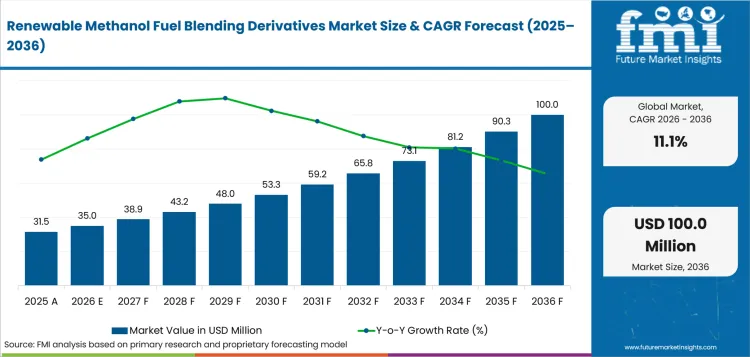
Renewable Methanol Fuel Blending Derivatives Market Overview: Size and Forecast
- 2025 Market Size: USD 31.5 million
- 2026 Market Size: USD 35.0 million
- 2036 Market Size: USD 100.0 million
- Forecast CAGR: 11.1% from 2026 to 2036
- Leading Chemistry Type: Bio-based Chemistry
- Bio-based Chemistry Share in 2026: 41.0%
- Leading Function: Additive
- Additive Share in 2026: 34.0%
- Fastest-growing Country: China
- China CAGR: 12.8% by 2036
Summary of the Renewable Methanol Fuel Blending Derivatives Market
- Demand and Growth Drivers
- Marine fuel buyers are testing renewable methyl derivatives that can support lower lifecycle carbon fuel portfolios.
- Chemical users are shifting trials toward renewable methyl intermediates as carbon accounting becomes part of supplier approval.
- Port fuel suppliers are building methanol handling capability as methanol-ready vessels enter service in Asia and Europe.
- Product and Segment View
- Bio-based chemistry leads the Chemistry Type segment with a projected 41.0% share in 2026 as buyers seek renewable carbon documentation.
- Additive leads the Function segment with an expected 34.0% share in 2026 because fuel blenders value dosage control.
- Automotive leads the End-use Industry segment with a projected 32.0% share in 2026 as fuel blending and component chemistry overlap.
- Geography and Competitive Outlook
- China is projected to record the highest country CAGR at 12.8% as offtake deals and methanol production capacity build local momentum.
- India is expected to post 12.1% CAGR through 2036 as port pilots and green hydrogen derivative programs start creating local demand.
- Methanex, OCI HyFuels, European Energy, Carbon Recycling International, and Liquid Wind compete through feedstock access and certification depth.
- Specialist developers compete on certification, carbon sourcing, and methanol synthesis integration rather than bulk chemical scale alone.
- Analyst Opinion
- Nikhil Kaitwade, Associate Vice President at FMI, observes, “I see this market as a carbon-accounting problem before I see it as a chemistry problem. Buyers are not simply asking for renewable methanol. They are asking whether the derivative can pass fuel handling tests, meet lifecycle carbon rules, and arrive with documents that survive audit. The strongest demand will come from three connected routes. Marine fuel buyers need compliant blending components. Battery and electronics suppliers need low-carbon methyl intermediates. Industrial buyers need solvent and additive substitutes with stable performance. Suppliers with direct access to renewable methanol, certified carbon sourcing, and application testing will have a clear edge.”
Qualification is the main pressure point for renewable methanol fuel blending derivatives as fuel buyers and industrial users review carbon proof before repeat purchasing. Methanol Institute reported in March 2026 that its renewable methanol database tracked 263 projects with 48.5 Mt of announced capacity by 2031. IMO’s Net-Zero Framework describes zero or near-zero fuels with a threshold of 19.0 gCO2eq/MJ. European Energy inaugurated the Kassoe e-methanol facility in May 2025 with 42,000 tonnes of annual production capacity, giving suppliers a commercial reference for certified renewable methanol feedstock.
Which factors support expansion in the renewable methanol fuel blending derivatives market?
Finished renewable methyl derivative revenue and certified feedstock documentation support market value across fuel blending and industrial formulation channels.
- Market value is supported by renewable methanol-derived additives, solvents, binders, coatings, and process aids before port and fuel channels add incremental sales.
- Supplier pricing reflects renewable carbon origin, derivative purity, and documentation quality before application testing affects repeat buying.
- Revenue improves as marine fuel buyers and chemical users convert trial purchases into qualified renewable methyl supply agreements.
- Customer trust rises as batch records make carbon origin, feedstock pathway, safety handling, and storage instructions easier to compare.
Why is the renewable methanol fuel blending derivatives market growing?
Marine fuel buyers and industrial users are moving toward renewable methyl derivatives with clearer carbon documentation and handling proof.
Growth outlook has become more structured as renewable methanol products move from announcement-led planning into regulated fuel and infrastructure programs. EPA stated that 53 Clean Ports Program projects totaling nearly USD 3.0 billion are being implemented across ports in 26 states and territories. That supports cleaner port equipment, infrastructure, and air quality planning that can strengthen readiness for lower-carbon fuel logistics. Renewable methanol derivative suppliers gain when port operators, fuel blenders, and chemical distributors can test handling, storage, and supply documentation near commercial channels.
How is the renewable methanol fuel blending derivatives market segmented?
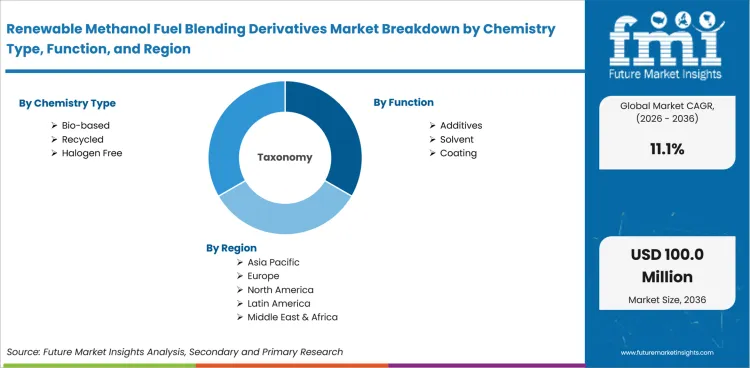
The renewable methanol fuel blending derivatives industry is segmented by chemistry type, function, application, end-use industry, and region.
- Bio-based chemistry is projected to secure 41.0% share in 2026, led by residue-based renewable carbon routes that support stronger feedstock documentation for buyer audits.
- Additive products are anticipated to hold 34.0% share in 2026 since fuel formulators prioritize dosage control, blend compatibility, and storage safety during qualification.
- Batteries are expected to capture 31.0% share in 2026 due to methyl carbonate pathways connecting renewable methanol chemistry with electrolyte solvent supply.
- Automotive is forecast to represent 32.0% share in 2026, guided by fuel blending, coatings, and component material routes that require renewable methyl chemistry.
- East Asia is estimated to account for 34.0% regional share in 2026, reflected by China supply scale, Japanese technical validation, and South Korean bunkering activity.
Why does bio-based chemistry dominate the renewable methanol fuel blending derivatives market?
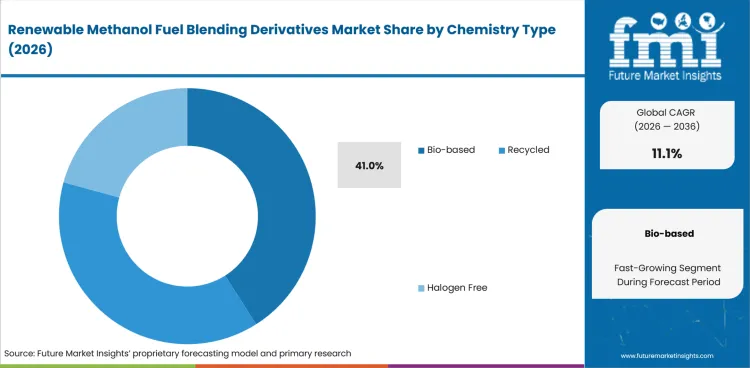
- Bio-based chemistry is projected to account for 41.0% share in 2026, influenced by residue-based feedstock routes and buyer preference for auditable renewable carbon.
- Recycled chemistry gains use as captured carbon pathways support e-methanol derivative production and give industrial users another route for low-carbon methyl inputs.
Which function leads the renewable methanol fuel blending derivatives market?
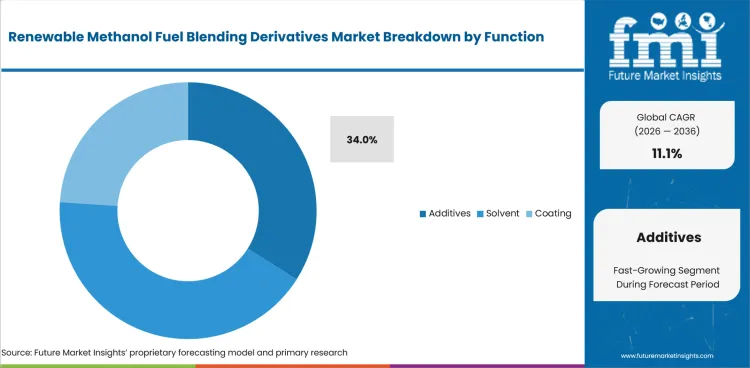
- Additives are expected to hold 34.0% share in 2026 through blend stability needs and clear dosing guidance for early renewable fuel trials.
- Solvents gain importance as industrial formulators test low-carbon methyl routes that preserve solvency, evaporation behavior, and supplier documentation.
Which application leads the renewable methanol fuel blending derivatives market?
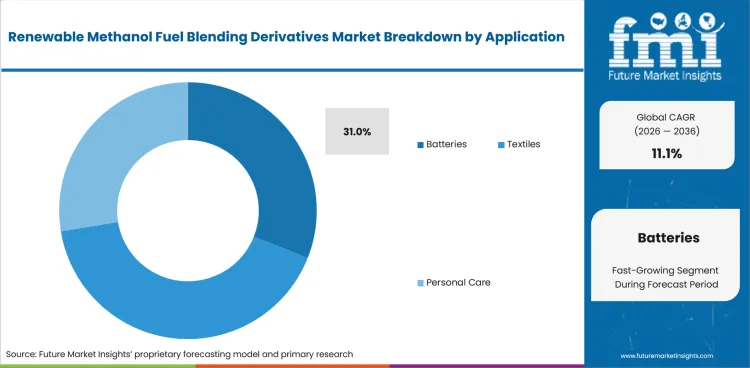
- Batteries are anticipated to account for 31.0% share in 2026 as methyl carbonate chemistry supports electrolyte solvent pathways for lithium-ion cells.
- Construction applications gain use where coatings, binders, and low VOC formulations require renewable methanol-derived chemistry with stable field performance.
Which end-use industry leads the renewable methanol fuel blending derivatives market?
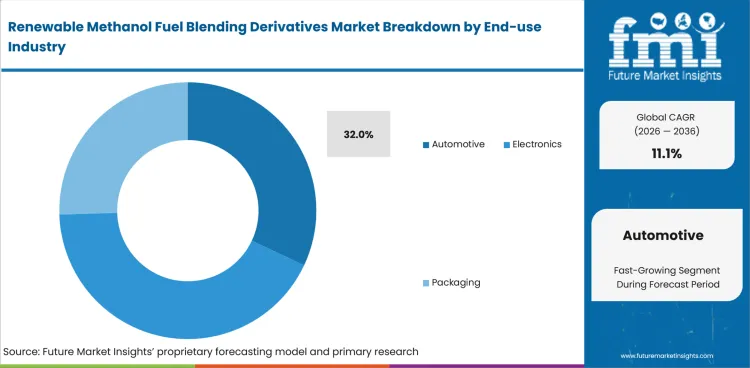
- Automotive is projected to hold 32.0% share in 2026 as fuel blending, coatings, and component material approval programs create multiple entry points.
- Electronics demand develops as high-purity methyl derivatives support cleaning, solvent, and battery material channels that require strict impurity control.
Which region leads the renewable methanol fuel blending derivatives market?
- East Asia is estimated to account for 34.0% share in 2026 as China provides scale while Japan and South Korea add marine qualification and port activity.
- Europe gains momentum through FuelEU Maritime compliance and hydrogen derivative import planning that support renewable methyl fuel and chemical routes.
What are the drivers, restraints, and opportunities in the renewable methanol fuel blending derivatives market?
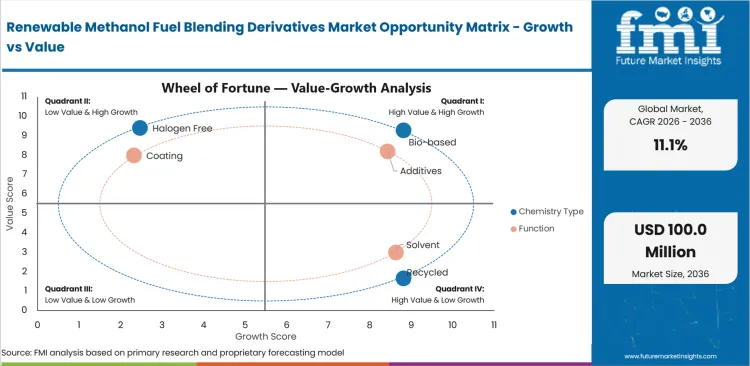
Fuel compliance and certified supply support growth while cost pressure and qualification delays limit wider channel expansion.
- Marine and specialty fuel buyers are testing renewable methyl derivatives to support lower lifecycle-carbon portfolios without changing every downstream blending asset.
- High production cost and limited certified renewable methanol supply can delay repeat purchasing because buyers need reliable volumes before moving beyond pilot orders.
- Port fuel hubs and chemical clusters can connect renewable methanol storage, derivative conversion, and blending, creating a practical route for scaled supply.
Renewable Methanol Fuel Blending Derivatives Market Demand Outlook
Demand outlook is moving toward derivative grades that can prove renewable carbon origin, safety handling, and fuel compatibility before channel expansion. European Commission materials state that vessels above 5,000 gross tonnes represent about 55.0% of all ships and about 90.0% of carbon dioxide emissions from the maritime sector. This makes marine fuel compliance a direct demand route for renewable methanol derivatives. Suppliers serving fuel additives and methyl solvents can use that pressure to prioritize lifecycle documents, storage compatibility, and blend performance rather than relying on renewable feedstock claims alone.
Feedstock Segmentation and Purchase Behavior Analysis
Buyers are separating renewable methanol derivatives by feedstock pathway, carbon proof, and application approval speed. Methanol Institute’s March 2026 database showed announced renewable methanol capacity split between 23.8 Mt of e-methanol and 24.7 Mt of biomethanol by 2031. This near-balanced split gives derivative makers two sourcing routes. E-methanol supports power-to-liquid positioning while biomethanol supports residue-based carbon claims. Repeat purchase will depend on whether suppliers can show origin records, mass-balance systems, and derivative performance in fuel, battery, and industrial formulations.
Voice of Customer and Decision-driver Analysis
Customer decisions are shaped by compliance risk, handling proof, and the cost of qualification failure. FuelEU Maritime applies staged greenhouse gas intensity reductions, including 6.0% from 2030 after the initial 2025 step. That schedule gives fuel buyers a planning horizon for methanol-linked blend components. For renewable methanol derivatives, the practical decision drivers are storage safety, batch traceability, and compatibility with existing material approval processes. Customers are expected to favor suppliers that can explain feedstock origin and performance data in one technical package.
Which countries are growing fastest in the renewable methanol fuel blending derivatives market?
China 12.8% CAGR, India 12.1% CAGR, South Korea 11.7% CAGR, Germany 11.6% CAGR, France 11.3% CAGR, United States 10.8% CAGR, United Kingdom 10.4% CAGR, and Japan 10.2% CAGR through 2036.
.webp "Top Country Growth Comparison Renewable Methanol Fuel Blending Derivatives Market Cagr (2026 2036)")
| Country | CAGR |
|---|---|
| United States | 10.8% |
| United Kingdom | 10.4% |
| Germany | 11.6% |
| France | 11.3% |
| Japan | 10.2% |
| China | 12.8% |
| South Korea | 11.7% |
| India | 12.1% |
Source: Future Market Insights, 2026.
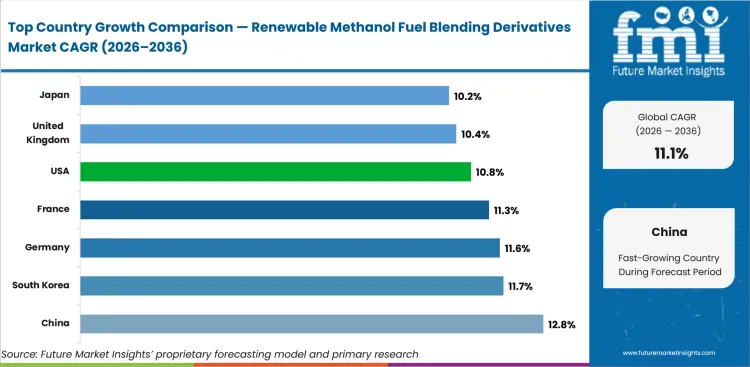
How do country-level CAGRs compare in the renewable methanol fuel blending derivatives market?
China leads country growth while Japan records the most cautious expansion outlook among profiled markets.
- China is forecast to record 12.8% CAGR by 2036 as green methanol production and bunkering activity strengthen local supply signals.
- India is expected to expand at 12.1% CAGR from 2026 to 2036 as green hydrogen and port-based derivative pilots support early adoption.
- South Korea is projected to grow at 11.7% CAGR through 2036 as Ulsan bunkering activity and shipbuilding channels support qualification.
- Germany is estimated to rise at 11.6% CAGR by 2036 with hydrogen derivative imports and chemical clusters supporting demand.
- France is expected to advance at 11.3% CAGR over the forecast period as Le Havre creates a port-linked e-methanol supply signal.
- The United States is forecast to grow at 10.8% CAGR through 2036 as port decarbonization and e-methanol research support demand.
- The United Kingdom is projected to post 10.4% CAGR by 2036 as maritime safety review and clean vessel funding support trials.
- Japan is expected to record 10.2% CAGR through 2036 as conservative technical approval cycles pace commercial adoption.
What is the renewable methanol fuel blending derivatives market outlook in the United States?
A 10.8% CAGR through 2036 reflects marine fuel research, port decarbonization programs, and Gulf Coast chemical infrastructure.
Country Market Snapshot Table
| Parameter | Value |
|---|---|
| Market Size in 2025 (Value) | USD 5.0 million |
| Market Size in 2026 (Value) | USD 5.5 million |
| Market Forecast in 2036 (Value) | USD 15.3 million |
| CAGR (2026 to 2036) | 10.8% |
| Years Considered | 2021 to 2036 |
| Base Year | 2025 |
| Forecast Period | 2026 to 2036 |
| Units Considered | Value (USD million) |
| Leading Sub-Region | Gulf Coast chemical and port corridors |
United States Renewable Methanol Fuel Blending Derivatives Market Outlook
United States renewable methanol fuel blending derivative demand is shaped by marine fuel research, Gulf Coast chemical infrastructure, and port decarbonization programs. Renewable methanol derivatives are expected to move first through direct qualification with fuel blenders and industrial formulation buyers.
Supplier selection will depend on feedstock proof, handling data, and compatibility with existing methanol storage systems. Buyers are likely to prefer producers that combine testing guidance with reliable renewable methanol access.
Key Growth Drivers
- Federal e-methanol research gives derivative suppliers a clearer technology route. ARPA-E listed a USD 3.4 million RTI International project for next-generation flexible modular e-methanol production.
- Port decarbonization funding improves infrastructure readiness. EPA reported 53 Clean Ports Program projects across 26 states and territories.
- Gulf Coast chemical infrastructure gives derivative producers access to methanol storage, handling knowledge, and industrial buyer relationships.
- Fuel and chemical buyers can use established distributor networks to test renewable methyl additives before accepting recurring supply contracts.
Key Restraints
- Certified renewable methanol offtake remains fragmented and often tied to specific projects.
- Fuel buyers face uncertainty over price premiums against conventional methanol and diesel alternatives.
- Port infrastructure funding is broad rather than methanol-specific. The U.S. Department of Transportation made USD 450.0 million available for FY2026 Port Infrastructure Development Program grants.
What makes United Kingdom unique
United States is unique due to Gulf Coast chemical infrastructure and federal e-methanol research support.
Key Companies
- Methanex Corporation
- OCI HyFuels
- BASF Corporation
- RTI International
- LanzaTech Global Inc.
- Maersk North America
- Mitsui & Co. USA
Sales & Marketing Channels
- Direct fuel blender qualification programs
- Gulf Coast chemical distributor networks
- Marine fuel technology pilots
- Industrial solvent buyer trials
- OEM material approval channels
- Port decarbonization consortia
Country Segment Breakdown Table
| Segment | Sub-Segments |
|---|---|
| By Chemistry Type | Bio-based · Recycled · Low VOC · Halogen Free · Waterborne |
| By Function | Solvent · Additive · Binder · Coating · Process Aid |
| By Application | Textiles · Batteries · Construction · Personal Care · Water Treatment |
| By End-use Industry | Automotive · Electronics · Packaging · Agriculture · Industrial Manufacturing |
| Key Sub-Regions Covered, Chemical and Port Corridors | Gulf Coast · California ports · Pacific Northwest · Great Lakes · Northeast ports · Southeast logistics corridors |
United States Renewable Methanol Fuel Blending Derivatives Market FAQs
How fast is United States renewable methanol fuel blending derivatives market growing?
Sector in the United States is anticipated to grow at 10.8% CAGR from 2026 to 2036 reflecting marine fuel research and port readiness.
Who leads United States renewable methanol fuel blending derivatives market?
Methanex, OCI HyFuels, BASF, RTI International, and LanzaTech compete through methanol supply, research, and derivative capabilities.
What is driving adoption in United States renewable methanol fuel blending derivatives market?
Port decarbonization programs, Gulf Coast chemical infrastructure, and e-methanol research are moving buyers toward renewable methyl derivatives.
What is the renewable methanol fuel blending derivatives market outlook in the United Kingdom?
A 10.4% CAGR through 2036 reflects clean maritime funding and formal methanol fuel safety review pathways.
Country Market Snapshot Table
| Parameter | Value |
|---|---|
| Market Size in 2025 (Value) | USD 2.4 million |
| Market Size in 2026 (Value) | USD 2.6 million |
| Market Forecast in 2036 (Value) | USD 7.0 million |
| CAGR (2026 to 2036) | 10.4% |
| Years Considered | 2021 to 2036 |
| Base Year | 2025 |
| Forecast Period | 2026 to 2036 |
| Units Considered | Value (USD million) |
| Leading Sub-Region | UK port demonstration corridors |
United Kingdom Renewable Methanol Fuel Blending Derivatives Market Outlook
United Kingdom demand is shaped by maritime safety review and clean vessel funding. Methanol-linked derivatives are likely to gain first through port demonstrations and alternative fuel projects.
Commercial buying will remain cautious until suppliers prove crew handling, fuel storage, and derivative safety performance. Companies with clear trial records and port partnerships should gain better access.
Key Growth Drivers
- Maritime and Coastguard Agency review routes create a clearer path for methanol vessel projects. MCA published a methanol alternative fuels process in April 2025.
- Clean maritime funding supports alternative fuel trials. ZEVI 2 opened in March 2026 with up to GBP 150.0 million available.
- UK ports offer a test environment for ferry, workboat, and short-sea fuel blending pilots.
- Marine engineering consultants can support supplier approval by translating fuel handling evidence into customer-ready operating procedures.
Key Restraints
- Domestic renewable methanol production remains less visible than European mainland supply.
- Safety assurance requirements slow conversion from pilot interest to recurring derivative orders.
- ZEVI 2 project rules require total eligible costs between GBP 6.0 million and GBP 60.0 million, limiting smaller developer participation.
What makes United Kingdom unique
United Kingdom acts as a safety-review and demonstration market rather than a large renewable methanol production hub.
Key Companies
- Associated British Ports
- B9 Energy Storage
- Methanex Europe
- Johnson Matthey
- Uniper UK
- Maersk UK
- Mitsubishi Chemical UK
Sales & Marketing Channels
- Port authority partnerships
- Clean maritime grant consortia
- Marine engineering consultants
- Vessel conversion project teams
- Chemical distributor qualification routes
- Industrial formulation buyer trials
Country Segment Breakdown Table
| Segment | Sub-Segments |
|---|---|
| By Chemistry Type | Bio-based · Recycled · Low VOC · Halogen Free · Waterborne |
| By Function | Solvent · Additive · Binder · Coating · Process Aid |
| By Application | Textiles · Batteries · Construction · Personal Care · Water Treatment |
| By End-use Industry | Automotive · Electronics · Packaging · Agriculture · Industrial Manufacturing |
| Key Sub-Regions Covered, Maritime Demonstration Areas | London Gateway · Southampton · Teesside · Humber · Liverpool · Scottish port clusters |
United Kingdom Renewable Methanol Fuel Blending Derivatives Market FAQs
How fast is United Kingdom renewable methanol fuel blending derivatives market growing?
Industry in the United Kingdom is projected to increase at 10.4% CAGR from 2026 to 2036 through clean maritime funding and methanol safety review.
Who leads United Kingdom renewable methanol fuel blending derivatives market?
Associated British Ports, B9 Energy Storage, Methanex Europe, Johnson Matthey, and Uniper UK are relevant through ports, projects, and chemical channels.
What is driving adoption in United Kingdom renewable methanol fuel blending derivatives market?
Methanol fuel guidance and clean maritime funding are helping suppliers test renewable methyl derivatives in controlled port settings.
How is the renewable methanol fuel blending derivatives market performing in Germany?
An 11.6% CAGR through 2036 reflects hydrogen derivative import planning and deep chemical conversion capacity.
Country Market Snapshot Table
| Parameter | Value |
|---|---|
| Market Size in 2025 (Value) | USD 4.1 million |
| Market Size in 2026 (Value) | USD 4.6 million |
| Market Forecast in 2036 (Value) | USD 13.8 million |
| CAGR (2026 to 2036) | 11.6% |
| Years Considered | 2021 to 2036 |
| Base Year | 2025 |
| Forecast Period | 2026 to 2036 |
| Units Considered | Value (USD million) |
| Leading Sub-Region | North Rhine-Westphalia and northern port corridors |
Germany Renewable Methanol Fuel Blending Derivatives Market Outlook
Germany demand is shaped by industrial hydrogen derivative imports and chemical cluster requirements. Renewable methanol derivatives are likely to develop through industrial offtake and EU fuel compliance channels.
Buyers will prioritize certificate quality, port handling access, and lifecycle carbon documentation. Suppliers connecting certified imports with German chemical distribution should gain stronger repeat demand.
Key Growth Drivers
- Germany’s hydrogen derivative import strategy gives buyers a policy basis for methanol-linked sourcing. The strategy expects demand for hydrogen and derivatives to reach 95 TWh to 130 TWh by 2030.
- Import planning supports renewable methanol pathways. Germany expects foreign supply to cover 50.0% to 70.0% of hydrogen and derivative demand by 2030.
- Chemical clusters in North Rhine-Westphalia and Lower Saxony support derivative conversion and distribution.
- EU marine fuel rules push ports and fuel suppliers to assess methanol-compatible pathways.
Key Restraints
- High import reliance increases exposure to certificate mismatch and logistics delays.
- German buyers often require detailed lifecycle documentation before signing repeat contracts.
- Longer-term derivative demand could intensify supply competition. Germany’s strategy expects about 200 TWh of synthetic hydrocarbons and other hydrogen derivatives demand by 2045.
What makes Germany unique
Germany combines import planning and chemical conversion depth in a way few other markets match.
Key Companies
- BASF SE
- Methanex Europe
- Uniper SE
- H&R Group
- LANXESS AG
- Mabanaft GmbH & Co. KG
- Evonik Industries AG
Sales & Marketing Channels
- Industrial offtake contracts
- Port fuel suppliers
- Chemical distributor networks
- EU compliance advisory channels
- Automotive material approval teams
- Hydrogen derivative import platforms
Country Segment Breakdown Table
| Segment | Sub-Segments |
|---|---|
| By Chemistry Type | Bio-based · Recycled · Low VOC · Halogen Free · Waterborne |
| By Function | Solvent · Additive · Binder · Coating · Process Aid |
| By Application | Textiles · Batteries · Construction · Personal Care · Water Treatment |
| By End-use Industry | Automotive · Electronics · Packaging · Agriculture · Industrial Manufacturing |
| Key Sub-Regions Covered, Chemical and Import Corridors | North Rhine-Westphalia · Hamburg · Lower Saxony · Bremen · Bavaria · Baden-Württemberg |
Germany Renewable Methanol Fuel Blending Derivatives Market FAQs
How fast is Germany renewable methanol fuel blending derivatives market growing?
Industry in Germany is expected to rise at 11.6% CAGR from 2026 to 2036 led by hydrogen derivative imports and chemical clusters.
Who leads Germany renewable methanol fuel blending derivatives market?
BASF, Methanex Europe, Uniper, H&R Group, LANXESS, and Mabanaft compete through chemical supply and fuel channels.
What is driving adoption in Germany renewable methanol fuel blending derivatives market?
Hydrogen derivative import planning and chemical manufacturing depth are moving German buyers toward renewable methyl routes.
What is the renewable methanol fuel blending derivatives market forecast for France?
An 11.3% CAGR through 2036 is supported by port-linked e-methanol project activity and industrial decarbonization demand.
Country Market Snapshot Table
| Parameter | Value |
|---|---|
| Market Size in 2025 (Value) | USD 3.4 million |
| Market Size in 2026 (Value) | USD 3.8 million |
| Market Forecast in 2036 (Value) | USD 11.1 million |
| CAGR (2026 to 2036) | 11.3% |
| Years Considered | 2021 to 2036 |
| Base Year | 2025 |
| Forecast Period | 2026 to 2036 |
| Units Considered | Value (USD million) |
| Leading Sub-Region | Le Havre and northern industrial port corridors |
France Renewable Methanol Fuel Blending Derivatives Market Outlook
France demand is expected to develop around Le Havre, industrial decarbonization, and marine fuel logistics. Renewable methanol derivatives can gain where project supply and port distribution are connected.
Local buyers will need technical proof before moving renewable methyl products into fuel, solvent, and coating applications. Project timing and grid access will shape conversion speed.
Key Growth Drivers
- Le Havre provides a domestic e-methanol anchor. Qair stated in November 2024 that Methavert would initially produce 200,000 tonnes of e-methanol.
- EU maritime rules give French port users a compliance signal. FuelEU Maritime starts with a 2.0% greenhouse gas intensity reduction requirement from 2025.
- French chemical users can connect renewable methyl inputs with low-carbon product claims.
- Le Havre’s deep-water port setting can support methanol fuel logistics and industrial distribution.
Key Restraints
- Project delivery timing can delay local feedstock availability for derivative makers.
- Buyers need proof that renewable methanol derivatives meet both fuel and industrial standards.
- Hydrogen competition may pressure feedstock economics. The European Commission’s 2024 PCI-PMI technical document listed a 300 MW CarlHYng electrolyser project in France seeking phased hydrogen production by 2030.
What makes France unique
France has one of the clearest port-linked e-methanol project signals among the selected countries.
Key Companies
- Qair Group
- Arkema SA
- TotalEnergies SE
- Air Liquide SA
- HAROPA Port partners
- Methanex Europe
- CMA CGM-linked fuel channels
Sales & Marketing Channels
- Le Havre port fuel channels
- Industrial gas and chemical distributors
- Marine fuel offtake routes
- Construction chemical formulators
- Automotive materials buyers
- Low-carbon solvent suppliers
Country Segment Breakdown Table
| Segment | Sub-Segments |
|---|---|
| By Chemistry Type | Bio-based · Recycled · Low VOC · Halogen Free · Waterborne |
| By Function | Solvent · Additive · Binder · Coating · Process Aid |
| By Application | Textiles · Batteries · Construction · Personal Care · Water Treatment |
| By End-use Industry | Automotive · Electronics · Packaging · Agriculture · Industrial Manufacturing |
| Key Sub-Regions Covered, Port and Industrial Corridors | Le Havre · Normandy · Ile-de-France · Dunkirk · Marseille-Fos · Lyon chemical corridor |
France Renewable Methanol Fuel Blending Derivatives Market FAQs
How fast is France renewable methanol fuel blending derivatives market growing?
Demand in France is expected to advance at 11.3% CAGR from 2026 to 2036 through port-linked e-methanol and industrial demand.
Who leads France renewable methanol fuel blending derivatives market?
Qair, Arkema, TotalEnergies, Air Liquide, Methanex Europe, and HAROPA Port partners shape project and channel development.
What is driving adoption in France renewable methanol fuel blending derivatives market?
Le Havre e-methanol planning and industrial decarbonization needs are moving buyers toward renewable methanol-derived products.
What is the renewable methanol fuel blending derivatives market outlook in Japan?
A 10.2% CAGR through 2036 reflects methanol bunkering standards, ship classification culture, and electronics-grade derivative demand.
Country Market Snapshot Table
| Parameter | Value |
|---|---|
| Market Size in 2025 (Value) | USD 2.1 million |
| Market Size in 2026 (Value) | USD 2.3 million |
| Market Forecast in 2036 (Value) | USD 6.1 million |
| CAGR (2026 to 2036) | 10.2% |
| Years Considered | 2021 to 2036 |
| Base Year | 2025 |
| Forecast Period | 2026 to 2036 |
| Units Considered | Value (USD million) |
| Leading Sub-Region | Yokohama and marine engineering corridors |
Japan Renewable Methanol Fuel Blending Derivatives Market Outlook
Japan demand is shaped by technical approval culture and controlled methanol bunkering development. Renewable methanol derivatives are likely to move through marine engineering and high-purity chemical channels.
Buyers will expect proof of safety, classification alignment, and stable supply before repeat orders. Trading houses and chemical producers can influence access to renewable methanol and derivative qualification.
Key Growth Drivers
- Methanol bunkering procedures gained practical evidence. Japan’s first methanol bunkering simulation at Yokohama Port involved 7 participating organizations in September 2024.
- Commercial practice improved in February 2026 when MOL joined a 5-way public-private partnership for Japan’s first ship-to-ship methanol bunkering at anchorage.
- Japanese trading houses can connect overseas renewable methanol supply with domestic users.
- Electronics and battery supply chains create high-purity derivative opportunities.
Key Restraints
- Limited domestic renewable methanol feedstock reduces local conversion flexibility.
- Conservative qualification cycles slow first commercial orders for new derivative grades.
- Technical adoption remains narrow. ClassNK reported only 4 methanol-fueled ships classified by the society were in service at the end of August 2024.
What makes Japan unique
Japan’s market is led by technical approval culture rather than by rapid volume buying.
Key Companies
- Mitsubishi Gas Chemical Company
- Mitsui & Co.
- Mitsui O.S.K. Lines
- Idemitsu Kosan Co.
- Kokuka Sangyo Co.
- ClassNK-linked marine channels
- Mitsubishi Chemical Group
Sales & Marketing Channels
- Trading house supply agreements
- Shipbuilder qualification channels
- Classification society approval routes
- Electronics chemical distributors
- Marine engine supplier partnerships
- Battery material supply channels
Country Segment Breakdown Table
| Segment | Sub-Segments |
|---|---|
| By Chemistry Type | Bio-based · Recycled · Low VOC · Halogen Free · Waterborne |
| By Function | Solvent · Additive · Binder · Coating · Process Aid |
| By Application | Textiles · Batteries · Construction · Personal Care · Water Treatment |
| By End-use Industry | Automotive · Electronics · Packaging · Agriculture · Industrial Manufacturing |
| Key Sub-Regions Covered, Marine and Electronics Corridors | Yokohama · Tokyo Bay · Osaka · Kobe · Nagoya · Niigata |
Japan Renewable Methanol Fuel Blending Derivatives Market FAQs
How fast is Japan renewable methanol fuel blending derivatives market growing?
Sector in Japan is projected at 10.2% CAGR from 2026 to 2036 as bunkering standards and electronics chemical demand develop.
Who leads Japan renewable methanol fuel blending derivatives market?
Mitsubishi Gas Chemical, Mitsui, MOL, Idemitsu Kosan, Kokuka Sangyo, and Mitsubishi Chemical influence market activity.
What is driving adoption in Japan renewable methanol fuel blending derivatives market?
Bunkering simulations, ship-to-ship trials, and electronics chemical needs are moving Japan toward renewable methanol derivatives.
Why is China the fastest-growing renewable methanol fuel blending derivatives market?
A 12.8% CAGR through 2036 reflects green methanol production scale, bunkering activity, and export-facing fuel demand.
Country Market Snapshot Table
| Parameter | Value |
|---|---|
| Market Size in 2025 (Value) | USD 8.9 million |
| Market Size in 2026 (Value) | USD 10.0 million |
| Market Forecast in 2036 (Value) | USD 33.3 million |
| CAGR (2026 to 2036) | 12.8% |
| Years Considered | 2021 to 2036 |
| Base Year | 2025 |
| Forecast Period | 2026 to 2036 |
| Units Considered | Value (USD million) |
| Leading Sub-Region | Shanghai, Jilin, and coastal bunkering corridors |
China Renewable Methanol Fuel Blending Derivatives Market Outlook
China demand is shaped by production scale, port activity, and global shipping offtake. Renewable methanol derivatives can gain through marine fuel supply, industrial chemical conversion, and export-facing customer needs.
Buyer acceptance will depend on lifecycle carbon proof and traceability. Suppliers that connect Chinese green methanol supply with audit-ready documentation can serve both domestic and international channels.
Key Growth Drivers
- Green bunkering scale supports fuel-linked derivative demand. Shanghai reported in July 2025 that China’s first methanol dual-fuel ship completed bunkering of 1,000 metric tons of green methanol at Yangshan Deep-Water Port.
- Yangshan Port set a larger proof point in March 2026 when a bunkering vessel refueled 3,643 tons of green methanol to the CMA CGM Osmium.
- Industrial clusters give Chinese suppliers conversion capacity for renewable methyl derivatives used in fuel and chemical applications.
- Official green shipping policy supports wider use of alternative ship fuels including green methanol across coastal fuel channels.
Key Restraints
- International customers need strong proof of residue sourcing, carbon savings, and certificate integrity before accepting export-linked derivative supply.
- Policy and certification differences can slow acceptance in EU, Japanese, and global buyer systems.
- Green methanol supply remains small compared with conventional methanol. Shanghai reporting stated that only 500,000 tonnes of global methanol output was green methanol in 2023.
What makes China unique
China is unique because production scale, bunkering activity, and export-facing green methanol certification are moving together.
Key Companies
- LONGi Green Energy Technology
- Shanghai Electric Group
- Goldwind
- COSCO Shipping
- China Merchants Group
- Maersk-linked offtake channels
- Mitsubishi and Mitsui trading partners
Sales & Marketing Channels
- Long-term shipping offtake agreements
- Industrial chemical distributors
- Export-oriented fuel suppliers
- Port fuel service companies
- Battery materials supply chains
- Green methanol bunkering channels
Country Segment Breakdown Table
| Segment | Sub-Segments |
|---|---|
| By Chemistry Type | Bio-based · Recycled · Low VOC · Halogen Free · Waterborne |
| By Function | Solvent · Additive · Binder · Coating · Process Aid |
| By Application | Textiles · Batteries · Construction · Personal Care · Water Treatment |
| By End-use Industry | Automotive · Electronics · Packaging · Agriculture · Industrial Manufacturing |
| Key Sub-Regions Covered, Production and Bunkering Corridors | Shanghai · Jilin · Tianjin · Ningbo-Zhoushan · Guangdong · Yangtze River Delta |
China Renewable Methanol Fuel Blending Derivatives Market FAQs
How fast is China renewable methanol fuel blending derivatives market growing?
Demand in China is projected to scale at 12.8% CAGR from 2026 to 2036 through green methanol supply and port bunkering.
Who leads China renewable methanol fuel blending derivatives market?
LONGi, Shanghai Electric, Goldwind, COSCO Shipping, China Merchants, and export-focused fuel channels shape competition.
What is driving adoption in China renewable methanol fuel blending derivatives market?
Green methanol certification, Yangshan bunkering activity, and bio-methanol offtake are moving Chinese suppliers toward derivative demand.
What is driving renewable methanol fuel blending derivatives demand in South Korea?
An 11.7% CAGR through 2036 reflects Ulsan bunkering proof, shipbuilding capability, and electronics chemical demand.
Country Market Snapshot Table
| Parameter | Value |
|---|---|
| Market Size in 2025 (Value) | USD 2.9 million |
| Market Size in 2026 (Value) | USD 3.2 million |
| Market Forecast in 2036 (Value) | USD 9.7 million |
| CAGR (2026 to 2036) | 11.7% |
| Years Considered | 2021 to 2036 |
| Base Year | 2025 |
| Forecast Period | 2026 to 2036 |
| Units Considered | Value (USD million) |
| Leading Sub-Region | Ulsan and Busan industrial corridors |
South Korea Renewable Methanol Fuel Blending Derivatives Market Outlook
South Korea demand is influenced by Ulsan bunkering activity, shipbuilding capacity, and electronics chemical channels. Renewable methanol derivatives are expected to build through marine fuel and high-purity industrial applications.
Early buying will depend on imported certified methanol and port procedures. Shipyards, port authorities, and electronics buyers will shape supplier access.
Key Growth Drivers
- Ulsan bunkering activity gives marine users a practical supply example. NYK reported in September 2025 that a methanol dual-fuel bulk carrier received low-carbon methanol by ship-to-ship transfer at Ulsan Port.
- Fuel supply channels are gaining commercial proof. ITOCHU stated in September 2025 that it supplied low-carbon methanol fuel for NYK at the Port of Ulsan.
- Korean shipyards support methanol-ready vessel design and fuel system integration for export-facing marine customers.
- Electronics supply chains create demand for clean methyl derivatives, carbonate solvents, and impurity-controlled chemical inputs.
Key Restraints
- Renewable methanol supply is likely to depend on imports during early scale-up.
- Safety training and port procedures add time before routine methanol bunkering expands beyond selected demonstrations.
- Safety and procedure gaps can slow wider rollout. The World Port Sustainability Program noted green methanol can reduce vessel carbon emissions by up to 95.0%, but legal status and safety procedures still needed structured resolution.
What makes South Korea unique
South Korea is unique because shipbuilding, port operations, and electronics demand are concentrated in a compact industrial geography.
Key Companies
- Ulsan Port Authority
- HD Hyundai
- Samsung Heavy Industries
- OCI-linked fuel channels
- ITOCHU Korea-linked supply routes
- Lotte Chemical
- SK Chemicals
Sales & Marketing Channels
- Port bunkering service providers
- Shipyard engineering approvals
- Electronics chemical distributors
- Marine fuel traders
- OEM fuel system partners
- Industrial solvent distributors
Country Segment Breakdown Table
| Segment | Sub-Segments |
|---|---|
| By Chemistry Type | Bio-based · Recycled · Low VOC · Halogen Free · Waterborne |
| By Function | Solvent · Additive · Binder · Coating · Process Aid |
| By Application | Textiles · Batteries · Construction · Personal Care · Water Treatment |
| By End-use Industry | Automotive · Electronics · Packaging · Agriculture · Industrial Manufacturing |
| Key Sub-Regions Covered, Shipbuilding and Chemical Corridors | Ulsan · Busan · Geoje · Incheon · Yeosu · Pohang |
South Korea Renewable Methanol Fuel Blending Derivatives Market FAQs
How fast is South Korea renewable methanol fuel blending derivatives market growing?
Industry in South Korea is expected to rise at 11.7% CAGR from 2026 to 2036 led by bunkering proof and shipbuilding channels.
Who leads South Korea renewable methanol fuel blending derivatives market?
Ulsan Port Authority, HD Hyundai, Samsung Heavy Industries, OCI-linked channels, Lotte Chemical, and SK Chemicals influence demand.
What is driving adoption in South Korea renewable methanol fuel blending derivatives market?
Ulsan bunkering activity, shipbuilding strength, and electronics chemical demand are moving buyers toward renewable methyl derivatives.
What is the renewable methanol fuel blending derivatives market outlook in India?
A 12.1% CAGR through 2036 is supported by green hydrogen policy, port pilots, and industrial chemical substitution.
Country Market Snapshot Table
| Parameter | Value |
|---|---|
| Market Size in 2025 (Value) | USD 2.7 million |
| Market Size in 2026 (Value) | USD 3.0 million |
| Market Forecast in 2036 (Value) | USD 9.4 million |
| CAGR (2026 to 2036) | 12.1% |
| Years Considered | 2021 to 2036 |
| Base Year | 2025 |
| Forecast Period | 2026 to 2036 |
| Units Considered | Value (USD million) |
| Leading Sub-Region | Gujarat and Tamil Nadu port corridors |
India Renewable Methanol Fuel Blending Derivatives Market Outlook
India demand is early but commercially relevant because port pilots and green hydrogen policy are moving into infrastructure. Renewable methanol derivatives can gain through public-sector demonstrations, fuel trials, and industrial chemical buyers.
Adoption will depend on cost competitiveness, domestic project delivery, and buyer confidence in derivative performance. Suppliers able to work through ports and industrial consortia should gain the clearest entry route.
Key Growth Drivers
- Green hydrogen policy supports renewable methanol pathways. India targets 5 MMT of green hydrogen production annually by 2030.
- Carbon utilization projects support local methanol knowledge. India’s CO2-to-methanol pilot plant has an overall capacity of 1.4 tons per day.
- Industrial buyers in chemicals, fertilizers, and refineries can test methanol derivatives as lower-carbon intermediates.
- Port pilots in Tamil Nadu and Gujarat can test fuel handling before large commercial orders develop.
Key Restraints
- Renewable methanol production has not yet reached the commercial depth seen in China or Europe.
- Price-sensitive buyers need clear cost benefits before switching from fossil-based derivatives.
- Commercial readiness remains early because the first shore-to-ship methanol bunkering trial at Kandla was conducted only in April 2026.
What makes India unique
India is unique because public-sector ports and green hydrogen policy are expected to shape early market entry.
Key Companies
- Thermax Limited
- Indian Oil Corporation Limited
- Deendayal Port Authority
- V.O. Chidambaranar Port Authority
- Reliance Industries Limited
- Larsen & Toubro
- NTPC Green Energy
Sales & Marketing Channels
- Public-sector port pilots
- Government-backed demonstration programs
- Industrial chemical distributors
- Fertilizer and refinery buyers
- Engineering procurement contractors
- Green hydrogen consortia
Country Segment Breakdown Table
| Segment | Sub-Segments |
|---|---|
| By Chemistry Type | Bio-based · Recycled · Low VOC · Halogen Free · Waterborne |
| By Function | Solvent · Additive · Binder · Coating · Process Aid |
| By Application | Textiles · Batteries · Construction · Personal Care · Water Treatment |
| By End-use Industry | Automotive · Electronics · Packaging · Agriculture · Industrial Manufacturing |
| Key Sub-Regions Covered, Port and Industrial Corridors | Gujarat · Tamil Nadu · Maharashtra · Odisha · Andhra Pradesh · National Capital Region |
India Renewable Methanol Fuel Blending Derivatives Market FAQs
How fast is India renewable methanol fuel blending derivatives market growing?
Demand in India is projected to expand at 12.1% CAGR from 2026 to 2036 through port pilots and green hydrogen policy.
Who leads India renewable methanol fuel blending derivatives market?
Thermax, Indian Oil, Deendayal Port Authority, V.O. Chidambaranar Port Authority, Reliance, L&T, and NTPC Green Energy are relevant to early demand.
What is driving adoption in India renewable methanol fuel blending derivatives market?
Green hydrogen targets, port bunkering development, and industrial demonstration programs are moving buyers toward renewable methanol derivatives.
Who are the leading companies in the renewable methanol fuel blending derivatives market?
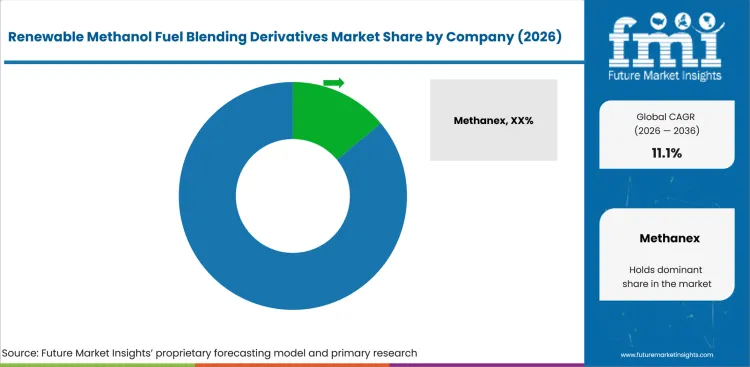
Methanex, OCI HyFuels, European Energy, Carbon Recycling International, and Liquid Wind.
- Established methanol companies hold an advantage through global supply access and methanol handling knowledge.
- Specialist renewable methanol developers gain value by linking e-methanol synthesis with certification and offtake.
- Marine-linked buyers influence demand by creating visible methanol fuel supply requirements.
- Chemical companies support adoption by matching renewable methyl inputs with formulation qualification.
Renewable methanol fuel blending derivative companies compete by combining certified feedstock access with application testing. Methanex and OCI HyFuels bring methanol supply depth. European Energy and Liquid Wind strengthen the renewable project pipeline. Carbon Recycling International and Enerkem compete through conversion technology and carbon-use pathways. BASF and Mitsubishi Gas Chemical add formulation and methyl chemistry experience. Maersk and LONGi influence demand by tying vessel fuel needs with bio-methanol supply.
Manufacturing scale has become a competitive separator as derivative buyers move beyond laboratory trial volumes. European Energy’s Kassoe e-methanol facility provides one commercial reference for renewable methanol supply. Maersk’s long-term arrangement with LONGi gives ship fuel buyers a supply signal from China. Carbon Recycling International’s e-methanol technology activity shows that licensed production routes can expand beyond one region. Scale alone is not enough if certification, storage proof, or customer qualification fails.
Smaller and regional players can win through local project integration and port-based channel access. France, India, Japan, and South Korea create opportunities where port demonstrations and industrial clusters sit close together. Germany and the United Kingdom create more qualification-heavy demand conditions because buyers need safety evidence and import documentation. Companies with conservative carbon claims, clear safety data, and repeatable application proof should gain more durable purchasing decisions.
How do top renewable methanol fuel blending derivatives companies compare?
Methanex and BASF score strongest on global reach while European Energy and Liquid Wind lead in renewable methanol project signaling.
| Company | Relevance to Market Title | Renewable Methanol Feedstock Access | Fuel Blend Qualification Depth | Derivative Formulation Reach | Channel Reach | Geographic Footprint |
|---|---|---|---|---|---|---|
| Methanex | Very High | High | Strong | Strong | Very Strong | Global |
| OCI HyFuels | Very High | High | Strong | Medium | Strong | Europe and North America |
| European Energy | Very High | High | Strong | Medium | Strong | Europe |
| Carbon Recycling International | High | High | Medium | Medium | Moderate | Europe and Asia |
| Enerkem | High | Medium | Medium | Strong | Moderate | North America and Europe |
| Liquid Wind | High | Medium | Strong | Medium | Moderate | Europe |
| BASF | High | Medium | Medium | High | Very Strong | Global |
| Mitsubishi Gas Chemical | High | Medium | Medium | Strong | Strong | Japan and Asia |
| LONGi | High | High | Medium | Low | Strong | China and Global |
| Maersk | High | Medium | High | Low | Very Strong | Global |
| Mitsui | High | Medium | Strong | Medium | Strong | Japan and Global |
| Goldwind | High | High | Medium | Low | Strong | China and Global |
Source: Future Market Insights competitive analysis, 2026.
Who are the key players in the renewable methanol fuel blending derivatives market?
Methanex, OCI HyFuels, European Energy, Carbon Recycling International, Enerkem, Liquid Wind, and BASF are listed with Maersk and LONGi among other suppliers.
Key global companies leading the renewable methanol fuel blending derivatives market include:
- Methanex
- OCI HyFuels
- European Energy
- Carbon Recycling International
- Enerkem
- Liquid Wind
- BASF
- Mitsubishi Gas Chemical
- LONGi
- Maersk
- Mitsui
- Goldwind
Key Developments in Renewable Methanol Fuel Blending Derivatives Market
- In May 2025, European Energy officially inaugurated the Kassoe e-methanol facility in Denmark. The facility can produce up to 42,000 tonnes of methanol per year and supports commercial renewable feedstock supply.
- In October 2024, Maersk signed a long-term bio-methanol sourcing agreement with LONGi Green Energy Technology. The agreement expects first volumes in 2026 for Maersk’s methanol-enabled fleet.
- In October 2024, Carbon Recycling International signed a technology agreement for large-scale e-methanol plants in China. The first phase carries 170,000 tons of e-methanol capacity per year.
Key Players in the Renewable Methanol Fuel Blending Derivatives Market
Integrated Methanol and Fuel Suppliers
- Methanex
- OCI HyFuels
- BASF
Renewable Methanol Project Developers
- European Energy
- Carbon Recycling International
- Enerkem
- Liquid Wind
Marine and Application Channel Influencers
- Maersk
- LONGi
- Mitsui
- Mitsubishi Gas Chemical
- Goldwind
Renewable Methanol Fuel Blending Derivatives Market - Report Scope
| Parameter | Details |
|---|---|
| Forecast period | 2026 to 2036 |
| Historical period | 2021 to 2025 |
| Quantitative unit | Revenue in USD million |
| By chemistry type | Bio-based, recycled, low VOC, halogen free, waterborne |
| By function | Solvent, additive, binder, coating, process aid |
| By application | Textiles, batteries, construction, personal care, water treatment |
| By end-use industry | Automotive, electronics, packaging, agriculture, industrial manufacturing |
| Regions covered | North America, Europe, East Asia, South Asia, Latin America |
| Countries covered | United States, United Kingdom, Germany, France, Japan, China, South Korea, India |
| Key companies profiled | Methanex, OCI HyFuels, European Energy, Carbon Recycling International, Enerkem, Liquid Wind, BASF |
| Approach | Hybrid bottom-up and top-down methodology using renewable methanol supply, derivative conversion rates, application demand, and country-level qualification signals |
Source: Future Market Insights, 2026.
Renewable Methanol Fuel Blending Derivatives Market - Scope & Definition
| Attribute | Detail |
|---|---|
| Market Definition | Methanol-derived chemicals made with renewable methanol, bio-methanol, or e-methanol feedstock for fuel blending and industrial formulation use |
| Functions Covered | Solvent performance, fuel additive function, binder support, coating modification, process aid use, and renewable carbon delivery |
| Applications Covered | Textiles, batteries, construction, personal care, water treatment, fuel blending, and industrial formulation |
| End-Use Industries | Automotive, electronics, packaging, agriculture, industrial manufacturing, marine fuel channels, and chemical distribution |
| Grades Covered | Bio-based, recycled, low VOC, halogen free, waterborne, fuel-compatible, industrial-grade, and application-qualified derivative formats |
| Inclusions | Commercially traded renewable methanol-derived additives, solvents, binders, coatings, process aids, methyl carbonates, methyl esters, and low-carbon solvent grades |
| Exclusions | Bulk fossil methanol, commodity methanol sales, conventional fossil MTBE, ethanol-only fuels, ammonia fuels, pure hydrogen, and finished goods without renewable methanol-derived inputs |
Renewable Methanol Fuel Blending Derivatives Market - Research Methodology
| Method | Description |
|---|---|
| Primary Research | FMI analyst interviews with fuel blenders, chemical distributors, methanol project developers, port fuel buyers, and specialty formulation users across key markets |
| Desk Research | Review of regulator pages, alternative fuel references, official company updates, renewable methanol project data, port fuel documents, and public policy sources |
| Market Sizing & Forecasting | Hybrid methodology using renewable methanol supply, derivative conversion ratios, average specialty chemical pricing, application demand, and country qualification signals |
| Data Validation | Cross-verification using renewable methanol capacity announcements, methanol-fueled vessel activity, port readiness, company disclosures, and adjacent demand checks |
Renewable Methanol Fuel Blending Derivatives Market Breakdown by Chemistry Type, Function, Application, End-use Industry, and Region
Renewable Methanol Fuel Blending Derivatives Market Segmented by Chemistry Type
- Bio-based
- Recycled
- Low VOC
- Halogen Free
- Waterborne
Renewable Methanol Fuel Blending Derivatives Market Segmented by Function
- Solvent
- Additive
- Binder
- Coating
- Process Aid
Renewable Methanol Fuel Blending Derivatives Market Segmented by Application
- Textiles
- Batteries
- Construction
- Personal Care
- Water Treatment
Renewable Methanol Fuel Blending Derivatives Market Segmented by End-use Industry
- Automotive
- Electronics
- Packaging
- Agriculture
- Industrial Manufacturing
Renewable Methanol Fuel Blending Derivatives Market by Region
- North America
- Europe
- East Asia
- South Asia
- Latin America
Research Sources and Bibliography
- A.P. Moller - Maersk. (2024, September 18). Maersk makes further step to support methanol bunkering standards in Japan.
- A.P. Moller - Maersk. (2024, October 30). Maersk signs long-term methanol sourcing deal.
- Carbon Recycling International. (2024, October 10). CRI supplies technology to world’s largest e-methanol plants.
- Department for Transport. (2026, March 26). Zero Emission Vessels and Infrastructure 2: Alternative Fuels.
- Department of Science and Technology. (2024, September 16). Foundation stone of CO2 to methanol pilot plant for advancement in CCU technology unveiled.
- European Commission. (2024, May 15). Technical document for the first PCI and PMI list.
- European Commission. (2025, January 10). New EU rules aiming to decarbonise the maritime sector take effect.
- European Commission. (2026). Decarbonising maritime transport - FuelEU Maritime.
- European Energy. (2025, May 13). Kassoe e-methanol facility officially inaugurated.
- Federal Ministry for Economic Affairs and Climate Action. (2024, July 24). Federal Cabinet adopts import strategy for hydrogen and hydrogen derivatives.
- International Maritime Organization. (2025). The IMO Net-Zero Framework: Frequently asked questions.
- ITOCHU Corporation. (2025, September 30). ITOCHU announces supply of low-carbon methanol fuel for NYK Line at Port of Ulsan, South Korea.
- Maritime and Coastguard Agency. (2025, April 16). MCA customer process for alternative fuels: Methanol.
- Methanol Institute. (2026, March). Renewable methanol project database summary.
- Mitsui O.S.K. Lines. (2026, February 9). MOL joins 5-way public-private partnership in Japan’s first ship-to-ship methanol bunkering at anchorage.
- NYK Line. (2025, September 30). NYK completes low-carbon methanol bunkering of methanol-fueled bulk carrier.
- Press Information Bureau. (2025, November 12). Unlocking India’s green hydrogen production potential.
- Press Information Bureau. (2026, April 3). Kandla Port advances methanol bunkering.
- Qair. (2024, November 7). Qair to develop e-methanol project on HAROPA Port site in Le Havre.
- Shanghai Lingang Special Area Administration. (2026, March 9). Yangshan Deep-Water Port sets new record for green methanol bunkering.
- Shanghai Municipal Government. (2025, July 18). China’s first methanol dual-fuel ship completes green bunkering in Shanghai.
- U.S. Department of Energy. (2025, January). GREENWELLS project descriptions.
- U.S. Department of Transportation. (2025, December 23). Port Infrastructure Development Program.
- U.S. Environmental Protection Agency. (2024, October 29). Clean Ports Program awards.
- Yokohama City. (2024, September 23). Methanol bunkering simulation at the Port of Yokohama.
- World Port Sustainability Program. (2026). Ulsan Port - Green methanol and bio-diesel bunkering.
- ClassNK. (2024). Trends in alternative fuel ships and activity of the society.
This bibliography is provided for reader reference and is not exhaustive. The full report contains the complete reference list and detailed citations.
This Report Answers
- Market size estimates for 2026 and forecasts through 2036 for the renewable methanol fuel blending derivatives market.
- Insights across more than 30 regional and country-level markets.
- Analysis of demand drivers, fuel compliance factors, application use cases, and buyer qualification behavior.
- Evaluation of key chemistry types, functions, applications, and end-use industries.
- Assessment of marine fuel policy, port pilots, hydrogen derivative planning, and renewable methanol supply.
- Identification of growth opportunities across fuel additives, solvents, battery materials, coatings, and process aids.
- Evaluation of supply chain dynamics, certification needs, and derivative qualification requirements.
- Country-level analysis covering the United States, United Kingdom, Germany, France, Japan, China, South Korea, and India.
- Assessment of the competitive landscape, including renewable methanol suppliers, project developers, and application channel participants.
- Analysis of cost pressure, certified supply gaps, and application approval delays.
- Regional outlooks across North America, Europe, East Asia, South Asia, and Latin America.
- Delivery of market data, forecasts, and supporting analysis in PDF and Excel formats.
Frequently Asked Questions
What is the growth prospect for renewable methanol fuel blending derivatives?
Demand for renewable methanol fuel blending derivatives is expected to rise at a considerable pace as fuel and chemical buyers seek traceable renewable carbon inputs.
Which companies are expected to shape the renewable methanol fuel blending derivatives market?
Methanex, OCI HyFuels, European Energy, Carbon Recycling International, Liquid Wind, BASF, Maersk, and LONGi are expected to shape market competition.
Why are leading companies investing in renewable methanol fuel blending derivatives?
Leading companies are investing in renewable methanol fuel blending derivatives to support fuel compliance, low-carbon formulation, and certified methyl chemistry demand.
Why is certification important in the renewable methanol fuel blending derivatives market?
Certification is important because fuel and chemical buyers need proof of renewable origin, lifecycle carbon performance, and batch-level traceability.
Which chemistry type is gaining strongest attention in renewable methanol fuel blending derivatives?
Bio-based chemistry is gaining attention as buyers prioritize renewable carbon proof and feedstock traceability.
Which function is gaining strongest attention in renewable methanol fuel blending derivatives?
Additives are gaining attention because fuel blenders require dosage control, blend stability, and handling clarity.
Which application is gaining attention in renewable methanol fuel blending derivatives?
Battery applications are gaining attention as methyl carbonate solvents connect methanol derivatives with electronics supply.
What does the Renewable Methanol Fuel Blending Derivatives Market include?
The market includes renewable methanol-derived additives, solvents, binders, coatings, process aids, methyl carbonates, methyl esters, and low-carbon solvent grades.
How does FMI forecast this market?
FMI combines renewable methanol supply, derivative conversion rates, application demand, country qualification signals, and company activity to forecast values.
What are the main disadvantages of renewable methanol derivatives?
The main disadvantages are high cost, limited certified supply, long qualification cycles, and strict documentation needs for fuel, chemical, and sustainability audits.
Preview the report firsthand - request a free sample
Get SampleGet the brochure for pricing and purchase details.
Get PDFTable of Content
- Key Takeaways
- Market Size and CAGR
- Top Growth Driver
- Fastest Growing Segment
- Leading Region
- Key Companies
- Emerging Opportunities
- Executive Summary
- Global Market Outlook
- Demand-side Trends
- Supply-side Trends
- Technology Roadmap Analysis
- Analysis and Recommendations
- Analyst Perspective (What is happening? Why now? What should investors know?)
- Key Questions Answered
- How large is the market?
- What is the CAGR?
- What are key trends?
- Which region dominates?
- Who are the leaders?
- Market Overview
- Market Coverage / Taxonomy
- Market Definition / Scope / Limitations
- Research Methodology
- Chapter Orientation
- Analytical Lens and Working Hypotheses
- Market Structure, Signals, and Trend Drivers
- Benchmarking and Cross-market Comparability
- Market Sizing, Forecasting, and Opportunity Mapping
- Research Design and Evidence Framework
- Desk Research Programme (Secondary Evidence)
- Expert Input and Fieldwork (Primary Evidence)
- Tooling, Models, and Reference Databases
- Data Engineering and Model Build
- Quality Assurance and Audit Trail
- Market Background
- Market Dynamics (Drivers, Restraints, Opportunity, Trends)
- Scenario Forecast (Optimistic, Likely, Conservative)
- Impact Analysis
- AI Impact
- Sustainability Impact
- Regulatory Impact
- Technology Impact
- Consumer / Buyer Analysis
- Purchase Drivers
- Adoption Barriers
- Buyer Journey
- Opportunity Map Analysis
- Product Life Cycle Analysis
- Supply Chain Analysis
- Investment Feasibility Matrix
- Value Chain Analysis
- PESTLE and Porter's Analysis
- Regulatory Landscape
- Regional Parent Market Outlook
- Production and Consumption Statistics
- Import and Export Statistics
- Global Market Analysis and Forecast, 2021 to 2036
- Historical Market Size Value (USD Million) & Volume (Unit) Analysis, 2021 to 2025
- Current and Future Market Size Value (USD Million) & Volume (Unit) Projections, 2026 to 2036
- Y-o-Y Growth Trend Analysis
- Absolute $ Opportunity Analysis
- Global Market Pricing Analysis, 2021 to 2036
- Global Market Analysis and Forecast, By Chemistry Type, 2021 to 2036
- Introduction / Key Findings
- Historical Market Size Value (USD Million) & Volume (Unit) Analysis By Chemistry Type, 2021 to 2025
- Current and Future Market Size Value (USD Million) & Volume (Unit) Analysis and Forecast By Chemistry Type, 2026 to 2036
- Bio-based
- Recycled
- Low VOC
- Halogen Free
- Waterborne
- Bio-based
- Y-o-Y Growth Trend Analysis By Chemistry Type, 2021 to 2025
- Absolute $ Opportunity Analysis By Chemistry Type, 2026 to 2036
- Global Market Analysis and Forecast, By Function, 2021 to 2036
- Introduction / Key Findings
- Historical Market Size Value (USD Million) & Volume (Unit) Analysis By Function, 2021 to 2025
- Current and Future Market Size Value (USD Million) & Volume (Unit) Analysis and Forecast By Function, 2026 to 2036
- Additive
- Solvent
- Binder
- Coating
- Process Aid
- Additive
- Y-o-Y Growth Trend Analysis By Function, 2021 to 2025
- Absolute $ Opportunity Analysis By Function, 2026 to 2036
- Global Market Analysis and Forecast, By Application, 2021 to 2036
- Introduction / Key Findings
- Historical Market Size Value (USD Million) & Volume (Unit) Analysis By Application, 2021 to 2025
- Current and Future Market Size Value (USD Million) & Volume (Unit) Analysis and Forecast By Application, 2026 to 2036
- Batteries
- Textiles
- Construction
- Personal Care
- Water Treatment
- Batteries
- Y-o-Y Growth Trend Analysis By Application, 2021 to 2025
- Absolute $ Opportunity Analysis By Application, 2026 to 2036
- Global Market Analysis and Forecast, By End-use Industry, 2021 to 2036
- Introduction / Key Findings
- Historical Market Size Value (USD Million) & Volume (Unit) Analysis By End-use Industry, 2021 to 2025
- Current and Future Market Size Value (USD Million) & Volume (Unit) Analysis and Forecast By End-use Industry, 2026 to 2036
- Automotive
- Electronics
- Packaging
- Agriculture
- Industrial Manufacturing
- Automotive
- Y-o-Y Growth Trend Analysis By End-use Industry, 2021 to 2025
- Absolute $ Opportunity Analysis By End-use Industry, 2026 to 2036
- Global Market Analysis and Forecast, By Region, 2021 to 2036
- Introduction
- Historical Market Size Value (USD Million) & Volume (Unit) Analysis By Region, 2021 to 2025
- Current Market Size Value (USD Million) & Volume (Unit) Analysis and Forecast By Region, 2026 to 2036
- North America
- Latin America
- Western Europe
- Eastern Europe
- East Asia
- South Asia and Pacific
- Middle East & Africa
- Market Attractiveness Analysis By Region
- North America Market Analysis and Forecast, By Country, 2021 to 2036
- Historical Market Size Value (USD Million) & Volume (Unit) Trend Analysis By Market Taxonomy, 2021 to 2025
- Market Size Value (USD Million) & Volume (Unit) Forecast By Market Taxonomy, 2026 to 2036
- By Country
- USA
- Canada
- Mexico
- By Chemistry Type
- By Function
- By Application
- By End-use Industry
- By Country
- Market Attractiveness Analysis
- By Country
- By Chemistry Type
- By Function
- By Application
- By End-use Industry
- Key Takeaways
- Latin America Market Analysis and Forecast, By Country
- Historical Market Size Value (USD Million) & Volume (Unit) Trend Analysis By Market Taxonomy, 2021 to 2025
- Market Size Value (USD Million) & Volume (Unit) Forecast By Market Taxonomy, 2026 to 2036
- By Country
- Brazil
- Chile
- Rest of Latin America
- By Chemistry Type
- By Function
- By Application
- By End-use Industry
- By Country
- Market Attractiveness Analysis
- By Country
- By Chemistry Type
- By Function
- By Application
- By End-use Industry
- Key Takeaways
- Western Europe Market Analysis and Forecast, By Country
- Historical Market Size Value (USD Million) & Volume (Unit) Trend Analysis By Market Taxonomy, 2021 to 2025
- Market Size Value (USD Million) & Volume (Unit) Forecast By Market Taxonomy, 2026 to 2036
- By Country
- Germany
- UK
- Italy
- Spain
- France
- Nordic
- BENELUX
- Rest of Western Europe
- By Chemistry Type
- By Function
- By Application
- By End-use Industry
- By Country
- Market Attractiveness Analysis
- By Country
- By Chemistry Type
- By Function
- By Application
- By End-use Industry
- Key Takeaways
- Eastern Europe Market Analysis and Forecast, By Country
- Historical Market Size Value (USD Million) & Volume (Unit) Trend Analysis By Market Taxonomy, 2021 to 2025
- Market Size Value (USD Million) & Volume (Unit) Forecast By Market Taxonomy, 2026 to 2036
- By Country
- Russia
- Poland
- Hungary
- Balkan & Baltic
- Rest of Eastern Europe
- By Chemistry Type
- By Function
- By Application
- By End-use Industry
- By Country
- Market Attractiveness Analysis
- By Country
- By Chemistry Type
- By Function
- By Application
- By End-use Industry
- Key Takeaways
- East Asia Market Analysis and Forecast, By Country
- Historical Market Size Value (USD Million) & Volume (Unit) Trend Analysis By Market Taxonomy, 2021 to 2025
- Market Size Value (USD Million) & Volume (Unit) Forecast By Market Taxonomy, 2026 to 2036
- By Country
- China
- Japan
- South Korea
- By Chemistry Type
- By Function
- By Application
- By End-use Industry
- By Country
- Market Attractiveness Analysis
- By Country
- By Chemistry Type
- By Function
- By Application
- By End-use Industry
- Key Takeaways
- South Asia and Pacific Market Analysis and Forecast, By Country
- Historical Market Size Value (USD Million) & Volume (Unit) Trend Analysis By Market Taxonomy, 2021 to 2025
- Market Size Value (USD Million) & Volume (Unit) Forecast By Market Taxonomy, 2026 to 2036
- By Country
- India
- ASEAN
- Australia & New Zealand
- Rest of South Asia and Pacific
- By Chemistry Type
- By Function
- By Application
- By End-use Industry
- By Country
- Market Attractiveness Analysis
- By Country
- By Chemistry Type
- By Function
- By Application
- By End-use Industry
- Key Takeaways
- Middle East & Africa Market Analysis and Forecast, By Country
- Historical Market Size Value (USD Million) & Volume (Unit) Trend Analysis By Market Taxonomy, 2021 to 2025
- Market Size Value (USD Million) & Volume (Unit) Forecast By Market Taxonomy, 2026 to 2036
- By Country
- Kingdom of Saudi Arabia
- Other GCC Countries
- Türkiye
- South Africa
- Other African Union
- Rest of Middle East & Africa
- By Chemistry Type
- By Function
- By Application
- By End-use Industry
- By Country
- Market Attractiveness Analysis
- By Country
- By Chemistry Type
- By Function
- By Application
- By End-use Industry
- Key Takeaways
- Key Countries Market Analysis
- USA
- Pricing Analysis
- Market Share Analysis, 2025
- By Chemistry Type
- By Function
- By Application
- By End-use Industry
- Canada
- Pricing Analysis
- Market Share Analysis, 2025
- By Chemistry Type
- By Function
- By Application
- By End-use Industry
- Mexico
- Pricing Analysis
- Market Share Analysis, 2025
- By Chemistry Type
- By Function
- By Application
- By End-use Industry
- Brazil
- Pricing Analysis
- Market Share Analysis, 2025
- By Chemistry Type
- By Function
- By Application
- By End-use Industry
- Chile
- Pricing Analysis
- Market Share Analysis, 2025
- By Chemistry Type
- By Function
- By Application
- By End-use Industry
- Germany
- Pricing Analysis
- Market Share Analysis, 2025
- By Chemistry Type
- By Function
- By Application
- By End-use Industry
- UK
- Pricing Analysis
- Market Share Analysis, 2025
- By Chemistry Type
- By Function
- By Application
- By End-use Industry
- Italy
- Pricing Analysis
- Market Share Analysis, 2025
- By Chemistry Type
- By Function
- By Application
- By End-use Industry
- Spain
- Pricing Analysis
- Market Share Analysis, 2025
- By Chemistry Type
- By Function
- By Application
- By End-use Industry
- France
- Pricing Analysis
- Market Share Analysis, 2025
- By Chemistry Type
- By Function
- By Application
- By End-use Industry
- India
- Pricing Analysis
- Market Share Analysis, 2025
- By Chemistry Type
- By Function
- By Application
- By End-use Industry
- ASEAN
- Pricing Analysis
- Market Share Analysis, 2025
- By Chemistry Type
- By Function
- By Application
- By End-use Industry
- Australia & New Zealand
- Pricing Analysis
- Market Share Analysis, 2025
- By Chemistry Type
- By Function
- By Application
- By End-use Industry
- China
- Pricing Analysis
- Market Share Analysis, 2025
- By Chemistry Type
- By Function
- By Application
- By End-use Industry
- Japan
- Pricing Analysis
- Market Share Analysis, 2025
- By Chemistry Type
- By Function
- By Application
- By End-use Industry
- South Korea
- Pricing Analysis
- Market Share Analysis, 2025
- By Chemistry Type
- By Function
- By Application
- By End-use Industry
- Russia
- Pricing Analysis
- Market Share Analysis, 2025
- By Chemistry Type
- By Function
- By Application
- By End-use Industry
- Poland
- Pricing Analysis
- Market Share Analysis, 2025
- By Chemistry Type
- By Function
- By Application
- By End-use Industry
- Hungary
- Pricing Analysis
- Market Share Analysis, 2025
- By Chemistry Type
- By Function
- By Application
- By End-use Industry
- Kingdom of Saudi Arabia
- Pricing Analysis
- Market Share Analysis, 2025
- By Chemistry Type
- By Function
- By Application
- By End-use Industry
- Türkiye
- Pricing Analysis
- Market Share Analysis, 2025
- By Chemistry Type
- By Function
- By Application
- By End-use Industry
- South Africa
- Pricing Analysis
- Market Share Analysis, 2025
- By Chemistry Type
- By Function
- By Application
- By End-use Industry
- USA
- Market Structure Analysis
- Competition Dashboard
- Competition Benchmarking
- Market Share Analysis of Top Players
- By Regional
- By Chemistry Type
- By Function
- By Application
- By End-use Industry
- Emerging Startups
- Innovation Benchmarking
- Competition Analysis
- Competition Deep Dive
- Methanex Corporation
- Overview
- Product Portfolio
- Profitability by Market Segments (Product/Region/Sales Channel)
- Sales Footprint
- Strategy Overview
- Marketing Strategy
- Product Strategy
- Channel Strategy
- OCI HyFuels
- BASF Corporation
- RTI International
- LanzaTech Global Inc.
- Maersk North America
- Mitsui & Co. USA
- Methanex Corporation
- Case Studies
- Success Stories
- Recent Developments
- Competition Deep Dive
- Assumptions & Acronyms Used


