

- Market Size (2026)
- USD 740.6 Mn
- Forecast (2036)
- USD 2674.2 Mn
- CAGR (2026 to 2036)
- 13.7%
How big is the pyrolysis catalysts market in 2026?
USD 740.6 million in 2026 and USD 2,674.2 million by 2036 at a 13.7% CAGR.
The pyrolysis catalysts industry value is forecast to rise from USD 651.4 million in 2025 to USD 2,674.2 million by 2036 at 13.7% CAGR as plastic waste, biomass, and tire-derived oil processors move from thermal conversion toward catalyst-aided upgrading. New Plants are forecast to represent 62.0% share in 2026 as first-fill catalyst demand follows chemical recycling and refinery-linked projects. Plastic Waste is expected to secure 54.0% share in 2026, supported by polyolefin-rich feedstocks requiring cracking selectivity, contaminant removal, and steam cracker readiness.
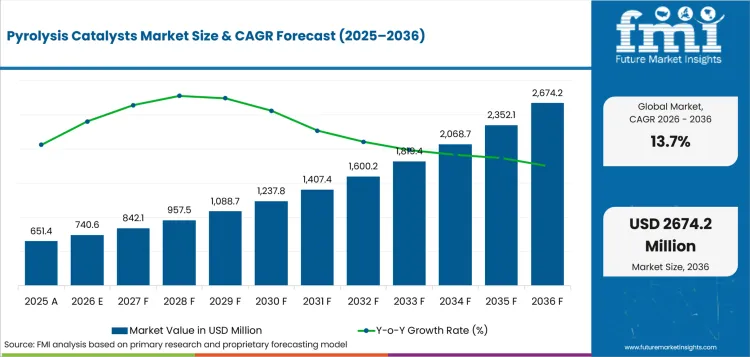
Pyrolysis Catalysts Market Overview: Size and Forecast
- 2025 Market Size: USD 651.4 million
- 2026 Market Size: USD 740.6 million
- 2036 Market Size: USD 2,674.2 million
- Forecast CAGR: 13.7% from 2026 to 2036
- Leading Sales Mix: New Plants
- New Plants Share in 2026: 62.0%
- Leading Feedstock: Plastic Waste
- Plastic Waste Share in 2026: 54.0%
- Fastest-growing Country: China
- China CAGR: 15.2% by 2036
Summary of the Pyrolysis Catalysts Market
- Demand and Growth Drivers
- Plastic waste processors are shifting from basic thermal oil production toward catalyst-aided upgrading for cleaner naphtha-range and fuel-range output.
- Petrochemical buyers are giving more attention to pyrolysis oil purification before steam cracker and refinery co-processing acceptance.
- Biomass and tire-derived oil projects are adding demand for deoxygenation, sulfur control, hydrogenation, and aromatics management.
- Product and Segment View
- New Plants are projected to represent 62.0% share in 2026, led by first-fill catalyst purchases linked to greenfield and retrofit recycling projects.
- Plastic Waste is expected to hold 54.0% share in 2026, supported by large recoverable hydrocarbon pools from mixed and polyolefin-rich streams.
- Fluidized-bed reactors are forecast to secure 48.0% share in 2026, influenced by continuous heat transfer needs in high-volume waste conversion.
- Geography and Competitive Outlook
- China is projected to record 15.2% CAGR by 2036, backed by waste scale and petrochemical integration.
- India is expected to expand at 14.8% CAGR by 2036, supported by formal plastic waste processing networks and EPR-linked recovery.
- BASF, Ketjen, Axens, Topsoe, Honeywell UOP, Clariant, and Zeolyst International compete through purification, hydroprocessing, zeolite, and process-linked catalyst offerings.
- Specialist suppliers gain advantage when guard-bed design, spent catalyst handling, pilot testing, and regeneration support reduce the risk of plant downtime.
- Analyst Opinion
- Nikhil Kaitwade, Associate Vice President at FMI, says, “Pyrolysis catalysts are becoming a qualification tool rather than a simple conversion input. Buyers want proof that a catalyst can survive chlorine, silicon, nitrogen, sulfur, wax, metals, and shifting plastic composition over longer operating cycles. The real opportunity lies in packages that combine zeolite chemistry, guard-bed protection, pilot testing, and regeneration support. Suppliers that help operators bridge the gap between waste quality and refinery feed specifications should gain stronger repeat business.”
Catalyst demand is being shaped by feedstock quality, operating temperature, and downstream acceptance requirements. The U.S. Environmental Protection Agency stated in May 2026 that pyrolysis generally operates at 400°C to 800°C, which keeps catalyst stability and fouling resistance central to unit economics. National Renewable Energy Laboratory analysis published in October 2024 linked U.S. plastic production and disposal with 44 million metric tons of landfilled or incinerated waste, creating a large feedstock pool for advanced conversion. NIST’s October 2024 review identified chemical recycling activity across mixed plastics, HDPE, LDPE, polypropylene, and polystyrene streams, showing why catalyst vendors must design systems for multiple impurity profiles rather than one clean laboratory feed.
Which factors support expansion in the pyrolysis catalysts market?
Finished catalyst fills, guard beds, adsorbents, and regeneration services support market value across plastic waste, biomass, tire, and mixed-feedstock conversion routes.
- Market value is supported by first-fill catalyst revenue before replacement and regeneration services create recurring demand.
- Supplier pricing reflects zeolite grade, metal loading, impurity control function, service intensity, and feedstock complexity.
- Revenue improves as operators move from raw pyrolysis oil output toward treated liquids suitable for crackers, refineries, and chemical buyers.
- Buyer confidence rises when catalyst vendors document feed analysis, spent-bed behavior, impurity mapping, and product-quality improvement.
Why is the pyrolysis catalysts market growing?
Plastic waste and biomass processors need catalyst-aided upgrading as raw pyrolysis oils require impurity control before they can become reliable fuels or chemical feedstocks.
Growth outlook has become more structured as chemical recycling moves closer to commercial qualification. The European Commission stated in 2025 that EU packaging rules aim to make all packaging on the EU market recyclable in an economically viable way by 2030. This target supports investment in routes that can handle difficult flexible, multilayer, and contaminated plastic waste. Pyrolysis catalyst demand improves when operators target specification-led output instead of simple oil yield. Suppliers with zeolite systems, hydroprocessing catalysts, selective hydrogenation products, and guard beds are therefore better positioned to convert trials into repeat supply contracts.
How is the pyrolysis catalysts market segmented?
The pyrolysis catalysts industry is segmented by catalyst type, feedstock, application, reactor type, and sales mix.
- Zeolite-based catalysts are projected to secure 46.0% share in 2026, led by shape-selective cracking performance and product slate control in mixed hydrocarbon vapors.
- Plastic Waste is anticipated to hold 54.0% share in 2026 since polyolefin-rich streams create the largest recoverable oil pool and need contaminant control before downstream use.
- Fuel Upgrading is expected to account for 42.0% share in 2026 due to rising demand for usable diesel, gasoline, jet fuel, and naphtha-range outputs from waste-derived liquids.
- Fluidized-bed reactors are forecast to represent 48.0% share in 2026, supported by continuous heat transfer and stronger suitability for high-volume vapor conversion.
- New Plants are estimated to capture 62.0% share in 2026 as first-fill catalyst loading follows new recycling plants, refinery retrofits, and technology-licensor packages.
Why do zeolite-based catalysts dominate the pyrolysis catalysts market?
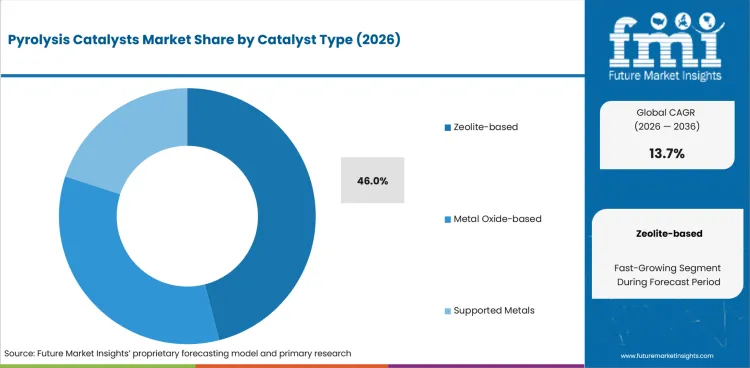
- Zeolite-based catalysts are projected to account for 46.0% share in 2026, influenced by pore structure, acidity control, and selective cracking performance across plastic and biomass vapors.
- Metal oxide-based and supported metal catalysts gain use where oxygen removal, hydrogenation, sulfur control, and biomass vapor stabilization are prioritized ahead of aromatics yield.
Which feedstock leads the pyrolysis catalysts market?
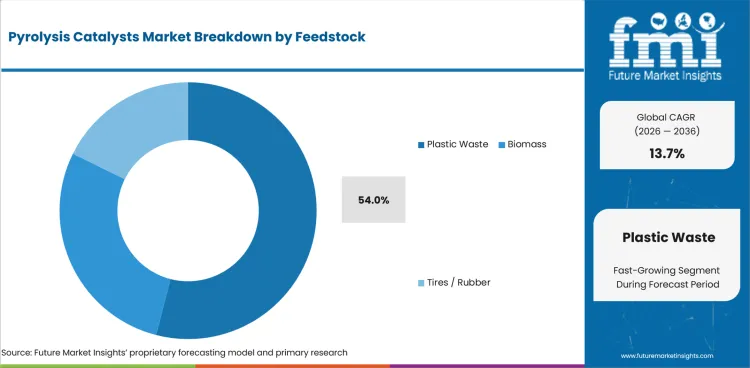
- Plastic Waste is expected to represent 54.0% share in 2026 through large polyolefin availability, higher catalyst service needs, and stronger connection to petrochemical feedstock demand.
- Biomass creates additional catalyst demand as oxygen-rich vapors need deoxygenation and stabilization before they can qualify for higher-value fuel or chemical routes.
Which application leads the pyrolysis catalysts market?
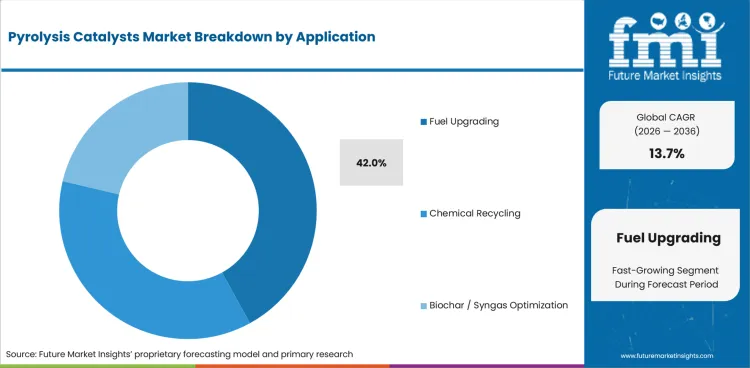
- Fuel Upgrading is anticipated to hold 42.0% share in 2026, reflected by operator preference for cleaner liquids that can move into naphtha, diesel, and fuel-blending channels.
- Chemical Recycling gains importance as brand owners and polymer producers seek circular feedstocks that can support mass-balance claims and specification-led polymer production.
Which reactor type leads the pyrolysis catalysts market?
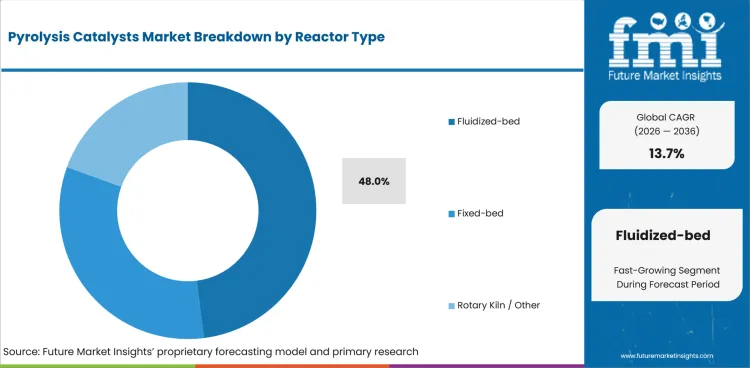
- Fluidized-bed reactors are projected to account for 48.0% share in 2026, led by efficient heat transfer and better fit with continuous plastic and biomass vapor processing.
- Fixed-bed systems retain relevance in smaller or more controlled installations where simplicity, catalyst containment, and lower operating complexity support project economics.
Which sales mix leads the pyrolysis catalysts market?
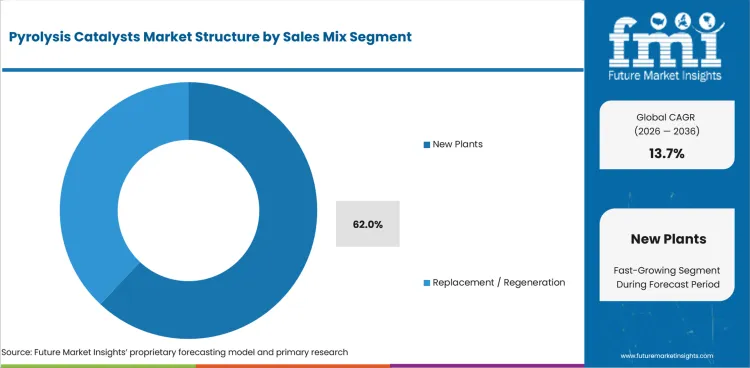
- New Plants are estimated to represent 62.0% share in 2026, shaped by greenfield chemical recycling projects and first-fill catalyst procurement before full utilization begins.
- Replacement / Regeneration demand gains value after plant start-up as fouling, coke formation, and spent catalyst handling become tied to operating reliability.
What are the drivers, restraints, and opportunities in the pyrolysis catalysts market?
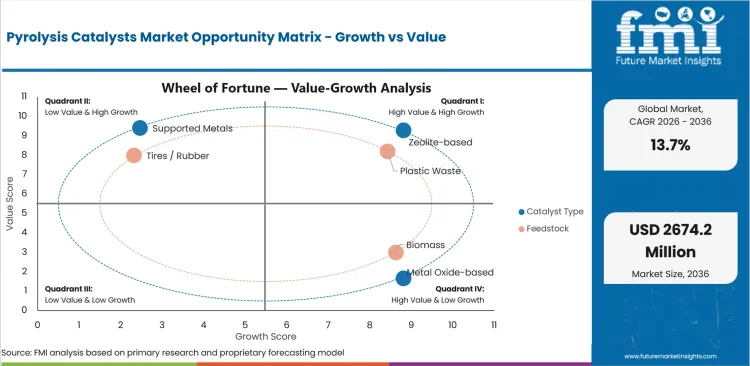
Feed impurity control and refinery integration support adoption while feed variability and project scrutiny limit wider deployment.
- Plastic waste and biomass operators need catalyst packages that convert variable oils into cleaner outputs, making product quality easier to sell into fuel and chemical channels.
- Feed contamination, coke formation, hydrogen demand, and permitting scrutiny slow full-scale conversion because each factor can change operating cost and product acceptance.
- Guard-bed, regeneration, and catalyst service bundles can create recurring revenue beyond first-fill sales, especially when operators need help stabilizing variable feedstocks.
Plastic Waste Feedstock Qualification
Pyrolysis oil specification control is becoming a stronger demand driver because downstream buyers need proof that waste-derived liquids can enter fuel and chemical systems safely. The U.S. Environmental Protection Agency stated in July 2025 that proposed TSCA rules covered 18 chemicals made from plastic waste-derived feedstocks. This directly supports catalyst demand because treated oils need impurity control before they can move toward transportation fuel or chemical feedstock use. Catalyst suppliers that can show contaminant removal, feed testing, and spent-bed behavior should gain stronger qualification with refinery-linked buyers.
Contaminant Review and Deactivation Pressure
Feedstock variability remains a restraint because mixed plastic waste can carry contaminants that increase catalyst deactivation risk and regulatory review work. OECD stated in October 2024 that mismanaged plastic waste could rise from 81 million metric tons annually in 2020 to 119 million metric tons annually by 2040 without stronger policies. This wider residual waste pressure does not automatically create clean feedstock. Pyrolysis operators must manage sorting quality, chlorine risk, metals, diolefins, and wax formation before catalysts can perform reliably across longer operating cycles.
Guard-bed Service and Circular Feedstock Opportunity
The opportunity lies in guard-bed, regeneration, and process-service packages that help operators convert difficult waste streams into more reliable outputs. UNEP stated in July 2025 that 19 million to 23 million tonnes of plastic waste leaks into aquatic ecosystems every year. That pollution pressure supports investment in routes that recover value from residual plastics, but buyers need more than a basic catalyst fill. Suppliers offering impurity mapping, front-end guard beds, replacement planning, and regeneration support can create higher-value relationships with waste processors and petrochemical customers.
Which countries are growing fastest in the pyrolysis catalysts market?
China 15.2% CAGR, India 14.8% CAGR, South Korea 14.5% CAGR, Germany 13.9% CAGR, United States 13.6% CAGR, France 13.3% CAGR, United Kingdom 12.9% CAGR, and Japan 12.6% CAGR through 2036.
.webp "Top Country Growth Comparison Pyrolysis Catalysts Market Cagr (2026 2036)")
| Country | CAGR |
|---|---|
| China | 15.2% |
| India | 14.8% |
| South Korea | 14.5% |
| Germany | 13.9% |
| United States | 13.6% |
| France | 13.3% |
| United Kingdom | 12.9% |
| Japan | 12.6% |
Source: Future Market Insights, 2026.
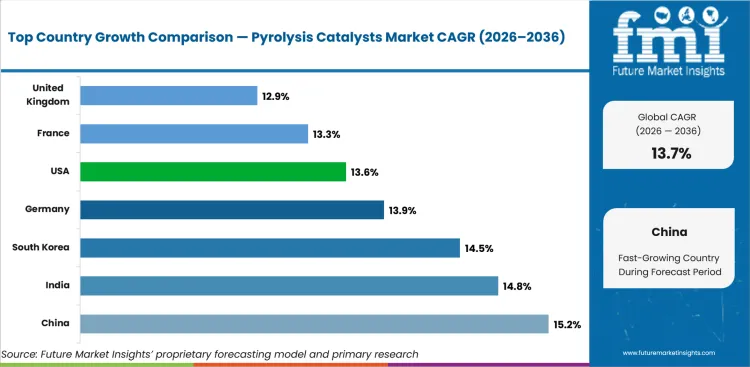
How do country-level CAGRs compare in the pyrolysis catalysts market?
China leads country expansion while Japan records the most cautious expansion outlook among profiled markets.
- China is forecast to record 15.2% CAGR by 2036 as plastic waste scale and petrochemical integration support large catalyst trials.
- India is expected to expand at 14.8% CAGR from 2026 to 2036 due to formal EPR-linked plastic waste processing networks.
- South Korea is projected to grow at 14.5% CAGR through 2036 as sorting discipline and petrochemical offtake support specification-led demand.
- Germany is estimated to rise at 13.9% CAGR by 2036 with strict recycling rules and chemical cluster demand shaping catalyst qualification.
- The United States is expected to advance at 13.6% CAGR over the forecast period as early commercial pyrolysis sites drive feed testing.
- France is forecast to grow at 13.3% CAGR through 2036 as technology licensors support pyrolysis oil purification routes.
- The United Kingdom is projected to post 12.9% CAGR by 2036 as packaging compliance creates demand for difficult plastic recovery routes.
- Japan is expected to expand at 12.6% CAGR by 2036 as quality-first procurement and longer qualification cycles moderate adoption.
How fast is the pyrolysis catalysts market growing in China?
A 15.2% CAGR through 2036 reflects plastic waste scale, petrochemical integration, and domestic catalyst qualification activity.
Country Market Snapshot Table
| Parameter | Value |
|---|---|
| Market Size in 2025 (Value) | USD 140.6 million |
| Market Size in 2026 (Value) | USD 162.0 million |
| Market Forecast in 2036 (Value) | USD 666.9 million |
| CAGR (2026 to 2036) | 15.2% |
| Years Considered | 2021 to 2036 |
| Base Year | 2025 |
| Forecast Period | 2026 to 2036 |
| Units Considered | Value (USD million) |
| Leading Sub-Region | Yangtze River Delta and coastal petrochemical corridors |
China Pyrolysis Catalysts Market Outlook
China pyrolysis catalyst demand is influenced by large plastic waste availability and the presence of petrochemical complexes that can evaluate treated pyrolysis oils. Domestic catalyst suppliers and state-linked industrial chains can support faster qualification when reactor design, feedstock sourcing, and downstream offtake are coordinated.
Project developers are expected to favor catalyst suppliers that combine local service teams with impurity control and feed testing. Stronger domestic recycling policy supports trial activity, although feedstock variability across provinces keeps catalyst life and quality control under close review.
Key Growth Drivers
- Large waste availability supports high-volume catalyst trials. SWITCH-Asia’s 2025 China profile estimated annual plastic waste generation at 55,697,000 tonnes.
- Policy-backed urban circularity programs support organized feedstock recovery. SWITCH-Asia reported that China’s zero-waste city programme was planned to scale across 100 cities during the 2021 to 2025 period.
- Domestic petrochemical integration gives treated pyrolysis oil a clearer route into refining, cracking, and chemical production systems.
- Local catalyst supply can shorten response time when operators need revised guard beds, replacement shipments, and process tuning during start-up.
Key Restraints
- Feed quality varies by province and collection channel, which raises deactivation risk and increases the need for prequalification.
- Plastic waste mismanagement limits clean feedstock access. SWITCH-Asia estimated 13,974,000 tonnes of China’s plastic waste was mismanaged in its 2025 profile.
- Local price competition can reduce margins for imported catalyst suppliers unless they provide stronger service support.
What makes China unique
China is unique due to the combination of plastic waste scale, petrochemical integration, and domestic catalyst manufacturing depth.
Key Companies
- Sinopec Catalyst
- China Petroleum & Chemical Corporation
- CNPC Catalyst entities
- W. R. Grace China
- BASF China
- Honeywell UOP China
- Local zeolite and adsorbent suppliers
Sales & Marketing Channels
- Direct sales to petrochemical groups
- State-owned enterprise procurement
- Local catalyst distributor networks
- Technology institute pilots
- Provincial recycling projects
- EPC-led plant packages
Country Segment Breakdown Table
| Segment | Sub-Segments |
|---|---|
| By Catalyst Type | Zeolite-based · Metal Oxide-based · Supported Metals · Other |
| By Feedstock | Plastic Waste · Biomass · Tires / Rubber · Mixed Feedstock |
| By Application | Fuel Upgrading · Chemical Recycling · Biochar / Syngas Optimization · Other |
| By Reactor Type | Fluidized-bed · Fixed-bed · Rotary Kiln / Other |
| By Sales Mix | New Plants · Replacement / Regeneration |
| Key Sub-Regions Covered, Petrochemical and Recycling Clusters | Yangtze River Delta · Pearl River Delta · Shandong · Hebei · Jiangsu · Zhejiang |
Frequently Asked Questions
How fast is China pyrolysis catalysts market growing?
Sales in China are ready to scale at 15.2% CAGR from 2026 to 2036, guided by plastic waste scale and petrochemical integration.
Who leads China pyrolysis catalysts market?
Sinopec Catalyst, CNPC-linked catalyst entities, BASF China, Honeywell UOP China, and domestic zeolite suppliers compete through local technical service and petrochemical channels.
What is driving adoption in China pyrolysis catalysts market?
Large plastic waste availability and petrochemical offtake options are moving operators toward catalyst-aided pyrolysis oil upgrading.
What is driving pyrolysis catalysts growth in India?
A 14.8% CAGR through 2036 is supported by formal EPR-linked plastic waste processing and price-performance catalyst demand.
Country Market Snapshot Table
| Parameter | Value |
|---|---|
| Market Size in 2025 (Value) | USD 27.9 million |
| Market Size in 2026 (Value) | USD 32.0 million |
| Market Forecast in 2036 (Value) | USD 127.2 million |
| CAGR (2026 to 2036) | 14.8% |
| Years Considered | 2021 to 2036 |
| Base Year | 2025 |
| Forecast Period | 2026 to 2036 |
| Units Considered | Value (USD million) |
| Leading Sub-Region | Gujarat and Maharashtra petrochemical corridors |
India Pyrolysis Catalysts Market Outlook
India demand is shaped by a formalizing plastic waste ecosystem and a large base of processors evaluating cleaner oil output. Catalyst adoption is expected to rise where waste processors move from basic fuel oil toward specification-led liquids for petrochemical, refinery, and industrial fuel channels.
Suppliers must prove payback under variable feedstock quality and tight working-capital conditions. Guard beds, sulfur-tolerant systems, practical regeneration routes, and distributor-backed service models should support faster adoption than premium-only catalyst packages.
Key Growth Drivers
- Formal EPR registration creates a wider buyer base. India’s Press Information Bureau reported 60,128 registered producers, importers, and brand owners on the centralized portal in March 2026.
- Processor registration supports feedstock aggregation and catalyst trials. The same government update reported 3,012 registered plastic waste processors in March 2026.
- Gujarat and Maharashtra petrochemical clusters can support routes for treated plastic-derived oils.
- Tire pyrolysis activity creates additional demand for sulfur-tolerant catalyst systems and aromatic-management support.
Key Restraints
- Mixed informal feedstock raises chlorine, ash, and metal contamination risk before catalytic upgrading.
- Working-capital limits can delay replacement cycles for smaller operators even when spent catalyst performance declines.
- India reported around 207 lakh tonnes of plastic packaging waste recycled after EPR guidelines came into force, which indicates scale but also raises documentation pressure for verified recovery routes.
What makes India unique
India is unique due to price-performance buying behavior and the need to prove catalyst payback under variable feedstock conditions.
Key Companies
- Indian Oil Corporation catalyst and refining channels
- Reliance Industries recycling and petrochemical channels
- Bharat Petroleum refinery-linked channels
- BASF India
- Honeywell UOP India
- Local adsorbent and catalyst distributors
- Tire pyrolysis technology suppliers
Sales & Marketing Channels
- Direct sales to waste processors
- Distributor-led catalyst supply
- EPC packages for pyrolysis plants
- Petrochemical offtake discussions
- State pollution compliance consultants
- Tire recycling networks
Country Segment Breakdown Table
| Segment | Sub-Segments |
|---|---|
| By Catalyst Type | Zeolite-based · Metal Oxide-based · Supported Metals · Other |
| By Feedstock | Plastic Waste · Biomass · Tires / Rubber · Mixed Feedstock |
| By Application | Fuel Upgrading · Chemical Recycling · Biochar / Syngas Optimization · Other |
| By Reactor Type | Fluidized-bed · Fixed-bed · Rotary Kiln / Other |
| By Sales Mix | New Plants · Replacement / Regeneration |
| Key Sub-Regions Covered, Waste Processing and Petrochemical Corridors | Gujarat · Maharashtra · Tamil Nadu · Telangana · Delhi NCR · Karnataka |
Frequently Asked Questions
How fast is India pyrolysis catalysts market growing?
Demand in India is ready to rise at 14.8% CAGR from 2026 to 2036 with EPR-linked plastic waste processing.
Who leads India pyrolysis catalysts market?
Indian Oil, Reliance-linked petrochemical channels, BASF India, Honeywell UOP India, and local catalyst distributors compete through refinery access and service networks.
What is driving adoption in India pyrolysis catalysts market?
Formal EPR networks and variable waste processing needs are moving operators toward guard beds and catalyst-supported oil upgrading.
How is the pyrolysis catalysts market performing in South Korea?
A 14.5% CAGR through 2036 reflects petrochemical capacity, strong sorting discipline, and recycled-content policy pressure.
Country Market Snapshot Table
| Parameter | Value |
|---|---|
| Market Size in 2025 (Value) | USD 30.6 million |
| Market Size in 2026 (Value) | USD 35.0 million |
| Market Forecast in 2036 (Value) | USD 135.6 million |
| CAGR (2026 to 2036) | 14.5% |
| Years Considered | 2021 to 2036 |
| Base Year | 2025 |
| Forecast Period | 2026 to 2036 |
| Units Considered | Value (USD million) |
| Leading Sub-Region | Ulsan and Yeosu petrochemical corridors |
South Korea Pyrolysis Catalysts Market Outlook
South Korea demand is supported by strong waste separation habits and petrochemical complexes that can evaluate treated pyrolysis oil. Catalyst buying is expected to favor specification-backed suppliers that can show stable oil quality, residue control, and lower emissions risk.
Public scrutiny of thermal recycling keeps documentation and testing requirements high. Suppliers that support transparent feed analysis and residue management should be better positioned in petrochemical-linked projects.
Key Growth Drivers
- Recycled-content policy supports demand for higher-quality recovered inputs. The World Bank noted in June 2024 that PET bottles in Korea must include at least 3% recovered PET.
- OECD’s 2025 regional plastics outlook noted Korea’s target to raise municipal plastic waste mechanical recycling from 18% in 2020 to 25% by 2025.
- Ulsan and Yeosu petrochemical complexes create routes for treated pyrolysis oil evaluation.
- High sorting discipline improves feed consistency and can reduce the severity of catalyst deactivation.
Key Restraints
- Public concern over thermal recycling emissions increases documentation needs before project approval.
- Petrochemical offtake terms can delay catalyst purchases when oil quality specifications remain unsettled.
- OECD’s 2025 regional plastics outlook also noted Korea’s plan to lower municipal plastic waste-to-energy recovery from 69% in 2020 to 55% by 2025, keeping policy pressure on recovery route selection.
What makes South Korea unique
South Korea is unique due to its combination of high sorting discipline and petrochemical offtake potential.
Key Companies
- SK Innovation
- LG Chem
- Lotte Chemical
- Hyundai Oilbank
- BASF Korea
- Honeywell UOP Korea
- Imported catalyst and adsorbent distributors
Sales & Marketing Channels
- Petrochemical group procurement
- Waste sorting operator partnerships
- Environmental technology distributors
- Government-backed circularity programs
- Engineering company packages
- Academic pilot collaborations
Country Segment Breakdown Table
| Segment | Sub-Segments |
|---|---|
| By Catalyst Type | Zeolite-based · Metal Oxide-based · Supported Metals · Other |
| By Feedstock | Plastic Waste · Biomass · Tires / Rubber · Mixed Feedstock |
| By Application | Fuel Upgrading · Chemical Recycling · Biochar / Syngas Optimization · Other |
| By Reactor Type | Fluidized-bed · Fixed-bed · Rotary Kiln / Other |
| By Sales Mix | New Plants · Replacement / Regeneration |
| Key Sub-Regions Covered, Petrochemical and Sorting Clusters | Ulsan · Yeosu · Seoul Capital Area · Incheon · Busan · Daesan |
Frequently Asked Questions
How fast is South Korea pyrolysis catalysts market growing?
Industry in South Korea is projected to increase at 14.5% CAGR from 2026 to 2036 through petrochemical-linked recycling demand.
Who leads South Korea pyrolysis catalysts market?
SK Innovation, LG Chem, Lotte Chemical, BASF Korea, and imported catalyst suppliers compete through petrochemical trials and specification support.
What is driving adoption in South Korea pyrolysis catalysts market?
Sorting discipline and petrochemical capacity are moving buyers toward specification-backed pyrolysis catalyst packages.
What is the pyrolysis catalysts market outlook in Germany?
A 13.9% CAGR through 2036 is supported by packaging recovery, chemical clusters, and strict qualification rules.
Country Market Snapshot Table
| Parameter | Value |
|---|---|
| Market Size in 2025 (Value) | USD 50.0 million |
| Market Size in 2026 (Value) | USD 57.0 million |
| Market Forecast in 2036 (Value) | USD 209.5 million |
| CAGR (2026 to 2036) | 13.9% |
| Years Considered | 2021 to 2036 |
| Base Year | 2025 |
| Forecast Period | 2026 to 2036 |
| Units Considered | Value (USD million) |
| Leading Sub-Region | Rhine-Ruhr and Ludwigshafen chemical corridors |
Germany Pyrolysis Catalysts Market Outlook
Germany pyrolysis catalyst demand is influenced by strong chemical production, strict recycling rules, and high technical expectations from downstream buyers. Catalyst sales are expected to depend on proof of oil quality, mass-balance documentation, impurity control, and safe residue handling.
German buyers are likely to use pyrolysis catalysts for difficult residual streams that mechanical recycling cannot process economically. Suppliers with process proof, guard-bed data, and local technical service should gain stronger credibility.
Key Growth Drivers
- Germany offers a large packaging recovery base. The German Environment Agency reported 19 million tonnes of packaging consumption in 2022 in a December 2024 update.
- The European Environment Agency reported in 2025 that Germany’s plastic packaging recycling rate increased above 50% in 2022 for the first time.
- Chemical clusters around Ludwigshafen and Rhine-Ruhr create direct demand for qualified circular feedstock.
- Automotive plastics recovery supports interest in catalyst routes that can process mixed shredder residues and high-performance polymer waste.
Key Restraints
- Environmental permitting and emissions scrutiny raise documentation costs before pyrolysis-linked projects expand.
- High mechanical recycling performance leaves a harder residual feedstock pool for catalyst-aided conversion.
- The German Environment Agency also stated in December 2024 that 2022 packaging consumption remained 18.8% above the 2010 level, keeping waste reduction and recycling scrutiny high.
What makes Germany unique
Germany is unique because catalyst sales depend heavily on compliance proof, certified circular feedstock claims, and rigorous process validation.
Key Companies
- BASF SE
- Clariant
- W. R. Grace Germany
- Zeolyst International European channels
- Axens European channels
- Topsoe European channels
- Chemical recycling project developers
Sales & Marketing Channels
- Direct chemical producer sales
- Refinery and cracker trials
- Engineering procurement contractors
- Certification consultant networks
- Waste sorting operator partnerships
- Automotive recycling consortia
Country Segment Breakdown Table
| Segment | Sub-Segments |
|---|---|
| By Catalyst Type | Zeolite-based · Metal Oxide-based · Supported Metals · Other |
| By Feedstock | Plastic Waste · Biomass · Tires / Rubber · Mixed Feedstock |
| By Application | Fuel Upgrading · Chemical Recycling · Biochar / Syngas Optimization · Other |
| By Reactor Type | Fluidized-bed · Fixed-bed · Rotary Kiln / Other |
| By Sales Mix | New Plants · Replacement / Regeneration |
| Key Sub-Regions Covered, Chemical and Recycling Clusters | North Rhine-Westphalia · Ludwigshafen · Hamburg · Bavaria · Saxony · Lower Saxony |
Frequently Asked Questions
How fast is Germany pyrolysis catalysts market growing?
Sector in Germany is anticipated to grow at 13.9% CAGR from 2026 to 2036 reflecting chemical-cluster demand.
Who leads Germany pyrolysis catalysts market?
BASF, Clariant, Axens, Topsoe, Zeolyst International, and regional technology partners compete through chemical recycling and refinery-facing channels.
What is driving adoption in Germany pyrolysis catalysts market?
Strict recycling rules and chemical feedstock qualification are moving suppliers toward tested pyrolysis catalyst systems.
What is the pyrolysis catalysts market outlook in the United States?
A 13.6% CAGR through 2036 is supported by early commercial pyrolysis assets and refinery-facing qualification work.
Country Market Snapshot Table
| Parameter | Value |
|---|---|
| Market Size in 2025 (Value) | USD 135.6 million |
| Market Size in 2026 (Value) | USD 154.0 million |
| Market Forecast in 2036 (Value) | USD 551.2 million |
| CAGR (2026 to 2036) | 13.6% |
| Years Considered | 2021 to 2036 |
| Base Year | 2025 |
| Forecast Period | 2026 to 2036 |
| Units Considered | Value (USD million) |
| Leading Sub-Region | Texas and Gulf Coast petrochemical networks |
United States Pyrolysis Catalysts Market Outlook
United States demand is shaped by early commercial plastic pyrolysis sites, refinery integration potential, and specialty catalyst supply. Operators need catalyst packages that can handle mixed plastic oils before downstream steam crackers and refineries accept larger volumes.
Regulatory scrutiny and state-level definitions can slow plant conversion, although technical suppliers have strong access to petrochemical buyers. Catalyst vendors with feed testing, guard beds, hydroprocessing capability, and regeneration services should gain stronger repeat listing.
Key Growth Drivers
- EPA’s May 2026 advanced recycling guidance states pyrolysis generally operates at 400°C to 800°C, supporting demand for thermally stable catalysts and impurity-control systems.
- NIST’s October 2024 review identified U.S. pyrolysis activity involving mixed plastics and polyolefin streams, creating at least 5 distinct feed categories that require catalyst qualification.
- Gulf Coast petrochemical clusters create routes for treated pyrolysis oil into crackers and chemical production systems.
- U.S. catalyst suppliers and process licensors give operators access to zeolites, guard beds, hydroprocessing systems, and refinery technical service.
Key Restraints
- State-level permitting language can slow pyrolysis plant approvals and create uneven project timing.
- Environmental scrutiny of emissions and residues raises testing costs before expansion.
- NREL analysis published in October 2024 linked U.S. plastic production and disposal with 44 million metric tons of landfilled or incinerated waste, showing large potential but also a difficult residual feedstock challenge.
What makes the United States unique
The United States is unique because early commercial sites, Gulf Coast petrochemicals, and strong catalyst suppliers create a deep qualification market.
Key Companies
- BASF Corporation
- Honeywell UOP
- Ketjen
- Zeolyst International
- W. R. Grace
- Clariant North America
- Braven Environmental-linked supply chains
Sales & Marketing Channels
- Direct sales to pyrolysis operators
- Refinery technical service contracts
- Petrochemical complex trials
- Technology licensor partnerships
- Catalyst regeneration channels
- Waste processor project alliances
Country Segment Breakdown Table
| Segment | Sub-Segments |
|---|---|
| By Catalyst Type | Zeolite-based · Metal Oxide-based · Supported Metals · Other |
| By Feedstock | Plastic Waste · Biomass · Tires / Rubber · Mixed Feedstock |
| By Application | Fuel Upgrading · Chemical Recycling · Biochar / Syngas Optimization · Other |
| By Reactor Type | Fluidized-bed · Fixed-bed · Rotary Kiln / Other |
| By Sales Mix | New Plants · Replacement / Regeneration |
| Key Sub-Regions Covered, Petrochemical and Recycling Corridors | Texas Gulf Coast · Louisiana · Georgia · North Carolina · Ohio Valley · California |
Frequently Asked Questions
How fast is United States pyrolysis catalysts market growing?
Demand in the United States is ready to rise at 13.6% CAGR from 2026 to 2036 with early commercial pyrolysis qualification.
Who leads United States pyrolysis catalysts market?
BASF, Honeywell UOP, Ketjen, Zeolyst International, W. R. Grace, and Clariant compete based on catalyst depth and refinery-linked service.
What is driving adoption in United States pyrolysis catalysts market?
Commercial pyrolysis assets and Gulf Coast petrochemical integration are moving buyers toward contaminant-control catalyst packages.
How is the pyrolysis catalysts market performing in France?
A 13.3% CAGR through 2036 reflects chemical recycling policy pressure and technology-licensor strength.
Country Market Snapshot Table
| Parameter | Value |
|---|---|
| Market Size in 2025 (Value) | USD 39.7 million |
| Market Size in 2026 (Value) | USD 45.0 million |
| Market Forecast in 2036 (Value) | USD 156.9 million |
| CAGR (2026 to 2036) | 13.3% |
| Years Considered | 2021 to 2036 |
| Base Year | 2025 |
| Forecast Period | 2026 to 2036 |
| Units Considered | Value (USD million) |
| Leading Sub-Region | Normandy and Auvergne-Rhône-Alpes chemical corridors |
France Pyrolysis Catalysts Market Outlook
France demand is shaped by packaging policy, chemical platforms, and technology licensors with refinery and petrochemical experience. Catalyst sales are expected to form around pyrolysis oil purification, steam cracker compatibility, and mixed-plastic conversion.
France differs from other European markets through stronger licensor influence. Axens creates a direct route for purification and process packages, while chemical producers evaluate how waste-derived oils can meet circular feedstock requirements.
Key Growth Drivers
- The European Environment Agency reported in October 2024 that France’s overall packaging recycling rate stood at 67.2% in 2022, creating a strong policy base for higher-quality recovery.
- The same country profile showed plastic packaging recycling at 25.2% in 2022, pointing to difficult plastic streams that need additional recovery routes.
- Axens’ refinery and petrochemical channels support adoption of pyrolysis oil purification systems.
- National circular economy rules keep pressure on plastic packaging recovery and specification-led recycling routes.
Key Restraints
- Local opposition to thermal conversion can affect project timelines and public acceptance before pyrolysis oil projects reach stable commercial operation.
- Plastic packaging recovery gaps require better sorting before catalyst systems perform consistently.
- France remains under recycling-performance scrutiny. The European Commission stated in June 2026 that France’s plastic packaging recycling rate was approximately 25.7% in 2023, below the EU average of 42.1%.
What makes France unique
France is unique due to technology-licensor influence and its ability to export purification know-how into global pyrolysis oil upgrading projects.
Key Companies
- Axens
- TotalEnergies-linked petrochemical channels
- BASF France
- Topsoe European channels
- Veolia-linked recycling networks
- Suez-linked recycling networks
- Refinery technology partners
Sales & Marketing Channels
- Technology licensing teams
- Petrochemical complex trials
- Refinery modernization programs
- Waste management partnerships
- Engineering design firms
- Public circular economy tenders
Country Segment Breakdown Table
| Segment | Sub-Segments |
|---|---|
| By Catalyst Type | Zeolite-based · Metal Oxide-based · Supported Metals · Other |
| By Feedstock | Plastic Waste · Biomass · Tires / Rubber · Mixed Feedstock |
| By Application | Fuel Upgrading · Chemical Recycling · Biochar / Syngas Optimization · Other |
| By Reactor Type | Fluidized-bed · Fixed-bed · Rotary Kiln / Other |
| By Sales Mix | New Plants · Replacement / Regeneration |
| Key Sub-Regions Covered, Chemical and Waste Recovery Clusters | Normandy · Auvergne-Rhône-Alpes · Île-de-France · Grand Est · Provence-Alpes-Côte d’Azur · Hauts-de-France |
Frequently Asked Questions
How fast is France pyrolysis catalysts market growing?
Industry in France is projected to increase at 13.3% CAGR from 2026 to 2036 through purification-led chemical recycling demand.
Who leads France pyrolysis catalysts market?
Axens, BASF France, Topsoe, TotalEnergies-linked channels, and recycling technology partners compete through process packages and petrochemical access.
What is driving adoption in France pyrolysis catalysts market?
Technology licensing and plastic packaging recovery pressure are moving buyers toward pyrolysis oil purification catalysts.
What is driving pyrolysis catalysts growth in the United Kingdom?
A 12.9% CAGR through 2036 is supported by packaging compliance pressure and difficult plastic recovery needs.
Country Market Snapshot Table
| Parameter | Value |
|---|---|
| Market Size in 2025 (Value) | USD 36.3 million |
| Market Size in 2026 (Value) | USD 41.0 million |
| Market Forecast in 2036 (Value) | USD 138.0 million |
| CAGR (2026 to 2036) | 12.9% |
| Years Considered | 2021 to 2036 |
| Base Year | 2025 |
| Forecast Period | 2026 to 2036 |
| Units Considered | Value (USD million) |
| Leading Sub-Region | North West England and Humber chemical corridors |
United Kingdom Pyrolysis Catalysts Market Outlook
United Kingdom demand is influenced by packaging waste reporting and the need to recover contaminated or flexible plastics that mechanical systems reject. Catalyst demand develops through feasibility studies, imported technology packages, and offtake discussions with petrochemical buyers.
British buyers are expected to remain cost-focused and audit-focused. Suppliers with local technical support, clear oil-quality data, and practical guard-bed packages can gain stronger acceptance.
Key Growth Drivers
- DEFRA reported provisional 2024 UK plastic packaging waste of 2,265 thousand tonnes, creating a target stream for advanced recycling routes.
- DEFRA also reported 1,154 thousand tonnes of plastic packaging recycled in 2024, leaving a recovery gap for harder-to-recycle plastics.
- EPR reporting raises the value of documented plastic waste recovery routes.
- Food, retail, and flexible packaging waste create feedstock pools that can support pyrolysis oil upgrading trials.
Key Restraints
- Planning consent and local opposition can delay thermal conversion plants.
- Smaller domestic catalyst production keeps buyers dependent on imported technical packages.
- WRAP reported in 2025 that UK Plastics Pact members had 71.6% of plastic packaging reusable or recyclable, which raises expectations for proof-backed recovery routes.
What makes the United Kingdom unique
The United Kingdom is unique because catalyst demand follows packaging compliance, recycler auditability, and petrochemical offtake quality.
Key Companies
- BASF UK channels
- Johnson Matthey-linked catalyst expertise
- Axens UK channels
- Topsoe UK channels
- ReNew ELP-linked recycling activity
- Plastic Energy technology channels
- Waste management partners
Sales & Marketing Channels
- Waste processor partnerships
- Engineering consultant introductions
- Petrochemical offtake negotiations
- Local authority procurement routes
- Compliance scheme partnerships
- Technology licensing channels
Country Segment Breakdown Table
| Segment | Sub-Segments |
|---|---|
| By Catalyst Type | Zeolite-based · Metal Oxide-based · Supported Metals · Other |
| By Feedstock | Plastic Waste · Biomass · Tires / Rubber · Mixed Feedstock |
| By Application | Fuel Upgrading · Chemical Recycling · Biochar / Syngas Optimization · Other |
| By Reactor Type | Fluidized-bed · Fixed-bed · Rotary Kiln / Other |
| By Sales Mix | New Plants · Replacement / Regeneration |
| Key Sub-Regions Covered, Packaging and Chemical Corridors | Humber · Teesside · North West England · Midlands · Scotland Central Belt · South Wales |
Frequently Asked Questions
How fast is United Kingdom pyrolysis catalysts market growing?
Sector in the United Kingdom is anticipated to grow at 12.9% CAGR from 2026 to 2036 reflecting packaging compliance pressure.
Who leads United Kingdom pyrolysis catalysts market?
BASF UK channels, Axens, Topsoe, Johnson Matthey-linked expertise, Plastic Energy, and waste technology partners compete through process knowledge and offtake support.
What is driving adoption in United Kingdom pyrolysis catalysts market?
Packaging waste recovery needs and audit-ready recycling pressure are moving processors toward catalyst-supported pyrolysis oil upgrading.
What is the pyrolysis catalysts market forecast for Japan?
A 12.6% CAGR through 2036 reflects quality-first procurement and longer qualification cycles.
Country Market Snapshot Table
| Parameter | Value |
|---|---|
| Market Size in 2025 (Value) | USD 34.6 million |
| Market Size in 2026 (Value) | USD 39.0 million |
| Market Forecast in 2036 (Value) | USD 127.8 million |
| CAGR (2026 to 2036) | 12.6% |
| Years Considered | 2021 to 2036 |
| Base Year | 2025 |
| Forecast Period | 2026 to 2036 |
| Units Considered | Value (USD million) |
| Leading Sub-Region | Tokyo Bay and Kansai industrial corridors |
Japan Pyrolysis Catalysts Market Outlook
Japan demand is expected to build from high-quality resource circulation and careful technology qualification. Petrochemical buyers and trading houses are likely to evaluate pyrolysis catalysts through reliability, trace contaminant control, and product consistency.
Japan’s strong sorting systems can improve feedstock consistency, but procurement decisions often take longer. Suppliers with proven reliability and technical documentation should perform better than vendors relying only on yield claims.
Key Growth Drivers
- Japan’s Ministry of the Environment stated in April 2024 that 92 plastic recycling facility projects were adopted from the FY2020 supplementary budget to the FY2024 budget.
- Japan’s Ministry of the Environment also cited 7 biomass plastic production facility projects, supporting adjacent demand for catalyst and process technology evaluation.
- High-quality sorting improves the consistency of pyrolysis feedstock before catalyst upgrading.
- Petrochemical buyers seek naphtha-like recycled inputs that can support circular polymer claims.
Key Restraints
- Long qualification cycles slow supplier switching and delay commercial catalyst commitments.
- Limited land availability and strict site rules restrict larger thermal conversion plants.
- Domestic reuse of recycled plastics remains limited. Trade.gov stated in August 2025 that Japan generated 7.69 million tons of plastic waste in 2023, while only 460,000 tons were recycled and reused domestically.
What makes Japan unique
Japan is unique because feed consistency improves catalyst performance, while quality-first procurement extends the approval cycle.
Key Companies
- Mitsubishi Chemical Group
- JGC Corporation
- Eneos-linked refinery channels
- Mitsui Chemicals-linked channels
- BASF Japan
- Honeywell UOP Japan
- Trading house technology channels
Sales & Marketing Channels
- Direct petrochemical buyer engagement
- Trading house introductions
- Engineering company partnerships
- Government-backed pilot projects
- University and institute trials
- Catalyst distributor networks
Country Segment Breakdown Table
| Segment | Sub-Segments |
|---|---|
| By Catalyst Type | Zeolite-based · Metal Oxide-based · Supported Metals · Other |
| By Feedstock | Plastic Waste · Biomass · Tires / Rubber · Mixed Feedstock |
| By Application | Fuel Upgrading · Chemical Recycling · Biochar / Syngas Optimization · Other |
| By Reactor Type | Fluidized-bed · Fixed-bed · Rotary Kiln / Other |
| By Sales Mix | New Plants · Replacement / Regeneration |
| Key Sub-Regions Covered, Petrochemical and Engineering Corridors | Tokyo Bay · Osaka · Nagoya · Kansai · Kyushu · Chiba |
Frequently Asked Questions
How fast is Japan pyrolysis catalysts market growing?
Sales in Japan are ready to scale at 12.6% CAGR from 2026 to 2036, guided by high-quality recycling projects.
Who leads Japan pyrolysis catalysts market?
Mitsubishi Chemical, JGC, Eneos-linked channels, Mitsui Chemicals-linked channels, BASF Japan, and Honeywell UOP Japan compete through qualification programs.
What is driving adoption in Japan pyrolysis catalysts market?
Government-backed recycling projects and quality-first petrochemical evaluation are moving buyers toward tested catalyst packages.
Who are the leading companies in the pyrolysis catalysts market?
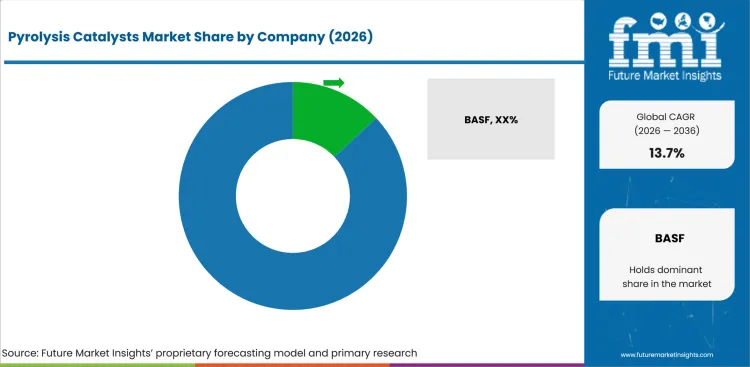
BASF, Ketjen, Axens, Topsoe, Honeywell UOP, Clariant, and Zeolyst International.
- Established catalyst companies hold an advantage through zeolite chemistry, refinery relationships, and impurity-control experience.
- Process-linked technology providers gain buyer confidence by connecting catalyst selection with unit design and downstream feed acceptance.
- Zeolite specialists gain value where cracking selectivity, pore structure, and coke resistance shape plastic vapor upgrading.
- Guard-bed and regeneration suppliers support trial-to-repeat conversion by reducing deactivation risk and replacement uncertainty.
Catalyst groups in the market compete by combining chemistry depth with plant-level qualification support. Buyers compare suppliers based on real-feed testing, contaminant control, spent catalyst behavior, and downstream oil quality. BASF and Ketjen are positioned strongly where waste plastic oil purification, hydroprocessing support, and refinery-facing catalyst services are important. Axens, Topsoe, and Honeywell UOP compete through technology packages that reduce integration risk for petrochemical and refinery buyers.
Service depth has become a competitive separator as pyrolysis projects move beyond laboratory validation. Operators need technical support during feedstock changes, reactor start-up, product-quality testing, and regeneration planning. Suppliers that can support both first-fill and replacement cycles are better placed to defend premium pricing. Scale alone is not enough if catalyst performance cannot handle chlorine, silicon, metals, sulfur, oxygenates, and coke formation under mixed-feed conditions.
Smaller and regional suppliers can win where local plants need affordable zeolite blends, fast replacement shipments, and practical guard-bed packages. China and India create space for domestic suppliers because price discipline and service response matter. Germany, France, Japan, South Korea, and the United States create stricter conditions because buyers expect stronger documentation, compliance proof, and downstream specification support. Companies with verifiable testing and spent catalyst handling should gain more durable listing decisions.
How do top pyrolysis catalysts companies compare?
BASF and Ketjen score strongest on contaminant-control depth while Axens and Topsoe lead process-linked integration.
| Company | Relevance to Market Title | Waste Oil Contaminant Control | Reactor-to-Refinery Integration | Zeolite and Guard-bed Depth | Channel Reach | Geographic Footprint |
|---|---|---|---|---|---|---|
| BASF | Very High | Very Strong | Strong | Very Strong | Very Strong | Global |
| Ketjen | Very High | Very Strong | Very Strong | Very Strong | Strong | Global |
| Axens | Very High | Very Strong | Very Strong | Strong | Strong | Global |
| Topsoe | Very High | Strong | Very Strong | Strong | Strong | Global |
| Honeywell UOP | High | Strong | Very Strong | Strong | Very Strong | Global |
| Clariant | High | Moderate | Strong | Strong | Strong | Global |
| Zeolyst International | High | Moderate | Moderate | Very Strong | Moderate | Global |
| Sinopec Catalyst | Moderate to High | Moderate | Strong | Moderate | Strong | China and Asia |
| W. R. Grace | Moderate to High | Moderate | Moderate | Strong | Strong | Global |
| Johnson Matthey | Moderate | Moderate | Moderate | Strong | Strong | Global |
Source: Future Market Insights competitive analysis, 2026.
Who are the key players in the pyrolysis catalysts market?
BASF, Ketjen, Axens, and Topsoe are listed with Honeywell UOP, Clariant, and Zeolyst International among other suppliers.
Key global companies leading the pyrolysis catalysts market include:
- BASF
- Ketjen
- Axens
- Topsoe
- Honeywell UOP
- Clariant
- Zeolyst International
- Sinopec Catalyst
- W. R. Grace
- Johnson Matthey
Key Developments in Pyrolysis Catalysts Market
- In March 2025, BASF signed a long-term agreement with Braven Environmental for advanced recycled feedstock derived from mixed plastic waste. The agreement supports BASF’s ChemCycling supply route in North America.
- In May 2026, Ketjen partnered with Imubit to introduce real-time catalyst intelligence for FCC and hydroprocessing units. The partnership strengthens catalyst monitoring and operating guidance for refinery-linked applications.
- In April 2026, Topsoe was selected to supply HydroFlex technology for Abundia Global Impact Group’s planned North American plastic waste-to-fuel facilities. The first planned facility is located in Baytown, Texas.
Key Players in the Pyrolysis Catalysts Market
Catalyst Formulators
- BASF
- Ketjen
- Clariant
- W. R. Grace
- Johnson Matthey
Process-Linked Technology Providers
- Axens
- Topsoe
- Honeywell UOP
- Sinopec Catalyst
Zeolite and Adsorbent Specialists
- Zeolyst International
- BASF Chemical Catalysts and Adsorbents
- Grace Davison
- Regional zeolite suppliers
- Local guard-bed suppliers
Pyrolysis Catalysts Market - Report Scope
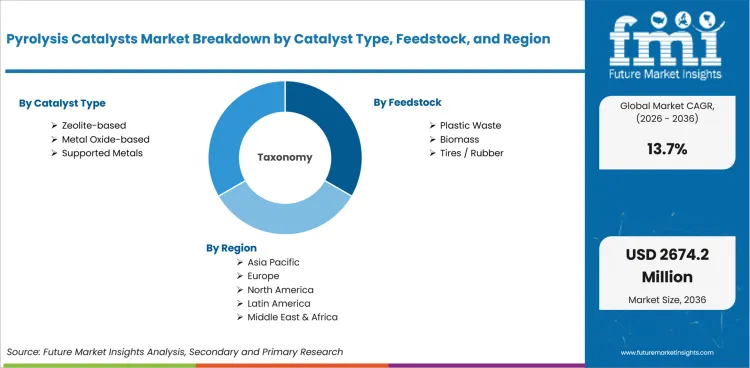
| Parameter | Details |
|---|---|
| Forecast period | 2026 to 2036 |
| Historical period | 2021 to 2025 |
| Quantitative unit | Revenue in USD million |
| By catalyst type | Zeolite-based, metal oxide-based, supported metals, other |
| By feedstock | Plastic waste, biomass, tires / rubber, mixed feedstock |
| By application | Fuel upgrading, chemical recycling, biochar / syngas optimization, other |
| By reactor type | Fluidized-bed, fixed-bed, rotary kiln / other |
| By sales mix | New plants, replacement / regeneration |
| Regions covered | North America, Latin America, Europe, East Asia, South Asia and Pacific, Middle East and Africa |
| Countries covered | United States, United Kingdom, Germany, France, Japan, China, South Korea, India |
| Key companies profiled | BASF, Ketjen, Axens, Topsoe, Honeywell UOP, Clariant, Zeolyst International, Sinopec Catalyst |
Source: Future Market Insights, 2026.
Pyrolysis Catalysts Market - Scope & Definition
| Attribute | Detail |
|---|---|
| Market Definition | Catalysts, guard beds, adsorbents, and catalytic process packages used in thermal conversion and upgrading of plastic waste, biomass, tires, and mixed feedstock |
| Functions Covered | Cracking, deoxygenation, dechlorination, hydrogenation, dewaxing, aromatics formation, sulfur control, and contaminant removal |
| Applications Covered | Fuel upgrading, chemical recycling, biochar / syngas optimization, and other pyrolysis-linked upgrading routes |
| End-Use Industries | Chemical recycling, petrochemicals, refining, waste management, biomass conversion, tire recycling, and circular feedstock production |
| Grades Covered | Zeolite-based, metal oxide-based, supported metals, and other catalyst grades |
| Inclusions | Catalyst fills, guard beds, adsorbents, regeneration services, process-specific catalyst packages, and reactor-specific catalyst products used in pyrolysis conversion or downstream upgrading |
| Exclusions | Non-catalytic incineration, mechanical recycling additives, composting agents, general boiler fuels, basic adsorbents not used in pyrolysis upgrading, and refinery catalysts sold only for conventional crude oil processing |
Pyrolysis Catalysts Market - Research Methodology
| Method | Description |
|---|---|
| Primary Research | FMI analyst interviews with catalyst suppliers, pyrolysis plant operators, refinery integration teams, waste processors, EPC firms, and technology licensors across key markets |
| Desk Research | Review of government recycling policy, chemical recycling evidence, catalyst technical pages, company developments, standards information, and publicly available plant qualification signals |
| Market Sizing & Forecasting | Bottom-up approach using catalyst loading, first-fill demand, replacement rates, regeneration cycles, reactor type, feedstock mix, country-level project readiness, and service intensity |
| Data Validation | Cross-verification using recycling infrastructure, official waste data, company portfolios, feedstock availability, petrochemical integration evidence, and regional adoption patterns |
Pyrolysis Catalysts Market Breakdown by Catalyst Type, Feedstock, Application, Reactor Type, Sales Mix, and Region
Pyrolysis Catalysts Market Segmented by Catalyst Type
- Zeolite-based
- Metal Oxide-based
- Supported Metals
- Other
Pyrolysis Catalysts Market Segmented by Feedstock
- Plastic Waste
- Biomass
- Tires / Rubber
- Mixed Feedstock
Pyrolysis Catalysts Market Segmented by Application
- Fuel Upgrading
- Chemical Recycling
- Biochar / Syngas Optimization
- Other
Pyrolysis Catalysts Market Segmented by Reactor Type
- Fluidized-bed
- Fixed-bed
- Rotary Kiln / Other
Pyrolysis Catalysts Market Segmented by Sales Mix
- New Plants
- Replacement / Regeneration
Pyrolysis Catalysts Market by Region
- North America
- Latin America
- Europe
- East Asia
- South Asia and Pacific
- Middle East and Africa
Research Sources and Bibliography
- Axens. (2026). Plastic recycling technologies and solutions. Axens.
- BASF. (2025, March 11). BASF signs long-term agreement with Braven Environmental for supply of advanced recycled feedstock. BASF.
- BASF Chemical Catalysts and Adsorbents. (2026). PuriCycle® for chemical recycling. BASF.
- Department for Environment, Food & Rural Affairs. (2025, July 23). UK statistics on waste. GOV.UK.
- European Commission. (2025). Packaging waste. European Commission.
- European Commission. (2026, June 3). 2026 country report: France. European Commission.
- European Environment Agency. (2024, October 10). Country profile waste management: France. European Environment Agency.
- European Environment Agency. (2025, March 1). Country profile waste management: Germany. European Environment Agency.
- German Environment Agency. (2024, December 5). Packaging consumption decreased in 2022 and recycling rate increased slightly. Umweltbundesamt.
- International Trade Administration. (2025, August 20). Japan recycled plastic materials. U.S. Department of Commerce.
- Ketjen. (2026). Plastics recycling solutions. Ketjen.
- Ketjen. (2026, May 12). Ketjen partners with Imubit to introduce real-time catalyst intelligence for refinery operations. Ketjen.
- Ministry of the Environment Japan. (2024, April 4). Japan’s policy related to plastic resource circulation. Ministry of the Environment Japan.
- National Institute of Standards and Technology. (2024, October). The U.S. plastics recycling economy: Current state, challenges, and opportunities. U.S. Department of Commerce.
- National Renewable Energy Laboratory. (2024, October 16). A primer on using analysis to guide plastic circularity. National Renewable Energy Laboratory.
- Organisation for Economic Co-operation and Development. (2024, October 2). Global action across the plastics lifecycle could nearly eliminate plastic pollution by 2040. OECD.
- Organisation for Economic Co-operation and Development. (2025, July 30). Regional plastics outlook for Southeast and East Asia. OECD.
- Press Information Bureau. (2026, March 23). Parliament question: Plastic waste management. Government of India.
- SWITCH-Asia Programme. (2025). Plastic policies in China. SWITCH-Asia Programme.
- Topsoe. (2026, April 20). Topsoe to support Abundia Global Impact Group’s innovative plastic waste to fuel projects. Topsoe.
- Topsoe. (2026, April 27). Technology focus: HydroFlex® is giving plastic waste a new life in fuel tanks. Topsoe.
- United Nations Environment Programme. (2025, July 1). Plastic pollution. UNEP.
- U.S. Environmental Protection Agency. (2025, July 14). Rules for chemicals made from plastic waste-based feedstocks under the Toxic Substances Control Act. U.S. Environmental Protection Agency.
- U.S. Environmental Protection Agency. (2026, May 22). Advanced recycling of plastics. U.S. Environmental Protection Agency.
- World Bank. (2024, June). Innovations for plastic circularity in Korea: Enabling conditions and solutions. World Bank.
- Zeolyst International. (2026). Refining. Zeolyst International.
This bibliography is provided for reader reference and is not exhaustive. The full report contains the complete reference list and detailed citations.
This Report Answers
- Market size estimates for 2026 and forecasts through 2036 for the pyrolysis catalysts market.
- Insights across more than 30 regional and country-level markets.
- Analysis of demand drivers, chemical recycling qualification, feedstock quality, and catalyst replacement behavior.
- Evaluation of key catalyst types and feedstocks, including zeolite-based catalysts and plastic waste.
- Assessment of reactor type dynamics across fluidized-bed, fixed-bed, and rotary kiln systems.
- Identification of opportunities across guard beds, regeneration services, and refinery-linked catalyst packages.
- Evaluation of supply chain dynamics, process licensing channels, and technical service structures.
- Country-level growth analysis covering China, India, South Korea, Germany, the United States, France, the United Kingdom, and Japan.
- Assessment of the competitive landscape, including leading catalyst suppliers and process-linked technology providers.
- Analysis of product quality requirements, impurity risks, and downstream acceptance barriers.
- Regional outlooks across North America, Europe, East Asia, and South Asia and Pacific.
- Delivery of market data, forecasts, and supporting analysis in PDF and Excel formats.
Frequently Asked Questions
What is the growth prospect for pyrolysis catalysts?
Demand for pyrolysis catalysts is expected to rise at a considerable pace as waste processors, refiners, and chemical producers seek cleaner output from plastic waste, biomass, and tire-derived oils.
Which companies are expected to shape the pyrolysis catalysts market?
BASF, Ketjen, Axens, Topsoe, Honeywell UOP, Clariant, Zeolyst International, Sinopec Catalyst, W. R. Grace, and Johnson Matthey are expected to shape market competition through catalyst products, process packages, and technical service.
Why are leading catalyst companies investing in pyrolysis catalysts?
Leading catalyst companies are investing in pyrolysis catalysts to support plastic waste conversion, circular feedstock production, refinery co-processing, and higher-quality waste-derived liquids.
Why are guard beds important in the pyrolysis catalysts market?
Guard beds are important because chlorine, metals, silicon, sulfur, diolefins, waxes, and nitrogen compounds can deactivate main catalysts and damage downstream units.
Which catalyst types are gaining attention in pyrolysis catalysts?
Zeolite-based catalysts, metal oxide catalysts, supported metals, and hybrid guard-bed systems are gaining attention as buyers require cracking, deoxygenation, hydrogenation, and contaminant-control functions.
How do regulations influence pyrolysis catalyst adoption?
Regulations influence adoption by shaping recycling claims, waste handling permits, emissions scrutiny, and the documentation required before treated pyrolysis oil enters downstream assets.
Why is feedstock quality important for pyrolysis catalysts?
Feedstock quality determines catalyst life, coke formation, impurity loading, product slate, and the ability of treated oils to meet refinery or petrochemical specifications.
What role does refinery integration play in pyrolysis catalysts?
Refinery integration creates demand for catalyst systems that can upgrade waste-derived oils into cleaner feedstocks for hydroprocessing, FCC co-processing, and steam cracker use.
How do regeneration services support pyrolysis catalyst suppliers?
Regeneration services support repeat revenue by helping operators restore performance, manage spent catalyst, and adjust catalyst loads based on real operating data.
Preview the report firsthand - request a free sample
Get SampleGet the brochure for pricing and purchase details.
Get PDFTable of Content
- Key Takeaways
- Market Size and CAGR
- Top Growth Driver
- Fastest Growing Segment
- Leading Region
- Key Companies
- Emerging Opportunities
- Executive Summary
- Global Market Outlook
- Demand-side Trends
- Supply-side Trends
- Technology Roadmap Analysis
- Analysis and Recommendations
- Analyst Perspective (What is happening? Why now? What should investors know?)
- Key Questions Answered
- How large is the market?
- What is the CAGR?
- What are key trends?
- Which region dominates?
- Who are the leaders?
- Market Overview
- Market Coverage / Taxonomy
- Market Definition / Scope / Limitations
- Research Methodology
- Chapter Orientation
- Analytical Lens and Working Hypotheses
- Market Structure, Signals, and Trend Drivers
- Benchmarking and Cross-market Comparability
- Market Sizing, Forecasting, and Opportunity Mapping
- Research Design and Evidence Framework
- Desk Research Programme (Secondary Evidence)
- Expert Input and Fieldwork (Primary Evidence)
- Tooling, Models, and Reference Databases
- Data Engineering and Model Build
- Quality Assurance and Audit Trail
- Market Background
- Market Dynamics (Drivers, Restraints, Opportunity, Trends)
- Scenario Forecast (Optimistic, Likely, Conservative)
- Impact Analysis
- AI Impact
- Sustainability Impact
- Regulatory Impact
- Technology Impact
- Consumer / Buyer Analysis
- Purchase Drivers
- Adoption Barriers
- Buyer Journey
- Opportunity Map Analysis
- Product Life Cycle Analysis
- Supply Chain Analysis
- Investment Feasibility Matrix
- Value Chain Analysis
- PESTLE and Porter's Analysis
- Regulatory Landscape
- Regional Parent Market Outlook
- Production and Consumption Statistics
- Import and Export Statistics
- Global Market Analysis and Forecast, 2021 to 2036
- Historical Market Size Value (USD Million) & Volume (Unit) Analysis, 2021 to 2025
- Current and Future Market Size Value (USD Million) & Volume (Unit) Projections, 2026 to 2036
- Y-o-Y Growth Trend Analysis
- Absolute $ Opportunity Analysis
- Global Market Pricing Analysis, 2021 to 2036
- Global Market Analysis and Forecast, By Catalyst Type, 2021 to 2036
- Introduction / Key Findings
- Historical Market Size Value (USD Million) & Volume (Unit) Analysis By Catalyst Type, 2021 to 2025
- Current and Future Market Size Value (USD Million) & Volume (Unit) Analysis and Forecast By Catalyst Type, 2026 to 2036
- Zeolite-based
- Metal Oxide-based
- Supported Metals
- Other
- Zeolite-based
- Y-o-Y Growth Trend Analysis By Catalyst Type, 2021 to 2025
- Absolute $ Opportunity Analysis By Catalyst Type, 2026 to 2036
- Global Market Analysis and Forecast, By Feedstock, 2021 to 2036
- Introduction / Key Findings
- Historical Market Size Value (USD Million) & Volume (Unit) Analysis By Feedstock, 2021 to 2025
- Current and Future Market Size Value (USD Million) & Volume (Unit) Analysis and Forecast By Feedstock, 2026 to 2036
- Plastic Waste
- Biomass
- Tires / Rubber
- Mixed Feedstock
- Plastic Waste
- Y-o-Y Growth Trend Analysis By Feedstock, 2021 to 2025
- Absolute $ Opportunity Analysis By Feedstock, 2026 to 2036
- Global Market Analysis and Forecast, By Application, 2021 to 2036
- Introduction / Key Findings
- Historical Market Size Value (USD Million) & Volume (Unit) Analysis By Application, 2021 to 2025
- Current and Future Market Size Value (USD Million) & Volume (Unit) Analysis and Forecast By Application, 2026 to 2036
- Fuel Upgrading
- Chemical Recycling
- Biochar / Syngas Optimization
- Other
- Fuel Upgrading
- Y-o-Y Growth Trend Analysis By Application, 2021 to 2025
- Absolute $ Opportunity Analysis By Application, 2026 to 2036
- Global Market Analysis and Forecast, By Reactor Type, 2021 to 2036
- Introduction / Key Findings
- Historical Market Size Value (USD Million) & Volume (Unit) Analysis By Reactor Type, 2021 to 2025
- Current and Future Market Size Value (USD Million) & Volume (Unit) Analysis and Forecast By Reactor Type, 2026 to 2036
- Fluidized-bed
- Fixed-bed
- Rotary Kiln / Other
- Fluidized-bed
- Y-o-Y Growth Trend Analysis By Reactor Type, 2021 to 2025
- Absolute $ Opportunity Analysis By Reactor Type, 2026 to 2036
- Global Market Analysis and Forecast, By Sales Mix, 2021 to 2036
- Introduction / Key Findings
- Historical Market Size Value (USD Million) & Volume (Unit) Analysis By Sales Mix, 2021 to 2025
- Current and Future Market Size Value (USD Million) & Volume (Unit) Analysis and Forecast By Sales Mix, 2026 to 2036
- New Plants
- Replacement / Regeneration
- New Plants
- Y-o-Y Growth Trend Analysis By Sales Mix, 2021 to 2025
- Absolute $ Opportunity Analysis By Sales Mix, 2026 to 2036
- Global Market Analysis and Forecast, By Region, 2021 to 2036
- Introduction
- Historical Market Size Value (USD Million) & Volume (Unit) Analysis By Region, 2021 to 2025
- Current Market Size Value (USD Million) & Volume (Unit) Analysis and Forecast By Region, 2026 to 2036
- North America
- Latin America
- Western Europe
- Eastern Europe
- East Asia
- South Asia and Pacific
- Middle East & Africa
- Market Attractiveness Analysis By Region
- North America Market Analysis and Forecast, By Country, 2021 to 2036
- Historical Market Size Value (USD Million) & Volume (Unit) Trend Analysis By Market Taxonomy, 2021 to 2025
- Market Size Value (USD Million) & Volume (Unit) Forecast By Market Taxonomy, 2026 to 2036
- By Country
- USA
- Canada
- Mexico
- By Catalyst Type
- By Feedstock
- By Application
- By Reactor Type
- By Sales Mix
- By Country
- Market Attractiveness Analysis
- By Country
- By Catalyst Type
- By Feedstock
- By Application
- By Reactor Type
- By Sales Mix
- Key Takeaways
- Latin America Market Analysis and Forecast, By Country
- Historical Market Size Value (USD Million) & Volume (Unit) Trend Analysis By Market Taxonomy, 2021 to 2025
- Market Size Value (USD Million) & Volume (Unit) Forecast By Market Taxonomy, 2026 to 2036
- By Country
- Brazil
- Chile
- Rest of Latin America
- By Catalyst Type
- By Feedstock
- By Application
- By Reactor Type
- By Sales Mix
- By Country
- Market Attractiveness Analysis
- By Country
- By Catalyst Type
- By Feedstock
- By Application
- By Reactor Type
- By Sales Mix
- Key Takeaways
- Western Europe Market Analysis and Forecast, By Country
- Historical Market Size Value (USD Million) & Volume (Unit) Trend Analysis By Market Taxonomy, 2021 to 2025
- Market Size Value (USD Million) & Volume (Unit) Forecast By Market Taxonomy, 2026 to 2036
- By Country
- Germany
- UK
- Italy
- Spain
- France
- Nordic
- BENELUX
- Rest of Western Europe
- By Catalyst Type
- By Feedstock
- By Application
- By Reactor Type
- By Sales Mix
- By Country
- Market Attractiveness Analysis
- By Country
- By Catalyst Type
- By Feedstock
- By Application
- By Reactor Type
- By Sales Mix
- Key Takeaways
- Eastern Europe Market Analysis and Forecast, By Country
- Historical Market Size Value (USD Million) & Volume (Unit) Trend Analysis By Market Taxonomy, 2021 to 2025
- Market Size Value (USD Million) & Volume (Unit) Forecast By Market Taxonomy, 2026 to 2036
- By Country
- Russia
- Poland
- Hungary
- Balkan & Baltic
- Rest of Eastern Europe
- By Catalyst Type
- By Feedstock
- By Application
- By Reactor Type
- By Sales Mix
- By Country
- Market Attractiveness Analysis
- By Country
- By Catalyst Type
- By Feedstock
- By Application
- By Reactor Type
- By Sales Mix
- Key Takeaways
- East Asia Market Analysis and Forecast, By Country
- Historical Market Size Value (USD Million) & Volume (Unit) Trend Analysis By Market Taxonomy, 2021 to 2025
- Market Size Value (USD Million) & Volume (Unit) Forecast By Market Taxonomy, 2026 to 2036
- By Country
- China
- Japan
- South Korea
- By Catalyst Type
- By Feedstock
- By Application
- By Reactor Type
- By Sales Mix
- By Country
- Market Attractiveness Analysis
- By Country
- By Catalyst Type
- By Feedstock
- By Application
- By Reactor Type
- By Sales Mix
- Key Takeaways
- South Asia and Pacific Market Analysis and Forecast, By Country
- Historical Market Size Value (USD Million) & Volume (Unit) Trend Analysis By Market Taxonomy, 2021 to 2025
- Market Size Value (USD Million) & Volume (Unit) Forecast By Market Taxonomy, 2026 to 2036
- By Country
- India
- ASEAN
- Australia & New Zealand
- Rest of South Asia and Pacific
- By Catalyst Type
- By Feedstock
- By Application
- By Reactor Type
- By Sales Mix
- By Country
- Market Attractiveness Analysis
- By Country
- By Catalyst Type
- By Feedstock
- By Application
- By Reactor Type
- By Sales Mix
- Key Takeaways
- Middle East & Africa Market Analysis and Forecast, By Country
- Historical Market Size Value (USD Million) & Volume (Unit) Trend Analysis By Market Taxonomy, 2021 to 2025
- Market Size Value (USD Million) & Volume (Unit) Forecast By Market Taxonomy, 2026 to 2036
- By Country
- Kingdom of Saudi Arabia
- Other GCC Countries
- Türkiye
- South Africa
- Other African Union
- Rest of Middle East & Africa
- By Catalyst Type
- By Feedstock
- By Application
- By Reactor Type
- By Sales Mix
- By Country
- Market Attractiveness Analysis
- By Country
- By Catalyst Type
- By Feedstock
- By Application
- By Reactor Type
- By Sales Mix
- Key Takeaways
- Key Countries Market Analysis
- USA
- Pricing Analysis
- Market Share Analysis, 2025
- By Catalyst Type
- By Feedstock
- By Application
- By Reactor Type
- By Sales Mix
- Canada
- Pricing Analysis
- Market Share Analysis, 2025
- By Catalyst Type
- By Feedstock
- By Application
- By Reactor Type
- By Sales Mix
- Mexico
- Pricing Analysis
- Market Share Analysis, 2025
- By Catalyst Type
- By Feedstock
- By Application
- By Reactor Type
- By Sales Mix
- Brazil
- Pricing Analysis
- Market Share Analysis, 2025
- By Catalyst Type
- By Feedstock
- By Application
- By Reactor Type
- By Sales Mix
- Chile
- Pricing Analysis
- Market Share Analysis, 2025
- By Catalyst Type
- By Feedstock
- By Application
- By Reactor Type
- By Sales Mix
- Germany
- Pricing Analysis
- Market Share Analysis, 2025
- By Catalyst Type
- By Feedstock
- By Application
- By Reactor Type
- By Sales Mix
- UK
- Pricing Analysis
- Market Share Analysis, 2025
- By Catalyst Type
- By Feedstock
- By Application
- By Reactor Type
- By Sales Mix
- Italy
- Pricing Analysis
- Market Share Analysis, 2025
- By Catalyst Type
- By Feedstock
- By Application
- By Reactor Type
- By Sales Mix
- Spain
- Pricing Analysis
- Market Share Analysis, 2025
- By Catalyst Type
- By Feedstock
- By Application
- By Reactor Type
- By Sales Mix
- France
- Pricing Analysis
- Market Share Analysis, 2025
- By Catalyst Type
- By Feedstock
- By Application
- By Reactor Type
- By Sales Mix
- India
- Pricing Analysis
- Market Share Analysis, 2025
- By Catalyst Type
- By Feedstock
- By Application
- By Reactor Type
- By Sales Mix
- ASEAN
- Pricing Analysis
- Market Share Analysis, 2025
- By Catalyst Type
- By Feedstock
- By Application
- By Reactor Type
- By Sales Mix
- Australia & New Zealand
- Pricing Analysis
- Market Share Analysis, 2025
- By Catalyst Type
- By Feedstock
- By Application
- By Reactor Type
- By Sales Mix
- China
- Pricing Analysis
- Market Share Analysis, 2025
- By Catalyst Type
- By Feedstock
- By Application
- By Reactor Type
- By Sales Mix
- Japan
- Pricing Analysis
- Market Share Analysis, 2025
- By Catalyst Type
- By Feedstock
- By Application
- By Reactor Type
- By Sales Mix
- South Korea
- Pricing Analysis
- Market Share Analysis, 2025
- By Catalyst Type
- By Feedstock
- By Application
- By Reactor Type
- By Sales Mix
- Russia
- Pricing Analysis
- Market Share Analysis, 2025
- By Catalyst Type
- By Feedstock
- By Application
- By Reactor Type
- By Sales Mix
- Poland
- Pricing Analysis
- Market Share Analysis, 2025
- By Catalyst Type
- By Feedstock
- By Application
- By Reactor Type
- By Sales Mix
- Hungary
- Pricing Analysis
- Market Share Analysis, 2025
- By Catalyst Type
- By Feedstock
- By Application
- By Reactor Type
- By Sales Mix
- Kingdom of Saudi Arabia
- Pricing Analysis
- Market Share Analysis, 2025
- By Catalyst Type
- By Feedstock
- By Application
- By Reactor Type
- By Sales Mix
- Türkiye
- Pricing Analysis
- Market Share Analysis, 2025
- By Catalyst Type
- By Feedstock
- By Application
- By Reactor Type
- By Sales Mix
- South Africa
- Pricing Analysis
- Market Share Analysis, 2025
- By Catalyst Type
- By Feedstock
- By Application
- By Reactor Type
- By Sales Mix
- USA
- Market Structure Analysis
- Competition Dashboard
- Competition Benchmarking
- Market Share Analysis of Top Players
- By Regional
- By Catalyst Type
- By Feedstock
- By Application
- By Reactor Type
- By Sales Mix
- Emerging Startups
- Innovation Benchmarking
- Competition Analysis
- Competition Deep Dive
- BASF
- Overview
- Product Portfolio
- Profitability by Market Segments (Product/Region/Sales Channel)
- Sales Footprint
- Strategy Overview
- Marketing Strategy
- Product Strategy
- Channel Strategy
- Ketjen
- Clariant
- W. R. Grace
- Johnson Matthey
- Axens
- Topsoe
- Honeywell UOP
- Sinopec Catalyst
- Zeolyst International
- BASF Chemical Catalysts and Adsorbents
- Grace Davison
- Regional zeolite suppliers
- Local guard-bed suppliers
- BASF
- Case Studies
- Success Stories
- Recent Developments
- Competition Deep Dive
- Assumptions & Acronyms Used


