

- Market Size (2026)
- USD 429.5 Mn
- Forecast (2036)
- USD 733.6 Mn
- CAGR (2026 to 2036)
- 5.5%
How big is Reed Diffusers Market in 2026?
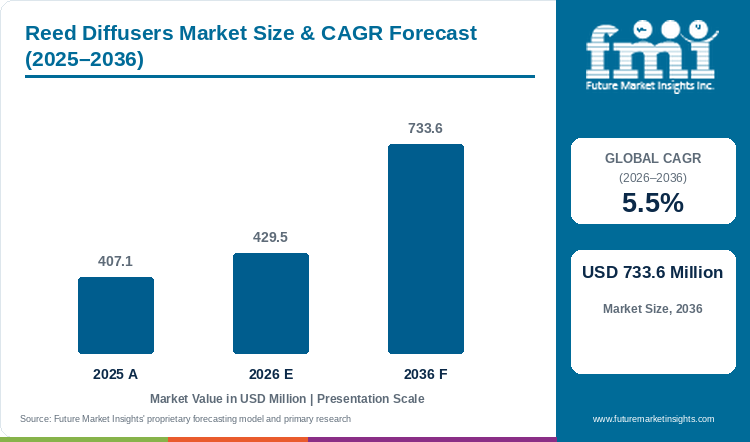
Sales of Reed Diffusers will expand at a 5.5% CAGR between 2026 and 2036. Market value is estimated at USD 429.5 Million in 2026 and will reach USD 733.6 Million by 2036.
FMI values the Reed Diffusers Market at USD 429.5 Million in 2026. Sales are forecast to reach USD 733.6 Million by 2036 at a 5.5% CAGR. The Reed Diffusers Market was valued at approximately USD 407.1 Million in 2025. The category benefits from a simple proposition: continuous room fragrance without power, heat or active spraying. The commercial model extends beyond the first purchase. Consumers initially choose the fragrance and vessel, while repeat revenue comes from refill oils and replacement reeds. This gives reed diffusers a different purchase cycle from much of the wider air freshener market. E-commerce strengthens this model by widening fragrance choice and making replenishment easier. U.S. retail e-commerce reached USD 340.2 billion in Q2 2026 and represented 17.1% of retail sales [3]. For suppliers, the priority is therefore not only gaining the first sale. It is building a product system that makes scent selection clear and brings the customer back for refills.
Key Takeaways
- Passive scent release supports repeat demand because the vessel can remain in use while oil and reeds are replaced.
- Classic reed sets are projected to hold 44.0% of Product Type demand in 2026 because the complete vessel-and-reed system is easy to understand at first purchase.
- Conventional is expected to account for 47.0% of Nature demand in 2026 because established fragrance systems give suppliers broad scent-design flexibility.
- Cream & balm is projected to hold 28.0% of Format demand in 2026.
- Online scent selection remains a key restraint because buyers cannot evaluate fragrance before delivery. European labeling duties add cost when mixtures fall under CLP.
- Profiled companies include Coty and L'Oreal in consumer fragrance. Puig and Estee Lauder Companies bring branded home fragrance. Rasasi, Ajmal Perfumes and Swiss Arabian add regional scent portfolios. Symrise, DSM-Firmenich and Givaudan represent fragrance creation.
Analyst Perspective
“Reed diffusers are easy to understand after the first use. The harder task is helping a buyer choose a scent online and making the refill purchase simple. Brands that solve both steps can build repeat revenue without changing the vessel.”
- Rahul Pandita, Principal Consultant, Future Market Insights.
How is the reed diffusers market segmented?
The market is segmented by Product Type, Nature, Format, Price Positioning, Sales Channel and Region.
Product Type comprises Classic reed sets, Premium ceramic & designer, Refill oils & reeds and Mini & car formats. Nature comprises Conventional, Vegan & cruelty-free, Natural & organic, Dermocosmetic / clinical and Fragrance-free & sensitive. Format comprises Cream & balm, Liquid & serum, Stick & solid, Spray & mist, Sheet & patch and Powder. Price Positioning comprises Mass, Masstige, Premium and Professional. Sales Channel comprises E-commerce & DTC, Specialty beauty retail, Pharmacies & drugstores, Supermarkets & hypermarkets and Salons & spas. Region covers North America, Latin America, Western Europe, Eastern Europe, East Asia, South Asia and Pacific and Middle East and Africa.
Why do Classic reed sets lead demand within the Product Type category?
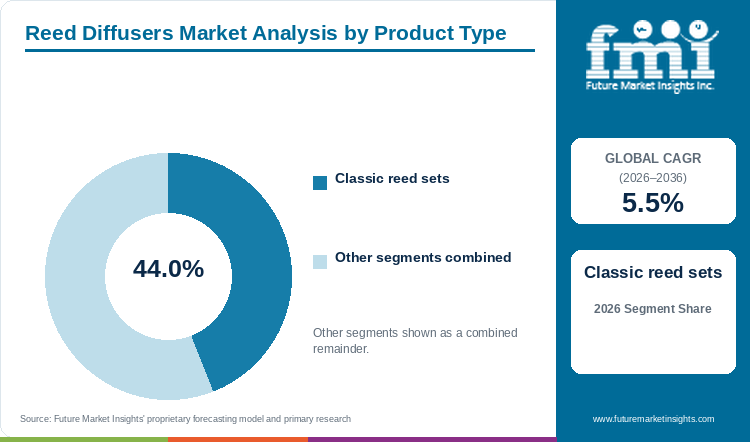
Classic reed sets are projected to hold 44.0% of Product Type demand in 2026.
Classic reed sets combine the fragrance reservoir and reeds in one purchase. That makes the use case clear at shelf and online. The same vessel can stay in the home while refill oil and new reeds are purchased later. Premium ceramic designs and mini formats add choice but do not simplify the first purchase as much as the standard set.
- Classic reed sets are projected to hold 44.0% of Product Type demand in 2026 because the complete system supports both first purchase and later refill sales.
- Symrise presented SymAqua in May 2024 as a water-based air-freshener solution that can also work with fragrance sticks. The development shows continued supplier work on stick-based delivery.
Why does Conventional lead demand within the Nature category?
Conventional is expected to account for 47.0% of Nature demand in 2026.
Conventional formulations let fragrance houses balance intensity and diffusion time across a wide scent library. They also fit established ingredient and compliance workflows. Natural or vegan claims can add value for selected buyers but they do not remove the need for stable scent release. The wider flavors and fragrances market faces the same need to balance performance with formulation rules.
- Conventional is expected to account for 47.0% of Nature demand in 2026 because it gives suppliers the broadest room to balance scent profile and diffusion performance.
- IFRA stated in August 2026 that reed diffusers fall within Category 10B for the relevant phototoxicity treatment under the 52nd Amendment process [1].
Why does Cream & balm lead demand within the Format category?
Cream & balm is projected to hold 28.0% of Format demand in 2026.
Cream & balm is projected to lead the defined Format category at 28.0% in 2026. Across reed-diffuser products the commercial requirement is steady movement of fragrance through the reeds. Buyers also look for stable scent output and refill compatibility. Those performance checks determine whether a format can support repeat purchase.
- Cream & balm is projected to hold 28.0% of Format demand in 2026.
- IFRA continues to treat reed diffusers as a defined air-care product type within its fragrance standards [1].
Why does Mass lead demand within the Price Positioning category?
Mass is projected to hold 32.0% of Price Positioning demand in 2026.
Reed diffusers compete for home-scent spending alongside products in the scented candle market. Mass pricing lowers the cost of trying a new fragrance and works well in supermarkets or large online stores. Premium offers can charge more for vessel design and brand equity. The mass tier remains easier for gifting and first purchase.
- Mass is projected to hold 32.0% of Price Positioning demand in 2026 because accessible pricing lowers the risk of buying an unfamiliar scent.
- Coty launched its Origen fragrance collection on Walmart.com in July 2025 before wider store availability. The launch illustrates how mass retail can support scent discovery at a lower trial threshold.
Why does E-commerce & DTC lead demand within the Sales Channel category?
E-commerce & DTC is projected to hold 29.0% of Sales Channel demand in 2026.
The fragrance diffuser market shows how digital discovery and refill ordering can shape home-scent purchases. E-commerce gives brands room for more fragrances than a physical shelf. It also supports refill reminders after the first purchase. The weakness is sensory because buyers cannot smell a product online. Clear scent descriptions and reviews therefore influence conversion.
- E-commerce & DTC is projected to hold 29.0% of Sales Channel demand in 2026 because wide assortments and repeat refill ordering fit online retail.
- U.S. e-commerce accounted for 17.1% of retail sales in Q2 2026 and grew 12.2% from a year earlier [3].
What are the drivers, restraints and opportunities in the reed diffusers market?
Continuous home scenting supports demand. Online fragrance selection and compliance slow conversion while refill systems create recurring revenue.
- Driver: Consumers can maintain room fragrance for long periods without power or repeated spraying.
- Restraint: Buyers cannot smell a fragrance online and suppliers must manage labeling requirements across markets.
- Opportunity: Refill oil and replacement reeds can extend customer value without requiring a new vessel.
Continuous Scenting Supports Repeat Demand
The main driver is demand for continuous home scent with little effort. A reed diffuser works in the background after setup and does not need power. That makes it suitable for living rooms, bedrooms and hospitality spaces. Refill oil extends the useful life of the vessel and gives brands a recurring purchase.
Scent Discovery and Compliance Slow Conversion
Online scent selection remains difficult because the buyer cannot test the fragrance. The Jo Malone London Scent Advisor was launched to reduce this digital discovery gap [4]. European suppliers also need to meet CLP labelling and packaging requirements when a mixture is hazardous [2]. These factors raise the cost of carrying a wide multi-country scent range.
Refills Extend Customer Value
Refills are the clearest opportunity because consumers can keep the vessel and replace only the fragrance oil or reeds. This lowers the cost of repeat purchase and can support subscriptions or replenishment reminders. Brands can also use online discovery tools to guide buyers toward a smaller set of relevant scents.
Which country CAGRs are profiled in the reed diffusers market?
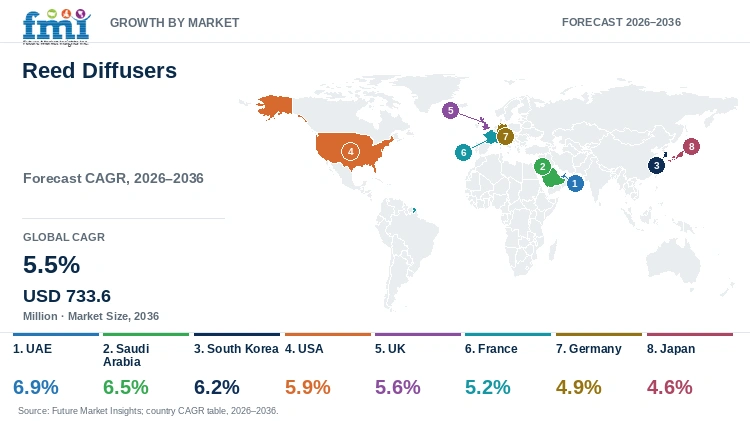
| Country | CAGR |
|---|---|
| UAE | 6.9% |
| Saudi Arabia | 6.5% |
| South Korea | 6.2% |
| USA | 5.9% |
| UK | 5.6% |
| France | 5.2% |
| Germany | 4.9% |
| Japan | 4.6% |
How do country-level CAGRs compare in the reed diffusers market?
UAE leads the profiled group at 6.9% CAGR through 2036. Saudi Arabia follows at 6.5% and South Korea at 6.2%. USA and UK form the middle band while France, Germany and Japan grow more slowly. These rates compare growth pace and do not show absolute country size.
Country-wise Analysis
- UAE is projected to grow at 6.9% CAGR through 2036. Premium fragrance buying and hospitality create several places where reed diffusers can be sold or specified. The strongest route is not tourism alone. Brands need scent profiles that fit local fragrance preferences and refill supply that can support repeat use.
- Saudi Arabia is projected at 6.5% CAGR through 2036. Digital payments and a growing hospitality base widen routes to purchase. Reed-diffuser brands still need clear price tiers because strong fragrance preferences do not remove value sensitivity.
- South Korea is projected at 6.2% CAGR through 2036. Online shopping supports rapid discovery and small assortment changes. Brands need concise scent descriptions because digital shoppers make decisions without direct testing. Distinctive vessels and reliable refills can help convert first purchase into repeat use.
- USA is projected at 5.9% CAGR through 2036. E-commerce gives brands broad reach and supports long-tail scent assortments. Census data show that e-commerce accounted for 17.1% of U.S. retail sales in Q2 2026 [3]. The main commercial challenge is helping buyers choose fragrance confidently before delivery.
- UK is projected at 5.6% CAGR through 2036. Online retail supports direct replenishment and wide fragrance choice. Premium brands benefit from gifting and home-fragrance use but still need digital tools that replace some of the guidance available in store.
- France is projected at 5.2% CAGR through 2036. The market combines strong fragrance knowledge with selective home and decor spending. Reed-diffuser brands need clear scent stories and attractive vessels while refills provide a lower-cost repeat purchase.
- Germany is projected at 4.9% CAGR through 2036. Mature online shopping reduces access friction. EU CLP duties still shape labels and packaging for relevant fragrance mixtures [2]. Brands compete on execution quality rather than digital availability alone.
- Japan is projected at 4.6% CAGR through 2036. Reed diffusers need to work in both online and physical discovery because scent and design remain difficult to judge from specifications. Compact presentation and consistent refill quality can support repeat purchase in a mature home-goods market.
Who are the notable companies in the reed diffusers market?
The profiled set includes Coty and L'Oreal in consumer fragrance. Rasasi and Ajmal Perfumes add regional fragrance channels. Puig and Estee Lauder Companies bring prestige home fragrance while Swiss Arabian adds a reed-diffuser category. Symrise, DSM-Firmenich and Givaudan represent fragrance creation.
Competition separates by role. Puig and Estee Lauder Companies participate through prestige home-fragrance brands with reed-diffuser offers. Swiss Arabian maintains a reed-diffuser category. Coty and L'Oreal bring consumer-fragrance channels alongside Rasasi and Ajmal Perfumes. Symrise, DSM-Firmenich and Givaudan compete upstream through fragrance creation and air-care work.
- Branded reed-diffuser and prestige home-fragrance portfolios: Puig and Swiss Arabian compete alongside Estee Lauder Companies.
- Consumer-fragrance brands with adjacent home-scent channels: Coty and L'Oreal compete alongside Rasasi and Ajmal Perfumes.
- Fragrance creation and air-care solution partners: Symrise and DSM-Firmenich compete alongside Givaudan.
Competitive Benchmarking: Reed Diffusers Market
| Company | Finished Reed-Diffuser Offer | Home / Air-Care Fragrance Capability | Branded DTC / Retail Reach | Geographic Reach |
|---|---|---|---|---|
| Coty | Low | Low | High | More than 125 countries and territories; U.S. mass-retail launch activity documented |
| Rasasi | Low | Medium | Medium | UAE direct delivery documented |
| Ajmal Perfumes | Low | Medium | Medium | 100+ stores in India and 3,000+ points of sale worldwide |
| Symrise | Low | High | Low | Global B2B activity with Middle East home-care work |
| DSM-Firmenich | Low | High | Low | Global B2B consumer-fragrance network across major regions |
| Givaudan | Low | High | Low | Global B2B network with a Casablanca development hub |
| Puig | High | Medium | High | Byredo has a documented direct-to-consumer model |
| Swiss Arabian | Medium | Medium | Medium | International e-commerce reed-diffuser category documented |
| Estee Lauder Companies | High | High | High | Jo Malone London operates across a broad international market base |
| L'Oreal | Low | Low | High | Global beauty distribution with strong digital reach |
Scoring basis: Finished Reed-Diffuser Offer measures direct branded reed-diffuser activity. Home / Air-Care Fragrance Capability measures finished home-scent activity or B2B air-care creation depth. Branded DTC / Retail Reach measures consumer commercialization capability. High indicates broad capability. Medium indicates narrower capability. Low indicates limited capability within the criterion.
Key Developments in the Reed Diffusers Market
- In December 2025 Estee Lauder Companies launched the Jo Malone London AI-powered Scent Advisor in the United States and UK. The tool was designed to reduce uncertainty in online fragrance selection [4].
- In October 2025 Symrise presented a Beauty World Middle East concept in Dubai that combined fragrance and home-care ideas around regional scent directions. The work supports faster local briefing for home-fragrance brands.
- In September 2026 Givaudan opened a Fragrance & Beauty development hub in Casablanca with application and perfumery laboratories. The site supports Home Care work alongside other fragrance categories.
Key Players in the Reed Diffusers Market
Branded reed-diffuser and prestige home-fragrance portfolios
- Puig
- Swiss Arabian
- Estee Lauder Companies
Consumer fragrance brands with adjacent home-scent channels
- Coty
- Rasasi
- Ajmal Perfumes
- L'Oreal
Fragrance creation and air-care solution partners
- Symrise
- DSM-Firmenich
- Givaudan
Reed Diffusers Market - Report Scope
| Coverage field | Report scope |
|---|---|
| Market breakdown | Product Type; Nature; Format; Price Positioning; Sales Channel; Region |
| Quantitative Units | USD Million |
| Market Definition | Revenue includes standalone reed diffuser sets and refill oils or reeds sold within the stated segmentation universe. It excludes candles, incense, room sprays, plug-in or electric scenting devices and standalone fragrance-compound revenue. |
| Regions Covered | North America; Latin America; Western Europe; Eastern Europe; East Asia; South Asia and Pacific; Middle East and Africa |
| Countries Covered | USA; Germany; France; UK; Saudi Arabia; UAE; Japan; South Korea |
| Key Companies Profiled | Coty; Rasasi; Ajmal Perfumes; Symrise; DSM-Firmenich; Givaudan; Puig; Swiss Arabian; Estee Lauder Companies; L'Oreal |
| Forecast Period | 2026 to 2036 |
| Approach | Primary and secondary research with market triangulation. |
Reed Diffusers Market - Research Methodology
| Method | Approach |
|---|---|
| Primary Research | FMI conducts primary research with manufacturers, distributors, retailers and procurement participants. Interviews cover product choice, pricing, channel behavior and repeat purchase. |
| Desk Research | Desk research uses government statistics, regulatory publications, standards, company filings and official product information. These sources support market conditions and company activity. |
| Market Sizing and Forecasting | Market sizing combines baseline values with segment structure and country demand conditions. Forecasting considers pricing, refill cycles, channel development and regulatory changes. |
| Data Validation | Market estimates are cross-checked against public data, company activity and primary research. Validation keeps revenue within the stated market definition and avoids overlap with adjacent home-fragrance categories. |
Reed Diffusers Market by Segments
Reed Diffusers Market segmented by Product Type:
- Classic reed sets
- Premium ceramic & designer
- Refill oils & reeds
- Mini & car formats
Reed Diffusers Market segmented by Nature:
- Conventional
- Vegan & cruelty-free
- Natural & organic
- Dermocosmetic / clinical
- Fragrance-free & sensitive
Reed Diffusers Market segmented by Format:
- Cream & balm
- Liquid & serum
- Stick & solid
- Spray & mist
- Sheet & patch
- Powder
Reed Diffusers Market segmented by Price Positioning:
- Mass
- Masstige
- Premium
- Professional
Reed Diffusers Market segmented by Sales Channel:
- E-commerce & DTC
- Specialty beauty retail
- Pharmacies & drugstores
- Supermarkets & hypermarkets
- Salons & spas
Reed Diffusers Market segmented by Region:
- North America
- United States
- Canada
- Latin America
- Brazil
- Mexico
- Argentina
- Chile
- Western Europe
- Germany
- France
- United Kingdom
- Italy
- Spain
- Benelux
- Nordics
- Eastern Europe
- Poland
- Czech Republic
- Romania
- Hungary
- East Asia
- China
- Japan
- South Korea
- South Asia and Pacific
- India
- ASEAN
- Australia and New Zealand
- Middle East and Africa
- GCC Countries
- South Africa
- Türkiye
- Israel
Research Sources and Bibliography
- [1] International Fragrance Association. (2026, August 31). IFRA publishes End of Consultation Letter for the 52nd Amendment to the IFRA Standards. https://ifrafragrance.org/latest-updates/ifra-news/ifra-publishes-end-of-consultation-letter-for-the-52nd-amendment-to-the-ifra-standards
- [2] European Chemicals Agency. (n.d.). Labelling and packaging. https://echa.europa.eu/web/guest/regulations/clp/labelling
- [3] U.S. Census Bureau. (2026, August 18). Quarterly Retail E-Commerce Sales. https://www.census.gov/retail/eCommerce.html
- [4] The Estee Lauder Companies. (2025, December 2). The Estee Lauder Companies and Jo Malone London Introduce AI-Powered Scent Advisor Experience. https://www.elcompanies.com/en/news-and-media/newsroom/press-releases/2025/12-02-2025-121509645
This bibliography lists four external references used in the public article. The full report contains the complete reference list and detailed citations.
This Report Answers
- How large is the Reed Diffusers Market in 2026 and what value is forecast for 2036?
- Which demand pressures support reed-diffuser purchasing and repeat use?
- Why do Classic reed sets hold the leading Product Type position?
- Why does Conventional hold the leading Nature position?
- How do profiled country growth rates differ from 2026 to 2036?
- Which companies supply finished reed diffusers and fragrance-creation capabilities?
- What limits adoption and repeat purchase in reed diffusers?
- What should buyers evaluate before purchasing a reed-diffuser assortment or fragrance solution?
Frequently Asked Questions
How big is the Reed Diffusers Market in 2026 and what is forecast for 2036?
The market is valued at USD 429.5 Million in 2026 and is forecast to reach USD 733.6 Million by 2036. Growth reflects continued spending on passive home-scent systems and refill purchases.
What is the CAGR of the Reed Diffusers Market from 2026 to 2036?
The Reed Diffusers Market is forecast to grow at a 5.5% CAGR from 2026 to 2036. The rate reflects refill demand and wider digital distribution across country markets.
Which Product Type segment leads the Reed Diffusers Market?
Classic reed sets lead Product Type with a 44.0% share in 2026. Their complete vessel-and-reed architecture is easy to understand and supports later refill sales.
Which Nature segment leads the Reed Diffusers Market?
Conventional leads Nature with a 47.0% share in 2026. It gives fragrance developers broad room to balance scent character and diffusion performance.
Which profiled countries have the highest growth rates in the Reed Diffusers Market?
UAE has the highest profiled CAGR at 6.9% through 2036. Saudi Arabia follows at 6.5% and South Korea at 6.2%. These figures compare growth pace rather than absolute country size.
Which companies are active in the Reed Diffusers Market?
The profiled set covers consumer fragrance through Coty and L'Oreal. Rasasi and Ajmal Perfumes add regional fragrance reach. Puig and Estee Lauder Companies bring prestige home fragrance while Swiss Arabian adds a reed-diffuser category. Symrise, DSM-Firmenich and Givaudan represent upstream fragrance creation.
Preview the report firsthand - request a free sample
Get SampleGet the brochure for pricing and purchase details.
Get PDFTable of Content
- Key Takeaways
- Market Size and CAGR
- Top Growth Driver
- Fastest Growing Segment
- Leading Region
- Key Companies
- Emerging Opportunities
- Executive Summary
- Global Market Outlook
- Demand-side Trends
- Supply-side Trends
- Technology Roadmap Analysis
- Analysis and Recommendations
- Analyst Perspective (What is happening? Why now? What should investors know?)
- Key Questions Answered
- How large is the market?
- What is the CAGR?
- What are key trends?
- Which region dominates?
- Who are the leaders?
- Market Overview
- Market Coverage / Taxonomy
- Market Definition / Scope / Limitations
- Research Methodology
- Chapter Orientation
- Analytical Lens and Working Hypotheses
- Market Structure, Signals, and Trend Drivers
- Benchmarking and Cross-market Comparability
- Market Sizing, Forecasting, and Opportunity Mapping
- Research Design and Evidence Framework
- Desk Research Programme (Secondary Evidence)
- Expert Input and Fieldwork (Primary Evidence)
- Tooling, Models, and Reference Databases
- Data Engineering and Model Build
- Quality Assurance and Audit Trail
- Market Background
- Market Dynamics (Drivers, Restraints, Opportunity, Trends)
- Scenario Forecast (Optimistic, Likely, Conservative)
- Impact Analysis
- AI Impact
- Sustainability Impact
- Regulatory Impact
- Technology Impact
- Consumer / Buyer Analysis
- Purchase Drivers
- Adoption Barriers
- Buyer Journey
- Opportunity Map Analysis
- Product Life Cycle Analysis
- Supply Chain Analysis
- Investment Feasibility Matrix
- Value Chain Analysis
- PESTLE and Porter's Analysis
- Regulatory Landscape
- Regional Parent Market Outlook
- Production and Consumption Statistics
- Import and Export Statistics
- Global Market Analysis and Forecast, 2021 to 2036
- Historical Market Size Value (USD Million) Analysis, 2021 to 2025
- Current and Future Market Size Value (USD Million) Projections, 2026 to 2036
- Y-o-Y Growth Trend Analysis
- Absolute $ Opportunity Analysis
- Global Market Pricing Analysis, 2021 to 2036
- Global Market Analysis and Forecast, By Product Type, 2021 to 2036
- Introduction / Key Findings
- Historical Market Size Value (USD Million) Analysis By Product Type, 2021 to 2025
- Current and Future Market Size Value (USD Million) Analysis and Forecast By Product Type, 2026 to 2036
- Classic reed sets
- Premium ceramic & designer
- Refill oils & reeds
- Mini & car formats
- Y-o-Y Growth Trend Analysis By Product Type, 2021 to 2025
- Absolute $ Opportunity Analysis By Product Type, 2026 to 2036
- Global Market Analysis and Forecast, By Nature, 2021 to 2036
- Introduction / Key Findings
- Historical Market Size Value (USD Million) Analysis By Nature, 2021 to 2025
- Current and Future Market Size Value (USD Million) Analysis and Forecast By Nature, 2026 to 2036
- Conventional
- Vegan & cruelty-free
- Natural & organic
- Dermocosmetic / clinical
- Fragrance-free & sensitive
- Y-o-Y Growth Trend Analysis By Nature, 2021 to 2025
- Absolute $ Opportunity Analysis By Nature, 2026 to 2036
- Global Market Analysis and Forecast, By Format, 2021 to 2036
- Introduction / Key Findings
- Historical Market Size Value (USD Million) Analysis By Format, 2021 to 2025
- Current and Future Market Size Value (USD Million) Analysis and Forecast By Format, 2026 to 2036
- Cream & balm
- Liquid & serum
- Stick & solid
- Spray & mist
- Sheet & patch
- Powder
- Y-o-Y Growth Trend Analysis By Format, 2021 to 2025
- Absolute $ Opportunity Analysis By Format, 2026 to 2036
- Global Market Analysis and Forecast, By Price Positioning, 2021 to 2036
- Introduction / Key Findings
- Historical Market Size Value (USD Million) Analysis By Price Positioning, 2021 to 2025
- Current and Future Market Size Value (USD Million) Analysis and Forecast By Price Positioning, 2026 to 2036
- Mass
- Masstige
- Premium
- Professional
- Y-o-Y Growth Trend Analysis By Price Positioning, 2021 to 2025
- Absolute $ Opportunity Analysis By Price Positioning, 2026 to 2036
- Global Market Analysis and Forecast, By Sales Channel, 2021 to 2036
- Introduction / Key Findings
- Historical Market Size Value (USD Million) Analysis By Sales Channel, 2021 to 2025
- Current and Future Market Size Value (USD Million) Analysis and Forecast By Sales Channel, 2026 to 2036
- E-commerce & DTC
- Specialty beauty retail
- Pharmacies & drugstores
- Supermarkets & hypermarkets
- Salons & spas
- Y-o-Y Growth Trend Analysis By Sales Channel, 2021 to 2025
- Absolute $ Opportunity Analysis By Sales Channel, 2026 to 2036
- Global Market Analysis and Forecast, By Region, 2021 to 2036
- Introduction
- Historical Market Size Value (USD Million) Analysis By Region, 2021 to 2025
- Current Market Size Value (USD Million) Analysis and Forecast By Region, 2026 to 2036
- North America
- Latin America
- Western Europe
- Eastern Europe
- East Asia
- South Asia and Pacific
- Middle East and Africa
- Market Attractiveness Analysis By Region
- North America Market Analysis and Forecast, By Country, 2021 to 2036
- Historical Market Size Value (USD Million) Trend Analysis By Market Taxonomy, 2021 to 2025
- Market Size Value (USD Million) Forecast By Market Taxonomy, 2026 to 2036
- By Country
- United States
- Canada
- By Product Type
- By Nature
- By Format
- By Price Positioning
- By Sales Channel
- By Country
- Market Attractiveness Analysis
- By Country
- By Product Type
- By Nature
- By Format
- By Price Positioning
- By Sales Channel
- Key Takeaways
- Latin America Market Analysis and Forecast, By Country
- Historical Market Size Value (USD Million) Trend Analysis By Market Taxonomy, 2021 to 2025
- Market Size Value (USD Million) Forecast By Market Taxonomy, 2026 to 2036
- By Country
- Brazil
- Mexico
- Argentina
- Chile
- By Product Type
- By Nature
- By Format
- By Price Positioning
- By Sales Channel
- By Country
- Market Attractiveness Analysis
- By Country
- By Product Type
- By Nature
- By Format
- By Price Positioning
- By Sales Channel
- Key Takeaways
- Western Europe Market Analysis and Forecast, By Country
- Historical Market Size Value (USD Million) Trend Analysis By Market Taxonomy, 2021 to 2025
- Market Size Value (USD Million) Forecast By Market Taxonomy, 2026 to 2036
- By Country
- Germany
- France
- United Kingdom
- Italy
- Spain
- Benelux
- Nordics
- By Product Type
- By Nature
- By Format
- By Price Positioning
- By Sales Channel
- By Country
- Market Attractiveness Analysis
- By Country
- By Product Type
- By Nature
- By Format
- By Price Positioning
- By Sales Channel
- Key Takeaways
- Eastern Europe Market Analysis and Forecast, By Country
- Historical Market Size Value (USD Million) Trend Analysis By Market Taxonomy, 2021 to 2025
- Market Size Value (USD Million) Forecast By Market Taxonomy, 2026 to 2036
- By Country
- Poland
- Czech Republic
- Romania
- Hungary
- By Product Type
- By Nature
- By Format
- By Price Positioning
- By Sales Channel
- By Country
- Market Attractiveness Analysis
- By Country
- By Product Type
- By Nature
- By Format
- By Price Positioning
- By Sales Channel
- Key Takeaways
- East Asia Market Analysis and Forecast, By Country
- Historical Market Size Value (USD Million) Trend Analysis By Market Taxonomy, 2021 to 2025
- Market Size Value (USD Million) Forecast By Market Taxonomy, 2026 to 2036
- By Country
- China
- Japan
- South Korea
- By Product Type
- By Nature
- By Format
- By Price Positioning
- By Sales Channel
- By Country
- Market Attractiveness Analysis
- By Country
- By Product Type
- By Nature
- By Format
- By Price Positioning
- By Sales Channel
- Key Takeaways
- South Asia and Pacific Market Analysis and Forecast, By Country
- Historical Market Size Value (USD Million) Trend Analysis By Market Taxonomy, 2021 to 2025
- Market Size Value (USD Million) Forecast By Market Taxonomy, 2026 to 2036
- By Country
- India
- ASEAN
- Australia and New Zealand
- By Product Type
- By Nature
- By Format
- By Price Positioning
- By Sales Channel
- By Country
- Market Attractiveness Analysis
- By Country
- By Product Type
- By Nature
- By Format
- By Price Positioning
- By Sales Channel
- Key Takeaways
- Middle East and Africa Market Analysis and Forecast, By Country
- Historical Market Size Value (USD Million) Trend Analysis By Market Taxonomy, 2021 to 2025
- Market Size Value (USD Million) Forecast By Market Taxonomy, 2026 to 2036
- By Country
- GCC Countries
- South Africa
- Türkiye
- Israel
- By Product Type
- By Nature
- By Format
- By Price Positioning
- By Sales Channel
- By Country
- Market Attractiveness Analysis
- By Country
- By Product Type
- By Nature
- By Format
- By Price Positioning
- By Sales Channel
- Key Takeaways
- Key Countries Market Analysis
- United States
- Pricing Analysis
- Market Share Analysis, 2025
- By Product Type
- By Nature
- By Format
- By Price Positioning
- By Sales Channel
- Canada
- Pricing Analysis
- Market Share Analysis, 2025
- By Product Type
- By Nature
- By Format
- By Price Positioning
- By Sales Channel
- Mexico
- Pricing Analysis
- Market Share Analysis, 2025
- By Product Type
- By Nature
- By Format
- By Price Positioning
- By Sales Channel
- Brazil
- Pricing Analysis
- Market Share Analysis, 2025
- By Product Type
- By Nature
- By Format
- By Price Positioning
- By Sales Channel
- Chile
- Pricing Analysis
- Market Share Analysis, 2025
- By Product Type
- By Nature
- By Format
- By Price Positioning
- By Sales Channel
- Germany
- Pricing Analysis
- Market Share Analysis, 2025
- By Product Type
- By Nature
- By Format
- By Price Positioning
- By Sales Channel
- United Kingdom
- Pricing Analysis
- Market Share Analysis, 2025
- By Product Type
- By Nature
- By Format
- By Price Positioning
- By Sales Channel
- Italy
- Pricing Analysis
- Market Share Analysis, 2025
- By Product Type
- By Nature
- By Format
- By Price Positioning
- By Sales Channel
- Spain
- Pricing Analysis
- Market Share Analysis, 2025
- By Product Type
- By Nature
- By Format
- By Price Positioning
- By Sales Channel
- France
- Pricing Analysis
- Market Share Analysis, 2025
- By Product Type
- By Nature
- By Format
- By Price Positioning
- By Sales Channel
- India
- Pricing Analysis
- Market Share Analysis, 2025
- By Product Type
- By Nature
- By Format
- By Price Positioning
- By Sales Channel
- ASEAN
- Pricing Analysis
- Market Share Analysis, 2025
- By Product Type
- By Nature
- By Format
- By Price Positioning
- By Sales Channel
- Australia and New Zealand
- Pricing Analysis
- Market Share Analysis, 2025
- By Product Type
- By Nature
- By Format
- By Price Positioning
- By Sales Channel
- China
- Pricing Analysis
- Market Share Analysis, 2025
- By Product Type
- By Nature
- By Format
- By Price Positioning
- By Sales Channel
- Japan
- Pricing Analysis
- Market Share Analysis, 2025
- By Product Type
- By Nature
- By Format
- By Price Positioning
- By Sales Channel
- South Korea
- Pricing Analysis
- Market Share Analysis, 2025
- By Product Type
- By Nature
- By Format
- By Price Positioning
- By Sales Channel
- Poland
- Pricing Analysis
- Market Share Analysis, 2025
- By Product Type
- By Nature
- By Format
- By Price Positioning
- By Sales Channel
- Hungary
- Pricing Analysis
- Market Share Analysis, 2025
- By Product Type
- By Nature
- By Format
- By Price Positioning
- By Sales Channel
- Türkiye
- Pricing Analysis
- Market Share Analysis, 2025
- By Product Type
- By Nature
- By Format
- By Price Positioning
- By Sales Channel
- South Africa
- Pricing Analysis
- Market Share Analysis, 2025
- By Product Type
- By Nature
- By Format
- By Price Positioning
- By Sales Channel
- UAE
- Pricing Analysis
- Market Share Analysis, 2025
- By Product Type
- By Nature
- By Format
- By Price Positioning
- By Sales Channel
- Saudi Arabia
- Pricing Analysis
- Market Share Analysis, 2025
- By Product Type
- By Nature
- By Format
- By Price Positioning
- By Sales Channel
- United States
- Market Structure Analysis
- Competition Dashboard
- Competition Benchmarking
- Market Share Analysis of Top Players
- By Regional
- By Product Type
- By Nature
- By Format
- By Price Positioning
- By Sales Channel
- Emerging Startups
- Innovation Benchmarking
- Competition Analysis
- Competition Deep Dive
- Coty
- Overview
- Product Portfolio
- Profitability by Market Segments
- Sales Footprint
- Strategy Overview
- Marketing Strategy
- Product Strategy
- Channel Strategy
- Rasasi
- Ajmal Perfumes
- Symrise
- DSM-Firmenich
- Givaudan
- Puig
- Swiss Arabian
- Estee Lauder Companies
- L'Oreal
- Coty
- Case Studies
- Success Stories
- Recent Developments
- Competition Deep Dive
- Assumptions & Acronyms Used


