

- Market Size (2026)
- USD 42.8 Bn
- Forecast (2036)
- USD 76.9 Bn
- CAGR (2026 to 2036)
- 6.0%
How big is Resource Circulation Equipment Market in 2026?
USD 42.8 billion in 2026 and USD 76.9 billion by 2036 at a 6.0% CAGR.
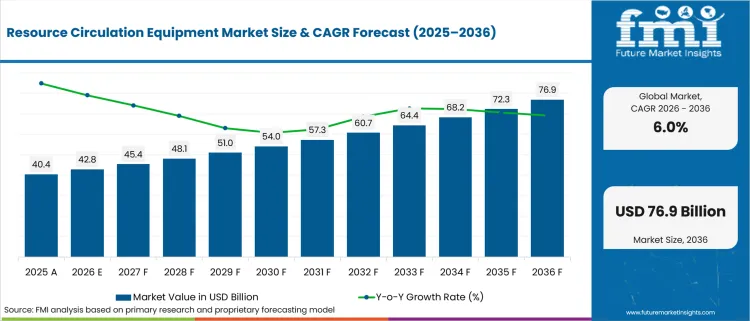
Demand for Resource Circulation Equipment Market is projected to expand at 6.0% CAGR between 2026 and 2036. FMI estimates the Resource Circulation Equipment Market at USD 42.8 billion in 2026. The market is forecast to reach USD 76.9 billion by 2036, corresponding to a 6.0% CAGR over the forecast period after rounding.
The forecast is tied to replacement cycles, new processing capacity and selective retrofits. Equipment revenue rises when collected material volumes exceed existing line capacity, when output specifications tighten or when labor and downtime costs justify added automation. A policy target alone does not create an order. The buyer must have a defined waste stream, an outlet for recovered material and a line design that can meet the required cost per processed tonne.
Key Takeaways of Resource Circulation Equipment Market
- FMI estimates demand to rise from USD 42.8 billion in 2026 to USD 76.9 billion by 2036 at a 6.0% CAGR.
- Sorting Equipment leads Equipment Type with a 34.0% share because separation quality determines the value and saleability of recovered fractions.
- Municipal Solid Waste Recycling leads Application at 36.0%, reflecting the broad equipment mix required to process household and commercial collection streams.
- Waste Management Companies lead End User at 39.0%, while Direct Sales leads Distribution Channel at 42.0% because integrated lines require site-specific engineering and commissioning.
- Fully Automated Equipment holds a 38.0% share as high-throughput plants use controls and automated separation to reduce variation across shifts.
- Feedstock variability, contamination, wear and fire protection and line integration can delay payback even when recovery targets support investment.
- Komatsu Ltd., Hitachi Construction Machinery Co., Ltd., Liebherr Group and Metso Corporation and TOMRA Systems ASA and Terex Corporation and SSI Shredding Systems, Inc. and Machinex Industries Inc. and BHS-Sonthofen GmbH and CP Manufacturing, Inc. form the named competitive set.
Analyst Perspective
"Resource circulation equipment earns its return at the interface between feed variability and a buyer's output specification. A sorting line that lifts recovery but raises downtime, energy use or residual contamination can erase the commercial gain. Suppliers that design around the whole plant balance, test the customer's actual waste stream and support controls plus wear parts after commissioning will be better placed for repeat projects."
- Nikhil Kaitwade, Principal Consultant, Future Market Insights
How is the Resource Circulation Equipment Market segmented?
The Resource Circulation Equipment Market is segmented by equipment type, application, end user, distribution channel, automation level and region.
The market is organized around equipment type, application, end user and distribution channel and automation level and region because each category changes line design and project qualification and after-sales support. The approved taxonomy is retained in full later in this article.
Why does Sorting Equipment lead the Equipment Type category?
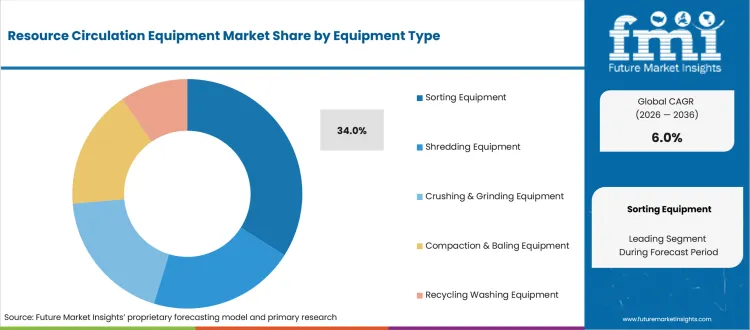
Sorting Equipment holds a 34.0% share in 2026.
- Optical Sorting Systems are selected when color, polymer type or object recognition matters. Magnetic Separation Systems provide a lower-complexity route for ferrous recovery and protect downstream machines from tramp metal.
Why does Municipal Solid Waste Recycling lead the Application category?
Municipal Solid Waste Recycling represents a 36.0% share in 2026.
- Household Waste Recycling places emphasis on packaging separation and contamination control. Commercial Waste Recycling can contain cleaner cardboard or film streams, but the equipment must handle peaks created by retail, hospitality and office collection.
Why do Waste Management Companies lead the End User category?
Waste Management Companies hold a 39.0% share in 2026.
- Municipal Waste Operators tend to buy around public budgets, procurement rules and service obligations. Private Waste Operators can move faster when recovery margin, gate fees and plant utilization support a business case.
Why does Direct Sales lead the Distribution Channel category?
Direct Sales accounts for a 42.0% share in 2026.
- Authorized Distributors extend local sales and service coverage. Regional Distributors provide proximity in fragmented markets, while National Dealers support broader fleets and structured parts inventories.
Why does Fully Automated Equipment lead the Automation Level category?
Fully Automated Equipment holds a 38.0% share in 2026.
- AI-Based Sorting Systems classify difficult objects or material combinations that fixed rules cannot separate reliably. Robotic Material Handling can replace selected manual picks, recover missed value or remove hazardous items from a line.
What are the drivers, restraints and opportunities in the Resource Circulation Equipment Market?
- Driver: Resource-recovery obligations and investment in domestic processing capacity create a need for higher-throughput equipment with measurable output quality.
- Restraint: Feed variability, contamination, wear and fire risk and integration cost can extend commissioning and weaken the expected payback.
- Opportunity: Sensor fusion, AI sorting, robotic picking and connected condition monitoring and modular retrofits can raise recovery without replacing an entire plant.
Which country CAGRs are profiled in the Resource Circulation Equipment Market?
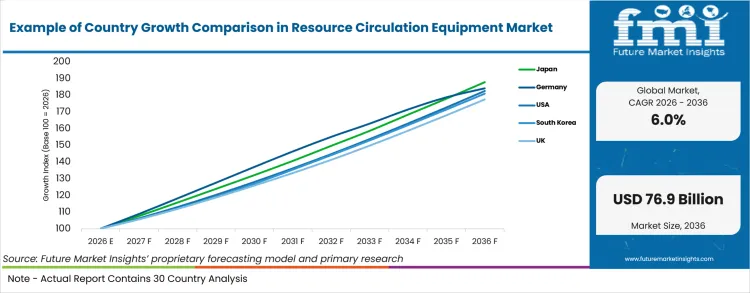
| Country | FMI CAGR, 2026 to 2036 |
|---|---|
| Japan | 6.5% |
| Germany | 6.3% |
| USA | 6.2% |
| South Korea | 6.1% |
| UK | 5.9% |
| Canada | 5.8% |
| Australia | 5.7% |
Country-wise Analysis
- Japan combines established waste and product-specific recycling systems with the Plastic Resource Circulation Act's life-cycle approach. Equipment buyers prioritize controlled sorting, low contamination, compact layouts and dependable service. Municipal and private operators can use automation to maintain output consistency where collection categories and downstream specifications are defined.
- Germany's waste framework and national circular-economy strategy support continued attention to secondary raw materials. The commercial mechanism is often a retrofit: an established plant adds separation, control or energy-efficiency capability to improve purity without interrupting the whole facility. Documentation, safety conformity and service response remain central to approval.
- The USA has a mix of public material recovery facilities, private waste companies, scrap processors and industrial recyclers. Federal recycling infrastructure grants can support local projects, while private investment follows commodity value and disposal economics. Suppliers need modular offers that can fit older plants and different state or municipal collection systems.
- South Korea's circular-economy rules place more emphasis on resource circulation across production and waste treatment. Electronics, metals, plastics and batteries create demand for specialized liberation and separation equipment. Buyers test whether recovered material can meet domestic manufacturing requirements and whether the supplier can manage fire, dust and process-control risks.
- Simpler Recycling changes the timing and consistency of collection requirements in England, while packaging producer responsibility links material choices with system cost. These changes can alter feed volumes at material recovery facilities. Operators may invest in sorting and quality-control positions that protect output value as collection systems converge.
- Canada's policy environment is split across federal action and provincial producer-responsibility systems. Equipment demand therefore varies by province and collection model. Long service distances favor machines with remote diagnostics, local parts support and modular capacity that can be expanded as contracted tonnage grows.
- Australia's National Waste Policy Action Plan and waste-export restrictions support domestic recovery capacity. Capital decisions are shaped by dispersed population centers and transport cost. Fixed plants need a reliable regional feed base, while mobile crushers, screens and shredders can improve the economics of construction and remote processing projects.
Who are the notable companies in the Resource Circulation Equipment Market?
Komatsu Ltd., Hitachi Construction Machinery Co., Ltd., Liebherr Group and Metso Corporation
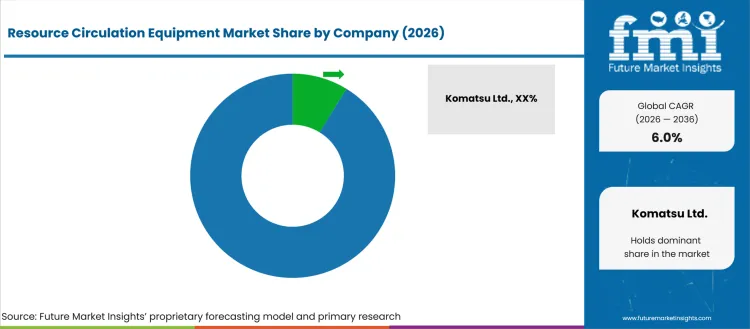
Competition is divided between full-line integrators, process-technology specialists, heavy-equipment suppliers and focused machine manufacturers. A buyer may source the complete plant from one integrator, then qualify specialist equipment for optical sorting, shredding and crushing and washing or material handling. The strongest commercial position comes from proving the mass balance on representative feed and supporting the installed line after handover.
- Komatsu Ltd., Hitachi Construction Machinery Co., Ltd., Liebherr Group and Terex Corporation serve mobile processing or material-handling needs.
- Metso Corporation, TOMRA Systems ASA and BHS-Sonthofen GmbH provide process-specific recovery technology.
- SSI Shredding Systems, Inc. focuses on size reduction.
- Machinex Industries Inc. and CP Manufacturing, Inc. integrate material recovery facilities and in-house sorting equipment.
Competitive Benchmarking: Resource Circulation Equipment Market
| Company | Evidenced role | Equipment and system scope |
|---|---|---|
| Komatsu Ltd. | Mobile site processing and heavy equipment | Mobile crushing plus jobsite equipment for demolition, waste and recycling applications. |
| Hitachi Construction Machinery Co., Ltd. | Recycling-yard handling | Excavators and wheel loaders used for loading, stockpile management and plant feed. |
| Liebherr Group | Waste and scrap material handling | Material handling machines with attachments and configurations for recycling operations. |
| Metso Corporation | Process and recovery technology | Crushing and screening for aggregates, plus integrated e-scrap smelting and refining solutions. |
| TOMRA Systems ASA | Sensor-based and AI sorting | Optical, X-ray, laser and deep-learning applications for waste and plastics and metals. |
| Terex Corporation | Mobile environmental processing | Shredding, screening, separating and composting and conveying and material-handling equipment through Terex Ecotec. |
| SSI Shredding Systems, Inc. | Industrial size reduction | Low-speed, high-torque shredders for e-scrap, plastics and RDF and metals and mixed industrial waste. |
| Machinex Industries Inc. | Turnkey MRF integration | Engineering, in-house equipment, controls and installation and commissioning for customized sorting systems. |
| BHS-Sonthofen GmbH | Liberation and separation | Crushing, cutting, tearing and classification and sorting and full-scale recycling plants. |
| CP Manufacturing, Inc. | MRF systems and retrofit integration | Screens, conveyors, optical and AI sorting and baling and controls and installation and system support. |
Benchmarking is based on documented product and system scope. It does not assign an overall market ranking. Project suitability still depends on feed composition, required purity, throughput and site constraints and installed controls and service coverage.
Key Developments in the Resource Circulation Equipment Market
- In June 2024, Metso Corporation announced an order from Hindalco for an integrated electronic-waste recycling process in Gujarat, India. The stated scope included Kaldo furnaces, an anode furnace, anode casting and gas cleaning and supporting equipment and basic engineering.
- In October 2024, Terex Ecotec reported that its Campsie facility had produced its 1,000th machine during 2024. The milestone machine was a TDS 815 slow-speed shredder.
- In March 2025, TOMRA Systems ASA introduced a GAINnext deep-learning application for upgrading wrought aluminum scrap by removing low-alloy cast material after X-ray sorting.
- In July 2025, SSI Shredding Systems, Inc. announced the SR900F shredder for high-volume refuse-derived fuel production with a one-inch output target.
- In April 2026, CP Manufacturing, Inc. announced the acquisition of a majority stake in Recycleye to combine MRF integration with AI-based vision and sorting technology.
Resource Circulation Equipment Market - Report Scope
| Coverage field | Report scope |
|---|---|
| Market breakdown | Equipment Type, Application, End User and Distribution Channel and Automation Level and Region |
| Quantitative Units | Revenue in USD Billion and CAGR in %. |
| Market Definition | Revenue includes first-sale manufacturer revenue from fixed or mobile machines and integrated systems used to sort, separate, size-reduce and crush and grind and compact and bale and wash and clean and handle or monitor waste and recovered materials within the stated segmentation. Collection-service revenue, treatment fees, recovered-commodity resale and standalone civil works are excluded. |
| Regions Covered | North America; Latin America; Western Europe; Eastern Europe; East Asia; South Asia and Pacific; Middle East and Africa |
| Countries Covered | USA, Canada, Germany and UK and Japan and South Korea and Australia and more than thirty additional countries in the full report |
| Key Companies Profiled | Komatsu Ltd.; Hitachi Construction Machinery Co., Ltd.; Liebherr Group; Metso Corporation; TOMRA Systems ASA; Terex Corporation; SSI Shredding Systems, Inc.; Machinex Industries Inc.; BHS-Sonthofen GmbH; CP Manufacturing, Inc. |
| Forecast Period | 2026 to 2036 |
| Approach | Hybrid bottom-up and top-down sizing using manufacturer revenue, installed-base and project evidence, equipment pricing and application throughput and country indicators and buyer-side validation. |
Resource Circulation Equipment Market - Research Methodology
| Method | Approach |
|---|---|
| Primary Research | FMI analysts gathered input from manufacturers, service providers, technology developers, distributors, end users, sourcing teams, and subject-matter experts. Interviews examined purchasing decisions, product or service evaluation, adoption barriers, approval requirements, pricing considerations, and expectations for technical or commercial support. Respondents were also asked what evidence is required before a trial, pilot, or initial order develops into regular purchasing. |
| Desk Research | Desk research covered government statistics, regulatory publications, trade data, industry associations, technical literature, standards, company filings, product information, and official corporate announcements. Sources were reviewed for relevance, publication date, geographic coverage, and consistency with the defined market scope. Claims relating to performance, applications, approvals, capacity, investment, and commercial activity were retained only when supported by credible public evidence. |
| Market Sizing and Forecasting | The market model combined the baseline value with historical performance, segment structure, pricing and volume indicators, adoption levels, company participation, and country-level demand conditions. Forecast assumptions considered economic activity, investment trends, regulatory developments, technology adoption, purchasing cycles, supply availability, and barriers to wider market use. Segment and regional estimates were reconciled before the final market total was calculated. |
| Data Validation | Estimates were checked against multiple independent indicators, including public data, company activity, trade patterns, industry developments, and findings from primary interviews. Validation also tested whether products, services, applications, and company revenues fell within the defined market boundaries. Adjacent categories, unsupported claims, overlapping revenues, and activities without direct market relevance were excluded to reduce double counting and maintain consistency across segments and countries. |
Resource Circulation Equipment Market by Segments
Resource Circulation Equipment Market segmented by Equipment Type:
- Sorting Equipment
- Optical Sorting Systems
- Magnetic Separation Systems
- Shredding Equipment
- Industrial Shredders
- Dual Shaft Shredders
- Crushing & Grinding Equipment
- Jaw Crushers
- Hammer Mills
- Compaction & Baling Equipment
- Horizontal Balers
- Vertical Balers
- Recycling Washing Equipment
- Plastic Washing Systems
- Metal Cleaning Systems
Resource Circulation Equipment Market segmented by Application:
- Municipal Solid Waste Recycling
- Household Waste Recycling
- Commercial Waste Recycling
- Industrial Waste Recycling
- Metal Scrap Recycling
- Plastic Waste Recycling
- Construction & Demolition Waste
- Concrete Recycling
- Asphalt Recycling
- Electronic Waste Recycling
- WEEE Recycling
- Battery Recycling
- Organic Waste Processing
- Composting Systems
- Biogas Feedstock Processing
Resource Circulation Equipment Market segmented by End User:
- Waste Management Companies
- Municipal Waste Operators
- Private Waste Operators
- Recycling Facilities
- Material Recovery Facilities
- Scrap Recycling Plants
- Industrial Manufacturers
- Automotive Manufacturers
- Electronics Manufacturers
- Government & Municipal Authorities
- Local Governments
- Public Utilities
- Construction Companies
- Demolition Contractors
- Infrastructure Developers
Resource Circulation Equipment Market segmented by Distribution Channel:
- Direct Sales
- OEM Contracts
- Project-Based Sales
- Authorized Distributors
- Regional Distributors
- National Dealers
- Equipment Leasing Companies
- Operating Lease Providers
- Finance Lease Providers
- Online B2B Platforms
- Industrial E-Commerce Platforms
- Manufacturer Websites
- Aftermarket Suppliers
- Replacement Parts Suppliers
- Equipment Service Providers
Resource Circulation Equipment Market segmented by Automation Level:
- Fully Automated Equipment
- AI-Based Sorting Systems
- Robotic Material Handling
- Semi-Automated Equipment
- PLC-Controlled Systems
- Operator-Assisted Equipment
- Manual Equipment
- Manual Sorting Systems
- Manual Baling Equipment
- Smart Connected Equipment
- IoT-Enabled Monitoring
- Predictive Maintenance Systems
Resource Circulation Equipment Market segmented by Region:
- North America
- Latin America
- Western Europe
- Eastern Europe
- East Asia
- South Asia and Pacific
- Middle East and Africa
Resource Circulation Equipment Market by Region:
- North America
- United States
- Canada
- Mexico
- Latin America
- Brazil
- Chile
- Rest of Latin America
- Western Europe
- Germany
- United Kingdom
- Italy
- Spain
- France
- Nordics
- Benelux
- Rest of Western Europe
- Eastern Europe
- Russia
- Poland
- Hungary
- Balkan and Baltic States
- Rest of Eastern Europe
- East Asia
- China
- Japan
- South Korea
- South Asia and Pacific
- India
- ASEAN
- Australia and New Zealand
- Rest of South Asia and Pacific
- Middle East and Africa
- Kingdom of Saudi Arabia
- Other GCC Countries
- Türkiye
- South Africa
- Other African Union Countries
- Rest of Middle East and Africa
Research Sources and Bibliography
- USA Environmental Protection Agency (accessed July 31, 2026). Solid Waste Infrastructure for Recycling Grant Program.
- USA Environmental Protection Agency (accessed July 31, 2026). National Recycling Strategy.
- European Commission (accessed July 31, 2026). Circular Economy Action Plan and Circular Economy Strategy.
- European Commission (accessed July 31, 2026). Waste Framework Directive.
- Ministry of the Environment, Government of Japan (2022). The Plastic Resource Circulation Act.
- Federal Ministry for the Environment, Germany (accessed July 31, 2026). National Circular Economy Strategy.
- Federal Government of Germany (June 3, 2026). Circular Economy Action Programme.
- Federal Statistical Office of Germany (accessed July 31, 2026). Waste Statistics for Europe and Germany.
- Ministry of Environment, Republic of Korea (2025). Accelerating the Transition to a Circular Economy.
- Department for Environment, Food & Rural Affairs, UK (November 29 and 2024). Simpler Recycling in England: Policy Update.
- Department for Environment, Food & Rural Affairs, UK (January 16 and 2025). PackUK, the Scheme Administrator for Packaging Extended Producer Responsibility.
- Environment and Climate Change Canada (accessed July 31, 2026). Canada's Action on Plastic Waste.
- Department of Climate Change, Energy, the Environment and Water and Australia (December 10 and 2024). National Waste Policy Action Plan 2024.
- Komatsu Ltd. (accessed July 31, 2026). Demolition, Waste and Recycling Industry Solutions.
- Hitachi Construction Machinery Co., Ltd. (accessed July 31, 2026). Industry Solutions.
- Liebherr Group (accessed July 31, 2026). Material Handling Machines.
- Metso Corporation (accessed July 31, 2026). eScrap Solutions.
- Metso Corporation (accessed July 31, 2026). Aggregates Recycling Solutions.
- TOMRA Systems ASA (accessed July 31, 2026). Recycling News and Product Developments.
- Terex Corporation (accessed July 31, 2026). Terex Ecotec Environmental Equipment.
- SSI Shredding Systems, Inc. (accessed July 31, 2026). Industrial Shredding Products.
- Machinex Industries Inc. (accessed July 31, 2026). Material Recovery Facilities and Sorting Technologies.
- BHS-Sonthofen GmbH (accessed July 31, 2026). Recycling Technology.
- CP Manufacturing, Inc. (accessed July 31, 2026). Material Recovery Facility Equipment.
- Metso Corporation (June 19, 2024). Metso Secures Order for an Electronic-Waste Recycling Facility in India.
- Terex Corporation (October 1, 2024). Terex Campsie Celebrates Five-Year Anniversary and 1,000th Machine.
- TOMRA Systems ASA (March 31, 2025). Deep Learning-Based Solution to Upgrade Wrought Aluminum Scrap.
- SSI Shredding Systems, Inc. (July 1, 2025). SR900F Shredder Development.
- CP Manufacturing, Inc. (April 14, 2026). CP Group Acquires a Majority Stake in Recycleye.
This bibliography is provided for reader reference and is not exhaustive. The full report contains the complete reference list and detailed citations.
This Report Answers
- What is the Resource Circulation Equipment Market size in 2026 and what value is forecast for 2036?
- Which operating problems convert resource-recovery policy into an equipment purchase?
- Why does Sorting Equipment hold the leading share within Equipment Type?
- How do shredding, crushing, baling and washing requirements change by waste stream?
- Why does Municipal Solid Waste Recycling lead the Application category?
- How do procurement routes differ across direct sales, distributors, leasing and online channels and aftermarket supply?
- When does full automation produce a better return than a semi-automated or manual process?
- How do CAGRs compare across Japan, Germany, USA and South Korea and UK and Canada and Australia?
- Which named companies supply mobile equipment, process technology, shredders or turnkey MRF systems?
- What should a buyer test before approving a resource-circulation equipment line?
Frequently Asked Questions
Which Application leads the market?
Municipal Solid Waste Recycling leads with a 36.0% share because mixed household and commercial streams require several linked processing stages.
Who is the leading End User?
Waste Management Companies hold a 39.0% share in 2026 due to their control of collected volume, processing assets and disposal economics.
Why does Direct Sales lead the Distribution Channel?
Direct Sales holds a 42.0% share because line design, feed testing, installation and controls and commissioning require direct manufacturer involvement.
What is the main restraint on market demand?
The main restraint is system-level execution risk. Variable feed, wear, contamination and safety controls and a poorly balanced line can reduce uptime and delay payback.
Which profiled country has the highest CAGR?
Japan has the highest profiled country CAGR at 6.5% from 2026 to 2036, based on FMI estimates.
Which companies are included in the competitive set?
The named companies are Komatsu Ltd., Hitachi Construction Machinery Co., Ltd., Liebherr Group and Metso Corporation and TOMRA Systems ASA and Terex Corporation and SSI Shredding Systems, Inc. and Machinex Industries Inc. and BHS-Sonthofen GmbH and CP Manufacturing, Inc.
What should buyers evaluate before purchase?
Buyers should evaluate representative feed composition, required output quality, mass balance and throughput and utility demand and fire and dust controls and wear parts and service response and the value of recovered material.
What supports long-term commercial confidence?
Confidence depends on recurring recovery volumes, stable outlets for recovered material, documented uptime and available wear parts and supplier support across controls and maintenance and operator training.
Preview the report firsthand - request a free sample
Get SampleGet the brochure for pricing and purchase details.
Get PDFTable of Content
- Key Takeaways
- Market Size and CAGR
- Top Growth Driver
- Fastest Growing Segment
- Leading Region
- Key Companies
- Emerging Opportunities
- Executive Summary
- Global Market Outlook
- Demand-side Trends
- Supply-side Trends
- Technology Roadmap Analysis
- Analysis and Recommendations
- Analyst Perspective (What is happening? Why now? What should investors know?)
- Key Questions Answered
- How large is the market?
- What is the CAGR?
- What are key trends?
- Which region dominates?
- Who are the leaders?
- Market Overview
- Market Coverage / Taxonomy
- Market Definition / Scope / Limitations
- Research Methodology
- Chapter Orientation
- Analytical Lens and Working Hypotheses
- Market Structure, Signals, and Trend Drivers
- Benchmarking and Cross-market Comparability
- Market Sizing, Forecasting, and Opportunity Mapping
- Research Design and Evidence Framework
- Desk Research Programme (Secondary Evidence)
- Expert Input and Fieldwork (Primary Evidence)
- Tooling, Models, and Reference Databases
- Data Engineering and Model Build
- Quality Assurance and Audit Trail
- Market Background
- Market Dynamics (Drivers, Restraints, Opportunity, Trends)
- Scenario Forecast (Optimistic, Likely, Conservative)
- Impact Analysis
- AI Impact
- Sustainability Impact
- Regulatory Impact
- Technology Impact
- Consumer / Buyer Analysis
- Purchase Drivers
- Adoption Barriers
- Buyer Journey
- Opportunity Map Analysis
- Product Life Cycle Analysis
- Supply Chain Analysis
- Investment Feasibility Matrix
- Value Chain Analysis
- PESTLE and Porter's Analysis
- Regulatory Landscape
- Regional Parent Market Outlook
- Production and Consumption Statistics
- Import and Export Statistics
- Global Market Analysis and Forecast, 2021 to 2036
- Historical Market Size Value (USD Billion) Analysis, 2021 to 2025
- Current and Future Market Size Value (USD Billion) Projections, 2026 to 2036
- Y-o-Y Growth Trend Analysis
- Absolute $ Opportunity Analysis
- Global Market Pricing Analysis, 2021 to 2036
- Global Market Analysis and Forecast, By Equipment Type, 2021 to 2036
- Introduction / Key Findings
- Historical Market Size Value (USD Billion) Analysis By Equipment Type, 2021 to 2025
- Current and Future Market Size Value (USD Billion) Analysis and Forecast By Equipment Type, 2026 to 2036
- Sorting Equipment
- Optical Sorting Systems
- Magnetic Separation Systems
- Shredding Equipment
- Industrial Shredders
- Dual Shaft Shredders
- Crushing & Grinding Equipment
- Jaw Crushers
- Hammer Mills
- Compaction & Baling Equipment
- Horizontal Balers
- Vertical Balers
- Recycling Washing Equipment
- Plastic Washing Systems
- Metal Cleaning Systems
- Sorting Equipment
- Y-o-Y Growth Trend Analysis By Equipment Type, 2021 to 2025
- Absolute $ Opportunity Analysis By Equipment Type, 2026 to 2036
- Global Market Analysis and Forecast, By Application, 2021 to 2036
- Introduction / Key Findings
- Historical Market Size Value (USD Billion) Analysis By Application, 2021 to 2025
- Current and Future Market Size Value (USD Billion) Analysis and Forecast By Application, 2026 to 2036
- Municipal Solid Waste Recycling
- Household Waste Recycling
- Commercial Waste Recycling
- Industrial Waste Recycling
- Metal Scrap Recycling
- Plastic Waste Recycling
- Construction & Demolition Waste
- Concrete Recycling
- Asphalt Recycling
- Electronic Waste Recycling
- WEEE Recycling
- Battery Recycling
- Organic Waste Processing
- Composting Systems
- Biogas Feedstock Processing
- Municipal Solid Waste Recycling
- Y-o-Y Growth Trend Analysis By Application, 2021 to 2025
- Absolute $ Opportunity Analysis By Application, 2026 to 2036
- Global Market Analysis and Forecast, By End User, 2021 to 2036
- Introduction / Key Findings
- Historical Market Size Value (USD Billion) Analysis By End User, 2021 to 2025
- Current and Future Market Size Value (USD Billion) Analysis and Forecast By End User, 2026 to 2036
- Waste Management Companies
- Municipal Waste Operators
- Private Waste Operators
- Recycling Facilities
- Material Recovery Facilities
- Scrap Recycling Plants
- Industrial Manufacturers
- Automotive Manufacturers
- Electronics Manufacturers
- Government & Municipal Authorities
- Local Governments
- Public Utilities
- Construction Companies
- Demolition Contractors
- Infrastructure Developers
- Waste Management Companies
- Y-o-Y Growth Trend Analysis By End User, 2021 to 2025
- Absolute $ Opportunity Analysis By End User, 2026 to 2036
- Global Market Analysis and Forecast, By Distribution Channel, 2021 to 2036
- Introduction / Key Findings
- Historical Market Size Value (USD Billion) Analysis By Distribution Channel, 2021 to 2025
- Current and Future Market Size Value (USD Billion) Analysis and Forecast By Distribution Channel, 2026 to 2036
- Direct Sales
- OEM Contracts
- Project-Based Sales
- Authorized Distributors
- Regional Distributors
- National Dealers
- Equipment Leasing Companies
- Operating Lease Providers
- Finance Lease Providers
- Online B2B Platforms
- Industrial E-Commerce Platforms
- Manufacturer Websites
- Aftermarket Suppliers
- Replacement Parts Suppliers
- Equipment Service Providers
- Direct Sales
- Y-o-Y Growth Trend Analysis By Distribution Channel, 2021 to 2025
- Absolute $ Opportunity Analysis By Distribution Channel, 2026 to 2036
- Global Market Analysis and Forecast, By Automation Level, 2021 to 2036
- Introduction / Key Findings
- Historical Market Size Value (USD Billion) Analysis By Automation Level, 2021 to 2025
- Current and Future Market Size Value (USD Billion) Analysis and Forecast By Automation Level, 2026 to 2036
- Fully Automated Equipment
- AI-Based Sorting Systems
- Robotic Material Handling
- Semi-Automated Equipment
- PLC-Controlled Systems
- Operator-Assisted Equipment
- Manual Equipment
- Manual Sorting Systems
- Manual Baling Equipment
- Smart Connected Equipment
- IoT-Enabled Monitoring
- Predictive Maintenance Systems
- Fully Automated Equipment
- Y-o-Y Growth Trend Analysis By Automation Level, 2021 to 2025
- Absolute $ Opportunity Analysis By Automation Level, 2026 to 2036
- Global Market Analysis and Forecast, By Region, 2021 to 2036
- Introduction
- Historical Market Size Value (USD Billion) Analysis By Region, 2021 to 2025
- Current Market Size Value (USD Billion) Analysis and Forecast By Region, 2026 to 2036
- North America
- Latin America
- Western Europe
- Eastern Europe
- East Asia
- South Asia and Pacific
- Middle East & Africa
- Market Attractiveness Analysis By Region
- North America Market Analysis and Forecast, By Country, 2021 to 2036
- Historical Market Size Value (USD Billion) Trend Analysis By Market Taxonomy, 2021 to 2025
- Market Size Value (USD Billion) Forecast By Market Taxonomy, 2026 to 2036
- By Country
- USA
- Canada
- By Equipment Type
- By Application
- By End User
- By Distribution Channel
- By Automation Level
- By Country
- Market Attractiveness Analysis
- By Country
- By Equipment Type
- By Application
- By End User
- By Distribution Channel
- By Automation Level
- Key Takeaways
- Latin America Market Analysis and Forecast, By Country
- Historical Market Size Value (USD Billion) Trend Analysis By Market Taxonomy, 2021 to 2025
- Market Size Value (USD Billion) Forecast By Market Taxonomy, 2026 to 2036
- By Country
- Brazil
- Mexico
- Chile
- Rest of Latin America
- By Equipment Type
- By Application
- By End User
- By Distribution Channel
- By Automation Level
- By Country
- Market Attractiveness Analysis
- By Country
- By Equipment Type
- By Application
- By End User
- By Distribution Channel
- By Automation Level
- Key Takeaways
- Western Europe Market Analysis and Forecast, By Country
- Historical Market Size Value (USD Billion) Trend Analysis By Market Taxonomy, 2021 to 2025
- Market Size Value (USD Billion) Forecast By Market Taxonomy, 2026 to 2036
- By Country
- Germany
- UK
- Italy
- Spain
- France
- Nordic
- BENELUX
- Rest of Western Europe
- By Equipment Type
- By Application
- By End User
- By Distribution Channel
- By Automation Level
- By Country
- Market Attractiveness Analysis
- By Country
- By Equipment Type
- By Application
- By End User
- By Distribution Channel
- By Automation Level
- Key Takeaways
- Eastern Europe Market Analysis and Forecast, By Country
- Historical Market Size Value (USD Billion) Trend Analysis By Market Taxonomy, 2021 to 2025
- Market Size Value (USD Billion) Forecast By Market Taxonomy, 2026 to 2036
- By Country
- Russia
- Poland
- Hungary
- Balkan & Baltic
- Rest of Eastern Europe
- By Equipment Type
- By Application
- By End User
- By Distribution Channel
- By Automation Level
- By Country
- Market Attractiveness Analysis
- By Country
- By Equipment Type
- By Application
- By End User
- By Distribution Channel
- By Automation Level
- Key Takeaways
- East Asia Market Analysis and Forecast, By Country
- Historical Market Size Value (USD Billion) Trend Analysis By Market Taxonomy, 2021 to 2025
- Market Size Value (USD Billion) Forecast By Market Taxonomy, 2026 to 2036
- By Country
- China
- Japan
- South Korea
- By Equipment Type
- By Application
- By End User
- By Distribution Channel
- By Automation Level
- By Country
- Market Attractiveness Analysis
- By Country
- By Equipment Type
- By Application
- By End User
- By Distribution Channel
- By Automation Level
- Key Takeaways
- South Asia and Pacific Market Analysis and Forecast, By Country
- Historical Market Size Value (USD Billion) Trend Analysis By Market Taxonomy, 2021 to 2025
- Market Size Value (USD Billion) Forecast By Market Taxonomy, 2026 to 2036
- By Country
- India
- ASEAN
- Australia & New Zealand
- Rest of South Asia and Pacific
- By Equipment Type
- By Application
- By End User
- By Distribution Channel
- By Automation Level
- By Country
- Market Attractiveness Analysis
- By Country
- By Equipment Type
- By Application
- By End User
- By Distribution Channel
- By Automation Level
- Key Takeaways
- Middle East & Africa Market Analysis and Forecast, By Country
- Historical Market Size Value (USD Billion) Trend Analysis By Market Taxonomy, 2021 to 2025
- Market Size Value (USD Billion) Forecast By Market Taxonomy, 2026 to 2036
- By Country
- Kingdom of Saudi Arabia
- Other GCC Countries
- Türkiye
- South Africa
- Other African Union
- Rest of Middle East & Africa
- By Equipment Type
- By Application
- By End User
- By Distribution Channel
- By Automation Level
- By Country
- Market Attractiveness Analysis
- By Country
- By Equipment Type
- By Application
- By End User
- By Distribution Channel
- By Automation Level
- Key Takeaways
- Key Countries Market Analysis
- USA
- Pricing Analysis
- Market Share Analysis, 2025
- By Equipment Type
- By Application
- By End User
- By Distribution Channel
- By Automation Level
- Canada
- Pricing Analysis
- Market Share Analysis, 2025
- By Equipment Type
- By Application
- By End User
- By Distribution Channel
- By Automation Level
- Mexico
- Pricing Analysis
- Market Share Analysis, 2025
- By Equipment Type
- By Application
- By End User
- By Distribution Channel
- By Automation Level
- Brazil
- Pricing Analysis
- Market Share Analysis, 2025
- By Equipment Type
- By Application
- By End User
- By Distribution Channel
- By Automation Level
- Chile
- Pricing Analysis
- Market Share Analysis, 2025
- By Equipment Type
- By Application
- By End User
- By Distribution Channel
- By Automation Level
- Germany
- Pricing Analysis
- Market Share Analysis, 2025
- By Equipment Type
- By Application
- By End User
- By Distribution Channel
- By Automation Level
- UK
- Pricing Analysis
- Market Share Analysis, 2025
- By Equipment Type
- By Application
- By End User
- By Distribution Channel
- By Automation Level
- Italy
- Pricing Analysis
- Market Share Analysis, 2025
- By Equipment Type
- By Application
- By End User
- By Distribution Channel
- By Automation Level
- Spain
- Pricing Analysis
- Market Share Analysis, 2025
- By Equipment Type
- By Application
- By End User
- By Distribution Channel
- By Automation Level
- France
- Pricing Analysis
- Market Share Analysis, 2025
- By Equipment Type
- By Application
- By End User
- By Distribution Channel
- By Automation Level
- India
- Pricing Analysis
- Market Share Analysis, 2025
- By Equipment Type
- By Application
- By End User
- By Distribution Channel
- By Automation Level
- ASEAN
- Pricing Analysis
- Market Share Analysis, 2025
- By Equipment Type
- By Application
- By End User
- By Distribution Channel
- By Automation Level
- Australia & New Zealand
- Pricing Analysis
- Market Share Analysis, 2025
- By Equipment Type
- By Application
- By End User
- By Distribution Channel
- By Automation Level
- China
- Pricing Analysis
- Market Share Analysis, 2025
- By Equipment Type
- By Application
- By End User
- By Distribution Channel
- By Automation Level
- Japan
- Pricing Analysis
- Market Share Analysis, 2025
- By Equipment Type
- By Application
- By End User
- By Distribution Channel
- By Automation Level
- South Korea
- Pricing Analysis
- Market Share Analysis, 2025
- By Equipment Type
- By Application
- By End User
- By Distribution Channel
- By Automation Level
- Russia
- Pricing Analysis
- Market Share Analysis, 2025
- By Equipment Type
- By Application
- By End User
- By Distribution Channel
- By Automation Level
- Poland
- Pricing Analysis
- Market Share Analysis, 2025
- By Equipment Type
- By Application
- By End User
- By Distribution Channel
- By Automation Level
- Hungary
- Pricing Analysis
- Market Share Analysis, 2025
- By Equipment Type
- By Application
- By End User
- By Distribution Channel
- By Automation Level
- Kingdom of Saudi Arabia
- Pricing Analysis
- Market Share Analysis, 2025
- By Equipment Type
- By Application
- By End User
- By Distribution Channel
- By Automation Level
- Türkiye
- Pricing Analysis
- Market Share Analysis, 2025
- By Equipment Type
- By Application
- By End User
- By Distribution Channel
- By Automation Level
- South Africa
- Pricing Analysis
- Market Share Analysis, 2025
- By Equipment Type
- By Application
- By End User
- By Distribution Channel
- By Automation Level
- USA
- Market Structure Analysis
- Competition Dashboard
- Competition Benchmarking
- Market Share Analysis of Top Players
- By Regional
- By Equipment Type
- By Application
- By End User
- By Distribution Channel
- By Automation Level
- Emerging Startups
- Innovation Benchmarking
- Competition Analysis
- Competition Deep Dive
- Komatsu Ltd.
- Overview
- Product Portfolio
- Profitability by Market Segments
- Sales Footprint
- Strategy Overview
- Marketing Strategy
- Product Strategy
- Channel Strategy
- Hitachi Construction Machinery Co., Ltd.
- Liebherr Group
- Metso Corporation
- TOMRA Systems ASA
- Terex Corporation
- SSI Shredding Systems, Inc.
- Machinex Industries Inc.
- BHS-Sonthofen GmbH
- CP Manufacturing, Inc.
- Komatsu Ltd.
- Case Studies
- Success Stories
- Recent Developments
- Competition Deep Dive
- Assumptions & Acronyms Used


