

- Industry Size (2026)
- USD 354.42 Mn
- Forecast (2036)
- USD 723.7 Mn
- CAGR (2026 to 2036)
- 7.4%
Respirator Fit Tester Market Size, Market Forecast and Outlook By FMI

The respirator fit tester market was valued at USD 330 million in 2025, projected to reach USD 354.42 million in 2026, and is forecast to expand to USD 723.7 million by 2036 at a 7.4% CAGR. Post-pandemic regulatory enforcement of respirator fit testing requirements across healthcare, pharmaceutical, and industrial sectors is sustaining procurement volumes for both quantitative and qualitative testing systems. Quantitative fit testing commands 55.0% share as occupational health programmes transition from subjective taste and smell qualitative methods to objective particle-counting systems that produce documented numerical fit factors.
Summary of Respirator Fit Tester Market
- Market Snapshot
- The respirator fit tester market is valued at USD 330 million in 2025 and is projected to reach USD 723.7 million by 2036.
- The industry is expected to grow at a 7.4% CAGR from 2026 to 2036, creating an incremental opportunity of USD 369.28 million.
- The market is an occupational health compliance category where regulatory enforcement, testing method standardization, and distributed testing capability define competitive positioning.
- Demand and Growth Drivers
- Post-pandemic regulatory enforcement of fit testing protocols is sustaining procurement volumes as healthcare systems and industrial employers maintain annual compliance programmes for workers exposed to airborne hazards.
- Transition from qualitative to quantitative fit testing methods is driving capital equipment upgrades as occupational health programmes demand objective, documented numerical fit factor results.
- Expansion of respiratory protection programmes in pharmaceutical manufacturing, semiconductor fabrication, and healthcare decontamination settings is creating new fit testing demand beyond traditional industrial sectors.
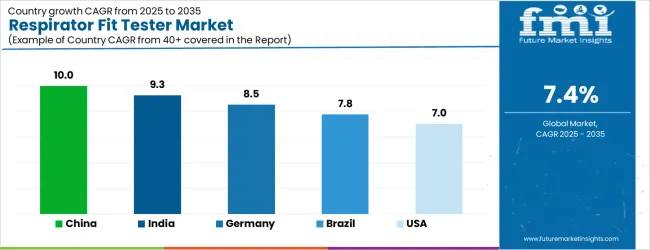
- Among key countries, China at 10.0%, India at 9.3%, Germany at 8.5%, Brazil at 7.8%, USA at 7.0%, UK at 6.3%, Japan at 5.6%.
- Product and Segment View
- The market includes quantitative particle-counting fit testing systems and qualitative taste/smell challenge kits for respirator seal evaluation across healthcare, industrial, and defence applications.
- Quantitative Respirator Fit Testing leads by Test Type with 55% share in 2026.
- Healthcare And Pharmaceutical leads by Industry with 30% share in 2026.
- Scope includes market scope includes quantitative particle-counting fit testing systems, qualitative taste and smell challenge kits, portable and benchtop fit testing instruments, and associated consumables including probe adapters and test solution refills. Respirator manufacturing equipment and mask production machinery are excluded.
- Geography and Competitive Outlook
- China and India are the fastest-growing markets at 10.0% and 9.3% CAGR respectively, driven by expanding occupational health programme enforcement and respiratory protection compliance requirements.
- USA represents a mature demand base where OSHA respiratory protection standard enforcement and annual fit testing requirements sustain equipment procurement.
- Competition is shaped by testing accuracy, portability, regulatory certification breadth, and calibration service support, with key players including 3M, TSI, Occupational Health Dynamics, Moldex-Metric, Honeywell, MSA, Allegro Industries.
- Analyst Opinion at FMI
- Nikhil Kaitwade, Principal Consultant for Industrial Safety, opines: 'In my analysis, I have observed that quantitative fit testing has become the de facto standard for respiratory protection compliance, displacing qualitative methods that produce subjective, undocumented results. Occupational health programmes maintaining qualitative-only testing capabilities face growing regulatory scrutiny as enforcement agencies demand numerical fit factor documentation. Equipment distributors that fail to stock quantitative fit testing systems will lose healthcare and pharmaceutical accounts where documented compliance is a procurement prerequisite.'
- Strategic Implications / Executive Takeaways
- Fit testing equipment manufacturers must expand portable quantitative testing system product lines to serve the growing demand for on-site testing in distributed healthcare and pharmaceutical manufacturing environments.
- Occupational health programme managers should transition from qualitative to quantitative fit testing methods to meet evolving regulatory documentation requirements and reduce legal liability exposure.
- Equipment distributors must develop fit testing service and calibration support capabilities to retain accounts requiring ongoing compliance programme maintenance.
Respirator Fit Tester Market Key Takeaways
| Metric | Details |
|---|---|
| Industry Size (2026) | USD 354.42 million |
| Industry Value (2036) | USD 723.7 million |
| CAGR (2026-2036) | 7.4% |
Source: Future Market Insights, 2026
The incremental opportunity of USD 369.28 million over the forecast period reflects both replacement cycle procurement and new testing programme establishment in sectors with previously lax fit testing compliance. Healthcare and pharmaceutical settings account for 30.0% of industry share as hospital systems and pharmaceutical manufacturers maintain annual fit testing programmes for workers exposed to airborne pathogens and hazardous drug dust.
China leads at 10.0% CAGR, driven by tightening occupational health enforcement by the Ministry of Emergency Management and expanding respiratory protection programmes in manufacturing and construction sectors. India follows at 9.3%, propelled by the Occupational Safety, Health and Working Conditions Code implementation and growing fit testing adoption in pharmaceutical manufacturing and healthcare facilities. Germany registers 8.5%, anchored by DGUV workplace safety regulations mandating documented respirator fit testing for workers exposed to airborne hazards in industrial and laboratory settings. Brazil advances at 7.8%, supported by NR-6 personal protective equipment regulations and growing occupational health programme adoption in mining and petrochemical sectors.
The United States expands at 7.0%, driven by OSHA 29 CFR 1910.134 respiratory protection standard enforcement and annual fit testing requirements for healthcare workers. The United Kingdom posts 6.3%, anchored by HSE RPE fit testing guidance and post-pandemic institutional commitment to documented respiratory protection compliance in NHS trusts. Japan registers 5.6% growth as the revised Industrial Safety and Health Act strengthens respiratory protection requirements for workers in chemical processing and semiconductor manufacturing.
Respirator Fit Tester Market Definition
The respirator fit tester market encompasses testing instruments and systems designed to evaluate the seal quality between a respirator facepiece and the wearer's face for occupational health compliance. Products include quantitative fit testing systems using particle counting and ambient aerosol methods, and qualitative fit testing kits using taste and smell challenge agents, deployed across healthcare, industrial, mining, and defence sectors.
Respirator Fit Tester Market Inclusions
Market scope includes quantitative particle-counting fit testing systems, qualitative taste and smell challenge kits, portable and benchtop fit testing instruments, and associated consumables including probe adapters and test solution refills. All respirator types including N95, half-face, and full-face configurations are covered.
Respirator Fit Tester Market Exclusions
Respirator manufacturing equipment and mask production machinery are excluded. The scope omits respiratory protection training software, medical spirometry systems, and pulmonary function testing equipment. Consumable respirator facepieces and cartridges sold separately from fit testing systems fall outside analytical parameters.
Respirator Fit Tester Market Research Methodology
- Primary Research: Analysts engaged with occupational health managers, respiratory protection programme directors, and fit testing equipment distributors to map testing protocol requirements and procurement decision criteria.
- Desk Research: Data collection phases aggregated occupational health regulation databases, fit testing protocol standards, respiratory protection certification registries, and workplace safety enforcement statistics.
- Market-Sizing and Forecasting: Baseline values derive from a bottom-up aggregation of procurement and installation tracking data, applying region-specific adoption curves to project future deployment velocity.
- Data Validation and Update Cycle: Projections are tested against publicly reported expenditure guidance from leading industry participants and cross-referenced with regulatory filing data.
Why is the Respirator Fit Tester Market Growing?
The Respirator Fit Tester market is experiencing steady growth, driven by increasing emphasis on occupational health and safety across industries. The current scenario reflects a heightened focus on protecting employees from airborne hazards, particularly in healthcare, pharmaceutical, and industrial sectors. Rising regulatory compliance requirements for workplace safety, coupled with growing awareness of respiratory health risks, have fueled the adoption of fit testing solutions.
The market is being shaped by technological advancements that allow both qualitative and quantitative testing, enabling organizations to ensure proper respirator fit and enhance protection efficiency. Increasing investments in workplace safety programs, stringent safety standards, and government initiatives promoting worker health are further supporting the market expansion.
As global industries prioritize employee safety and preparedness against hazardous exposures, demand for reliable, precise, and easy-to-deploy respirator fit testing solutions is expected to increase Future opportunities lie in the development of portable, automated, and software-enabled testers that provide faster, accurate, and digitally recorded results, reducing operational bottlenecks and supporting long-term compliance objectives.
Segmental Analysis
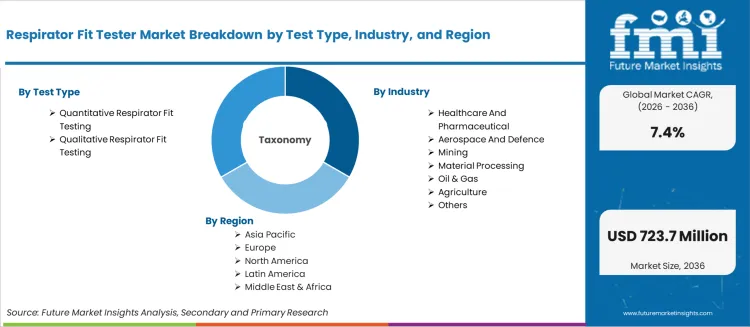
The respirator fit tester market is segmented by test type, industry, and geographic regions. By test type, respirator fit tester market is divided into Quantitative Respirator Fit Testing and Qualitative Respirator Fit Testing. In terms of industry, respirator fit tester market is classified into Healthcare And Pharmaceutical, Aerospace And Defence, Mining, Material Processing, Oil & Gas, Agriculture, and Others. Regionally, the respirator fit tester industry is classified into North America, Latin America, Western Europe, Eastern Europe, Balkan & Baltic Countries, Russia & Belarus, Central Asia, East Asia, South Asia & Pacific, and the Middle East & Africa.
Insights into the Quantitative Respirator Fit Testing Segment
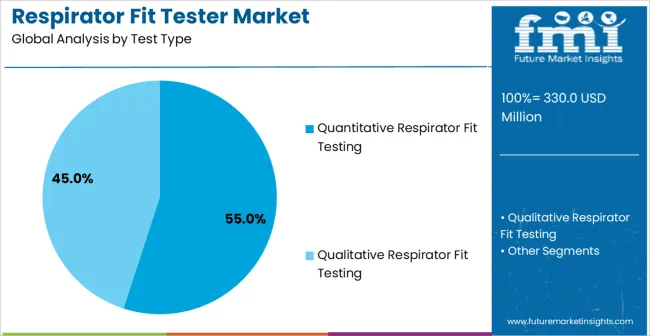
The Quantitative Respirator Fit Testing segment is projected to hold 55.00% of the Respirator Fit Tester market revenue share in 2026, making it the leading test type. This segment’s growth is being driven by its ability to provide precise, numerical measurements of respirator fit, which are critical for ensuring safety compliance and minimizing exposure risks. The adoption has been supported by the increasing demand from industries where accurate fit verification is essential, such as healthcare, pharmaceuticals, and chemical manufacturing.
Quantitative testing is preferred due to its reliability, reproducibility, and ability to meet strict regulatory standards, making it an essential component of occupational safety programs. Organizations are increasingly prioritizing quantitative testing as it allows data-driven decision-making regarding respirator selection and employee training.
The flexibility to test various respirator models, coupled with technological advancements that facilitate faster and more user-friendly testing processes, has further contributed to its dominance As workplace safety regulations continue to tighten globally, this segment is expected to maintain its leadership due to its superior accuracy and compliance assurance.
Insights into the Healthcare and Pharmaceutical Segment

The Healthcare and Pharmaceutical end-use industry segment is expected to account for 30.00% of the Respirator Fit Tester market revenue in 2026, emerging as the leading end-use segment. Growth in this segment is being driven by the critical need to protect healthcare professionals and laboratory personnel from airborne pathogens, chemicals, and other hazardous substances. Regulatory mandates for employee safety, coupled with the heightened awareness of infection control and pandemic preparedness, have accelerated the adoption of respirator fit testing in hospitals, clinics, and pharmaceutical manufacturing units.
The segment benefits from the adoption of both qualitative and quantitative fit testing, which ensures compliance while supporting workforce health management. Rising investments in safety training programs, growing hospital capacities, and expansion of pharmaceutical facilities have contributed to increased deployment of fit testing solutions.
Additionally, the push for automated, digital, and portable testing devices that streamline processes while maintaining accuracy is expected to drive further growth As safety standards continue to evolve and awareness around occupational respiratory health increases, the Healthcare and Pharmaceutical segment is likely to sustain its leading position in the market.
Market Overview
Respirator Fit Tester Market: Overview
The challenging weather conditions involved in the working areas such as mining, aerospace, defense affect the breathing patterns of people. Factors such as high air pressure, temperature, humidity affects the breathing and can be fatal in nature due to scarcity of oxygen.
Respirator Fit Testers play a pivot role as leakage of contaminated air can create breathing hazards to the respirator. The governments of different countries are enforcing laws to maintain safety at workplace and reduce the hazards caused to employees and this factor is resulting into increasing demand for respirator fit tester.
For example, United States Department of Labor enforce OSHA (Occupational Safety & Health Administration) standard is aimed at maintaining safety at workplaces
- As per this standard, the employers should ensure the proper fitting of respiratory masks using respirator fit tester and that employees are medically fit to wear it
Such regulations in various countries are boosting the adoption of respirator fit testers as these testers make sure that respiratory masks are functional.
Analysis of Respirator Fit Tester Market By Key Countries
.webp "Top Country Growth Comparison Respirator Fit Tester Market Cagr (2026 2036)")
| Country | CAGR |
|---|---|
| China | 10.0% |
| India | 9.3% |
| Germany | 8.5% |
| Brazil | 7.8% |
| USA | 7.0% |
| UK | 6.3% |
| Japan | 5.6% |
Source: FMI analysis based on primary research and proprietary forecasting model
Country-wise Analysis
The Respirator Fit Tester Market is expected to register a CAGR of 7.4% during the forecast period, exhibiting varied country level momentum. China leads with the highest CAGR of 10.0%, followed by India at 9.3%. Developed markets such as Germany, France, and the UK continue to expand steadily, while the USA is likely to grow at consistent rates. Japan posts the lowest CAGR at 5.6%, yet still underscores a broadly positive trajectory for the global Respirator Fit Tester Market. In 2024, Germany held a dominant revenue in the Western Europe market and is expected to grow with a CAGR of 8.5%. The USA Respirator Fit Tester Market is estimated to be valued at USD 115.8 million in 2026 and is anticipated to reach a valuation of USD 115.8 million by 2036. Sales are projected to rise at a CAGR of 0.0% over the forecast period between 2026 and 2036. While Japan and South Korea markets are estimated to be valued at USD 17.4 million and USD 8.7 million respectively in 2026.
Key Players in the Respirator Fit Tester Market
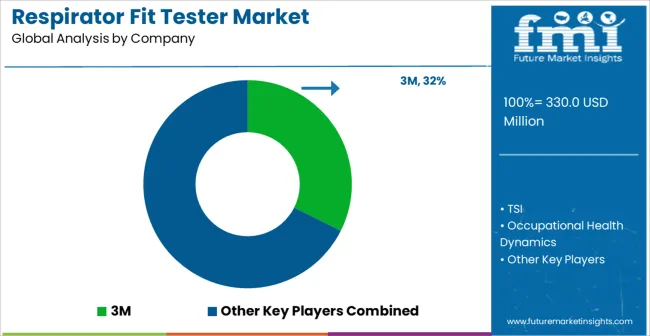
- 3M
- TSI
- Occupational Health Dynamics
- Moldex-Metric
- Honeywell
- MSA
- Allegro Industries
- Accutec-IHS
Scope of the Report
| Metric | Value |
|---|---|
| Quantitative Units | USD 354.42 million to USD 723.7 million, at a CAGR of 7.4% |
| Market Definition | The respirator fit tester market encompasses testing instruments and systems designed to evaluate the seal quality between a respirator facepiece and the wearer's face for occupational health complian... |
| Segmentation | Test Type: Quantitative Respirator Fit Testing, Qualitative Respirator Fit Testing; Industry: Healthcare And Pharmaceutical, Aerospace And Defence, Mining, Material Processing, Oil & Gas, Agriculture, Others |
| Regions Covered | North America, Latin America, Europe, East Asia, South Asia, Oceania, Middle East & Africa |
| Countries Covered | China, India, Germany, Brazil, USA, UK, Japan, and 40 plus countries |
| Key Companies Profiled | 3M, TSI, Occupational Health Dynamics, Moldex-Metric, Honeywell, MSA, Allegro Industries, Accutec-IHS |
| Forecast Period | 2026 to 2036 |
| Approach | Forecasting models apply a bottom-up methodology starting with procurement tracking data and projecting adoption rates using region-specific deployment curves. |
Respirator Fit Tester Market by Segments
Test Type:
- Quantitative Respirator Fit Testing
- Qualitative Respirator Fit Testing
Industry:
- Healthcare And Pharmaceutical
- Aerospace And Defence
- Mining
- Material Processing
- Oil & Gas
- Agriculture
- Others
Region:
- North America
- USA
- Canada
- Mexico
- Latin America
- Brazil
- Chile
- Rest of Latin America
- Western Europe
- Germany
- UK
- Italy
- Spain
- France
- Nordic
- BENELUX
- Rest of Western Europe
- Eastern Europe
- Russia
- Poland
- Hungary
- Balkan & Baltic
- Rest of Eastern Europe
- East Asia
- China
- Japan
- South Korea
- South Asia and Pacific
- India
- ASEAN
- Australia & New Zealand
- Rest of South Asia and Pacific
- Middle East & Africa
- Kingdom of Saudi Arabia
- Other GCC Countries
- Turkiye
- South Africa
- Other African Union
- Rest of Middle East & Africa
Bibliography
- Occupational Safety and Health Administration. (2024). 29 CFR 1910.134: Respiratory protection standard enforcement guidance. OSHA.
- UK Health and Safety Executive. (2024). RPE fit testing guidance: Quantitative and qualitative methods. HSE.
- International Organization for Standardization. (2024). ISO 16975: Respiratory protective devices, selection, use and maintenance. ISO.
- National Institute for Occupational Safety and Health. (2024). NIOSH respirator fit testing procedures. NIOSH.
- European Committee for Standardization. (2024). EN 529: Respiratory protective devices, recommendations for selection and use. CEN.
This bibliography is provided for reader reference. The full Future Market Insights report contains the complete reference list with primary research documentation.
Frequently Asked Questions
How large is the demand for Respirator Fit Tester Market in the global market in 2026?
Demand for respirator fit tester in the global market is estimated to be valued at USD 354.42 million in 2026.
What will be the market size of Respirator Fit Tester Market in the global market by 2036?
Market size for respirator fit tester is projected to reach USD 723.7 million by 2036.
What is the expected demand growth for Respirator Fit Tester Market between 2026 and 2036?
Demand for respirator fit tester is expected to grow at a CAGR of 7.4% between 2026 and 2036.
Which Test Type is poised to lead global sales by 2026?
Quantitative Respirator Fit Testing accounts for 55% share in 2026 as quantitative particle-counting methods produce objective numerical fit factors that meet evolving regulatory documentation requirements and reduce compliance liability.
How is the role of Healthcare And Pharmaceutical in driving Respirator Fit Tester Market adoption in 2026?
Healthcare And Pharmaceutical represents 30% of Industry share in 2026 as healthcare and pharmaceutical settings maintain the highest annual fit testing frequency due to continuous exposure to airborne pathogens and hazardous drug particles.
What is driving demand in China?
China is projected to grow at a CAGR of 10.0% during 2026 to 2036, driven by tightening occupational health enforcement by the Ministry of Emergency Management and expanding respiratory protection programmes in manufacturing sectors.
What is Respirator Fit Tester and what is it mainly used for?
Respirator fit testers are testing instruments that evaluate the seal quality between a respirator and the wearer's face. They are used in occupational health programmes to verify that respiratory protective equipment provides adequate protection against airborne hazards.
How does FMI build and validate the Respirator Fit Tester Market forecast?
Forecasting models apply a bottom-up methodology starting with fit testing equipment procurement records and occupational health programme compliance tracking data and cross-validate projections against publicly reported expenditure data from leading industry participants.
Preview the report firsthand - request a free sample
Get SampleGet the brochure for pricing and purchase details.
Get PDFTable of Content
- Executive Summary
- Global Market Outlook
- Demand-side Trends
- Supply-side Trends
- Technology Roadmap Analysis
- Analysis and Recommendations
- Market Overview
- Market Coverage / Taxonomy
- Market Definition / Scope / Limitations
- Research Methodology
- Chapter Orientation
- Analytical Lens and Working Hypotheses
- Market Structure, Signals, and Trend Drivers
- Benchmarking and Cross-market Comparability
- Market Sizing, Forecasting, and Opportunity Mapping
- Research Design and Evidence Framework
- Desk Research Programme (Secondary Evidence)
- Company Annual and Sustainability Reports
- Peer-reviewed Journals and Academic Literature
- Corporate Websites, Product Literature, and Technical Notes
- Earnings Decks and Investor Briefings
- Statutory Filings and Regulatory Disclosures
- Technical White Papers and Standards Notes
- Trade Journals, Industry Magazines, and Analyst Briefs
- Conference Proceedings, Webinars, and Seminar Materials
- Government Statistics Portals and Public Data Releases
- Press Releases and Reputable Media Coverage
- Specialist Newsletters and Curated Briefings
- Sector Databases and Reference Repositories
- FMI Internal Proprietary Databases and Historical Market Datasets
- Subscription Datasets and Paid Sources
- Social Channels, Communities, and Digital Listening Inputs
- Additional Desk Sources
- Expert Input and Fieldwork (Primary Evidence)
- Primary Modes
- Qualitative Interviews and Expert Elicitation
- Quantitative Surveys and Structured Data Capture
- Blended Approach
- Why Primary Evidence is Used
- Field Techniques
- Interviews
- Surveys
- Focus Groups
- Observational and In-context Research
- Social and Community Interactions
- Stakeholder Universe Engaged
- C-suite Leaders
- Board Members
- Presidents and Vice Presidents
- R&D and Innovation Heads
- Technical Specialists
- Domain Subject-matter Experts
- Scientists
- Physicians and Other Healthcare Professionals
- Governance, Ethics, and Data Stewardship
- Research Ethics
- Data Integrity and Handling
- Primary Modes
- Tooling, Models, and Reference Databases
- Desk Research Programme (Secondary Evidence)
- Data Engineering and Model Build
- Data Acquisition and Ingestion
- Cleaning, Normalisation, and Verification
- Synthesis, Triangulation, and Analysis
- Quality Assurance and Audit Trail
- Market Background
- Market Dynamics
- Drivers
- Restraints
- Opportunity
- Trends
- Scenario Forecast
- Demand in Optimistic Scenario
- Demand in Likely Scenario
- Demand in Conservative Scenario
- Opportunity Map Analysis
- Product Life Cycle Analysis
- Supply Chain Analysis
- Investment Feasibility Matrix
- Value Chain Analysis
- PESTLE and Porter’s Analysis
- Regulatory Landscape
- Regional Parent Market Outlook
- Production and Consumption Statistics
- Import and Export Statistics
- Market Dynamics
- Global Market Analysis 2021 to 2025 and Forecast, 2026 to 2036
- Historical Market Size Value (USD Million) Analysis, 2021 to 2025
- Current and Future Market Size Value (USD Million) Projections, 2026 to 2036
- Y-o-Y Growth Trend Analysis
- Absolute $ Opportunity Analysis
- Global Market Pricing Analysis 2021 to 2025 and Forecast 2026 to 2036
- Global Market Analysis 2021 to 2025 and Forecast 2026 to 2036, By Test Type
- Introduction / Key Findings
- Historical Market Size Value (USD Million) Analysis By Test Type , 2021 to 2025
- Current and Future Market Size Value (USD Million) Analysis and Forecast By Test Type , 2026 to 2036
- Quantitative Respirator Fit Testing
- Qualitative Respirator Fit Testing
- Quantitative Respirator Fit Testing
- Y-o-Y Growth Trend Analysis By Test Type , 2021 to 2025
- Absolute $ Opportunity Analysis By Test Type , 2026 to 2036
- Global Market Analysis 2021 to 2025 and Forecast 2026 to 2036, By Industry
- Introduction / Key Findings
- Historical Market Size Value (USD Million) Analysis By Industry, 2021 to 2025
- Current and Future Market Size Value (USD Million) Analysis and Forecast By Industry, 2026 to 2036
- Healthcare And Pharmaceutical
- Aerospace And Defence
- Mining
- Material Processing
- Oil & Gas
- Agriculture
- Others
- Healthcare And Pharmaceutical
- Y-o-Y Growth Trend Analysis By Industry, 2021 to 2025
- Absolute $ Opportunity Analysis By Industry, 2026 to 2036
- Global Market Analysis 2021 to 2025 and Forecast 2026 to 2036, By Region
- Introduction
- Historical Market Size Value (USD Million) Analysis By Region, 2021 to 2025
- Current Market Size Value (USD Million) Analysis and Forecast By Region, 2026 to 2036
- North America
- Latin America
- Western Europe
- Eastern Europe
- East Asia
- South Asia and Pacific
- Middle East & Africa
- Market Attractiveness Analysis By Region
- North America Market Analysis 2021 to 2025 and Forecast 2026 to 2036, By Country
- Historical Market Size Value (USD Million) Trend Analysis By Market Taxonomy, 2021 to 2025
- Market Size Value (USD Million) Forecast By Market Taxonomy, 2026 to 2036
- By Country
- USA
- Canada
- Mexico
- By Test Type
- By Industry
- By Country
- Market Attractiveness Analysis
- By Country
- By Test Type
- By Industry
- Key Takeaways
- Latin America Market Analysis 2021 to 2025 and Forecast 2026 to 2036, By Country
- Historical Market Size Value (USD Million) Trend Analysis By Market Taxonomy, 2021 to 2025
- Market Size Value (USD Million) Forecast By Market Taxonomy, 2026 to 2036
- By Country
- Brazil
- Chile
- Rest of Latin America
- By Test Type
- By Industry
- By Country
- Market Attractiveness Analysis
- By Country
- By Test Type
- By Industry
- Key Takeaways
- Western Europe Market Analysis 2021 to 2025 and Forecast 2026 to 2036, By Country
- Historical Market Size Value (USD Million) Trend Analysis By Market Taxonomy, 2021 to 2025
- Market Size Value (USD Million) Forecast By Market Taxonomy, 2026 to 2036
- By Country
- Germany
- UK
- Italy
- Spain
- France
- Nordic
- BENELUX
- Rest of Western Europe
- By Test Type
- By Industry
- By Country
- Market Attractiveness Analysis
- By Country
- By Test Type
- By Industry
- Key Takeaways
- Eastern Europe Market Analysis 2021 to 2025 and Forecast 2026 to 2036, By Country
- Historical Market Size Value (USD Million) Trend Analysis By Market Taxonomy, 2021 to 2025
- Market Size Value (USD Million) Forecast By Market Taxonomy, 2026 to 2036
- By Country
- Russia
- Poland
- Hungary
- Balkan & Baltic
- Rest of Eastern Europe
- By Test Type
- By Industry
- By Country
- Market Attractiveness Analysis
- By Country
- By Test Type
- By Industry
- Key Takeaways
- East Asia Market Analysis 2021 to 2025 and Forecast 2026 to 2036, By Country
- Historical Market Size Value (USD Million) Trend Analysis By Market Taxonomy, 2021 to 2025
- Market Size Value (USD Million) Forecast By Market Taxonomy, 2026 to 2036
- By Country
- China
- Japan
- South Korea
- By Test Type
- By Industry
- By Country
- Market Attractiveness Analysis
- By Country
- By Test Type
- By Industry
- Key Takeaways
- South Asia and Pacific Market Analysis 2021 to 2025 and Forecast 2026 to 2036, By Country
- Historical Market Size Value (USD Million) Trend Analysis By Market Taxonomy, 2021 to 2025
- Market Size Value (USD Million) Forecast By Market Taxonomy, 2026 to 2036
- By Country
- India
- ASEAN
- Australia & New Zealand
- Rest of South Asia and Pacific
- By Test Type
- By Industry
- By Country
- Market Attractiveness Analysis
- By Country
- By Test Type
- By Industry
- Key Takeaways
- Middle East & Africa Market Analysis 2021 to 2025 and Forecast 2026 to 2036, By Country
- Historical Market Size Value (USD Million) Trend Analysis By Market Taxonomy, 2021 to 2025
- Market Size Value (USD Million) Forecast By Market Taxonomy, 2026 to 2036
- By Country
- Kingdom of Saudi Arabia
- Other GCC Countries
- Turkiye
- South Africa
- Other African Union
- Rest of Middle East & Africa
- By Test Type
- By Industry
- By Country
- Market Attractiveness Analysis
- By Country
- By Test Type
- By Industry
- Key Takeaways
- Key Countries Market Analysis
- USA
- Pricing Analysis
- Market Share Analysis, 2025
- By Test Type
- By Industry
- Canada
- Pricing Analysis
- Market Share Analysis, 2025
- By Test Type
- By Industry
- Mexico
- Pricing Analysis
- Market Share Analysis, 2025
- By Test Type
- By Industry
- Brazil
- Pricing Analysis
- Market Share Analysis, 2025
- By Test Type
- By Industry
- Chile
- Pricing Analysis
- Market Share Analysis, 2025
- By Test Type
- By Industry
- Germany
- Pricing Analysis
- Market Share Analysis, 2025
- By Test Type
- By Industry
- UK
- Pricing Analysis
- Market Share Analysis, 2025
- By Test Type
- By Industry
- Italy
- Pricing Analysis
- Market Share Analysis, 2025
- By Test Type
- By Industry
- Spain
- Pricing Analysis
- Market Share Analysis, 2025
- By Test Type
- By Industry
- France
- Pricing Analysis
- Market Share Analysis, 2025
- By Test Type
- By Industry
- India
- Pricing Analysis
- Market Share Analysis, 2025
- By Test Type
- By Industry
- ASEAN
- Pricing Analysis
- Market Share Analysis, 2025
- By Test Type
- By Industry
- Australia & New Zealand
- Pricing Analysis
- Market Share Analysis, 2025
- By Test Type
- By Industry
- China
- Pricing Analysis
- Market Share Analysis, 2025
- By Test Type
- By Industry
- Japan
- Pricing Analysis
- Market Share Analysis, 2025
- By Test Type
- By Industry
- South Korea
- Pricing Analysis
- Market Share Analysis, 2025
- By Test Type
- By Industry
- Russia
- Pricing Analysis
- Market Share Analysis, 2025
- By Test Type
- By Industry
- Poland
- Pricing Analysis
- Market Share Analysis, 2025
- By Test Type
- By Industry
- Hungary
- Pricing Analysis
- Market Share Analysis, 2025
- By Test Type
- By Industry
- Kingdom of Saudi Arabia
- Pricing Analysis
- Market Share Analysis, 2025
- By Test Type
- By Industry
- Turkiye
- Pricing Analysis
- Market Share Analysis, 2025
- By Test Type
- By Industry
- South Africa
- Pricing Analysis
- Market Share Analysis, 2025
- By Test Type
- By Industry
- USA
- Market Structure Analysis
- Competition Dashboard
- Competition Benchmarking
- Market Share Analysis of Top Players
- By Regional
- By Test Type
- By Industry
- Competition Analysis
- Competition Deep Dive
- 3M
- Overview
- Product Portfolio
- Profitability by Market Segments (Product/Age /Sales Channel/Region)
- Sales Footprint
- Strategy Overview
- Marketing Strategy
- Product Strategy
- Channel Strategy
- TSI
- Occupational Health Dynamics
- Moldex-Metric
- Honeywell
- MSA
- Allegro Industries
- Accutec-IHS
- 3M
- Competition Deep Dive
- Assumptions & Acronyms Used


