
- Market Size (2026)
- USD 1144.5 Mn
- Forecast (2036)
- USD 2587.7 Mn
- CAGR (2026 to 2036)
- 8.5%
How big is the Sacral Nerve Stimulation Market in 2026?
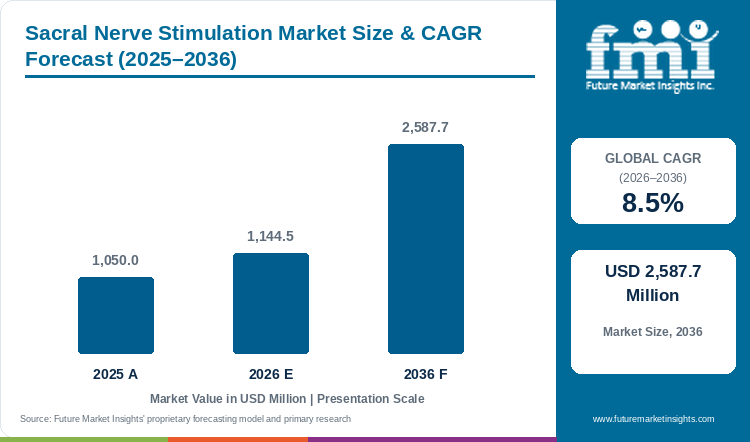
By 2036, FMI expects the global sacral nerve stimulation market to reach USD 2,587.7 million, growing at 8.5% a year from 2026 to 2036. The market was valued at USD 1,050.0 million in 2025. FMI estimates USD 1,144.5 million for 2026.
Sacral Nerve Stimulation Market Size and Forecast
Table 1: Sacral Nerve Stimulation Market Size and Forecast
| Market size and forecast | Value |
|---|---|
| Market size in 2025 | USD 1,050.0 million |
| Estimated market size in 2026 | USD 1,144.5 million |
| Projected market size by 2036 | USD 2,587.7 million |
| CAGR from 2026 to 2036 | 8.5% |
Source: Future Market Insights analysis of the sacral nerve stimulation market, 2026.
Commercial expansion depends on converting an evaluated patient into a supported long-term implant. The FDA approved Neuspera's sacral neuromodulation system on 17 June 2025 for urinary urge incontinence after conservative treatment has failed or is unsuitable. The addition introduces an externally powered sacral system alongside conventional implanted-battery platforms and changes the device choice available to specialist practices.
Programming is also becoming a focus of product development. Medtronic's April 2025 PEER 2 interim analysis examined sacral evoked responses in 82 women. The investigational external stimulator was not approved for sale. FMI sees a commercial distinction between improving the assessment pathway and selling another permanent generator. Better-supported evaluation may strengthen implant conversion, while longer battery service can reduce the frequency of replacement purchases. Suppliers must earn growth through additional eligible patients and continuing service.
Key Market Trends & Insights
- Device choice now includes different power arrangements. Medtronic's October 2025 pelvic-health portfolio separates rechargeable InterStim Micro from recharge-free InterStim X, alongside evaluation tools and a programmer. An individual practice must support the selected system after implantation.
- Specialist capacity is a measurable access constraint. A June 2025 Canadian clinical report described a Sudbury evaluation pathway linked to implantation in Toronto. Its purpose was to reduce repeated long-distance travel.
- Product longevity has a purchasing consequence beyond smaller implants. Japan's January 2025 reimbursement discussion evaluated InterStim X against earlier recharge-free equipment and agreed a JPY 1,060,000 reimbursement price. Battery-life claims remained dependent on therapy settings.
Regional Highlights
- Share of global revenue grows for the Netherlands and Japan. FMI's 2036 shares are the Netherlands 3.3% (from 3.0%) and Japan 3.3% (from 3.0%).
- Share slips for the United States and Germany as revenue grows. FMI projects the United States from 64.0% to 63.3% and Germany from 6.0% to 5.9% by 2036.
Analyst Perspective
“FMI sees referral completion and follow-up capacity as stronger commercial tests than implant miniaturization alone. A hospital buys an enduring treatment pathway, including evaluation equipment, implant supply and access to programming support. Longer-lived generators may improve the offer while postponing replacement revenue. Suppliers with reliable clinical support have a clearer route to recurring accounts than those promoting battery specifications without an accessible service network.”
- Anurag Sharma, Principal Consultant, FMI
How is the Sacral Nerve Stimulation Market segmented?
- By product: Implantable Pulse Generators, Leads and Accessories, Programmers and Software, Replacement and Revision Devices.
- By indication: Overactive Bladder and Urge Incontinence, Faecal Incontinence, Non-Obstructive Urinary Retention.
- By care setting: Hospitals, Specialist Urology and Pelvic Floor Clinics, and Ambulatory Surgery Centers.
- By region: North America, Western Europe, East Asia, Oceania, and Rest of world.
Why does the Implantable Pulse Generators segment lead by Product in the Sacral Nerve Stimulation Market in 2026?
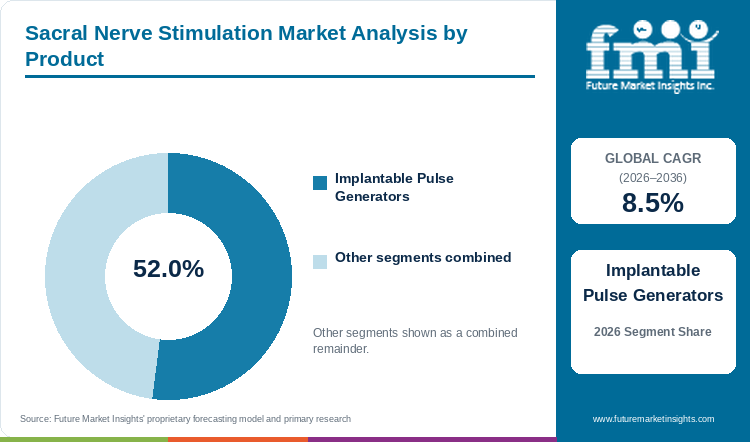
The Implantable Pulse Generators segment holds 52.0% of the Sacral Nerve Stimulation Market by product in 2026.
The generator remains the principal revenue-bearing implant within conventional sacral systems. A hospital's decision covers more than the generator specification. One supplier's documented portfolio includes evaluation systems, implantable products, a smart programmer and patient education tools. Selection commits a practice to a particular set of components and follow-up arrangements. This supports an established supplier's position even when a competing device offers a different battery profile.
New architecture also qualifies the product argument. Neuspera's FDA labeling describes a sacral implant powered by a separately worn transmitter. Hospitals need to examine the complete approved configuration and its support requirements.
FMI projects the generator share at 50.4% in 2036, below its 2026 proportion. Programmers and Software grow from 8.0% to 9.3% across the same period. That shift indicates that revenue attached to the broader system grows faster than generator revenue. The commercial opportunity for a supplier includes support for existing patients and upgrades to practice workflows. The wider urology electrodes market covers a broader range of procedures.
Leads and Accessories, Programmers and Software and Replacement and Revision Devices together make up the remaining 48.0% by product.
Table 2: Product, 2026 Share
| Leading Share | 2026 market share |
|---|---|
| Implantable Pulse Generators | 52.0% |
| All Other Segments Combined Share | 48.0% |
Source: Future Market Insights analysis of the sacral nerve stimulation market, 2026.
Why does the Overactive Bladder and Urge Incontinence segment lead by Indication in the Sacral Nerve Stimulation Market in 2026?
The Overactive Bladder and Urge Incontinence segment holds 52.0% of the Sacral Nerve Stimulation Market by indication in 2026.
Overactive bladder is the leading commercial indication, but treatment demand is narrower than the population with urinary symptoms. The 2024 AUA/SUFU guideline discusses sacral neuromodulation alongside other minimally invasive options and recognizes device-related complications and potential revision. The addressable implant population therefore depends on assessment and treatment choice.
Competition also reaches beyond sacral technology. Laborie's Urgent PC stimulates the tibial nerve through an office-based pathway. Valencia's eCoin is an implanted tibial system. Both address related patient needs. Hospitals may weigh these alternatives while planning a continence service. The separate pelvic floor stimulator market includes a broader group of technologies and treatment settings.
FMI expects the Overactive Bladder and Urge Incontinence share to ease to 49.7% by 2036. Faecal Incontinence reaches 27.2% and Non-Obstructive Urinary Retention reaches 23.1%. These remain indication-specific opportunities. Suppliers expanding their commercial message must retain the product's local indication and evidence boundaries.
Faecal Incontinence and Non-Obstructive Urinary Retention together hold the remaining 48.0% by indication.
Table 3: Indication, 2026 Share
| Leading Share | 2026 market share |
|---|---|
| Overactive Bladder and Urge Incontinence | 52.0% |
| All Other Segments Combined Share | 48.0% |
Source: Future Market Insights analysis of the sacral nerve stimulation market, 2026.
Why does the Hospitals segment lead by Care Setting in the Sacral Nerve Stimulation Market in 2026?
The Hospitals segment holds 61.0% of the Sacral Nerve Stimulation Market by care setting in 2026.
Hospitals lead because sacral neuromodulation combines a staged evaluation, surgical implantation and long-term device follow-up, which most health systems organise around specialist hospital departments. A June 2025 Canadian clinical report described a Sudbury evaluation pathway linked to implantation in Toronto, designed to reduce repeated long-distance travel. The pathway shows that implantation stays at a centre with surgical capacity even when screening moves closer to patients.
Public purchasing also runs through hospital accounts. Spain's Navarra authority opened a 2026 supply tender serving both urology and general surgery, and France maintains device-specific health-technology assessments. A sacral supplier therefore competes inside a multi-specialty procurement and a hospital-level qualification step.
FMI's 2026 assessment values Hospitals at USD 698.1 million. Clinic and ambulatory settings would gain share if evaluation and programming move outside the hospital, but implantation and revision keep a hospital anchor. Suppliers that support clinic follow-up without displacing the hospital account hold the stronger position.
Specialist Urology and Pelvic Floor Clinics and Ambulatory Surgery Centers together hold the remaining 39.0% by care setting.
Table 4: Care Setting, 2026 Share
| Leading Share | 2026 market share |
|---|---|
| Hospitals | 61.0% |
| All Other Segments Combined Share | 39.0% |
Source: Future Market Insights analysis of the sacral nerve stimulation market, 2026.
What are the key drivers restraints and opportunities?
Growth depends on more eligible patients completing evaluation and implantation. Specialist staffing and follow-up requirements limit throughput. Opportunities arise where a supplier helps an existing continence pathway serve patients more reliably.
Driver
Additional approved sacral systems broaden the choice available to implanting specialists after conservative treatment has failed.
Restraint
Evaluation, permanent implantation and continuing programming require a coordinated service. The Canadian access report documents practical barriers around travel and local resources.
Opportunity
Regional assessment arrangements can support access to an established implant center. Their economics depend on completed referrals, not merely equipment placement.
How do purchasing rules and qualification affect sacral nerve stimulation market demand?
Installed device revenue grows when referral and evaluation capacity produce additional long-term patients. The June 2025 FDA decision on one newer entrant is a specific example of commercial entry into sacral stimulation. It introduces an alternative power architecture for a defined urinary indication. FMI considers the resulting practice-level choice more consequential than a general claim that all neuromodulation demand is accelerating. A new entrant must establish appropriate training and service capacity before its approved product becomes a recurring hospital order.
Colorectal services provide another route. Italy's Terni hospital announced a sacral neurostimulation center within its multidisciplinary pelvic-floor pathway in March 2026. This is a documented local service expansion. A supplier serving such a center must understand its urological and bowel indications together.
What limits reliable sacral nerve stimulation market supply and quality?
Clinical eligibility and device burden can interrupt commercial conversion. NICE requires discussion of test stimulation, failure, revision and long-term commitment within its pathway for women with overactive bladder. A supplier cannot replace that discussion with a universal treatment-success claim. Battery longevity comparisons also need their operating assumptions. The January 2025 Japanese reimbursement hearing explicitly discussed how settings affect projected service life.
Price competition must consequently be read over the treatment pathway. A less expensive implant is not automatically the less expensive account if a practice requires unfamiliar equipment and additional support. FMI expects providers to examine support and maintenance requirements against the patients they actually serve. Sacral stimulation is one application within the broader neurostimulation market.
Where can suppliers win additional business in the sacral nerve stimulation market?
Follow-up capability creates room for differentiation without broadening clinical claims. Labeling for the newer system identifies distinct clinician and patient interfaces around its implant and transmitter. Investigational sensing work explores a separate opportunity to make physiological responses measurable during assessment. The latter remains research evidence, not an approved automated-care offer.
A credible commercial program connects the appropriate system to a practice able to support it. It also preserves access to revision components for existing patients. This market should remain separate from recurring expenditure on absorbent products within the incontinence care products market. Those products indicate continuing management needs but their retail sales are not sacral implant revenue.
Sacral Nerve Stimulation Market by Country (2026 to 2036)
Table 5: Sacral Nerve Stimulation Market Country Growth Forecast
| Country | CAGR, 2026 to 2036 |
|---|---|
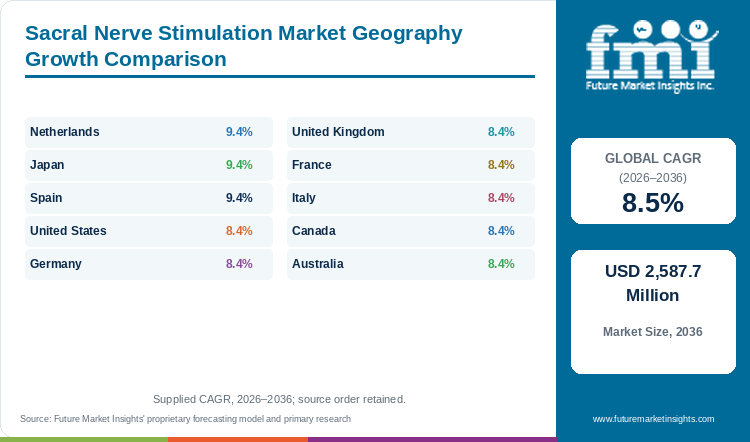
| Netherlands | 9.4% |
| Japan | 9.4% |
| Spain | 9.4% |
| United States | 8.4% |
| Germany | 8.4% |
| United Kingdom | 8.4% |
| France | 8.4% |
| Italy | 8.4% |
| Canada | 8.4% |
| Australia | 8.4% |
Source: Future Market Insights analysis of the sacral nerve stimulation market, 2026.
Netherlands
The Netherlands presents a clear distinction between an available treatment pathway and the limits of a particular indication. St. Antonius describes a staged sacral neuromodulation service for bowel dysfunction, with a trial before a permanent implant and specific arrangements with insurers. Separately, Zorginstituut Nederland explains why an expired device certification prevented further assessment of a particular constipation indication after its conditional-admission period. The two sources concern different boundaries and should not be collapsed into a general statement about coverage.
Dutch revenue is forecast at USD 34.3 million in 2026 and USD 84.2 million by 2036. The CAGR is 9.4% from 2026 to 2036, placing the Netherlands among the faster-growing named markets in this outlook. The commercial opening depends on appropriate indications passing through a functioning specialist service. The Netherlands adds USD 49.9 million, ranking joint fifth for increase.
FMI views this precision as an account-management requirement. The supplied configuration, intended use and insurer arrangement need to align. A provider also requires continuing service for people already implanted. That creates a meaningful distinction between acquiring a new account and maintaining its installed population. A supplier able to sustain both can support growth without relying on an overly broad eligibility claim. The Netherlands offers potential through appropriately supported pathways instead of unrestricted expansion into every form of bowel dysfunction.
Japan
Japan's reimbursement discussion shows how battery longevity becomes an economic purchasing issue. At the January 2025 medical-materials meeting, the InterStim X presentation compared its recharge-free service life with earlier equipment. The discussion concluded with agreement on a JPY 1,060,000 reimbursement price. It also recognized that battery duration varies with stimulation settings. The approved price is therefore a product-specific reimbursement fact.
FMI expects Japanese revenue to rise from USD 34.3 million in 2026 to USD 84.2 million in 2036. Growth is forecast at 9.4% annually across 2026 to 2036. The local commercial argument includes choice between rechargeable and recharge-free systems. A longer-lived recharge-free offer can change the balance between a device's purchase cost and anticipated replacement procedures. Such an argument still depends on the patient's supported care plan and the product's labeling. That leaves Japan with 3.3% of global revenue in 2036, against 3.0% in 2026. In the sacral nerve stimulation market, Japan contributes USD 49.9 million of new revenue, joint fifth of ten.
Suppliers must also distinguish replacement demand from new uptake. Better longevity may delay a future generator sale while strengthening the value of the original offer. FMI sees that tension as central to the Japanese outlook. It favors careful planning for the installed population and service support alongside new referrals. Product availability, reimbursement and the completion of appropriate clinical pathways influence device demand and the timing of replacement purchases.
Spain
Spain offers recent direct evidence of hospital purchasing activity. Navarra's APRO 225/2026 procurement notice seeks sacral neuromodulation systems for the urology and general surgery services at Hospital Universitario de Navarra. The notice uses an open supply procedure and a best quality-price criterion. Its scope makes the commercial customer identifiable.
FMI projects the Spanish market from USD 22.9 million in 2026 to USD 56.2 million in 2036. The forecast CAGR is 9.4% between 2026 and 2036. Participation in institutional purchasing is one route to that opportunity. A supplier must respond to the actual systems and service requirements in the contract instead of substitute a general neuromodulation portfolio description. Serving both named departments also requires clarity about the indications and configurations included in the offer. Revenue in Spain multiplies 2.5 times by 2036, compared with 2.3 times worldwide. Spain's share of global revenue rises from 2.0% to 2.2%. Growth of USD 33.3 million leaves Spain ninth among the ten named countries.
The local implication is a more concrete sales opportunity than a general claim about European health spending. A tender reveals a purchasing process and the account seeking supply. FMI expects the ability to support a hospital contract after award to remain important. Training and component availability affect the practicality of that service commitment. Spain's forecast therefore combines institutional purchasing opportunities with the clinical capacity needed to turn contracted supply into sustained treatment activity.
United States
The United States accounts for 64.0% of global sacral nerve stimulation revenue in 2026. Its importance follows the size of the existing commercial base and the entry of another approved sacral system. The FDA's June 2025 decision covers urinary urge incontinence after conservative options have failed or are unsuitable. That precise indication matters for a US sales strategy.
FMI forecasts US revenue at USD 732.5 million in 2026 and USD 1,638.8 million in 2036. The 2026 to 2036 CAGR is 8.4%. Growth requires additional qualified patients as well as continuing care for people already implanted. The AUA/SUFU guideline situates sacral neuromodulation among treatment choices and discusses revision, discomfort and lead migration. A larger choice of devices therefore does not eliminate the need for individual assessment or ongoing clinical support. At 8.4%, the CAGR for the United States is 0.1 points below the global 8.5%. The market adds USD 906.3 million over the decade, which is 62.8% of the global increase. In the sacral nerve stimulation market, the United States' 2026 revenue is first among the ten.
The strongest commercial proposition addresses the practice's full workload. Evaluation kits create one purchase, permanent systems another, while programmers and revision components remain relevant after implantation. FMI expects a supplier's ability to support those stages to influence account retention. A new device's approval opens the selling process. Sustained use depends on the service built around it.
Germany
Colorectal referral patterns deserve separate attention in Germany's sacral stimulation outlook. Erlangen's continence and pelvic-floor center reported on the March 2025 German coloproctology congress, where faecal incontinence was a focus. Its account placed conservative care before operative options and described sacral neuromodulation within the surgical discussion. This local professional evidence supports a bowel-care route into the market.
The German market is projected to advance at an 8.4% CAGR from 2026 to 2036. Revenue moves from USD 68.7 million to USD 153.6 million. For suppliers, the opportunity includes relationships with continence services that assess urinary and bowel conditions through different clinical teams. A hospital's need for a generator depends on the cases reaching permanent treatment, not simply on the number of referrals discussed at a specialist meeting. Germany adds USD 84.9 million, ranking second for increase.
Commercial support must reflect those pathways. An account built around colorectal surgery may need a different evidence discussion from an account centered on urinary urgency. FMI sees value in equipment continuity and a service team that understands the local program. This is more specific than treating Germany as a single demand pool for all neurostimulation products. Hospitals also have to support existing patients when stimulation is adjusted or a component needs replacement. A supplier that maintains that continuity has a stronger reason to remain on the purchasing list.
United Kingdom
NICE's pathway for women with overactive bladder makes multidisciplinary review commercially important in the United Kingdom. It recommends sacral stimulation after non-surgical management when botulinum toxin has failed or the woman does not accept its catheterization risk. The guidance also requires discussion of long-term commitment and potential revision. These conditions narrow the point at which an implant becomes a realistic purchasing requirement. Marketing to the broader population with urinary symptoms overstates that opportunity.
FMI projects UK revenue of USD 45.8 million in 2026 and USD 102.4 million by 2036. The forecast CAGR is 8.4% over 2026 to 2036. The commercial argument concerns throughput through an assessed pathway. More consultations produce additional device demand only when eligible patients reach evaluation and proceed to permanent treatment. Follow-up and prompt specialist review also remain part of the service described by NICE.
For a provider, a supplier change therefore involves more than the generator's purchase price. Staff need familiarity with the specific evaluation equipment and programming interface. The number of patients supported by an existing system is a practical consideration when a center considers another offer. FMI expects suppliers to compete on the fit between their approved products and the center's care pathway. Clear arrangements for clinical support and component continuity make that offer more credible. Published guidance establishes an eligible treatment route, while local service capacity determines how much of it becomes annual demand.
France
France evaluates sacral stimulation at the level of a specific device and its intended use. HAS's September 2023 renewal assessment for InterStim II retained urinary and faecal indications after failure of conservative treatment. It also described conditional MRI compatibility for the specified generator-and-lead combination. These details give procurement a defined clinical and technical boundary. A general claim that a sacral system is MRI compatible is insufficient without the complete configuration and conditions.
FMI expects the French market to grow from USD 45.8 million to USD 102.4 million between 2026 and 2036. The 2026 to 2036 CAGR is 8.4%. The opportunity is broader than equipment renewal alone because additional eligible patients create new implant demand. Suppliers need current documentation for the exact system offered to a French account. France posts 8.4% annual growth against 8.5% for the global market, 0.1 points below the global rate.
The commercial distinction is between a product family's reputation and the offer a hospital can actually support. A practice may have staff trained on one programmer and an existing population with particular leads. Changing devices affects the equipment and service needed around future implants. FMI considers reliable local documentation and continuing support important to account retention. France's device-specific assessment process makes unsupported equivalence claims especially weak. A supplier has a stronger position when its proposal identifies the configuration, intended population and follow-up arrangements clearly, while keeping price comparisons within that same treatment scope.
Italy
A service opening in Terni illustrates a practical source of Italian demand. In March 2026, Azienda Ospedaliera Santa Maria described an active sacral neurostimulation center within its pelvic-floor care program. The hospital linked the addition to an existing multidisciplinary pathway and the aim of reducing travel outside the region. This is a local capacity development.
The Italian revenue outlook rises from USD 34.3 million in 2026 to USD 76.8 million by 2036. FMI forecasts an 8.4% CAGR during 2026 to 2036. Expansion of complete treatment services offers a clearer commercial explanation than a demographic argument alone. The relevant hospital must assess patients and provide permanent treatment with follow-up. The Terni announcement describes those activities within a wider pathway instead of an isolated equipment purchase. Its 8.4% CAGR runs 0.1 percentage points below the 8.5% global rate.
For suppliers, a newly established service can require evaluation devices and staff support before permanent implant orders become consistent. Commercial planning should distinguish that introduction stage from the replacement needs of an established center. FMI sees regional clinical relationships as important to both. They may improve access to a qualified treatment pathway without implying a change in the product's approved uses. The opportunity is to support an additional capable account and retain its confidence as the installed patient population grows. Forecast revenue should therefore be read against service development and actual conversion into supported long-term implants.
Canada
Distance between evaluation and implantation is an unusually concrete Canadian commercial constraint. A June 2025 report from clinicians in Sudbury and Toronto described a feasibility project for local percutaneous nerve evaluation at Health Sciences North. Patients with a successful evaluation could then travel to Toronto for permanent implantation. The authors sought to remove at least two long-distance return trips. Their report supports a specific approach to access, instead of evidence that all Canadian centers operate this way.
FMI projects Canada at USD 34.3 million in 2026, rising to USD 76.8 million in 2036. The country CAGR is 8.4% for 2026 to 2036. A distributed evaluation service may support implant demand at a central hospital without requiring each local site to provide the complete procedure. This separates sales of evaluation equipment from the permanent-system opportunity. A supplier needs to understand which institution owns each part of that pathway.
Patient information from Nova Scotia Health also treats peripheral nerve evaluation as a test of whether sacral neuromodulation may help bladder or bowel function. For commercial planning, a test appointment and a permanent implant remain different stages. FMI expects the reliability of patient referrals to matter when such networks expand. Training and equipment continuity across the two locations can support completion, while a weak referral can leave demand unrealized. The Canadian case therefore favors a service proposition built around access and coordination, with account targets tied to the actual institution delivering each stage.
Australia
Australia's Medicare Benefits Schedule separates a procedural payment from the device opportunity. Item 36666 covers placement of a pulse generator for specified urinary conditions after at least 12 months of conservative non-surgical treatment. Its description was updated in March 2025 and its schedule fee in July 2026. The item supports a defined pathway for refractory patients.
FMI forecasts Australian revenue of USD 22.9 million in 2026 and USD 51.2 million in 2036. The 2026 to 2036 CAGR is 8.4%. The device opportunity concerns a supported sequence of care instead of a single undifferentiated surgical payment. Evaluation and permanent equipment are commercially distinct. Revenue also includes components associated with the existing implant population. A supplier planning account coverage should therefore examine the service delivered by each provider instead of applying one national reimbursement number to every product.
The government's earlier schedule fact sheet also distinguishes bowel and urinary item groups. A hospital's commercial requirements therefore need to be understood at the relevant clinical service. FMI considers continuity of support important for existing implants as well as new referrals. Providers require access to appropriate components when a patient's treatment needs review or revision. The opportunity is not captured by applying one procedural fee to all equipment. It depends on the devices purchased across the treatment pathway and the additional activity a capable service can deliver. This creates a more specific basis for account planning than a general comparison of national healthcare expenditure.
Who are the notable companies in the Sacral Nerve Stimulation Market?
Notable companies in the Sacral Nerve Stimulation Market include Medtronic, Boston Scientific, Neuspera Medical, Laborie and Valencia Technologies, part of Boston Scientific.
Competition has a direct sacral-device group and a wider continence-treatment group. Medtronic's InterStim family includes rechargeable and recharge-free systems, supported by evaluation equipment and programming tools. Boston Scientific entered sacral neuromodulation through its completed acquisition of Axonics in November 2024. Neuspera brings an externally powered implant architecture with a US approval specific to urinary urge incontinence. These positions are meaningful product differences. They do not establish a numerical company ranking in this assessment.
Laborie supplies Urgent PC for percutaneous tibial nerve stimulation. Valencia developed the implanted tibial eCoin system, which Boston Scientific describes as an addition alongside Axonics within its continence portfolio. Neither tibial offer should be counted as a sacral generator or lead. Their commercial relevance lies in the treatment alternatives considered by some of the same specialists.
FMI sees the account decision as a combination of approved indication, system configuration and service continuity. A broad continence portfolio may support a supplier's relationship with a practice. It does not make every product interchangeable or place all related revenue inside the sacral market. That distinction is especially important when evaluating Boston Scientific and its acquired businesses.
Key Developments in the Sacral Nerve Stimulation Market
- In its 1 July 2026 account of the Valencia acquisition, Boston Scientific confirmed that eCoin had joined its portfolio alongside Axonics. eCoin is tibial stimulation, so this development broadens the company's competing treatment choices without adding a second sacral platform.
Key Players in the Sacral Nerve Stimulation Market
- Medtronic
- Boston Scientific
- Neuspera Medical
- Laborie
- Valencia Technologies, part of Boston Scientific
Sacral Nerve Stimulation Market Report Scope
Table 6: Sacral Nerve Stimulation Market Report Scope
| Coverage field | Report scope |
|---|---|
| Market definition | Implantable neurostimulators, leads, programmers and accessories used for stimulation of the sacral nerves. |
| Indication boundary | Overactive Bladder and Urge Incontinence, Faecal Incontinence, Non-Obstructive Urinary Retention. Product-specific local labeling governs actual use. |
| Exclusions | Tibial stimulation systems, spinal cord and deep brain stimulation, absorbent products, medicines, professional fees and facility charges. |
| Quantitative Units | USD million |
| Activity unit | Thousand annual implants. Revenue-per-implant indicator expressed in USD per implant. |
| Product breakdown | Implantable Pulse Generators, Leads and Accessories, Programmers and Software, Replacement and Revision Devices. |
| Named countries | United States, Germany, United Kingdom, France, Italy, Netherlands, Canada, Japan, Australia and Spain |
| Companies considered | Medtronic, Boston Scientific, Neuspera Medical, Laborie and Valencia Technologies. Adjacent tibial offers are identified separately. |
| Competitive coverage | Approved configurations, documented portfolio roles, dated developments and requirements affecting hospital service. |
| Care Setting coverage | Hospitals, Specialist Urology and Pelvic Floor Clinics, Ambulatory Surgery Centers. |
Source: Future Market Insights analysis of the sacral nerve stimulation market, 2026.
Sacral Nerve Stimulation Market Research Methodology
This assessment combines FMI's sacral stimulation revenue and implant outlook with secondary review of regulator decisions, national clinical and assessment documents, hospital service disclosures and original supplier publications. Quantitative checks address units, category allocation and country coverage. Competitive analysis separates sacral systems from adjacent tibial alternatives and retains the distinction between approved products, investigational capabilities and an open purchasing process. Forecasts describe the market outlook instead of a guarantee of clinical adoption or a recommendation for individual treatment.
Sacral Nerve Stimulation Market by Segments
Sacral Nerve Stimulation Market segmented by Product:
- Implantable Pulse Generators
- Leads and Accessories
- Programmers and Software
- Replacement and Revision Devices
Sacral Nerve Stimulation Market segmented by Indication:
- Overactive Bladder and Urge Incontinence
- Faecal Incontinence
- Non-Obstructive Urinary Retention
Sacral Nerve Stimulation Market segmented by Care Setting:
- Hospitals
- Specialist Urology and Pelvic Floor Clinics
- Ambulatory Surgery Centers
Sacral Nerve Stimulation Market by Region
- North America
- United States
- Canada
- Western Europe
- Germany
- United Kingdom
- France
- Italy
- Netherlands
- Spain
- East Asia
- Japan
- Oceania
- Australia
- Rest of world
- Aggregate of other markets
Research Sources and Bibliography
- American Urological Association and Society of Urodynamics, Female Pelvic Medicine & Urogenital Reconstruction. (2024). Guideline on the Diagnosis and Treatment of Idiopathic Overactive Bladder.
- Australian Government, Department of Health. (2017, June 21). Sacral Nerve Stimulation: changes to Medicare Benefits Schedule items. Accessed 9 November 2026.
- Australian Government, Medicare Benefits Schedule. (2026). Item 36666: pulse generator placement for specified refractory urinary conditions. Description updated 1 March 2025; fee updated 1 July 2026. Accessed 9 November 2026.
- Azienda Ospedaliera Santa Maria Terni. (2026, March 11). Ospedale di Terni, primo centro regionale di Neurostimolazione sacrale per cure pavimento pelvico.
- Boston Scientific. (2024, November 15). Boston Scientific Closes Acquisition of Axonics, Inc.
- Boston Scientific. (2026, July 1). Four things to know about our acquisition of Valencia Technologies.
- Haute Autorité de Santé. (2023, September 19). INTERSTIM II: renouvellement d'inscription, avis de la CNEDiMTS.
- Laborie. (n.d.). URGENT PC for Overactive Bladder & Fecal Incontinence, Europe. Accessed 9 November 2026.
- Medtronic. (n.d.). InterStim Micro system: rechargeable neurostimulator for bladder and bowel control. Product specifications and MRI conditions. Accessed 9 November 2026.
- Medtronic. (2025, April 29). New study demonstrates sacral neuromodulation lead sensing could optimize overactive bladder therapy.
- Medtronic Investor Relations. (2025, October 9). Altaviva Device Management Call. Pelvic Health Portfolio, slide 5.
- Ministry of Health, Labour and Welfare, Japan. (2025, January 16). Medical Materials Expert Organization, FY2024 tenth meeting: InterStim X sacral nerve stimulation system discussion.
- National Institute for Health and Care Excellence. (2019). Urinary incontinence and pelvic organ prolapse in women: management, NG123. Recommendations 1.4.52 to 1.4.54. Accessed 9 November 2026.
- Neuspera Medical and US Food and Drug Administration. (2025). Neuspera Sacral Neuromodulation System: FDA-approved labeling and instructions for use, P240031.
- Nova Scotia Health. (2026, March 1). Peripheral Nerve Evaluation (PNE), patient education resource 0536.
- Saadat, S. H., Ma, G., and Elterman, D. (2025, June). Overcoming barriers to accessing sacral neuromodulation care in Canada. Canadian Urological Association Journal, 19(6), E210-E211. doi:10.5489/cuaj.9159.
- Servicio Navarro de Salud-Osasunbidea. (2026, November 5). APRO 225/2026: Suministro de sistemas de neuromodulación sacra, Hospital Universitario de Navarra. Tender notice.
- St. Antonius Ziekenhuis. (n.d.). Sacrale neuromodulatie (SNM). Accessed 9 November 2026.
- Universitätsklinikum Erlangen, Kontinenz- und Beckenbodenzentrum. (2025). Newsletter 2/2025: 51. Deutscher Koloproktologen-Kongress, Kongressbericht.
- US Food and Drug Administration. (2025, June 17). Neuspera Sacral Neuromodulation System: Premarket Approval P240031. Accessed 9 November 2026.
- Valencia Technologies. (2025, February 20). Valencia Technologies Announces Strategic Investment and Appoints Jim Surek as Chief Executive Officer. Product description and funding disclosure.
- Zorginstituut Nederland. (2021, December 21; status updated 2024). Geen verdere beoordeling van sacrale neuromodulatie bij een bepaalde vorm van obstipatie. Accessed 9 November 2026.
Table of Content
- Key Takeaways
- Market Size and CAGR
- Top Growth Driver
- Fastest Growing Segment
- Leading Region
- Key Companies
- Emerging Opportunities
- Executive Summary
- Global Market Outlook
- Demand-side Trends
- Supply-side Trends
- Technology Roadmap Analysis
- Analysis and Recommendations
- Analyst Perspective (What is happening? Why now? What should investors know?)
- Key Questions Answered
- How large is the market?
- What is the CAGR?
- What are key trends?
- Which region dominates?
- Who are the leaders?
Read More...
- Market Overview
- Market Coverage / Taxonomy
- Market Definition / Scope / Limitations
- Research Methodology
- Chapter Orientation
- Analytical Lens and Working Hypotheses
- Market Structure, Signals, and Trend Drivers
- Benchmarking and Cross-market Comparability
- Market Sizing, Forecasting, and Opportunity Mapping
- Research Design and Evidence Framework
- Desk Research Programme (Secondary Evidence)
- Expert Input and Fieldwork (Primary Evidence)
- Tooling, Models, and Reference Databases
- Data Engineering and Model Build
- Quality Assurance and Audit Trail
- Market Background
- Market Dynamics (Drivers, Restraints, Opportunity, Trends)
- Scenario Forecast (Optimistic, Likely, Conservative)
- Impact Analysis
- AI Impact
- Sustainability Impact
- Regulatory Impact
- Technology Impact
- Consumer / Buyer Analysis
- Purchase Drivers
- Adoption Barriers
- Buyer Journey
- Opportunity Map Analysis
- Product Life Cycle Analysis
- Supply Chain Analysis
- Investment Feasibility Matrix
- Value Chain Analysis
- PESTLE and Porter's Analysis
- Regulatory Landscape
- Regional Parent Market Outlook
- Production and Consumption Statistics
- Import and Export Statistics
- Global Market Analysis and Forecast, 2021 to 2036
- Historical Market Size Value (USD Million) Analysis, 2021 to 2025
- Current and Future Market Size Value (USD Million) Projections, 2026 to 2036
- Y-o-Y Growth Trend Analysis
- Absolute $ Opportunity Analysis
- Global Market Pricing Analysis, 2021 to 2036
- Global Market Analysis and Forecast, By Product, 2021 to 2036
- Introduction / Key Findings
- Historical Market Size Value (USD Million) Analysis By Product, 2021 to 2025
- Current and Future Market Size Value (USD Million) Analysis and Forecast By Product, 2026 to 2036
- Implantable Pulse Generators
- Leads and Accessories
- Programmers and Software
- Replacement and Revision Devices
- Y-o-Y Growth Trend Analysis By Product, 2021 to 2025
- Absolute $ Opportunity Analysis By Product, 2026 to 2036
- Global Market Analysis and Forecast, By Indication, 2021 to 2036
- Introduction / Key Findings
- Historical Market Size Value (USD Million) Analysis By Indication, 2021 to 2025
- Current and Future Market Size Value (USD Million) Analysis and Forecast By Indication, 2026 to 2036
- Overactive Bladder and Urge Incontinence
- Faecal Incontinence
- Non-Obstructive Urinary Retention
- Y-o-Y Growth Trend Analysis By Indication, 2021 to 2025
- Absolute $ Opportunity Analysis By Indication, 2026 to 2036
- Global Market Analysis and Forecast, By Care Setting, 2021 to 2036
- Introduction / Key Findings
- Historical Market Size Value (USD Million) Analysis By Care Setting, 2021 to 2025
- Current and Future Market Size Value (USD Million) Analysis and Forecast By Care Setting, 2026 to 2036
- Hospitals
- Specialist Urology and Pelvic Floor Clinics
- Ambulatory Surgery Centers
- Y-o-Y Growth Trend Analysis By Care Setting, 2021 to 2025
- Absolute $ Opportunity Analysis By Care Setting, 2026 to 2036
- Global Market Analysis and Forecast, By Region, 2021 to 2036
- Introduction
- Historical Market Size Value (USD Million) Analysis By Region, 2021 to 2025
- Current Market Size Value (USD Million) Analysis and Forecast By Region, 2026 to 2036
- North America
- Western Europe
- East Asia
- Oceania
- Market Attractiveness Analysis By Region
- North America Market Analysis and Forecast, By Country, 2021 to 2036
- Historical Market Size Value (USD Million) Trend Analysis By Market Taxonomy, 2021 to 2025
- Market Size Value (USD Million) Forecast By Market Taxonomy, 2026 to 2036
- By Country
- United States
- Canada
- By Product
- By Indication
- By Care Setting
- By Country
- Market Attractiveness Analysis
- By Country
- By Product
- By Indication
- By Care Setting
- Key Takeaways
- Western Europe Market Analysis and Forecast, By Country
- Historical Market Size Value (USD Million) Trend Analysis By Market Taxonomy, 2021 to 2025
- Market Size Value (USD Million) Forecast By Market Taxonomy, 2026 to 2036
- By Country
- Germany
- United Kingdom
- France
- Italy
- Netherlands
- Spain
- By Product
- By Indication
- By Care Setting
- By Country
- Market Attractiveness Analysis
- By Country
- By Product
- By Indication
- By Care Setting
- Key Takeaways
- East Asia Market Analysis and Forecast, By Country
- Historical Market Size Value (USD Million) Trend Analysis By Market Taxonomy, 2021 to 2025
- Market Size Value (USD Million) Forecast By Market Taxonomy, 2026 to 2036
- By Country
- Japan
- By Product
- By Indication
- By Care Setting
- By Country
- Market Attractiveness Analysis
- By Country
- By Product
- By Indication
- By Care Setting
- Key Takeaways
- Oceania Market Analysis and Forecast, By Country
- Historical Market Size Value (USD Million) Trend Analysis By Market Taxonomy, 2021 to 2025
- Market Size Value (USD Million) Forecast By Market Taxonomy, 2026 to 2036
- By Country
- Australia
- Rest of world
- Aggregate of other markets
- By Product
- By Indication
- By Care Setting
- By Country
- Market Attractiveness Analysis
- By Country
- By Product
- By Indication
- By Care Setting
- Key Takeaways
- Key Countries Market Analysis
- United States
- Pricing Analysis
- Market Share Analysis, 2025
- By Product
- By Indication
- By Care Setting
- Canada
- Pricing Analysis
- Market Share Analysis, 2025
- By Product
- By Indication
- By Care Setting
- Germany
- Pricing Analysis
- Market Share Analysis, 2025
- By Product
- By Indication
- By Care Setting
- United Kingdom
- Pricing Analysis
- Market Share Analysis, 2025
- By Product
- By Indication
- By Care Setting
- Italy
- Pricing Analysis
- Market Share Analysis, 2025
- By Product
- By Indication
- By Care Setting
- Spain
- Pricing Analysis
- Market Share Analysis, 2025
- By Product
- By Indication
- By Care Setting
- France
- Pricing Analysis
- Market Share Analysis, 2025
- By Product
- By Indication
- By Care Setting
- Japan
- Pricing Analysis
- Market Share Analysis, 2025
- By Product
- By Indication
- By Care Setting
- Netherlands
- Pricing Analysis
- Market Share Analysis, 2025
- By Product
- By Indication
- By Care Setting
- Australia
- Pricing Analysis
- Market Share Analysis, 2025
- By Product
- By Indication
- By Care Setting
- United States
- Market Structure Analysis
- Competition Dashboard
- Competition Benchmarking
- Market Share Analysis of Top Players
- By Regional
- By Product
- By Indication
- By Care Setting
- Emerging Startups
- Innovation Benchmarking
- Competition Analysis
- Competition Deep Dive
- Medtronic
- Overview
- Product Portfolio
- Profitability by Market Segments
- Sales Footprint
- Strategy Overview
- Marketing Strategy
- Product Strategy
- Channel Strategy
- Boston Scientific
- Neuspera Medical
- Laborie
- Valencia Technologies
- Valencia Technologies, part of Boston Scientific
- Medtronic
- Case Studies
- Success Stories
- Recent Developments
- Competition Deep Dive
- Assumptions & Acronyms Used
List of Tables
- Table 1: Global Market Value (USD Million) Forecast by Region, 2021 to 2036
- Table 2: Global Market Value (USD Million) Forecast by Product, 2021 to 2036
- Table 3: Global Market Value (USD Million) Forecast by Indication, 2021 to 2036
- Table 4: Global Market Value (USD Million) Forecast by Care Setting, 2021 to 2036
- Table 5: North America Market Value (USD Million) Forecast by Country, 2021 to 2036
- Table 6: North America Market Value (USD Million) Forecast by Product, 2021 to 2036
- Table 7: North America Market Value (USD Million) Forecast by Indication, 2021 to 2036
- Table 8: North America Market Value (USD Million) Forecast by Care Setting, 2021 to 2036
- Table 9: Western Europe Market Value (USD Million) Forecast by Country, 2021 to 2036
- Table 10: Western Europe Market Value (USD Million) Forecast by Product, 2021 to 2036
- Table 11: Western Europe Market Value (USD Million) Forecast by Indication, 2021 to 2036
- Table 12: Western Europe Market Value (USD Million) Forecast by Care Setting, 2021 to 2036
- Table 13: East Asia Market Value (USD Million) Forecast by Country, 2021 to 2036
- Table 14: East Asia Market Value (USD Million) Forecast by Product, 2021 to 2036
- Table 15: East Asia Market Value (USD Million) Forecast by Indication, 2021 to 2036
- Table 16: East Asia Market Value (USD Million) Forecast by Care Setting, 2021 to 2036
- Table 17: Oceania Market Value (USD Million) Forecast by Country, 2021 to 2036
- Table 18: Oceania Market Value (USD Million) Forecast by Product, 2021 to 2036
- Table 19: Oceania Market Value (USD Million) Forecast by Indication, 2021 to 2036
- Table 20: Oceania Market Value (USD Million) Forecast by Care Setting, 2021 to 2036
List of Figures
- Figure 1: Global Market Pricing Analysis
- Figure 2: Global Market Value (USD Million) Forecast 2021-2036
- Figure 3: Global Market Value Share and BPS Analysis by Product, 2026 and 2036
- Figure 4: Global Market Y-o-Y Growth Comparison by Product, 2026-2036
- Figure 5: Global Market Attractiveness Analysis by Product
- Figure 6: Global Market Value Share and BPS Analysis by Indication, 2026 and 2036
- Figure 7: Global Market Y-o-Y Growth Comparison by Indication, 2026-2036
- Figure 8: Global Market Attractiveness Analysis by Indication
- Figure 9: Global Market Value Share and BPS Analysis by Care Setting, 2026 and 2036
- Figure 10: Global Market Y-o-Y Growth Comparison by Care Setting, 2026-2036
- Figure 11: Global Market Attractiveness Analysis by Care Setting
- Figure 12: Global Market Value (USD Million) Share and BPS Analysis by Region, 2026 and 2036
- Figure 13: Global Market Y-o-Y Growth Comparison by Region, 2026-2036
- Figure 14: Global Market Attractiveness Analysis by Region
- Figure 15: North America Market Incremental Dollar Opportunity, 2026-2036
- Figure 16: Western Europe Market Incremental Dollar Opportunity, 2026-2036
- Figure 17: East Asia Market Incremental Dollar Opportunity, 2026-2036
- Figure 18: Oceania Market Incremental Dollar Opportunity, 2026-2036
- Figure 19: North America Market Value Share and BPS Analysis by Country, 2026 and 2036
- Figure 20: North America Market Value Share and BPS Analysis by Product, 2026 and 2036
- Figure 21: North America Market Y-o-Y Growth Comparison by Product, 2026-2036
- Figure 22: North America Market Attractiveness Analysis by Product
- Figure 23: North America Market Value Share and BPS Analysis by Indication, 2026 and 2036
- Figure 24: North America Market Y-o-Y Growth Comparison by Indication, 2026-2036
- Figure 25: North America Market Attractiveness Analysis by Indication
- Figure 26: North America Market Value Share and BPS Analysis by Care Setting, 2026 and 2036
- Figure 27: North America Market Y-o-Y Growth Comparison by Care Setting, 2026-2036
- Figure 28: North America Market Attractiveness Analysis by Care Setting
- Figure 29: Western Europe Market Value Share and BPS Analysis by Country, 2026 and 2036
- Figure 30: Western Europe Market Value Share and BPS Analysis by Product, 2026 and 2036
- Figure 31: Western Europe Market Y-o-Y Growth Comparison by Product, 2026-2036
- Figure 32: Western Europe Market Attractiveness Analysis by Product
- Figure 33: Western Europe Market Value Share and BPS Analysis by Indication, 2026 and 2036
- Figure 34: Western Europe Market Y-o-Y Growth Comparison by Indication, 2026-2036
- Figure 35: Western Europe Market Attractiveness Analysis by Indication
- Figure 36: Western Europe Market Value Share and BPS Analysis by Care Setting, 2026 and 2036
- Figure 37: Western Europe Market Y-o-Y Growth Comparison by Care Setting, 2026-2036
- Figure 38: Western Europe Market Attractiveness Analysis by Care Setting
- Figure 39: East Asia Market Value Share and BPS Analysis by Country, 2026 and 2036
- Figure 40: East Asia Market Value Share and BPS Analysis by Product, 2026 and 2036
- Figure 41: East Asia Market Y-o-Y Growth Comparison by Product, 2026-2036
- Figure 42: East Asia Market Attractiveness Analysis by Product
- Figure 43: East Asia Market Value Share and BPS Analysis by Indication, 2026 and 2036
- Figure 44: East Asia Market Y-o-Y Growth Comparison by Indication, 2026-2036
- Figure 45: East Asia Market Attractiveness Analysis by Indication
- Figure 46: East Asia Market Value Share and BPS Analysis by Care Setting, 2026 and 2036
- Figure 47: East Asia Market Y-o-Y Growth Comparison by Care Setting, 2026-2036
- Figure 48: East Asia Market Attractiveness Analysis by Care Setting
- Figure 49: Oceania Market Value Share and BPS Analysis by Country, 2026 and 2036
- Figure 50: Oceania Market Value Share and BPS Analysis by Product, 2026 and 2036
- Figure 51: Oceania Market Y-o-Y Growth Comparison by Product, 2026-2036
- Figure 52: Oceania Market Attractiveness Analysis by Product
- Figure 53: Oceania Market Value Share and BPS Analysis by Indication, 2026 and 2036
- Figure 54: Oceania Market Y-o-Y Growth Comparison by Indication, 2026-2036
- Figure 55: Oceania Market Attractiveness Analysis by Indication
- Figure 56: Oceania Market Value Share and BPS Analysis by Care Setting, 2026 and 2036
- Figure 57: Oceania Market Y-o-Y Growth Comparison by Care Setting, 2026-2036
- Figure 58: Oceania Market Attractiveness Analysis by Care Setting
- Figure 59: Global Market - Tier Structure Analysis
- Figure 60: Global Market - Company Share Analysis
Frequently Asked Questions
How big is the sacral nerve stimulation market in 2026?
FMI estimates the market at USD 1,144.5 million in 2026, up from USD 1,050.0 million in 2025. It is forecast to reach USD 2,587.7 million by 2036 at a 8.5% CAGR.
Which product leads the sacral nerve stimulation market in 2026?
Implantable Pulse Generators leads by product with 52.0% in 2026. All other segments together hold 48.0%.
Which indication and care setting lead in 2026?
Overactive Bladder and Urge Incontinence holds 52.0% by indication and Hospitals holds 61.0% by care setting in FMI's 2026 assessment.
Which market is forecast to grow fastest through 2036?
Netherlands, Japan and Spain tie for the highest forecast CAGR at 9.4% during 2026 to 2036, followed by United States, Germany, United Kingdom, France, Italy, Canada and Australia at 8.4%.
Are tibial nerve stimulation devices included in this sacral market?
No. Laborie's Urgent PC and Valencia's eCoin address related treatment needs through tibial stimulation. They are discussed as adjacent alternatives and their product revenue is excluded from sacral stimulation totals.[17][19]
Preview the report firsthand - request a free sample
Get SampleGet the brochure for pricing and purchase details.
Get PDF
