
- Market Size (2026)
- USD 616.0 Mn
- Forecast (2036)
- USD 1526.6 Mn
- CAGR (2026 to 2036)
- 9.5%
How big is the Sacroiliac Joint Fusion Surgery Market in 2026?
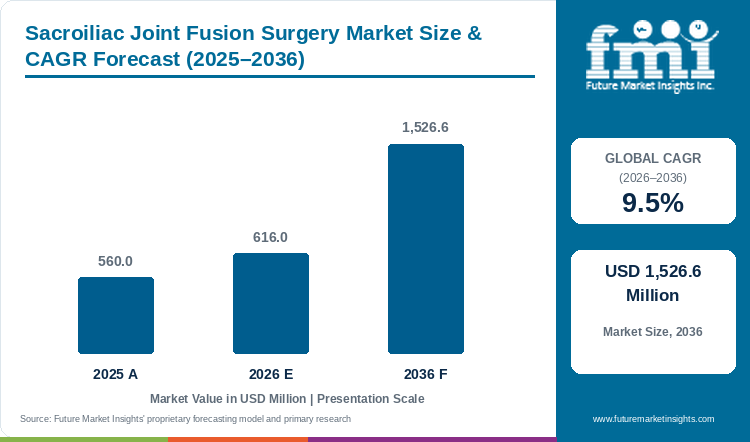
Revenue in the global sacroiliac joint fusion surgery market is projected to rise to USD 1,526.6 million by 2036 at a CAGR of 9.5% between 2026 and 2036. The market was valued at USD 560.0 million in 2025, with USD 616.0 million estimated for 2026.
Sacroiliac Joint Fusion Surgery Market Size and Forecast
Table 1: Sacroiliac Joint Fusion Surgery Market Size and Forecast
| Market size and forecast | Value |
|---|---|
| Market size in 2025 | USD 560.0 million |
| Estimated market size in 2026 | USD 616.0 million |
| Projected market size by 2036 | USD 1,526.6 million |
| CAGR from 2026 to 2036 | 9.5% |
Source: Future Market Insights analysis of the sacroiliac joint fusion surgery market, 2026.
The market's next increment depends on converting clinical eligibility into funded procedures. Medicare local coverage policy L36406 requires substantial documentation before coverage applies, including unsuccessful nonoperative care and evidence identifying the joint as the pain source. Longer evidence supports that conversion. A prospective study published in Spine in 2025 followed 3D-printed triangular titanium implants for five years, and thirty-six of the original 51 participants remained at that assessment.
FDA cleared an expanded Catamaran indication in March 2025 for augmentation during specified lumbar or thoracolumbar fixation procedures. France's HAS issued an assessment of iFuse TORQ in June 2026, recommending brand-name listing for second-line treatment in its stated population. These are separate access routes with different commercial requirements. Ambulatory surgical centers grow faster than hospitals in FMI's outlook, which will require suppliers to defend instrument costs.
Key Market Trends & Insights
- Interventional pain physicians are entering the discussion on who treats the joint. A 2026 STACI report evaluated 112 patients at 15 United States sites with lateral fusion performed by interventional pain physicians.
- Outpatient settings are taking more procedures. One device manufacturer describes SI fusion as a procedure that may be performed on an outpatient basis. FMI projects Ambulatory Surgical Centers to grow at 11.7% a year against 7.8% for Hospitals.
- Product comparison extends beyond implant shape to surface and instrumentation. Globus Medical's April 2025 SI-LOK product insert identifies titanium-alloy screws and optional hydroxyapatite coatings.
Regional Highlights
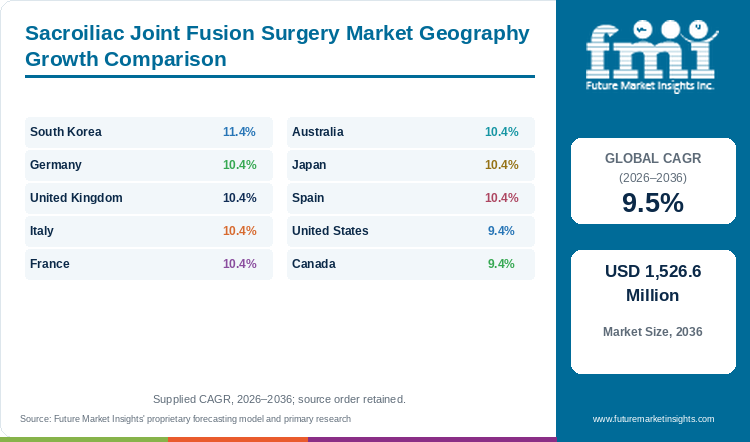
- South Korea grows fastest among the named countries at an 11.4% CAGR over 2026 to 2036. Germany, the United Kingdom, Italy, France, Australia, Japan and Spain follow jointly at 10.4%, against 9.5% for the global market.
- The United States and Canada grow slowest at 9.4% each over the same period, just under the global rate.
Analyst Perspective
“FMI expects the most durable accounts to come from systems that fit a clearly defined clinical and reimbursement pathway. A hospital may accept a premium implant when its evidence and instrument support fit the institution's practice. An ambulatory purchaser faces a different margin calculation. Suppliers need to show the commercial case for the actual approach and care setting instead of treating every cleared SI-fusion product as interchangeable.”
- Anurag Sharma, Principal Consultant, FMI
How is the Sacroiliac Joint Fusion Surgery Market segmented?
- By procedure: Lateral Transfixing Approach, Posterior Approach, and Other Approaches.
- By implant material: Titanium, Allograft and Biologic, and Polyetheretherketone and Others.
- By end user: Hospitals, Ambulatory Surgical Centers, and Specialty Spine Clinics.
- By region: North America, Western Europe, East Asia, South Asia and Pacific, and the Rest of world aggregate.
Why does the Lateral Transfixing Approach segment lead by Procedure in the Sacroiliac Joint Fusion Surgery Market in 2026?
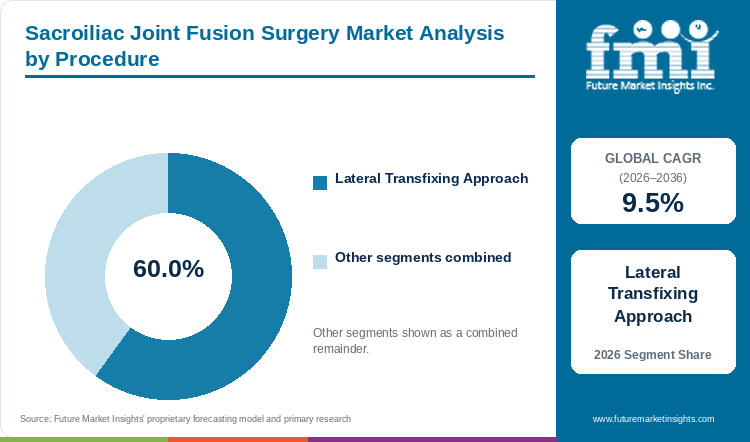
The Lateral Transfixing Approach segment holds 60.0% of the Sacroiliac Joint Fusion Surgery Market by procedure in 2026.
The lateral category benefits from an established evidence base, but the evidence belongs to particular implants and selected populations. The five-year triangular-implant study reports sustained clinical improvements and radiographic findings for the studied device.
Posterior Approach revenue is projected to grow at 10.9% CAGR between 2026 and 2036, compared with 8.9% for Lateral Transfixing Approach. Its share rises from 28.0% to 31.8%. FMI reads this as a widening commercial choice. Medtronic markets Rialto as a cylindrical threaded titanium system. Implants differ in geometry and approach, so each offer needs product-specific evaluation. Suppliers defending the lateral lead will need to retain trained users and produce evidence that remains relevant as alternative approaches gain purchasing consideration.
Posterior Approach and Other Approaches together hold the remaining 40.0% by procedure.
Table 2: Procedure, 2026 Share
| Leading Share | 2026 market share |
|---|---|
| Lateral Transfixing Approach | 60.0% |
| All Other Segments Combined Share | 40.0% |
Source: Future Market Insights analysis of the sacroiliac joint fusion surgery market, 2026.
Why does the Titanium segment lead by Implant Material in the Sacroiliac Joint Fusion Surgery Market in 2026?
The Titanium segment holds 82.0% of the Sacroiliac Joint Fusion Surgery Market by implant material in 2026.
Titanium spans more than one competitive design, from screw systems with optional hydroxyapatite coatings to cylindrical threaded implants. Material leadership therefore reflects broad commercial adoption across competing systems.
The commercial distinction within titanium concerns implant geometry, surface characterization and the evidence supporting the complete system. A purchaser comparing brands needs a defensible reason to change its stocked platform. A change also affects instruments and clinical familiarity.
Allograft and Biologic is projected to expand at 10.2% CAGR from 2026 to 2036. Its role overlaps the broader orthobiologics market.
Allograft and Biologic and Polyetheretherketone and Others together hold the remaining 18.0% by implant material.
Table 3: Implant Material, 2026 Share
| Leading Share | 2026 market share |
|---|---|
| Titanium | 82.0% |
| All Other Segments Combined Share | 18.0% |
Source: Future Market Insights analysis of the sacroiliac joint fusion surgery market, 2026.
Why does the Hospitals segment lead by End User in the Sacroiliac Joint Fusion Surgery Market in 2026?
The Hospitals segment holds 52.0% of the Sacroiliac Joint Fusion Surgery Market by end user in 2026.
Hospitals bring together implant selection, operating facilities and the management of patients whose condition may require a broader spinal assessment. They also purchase systems used in more complex fixation settings. Catamaran's expanded 2025 indication specifically includes augmentation in skeletally mature patients undergoing defined lumbar or thoracolumbar fusion procedures. That indication creates a distinct hospital purchasing discussion from an isolated elective SI-joint intervention.
Ambulatory Surgical Centers grow at 11.7% CAGR in the FMI outlook, exceeding the 7.8% forecast for Hospitals. Their expansion changes account economics even as hospital revenue continues to rise. A supplier competing for these cases must fit the center's payment and operating model. The funded purchasing route depends on the applicable payer and jurisdiction requirements.
Hospital share falls to 44.3% in 2036, but Hospitals remain the leading end-user category. Specialty Spine Clinics retain a separate role at 15.3%. The forecast therefore calls for a differentiated sales offer across institutions.
Ambulatory Surgical Centers and Specialty Spine Clinics together hold the remaining 48.0% by end user.
Table 4: End User, 2026 Share
| Leading Share | 2026 market share |
|---|---|
| Hospitals | 52.0% |
| All Other Segments Combined Share | 48.0% |
Source: Future Market Insights analysis of the sacroiliac joint fusion surgery market, 2026.
What are the key drivers restraints and opportunities?
Growth depends on funded access for appropriately selected patients, while uncertainty about diagnosis and comparative outcomes constrains adoption. Approach-specific evidence and efficient site support provide the main commercial openings.
Driver
A broader pool of trained treating specialists and longer implant-specific follow-up can support additional funded procedures.
Restraint
Coverage criteria and conflicting evidence prevent the chronic back-pain population from translating directly into fusion demand.
Opportunity
Suppliers can build accounts around a defined approach, documented outcomes and instrumentation suited to the purchasing site.
How do purchasing rules and qualification affect sacroiliac joint fusion surgery market demand?
The market has a practical conversion problem. Recognition of SI-joint pain must be followed by a defensible treatment decision and an accepted payment route. The 2026 STACI publication reports a 5.2-point mean pain-score improvement at six months in its single-arm cohort. Its authors call for randomized reproduction. FMI interprets this evidence as support for continued evaluation of specialist participation, not proof that a larger physician pool automatically creates the same growth in implant sales.
Country access can expand independently of United States activity. SI-BONE's 2025 annual filing lists a March 2025 European CE-mark date for iFuse TORQ. The commercial task after a regulatory milestone is to establish local clinical use and obtain institutional orders. The sales opportunity is specific to the authorized device and application. Product families that also serve pelvic trauma or thoracolumbar fixation must keep those revenues separate from stand-alone SI-fusion demand.
What limits reliable sacroiliac joint fusion surgery market supply and quality?
A multispecialty consensus published in 2025 describes mixed evidence for surgery, including disagreement between pragmatic trials and a sham-controlled study. This limits broad claims that all persistent SI-joint pain will respond to fusion. For suppliers, the resulting risk is a narrower eligible population or a stricter evidence requirement at the payer. It also increases the value of transparent study design and follow-up. Fusion at other spinal levels is covered in FMI's spinal fusion market.
Supply quality remains a separate issue. FDA's 2026 packaging-related recall involved designated iFuse TORQ lots, instead of a finding about all products used for SI fusion. FMI expects buyers to scrutinize packaging and traceability alongside implant performance. An alternative product still needs its own supporting evidence. Changing brands solely because of a narrowly defined supply action could introduce a different clinical and operational uncertainty.
Where can suppliers win additional business in the sacroiliac joint fusion surgery market?
The strongest opening is a supported account conversion with a clear economic rationale. An ambulatory center evaluates product costs in the context of its own reimbursement, whereas a hospital may also assess compatibility with a broader spinal service. Navigation compatibility can enter that discussion. FDA's SI-LOK record includes navigation instruments and ExcelsiusGPS instruments, although clearance alone does not quantify a clinical benefit from navigation. The related surgical navigation system market is therefore an adjacent capital-equipment consideration instead of revenue added to the implant forecast.
Clinical evidence, device supply and payment support need to agree on the same intervention. Suppliers that maintain this alignment have a clearer route to repeat orders than those promoting an undifferentiated category-wide claim. There is also a distinct purchasing discussion around postoperative bone healing, considered in the bone growth stimulators market. Such adjuncts are outside this report's implant and procedure-set valuation.
Sacroiliac Joint Fusion Surgery Market by Country (2026 to 2036)
Table 5: Sacroiliac Joint Fusion Surgery Market Country Growth Forecast
| Country | CAGR, 2026 to 2036 |
|---|---|
| South Korea | 11.4% |
| Germany | 10.4% |
| United Kingdom | 10.4% |
| Italy | 10.4% |
| France | 10.4% |
| Australia | 10.4% |
| Japan | 10.4% |
| Spain | 10.4% |
| United States | 9.4% |
| Canada | 9.4% |
Source: Future Market Insights analysis of the sacroiliac joint fusion surgery market, 2026.
South Korea
South Korea starts from USD 4.3 million in 2026, so its 11.4% CAGR, the highest country growth rate in the 2026 to 2036 outlook, describes growth from a small base. South Korea reaches 0.7% of the global market in 2026. South Korea ranks tenth of ten on 2026 revenue. South Korea's 11.4% CAGR sits 1.9 points above the global 9.5%. At that pace revenue multiplies 2.9 times over the decade, against 2.5 times for the global market.
Local research supports careful differentiation between joint degeneration and an indication for fusion. A 2025 Yonsei Medical Journal study examined sacroiliac changes after adolescent scoliosis surgery and associated lower distal lumbar fusion levels with faster degenerative change. This was a retrospective follow-up study in a defined postoperative population.
For suppliers, the useful consequence is a stronger need to understand the referral pathway and the diagnostic distinctions made by local spine services. FMI expects product introduction to depend on documented authorization and a clinically credible account, followed by evidence of actual recurring use. An expanding market may support more specialist accounts, but each new inventory placement still needs a sustainable commercial rationale. Training and instrument support should be matched to the procedure the institution intends to offer. The forecast's faster rate therefore reflects room for development from a narrow base, with clinical selection and product-specific evidence continuing to constrain the pace.
Germany
German clinical experience shows how narrowly selected demand can emerge from a much larger back-pain referral population. A 2024 Munich-Taufkirchen study assessed more than 15,000 outpatients, performed SI-joint blocks in 3,477 and selected 541 for fusion with triangular titanium implants. Twelve-month follow-up was available for 483 patients. These figures describe one specialist service.
A supplier building a German account needs to understand the institution's referral and assessment pathway before projecting implant orders from the general prevalence of back pain. FMI forecasts German revenue of USD 18.5 million in 2026 and 10.4% CAGR between 2026 and 2036. Sustaining that expansion requires consistent case identification and a purchasing arrangement that fits the service's actual activity. In 2026 revenue terms, Germany is second of the ten countries. Germany reaches 3.0% of the global market in 2026. Germany's 10.4% CAGR sits 0.9 points above the global 9.5%. It trails South Korea's 11.4% by 1.0 point and exceeds the 9.4% of the United States by the same margin.
FMI's reading favors a concentrated clinical-account strategy over a broad sales claim based on population size. A specialist center can assess implant performance over repeated cases, while a new supplier must explain why changing a familiar system is worthwhile. German account development should therefore connect the product's evidence to the treating service's own requirements, with an explicit distinction between a training activity and a completed revenue-generating case.
United Kingdom
NICE provides a technology-specific starting point for the United Kingdom. Its iFuse guidance was updated in August 2022 to include the 3D-printed version and revised costs. The later migration to HealthTech guidance 488 in December 2025 left the recommendations unchanged. The existence of an assessed technology gives a purchasing discussion a clearer evidence reference, but it does not confer the same standing on all SI-fusion implants.
FMI projects 10.4% CAGR between 2026 and 2036, taking the market beyond its USD 12.3 million 2026 base. The practical question is how an individual service organizes referrals, case review and implant procurement around the patients it actually treats. A competing supplier needs an argument relevant to that pathway. A discount against an established implant may be insufficient if the alternative lacks comparable follow-up or requires a different instrument commitment.
The United Kingdom also illustrates why an economic case needs careful boundaries. A technology assessment's cost assumptions belong to its specified intervention and setting. They cannot be recast as the selling price of an entire procedure or applied unchanged to a different design. FMI expects commercial discussions to focus on the hospital's incremental product costs, service support and evidence requirements. Suppliers able to explain those elements precisely have a stronger basis for account retention. Expansion will be uneven if clinicians and purchasing teams reach different conclusions about the evidence supporting a proposed replacement.
Italy
Anatomical assessment provides a useful lens on Italy's opportunity. Researchers associated with Rome institutions examined dry pelvic specimens and CT scans in a study published in Surgical and Radiologic Anatomy in 2017. They warned that articular and extra-articular structures can be confused on common imaging views. Its relevance is the continuing need for careful interpretation when a product is introduced into a specialist practice.
Italy's market reaches USD 9.2 million in 2026 in the FMI outlook and grows at 10.4% CAGR from 2026 to 2036. From that base, the commercial value of an additional trained institutional account can be meaningful. A supplier must still establish the exact regulatory status and purchasing fit of the system it offers. Experience with another spinal implant does not eliminate the need to assess a new SI-fusion platform. Italy compounds at 10.4%, which is 0.9 points above the global 9.5%. In the sacroiliac joint fusion surgery market, Italy's 2026 revenue ranks joint fourth of ten. Italy's 2026 revenue equals 1.5% of the global total.
FMI sees scope for suppliers that make the distinction between implant design and the evidence for clinical selection clear to local users. An institution deciding between platforms can examine its current instrument inventory and the cost of adding another complete set. The forecast therefore depends on a gradual increase in supported use, with sales expectations tied to functioning clinical programs.
France
France has a specific 2026 access development. HAS's CNEDiMTS assessed iFuse TORQ on 9 June 2026 and considered its expected service sufficient for brand-name listing in the stated second-line indication. A recommendation is an assessment milestone. It should not be described as evidence that every hospital has adopted the device or that every referred patient qualifies for funding.
That distinction shapes FMI's 10.4% CAGR forecast from 2026 to 2036, starting from USD 9.2 million in 2026. Commercial progress requires the assessment to connect with the relevant listing, purchasing and clinical processes. Supplier forecasts should follow the status of those steps for the actual device. A new family member cannot automatically inherit another implant's national evidence or access position.
France also presents a concrete challenge for comparative selling. An established brand-specific assessment provides purchasers with a defined reference point. A rival has to explain whether its design and studied population fit the same problem, or whether it is making a different offer that needs its own assessment. FMI expects evidence support and institutional service to remain central to this discussion. The national outlook is small enough that individual access milestones may alter the pace of adoption without indicating a general acceleration across Europe. The French opportunity should be followed on its own terms, with the distinction between recommendation, listing and actual clinical orders kept intact.
Australia
Australian private-insurance device rules provide a concrete purchasing reference. The July 2025 schedule listed SI-LOK, iFuse and other SI-fusion devices with stated device benefits. Those entries concern listed products and benefits.
Evidence scrutiny accompanies this payment structure. In May 2024, ISCRR described short-term findings as potentially favorable while identifying low-quality evidence and uncertainty about longer-term outcomes. A supplier therefore faces two separate questions: whether a product can enter a funded purchasing route and whether the institution accepts its evidence. FMI forecasts Australian revenue at USD 9.2 million in 2026 with 10.4% CAGR from 2026 to 2036. Measured by 2026 revenue, Australia sits joint fourth of ten. Australia's 2026 revenue equals 1.5% of the global total. In the sacroiliac joint fusion surgery market, Australia's 10.4% CAGR sits 0.9 points above the global 9.5%.
For distributors, growth requires matching stock and instrument investment to real clinical activity. A listed device can remain commercially limited if the number of treating accounts is small. FMI expects suppliers to support disciplined account expansion with a clearly bounded clinical case and an accurate explanation of the applicable device listing. Price competition should be assessed within this framework. A lower acquisition price cannot by itself resolve uncertainty about patient selection or long-term performance. The Australian market's smaller scale makes inventory turnover and account continuity particularly relevant to the commercial offer.
Japan
Japan's early local experience cautions against importing another country's clinical assumptions. A pilot study of five patients treated in 2017 reported three-year outcomes in Spine Surgery and Related Research. No patient demonstrated osseous bridging across the joint, and disability outcomes weakened after earlier improvement. It does show why local evidence needs to be examined independently.
FMI forecasts Japan at USD 6.2 million in 2026 and 10.4% CAGR through 2036. A supplier entering the country must establish its own device's current status and the practical route to institutional purchasing. A 10.4% CAGR leaves Japan 0.9 points above the 9.5% global pace. In the sacroiliac joint fusion surgery market, Japan's 2026 revenue ranks joint seventh of ten. Japan reaches 1.0% of the global market in 2026.
The commercial argument is consequently measured. Product variants should be evaluated for the patients and practices that will use them, with longer follow-up and clear reporting of any revisions or loss of benefit. FMI expects narrowly defined specialist programs to provide a more credible initial basis for demand than a broad prevalence calculation. Sales teams should also distinguish an implant's familiarity in international publications from acceptance by a Japanese institution. A local purchasing decision needs evidence and support relevant to the system actually offered. Growth from a small base can be material without requiring rapid general adoption.
Spain
Spain has contributed a useful comparison across treatment pathways. A Valencia-based retrospective series published in Neurosurgery in 2018 followed patients receiving conservative management, radiofrequency denervation or minimally invasive fusion for up to six years. The fusion group comprised 27 of the 137 patients. Its observational design limits causal conclusions, but it places implant treatment within the wider sequence of pain management instead of treating fusion as the only commercial option.
The Spanish market is forecast at USD 4.9 million in 2026 with 10.4% CAGR from 2026 to 2036. At this scale, market expansion depends on additional institutions establishing supported treatment programs and on existing users sustaining appropriate case activity. FMI expects suppliers to show how their evidence relates to the specific patients being considered, without presenting a small historical series as a national demand measure. Spain compounds at 10.4%, which is 0.9 points above the global 9.5%. Spain's 2026 revenue ranks ninth of ten.
Competing treatment pathways also influence the sales process. A product's commercial case must explain its role after the relevant alternatives have been considered. That is different from arguing that every alternative treatment failure creates a surgical indication. For purchasers, the useful comparison concerns the actual system, its supporting follow-up and the service required to maintain it. A distributor can add value by keeping the technical and commercial offer consistent across clinical and purchasing discussions.
United States
United States purchasing is divided by payer and care setting, even though it holds the leading share of global revenue. FMI estimates the market at USD 529.8 million in 2026 with 9.4% CAGR from 2026 to 2036. Local Medicare policy L36406 illustrates the documentation burden: coverage requires persistent functional impairment despite nonoperative treatment, clinical assessment and confirmatory injection evidence. This is a local policy for its named contractor jurisdictions. In the sacroiliac joint fusion surgery market, the United States accounts for 86.0% of global revenue in 2026. Measured by 2026 revenue, the United States sits first of ten. The United States grows at 9.4% a year, 0.1 points slower than the global rate.
For implant companies, access support is part of account development. Hospitals and ambulatory centers also evaluate different facility economics. FMI expects suppliers to distinguish clinical demand from the institution's willingness to stock another platform. A dependable instrument service and a clear explanation of the studied patient group strengthen that discussion without replacing medical necessity.
The United States already offers a large base for repeat usage. Incremental growth therefore requires more than signing new distributors. Suppliers must retain active users and demonstrate where a new approach or implant changes the account's offer. The country's share eases to 84.9% in 2036 as other markets expand. That leaves the United States central to revenue, while reducing the logic of treating international access as a peripheral sales project.
Canada
Canadian research highlights the importance of evidence independence. A University of Toronto and Sunnybrook-associated review published in 2022 included six studies and 564 patients. It rated the evidence as low quality and noted that five studies were industry funded. The authors found potential for SI fusion but emphasized the limited independent long-term trials. These findings do not constitute a national Canadian coverage determination.
FMI projects Canadian growth of 9.4% CAGR between 2026 and 2036, from USD 6.2 million in 2026. The commercial implication is that suppliers should expect purchasers to examine more than favorable headline outcomes. Study design, retention and the exact intervention are relevant to whether an account accepts a product's case. An institution evaluating a new system also needs to decide whether the expected activity justifies a dedicated instrument commitment.
In FMI's assessment, a smaller revenue base rewards careful account selection and continuity of support. A supplier can build a defensible program around a service with an established assessment pathway, while avoiding the assumption that every chronic back-pain referral represents future implant revenue. It should distinguish evidence review from evidence generation. Repackaging a manufacturer's international study does not create a Canadian trial or a Canadian reimbursement approval. Commercial progress will be more credible when local clinical use, product access and purchasing arrangements are documented separately. This approach supports measured expansion without overstating the scale or certainty of adoption.
Who are the notable companies in the Sacroiliac Joint Fusion Surgery Market?
Notable companies in the Sacroiliac Joint Fusion Surgery Market include SI-BONE, Medtronic, Globus Medical, Tenon Medical and Aurora Spine.
The competitive structure combines a focused sacropelvic specialist with broader spine companies and smaller dedicated-system suppliers. SI-BONE's iFuse family covers several implant designs and applications. Its 2025 filing distinguishes SI-joint dysfunction from spinal deformity and pelvic-trauma applications. Revenue from those adjacent uses should not be interpreted as a disclosed SI-fusion market share. Medtronic's Rialto and Globus Medical's SI-LOK provide separate titanium-based platforms with their own product documentation.
Tenon Medical's Catamaran creates a different commercial offer through its dedicated system and indicated uses. Aurora Spine identifies SiLO and SiLO TFX within its product range, while Life Spine markets the SImpact fixation system. Their presence broadens product choice without establishing equivalence of clinical evidence or account scale.
Zimmer Biomet completed the separation of its former dental and spine business into ZimVie in March 2022.Likewise, a July 2025 FDA record names Sivantage as the applicant for SImmetry+. Legacy brand associations should not substitute for checking the actual legal manufacturer. FMI expects precise product attribution to matter as purchasers consolidate evidence, regulatory records and supply contracts around the same entity.
Dedicated sacropelvic platform: SI-BONE, with its iFuse product family.
Broader spine platforms with documented SI systems: Medtronic and Globus Medical.
Specialized SI-joint offers: Tenon Medical, Aurora Spine and Life Spine.
Historical orthopaedic comparison: Zimmer Biomet, following separation of its former spine business.
Key Developments in the Sacroiliac Joint Fusion Surgery Market
- On 16 April 2026, Genesys Spine announced the launch of its SIros-X System for sacroiliac joint fusion and pelvic fixation. The first surgical case was performed in Nashville, Tennessee on 30 March 2026.
Key Players in the Sacroiliac Joint Fusion Surgery Market
- SI-BONE
- Medtronic
- Globus Medical
- Tenon Medical
- Aurora Spine
- Life Spine
- Zimmer Biomet
Sacroiliac Joint Fusion Surgery Market Report Scope
Table 6: Sacroiliac Joint Fusion Surgery Market Report Scope
| Coverage field | Report scope |
|---|---|
| Market definition | Implants, instrumentation and procedure sets for minimally invasive and open sacroiliac-joint fusion treating dysfunction and degeneration. |
| Product coverage | Triangular titanium implants, other metallic systems and allograft implant systems within the defined fusion scope. |
| Exclusions | General back-pain care, injections, radiofrequency treatment, total hospital episode charges and unrelated pelvic-trauma or spinal-implant sales. |
| Quantitative Units | USD million |
| Market breakdown | Procedure, Implant Material and End User. |
| Named country coverage | United States, Germany, United Kingdom, Italy, France, Australia, Japan, Canada, Spain and South Korea. |
| Other geographic coverage | Rest of world aggregate, separately identified. |
| Company coverage | SI-BONE, Medtronic, Globus Medical, Zimmer Biomet as former context, Tenon Medical, Aurora Spine and Life Spine. |
Source: Future Market Insights analysis of the sacroiliac joint fusion surgery market, 2026.
Sacroiliac Joint Fusion Surgery Market Research Methodology
The assessment combines FMI's market outlook with secondary review of product labeling, regulator decisions, technology assessments and clinical publications. Revenue and volume measures use a consistent implant and procedure-set boundary. Country forecasts are interpreted alongside local evidence without treating a small study as national utilization. Competitive comparisons distinguish documented SI-fusion offers from historical company associations.
Sacroiliac Joint Fusion Surgery Market by Segments
Sacroiliac Joint Fusion Surgery Market segmented by Procedure:
- Lateral Transfixing Approach
- Posterior Approach
- Other Approaches
Sacroiliac Joint Fusion Surgery Market segmented by Implant Material:
- Titanium
- Allograft and Biologic
- Polyetheretherketone and Others
Sacroiliac Joint Fusion Surgery Market segmented by End User:
- Hospitals
- Ambulatory Surgical Centers
- Specialty Spine Clinics
Sacroiliac Joint Fusion Surgery Market by Region
- North America
- United States
- Canada
- Western Europe
- Germany
- United Kingdom
- Italy
- France
- Spain
- East Asia
- Japan
- South Korea
- South Asia and Pacific
- Australia
- Rest of world aggregate
Research Sources and Bibliography
- Abbas, A., Du, J. T., Toor, J., Versteeg, A., and Finkelstein, J. A. (2022). The efficacy of primary sacroiliac joint fusion for low back pain caused by sacroiliac joint pathology: A systematic review and meta-analysis. European Spine Journal, 31, 2461-2472. DOI: 10.1007/s00586-022-07291-y. https://pubmed.ncbi.nlm.nih.gov/35768617/
- Aurora Spine. (Accessed 2026, November 9). SiLO TFX: Product information and studies. https://www.aurora-spine.com/silo-tfx-studies ; Management's Discussion and Analysis. https://www.aurora-spine.com/s/Aurora_Spine_MDA_Master-FInal-2.pdf
- Australian Government. (2025, July 1 compilation). Private Health Insurance (Medical Devices and Human Tissue Products) Rules 2025: Device benefit schedule. https://www.legislation.gov.au/F2025L00198/2025-07-01/2025-07-01/text/2/epub/OEBPS/document_6/document_6.html
- Centers for Medicare & Medicaid Services. (2026). Local Coverage Determination L36406: Minimally-invasive Surgical Fusion of the Sacroiliac Joint. Revision effective 1 April 2026. https://www.cms.gov/medicare-coverage-database/view/lcd.aspx?lcdid=36406
- Genesys Spine. (2026, April 16). Genesys Spine Announces Launch of the SIros-X System for Sacroiliac Joint Fusion and Pelvic Fixation of Pedicle Screw Constructs. https://www.genesysspine.com/genesys-spine-announces-siros-x-launch/
- Globus Medical. (2025, April). SI-LOK Sacroiliac Joint Fixation System: Product insert DI158B-EN, Revision G. https://www.globusmedical.com/wp-content/uploads/2025/06/DI158B-EN-SILOK-Product-Insert_revG.pdf
- Haute Autorité de Santé. (2026, June 9). IFUSE TORQ IMPLANT SYSTEM: Avis de la CNEDiMTS. https://www.has-sante.fr/jcms/p_4092756/fr/ifuse-torq-implant-system-avis-de-la-cnedimts-du-09-juin-2026
- Institute for Safety, Compensation and Recovery Research. (2024, May 27). Evidence Review: Sacroiliac joint fusion for persistent pain. https://www.iscrr.com.au/news/newsletter/may-2024-sacroiliac-joint-fusion/
- Kim, S.-H., et al. (2025, February). Impact of Distal Fusion Level on Sacroiliac Joint Degenerative Change Following Adolescent Idiopathic Scoliosis Surgery. Yonsei Medical Journal, 66(2), 103-110. DOI: 10.3349/ymj.2023.0634. https://pubmed.ncbi.nlm.nih.gov/39894043/
- Kurosawa, D., Murakami, E., Koga, H., and Ozawa, H. (2022). Three-Year Clinical Outcomes after Minimally Invasive Sacroiliac Joint Arthrodesis Using Triangular Implants in Japan: A Pilot Study of Five Cases. Spine Surgery and Related Research, 6(1), 71-78. DOI: 10.22603/ssrr.2021-0028. https://www.jstage.jst.go.jp/article/ssrr/6/1/6_2021-0028/_article/-char/en
- Life Spine. (Accessed 2026, November 9). SImpact Sacroiliac Joint Fixation Screw System. https://lifespine.com/simpact/
- Medtronic. (Accessed 2026, November 9). About SI Joint Fusion: Rialto SI Fusion System. https://www.medtronic.com/en-us/l/patients/treatments-therapies/sacroiliac-joint-fusion/treatment-options/si-fusion.html
- Medtronic. (Accessed 2026, November 9). Important Safety Information: Rialto SI Fusion System. https://www.medtronic.com/en-us/l/patients/treatments-therapies/sacroiliac-joint-fusion/important-safety-information.html
- Multispecialty international working group. (2025). Consensus practice guidelines on sacroiliac joint complex pain. Regional Anesthesia & Pain Medicine. DOI: 10.1136/rapm-2025-107387. https://rapm.bmj.com/content/early/2025/11/28/rapm-2025-107387
- National Institute for Health and Care Excellence. (2022; migration December 2025). iFuse for treating chronic sacroiliac joint pain. HealthTech guidance HTG488. https://www.nice.org.uk/guidance/htg488
- Patel, V., et al. (2025). Prospective Trial of Sacroiliac Joint Fusion Using 3D-Printed Triangular Titanium Implants: Five-Year Follow-Up. Spine, 50(9), 620-627. Published online 30 September 2024. DOI: 10.1097/BRS.0000000000005170. https://pubmed.ncbi.nlm.nih.gov/39344079/
- Postacchini, R., et al. (2017). Morphometric anatomical and CT study of the human adult sacroiliac region. Surgical and Radiologic Anatomy, 39(1), 85-94. Published online 20 June 2016. DOI: 10.1007/s00276-016-1703-0. https://pubmed.ncbi.nlm.nih.gov/27324173/
- Rainov, N. G., Schneiderhan, R., and Haritonov, D. (2024, November 18). Triangular titanium implants for sacroiliac joint fusion. Acta Neurochirurgica, 166, 462. DOI: 10.1007/s00701-024-06357-8. https://pubmed.ncbi.nlm.nih.gov/39557713/
- SI-BONE, Inc. (2026). Annual Report on Form 10-K for the year ended 31 December 2025. https://www.sec.gov/Archives/edgar/data/1459839/000145983926000036/sibn-20251231.htm
- U.S. Food and Drug Administration. (2018). SI-LOK Additional Implants and Instruments, K183119: 510(k) summary. https://www.accessdata.fda.gov/cdrh_docs/pdf18/K183119.pdf
- U.S. Food and Drug Administration. (2025, March 21). Catamaran SI Joint Fusion System, K250403: Clearance letter and 510(k) summary. https://www.accessdata.fda.gov/cdrh_docs/pdf25/K250403.pdf
- U.S. Food and Drug Administration. (2025, July 29). SImmetry+ System, K250647: 510(k) Premarket Notification. Applicant: Sivantage. https://www.accessdata.fda.gov/scripts/cdrh/cfdocs/cfPMN/pmn.cfm?ID=K250647
- U.S. Food and Drug Administration. (2026, October 9). Class 2 Device Recall: iFuse TORQ Implant System. Recall Z-0146-2027; firm initiation 21 August 2026. https://www.accessdata.fda.gov/SCRIPTs/cdrh/cfdocs/cfres/res.cfm?id=222762
- Vanaclocha, V., Herrera, J. M., Sáiz-Sapena, N., Rivera-Paz, M., and Verdú-López, F. (2018). Minimally Invasive Sacroiliac Joint Fusion, Radiofrequency Denervation, and Conservative Management for Sacroiliac Joint Pain: 6-Year Comparative Case Series. Neurosurgery, 82(1), 48-55. DOI: 10.1093/neuros/nyx185. https://pubmed.ncbi.nlm.nih.gov/28431026/
- Weisbein, J., et al. (2026, January 30). Minimally invasive sacroiliac joint fusion: Primary endpoint results from the prospective, multicenter STACI study. PM&R, 18(9), 986-996. DOI: 10.1002/pmrj.70095. https://pmc.ncbi.nlm.nih.gov/articles/PMC13575448/
- Zimmer Biomet. (2022, March 1). Zimmer Biomet Announces Completion of ZimVie Spinoff. https://investor.zimmerbiomet.com/news-and-events/news/archive/03-01-2022-120035502
This bibliography is provided for reader reference and is not exhaustive. The full report contains the complete reference list and detailed citations.
Table of Content
- Key Takeaways
- Market Size and CAGR
- Top Growth Driver
- Fastest Growing Segment
- Leading Region
- Key Companies
- Emerging Opportunities
- Executive Summary
- Global Market Outlook
- Demand-side Trends
- Supply-side Trends
- Technology Roadmap Analysis
- Analysis and Recommendations
- Analyst Perspective (What is happening? Why now? What should investors know?)
- Key Questions Answered
- How large is the market?
- What is the CAGR?
- What are key trends?
- Which region dominates?
- Who are the leaders?
Read More...
- Market Overview
- Market Coverage / Taxonomy
- Market Definition / Scope / Limitations
- Research Methodology
- Chapter Orientation
- Analytical Lens and Working Hypotheses
- Market Structure, Signals, and Trend Drivers
- Benchmarking and Cross-market Comparability
- Market Sizing, Forecasting, and Opportunity Mapping
- Research Design and Evidence Framework
- Desk Research Programme (Secondary Evidence)
- Expert Input and Fieldwork (Primary Evidence)
- Tooling, Models, and Reference Databases
- Data Engineering and Model Build
- Quality Assurance and Audit Trail
- Market Background
- Market Dynamics (Drivers, Restraints, Opportunity, Trends)
- Scenario Forecast (Optimistic, Likely, Conservative)
- Impact Analysis
- AI Impact
- Sustainability Impact
- Regulatory Impact
- Technology Impact
- Consumer / Buyer Analysis
- Purchase Drivers
- Adoption Barriers
- Buyer Journey
- Opportunity Map Analysis
- Product Life Cycle Analysis
- Supply Chain Analysis
- Investment Feasibility Matrix
- Value Chain Analysis
- PESTLE and Porter's Analysis
- Regulatory Landscape
- Regional Parent Market Outlook
- Production and Consumption Statistics
- Import and Export Statistics
- Global Market Analysis and Forecast, 2021 to 2036
- Historical Market Size Value (USD Million) Analysis, 2021 to 2025
- Current and Future Market Size Value (USD Million) Projections, 2026 to 2036
- Y-o-Y Growth Trend Analysis
- Absolute $ Opportunity Analysis
- Global Market Pricing Analysis, 2021 to 2036
- Global Market Analysis and Forecast, By Procedure, 2021 to 2036
- Introduction / Key Findings
- Historical Market Size Value (USD Million) Analysis By Procedure, 2021 to 2025
- Current and Future Market Size Value (USD Million) Analysis and Forecast By Procedure, 2026 to 2036
- Lateral Transfixing Approach
- Posterior Approach
- Other Approaches
- Y-o-Y Growth Trend Analysis By Procedure, 2021 to 2025
- Absolute $ Opportunity Analysis By Procedure, 2026 to 2036
- Global Market Analysis and Forecast, By Implant Material, 2021 to 2036
- Introduction / Key Findings
- Historical Market Size Value (USD Million) Analysis By Implant Material, 2021 to 2025
- Current and Future Market Size Value (USD Million) Analysis and Forecast By Implant Material, 2026 to 2036
- Titanium
- Allograft and Biologic
- Polyetheretherketone and Others
- Y-o-Y Growth Trend Analysis By Implant Material, 2021 to 2025
- Absolute $ Opportunity Analysis By Implant Material, 2026 to 2036
- Global Market Analysis and Forecast, By End User, 2021 to 2036
- Introduction / Key Findings
- Historical Market Size Value (USD Million) Analysis By End User, 2021 to 2025
- Current and Future Market Size Value (USD Million) Analysis and Forecast By End User, 2026 to 2036
- Hospitals
- Ambulatory Surgical Centers
- Specialty Spine Clinics
- Y-o-Y Growth Trend Analysis By End User, 2021 to 2025
- Absolute $ Opportunity Analysis By End User, 2026 to 2036
- Global Market Analysis and Forecast, By Region, 2021 to 2036
- Introduction
- Historical Market Size Value (USD Million) Analysis By Region, 2021 to 2025
- Current Market Size Value (USD Million) Analysis and Forecast By Region, 2026 to 2036
- North America
- Western Europe
- East Asia
- South Asia and Pacific
- Market Attractiveness Analysis By Region
- North America Market Analysis and Forecast, By Country, 2021 to 2036
- Historical Market Size Value (USD Million) Trend Analysis By Market Taxonomy, 2021 to 2025
- Market Size Value (USD Million) Forecast By Market Taxonomy, 2026 to 2036
- By Country
- United States
- Canada
- By Procedure
- By Implant Material
- By End User
- By Country
- Market Attractiveness Analysis
- By Country
- By Procedure
- By Implant Material
- By End User
- Key Takeaways
- Western Europe Market Analysis and Forecast, By Country
- Historical Market Size Value (USD Million) Trend Analysis By Market Taxonomy, 2021 to 2025
- Market Size Value (USD Million) Forecast By Market Taxonomy, 2026 to 2036
- By Country
- Germany
- United Kingdom
- Italy
- France
- Spain
- By Procedure
- By Implant Material
- By End User
- By Country
- Market Attractiveness Analysis
- By Country
- By Procedure
- By Implant Material
- By End User
- Key Takeaways
- East Asia Market Analysis and Forecast, By Country
- Historical Market Size Value (USD Million) Trend Analysis By Market Taxonomy, 2021 to 2025
- Market Size Value (USD Million) Forecast By Market Taxonomy, 2026 to 2036
- By Country
- Japan
- South Korea
- By Procedure
- By Implant Material
- By End User
- By Country
- Market Attractiveness Analysis
- By Country
- By Procedure
- By Implant Material
- By End User
- Key Takeaways
- South Asia and Pacific Market Analysis and Forecast, By Country
- Historical Market Size Value (USD Million) Trend Analysis By Market Taxonomy, 2021 to 2025
- Market Size Value (USD Million) Forecast By Market Taxonomy, 2026 to 2036
- By Country
- Australia
- Rest of world aggregate
- By Procedure
- By Implant Material
- By End User
- By Country
- Market Attractiveness Analysis
- By Country
- By Procedure
- By Implant Material
- By End User
- Key Takeaways
- Key Countries Market Analysis
- United States
- Pricing Analysis
- Market Share Analysis, 2025
- By Procedure
- By Implant Material
- By End User
- Canada
- Pricing Analysis
- Market Share Analysis, 2025
- By Procedure
- By Implant Material
- By End User
- Germany
- Pricing Analysis
- Market Share Analysis, 2025
- By Procedure
- By Implant Material
- By End User
- United Kingdom
- Pricing Analysis
- Market Share Analysis, 2025
- By Procedure
- By Implant Material
- By End User
- Italy
- Pricing Analysis
- Market Share Analysis, 2025
- By Procedure
- By Implant Material
- By End User
- Spain
- Pricing Analysis
- Market Share Analysis, 2025
- By Procedure
- By Implant Material
- By End User
- France
- Pricing Analysis
- Market Share Analysis, 2025
- By Procedure
- By Implant Material
- By End User
- Japan
- Pricing Analysis
- Market Share Analysis, 2025
- By Procedure
- By Implant Material
- By End User
- South Korea
- Pricing Analysis
- Market Share Analysis, 2025
- By Procedure
- By Implant Material
- By End User
- Australia
- Pricing Analysis
- Market Share Analysis, 2025
- By Procedure
- By Implant Material
- By End User
- United States
- Market Structure Analysis
- Competition Dashboard
- Competition Benchmarking
- Market Share Analysis of Top Players
- By Regional
- By Procedure
- By Implant Material
- By End User
- Emerging Startups
- Innovation Benchmarking
- Competition Analysis
- Competition Deep Dive
- SI-BONE
- Overview
- Product Portfolio
- Profitability by Market Segments
- Sales Footprint
- Strategy Overview
- Marketing Strategy
- Product Strategy
- Channel Strategy
- Medtronic
- Globus Medical
- Zimmer Biomet
- Tenon Medical
- Aurora Spine
- Life Spine
- SI-BONE
- Case Studies
- Success Stories
- Recent Developments
- Competition Deep Dive
- Assumptions & Acronyms Used
List of Tables
- Table 1: Global Market Value (USD Million) Forecast by Region, 2021 to 2036
- Table 2: Global Market Value (USD Million) Forecast by Procedure, 2021 to 2036
- Table 3: Global Market Value (USD Million) Forecast by Implant Material, 2021 to 2036
- Table 4: Global Market Value (USD Million) Forecast by End User, 2021 to 2036
- Table 5: North America Market Value (USD Million) Forecast by Country, 2021 to 2036
- Table 6: North America Market Value (USD Million) Forecast by Procedure, 2021 to 2036
- Table 7: North America Market Value (USD Million) Forecast by Implant Material, 2021 to 2036
- Table 8: North America Market Value (USD Million) Forecast by End User, 2021 to 2036
- Table 9: Western Europe Market Value (USD Million) Forecast by Country, 2021 to 2036
- Table 10: Western Europe Market Value (USD Million) Forecast by Procedure, 2021 to 2036
- Table 11: Western Europe Market Value (USD Million) Forecast by Implant Material, 2021 to 2036
- Table 12: Western Europe Market Value (USD Million) Forecast by End User, 2021 to 2036
- Table 13: East Asia Market Value (USD Million) Forecast by Country, 2021 to 2036
- Table 14: East Asia Market Value (USD Million) Forecast by Procedure, 2021 to 2036
- Table 15: East Asia Market Value (USD Million) Forecast by Implant Material, 2021 to 2036
- Table 16: East Asia Market Value (USD Million) Forecast by End User, 2021 to 2036
- Table 17: South Asia and Pacific Market Value (USD Million) Forecast by Country, 2021 to 2036
- Table 18: South Asia and Pacific Market Value (USD Million) Forecast by Procedure, 2021 to 2036
- Table 19: South Asia and Pacific Market Value (USD Million) Forecast by Implant Material, 2021 to 2036
- Table 20: South Asia and Pacific Market Value (USD Million) Forecast by End User, 2021 to 2036
List of Figures
- Figure 1: Global Market Pricing Analysis
- Figure 2: Global Market Value (USD Million) Forecast 2021-2036
- Figure 3: Global Market Value Share and BPS Analysis by Procedure, 2026 and 2036
- Figure 4: Global Market Y-o-Y Growth Comparison by Procedure, 2026-2036
- Figure 5: Global Market Attractiveness Analysis by Procedure
- Figure 6: Global Market Value Share and BPS Analysis by Implant Material, 2026 and 2036
- Figure 7: Global Market Y-o-Y Growth Comparison by Implant Material, 2026-2036
- Figure 8: Global Market Attractiveness Analysis by Implant Material
- Figure 9: Global Market Value Share and BPS Analysis by End User, 2026 and 2036
- Figure 10: Global Market Y-o-Y Growth Comparison by End User, 2026-2036
- Figure 11: Global Market Attractiveness Analysis by End User
- Figure 12: Global Market Value (USD Million) Share and BPS Analysis by Region, 2026 and 2036
- Figure 13: Global Market Y-o-Y Growth Comparison by Region, 2026-2036
- Figure 14: Global Market Attractiveness Analysis by Region
- Figure 15: North America Market Incremental Dollar Opportunity, 2026-2036
- Figure 16: Western Europe Market Incremental Dollar Opportunity, 2026-2036
- Figure 17: East Asia Market Incremental Dollar Opportunity, 2026-2036
- Figure 18: South Asia and Pacific Market Incremental Dollar Opportunity, 2026-2036
- Figure 19: North America Market Value Share and BPS Analysis by Country, 2026 and 2036
- Figure 20: North America Market Value Share and BPS Analysis by Procedure, 2026 and 2036
- Figure 21: North America Market Y-o-Y Growth Comparison by Procedure, 2026-2036
- Figure 22: North America Market Attractiveness Analysis by Procedure
- Figure 23: North America Market Value Share and BPS Analysis by Implant Material, 2026 and 2036
- Figure 24: North America Market Y-o-Y Growth Comparison by Implant Material, 2026-2036
- Figure 25: North America Market Attractiveness Analysis by Implant Material
- Figure 26: North America Market Value Share and BPS Analysis by End User, 2026 and 2036
- Figure 27: North America Market Y-o-Y Growth Comparison by End User, 2026-2036
- Figure 28: North America Market Attractiveness Analysis by End User
- Figure 29: Western Europe Market Value Share and BPS Analysis by Country, 2026 and 2036
- Figure 30: Western Europe Market Value Share and BPS Analysis by Procedure, 2026 and 2036
- Figure 31: Western Europe Market Y-o-Y Growth Comparison by Procedure, 2026-2036
- Figure 32: Western Europe Market Attractiveness Analysis by Procedure
- Figure 33: Western Europe Market Value Share and BPS Analysis by Implant Material, 2026 and 2036
- Figure 34: Western Europe Market Y-o-Y Growth Comparison by Implant Material, 2026-2036
- Figure 35: Western Europe Market Attractiveness Analysis by Implant Material
- Figure 36: Western Europe Market Value Share and BPS Analysis by End User, 2026 and 2036
- Figure 37: Western Europe Market Y-o-Y Growth Comparison by End User, 2026-2036
- Figure 38: Western Europe Market Attractiveness Analysis by End User
- Figure 39: East Asia Market Value Share and BPS Analysis by Country, 2026 and 2036
- Figure 40: East Asia Market Value Share and BPS Analysis by Procedure, 2026 and 2036
- Figure 41: East Asia Market Y-o-Y Growth Comparison by Procedure, 2026-2036
- Figure 42: East Asia Market Attractiveness Analysis by Procedure
- Figure 43: East Asia Market Value Share and BPS Analysis by Implant Material, 2026 and 2036
- Figure 44: East Asia Market Y-o-Y Growth Comparison by Implant Material, 2026-2036
- Figure 45: East Asia Market Attractiveness Analysis by Implant Material
- Figure 46: East Asia Market Value Share and BPS Analysis by End User, 2026 and 2036
- Figure 47: East Asia Market Y-o-Y Growth Comparison by End User, 2026-2036
- Figure 48: East Asia Market Attractiveness Analysis by End User
- Figure 49: South Asia and Pacific Market Value Share and BPS Analysis by Country, 2026 and 2036
- Figure 50: South Asia and Pacific Market Value Share and BPS Analysis by Procedure, 2026 and 2036
- Figure 51: South Asia and Pacific Market Y-o-Y Growth Comparison by Procedure, 2026-2036
- Figure 52: South Asia and Pacific Market Attractiveness Analysis by Procedure
- Figure 53: South Asia and Pacific Market Value Share and BPS Analysis by Implant Material, 2026 and 2036
- Figure 54: South Asia and Pacific Market Y-o-Y Growth Comparison by Implant Material, 2026-2036
- Figure 55: South Asia and Pacific Market Attractiveness Analysis by Implant Material
- Figure 56: South Asia and Pacific Market Value Share and BPS Analysis by End User, 2026 and 2036
- Figure 57: South Asia and Pacific Market Y-o-Y Growth Comparison by End User, 2026-2036
- Figure 58: South Asia and Pacific Market Attractiveness Analysis by End User
- Figure 59: Global Market - Tier Structure Analysis
- Figure 60: Global Market - Company Share Analysis
Frequently Asked Questions
How big is the sacroiliac joint fusion surgery market in 2026?
FMI estimates the market at USD 616.0 million in 2026, up from USD 560.0 million in 2025. It is forecast to reach USD 1,526.6 million by 2036 at a 9.5% CAGR.
Which procedure leads the sacroiliac joint fusion surgery market in 2026?
Lateral Transfixing Approach leads by procedure with 60.0% in 2026. All other segments together hold 40.0%.
Which implant material and end user lead in 2026?
Titanium holds 82.0% by implant material and Hospitals holds 52.0% by end user in FMI's 2026 assessment.
Which market is forecast to grow fastest through 2036?
South Korea has the highest forecast CAGR at 11.4% during 2026 to 2036, followed by Germany, United Kingdom, Italy, France, Australia, Japan and Spain at 10.4%.
Does regulatory clearance establish reimbursement or equal clinical outcomes?
No. Product authorization, a payer's coverage conditions and implant-specific clinical evidence answer different questions. They must be assessed separately for the system and setting concerned.[2][3]
Preview the report firsthand - request a free sample
Get SampleGet the brochure for pricing and purchase details.
Get PDF
