

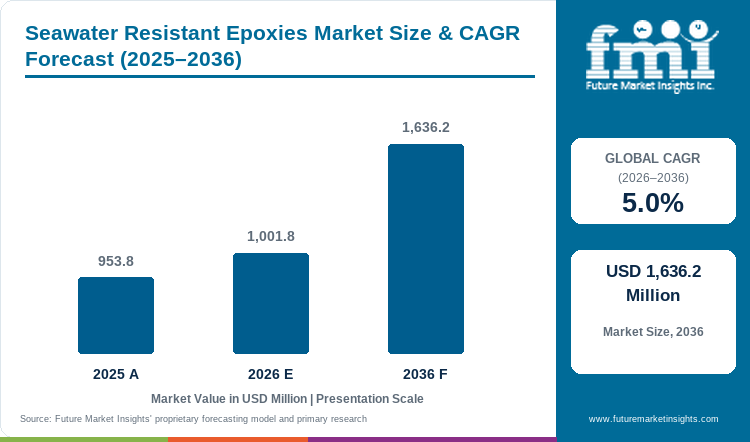
- Market Size (2026)
- USD 1001.8 Mn
- Forecast (2036)
- USD 1636.2 Mn
- CAGR (2026 to 2036)
- 5.0%
How big is the Seawater Resistant Epoxies Market in 2026?
USD 1001.8 million in 2026 and USD 1636.2 million by 2036, expanding at 5.0% CAGR.
Sales of seawater resistant epoxies are estimated to rise at 5.0% CAGR through 2036, increasing valuation from USD 953.8 million in 2025 to USD 1001.8 million in 2026, and reaching USD 1636.2 million by 2036. Revenue expands as operators replace spot repairs with specified epoxy systems that hold adhesion and barrier performance through immersion, salt spray and repeated wet-dry exposure. UN Trade and Development reported in October 2024 that global maritime trade grew 2.4% in 2023, keeping vessels, terminals, and offshore assets in recurring corrosion-control cycles. The International Maritime Organization also requires a performance standard for protective coatings in dedicated seawater ballast tanks on covered new ships, which pushes shipyards and asset owners to buy primers and build coats as compatible systems rather than standalone products.
A ballast-tank coating, a submerged repair and a composite bond require different epoxy properties. Coatings are purchased as compatible layers with defined preparation and overcoat requirements. Underwater repairs depend on adhesion and cure in conditions where drying may be impractical. Composite work places greater weight on bond strength and handling. This division creates room for both marine coating suppliers and specialized repair or resin businesses.
Key Takeaways
- Vessel owners and infrastructure operators are specifying epoxy systems over spot repairs because coating failure can extend shutdowns or impair asset integrity in immersion and wet-dry service.
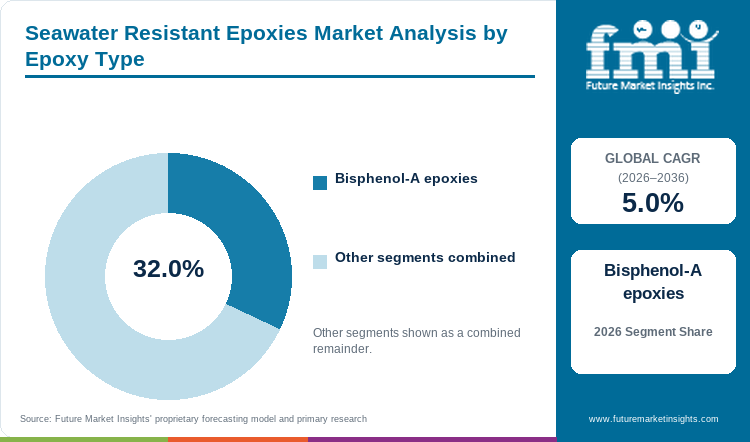
- By epoxy type, Bisphenol-A epoxies are estimated to hold 32.0% share in 2026, supported by their balance of adhesion, processability, and formulation flexibility.
- By application, marine coatings are projected to account for 32.0% share in 2026, influenced by large exposed surface areas that create recurring newbuild and maintenance consumption.
- By end use, marine vessels are forecast to represent 30.0% share in 2026, attributable to drydock and tank-maintenance cycles that create a broad installed demand base.
- IMO coating requirements and ISO performance tests keep qualification evidence central to product selection, and room-temperature or wet-condition formulations can reduce lost operating time where field conditions limit heat cure or ideal surface preparation.
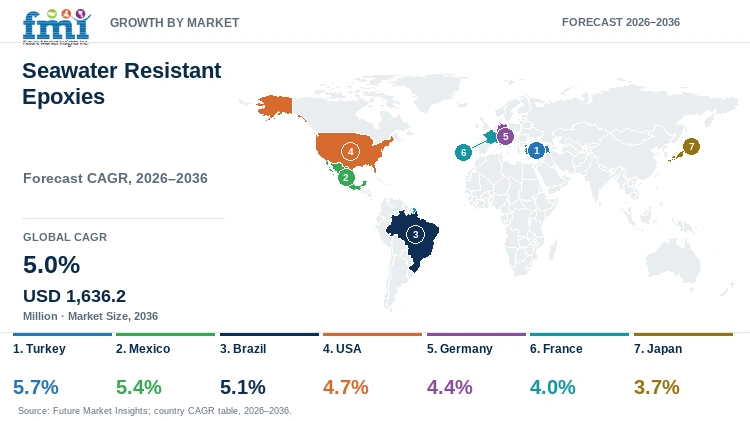
- Turkey (5.7% CAGR) and Mexico (5.4%) are forecast to lead growth through 2036, ahead of Brazil (5.1%), the USA (4.7%), Germany (4.4%), France (4.0%), and Japan (3.7%); CAGR indicates pace rather than absolute revenue.
- Some of the key players in this market include Westlake Epoxy, Huntsman, Olin Epoxy, Hempel, Jotun, AkzoNobel, PPG, Sika, Belzona, and Gurit.
Analyst Perspective
An epoxy system earns repeat orders when it survives the conditions of the job. Immersion resistance matters, but so do salt removal, surface preparation and the time available for cure. Yards and contractors need application instructions that fit the actual steel temperature and maintenance window.
- Nikhil Kaitwade, Principal Analyst at Future Market Insights
How is the seawater resistant epoxies market segmented?
The market is segmented by Epoxy Type, Application, End Use, Cure Type, Sales Channel, and Region.
Epoxy Type covers Bisphenol-A, novolac, cycloaliphatic, filled marine and flexible epoxies. Applications include marine coatings, composite bonding, concrete repair, pipe and tank lining, and underwater repair. End Use spans marine vessels, offshore oil and gas, ports and harbors, desalination plants and industrial structures. Cure Type distinguishes room-temperature, low-temperature, underwater and heat-cure systems. Sales channels include coating suppliers, marine distributors, contractor supply and direct industrial customers.
What makes Bisphenol-A epoxies central to the Epoxy Type category?
Bisphenol-A chemistry gives formulators a practical balance of adhesion and mechanical strength, paired with chemical resistance at manageable viscosity. Westlake completed the acquisition of Hexion's global epoxy business in February 2022, adding specialty resins, coatings, and composite materials to the Westlake Epoxy platform. Formulators adjust the base resin with fillers and reactive modifiers for hulls, tanks, concrete, and composite structures, and its compatibility with several ambient-cure hardeners supports both standardized coating lines and application-specific products.
- Based on epoxy type, Bisphenol-A epoxies are projected to account for 32.0% in 2026, supported by a formulation range that spans coatings, adhesives, linings, and repair compounds.
- Buyers get familiar mixing behavior and a broad raw-material base, while novolac and cycloaliphatic systems remain the fallback where temperature or chemical exposure runs more severe.
Why do marine coatings lead the Application category?
Marine coatings convert epoxy chemistry into the largest recurring maintenance workflow across the industry. Hull interiors, ballast tanks, decks, splash zones, and steel structures present extensive surface area that faces repeated inspection and recoating. AkzoNobel's International brand launched Intergard 6788 in April 2026, a high-solids pure epoxy universal primer designed for newbuilding productivity and corrosion protection. Coating specifications link primer compatibility with build thickness and overcoat intervals, so a product must work as part of a full system rather than stand alone.
- By application, marine coatings are estimated to account for 32.0% in 2026, influenced by broad surface coverage and repeat maintenance that create sustained material throughput.
- Composite bonding and underwater repair can carry high value per job but treat a narrower area, and pipe and tank linings stay more specialized; marine coatings lead by combining new build consumption with a large installed base that returns to dry dock or planned maintenance.
How do Marine vessels shape the End Use category?
Marine vessels generate demand across construction, operation, and repair, beside offshore platforms and port infrastructure that share similar protection needs. PPG launched its PHENGUARD 985 phenolic epoxy tank lining in March 2022, offering two- or three-coat flexibility for marine and tank-storage service. New ships require defined coating systems for steel spaces that will contact seawater, while existing ships return for tank work and localized corrosion repair.
- In 2026, marine vessels are expected to lead end use with 30.0% share, shaped by fleet maintenance and dry dock cycles that broaden the addressable installed base.
- Owners favor barrier coatings and tank linings that balance cargo compatibility with time out of service, while fairing compounds and structural adhesives serve narrower repair work.
What supports Room-temperature cure within the Cure Type category?
Room-temperature cure fits the physical scale and location of marine work, where large hulls, jetties, pipelines, and concrete structures cannot usually be moved into an oven. Belzona documented its 5831 systems for wet and underwater application in March 2024, including a lower-temperature variant covering substrate temperatures from 5°C to 30°C. Ambient-cure systems let contractors complete localized repair during normal yard operations while still managing substrate temperature, dew point, pot life, and overcoat time.
- By cure type, room-temperature cure is forecast to represent 36.0% in 2026, supported by the need for most vessel and infrastructure work to cure on the asset itself.
- Low-temperature cure is favored in cold climates and underwater cure addresses emergency or access-constrained work, while heat-cure systems retain a role in controlled composite manufacturing.
What drives Coating suppliers within the Sales Channel category?
Coating suppliers convert resin selection and system compatibility into one accountable purchase, positioning them close to both specification and execution. Marine buyers rarely select resin in isolation; they evaluate a primer, intermediate coat, and lining or repair layer as one compatible package. PPG presented PHENGUARD 985 as a flexible two- or three-coat system in March 2022, linking product design directly to asset-owner and contractor preferences. Suppliers extend support through technical data, color control, mixing guidance, film thickness checks, and overcoat-interval troubleshooting.
- Coating suppliers are likely to capture 38.0% share in 2026, supported by buyer demand for complete qualified systems backed by on-site technical support.
- Marine distributors add local inventory and rapid delivery for smaller jobs, while direct industrial sales suit large asset owners operating approved-vendor systems.
What are the drivers, restraints, and opportunities in the Seawater Resistant Epoxies Market?
Corrosion creates recurring coating and repair work. Adoption depends on surface preparation and cure conditions, while high-solids and wet-service formulations address jobs with restricted access or short maintenance windows.
- Driver: Repeat maintenance across vessels, offshore assets, ports, and desalination infrastructure keeps material demand tied to inspection and maintenance windows.
- Restraint: Surface preparation, environmental control, and qualification requirements can raise installed cost and delay work in the field.
- Opportunity: High-solids coatings and wet-condition repair products can address jobs where drying, access or application time restricts the choice of system.
Repeat maintenance turns fleet exposure into a recurring material order
Vessels, offshore platforms, and port assets stay in corrosive service long after construction, and that installed base is what sustains demand. UN Trade and Development reported 12,292 million tons of maritime trade in 2023, a 2.4% annual increase following a contraction in 2022. More trade does not translate directly into epoxy revenue, but it does keep vessels and port assets working under salt exposure. IMO coating requirements make performance documentation part of defined shipbuilding practice, so owners and yards respond through scheduled recoating, tank lining, and structural repair rather than one-time construction spend alone.
Qualification standards can outpace real-world surface conditions
ISO 12944-9 sets performance requirements for offshore paint systems in marine atmosphere and seawater immersion, using laboratory test methods to assess likely durability, and the standard covers complete refurbishment where abrasive blast-cleaning exposes the steel substrate. Field maintenance often has less ideal access and surface condition, so buyers must reconcile test evidence with actual preparation. Cold steel and residual moisture can narrow the cure window, raising labor and inspection cost and sometimes delaying purchase until a system has passed owner or yard qualification.
Wet-service formulations expand the range of repair conditions
A damaged area below the waterline may be difficult to isolate and dry. Wet-surface repair compounds address that access problem, while low-temperature formulations allow work under colder conditions. Belzona’s product guidance distinguishes these application requirements. Gurit’s November 2025 reformulation announcement addresses a separate need: maintaining epoxy performance as chemical classifications change.
Which country CAGRs are profiled in the Seawater Resistant Epoxies Market?
| Country | CAGR |
|---|---|
| Turkey | 5.7% |
| Mexico | 5.4% |
| Brazil | 5.1% |
| USA | 4.7% |
| Germany | 4.4% |
| France | 4.0% |
| Japan | 3.7% |
How do country-level CAGRs compare in the Seawater Resistant Epoxies Market?
Turkey is forecast to grow at 5.7%, Mexico at 5.4% and Brazil at 5.1%. The USA follows at 4.7%, Germany at 4.4%, France at 4.0% and Japan at 3.7%. New vessel orders can produce large initial coating purchases, while repair fleets and port structures sustain maintenance demand between construction projects.
- Turkish yards combine newbuilding and repair work, making delivery timing and the installed coating cost important to material selection.
- Mexico’s vessel financing programs can support modernization, with coating purchases tied to the work funded at each yard.
- Brazilian offshore vessel tenders can concentrate orders, so material approval and supply planning need to precede the yard schedule.
- U.S. port projects create coating and concrete-repair work whose timing depends on construction access and public procurement.
- German port refurbishment requires systems suited to the exposure of each structure, from marine atmosphere to immersion.
- French shipyards assess lower-solvent formulations alongside cure time and compatibility with existing coating systems.
- Japanese terminals and shipyards rely on consistent application procedures when maintaining already-qualified systems.
Project type determines when epoxy is consumed: newbuild coating schedules differ from local repairs or the refurbishment of an operating terminal. The full report covers North America, Latin America, Western Europe, Eastern Europe, East Asia, South Asia and Pacific, and Middle East and Africa.
Country-wise Analysis
- The USA market is forecast to expand at 4.7% CAGR from 2026 to 2036. MARAD announced nearly USD 580 million for 31 port improvement projects in November 2024, including wharf replacement and structural repair. Such work creates demand for protective materials, but application has to follow the construction sequence. Surface access, preparation and cure time determine when a coating system can be installed.
- Germany’s forecast is 4.4% CAGR through 2036. The National Ports Strategy adopted in March 2024 includes around 140 measures across five action fields. For epoxy suppliers, the relevant opportunities lie in specific steel and concrete refurbishment packages. Coating selection must distinguish atmospheric exposure, splash zones and immersion rather than treating all port work as one specification.
- Japan is forecast to grow at 3.7% CAGR over the assessment period. Its transport ministry awarded the first Carbon Neutral Port certifications to five terminals in October 2025 under a system launched that June. Terminal investment creates opportunities to review asset maintenance, but epoxy selection remains a technical decision about exposure, preparation and cure. Consistent batches and compatible coating layers help maintain an established system.
- Brazilian demand is forecast at 5.1% CAGR over the forecast period. Petrobras said in March 2024 that it expected to hire around 200 support vessels between 2024 and 2028, with opportunities to build up to 38 vessels domestically. New vessels need complete coating systems; operating fleets also generate localized repair and recoating orders. Tender timing and yard schedules determine when these material purchases occur.
- France is forecast to expand at 4.0% CAGR through 2036. In March 2024, the government named 13 France 2030 maritime-industry projects within a program providing nearly EUR 100 million in public support and generating more than EUR 200 million in private investment. Lower-emission production goals can encourage a review of solvent content, but yards still need acceptable adhesion, film build and cure times before changing coating systems.
- Mexico’s forecast CAGR is 5.4% over the forecast period. January 2024 revisions to FONDEMAR operating rules broadened financing access for vessel acquisition, modernization and domestic construction. Refurbishment orders can include tank lining, hull coating and repair compounds, each with different application requirements. Distribution near working ports reduces the risk of material shortages during a yard stay.
- Turkey is forecast to grow at 5.7% CAGR through 2036. In March 2024, the transport ministry expanded vessel-renewal incentives and doubled the eligible application tonnage ceiling to 50,000 GT. Construction and repair yards need coating systems that fit their delivery schedules. Reliable local stock and application support help manage the preparation, overcoating and inspection stages of each job.
Who are the notable companies in the Seawater Resistant Epoxies Market?
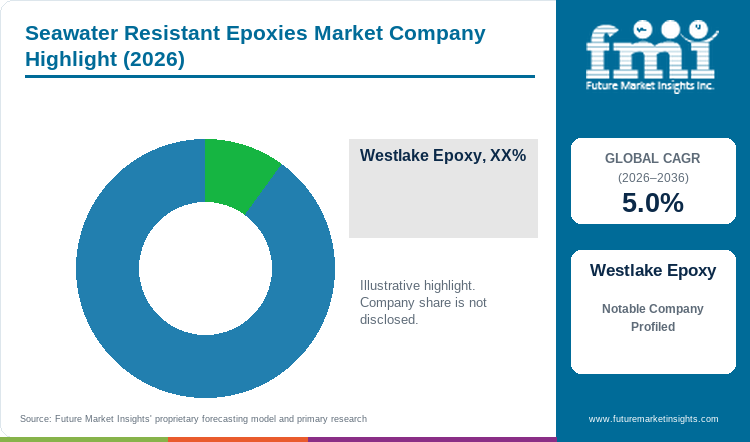
Westlake Epoxy, Huntsman, Olin Epoxy, Sika, Hempel, Jotun, AkzoNobel, PPG, Belzona and Gurit supply products for marine coating, repair and bonding.
Resin suppliers sell the chemistry that formulators turn into coatings, adhesives and repair compounds. Marine coating groups sell complete systems specified by owners and yards. Repair and composite specialists address bonding or substrate conditions that a general coating range may not cover. The point of competition therefore differs between bulk resin purchasing and a time-critical field repair.
- Resin and formulation platforms include Westlake Epoxy, Huntsman and Olin Epoxy for coverage spanning coatings, adhesives, curing systems, and composites.
- Coating-led suppliers include Hempel, Jotun, AkzoNobel and PPG for specification-driven marine systems guided by multi-layer portfolio depth and field service reach.
- Sika and Belzona serve wet-substrate and steel repair routes beside Gurit for composite laminate applications. Belzona markets targeted repair compounds as a distinct offer within the broader specialty-bonding segment.
Competitive Benchmarking: Seawater Resistant Epoxies Market
| Company | Coating / Lining Breadth | Wet-Surface Repair | Composite Bonding | Geographic Reach |
|---|---|---|---|---|
| Westlake Epoxy | Medium | - | High | North America, Europe, and Asia |
| Huntsman | Medium | - | High | Americas, Europe, and Asia-Pacific |
| Olin Epoxy | Medium | - | Medium | Americas, Europe, and Asia-Pacific |
| Sika | Medium | High | High | Global |
| Hempel | High | Medium | - | Americas, Europe, Middle East, and Asia-Pacific |
| Jotun | High | Medium | - | Europe, Middle East, Asia-Pacific, and Americas |
| AkzoNobel | High | Medium | - | Global marine and protective coatings network |
| PPG | High | Medium | - | Americas, Europe, Middle East, and Asia-Pacific |
| Belzona | Medium | High | Medium | Global distributor and service network |
| Gurit | - | - | High | Europe, Americas, and Asia-Pacific |
- Scoring basis: Coating / Lining Breadth compares marine primers, barrier coats and immersion systems. Wet-Surface Repair compares products for damp or submerged substrates. Composite Bonding compares resin and adhesive systems for marine laminates. High indicates broad capability and Medium a more focused range. A dash denotes a category outside the supplier profile assessed here. Geographic Reach describes the sales and service network.
Key Developments in the Seawater Resistant Epoxies Market
- In February 2022, Westlake Epoxy completed the acquisition of Hexion's global epoxy business, including specialty resins, coatings, and composite materials, for approximately USD 1.2 billion.
- In March 2022, PPG launched PHENGUARD 985 phenolic epoxy tank lining for marine and tank-storage applications, supporting a two- or three-coat build with high chemical and temperature resistance.
- In November 2025, Gurit introduced patent-pending alternatives to epoxy diluents affected by European Union chemical reclassification, covering laminating, adhesive, fairing, and multipurpose systems.
- In April 2026, AkzoNobel launched Intergard 6788, a high-solids pure epoxy universal primer, through its International marine brand for newbuilding applications and broad vessel areas.
Key Players in the Seawater Resistant Epoxies Market
Epoxy resin and formulation platforms
- Westlake Epoxy
- Huntsman
- Olin Epoxy
Protective marine coating systems
- Hempel
- Jotun
- AkzoNobel
- PPG
Specialty repair and composite bonding
- Sika
- Belzona
- Gurit
Seawater Resistant Epoxies Market - Report Scope
| Coverage field | Report scope |
|---|---|
| Market breakdown | Epoxy Type, Application, End Use, Cure Type, Sales Channel, and Region |
| Quantitative Units | USD Million |
| Market Definition | Revenue includes epoxy resin systems and formulated epoxy coatings, adhesives, linings, and repair compounds sold for seawater immersion, splash-zone, marine-atmosphere, or wet-service use within the stated segmentation. It excludes downstream finished-asset revenue, completed-service revenue beyond the epoxy material component, generic epoxies without marine qualification, and non-epoxy substitutes. |
| Regions Covered | North America, Latin America, Western Europe, Eastern Europe, East Asia, South Asia and Pacific, and Middle East and Africa |
| Countries Covered | USA, Germany, Japan, Brazil, France, Mexico, Turkey, and more than twenty-five additional countries in the full report |
| Key Companies Profiled | Westlake Epoxy, Huntsman, Olin Epoxy, Sika, Hempel, Jotun, AkzoNobel, PPG, Belzona, and Gurit |
| Forecast Period | 2026 to 2036 |
| Approach | Market estimates use a hybrid bottom-up and top-down approach that reconciles supplier activity, end-use demand, asset maintenance cycles, and regional operating conditions. |
Seawater Resistant Epoxies Market - Research Methodology
| Method | Approach |
|---|---|
| Primary Research | FMI consults epoxy manufacturers and formulators, marine coating suppliers, distributors, shipyard and contractor stakeholders, asset owners, procurement teams, and subject-matter specialists. Discussions examine pricing, qualification, cure windows, application practice, replacement cycles, and purchasing friction. |
| Desk Research | The review covers government statistics, maritime regulations, standards, company filings, procurement material, technical documentation and dated corporate announcements. |
| Market Sizing and Forecasting | The model combines supplier revenue and volume indicators with end-use intensity, installed marine assets, maintenance intervals, coating-system consumption, and regional operating assumptions. Bottom-up estimates are reconciled with top-down checks for coherence across segments and countries. |
| Data Validation | Findings are compared across company information, operating indicators and commercial interviews. Market revenue covers the epoxy material component, with downstream assets, completed services and non-epoxy products excluded. |
Seawater Resistant Epoxies Market by Segments
Seawater Resistant Epoxies Market segmented by Epoxy Type:
- Bisphenol-A epoxies
- Novolac epoxies
- Cycloaliphatic epoxies
- Filled marine epoxies
- Flexible epoxies
Seawater Resistant Epoxies Market segmented by Application:
- Marine coatings
- Composite bonding
- Concrete repair
- Pipe and tank lining
- Underwater repair
Seawater Resistant Epoxies Market segmented by End Use:
- Marine vessels
- Offshore oil and gas
- Ports and harbors
- Desalination plants
- Industrial structures
Seawater Resistant Epoxies Market segmented by Cure Type:
- Room-temperature cure
- Low-temperature cure
- Underwater cure
- Heat-cure systems
Seawater Resistant Epoxies Market segmented by Sales Channel:
- Coating suppliers
- Marine distributors
- Contractor supply
- Direct industrial customers
Seawater Resistant Epoxies Market by Region:
- North America
- United States
- Canada
- Latin America
- Brazil
- Mexico
- Argentina
- Chile
- Western Europe
- Germany
- France
- United Kingdom
- Italy
- Spain
- Benelux
- Nordics
- Eastern Europe
- Poland
- Czech Republic
- Romania
- Hungary
- East Asia
- China
- Japan
- South Korea
- South Asia and Pacific
- India
- ASEAN
- Australia and New Zealand
- Middle East and Africa
- GCC Countries
- South Africa
- Turkey
- Israel
Research Sources and Bibliography
- UN Trade and Development (2024, October 22). Review of Maritime Transport 2024.
- International Maritime Organization (2006, December 8). Protective Coatings
- International Organization for Standardization (2018, January 31). ISO 12944-9:2018: Protective Paint Systems and Laboratory Performance Test Methods for Offshore and Related Structures
- U.S. Maritime Administration (2024, November 15). Biden-Harris Administration Announces Nearly USD 580 Million for Ports to Strengthen American Supply Chains and Lower Costs.
- Federal Ministry of Transport, Germany (2024, October 10). The National Ports Strategy.
- Ministry of Land, Infrastructure, Transport and Tourism, Japan (2025, October 10). First CNP Certification Awarded to Five Terminals.
- Petrobras (2024, March 28). Petrobras Presents Demand for Contracts and Opportunities for the National Industry.
- French Ministry for the Sea (2024, March 29). France 2030: 13 Projects Selected for the Maritime Industries Sector.
- Secretaría de Marina, Mexico (2024). Avance y Resultados del Objetivo 4 PSCyT 2024.
- Ministry of Transport and Infrastructure, Turkey (2024, March 23). Denizcilik Sektörüne Büyük Destek.
- Westlake Corporation (2022, February 1). Westlake Completes Acquisition of Epoxy Business.
- PPG (2022, March 31). PPG Launches PPG PHENGUARD 985 Phenolic Epoxy Tank Coating.
- International, an AkzoNobel Brand (2026, April 7). International Launches Intergard 6788 Universal Primer.
- Gurit (2025, November 27). Gurit Leads the Way in Safer Epoxy Chemistry.
- Belzona (2024, March 25). Surface Tolerant Epoxy Solutions: Belzona 5831 vs 5831LT.
This bibliography is provided for reader reference and is not exhaustive. The full report contains the complete reference list and detailed citations.
This Report Answers
- What is the Seawater Resistant Epoxies Market size in 2026 and 2036?
- Which vessel, offshore, port, and desalination pressures support demand for seawater resistant epoxies?
- Why do Bisphenol-A epoxies hold the leading position within Epoxy Type?
- How does the Marine coatings segment influence downstream material demand?
- Why do Marine vessels hold the leading position within End Use?
- How do country growth rates differ across the USA, Germany, Japan, Brazil, France, Mexico, and Turkey?
- Which companies supply resin platforms, protective coating systems, and specialized repair or composite products?
- How do qualification, surface preparation, moisture, and cure conditions limit adoption?
- What should coating specifiers and asset integrity teams evaluate before purchasing seawater resistant epoxies?
Frequently Asked Questions
What is driving growth in the Seawater Resistant Epoxies Market?
Recurring maintenance on vessels and seawater-exposed infrastructure converts corrosion risk into repeat purchases of epoxy systems. Growth is strongest where products can reduce shutdown time while meeting documented immersion and application requirements.
Who are the key players in the Seawater Resistant Epoxies Market?
The profiled companies are Westlake Epoxy, Huntsman, Olin Epoxy, Sika, Hempel, Jotun, AkzoNobel, PPG, Belzona, and Gurit. Their roles span resin supply and marine coating systems as well as wet-condition repair and composite bonding.
What is a notable restraint in the Seawater Resistant Epoxies Market?
Surface preparation and cure control can raise the installed cost beyond the material price. Owner qualification and contractor execution may delay adoption when evidence does not match the actual moisture, temperature, or maintenance conditions.
Why should executives track the Seawater Resistant Epoxies Market?
The market sits at the intersection of asset integrity, maintenance planning, and vessel or infrastructure uptime. Executives can use its development to guide supplier strategy and technical-service investment while setting inventory and reformulation priorities.
What business problem does the Seawater Resistant Epoxies Market address?
Seawater resistant epoxies protect or restore substrates exposed to immersion and salt spray under splash-zone cycling or difficult access. They help owners manage corrosion and leakage along with bond failure or structural deterioration without replacing the entire asset.
What should coating specifiers and asset integrity managers evaluate in the Seawater Resistant Epoxies Market?
They should compare adhesion after immersion with surface-preparation tolerance and cure temperature while checking pot life, chemical resistance, and system compatibility. Evaluation should also cover contractor training and local stock alongside inspection needs and the cost of lost operating time.
What limits return on investment in the Seawater Resistant Epoxies Market?
Poor preparation or incorrect cure conditions can cause rework and shorten service life even when the resin is technically suitable. ROI also weakens when qualification delays, fragmented product layers, or remote logistics extend the maintenance window.
What supports long-term commercial confidence in the Seawater Resistant Epoxies Market?
An installed base of seawater-exposed vessels and structures creates repeated coating and repair requirements. Suppliers retain business when their systems deliver the expected service life and can be reapplied within practical maintenance windows.
Preview the report firsthand - request a free sample
Get SampleGet the brochure for pricing and purchase details.
Get PDFTable of Content
- Key Takeaways
- Market Size and CAGR
- Top Growth Driver
- Fastest Growing Segment
- Leading Region
- Key Companies
- Emerging Opportunities
- Executive Summary
- Global Market Outlook
- Demand-side Trends
- Supply-side Trends
- Technology Roadmap Analysis
- Analysis and Recommendations
- Analyst Perspective (What is happening? Why now? What should investors know?)
- Key Questions Answered
- How large is the market?
- What is the CAGR?
- What are key trends?
- Which region dominates?
- Who are the leaders?
- Market Overview
- Market Coverage / Taxonomy
- Market Definition / Scope / Limitations
- Research Methodology
- Chapter Orientation
- Analytical Lens and Working Hypotheses
- Market Structure, Signals, and Trend Drivers
- Benchmarking and Cross-market Comparability
- Market Sizing, Forecasting, and Opportunity Mapping
- Research Design and Evidence Framework
- Desk Research Programme (Secondary Evidence)
- Expert Input and Fieldwork (Primary Evidence)
- Tooling, Models, and Reference Databases
- Data Engineering and Model Build
- Quality Assurance and Audit Trail
- Market Background
- Market Dynamics (Drivers, Restraints, Opportunity, Trends)
- Scenario Forecast (Optimistic, Likely, Conservative)
- Impact Analysis
- AI Impact
- Sustainability Impact
- Regulatory Impact
- Technology Impact
- Consumer / Buyer Analysis
- Purchase Drivers
- Adoption Barriers
- Buyer Journey
- Opportunity Map Analysis
- Product Life Cycle Analysis
- Supply Chain Analysis
- Investment Feasibility Matrix
- Value Chain Analysis
- PESTLE and Porter's Analysis
- Regulatory Landscape
- Regional Parent Market Outlook
- Production and Consumption Statistics
- Import and Export Statistics
- Global Market Analysis and Forecast, 2021 to 2036
- Historical Market Size Value (USD Million) Analysis, 2021 to 2025
- Current and Future Market Size Value (USD Million) Projections, 2026 to 2036
- Y-o-Y Growth Trend Analysis
- Absolute $ Opportunity Analysis
- Global Market Pricing Analysis, 2021 to 2036
- Global Market Analysis and Forecast, By Epoxy Type, 2021 to 2036
- Introduction / Key Findings
- Historical Market Size Value (USD Million) Analysis By Epoxy Type, 2021 to 2025
- Current and Future Market Size Value (USD Million) Analysis and Forecast By Epoxy Type, 2026 to 2036
- Bisphenol-A epoxies
- Novolac epoxies
- Cycloaliphatic epoxies
- Filled marine epoxies
- Flexible epoxies
- Y-o-Y Growth Trend Analysis By Epoxy Type, 2021 to 2025
- Absolute $ Opportunity Analysis By Epoxy Type, 2026 to 2036
- Global Market Analysis and Forecast, By Application, 2021 to 2036
- Introduction / Key Findings
- Historical Market Size Value (USD Million) Analysis By Application, 2021 to 2025
- Current and Future Market Size Value (USD Million) Analysis and Forecast By Application, 2026 to 2036
- Marine coatings
- Composite bonding
- Concrete repair
- Pipe and tank lining
- Underwater repair
- Y-o-Y Growth Trend Analysis By Application, 2021 to 2025
- Absolute $ Opportunity Analysis By Application, 2026 to 2036
- Global Market Analysis and Forecast, By End Use, 2021 to 2036
- Introduction / Key Findings
- Historical Market Size Value (USD Million) Analysis By End Use, 2021 to 2025
- Current and Future Market Size Value (USD Million) Analysis and Forecast By End Use, 2026 to 2036
- Marine vessels
- Offshore oil and gas
- Ports and harbors
- Desalination plants
- Industrial structures
- Y-o-Y Growth Trend Analysis By End Use, 2021 to 2025
- Absolute $ Opportunity Analysis By End Use, 2026 to 2036
- Global Market Analysis and Forecast, By Cure Type, 2021 to 2036
- Introduction / Key Findings
- Historical Market Size Value (USD Million) Analysis By Cure Type, 2021 to 2025
- Current and Future Market Size Value (USD Million) Analysis and Forecast By Cure Type, 2026 to 2036
- Room-temperature cure
- Low-temperature cure
- Underwater cure
- Heat-cure systems
- Y-o-Y Growth Trend Analysis By Cure Type, 2021 to 2025
- Absolute $ Opportunity Analysis By Cure Type, 2026 to 2036
- Global Market Analysis and Forecast, By Sales Channel, 2021 to 2036
- Introduction / Key Findings
- Historical Market Size Value (USD Million) Analysis By Sales Channel, 2021 to 2025
- Current and Future Market Size Value (USD Million) Analysis and Forecast By Sales Channel, 2026 to 2036
- Coating suppliers
- Marine distributors
- Contractor supply
- Direct industrial customers
- Y-o-Y Growth Trend Analysis By Sales Channel, 2021 to 2025
- Absolute $ Opportunity Analysis By Sales Channel, 2026 to 2036
- Global Market Analysis and Forecast, By Region, 2021 to 2036
- Introduction
- Historical Market Size Value (USD Million) Analysis By Region, 2021 to 2025
- Current Market Size Value (USD Million) Analysis and Forecast By Region, 2026 to 2036
- North America
- Latin America
- Western Europe
- Eastern Europe
- East Asia
- South Asia and Pacific
- Middle East and Africa
- Market Attractiveness Analysis By Region
- North America Market Analysis and Forecast, By Country, 2021 to 2036
- Historical Market Size Value (USD Million) Trend Analysis By Market Taxonomy, 2021 to 2025
- Market Size Value (USD Million) Forecast By Market Taxonomy, 2026 to 2036
- By Country
- United States
- Canada
- By Epoxy Type
- By Application
- By End Use
- By Cure Type
- By Sales Channel
- By Country
- Market Attractiveness Analysis
- By Country
- By Epoxy Type
- By Application
- By End Use
- By Cure Type
- By Sales Channel
- Key Takeaways
- Latin America Market Analysis and Forecast, By Country
- Historical Market Size Value (USD Million) Trend Analysis By Market Taxonomy, 2021 to 2025
- Market Size Value (USD Million) Forecast By Market Taxonomy, 2026 to 2036
- By Country
- Brazil
- Mexico
- Argentina
- Chile
- By Epoxy Type
- By Application
- By End Use
- By Cure Type
- By Sales Channel
- By Country
- Market Attractiveness Analysis
- By Country
- By Epoxy Type
- By Application
- By End Use
- By Cure Type
- By Sales Channel
- Key Takeaways
- Western Europe Market Analysis and Forecast, By Country
- Historical Market Size Value (USD Million) Trend Analysis By Market Taxonomy, 2021 to 2025
- Market Size Value (USD Million) Forecast By Market Taxonomy, 2026 to 2036
- By Country
- Germany
- France
- United Kingdom
- Italy
- Spain
- Benelux
- Nordics
- By Epoxy Type
- By Application
- By End Use
- By Cure Type
- By Sales Channel
- By Country
- Market Attractiveness Analysis
- By Country
- By Epoxy Type
- By Application
- By End Use
- By Cure Type
- By Sales Channel
- Key Takeaways
- Eastern Europe Market Analysis and Forecast, By Country
- Historical Market Size Value (USD Million) Trend Analysis By Market Taxonomy, 2021 to 2025
- Market Size Value (USD Million) Forecast By Market Taxonomy, 2026 to 2036
- By Country
- Poland
- Czech Republic
- Romania
- Hungary
- By Epoxy Type
- By Application
- By End Use
- By Cure Type
- By Sales Channel
- By Country
- Market Attractiveness Analysis
- By Country
- By Epoxy Type
- By Application
- By End Use
- By Cure Type
- By Sales Channel
- Key Takeaways
- East Asia Market Analysis and Forecast, By Country
- Historical Market Size Value (USD Million) Trend Analysis By Market Taxonomy, 2021 to 2025
- Market Size Value (USD Million) Forecast By Market Taxonomy, 2026 to 2036
- By Country
- China
- Japan
- South Korea
- By Epoxy Type
- By Application
- By End Use
- By Cure Type
- By Sales Channel
- By Country
- Market Attractiveness Analysis
- By Country
- By Epoxy Type
- By Application
- By End Use
- By Cure Type
- By Sales Channel
- Key Takeaways
- South Asia and Pacific Market Analysis and Forecast, By Country
- Historical Market Size Value (USD Million) Trend Analysis By Market Taxonomy, 2021 to 2025
- Market Size Value (USD Million) Forecast By Market Taxonomy, 2026 to 2036
- By Country
- India
- ASEAN
- Australia and New Zealand
- By Epoxy Type
- By Application
- By End Use
- By Cure Type
- By Sales Channel
- By Country
- Market Attractiveness Analysis
- By Country
- By Epoxy Type
- By Application
- By End Use
- By Cure Type
- By Sales Channel
- Key Takeaways
- Middle East and Africa Market Analysis and Forecast, By Country
- Historical Market Size Value (USD Million) Trend Analysis By Market Taxonomy, 2021 to 2025
- Market Size Value (USD Million) Forecast By Market Taxonomy, 2026 to 2036
- By Country
- GCC Countries
- South Africa
- Turkey
- Israel
- By Epoxy Type
- By Application
- By End Use
- By Cure Type
- By Sales Channel
- By Country
- Market Attractiveness Analysis
- By Country
- By Epoxy Type
- By Application
- By End Use
- By Cure Type
- By Sales Channel
- Key Takeaways
- Key Countries Market Analysis
- United States
- Pricing Analysis
- Market Share Analysis, 2025
- By Epoxy Type
- By Application
- By End Use
- By Cure Type
- By Sales Channel
- Canada
- Pricing Analysis
- Market Share Analysis, 2025
- By Epoxy Type
- By Application
- By End Use
- By Cure Type
- By Sales Channel
- Mexico
- Pricing Analysis
- Market Share Analysis, 2025
- By Epoxy Type
- By Application
- By End Use
- By Cure Type
- By Sales Channel
- Brazil
- Pricing Analysis
- Market Share Analysis, 2025
- By Epoxy Type
- By Application
- By End Use
- By Cure Type
- By Sales Channel
- Chile
- Pricing Analysis
- Market Share Analysis, 2025
- By Epoxy Type
- By Application
- By End Use
- By Cure Type
- By Sales Channel
- Germany
- Pricing Analysis
- Market Share Analysis, 2025
- By Epoxy Type
- By Application
- By End Use
- By Cure Type
- By Sales Channel
- United Kingdom
- Pricing Analysis
- Market Share Analysis, 2025
- By Epoxy Type
- By Application
- By End Use
- By Cure Type
- By Sales Channel
- Italy
- Pricing Analysis
- Market Share Analysis, 2025
- By Epoxy Type
- By Application
- By End Use
- By Cure Type
- By Sales Channel
- Spain
- Pricing Analysis
- Market Share Analysis, 2025
- By Epoxy Type
- By Application
- By End Use
- By Cure Type
- By Sales Channel
- France
- Pricing Analysis
- Market Share Analysis, 2025
- By Epoxy Type
- By Application
- By End Use
- By Cure Type
- By Sales Channel
- India
- Pricing Analysis
- Market Share Analysis, 2025
- By Epoxy Type
- By Application
- By End Use
- By Cure Type
- By Sales Channel
- ASEAN
- Pricing Analysis
- Market Share Analysis, 2025
- By Epoxy Type
- By Application
- By End Use
- By Cure Type
- By Sales Channel
- Australia and New Zealand
- Pricing Analysis
- Market Share Analysis, 2025
- By Epoxy Type
- By Application
- By End Use
- By Cure Type
- By Sales Channel
- China
- Pricing Analysis
- Market Share Analysis, 2025
- By Epoxy Type
- By Application
- By End Use
- By Cure Type
- By Sales Channel
- Japan
- Pricing Analysis
- Market Share Analysis, 2025
- By Epoxy Type
- By Application
- By End Use
- By Cure Type
- By Sales Channel
- South Korea
- Pricing Analysis
- Market Share Analysis, 2025
- By Epoxy Type
- By Application
- By End Use
- By Cure Type
- By Sales Channel
- Poland
- Pricing Analysis
- Market Share Analysis, 2025
- By Epoxy Type
- By Application
- By End Use
- By Cure Type
- By Sales Channel
- Hungary
- Pricing Analysis
- Market Share Analysis, 2025
- By Epoxy Type
- By Application
- By End Use
- By Cure Type
- By Sales Channel
- South Africa
- Pricing Analysis
- Market Share Analysis, 2025
- By Epoxy Type
- By Application
- By End Use
- By Cure Type
- By Sales Channel
- Turkey
- Pricing Analysis
- Market Share Analysis, 2025
- By Epoxy Type
- By Application
- By End Use
- By Cure Type
- By Sales Channel
- United States
- Market Structure Analysis
- Competition Dashboard
- Competition Benchmarking
- Market Share Analysis of Top Players
- By Regional
- By Epoxy Type
- By Application
- By End Use
- By Cure Type
- By Sales Channel
- Emerging Startups
- Innovation Benchmarking
- Competition Analysis
- Competition Deep Dive
- Westlake Epoxy
- Overview
- Product Portfolio
- Profitability by Market Segments
- Sales Footprint
- Strategy Overview
- Marketing Strategy
- Product Strategy
- Channel Strategy
- Huntsman
- Olin Epoxy
- Sika
- Hempel
- Jotun
- AkzoNobel
- PPG
- Belzona
- Gurit
- Westlake Epoxy
- Case Studies
- Success Stories
- Recent Developments
- Competition Deep Dive
- Assumptions & Acronyms Used


