

- Market Size (2026)
- USD 1.7 Bn
- Forecast (2036)
- USD 3.0 Bn
- CAGR (2026 to 2036)
- 5.8%
How big is Chemical-Resistant Adhesives Market in 2026?
USD 1.7 billion in 2026 and USD 3.0 billion by 2036 at a 5.8% CAGR.
Chemical-resistant adhesive demand is expected to increase valuation from USD 1.7 billion in 2026 to USD 3.0 billion by 2036 at a 5.8% CAGR. Industrial adhesives gain specification value once engineers test each formulation against the actual acid or solvent before approval. Master Bond's May 2026 EP64 release documents resistance to acids and bases as well as many solvents. The release gives engineers current evidence for harsh-service qualification.
Germany's 6.5% CAGR exceeds the USA's 5.2% by 2036 alongside denser process-industry clusters that require frequent material qualification. VCI's August 2026 industry profile counts more than 2,100 chemical and pharmaceutical companies in Germany. The USA market has a broader installed manufacturing base, so orders spread through more plants and approved-material systems. German programs therefore place more weight on local testing depth, whereas USA programs require broader service coverage and distributor access.
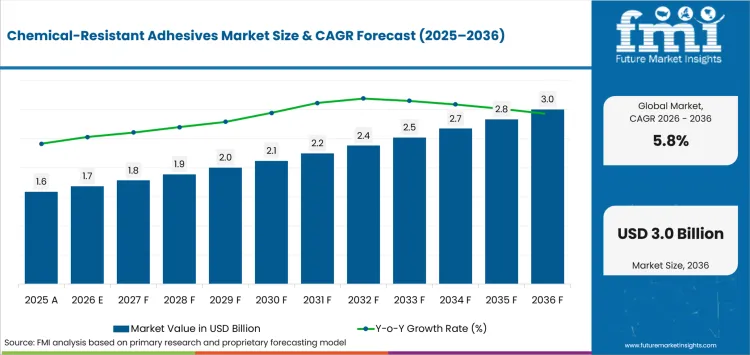
Key Takeaways
- Demand increases as chemical processors and industrial manufacturers specify bond performance against defined fluids, temperatures and cure conditions during material approval.
- By chemistry, epoxy adhesives are estimated to hold 34.0% in 2026 owing to crosslinked networks that retain strength under chemical and thermal exposure.
- Two-component cure is set to lead the cure type category with 36.0% share in 2026 due to controlled resin-hardener mixing and repeatable final properties.
- In 2026, acid resistant is expected to lead the resistance category with 23.0% share because acid-driven softening or adhesion loss can stop process equipment.
- Qualification time limits rapid switching because fluid concentration, temperature, substrate preparation and cure history can materially change a bonded joint’s service result.
- Some of the key players in this market include Henkel, 3M, H.B. Fuller, Sika, Arkema / Bostik, Master Bond, Permabond, and ITW Performance Polymers.
Analyst Perspective
"Chemical-resistant adhesives earn margin once engineers reproduce the service fluid, temperature and cure condition that threaten the joint. Companies that can run that work quickly near the customer are better positioned to turn compatibility data into an approved plant or OEM specification."
- Nikhil Kaitwade, Principal Consultant, Future Market Insights
How is the Chemical-Resistant Adhesives Market segmented?
The market is segmented by chemistry, cure type, resistance, end use, sales channel and region.
Chemistry covers epoxy, MMA, polyurethane, silicone and fluoropolymer-based adhesives, whereas cure type separates two-component, one-component heat, moisture, UV or light and room-temperature systems. Resistance covers acid, solvent, oil or fuel, alkali and high-temperature chemical exposure, and end use covers chemical processing, automotive, electronics, marine and industrial maintenance. Sales channels distinguish industrial distributors, direct OEM supply, MRO channels and specialty formulators for commercial access.
Why does Chemical processing lead the End use category?
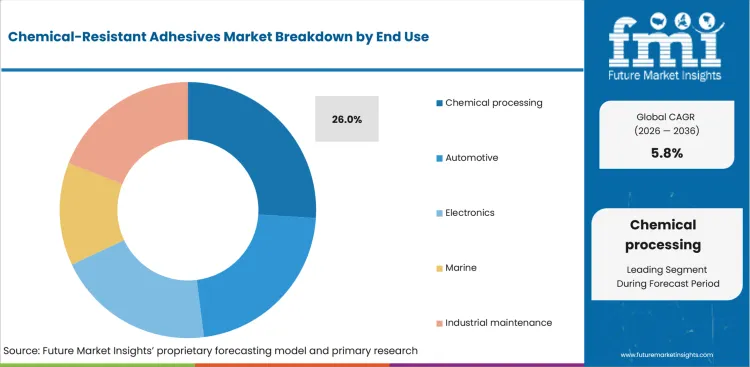
At process plants, bonded repairs operate beside aggressive fluids that define the service requirement. Plant engineers compare exposure history with cure practicality during maintenance-material approval. Polyurethane adhesives are selected for joints that also need flexibility.
- By end use, chemical processing is forecast to represent 26.0% in 2026 attributable to downtime costs that make service-specific compatibility a routine specification requirement.
- Operating plants sustain repair demand as maintenance continues during uneven production cycles and scheduled shutdowns. Eurostat's December 2025 release documented 224 million tonnes of EU chemical production in 2024.
Why do Epoxy adhesives lead the Chemistry category?
Epoxy chemistry suits joints that need structural strength during repeated contact with aggressive fluids and elevated temperatures. Engineers compare chemical exposure with cure practicality during long-service assembly qualification. Permabond launched ET5164 in May 2025 as a 1:1 two-part epoxy with documented water and chemical resistance.
- Epoxy adhesives are projected to hold 34.0% share in 2026 owing to crosslinked networks that retain strength under chemical and thermal exposure.
- Structural adhesive programs retain epoxy in consideration through room-temperature cure and optional heat acceleration that fit existing production equipment.
Why does Two-component cure lead the Cure type category?
Two-component systems store resin and hardener separately until dispensing, letting manufacturers trade working time against fixture speed without adding an oven. 2K epoxy adhesives fit lines that monitor mix ratio as part of existing process release.
- Based on cure type, two-component cure is projected to account for 36.0% in 2026 due to controlled resin-hardener mixing and repeatable final properties.
- Manufacturers need early warning once mix ratio drifts outside specification during production at commercial assembly scale. 3M's December 2025 Adhesive Mix Monitor introduced real-time feedback for two-part structural adhesive dispensing.
Why does Acid resistant lead the Resistance category?
Chemical-resistant coatings face the same concentration and temperature challenge on plant surfaces, but bonded joints must retain mechanical integrity under mechanical load after cure.
- Acid resistant is likely to capture 23.0% share in 2026 attributable to acid-driven softening or adhesion loss that can stop process equipment. Master Bond's July 2026 UV16Med-FD release documents resistance to acids, bases and solvents under a controlled light-cure system.
- Process engineers screen the actual fluid and service temperature and then compare cure speed or handling convenience during qualification at each site.
What are the drivers, restraints and opportunities in the Chemical-Resistant Adhesives Market?
Failure avoidance raises demand, application-specific qualification slows material changes and automated mobility or electronics assembly expands the value of chemically durable bonding systems.
- Driver: High-consequence fluid exposure pushes engineers to specify resistance against the exact chemical, temperature and mechanical load in service.
- Restraint: Validation burden rises as surface preparation, cure history and chemical-handling requirements extend approvals beyond a simple strength comparison.
- Opportunity: Mobility and electronics programs reward adhesives that pair chemical compatibility with repeatable dispensing, thermal performance and production-scale process control.
Chemical processors scrutinize adhesive compatibility most closely at joints whose failure can release fluid or stop equipment. Cefic's February 2026 equipment study assessed three PFAS-restriction scenarios and found no single substitute matching combined chemical, thermal and mechanical performance for many plant-equipment uses. The result makes material compatibility a practical qualification issue for repairs and new assemblies. Aerospace adhesives face comparable qualification pressure in systems that carry several service stresses at once.
Plant approvals slow once a material change also affects chemical-handling controls and worker protection requirements at the same production site. The USA EPA's January 2025 WCPP guide identifies four chemicals covered by final 2024 risk-management rules with workplace protection requirements. Plant safety teams must therefore review handling controls alongside adhesive performance during each qualification program. Silicone adhesives and sealants also require service evidence beyond bond strength in selected industrial applications.
Mobility and electronics programs pay for chemically durable adhesives only if dispensing and cure controls fit production takt time. Henkel's September 2025 Brandon expansion doubled the site's footprint and installed additional mixers for higher-volume thermal-management and adhesive production. Electronics adhesives can enter qualification beside production-scale process support. Automotive adhesives and sealants face a commercial limit if slower cure schedules erase the value of chemical durability.
Which country CAGRs are profiled in the Chemical-Resistant Adhesives Market?
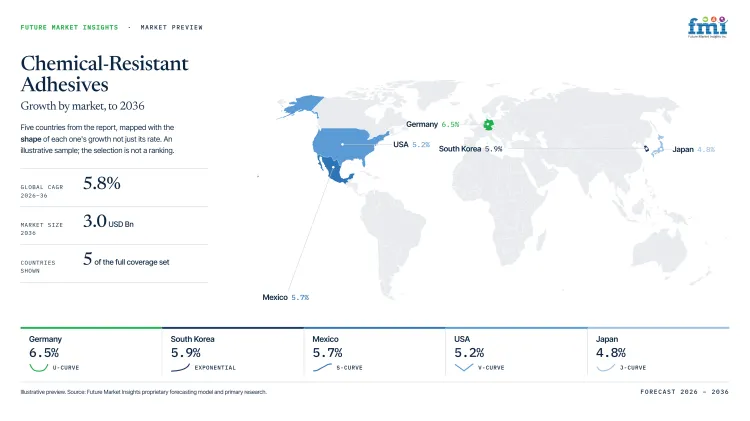
| Country | CAGR |
|---|---|
| Germany | 6.5% |
| South Korea | 5.9% |
| Mexico | 5.7% |
| USA | 5.2% |
| Japan | 4.8% |
How do country-level CAGRs compare in the Chemical-Resistant Adhesives Market?
The 1.3-point spread separates Germany and South Korea from a middle group led by Mexico. Brazil and the USA form the lower pair. The pattern reflects qualification frequency and end-use mix rather than a ranking of current national revenue pools. Germany's chemical-industry density raises application-testing frequency, whereas the USA rate starts from a broader installed manufacturing base.
- German machinery OEMs add specification routes beyond chemical-plant maintenance.
- South Korean shipyards add marine-fluid exposure beside electronics assembly.
- Mexico's tier-one networks carry global bonding specifications into regional plants.
- USA aerospace and electronics programs sustain high-specification bonding demand.
- Japan aerospace and electronics programs sustain high-specification bonding demand.
Similar CAGRs require different entry models as application density and service distance vary by country. The full report provides country-level CAGR analysis across North America, Latin America, Europe, East Asia, South Asia, Oceania and the Middle East and Africa.
Country-wise Analysis
- German chemical processors often qualify replacement bonding materials inside regional chemical clusters that shorten travel between application laboratories and plant maintenance teams. The German chemical-resistant adhesives sector is projected to record 6.5% CAGR during the assessment period, given the country's process-industry density and local engineering depth. VCI's July 2026 review put first-half chemical and pharmaceutical production about 3% below a year earlier, so growth still faces weak plant utilization. High energy costs and long approved-material histories discourage reformulation that offers no clear operating gain. Companies with nearby testing and stock can convert compatibility data into plant specifications faster than remote technical teams.
- South Korean electronics lines require tight dispense control to meet export-customer expectations for consistent bonded-joint quality in production programs. First-half ICT exports increased 120.5% year on year according to MOTIR's July 2026 release. Chemical-resistant adhesive demand in South Korea is forecast to rise at 5.9% CAGR over the forecast period, tied to electronics output and local process-engineering capacity. Automated lines make controlled mixing and cure verification a direct enabler for repeat export programs. Local engineering teams can reproduce dispense settings without routing every adjustment to an overseas laboratory. Fluid-specific testing can extend approval, so faster market growth does not eliminate application-level evidence before export production begins.
- Automotive plants in Bajío and northern Mexico qualify approved adhesive grades locally once model-specific material lists reach each assembly site. Adoption of chemical-resistant adhesives in Mexico is estimated to expand at 5.7% CAGR through 2036, supported by export vehicle production and regional sourcing. Local application engineers can run line trials beside the plant and maintain approved grades through regional stock for model-change, launch and maintenance work. INEGI's June 2026 bulletin recorded 342,926 light vehicles produced in May. Plant-specific sourcing rules and production swings complicate inventory planning, so validated local supply becomes a structural requirement for repeat orders.
- USA chemical plants and assembly sites often maintain separate approved-material lists, so national adoption depends on plant-level documentation instead of one central specification. Broad distributor coverage makes small replacement quantities easier to source during maintenance and line-change programs. The USA chemical-resistant adhesives outlook is anticipated to advance at 5.2% CAGR over the assessment period, since a large installed base sustains replacement work. Transportation equipment orders increased 2.3% in July 2026 according to the USA Census Bureau's August 26 release. Legacy approvals can slow substitution even after technical testing proves the new grade's required chemical compatibility. Companies that translate fluid data into mixing and cure instructions have a clearer route into decentralized USA accounts.
- Japan’s chemical manufacturing facilities and assembly operations commonly follow company- or site-specific material approval procedures, making market penetration highly dependent on individual plant specifications and qualification records. A well-established network of specialty-chemical distributors supports timely access to small-volume adhesive requirements for equipment maintenance, repairs, and production-line modifications. The Japan chemical-resistant adhesives market is projected to expand at a 4.8% CAGR over the assessment period, supported by ongoing maintenance demand across Japan’s mature industrial base. Japan’s strong automotive, electronics, machinery, and chemical-processing sectors continue to create opportunities for adhesives capable of withstanding aggressive fluids and demanding operating environments. However, established supplier relationships and lengthy qualification procedures can delay the adoption of alternative adhesive grades, even when laboratory testing demonstrates comparable chemical resistance.
Who are the notable companies in the Chemical-Resistant Adhesives Market?
Henkel, 3M, H.B. Fuller, Sika, Arkema / Bostik, Master Bond, Permabond, ITW Performance Polymers
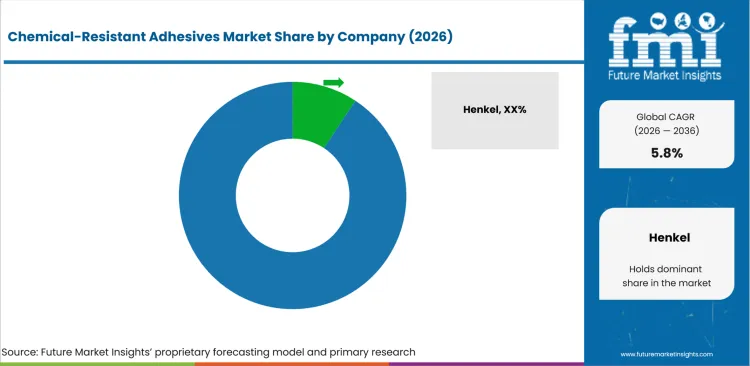
The competitive field includes global adhesive groups and smaller specialists serving harsh-service joints whose specifications depend on documentation and technical response. Entry becomes harder once chemical-resistance evidence must match application testing, distribution reach and approved processing conditions. Acrylic adhesives retain a role in programs that prioritize fixture speed and mixed-substrate bonding over the longer working window available from many epoxies.
- Henkel, 3M, H.B. Fuller, Sika and Arkema / Bostik offer multiple adhesive chemistries plus global or regional application support for large industrial programs.
- Master Bond and Permabond focus more heavily on specialty formulations where exposure data and direct technical support influence harsh-service qualification.
- ITW Performance Polymers serves industrial and automotive applications through engineered structural adhesives and repair materials used in specialized programs.
Competitive Benchmarking: Chemical-Resistant Adhesives Market
| Company | Reactive Chemistry Breadth | Qualification and Process Support | Industrial Application Breadth | Geographic Reach |
|---|---|---|---|---|
| Henkel | High | High | High | Global |
| 3M | Medium | High | High | Global |
| H.B. Fuller | Medium | High | High | Global |
| Sika | Medium | Medium | High | Global |
| Arkema / Bostik | High | Medium | High | Global |
| Master Bond | High | High | Medium | North America and international sales |
| Permabond | Medium | Medium | High | North America, Europe and international sales |
| ITW Performance Polymers | Medium | Medium | High | North America, Europe and Asia |
Scoring basis: Reactive chemistry breadth rates High for at least three documented adhesive families, whereas Medium requires two and Low covers one documented family. Qualification support rates High for dedicated testing or application infrastructure, whereas Medium requires documented technical assistance and Low indicates basic support. Application breadth rates High for at least three verified industrial groups, whereas Medium requires two and Low covers one verified group. Geographic reach records documented service regions and does not represent market share or corporate size.
Key Developments in the Chemical-Resistant Adhesives Market
- In February 2026, Sika agreed to acquire Akkim to expand adhesive and sealant production capacity and strengthen distribution reach in Eastern Europe, Central Asia, the Middle East and North Africa.
- In December 2025, Master Bond released Supreme 10HTLV as a one-part structural epoxy that resists water, oils and various chemicals under severe thermal cycling.
- In March 2025, Permabond launched ES5516 as a heat-curing epoxy for electric-motor magnets that maintains structural strength at 180°C and lists good resistance to chemicals.
Key Players in the Chemical-Resistant Adhesives Market
Global Multi-Chemistry Adhesive Platforms
- Henkel
- 3M
- H.B. Fuller
- Sika
- Arkema / Bostik
Specialist Harsh-Service and Engineered Adhesive Platforms
- Master Bond
- Permabond
- ITW Performance Polymers
Chemical-Resistant Adhesives Market - Report Scope
| Coverage field | Report scope |
|---|---|
| Market breakdown | By chemistry, cure type, resistance, end use, sales channel and region. |
| Quantitative Units | USD Billion. |
| Market Definition | Commercial adhesives specified for bonded joints that require resistance to acids, bases, solvents, oils, fuels or other chemically aggressive service media. |
| Regions Covered | North America, Latin America, Europe, East Asia, South Asia and Pacific, and Middle East and Africa. |
| Countries Covered | Germany, South Korea, Mexico, Brazil, USA, and 20+ countries included in the full report. |
| Key Companies Profiled | Henkel, 3M, H.B. Fuller, Sika, Arkema / Bostik, Master Bond, Permabond, ITW Performance Polymers |
| Forecast Period | 2026 to 2036. |
| Approach | Primary and secondary research with market triangulation. |
Chemical-Resistant Adhesives Market - Research Methodology
| Method | Approach |
|---|---|
| Primary Research | FMI analysts gathered input from manufacturers, service providers, technology developers, distributors, end users, procurement teams, and subject-matter experts. Interviews examined purchasing decisions, product or service evaluation, adoption barriers, approval requirements, pricing considerations, and expectations for technical or commercial support. Respondents were also asked what evidence is required before a trial, pilot, or initial order develops into regular purchasing. |
| Desk Research | Desk research covered government statistics, regulatory publications, trade data, industry associations, technical literature, standards, company filings, product information, and official corporate announcements. Sources were reviewed for relevance, publication date, geographic coverage, and consistency with the defined market scope. Claims relating to performance, applications, approvals, capacity, investment, and commercial activity were retained only when supported by credible public evidence. |
| Market Sizing and Forecasting | The market model combined the baseline value with historical performance, segment structure, pricing and volume indicators, adoption levels, company participation, and country-level demand conditions. Forecast assumptions considered economic activity, investment trends, regulatory developments, technology adoption, purchasing cycles, supply availability, and barriers to wider market use. Segment and regional estimates were reconciled before the final market total was calculated. |
| Data Validation | Estimates were checked against multiple independent indicators, including public data, company activity, trade patterns, industry developments, and findings from primary interviews. Validation also tested whether products, services, applications, and company revenues fell within the defined market boundaries. Adjacent categories, unsupported claims, overlapping revenues, and activities without direct market relevance were excluded to reduce double counting and maintain consistency across segments and countries. |
Chemical-Resistant Adhesives Market by Segments
Chemistry
- Epoxy adhesives
- MMA adhesives
- Polyurethane adhesives
- Silicone adhesives
- Fluoropolymer-based adhesives
Cure Type
- Two-component cure
- One-component heat cure
- Moisture cure
- UV / light cure
- Room-temperature cure
Resistance
- Acid resistant
- Solvent resistant
- Oil / fuel resistant
- Alkali resistant
- High-temperature chemical resistant
End Use
- Chemical processing
- Automotive
- Electronics
- Marine
- Industrial maintenance
Sales Channel
- Industrial distributors
- Direct OEM supply
- MRO channel
- Specialty formulators
Chemical-Resistant Adhesives Market by Region:
- North America
- United States
- Canada
- Latin America
- Brazil
- Mexico
- Chile
- Rest of Latin America
- Western Europe
- Germany
- United Kingdom
- Italy
- Spain
- France
- Nordics
- Benelux
- Rest of Western Europe
- Eastern Europe
- Russia
- Poland
- Hungary
- Balkan and Baltic States
- Rest of Eastern Europe
- East Asia
- China
- Japan
- South Korea
- South Asia and Pacific
- India
- ASEAN
- Australia and New Zealand
- Rest of South Asia and Pacific
- Middle East and Africa
- Kingdom of Saudi Arabia
- Other GCC Countries
- Türkiye
- South Africa
- Other African Union Countries
- Rest of Middle East and Africa
Research Sources and Bibliography
- Master Bond. (2026, May 1). NASA Low Outgassing, Chemically Resistant Epoxy Features High Tg.
- VCI. (2026, August 18). Industry Profile.
- Permabond. (2025, May 15). Introducing FDA & EU food safe adhesive, Permabond ET5164.
- 3M. (2025, December 30). 3M Adhesive Mix Monitor reimagines two-part adhesive dispensing for manufacturers.
- Master Bond. (2026, July 10). UV Curable System with a Fluorescent Dye Meets ISO 10993-5 Testing.
- Eurostat. (2025, December 16). EU chemical production: -15% over 10 years.
- European Chemical Industry Council. (2026, February 26). Study on uses of PFAS in chemical manufacturing plant equipment.
- USA Environmental Protection Agency. (2025, January 16). EPA Releases Compliance Guide for Workplace Chemical Protection Program Requirements.
- Henkel. (2025, September 25). Henkel celebrates expansion of flagship manufacturing facility in Brandon, South Dakota to advance mobility and electronics innovation.
- VCI. (2026, July 16). First-Half 2026 Review.
- Ministry of Trade, Industry and Resources. (2026, July 14). Korea’s ICT Exports Reach Record $253.9 Billion in First Half of 2026.
- INEGI. (2026, June 8). Registro Administrativo de la Industria Automotriz de Vehículos Ligeros (RAIAVL).
- Agência Nacional do Petróleo, Gás Natural e Biocombustíveis. (2026, July 1). Produção nacional de petróleo e gás natural se mantém estável em maio de 2026.
- USA Census Bureau. (2026, August 26). Monthly Advance Report on Durable Goods Manufacturers' Shipments Inventories and Orders.
- Sika. (2026, February 13). Sika to acquire Akkim: Marking a major step in accelerating global expansion in adhesives and sealants.
- Master Bond. (2025, December 18). Structural One Part Epoxy for High-Performance Bonding Applications.
- Permabond. (2025, March 24). Permabond introduces high-temperature magnet adhesive, ES5516.
- Henkel. (2026, January 16). Henkel to acquire ATP Adhesive Systems.
- 3M. (2026, August 24). 3M and BOE launch joint laboratory to accelerate display technology innovation.
- Bostik. (2025, May 19). Bostik Adhesive Solutions: Investment in Middleton, MA.
- Master Bond. (2025, February 25). Medical Grade, Dual Curable Adhesive Offers Rapid Fixturing with LED Light.
- Permabond. (2025, July 14). Permabond launches cold-resistant adhesive, UV6357.
- H.B. Fuller. (2025, May 16). H.B. Fuller Expands Manufacturing Capabilities in IMEA Region.
- Henkel. (2026, February 4). Henkel agrees to acquire specialty coatings company Stahl.
- 3M. (2026, June 30). 3M joins Cadillac Formula 1 Team as Official Material Science Partner to accelerate racing performance.
- Sika. (2025, June 18). Sika strengthens global presence with strategic investments across all regions.
- Bostik. (2026, April 20). Bostik unifies its flexible materials portfolio under one global brand: ADCOTE.
- Master Bond. (2026, February 18). Dual Cure Medical Adhesive Features High Tg and Autoclave Resistance.
- Permabond. (2025, February 4). Introducing high temperature aerospace epoxy, Permabond ET5424.
- Illinois Tool Works Inc. (2026, February 13). Annual Report on Form 10-K for the year ended December 31, 2025.
This bibliography is provided for reader reference and is not exhaustive. The full report contains the complete reference list and detailed citations
This Report Answers
- What is the chemical-resistant adhesives market size in 2026 and forecast value for 2036?
- Which chemistry, cure type, resistance, end-use and sales-channel segments define the market?
- Why do epoxy adhesives hold the largest chemistry share in 2026?
- Why do two-component cure and acid-resistant formulations retain large current shares?
- How do the five profiled country CAGRs differ through 2036?
- Which demand driver, adoption restraint and commercial opportunity shape adhesive specifications?
- How do eight companies compare by chemistry breadth, qualification support and geography?
- Which recent company developments alter capacity, qualification or technical support?
Frequently Asked Questions
How big is the chemical-resistant adhesives market in 2026?
The chemical-resistant adhesives market is valued at USD 1.7 billion in 2026 and is projected to reach USD 3.0 billion by 2036. Growth comes from service-specific bonding requirements in chemical processing, electronics, transport and industrial maintenance programs.
What is the CAGR of the chemical-resistant adhesives market from 2026 to 2036?
The chemical-resistant adhesives market is projected to grow at a CAGR of 5.8% between 2026 and 2036. Expansion follows failure avoidance, stricter qualification of fluid-exposed joints and wider use of engineered adhesives in automated manufacturing.
Which chemistry leads the chemical-resistant adhesives market?
The epoxy adhesives segment is expected to hold 34.0% of the chemical-resistant adhesives market in 2026, attributable to crosslinked formulations that retain strength under chemical and thermal exposure. Plant engineers select epoxy where fluid resistance must coexist with structural bond strength during service.
Which countries are projected to record the highest growth in the chemical-resistant adhesives market?
Germany is projected to grow at 6.5% CAGR, followed by South Korea at 5.9% and Mexico at 5.7% through 2036. Local manufacturing mixes, qualification practices and service access explain the different national growth paths in this comparison.
Which companies are active in the chemical-resistant adhesives market?
Key companies operating in the chemical-resistant adhesives market include Henkel, 3M, H.B. Fuller, Sika, Arkema / Bostik, Master Bond, Permabond, and ITW Performance Polymers. Their positions differ in chemistry coverage, application testing, process support and the reach of industrial channels.
Preview the report firsthand - request a free sample
Get SampleGet the brochure for pricing and purchase details.
Get PDFTable of Content
- Key Takeaways
- Market Size and CAGR
- Top Growth Driver
- Fastest Growing Segment
- Leading Region
- Key Companies
- Emerging Opportunities
- Executive Summary
- Global Market Outlook
- Demand-side Trends
- Supply-side Trends
- Technology Roadmap Analysis
- Analysis and Recommendations
- Analyst Perspective (What is happening? Why now? What should investors know?)
- Key Questions Answered
- How large is the market?
- What is the CAGR?
- What are key trends?
- Which region dominates?
- Who are the leaders?
- Market Overview
- Market Coverage / Taxonomy
- Market Definition / Scope / Limitations
- Research Methodology
- Chapter Orientation
- Analytical Lens and Working Hypotheses
- Market Structure, Signals, and Trend Drivers
- Benchmarking and Cross-market Comparability
- Market Sizing, Forecasting, and Opportunity Mapping
- Research Design and Evidence Framework
- Desk Research Programme (Secondary Evidence)
- Expert Input and Fieldwork (Primary Evidence)
- Tooling, Models, and Reference Databases
- Data Engineering and Model Build
- Quality Assurance and Audit Trail
- Market Background
- Market Dynamics (Drivers, Restraints, Opportunity, Trends)
- Scenario Forecast (Optimistic, Likely, Conservative)
- Impact Analysis
- AI Impact
- Sustainability Impact
- Regulatory Impact
- Technology Impact
- Consumer / Buyer Analysis
- Purchase Drivers
- Adoption Barriers
- Buyer Journey
- Opportunity Map Analysis
- Product Life Cycle Analysis
- Supply Chain Analysis
- Investment Feasibility Matrix
- Value Chain Analysis
- PESTLE and Porter's Analysis
- Regulatory Landscape
- Regional Parent Market Outlook
- Production and Consumption Statistics
- Import and Export Statistics
- Global Market Analysis and Forecast, 2021 to 2036
- Historical Market Size Value (USD Billion) Analysis, 2021 to 2025
- Current and Future Market Size Value (USD Billion) Projections, 2026 to 2036
- Y-o-Y Growth Trend Analysis
- Absolute $ Opportunity Analysis
- Global Market Pricing Analysis, 2021 to 2036
- Global Market Analysis and Forecast, By Chemistry, 2021 to 2036
- Introduction / Key Findings
- Historical Market Size Value (USD Billion) Analysis By Chemistry, 2021 to 2025
- Current and Future Market Size Value (USD Billion) Analysis and Forecast By Chemistry, 2026 to 2036
- Epoxy adhesives
- MMA adhesives
- Polyurethane adhesives
- Silicone adhesives
- Fluoropolymer-based adhesives
- Epoxy adhesives
- Y-o-Y Growth Trend Analysis By Chemistry, 2021 to 2025
- Absolute $ Opportunity Analysis By Chemistry, 2026 to 2036
- Global Market Analysis and Forecast, By Cure Type, 2021 to 2036
- Introduction / Key Findings
- Historical Market Size Value (USD Billion) Analysis By Cure Type, 2021 to 2025
- Current and Future Market Size Value (USD Billion) Analysis and Forecast By Cure Type, 2026 to 2036
- Two-component cure
- One-component heat cure
- Moisture cure
- UV / light cure
- Room-temperature cure
- Two-component cure
- Y-o-Y Growth Trend Analysis By Cure Type, 2021 to 2025
- Absolute $ Opportunity Analysis By Cure Type, 2026 to 2036
- Global Market Analysis and Forecast, By Resistance, 2021 to 2036
- Introduction / Key Findings
- Historical Market Size Value (USD Billion) Analysis By Resistance, 2021 to 2025
- Current and Future Market Size Value (USD Billion) Analysis and Forecast By Resistance, 2026 to 2036
- Acid resistant
- Solvent resistant
- Oil/fuel resistant
- Alkali resistant
- High-temperature chemical resistant
- Acid resistant
- Y-o-Y Growth Trend Analysis By Resistance, 2021 to 2025
- Absolute $ Opportunity Analysis By Resistance, 2026 to 2036
- Global Market Analysis and Forecast, By End Use, 2021 to 2036
- Introduction / Key Findings
- Historical Market Size Value (USD Billion) Analysis By End Use, 2021 to 2025
- Current and Future Market Size Value (USD Billion) Analysis and Forecast By End Use, 2026 to 2036
- Chemical processing
- Automotive
- Electronics
- Marine
- Industrial maintenance
- Chemical processing
- Y-o-Y Growth Trend Analysis By End Use, 2021 to 2025
- Absolute $ Opportunity Analysis By End Use, 2026 to 2036
- Global Market Analysis and Forecast, By Sales Channel, 2021 to 2036
- Introduction / Key Findings
- Historical Market Size Value (USD Billion) Analysis By Sales Channel, 2021 to 2025
- Current and Future Market Size Value (USD Billion) Analysis and Forecast By Sales Channel, 2026 to 2036
- Industrial distributors
- Direct OEM supply
- MRO channel
- Specialty formulators
- Industrial distributors
- Y-o-Y Growth Trend Analysis By Sales Channel, 2021 to 2025
- Absolute $ Opportunity Analysis By Sales Channel, 2026 to 2036
- Global Market Analysis and Forecast, By Region, 2021 to 2036
- Introduction
- Historical Market Size Value (USD Billion) Analysis By Region, 2021 to 2025
- Current Market Size Value (USD Billion) Analysis and Forecast By Region, 2026 to 2036
- North America
- Latin America
- Western Europe
- Eastern Europe
- East Asia
- South Asia and Pacific
- Middle East & Africa
- Market Attractiveness Analysis By Region
- North America Market Analysis and Forecast, By Country, 2021 to 2036
- Historical Market Size Value (USD Billion) Trend Analysis By Market Taxonomy, 2021 to 2025
- Market Size Value (USD Billion) Forecast By Market Taxonomy, 2026 to 2036
- By Country
- USA
- Canada
- By Chemistry
- By Cure Type
- By Resistance
- By End Use
- By Sales Channel
- By Country
- Market Attractiveness Analysis
- By Country
- By Chemistry
- By Cure Type
- By Resistance
- By End Use
- By Sales Channel
- Key Takeaways
- Latin America Market Analysis and Forecast, By Country
- Historical Market Size Value (USD Billion) Trend Analysis By Market Taxonomy, 2021 to 2025
- Market Size Value (USD Billion) Forecast By Market Taxonomy, 2026 to 2036
- By Country
- Brazil
- Mexico
- Chile
- Rest of Latin America
- By Chemistry
- By Cure Type
- By Resistance
- By End Use
- By Sales Channel
- By Country
- Market Attractiveness Analysis
- By Country
- By Chemistry
- By Cure Type
- By Resistance
- By End Use
- By Sales Channel
- Key Takeaways
- Western Europe Market Analysis and Forecast, By Country
- Historical Market Size Value (USD Billion) Trend Analysis By Market Taxonomy, 2021 to 2025
- Market Size Value (USD Billion) Forecast By Market Taxonomy, 2026 to 2036
- By Country
- Germany
- UK
- Italy
- Spain
- France
- Nordic
- BENELUX
- Rest of Western Europe
- By Chemistry
- By Cure Type
- By Resistance
- By End Use
- By Sales Channel
- By Country
- Market Attractiveness Analysis
- By Country
- By Chemistry
- By Cure Type
- By Resistance
- By End Use
- By Sales Channel
- Key Takeaways
- Eastern Europe Market Analysis and Forecast, By Country
- Historical Market Size Value (USD Billion) Trend Analysis By Market Taxonomy, 2021 to 2025
- Market Size Value (USD Billion) Forecast By Market Taxonomy, 2026 to 2036
- By Country
- Russia
- Poland
- Hungary
- Balkan & Baltic
- Rest of Eastern Europe
- By Chemistry
- By Cure Type
- By Resistance
- By End Use
- By Sales Channel
- By Country
- Market Attractiveness Analysis
- By Country
- By Chemistry
- By Cure Type
- By Resistance
- By End Use
- By Sales Channel
- Key Takeaways
- East Asia Market Analysis and Forecast, By Country
- Historical Market Size Value (USD Billion) Trend Analysis By Market Taxonomy, 2021 to 2025
- Market Size Value (USD Billion) Forecast By Market Taxonomy, 2026 to 2036
- By Country
- China
- Japan
- South Korea
- By Chemistry
- By Cure Type
- By Resistance
- By End Use
- By Sales Channel
- By Country
- Market Attractiveness Analysis
- By Country
- By Chemistry
- By Cure Type
- By Resistance
- By End Use
- By Sales Channel
- Key Takeaways
- South Asia and Pacific Market Analysis and Forecast, By Country
- Historical Market Size Value (USD Billion) Trend Analysis By Market Taxonomy, 2021 to 2025
- Market Size Value (USD Billion) Forecast By Market Taxonomy, 2026 to 2036
- By Country
- India
- ASEAN
- Australia & New Zealand
- Rest of South Asia and Pacific
- By Chemistry
- By Cure Type
- By Resistance
- By End Use
- By Sales Channel
- By Country
- Market Attractiveness Analysis
- By Country
- By Chemistry
- By Cure Type
- By Resistance
- By End Use
- By Sales Channel
- Key Takeaways
- Middle East & Africa Market Analysis and Forecast, By Country
- Historical Market Size Value (USD Billion) Trend Analysis By Market Taxonomy, 2021 to 2025
- Market Size Value (USD Billion) Forecast By Market Taxonomy, 2026 to 2036
- By Country
- Kingdom of Saudi Arabia
- Other GCC Countries
- Türkiye
- South Africa
- Other African Union
- Rest of Middle East & Africa
- By Chemistry
- By Cure Type
- By Resistance
- By End Use
- By Sales Channel
- By Country
- Market Attractiveness Analysis
- By Country
- By Chemistry
- By Cure Type
- By Resistance
- By End Use
- By Sales Channel
- Key Takeaways
- Key Countries Market Analysis
- USA
- Pricing Analysis
- Market Share Analysis, 2025
- By Chemistry
- By Cure Type
- By Resistance
- By End Use
- By Sales Channel
- Canada
- Pricing Analysis
- Market Share Analysis, 2025
- By Chemistry
- By Cure Type
- By Resistance
- By End Use
- By Sales Channel
- Mexico
- Pricing Analysis
- Market Share Analysis, 2025
- By Chemistry
- By Cure Type
- By Resistance
- By End Use
- By Sales Channel
- Brazil
- Pricing Analysis
- Market Share Analysis, 2025
- By Chemistry
- By Cure Type
- By Resistance
- By End Use
- By Sales Channel
- Chile
- Pricing Analysis
- Market Share Analysis, 2025
- By Chemistry
- By Cure Type
- By Resistance
- By End Use
- By Sales Channel
- Germany
- Pricing Analysis
- Market Share Analysis, 2025
- By Chemistry
- By Cure Type
- By Resistance
- By End Use
- By Sales Channel
- UK
- Pricing Analysis
- Market Share Analysis, 2025
- By Chemistry
- By Cure Type
- By Resistance
- By End Use
- By Sales Channel
- Italy
- Pricing Analysis
- Market Share Analysis, 2025
- By Chemistry
- By Cure Type
- By Resistance
- By End Use
- By Sales Channel
- Spain
- Pricing Analysis
- Market Share Analysis, 2025
- By Chemistry
- By Cure Type
- By Resistance
- By End Use
- By Sales Channel
- France
- Pricing Analysis
- Market Share Analysis, 2025
- By Chemistry
- By Cure Type
- By Resistance
- By End Use
- By Sales Channel
- India
- Pricing Analysis
- Market Share Analysis, 2025
- By Chemistry
- By Cure Type
- By Resistance
- By End Use
- By Sales Channel
- ASEAN
- Pricing Analysis
- Market Share Analysis, 2025
- By Chemistry
- By Cure Type
- By Resistance
- By End Use
- By Sales Channel
- Australia & New Zealand
- Pricing Analysis
- Market Share Analysis, 2025
- By Chemistry
- By Cure Type
- By Resistance
- By End Use
- By Sales Channel
- China
- Pricing Analysis
- Market Share Analysis, 2025
- By Chemistry
- By Cure Type
- By Resistance
- By End Use
- By Sales Channel
- Japan
- Pricing Analysis
- Market Share Analysis, 2025
- By Chemistry
- By Cure Type
- By Resistance
- By End Use
- By Sales Channel
- South Korea
- Pricing Analysis
- Market Share Analysis, 2025
- By Chemistry
- By Cure Type
- By Resistance
- By End Use
- By Sales Channel
- Russia
- Pricing Analysis
- Market Share Analysis, 2025
- By Chemistry
- By Cure Type
- By Resistance
- By End Use
- By Sales Channel
- Poland
- Pricing Analysis
- Market Share Analysis, 2025
- By Chemistry
- By Cure Type
- By Resistance
- By End Use
- By Sales Channel
- Hungary
- Pricing Analysis
- Market Share Analysis, 2025
- By Chemistry
- By Cure Type
- By Resistance
- By End Use
- By Sales Channel
- Kingdom of Saudi Arabia
- Pricing Analysis
- Market Share Analysis, 2025
- By Chemistry
- By Cure Type
- By Resistance
- By End Use
- By Sales Channel
- Türkiye
- Pricing Analysis
- Market Share Analysis, 2025
- By Chemistry
- By Cure Type
- By Resistance
- By End Use
- By Sales Channel
- South Africa
- Pricing Analysis
- Market Share Analysis, 2025
- By Chemistry
- By Cure Type
- By Resistance
- By End Use
- By Sales Channel
- USA
- Market Structure Analysis
- Competition Dashboard
- Competition Benchmarking
- Market Share Analysis of Top Players
- By Regional
- By Chemistry
- By Cure Type
- By Resistance
- By End Use
- By Sales Channel
- Emerging Startups
- Innovation Benchmarking
- Competition Analysis
- Competition Deep Dive
- Henkel
- Overview
- Product Portfolio
- Profitability by Market Segments
- Sales Footprint
- Strategy Overview
- Marketing Strategy
- Product Strategy
- Channel Strategy
- 3M
- H.B. Fuller
- Sika
- Arkema / Bostik
- Master Bond
- Dow
- Parker LORD
- Permabond
- ITW Performance Polymers
- Henkel
- Case Studies
- Success Stories
- Recent Developments
- Competition Deep Dive
- Assumptions & Acronyms Used


