

- Market Size (2026)
- USD 1.3 Bn
- Forecast (2036)
- USD 2.4 Bn
- CAGR (2026 to 2036)
- 6.7%
How big is the Chemical Resistant Expansion Joints Market in 2026?
USD 1.3 billion in 2026 and USD 2.4 billion by 2036 at a 6.7% CAGR.
The chemical resistant expansion joints industry value is predicted to rise from USD 1.2 billion in 2025 to USD 2.4 billion by 2036 at 6.7% CAGR due to corrosive piping systems needing stronger movement control. Direct sales are expected to hold 51.0% share in 2026, supported by specification review and warranty responsibility. Medium temperature products are projected to secure 45.0% share in 2026, guided by process piping needs below extreme flue-gas duty.
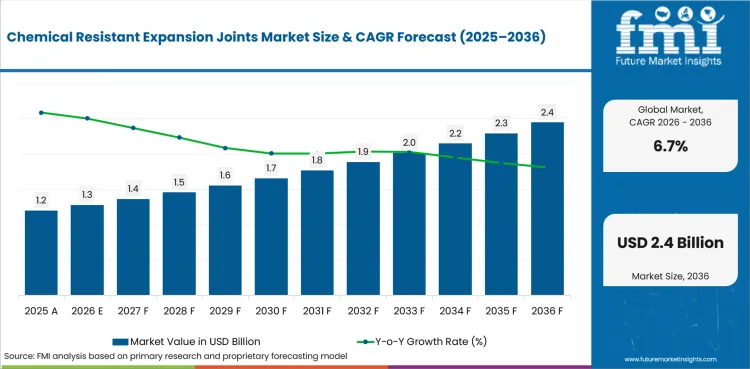
| Metric | Value |
|---|---|
| 2026 Market Size | USD 1.3 billion |
| 2036 Market Size | USD 2.4 billion |
| Forecast CAGR (2026-2036) | 6.7% |
| Leading Sales Channel | Direct |
| Direct Share (2026) | 51.0% |
| Leading Temperature Range | Medium |
| Medium Share (2026) | 45.0% |
| Fastest-growing Country | India |
| India CAGR by 2036 | 7.9% |
Summary of the Chemical Resistant Expansion Joints Market
| Market Signal | Commercial Impact |
|---|---|
| Demand and Growth Drivers | Demand for chemical resistant expansion joints is increasing as industrial facilities prioritize corrosion protection, process reliability, and reduced maintenance downtime in aggressive operating environments.
|
| Product and Segment View | Direct sales, medium temperature products, and PTFE-lined materials continue to represent the leading commercial opportunities across the market.
|
| Geography and Growth Outlook | Asia continues to strengthen its position as industrial processing, environmental compliance, and water treatment investments accelerate across major manufacturing economies.
|
| Competitive Landscape | Competition focuses on engineered corrosion-resistant designs, technical documentation, and application-specific engineering support.
|
| Analyst Perspective | Chemical resistant expansion joints are becoming critical reliability components as industrial operators seek longer equipment life and greater protection against corrosive process media.
- Nikhil Kaitwade, Principal Consultant at Future Market Insights |
Chemical resistant expansion joints demand is forecast to expand through 2036, supported by corrosive process piping, water treatment chemical dosing and engineered replacement cycles.
Chemical and water treatment assets are reinforcing demand for corrosion-safe flexible connectors. USA chemical manufacturing shipments increased 22.4% from about USD 735.9 billion to USD 901.0 billion, creating a wide installed base for chemically exposed process piping. USA clean-water infrastructure needs were reported at USD 630.1 billion over 20 years and chemical dosing assets that require flexible connections. USA power generation reached about 4.43 trillion kWh in 2025, sustaining replacement demand across auxiliary piping and water treatment systems. Expansion joint suppliers gain value as buyers need liner compatibility and documentation before approval.
Which factors support expansion in the Chemical Resistant Expansion Joints Market?
Finished product demand and engineered service support expand market value across chemical and oil and gas installations.
- Market value rises as corrosive process lines need PTFE-lined and FEP-lined joints to reduce permeation and liner failure exposure.
- Metal bellows demand strengthens as higher pressure and temperature movement raise documentation needs for process piping.
- Water treatment assets influence repeat demand through chlorine dosing and pump station maintenance.
- Power plants support replacement cycles through flue-gas auxiliary systems and wastewater treatment lines.
Why is the Chemical Resistant Expansion Joints Market growing?
Corrosive industrial fluid handling is increasing demand for lined and engineered flexible connectors.
Chemical plants and wastewater operators spend more on expansion joints as aggressive fluids raise leak and shutdown exposure. USA steam electric wastewater rules finalized in 2024 are expected to reduce pollutant discharges from coal-fired power plant wastewater by more than 660 million pounds each year, showing higher control pressure on power-sector water systems. Auxiliary treatment lines and sludge circuits need compatible flexible joints as wastewater treatment duties tighten. Suppliers able to connect media charts and installation drawings gain stronger replacement positions.
How is the Chemical Resistant Expansion Joints Market segmented?
Chemical Resistant Expansion Joints Market is segmented by material, product type, end use, temperature range, and sales channel.
- PTFE-lined materials are projected to account for 39.0% share in 2026, influenced by high chemical compatibility across acids and hazardous-media systems.
- Metal expansion joints are expected to hold 34.0% share in 2026, shaped by pressure control and thermal movement needs in engineered piping.
- Chemicals are anticipated to account for 34.0% share in 2026, led by process lines exposed to aggressive fluids and plant shutdown risk.
- Medium temperature products are projected to hold 45.0% share by Temperature Range in 2026, guided by process piping duty below extreme flue-gas service.
- Direct sales are expected to represent 51.0% share by Sales Channel in 2026, supported by specification review and manufacturer-led design responsibility.
Why do PTFE-lined materials dominate the Chemical Resistant Expansion Joints Market by material?
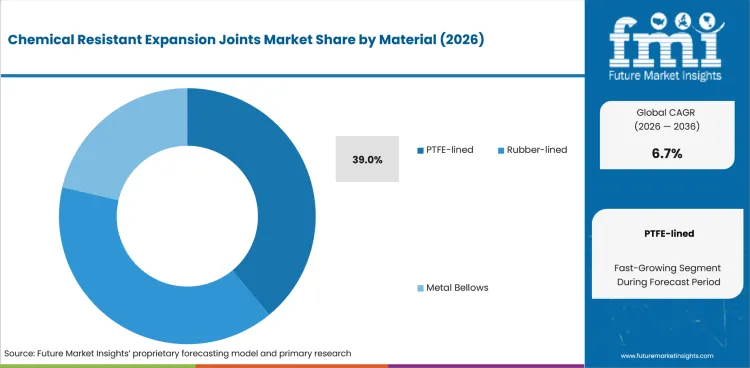
- PTFE-lined materials are projected to account for 39.0% share in 2026, driven by corrosion resistance needs in acid and hazardous-media service.
- Rubber-lined products remain active in water treatment and lower-pressure duties as buyers balance chemical resistance and replacement cost.
Which product type leads the Chemical Resistant Expansion Joints Market?
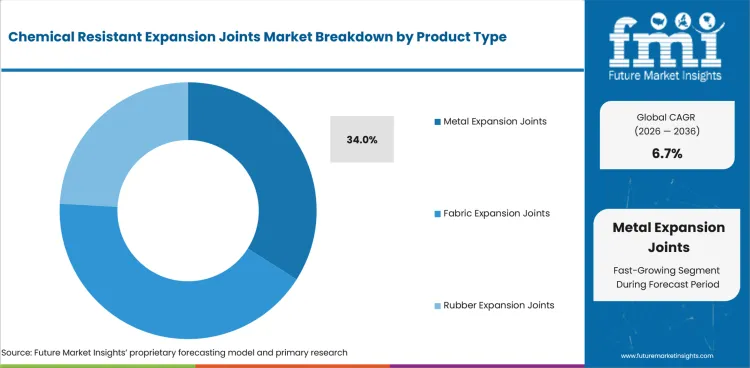
- Metal expansion joints are expected to hold 34.0% share in 2026, shaped by pressure duty, thermal movement and code-linked engineering review.
- Fabric expansion joints gain use in ducts and lower-pressure gas systems as plants manage movement under larger surface-area conditions.
Which end use leads the Chemical Resistant Expansion Joints Market?
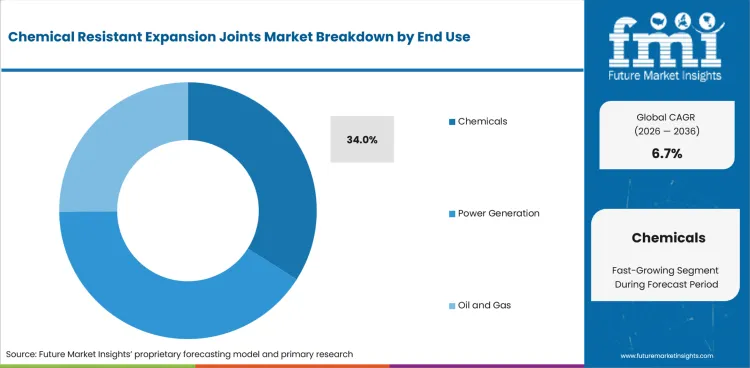
- Chemicals are anticipated to account for 34.0% share in 2026, led by acids and specialty media that raise leak-cost exposure.
- Power generation adds steady demand as utilities replace flexible connectors around cooling and auxiliary process lines.
Which temperature range leads the Chemical Resistant Expansion Joints Market?
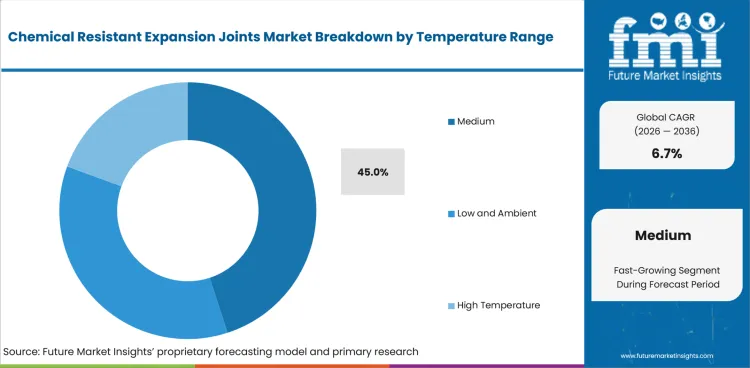
- Medium temperature products are projected to hold 45.0% share in 2026, reflected by common process piping duties below severe flue-gas and furnace service.
- High temperature products retain demand in refinery and exhaust systems requiring metal bellows or fabric designs with notable thermal tolerance.
Which sales channel leads the Chemical Resistant Expansion Joints Market?
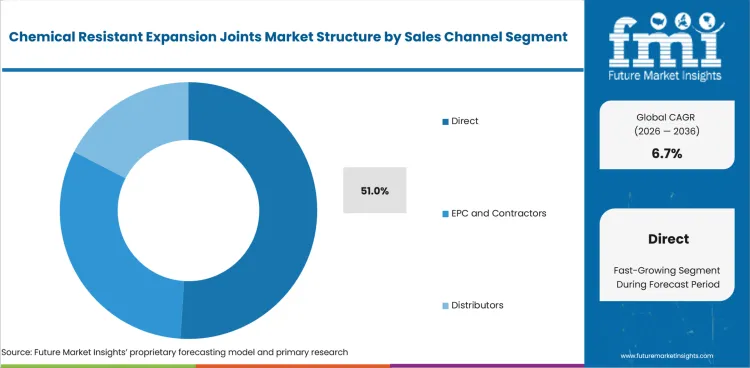
- Direct sales are expected to represent 51.0% share in 2026, guided by buyer preference for engineering review and warranty responsibility.
- EPC and contractor channels remain active in new projects as engineering teams specify expansion joints during piping and duct design.
What are the drivers, restraints, and opportunities in the Chemical Resistant Expansion Joints Market?
Corrosive process safety and documentation-led purchasing are shaping expansion joint buying decisions.
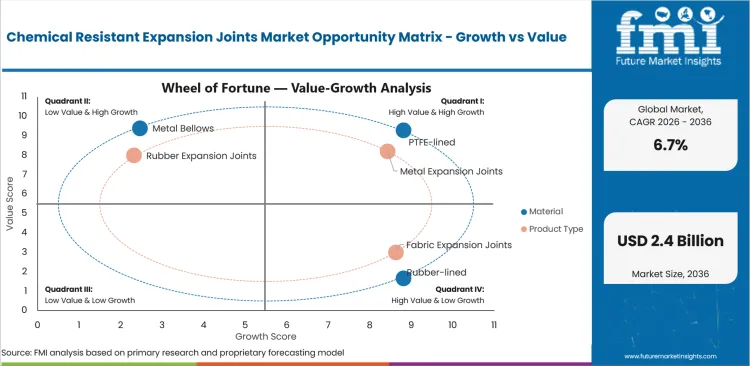
- Driver: Acid and solvent lines require expansion joints with compatible liners and proven movement performance.
- Restraint: Engineered joints can face slow approval in smaller facilities as limited process data and tight maintenance budgets restrict upgrades.
- Opportunity: Field inspection and fast fabrication support can improve supplier renewal rates across shutdown and turnaround work.
Corrosive Process Piping Strengthens Lined Joint Demand
Chemical processing creates a strong base for lined expansion joint demand as corrosion exposure turns flexible connectors into safety items. USA Census data showed chemical manufacturing shipments increased 22.4% from about USD 735.9 billion to USD 901.0 billion, indicating a large service pool for process piping. PTFE-lined and FEP-lined products gain priority as media compatibility affects leak risk and service interval. Suppliers with documented liner bonding and pressure files can defend premium positioning.
Cost and Approval Burden Limits Smaller Plant Adoption
Engineered expansion joints require media data, pressure details and installation review before safe release. USA clean-water needs were reported at USD 630.1 billion over 20 years, showing heavy capital pressure across water and wastewater infrastructure before equipment choices reach approval. Smaller industrial buyers may delay higher-grade joints if replacement budgets are tied to emergency maintenance. Suppliers can reduce adoption pressure through standardized data sheets and staged inspection support.
Water and Utility Investment Creates Replacement Opportunity
Water infrastructure spending creates added demand around dosing lines and sludge handling systems. Ofwat approved GBP 104 billion of water company expenditure allowances for 2025 to 2030, including major water and wastewater upgrades. Such programs expand the installed base of chemical-contact piping and flexible connectors across utility assets. Expansion joint suppliers with distributor coverage and documentation support can capture recurring replacement needs.
Which countries are prominently growing in the Chemical Resistant Expansion Joints Market?
India 7.9% CAGR, China 7.6% CAGR, South Korea 7.2% CAGR, United States 6.5% CAGR, Germany 6.1% CAGR, United Kingdom 5.9% CAGR, France 5.8% CAGR, and Japan 5.7% CAGR through 2036.
.webp "Top Country Growth Comparison Chemical Resistant Expansion Joints Market Cagr (2026 2036)")
| Country | CAGR |
|---|---|
| India | 7.9% |
| China | 7.6% |
| South Korea | 7.2% |
| United States | 6.5% |
| Germany | 6.1% |
| United Kingdom | 5.9% |
| France | 5.8% |
| Japan | 5.7% |
Source: Future Market Insights, 2026.
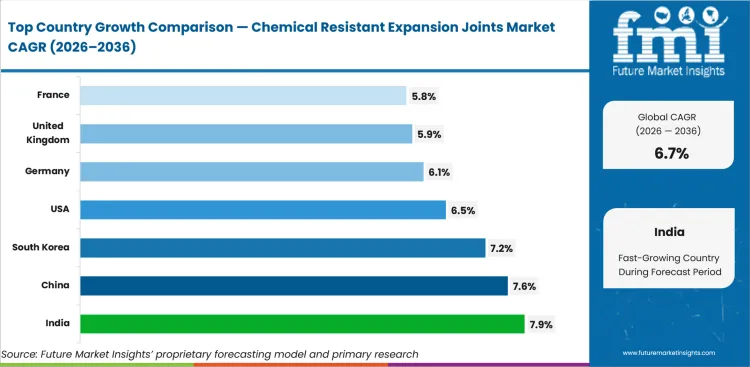
How do country-level CAGRs compare in the Chemical Resistant Expansion Joints Market?
India leads country expansion while Japan records the most cautious pace among profiled markets.
- India is forecast to record 7.9% CAGR by 2036 as chemical investment and industrial water treatment upgrades lift replacement demand.
- China is expected to expand at 7.6% CAGR from 2026 to 2036, guided by environmental technology demand and water reuse goals.
- South Korea is projected to grow at 7.2% CAGR through 2036 due to petrochemical and advanced manufacturing plants maintaining high-control piping systems.
- United States is estimated to rise at 6.5% CAGR by 2036, reflected by chemical shipment scale and wastewater compliance spending.
- Germany is expected to advance at 6.1% CAGR over the forecast period as chemical and engineered piping suppliers sustain replacement demand.
- United Kingdom is projected to post 5.9% CAGR by 2036, guided by water company investment and industrial maintenance needs.
- France is forecast to grow at 5.8% CAGR by 2036, backed by power generation and water infrastructure modernization.
- Japan is expected to record 5.7% CAGR by 2036, driven by industrial production stability and chemical management compliance.
How fast is the Chemical Resistant Expansion Joints Market growing in India?
A 7.9% CAGR through 2036 reflects chemical investment, power capacity additions, and industrial effluent control.
Country Market Snapshot Table
| Parameter | Value |
|---|---|
| Market Size in 2025 (Value) | USD 86.2 million |
| Market Size in 2026 (Value) | USD 93.0 million |
| Market Forecast in 2036 (Value) | USD 198.9 million |
| CAGR (2026 to 2036) | 7.9% |
| Years Considered | 2021 to 2036 |
| Base Year | 2025 |
| Forecast Period | 2026 to 2036 |
| Units Considered | Value (USD million) |
| Leading Sub-Region | Gujarat, Maharashtra, and Tamil Nadu industrial corridors |
India Chemical Resistant Expansion Joints Market Outlook
India Chemical Resistant Expansion Joints demand comes from chemicals, power, and industrial water treatment assets. Gujarat, Maharashtra, and Tamil Nadu support demand for PTFE-lined joints and metal bellows.
Buyers are expected to favor suppliers offering fast compatibility review and site service. Local fabrication support are likely to remain important as replacement windows stay narrow across process plants.
Key Growth Drivers
- Chemical plant investment supports lined-joint demand, supported by India’s chemical sector value of USD 220 billion and a stated path toward USD 300 billion by 2030.
- Power-sector piping creates replacement demand, reflected in India’s installed generation capacity of 520,511 MW as of January 31, 2026.
- Common effluent treatment and industrial wastewater projects create demand for rubber-lined and PTFE-lined joints around dosing and sludge systems.
- Domestic service teams gain acceptance as buyers need faster site visits during shutdowns and emergency replacement cycles.
Key Restraints
- Smaller factories can delay higher-grade joints as imported liners and engineered calculations raise purchase cost.
- Mixed industrial effluent streams can shorten service life if buyers approve joints without full media compatibility review.
- River water quality monitoring adds compliance pressure, shown by manual Ganga monitoring across 112 locations in 5 states.
What makes India unique
India stands apart through petrochemical capacity and common effluent treatment networks supporting recurring replacement demand.
Key Companies
- Flexpert Bellows
- Neeta Enterprises
- Shah Expansion Joints
- Easyflex
- Garlock
- Witzenmann India
- MACOGA
Sales & Marketing Channels
- Direct technical sales to chemical and power plants
- EPC contractor specification programs
- Distributor-led MRO replacement channels
- Shutdown inspection support
- Local fabrication and flange documentation support
- Technical seminars for maintenance engineers
Country Segment Breakdown Table
| Segment | Sub-Segments |
|---|---|
| By Material | PTFE-lined, Rubber-lined, Metal Bellows, Composite and Other |
| By Product Type | Fabric Expansion Joints, Metal Expansion Joints, Rubber Expansion Joints, Other |
| By End Use | Chemicals, Power Generation, Oil and Gas, Water Treatment and Other |
| By Temperature Range | Low and Ambient, Medium, High Temperature |
| By Sales Channel | Direct, EPC and Contractors, Distributors |
| Key Sub-Regions Covered, Industrial Corridors | Gujarat, Maharashtra, Tamil Nadu, Karnataka, Andhra Pradesh, Delhi NCR |
Frequently Asked Questions
How fast is India Chemical Resistant Expansion Joints Market growing?
India demand is projected to rise at 7.9% CAGR from 2026 to 2036, supported by chemical investment and utility replacement needs.
Who leads India Chemical Resistant Expansion Joints Market?
Flexpert Bellows, Neeta Enterprises, Shah Expansion Joints, Easyflex, Garlock, Witzenmann India, and MACOGA lead through local fabrication and engineered service access.
Why are Indian buyers choosing PTFE-lined expansion joints?
Indian buyers choose PTFE-lined joints as stronger acid and solvent services require better liner compatibility.
How fast is the Chemical Resistant Expansion Joints Market growing in China?
A 7.6% CAGR through 2036 reflects environmental technology demand and industrial process expansion.
Country Market Snapshot Table
| Parameter | Value |
|---|---|
| Market Size in 2025 (Value) | USD 190.5 million |
| Market Size in 2026 (Value) | USD 205.0 million |
| Market Forecast in 2036 (Value) | USD 426.5 million |
| CAGR (2026 to 2036) | 7.6% |
| Years Considered | 2021 to 2036 |
| Base Year | 2025 |
| Forecast Period | 2026 to 2036 |
| Units Considered | Value (USD million) |
| Leading Sub-Region | Jiangsu, Zhejiang, Shandong, and Guangdong industrial belts |
China Chemical Resistant Expansion Joints Market Outlook
China Chemical Resistant Expansion Joints sales draw strength from chemical production and power-sector auxiliary systems. Coastal industrial belts sustain steady demand for lined rubber joints and metal bellows.
Buyers are expected to compare local fabrication speed and chemical compatibility. Suppliers with corrosion-service references can gain stronger approval in chemical and wastewater projects.
Key Growth Drivers
- Industrial environmental technology demand supports wastewater-linked piping upgrades, anchored by a 2025 target for county-level sewage treatment rates above 95%.
- Power and process utilities keep connector demand active, indicated by 1,492.1 billion kWh of power generated by large industrial enterprises in January to February 2025.
- Chemical and petrochemical parks need PTFE-lined and rubber-lined joints for acids and byproduct treatment streams.
- Local equipment networks support faster replacement for standard rubber and fabric joints across medium-duty plants.
Key Restraints
- Price competition can pressure premium lined products in less hazardous service applications.
- Documentation expectations can slow approvals for imported designs without complete Chinese-language technical files.
- Industrial producer price pressure can delay replacement spending, measured by a 3.3% year-on-year decline in producer prices during May 2025.
What makes China unique
China differs through chemical cluster scale and local manufacturing depth across expansion joint supply.
Key Companies
- Shandong Hengtong Expansion Joint Manufacturing
- Hebei Xinqi Pipeline Equipment
- Shanghai Songjiang Shock Absorber
- Hangzhou EhaseFlex
- Witzenmann
- Trelleborg
- MACOGA
Sales & Marketing Channels
- Direct project sales to chemical parks
- EPC contractor specification support
- Distributor and MRO channels
- Local technical service partnerships
- Plant audit programs
- Fabrication-linked replacement sales
Country Segment Breakdown Table
| Segment | Sub-Segments |
|---|---|
| By Material | PTFE-lined, Rubber-lined, Metal Bellows, Composite and Other |
| By Product Type | Fabric Expansion Joints, Metal Expansion Joints, Rubber Expansion Joints, Other |
| By End Use | Chemicals, Power Generation, Oil and Gas, Water Treatment and Other |
| By Temperature Range | Low and Ambient, Medium, High Temperature |
| By Sales Channel | Direct, EPC and Contractors, Distributors |
| Key Sub-Regions Covered, Industrial Corridors | Jiangsu, Zhejiang, Shandong, Guangdong, Shanghai, Tianjin |
Frequently Asked Questions
How fast is China Chemical Resistant Expansion Joints Market growing?
China demand is projected to rise at 7.6% CAGR from 2026 to 2036, supported by chemical parks and wastewater-linked piping upgrades.
Who leads China Chemical Resistant Expansion Joints Market?
Shandong Hengtong Expansion Joint Manufacturing, Hebei Xinqi Pipeline Equipment, Shanghai Songjiang Shock Absorber, Hangzhou EhaseFlex, Witzenmann, Trelleborg, and MACOGA lead through local production depth and corrosive-service portfolios.
Which applications drive China demand?
Wastewater treatment systems and dosing systems drive expansion joint replacement.
How fast is the Chemical Resistant Expansion Joints Market growing in South Korea?
A 7.2% CAGR through 2036 reflects petrochemical restructuring and advanced manufacturing service needs.
Country Market Snapshot Table
| Parameter | Value |
|---|---|
| Market Size in 2025 (Value) | USD 80.2 million |
| Market Size in 2026 (Value) | USD 86.0 million |
| Market Forecast in 2036 (Value) | USD 172.3 million |
| CAGR (2026 to 2036) | 7.2% |
| Years Considered | 2021 to 2036 |
| Base Year | 2025 |
| Forecast Period | 2026 to 2036 |
| Units Considered | Value (USD million) |
| Leading Sub-Region | Ulsan, Yeosu, and Gyeonggi industrial corridors |
South Korea Chemical Resistant Expansion Joints Market Outlook
South Korea chemical resistant expansion joints sales are tied to petrochemical plants and compact industrial sites. Corrosion-resistant joints support wastewater treatment loops and high-control manufacturing systems.
Buyers are expected to prioritize proven compatibility and compact installation support. Suppliers with advanced manufacturing references can gain stronger acceptance.
Key Growth Drivers
- Petrochemical plant restructuring supports reliability-led upgrades, evidenced by 16 companies from 3 petrochemical complexes joining a national innovation alliance in 2025.
- Power and industrial utilities support replacement needs, since coal accounted for 33% of South Korea’s electricity production in 2024.
- Electronics and battery facilities need controlled flexible connectors around chemical dosing, scrubbers, and wastewater systems.
- Site service access supports repeat sales as compact plants require fast inspection and replacement during planned maintenance.
Key Restraints
- Compact industrial sites can limit access for large expansion joints and inspection tools.
- Imported specialty liners may require longer qualification before approval in advanced manufacturing plants.
- Chemical registration changes can alter approval work, as new substance registration thresholds shift from 0.1 ton to 1 ton per year from 2025.
What makes South Korea unique
South Korea gains distinction from advanced manufacturing plants requiring compact and high-control corrosion service.
Key Companies
- KURBO
- Megaflexon
- UnisonHKR
- EagleBurgmann
- Trelleborg
- Garlock
- MACOGA
Sales & Marketing Channels
- Direct sales to petrochemical and electronics plants
- EPC contractor support
- Qualified vendor programs
- Local distributor replacement support
- Plant engineer seminars
- Shutdown inspection services
Country Segment Breakdown Table
| Segment | Sub-Segments |
|---|---|
| By Material | PTFE-lined, Rubber-lined, Metal Bellows, Composite and Other |
| By Product Type | Fabric Expansion Joints, Metal Expansion Joints, Rubber Expansion Joints, Other |
| By End Use | Chemicals, Power Generation, Oil and Gas, Water Treatment and Other |
| By Temperature Range | Low and Ambient, Medium, High Temperature |
| By Sales Channel | Direct, EPC and Contractors, Distributors |
| Key Sub-Regions Covered, Industrial Corridors | Ulsan, Yeosu, Gyeonggi, Incheon, Busan, Daesan |
Frequently Asked Questions
How fast is South Korea Chemical Resistant Expansion Joints Market growing?
South Korea demand is projected to rise at 7.2% CAGR from 2026 to 2036, supported by compact plant replacement and petrochemical reliability work.
Who leads South Korea Chemical Resistant Expansion Joints Market?
KURBO, Megaflexon, UnisonHKR, EagleBurgmann, Trelleborg, Garlock, and MACOGA lead through rubber and engineered expansion joint supply for compact industrial sites.
Why are compact designs important in South Korea?
Compact industrial sites require expansion joints combining corrosion resistance and simpler inspection access.
How fast is the Chemical Resistant Expansion Joints Market growing in the United States?
A 6.5% CAGR through 2036 reflects chemical manufacturing scale and wastewater compliance investments.
Country Market Snapshot Table
| Parameter | Value |
|---|---|
| Market Size in 2025 (Value) | USD 268.5 million |
| Market Size in 2026 (Value) | USD 286.0 million |
| Market Forecast in 2036 (Value) | USD 536.7 million |
| CAGR (2026 to 2036) | 6.5% |
| Years Considered | 2021 to 2036 |
| Base Year | 2025 |
| Forecast Period | 2026 to 2036 |
| Units Considered | Value (USD million) |
| Leading Sub-Region | Gulf Coast, Midwest, and Northeast process corridors |
United States Chemical Resistant Expansion Joints Market Outlook
United States Chemical Resistant Expansion Joints demand draws from chemical manufacturing, power generation, refineries, and municipal water assets. Gulf Coast plants create a strong base for PTFE-lined and metal bellows replacements.
Buyers are expected to emphasize product testing and media compatibility. Distributor coverage remains important for urgent MRO replacement.
Key Growth Drivers
- Chemical manufacturing creates a large service base, illustrated by shipment value rising 22.4% from about USD 735.9 billion to USD 901.0 billion.
- Utility assets support auxiliary piping replacement, after about 4.43 trillion kWh of utility-scale electricity generation was reported in 2025.
- Refinery and petrochemical turnarounds sustain demand for metal bellows and lined joints in corrosive process systems.
- Water treatment operators need flexible connectors around chlorine and sludge handling systems.
Key Restraints
- Premium engineered products can face cost scrutiny during routine MRO purchasing cycles.
- Import-dependent specialty materials can lengthen replacement lead times for urgent shutdown work.
- Wastewater compliance can add cost pressure, since steam electric rules are expected to reduce pollutant discharges by more than 660 million pounds each year.
What makes the United States unique
United States demand has a distinct Gulf Coast chemical base and distributor-led MRO coverage.
Key Companies
- Garlock
- USA Bellows
- Kadant Unaflex
- Hyspan Precision Products
- Senior Flexonics
- Unisource Manufacturing
- Andronaco Industries
Sales & Marketing Channels
- Direct manufacturer sales
- Industrial distributor networks
- EPC contractor specifications
- MRO catalog channels
- Turnaround service programs
- Field inspection support
Country Segment Breakdown Table
| Segment | Sub-Segments |
|---|---|
| By Material | PTFE-lined, Rubber-lined, Metal Bellows, Composite and Other |
| By Product Type | Fabric Expansion Joints, Metal Expansion Joints, Rubber Expansion Joints, Other |
| By End Use | Chemicals, Power Generation, Oil and Gas, Water Treatment and Other |
| By Temperature Range | Low and Ambient, Medium, High Temperature |
| By Sales Channel | Direct, EPC and Contractors, Distributors |
| Key Sub-Regions Covered, Industrial Corridors | Texas Gulf Coast, Louisiana, Midwest, California, Pennsylvania, New Jersey |
Frequently Asked Questions
How fast is the United States Chemical Resistant Expansion Joints Market growing?
United States demand is projected to rise at 6.5% CAGR from 2026 to 2036, supported by chemical shipment scale and wastewater controls.
Who leads United States Chemical Resistant Expansion Joints Market?
Garlock, USA Bellows, Kadant Unaflex, Hyspan Precision Products, Senior Flexonics, Unisource Manufacturing, and Andronaco Industries lead through PTFE-lined products and MRO channel reach.
Why do USA buyers prefer documented designs?
Documented designs support pressure review and plant safety approval.
How fast is the Chemical Resistant Expansion Joints Market growing in Germany?
A 6.1% CAGR through 2036 reflects chemical engineering strength and process equipment replacement needs.
Country Market Snapshot Table
| Parameter | Value |
|---|---|
| Market Size in 2025 (Value) | USD 101.8 million |
| Market Size in 2026 (Value) | USD 108.0 million |
| Market Forecast in 2036 (Value) | USD 195.4 million |
| CAGR (2026 to 2036) | 6.1% |
| Years Considered | 2021 to 2036 |
| Base Year | 2025 |
| Forecast Period | 2026 to 2036 |
| Units Considered | Value (USD million) |
| Leading Sub-Region | North Rhine-Westphalia, Bavaria, and Baden-Württemberg |
Germany Chemical Resistant Expansion Joints Market Outlook
Germany Chemical Resistant Expansion Joints replacement activity is guided by engineered equipment suppliers and strict plant documentation. Process industries use metal bellows and PTFE-lined joints for service reliability.
Buyers are expected to favor suppliers with EN documentation and service references. Local engineering capability supports premium positioning.
Key Growth Drivers
- Manufacturing order backlogs support engineered equipment demand, as order stock in April 2026 rose 0.4% month over month and 8.4% year over year.
- Chemical and pharmaceutical producers sustain process-joint demand, after sector sales reached EUR 54.8 billion in the first quarter of 2025.
- Domestic engineering depth supports metal bellows specification across power and industrial ducting systems.
- EN-linked documentation practices favor suppliers able to provide calculations and material certificates.
Key Restraints
- Energy-intensive chemical producers may delay non-urgent replacement during margin pressure.
- Smaller process plants can prefer standard rubber connectors unless hazardous media require lined designs.
- Industrial production softness can slow replacement timing, marked by February to April 2026 output down 0.5% against the previous three-month period.
What makes Germany unique
Germany stands out through chemical manufacturing clusters and strong documentation requirements.
Key Companies
- Witzenmann
- BOA Group
- EagleBurgmann
- STENFLEX
- WILLBRANDT
- Frenzelit
- Senior Flexonics GmbH
Sales & Marketing Channels
- Direct engineering-led sales
- EPC contractor engagement
- Industrial distributor channels
- Maintenance contractor relationships
- Specification workshops
- Plant shutdown service support
Country Segment Breakdown Table
| Segment | Sub-Segments |
|---|---|
| By Material | PTFE-lined, Rubber-lined, Metal Bellows, Composite and Other |
| By Product Type | Fabric Expansion Joints, Metal Expansion Joints, Rubber Expansion Joints, Other |
| By End Use | Chemicals, Power Generation, Oil and Gas, Water Treatment and Other |
| By Temperature Range | Low and Ambient, Medium, High Temperature |
| By Sales Channel | Direct, EPC and Contractors, Distributors |
| Key Sub-Regions Covered, Industrial Corridors | North Rhine-Westphalia, Bavaria, Baden-Württemberg, Saxony, Hesse, Hamburg |
Frequently Asked Questions
How fast is Germany Chemical Resistant Expansion Joints Market growing?
Germany demand is projected to rise at 6.1% CAGR from 2026 to 2036, supported by engineered process assets and local documentation strength.
Who leads Germany Chemical Resistant Expansion Joints Market?
Witzenmann, BOA Group, EagleBurgmann, STENFLEX, WILLBRANDT, Frenzelit, and Senior Flexonics GmbH lead through engineered bellows and documentation-led service.
Why do German buyers value documentation?
Documentation supports pressure equipment review and service-life assessment.
How fast is the Chemical Resistant Expansion Joints Market growing in the United Kingdom?
A 5.9% CAGR through 2036 reflects water investment and process-industry replacement demand.
Country Market Snapshot Table
| Parameter | Value |
|---|---|
| Market Size in 2025 (Value) | USD 66.1 million |
| Market Size in 2026 (Value) | USD 70.0 million |
| Market Forecast in 2036 (Value) | USD 124.1 million |
| CAGR (2026 to 2036) | 5.9% |
| Years Considered | 2021 to 2036 |
| Base Year | 2025 |
| Forecast Period | 2026 to 2036 |
| Units Considered | Value (USD million) |
| Leading Sub-Region | England industrial and water utility corridors |
United Kingdom Chemical Resistant Expansion Joints Market Outlook
United Kingdom Chemical Resistant Expansion Joints replacement demand is supported by water utility upgrades and chemical processing. Industrial and utility buyers need corrosion-resistant connectors around dosing and process piping systems.
Suppliers are expected to compete through distributor access and fast replacement support. Water company capital programs can expand installed assets using flexible connections.
Key Growth Drivers
- Water infrastructure spending supports dosing and wastewater assets, backed by approved expenditure allowances of GBP 104 billion for 2025 to 2030.
- Production activity supports process equipment demand, marked by manufacturing output rising 1.2% in the three months to February 2026.
- Nuclear and power projects create specification-led demand for engineered metal and fabric expansion joints.
- Industrial distributors support routine replacement across water and power maintenance accounts.
Key Restraints
- Budget scrutiny can push smaller buyers toward standard rubber connectors in lower-risk duties.
- Project documentation requirements can extend approval timing for custom lined or metal bellows products.
- Water and sewerage output weakness can slow near-term utility replacement, reported through a 0.5% output decline in the first quarter of 2026.
What makes the United Kingdom unique
United Kingdom demand is set apart by water utility investment and distributor-led MRO replacement.
Key Companies
- FlexEJ
- James Walker
- Interflex Hose & Bellows
- Tube Engineering Services
- Senior Flexonics UK
- Garlock
- MACOGA
Sales & Marketing Channels
- Water utility supplier frameworks
- Direct technical sales
- EPC contractor specifications
- Distributor-led replacement sales
- Shutdown service relationships
- Plant engineer training sessions
Country Segment Breakdown Table
| Segment | Sub-Segments |
|---|---|
| By Material | PTFE-lined, Rubber-lined, Metal Bellows, Composite and Other |
| By Product Type | Fabric Expansion Joints, Metal Expansion Joints, Rubber Expansion Joints, Other |
| By End Use | Chemicals, Power Generation, Oil and Gas, Water Treatment and Other |
| By Temperature Range | Low and Ambient, Medium, High Temperature |
| By Sales Channel | Direct, EPC and Contractors, Distributors |
| Key Sub-Regions Covered, Industrial Corridors | England, Scotland, Wales, Humber, Teesside, Midlands |
Frequently Asked Questions
How fast is the United Kingdom Chemical Resistant Expansion Joints Market growing?
United Kingdom demand is projected to rise at 5.9% CAGR from 2026 to 2036, supported by water assets and power maintenance.
Who leads United Kingdom Chemical Resistant Expansion Joints Market?
FlexEJ, James Walker, Interflex Hose & Bellows, Tube Engineering Services, Senior Flexonics UK, Garlock, and MACOGA lead through UK manufacturing and distributor-backed replacement support.
Why do distributors matter in the United Kingdom?
Distributors support urgent replacement needs and smaller plant maintenance accounts.
How fast is the Chemical Resistant Expansion Joints Market growing in France?
A 5.8% CAGR through 2036 reflects power generation and chemical processing demand.
Country Market Snapshot Table
| Parameter | Value |
|---|---|
| Market Size in 2025 (Value) | USD 69.0 million |
| Market Size in 2026 (Value) | USD 73.0 million |
| Market Forecast in 2036 (Value) | USD 128.3 million |
| CAGR (2026 to 2036) | 5.8% |
| Years Considered | 2021 to 2036 |
| Base Year | 2025 |
| Forecast Period | 2026 to 2036 |
| Units Considered | Value (USD million) |
| Leading Sub-Region | Auvergne-Rhône-Alpes, Normandy, and Île-de-France |
France Chemical Resistant Expansion Joints Market Outlook
France Chemical Resistant Expansion Joints purchases are supported by power generation, chemical plants, and water network renewal. Corrosion-resistant joints serve dosing systems and power auxiliary equipment.
Buyers are expected to favor suppliers that can support installation review and service documentation. Water modernization can add replacement points across treatment infrastructure.
Key Growth Drivers
- Power-sector assets support auxiliary piping demand, demonstrated by low-carbon generation reaching 521.1 TWh in 2025 and accounting for 95.2% of mainland generation.
- Water infrastructure renewal supports flexible connector demand, highlighted by an EUR 80 million loan for drinking water and wastewater pipe renovation in Brittany.
- Chemical processing plants require PTFE-lined and rubber-lined products for media compatibility across aggressive fluids.
- Local engineering support helps buyers specify metal bellows and fabric joints for movement-sensitive systems.
Key Restraints
- Smaller industrial sites can defer engineered replacements if standard connectors remain serviceable.
- Imported specialty products can face longer approval and logistics timelines for custom dimensions.
- Electricity output shifts can affect maintenance timing, following nuclear generation recovery from 279 TWh in 2022 to 361 TWh in 2024.
What makes France unique
France has a distinct demand base linked to nuclear power assets and chemical processing corridors.
Key Companies
- SEIRIS Expansion Joints
- DILATOFLEX
- Ferlam Compensateurs
- Porteret Beaulieu Industrie
- Pacquet Industrie
- Trelleborg Expansion Joints
- Garlock
Sales & Marketing Channels
- Direct technical engagement
- EPC contractor specifications
- Industrial distributors
- Utility service networks
- Maintenance contractor programs
- Plant reliability workshops
Country Segment Breakdown Table
| Segment | Sub-Segments |
|---|---|
| By Material | PTFE-lined, Rubber-lined, Metal Bellows, Composite and Other |
| By Product Type | Fabric Expansion Joints, Metal Expansion Joints, Rubber Expansion Joints, Other |
| By End Use | Chemicals, Power Generation, Oil and Gas, Water Treatment and Other |
| By Temperature Range | Low and Ambient, Medium, High Temperature |
| By Sales Channel | Direct, EPC and Contractors, Distributors |
| Key Sub-Regions Covered, Industrial Corridors | Auvergne-Rhône-Alpes, Normandy, Île-de-France, Grand Est, Hauts-de-France, Provence-Alpes-Côte d’Azur |
Frequently Asked Questions
How fast is France Chemical Resistant Expansion Joints Market growing?
France demand is projected to rise at 5.8% CAGR from 2026 to 2036, supported by power auxiliary systems and pipe renovation.
Who leads France Chemical Resistant Expansion Joints Market?
SEIRIS Expansion Joints, DILATOFLEX, Ferlam Compensateurs, Porteret Beaulieu Industrie, Pacquet Industrie, Trelleborg Expansion Joints, and Garlock lead through local compensator production and engineered chemical-duty supply.
Why are service references important in France?
Service references help buyers approve products for corrosive fluid and maintenance-window replacement.
How fast is the Chemical Resistant Expansion Joints Market growing in Japan?
A 5.7% CAGR through 2036 reflects industrial production stability and high-control chemical management.
Country Market Snapshot Table
| Parameter | Value |
|---|---|
| Market Size in 2025 (Value) | USD 73.8 million |
| Market Size in 2026 (Value) | USD 78.0 million |
| Market Forecast in 2036 (Value) | USD 135.9 million |
| CAGR (2026 to 2036) | 5.7% |
| Years Considered | 2021 to 2036 |
| Base Year | 2025 |
| Forecast Period | 2026 to 2036 |
| Units Considered | Value (USD million) |
| Leading Sub-Region | Kanto, Kansai, Chubu, and Kyushu industrial belts |
Japan Chemical Resistant Expansion Joints Market Outlook
Japan Chemical Resistant Expansion Joints replacement demand is supported by chemicals, power, electronics, and precision manufacturing. Buyers prioritize product reliability and documented media compatibility.
Suppliers are expected to compete through technical assurance and long service history. Replacement demand remains steady across process plants and utility systems.
Key Growth Drivers
- Industrial production stability supports process equipment demand, as Japan’s production index reached 102.5 in April 2026 and rose 0.5% month over month.
- Chemical management rules support careful material selection; Japan’s 2025 Cabinet Order identified 2 product groups for import prohibition and 3 firefighting product groups for handling standards under PFHxS-related controls.
- Electronics and specialty chemicals require tight control of feed quality before membrane and thermal recovery steps.
- Compact industrial sites favor chemical programs reducing cleaning downtime and improving operator predictability.
Key Restraints
- Conservative qualification processes can slow new chemical approvals in electronics and pharmaceutical plants.
- High treatment expectations restrict unproven programs, measured by Japan’s 80.6 wastewater-treatment score in the 2024 Environmental Performance Index.
- Aging industrial assets can limit space for chemical storage and added testing equipment.
What makes Japan unique
Japan is distinguished by precision manufacturing and high-purity fluid handling expectations.
Key Companies
- TOZEN Corporation
- Tokyo Nisshin Jabara
- Nisshin Corporation
- EagleBurgmann Japan
- Garlock
- Witzenmann
- MACOGA
Sales & Marketing Channels
- Direct technical sales
- EPC contractor specifications
- Maintenance contractor support
- Distributor-led replacement supply
- Product documentation workshops
- Plant inspection services
Country Segment Breakdown Table
| Segment | Sub-Segments |
|---|---|
| By Material | PTFE-lined, Rubber-lined, Metal Bellows, Composite and Other |
| By Product Type | Fabric Expansion Joints, Metal Expansion Joints, Rubber Expansion Joints, Other |
| By End Use | Chemicals, Power Generation, Oil and Gas, Water Treatment and Other |
| By Temperature Range | Low and Ambient, Medium, High Temperature |
| By Sales Channel | Direct, EPC and Contractors, Distributors |
| Key Sub-Regions Covered, Industrial Corridors | Kanto, Kansai, Chubu, Kyushu, Chugoku, Shikoku |
Frequently Asked Questions
How fast is Japan Chemical Resistant Expansion Joints Market growing?
Japan demand is projected to rise at 5.7% CAGR from 2026 to 2036, supported by precision manufacturing and documented material selection.
Who leads Japan Chemical Resistant Expansion Joints Market?
TOZEN Corporation, Tokyo Nisshin Jabara, Nisshin Corporation, EagleBurgmann Japan, Garlock, Witzenmann, and MACOGA lead through local flexible joint manufacturing, non-metallic expansion joints, and global engineered portfolios.
Why do Japanese buyers emphasize qualification?
Qualification reduces risk across corrosive media and plant reliability targets.
Who are the leading companies in the Chemical Resistant Expansion Joints Market?
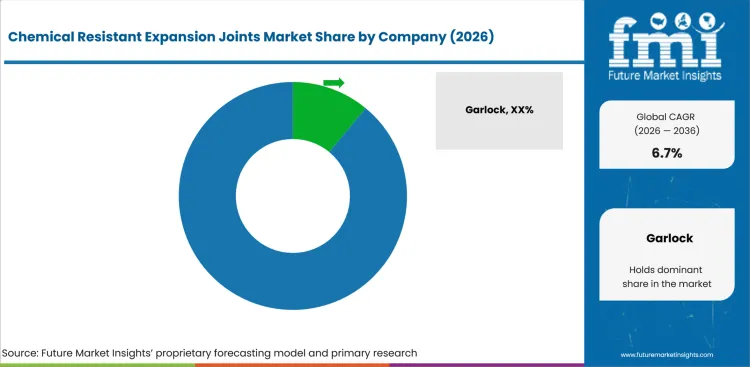
Garlock, Witzenmann, Senior Flexonics, MACOGA, EagleBurgmann, Trelleborg, Kadant Unaflex, Hyspan Precision Products, and BOA Group lead competition through material compatibility and replacement support.
- Established engineered expansion joint companies hold an advantage through technical design teams and proven corrosive-service references.
- Lined-product suppliers gain stronger acceptance by connecting PTFE and metal bellows designs with process-media requirements.
- Regional suppliers win in country markets by offering faster inspection and locally stocked expansion joint supply.
- Service-ready suppliers improve renewal chances through movement review and installation troubleshooting.
Industrial sealing and expansion joint companies compete by combining product compatibility and engineering documentation. Garlock has a strong position through PTFE and elastomer expansion joint programs. Witzenmann competes based on metal bellows design and engineered piping support. MACOGA strengthens competition through PTFE-lined and rubber-lined expansion joints for corrosive chemical service.
Manufacturing and field support depth have become stronger competitive separators as buyers treat expansion joints as safety and reliability components. Senior Flexonics and EagleBurgmann compete through engineered bellows and process-industry relationships. Trelleborg, Kadant Unaflex, Hyspan Precision Products, and BOA Group strengthen competition depending on rubber and specialty flexible connector coverage. Buyers compare suppliers through liner compatibility and replacement speed.
Smaller and regional suppliers can win through local fabrication knowledge and urgent replacement support. India, China, and South Korea create opportunities for suppliers with plant-level service teams and EPC relationships. United States and Europe promote demand for pressure documentation and specification-led sales. Companies that prove service life under corrosive media should gain more durable replacement accounts.
How do top Chemical Resistant Expansion Joints companies compare?
Garlock and Witzenmann score on documentation depth while MACOGA leads through corrosive lined-joint specialization.
| Company | Relevance to Market Title | Material Portfolio Depth | Engineering Support | Corrosive Service Strength | Channel Reach | Geographic Footprint |
|---|---|---|---|---|---|---|
| Garlock | Very High | Very Strong | Strong | Very Strong | Very Strong | Global |
| Witzenmann | Very High | Strong | Very Strong | Strong | Strong | Global |
| Senior Flexonics | High | Strong | Very Strong | Moderate | Strong | Global |
| MACOGA | Very High | Very Strong | Strong | Very Strong | Moderate | International |
| EagleBurgmann | High | Strong | Very Strong | Strong | Strong | Global |
| Trelleborg | High | Very Strong | Strong | Strong | Very Strong | Global |
| Kadant Unaflex | High | Strong | Moderate | Very Strong | Strong | North America and International |
| Hyspan Precision Products | Moderate to High | Moderate | Strong | Moderate | Moderate | North America |
| BOA Group | High | Strong | Very Strong | Moderate | Strong | Global |
Source: Future Market Insights competitive analysis, 2026.
Who are the key players in the Chemical Resistant Expansion Joints Market?
Garlock, Witzenmann, Senior Flexonics, MACOGA, and EagleBurgmann are listed with Trelleborg and Kadant Unaflex among other suppliers.
Key global companies leading the Chemical Resistant Expansion Joints Market include:
- Garlock
- Witzenmann
- Senior Flexonics
- MACOGA
- EagleBurgmann
- Trelleborg
- Kadant Unaflex
- Hyspan Precision Products
- BOA Group
Key Developments in Chemical Resistant Expansion Joints Market
- In April 2025, MACOGA listed PTFE-lined rubber expansion joints for a European chemical plant, supporting lined-rubber use in corrosive industrial service.
- In July 2025, MACOGA listed PTFE-lined expansion joints for a major Saudi petrochemical company, reflecting use across aggressive media including chlorine and phosphoric acid.
Key Players in the Chemical Resistant Expansion Joints Market
Engineered Expansion Joint Leaders
- Garlock
- Witzenmann
- Senior Flexonics
- MACOGA
Sealing and Industrial Reliability Companies
- EagleBurgmann
- Trelleborg
- BOA Group
Rubber, PTFE, and Fabric Joint Specialists
- Kadant Unaflex
- Hyspan Precision Products
- Regional engineered rubber joint suppliers
Industrial Service and Distribution Participants
- EPC contractors
- Industrial distributors
- Maintenance service contractors
- Local fabrication partners
Chemical Resistant Expansion Joints Market - Report Scope
| Parameter | Details |
|---|---|
| Forecast Period | 2026 to 2036 |
| Historical Period | 2021 to 2025 |
| Quantitative Unit | Revenue in USD billion |
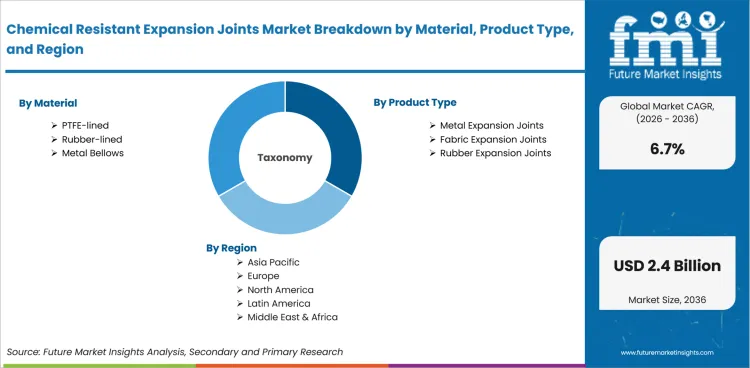
| By Material | PTFE-lined, Rubber-lined, Metal Bellows, Composite and Other |
| By Product Type | Fabric Expansion Joints, Metal Expansion Joints, Rubber Expansion Joints, Other |
| By End Use | Chemicals, Power Generation, Oil and Gas, Water Treatment and Other |
| By Temperature Range | Low and Ambient, Medium, High Temperature |
| By Sales Channel | Direct, EPC and Contractors, Distributors |
| Regions Covered | North America, Latin America, Europe, East Asia, South Asia and Pacific, Middle East and Africa |
| Countries Covered | India, China, South Korea, United States, Germany, United Kingdom, France, Japan |
| Key Companies Profiled | Garlock, Witzenmann, Senior Flexonics, MACOGA, EagleBurgmann, Trelleborg, Kadant Unaflex, Hyspan Precision Products, BOA Group |
| Approach | Hybrid bottom-up and top-down methodology using verified industrial activity, supplier portfolios, segment use rates, and country-level demand indicators |
Source: Future Market Insights competitive analysis, 2026.
Chemical Resistant Expansion Joints Market - Scope & Definition
| Attribute | Detail |
|---|---|
| Market Definition | Flexible connectors used in piping and duct systems that carry corrosive liquids, aggressive gases, chemically active media, and chemically exposed wastewater streams |
| Functions Covered | Movement absorption, vibration control, leakage risk reduction, chemical compatibility support, thermal expansion control, flange protection, and equipment stress reduction |
| Applications Covered | Chemical process lines, wastewater treatment systems, dosing lines, sludge circuits, power auxiliary systems, refinery lines, and industrial ducts |
| End-Use Industries | Chemicals, power generation, oil and gas, water treatment, pharmaceuticals, electronics, food processing, and other industrial users |
| Grades Covered | PTFE-lined, FEP-lined, rubber-lined, metal bellows, composite, fabric, low-temperature, medium-temperature, and high-temperature designs |
| Inclusions | All commercially traded chemical resistant expansion joints across material, product type, end use, temperature range, sales channel, and country-level industrial use |
| Exclusions | Bridge deck expansion joints, seismic building joints, automotive exhaust flex parts, ordinary rubber hose connectors without chemical duty, standard gaskets, static seals, and mechanical seals used inside rotating equipment |
Chemical Resistant Expansion Joints Market - Research Methodology
| Method | Description |
|---|---|
| Primary Research | FMI analyst interviews with expansion joint suppliers, EPC engineers, plant maintenance teams, utility buyers, industrial distributors, and process equipment specialists across selected markets |
| Desk Research | Review of official industrial output data, water infrastructure programs, supplier manuals, product pages, company project updates, regulatory statements, and public infrastructure evidence |
| Market Sizing & Forecasting | Hybrid bottom-up and top-down approach using shipment value, engineered project demand, material mix, replacement rates, temperature duty, and end-use exposure |
| Data Validation | Cross-verification using company portfolios, official industrial data, country-level utility activity, supplier disclosures, and adjacent sealing and flexible connector demand checks |
Chemical Resistant Expansion Joints Market Breakdown by Material, Product Type, End Use, Temperature Range, Sales Channel, and Region
Chemical Resistant Expansion Joints Market Segmented by Material
- PTFE-lined
- Rubber-lined
- Metal Bellows
- Composite and Other
Chemical Resistant Expansion Joints Market Segmented by Product Type
- Fabric Expansion Joints
- Metal Expansion Joints
- Rubber Expansion Joints
- Other
Chemical Resistant Expansion Joints Market Segmented by End Use
- Chemicals
- Power Generation
- Oil and Gas
- Water Treatment and Other
Chemical Resistant Expansion Joints Market Segmented by Temperature Range
- Low and Ambient
- Medium
- High Temperature
Chemical Resistant Expansion Joints Market Segmented by Sales Channel
- Direct
- EPC and Contractors
- Distributors
Chemical Resistant Expansion Joints Market by Region
- North America
- Latin America
- Europe
- East Asia
- South Asia and Pacific
- Middle East and Africa
Research Sources and Bibliography
- USA Census Bureau. (2026, March). USA chemical manufacturers grew despite overall manufacturing slowdown.
- USA Environmental Protection Agency. (2024, April). Steam electric power generating effluent guidelines final rule.
- USA Environmental Protection Agency. (2024, May). Clean watersheds needs survey results.
- USA Energy Information Administration. (2026). Electricity explained: Electricity in the United States.
- Ofwat. (2024, December). Water company price review final determinations.
- Ofwat. (2025, February). Price review expenditure allowances.
- Office for National Statistics. (2026, April). Index of Production, UK: February 2026.
- Office for National Statistics. (2026, May). Index of Production, UK: March 2026.
- Federal Statistical Office of Germany. (2026, June). Stock of orders in manufacturing, April 2026.
- Federal Statistical Office of Germany. (2026, June). Production in April 2026.
- German Chemical Industry Association. (2025). Quarterly report on chemical and pharmaceutical industry performance.
- RTE France. (2026). Electricity generation review for 2025.
- European Investment Bank. (2025, March). Financing for drinking water and wastewater pipe renovation in Brittany.
- European Investment Bank. (2026). Water investment and water security financing.
- Ministry of Economy, Trade and Industry, Japan. (2026, June). Revised report on indices of industrial production, April 2026.
- Ministry of Economy, Trade and Industry, Japan. (2025, December). Cabinet decision on the Order for Enforcement of the Act on the Regulation of Manufacture and Evaluation of Chemical Substances.
- Yale Center for Environmental Law and Policy. (2024). Environmental Performance Index: Japan.
- National Bureau of Statistics of China. (2025, March). Energy production from January to February 2025.
- National Bureau of Statistics of China. (2025, June). Producer price index for industrial products.
- International Trade Administration. (2025, September). China environmental technology market information.
- Press Information Bureau. (2024, July). India Chem 2024 industry statement.
- Press Information Bureau. (2026, March). Power generation capacity from various sources.
- Press Information Bureau. (2025, December). Ganga river water quality monitoring statement.
- Ministry of Trade, Industry and Resources, Republic of Korea. (2025, December). Petrochemical industry innovation alliance announcement.
- International Energy Agency. (2025). Korea electricity data.
- Ministry of Environment, Republic of Korea. (2025). Environmental policy changes for chemical registration.
- Kadant Unaflex. (2024, June). Fluid handling solutions for the chemical and pharmaceutical industry.
- MACOGA. (2025, April). PTFE-lined rubber expansion joints for European chemical plant.
- MACOGA. (2025, July). PTFE-lined expansion joints for a major Saudi petrochemical company.
- Garlock. (2024, June). Capabilities of expansion joints.
This bibliography is provided for reader reference and is not exhaustive. The full report contains the complete reference list and detailed citations.
This Report Answers
- Market size estimates for 2026 and forecasts through 2036 for the Chemical Resistant Expansion Joints Market.
- Insights across regional and country-level corrosive process piping demand.
- Analysis of demand drivers and purchasing behavior across chemicals, power, oil and gas, and water treatment.
- Evaluation of material, product type, end use, temperature range, and sales channel segments.
- Assessment of chemical compatibility and shutdown replacement impact.
- Identification of opportunities across PTFE-lined and metal bellows expansion joints.
- Country-level analysis covering India, China, South Korea, United States, Germany, United Kingdom, France, and Japan.
- Assessment of competition, including engineered expansion joint suppliers and industrial sealing companies.
- Analysis of plant-level approval criteria and service expectations.
- Regional outlooks across North America, Europe, East Asia, South Asia and Pacific, Latin America, and Middle East and Africa.
- Delivery of market data, forecasts, and supporting analysis in report-ready format.
- Review of company developments supporting corrosive service applications.
Frequently Asked Questions
What is the growth prospect for Chemical Resistant Expansion Joints?
Demand for Chemical Resistant Expansion Joints is expected to rise as chemical and water treatment plants replace corrosion-exposed flexible connectors.
Which companies are expected to shape the Chemical Resistant Expansion Joints Market?
Garlock, Witzenmann, Senior Flexonics, MACOGA, EagleBurgmann, Trelleborg, Kadant Unaflex, Hyspan Precision Products, and BOA Group are expected to shape competition.
Why are industrial buyers investing in chemical resistant expansion joints?
Industrial buyers invest in chemical resistant expansion joints to protect connected equipment and support safer process movement.
Why are direct sales important in the Chemical Resistant Expansion Joints Market?
Direct sales support media compatibility checks and warranty responsibility before installation.
Which material formats are gaining attention in Chemical Resistant Expansion Joints?
PTFE-lined and FEP-lined products are gaining attention as buyers manage acids and hazardous media.
How do regulations influence Chemical Resistant Expansion Joint demand?
Regulations influence demand through chemical handling requirements and documentation expectations for process safety.
Why are medium temperature products important for Chemical Resistant Expansion Joints?
Medium temperature products are important since many corrosive process lines need chemical resistance without extreme flue-gas temperature duty.
What role does engineered documentation play in adoption?
Engineered documentation supports approval by showing liner compatibility and installation requirements.
Preview the report firsthand - request a free sample
Get SampleGet the brochure for pricing and purchase details.
Get PDFTable of Content
- Key Takeaways
- Market Size and CAGR
- Top Growth Driver
- Fastest Growing Segment
- Leading Region
- Key Companies
- Emerging Opportunities
- Executive Summary
- Global Market Outlook
- Demand-side Trends
- Supply-side Trends
- Technology Roadmap Analysis
- Analysis and Recommendations
- Analyst Perspective (What is happening? Why now? What should investors know?)
- Key Questions Answered
- How large is the market?
- What is the CAGR?
- What are key trends?
- Which region dominates?
- Who are the leaders?
- Market Overview
- Market Coverage / Taxonomy
- Market Definition / Scope / Limitations
- Research Methodology
- Chapter Orientation
- Analytical Lens and Working Hypotheses
- Market Structure, Signals, and Trend Drivers
- Benchmarking and Cross-market Comparability
- Market Sizing, Forecasting, and Opportunity Mapping
- Research Design and Evidence Framework
- Desk Research Programme (Secondary Evidence)
- Expert Input and Fieldwork (Primary Evidence)
- Tooling, Models, and Reference Databases
- Data Engineering and Model Build
- Quality Assurance and Audit Trail
- Market Background
- Market Dynamics (Drivers, Restraints, Opportunity, Trends)
- Scenario Forecast (Optimistic, Likely, Conservative)
- Impact Analysis
- AI Impact
- Sustainability Impact
- Regulatory Impact
- Technology Impact
- Consumer / Buyer Analysis
- Purchase Drivers
- Adoption Barriers
- Buyer Journey
- Opportunity Map Analysis
- Product Life Cycle Analysis
- Supply Chain Analysis
- Investment Feasibility Matrix
- Value Chain Analysis
- PESTLE and Porter's Analysis
- Regulatory Landscape
- Regional Parent Market Outlook
- Production and Consumption Statistics
- Import and Export Statistics
- Global Market Analysis and Forecast, 2021 to 2036
- Historical Market Size Value (USD Billion) Analysis, 2021 to 2025
- Current and Future Market Size Value (USD Billion) Projections, 2026 to 2036
- Y-o-Y Growth Trend Analysis
- Absolute $ Opportunity Analysis
- Global Market Pricing Analysis, 2021 to 2036
- Global Market Analysis and Forecast, By Material, 2021 to 2036
- Introduction / Key Findings
- Historical Market Size Value (USD Billion) Analysis By Material, 2021 to 2025
- Current and Future Market Size Value (USD Billion) Analysis and Forecast By Material, 2026 to 2036
- PTFE-lined
- Rubber-lined
- Metal Bellows
- PTFE-lined
- Y-o-Y Growth Trend Analysis By Material, 2021 to 2025
- Absolute $ Opportunity Analysis By Material, 2026 to 2036
- Global Market Analysis and Forecast, By Product Type, 2021 to 2036
- Introduction / Key Findings
- Historical Market Size Value (USD Billion) Analysis By Product Type, 2021 to 2025
- Current and Future Market Size Value (USD Billion) Analysis and Forecast By Product Type, 2026 to 2036
- Metal Expansion Joints
- Fabric Expansion Joints
- Rubber Expansion Joints
- Metal Expansion Joints
- Y-o-Y Growth Trend Analysis By Product Type, 2021 to 2025
- Absolute $ Opportunity Analysis By Product Type, 2026 to 2036
- Global Market Analysis and Forecast, By End Use, 2021 to 2036
- Introduction / Key Findings
- Historical Market Size Value (USD Billion) Analysis By End Use, 2021 to 2025
- Current and Future Market Size Value (USD Billion) Analysis and Forecast By End Use, 2026 to 2036
- Chemicals
- Power Generation
- Oil and Gas
- Chemicals
- Y-o-Y Growth Trend Analysis By End Use, 2021 to 2025
- Absolute $ Opportunity Analysis By End Use, 2026 to 2036
- Global Market Analysis and Forecast, By Temperature Range, 2021 to 2036
- Introduction / Key Findings
- Historical Market Size Value (USD Billion) Analysis By Temperature Range, 2021 to 2025
- Current and Future Market Size Value (USD Billion) Analysis and Forecast By Temperature Range, 2026 to 2036
- Medium
- Low and Ambient
- High Temperature
- Medium
- Y-o-Y Growth Trend Analysis By Temperature Range, 2021 to 2025
- Absolute $ Opportunity Analysis By Temperature Range, 2026 to 2036
- Global Market Analysis and Forecast, By Sales Channel, 2021 to 2036
- Introduction / Key Findings
- Historical Market Size Value (USD Billion) Analysis By Sales Channel, 2021 to 2025
- Current and Future Market Size Value (USD Billion) Analysis and Forecast By Sales Channel, 2026 to 2036
- Direct
- EPC and Contractors
- Distributors
- Direct
- Y-o-Y Growth Trend Analysis By Sales Channel, 2021 to 2025
- Absolute $ Opportunity Analysis By Sales Channel, 2026 to 2036
- Global Market Analysis and Forecast, By Region, 2021 to 2036
- Introduction
- Historical Market Size Value (USD Billion) Analysis By Region, 2021 to 2025
- Current Market Size Value (USD Billion) Analysis and Forecast By Region, 2026 to 2036
- North America
- Latin America
- Western Europe
- Eastern Europe
- East Asia
- South Asia and Pacific
- Middle East & Africa
- Market Attractiveness Analysis By Region
- North America Market Analysis and Forecast, By Country, 2021 to 2036
- Historical Market Size Value (USD Billion) Trend Analysis By Market Taxonomy, 2021 to 2025
- Market Size Value (USD Billion) Forecast By Market Taxonomy, 2026 to 2036
- By Country
- USA
- Canada
- Mexico
- By Material
- By Product Type
- By End Use
- By Temperature Range
- By Sales Channel
- By Country
- Market Attractiveness Analysis
- By Country
- By Material
- By Product Type
- By End Use
- By Temperature Range
- By Sales Channel
- Key Takeaways
- Latin America Market Analysis and Forecast, By Country
- Historical Market Size Value (USD Billion) Trend Analysis By Market Taxonomy, 2021 to 2025
- Market Size Value (USD Billion) Forecast By Market Taxonomy, 2026 to 2036
- By Country
- Brazil
- Chile
- Rest of Latin America
- By Material
- By Product Type
- By End Use
- By Temperature Range
- By Sales Channel
- By Country
- Market Attractiveness Analysis
- By Country
- By Material
- By Product Type
- By End Use
- By Temperature Range
- By Sales Channel
- Key Takeaways
- Western Europe Market Analysis and Forecast, By Country
- Historical Market Size Value (USD Billion) Trend Analysis By Market Taxonomy, 2021 to 2025
- Market Size Value (USD Billion) Forecast By Market Taxonomy, 2026 to 2036
- By Country
- Germany
- UK
- Italy
- Spain
- France
- Nordic
- BENELUX
- Rest of Western Europe
- By Material
- By Product Type
- By End Use
- By Temperature Range
- By Sales Channel
- By Country
- Market Attractiveness Analysis
- By Country
- By Material
- By Product Type
- By End Use
- By Temperature Range
- By Sales Channel
- Key Takeaways
- Eastern Europe Market Analysis and Forecast, By Country
- Historical Market Size Value (USD Billion) Trend Analysis By Market Taxonomy, 2021 to 2025
- Market Size Value (USD Billion) Forecast By Market Taxonomy, 2026 to 2036
- By Country
- Russia
- Poland
- Hungary
- Balkan & Baltic
- Rest of Eastern Europe
- By Material
- By Product Type
- By End Use
- By Temperature Range
- By Sales Channel
- By Country
- Market Attractiveness Analysis
- By Country
- By Material
- By Product Type
- By End Use
- By Temperature Range
- By Sales Channel
- Key Takeaways
- East Asia Market Analysis and Forecast, By Country
- Historical Market Size Value (USD Billion) Trend Analysis By Market Taxonomy, 2021 to 2025
- Market Size Value (USD Billion) Forecast By Market Taxonomy, 2026 to 2036
- By Country
- China
- Japan
- South Korea
- By Material
- By Product Type
- By End Use
- By Temperature Range
- By Sales Channel
- By Country
- Market Attractiveness Analysis
- By Country
- By Material
- By Product Type
- By End Use
- By Temperature Range
- By Sales Channel
- Key Takeaways
- South Asia and Pacific Market Analysis and Forecast, By Country
- Historical Market Size Value (USD Billion) Trend Analysis By Market Taxonomy, 2021 to 2025
- Market Size Value (USD Billion) Forecast By Market Taxonomy, 2026 to 2036
- By Country
- India
- ASEAN
- Australia & New Zealand
- Rest of South Asia and Pacific
- By Material
- By Product Type
- By End Use
- By Temperature Range
- By Sales Channel
- By Country
- Market Attractiveness Analysis
- By Country
- By Material
- By Product Type
- By End Use
- By Temperature Range
- By Sales Channel
- Key Takeaways
- Middle East & Africa Market Analysis and Forecast, By Country
- Historical Market Size Value (USD Billion) Trend Analysis By Market Taxonomy, 2021 to 2025
- Market Size Value (USD Billion) Forecast By Market Taxonomy, 2026 to 2036
- By Country
- Kingdom of Saudi Arabia
- Other GCC Countries
- Türkiye
- South Africa
- Other African Union
- Rest of Middle East & Africa
- By Material
- By Product Type
- By End Use
- By Temperature Range
- By Sales Channel
- By Country
- Market Attractiveness Analysis
- By Country
- By Material
- By Product Type
- By End Use
- By Temperature Range
- By Sales Channel
- Key Takeaways
- Key Countries Market Analysis
- USA
- Pricing Analysis
- Market Share Analysis, 2025
- By Material
- By Product Type
- By End Use
- By Temperature Range
- By Sales Channel
- Canada
- Pricing Analysis
- Market Share Analysis, 2025
- By Material
- By Product Type
- By End Use
- By Temperature Range
- By Sales Channel
- Mexico
- Pricing Analysis
- Market Share Analysis, 2025
- By Material
- By Product Type
- By End Use
- By Temperature Range
- By Sales Channel
- Brazil
- Pricing Analysis
- Market Share Analysis, 2025
- By Material
- By Product Type
- By End Use
- By Temperature Range
- By Sales Channel
- Chile
- Pricing Analysis
- Market Share Analysis, 2025
- By Material
- By Product Type
- By End Use
- By Temperature Range
- By Sales Channel
- Germany
- Pricing Analysis
- Market Share Analysis, 2025
- By Material
- By Product Type
- By End Use
- By Temperature Range
- By Sales Channel
- UK
- Pricing Analysis
- Market Share Analysis, 2025
- By Material
- By Product Type
- By End Use
- By Temperature Range
- By Sales Channel
- Italy
- Pricing Analysis
- Market Share Analysis, 2025
- By Material
- By Product Type
- By End Use
- By Temperature Range
- By Sales Channel
- Spain
- Pricing Analysis
- Market Share Analysis, 2025
- By Material
- By Product Type
- By End Use
- By Temperature Range
- By Sales Channel
- France
- Pricing Analysis
- Market Share Analysis, 2025
- By Material
- By Product Type
- By End Use
- By Temperature Range
- By Sales Channel
- India
- Pricing Analysis
- Market Share Analysis, 2025
- By Material
- By Product Type
- By End Use
- By Temperature Range
- By Sales Channel
- ASEAN
- Pricing Analysis
- Market Share Analysis, 2025
- By Material
- By Product Type
- By End Use
- By Temperature Range
- By Sales Channel
- Australia & New Zealand
- Pricing Analysis
- Market Share Analysis, 2025
- By Material
- By Product Type
- By End Use
- By Temperature Range
- By Sales Channel
- China
- Pricing Analysis
- Market Share Analysis, 2025
- By Material
- By Product Type
- By End Use
- By Temperature Range
- By Sales Channel
- Japan
- Pricing Analysis
- Market Share Analysis, 2025
- By Material
- By Product Type
- By End Use
- By Temperature Range
- By Sales Channel
- South Korea
- Pricing Analysis
- Market Share Analysis, 2025
- By Material
- By Product Type
- By End Use
- By Temperature Range
- By Sales Channel
- Russia
- Pricing Analysis
- Market Share Analysis, 2025
- By Material
- By Product Type
- By End Use
- By Temperature Range
- By Sales Channel
- Poland
- Pricing Analysis
- Market Share Analysis, 2025
- By Material
- By Product Type
- By End Use
- By Temperature Range
- By Sales Channel
- Hungary
- Pricing Analysis
- Market Share Analysis, 2025
- By Material
- By Product Type
- By End Use
- By Temperature Range
- By Sales Channel
- Kingdom of Saudi Arabia
- Pricing Analysis
- Market Share Analysis, 2025
- By Material
- By Product Type
- By End Use
- By Temperature Range
- By Sales Channel
- Türkiye
- Pricing Analysis
- Market Share Analysis, 2025
- By Material
- By Product Type
- By End Use
- By Temperature Range
- By Sales Channel
- South Africa
- Pricing Analysis
- Market Share Analysis, 2025
- By Material
- By Product Type
- By End Use
- By Temperature Range
- By Sales Channel
- USA
- Market Structure Analysis
- Competition Dashboard
- Competition Benchmarking
- Market Share Analysis of Top Players
- By Regional
- By Material
- By Product Type
- By End Use
- By Temperature Range
- By Sales Channel
- Emerging Startups
- Innovation Benchmarking
- Competition Analysis
- Competition Deep Dive
- Garlock
- Overview
- Product Portfolio
- Profitability by Market Segments (Product/Region/Sales Channel)
- Sales Footprint
- Strategy Overview
- Marketing Strategy
- Product Strategy
- Channel Strategy
- Witzenmann
- Senior Flexonics
- MACOGA
- EagleBurgmann
- Trelleborg
- Kadant Unaflex
- Hyspan Precision Products
- Garlock
- Case Studies
- Success Stories
- Recent Developments
- Competition Deep Dive
- Assumptions & Acronyms Used


