

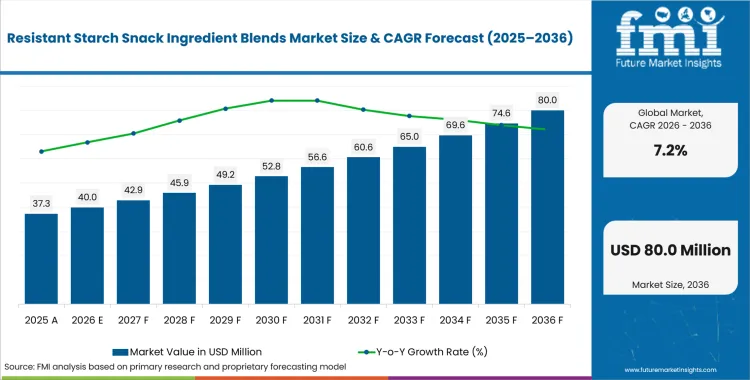
- Market Size (2026)
- USD 40.0 Mn
- Forecast (2036)
- USD 80.0 Mn
- CAGR (2026 to 2036)
- 7.2%
How big is the Resistant Starch Snack Ingredient Blends Market in 2026?
USD 40.0 million in 2026 and USD 80.0 million by 2036 at a 7.2% CAGR.
Sales of resistant starch snack ingredient blends are estimated to rise at 7.2% CAGR through 2036, increasing valuation from USD 40.0 million in 2026 to USD 80.0 million by 2036. The broader resistant starch category gives snack developers a familiar fiber route across bars and baked products. Adjacent dietary fiber inputs widen formulation options for nutrition targets that remain valid through finished-product testing and label review. In February 2025, FDA postponed the updated healthy-claim rule’s effective date to April 28 2025. The rule requires qualifying food-group content and sets limits for saturated fat, sodium and added sugars in every packaged product carrying the claim. Resistant starch cannot establish eligibility alone, so manufacturers must review the complete recipe and intended claim together.
United States snack developers must balance fiber enrichment with proposed front-of-package labeling for saturated fat, sodium and added sugars. In May 2025, FDA extended the proposal’s comment period through July 15 2025 for additional public input. The extension connected packaging decisions to broader recipe review across affected snack portfolios and scheduled product launches. European processors apply separate claim thresholds and local documentation across each commercial formula and regional label version. Companies with functional food ingredients expertise shorten trials through local application testing and clear production specifications. Comparisons with prebiotic ingredients help formulators separate digestive-health positioning from verified resistant-starch functionality during regional snack development. Clear evidence packages reduce repeated work, but finished-product testing remains necessary under each regional claim framework.
Key Takeaways of Resistant Starch Snack Ingredient Blends Market
- Snack manufacturers purchase resistant starch blends to increase fiber content and preserve familiar bite with routine production efficiency across existing lines.
- Proteins are expected to account for 30.0% by product type in 2026, supported by combined nutrition and texture functions.
- Plant sources are projected to represent 26.0% in 2026, reflecting traceable grain and pulse supply options.
- Bakery applications are anticipated to capture 28.0% share in 2026, owing to repeatable testing across crackers and baked snacks.
- Claim substantiation and sensory drift remain material barriers as small formula changes can alter texture or declared fiber content.
- Ingredion and Tate & Lyle combine broad application support with global channels, whereas Cargill and Roquette compete through complementary starch and bakery capabilities.
Analyst Perspective
“Snack formulas containing resistant starch often reach factory trials with fiber targets resolved but texture risks unanswered. Commercial approval requires the same trial to confirm declared fiber, familiar bite and stable processing across normal production conditions. Ingredient companies that connect dosage guidance with regional claim rules should convert more development projects into repeat orders than firms relying mainly on specification sheets.”
- Nandini Roy Choudhury, Principal Analyst, Future Market Insights
How is the Resistant Starch Snack Ingredient Blends Market segmented?
The resistant starch snack ingredient blends industry is segmented by product type, source, application, end user, and region.
Based on product type, the industry is divided by proteins, fibers, sweeteners, cultures and flavors used within a defined snack recipe. Source separates plant, microbial, dairy-analog, upcycled and mineral inputs through origin, allergen and supply checks. Application identifies the process conditions that each blend must tolerate across bakery, beverages, snacks, infant nutrition and ready meals. End user distinguishes the organizations responsible for technical approval and regular purchasing across commercial production programs. Food starch systems support product type and application decisions through moisture control and texture management across final blend design. Plant-based ingredients broaden the source comparison through grain and pulse routes with familiar origin records and established handling practices. Regional analysis captures differences in claim rules, ingredient access and application support across major manufacturing locations.
Why do protein-containing blends shape product type demand?
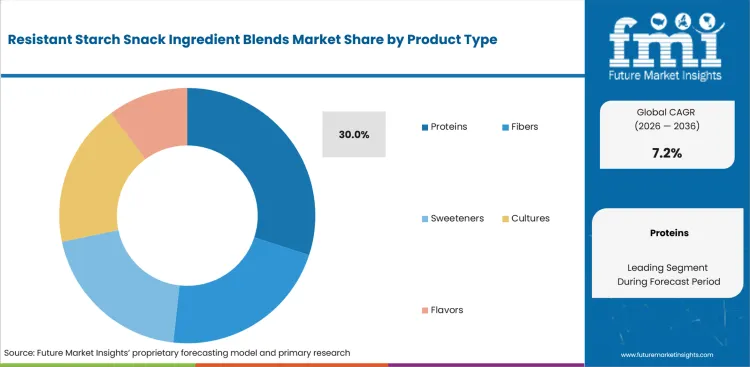
Protein-containing blends allow snack developers to combine fiber enrichment with satiety or nutrition positioning through one formulation project. Grain Processing Corporation introduced PURE-TEIN™ faba protein concentrate and PURE-PULSE™ faba flour in October 2025 for snacks and bakery blends. The launch paired protein and fiber with mild flavor and a documented North American production route. Comparisons with insoluble dietary fiber products help developers separate nutrition targets from texture and water-management requirements.
- By product type, proteins are estimated to hold 30.0% in 2026 owing to combined nutrition and texture requirements. Product teams reduce separate formulation work by qualifying compatible nutrition functions through one controlled program. The share reflects purchasing convenience rather than identical performance across every snack format in commercial production.
- Snack manufacturers adopt protein blends through benchtop trials that compare flavor masking and finished-product firmness. Commercial approval improves as an ingredient company provides representative pilot quantities and application guidance for the exact manufacturing process. Excessive protein addition can harden bars or crackers, so dosage control remains a separate adoption requirement.
Why does plant sourcing remain central to source demand?
Plant sources give manufacturers familiar grain and pulse inputs that fit established ingredient declarations and sourcing programs. BENEO inaugurated a German pulse-processing plant in April 2025 for locally grown faba beans and food ingredients. The facility links regional crops with controlled processing and a documented supply route for European manufacturers. Comparable plant-based food ingredients allow formulators to compare starch and protein combinations through a common raw-material platform.
- Plant is likely to capture 26.0% share in 2026 attributable to familiar grain and pulse channels that simplify origin review. Manufacturers can qualify these inputs through established origin and allergen checks across existing food-safety systems. Corn and wheat inputs beside rice-based alternatives give formulators several plant routes for different snack textures.
- Regional sourcing shortens transport routes and gives processors clearer audited crop documentation across major production areas. Raw-material quality can alter starch functionality across harvest years, so snack brands require consistent finished texture through routine sourcing changes. Ingredient processors need blending controls and replacement plans that protect approved recipes from annual crop variation.
Why does bakery attract application demand?
Bakery formats expose resistant starch blends to mixing and baking conditions that reveal changes in dough handling or finished bite. Cargill showcased functional blends for snacks and bakery applications during the AAHAR exhibition in March 2025. The company demonstrated starch systems that add finished crispness and reduce oil absorption during commercial frying. Related bakery ingredients establish practical benchmarks for texture and process tolerance across crackers and baked snacks.
- Bakery is set to lead the application category with 28.0% share in 2026 due to measurable dough and finished-texture qualification. Manufacturers compare dough spread with finished moisture and break strength throughout each controlled development program. Repeatable tests help technical teams reject unsuitable blends ahead of costly factory trials and wider production commitments.
- Commercial adoption increases through line trials that confirm mixing tolerance and package-life texture under normal storage. A successful bench sample can fail during larger batches if water distribution changes across the complete mixture. Application teams therefore value support that connects ingredient dosage with process adjustments and finished-product specifications during commercial scale-up.
Why are food manufacturers central to end user demand?
Food manufacturers control ingredient approval and production trials across multiple snack brands or product lines. Tate & Lyle presented four prototypes and expanded mouthfeel capabilities at IFT FIRST in July 2025. Its showcase included fiber fortification and modified starches across several formulations designed around finished-product texture. The development shows how manufacturers evaluate nutrition changes through sensory and process work rather than specification review alone.
- By end user, food manufacturers are forecast to represent 29.0% in 2026 driven by their control over formulas and factory specifications. Their teams connect regulatory review with sensory testing and commercial costing throughout the approval process. One verified blend can enter several related products through a centralized technical and commercial route.
- Manufacturers favor ingredient companies that provide representative samples and technical troubleshooting during scale-up across several operating plants. Production teams need consistent specifications and responsive reformulation support if a raw-material specification changes during routine manufacturing. Weak technical coverage can delay repeat orders across markets despite laboratory results meeting the documented nutrition target.
What are the drivers, restraints, and opportunities in the Resistant Starch Snack Ingredient Blends Market?
Fiber enrichment supports demand, with texture control and claim documentation shaping commercial approval across established snack formulations.
- Driver: Manufacturers are expanding fiber-focused snack development through blends that protect familiar texture and routine production efficiency.
- Restraint: Nutrition claims and finished-product testing require separate documentation across regulatory systems and snack formats.
- Opportunity: Application support can connect resistant starch functionality with reformulation programs across established bakery and snack lines.
Fiber enrichment is expected to drive demand as snack developers seek nutrition gains without sacrificing familiar texture or line performance. In January 2025, Grain Processing Corporation reported that 4.68% FYBRIN® RS F100 delivered three grams of fiber in a 48-gram tortilla serving. Testing found no significant texture difference from the control formula during the fourteen-day review period. The result gives bakery teams a practical basis for evaluating resistant starch in packaged products. Each recipe requires equivalent testing across its moisture level, processing conditions and intended storage period prior to commercial approval.
Finished-product claim and texture verification create a notable restraint across snack portfolios with different serving sizes. European rules require at least three grams of fiber per 100 grams for a source claim and six grams for a high-fiber claim. Formulators must calculate the finished food rather than rely on the underlying resistant starch specification. Processing losses and moisture changes can alter declared fiber values or sensory results across commercial batches. Development costs rise as regional teams repeat testing across related recipes and use different laboratory methods for validation.
Application-led reformulation is offering a practical opening for companies that combine resistant starch with bakery troubleshooting and documented fiber performance. MGP Ingredients reported in February 2026 that Fibersym serves lower-net-carbohydrate baked goods and tortillas as an FDA-approved dietary fiber. The filing also identifies texture and taste benefits that support established wheat formulations across packaged bakery and tortilla applications. A combined support route with related modified starch systems can reduce repeated work across products, but every finished formula requires independent fiber measurement and sensory testing.
Which country CAGRs are profiled in the Resistant Starch Snack Ingredient Blends Market?
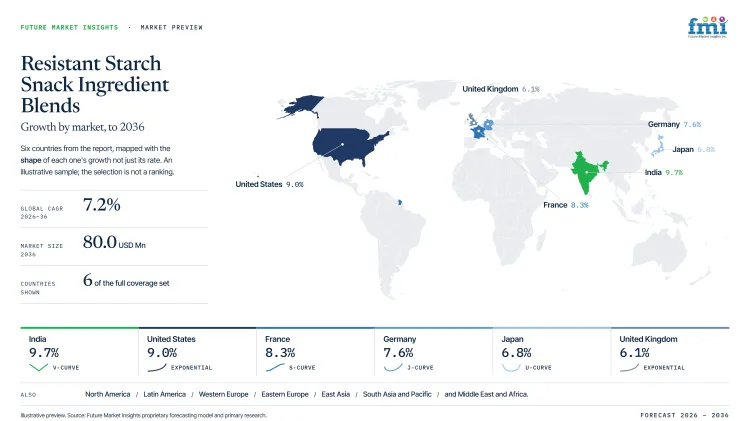
| Country | CAGR |
|---|---|
| India | 9.7% |
| United States | 9.0% |
| France | 8.3% |
| Germany | 7.6% |
| Japan | 6.8% |
| United Kingdom | 6.1% |
How do country-level CAGRs compare in the Resistant Starch Snack Ingredient Blends Market?
The country forecasts show a steady progression across the resistant starch snack ingredient blends market rather than distinct growth tiers. India and the United States form the upper end of the comparison, reflecting growing demand for fiber-enriched snacks and ingredients that support digestive health positioning. France and Germany create a middle band where growth remains supported by clean-label formulation and functional ingredient adoption. Japan and the United Kingdom follow with more measured forecasts, although the differences between adjacent markets remain relatively consistent throughout the comparison.
- India benefits from increasing demand for functional foods and a growing focus on digestive wellness, encouraging manufacturers to incorporate resistant starch blends into better-for-you snack formulations.
- The United States reflects strong adoption of fiber-forward product development strategies, with snack brands increasingly using resistant starch ingredients to improve nutritional profiles without compromising texture or taste.
- France continues to support market expansion through demand for clean-label ingredients and growing interest in snacks that combine convenience with nutritional benefits.
- Germany's outlook is influenced by ongoing reformulation initiatives and the use of specialty starch ingredients to support fiber enrichment and product differentiation.
- Japan maintains steady momentum as manufacturers focus on digestive health, balanced nutrition and functional food concepts that align with established wellness trends.
- The United Kingdom reflects measured growth supported by demand for healthier snacking options and continued efforts to reduce reliance on less nutritious formulation approaches.
Similar CAGRs do not necessarily create identical opportunities for ingredient suppliers. Differences in consumer perceptions of fiber, regulatory approaches to health claims, formulation preferences and snack category development can significantly influence adoption patterns. As a result, commercialization strategies for resistant starch ingredient blends may vary even among markets with broadly comparable growth trajectories. The full report provides country-level CAGR analysis across North America, Latin America, Europe, East Asia, South Asia, Oceania and the Middle East and Africa.
Country-wise Analysis
- Indian food businesses must determine whether an imported functional ingredient already fits an FSSAI standard prior to scheduling commercial trials. India’s resistant starch snack ingredient blends market is estimated to post 9.7% CAGR over the forecast period, driven by local reformulation activity and expanding application support. FSSAI’s July 2026 status page confirms that unstandardized foods and ingredients enter a prior-approval route with supporting technical documents. Scientific Panel risk analysis gives well-documented blends a defined review path but extends qualification for unfamiliar formulations. Regional ingredient distributors shorten sample cycles and translate technical files for processors in established manufacturing clusters. Import costs and limited technical coverage create material friction for smaller plants outside major food-processing centers.
- United States snack manufacturers must prove declared fiber and complete finished-product claim conditions across each commercial formulation. Adoption of resistant starch snack ingredient blends in the United States is estimated to expand at 9.0% CAGR through 2036, aided by established ingredient distribution and application laboratories. FDA’s December 2016 enforcement-discretion letter covers high-amylose maize starch containing type 2 resistant starch through qualified health-claim wording. The regulatory route gives technical teams a defined basis for claim review across conventional foods. Domestic warehousing and technical centers improve representative sample access across major food-manufacturing regions and product-development locations. Moisture changes can alter fiber values and texture during production across different serving sizes or recipes. Label review and sensory validation therefore add cost across portfolios that use several formulas and manufacturing sites.
- French food manufacturers apply European nutrition-claim thresholds through local product files and French-language label review. Regional laboratories often compare starch functionality across bakery formulas prior to larger commercial production trials. Resistant starch snack ingredient blend demand in France is forecast to rise at 8.3% CAGR over the forecast period, linked to established bakery production and nutrition-focused reformulation. Santé publique France reported in March 2026 that the revised Nutri-Score algorithm better identifies fiber-rich foods. The agency estimated that 30% to 40% of products would change score and gave participating companies two years to update packaging. Local application laboratories support recipe adjustment and texture testing across several finished commercial product categories. Retail price pressure remains material as reformulated snacks must preserve familiar taste without widening production costs.
- German processors often qualify new starch systems through detailed specifications and repeatable bakery trials across industrial production sites. Germany’s resistant starch snack ingredient blends outlook is anticipated to advance at 7.6% CAGR over the assessment period, owing to dense technical distribution and established grain-processing expertise. Germany’s food ministry reported in June 2025 that about 960 companies with roughly 1,420 brands had registered for Nutri-Score by April 9. The registration base gives ingredient teams an established label-review route for fiber-focused formulas across national retail channels. Manufacturers can access technical laboratories within major food-processing corridors without extended overseas sample and testing cycles. Documentation remains a material friction as fiber claims and allergen statements must match finished formulas across repeated production runs. Cost control can narrow projects that need several factory trials prior to final technical approval.
- Japanese food processors generally require precise ingredient specifications and local-language technical communication prior to approving formula changes. Resistant starch snack ingredient blend sales in Japan are forecast to expand at 6.8% CAGR by 2036, supported by established processing capacity and careful label review. Japan’s Consumer Affairs Agency published a voluntary front-of-package nutrition guideline in February 2026 following ten consultation meetings. The guideline remains outside mandatory food-labeling standards and does not replace ingredient declarations or claim substantiation. Local importers coordinate representative samples and technical files during qualification across major food-manufacturing regions and product categories. Conservative sensory expectations and extended approval cycles remain material frictions for blends that alter texture or ingredient declarations.
- United Kingdom snack companies must align ingredient declarations with retained food-information rules and specific bread or flour requirements. The United Kingdom resistant starch snack ingredient blends sector is projected to record 6.1% CAGR during the assessment period, shaped by mature retail specifications and established imported-ingredient channels. Government guidance published in April 2025 requires added nutrients in fortified flour to appear within the ingredients list. The rules give bakery manufacturers a clear composition and labeling route for formulas that use composite flour systems. Distributors and contract laboratories support representative application trials across established snack-manufacturing locations and product categories. Border documentation and longer logistics lead times create friction for imported functional ingredients and representative development samples. Retail price pressure further limits reformulation programs that raise ingredient costs without a clear product benefit.
Who are the notable companies in the Resistant Starch Snack Ingredient Blends Market?
Ingredion, Tate & Lyle, Cargill, Roquette, MGP Ingredients, Grain Processing Corporation, BENEO, and Manildra Group are notable companies shaping this market.
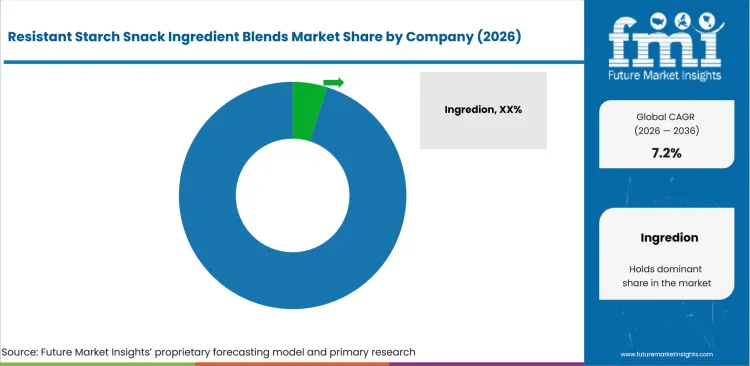
The competitive field combines international formulation networks with grain processors that offer specific resistant-starch or bakery functions. Ingredion and Tate & Lyle connect nutrition work with texture laboratories across several regional customer bases. Cargill and Roquette support bakery development through starch systems and regional pilot facilities serving commercial formulation teams. MGP Ingredients and Grain Processing Corporation provide named resistant-starch routes for defined nutrition and processing needs. BENEO contributes rice and pulse ingredient capabilities through international technical channels and established application support. Manildra Group supplies resistant wheat starch and bakery formulation support through Australian and export operations.
- Ingredion and Tate & Lyle focus on formulation networks that connect texture work with nutrition and label requirements across several snack categories. Their application teams support regional product trials and common specifications help multinational manufacturers coordinate approvals across multiple production locations.
- Cargill and Roquette use regional innovation facilities and starch platforms to support bakery trials and local product development programs. Their technical models emphasize applied testing near customer operations so formulation teams compare texture performance through representative recipes and processing conditions.
- MGP Ingredients and Grain Processing Corporation offer named grain-based resistant starches for lower-net-carbohydrate or fiber-enriched foods. BENEO and Manildra Group provide complementary rice or wheat ingredient routes that support texture work and regional supply relationships across commercial bakery applications.
Competitive Benchmarking: Resistant Starch Snack Ingredient Blends Market
| Company | Resistant Starch and Fiber Portfolio | Snack and Bakery Formulation Support | Regional Supply and Technical Reach | Geographic Reach |
|---|---|---|---|---|
| Ingredion | High | High | High | Global |
| Tate & Lyle | Medium | High | High | Global |
| Cargill | Medium | High | High | Global |
| Roquette | Medium | High | High | Global |
| MGP Ingredients | Medium | Medium | Medium | North America and export markets |
| Grain Processing Corporation | Medium | Medium | High | Global export network |
| BENEO | Low | Medium | High | Europe and global channels |
| Manildra Group | Medium | Medium | Medium | Asia-Pacific and export markets |
Key Developments in the Resistant Starch Snack Ingredient Blends Market
- In March 2026, Roquette inaugurated a starch and polyol pilot center at its Lianyungang plant in China. The facility covers more than one thousand square meters and combines physicochemical analysis with laboratory research and pilot transformation. Its localized validation route supports bakery and snack developers that need to test starch functionality prior to full production. Commercial value depends on consistent transfer from pilot results into finished recipes and manufacturing conditions.
- In April 2025, Cargill reopened its transformed Innovation Center in Singapore with laboratories for bakery and convenience applications. The site includes sensory facilities and a core science laboratory focused on ingredient functionality across regional foods. The expanded laboratory network shortens local formulation cycles for Asian snack manufacturers evaluating fiber and starch systems. Commercial value depends on testing regional recipes through equipment and sensory methods that resemble production conditions.
- In June 2026, Tate & Lyle received NutraStrong™ Prebiotic Verified certification for four fiber product lines. The review covered product specifications and manufacturing accreditation through scientific substantiation across the certified ranges. The certification gives snack developers documented complementary fibers for multi-fiber blends beside resistant starch formulations. Each finished snack requires separate texture testing and resistant-starch claim substantiation prior to commercial approval.
- In June 2026, Ingredion announced a recommended cash acquisition of Tate & Lyle through a court-sanctioned scheme. The SEC filing states that completion is expected during the second half of 2027 and remains subject to approvals. The proposed combination would unite starch and fiber capabilities with mouthfeel expertise and formulation support across global customer networks. Tate & Lyle shareholders approved the acquisition by 98.64% of votes cast on July 28, 2026. Completion remains subject to court sanction and antitrust approvals, with closing expected in the second half of 2027. Tate & Lyle therefore continues to operate as a separate company through the current competitive analysis period.
Key Players in the Resistant Starch Snack Ingredient Blends Market
Global Ingredient and Formulation Companies
- Ingredion
- Tate & Lyle
- Cargill
- Roquette
Resistant Starch and Grain Specialists
- MGP Ingredients
- Grain Processing Corporation
Regional Plant Ingredient Companies
- BENEO
- Manildra Group
Resistant Starch Snack Ingredient Blends Market - Report Scope
| Coverage field | Report scope |
|---|---|
| Market breakdown | Product Type, Source, Application, End User, and Region. |
| Quantitative Units | USD Million, CAGR in %. |
| Market Definition | Commercial demand for resistant starch snack ingredient blends across defined product types, sources, applications, and end users. |
| Regions Covered | North America, Latin America, Western Europe, Eastern Europe, East Asia, South Asia and Pacific, and Middle East and Africa. |
| Countries Covered | United States, Germany, United Kingdom, France, Japan, India, and 30+ countries. |
| Key Companies Profiled | Ingredion, Tate & Lyle, Cargill, Roquette, MGP Ingredients, Grain Processing Corporation, BENEO, and Manildra Group. |
| Forecast Period | 2026 to 2036. |
| Approach | Hybrid bottom-up and top-down market sizing supported by primary interviews and official desk research. |
Resistant Starch Snack Ingredient Blends Market - Research Methodology
| Method | Approach |
|---|---|
| Primary Research | FMI analysts gathered input from manufacturers, service providers, technology developers, distributors, end users, procurement teams, and subject-matter experts. Interviews examined purchasing decisions, product or service evaluation, adoption barriers, approval requirements, pricing considerations, and expectations for technical or commercial support. Respondents were also asked what evidence is required before a trial, pilot, or initial order develops into regular purchasing. |
| Desk Research | Desk research covered government statistics, regulatory publications, trade data, industry associations, technical literature, standards, company filings, product information, and official corporate announcements. Sources were reviewed for relevance, publication date, geographic coverage, and consistency with the defined market scope. Claims relating to performance, applications, approvals, capacity, investment, and commercial activity were retained only when supported by credible public evidence. |
| Market Sizing and Forecasting | The market model combined the baseline value with historical performance, segment structure, pricing and volume indicators, adoption levels, company participation, and country-level demand conditions. Forecast assumptions considered economic activity, investment trends, regulatory developments, technology adoption, purchasing cycles, supply availability, and barriers to wider market use. Segment and regional estimates were reconciled before the final market total was calculated. |
| Data Validation | Estimates were checked against multiple independent indicators, including public data, company activity, trade patterns, industry developments, and findings from primary interviews. Validation also tested whether products, services, applications, and company revenues fell within the defined market boundaries. Adjacent categories, unsupported claims, overlapping revenues, and activities without direct market relevance were excluded to reduce double counting and maintain consistency across segments and countries. |
Resistant Starch Snack Ingredient Blends Market by Segments
Resistant Starch Snack Ingredient Blends Market segmented by Product Type:
- Proteins
- Fibers
- Sweeteners
- Cultures
- Flavors
Resistant Starch Snack Ingredient Blends Market segmented by Source:
- Plant
- Microbial
- Dairy Analog
- Upcycled
- Mineral
Resistant Starch Snack Ingredient Blends Market segmented by Application:
- Bakery
- Beverages
- Snacks
- Infant Nutrition
- Ready Meals
Resistant Starch Snack Ingredient Blends Market segmented by End User:
- Food Manufacturers
- Beverage Manufacturers
- Foodservice Operators
- Contract Manufacturers
- Retail Brands
Resistant Starch Snack Ingredient Blends Market by Region:
- North America
- United States
- Canada
- Mexico
- Latin America
- Brazil
- Chile
- Rest of Latin America
- Western Europe
- Germany
- United Kingdom
- Italy
- Spain
- France
- Nordic
- BENELUX
- Rest of Western Europe
- Eastern Europe
- Russia
- Poland
- Hungary
- Balkan and Baltic
- Rest of Eastern Europe
- East Asia
- China
- Japan
- South Korea
- South Asia and Pacific
- India
- ASEAN
- Australia and New Zealand
- Rest of South Asia and Pacific
- Middle East and Africa
- Kingdom of Saudi Arabia
- Other GCC Countries
- Turkiye
- South Africa
- Other African Union
- Rest of Middle East and Africa
Research Sources and Bibliography
- USA Food and Drug Administration. (2025, February 24). FDA Finalizes Updated “Healthy” Nutrient Content Claim.
- USA Food and Drug Administration. (2025, May 8). FDA Issues Proposed Rule on Front-of-Package Nutrition Labeling.
- Food Safety and Standards Authority of India. (2026, July 22). NON-SPECIFIED FOOD.
- Consumer Affairs Agency, Government of Japan. (2026, February 26).
- USA Food and Drug Administration. (2016, December 12). High-Amylose Maize Starch and Reduced Risk Type 2 Diabetes Mellitus.
- European Parliament and Council of the European Union. (2006, December 20). Regulation (EC) No 1924/2006 of the European Parliament and of the Council of 20 December 2006 on nutrition and health claims made on foods.
- Santé publique France. (2026, March 19). Évaluation de la campagne Nutri-Score 2025.
- Bundesministerium für Landwirtschaft, Ernährung und Heimat. (2025, June 4). Hilfestellung für Unternehmen - Verwendung des Nutri-Score.
- Department for Environment, Food & Rural Affairs and Food Standards Agency. (2025, April 23). Bread and flour: labelling and composition.
- Grain Processing Corporation. (2025, October 20). GPC INTRODUCES PURE-TEIN™ AND PURE-PULSE™ FABA INGREDIENTS.
- BENEO. (2025, April 11). BENEO inaugurates new pulse-processing plant.
- Cargill, Incorporated. (2025, March 4). Cargill Showcases Full Range of Innovative Food Solutions at AAHAR 2025.
- Tate & Lyle PLC. (2025, July 7). Tate & Lyle debuts expanded portfolio and mouthfeel leadership at IFT FIRST 2025.
- Grain Processing Corporation. (2025, January 13). Improving Nutritional Content of Corn Tortillas.
- MGP Ingredients, Inc. (2026, February 25). Annual report [Section 13 and 15(d), not S-K Item 405].
- Roquette Frères. (2026, April 6). Roquette Inaugurates its New Pilot Center at Lianyungang.
- Cargill, Incorporated. (2025, April 10). Cargill unveils transformed Innovation Center in Singapore to advance food innovation, for Asia from Asia.
- Tate & Lyle PLC. (2026, June 3). Tate & Lyle fibre portfolio receives Nutrastrong™ Prebiotic Verified certification.
- Ingredion Incorporated. (2026, June 8). Ingredion Announces Recommended All-Cash Acquisition of Tate & Lyle.
This bibliography is provided for reader reference and is not exhaustive. The full report contains the complete reference list and detailed citations
This Report Answers
- How large is the resistant starch snack ingredient blends market in 2026 and 2036?
- Which formulation needs support demand for resistant starch blends across snack manufacturing?
- Why do proteins account for 30.0% of product type demand during 2026?
- How do plant sources affect supply review and ingredient qualification?
- Why does bakery account for a notable application share during 2026?
- How do country growth rates differ across India and other profiled manufacturing markets?
- Which companies provide resistant starch capabilities or snack formulation support?
- What limits wider adoption across nutrition claims and sensory requirements?
- How can application support convert product trials into repeat ingredient purchasing?
Frequently Asked Questions
How big is the Resistant Starch Snack Ingredient Blends Market in 2026?
The resistant starch snack ingredient blends market is valued at USD 40.0 million in 2026 and is forecast to reach USD 80.0 million by 2036, driven by snack manufacturers purchasing fiber-enriched blends that preserve familiar bite and maintain routine production efficiency across existing commercial lines.
What is the CAGR of the Resistant Starch Snack Ingredient Blends Market from 2026 to 2036?
The resistant starch snack ingredient blends market is projected to grow at a CAGR of 7.2% between 2026 and 2036, supported by expanding fiber-focused snack reformulation programs, growing regulatory clarity around dietary fiber claims, and increasing application support that connects resistant starch functionality with bakery and snack production requirements.
Which application leads the Resistant Starch Snack Ingredient Blends Market?
Bakery accounts for 28.0% of the resistant starch snack ingredient blends market by application in 2026, driven by repeatable dough and finished-texture qualification across crackers and baked snacks, and the ability to conduct measurable performance comparisons between verified and conventional flour lots during commercial development programs.
Which country is growing fastest in the Resistant Starch Snack Ingredient Blends Market?
Repeatable finished-product performance supports commercial confidence more than isolated laboratory specifications across regional snack formulation programs. Clear regulatory documentation and responsive application support strengthen repeat purchasing decisions across several approved product lines.
Who are the leading companies in the Resistant Starch Snack Ingredient Blends Market?
Leading companies in the resistant starch snack ingredient blends market include Ingredion, Tate & Lyle, Cargill, Roquette, MGP Ingredients, Grain Processing Corporation, BENEO, and Manildra Group, spanning global formulation networks, regional pilot facilities, named resistant-starch grades, and complementary rice and wheat ingredient routes for bakery applications.
Preview the report firsthand - request a free sample
Get SampleGet the brochure for pricing and purchase details.
Get PDFTable of Content
- Key Takeaways
- Market Size and CAGR
- Top Growth Driver
- Fastest Growing Segment
- Leading Region
- Key Companies
- Emerging Opportunities
- Executive Summary
- Global Market Outlook
- Demand-side Trends
- Supply-side Trends
- Technology Roadmap Analysis
- Analysis and Recommendations
- Analyst Perspective (What is happening? Why now? What should investors know?)
- Key Questions Answered
- How large is the market?
- What is the CAGR?
- What are key trends?
- Which region dominates?
- Who are the leaders?
- Market Overview
- Market Coverage / Taxonomy
- Market Definition / Scope / Limitations
- Research Methodology
- Chapter Orientation
- Analytical Lens and Working Hypotheses
- Market Structure, Signals, and Trend Drivers
- Benchmarking and Cross-market Comparability
- Market Sizing, Forecasting, and Opportunity Mapping
- Research Design and Evidence Framework
- Desk Research Programme (Secondary Evidence)
- Expert Input and Fieldwork (Primary Evidence)
- Tooling, Models, and Reference Databases
- Data Engineering and Model Build
- Quality Assurance and Audit Trail
- Market Background
- Market Dynamics (Drivers, Restraints, Opportunity, Trends)
- Scenario Forecast (Optimistic, Likely, Conservative)
- Impact Analysis
- AI Impact
- Sustainability Impact
- Regulatory Impact
- Technology Impact
- Consumer / Buyer Analysis
- Purchase Drivers
- Adoption Barriers
- Buyer Journey
- Opportunity Map Analysis
- Product Life Cycle Analysis
- Supply Chain Analysis
- Investment Feasibility Matrix
- Value Chain Analysis
- PESTLE and Porter's Analysis
- Regulatory Landscape
- Regional Parent Market Outlook
- Production and Consumption Statistics
- Import and Export Statistics
- Global Market Analysis and Forecast, 2021 to 2036
- Historical Market Size Value (USD Million) Analysis, 2021 to 2025
- Current and Future Market Size Value (USD Million) Projections, 2026 to 2036
- Y-o-Y Growth Trend Analysis
- Absolute $ Opportunity Analysis
- Global Market Pricing Analysis, 2021 to 2036
- Global Market Analysis and Forecast, By Product Type, 2021 to 2036
- Introduction / Key Findings
- Historical Market Size Value (USD Million) Analysis By Product Type, 2021 to 2025
- Current and Future Market Size Value (USD Million) Analysis and Forecast By Product Type, 2026 to 2036
- Proteins
- Fibers
- Sweeteners
- Cultures
- Flavors
- Proteins
- Y-o-Y Growth Trend Analysis By Product Type, 2021 to 2025
- Absolute $ Opportunity Analysis By Product Type, 2026 to 2036
- Global Market Analysis and Forecast, By Source, 2021 to 2036
- Introduction / Key Findings
- Historical Market Size Value (USD Million) Analysis By Source, 2021 to 2025
- Current and Future Market Size Value (USD Million) Analysis and Forecast By Source, 2026 to 2036
- Plant
- Microbial
- Dairy Analog
- Upcycled
- Mineral
- Plant
- Y-o-Y Growth Trend Analysis By Source, 2021 to 2025
- Absolute $ Opportunity Analysis By Source, 2026 to 2036
- Global Market Analysis and Forecast, By Application, 2021 to 2036
- Introduction / Key Findings
- Historical Market Size Value (USD Million) Analysis By Application, 2021 to 2025
- Current and Future Market Size Value (USD Million) Analysis and Forecast By Application, 2026 to 2036
- Bakery
- Beverages
- Snacks
- Infant Nutrition
- Ready Meals
- Bakery
- Y-o-Y Growth Trend Analysis By Application, 2021 to 2025
- Absolute $ Opportunity Analysis By Application, 2026 to 2036
- Global Market Analysis and Forecast, By End User, 2021 to 2036
- Introduction / Key Findings
- Historical Market Size Value (USD Million) Analysis By End User, 2021 to 2025
- Current and Future Market Size Value (USD Million) Analysis and Forecast By End User, 2026 to 2036
- Food Manufacturers
- Ingredient Blenders
- Private Label
- Foodservice
- Nutraceutical Brands
- Food Manufacturers
- Y-o-Y Growth Trend Analysis By End User, 2021 to 2025
- Absolute $ Opportunity Analysis By End User, 2026 to 2036
- Global Market Analysis and Forecast, By Region, 2021 to 2036
- Introduction
- Historical Market Size Value (USD Million) Analysis By Region, 2021 to 2025
- Current Market Size Value (USD Million) Analysis and Forecast By Region, 2026 to 2036
- North America
- Latin America
- Western Europe
- Eastern Europe
- East Asia
- South Asia and Pacific
- Middle East & Africa
- Market Attractiveness Analysis By Region
- North America Market Analysis and Forecast, By Country, 2021 to 2036
- Historical Market Size Value (USD Million) Trend Analysis By Market Taxonomy, 2021 to 2025
- Market Size Value (USD Million) Forecast By Market Taxonomy, 2026 to 2036
- By Country
- USA
- Canada
- By Product Type
- By Source
- By Application
- By End User
- By Country
- Market Attractiveness Analysis
- By Country
- By Product Type
- By Source
- By Application
- By End User
- Key Takeaways
- Latin America Market Analysis and Forecast, By Country
- Historical Market Size Value (USD Million) Trend Analysis By Market Taxonomy, 2021 to 2025
- Market Size Value (USD Million) Forecast By Market Taxonomy, 2026 to 2036
- By Country
- Brazil
- Mexico
- Chile
- Rest of Latin America
- By Product Type
- By Source
- By Application
- By End User
- By Country
- Market Attractiveness Analysis
- By Country
- By Product Type
- By Source
- By Application
- By End User
- Key Takeaways
- Western Europe Market Analysis and Forecast, By Country
- Historical Market Size Value (USD Million) Trend Analysis By Market Taxonomy, 2021 to 2025
- Market Size Value (USD Million) Forecast By Market Taxonomy, 2026 to 2036
- By Country
- Germany
- UK
- Italy
- Spain
- France
- Nordic
- BENELUX
- Rest of Western Europe
- By Product Type
- By Source
- By Application
- By End User
- By Country
- Market Attractiveness Analysis
- By Country
- By Product Type
- By Source
- By Application
- By End User
- Key Takeaways
- Eastern Europe Market Analysis and Forecast, By Country
- Historical Market Size Value (USD Million) Trend Analysis By Market Taxonomy, 2021 to 2025
- Market Size Value (USD Million) Forecast By Market Taxonomy, 2026 to 2036
- By Country
- Russia
- Poland
- Hungary
- Balkan & Baltic
- Rest of Eastern Europe
- By Product Type
- By Source
- By Application
- By End User
- By Country
- Market Attractiveness Analysis
- By Country
- By Product Type
- By Source
- By Application
- By End User
- Key Takeaways
- East Asia Market Analysis and Forecast, By Country
- Historical Market Size Value (USD Million) Trend Analysis By Market Taxonomy, 2021 to 2025
- Market Size Value (USD Million) Forecast By Market Taxonomy, 2026 to 2036
- By Country
- China
- Japan
- South Korea
- By Product Type
- By Source
- By Application
- By End User
- By Country
- Market Attractiveness Analysis
- By Country
- By Product Type
- By Source
- By Application
- By End User
- Key Takeaways
- South Asia and Pacific Market Analysis and Forecast, By Country
- Historical Market Size Value (USD Million) Trend Analysis By Market Taxonomy, 2021 to 2025
- Market Size Value (USD Million) Forecast By Market Taxonomy, 2026 to 2036
- By Country
- India
- ASEAN
- Australia & New Zealand
- Rest of South Asia and Pacific
- By Product Type
- By Source
- By Application
- By End User
- By Country
- Market Attractiveness Analysis
- By Country
- By Product Type
- By Source
- By Application
- By End User
- Key Takeaways
- Middle East & Africa Market Analysis and Forecast, By Country
- Historical Market Size Value (USD Million) Trend Analysis By Market Taxonomy, 2021 to 2025
- Market Size Value (USD Million) Forecast By Market Taxonomy, 2026 to 2036
- By Country
- Kingdom of Saudi Arabia
- Other GCC Countries
- Türkiye
- South Africa
- Other African Union
- Rest of Middle East & Africa
- By Product Type
- By Source
- By Application
- By End User
- By Country
- Market Attractiveness Analysis
- By Country
- By Product Type
- By Source
- By Application
- By End User
- Key Takeaways
- Key Countries Market Analysis
- USA
- Pricing Analysis
- Market Share Analysis, 2025
- By Product Type
- By Source
- By Application
- By End User
- Canada
- Pricing Analysis
- Market Share Analysis, 2025
- By Product Type
- By Source
- By Application
- By End User
- Mexico
- Pricing Analysis
- Market Share Analysis, 2025
- By Product Type
- By Source
- By Application
- By End User
- Brazil
- Pricing Analysis
- Market Share Analysis, 2025
- By Product Type
- By Source
- By Application
- By End User
- Chile
- Pricing Analysis
- Market Share Analysis, 2025
- By Product Type
- By Source
- By Application
- By End User
- Germany
- Pricing Analysis
- Market Share Analysis, 2025
- By Product Type
- By Source
- By Application
- By End User
- UK
- Pricing Analysis
- Market Share Analysis, 2025
- By Product Type
- By Source
- By Application
- By End User
- Italy
- Pricing Analysis
- Market Share Analysis, 2025
- By Product Type
- By Source
- By Application
- By End User
- Spain
- Pricing Analysis
- Market Share Analysis, 2025
- By Product Type
- By Source
- By Application
- By End User
- France
- Pricing Analysis
- Market Share Analysis, 2025
- By Product Type
- By Source
- By Application
- By End User
- India
- Pricing Analysis
- Market Share Analysis, 2025
- By Product Type
- By Source
- By Application
- By End User
- ASEAN
- Pricing Analysis
- Market Share Analysis, 2025
- By Product Type
- By Source
- By Application
- By End User
- Australia & New Zealand
- Pricing Analysis
- Market Share Analysis, 2025
- By Product Type
- By Source
- By Application
- By End User
- China
- Pricing Analysis
- Market Share Analysis, 2025
- By Product Type
- By Source
- By Application
- By End User
- Japan
- Pricing Analysis
- Market Share Analysis, 2025
- By Product Type
- By Source
- By Application
- By End User
- South Korea
- Pricing Analysis
- Market Share Analysis, 2025
- By Product Type
- By Source
- By Application
- By End User
- Russia
- Pricing Analysis
- Market Share Analysis, 2025
- By Product Type
- By Source
- By Application
- By End User
- Poland
- Pricing Analysis
- Market Share Analysis, 2025
- By Product Type
- By Source
- By Application
- By End User
- Hungary
- Pricing Analysis
- Market Share Analysis, 2025
- By Product Type
- By Source
- By Application
- By End User
- Kingdom of Saudi Arabia
- Pricing Analysis
- Market Share Analysis, 2025
- By Product Type
- By Source
- By Application
- By End User
- Türkiye
- Pricing Analysis
- Market Share Analysis, 2025
- By Product Type
- By Source
- By Application
- By End User
- South Africa
- Pricing Analysis
- Market Share Analysis, 2025
- By Product Type
- By Source
- By Application
- By End User
- USA
- Market Structure Analysis
- Competition Dashboard
- Competition Benchmarking
- Market Share Analysis of Top Players
- By Regional
- By Product Type
- By Source
- By Application
- By End User
- Emerging Startups
- Innovation Benchmarking
- Competition Analysis
- Competition Deep Dive
- Ingredion
- Overview
- Product Portfolio
- Profitability by Market Segments
- Sales Footprint
- Strategy Overview
- Marketing Strategy
- Product Strategy
- Channel Strategy
- Tate & Lyle
- Cargill
- Roquette
- MGP Ingredients
- Grain Processing Corporation
- Beneo
- Manildra Group
- Ingredion
- Case Studies
- Success Stories
- Recent Developments
- Competition Deep Dive
- Assumptions & Acronyms Used


