
- Market Size (2026)
- USD 156.2 Mn
- Forecast (2036)
- USD 274.5 Mn
- CAGR (2026 to 2036)
- 5.8%
How big is Semillon Market in 2026?
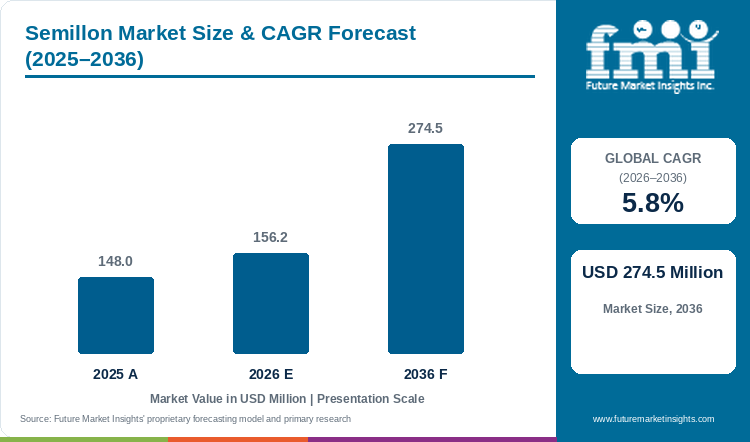
Registering a value of USD 148.0 million in 2025, the Semillon market expanded to USD 156.2 million in 2026 and is anticipated to achieve USD 274.5 million by 2036, driven by a 5.8% CAGR.
Fine dining sommeliers and private wine collectors reallocating cellar budgets toward naturally low-alcohol age-worthy white wines and dry Bordeaux Blanc cuvées propel commercial expansion for Semillon. When Hunter Valley vineyards harvest Semillon early in January at 10.5% to 11.0% potential alcohol, the wine retains razor-sharp malic acidity in youth and transforms over 10 to 20 years in bottle into a honeyed, toasted-nut collector white without touching a single oak barrel. Driven by this cellar longevity and the reopening of Asian duty-free trade, the global Semillon market value grows from USD 148.0 million in 2025 to USD 156.2 million in 2026 and is projected to reach USD 274.5 million by 2036 at a 5.8% CAGR. Dry unoaked crisp fresh Semillon captures 40.8% of 2026 demand as seafood restaurants and Asian luxury hotels restock classic Australian and French dry releases. This collector-driven price appreciation distinguishes Semillon from the broader collectible fine wine market, because estates release back-vintage museum stock at double the initial ex-cellar price while Sauternes chateaux monetize dry white second labels. in July 2025, Wine Australia released its National Vintage Report 2025 confirming a rebound in the Australian winegrape crush after two historically low vintages as exporters rebuilt shipments to mainland China [1]. Similarly, in March 2026, LVMH's Chateau d'Yquem announced the global release of its 2023 Premier Cru Superieur Sauternes as well as expanded dry white Ygrec allocations across international fine dining accounts [24]. According to FMI analyst observations, thin grape skins make Semillon highly vulnerable to unwanted gray bunch rot during humid harvests, inflating manual sorting labor.
Key Market Trends & Insights
- By wine style: Dry Unoaked Crisp Fresh Semillon holds an estimated 40.8% share in 2026 because early-picked 11.0% ABV bottlings match sommelier demand for lower-alcohol whites with multi-decade aging potential.
- By geographic origin: Hunter Valley Australia Traditional estates represent 44.5% in 2026 as heritage single-vineyard releases regain duty-free access across Chinese and Southeast Asian luxury hospitality accounts.
- By distribution channel: Fine Dining Restaurants and Sommeliers command 48.2% in 2026 because aged dry Semillon and sweet Sauternes anchor high-margin degustation pairing menus.
- By closure type: Stelvin Aluminum Screwcaps with tin or saranex liners secure 51.6% in 2026 owing to zero cork taint and calibrated oxygen transmission across Australian and New World cellars.
- By vintage tier: Current-Release Young Varietal bottlings account for 54.0% in 2026 while Museum Cellar-Aged (5+ Years) releases expand at 6.5% CAGR through winery library hold-backs.
Regional Highlights
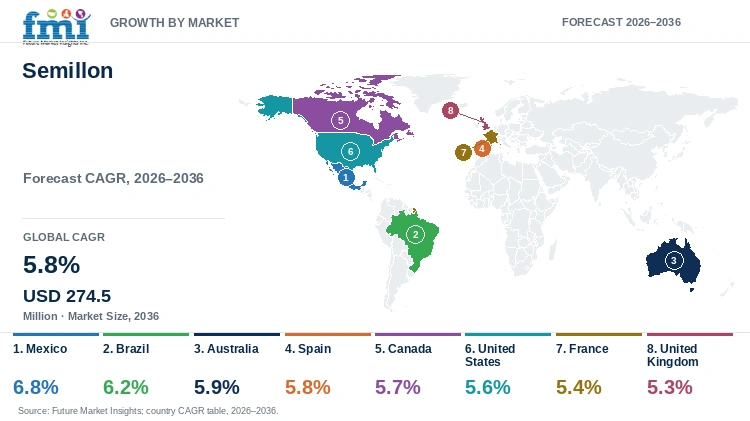
- Top national expansion: Mexico leads national growth projections at a 6.8% CAGR through 2036 under luxury resort sommelier demand in Los Cabos, Cancun, and Mexico City.
- Broader country progression: Brazil tracks at a 6.2% CAGR ahead of Australia at 5.9%, Spain at 5.8% and Canada at 5.7% and whereas the United States advances at 5.6% and France grows at 5.4%.
Market Size & Forecast
Table 1: Market Size and Forecast for the Semillon Market (USD million and CAGR percentage), 2025 to 2036
| Metric | Value |
|---|---|
| 2025 Market Size | USD 148.0 million |
| Estimated Market Size in 2026 | USD 156.2 million |
| Projected Market Size by 2036 | USD 274.5 million |
| CAGR, 2026 to 2036 | 5.8% |
| Added Value, 2026 to 2036 | USD 118.3 million |
Thin-skinned Semillon berries require exact harvest timing and selective vineyard sorting because autumn rain events can turn beneficial noble rot (Botrytis cinerea) into destructive sour gray mold within 48 hours. When gray mold infects grape clusters, fungal laccase enzymes oxidize must polyphenols rapidly and produce muddy, unstable wines unless biological or enzymatic controls are applied. In August 2026, viticultural pathologists reporting in Microorganisms demonstrated biocontrol efficacy against Vitis vinifera Botrytis cinerea gray mold isolates, detailing why estates invest heavily in canopy microclimate management and selective hand picking [2]. To diversify vintage weather risk, Sauternes and Barsac estates actively press non-botrytized Semillon passes into crisp dry Bordeaux Blanc as well as traditional fortified and dessert wine programs.
Vineyard Crush and Cellar Filtration Sizing
Table 2: Vineyard Production and Enological Filtration Sizing for the Semillon Market (USD million and operational ranges), 2025 to 2036
| Metric | 2025 | 2026 | 2036 |
|---|---|---|---|
| Market size (USD million) | 148.0 | 156.2 | 274.5 |
| Commercial Semillon bottled output (million 9L cases) | 1.52 to 1.60 | 1.58 to 1.66 | 2.48 to 2.62 |
| Cultivated Semillon bearing vineyard area (thousand hectares) | 18.2 to 19.5 | 18.5 to 19.8 | 21.0 to 22.5 |
| Average ex-cellar realization per 9L case (USD) | 94.5 to 98.2 | 96.4 to 100.2 | 106.5 to 111.8 |
Operational note: Enological enzyme ranges apply standard 3 to 6 g/hL beta-(1,3)(1,6)-glucanase dosing for botrytized Sauternes musts and 20 to 30 g/hL cryo-tolerant yeast inoculation for dry Semillon.
Fermentation of noble-rot Sauternes and Barsac Semillon presents a severe physical filtration bottleneck because Botrytis cinerea secretes high-molecular-weight beta-glucan polysaccharides into the grape berry. Even at concentrations of 40 milligrams per liter, beta-glucan colloids foul cross-flow membranes and plug sterile 0.45-micron bottling cartridges. Cellar masters producing sweet dessert wine solve this problem by dosing purified fungal beta-glucanase enzymes from DSM-Firmenich and Novonesis (Chr. Hansen) during post-fermentation clarification, cleaving glucan chains within 48 hours and cutting filtration wine loss by 15%.
Per Capita & Fine Dining Sommelier Account Sizing
Table 3: Per Capita and Fine Dining Sommelier Account Indicators for the Semillon Market (USD), 2025 to 2036
| Metric | 2025 | 2026 | 2036 |
|---|---|---|---|
| World population (billion) | 8.2 | 8.3 | 9.0 |
| Value per 1,000 people (USD) | 18.0 | 18.8 | 30.5 |
| Annual spend per fine dining sommelier account (USD thousand) | 5.8 to 6.6 | 6.1 to 6.9 | 9.8 to 11.2 |
| Museum-aged &Premier Cru reserve value share (%) | 44.0% to 47.0% | 45.5% to 48.5% | 52.0% to 56.0% |
Table 4: Winery Library & Distribution Channel Indicators for the Semillon Market (USD and percentages), 2026
| Metric | Value | Institutional Reference Basis |
|---|---|---|
| Market size, 2026 | USD 156.2 million | 2026 global valuation baseline (5.8% child share) |
| Fine dining & luxury hotel sommelier accounts | 11,800 venues | Michelin-starred restaurants, steakhouse & resort cellars |
| Average annual Semillon value per sommelier venue | USD 6,381.4 | Annualized fine dining Semillon & Sauternes procurement |
| Fine Dining Restaurants & Sommeliers value, 2026 | USD 75.3 million | 48.2% distribution channel allocation |
High-sugar botrytized Semillon musts (exceeding 320 grams per liter of sugar) impose extreme osmotic stress on conventional Saccharomyces cerevisiae wine yeasts, causing sluggish fermentations and elevated acetic acid (volatile acidity) above legal European limits. To prevent acetic acid spikes without adding excessive sulfur dioxide, chateaux converting to certified biodynamic wine protocols co-inoculate musts with osmotolerant Torulaspora delbrueckii bio-protection yeasts from Chr. Hansen (Novonesis) before completing fermentation with Saccharomyces bayanus.
Analyst Perspective
"Semillon operates on a unique two-speed commercial engine: in Australia's Hunter Valley, holding back screwcap-sealed dry Semillon for six years in winery museum cellars doubles ex-cellar bottle prices without a cent of new oak expenditure; in Bordeaux, reallocating Sauternes vineyards into dry white Grand Vin cuvées opens main-course restaurant volume. Enological suppliers that solve botrytis glucan filtration and volatile acidity control are essential partners in both models."
- Nandini Roy Choudhury, Principal Consultant, Future Market Insights.
How is the Semillon market segmented?
The Semillon market is segmented by wine style, geographic origin with distribution channel with closure type and vintage tier. In 2026, Dry Unoaked Crisp Fresh Semillon is projected at 40.8% with Hunter Valley Australia Traditional at 44.5% with Fine Dining Restaurants and Sommeliers at 48.2% with Stelvin Aluminum Screwcap at 51.6% and Current-Release Young Varietal at 54.0%.
By wine style: Dry Unoaked Crisp Fresh Semillon and Sweet Botrytis Noble Rot Sauternes Style with Oak-Aged Reserve Semillon.
By geographic origin: Hunter Valley Australia Traditional and Bordeaux France Graves and Sauternes as well as Washington State and California and South Africa Franschhoek and Chile.
By distribution channel: Fine Dining Restaurants and Sommeliers and Specialty Wine Merchants with DTC Direct Winery Sales and Luxury Auction and Travel Retail.
By closure type: Stelvin Aluminum Screwcap and Natural Cork Premier Cru with Technical Micro-Agglomerated Cork.
By vintage tier: Current-Release Young Varietal and Museum Cellar-Aged (5+ Years) with En Primeur Collector Allocations.
Why does Dry Unoaked Crisp Fresh Semillon lead the wine style category?
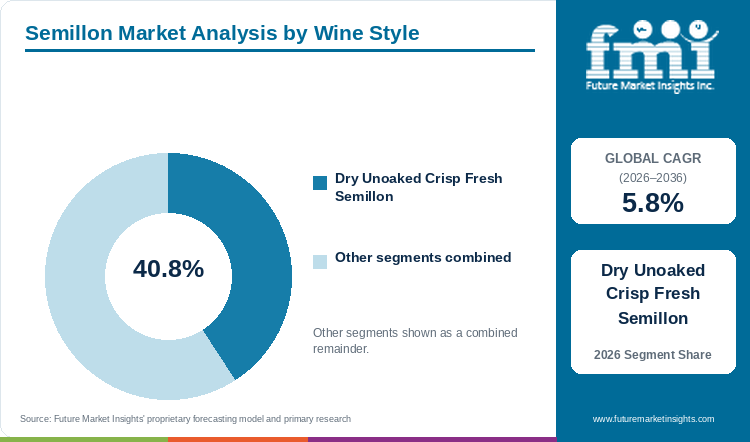
Dry Unoaked Crisp Fresh Semillon holds an estimated 40.8% of wine style demand in 2026, anchored by 11.0% ABV seafood pairing versatility and 20-year screwcap aging potential.
Table 5: Wine Style Share for the Semillon Market (percentage share), 2026
| Wine Style | Share (2026) |
|---|---|
| Dry Unoaked Crisp Fresh Semillon | 40.8% |
| Other Segments Combined | 59.2%* |
| Total | 100.0% |
*Note: Remaining wine style categories account for the balance of 2026 global Semillon demand.
Table 6: Wine Style Leadership and Market Growth for the Semillon Market (segment and CAGR percentage), 2026 to 2036
| Metric | Value |
|---|---|
| Global CAGR (2026 to 2036) | 5.8% |
| Leading Segment | Dry Unoaked Crisp Fresh Semillon |
Dry Unoaked Crisp Fresh Semillon harvested early at 18 to 20 degrees Brix and fermented cool in stainless steel delivers a bone-dry 10.5% to 11.5% ABV white wine with lemon-pith acidity that develops complex lanolin and toasted honey notes with bottle age. Sommeliers curating lower-alcohol pairings as well as dealcoholized and low-ABV wine selections favor unoaked Semillon because it provides grand-cru aging complexity at half the alcohol load of oaked Chardonnay.
- Dry Unoaked Crisp Fresh Semillon holds 40.8% of wine style value in 2026 because early picking and zero oak barrel aging maximize winery cash-flow velocity on young releases while feeding library reserves.
- In December 2024, researchers publishing in Food Chemistry: X demonstrated that combined grape harvest maturity and selected Saccharomyces yeast strains govern ester synthesis and sensory quality in varietal wines [3].
What sustains Hunter Valley Australia Traditional leadership in the geographic origin segment?
Hunter Valley Australia Traditional estates represent 44.5% of the geographic origin category in 2026, supported by post-tariff Chinese export recovery and museum library releases.
Australia's Hunter Valley (New South Wales) as well as Margaret River (Western Australia) and Barossa Valley represents the world's largest commercial production hub for varietal Semillon and classic Semillon-Sauvignon Blanc blends. While prestige Vat 1 and single-vineyard bottlings anchor collector cellars, Australian producers also package crisp young Semillon formats as well as single-serve canned wine and screwcap glass for outdoor and stadium hospitality.
- Hunter Valley Australia Traditional accounts for 44.5% of the geographic origin segment in 2026 as tariff-free Chinese hospitality restocking and Sydney cellar-door tourism boost export realizations.
- In March 2025, viticultural researchers publishing in Agriculture (PMC11989029) documented how vineyard site elevation with cluster thinning and yeast selection regulate volatile ester and terpene concentrations across consecutive vintages [4].
How do Fine Dining Restaurants and Sommeliers lead the distribution channel category?
Fine Dining Restaurants and Sommeliers account for 48.2% of distribution channel demand in 2026, driven by high-margin degustation pairings for aged dry Semillon and Sauternes.
Michelin-starred tasting menus and luxury hotel dining rooms across Paris, London with Tokyo with Shanghai with Sydney with New York and Mexico City represent the primary commercial channel for both aged dry Semillon and sweet Sauternes. Because consumers rarely open a full 750 mL bottle of noble-rot Sauternes at home on weeknights, restaurant sommeliers drive volume by pouring 75 mL dessert and foie-gras pairing glasses as well as seasonal spiced mulled wine and digestif programs.
- Fine Dining Restaurants and Sommeliers command 48.2% of distribution channel demand in 2026 because by-the-glass sommelier curation monetizes both 10-year-old dry Hunter Semillon and half-bottles of Sauternes.
- In July 2026, the USDA Foreign Agricultural Service reported that premium imported wine consumption in Asian hospitality venues expanded by 14% in value during 2025 as fine dining tourism rebounded [5].
Why does Stelvin Aluminum Screwcap lead the closure type category?
Stelvin Aluminum Screwcap secures 51.6% of closure type value in 2026, supported by zero cork taint and uniform 0.002 mg/day oxygen transmission across Australian cellars.
Australian and New Zealand Semillon producers pioneered the adoption of Stelvin aluminum screwcaps fitted with tin-saran liners after 1990s cork-taint (2,4,6-trichloroanisole) and random oxidation ruined up to 8% of aged museum bottles. Precision screwcap liners deliver a uniform oxygen transmission rate of 0.002 milligrams of oxygen per day, ensuring that every bottle in a 10-year-old museum case of Hunter Valley Semillon ages identically.
- Stelvin Aluminum Screwcap secures 51.6% of closure type value in 2026 as Australian, New Zealand, and Washington State wineries standardize tin-lined closures for zero TCA risk.
- In June 2026, researchers publishing in Foods (PMC13213739) demonstrated how membrane pervaporation and controlled oxygen management preserve key volatile esters in white wines during post-fermentation processing [6].
What gives Current-Release Young Varietal the leading position in vintage tier?
Current-Release Young Varietal commands 54.0% of vintage tier share in 2026, anchored by immediate restaurant by-the-glass velocity while Museum Releases grow at 6.5% CAGR.
Current-Release Young Varietal bottlings (released within 6 to 18 months of harvest) generate the working capital required by estates to finance multi-year library aging of museum reserves. At the same time, Museum Cellar-Aged Releases (held 5 to 15 years in temperature-controlled winery vaults) record the fastest growth at 6.5% CAGR because collectors willingly pay a 75% to 120% premium for provenance-guaranteed aged Semillon.
- Current-Release Young Varietal commands 54.0% of vintage tier value in 2026 through high-velocity restaurant by-the-glass and retail sell-through.
- In November 2024, researchers in Microorganisms (PMC11665412) confirmed that concurrent utilization of non-Saccharomyces and Saccharomyces wine yeasts enhances varietal aroma complexity and stability in young white wines [7].
What are the drivers, restraints, and opportunities in the Semillon market?
In the Semillon market, China's removal of Australian wine tariffs and Bordeaux dry white conversions are projected to drive growth whereas thin-skin bunch rot sensitivity and low botrytis yields restrain volume and beta-glucanase enzymatic clarification with museum library hold-backs expand estate margins.
- Driver: China's removal of tariffs on Australian bottled wine and Bordeaux estate conversions from sweet Sauternes into dry white Bordeaux Blanc propel global Semillon value growth.
- Restraint: Thin berry skins susceptible to autumn bunch rot and tiny noble-rot Sauternes yields (12 to 20 hl/ha) inflate vineyard picking costs per bottle.
- Opportunity: Museum library vertical releases and sequential Torulaspora delbrueckii fermentation with beta-glucanase clarification capture higher estate margins and cleaner botrytis vinification.
Growth Analysis and Future Potential: Qualitative Demand Drivers
Restoration of tariff-free trade between Australia and China as well as rising Asian fine dining demand for low-ABV white wines acts as the primary macro driver for the Semillon market. In Cantonese, Shanghainese and Japanese high-end dining rooms with heavy 14.5% ABV oaked white wines overpower delicate steamed seafood and dim sum and whereas crisp 11.0% ABV Hunter Valley Semillon and dry white Bordeaux pair cleanly as well as fermented rice and culinary wine courses. In November 2025, the International Organisation of Vine and Wine released its world wine production estimates detailing how Southern Hemisphere exporters and premium European white appellations capture rising value share [8].
Risk Assessment of the Semillon Market: Operational and Formulation Friction
Climatic volatility in Southwest France and coastal New South Wales threatens both ends of the Semillon style spectrum: unseasonal September deluges in the Hunter Valley split thin Semillon skins, while warm dry autumns in Sauternes fail to trigger morning mists needed for noble Botrytis cinerea. In addition, younger casual drinkers shifting toward refreshing ready-to-drink wine coolers and spritzes have reduced traditional after-dinner consumption of heavy 375 mL and 750 mL dessert bottles. in july 2026, usda agricultural attaché analysts European Union agricultural update noted how erratic weather patterns across French and Iberian growing basins create acute vintage yield swings [9].
Commercial Opportunity Analysis: Formulation Differentiation and Value-Add Formats
Winemakers in Sauternes, Barsac, and New World late-harvest cellars are overcoming high volatile acidity and sluggish botrytis fermentations by adopting sequential inoculation with organic fermentation yeast and targeted beta-glucanase enzymes. When high-sugar botrytized Semillon musts are fermented solely with conventional Saccharomyces cerevisiae, osmotic stress causes yeast cells to excrete up to 1.4 grams per liter of acetic acid, approaching legal rejection thresholds. In July 2025, enological microbiologists publishing in Foods (PMC12263952) demonstrated that sequential fermentation with Torulaspora delbrueckii and Metschnikowia pulcherrima dramatically lowered volatile acidity while boosting fruity ester formation in high-gravity wine fermentations [10].
Semillon Market by Country (2026 to 2036)
FMI country modeling indicates that Mexico leads Semillon expansion at a 6.8% CAGR through 2036, followed by Brazil at 6.2% with Australia at 5.9% with Spain at 5.8% with Canada at 5.7% with the United States at 5.6% with France at 5.4% and the United Kingdom at 5.3%.
Table 7: Country CAGR and Primary Growth Levers for the Semillon Market (CAGR percentage and operational drivers), 2026 to 2036
| Country | CAGR (2026 to 2036) | Primary Growth Lever |
|---|---|---|
| Mexico | 6.8% | Mexico City, Los Cabos, and Riviera Maya tasting-menu pairings and USMCA imports |
| Brazil | 6.2% | Sao Paulo collector wine clubs, luxury steakhouses, and South American old-vine trade |
| Australia | 5.9% | Post-tariff mainland China export restocking and Hunter Valley museum cellar doors |
| Spain | 5.8% | Madrid, Barcelona, and San Sebastian Michelin-starred gastronomic wine lists |
| Canada | 5.7% | SAQ Cellier white Bordeaux allocations and Okanagan Valley Meritage production |
| United States | 5.6% | Columbia Valley and Napa old-vine DTC clubs alongside classified Graves imports |
| France | 5.4% | Sauternes and Barsac dry white Grand Vin conversions and Place de Bordeaux trade |
| United Kingdom | 5.3% | St. James's collector merchants and HMRC excise duty savings on 11.0% ABV Hunter Semillon |
Source: Future Market Insights analysis
France Semillon Market Outlook (2026 to 2036)
France anchors the global luxury tier of the Semillon market and expands at a 5.4% CAGR from 2026 to 2036 as classified estates in Sauternes, Barsac with Pessac-Leognan and Graves reallocate vineyard blocks into high-margin dry white cuvées. Semillon accounts for nearly half of all white vineyard acreage in Bordeaux, forming the 80% backbone of premier cru Sauternes (such as LVMH's Chateau d'Yquem) and the core of classified dry Graves whites. In January 2026, the French Ministry of Agriculture (Agreste) viticultural conjuncture bulletin documented rising per-hectoliter realizations for AOC white Bordeaux and Pessac-Leognan as chateaux shifted grape must away from bulk sweet tiers [11]. Parisian gastronomy and Place de Bordeaux collector allocations sustain luxury pricing.
Key takeaway: In France, Bordeaux estate conversions into dry white Grand Vin cuvées as well as premier cru Sauternes releases are projected to drive a 5.4% CAGR.
Brazil Semillon Market Outlook (2026 to 2036)
Brazil's Semillon market surges at a 6.2% CAGR between 2026 and 2036, driven by fine wine collector clubs in Sao Paulo and Brasilia as well as upscale churrascaria and seafood restaurants expanding white Bordeaux with Sauternes and South American old-vine Semillon listings. Brazilian demand combines luxury imports from Bordeaux and Australia as well as old-vine Semillon from Argentina and Chile as well as winter-pruned vineyards in Brazil's Serra da Mantiqueira. In October 2026, the USDA Foreign Agricultural Service reported on how shifting El Nino weather patterns across southern Brazil are prompting domestic growers in Rio Grande do Sul to invest in protective canopy and cellar technologies [12]. Sommeliers pair oak-aged Semillon with rich Brazilian moqueca seafood stews.
Key takeaway: In Brazil, luxury wine club subscriptions and Mercosur old-vine Semillon trade are estimated to propel 6.2% annual growth.
Mexico Semillon Market Outlook (2026 to 2036)
Mexico registers the fastest national growth rate in the global Semillon study at a 6.8% CAGR from 2026 to 2036, fueled by fine dining expansion in Mexico City (Polanco and Roma Norte) and international resort corridors in Los Cabos and Riviera Maya. Across Mexican haute cuisine, sommeliers pair crisp unoaked Hunter Valley and Washington State Semillon with lime-cured aguachile while pouring chilled Sauternes as well as Oaxacan mole negro courses. In February 2026, Mexico's Instituto Nacional de Estadistica y Geografia (INEGI) monthly services survey confirmed sustained revenue expansion across five-star hospitality and gastronomic restaurant venues [13]. USMCA duty-free access for Washington State and Napa Valley Semillon further accelerates Mexican importer margins.
Key takeaway: In Mexico, contemporary tasting-menu sommelier pairings and luxury resort hospitality are forecast to drive a market-leading 6.8% CAGR.
Canada Semillon Market Outlook (2026 to 2036)
Canada's Semillon market advances at a 5.7% CAGR over the 2026 to 2036 horizon, supported by two distinct pillars: strong collector imports of white Bordeaux and Australian Semillon through provincial liquor monopolies (SAQ in Quebec and LCBO in Ontario), and domestic barrel-fermented Semillon production in British Columbia's Okanagan and Similkameen valleys. Southern Okanagan vineyards in Osoyoos and Oliver experience warm desert days and cool nights, allowing estates to craft textured Semillon-Sauvignon Blanc blends and late-harvest bottlings. In late July 2026, official USDA trade reports Canada Exporter Guide Annual PDF documented how provincial monopoly specialty wine boutiques expand high-value French and Commonwealth varietal allocations [14]. Quebec bistros remain a premier North American market for Sauternes and Graves.
Key takeaway: In Canada, SAQ Cellier white Bordeaux allocations and Okanagan Valley Meritage production are anticipated to sustain a 5.7% CAGR.
Spain Semillon Market Outlook (2026 to 2036)
Spain's Semillon market scales at a 5.8% CAGR during the ten-year forecast window because Michelin-starred restaurants and luxury hotel cellars in Madrid, Barcelona with San Sebastian and Mallorca broaden international white wine lists for culinary tourists. While Spain is a powerhouse exporter of native Albariño and Verdejo, top Spanish sommeliers actively import aged Hunter Valley Semillon with classified Pessac-Leognan whites and premier cru Sauternes to offer international collectors multi-decade aged white pairings as well as Basque and Catalan tasting menus. In March 2026, the USDA Foreign Agricultural Service Spain Food Processing Ingredients Annual documented record international tourism arrivals and rising premium food and beverage expenditure across Spain's hospitality sector [15]. Fine wine distributors in Bilbao and Barcelona anchor direct chateau allocations.
Key takeaway: In Spain, Michelin-starred culinary tourism in Madrid with Barcelona and San Sebastian is expected to support 5.8% annual growth.
Australia Semillon Market Outlook (2026 to 2036)
Australia represents the largest single-country producer and exporter of dry varietal Semillon, growing at a 5.9% CAGR between 2026 and 2036 across New South Wales (Hunter Valley) with Western Australia (Margaret River) and South Australia (Barossa and Eden Valley). After Beijing's March 2024 elimination of punitive duties on Australian bottled wine, Hunter Valley and South Australian producers led by Treasury Wine Estates and historic family wineries have redirected prestige museum Semillon allocations into high-margin Asian and domestic hospitality channels. In December 2025, the Australian Bureau of Agricultural and Resource Economics and Sciences (ABARES) Agricultural Commodities report confirmed rising export values for premium Australian bottled wines [16]. Sydney and Melbourne fine dining restaurants as well as Pokolbin cellar-door clubs anchor domestic demand.
Key takeaway: In Australia, post-tariff Asian export recovery and Hunter Valley museum cellar-door releases are slated to drive 5.9% CAGR expansion.
United States Semillon Market Outlook (2026 to 2036)
The United States Semillon market progresses at a 5.6% CAGR from 2026 to 2036, combining East and West Coast collector imports of classified white Bordeaux and Sauternes as well as high-scoring domestic bottlings from Washington State (Columbia Valley and Walla Walla) and California (Napa Valley and Sonoma). In Napa and Columbia valleys, boutique estates prize old-vine Semillon blocks for adding waxy fig and citrus complexity to Sauvignon Blanc blends and varietal concrete-egg releases sold directly to mailing lists. In April 2025, the Washington State Wine Commission annual grape production report documented strong grower prices per ton for premium Columbia Valley white winegrapes [17]. Sommelier programs in New York and San Francisco drive on-trade turnover.
Key takeaway: In the United States, Columbia Valley and Napa old-vine DTC wine clubs as well as Bordeaux Blanc imports are predicted to sustain a 5.6% CAGR.
United Kingdom Semillon Market Outlook (2026 to 2036)
The United Kingdom semillon sector climbs at a 5.3% CAGR through 2036, anchored by London's St. James's fine wine merchants, bonded warehouse investment trading, and UK gastropub and restaurant buyers capitalizing on lower excise duty bands for 11.0% ABV Hunter Valley Semillon. Because the UK alcohol duty regime taxes wines progressively by exact ABV percentage, early-picked Hunter Valley Semillon at 11.0% ABV carries a lower excise tax per case than high-alcohol collector whites. In January 2026, the UK Office for National Statistics consumer price and hospitality expenditure data documented steady premiumization across British restaurant wine lists despite broader retail inflation [18]. En primeur Sauternes and dry white Bordeaux campaigns remain a core revenue pillar for British wine merchants.
Key takeaway: In the United Kingdom, St. James's collector trading and excise duty savings on 11.0% ABV Hunter Semillon are projected to drive a 5.3% CAGR.
Full report country CAGRs cover: North America; Latin America; Western Europe; Eastern Europe; East Asia; South Asia and Pacific; Middle East and Africa.
Who are the notable companies in the Semillon market?
LVMH Moet Hennessy Louis Vuitton, Treasury Wine Estates with Pernod Ricard SA with Banfi Vintners with DSM-Firmenich AG and Chr. Hansen Holding AS, Givaudan SA with Symrise AG with Archer Daniels Midland Company and Cargill Incorporated are the notable companies in the Semillon market.
Competitive positioning in the Semillon industry unites Tier 1 Bordeaux and Australian vineyard estates with Tier 2 enological enzyme and yeast fermenters and Tier 3 beverage aroma and stabilization ingredient suppliers. LVMH Moet Hennessy Louis Vuitton (Chateau d'Yquem, Petit Cheval Blanc) and Treasury Wine Estates with Pernod Ricard SA and Banfi Vintners lead in prestige vineyard ownership and global fine dining allocation. DSM-Firmenich AG and Chr. Hansen Holding AS (Novonesis) supply essential Botrytis beta-glucanase filtration enzymes and low-VA fermentation yeasts, whereas Givaudan SA and Symrise AG with Archer Daniels Midland Company and Cargill Incorporated provide dealcoholized wine aroma restitution fractions with acidulants and tartrate stabilizers.
- Flagship Bordeaux, Australian & Global Wine Estates: LVMH with Treasury Wine Estates with Pernod Ricard and Banfi Vintners control premier Sauternes with Graves and Australian Semillon vineyards.
- Enological Glucanase Enzyme & Bio-Protection Yeast Leaders: DSM-Firmenich AG and Chr. Hansen Holding AS (Novonesis) manufacture fungal beta-(1,3)(1,6)-glucanases for botrytis must clarification and Torulaspora delbrueckii yeasts that suppress volatile acidity.
- Adjacent Beverage Aroma, Acidulant & Stabilization Suppliers: Givaudan with Symrise with ADM and Cargill supply honeyed-citrus modulators for 0.0% wines with acidulants and CMC tartrate stabilizers.
Competitive Benchmarking: Semillon Market
Table 8: Competitive Benchmarking for the Semillon Market (qualitative capability ratings), 2026
| Company | Vineyard / Portfolio Role | Botrytis & Reductive Enology | Clean-Label & Low-ABV Fit | Geographic Reach |
|---|---|---|---|---|
| LVMH Moet Hennessy Louis Vuitton | High (Chateau d'Yquem & Ygrec) | High | High | Premier Cru Superieur Sauternes and global luxury allocations |
| Treasury Wine Estates | High (Australian Semillon Leader) | High | High | Hunter Valley & South Australian estates exporting to Asia, UK & US |
| Pernod Ricard SA | High (Global Fine Wine Portfolio) | High | Medium | Australian and French heritage white distribution across 60+ markets |
| Banfi Vintners | Medium (Fine Dining Estate Importer) | High | High | North American, European, and Latin American sommelier distribution |
| DSM-Firmenich AG | Glucanase Enzyme & Yeast Leader | High | High | Global Rapidase beta-glucanase enzymes and Fermivin cryo yeasts |
| Chr. Hansen Holding AS (Novonesis) | Bio-Protection & Enzyme Leader | High | High | Global Viniflora Torulaspora low-VA yeasts and pectinases |
| Givaudan SA | Aroma Restitution Specialist | High | High | Global Taste & Wellbeing honeyed-citrus aroma fractions for 0.0% wine |
| Symrise AG | Sensory & Lactone Specialist | High | High | Global Food & Beverage oak lactone and mouthfeel modulators |
| Archer Daniels Midland Company | Acidulant & Nutrient Supplier | Medium | High | Global tartaric/malic acidulants and osmotic yeast nutrients |
| Cargill Incorporated | Stabilizer & Vegan Fining Supplier | Medium | High | Global CMC tartrate stabilizers, mannoproteins, and pea fining |
Evaluation basis: Heritage Vineyard & Museum Inventory evaluates ownership of classified Bordeaux or old-vine Australian Semillon parcels and library stock, whereas Botrytis & Reductive Enology rates beta-glucanase filtration and low-oxygen screwcap precision. Clean-Label & Low-ABV Fit measures non-Saccharomyces bio-protection, sulfite reduction, and 0.0%/low-alcohol formulation support.
Key Developments in the Semillon Market
- Treasury Wine Estates published its 2025 Annual Report on August 13, 2025, detailing 17.0% EBITS growth to AUD 770.3 million following the removal of Chinese tariffs on Australian wine and expanded luxury allocations across Asia [19].
- Novonesis (combining Chr. Hansen and Novozymes) delivered strong full-year biosolutions growth in February 2025 and expanded enzymatic clarification and microbial bio-protection tools for beverage and wine processors [20].
- Givaudan SA reported nine-month 2026 sales on October 13, 2026, detailing resilient Taste & Wellbeing innovation across natural beverage aroma restitution and sweetness/mouthfeel modulation systems [21].
Key Players in the Semillon Market
Flagship Bordeaux, Australian & Global Wine Estates
- LVMH Moet Hennessy Louis Vuitton
- Treasury Wine Estates
- Pernod Ricard SA
- Banfi Vintners
Enological Glucanase Enzyme & Bio-Protection Yeast Leaders
- DSM-Firmenich AG
- Chr. Hansen Holding AS (Novonesis)
- Adjacent Beverage Aroma, Acidulant & Tartrate Stabilization Suppliers
- Givaudan SA
Symrise AG
- Archer Daniels Midland Company
- Cargill Incorporated
Semillon Market - Report Scope
Table 9: Report Scope for the Semillon Market (coverage fields and definitions), 2026 to 2036
| Coverage field | Report scope |
|---|---|
| Market breakdown | Wine Style; Geographic Origin; Distribution Channel; Closure Type; Vintage Tier |
| Quantitative Units | USD Million (Strict Lock: 2025 = 148.0, 2026 = 156.2, 2036 = 274.5) |
| Market Definition | Includes commercial revenue from dry unoaked varietal Semillon, sweet botrytized noble-rot Sauternes/Barsac and late-harvest Semillon, oak-aged reserve Semillon and Semillon-dominant Bordeaux/Margaret River white blends, plus attributable enological glucanase, yeast, stabilizer, and aroma inputs. Child market represents 5.8% of Global Food and Specialty Ingredients Industry. |
| Regions Covered | North America; Latin America; Western Europe; Eastern Europe; East Asia; South Asia and Pacific; Middle East and Africa |
| Countries Covered | France, Brazil, Mexico, Canada, Spain, Australia, United States, United Kingdom, and China/East Asia |
| Key Companies Covered | LVMH Moet Hennessy Louis Vuitton, Treasury Wine Estates, Pernod Ricard SA, Banfi Vintners, DSM-Firmenich AG, Chr. Hansen Holding AS, Givaudan SA, Symrise AG, Archer Daniels Midland Company, Cargill Incorporated |
| Forecast Period | 2026 to 2036 |
| Approach | Primary and secondary research triangulated via physical volume shipments, manufacturer ASP realizations, and published appellation registries. |
Semillon Market - Research Methodology
Table 10: Research Methodology for the Semillon Market (research methods and approach), 2026 edition
| Method | Approach |
|---|---|
| Primary Research | Structured interviews with Hunter Valley and Margaret River winemakers, Sauternes and Graves cellar masters, Place de Bordeaux courtiers, and enological enzyme specialists. |
| Secondary Research | Analysis of Wine Australia National Vintage and Export Reports, OIV production statistics, USDA FAS GAIN country reports, and PubMed/PMC botrytis and fermentation studies. |
| Market Sizing and Forecasting | Top-down Global Food and Specialty Ingredients Industry baseline (5.8% child share) reconciled against bottom-up physical case shipments (1.58M to 1.66M 9L cases in 2026) and ex-cellar ASP realizations from 2026 to 2036. |
| Country Forecasting Model | Econometric country projections weight post-tariff Chinese luxury restocking, fine dining sommelier pairings, monopoly liquor board allocations, and dry Bordeaux Blanc conversions across eight national markets. |
| Operational Benchmark Traceability | Vineyard crush tonnages and beta-glucanase filtration indicators in Tables 2, 3, and 4 trace to Wine Australia crush data, PMC microbial fermentation assays, and corporate filings. |
| Data Triangulation and Validation | Compounding validated at exactly 5.8% CAGR (USD 156.2 million in 2026 to USD 274.5 million in 2036) with zero hierarchy anomalies. |
Semillon Market by Segments
Semillon Market segmented by Wine Style:
- Dry Unoaked Crisp Fresh Semillon
- Sweet Botrytis Noble Rot Sauternes Style
- Oak-Aged Reserve Semillon
- Dry White Bordeaux & Meritage Blends
Semillon Market segmented by Geographic Origin:
- Hunter Valley Australia Traditional
- Bordeaux France Graves and Sauternes
- Washington State and California
- South Africa Franschhoek, Chile and Argentina
Semillon Market segmented by Distribution Channel:
- Fine Dining Restaurants and Sommeliers
- Specialty Wine Merchants
- DTC Direct Winery Sales
- Luxury Auction and En Primeur Channels
- Duty-Free Travel Retail
Semillon Market segmented by Closure Type:
- Stelvin Aluminum Screwcap (Tin / Saranex Liner)
- Natural Cork Premier Cru
- Technical Micro-Agglomerated Cork
- Plant-Based Biopolymer Closures
Semillon Market segmented by Vintage Tier:
- Current-Release Young Varietal (1 to 3 Years)
- Museum Cellar-Aged Releases (5 to 15+ Years)
- En Primeur Collector Allocations
- Half-Bottle (375 mL) Dessert Formats
Semillon Market by Region
- North America
- United States
- Canada
- Latin America
- Brazil
- Mexico
- Argentina
- Chile
- Western Europe
- Germany
- France
- United Kingdom
- Italy
- Spain
- Benelux
- Nordics
- Eastern Europe
- Poland
- Czech Republic
- Romania
- Hungary
- East Asia
- China
- Japan
- South Korea
- South Asia and Pacific
- India
- ASEAN
- Australia and New Zealand
- Middle East and Africa
- GCC Countries
- South Africa
- Türkiye
- Israel
Research Sources and Bibliography
- [1] Wine Australia. (2025, July 08). National Vintage Report 2025: Australian Winegrape Crush Recovery and Varietal Tonnage. Australian Government Statutory Authority.
- [2] Kaya, G., & Yildiz, H. (2026, August 20). Biocontrol of Vitis vinifera Gray Mold Caused by Botrytis cinerea via Microbial Culture Filtrates (PMC13493534). Microorganisms (MDPI).
- [3] Liu, P., Zhang, Q., & Wang, J. (2024, December 05). Impact of Combined Grape Maturity and Selected Saccharomyces Strains on Physicochemical and Aroma Profiles of Varietal Wines (PMC11698972). Food Chemistry: X (Elsevier).
- [4] Jagatic Korenika, A. M., Preiner, D., & Jeromel, A. (2025, March 12). Influence of Vineyard Location, Cluster Thinning and Yeast Selection on Volatile Compounds in Varietal Wines (PMC11989029). Agriculture (MDPI).
- [5] USDA Foreign Agricultural Service. (2026, July 07). Growing Wine Market and Hospitality Import Opportunities in Asia-Pacific (GAIN Report TH2026-0022). United States Department of Agriculture.
- [6] Gómez-Plaza, E., & Bautista-Ortín, A. B. (2026, June 14). Dealcoholization and Post-Fermentation Processing of White Wines by Membrane Pervaporation: Ester Retention Kinetics (PMC13213739). Foods (MDPI).
- [7] Morales, P., Gonzalez, R., & Tronchoni, J. (2024, November 30). Enhancing White Wine Fermentation Through Concurrent Utilization of Non-Saccharomyces and Saccharomyces Yeasts (PMC11665412). Microorganisms (MDPI).
- [8] International Organisation of Vine and Wine. (2025, November 12). OIV Releases 2025 World Wine Production First Estimates and Regional Harvest Balance. OIV Official Press Releases.
- [9] USDA Foreign Agricultural Service. (2026, July 30). European Union Agricultural Weather and Crop Production Update (GAIN Report E42026-0024). United States Department of Agriculture.
- [10] Canonico, L., Comitini, F., & Ciani, M. (2025, July 18). Comparison Between Metschnikowia pulcherrima and Torulaspora delbrueckii in Sequential Wine Fermentations for Volatile Acidity Reduction (PMC12263952). Foods (MDPI).
- [11] Agreste Ministere de l'Agriculture et de la Souverainete Alimentaire. (2026, January 20). Infos Rapides Viticulture: Valorisation et Production des Vins Blancs AOC de Bordeaux et Gironde. Service de la Statistique et de la Prospective.
- [12] USDA Foreign Agricultural Service. (2026, October 13). Brazil: How the 2026 El Nino Affects Brazil's Agriculture and Southern Vineyard Production. United States Department of Agriculture GAIN Report.
- [13] Instituto Nacional de Estadistica y Geografia. (2026, February 12). Encuesta Mensual de Servicios de Alojamiento Temporal y Preparacion de Alimentos y Bebidas en Mexico. INEGI Mexico Official Statistics.
- [14] USDA Foreign Agricultural Service. (2026, July 31). Canada: Exporter Guide Annual and Provincial Liquor Control Board Wine Procurement (GAIN Report CA2026-0019 PDF). United States Department of Agriculture.
- [15] USDA Foreign Agricultural Service. (2026, March 31). Spain: Food Processing Ingredients Annual and Hospitality Tourism Sector Demand (GAIN Report SP2026-0003). United States Department of Agriculture.
- [16] Australian Bureau of Agricultural and Resource Economics and Sciences. (2025, December 03). Agricultural Commodities Report: Australian Winegrape Crush and Bottled Wine Export Value Outlook. Department of Agriculture, Fisheries and Forestry.
- [17] Washington State Wine Commission. (2025, April 08). 2024 Washington State Wine Grape Production and Columbia Valley Varietal Tonnage Report. Washington State Wine Commission Official Reports.
- [18] Office for National Statistics. (2026, January 21). Consumer Price Inflation and Hospitality Beverage Expenditure Indices in the United Kingdom. UK Statistics Authority.
- [19] Treasury Wine Estates. (2025, August 13). Treasury Wine Estates 2025 Annual Report: Luxury Portfolio Growth and Post-Tariff China Allocation. Treasury Wine Estates ASX Announcements.
- [20] Novonesis. (2025, February 26). Novonesis Delivers Strong Full-Year Results and Expands Food and Beverage Biosolutions Portfolio. Novonesis Corporate Newsroom.
- [21] Givaudan SA. (2026, October 13). Givaudan 2026 Nine-Month Sales: Taste and Wellbeing Beverage Aroma and Modulation Performance. Givaudan Official Media Releases.
- [22] Symrise AG. (2026, April 29). Symrise Reports Solid Q1 2026 Sales Results in Taste Nutrition and Health Beverage Naturals. Symrise Corporate Newsroom.
- [23] Archer Daniels Midland Company. (2026, February 03). ADM Reports Fourth Quarter and Full-Year 2025 Results and Provides 2026 Nutrition and Carbohydrate Outlook. ADM Official News Releases.
- [24] LVMH Moet Hennessy Louis Vuitton. (2026, March 18). Chateau d'Yquem Announces Release of Chateau d'Yquem 2023 and Ygrec Dry White Allocations. LVMH Official Newsroom.
This bibliography is provided for reader reference and documents the verified primary sources cited across the report.
This Report Answers
- How large is the Semillon market in 2026 and what is forecast for 2036?
- How do China's tariff removal on Australian wine and Bordeaux dry-white conversions drive Semillon demand?
- Why does Dry Unoaked Crisp Fresh Semillon lead the wine style category?
- Why does Hunter Valley Australia Traditional lead the geographic origin category globally?
- How do growth rates differ across Mexico, Brazil with Australia with Spain with Canada and France?
- Which leading companies control premier Semillon estates versus beta-glucanase enzymes and aroma modulation inputs?
- What botrytis filtration bottlenecks or thin-skin bunch rot risks restrain margins in the Semillon market?
- What closure oxygen transmission rates and sequential yeast protocols should wineries evaluate for Semillon?
Table of Content
Table of Content
- Key Takeaways
- Market Size and CAGR
- Top Growth Driver
- Fastest Growing Segment
- Leading Region
- Key Companies
- Emerging Opportunities
- Executive Summary
- Global Market Outlook
- Demand-side Trends
- Supply-side Trends
- Technology Roadmap Analysis
- Analysis and Recommendations
- Analyst Perspective (What is happening? Why now? What should investors know?)
- Key Questions Answered
- How large is the market?
- What is the CAGR?
- What are key trends?
- Which region dominates?
- Who are the leaders?
Read More...
- Market Overview
- Market Coverage / Taxonomy
- Market Definition / Scope / Limitations
- Research Methodology
- Chapter Orientation
- Analytical Lens and Working Hypotheses
- Market Structure, Signals, and Trend Drivers
- Benchmarking and Cross-market Comparability
- Market Sizing, Forecasting, and Opportunity Mapping
- Research Design and Evidence Framework
- Desk Research Programme (Secondary Evidence)
- Expert Input and Fieldwork (Primary Evidence)
- Tooling, Models, and Reference Databases
- Data Engineering and Model Build
- Quality Assurance and Audit Trail
- Market Background
- Market Dynamics (Drivers, Restraints, Opportunity, Trends)
- Scenario Forecast (Optimistic, Likely, Conservative)
- Impact Analysis
- AI Impact
- Sustainability Impact
- Regulatory Impact
- Technology Impact
- Consumer / Buyer Analysis
- Purchase Drivers
- Adoption Barriers
- Buyer Journey
- Opportunity Map Analysis
- Product Life Cycle Analysis
- Supply Chain Analysis
- Investment Feasibility Matrix
- Value Chain Analysis
- PESTLE and Porter's Analysis
- Regulatory Landscape
- Regional Parent Market Outlook
- Production and Consumption Statistics
- Import and Export Statistics
- Global Market Analysis and Forecast, 2021 to 2036
- Historical Market Size Value (USD Million) Analysis, 2021 to 2025
- Current and Future Market Size Value (USD Million) Projections, 2026 to 2036
- Y-o-Y Growth Trend Analysis
- Absolute $ Opportunity Analysis
- Global Market Pricing Analysis, 2021 to 2036
- Global Market Analysis and Forecast, By Wine Style, 2021 to 2036
- Introduction / Key Findings
- Historical Market Size Value (USD Million) Analysis By Wine Style, 2021 to 2025
- Current and Future Market Size Value (USD Million) Analysis and Forecast By Wine Style, 2026 to 2036
- Dry Unoaked Crisp Fresh Semillon
- Sweet Botrytis Noble Rot Sauternes Style
- Oak-Aged Reserve Semillon
- Dry White Bordeaux & Meritage Blends
- Y-o-Y Growth Trend Analysis By Wine Style, 2021 to 2025
- Absolute $ Opportunity Analysis By Wine Style, 2026 to 2036
- Global Market Analysis and Forecast, By Geographic Origin, 2021 to 2036
- Introduction / Key Findings
- Historical Market Size Value (USD Million) Analysis By Geographic Origin, 2021 to 2025
- Current and Future Market Size Value (USD Million) Analysis and Forecast By Geographic Origin, 2026 to 2036
- Hunter Valley Australia Traditional
- Bordeaux France Graves and Sauternes
- Washington State and California
- South Africa Franschhoek, Chile and Argentina
- Y-o-Y Growth Trend Analysis By Geographic Origin, 2021 to 2025
- Absolute $ Opportunity Analysis By Geographic Origin, 2026 to 2036
- Global Market Analysis and Forecast, By Distribution Channel, 2021 to 2036
- Introduction / Key Findings
- Historical Market Size Value (USD Million) Analysis By Distribution Channel, 2021 to 2025
- Current and Future Market Size Value (USD Million) Analysis and Forecast By Distribution Channel, 2026 to 2036
- Fine Dining Restaurants and Sommeliers
- Specialty Wine Merchants
- DTC Direct Winery Sales
- Luxury Auction and En Primeur Channels
- Duty-Free Travel Retail
- Y-o-Y Growth Trend Analysis By Distribution Channel, 2021 to 2025
- Absolute $ Opportunity Analysis By Distribution Channel, 2026 to 2036
- Global Market Analysis and Forecast, By Closure Type, 2021 to 2036
- Introduction / Key Findings
- Historical Market Size Value (USD Million) Analysis By Closure Type, 2021 to 2025
- Current and Future Market Size Value (USD Million) Analysis and Forecast By Closure Type, 2026 to 2036
- Stelvin Aluminum Screwcap (Tin / Saranex Liner)
- Natural Cork Premier Cru
- Technical Micro-Agglomerated Cork
- Plant-Based Biopolymer Closures
- Y-o-Y Growth Trend Analysis By Closure Type, 2021 to 2025
- Absolute $ Opportunity Analysis By Closure Type, 2026 to 2036
- Global Market Analysis and Forecast, By Vintage Tier, 2021 to 2036
- Introduction / Key Findings
- Historical Market Size Value (USD Million) Analysis By Vintage Tier, 2021 to 2025
- Current and Future Market Size Value (USD Million) Analysis and Forecast By Vintage Tier, 2026 to 2036
- Current-Release Young Varietal (1 to 3 Years)
- Museum Cellar-Aged Releases (5 to 15+ Years)
- En Primeur Collector Allocations
- Half-Bottle (375 mL) Dessert Formats
- Y-o-Y Growth Trend Analysis By Vintage Tier, 2021 to 2025
- Absolute $ Opportunity Analysis By Vintage Tier, 2026 to 2036
- Global Market Analysis and Forecast, By Region, 2021 to 2036
- Introduction
- Historical Market Size Value (USD Million) Analysis By Region, 2021 to 2025
- Current Market Size Value (USD Million) Analysis and Forecast By Region, 2026 to 2036
- North America
- Latin America
- Western Europe
- Eastern Europe
- East Asia
- South Asia and Pacific
- Middle East and Africa
- Market Attractiveness Analysis By Region
- North America Market Analysis and Forecast, By Country, 2021 to 2036
- Historical Market Size Value (USD Million) Trend Analysis By Market Taxonomy, 2021 to 2025
- Market Size Value (USD Million) Forecast By Market Taxonomy, 2026 to 2036
- By Country
- United States
- Canada
- By Wine Style
- By Geographic Origin
- By Distribution Channel
- By Closure Type
- By Vintage Tier
- By Country
- Market Attractiveness Analysis
- By Country
- By Wine Style
- By Geographic Origin
- By Distribution Channel
- By Closure Type
- By Vintage Tier
- Key Takeaways
- Latin America Market Analysis and Forecast, By Country
- Historical Market Size Value (USD Million) Trend Analysis By Market Taxonomy, 2021 to 2025
- Market Size Value (USD Million) Forecast By Market Taxonomy, 2026 to 2036
- By Country
- Brazil
- Mexico
- Argentina
- Chile
- By Wine Style
- By Geographic Origin
- By Distribution Channel
- By Closure Type
- By Vintage Tier
- By Country
- Market Attractiveness Analysis
- By Country
- By Wine Style
- By Geographic Origin
- By Distribution Channel
- By Closure Type
- By Vintage Tier
- Key Takeaways
- Western Europe Market Analysis and Forecast, By Country
- Historical Market Size Value (USD Million) Trend Analysis By Market Taxonomy, 2021 to 2025
- Market Size Value (USD Million) Forecast By Market Taxonomy, 2026 to 2036
- By Country
- Germany
- France
- United Kingdom
- Italy
- Spain
- Benelux
- Nordics
- By Wine Style
- By Geographic Origin
- By Distribution Channel
- By Closure Type
- By Vintage Tier
- By Country
- Market Attractiveness Analysis
- By Country
- By Wine Style
- By Geographic Origin
- By Distribution Channel
- By Closure Type
- By Vintage Tier
- Key Takeaways
- Eastern Europe Market Analysis and Forecast, By Country
- Historical Market Size Value (USD Million) Trend Analysis By Market Taxonomy, 2021 to 2025
- Market Size Value (USD Million) Forecast By Market Taxonomy, 2026 to 2036
- By Country
- Poland
- Czech Republic
- Romania
- Hungary
- By Wine Style
- By Geographic Origin
- By Distribution Channel
- By Closure Type
- By Vintage Tier
- By Country
- Market Attractiveness Analysis
- By Country
- By Wine Style
- By Geographic Origin
- By Distribution Channel
- By Closure Type
- By Vintage Tier
- Key Takeaways
- East Asia Market Analysis and Forecast, By Country
- Historical Market Size Value (USD Million) Trend Analysis By Market Taxonomy, 2021 to 2025
- Market Size Value (USD Million) Forecast By Market Taxonomy, 2026 to 2036
- By Country
- China
- Japan
- South Korea
- By Wine Style
- By Geographic Origin
- By Distribution Channel
- By Closure Type
- By Vintage Tier
- By Country
- Market Attractiveness Analysis
- By Country
- By Wine Style
- By Geographic Origin
- By Distribution Channel
- By Closure Type
- By Vintage Tier
- Key Takeaways
- South Asia and Pacific Market Analysis and Forecast, By Country
- Historical Market Size Value (USD Million) Trend Analysis By Market Taxonomy, 2021 to 2025
- Market Size Value (USD Million) Forecast By Market Taxonomy, 2026 to 2036
- By Country
- India
- ASEAN
- Australia and New Zealand
- By Wine Style
- By Geographic Origin
- By Distribution Channel
- By Closure Type
- By Vintage Tier
- By Country
- Market Attractiveness Analysis
- By Country
- By Wine Style
- By Geographic Origin
- By Distribution Channel
- By Closure Type
- By Vintage Tier
- Key Takeaways
- Middle East and Africa Market Analysis and Forecast, By Country
- Historical Market Size Value (USD Million) Trend Analysis By Market Taxonomy, 2021 to 2025
- Market Size Value (USD Million) Forecast By Market Taxonomy, 2026 to 2036
- By Country
- GCC Countries
- South Africa
- Türkiye
- Israel
- By Wine Style
- By Geographic Origin
- By Distribution Channel
- By Closure Type
- By Vintage Tier
- By Country
- Market Attractiveness Analysis
- By Country
- By Wine Style
- By Geographic Origin
- By Distribution Channel
- By Closure Type
- By Vintage Tier
- Key Takeaways
- Key Countries Market Analysis
- United States
- Pricing Analysis
- Market Share Analysis, 2025
- By Wine Style
- By Geographic Origin
- By Distribution Channel
- By Closure Type
- By Vintage Tier
- Canada
- Pricing Analysis
- Market Share Analysis, 2025
- By Wine Style
- By Geographic Origin
- By Distribution Channel
- By Closure Type
- By Vintage Tier
- Mexico
- Pricing Analysis
- Market Share Analysis, 2025
- By Wine Style
- By Geographic Origin
- By Distribution Channel
- By Closure Type
- By Vintage Tier
- Brazil
- Pricing Analysis
- Market Share Analysis, 2025
- By Wine Style
- By Geographic Origin
- By Distribution Channel
- By Closure Type
- By Vintage Tier
- Chile
- Pricing Analysis
- Market Share Analysis, 2025
- By Wine Style
- By Geographic Origin
- By Distribution Channel
- By Closure Type
- By Vintage Tier
- Germany
- Pricing Analysis
- Market Share Analysis, 2025
- By Wine Style
- By Geographic Origin
- By Distribution Channel
- By Closure Type
- By Vintage Tier
- United Kingdom
- Pricing Analysis
- Market Share Analysis, 2025
- By Wine Style
- By Geographic Origin
- By Distribution Channel
- By Closure Type
- By Vintage Tier
- Italy
- Pricing Analysis
- Market Share Analysis, 2025
- By Wine Style
- By Geographic Origin
- By Distribution Channel
- By Closure Type
- By Vintage Tier
- Spain
- Pricing Analysis
- Market Share Analysis, 2025
- By Wine Style
- By Geographic Origin
- By Distribution Channel
- By Closure Type
- By Vintage Tier
- France
- Pricing Analysis
- Market Share Analysis, 2025
- By Wine Style
- By Geographic Origin
- By Distribution Channel
- By Closure Type
- By Vintage Tier
- India
- Pricing Analysis
- Market Share Analysis, 2025
- By Wine Style
- By Geographic Origin
- By Distribution Channel
- By Closure Type
- By Vintage Tier
- ASEAN
- Pricing Analysis
- Market Share Analysis, 2025
- By Wine Style
- By Geographic Origin
- By Distribution Channel
- By Closure Type
- By Vintage Tier
- Australia and New Zealand
- Pricing Analysis
- Market Share Analysis, 2025
- By Wine Style
- By Geographic Origin
- By Distribution Channel
- By Closure Type
- By Vintage Tier
- China
- Pricing Analysis
- Market Share Analysis, 2025
- By Wine Style
- By Geographic Origin
- By Distribution Channel
- By Closure Type
- By Vintage Tier
- Japan
- Pricing Analysis
- Market Share Analysis, 2025
- By Wine Style
- By Geographic Origin
- By Distribution Channel
- By Closure Type
- By Vintage Tier
- South Korea
- Pricing Analysis
- Market Share Analysis, 2025
- By Wine Style
- By Geographic Origin
- By Distribution Channel
- By Closure Type
- By Vintage Tier
- Poland
- Pricing Analysis
- Market Share Analysis, 2025
- By Wine Style
- By Geographic Origin
- By Distribution Channel
- By Closure Type
- By Vintage Tier
- Hungary
- Pricing Analysis
- Market Share Analysis, 2025
- By Wine Style
- By Geographic Origin
- By Distribution Channel
- By Closure Type
- By Vintage Tier
- Türkiye
- Pricing Analysis
- Market Share Analysis, 2025
- By Wine Style
- By Geographic Origin
- By Distribution Channel
- By Closure Type
- By Vintage Tier
- South Africa
- Pricing Analysis
- Market Share Analysis, 2025
- By Wine Style
- By Geographic Origin
- By Distribution Channel
- By Closure Type
- By Vintage Tier
- Australia
- Pricing Analysis
- Market Share Analysis, 2025
- By Wine Style
- By Geographic Origin
- By Distribution Channel
- By Closure Type
- By Vintage Tier
- United States
- Market Structure Analysis
- Competition Dashboard
- Competition Benchmarking
- Market Share Analysis of Top Players
- By Regional
- By Wine Style
- By Geographic Origin
- By Distribution Channel
- By Closure Type
- By Vintage Tier
- Emerging Startups
- Innovation Benchmarking
- Competition Analysis
- Competition Deep Dive
- LVMH Moet Hennessy Louis Vuitton
- Overview
- Product Portfolio
- Profitability by Market Segments
- Sales Footprint
- Strategy Overview
- Marketing Strategy
- Product Strategy
- Channel Strategy
- Treasury Wine Estates
- Pernod Ricard SA
- Banfi Vintners
- DSM-Firmenich AG
- Chr. Hansen Holding AS (Novonesis)
- Givaudan SA
- Symrise AG
- Archer Daniels Midland Company
- Cargill Incorporated
- Adjacent Beverage Aroma, Acidulant & Tartrate Stabilization Suppliers
- LVMH Moet Hennessy Louis Vuitton
- Case Studies
- Success Stories
- Recent Developments
- Competition Deep Dive
- Assumptions & Acronyms Used
List of Tables
- Table 1: Global Market Value (USD Million) Forecast by Region, 2021 to 2036
- Table 2: Global Market Value (USD Million) Forecast by Wine Style, 2021 to 2036
- Table 3: Global Market Value (USD Million) Forecast by Geographic Origin, 2021 to 2036
- Table 4: Global Market Value (USD Million) Forecast by Distribution Channel, 2021 to 2036
- Table 5: Global Market Value (USD Million) Forecast by Closure Type, 2021 to 2036
- Table 6: Global Market Value (USD Million) Forecast by Vintage Tier, 2021 to 2036
- Table 7: North America Market Value (USD Million) Forecast by Country, 2021 to 2036
- Table 8: North America Market Value (USD Million) Forecast by Wine Style, 2021 to 2036
- Table 9: North America Market Value (USD Million) Forecast by Geographic Origin, 2021 to 2036
- Table 10: North America Market Value (USD Million) Forecast by Distribution Channel, 2021 to 2036
- Table 11: North America Market Value (USD Million) Forecast by Closure Type, 2021 to 2036
- Table 12: North America Market Value (USD Million) Forecast by Vintage Tier, 2021 to 2036
- Table 13: Latin America Market Value (USD Million) Forecast by Country, 2021 to 2036
- Table 14: Latin America Market Value (USD Million) Forecast by Wine Style, 2021 to 2036
- Table 15: Latin America Market Value (USD Million) Forecast by Geographic Origin, 2021 to 2036
- Table 16: Latin America Market Value (USD Million) Forecast by Distribution Channel, 2021 to 2036
- Table 17: Latin America Market Value (USD Million) Forecast by Closure Type, 2021 to 2036
- Table 18: Latin America Market Value (USD Million) Forecast by Vintage Tier, 2021 to 2036
- Table 19: Western Europe Market Value (USD Million) Forecast by Country, 2021 to 2036
- Table 20: Western Europe Market Value (USD Million) Forecast by Wine Style, 2021 to 2036
- Table 21: Western Europe Market Value (USD Million) Forecast by Geographic Origin, 2021 to 2036
- Table 22: Western Europe Market Value (USD Million) Forecast by Distribution Channel, 2021 to 2036
- Table 23: Western Europe Market Value (USD Million) Forecast by Closure Type, 2021 to 2036
- Table 24: Western Europe Market Value (USD Million) Forecast by Vintage Tier, 2021 to 2036
- Table 25: Eastern Europe Market Value (USD Million) Forecast by Country, 2021 to 2036
- Table 26: Eastern Europe Market Value (USD Million) Forecast by Wine Style, 2021 to 2036
- Table 27: Eastern Europe Market Value (USD Million) Forecast by Geographic Origin, 2021 to 2036
- Table 28: Eastern Europe Market Value (USD Million) Forecast by Distribution Channel, 2021 to 2036
- Table 29: Eastern Europe Market Value (USD Million) Forecast by Closure Type, 2021 to 2036
- Table 30: Eastern Europe Market Value (USD Million) Forecast by Vintage Tier, 2021 to 2036
- Table 31: East Asia Market Value (USD Million) Forecast by Country, 2021 to 2036
- Table 32: East Asia Market Value (USD Million) Forecast by Wine Style, 2021 to 2036
- Table 33: East Asia Market Value (USD Million) Forecast by Geographic Origin, 2021 to 2036
- Table 34: East Asia Market Value (USD Million) Forecast by Distribution Channel, 2021 to 2036
- Table 35: East Asia Market Value (USD Million) Forecast by Closure Type, 2021 to 2036
- Table 36: East Asia Market Value (USD Million) Forecast by Vintage Tier, 2021 to 2036
- Table 37: South Asia and Pacific Market Value (USD Million) Forecast by Country, 2021 to 2036
- Table 38: South Asia and Pacific Market Value (USD Million) Forecast by Wine Style, 2021 to 2036
- Table 39: South Asia and Pacific Market Value (USD Million) Forecast by Geographic Origin, 2021 to 2036
- Table 40: South Asia and Pacific Market Value (USD Million) Forecast by Distribution Channel, 2021 to 2036
- Table 41: South Asia and Pacific Market Value (USD Million) Forecast by Closure Type, 2021 to 2036
- Table 42: South Asia and Pacific Market Value (USD Million) Forecast by Vintage Tier, 2021 to 2036
- Table 43: Middle East and Africa Market Value (USD Million) Forecast by Country, 2021 to 2036
- Table 44: Middle East and Africa Market Value (USD Million) Forecast by Wine Style, 2021 to 2036
- Table 45: Middle East and Africa Market Value (USD Million) Forecast by Geographic Origin, 2021 to 2036
- Table 46: Middle East and Africa Market Value (USD Million) Forecast by Distribution Channel, 2021 to 2036
- Table 47: Middle East and Africa Market Value (USD Million) Forecast by Closure Type, 2021 to 2036
- Table 48: Middle East and Africa Market Value (USD Million) Forecast by Vintage Tier, 2021 to 2036
List of Figures
- Figure 1: Global Market Pricing Analysis
- Figure 2: Global Market Value (USD Million) Forecast 2021-2036
- Figure 3: Global Market Value Share and BPS Analysis by Wine Style, 2026 and 2036
- Figure 4: Global Market Y-o-Y Growth Comparison by Wine Style, 2026-2036
- Figure 5: Global Market Attractiveness Analysis by Wine Style
- Figure 6: Global Market Value Share and BPS Analysis by Geographic Origin, 2026 and 2036
- Figure 7: Global Market Y-o-Y Growth Comparison by Geographic Origin, 2026-2036
- Figure 8: Global Market Attractiveness Analysis by Geographic Origin
- Figure 9: Global Market Value Share and BPS Analysis by Distribution Channel, 2026 and 2036
- Figure 10: Global Market Y-o-Y Growth Comparison by Distribution Channel, 2026-2036
- Figure 11: Global Market Attractiveness Analysis by Distribution Channel
- Figure 12: Global Market Value Share and BPS Analysis by Closure Type, 2026 and 2036
- Figure 13: Global Market Y-o-Y Growth Comparison by Closure Type, 2026-2036
- Figure 14: Global Market Attractiveness Analysis by Closure Type
- Figure 15: Global Market Value Share and BPS Analysis by Vintage Tier, 2026 and 2036
- Figure 16: Global Market Y-o-Y Growth Comparison by Vintage Tier, 2026-2036
- Figure 17: Global Market Attractiveness Analysis by Vintage Tier
- Figure 18: Global Market Value (USD Million) Share and BPS Analysis by Region, 2026 and 2036
- Figure 19: Global Market Y-o-Y Growth Comparison by Region, 2026-2036
- Figure 20: Global Market Attractiveness Analysis by Region
- Figure 21: North America Market Incremental Dollar Opportunity, 2026-2036
- Figure 22: Latin America Market Incremental Dollar Opportunity, 2026-2036
- Figure 23: Western Europe Market Incremental Dollar Opportunity, 2026-2036
- Figure 24: Eastern Europe Market Incremental Dollar Opportunity, 2026-2036
- Figure 25: East Asia Market Incremental Dollar Opportunity, 2026-2036
- Figure 26: South Asia and Pacific Market Incremental Dollar Opportunity, 2026-2036
- Figure 27: Middle East and Africa Market Incremental Dollar Opportunity, 2026-2036
- Figure 28: North America Market Value Share and BPS Analysis by Country, 2026 and 2036
- Figure 29: North America Market Value Share and BPS Analysis by Wine Style, 2026 and 2036
- Figure 30: North America Market Y-o-Y Growth Comparison by Wine Style, 2026-2036
- Figure 31: North America Market Attractiveness Analysis by Wine Style
- Figure 32: North America Market Value Share and BPS Analysis by Geographic Origin, 2026 and 2036
- Figure 33: North America Market Y-o-Y Growth Comparison by Geographic Origin, 2026-2036
- Figure 34: North America Market Attractiveness Analysis by Geographic Origin
- Figure 35: North America Market Value Share and BPS Analysis by Distribution Channel, 2026 and 2036
- Figure 36: North America Market Y-o-Y Growth Comparison by Distribution Channel, 2026-2036
- Figure 37: North America Market Attractiveness Analysis by Distribution Channel
- Figure 38: North America Market Value Share and BPS Analysis by Closure Type, 2026 and 2036
- Figure 39: North America Market Y-o-Y Growth Comparison by Closure Type, 2026-2036
- Figure 40: North America Market Attractiveness Analysis by Closure Type
- Figure 41: North America Market Value Share and BPS Analysis by Vintage Tier, 2026 and 2036
- Figure 42: North America Market Y-o-Y Growth Comparison by Vintage Tier, 2026-2036
- Figure 43: North America Market Attractiveness Analysis by Vintage Tier
- Figure 44: Latin America Market Value Share and BPS Analysis by Country, 2026 and 2036
- Figure 45: Latin America Market Value Share and BPS Analysis by Wine Style, 2026 and 2036
- Figure 46: Latin America Market Y-o-Y Growth Comparison by Wine Style, 2026-2036
- Figure 47: Latin America Market Attractiveness Analysis by Wine Style
- Figure 48: Latin America Market Value Share and BPS Analysis by Geographic Origin, 2026 and 2036
- Figure 49: Latin America Market Y-o-Y Growth Comparison by Geographic Origin, 2026-2036
- Figure 50: Latin America Market Attractiveness Analysis by Geographic Origin
- Figure 51: Latin America Market Value Share and BPS Analysis by Distribution Channel, 2026 and 2036
- Figure 52: Latin America Market Y-o-Y Growth Comparison by Distribution Channel, 2026-2036
- Figure 53: Latin America Market Attractiveness Analysis by Distribution Channel
- Figure 54: Latin America Market Value Share and BPS Analysis by Closure Type, 2026 and 2036
- Figure 55: Latin America Market Y-o-Y Growth Comparison by Closure Type, 2026-2036
- Figure 56: Latin America Market Attractiveness Analysis by Closure Type
- Figure 57: Latin America Market Value Share and BPS Analysis by Vintage Tier, 2026 and 2036
- Figure 58: Latin America Market Y-o-Y Growth Comparison by Vintage Tier, 2026-2036
- Figure 59: Latin America Market Attractiveness Analysis by Vintage Tier
- Figure 60: Western Europe Market Value Share and BPS Analysis by Country, 2026 and 2036
- Figure 61: Western Europe Market Value Share and BPS Analysis by Wine Style, 2026 and 2036
- Figure 62: Western Europe Market Y-o-Y Growth Comparison by Wine Style, 2026-2036
- Figure 63: Western Europe Market Attractiveness Analysis by Wine Style
- Figure 64: Western Europe Market Value Share and BPS Analysis by Geographic Origin, 2026 and 2036
- Figure 65: Western Europe Market Y-o-Y Growth Comparison by Geographic Origin, 2026-2036
- Figure 66: Western Europe Market Attractiveness Analysis by Geographic Origin
- Figure 67: Western Europe Market Value Share and BPS Analysis by Distribution Channel, 2026 and 2036
- Figure 68: Western Europe Market Y-o-Y Growth Comparison by Distribution Channel, 2026-2036
- Figure 69: Western Europe Market Attractiveness Analysis by Distribution Channel
- Figure 70: Western Europe Market Value Share and BPS Analysis by Closure Type, 2026 and 2036
- Figure 71: Western Europe Market Y-o-Y Growth Comparison by Closure Type, 2026-2036
- Figure 72: Western Europe Market Attractiveness Analysis by Closure Type
- Figure 73: Western Europe Market Value Share and BPS Analysis by Vintage Tier, 2026 and 2036
- Figure 74: Western Europe Market Y-o-Y Growth Comparison by Vintage Tier, 2026-2036
- Figure 75: Western Europe Market Attractiveness Analysis by Vintage Tier
- Figure 76: Eastern Europe Market Value Share and BPS Analysis by Country, 2026 and 2036
- Figure 77: Eastern Europe Market Value Share and BPS Analysis by Wine Style, 2026 and 2036
- Figure 78: Eastern Europe Market Y-o-Y Growth Comparison by Wine Style, 2026-2036
- Figure 79: Eastern Europe Market Attractiveness Analysis by Wine Style
- Figure 80: Eastern Europe Market Value Share and BPS Analysis by Geographic Origin, 2026 and 2036
- Figure 81: Eastern Europe Market Y-o-Y Growth Comparison by Geographic Origin, 2026-2036
- Figure 82: Eastern Europe Market Attractiveness Analysis by Geographic Origin
- Figure 83: Eastern Europe Market Value Share and BPS Analysis by Distribution Channel, 2026 and 2036
- Figure 84: Eastern Europe Market Y-o-Y Growth Comparison by Distribution Channel, 2026-2036
- Figure 85: Eastern Europe Market Attractiveness Analysis by Distribution Channel
- Figure 86: Eastern Europe Market Value Share and BPS Analysis by Closure Type, 2026 and 2036
- Figure 87: Eastern Europe Market Y-o-Y Growth Comparison by Closure Type, 2026-2036
- Figure 88: Eastern Europe Market Attractiveness Analysis by Closure Type
- Figure 89: Eastern Europe Market Value Share and BPS Analysis by Vintage Tier, 2026 and 2036
- Figure 90: Eastern Europe Market Y-o-Y Growth Comparison by Vintage Tier, 2026-2036
- Figure 91: Eastern Europe Market Attractiveness Analysis by Vintage Tier
- Figure 92: East Asia Market Value Share and BPS Analysis by Country, 2026 and 2036
- Figure 93: East Asia Market Value Share and BPS Analysis by Wine Style, 2026 and 2036
- Figure 94: East Asia Market Y-o-Y Growth Comparison by Wine Style, 2026-2036
- Figure 95: East Asia Market Attractiveness Analysis by Wine Style
- Figure 96: East Asia Market Value Share and BPS Analysis by Geographic Origin, 2026 and 2036
- Figure 97: East Asia Market Y-o-Y Growth Comparison by Geographic Origin, 2026-2036
- Figure 98: East Asia Market Attractiveness Analysis by Geographic Origin
- Figure 99: East Asia Market Value Share and BPS Analysis by Distribution Channel, 2026 and 2036
- Figure 100: East Asia Market Y-o-Y Growth Comparison by Distribution Channel, 2026-2036
- Figure 101: East Asia Market Attractiveness Analysis by Distribution Channel
- Figure 102: East Asia Market Value Share and BPS Analysis by Closure Type, 2026 and 2036
- Figure 103: East Asia Market Y-o-Y Growth Comparison by Closure Type, 2026-2036
- Figure 104: East Asia Market Attractiveness Analysis by Closure Type
- Figure 105: East Asia Market Value Share and BPS Analysis by Vintage Tier, 2026 and 2036
- Figure 106: East Asia Market Y-o-Y Growth Comparison by Vintage Tier, 2026-2036
- Figure 107: East Asia Market Attractiveness Analysis by Vintage Tier
- Figure 108: South Asia and Pacific Market Value Share and BPS Analysis by Country, 2026 and 2036
- Figure 109: South Asia and Pacific Market Value Share and BPS Analysis by Wine Style, 2026 and 2036
- Figure 110: South Asia and Pacific Market Y-o-Y Growth Comparison by Wine Style, 2026-2036
- Figure 111: South Asia and Pacific Market Attractiveness Analysis by Wine Style
- Figure 112: South Asia and Pacific Market Value Share and BPS Analysis by Geographic Origin, 2026 and 2036
- Figure 113: South Asia and Pacific Market Y-o-Y Growth Comparison by Geographic Origin, 2026-2036
- Figure 114: South Asia and Pacific Market Attractiveness Analysis by Geographic Origin
- Figure 115: South Asia and Pacific Market Value Share and BPS Analysis by Distribution Channel, 2026 and 2036
- Figure 116: South Asia and Pacific Market Y-o-Y Growth Comparison by Distribution Channel, 2026-2036
- Figure 117: South Asia and Pacific Market Attractiveness Analysis by Distribution Channel
- Figure 118: South Asia and Pacific Market Value Share and BPS Analysis by Closure Type, 2026 and 2036
- Figure 119: South Asia and Pacific Market Y-o-Y Growth Comparison by Closure Type, 2026-2036
- Figure 120: South Asia and Pacific Market Attractiveness Analysis by Closure Type
- Figure 121: South Asia and Pacific Market Value Share and BPS Analysis by Vintage Tier, 2026 and 2036
- Figure 122: South Asia and Pacific Market Y-o-Y Growth Comparison by Vintage Tier, 2026-2036
- Figure 123: South Asia and Pacific Market Attractiveness Analysis by Vintage Tier
- Figure 124: Middle East and Africa Market Value Share and BPS Analysis by Country, 2026 and 2036
- Figure 125: Middle East and Africa Market Value Share and BPS Analysis by Wine Style, 2026 and 2036
- Figure 126: Middle East and Africa Market Y-o-Y Growth Comparison by Wine Style, 2026-2036
- Figure 127: Middle East and Africa Market Attractiveness Analysis by Wine Style
- Figure 128: Middle East and Africa Market Value Share and BPS Analysis by Geographic Origin, 2026 and 2036
- Figure 129: Middle East and Africa Market Y-o-Y Growth Comparison by Geographic Origin, 2026-2036
- Figure 130: Middle East and Africa Market Attractiveness Analysis by Geographic Origin
- Figure 131: Middle East and Africa Market Value Share and BPS Analysis by Distribution Channel, 2026 and 2036
- Figure 132: Middle East and Africa Market Y-o-Y Growth Comparison by Distribution Channel, 2026-2036
- Figure 133: Middle East and Africa Market Attractiveness Analysis by Distribution Channel
- Figure 134: Middle East and Africa Market Value Share and BPS Analysis by Closure Type, 2026 and 2036
- Figure 135: Middle East and Africa Market Y-o-Y Growth Comparison by Closure Type, 2026-2036
- Figure 136: Middle East and Africa Market Attractiveness Analysis by Closure Type
- Figure 137: Middle East and Africa Market Value Share and BPS Analysis by Vintage Tier, 2026 and 2036
- Figure 138: Middle East and Africa Market Y-o-Y Growth Comparison by Vintage Tier, 2026-2036
- Figure 139: Middle East and Africa Market Attractiveness Analysis by Vintage Tier
- Figure 140: Global Market - Tier Structure Analysis
- Figure 141: Global Market - Company Share Analysis
Frequently Asked Questions
How big is the Semillon market in 2026, and what is forecast for 2036?
FMI estimates that the global Semillon market size stood at USD 148.0 million in 2025 and reached USD 156.2 million in 2026. Overall industry valuation is forecast to hit usd 274.5 million by the end of 2036 as Asian fine dining accounts restock Australian Semillon and Bordeaux chateaux expand dry white releases.
What is the CAGR for the Semillon market from 2026 to 2036?
The Semillon sector is projected to expand at a 5.8% CAGR over the 2026 to 2036 window, adding USD 118.3 million in incremental value.
Which wine style segment leads the Semillon market?
Dry Unoaked Crisp Fresh Semillon holds 40.8% of wine style demand in 2026 because early-harvested 11.0% ABV bottlings offer unmatched cellar longevity and seafood pairing versatility.
Which geographic origin segment leads the Semillon market?
Hunter Valley Australia Traditional (as well as premium Australian regions) represents 44.5% of the geographic origin category in 2026 following the reopening of mainland Chinese trade.
Which country has a notable growth outlook during the assessment period?
Mexico leads national expansion projections at a 6.8% CAGR through 2036, followed by Brazil at 6.2% with Australia at 5.9% and Spain at 5.8%.
Who are the key players in the market?
LVMH Moet Hennessy Louis Vuitton and Treasury Wine wineries Pernod Ricard SA, Banfi Vintners DSM- AG and Chr. Commercial AS (Novonesis), Givaudan SA with AG with Midland Company and Cargill Incorporated lead across the value chain.
Preview the report firsthand - request a free sample
Get SampleGet the brochure for pricing and purchase details.
Get PDF
