

- Market Size (2026)
- USD 407.0 Mn
- Forecast (2036)
- USD 1055.7 Mn
- CAGR (2026 to 2036)
- 10.0%
How big is NMN (Nicotinamide Mononucleotide) Market in 2026?
USD 407.0 million in 2026 and USD 1055.7 million by 2036 at a 10.0% CAGR.
Demand for NMN (Nicotinamide Mononucleotide) is projected to expand at 10.0% CAGR between 2026 and 2036, increasing valuation from USD 407.0 million in 2026 to USD 1055.7 million by 2036. Growing investment in dedicated retail channels reflects rising consumer interest in longevity-focused supplements and personalized product guidance. MIRAILAB BIOSCIENCE announced in September 2025 that it would open a directly operated NMN specialty store in Ginza. The store combined technical product guidance with in-person purchasing for consumers comparing premium formulations and serving levels. Companies active in cellular health supplements need stable specifications and measured claims to support responsible inventory commitments for new NMN product lines.
Regulatory routes create different entry conditions across the United States and Europe despite active product development in both regions. FDA records updated through April 2026 list separate new dietary ingredient notifications for beta-NMN and reduced beta-NMN calcium salt. The filing records give United States companies ingredient-specific filing histories rather than unrestricted approval for every finished product. European launches remain dependent on product-specific novel-food authorization and exact specification matching across each reviewed ingredient. The distinction separates research on nicotinamide adenine dinucleotide from the legal route required for a commercial supplement. Manufacturers must confirm sale status and claim language within each target country to finalize production volumes and regional retailer agreements.
-market-value-analysis.webp "Nmn (nicotinamide Mononucleotide) Market Value Analysis")
Key Takeaways of NMN (Nicotinamide Mononucleotide) Market
- Demand is projected to be driven by increasing regulatory clarity, rising consumer interest in healthy aging solutions and the gradual reintroduction of compliant NMN-based products across key markets.
- The ≥98% purity grade is expected to represent 64.0% share in 2026 owing to specification-led ingredient qualification and stronger batch-release controls.
- Capsules are projected to hold 49.3% share in 2026 supported by measured dosing and established production lines across premium supplement brands.
- Anti-aging and longevity applications are estimated to capture 65.0% share in 2026 reflecting daily wellness positioning around NAD+ precursor supplementation.
- Product-specific authorization and claim substantiation remain material constraints, one national decision does not transfer automatically across other commercial routes.
- Competition favors companies that combine documented purity with practical dosage forms and country-specific regulatory progress across ingredient and finished-product portfolios.
Analyst Perspective
“NMN growth depends less on healthy-aging interest than on whether each ingredient specification clears a national route with matching purity evidence. The commercial advantage rests with companies that connect assay controls to practical capsules and evidence-bounded claims. United States filings can restore access for named ingredients, while European and United Kingdom reviews continue to separate safety assessment from legal sale. Companies should commit production following confirmation that the chosen specification and finished formula have a workable route in each target country.”
- Nandini Roy Choudhury, Principal Analyst, Future Market Insights
How is the NMN (Nicotinamide Mononucleotide) Market segmented?
The NMN (nicotinamide mononucleotide) market is segmented by purity grade, form, application, distribution channel, and region.
The market is segmented by purity grade, dosage form, application, distribution channel, and geographic region. Purity grade covers ≥98% and <98% material, and dosage form includes capsules, powders, softgels, and liquids. Application analysis separates anti-aging and longevity from metabolic health, sports nutrition, and cognitive health supplements. Distribution analysis covers online channels, specialist retail locations, and pharmacies and drugstores serving different purchasing needs. The segmentation categories distinguish ingredient qualification from finished-product design and consumer positioning across the defined commercial scope. The taxonomy also separates NMN from other vitamin B3 compounds that do not contain the named ingredient. Country analysis then examines authorization routes and commercial access across the six profiled national markets.
Why does anti-aging and longevity remain the core application?
-market-analysis-by-application.webp "Nmn (nicotinamide Mononucleotide) Market Analysis By Application")
Healthy-aging positioning remains the category’s central commercial identity rather than treatment claims or disease-specific use. MIRAILAB BIOSCIENCE launched an NMN and sulforaphane supplement in January 2026 with 3,000 milligrams of NMN per bottle. The combination placed NMN inside a broader daily wellness routine and showed how brands differentiate through formula design. The application also overlaps with older adult supplements but requires brands to avoid unsupported therapeutic promises tied to age-related interest.
- The anti-aging and longevity segment is set to lead the application category with 65.0% share in 2026 due to clear wellness positioning around NAD+ precursor use. Consumers enter this application through routine health goals rather than acute treatment expectations or immediate clinical outcomes. Companies therefore emphasize serving information and reliable documentation across premium products and recurring subscription programs.
- Adoption expands through premium routines that combine NMN with exercise or sleep programs and selected sports nutrition products. Metabolic and cognitive applications remain relevant but require distinct evidence and claim language for each intended use. Portfolio breadth therefore depends on separating supported consumer purposes instead of placing every proposed benefit under one general longevity message.
Why does the ≥98% purity grade shape purchasing decisions?
Purity provides the first commercial screen during ingredient qualification and supports consistent finished-product batch release across several dosage formats. EFSA published a May 2026 safety opinion for chemically synthesized beta-NMN with a minimum purity specification of 99.0%, which exceeds the ≥98% commercial threshold that defines the leading market segment. The assessment also defined water-content and impurity limits for the exact material reviewed within the European safety process. Comparable controls help manufacturers reduce avoidable retesting, although every commercial ingredient must match its own verified specification and legal route.
- The ≥98% grade is likely to capture 64.0% share in 2026 attributable to documented assay thresholds that shorten ingredient qualification and support consistent finished-product release. The threshold gives brand laboratories a practical basis for comparing production lots and calculating label quantities. Its position reflects disciplined qualification rather than equal technical performance across every material above the stated assay level.
- Ingredient manufacturers adopt the grade to reduce reformulation risk across capsules and powders that use small daily serving weights. Consistent assay results support reliable label calculations across production lots and reduce disputes during finished-product release. Higher purification costs can restrict lower-priced offers, so commercial planning must balance documentation strength with an affordable retail position.
Why do capsules retain the largest form share?
Capsules convert a sensitive ingredient into a familiar measured serving that simplifies routine use and retail comparison. Doctor’s Best announced in January 2026 that it had relaunched three NMN formulations following clearer United States regulatory access. The relaunch demonstrated how established encapsulation lines can support several serving designs without changing the core consumer routine. Capsule production also gives brands consistent label instructions and familiar packaging across online and pharmacy channels.
- By form, capsules are estimated to hold 49.3% share in 2026 owing to measured servings that fit established production lines and familiar daily supplement routines. The format removes preparation steps and gives retailers a familiar package for comparing competing products. Contract manufacturers can also control serving weight through mature filling equipment and standard in-process checks.
- The capsule shell protects measured powder loads and supports combination formulas within one daily routine. Powder formats allow flexible serving levels but require measuring and stronger flavor management during use. Capsule adoption therefore reflects convenience and production control, alternative formats serve consumers who prioritize flexible dosing or different swallowing preferences.
Why does the online channel account for the largest distribution share?
NMN purchases often require comparison of assay documentation and serving levels across several brands during a considered online purchase decision. The Natural Products Association reported in September 2025 that FDA confirmed NMN was not excluded from dietary supplements under the drug-preclusion clause. The association also urged major e-commerce platforms to restore removed products under the clarified federal position. Digital access can recover quickly, although each brand remains responsible for ingredient safety and compliant claims.
- By distribution channel, online is forecast to represent 55.0% share in 2026 driven by detailed digital comparison of serving levels and purity records. Consumers can review specifications and pricing across specialist brands during one structured online purchase journey. Conversion declines if labels and listings conflict or promotional claims exceed the evidence supporting the finished formula.
- Digital retailers attract consumers who already research NAD+ biology and supplement routines during product selection. Offline stores and pharmacies provide personal guidance but offer less shelf space for detailed comparison. Online adoption therefore depends on visible testing information and responsive compliance controls that correct unsupported listings without interrupting access to properly documented products.
What are the drivers, restraints, and opportunities in the NMN (Nicotinamide Mononucleotide) Market?
Regulatory clarification supports channel rebuilding, authorization differences reward companies with disciplined evidence and country-specific commercialization plans.
- Driver: Clearer United States supplement status gives qualified ingredient manufacturers and finished-product brands a workable route for rebuilding national distribution.
- Restraint: Product-specific novel-food review and different claim boundaries delay coordinated launches across Europe and raise the cost of regional inventory planning.
- Opportunity: Defined ingredient specifications create room for evidence-led formulas and local sponsor arrangements that match each country’s permitted ingredient conditions.
Clearer federal treatment has reopened a practical route for NMN supplements in the United States. The Natural Products Association reported in September 2025 that FDA confirmed NMN is not excluded from the dietary supplement definition, reversing its earlier 2022 position. The decision allows companies to rebuild dietary supplement channels under a more workable national position. Legal teams must confirm the notification record and supported claim language for each finished formula entering national retail. Retail recovery therefore depends on documentation that meets regulator and marketplace requirements rather than consumer interest alone.
European commercialization remains constrained by product-specific review instead of broad acceptance for every NMN specification. EffePharm reported in February 2025 that its Uthever dossier had completed public consultation and entered European Union risk assessment. An active application remains different from final authorization and cannot cover unrelated ingredients or production specifications. The unresolved route delays distributor commitments and requires separate inventory plans for countries that apply the novel-food framework.
Australia provides a defined opening for NMN-based listed medicines without granting unrestricted access to every finished supplement. The Therapeutic Goods Administration added nicotinamide mononucleotide to the permissible ingredients determination in December 2025. The update created a formal ingredient route within Australia’s listed-medicine framework and tied use to the requirements in the applicable determination. Companies must examine the current instrument before finalizing dosage and sponsor arrangements for each product. Commercial access therefore depends on formulas and documentation that comply with the applicable ingredient requirements.
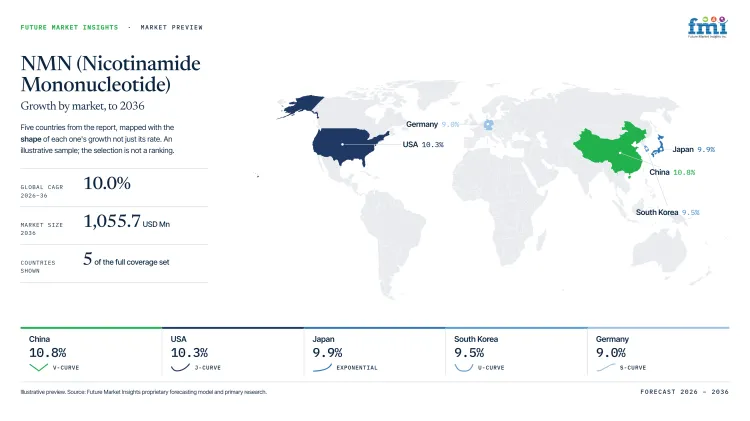
Which country CAGRs are profiled in the NMN (Nicotinamide Mononucleotide) Market?
| Country | CAGR |
|---|---|
| China | 10.8% |
| United States | 10.3% |
| Japan | 9.9% |
| South Korea | 9.5% |
| Germany | 9.0% |
| United Kingdom | 8.5% |
How do country-level CAGRs compare in the NMN (Nicotinamide Mononucleotide) Market?
The country forecasts span 2.3 percentage points and form a gradual progression instead of sharply separated tiers. China and the United States combine production depth or restored supplement access with active digital channels. Japan and South Korea rely on structured notification or import pathways for defined products and ingredient forms. Germany and the United Kingdom apply product-specific novel-food review that can delay coordinated national launches and distributor commitments. Similar growth rates therefore conceal different legal routes and operating costs across the profiled countries.
- China combines export-oriented NMN production with formal laboratory testing for outbound health-food shipments, but domestic food use remains more restricted.
- United States companies benefit from a restored federal supplement route, although ingredient notification and claim controls continue to shape retailer acceptance.
- Japan rewards prepared companies that can submit complete safety and function-claim files for each finished supplement offered nationally.
- South Korea provides documented import access for specified NMN-enriched yeast material without extending the classification across unrelated high-purity ingredients.
- Germany applies European novel-food controls through exact specifications and requires distributors to confirm legal status to support national inventory commitments.
- The United Kingdom offers a documented regulated-product application route, although an unresolved assessment continues to limit immediate commercial scale.
Comparable CAGRs can produce different commercial outcomes under the distinct ingredient classifications and claim controls applied across national markets. The full report extends national outlooks across North America and Latin America alongside Europe and East Asia. It also examines South Asia and the Middle East and Africa within the broader regional structure.
Country-wise Analysis
- China combines export-oriented health-food manufacturing with a national test method that applies specifically to exported products. NMN sales in China are forecast to expand at 10.8% CAGR by 2036, supported by export manufacturing and a formal content-testing method. China’s General Administration of Customs published SN/T 5870-2025 in December 2025 for measuring NMN content in exported health foods. The standard took effect in July 2026 and gives export laboratories a defined method for consistent content testing. The method supports consistent export testing but does not establish a domestic sale authorization for NMN ingredients or finished supplements.
- United States supplement channels can offer NMN under the clarified federal position, yet each brand remains responsible for safety and labeling compliance. The United States NMN market outlook is anticipated to advance at 10.3% CAGR over the assessment period, supported by restored federal access and established online supplement retail. The Natural Products Association reported in December 2025 that FDA reinstated prior new dietary ingredient responses for NMN. The action improved the route for qualified ingredients and finished products but did not remove formula-specific obligations. Companies serving North American supplements must maintain testing records and claims that survive regulator and retailer review.
- Japan uses a notification system for foods with function claims and places substantial responsibility on the company submitting each finished product. The Japanese NMN market is estimated to post 9.9% CAGR over the forecast period, reinforced by capsule familiarity and a structured function-claim notification system. The Consumer Affairs Agency required new filings from April 2025 to use its updated national notification database. Required materials cover safety and manufacturing quality alongside functional evidence and labeling controls for every submitted product. The system supports organized access for prepared brands but raises documentation costs and requires dependable Japanese compliance support.
- South Korea provides a documented import route for specified NMN-containing yeast ingredients rather than unrestricted access for every high-purity powder. The South Korean NMN market sector is projected to record 9.5% CAGR during the assessment period, aided by a documented import route for specified NMN-enriched yeast material. The Ministry of Food and Drug Safety issued an import record in March 2026 for yeast extract containing 30% NMN. The record identified the product classification and the manufacturer responsible for producing the imported ingredient. The route supports defined formats but unrelated ingredient forms may require separate review and cannot rely on the same classification.
- Germany applies the European Union novel-food framework to NMN and requires premarket authorization for each relevant ingredient specification. Adoption of NMN supplements in Germany is estimated to expand at 9.0% CAGR through 2036, shaped by premium supplement demand and product-specific novel-food authorization. The European Commission classified NMN with 95% to 99% purity as novel food in October 2022. The classification gives companies a defined legal test without providing automatic authorization for every commercial product or ingredient source. German distributors need exact specification confirmation and compliant national labeling to support inventory commitments across pharmacy and specialist channels.
- United Kingdom commercialization depends on the regulated-product application route and cannot proceed from European scientific review alone. NMN demand in the United Kingdom is forecast to rise at 8.5% CAGR over the forecast period, influenced by established supplement demand and an active regulated-product application route. The Food Standards Agency listed EffePharm’s beta-NMN application as an in-progress assessment in July 2026. The register identifies the applicant and the exact ingredient being examined through the national regulated-product process. Final authorization remains unresolved and requires companies to retain flexible launch plans plus compliant claims and local distribution agreements.
Who are the notable companies in the NMN (Nicotinamide Mononucleotide) Market?
BONTAC, EffePharm, SyncoZymes, Xiamen Kingdomway Group, CELFULL, MIRAILAB BIOSCIENCE, Renue By Science Inc., and ProHealth, Inc. are notable companies shaping this market.
-market-analysis-by-company.webp "Nmn (nicotinamide Mononucleotide) Market Analysis By Company")
Competition spans ingredient manufacturers and finished-product companies with different control over purity and delivery. BONTAC reported in November 2025 that its purification process maintained NMN purity above 99.5% during expanded international exhibition activity. EffePharm and SyncoZymes advanced formal market-access routes during 2025, and Xiamen Kingdomway Group connected ingredient compliance with nutraceutical product development through Doctor’s Best products. CELFULL and MIRAILAB BIOSCIENCE compete through differentiated delivery systems and premium finished formulations for defined wellness routines. Renue By Science and ProHealth extend consumer access through several capsule and powder options sold across online supplement channels. The finished-product positions overlap with beauty nutrition formats that use healthy-aging language across oral wellness portfolios.
- BONTAC and SyncoZymes represent ingredient specialists with documented NMN manufacturing and formal access records across several jurisdictions. Their commercial position depends on repeatable synthesis and analytical documentation that downstream brands can use during ingredient qualification and national filings.
- EffePharm and Xiamen Kingdomway Group connect ingredient development with regulatory planning and finished-product commercialization across several major supplement markets. Their advantage comes from matching exact specifications with country requirements instead of assuming one filing covers every ingredient source or dosage design.
- CELFULL and MIRAILAB BIOSCIENCE differentiate through delivery technology and premium finished formulas designed for distinct daily wellness routines. Renue By Science and ProHealth broaden consumer choice across capsules and powders, although each company must align product claims with the evidence available for its exact formulation.
Competitive Benchmarking: NMN (Nicotinamide Mononucleotide) Market
| Company | Ingredient and Quality Control | Formulation Breadth | Commercial Route Evidence | Geographic Reach |
|---|---|---|---|---|
| BONTAC | High | Low | Low | Asia, Europe, and North America |
| EffePharm | High | Medium | Medium | Asia, Europe, and North America |
| SyncoZymes | High | Low | High | China and the United States |
| Xiamen Kingdomway Group | High | Medium | High | China and North America |
| CELFULL | Low | High | Low | China and Europe |
| MIRAILAB BIOSCIENCE | Medium | Medium | Medium | Japan |
| Renue By Science Inc. | Medium | High | Low | United States online market |
| ProHealth, Inc. | Medium | High | Low | United States and Singapore online markets |
Key Developments in the NMN (Nicotinamide Mononucleotide) Market
- In April 2025, BONTAC presented a broader NAD+ ingredient portfolio at Health Food Expo 2025 in Tokyo. The display included NMN and reduced NMN alongside other coenzyme ingredients supported by the company’s patented production work. The development expanded BONTAC’s commercial offer beyond one precursor and gave supplement formulators additional options for differentiated NAD+ products. Each ingredient requires separate specification review and claim controls within its intended national market and finished formulation.
- In September 2025, EffePharm announced that Uthever NMN and its LipoAvail delivery technology would be presented at Vitafoods Asia. The company connected a defined NMN ingredient with a delivery platform intended for finished supplement development. The announcement showed how ingredient companies are extending their commercial role into formulation support rather than relying on bulk powder supply alone. Finished-product claims remain dependent on evidence that matches the selected formulation and its stated dosage conditions.
- In December 2025, SyncoZymes reported that FDA had restored the company’s NMN new dietary ingredient notifications. The restored records covered the company’s named beta-NMN ingredient and re-established a documented United States route following the earlier regulatory dispute. The development gives downstream brands a clearer basis for ingredient qualification and coordinated national market planning. It does not remove safety and labeling responsibilities for the finished supplement offered to consumers.
- In December 2025, Xiamen Kingdomway Group reported that its Inner Mongolia subsidiary completed FDA-related NMN procedures and received an acknowledgement letter. The company linked the outcome with renewed United States planning for Doctor’s Best NMN products. The development joined an ingredient-level compliance step with a documented finished-product commercialization route in the United States. Each formulation remains subject to its own serving instructions and compliant retail claims across every selected distribution channel.
NMN (Nicotinamide Mononucleotide) Market - Report Scope
| Coverage field | Report scope |
|---|---|
| Market breakdown | Purity grade, form, application, distribution channel, and region. |
| Quantitative Units | Revenue in USD Million and CAGR in %. |
| Market Definition | Nicotinamide mononucleotide ingredients and finished oral supplements positioned as NAD+ precursors across healthy-aging and wellness applications. |
| Regions Covered | North America, Latin America, Europe, East Asia, South Asia, Oceania, and Middle East and Africa. |
| Countries Covered | China, United States, Japan, South Korea, Germany, and United Kingdom. |
| Key Companies Profiled | BONTAC, EffePharm, SyncoZymes, Xiamen Kingdomway Group, CELFULL, MIRAILAB BIOSCIENCE, Renue By Science Inc., and ProHealth, Inc. |
| Forecast Period | 2026 to 2036. |
| Approach | Hybrid bottom-up and top-down market sizing supported by primary interviews and official desk research. |
NMN (Nicotinamide Mononucleotide) Market - Research Methodology
| Method | Approach |
|---|---|
| Primary Research | FMI analysts gathered input from manufacturers, service providers, technology developers, distributors, end users, procurement teams, and subject-matter experts. Interviews examined purchasing decisions, product or service evaluation, adoption barriers, approval requirements, pricing considerations, and expectations for technical or commercial support. Respondents were also asked what evidence is required before a trial, pilot, or initial order develops into regular purchasing. |
| Desk Research | Desk research covered government statistics, regulatory publications, trade data, industry associations, technical literature, standards, company filings, product information, and official corporate announcements. Sources were reviewed for relevance, publication date, geographic coverage, and consistency with the defined market scope. Claims relating to performance, applications, approvals, capacity, investment, and commercial activity were retained only when supported by credible public evidence. |
| Market Sizing and Forecasting | The market model combined the baseline value with historical performance, segment structure, pricing and volume indicators, adoption levels, company participation, and country-level demand conditions. Forecast assumptions considered economic activity, investment trends, regulatory developments, technology adoption, purchasing cycles, supply availability, and barriers to wider market use. Segment and regional estimates were reconciled before the final market total was calculated. |
| Data Validation | Estimates were checked against multiple independent indicators, including public data, company activity, trade patterns, industry developments, and findings from primary interviews. Validation also tested whether products, services, applications, and company revenues fell within the defined market boundaries. Adjacent categories, unsupported claims, overlapping revenues, and activities without direct market relevance were excluded to reduce double counting and maintain consistency across segments and countries. |
NMN (Nicotinamide Mononucleotide) Market by Segments
NMN (Nicotinamide Mononucleotide) Market segmented by Purity Grade:
- ≥98%
- <98%
NMN (Nicotinamide Mononucleotide) Market segmented by Form:
- Capsules
- Powder
- Softgels
- Liquid
NMN (Nicotinamide Mononucleotide) Market segmented by Application:
- Anti-aging and Longevity
- Cognitive Health
- Metabolic Health
- Sports Nutrition
NMN (Nicotinamide Mononucleotide) Market segmented by Distribution Channel:
- Online
- Offline Retail
- Pharmacies and Drugstores
NMN (Nicotinamide Mononucleotide) Market by Region:
- North America
- United States
- Latin America
- Western Europe
- Germany
- United Kingdom
- East Asia
- China
- Japan
- South Korea
- South Asia and Pacific
- Middle East and Africa
Research Sources and Bibliography
- MIRAILAB BIOSCIENCE Inc. (2025, September 5). [Monday, September 8, 2025] MIRAILAB Wellness Branch, Japan’s first directly operated NMN specialty store, will open in Ginza, Tokyo.
- USA Food and Drug Administration. (2026, April 17). Submitted 75-Day Premarket Notifications for New Dietary Ingredients.
- EFSA Panel on Nutrition, Novel Foods and Food Allergens. (2026, May 11). Safety of beta-nicotinamide mononucleotide (β-NMN) pursuant the regulation (EU) 2015/2283 and the bioavailability of nicotinamide from this source in the context of Directive 2002/46/EC.
- Doctor’s Best. (2026, January 19). Doctor’s Best Celebrates FDA Decision on NMN Supplements, Relaunches Product Line.
- MIRAILAB BIOSCIENCE Inc. (2026, January 30). [New Release: January 30, 2026] Introducing “NMN × Sulforaphane,” New supplement designed for internal balance, featuring 3,000 mg of NMN per bottle.
- Natural Products Association. (2025, September 29). Amid Pressure From NPA, FDA Declares NMN Lawful In Dietary Supplements.
- Council for Responsible Nutrition. (2025, September 29). CRN Dismayed by FDA’s Response to its Citizen Petition on Drug Preclusion.
- EffePharm. (2025, March 11). NMN Novel Food Status: UTHEVER® NMN Leads the EU Compliance Race.
- Therapeutic Goods Administration. (2025, December 10). Update to listed medicine ingredients in December 2025.
- General Administration of Customs of the People’s Republic of China. (2025, December 11). [Determination of nicotinamide mononucleotide content in exported health foods] (SN/T 5870-2025).
- Natural Products Association. (2025, December 10). FDA Reinstates NMN as Dietary Supplement After NPA Lawsuit.
- Consumer Affairs Agency, Government of Japan. (2025, April 1). [Notifications for foods with function claims: Guidance for food businesses].
- Ministry of Food and Drug Safety. (2026, March 4). (NMN30%) [Imported product detail: NMN enriched yeast extract (NMN 30%)].
- European Commission. (2022, October 11). Consultation process on novel food status.
- Food Standards Agency. (2026, July 1). β-Nicotinamide mononucleotide (RP-2116).
- BONTAC. (2025, November 7). BONTAC Biotech Successfully Concludes Its 2025 Overseas Exhibitions.
- BONTAC. (2025, April 28). BONTAC Unveils Next-Gen NAD+ Supplements at Health Food Expo 2025.
- EffePharm. (2025, September 8). Vitafoods Asia 2025 Preview: EffePharm to Present Uthever®, UthPeak®, and LipoAvail™ Advances.
- SyncoZymes (Shanghai) Co., Ltd. (2025, December 9). NDI [FDA formally restores SyncoZymes NMN ingredient NDI notifications].
- Xiamen Kingdomway Group Co., Ltd. (2025, December 23). [Kingdomway NMN completes FDA-related compliance procedures].
- CELFULL. (2026, April 23). CELFULL to Redefine Longevity Standards with “Serious Anti-Aging” Clinical Tech at Vitafoods Europe 2026.
- CELFULL. (2024, January 17). CELFULL NMN Microspheres.
- MIRAILAB BIOSCIENCE Inc. (2026, June 16). [New Release: Friday, June 12, 2026] Next-Generation Supplement Formulated with NMNH (Reduced NMN) - The New Era of Aging Care, Powered by NMNH.
- Renue By Science Inc. (2025, November 7). The Complete Guide to Choosing Your Optimal NMN Formula: Evidence-Based Recommendations for Personalized NAD+ Support.
- ProHealth. (2025, September 29). FDA Confirms NMN Is Lawful in Dietary Supplements.
- Florida Department of State, Division of Corporations. (2026, March 26). Detail by entity name: Renue By Science Inc.
This bibliography is provided for reader reference and is not exhaustive. The full report contains the complete reference list and detailed citations.
This Report Answers
- How large is the NMN (nicotinamide mononucleotide) market in 2026 and 2036?
- Why does the ≥98% purity grade account for the largest share in 2026?
- How do capsule formats support measured dosing and consistent commercial production?
- Why do anti-aging and longevity applications remain central to NMN positioning?
- How does online distribution influence product comparison and compliance risk?
- Which regulatory conditions distinguish China, the United States, Japan, South Korea, Germany, and the United Kingdom?
- Which companies combine NMN manufacturing with regulatory progress or finished-product formulation?
- What factors limit commercialization despite clearer regulatory routes?
- How should executives evaluate evidence and country-specific market-entry requirements?
Frequently Asked Questions
How big is the NMN (Nicotinamide Mononucleotide) Market in 2026?
The NMN (nicotinamide mononucleotide) market is valued at USD 407.0 million in 2026 and is forecast to reach USD 1055.7 million by 2036. Growth is supported by rising consumer interest in healthy aging solutions, regulatory clarification across key markets, and the gradual expansion of compliant NMN-based products through online and specialist retail channels.
What is the CAGR of the NMN (Nicotinamide Mononucleotide) Market from 2026 to 2036?
The NMN (nicotinamide mononucleotide) market grows at a CAGR of 10.0% between 2026 and 2036, supported by clearer ingredient authorization routes, restored supplement access in the United States, and increasing brand investment in purity-documented formulations that meet retailer and regulatory requirements across established online and pharmacy distribution channels.
Which application segment leads the NMN (Nicotinamide Mononucleotide) Market?
Anti-aging and longevity applications account for 65.0% of the NMN (nicotinamide mononucleotide) market by application in 2026, driven by wellness positioning around NAD+ precursor supplementation that allows brands to build recurring consumer routines without relying on unsupported therapeutic claims tied to age-related conditions or acute treatment expectations.
How much will the NMN (Nicotinamide Mononucleotide) Market add between 2026 and 2036?
The NMN (nicotinamide mononucleotide) market is set to add USD 648.7 million between 2026 and 2036, growing from USD 407.0 million to USD 1055.7 million as purity-documented ingredients and compliant finished formulas enter funded retail and pharmacy channels across a widening base of authorized national markets.
Who are the leading companies in the NMN (Nicotinamide Mononucleotide) Market?
Eight companies shape the NMN (nicotinamide mononucleotide) market, including BONTAC, EffePharm, SyncoZymes, Xiamen Kingdomway Group, CELFULL, MIRAILAB BIOSCIENCE, Renue By Science Inc., and ProHealth Inc., competing through ingredient purity controls, delivery technology, regulatory route development, and finished-product formulation across online and specialist supplement channels worldwide.
Preview the report firsthand - request a free sample
Get SampleGet the brochure for pricing and purchase details.
Get PDFTable of Content
- Key Takeaways
- Market Size and CAGR
- Top Growth Driver
- Fastest Growing Segment
- Leading Region
- Key Companies
- Emerging Opportunities
- Executive Summary
- Global Market Outlook
- Demand-side Trends
- Supply-side Trends
- Technology Roadmap Analysis
- Analysis and Recommendations
- Analyst Perspective (What is happening? Why now? What should investors know?)
- Key Questions Answered
- How large is the market?
- What is the CAGR?
- What are key trends?
- Which region dominates?
- Who are the leaders?
- Market Overview
- Market Coverage / Taxonomy
- Market Definition / Scope / Limitations
- Research Methodology
- Chapter Orientation
- Analytical Lens and Working Hypotheses
- Market Structure, Signals, and Trend Drivers
- Benchmarking and Cross-market Comparability
- Market Sizing, Forecasting, and Opportunity Mapping
- Research Design and Evidence Framework
- Desk Research Programme (Secondary Evidence)
- Expert Input and Fieldwork (Primary Evidence)
- Tooling, Models, and Reference Databases
- Data Engineering and Model Build
- Quality Assurance and Audit Trail
- Market Background
- Market Dynamics (Drivers, Restraints, Opportunity, Trends)
- Scenario Forecast (Optimistic, Likely, Conservative)
- Impact Analysis
- AI Impact
- Sustainability Impact
- Regulatory Impact
- Technology Impact
- Consumer / Buyer Analysis
- Purchase Drivers
- Adoption Barriers
- Buyer Journey
- Opportunity Map Analysis
- Product Life Cycle Analysis
- Supply Chain Analysis
- Investment Feasibility Matrix
- Value Chain Analysis
- PESTLE and Porter's Analysis
- Regulatory Landscape
- Regional Parent Market Outlook
- Production and Consumption Statistics
- Import and Export Statistics
- Global Market Analysis and Forecast, 2021 to 2036
- Historical Market Size Value (USD Million) Analysis, 2021 to 2025
- Current and Future Market Size Value (USD Million) Projections, 2026 to 2036
- Y-o-Y Growth Trend Analysis
- Absolute $ Opportunity Analysis
- Global Market Pricing Analysis, 2021 to 2036
- Global Market Analysis and Forecast, By Purity Grade, 2021 to 2036
- Introduction / Key Findings
- Historical Market Size Value (USD Million) Analysis By Purity Grade, 2021 to 2025
- Current and Future Market Size Value (USD Million) Analysis and Forecast By Purity Grade, 2026 to 2036
- ≥98%
- <98%
- ≥98%
- Y-o-Y Growth Trend Analysis By Purity Grade, 2021 to 2025
- Absolute $ Opportunity Analysis By Purity Grade, 2026 to 2036
- Global Market Analysis and Forecast, By Form, 2021 to 2036
- Introduction / Key Findings
- Historical Market Size Value (USD Million) Analysis By Form, 2021 to 2025
- Current and Future Market Size Value (USD Million) Analysis and Forecast By Form, 2026 to 2036
- Capsules
- Powder
- Softgels
- Liquid
- Capsules
- Y-o-Y Growth Trend Analysis By Form, 2021 to 2025
- Absolute $ Opportunity Analysis By Form, 2026 to 2036
- Global Market Analysis and Forecast, By Application, 2021 to 2036
- Introduction / Key Findings
- Historical Market Size Value (USD Million) Analysis By Application, 2021 to 2025
- Current and Future Market Size Value (USD Million) Analysis and Forecast By Application, 2026 to 2036
- Anti-aging & Longevity
- Cognitive Health
- Metabolic Health
- Sports Nutrition
- Anti-aging & Longevity
- Y-o-Y Growth Trend Analysis By Application, 2021 to 2025
- Absolute $ Opportunity Analysis By Application, 2026 to 2036
- Global Market Analysis and Forecast, By Distribution Channel, 2021 to 2036
- Introduction / Key Findings
- Historical Market Size Value (USD Million) Analysis By Distribution Channel, 2021 to 2025
- Current and Future Market Size Value (USD Million) Analysis and Forecast By Distribution Channel, 2026 to 2036
- Online
- Offline Retail
- Pharmacies & Drugstores
- Online
- Y-o-Y Growth Trend Analysis By Distribution Channel, 2021 to 2025
- Absolute $ Opportunity Analysis By Distribution Channel, 2026 to 2036
- Global Market Analysis and Forecast, By Region, 2021 to 2036
- Introduction
- Historical Market Size Value (USD Million) Analysis By Region, 2021 to 2025
- Current Market Size Value (USD Million) Analysis and Forecast By Region, 2026 to 2036
- North America
- Latin America
- Western Europe
- Eastern Europe
- East Asia
- South Asia and Pacific
- Middle East & Africa
- Market Attractiveness Analysis By Region
- North America Market Analysis and Forecast, By Country, 2021 to 2036
- Historical Market Size Value (USD Million) Trend Analysis By Market Taxonomy, 2021 to 2025
- Market Size Value (USD Million) Forecast By Market Taxonomy, 2026 to 2036
- By Country
- USA
- Canada
- By Purity Grade
- By Form
- By Application
- By Distribution Channel
- By Country
- Market Attractiveness Analysis
- By Country
- By Purity Grade
- By Form
- By Application
- By Distribution Channel
- Key Takeaways
- Latin America Market Analysis and Forecast, By Country
- Historical Market Size Value (USD Million) Trend Analysis By Market Taxonomy, 2021 to 2025
- Market Size Value (USD Million) Forecast By Market Taxonomy, 2026 to 2036
- By Country
- Brazil
- Mexico
- Chile
- Rest of Latin America
- By Purity Grade
- By Form
- By Application
- By Distribution Channel
- By Country
- Market Attractiveness Analysis
- By Country
- By Purity Grade
- By Form
- By Application
- By Distribution Channel
- Key Takeaways
- Western Europe Market Analysis and Forecast, By Country
- Historical Market Size Value (USD Million) Trend Analysis By Market Taxonomy, 2021 to 2025
- Market Size Value (USD Million) Forecast By Market Taxonomy, 2026 to 2036
- By Country
- Germany
- UK
- Italy
- Spain
- France
- Nordic
- BENELUX
- Rest of Western Europe
- By Purity Grade
- By Form
- By Application
- By Distribution Channel
- By Country
- Market Attractiveness Analysis
- By Country
- By Purity Grade
- By Form
- By Application
- By Distribution Channel
- Key Takeaways
- Eastern Europe Market Analysis and Forecast, By Country
- Historical Market Size Value (USD Million) Trend Analysis By Market Taxonomy, 2021 to 2025
- Market Size Value (USD Million) Forecast By Market Taxonomy, 2026 to 2036
- By Country
- Russia
- Poland
- Hungary
- Balkan & Baltic
- Rest of Eastern Europe
- By Purity Grade
- By Form
- By Application
- By Distribution Channel
- By Country
- Market Attractiveness Analysis
- By Country
- By Purity Grade
- By Form
- By Application
- By Distribution Channel
- Key Takeaways
- East Asia Market Analysis and Forecast, By Country
- Historical Market Size Value (USD Million) Trend Analysis By Market Taxonomy, 2021 to 2025
- Market Size Value (USD Million) Forecast By Market Taxonomy, 2026 to 2036
- By Country
- China
- Japan
- South Korea
- By Purity Grade
- By Form
- By Application
- By Distribution Channel
- By Country
- Market Attractiveness Analysis
- By Country
- By Purity Grade
- By Form
- By Application
- By Distribution Channel
- Key Takeaways
- South Asia and Pacific Market Analysis and Forecast, By Country
- Historical Market Size Value (USD Million) Trend Analysis By Market Taxonomy, 2021 to 2025
- Market Size Value (USD Million) Forecast By Market Taxonomy, 2026 to 2036
- By Country
- India
- ASEAN
- Australia & New Zealand
- Rest of South Asia and Pacific
- By Purity Grade
- By Form
- By Application
- By Distribution Channel
- By Country
- Market Attractiveness Analysis
- By Country
- By Purity Grade
- By Form
- By Application
- By Distribution Channel
- Key Takeaways
- Middle East & Africa Market Analysis and Forecast, By Country
- Historical Market Size Value (USD Million) Trend Analysis By Market Taxonomy, 2021 to 2025
- Market Size Value (USD Million) Forecast By Market Taxonomy, 2026 to 2036
- By Country
- Kingdom of Saudi Arabia
- Other GCC Countries
- Türkiye
- South Africa
- Other African Union
- Rest of Middle East & Africa
- By Purity Grade
- By Form
- By Application
- By Distribution Channel
- By Country
- Market Attractiveness Analysis
- By Country
- By Purity Grade
- By Form
- By Application
- By Distribution Channel
- Key Takeaways
- Key Countries Market Analysis
- USA
- Pricing Analysis
- Market Share Analysis, 2025
- By Purity Grade
- By Form
- By Application
- By Distribution Channel
- Canada
- Pricing Analysis
- Market Share Analysis, 2025
- By Purity Grade
- By Form
- By Application
- By Distribution Channel
- Mexico
- Pricing Analysis
- Market Share Analysis, 2025
- By Purity Grade
- By Form
- By Application
- By Distribution Channel
- Brazil
- Pricing Analysis
- Market Share Analysis, 2025
- By Purity Grade
- By Form
- By Application
- By Distribution Channel
- Chile
- Pricing Analysis
- Market Share Analysis, 2025
- By Purity Grade
- By Form
- By Application
- By Distribution Channel
- Germany
- Pricing Analysis
- Market Share Analysis, 2025
- By Purity Grade
- By Form
- By Application
- By Distribution Channel
- UK
- Pricing Analysis
- Market Share Analysis, 2025
- By Purity Grade
- By Form
- By Application
- By Distribution Channel
- Italy
- Pricing Analysis
- Market Share Analysis, 2025
- By Purity Grade
- By Form
- By Application
- By Distribution Channel
- Spain
- Pricing Analysis
- Market Share Analysis, 2025
- By Purity Grade
- By Form
- By Application
- By Distribution Channel
- France
- Pricing Analysis
- Market Share Analysis, 2025
- By Purity Grade
- By Form
- By Application
- By Distribution Channel
- India
- Pricing Analysis
- Market Share Analysis, 2025
- By Purity Grade
- By Form
- By Application
- By Distribution Channel
- ASEAN
- Pricing Analysis
- Market Share Analysis, 2025
- By Purity Grade
- By Form
- By Application
- By Distribution Channel
- Australia & New Zealand
- Pricing Analysis
- Market Share Analysis, 2025
- By Purity Grade
- By Form
- By Application
- By Distribution Channel
- China
- Pricing Analysis
- Market Share Analysis, 2025
- By Purity Grade
- By Form
- By Application
- By Distribution Channel
- Japan
- Pricing Analysis
- Market Share Analysis, 2025
- By Purity Grade
- By Form
- By Application
- By Distribution Channel
- South Korea
- Pricing Analysis
- Market Share Analysis, 2025
- By Purity Grade
- By Form
- By Application
- By Distribution Channel
- Russia
- Pricing Analysis
- Market Share Analysis, 2025
- By Purity Grade
- By Form
- By Application
- By Distribution Channel
- Poland
- Pricing Analysis
- Market Share Analysis, 2025
- By Purity Grade
- By Form
- By Application
- By Distribution Channel
- Hungary
- Pricing Analysis
- Market Share Analysis, 2025
- By Purity Grade
- By Form
- By Application
- By Distribution Channel
- Kingdom of Saudi Arabia
- Pricing Analysis
- Market Share Analysis, 2025
- By Purity Grade
- By Form
- By Application
- By Distribution Channel
- Türkiye
- Pricing Analysis
- Market Share Analysis, 2025
- By Purity Grade
- By Form
- By Application
- By Distribution Channel
- South Africa
- Pricing Analysis
- Market Share Analysis, 2025
- By Purity Grade
- By Form
- By Application
- By Distribution Channel
- USA
- Market Structure Analysis
- Competition Dashboard
- Competition Benchmarking
- Market Share Analysis of Top Players
- By Regional
- By Purity Grade
- By Form
- By Application
- By Distribution Channel
- Emerging Startups
- Innovation Benchmarking
- Competition Analysis
- Competition Deep Dive
- GeneHarbor
- Overview
- Product Portfolio
- Profitability by Market Segments
- Sales Footprint
- Strategy Overview
- Marketing Strategy
- Product Strategy
- Channel Strategy
- Herbalmax
- EffePharm
- Bontac
- CELFULL
- Kingdomway
- ChromaDex (Niagen)
- Shinkowa
- GeneHarbor
- Case Studies
- Success Stories
- Recent Developments
- Competition Deep Dive
- Assumptions & Acronyms Used


