

- Market Size (2026)
- USD 282.2 Mn
- Forecast (2036)
- USD 1161.8 Mn
- CAGR (2026 to 2036)
- 15.2%
How big is Sensor-Based Fertilization Market in 2026?
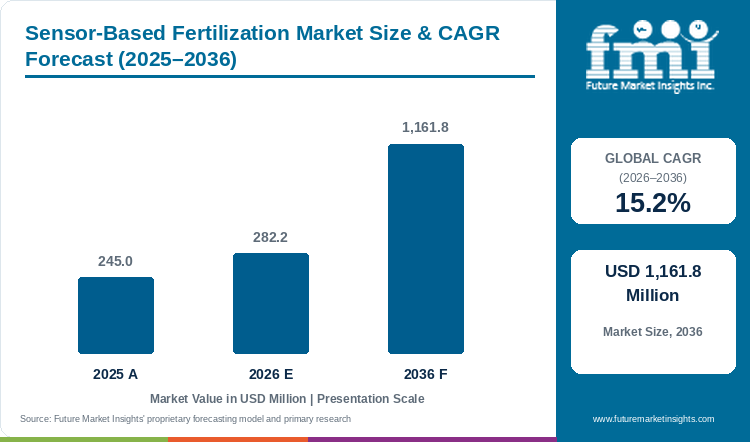
The sensor-based fertilization market is valued at USD 282.2 Million in 2026 and is expected to reach USD 1,161.8 Million by 2036 at a 15.2% CAGR. The market was valued at USD 245.0 Million in 2025.
FMI values the market at USD 282.2 Million in 2026. Demand is projected to reach USD 1,161.8 Million by 2036 at a 15.2% CAGR. Adoption will rise as field data is used directly in fertilizer application through spreaders, planters, drones and fertigation systems. The market was valued at USD 245.0 million in 2025.
Government support will add more opportunities for adoption during the forecast period. For instance, England's 2025 equipment fund offered a 40% grant for eligible nitrogen sensors and controllers added to older spreaders. Japan approved plans in April 2025 to connect sensor data with spraying drones. South Korea's smart-farming plan aims to bring smart technology to 20% of the main field-crop area.
Key Takeaways
- Hardware & Application Systems are estimated to account for 48.7% of share in terms of Offering demand in 2026.
- Drone / UAV-Based technology’s share is estimated at 47.2% by technology in 2026.
- Cereals & Grains will account for 38.8% of Crop Type demand in 2026.
- High equipment cost will remain a key challenge for smaller farms during the forecast period.
Analyst Perspective
Farmers will first assess whether the system can work with existing machinery. If the prescription cannot be used by the spreader, adoption will remain limited. Suppliers will also need to show that lower fertilizer use can offset setup and service costs.
- Nandini Roy Choudhury, Principal Analyst at Future Market Insights
How is the sensor-based fertilization market segmented?
The market is assessed by Offering, Technology, Crop Type, Farm Size and Sales Channel.
Offering comprises Hardware & Application Systems, Software & Analytics, Formulated Inputs (Application-Optimized), Services and Others. Technology includes Drone / UAV-Based, Ground Sensor Networks, Satellite & Imagery-Driven, Variable-Rate Controllers and Others. Crop Type covers Cereals & Grains, Fruits & Vegetables, Oilseeds & Pulses, Turf & Ornamentals and Others. Farm Size is divided into Large (>1,000 ha), Medium (100-1,000 ha) and Small (<100 ha). Sales Channel includes Equipment Dealers, Agri-Input Distributors, Direct / SaaS, Service Providers and Others.
What makes Hardware & Application Systems central to the Offering category?
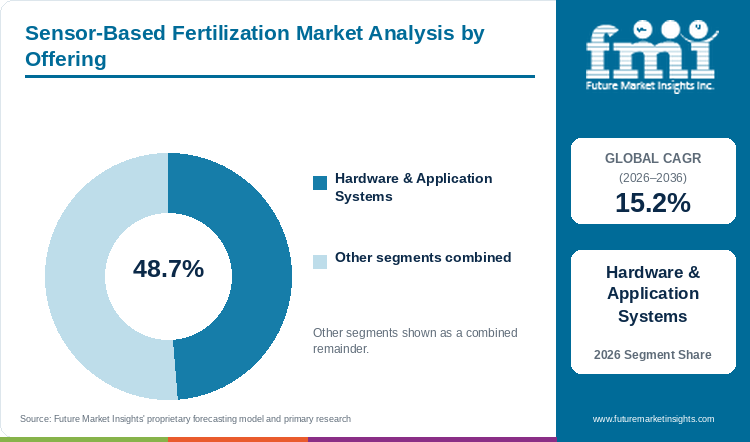
Hardware and application systems are likely to hold 48.7% share in 2026
Demand for Hardware & Application Systems will remain high as fertilizer equipment has to use field information during application. Sensors measure the nitrogen condition of crops, while controllers change fertilizer rates as the spreader works in the field. Farmers using older spreaders can also add controllers rather than replace the complete machine.
- Hardware & Application Systems will hold 48.7% of Offering demand in 2026.
- In March 2026, England's FETF specifications included crop sensors that measure nitrogen requirements and automatically adjust fertilizer rates. The program also included variable-rate controllers that can be fitted to older fertilizer spreaders.
Why does Drone / UAV-Based lead the Technology category?
Drone/UAV segment is estimated at 47.2% share by technology in 2026
Drone / UAV-Based systems are gaining demand as the same equipment can be used across several fields and farms. Unlike ground sensors that generally remain at one location, drones can be moved as required. They can also be used to check crop conditions before spraying or spreading. This is supporting their use among growers with scattered fields and those using drone services. Flight restrictions and limited carrying capacity can still affect the amount of work completed in a single trip.
- Drone / UAV-Based technology will account for 47.2% of Technology demand in 2026.
- In April 2024, DJI Agriculture launched the Agras T50 and T25 internationally for spraying and spreading. The company stated that its agricultural drones had covered more than 980 million acres across over 100 countries and regions by that time.
Why are Cereals & Grains central to the Crop Type category?
Cereals & grains are estimated at 38.8% share in 2026.
Cereal crops receive fertilizer several times during the growing season, creating more opportunities to adjust application rates. Sensors and field maps can show where crop growth differs across the field. Fertilizer rates can then be changed in these areas during application.
- Cereals & Grains will account for 38.8% of Crop Type demand in 2026.
- USDA ERS reported variable-rate technology on 37.4% of planted U.S. corn acres in 2016 and 18.8% of winter-wheat acres in 2017. The figures cover variable-rate technology, not the use of live sensors.
Why do Large (>1,000 ha) farms lead the Farm Size category?
Large farms are likely to account for higher demand as the same controller can be used across a wider crop area. The equipment can be used over several fields and during more than one fertilizer application. Many large farms also already use guidance systems, reducing the amount of additional equipment required.
- Large (>1,000 ha) farms will account for 53.2% of Farm Size demand in 2026.
- USDA ERS reported that 70% of large-scale U.S. crop farms used guidance or autosteering in 2023. Another 68% used yield monitors, yield maps or soil maps. Use of these technologies was lower among small family farms.
Why do Equipment Dealers lead the Sales Channel category?
Equipment Dealers will hold 38.4% of Sales Channel demand in 2026.
Equipment dealers will offer precision fertilizer suppliers a wider route to farms during the forecast period. Farmers adding controllers to older spreaders need support with fitting and setup. The controller also has to work with the existing machine and maintain the required fertilizer rate during application. Dealer support for repairs and servicing will keep this channel important after installation.
- As per FMI's report, Equipment Dealers will hold 38.4% of Sales Channel demand in 2026.
- In May 2025, AGCO said that more than 50 additional Fendt and Massey Ferguson dealers in the United States and Canada had added PTx solutions within a year. The expansion increased local access to PTx equipment and service.
What are the drivers, restraints and opportunities in the sensor-based fertilization market?
Efficient use of fertilizers and proven improvements remain a key driver, whereas these sensors are limited to only large landholdings remains a key restraint.
Demand for sensor-based fertilization will grow as farmers look to reduce fertilizer use in parts of the field that need less. However, high equipment costs and compatibility with machines from different brands can restrict adoption among smaller farms. Retrofitting controllers to spreaders already in use will create more opportunities during the forecast period.
- Driver: Ability to change fertilizer rates according to crop conditions will help farmers reduce unnecessary fertilizer use.
- Restraint: High equipment costs and compatibility issues will restrict adoption, particularly among smaller farms.
- Opportunity: Adding controllers to existing spreaders will reduce the need for complete equipment replacement.
Adoption of variable-rate technology has increased as farmers look for better control over fertilizer and other inputs. USDA ERS reported that variable-rate technology was used on 11.5% of U.S. corn acres in 2005 and 37.4% in 2016. Sensors can improve these applications by showing where crop conditions have changed from earlier field maps.
High equipment cost will remain a key restraint for smaller farms as the investment is spread across less land. USDA ERS also reported in 2024 that precision technology was more common on larger farms. Compatibility between equipment brands can add another barrier. Bayer noted in 2024 that prescription files were often transferred to farm equipment by thumb drive, adding another step before a new prescription could be used.
Retrofitting existing equipment will create opportunities for wider adoption during the forecast period. England's 2025 FETF offered a 40% grant rate for eligible controllers fitted to older spreaders. This allowed farmers to retain equipment already in use. For the 2026 season, Bayer and John Deere also added wireless transfer of FieldView prescriptions into John Deere Operations Center, removing the need to transfer files manually before field work.
Which country CAGRs are profiled in the sensor-based fertilization market?
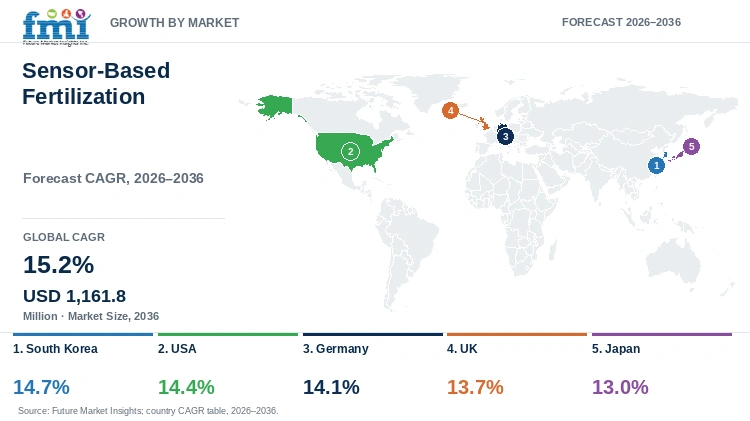
| Country | CAGR |
|---|---|
| South Korea | 14.7% |
| USA | 14.4% |
| Germany | 14.1% |
| UK | 13.7% |
| Japan | 13.0% |
How do country-level CAGRs compare in the sensor-based fertilization market?
Sensor-based fertilization market growth across the five profiled countries will span 1.7 percentage points through 2036. South Korea will lead at 14.7%, while Japan will record the lowest growth at 13.0%. Smart-farming programs, existing precision equipment, fertilizer rules and equipment grants will account for much of the difference.
- Demand for sensor-based fertilization will grow fastest in South Korea at a 14.7% CAGR. The country’s smart-farming plan will bring more technology into field-crop farming.
- Adoption in the USA will benefit from the existing use of guidance and variable-rate equipment across farms.
- Fertilizer application rules in Germany will support demand for systems that help farmers record and control fertilizer use.
- Grants for crop-nitrogen sensors and rate controllers will support adoption in the UK.
- Japan will grow at a 13.0% CAGR, the slowest among the five profiled countries. Approved programs linking sensor data with drones and variable fertilizer maps will support demand.
Country-wise Analysis
- South Korea's 2025-2029 smart-farming plan is taking smart technology beyond greenhouse farming and into field crops. The plan targets 20% of the main field-crop area and supports wider use of drones and robots in open fields. Suppliers with local training and service will have more room as adoption expands. Demand for sensor-based fertilization in South Korea will grow at a 14.7% CAGR through 2036, the fastest among the profiled countries.
- Large farms in the USA already use much of the equipment needed to add sensor-based fertilization. USDA ERS reported that 70% of large-scale crop farms used guidance or autosteering in 2023, while 68% used yield monitors, yield maps or soil maps. New systems will still need to show clear fertilizer savings before farmers add another layer of technology. Growth of the sensor-based fertilization market in the USA will reach a 14.4% CAGR till 2036.
- Fertilizer application in Germany already has to reflect crop and soil needs. Sensors can help farmers decide where rates should change, but the prescription still has to work with the spreader or other equipment already on the farm. Compatibility will remain important as more farms move from mapping to in-field adjustment. Demand in Germany will rise at a 14.1% CAGR through 2036.
- England's 2025 equipment fund lowered the upfront cost of crop-nitrogen sensors and controllers fitted to older spreaders, with eligible equipment receiving a 40% grant rate. Farmers could therefore add control systems without replacing the complete machine. Sales of sensor-based fertilization systems in the UK will grow at a 13.7% CAGR through 2036.
- Programs approved in Japan in April 2025 linked sensor data with spraying drones and variable fertilizer maps. Smaller farms can also use these systems through service providers instead of owning all the equipment. Japan will record a 13.0% CAGR till 2036, the slowest among the five profiled countries.
Who are the notable companies in the sensor-based fertilization market?
FMI groups profiled suppliers into three strategy groups. Sentera and Climate LLC (Bayer) focus on field sensing and prescription data. Netafim (Orbia), DJI Agriculture and XAG cover fertilizer application through fertigation and drones. John Deere, Trimble Agriculture and AGCO (Precision Planting) connect rate control with farm machinery and retrofit systems.
- Field Sensing and Prescription Platforms: Sentera and Climate LLC (Bayer) use field data to determine where fertilizer is needed and how much should be applied.
- Fertigation and Aerial Application Systems: Netafim (Orbia) applies nutrients through irrigation, while DJI Agriculture and XAG supply drone-based application systems.
- Machinery Control and Retrofit Platforms: John Deere, Trimble Agriculture and AGCO (Precision Planting) connect fertilizer-rate control with farm machinery and systems already in use.
Competitive Benchmarking: Sensor-Based Fertilization Market
| Company | Sensing & Prescription | Nutrient Application Control | Mixed-Fleet Integration | Geographic Reach |
|---|---|---|---|---|
| Sentera | High | Low | Medium | United States; broader workflow reach through major equipment and drone integrations |
| Climate LLC (Bayer) | High | Medium | High | 23 countries as of November 2024 |
| Netafim (Orbia) | Medium | High | Low | More than 100 countries through Netafim’s irrigation and fertigation business |
| DJI Agriculture | Medium | High | Low | More than 100 countries and regions reported in April 2024 |
| XAG | High | High | Low | China and international agricultural-drone markets; Vietnam deployment is documented |
| John Deere | High | High | High | North America and other connected John Deere equipment markets; availability varies by product |
| Trimble Agriculture | Medium | High | High | Global precision-agriculture reseller and equipment-integration markets |
| AGCO (Precision Planting) | Medium | High | High | United States and Canada through expanded PTx dealer coverage; broader OEM channels |
Scoring basis: Sensing & Prescription covers field measurement and fertilizer instructions. Nutrient Application Control covers equipment that changes fertilizer delivery. Mixed-Fleet Integration covers use with different machine brands and older equipment as well as outside prescription tools. High denotes broad documented capability. Medium denotes a narrower one. Low denotes a documented limit or insufficient public evidence for a higher rating.
Key Developments in the Sensor-Based Fertilization Market
- In February 2026, Climate LLC (Bayer) and John Deere added wireless transfer of FieldView prescriptions into John Deere Operations Center Work Plans for U.S. customers. Farmers no longer need to move the files with a thumb drive.
- DJI Agriculture launched the Agras T100, T70P and T25P worldwide in July 2025. The drones can spray and spread inputs, giving growers and service providers more equipment options.
- XAG and PIX4D partnered in October 2024 to support prescription maps on XAG agricultural drones. The map can change the fertilizer rate as the drone moves across different parts of the field.
Key Players in the Sensor-Based Fertilization Market
Agronomic Sensing and Prescription Platforms
- Sentera
- Climate LLC (Bayer)
Automated Nutrient Application Systems
- Netafim (Orbia)
- DJI Agriculture
- XAG
- John Deere
Mixed-Fleet Control and Retrofit Ecosystems
- Trimble Agriculture
- AGCO (Precision Planting)
Sensor-Based Fertilization Market - Report Scope
| Coverage field | Report scope |
|---|---|
| Market breakdown | Offering; Technology; Crop Type; Farm Size; Sales Channel |
| Quantitative Units | USD Million |
| Market Definition | Includes revenue from sensor-based fertilization products and directly tied services within the stated segmentation. This covers sensing and application hardware, software and analytics, application-optimized formulated inputs when specifically sold for sensor-guided use, and related setup or managed services. It excludes downstream crop or food revenue, generic fertilizer sales without a sensor-guided application link, unrelated machinery and adjacent crop-protection-only systems. |
| Regions Covered | North America; Latin America; Western Europe; Eastern Europe; East Asia; South Asia and Pacific; Middle East and Africa |
| Countries Covered | USA; UK; Germany; Japan; South Korea |
| Key Companies Profiled | Sentera; Climate LLC (Bayer); Netafim (Orbia); DJI Agriculture; XAG; John Deere; Trimble Agriculture; AGCO (Precision Planting) |
| Forecast Period | 2026 to 2036 |
| Approach | Primary and secondary research with market triangulation. |
Sensor-Based Fertilization Market - Research Methodology
| Method | Approach |
|---|---|
| Primary Research | FMI analysts gathered input from manufacturers and service providers as well as technology developers. They also spoke with distributors and end users. Procurement teams and subject-matter experts supplied further views. Interviews examined purchasing decisions and product evaluation. They covered adoption barriers, approval requirements and pricing. Respondents discussed technical and commercial support. They also described the evidence needed before a trial or pilot becomes regular purchasing. |
| Desk Research | Desk research covered government statistics and regulatory publications. Analysts reviewed trade data and industry associations along with technical literature. Standards and company filings were also examined with product information. Official corporate announcements supplied dated developments. Sources were checked for relevance and publication date as well as geographic coverage and consistency with market scope. Claims about performance and applications were retained only when supported by credible public evidence. The same standard applied to approvals and capacity as well as investment and commercial activity. |
| Market Sizing and Forecasting | The model combined the baseline value with historical performance and segment structure. Pricing and volume indicators were considered alongside adoption levels. Company participation and country demand conditions were also assessed. Forecast assumptions covered economic activity and investment trends. They also covered regulation and technology adoption as well as purchasing cycles, supply availability and barriers to wider use. Segment and regional estimates were reconciled before the final market total was calculated. |
| Data Validation | Estimates were checked against public data and company activity. Trade patterns and industry developments supplied further independent indicators alongside primary interviews. Validation tested whether products and services belonged within the defined market. The same check covered applications and company revenue. Adjacent categories and unsupported claims were excluded. Overlapping revenues and activities without direct relevance were also removed to limit double counting across segments and countries. |
Sensor-Based Fertilization Market by Segments
Sensor-Based Fertilization Market segmented by Offering:
- Hardware & Application Systems
- Software & Analytics
- Formulated Inputs (Application-Optimized)
- Services
- Others
Sensor-Based Fertilization Market segmented by Technology:
- Drone / UAV-Based
- Ground Sensor Networks
- Satellite & Imagery-Driven
- Variable-Rate Controllers
- Others
Sensor-Based Fertilization Market segmented by Crop Type:
- Cereals & Grains
- Fruits & Vegetables
- Oilseeds & Pulses
- Turf & Ornamentals
- Others
Sensor-Based Fertilization Market segmented by Farm Size:
- Large (>1,000 ha)
- Medium (100-1,000 ha)
- Small (<100 ha)
Sensor-Based Fertilization Market segmented by Sales Channel:
- Equipment Dealers
- Agri-Input Distributors
- Direct / SaaS
- Service Providers
- Others
Sensor-Based Fertilization Market by Region:
- North America
- United States
- Canada
- Latin America
- Brazil
- Mexico
- Argentina
- Chile
- Western Europe
- Germany
- France
- United Kingdom
- Italy
- Spain
- Benelux
- Nordics
- Eastern Europe
- Poland
- Czech Republic
- Romania
- Hungary
- East Asia
- China
- Japan
- South Korea
- South Asia and Pacific
- India
- ASEAN
- Australia and New Zealand
- Middle East and Africa
- GCC Countries
- South Africa
- Türkiye
- Israel
Research Sources and Bibliography
- U.S. Department of Agriculture, Economic Research Service (2023, February 22). Precision Agriculture in the Digital Era: Recent Adoption on U.S. Farms.
- U.S. Department of Agriculture, Economic Research Service (2023, August 15).
- U.S. Department of Agriculture, Economic Research Service (2024, December 10). Precision agriculture use increases with farm size and varies widely by technology.
- Rural Payments Agency (2026, March 2). Productivity items and specifications - Farming Equipment and Technology Fund (FETF) 2025.
- Federal Ministry of Food and Agriculture, Germany (2024, November 12). Fertilisation.
- Ministry of Agriculture, Forestry and Fisheries, Japan (2025, April 25).
- Ministry of Agriculture, Food and Rural Affairs, Republic of Korea (2025, February 27). S. Korea’s First Master Plan for Promotion of the Growth of the Smart-Farming Industry for the Years 2025-2029.
- Sentera (2025, January 16). Sentera Unveils SMARTSCRIPT™ Weeds, Formerly Aerial WeedScout, with Enhanced Features for 2025.
- Sentera (2025, May 23). John Deere Acquires Sentera to Integrate Aerial Field Scouting.
- Bayer (2024, August 26). Fast, stable, secure: New Bayer hardware simplifies farm activities, equipment setup and provides increased value to farmers.
- Bayer (2024, November 14). Bayer’s recent FieldView release turns farm information into answers.
- Bayer (2026, February 23). Bayer, John Deere further integrate FieldView and Operations Center to improve customer experience for 2026 season.
- Netafim (2024, September 4). Orbia’s Precision Agriculture Business, Netafim, Successfully Delivers Digital Farming with All-in-One Irrigation Operating System GrowSphere™.
- DJI Agriculture (2024, April 26). DJI Agras T50 and T25 Expand Aerial Crop Protection Capabilities.
- DJI (2025, July 15). DJI Agras T100, T70P and T25P Launches Globally.
- XAG (2023, July 20). XAG P100 Pro Agricultural Drone Launches in Vietnam: Bigger, Foldable and Cost Saving.
- XAG (2024, October 30). XAG Partners with PIX4D to Introduce Prescription Map Feature for Agricultural Drone, Boosting Variable-Rate Application on Farm.
- John Deere (2023, January 5). John Deere Debuts New Planting Technology & Electric Excavator During CES 2023 Keynote.
- AGCO (2024, April 8). AGCO Launches PTx, a Precision Ag Portfolio to Accelerate Technology Transformation.
- AGCO (2025, May 29). AGCO Accelerates PTx Dealership Expansion Across North America.
- Precision Planting (2023, July 17). Precision Planting Launches Clarity™, an Advanced Blockage and Flow Monitoring System.
- Precision Planting (2024, January 16). Precision Planting Launches New Planting System.
- Trimble Agriculture (2022, February). Field-IQ Crop Input Control System.
The full report provides detailed citations and the complete reference list. The sources above are included for reader reference.
This Report Answers
- How large is the Sensor-Based Fertilization Market in 2026 and what is the forecast value for 2036?
- Which operating and policy pressures are supporting demand for sensor-based fertilization?
- Why does Hardware & Application Systems hold the leading position within Offering?
- Why does Drone / UAV-Based hold the leading position within Technology?
- How do growth rates compare across the five profiled countries?
- Which profiled companies supply sensing, prescription, application-control or enabling technology relevant to this market?
- What limits adoption or delays switching from uniform fertilizer application to sensor-guided workflows?
- What should buyers evaluate before purchasing sensors, controllers, software or application systems for nutrient management?
Frequently Asked Questions
How big is the Sensor-Based Fertilization Market in 2026, and what is forecast for 2036?
FMI values the market at USD 282.2 Million in 2026 and forecasts USD 1,161.8 Million in 2036. The scope covers sensor-guided fertilizer products and the services directly tied to their use.
What is the CAGR for the Sensor-Based Fertilization Market from 2026 to 2036?
The 2026 to 2036 forecast works out to a 15.2% CAGR. Farms will adopt at different rates because equipment cost and machine compatibility are not the same everywhere.
Which Offering segment leads the Sensor-Based Fertilization Market?
Hardware & Application Systems leads Offering with 48.7% in 2026. It takes both a field reading and working application equipment to change the rate during a pass.
Which Technology segment leads the Sensor-Based Fertilization Market?
Drone / UAV-Based leads Technology with 47.2% in 2026. One aircraft can map and apply inputs on separate fields without permanent sensors at each site.
Which profiled countries have the highest growth rates in the Sensor-Based Fertilization Market?
South Korea leads the profiled country CAGRs at 14.7% for 2026 to 2036. The USA is at 14.4% and Germany at 14.1%. These percentages describe growth rather than the size of each national market.
Which companies are active in the Sensor-Based Fertilization Market?
Sentera and Climate LLC (Bayer) cover field data and prescriptions. Netafim (Orbia) covers fertigation, while DJI Agriculture and XAG supply aerial systems. John Deere, Trimble Agriculture and AGCO (Precision Planting) work with machinery and controls. The eight profiles span different parts of the job a grower must complete.
Preview the report firsthand - request a free sample
Get SampleGet the brochure for pricing and purchase details.
Get PDFTable of Content
- Key Takeaways
- Market Size and CAGR
- Top Growth Driver
- Fastest Growing Segment
- Leading Region
- Key Companies
- Emerging Opportunities
- Executive Summary
- Global Market Outlook
- Demand-side Trends
- Supply-side Trends
- Technology Roadmap Analysis
- Analysis and Recommendations
- Analyst Perspective (What is happening? Why now? What should investors know?)
- Key Questions Answered
- How large is the market?
- What is the CAGR?
- What are key trends?
- Which region dominates?
- Who are the leaders?
- Market Overview
- Market Coverage / Taxonomy
- Market Definition / Scope / Limitations
- Research Methodology
- Chapter Orientation
- Analytical Lens and Working Hypotheses
- Market Structure, Signals, and Trend Drivers
- Benchmarking and Cross-market Comparability
- Market Sizing, Forecasting, and Opportunity Mapping
- Research Design and Evidence Framework
- Desk Research Programme (Secondary Evidence)
- Expert Input and Fieldwork (Primary Evidence)
- Tooling, Models, and Reference Databases
- Data Engineering and Model Build
- Quality Assurance and Audit Trail
- Market Background
- Market Dynamics (Drivers, Restraints, Opportunity, Trends)
- Scenario Forecast (Optimistic, Likely, Conservative)
- Impact Analysis
- AI Impact
- Sustainability Impact
- Regulatory Impact
- Technology Impact
- Consumer / Buyer Analysis
- Purchase Drivers
- Adoption Barriers
- Buyer Journey
- Opportunity Map Analysis
- Product Life Cycle Analysis
- Supply Chain Analysis
- Investment Feasibility Matrix
- Value Chain Analysis
- PESTLE and Porter's Analysis
- Regulatory Landscape
- Regional Parent Market Outlook
- Production and Consumption Statistics
- Import and Export Statistics
- Global Market Analysis and Forecast, 2021 to 2036
- Historical Market Size Value (USD Million) Analysis, 2021 to 2025
- Current and Future Market Size Value (USD Million) Projections, 2026 to 2036
- Y-o-Y Growth Trend Analysis
- Absolute $ Opportunity Analysis
- Global Market Pricing Analysis, 2021 to 2036
- Global Market Analysis and Forecast, By Offering, 2021 to 2036
- Introduction / Key Findings
- Historical Market Size Value (USD Million) Analysis By Offering, 2021 to 2025
- Current and Future Market Size Value (USD Million) Analysis and Forecast By Offering, 2026 to 2036
- Hardware & Application Systems
- Software & Analytics
- Formulated Inputs (Application-Optimized)
- Services
- Others
- Y-o-Y Growth Trend Analysis By Offering, 2021 to 2025
- Absolute $ Opportunity Analysis By Offering, 2026 to 2036
- Global Market Analysis and Forecast, By Technology, 2021 to 2036
- Introduction / Key Findings
- Historical Market Size Value (USD Million) Analysis By Technology, 2021 to 2025
- Current and Future Market Size Value (USD Million) Analysis and Forecast By Technology, 2026 to 2036
- Drone / UAV-Based
- Ground Sensor Networks
- Satellite & Imagery-Driven
- Variable-Rate Controllers
- Others
- Y-o-Y Growth Trend Analysis By Technology, 2021 to 2025
- Absolute $ Opportunity Analysis By Technology, 2026 to 2036
- Global Market Analysis and Forecast, By Crop Type, 2021 to 2036
- Introduction / Key Findings
- Historical Market Size Value (USD Million) Analysis By Crop Type, 2021 to 2025
- Current and Future Market Size Value (USD Million) Analysis and Forecast By Crop Type, 2026 to 2036
- Cereals & Grains
- Fruits & Vegetables
- Oilseeds & Pulses
- Turf & Ornamentals
- Others
- Y-o-Y Growth Trend Analysis By Crop Type, 2021 to 2025
- Absolute $ Opportunity Analysis By Crop Type, 2026 to 2036
- Global Market Analysis and Forecast, By Farm Size, 2021 to 2036
- Introduction / Key Findings
- Historical Market Size Value (USD Million) Analysis By Farm Size, 2021 to 2025
- Current and Future Market Size Value (USD Million) Analysis and Forecast By Farm Size, 2026 to 2036
- Large (>1,000 ha)
- Medium (100-1,000 ha)
- Small (<100 ha)
- Y-o-Y Growth Trend Analysis By Farm Size, 2021 to 2025
- Absolute $ Opportunity Analysis By Farm Size, 2026 to 2036
- Global Market Analysis and Forecast, By Sales Channel, 2021 to 2036
- Introduction / Key Findings
- Historical Market Size Value (USD Million) Analysis By Sales Channel, 2021 to 2025
- Current and Future Market Size Value (USD Million) Analysis and Forecast By Sales Channel, 2026 to 2036
- Equipment Dealers
- Agri-Input Distributors
- Direct / SaaS
- Service Providers
- Others
- Y-o-Y Growth Trend Analysis By Sales Channel, 2021 to 2025
- Absolute $ Opportunity Analysis By Sales Channel, 2026 to 2036
- Global Market Analysis and Forecast, By Region, 2021 to 2036
- Introduction
- Historical Market Size Value (USD Million) Analysis By Region, 2021 to 2025
- Current Market Size Value (USD Million) Analysis and Forecast By Region, 2026 to 2036
- North America
- Latin America
- Western Europe
- Eastern Europe
- East Asia
- South Asia and Pacific
- Middle East and Africa
- Market Attractiveness Analysis By Region
- North America Market Analysis and Forecast, By Country, 2021 to 2036
- Historical Market Size Value (USD Million) Trend Analysis By Market Taxonomy, 2021 to 2025
- Market Size Value (USD Million) Forecast By Market Taxonomy, 2026 to 2036
- By Country
- United States
- Canada
- By Offering
- By Technology
- By Crop Type
- By Farm Size
- By Sales Channel
- By Country
- Market Attractiveness Analysis
- By Country
- By Offering
- By Technology
- By Crop Type
- By Farm Size
- By Sales Channel
- Key Takeaways
- Latin America Market Analysis and Forecast, By Country
- Historical Market Size Value (USD Million) Trend Analysis By Market Taxonomy, 2021 to 2025
- Market Size Value (USD Million) Forecast By Market Taxonomy, 2026 to 2036
- By Country
- Brazil
- Mexico
- Argentina
- Chile
- By Offering
- By Technology
- By Crop Type
- By Farm Size
- By Sales Channel
- By Country
- Market Attractiveness Analysis
- By Country
- By Offering
- By Technology
- By Crop Type
- By Farm Size
- By Sales Channel
- Key Takeaways
- Western Europe Market Analysis and Forecast, By Country
- Historical Market Size Value (USD Million) Trend Analysis By Market Taxonomy, 2021 to 2025
- Market Size Value (USD Million) Forecast By Market Taxonomy, 2026 to 2036
- By Country
- Germany
- France
- United Kingdom
- Italy
- Spain
- Benelux
- Nordics
- By Offering
- By Technology
- By Crop Type
- By Farm Size
- By Sales Channel
- By Country
- Market Attractiveness Analysis
- By Country
- By Offering
- By Technology
- By Crop Type
- By Farm Size
- By Sales Channel
- Key Takeaways
- Eastern Europe Market Analysis and Forecast, By Country
- Historical Market Size Value (USD Million) Trend Analysis By Market Taxonomy, 2021 to 2025
- Market Size Value (USD Million) Forecast By Market Taxonomy, 2026 to 2036
- By Country
- Poland
- Czech Republic
- Romania
- Hungary
- By Offering
- By Technology
- By Crop Type
- By Farm Size
- By Sales Channel
- By Country
- Market Attractiveness Analysis
- By Country
- By Offering
- By Technology
- By Crop Type
- By Farm Size
- By Sales Channel
- Key Takeaways
- East Asia Market Analysis and Forecast, By Country
- Historical Market Size Value (USD Million) Trend Analysis By Market Taxonomy, 2021 to 2025
- Market Size Value (USD Million) Forecast By Market Taxonomy, 2026 to 2036
- By Country
- China
- Japan
- South Korea
- By Offering
- By Technology
- By Crop Type
- By Farm Size
- By Sales Channel
- By Country
- Market Attractiveness Analysis
- By Country
- By Offering
- By Technology
- By Crop Type
- By Farm Size
- By Sales Channel
- Key Takeaways
- South Asia and Pacific Market Analysis and Forecast, By Country
- Historical Market Size Value (USD Million) Trend Analysis By Market Taxonomy, 2021 to 2025
- Market Size Value (USD Million) Forecast By Market Taxonomy, 2026 to 2036
- By Country
- India
- ASEAN
- Australia and New Zealand
- By Offering
- By Technology
- By Crop Type
- By Farm Size
- By Sales Channel
- By Country
- Market Attractiveness Analysis
- By Country
- By Offering
- By Technology
- By Crop Type
- By Farm Size
- By Sales Channel
- Key Takeaways
- Middle East and Africa Market Analysis and Forecast, By Country
- Historical Market Size Value (USD Million) Trend Analysis By Market Taxonomy, 2021 to 2025
- Market Size Value (USD Million) Forecast By Market Taxonomy, 2026 to 2036
- By Country
- GCC Countries
- South Africa
- Türkiye
- Israel
- By Offering
- By Technology
- By Crop Type
- By Farm Size
- By Sales Channel
- By Country
- Market Attractiveness Analysis
- By Country
- By Offering
- By Technology
- By Crop Type
- By Farm Size
- By Sales Channel
- Key Takeaways
- Key Countries Market Analysis
- United States
- Pricing Analysis
- Market Share Analysis, 2025
- By Offering
- By Technology
- By Crop Type
- By Farm Size
- By Sales Channel
- Canada
- Pricing Analysis
- Market Share Analysis, 2025
- By Offering
- By Technology
- By Crop Type
- By Farm Size
- By Sales Channel
- Mexico
- Pricing Analysis
- Market Share Analysis, 2025
- By Offering
- By Technology
- By Crop Type
- By Farm Size
- By Sales Channel
- Brazil
- Pricing Analysis
- Market Share Analysis, 2025
- By Offering
- By Technology
- By Crop Type
- By Farm Size
- By Sales Channel
- Chile
- Pricing Analysis
- Market Share Analysis, 2025
- By Offering
- By Technology
- By Crop Type
- By Farm Size
- By Sales Channel
- Germany
- Pricing Analysis
- Market Share Analysis, 2025
- By Offering
- By Technology
- By Crop Type
- By Farm Size
- By Sales Channel
- United Kingdom
- Pricing Analysis
- Market Share Analysis, 2025
- By Offering
- By Technology
- By Crop Type
- By Farm Size
- By Sales Channel
- Italy
- Pricing Analysis
- Market Share Analysis, 2025
- By Offering
- By Technology
- By Crop Type
- By Farm Size
- By Sales Channel
- Spain
- Pricing Analysis
- Market Share Analysis, 2025
- By Offering
- By Technology
- By Crop Type
- By Farm Size
- By Sales Channel
- France
- Pricing Analysis
- Market Share Analysis, 2025
- By Offering
- By Technology
- By Crop Type
- By Farm Size
- By Sales Channel
- India
- Pricing Analysis
- Market Share Analysis, 2025
- By Offering
- By Technology
- By Crop Type
- By Farm Size
- By Sales Channel
- ASEAN
- Pricing Analysis
- Market Share Analysis, 2025
- By Offering
- By Technology
- By Crop Type
- By Farm Size
- By Sales Channel
- Australia and New Zealand
- Pricing Analysis
- Market Share Analysis, 2025
- By Offering
- By Technology
- By Crop Type
- By Farm Size
- By Sales Channel
- China
- Pricing Analysis
- Market Share Analysis, 2025
- By Offering
- By Technology
- By Crop Type
- By Farm Size
- By Sales Channel
- Japan
- Pricing Analysis
- Market Share Analysis, 2025
- By Offering
- By Technology
- By Crop Type
- By Farm Size
- By Sales Channel
- South Korea
- Pricing Analysis
- Market Share Analysis, 2025
- By Offering
- By Technology
- By Crop Type
- By Farm Size
- By Sales Channel
- Poland
- Pricing Analysis
- Market Share Analysis, 2025
- By Offering
- By Technology
- By Crop Type
- By Farm Size
- By Sales Channel
- Hungary
- Pricing Analysis
- Market Share Analysis, 2025
- By Offering
- By Technology
- By Crop Type
- By Farm Size
- By Sales Channel
- Türkiye
- Pricing Analysis
- Market Share Analysis, 2025
- By Offering
- By Technology
- By Crop Type
- By Farm Size
- By Sales Channel
- South Africa
- Pricing Analysis
- Market Share Analysis, 2025
- By Offering
- By Technology
- By Crop Type
- By Farm Size
- By Sales Channel
- United States
- Market Structure Analysis
- Competition Dashboard
- Competition Benchmarking
- Market Share Analysis of Top Players
- By Regional
- By Offering
- By Technology
- By Crop Type
- By Farm Size
- By Sales Channel
- Emerging Startups
- Innovation Benchmarking
- Competition Analysis
- Competition Deep Dive
- Sentera
- Overview
- Product Portfolio
- Profitability by Market Segments
- Sales Footprint
- Strategy Overview
- Marketing Strategy
- Product Strategy
- Channel Strategy
- Climate LLC (Bayer)
- Netafim (Orbia)
- DJI Agriculture
- XAG
- John Deere
- Trimble Agriculture
- AGCO (Precision Planting)
- Sentera
- Case Studies
- Success Stories
- Recent Developments
- Competition Deep Dive
- Assumptions & Acronyms Used


