

- Market Size (2026)
- USD 249.6 Mn
- Forecast (2036)
- USD 590.9 Mn
- CAGR (2026 to 2036)
- 9.0%
How big is Sensor-Based Digital Therapeutics Devices Market in 2026?
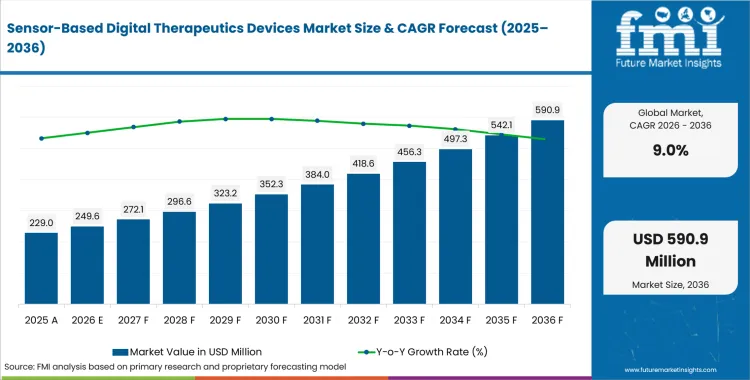
USD 249.6 million in 2026 and USD 590.9 million by 2036 at a 9.0% CAGR.
Demand for sensor-based digital therapeutics devices is projected to expand at 9.0% CAGR between 2026 and 2036, increasing valuation from USD 249.6 million in 2026 to USD 590.9 million by 2036. Regulatory initiatives aimed at modernizing oversight of digital health technologies are improving the commercial outlook for sensor-enabled therapeutic devices. The FDA launched TEMPO in December 2025 to test risk-based pathways for selected digital health devices used in chronic disease management. In July 2026, the agency selected Dexcom as the first participant and required real-world data collection for the reviewed intended use. The pilot provides a clearer route for systems that connect sensor measurements with software guidance and defined clinical responsibilities. Commercial adoption becomes more defensible through measurable device outputs and a treatment pathway that health systems can supervise.
United States providers can connect regulated devices with Medicare payment pathways for qualifying digital treatments used within behavioral health care. CMS expanded payment for digital mental health treatment devices used for attention deficit hyperactivity disorder through its October 2025 final rule. German access follows the separate DiGA route, eligible applications require structured BfArM review and evidence of positive care effects. BfArM released version 3.6 of its DiGA fast-track guide in December 2025 with updated application and evidence requirements. United Kingdom developers must manage registration and continuing surveillance duties across NHS service environments and prescribing organizations. Commercial teams therefore need country-specific evidence plans and support arrangements rather than one launch package for every geography.
Key Takeaways of Sensor-Based Digital Therapeutics Devices Market
- Regulated treatment pathways and payer coverage are expanding demand for devices that connect continuous measurements with guided therapeutic actions and accountable follow-up.
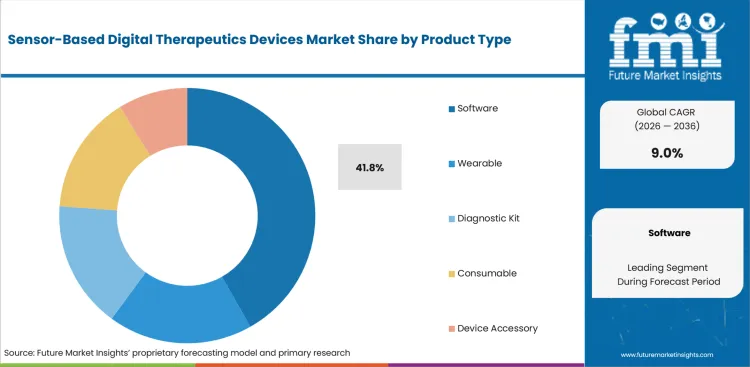
- Software is expected to account for 41.8% in 2026, reflecting its central role in sensor-based digital therapeutics, it interprets sensor inputs and coordinates personalized interventions across care pathways.
- Hospitals are projected to represent 28.0% in 2026, owing to their established clinical governance frameworks, these structures support timely escalation for abnormal readings and treatment-related issues.
- Monitoring is anticipated to capture 14.0% of application demand in 2026, driven by the need for continuous patient assessment.
- Clinical integration and post-market surveillance obligations create material barriers for developers seeking repeat deployment across multiple health systems and reimbursement routes.
- Competition includes MedRhythms, Cala Health, Omada Health, Hinge Health, Biofourmis, Theranica, Resmed, and Welldoc across prescription therapies and connected care programs.
Analyst Perspective
“A sensor-based therapeutic earns recurring use through accurate measurement and a defined clinical response for every important reading. Health systems compare evidence quality with alert burden and integration effort across the complete care pathway. They also examine reimbursement fit and service ownership during program selection for continuing patient treatment. Developers that connect reliable sensing with clear escalation rules can convert controlled deployments into repeatable treatment programs.”
- Anurag Sharma, Principal Analyst, Future Market Insights
How is the Sensor-Based Digital Therapeutics Devices Market segmented?
The sensor-based digital therapeutics devices industry is segmented by product type, care setting, application, end user, and region.
The market is segmented by product type, care setting, application, end user, and region for detailed commercial analysis. Product type covers software, wearables, diagnostic kits, consumables, and device accessories that support therapeutic programs. Care setting separates hospitals, home care, ambulatory centers, retail clinics, and decentralized trial sites according to oversight and service needs. Application includes monitoring, diagnosis, workflow automation, therapy support, and infection control across regulated treatment pathways and services. End user distinguishes hospitals, payers, diagnostic laboratories, medtech firms, and patients that finance or operate each program. Regional analysis reflects authorization, reimbursement, integration capacity, and technical support across major countries and commercial entry routes. The taxonomy also links sensor-guided treatment with adjacent wearable medical devices used across regulated care pathways.
Why does software support the largest product type share?
Software translates sensor readings into patient guidance and records that clinicians can evaluate during continuing treatment. Welldoc began powering the Lilly Health platform in June 2025 with device connectivity and health-data tracking for selected incretin therapies. The launch shows how home healthcare software can connect measurements with medication support without placing data inside separate applications. Continuous glucose monitoring and connected scales provide repeated inputs that software must place within one patient record. Developers also need clear escalation logic and secure data exchange across connected clinical workflows and provider systems.
- Software is projected to hold 41.8% share in 2026 owing to its control over data interpretation and therapeutic guidance. The code combines measurements from several regulated devices and applies condition-specific rules across one patient pathway. Recurring licenses and updates strengthen software spending beyond the initial device purchase throughout continuing treatment.
- Health plans and clinical teams adopt configurable software that supports several conditions without separate enrollment systems for every program. Unified workflows reduce duplicate training and give care teams one location for engagement and escalation review. Adoption weakens if data enter a separate dashboard that cannot exchange records with clinical systems.
How does hospital shape demand within the care setting category?
Hospitals carry responsibility for clinical escalation if sensor readings reveal deterioration or a treatment problem requiring immediate review. Their governance structures assign alert ownership and allow specialty teams to change treatment under established protocols. Sensor-based programs must connect bedside and home readings with the clinical records that responsible teams already use. Health systems therefore assess integration ownership and clinical staffing ahead of expansion across specialties and service lines.
- The care setting category is forecast to be led by hospital at 28.0% share in 2026 due to established clinical governance and escalation capacity. Biofourmis announced an AdventHealth acute care-at-home collaboration in January 2025 using remote patient monitoring and FDA-cleared algorithms. The deployment demonstrates why institutions with defined clinical ownership can validate sensor-guided treatment across hospital and home settings.
- Hospital groups often begin with specialty services that can measure outcomes and resolve adverse readings under controlled protocols. Successful programs require biomedical engineering support and an accountable clinical owner for alerts and software changes. Expansion becomes difficult if maintenance coverage or record integration remains unclear across departments and affiliated home-care services.
What supports monitoring demand within the application category?
Monitoring creates a longitudinal record that connects treatment use with symptoms and physiological response between scheduled encounters. Omada Health added cholesterol management to its integrated platform in February 2026 alongside weight and glucose support. The launch shows how continuous glucose monitoring can inform continuing care across related cardiometabolic conditions instead of separate programs. Clinical teams must filter routine variation from actionable change so monitoring improves decisions without adding excessive review work.
- By application, monitoring is estimated to hold 14.0% share in 2026 owing to its role in documenting treatment response across repeated measurements. Longitudinal records help clinicians compare current results with prior baselines and identify changes that require intervention. The segment gains commercial value through continuing evidence between visits instead of isolated readings collected during appointments.
- Care programs favor monitoring functions that prioritize clinically relevant changes and preserve a complete record for later review. Reliable thresholds reduce repetitive alerts and help clinicians direct attention toward patients who require intervention. Adoption slows if sensor accuracy varies or alert logic cannot match the treatment protocol used by the responsible care team.
What are the drivers, restraints, and opportunities in the Sensor-Based Digital Therapeutics Devices Market?
Regulated care pathways are widening access to sensor-guided treatment, while integration burdens and evidence obligations continue to limit repeat deployment.
- Driver: Regulated prescription pathways create defined purchasing routes for devices that connect sensor measurements with therapeutic actions and documented clinical outcomes.
- Restraint: Clinical integration and post-market surveillance requirements create continuing service obligations beyond initial device authorization or software deployment.
- Opportunity: Interoperable health data networks allow developers to connect sensor records with longitudinal care pathways and outcome-based service models.
Regulated prescription pathways are strengthening demand for devices that pair sensors with a defined therapeutic response. MedRhythms announced FDA Class II listing for Movive in March 2025 to support gait rehabilitation and motor function in Parkinson’s disease. The listing created a route for a home-use neurostimulation platform that combines movement sensors with rhythmic auditory stimulation. Clinical teams support purchasing decisions through clear patient criteria and evidence that device output changes treatment. Wellness products without regulated therapeutic claims or accountable prescribing pathways face weaker adoption across clinical treatment programs.
Post-market obligations are one of the notable restraints for clinical software and connected devices that require continuing safety oversight beyond initial authorization. The MHRA implemented stronger Great Britain surveillance regulations in June 2025 and required manufacturers to track performance during commercial use. Device teams must maintain complaint handling and corrective action routes alongside cybersecurity and software updates. Smaller developers face heavier service burdens across jurisdictions with separate reporting systems and local representation duties. Adoption slows if a health system cannot identify responsibility for incident review or long-term technical maintenance.
Interoperable public infrastructure creates a commercial opening for therapeutics that exchange consented records across participating providers. India reported in May 2026 that more than 100 crore health records were linked with ABHA and over 450 technology solutions had integrated with ABDM. The national network can preserve treatment context across participating facilities through consent-based health information exchange. Developers must complete technical integration with consent-based exchange components before treatment data can enter connected records through national interfaces. Commercial value increases through sensor outputs that follow the patient across providers instead of remaining inside one isolated application.
Which country CAGRs are profiled in the sensor-based digital therapeutics devices market?
| Country | CAGR |
|---|---|
| India | 12.2% |
| China | 11.3% |
| United States | 10.4% |
| Germany | 9.5% |
| Japan | 8.6% |
| United Kingdom | 7.7% |
How do country-level CAGRs compare in the Sensor-Based Digital Therapeutics Devices Market?
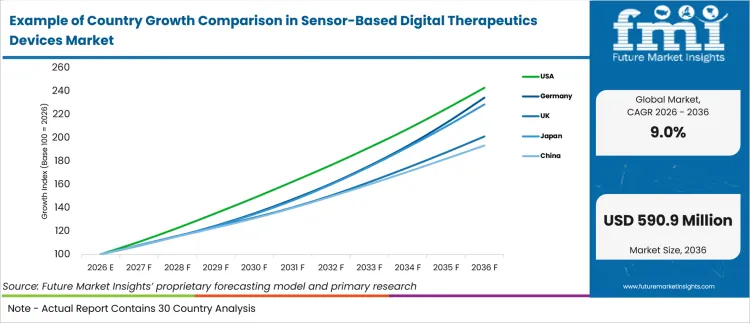
The country forecasts show a clear progression across the sensor-based digital therapeutics devices market, with each successive market reflecting a gradual shift in adoption conditions rather than sharply defined growth tiers. India and China form the upper band of the comparison, supported by expanding digital health ecosystems, growing chronic disease burdens and increasing use of connected monitoring technologies. The United States follows closely behind and serves as a bridge between the higher-growth Asian markets and the more established healthcare environments of Europe and Japan. Germany, Japan and the United Kingdom create a lower grouping where differences are incremental rather than pronounced.
- India benefits from rapid expansion of digital healthcare services and increasing deployment of connected health technologies that support remote disease management and patient engagement.
- China's outlook is supported by large-scale adoption of digital health platforms and growing investment in technologies that combine sensor monitoring with clinical decision support.
- The United States reflects a mature innovation environment where regulatory initiatives, real-world evidence generation and established digital health companies continue to advance sensor-based therapeutic solutions.
- Germany continues to support adoption through increasing acceptance of digital health tools and the integration of data-driven care models within healthcare delivery systems.
- Japan's market development is influenced by demand for chronic disease management solutions and growing interest in technologies that support continuous monitoring and preventive care.
- The United Kingdom maintains steady momentum as healthcare providers evaluate digital therapeutic approaches that can improve patient outcomes while supporting more efficient care pathways.
Similar CAGRs do not necessarily create similar commercialization environments for sensor-based digital therapeutics devices. Differences in reimbursement frameworks, digital health regulations, clinical validation requirements and healthcare infrastructure can significantly influence adoption timelines and market access strategies. The full report provides country-level CAGR analysis across North America, Latin America, Europe, East Asia, South Asia, Oceania and the Middle East and Africa.
Country-wise Analysis
- India uses ABDM to exchange consented digital records across registered facilities and technology platforms that meet national integration requirements. In India, sensor-based digital therapeutics device demand is predicted to advance at 12.2% CAGR through 2036, supported by broader use of ABDM-enabled software. The Press Information Bureau reported in February 2025 that 159,020 health facilities used ABDM-enabled software across every state and union territory. The installed route supports longitudinal records and consent-based exchange across participating treatment programs and registered clinical settings. Assisted and offline options improve enrollment across areas with unreliable connectivity and limited digital support. Technology platforms must integrate with ABDM consent and record-exchange components before treatment data can enter participating systems through approved interfaces. Commercial plans need local implementation partners that manage uneven technical capacity beyond major hospital networks.
- China requires overseas device developers to align registration and local representation with national medical device rules for commercial distribution. Provincial hospital access and service coverage vary across regions with different purchasing and maintenance arrangements. Adoption of sensor-based digital therapeutics devices in China is estimated to expand at 11.3% CAGR through 2036, shaped by evolving domestic production pathways. The NMPA issued a March 2025 announcement that optimized domestic production routes for certain imported Class II and Class III devices. Qualified manufacturers can shorten supply routes and strengthen maintenance access through approved domestic production for local service teams. Applicants must provide registration dossiers and quality-system equivalence evidence across overseas and domestic production locations. Distribution plans require regional technical support across provinces with different hospital access requirements and purchasing routes.
- The United States combines FDA authorization with Medicare and commercial benefit pathways for prescribed home-use systems. Sensor-based digital therapeutics device demand in the United States is forecast to rise at 10.4% CAGR over the forecast period, driven by specialty distribution and product-specific payment routes. MedRhythms reported in January 2025 that CMS issued a final Medicare payment determination for its InTandem rehabilitation system. CMS explains that new DMEPOS items receive benefit-category and payment determinations through a public process with a defined pricing hierarchy. The route can standardize payment for qualifying prescription devices without extending coverage to every digital therapeutic. Developers need billing support and patient onboarding with documentation that matches each health plan’s eligibility rules.
- Germany uses the BfArM DiGA fast-track route for eligible digital applications seeking directory listing and statutory reimbursement. Applicants must provide evidence of positive care effects with data protection controls that meet national requirements. Germany’s sensor-based digital therapeutics devices outlook is anticipated to advance at 9.5% CAGR over the assessment period, underpinned by a defined reimbursement route. BfArM’s January 2026 status graphic recorded 246 applications and 58 final-listing applications within the process. The figures show substantial commercial interest alongside meaningful attrition, so market entry requires German-language documentation and comparative evidence that withstands insurer and regulator scrutiny.
- Japan regulates therapeutic software as a medical device and expects developers to coordinate approval with a suitable domestic commercialization route. Sensor-based digital therapeutics device sales in Japan are forecast to expand at 8.6% CAGR by 2036, linked to continuing support for innovative SaMD review. Priority review can improve consultation and evaluation for products that meet innovation and clinical need criteria. PMDA stated in June 2026 that priority SaMD designation applications would be accepted continuously from fiscal 2026. Local partners remain important for Japanese documentation and clinician education across hospitals with established approval processes. Commercial teams should test interfaces and service procedures against local workflows during initial clinical deployments.
- The United Kingdom combines NHS evidence review with Great Britain registration and strengthened post-market reporting duties for regulated software devices. The MHRA published digital mental health guidance in August 2025 that explained adverse-event reporting duties for regulated software. The United Kingdom sensor-based digital therapeutics devices sector is projected to record 7.7% CAGR during the assessment period, owing to structured review and service capacity. Clearer guidance supports safer clinical deployment by defining reportable incidents and continuing manufacturer responsibilities for regulated software. Limited integration resources across NHS organizations can extend implementation schedules and increase the need for local incident response and technical support. Commercial plans should allow longer deployment periods across services with limited specialist capacity for continuing review.
Who are the notable companies in the Sensor-Based Digital Therapeutics Devices Market?
MedRhythms, Cala Health, Omada Health, Hinge Health, Biofourmis, Theranica, Resmed, and Welldoc compete across prescription neuromodulation, connected chronic care, and home monitoring programs.
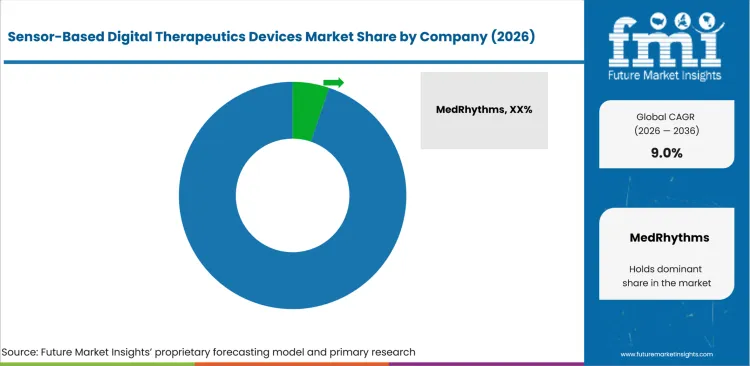
The competitive field spans prescription neuromodulation and integrated chronic care platforms that support treatment across home and clinical settings. Hinge Health reported in May 2026 that its client count reached 2,849 during the first quarter. The figure shows the account reach available to introduce sensor-guided care through existing employer and health plan channels. MedRhythms, Cala Health, and Theranica focus on prescription neuromodulation with condition-specific home treatment protocols for eligible neurological conditions. Omada Health, Hinge Health, and Welldoc combine connected devices with continuing digital care across cardiometabolic or pain programs and health plan channels. Biofourmis and Resmed emphasize remote clinical workflows that depend on monitoring infrastructure and dependable service support through connected care platforms.
- MedRhythms and Cala Health focus on regulated neuromodulation devices that connect sensor or stimulation functions with condition-specific treatment protocols. Both companies require prescription access and patient support; their commercial differentiation depends on clinical evidence and fulfillment arrangements for home use.
- Omada Health, Hinge Health, and Welldoc combine connected devices with digital coaching or clinical support across employer and health plan channels. Their platforms compete through multi-condition workflows and national account relationships that reduce separate enrollment processes across related care programs.
- Biofourmis, Theranica, and Resmed compete through remote clinical workflows or prescription wearables that require coordinated monitoring and continuing service support. Commercial performance depends on how reliably each company connects device data with clinical action and patient access across supported geographies.
Competitive Benchmarking: Sensor-Based Digital Therapeutics Devices Market
| Company | Regulated Therapeutic Capability | Sensor and Device Integration | Delivery and Access Support | Geographic Reach |
|---|---|---|---|---|
| MedRhythms | High | High | Medium | United States |
| Cala Health | High | High | Medium | United States |
| Omada Health | Medium | High | High | United States |
| Hinge Health | High | High | High | United States |
| Biofourmis | Medium | High | High | United States |
| Theranica | High | High | High | United States and China |
| Resmed | High | High | High | Global |
| Welldoc | High | High | High | United States |
Key Developments in the Sensor-Based Digital Therapeutics Devices Market
- In April 2026, Hinge Health launched a comprehensive migraine care program that combined its FDA-cleared Enso wearable with trigger management and expert-led prevention. The company reported that more than 125 clients covering over two million people had already adopted the program. The launch extended an established employer care channel into sensor-guided migraine treatment with integrated clinical and digital support.
- In September 2025, Theranica and Pier 88 Health announced China NMPA approval for the Nerivio remote electrical neuromodulation wearable used for acute migraine treatment. The approval created a regulated route for a prescription therapy within China and supported structured physician-led commercialization. Expansion requires physician education and local distribution that can manage patient onboarding and repeat treatment access across participating treatment centers.
- In April 2026, Cala Health received FDA clearance for Cala kIQ Plus as a Class II external upper limb tremor stimulator. The prescription wrist-worn device is indicated for temporary relief of action hand tremors in adults with essential tremor and postural and kinetic hand tremor symptoms in adults with Parkinson's disease. The clearance extends the company’s regulated TAPS platform across two neurological conditions through one home-use wearable. Commercial rollout requires clinician education and patient training alongside fulfillment support that supports consistent setup and therapy use.
- In April 2025, MedRhythms announced that Movive became available to eligible veterans living with Parkinson’s disease through a dedicated national federal access channel. The prescription device delivers rhythmic auditory stimulation through sensors and software during home-based walking sessions. The development extended a regulated digital therapeutic beyond standard commercial coverage and required coordinated prescribing with fulfillment and ongoing patient support nationwide.
Key Players in the Sensor-Based Digital Therapeutics Devices Market
Regulated Therapeutic Device Developers
- MedRhythms
- Cala Health
- Theranica
Integrated Digital Care Platforms
- Omada Health
- Hinge Health
- Welldoc
Clinical Monitoring and Home Care Platforms
- Biofourmis
- Resmed
Sensor-Based Digital Therapeutics Devices Market - Report Scope
| Coverage field | Report scope |
|---|---|
| Market breakdown | Product type, care setting, application, end user, and region. |
| Quantitative Units | Revenue in USD Million, CAGR in %. |
| Market Definition | Commercial demand for regulated or clinically deployed digital therapeutic devices that combine sensor inputs with software-guided therapeutic intervention, monitoring, or treatment support. |
| Regions Covered | North America, Latin America, Europe, East Asia, South Asia and Pacific, and Middle East and Africa. |
| Countries Covered | United States, Germany, United Kingdom, Japan, China, India, and 30+ countries. |
| Key Companies Profiled | MedRhythms, Cala Health, Omada Health, Hinge Health, Biofourmis, Theranica, Resmed, and Welldoc. |
| Forecast Period | 2026 to 2036. |
| Approach | Hybrid bottom-up and top-down market sizing supported by primary interviews and official desk research. |
Sensor-Based Digital Therapeutics Devices Market - Research Methodology
| Method | Approach |
|---|---|
| Primary Research | FMI analysts gathered input from manufacturers, service providers, technology developers, distributors, end users, procurement teams, and subject-matter experts. Interviews examined purchasing decisions, product or service evaluation, adoption barriers, approval requirements, pricing considerations, and expectations for technical or commercial support. Respondents were also asked what evidence is required before a trial, pilot, or initial order develops into regular purchasing. |
| Desk Research | Desk research covered government statistics, regulatory publications, trade data, industry associations, technical literature, standards, company filings, product information, and official corporate announcements. Sources were reviewed for relevance, publication date, geographic coverage, and consistency with the defined market scope. Claims relating to performance, applications, approvals, capacity, investment, and commercial activity were retained only when supported by credible public evidence. |
| Market Sizing and Forecasting | The market model combined the baseline value with historical performance, segment structure, pricing and volume indicators, adoption levels, company participation, and country-level demand conditions. Forecast assumptions considered economic activity, investment trends, regulatory developments, technology adoption, purchasing cycles, supply availability, and barriers to wider market use. Segment and regional estimates were reconciled before the final market total was calculated. |
| Data Validation | Estimates were checked against multiple independent indicators, including public data, company activity, trade patterns, industry developments, and findings from primary interviews. Validation also tested whether products, services, applications, and company revenues fell within the defined market boundaries. Adjacent categories, unsupported claims, overlapping revenues, and activities without direct market relevance were excluded to reduce double counting and maintain consistency across segments and countries. |
Sensor-Based Digital Therapeutics Devices Market by Segments
Sensor-Based Digital Therapeutics Devices Market segmented by Product Type:
- Software
- Wearable
- Diagnostic Kit
- Consumable
- Device Accessory
Sensor-Based Digital Therapeutics Devices Market segmented by Care Setting:
- Hospital
- Home Care
- Ambulatory Center
- Retail Clinic
- Decentralized Trial Site
Sensor-Based Digital Therapeutics Devices Market segmented by Application:
- Monitoring
- Diagnosis
- Workflow Automation
- Therapy Support
- Infection Control
Sensor-Based Digital Therapeutics Devices Market segmented by End User:
- Hospitals
- Payers
- Diagnostic Labs
- Medtech Firms
- Patients
Sensor-Based Digital Therapeutics Devices Market by Region:
- North America
- United States
- Canada
- Mexico
- Latin America
- Brazil
- Chile
- Rest of Latin America
- Western Europe
- Germany
- UK
- Italy
- Spain
- France
- Nordic
- BENELUX
- Rest of Western Europe
- Eastern Europe
- Russia
- Poland
- Hungary
- Balkan and Baltic
- Rest of Eastern Europe
- East Asia
- China
- Japan
- South Korea
- South Asia and Pacific
- India
- ASEAN
- Australia and New Zealand
- Rest of South Asia and Pacific
- Middle East and Africa
- Kingdom of Saudi Arabia
- Other GCC Countries
- Turkiye
- South Africa
- Other African Union
- Rest of Middle East and Africa
Research Sources and Bibliography
- U.S. Food and Drug Administration. (2025, December 5). FDA Launches TEMPO: A First-of-Its-Kind Digital Health Pilot to Expand Access to Chronic Disease Technologies.
- U.S. Food and Drug Administration. (2026, July 22). FDA Announces First Participant Selected for TEMPO for Digital Health Devices Pilot.
- Centers for Medicare & Medicaid Services. (2025, October 31). Calendar Year (CY) 2026 Medicare Physician Fee Schedule Final Rule (CMS-1832-F).
- Federal Institute for Drugs and Medical Devices. (2025, December 11). DiGA (Digitale Gesundheitsanwendungen)-Leitfaden (Stand: 10.12.2025, Version 3.6).
- Welldoc. (2025, June 4). Welldoc Works with Lilly to Launch a New Personalized Health & Medicine Platform for Those Prescribed Lilly’s Incretin Therapies.
- Biofourmis. (2025, January 6). Biofourmis Selected by AdventHealth to Support “Whole-Person Care” With New Acute Care-at Home Program.
- Omada Health. (2026, February 19). Omada Adds Cholesterol Care to Its Integrated Platform, Addressing the Silent Driver of Cardiovascular Risk.
- Theranica. (2026, February 4). Theranica Announces U.S. Coverage for Nerivio® Reaching ~130 Million Lives, Attaining Payer Scale Comparable to Leading Migraine Drugs.
- Resmed. (2025, December 8). Resmed Receives FDA Clearance for Personalized Therapy Comfort Settings, to be Marketed as Smart Comfort, an AI-Enabled, Digital Medical Device That Helps Personalize CPAP Therapy.
- MedRhythms. (2025, March 6). MedRhythms Announces FDA Class II Listing for Movive™ to Support Gait Rehabilitation and Motor Function for Parkinson’s Disease.
- Medicines and Healthcare products Regulatory Agency. (2025, June 16). First major overhaul of medical device regulation comes into force across Great Britain.
- Press Information Bureau. (2026, May 22). 100 Crore Health Records Linked with ABHA under ABDM, Marking Major Leap in Digital Healthcare.
- Press Information Bureau. (2025, February 11). Update on the implementation of Ayushman Bharat Digital Mission (ABDM).
- National Medical Products Administration. (2025, March 17). NMPA Announcement on Further Improvement and Optimization of Matters Concerning the Production of Imported Medical Devices in Domestic Enterprises in China (No. 30, 2025).
- MedRhythms. (2025, January 16). MedRhythms’ InTandem® Rehabilitation System for Chronic Stroke Gait Impairment Receives Final Medicare Payment Determination from CMS.
- Centers for Medicare & Medicaid Services. (2025, May 5). DMEPOS Payment Determinations for New Items & Services.
- Federal Institute for Drugs and Medical Devices. (2026, January 14). Interesting facts.
- Pharmaceuticals and Medical Devices Agency. (2026, June 15). Trial Implementation of Priority Review of SaMD.
- Medicines and Healthcare products Regulatory Agency. (2025, August 1). Report on Adverse Event (AE) reporting in digital mental health technologies (DMHTs) and the development of updates to regulatory guidance.
- Hinge Health. (2026, May 5). Hinge Health reports record first quarter 2026 financial results.
- Hinge Health. (2026, April 29). Hinge Health launches comprehensive Migraine Care Program.
- Theranica. (2025, September 30). Pier 88 Health and Theranica Announce China NMPA Approval of the Nerivio® REN Wearable for Acute Treatment of Migraine.
- U.S. Food and Drug Administration. (2026, March 17). 510(k) Premarket Notification.
- MedRhythms. (2025, April 2). MedRhythms Announces Availability of Movive™ for Parkinson’s Disease (PD) for Veterans.
This bibliography is provided for reader reference and is not exhaustive. The full report contains the complete reference list and detailed citations.
This Report Answers
- How large is the sensor-based digital therapeutics devices market in 2026 and 2036?
- Which product types create defensible commercial demand across regulated care pathways?
- How does care setting influence clinical oversight and device integration responsibilities?
- Which applications support repeat purchasing through measurable therapeutic response?
- How do payers and other end users evaluate coverage and service responsibilities?
- How do country growth rates compare across different access environments?
- Which company capabilities matter most for competitive benchmarking in this market?
- Which regulatory and reimbursement changes influence commercial access for sensor-based therapies?
- How should health systems compare regulated device developers with integrated digital care platforms?
Frequently Asked Questions
How big is the Sensor-Based Digital Therapeutics Devices Market in 2026?
The sensor-based digital therapeutics devices market is valued at USD 249.6 million in 2026 and is forecast to reach USD 590.9 million by 2036, supported by expanding regulated prescription pathways and growing payer coverage for devices that connect continuous sensor measurements with guided therapeutic actions and documented clinical outcomes.
What is the CAGR of the Sensor-Based Digital Therapeutics Devices Market from 2026 to 2036?
The sensor-based digital therapeutics devices market is projected to grow at a CAGR of 9.0% between 2026 and 2036, supported by regulatory initiatives modernizing digital health oversight and increasing adoption of connected monitoring technologies across chronic disease management and behavioral health care programs.
Which product type leads the Sensor-Based Digital Therapeutics Devices Market?
Software accounts for 41.8% of the sensor-based digital therapeutics devices market by product type in 2026, driven by its central role in interpreting sensor inputs, coordinating personalized interventions, and combining measurements from multiple regulated devices across one patient care pathway.
Who are the leading companies in the Sensor-Based Digital Therapeutics Devices Market?
Leading companies in the sensor-based digital therapeutics devices market include MedRhythms, Cala Health, Omada Health, Hinge Health, Biofourmis, Theranica, Resmed, and Welldoc, competing across regulated therapeutic device development, integrated digital care platforms, and clinical monitoring and home care programs.
How much will the Sensor-Based Digital Therapeutics Devices Market add between 2026 and 2036?
The sensor-based digital therapeutics devices market is set to add USD 341.3 million between 2026 and 2036, growing from USD 249.6 million to USD 590.9 million as regulated prescription pathways, interoperable health data networks, and expanding payer coverage bring sensor-guided therapeutic programs into broader clinical and home care deployment.
Preview the report firsthand - request a free sample
Get SampleGet the brochure for pricing and purchase details.
Get PDFTable of Content
- Key Takeaways
- Market Size and CAGR
- Top Growth Driver
- Fastest Growing Segment
- Leading Region
- Key Companies
- Emerging Opportunities
- Executive Summary
- Global Market Outlook
- Demand-side Trends
- Supply-side Trends
- Technology Roadmap Analysis
- Analysis and Recommendations
- Analyst Perspective (What is happening? Why now? What should investors know?)
- Key Questions Answered
- How large is the market?
- What is the CAGR?
- What are key trends?
- Which region dominates?
- Who are the leaders?
- Market Overview
- Market Coverage / Taxonomy
- Market Definition / Scope / Limitations
- Research Methodology
- Chapter Orientation
- Analytical Lens and Working Hypotheses
- Market Structure, Signals, and Trend Drivers
- Benchmarking and Cross-market Comparability
- Market Sizing, Forecasting, and Opportunity Mapping
- Research Design and Evidence Framework
- Desk Research Programme (Secondary Evidence)
- Expert Input and Fieldwork (Primary Evidence)
- Tooling, Models, and Reference Databases
- Data Engineering and Model Build
- Quality Assurance and Audit Trail
- Market Background
- Market Dynamics (Drivers, Restraints, Opportunity, Trends)
- Scenario Forecast (Optimistic, Likely, Conservative)
- Impact Analysis
- AI Impact
- Sustainability Impact
- Regulatory Impact
- Technology Impact
- Consumer / Buyer Analysis
- Purchase Drivers
- Adoption Barriers
- Buyer Journey
- Opportunity Map Analysis
- Product Life Cycle Analysis
- Supply Chain Analysis
- Investment Feasibility Matrix
- Value Chain Analysis
- PESTLE and Porter's Analysis
- Regulatory Landscape
- Regional Parent Market Outlook
- Production and Consumption Statistics
- Import and Export Statistics
- Global Market Analysis and Forecast, 2021 to 2036
- Historical Market Size Value (USD Million) Analysis, 2021 to 2025
- Current and Future Market Size Value (USD Million) Projections, 2026 to 2036
- Y-o-Y Growth Trend Analysis
- Absolute $ Opportunity Analysis
- Global Market Pricing Analysis, 2021 to 2036
- Global Market Analysis and Forecast, By Product Type, 2021 to 2036
- Introduction / Key Findings
- Historical Market Size Value (USD Million) Analysis By Product Type, 2021 to 2025
- Current and Future Market Size Value (USD Million) Analysis and Forecast By Product Type, 2026 to 2036
- Software
- Wearable
- Diagnostic Kit
- Consumable
- Device Accessory
- Software
- Y-o-Y Growth Trend Analysis By Product Type, 2021 to 2025
- Absolute $ Opportunity Analysis By Product Type, 2026 to 2036
- Global Market Analysis and Forecast, By Care Setting, 2021 to 2036
- Introduction / Key Findings
- Historical Market Size Value (USD Million) Analysis By Care Setting, 2021 to 2025
- Current and Future Market Size Value (USD Million) Analysis and Forecast By Care Setting, 2026 to 2036
- Hospital
- Home Care
- Ambulatory Center
- Retail Clinic
- Decentralized Trial Site
- Hospital
- Y-o-Y Growth Trend Analysis By Care Setting, 2021 to 2025
- Absolute $ Opportunity Analysis By Care Setting, 2026 to 2036
- Global Market Analysis and Forecast, By Application, 2021 to 2036
- Introduction / Key Findings
- Historical Market Size Value (USD Million) Analysis By Application, 2021 to 2025
- Current and Future Market Size Value (USD Million) Analysis and Forecast By Application, 2026 to 2036
- Monitoring
- Diagnosis
- Workflow Automation
- Therapy Support
- Infection Control
- Monitoring
- Y-o-Y Growth Trend Analysis By Application, 2021 to 2025
- Absolute $ Opportunity Analysis By Application, 2026 to 2036
- Global Market Analysis and Forecast, By End User, 2021 to 2036
- Introduction / Key Findings
- Historical Market Size Value (USD Million) Analysis By End User, 2021 to 2025
- Current and Future Market Size Value (USD Million) Analysis and Forecast By End User, 2026 to 2036
- Payers
- Hospitals
- Diagnostic Labs
- Medtech Firms
- Patients
- Payers
- Y-o-Y Growth Trend Analysis By End User, 2021 to 2025
- Absolute $ Opportunity Analysis By End User, 2026 to 2036
- Global Market Analysis and Forecast, By Region, 2021 to 2036
- Introduction
- Historical Market Size Value (USD Million) Analysis By Region, 2021 to 2025
- Current Market Size Value (USD Million) Analysis and Forecast By Region, 2026 to 2036
- North America
- Latin America
- Western Europe
- Eastern Europe
- East Asia
- South Asia and Pacific
- Middle East & Africa
- Market Attractiveness Analysis By Region
- North America Market Analysis and Forecast, By Country, 2021 to 2036
- Historical Market Size Value (USD Million) Trend Analysis By Market Taxonomy, 2021 to 2025
- Market Size Value (USD Million) Forecast By Market Taxonomy, 2026 to 2036
- By Country
- USA
- Canada
- By Product Type
- By Care Setting
- By Application
- By End User
- By Country
- Market Attractiveness Analysis
- By Country
- By Product Type
- By Care Setting
- By Application
- By End User
- Key Takeaways
- Latin America Market Analysis and Forecast, By Country
- Historical Market Size Value (USD Million) Trend Analysis By Market Taxonomy, 2021 to 2025
- Market Size Value (USD Million) Forecast By Market Taxonomy, 2026 to 2036
- By Country
- Brazil
- Mexico
- Chile
- Rest of Latin America
- By Product Type
- By Care Setting
- By Application
- By End User
- By Country
- Market Attractiveness Analysis
- By Country
- By Product Type
- By Care Setting
- By Application
- By End User
- Key Takeaways
- Western Europe Market Analysis and Forecast, By Country
- Historical Market Size Value (USD Million) Trend Analysis By Market Taxonomy, 2021 to 2025
- Market Size Value (USD Million) Forecast By Market Taxonomy, 2026 to 2036
- By Country
- Germany
- UK
- Italy
- Spain
- France
- Nordic
- BENELUX
- Rest of Western Europe
- By Product Type
- By Care Setting
- By Application
- By End User
- By Country
- Market Attractiveness Analysis
- By Country
- By Product Type
- By Care Setting
- By Application
- By End User
- Key Takeaways
- Eastern Europe Market Analysis and Forecast, By Country
- Historical Market Size Value (USD Million) Trend Analysis By Market Taxonomy, 2021 to 2025
- Market Size Value (USD Million) Forecast By Market Taxonomy, 2026 to 2036
- By Country
- Russia
- Poland
- Hungary
- Balkan & Baltic
- Rest of Eastern Europe
- By Product Type
- By Care Setting
- By Application
- By End User
- By Country
- Market Attractiveness Analysis
- By Country
- By Product Type
- By Care Setting
- By Application
- By End User
- Key Takeaways
- East Asia Market Analysis and Forecast, By Country
- Historical Market Size Value (USD Million) Trend Analysis By Market Taxonomy, 2021 to 2025
- Market Size Value (USD Million) Forecast By Market Taxonomy, 2026 to 2036
- By Country
- China
- Japan
- South Korea
- By Product Type
- By Care Setting
- By Application
- By End User
- By Country
- Market Attractiveness Analysis
- By Country
- By Product Type
- By Care Setting
- By Application
- By End User
- Key Takeaways
- South Asia and Pacific Market Analysis and Forecast, By Country
- Historical Market Size Value (USD Million) Trend Analysis By Market Taxonomy, 2021 to 2025
- Market Size Value (USD Million) Forecast By Market Taxonomy, 2026 to 2036
- By Country
- India
- ASEAN
- Australia & New Zealand
- Rest of South Asia and Pacific
- By Product Type
- By Care Setting
- By Application
- By End User
- By Country
- Market Attractiveness Analysis
- By Country
- By Product Type
- By Care Setting
- By Application
- By End User
- Key Takeaways
- Middle East & Africa Market Analysis and Forecast, By Country
- Historical Market Size Value (USD Million) Trend Analysis By Market Taxonomy, 2021 to 2025
- Market Size Value (USD Million) Forecast By Market Taxonomy, 2026 to 2036
- By Country
- Kingdom of Saudi Arabia
- Other GCC Countries
- Türkiye
- South Africa
- Other African Union
- Rest of Middle East & Africa
- By Product Type
- By Care Setting
- By Application
- By End User
- By Country
- Market Attractiveness Analysis
- By Country
- By Product Type
- By Care Setting
- By Application
- By End User
- Key Takeaways
- Key Countries Market Analysis
- USA
- Pricing Analysis
- Market Share Analysis, 2025
- By Product Type
- By Care Setting
- By Application
- By End User
- Canada
- Pricing Analysis
- Market Share Analysis, 2025
- By Product Type
- By Care Setting
- By Application
- By End User
- Mexico
- Pricing Analysis
- Market Share Analysis, 2025
- By Product Type
- By Care Setting
- By Application
- By End User
- Brazil
- Pricing Analysis
- Market Share Analysis, 2025
- By Product Type
- By Care Setting
- By Application
- By End User
- Chile
- Pricing Analysis
- Market Share Analysis, 2025
- By Product Type
- By Care Setting
- By Application
- By End User
- Germany
- Pricing Analysis
- Market Share Analysis, 2025
- By Product Type
- By Care Setting
- By Application
- By End User
- UK
- Pricing Analysis
- Market Share Analysis, 2025
- By Product Type
- By Care Setting
- By Application
- By End User
- Italy
- Pricing Analysis
- Market Share Analysis, 2025
- By Product Type
- By Care Setting
- By Application
- By End User
- Spain
- Pricing Analysis
- Market Share Analysis, 2025
- By Product Type
- By Care Setting
- By Application
- By End User
- France
- Pricing Analysis
- Market Share Analysis, 2025
- By Product Type
- By Care Setting
- By Application
- By End User
- India
- Pricing Analysis
- Market Share Analysis, 2025
- By Product Type
- By Care Setting
- By Application
- By End User
- ASEAN
- Pricing Analysis
- Market Share Analysis, 2025
- By Product Type
- By Care Setting
- By Application
- By End User
- Australia & New Zealand
- Pricing Analysis
- Market Share Analysis, 2025
- By Product Type
- By Care Setting
- By Application
- By End User
- China
- Pricing Analysis
- Market Share Analysis, 2025
- By Product Type
- By Care Setting
- By Application
- By End User
- Japan
- Pricing Analysis
- Market Share Analysis, 2025
- By Product Type
- By Care Setting
- By Application
- By End User
- South Korea
- Pricing Analysis
- Market Share Analysis, 2025
- By Product Type
- By Care Setting
- By Application
- By End User
- Russia
- Pricing Analysis
- Market Share Analysis, 2025
- By Product Type
- By Care Setting
- By Application
- By End User
- Poland
- Pricing Analysis
- Market Share Analysis, 2025
- By Product Type
- By Care Setting
- By Application
- By End User
- Hungary
- Pricing Analysis
- Market Share Analysis, 2025
- By Product Type
- By Care Setting
- By Application
- By End User
- Kingdom of Saudi Arabia
- Pricing Analysis
- Market Share Analysis, 2025
- By Product Type
- By Care Setting
- By Application
- By End User
- Türkiye
- Pricing Analysis
- Market Share Analysis, 2025
- By Product Type
- By Care Setting
- By Application
- By End User
- South Africa
- Pricing Analysis
- Market Share Analysis, 2025
- By Product Type
- By Care Setting
- By Application
- By End User
- USA
- Market Structure Analysis
- Competition Dashboard
- Competition Benchmarking
- Market Share Analysis of Top Players
- By Regional
- By Product Type
- By Care Setting
- By Application
- By End User
- Emerging Startups
- Innovation Benchmarking
- Competition Analysis
- Competition Deep Dive
- MedRhythms
- Overview
- Product Portfolio
- Profitability by Market Segments
- Sales Footprint
- Strategy Overview
- Marketing Strategy
- Product Strategy
- Channel Strategy
- Cala Health
- Omada Health
- Hinge Health
- Biofourmis
- Propeller Health
- ResMed
- Welldoc
- MedRhythms
- Case Studies
- Success Stories
- Recent Developments
- Competition Deep Dive
- Assumptions & Acronyms Used


