

- Market Size (2026)
- USD 281.1 Mn
- Forecast (2036)
- USD 629.7 Mn
- CAGR (2026 to 2036)
- 8.4%
How big is the Shelf-Stable Clinical Meal Market in 2026?
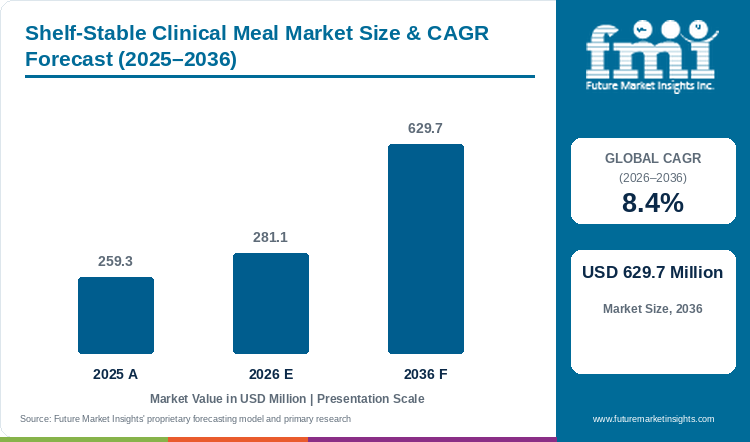
USD 281.1 Million in 2026 and USD 629.7 Million by 2036 at an 8.4% CAGR.
The shelf-stable clinical meal market stands at USD 281.1 Million in 2026 and is projected to reach USD 629.7 Million by 2036, growing at an 8.4% CAGR. Market demand is heavily reinforced by care models that actively move nutrition support closer to the patient's home. The U.S. Administration for Community Living reported that 93% of home-delivered Senior Nutrition Program respondents in 2024 felt the program helped them live independently. Shelf-stable clinical meals extend this logic by eliminating refrigeration dependence, giving programs vital reserve inventory for post-discharge transitions or intermittent nutritional needs.[4]
Country conditions dictate how quickly clinical need translates into purchased volume. U.S. health plans can utilize meal benefits, but CMS requires Special Supplemental Benefits for the Chronically Ill to be supported by concrete research showing a reasonable expectation of improving health or function. Germany combines a massive home-care population with strict reimbursement rules for medically necessary nutrition. Japan places special-use foods under formal permission and labeling controls. Across all these settings, demand only converts to revenue when products successfully meet the clinical specifications, channel qualifications, and evidence thresholds of the paying organization.[3][7][8]
Market Size and Forecast
Table 1: Market Size and Forecast for the Shelf-Stable Clinical Meal Market (USD Million), 2025 to 2036
| Metric | Value |
|---|---|
| Estimated Market Size in 2025 | USD 259.3 Million |
| Estimated Market Size in 2026 | USD 281.1 Million |
| Projected Market Size by 2036 | USD 629.7 Million |
| CAGR, 2026 to 2036 | 8.4% |
Key Takeaways
- Demand Mechanism: Home-based care and community nutrition support programs create the strongest demand mechanism, as shelf-stable meals can be stored directly near the patient and deployed without complex refrigerated logistics.
- Product Type: Shelf-Stable Fortified Entrees lead with a 42.3% share in 2026 because they successfully combine main-meal completeness with simple storage and service requirements.
- Diet Type: Standard Fortified leads with a 51.8% share in 2026 because it addresses the broadest group of users before more specialized, condition-specific clinical restrictions are applied.
- Shelf Life: The 6-12 Months category leads with a 53.6% share in 2026 because buyers gain a highly practical reserve window without the burden of carrying extremely long-dated inventory.
- Purchasing Friction: Buyers require concrete evidence that nutrition specifications, texture modifications, labeling, and benefit rules perfectly match the intended clinical population.
Profiled Companies: Hormel Health Labs, Mom's Meals (PurFoods), Kent Precision Foods, Abbott, Nestle Health Science, Medtrition, Danone Nutricia, and Victus.
Analyst Perspective
Revenue will naturally concentrate where extended shelf life is paired with a clear clinical use case and an accountable route to payment. Products that are merely convenient but cannot clear strict care-plan, formulary, or benefit criteria will remain entirely outside repeat purchasing cycles.
- Anurag Sharma, Future Market Insights
How is the shelf-stable clinical meal market segmented?
The market is segmented by Product Type, Diet Type, Shelf Life, End User and Sales Channel.
Product Type includes Shelf-Stable Fortified Entrees, Retort Pouched Clinical Meals, Fortified Breakfast Products, Emergency / Disaster Clinical Meals, and Others. Diet Type covers Standard Fortified, Texture-Modified, Disease-Specific, and Others. Shelf Life is divided into 6-12 Months, 12-24 Months, and >24 Months. End User covers Homecare, Long-Term Care, Meal Programs (MOW), and Others. Sales Channel includes Hospital Pharmacy, Retail Pharmacy, Online, Institutional Tender, and Others.
Why do Shelf-Stable Fortified Entrees lead the Product Type category?
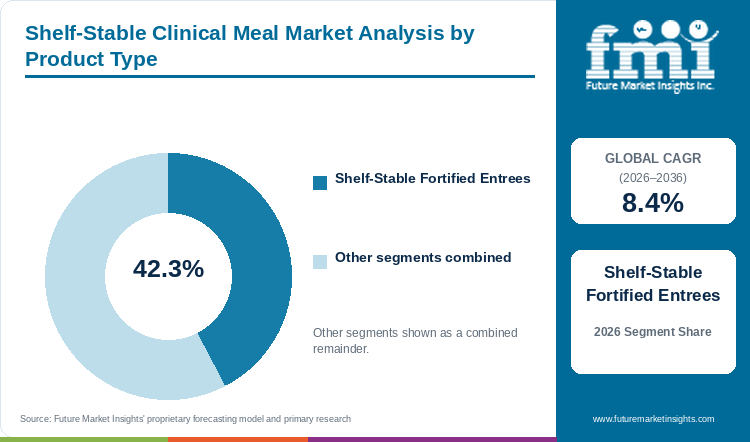
Shelf-Stable Fortified Entrees hold 42.3% of Product Type in 2026.
Fortified entrees sit closest to a normal meal occasion while actively adding nutritional density and storage resilience. This combination is critical for homecare teams and institutional buyers because a complete entree can entirely replace a meal rather than just supplementing one. The format also drastically reduces preparation steps when caregivers need to guarantee consistent portions or specific textures. While retort pouches and fortified breakfast products remain useful for portability or daypart variety, the entree format provides a much broader main-meal role. Shelf-Stable Fortified Entrees hold 42.3% of Product Type revenue in 2026 because a complete main-meal format perfectly fits both planned daily care and contingency feeding scenarios.
- Shelf-Stable Fortified Entrees account for 42.3% of Product Type in 2026.
- Main-Meal Replacement and Caregiver Convenience: The leading market position is driven by the format's ability to serve as a complete, nutritionally dense main meal that requires minimal preparation, significantly reducing the daily burden on family and professional caregivers.
- Expansion into Retail Pharmacy Channels: Clinical entrees are increasingly moving beyond traditional healthcare distribution into accessible retail environments, as demonstrated by Hormel Health Labs placing pureed meals in Discount Drug Mart stores across Ohio in July 2023.[17]
Why does Standard Fortified lead the Diet Type category?
Standard Fortified holds 51.8% of Diet Type in 2026.
Standard fortified meals serve the widest eligible population because they effectively raise nutrient density without narrowing the product to a single disease state or specific texture requirement. Buyers can confidently use this format for general frailty, reduced intake, or post-operative recovery when a highly specialized formulation is not strictly necessary. Texture-Modified and Disease-Specific meals require much closer alignment with a specific diagnosis or swallowing function assessment. This makes Standard Fortified significantly easier to place into broad, population-level meal programs while preserving more specialized options for defined clinical cohorts. Standard Fortified accounts for 51.8% of Diet Type revenue in 2026 because its broader eligibility supports much larger program pools than condition-specific alternatives.
- Standard Fortified accounts for 51.8% of Diet Type in 2026.
- Broad Eligibility for Population-Level Programs: The segment dominates because it provides a high-nutrient, versatile solution that can be deployed across large homecare and community programs without requiring individualized, disease-specific medical clearance for every patient.
- Regulatory and Clinical Distinctions: The U.S. FDA's medical-food guidance emphasizes that medically oriented foods are tied to distinctive nutritional requirements under physician supervision, reinforcing why standard fortification remains the default for general nutritional support before specialized medical foods are mandated.[1]
What keeps 6-12 Months central to the Shelf Life category?
6-12 Months holds 53.6% of Shelf Life in 2026.
A six-to-twelve-month window perfectly balances supply chain resilience with necessary inventory rotation. Health plans and community programs can easily stage meals for short-term disruptions or discharge support without the financial burden of carrying extremely long-dated stock. Households also gain valuable room-temperature reserve capacity without committing to bulk quantities that might outlast a patient's changing dietary needs. While longer shelf-life products remain highly relevant for disaster reserves and dispersed logistics, and shorter cycles support fresher menu planning where distribution is highly predictable, the mid-range offers the best operational fit. The 6-12 Months category represents 53.6% of Shelf Life revenue in 2026 because it offers enough storage flexibility for home and program use while supporting regular, efficient stock rotation.
- 6-12 Months accounts for 53.6% of Shelf Life in 2026.
- Operational Flexibility for Care Programs: This specific shelf-life band allows community organizations and health plans to maintain vital emergency or post-discharge reserves without the waste and logistical friction associated with managing multi-year inventory.
- Alignment with Home Delivery Cadences: Suppliers like Mom's Meals leverage this exact timeframe to offer monthly shelf-stable shipments and bulk program orders, proving that a six-month window perfectly aligns with standard homecare delivery and consumption cycles.[12]
Why is Homecare central to the End User category?
Homecare holds 45.7% of End User in 2026.
Homecare combines acute clinical need with a highly practical logistics problem, as many users have limited mobility or rely entirely on family caregivers. Shelf-stable meals drastically reduce the requirement for frequent grocery trips and preserve a ready, safe meal option when normal fresh delivery is interrupted by weather or supply chain issues. Community nutrition programs also heavily utilize home delivery as a primary way to support aging in place. While Long-Term Care remains important for standardized diets, institutional kitchens usually possess alternative commercial storage and preparation capacity that private households simply do not have. Homecare leads the End User segment with a 45.7% share in 2026 because room-temperature storage directly supports aging in place, caregiver efficiency, and post-discharge nutrition continuity.
- Homecare accounts for 45.7% of End User in 2026.
- Supporting Aging in Place and Independence: Demand is anchored by the critical need to help mobility-constrained individuals remain in their own homes safely, bypassing the physical burdens of grocery shopping and daily cooking.
- Validation Through Community Programs: The Administration for Community Living's 2024 participant survey found that 42% of home-delivered meal respondents had difficulty going outside the home, strongly validating the need for easy-to-store, ambient meal formats in residential settings.[4]
Why is Hospital Pharmacy central to the Sales Channel category?
Hospital Pharmacy holds 40.6% of Sales Channel in 2026.
Hospital pharmacy channels sit precisely at the clinical handoff between prescribed inpatient nutrition and ongoing home use. This strategic position supports rigorous product verification, seamless discharge coordination, and direct access to formulations that require tighter clinical matching. While retail pharmacy and online channels increase consumer convenience, and institutional tenders support massive program purchases, the hospital pharmacy advantage comes from controlled product selection and direct proximity to clinical decision-making. Hospital Pharmacy holds 40.6% of Sales Channel revenue in 2026 because clinical oversight and product verification are absolutely critical when meals actively support disease management or complex texture needs.
- Hospital Pharmacy accounts for 40.6% of Sales Channel in 2026.
- Bridging Inpatient Care and Home Recovery: The channel dominates because it allows clinical dietitians and discharge planners to directly prescribe and verify specialized nutrition, ensuring patients leave the hospital with the exact ambient-stable meals required for their recovery.
- Expanding Clinical Reach into Retail: The broader role of pharmacy channels is expanding beyond the hospital, as evidenced by Hormel Health Labs moving selected dysphagia products into retail pharmacy locations, bridging the gap between clinical prescription and community access.[17]
What are the drivers, restraints and opportunities in the shelf-stable clinical meal market?
Home-based nutrition support is expanding the addressable need, while clinical and payer qualification can slow purchasing, and broader condition-specific shelf-stable menus create the main product-development opportunity.
- Driver: Aging-in-place programs and food-as-medicine benefits actively increase demand for meals that can reliably reach patients outside of institutional settings.
- Restraint: Strict clinical evidence requirements, benefit eligibility rules, and product qualification hurdles can severely delay the movement from demonstrated clinical need to actual repeat purchase.
- Opportunity: Suppliers can significantly broaden their shelf-stable menus for disease-specific and texture-modified users while keeping preparation simple and palatable.
The primary demand driver is the rapid shift toward delivering nutrition support exactly where people live. The Administration for Community Living reports that the national Senior Nutrition Program serves nearly one million meals each day through about 5,000 local providers. Furthermore, a September 2024 HHS landscape summary reported that 72% of Medicare Advantage plans and 75% of Special Needs Plans offered supplemental meal benefits in 2024. Shelf-stable clinical meals fit these pathways perfectly because inventory can be stored near the user and shipped without expensive refrigerated handling. The commercial consequence is a rapidly expanding role for suppliers that can combine clinical suitability with reliable home delivery or program fulfillment.[2][4]
The primary restraint is that clinical need alone does not automatically create a reimbursed meal order. CMS requires Medicare Advantage plans to support certain chronically ill supplemental benefits with concrete research showing a reasonable expectation of improving health or function. FDA rules also strictly distinguish medical foods through intended use and physician supervision. Buyers therefore must rigorously examine formulation, labeling, eligibility, and evidence before scaling a program. This burden is especially high when a product claims disease-specific or texture-specific utility, effectively slowing supplier switching because a lower price cannot compensate for weak clinical documentation or poor fit with an existing care pathway.[1][3]
The strongest opportunity lies in placing more specialized diets into ambient-stable formats without making the eating experience feel overly clinical or restrictive. For example, South Korea's Ministry of Food and Drug Safety added standards for nutritional formulas for pulmonary disease patients in July 2024 because existing standardized patient-food criteria covered only selected conditions. Similarly, Danone Nutricia recently introduced savory plant-based medical nutrition to improve patient adherence. For shelf-stable meal suppliers, the ultimate opportunity is to widen condition coverage and menu variety while preserving simple preparation, clear clinical instructions, and channel-ready documentation.[11][23]
Which country CAGRs are profiled in the shelf-stable clinical meal market?
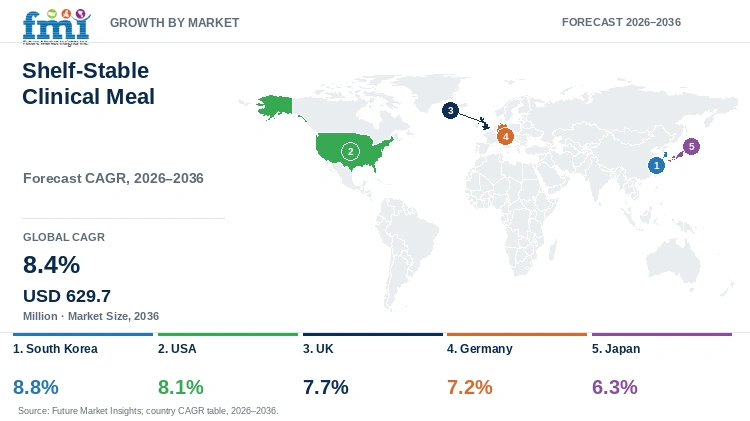
The profiled country CAGRs cover the period from 2026 to 2036.
Table 2: Country CAGRs for the Shelf-Stable Clinical Meal Market (CAGR, %), 2026 to 2036
| Country | CAGR |
|---|---|
| South Korea | 8.8% |
| USA | 8.1% |
| UK | 7.7% |
| Germany | 7.2% |
| Japan | 6.3% |
Country-wise Analysis
- South Korea: South Korea boasts the fastest profiled rate at an 8.8% CAGR from 2026 to 2036. Population aging provides a highly durable demand backdrop, with Statistics Korea reporting in September 2025 that people aged 65 and above represented 20.3% of the population, projecting that share to reach 30% by 2036. Product regulation is also rapidly broadening. In July 2024, the Ministry of Food and Drug Safety created specific standards for nutritional formulas for pulmonary disease patients because standardized patient-food criteria had previously covered only selected conditions. Suppliers therefore face both a wider clinical opportunity and a strict requirement to map each formulation to the correct patient-food standard.[10][11]
- USA: The USA is profiled at an 8.1% CAGR from 2026 to 2036, supported by a highly mature home-delivery ecosystem and intense health-plan interest in nutrition benefits. The Administration for Community Living's 2024 survey shows that home-delivered meal users are often mobility-constrained and highly value support for independent living. Medicare Advantage creates another massive purchase route, yet CMS added strict evidence guardrails for Special Supplemental Benefits for the Chronically Ill in its April 2024 final rule. Suppliers therefore need far more than just ambient stability. They require comprehensive program documentation, reliable fulfillment, and a clinical proposition that health plans can confidently defend when determining eligibility and benefit design.[3][4]
- UK: Clinical guidance gives the UK a highly structured path for oral nutrition support. From 2026 to 2036, the country is profiled at a 7.7% CAGR. NICE guidance comprehensively covers hospital patients, care-home residents, and people in their own homes, explicitly including fortified food within oral nutrition support for individuals who are malnourished or at risk. The same guidance mandates strict attention to swallowing safety and nutritional balance. Shelf-stable clinical meal suppliers therefore compete heavily on how well their products fit screening protocols, dietetic oversight, and safe eating requirements. A convenient ambient format is highly useful, but it must remain entirely consistent with the individual's nutrition plan and texture needs.[5]
- Germany: Germany's 7.2% CAGR from 2026 to 2036 is heavily supported by a massive population receiving care at home. Destatis reported in December 2024 that almost 5.7 million people required long-term care at the end of 2023, and a staggering 86% were cared for at home. This drastically expands the practical need for meals that caregivers can store and prepare consistently. However, reimbursement remains highly selective. The Federal Joint Committee states that statutory insurance only covers medically necessary balanced diets for enteral nutrition when dietary modification or other measures are proven insufficient. Suppliers must therefore strictly separate broadly convenient meal propositions from products that can satisfy much stricter medical-necessity pathways.[6][7]
- Japan: Japan is profiled to grow at a 6.3% CAGR from 2026 to 2036. The operating environment heavily rewards formal product discipline. Japan's Consumer Affairs Agency administers Special Dietary Uses foods for patients and people with swallowing difficulty, enforcing strict permission and review requirements for relevant categories. The Ministry of Health, Labour and Welfare also publishes rigorous nutrition-management guidance for meal-delivery services supporting older people in the community. This combination heavily favors suppliers that can provide clear nutrition specifications and stable quality across delivery cycles. It also makes compliance and dietetic fit a much larger part of product qualification than simple shelf-life performance.[8][9]
Who are the notable companies in the shelf-stable clinical meal market?
Hormel Health Labs, Mom's Meals (PurFoods), Kent Precision Foods, Abbott, Nestle Health Science, Medtrition, Danone Nutricia and Victus are the notable companies profiled in this market.
Competition spans three distinct strategic positions. Hormel Health Labs, Mom's Meals (PurFoods), and Kent Precision Foods possess direct public evidence in prepared meal or puree formats that specifically address ambient storage, home use, or dysphagia. Medtrition and Nestle Health Science bring advanced texture-modified or complete clinical nutrition capabilities that sit comfortably beside the defined meal category. Abbott, Danone Nutricia, and Victus contribute massive, broad disease-specific medical nutrition portfolios and deep channel experience. However, their public evidence is stronger in oral clinical formulas than in complete shelf-stable meals.[12][13][18][19][20][21][23][25][27]
- Shelf-stable and home-delivered meal specialists: Hormel Health Labs, Mom's Meals (PurFoods), and Kent Precision Foods.
- Texture-modified and modular clinical nutrition specialists: Medtrition and Nestle Health Science.
- Broad disease-specific medical nutrition platforms: Abbott, Danone Nutricia, and Victus.
Competitive Benchmarking: Shelf-Stable Clinical Meal Market
Table 3: Competitive Benchmarking for the Shelf-Stable Clinical Meal Market
| Company | Shelf-Stable Meal Format | Texture / Condition Specificity | Homecare / Institutional Access | Geographic Reach |
|---|---|---|---|---|
| Hormel Health Labs | High | High | High | United States; healthcare, retail pharmacy and distributor channels |
| Mom's Meals (PurFoods) | High | High | High | United States; nationwide home-delivery programs |
| Kent Precision Foods | Medium | High | Medium | United States; Thick-It clinical nutrition and puree channels |
| Abbott | Not specified | Medium | High | More than 160 countries across Abbott operations |
| Nestle Health Science | Not specified | Medium | High | More than 140 countries across Nestle Health Science |
| Medtrition | Not specified | High | High | United States; institutional foodservice and distributor channels |
| Danone Nutricia | Not specified | High | High | More than 100 countries across Nutricia operations |
| Victus | Not specified | Medium | Medium | Continental United States direct shipping documented for Enterex products |
Scoring basis: Shelf-Stable Meal Format is High when public evidence shows a direct prepared shelf-stable meal portfolio, Medium when evidence is narrower,. Texture / Condition Specificity rates the documented depth of texture-modified or disease-specific nutrition capability. Homecare / Institutional Access rates documented routes to patients and caregivers, considering health plans, pharmacies, foodservice, and clinical institutions.
Key Developments in the Shelf-Stable Clinical Meal Market
- In October 2024, Hormel Health Labs entered a new ownership structure when Lyons Magnus completed the acquisition of Hormel Health Labs operations and brands, creating Lyons Health Labs. The combined business retained vital brands such as THICK & EASY and Vital Cuisine, concentrating dysphagia and clinical nutrition capabilities inside a dedicated nutrition platform.[16]
- In August 2024, Mom's Meals (PurFoods) reported donating more than 20,000 shelf-stable meals to 19 community-based organizations across the United States. This activity perfectly demonstrated that its ambient meal format could be rapidly deployed outside routine refrigerated delivery to support short-notice community programs.[14]
- In March 2026, Nestle Health Science introduced Compleat Paediatric Oral Blends in an on-the-go pouch, launching across several European markets. It demonstrates continued heavy investment in portable, complete clinical nutrition formats that drastically reduce preparation burden.[21]
Key Players in the Shelf-Stable Clinical Meal Market
- Shelf-Stable and Home-Delivered Meal Specialists
- Hormel Health Labs
- Mom's Meals (PurFoods)
- Kent Precision Foods
- Texture-Modified and Modular Clinical Nutrition Specialists
- Medtrition
- Nestle Health Science
- Broad Disease-Specific Medical Nutrition Platforms
- Abbott
- Danone Nutricia
- Victus
Shelf-Stable Clinical Meal Market - Report Scope
Table 4: Report scope for the Shelf-Stable Clinical Meal Market (USD Million), 2026 to 2036
| Coverage field | Report scope |
|---|---|
| Market breakdown | Product Type; Diet Type; Shelf Life; End User; Sales Channel |
| Quantitative Units | USD Million |
| Market Definition | Revenue covers shelf-stable clinical meals sold within the defined categories. It excludes ordinary consumer meals and refrigerated or frozen meal revenue. Stand-alone adjacent nutrition products such as tube feeds, supplements, thickeners or desserts are excluded. |
| Regions Covered | North America; Latin America; Western Europe; Eastern Europe; East Asia; South Asia and Pacific; Middle East and Africa |
| Countries Covered | USA; UK; Germany; Japan; South Korea |
| Key Companies Profiled | Hormel Health Labs; Mom's Meals (PurFoods); Kent Precision Foods; Abbott; Nestle Health Science; Medtrition; Danone Nutricia; Victus |
| Forecast Period | 2026 to 2036 |
| Approach | Primary and secondary research with market triangulation. |
Shelf-Stable Clinical Meal Market - Research Methodology
Table 5: Research methodology for the Shelf-Stable Clinical Meal Market (USD Million), 2026 to 2036
| Method | Approach |
|---|---|
| Primary Research | FMI analysts gathered input from manufacturers, service providers, distributors, end users, procurement teams and subject-matter experts. Interviews examined purchasing decisions, adoption barriers, approval requirements, pricing considerations and expectations for technical support. |
| Desk Research | Desk research covered government statistics, regulatory publications, trade data, industry associations, technical literature, standards, company filings and official corporate announcements. Claims relating to performance, applications, approvals and commercial activity were retained only when supported by credible public evidence. |
| Market Sizing and Forecasting | The market model combined the baseline value with historical performance, segment structure, pricing and volume indicators, adoption levels, company participation and country-level demand conditions. Forecast assumptions considered economic activity, regulatory developments, technology adoption and purchasing cycles. |
| Data Validation | Estimates were checked against multiple independent indicators, including public data, company activity, trade patterns and findings from primary interviews. Adjacent categories, unsupported claims, overlapping revenues and activities without direct market relevance were excluded to reduce double counting. |
Shelf-Stable Clinical Meal Market by Segments
Shelf-Stable Clinical Meal Market segmented by Product Type:
- Shelf-Stable Fortified Entrees
- Retort Pouched Clinical Meals
- Fortified Breakfast Products
- Emergency / Disaster Clinical Meals
- Others
Shelf-Stable Clinical Meal Market segmented by Diet Type:
- Standard Fortified
- Texture-Modified
- Disease-Specific
- Others
Shelf-Stable Clinical Meal Market segmented by Shelf Life:
- 6-12 Months
- 12-24 Months
- >24 Months
Shelf-Stable Clinical Meal Market segmented by End User:
- Homecare
- Long-Term Care
- Meal Programs (MOW)
- Others
Shelf-Stable Clinical Meal Market segmented by Sales Channel:
- Hospital Pharmacy
- Retail Pharmacy
- Online
- Institutional Tender
- Others
Shelf-Stable Clinical Meal Market by Region:
- North America
- United States
- Canada
- Latin America
- Brazil
- Mexico
- Argentina
- Chile
- Western Europe
- Germany
- France
- United Kingdom
- Italy
- Spain
- Benelux
- Nordics
- Eastern Europe
- Poland
- Czech Republic
- Romania
- Hungary
- East Asia
- China
- Japan
- South Korea
- South Asia and Pacific
- India
- ASEAN
- Australia and New Zealand
- Middle East and Africa
- GCC Countries
- South Africa
- Türkiye
- Israel
Research Sources and Bibliography
- [1] U.S. Food and Drug Administration (2023, March). Guidance for Industry: Frequently Asked Questions About Medical Foods.
- [2] U.S. Department of Health and Human Services (2024, September). Food Is Medicine: A Project to Unify and Advance Collective Action.
- [3] Centers for Medicare & Medicaid Services (2024, April 4). Contract Year 2025 Medicare Advantage and Part D Final Rule. https://www.cms.gov/newsroom/fact-sheets/contract-year-2025-medicare-advantage-part-d-final-rule-cms-4205-f
- [4] Administration for Community Living (2026, March 18). Nutrition Services. https://acl.gov/programs/health-wellness/nutrition-services
- [5] National Institute for Health and Care Excellence (2017, August 4). Nutrition support for adults: oral nutrition support, enteral tube feeding and parenteral nutrition.
- [6] Statistisches Bundesamt (2024, December 18). 5,7 Millionen Pflegebedürftige zum Jahresende 2023.
- [7] Gemeinsamer Bundesausschuss (n.d.). Bilanzierte Diäten zur enteralen Ernährung in der Arzneimittelversorgung.
- [8] Consumer Affairs Agency, Japan (n.d.). Foods for Special Dietary Uses.
- [9] Ministry of Health, Labour and Welfare, Japan (n.d.). Nutrition management in meal delivery services supporting the health of older people.
- [10] Statistics Korea (2025, September 29). 2025 Statistics on the Aged.
- [11] Ministry of Food and Drug Safety, Republic of Korea (2024, July 10). Partial amendment to the Food Standards and Specifications.
- [12] Mom's Meals (n.d.). Using Shelf-Stable Meals for Nutrition Access.
- [13] Mom's Meals (n.d.). Medically Tailored Meals.
- [14] Mom's Meals (2024, August 8). Mom’s Meals donates shelf-stable meals to community-based organizations.
- [15] Mom's Meals (2026, June 18). Mom’s Meals and Agilix Health Collaborate to Advance Food as Medicine. https://www.momsmeals.com/our-newsroom/moms-meals-and-agilix-health-collaborate-to-advance-food-as-medicine-/
- [16] Lyons Magnus (2024, October 23). Lyons Magnus Establishes Lyons Health Labs with Addition of Hormel Health Labs.
- [17] Hormel Foods (2023, July 26). Hormel Health Labs Brings Leading Line of Products to Discount Drug Mart Locations.
- [18] Hormel Foods (2019, March 15). Hormel Health Labs Introduces Meal Kit For People With Swallowing Disorders.
- [19] Kent Precision Foods Group / Thick-It (n.d.). Product Facts.
- [20] Medtrition (2025, May 27). MEDTRITION Receives Quality and Service Award for Their Food Service Portfolio.
- [21] Nestle Health Science (2026, March). Nestlé introduces an innovative complete nutritional solution for children. https://www.nestle.com/media/news/compleat-paediatric-nutritional-blend-launch
- [22] Nestle Health Science (n.d.). About Nestlé Health Science.
- [23] Danone Nutricia (2025, October 1). Nutricia’s new savory plant-based medical nutrition proven to improve patient adherence.
- [24] Danone Nutricia (n.d.). Where to find us.
- [25] Abbott (2025, November 13). Abbott Launches New And Advanced Ensure Diabetes Care.
- [26] Abbott (n.d.). Global Locations & Contacts.
- [27] Victus (n.d.). Enterex Diabetic Ready-to-Drink Cartons.
This Report Answers
- How large is the Shelf-Stable Clinical Meal Market in 2026 and what value is forecast for 2036?
- Which industry pressures are supporting demand for shelf-stable clinical meals?
- Why do Shelf-Stable Fortified Entrees hold the leading Product Type position?
- Why does Standard Fortified hold the leading Diet Type position?
- How do the profiled country growth rates differ from 2026 to 2036?
- Which companies supply relevant shelf-stable meal, texture-modified or disease-specific clinical nutrition categories?
- What limits adoption or supplier switching in shelf-stable clinical meal programs?
- What should buyers evaluate before purchasing shelf-stable clinical meals for clinical or homecare use?
Frequently Asked Questions
How big is the Shelf-Stable Clinical Meal Market in 2026, and what is forecast for 2036?
The market is valued at USD 281.1 Million in 2026 and is forecast to reach USD 629.7 Million by 2036. The increase reflects the wider use of nutrition support in homecare and clinical programs that highly value ambient storage and simple distribution.
What is the CAGR for the Shelf-Stable Clinical Meal Market from 2026 to 2036?
The market is forecast to expand at an 8.4% CAGR from 2026 to 2036. Growth heavily depends on converting aging-related nutrition needs into qualified, reimbursable, and operationally reliable meal programs.
Which Product Type segment leads the Shelf-Stable Clinical Meal Market?
Shelf-Stable Fortified Entrees lead Product Type with a 42.3% share in 2026. Their primary advantage is the ability to completely replace a main meal while retaining room-temperature storage and standardized preparation.
Which Diet Type segment leads the Shelf-Stable Clinical Meal Market?
Standard Fortified leads Diet Type with a 51.8% share in 2026. It serves a vastly wider eligible population than products tied to a highly specific disease or strict texture requirement.
Which profiled countries have the highest growth rates?
South Korea has the highest profiled CAGR at 8.8%, followed by the USA at 8.1% from 2026 to 2036.
Which companies are active in the Shelf-Stable Clinical Meal Market?
Profiled market participants are Hormel Health Labs, Mom's Meals (PurFoods), Kent Precision Foods, Abbott, Nestle Health Science, Medtrition, Danone Nutricia, and Victus. Their public evidence spans prepared meals, texture-modified foods, home-delivery programs, and broader clinical nutrition platforms.
Preview the report firsthand - request a free sample
Get SampleGet the brochure for pricing and purchase details.
Get PDFTable of Content
- Key Takeaways
- Market Size and CAGR
- Top Growth Driver
- Fastest Growing Segment
- Leading Region
- Key Companies
- Emerging Opportunities
- Executive Summary
- Global Market Outlook
- Demand-side Trends
- Supply-side Trends
- Technology Roadmap Analysis
- Analysis and Recommendations
- Analyst Perspective (What is happening? Why now? What should investors know?)
- Key Questions Answered
- How large is the market?
- What is the CAGR?
- What are key trends?
- Which region dominates?
- Who are the leaders?
- Market Overview
- Market Coverage / Taxonomy
- Market Definition / Scope / Limitations
- Research Methodology
- Chapter Orientation
- Analytical Lens and Working Hypotheses
- Market Structure, Signals, and Trend Drivers
- Benchmarking and Cross-market Comparability
- Market Sizing, Forecasting, and Opportunity Mapping
- Research Design and Evidence Framework
- Desk Research Programme (Secondary Evidence)
- Expert Input and Fieldwork (Primary Evidence)
- Tooling, Models, and Reference Databases
- Data Engineering and Model Build
- Quality Assurance and Audit Trail
- Market Background
- Market Dynamics (Drivers, Restraints, Opportunity, Trends)
- Scenario Forecast (Optimistic, Likely, Conservative)
- Impact Analysis
- AI Impact
- Sustainability Impact
- Regulatory Impact
- Technology Impact
- Consumer / Buyer Analysis
- Purchase Drivers
- Adoption Barriers
- Buyer Journey
- Opportunity Map Analysis
- Product Life Cycle Analysis
- Supply Chain Analysis
- Investment Feasibility Matrix
- Value Chain Analysis
- PESTLE and Porter's Analysis
- Regulatory Landscape
- Regional Parent Market Outlook
- Production and Consumption Statistics
- Import and Export Statistics
- Global Market Analysis and Forecast, 2021 to 2036
- Historical Market Size Value (USD Million) Analysis, 2021 to 2025
- Current and Future Market Size Value (USD Million) Projections, 2026 to 2036
- Y-o-Y Growth Trend Analysis
- Absolute $ Opportunity Analysis
- Global Market Pricing Analysis, 2021 to 2036
- Global Market Analysis and Forecast, By Product Type, 2021 to 2036
- Introduction / Key Findings
- Historical Market Size Value (USD Million) Analysis By Product Type, 2021 to 2025
- Current and Future Market Size Value (USD Million) Analysis and Forecast By Product Type, 2026 to 2036
- Shelf-Stable Fortified Entrees
- Retort Pouched Clinical Meals
- Fortified Breakfast Products
- Emergency / Disaster Clinical Meals
- Others
- Y-o-Y Growth Trend Analysis By Product Type, 2021 to 2025
- Absolute $ Opportunity Analysis By Product Type, 2026 to 2036
- Global Market Analysis and Forecast, By Diet Type, 2021 to 2036
- Introduction / Key Findings
- Historical Market Size Value (USD Million) Analysis By Diet Type, 2021 to 2025
- Current and Future Market Size Value (USD Million) Analysis and Forecast By Diet Type, 2026 to 2036
- Standard Fortified
- Texture-Modified
- Disease-Specific
- Others
- Y-o-Y Growth Trend Analysis By Diet Type, 2021 to 2025
- Absolute $ Opportunity Analysis By Diet Type, 2026 to 2036
- Global Market Analysis and Forecast, By Shelf Life, 2021 to 2036
- Introduction / Key Findings
- Historical Market Size Value (USD Million) Analysis By Shelf Life, 2021 to 2025
- Current and Future Market Size Value (USD Million) Analysis and Forecast By Shelf Life, 2026 to 2036
- 6-12 Months
- 12-24 Months
- >24 Months
- Y-o-Y Growth Trend Analysis By Shelf Life, 2021 to 2025
- Absolute $ Opportunity Analysis By Shelf Life, 2026 to 2036
- Global Market Analysis and Forecast, By End User, 2021 to 2036
- Introduction / Key Findings
- Historical Market Size Value (USD Million) Analysis By End User, 2021 to 2025
- Current and Future Market Size Value (USD Million) Analysis and Forecast By End User, 2026 to 2036
- Homecare
- Long-Term Care
- Meal Programs (MOW)
- Others
- Y-o-Y Growth Trend Analysis By End User, 2021 to 2025
- Absolute $ Opportunity Analysis By End User, 2026 to 2036
- Global Market Analysis and Forecast, By Sales Channel, 2021 to 2036
- Introduction / Key Findings
- Historical Market Size Value (USD Million) Analysis By Sales Channel, 2021 to 2025
- Current and Future Market Size Value (USD Million) Analysis and Forecast By Sales Channel, 2026 to 2036
- Hospital Pharmacy
- Retail Pharmacy
- Online
- Institutional Tender
- Others
- Y-o-Y Growth Trend Analysis By Sales Channel, 2021 to 2025
- Absolute $ Opportunity Analysis By Sales Channel, 2026 to 2036
- Global Market Analysis and Forecast, By Region, 2021 to 2036
- Introduction
- Historical Market Size Value (USD Million) Analysis By Region, 2021 to 2025
- Current Market Size Value (USD Million) Analysis and Forecast By Region, 2026 to 2036
- North America
- Latin America
- Western Europe
- Eastern Europe
- East Asia
- South Asia and Pacific
- Middle East and Africa
- Market Attractiveness Analysis By Region
- North America Market Analysis and Forecast, By Country, 2021 to 2036
- Historical Market Size Value (USD Million) Trend Analysis By Market Taxonomy, 2021 to 2025
- Market Size Value (USD Million) Forecast By Market Taxonomy, 2026 to 2036
- By Country
- United States
- Canada
- By Product Type
- By Diet Type
- By Shelf Life
- By End User
- By Sales Channel
- By Country
- Market Attractiveness Analysis
- By Country
- By Product Type
- By Diet Type
- By Shelf Life
- By End User
- By Sales Channel
- Key Takeaways
- Latin America Market Analysis and Forecast, By Country
- Historical Market Size Value (USD Million) Trend Analysis By Market Taxonomy, 2021 to 2025
- Market Size Value (USD Million) Forecast By Market Taxonomy, 2026 to 2036
- By Country
- Brazil
- Mexico
- Argentina
- Chile
- By Product Type
- By Diet Type
- By Shelf Life
- By End User
- By Sales Channel
- By Country
- Market Attractiveness Analysis
- By Country
- By Product Type
- By Diet Type
- By Shelf Life
- By End User
- By Sales Channel
- Key Takeaways
- Western Europe Market Analysis and Forecast, By Country
- Historical Market Size Value (USD Million) Trend Analysis By Market Taxonomy, 2021 to 2025
- Market Size Value (USD Million) Forecast By Market Taxonomy, 2026 to 2036
- By Country
- Germany
- France
- United Kingdom
- Italy
- Spain
- Benelux
- Nordics
- By Product Type
- By Diet Type
- By Shelf Life
- By End User
- By Sales Channel
- By Country
- Market Attractiveness Analysis
- By Country
- By Product Type
- By Diet Type
- By Shelf Life
- By End User
- By Sales Channel
- Key Takeaways
- Eastern Europe Market Analysis and Forecast, By Country
- Historical Market Size Value (USD Million) Trend Analysis By Market Taxonomy, 2021 to 2025
- Market Size Value (USD Million) Forecast By Market Taxonomy, 2026 to 2036
- By Country
- Poland
- Czech Republic
- Romania
- Hungary
- By Product Type
- By Diet Type
- By Shelf Life
- By End User
- By Sales Channel
- By Country
- Market Attractiveness Analysis
- By Country
- By Product Type
- By Diet Type
- By Shelf Life
- By End User
- By Sales Channel
- Key Takeaways
- East Asia Market Analysis and Forecast, By Country
- Historical Market Size Value (USD Million) Trend Analysis By Market Taxonomy, 2021 to 2025
- Market Size Value (USD Million) Forecast By Market Taxonomy, 2026 to 2036
- By Country
- China
- Japan
- South Korea
- By Product Type
- By Diet Type
- By Shelf Life
- By End User
- By Sales Channel
- By Country
- Market Attractiveness Analysis
- By Country
- By Product Type
- By Diet Type
- By Shelf Life
- By End User
- By Sales Channel
- Key Takeaways
- South Asia and Pacific Market Analysis and Forecast, By Country
- Historical Market Size Value (USD Million) Trend Analysis By Market Taxonomy, 2021 to 2025
- Market Size Value (USD Million) Forecast By Market Taxonomy, 2026 to 2036
- By Country
- India
- ASEAN
- Australia and New Zealand
- By Product Type
- By Diet Type
- By Shelf Life
- By End User
- By Sales Channel
- By Country
- Market Attractiveness Analysis
- By Country
- By Product Type
- By Diet Type
- By Shelf Life
- By End User
- By Sales Channel
- Key Takeaways
- Middle East and Africa Market Analysis and Forecast, By Country
- Historical Market Size Value (USD Million) Trend Analysis By Market Taxonomy, 2021 to 2025
- Market Size Value (USD Million) Forecast By Market Taxonomy, 2026 to 2036
- By Country
- GCC Countries
- South Africa
- Türkiye
- Israel
- By Product Type
- By Diet Type
- By Shelf Life
- By End User
- By Sales Channel
- By Country
- Market Attractiveness Analysis
- By Country
- By Product Type
- By Diet Type
- By Shelf Life
- By End User
- By Sales Channel
- Key Takeaways
- Key Countries Market Analysis
- United States
- Pricing Analysis
- Market Share Analysis, 2025
- By Product Type
- By Diet Type
- By Shelf Life
- By End User
- By Sales Channel
- Canada
- Pricing Analysis
- Market Share Analysis, 2025
- By Product Type
- By Diet Type
- By Shelf Life
- By End User
- By Sales Channel
- Mexico
- Pricing Analysis
- Market Share Analysis, 2025
- By Product Type
- By Diet Type
- By Shelf Life
- By End User
- By Sales Channel
- Brazil
- Pricing Analysis
- Market Share Analysis, 2025
- By Product Type
- By Diet Type
- By Shelf Life
- By End User
- By Sales Channel
- Chile
- Pricing Analysis
- Market Share Analysis, 2025
- By Product Type
- By Diet Type
- By Shelf Life
- By End User
- By Sales Channel
- Germany
- Pricing Analysis
- Market Share Analysis, 2025
- By Product Type
- By Diet Type
- By Shelf Life
- By End User
- By Sales Channel
- United Kingdom
- Pricing Analysis
- Market Share Analysis, 2025
- By Product Type
- By Diet Type
- By Shelf Life
- By End User
- By Sales Channel
- Italy
- Pricing Analysis
- Market Share Analysis, 2025
- By Product Type
- By Diet Type
- By Shelf Life
- By End User
- By Sales Channel
- Spain
- Pricing Analysis
- Market Share Analysis, 2025
- By Product Type
- By Diet Type
- By Shelf Life
- By End User
- By Sales Channel
- France
- Pricing Analysis
- Market Share Analysis, 2025
- By Product Type
- By Diet Type
- By Shelf Life
- By End User
- By Sales Channel
- India
- Pricing Analysis
- Market Share Analysis, 2025
- By Product Type
- By Diet Type
- By Shelf Life
- By End User
- By Sales Channel
- ASEAN
- Pricing Analysis
- Market Share Analysis, 2025
- By Product Type
- By Diet Type
- By Shelf Life
- By End User
- By Sales Channel
- Australia and New Zealand
- Pricing Analysis
- Market Share Analysis, 2025
- By Product Type
- By Diet Type
- By Shelf Life
- By End User
- By Sales Channel
- China
- Pricing Analysis
- Market Share Analysis, 2025
- By Product Type
- By Diet Type
- By Shelf Life
- By End User
- By Sales Channel
- Japan
- Pricing Analysis
- Market Share Analysis, 2025
- By Product Type
- By Diet Type
- By Shelf Life
- By End User
- By Sales Channel
- South Korea
- Pricing Analysis
- Market Share Analysis, 2025
- By Product Type
- By Diet Type
- By Shelf Life
- By End User
- By Sales Channel
- Poland
- Pricing Analysis
- Market Share Analysis, 2025
- By Product Type
- By Diet Type
- By Shelf Life
- By End User
- By Sales Channel
- Hungary
- Pricing Analysis
- Market Share Analysis, 2025
- By Product Type
- By Diet Type
- By Shelf Life
- By End User
- By Sales Channel
- Türkiye
- Pricing Analysis
- Market Share Analysis, 2025
- By Product Type
- By Diet Type
- By Shelf Life
- By End User
- By Sales Channel
- South Africa
- Pricing Analysis
- Market Share Analysis, 2025
- By Product Type
- By Diet Type
- By Shelf Life
- By End User
- By Sales Channel
- United States
- Market Structure Analysis
- Competition Dashboard
- Competition Benchmarking
- Market Share Analysis of Top Players
- By Regional
- By Product Type
- By Diet Type
- By Shelf Life
- By End User
- By Sales Channel
- Emerging Startups
- Innovation Benchmarking
- Competition Analysis
- Competition Deep Dive
- Hormel Health Labs
- Overview
- Product Portfolio
- Profitability by Market Segments
- Sales Footprint
- Strategy Overview
- Marketing Strategy
- Product Strategy
- Channel Strategy
- Mom's Meals (PurFoods)
- Kent Precision Foods
- Abbott
- Nestle Health Science
- Medtrition
- Danone Nutricia
- Victus
- Shelf-Stable and Home-Delivered Meal Specialists
- Texture-Modified and Modular Clinical Nutrition Specialists
- Broad Disease-Specific Medical Nutrition Platforms
- Hormel Health Labs
- Case Studies
- Success Stories
- Recent Developments
- Competition Deep Dive
- Assumptions & Acronyms Used


