

- Market Size (2026)
- USD 620.0 Mn
- Forecast (2036)
- USD 1208.3 Mn
- CAGR (2026 to 2036)
- 6.9%
How big is Shelf-Stable Guacamole Market in 2026?
USD 620.0 Million in 2026 and USD 1,208.3 Million by 2036 at a 6.9% CAGR.
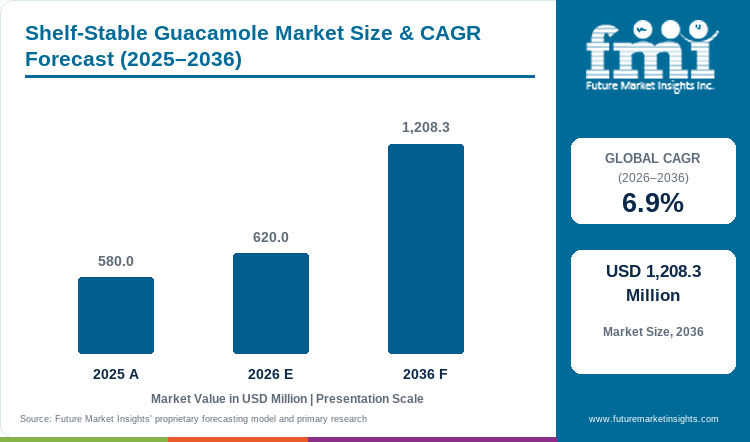
Sales of shelf-stable guacamole are estimated at USD 620.0 Million in 2026 and are forecast to reach USD 1,208.3 Million by 2036 at a 6.9% CAGR. The market was valued at USD 580.0 Million in 2025. The revenue pool is narrow compared with fresh avocado or chilled guacamole because the product has to remain safe and acceptable before opening without refrigeration. That requirement changes formulation, packaging and plant controls. FDA guidance defines acidified foods around a finished equilibrium pH of 4.6 or below when the product otherwise meets the low-acid criteria. For avocado-based dips, the commercial problem is to meet that safety and shelf-life requirement while limiting browning and the cooked flavor that can appear when heat treatment becomes too aggressive.
Unopened ambient guacamole can use conventional grocery distribution and pantry storage. In the dips and spreads market, this gives it access to outlets with limited refrigerated capacity. The formulation still has to retain acceptable avocado color, flavor and texture through the stated shelf life. As a serving-ready product within the ready-to-eat food market, it also needs clear after-opening storage instructions.
Key Takeaways
- The market is estimated at USD 620.0 Million in 2026 and is forecast to reach USD 1,208.3 Million by 2036 at a 6.9% CAGR. The 2025 base is USD 580.0 Million, creating USD 588.3 Million of incremental opportunity through 2036.
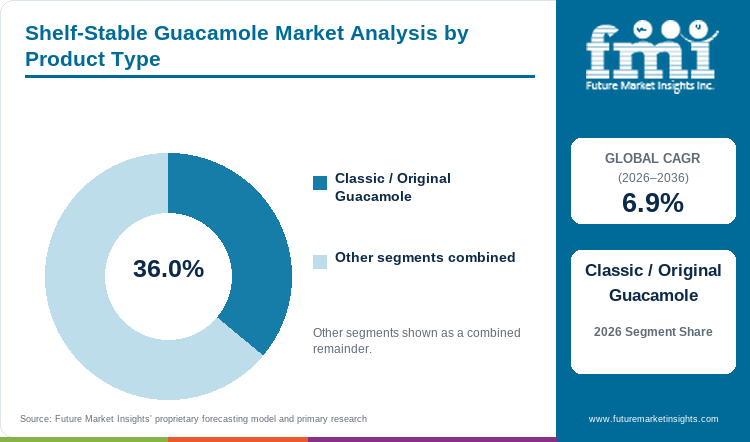
- Classic / Original Guacamole accounts for 36.0% of Product Type demand in 2026 because retailers and foodservice buyers can use a familiar base flavor across chips, sandwiches, wraps and prepared meals.
- Jars hold 43.0% of Packaging Format demand in 2026 because they suit hot-fill or thermally processed systems and give shoppers a familiar resealable pantry format.
- Acidified Thermal / Hot-Fill processing represents 56.0% of Processing Technology demand because pH control and validated thermal treatment provide a practical route to ambient stability for avocado-based dips.
- Household Retail represents 57.0% of End Use demand, while Supermarkets & Hypermarkets account for 45.0% of Sales Channel demand because shelf-stable products can sit in the Mexican-food, sauce or dip aisle without refrigerated merchandising.
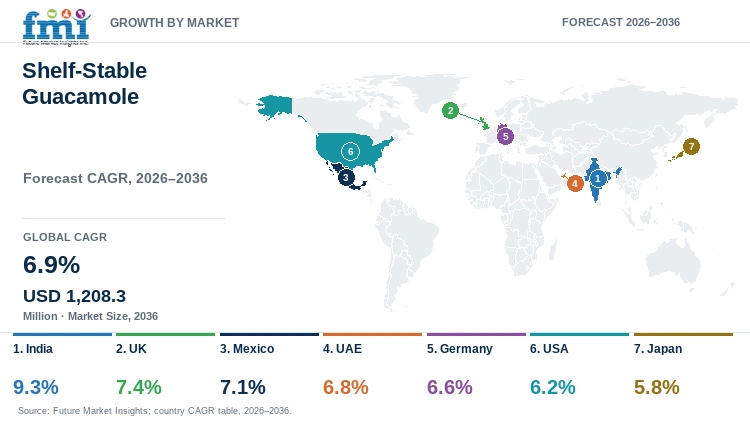
- Country CAGRs range from 9.3% in India to 5.8% in Japan from 2026 to 2036. Growth depends on avocado availability, ambient-food acceptance, imported Mexican-food penetration and the cost of chilled distribution.
Analyst Perspective
Ambient guacamole must remain safe and appealing throughout its unopened shelf life. Acidification, oxygen control and packaging affect both preservation and the avocado's flavor and color. Processors need to validate the complete product and process, then confirm that the sensory result remains acceptable near the end of storage. Pantry convenience is valuable only when consumers still want to eat the dip.
- Nandini Roy Choudhury, Principal Consultant, Future Market Insights
How is the Shelf-Stable Guacamole Market segmented?
The Shelf-Stable Guacamole Market is segmented by Product Type, Packaging Format, Processing Technology, End Use, Sales Channel, and Region.
Product Type includes Classic / Original Guacamole, Flavored / Spicy Guacamole, Guacamole Salsa, Avocado Dip / Creamy Style, and Specialty / Other products. Packaging Format covers Jars, Flexible Pouches, Squeeze Bottles / Tubes, and Single-Serve Cups. Processing Technology includes Acidified Thermal / Hot-Fill, Hurdle Processing, and Aseptic Processing / Filling. End Use covers Household Retail, Foodservice, and Industrial / Ingredient users. Sales Channel includes Supermarkets & Hypermarkets, Foodservice Distributors, Online Retail, and Convenience & Specialty Stores. Regional coverage spans North America, Latin America, Western Europe, Eastern Europe, East Asia, South Asia & Pacific, and Middle East & Africa.
Why does Classic / Original Guacamole lead demand within the Product Type category?
Classic formulations give the buyer a neutral avocado-led base without tying the product to one heat level or meal. This matters in ambient formats because every extra flavor system can change acidity, color or viscosity and therefore complicate process validation. A classic product can also move between dipping and meal assembly. HERDEZ Avocado Dip and several European retail products show how manufacturers keep the proposition simple enough for broad use while relying on acidity regulators, antioxidants or preservatives to protect the product after processing.
- Classic / Original Guacamole holds 36.0% of Product Type demand in 2026 because it supports the broadest set of household and foodservice uses.
- Flavor extensions remain important, but mild or classic bases reduce the need for retailers to carry several low-volume ambient variants.
Why do Jars lead demand within the Packaging Format category?
Jars fit products that need a strong oxygen and moisture barrier plus a visible tamper-evident closure. They are also familiar to shoppers buying salsa or shelf-stable dips, so merchandising does not require a new pack convention. ASDA lists its 270 g guacamole as ambient and instructs consumers to refrigerate after opening. The format gives enough volume for repeat household use while keeping the pre-opening storage proposition simple. Pouches can reduce pack weight, and squeeze bottles improve dispensing, but jars remain well matched to spoonable products and conventional filling lines.
- Jars account for 43.0% of Packaging Format demand in 2026 because they balance barrier performance, resealability and retail familiarity.
- Flexible and squeeze formats gain where portability or controlled dispensing matters more than a bowl-style eating experience.
Why does Acidified Thermal / Hot-Fill processing lead within Processing Technology?
Shelf stability starts with microbiological control, but avocado quality makes the process more difficult than acidifying a simple tomato sauce. FDA guidance places acidified foods at an equilibrium pH of 4.6 or below under the relevant definition, and registered processors must file scheduled processes when the regulation applies. Acidification also helps suppress enzymatic browning, while heat provides a kill step. The trade-off is sensory. Too much heat can flatten fresh flavor and darken the product, so processors need to manage time, temperature and oxygen exposure as one system.
- Acidified Thermal / Hot-Fill systems hold 56.0% of Processing Technology demand in 2026 because they use established food-preservation controls that can be validated at commercial scale.
- Hurdle and aseptic approaches create room to reduce thermal load, but they require tighter control of formulation, filling conditions and package integrity.
Why does Household Retail lead demand within the End Use category?
The main commercial benefit of an ambient product appears before the consumer opens it. Households can keep the pack in a pantry, and retailers avoid refrigerated display space. That is useful for occasional guacamole users who do not want a short unopened shelf life. HERDEZ positioned its Avocado Dip as a ready-made shelf-stable pantry product, while UK retailers sell ambient guacamole jars and squeeze bottles alongside other Mexican-food accompaniments. Foodservice gains similar storage flexibility, but restaurant kitchens can also buy chilled or frozen guacamole in larger formats, so ambient products face more direct format substitution in that channel.
- Household Retail accounts for 57.0% of End Use demand in 2026 because pantry storage supports planned and occasional at-home usage.
- Foodservice demand is strongest where small sites value reduced refrigeration dependence or need portion control across dispersed outlets.
Why do Supermarkets & Hypermarkets lead demand within the Sales Channel category?
Shelf-stable guacamole is easier to merchandise when it can join the same aisle as salsa, tortilla accompaniments and other ambient dips. That gives supermarkets more placement options than a chilled-only product. It also allows consumers to compare guacamole with products in the broader sauces and condiments market rather than relying on a refrigerated produce or deli visit. The channel advantage disappears if consumers do not understand the formulation or if avocado content appears too low, so labels and ingredient communication remain part of shelf conversion.
- Supermarkets & Hypermarkets hold 45.0% of Sales Channel demand in 2026 because they combine pantry shelf space with frequent tortilla-chip and Mexican-food purchasing occasions.
- Online retail helps specialist ambient brands reach markets where physical stores do not allocate a dedicated guacamole shelf.
What are the drivers, restraints and opportunities in the Shelf-Stable Guacamole Market?
Avocado supply and pantry convenience support demand, sensory trade-offs constrain conversion, and lower-thermal-load shelf-stable systems create room for product improvement.
- Driver: Global avocado production is projected by OECD-FAO to reach 16 Mt by 2035, expanding the raw-material base available to fresh, chilled and processed avocado products.
- Restraint: Acid, heat and oxygen control can protect shelf life but may reduce fresh color or flavor, making sensory performance the main comparison point against refrigerated guacamole.
- Opportunity: Hurdle and aseptic approaches can reduce refrigeration dependence while giving processors more options to manage color, texture and thermal exposure.
The supply side is becoming deeper. OECD-FAO projects avocado production to grow at 2.6% per year to 16 Mt by 2035, with Mexico, Colombia, Peru and the Dominican Republic together accounting for about 53% of output. Mexico alone produced about 2.7 million tonnes in 2025. More fruit does not automatically become shelf-stable guacamole, but a larger commercial avocado base supports processors that need consistent pulp supply and diversified sourcing. It also strengthens the adjacent processed fruit and vegetable market by giving manufacturers more raw material for puree, pulp and value-added formats.
The technical restraint is visible in the ingredient deck. CBI notes that citric acid and ascorbic acid are common in avocado processing, while sorbic acid is used more frequently in shelf-stable guacamole dips. These controls solve real stability problems, but every added preservative or acidity adjustment changes the sensory proposition. A shelf-stable brand therefore competes on two fronts: it must survive ambient distribution and still feel close enough to guacamole that buyers do not treat it as a generic green sauce. That is why avocado percentage, color retention and after-opening instructions influence repeat purchase.
Processing improvement is the main product opportunity. Aseptic or multi-hurdle systems can shift some of the preservation burden away from a single heavy thermal step. The packaging side matters at the same time, because oxygen ingress can undermine color even when microbiological stability is controlled. This creates overlap with the aseptic packaging market. Suppliers that can combine validated product safety with lower oxygen exposure have more room to improve flavor retention and serve long export routes.
Which country CAGRs are profiled in the Shelf-Stable Guacamole Market?
| Country | CAGR |
|---|---|
| India | 9.3% |
| UK | 7.4% |
| Mexico | 7.1% |
| UAE | 6.8% |
| Germany | 6.6% |
| USA | 6.2% |
| Japan | 5.8% |
How do country-level CAGRs compare in the Shelf-Stable Guacamole Market?
Growth across the profiled countries ranges from 9.3% CAGR in India to 5.8% in Japan between 2026 and 2036. India starts from a smaller ambient-guacamole base, so shelf-stable avocado processing can add distribution without first building a national refrigerated route. The UK and Germany already show ambient guacamole in mainstream grocery, which gives suppliers a shelf reference point. Mexico has raw-material scale and processing know-how. The USA has a developed guacamole habit but also strong refrigerated competition. Japan grows more gradually because imported avocado demand is established, yet the ambient format has to earn space within a mature convenience-food system.
- India at 9.3% gains from a lower starting base and the operational value of products that can move without refrigerated retail storage before opening.
- UK at 7.4% benefits from established ambient guacamole and squeeze formats in grocery, giving new products a familiar merchandising context.
- Mexico at 7.1% combines a 2.7 million-tonne 2025 avocado crop with established export and processing infrastructure.
- UAE at 6.8% benefits from import-intensive food distribution and a large flow of newly registered food products through Dubai.
- Germany at 6.6% has current guacamole dip listings across ambient-style international-food assortments and broad access to imported avocados.
- USA at 6.2% has strong avocado consumption and branded shelf-stable products, but chilled guacamole creates a higher sensory benchmark.
- Japan at 5.8% remains an import-led avocado market where shelf-stable products compete with fresh preparation and established convenience formats.
Country-wise Analysis
- India: Demand is forecast to rise at 9.3% CAGR from 2026 to 2036. The commercial attraction is distribution reach. An ambient product can enter modern grocery and e-commerce without requiring a refrigerated fixture before opening. India also has a growing set of avocado-processing ventures, which can reduce dependence on finished imported guacamole over time. The addressable buyer is likely to remain urban and premium in the early period, so suppliers need pack sizes and price points that support trial rather than assuming avocado awareness alone will create repeat purchase.
- UK: Demand is forecast to expand at 7.4% CAGR from 2026 to 2036. Ambient guacamole is already visible through retailer own label and branded formats. ASDA lists a 270 g guacamole as ambient, while Old El Paso sells a squeezy guacamole that can be stored at room temperature before opening. That gives the category more than one pack architecture. Future growth depends on whether brands can raise avocado content and sensory quality without giving up the storage advantage that makes the format distinct from chilled guacamole.
- Mexico: Demand is forecast to increase at 7.1% CAGR from 2026 to 2036. Mexico produced about 2.7 million tonnes of avocados in 2025, while avocado export value reached about USD 3.9 Billion. This gives processors proximity to raw fruit and a mature supply chain. Domestic consumers also have a strong avocado habit, so shelf-stable products have to compete against fresh preparation rather than introduce the taste itself. The stronger opportunity is export-oriented processing and convenient pantry formats for consumers who want avocado flavor without handling ripe fruit.
- UAE: Demand is forecast to rise at 6.8% CAGR from 2026 to 2036. Dubai Municipality cleared 173,775 food shipments totaling 4.9 million tons in the first half of 2025 and registered 77,700 new food products. An ambient guacamole pack fits this import-heavy environment because it reduces refrigeration pressure during storage and retail distribution before opening. Suppliers still need heat-stable packaging and clear labeling because last-mile temperature exposure can be severe even when the product is microbiologically shelf stable.
- Germany: Demand is forecast to expand at 6.6% CAGR from 2026 to 2036. REWE currently lists Fuego Guacamole Dip, Henderson and Sons Guacamole Dip, Old El Paso Guacamole and several refrigerated avocado creams, giving shoppers direct format choice. Ambient products therefore compete on convenience rather than novelty. Brands can gain when they deliver a credible avocado profile at a pantry price point, but formulations that read as heavily processed may lose to chilled alternatives in a market with broad grocery access.
- USA: Demand is forecast to rise at 6.2% CAGR from 2026 to 2036. USDA forecast Mexican avocado exports at 1.34 MMT in 2025, with the USA taking 80% by volume. That creates a deep avocado supply environment and a consumer base familiar with guacamole. HERDEZ has already demonstrated that an avocado-based dip can be positioned as shelf stable. Competitive pressure is increasing, however, as PepsiCo announced in April 2026 that Tostitos would enter refrigerated guacamole, explicitly moving beyond shelf-stable offerings. Ambient suppliers need convenience advantages that remain visible after that chilled comparison.
- Japan: Demand is forecast to increase at 5.8% CAGR from 2026 to 2036. USDA identifies Japan as one of Mexico’s avocado export destinations, though at a much smaller share than the USA. The market rewards compact, dependable food formats, but shelf-stable guacamole must fit local flavor expectations and portion sizes. Growth is more likely through imported Mexican-food assortments and selected foodservice use than through rapid substitution for fresh avocado. The emphasis for suppliers is product consistency and package efficiency rather than a broad pantry conversion assumption.
Who are the notable companies in the Shelf-Stable Guacamole Market?
MegaMex Foods / HERDEZ; General Mills / Old El Paso; PepsiCo / Doritos; Fine Food Group; Nesway Foods; ASDA; Theodor Kattus / Fuego; Amexicana
The competitive set is fragmented across branded Mexican-food portfolios, retailer private label and specialist ambient processors. MegaMex Foods has direct shelf-stable avocado credentials through HERDEZ Guacamole Salsa and Avocado Dip. General Mills sells Old El Paso ambient guacamole in a squeeze format. Doritos-branded ambient guacamole dip shows how a snack brand can extend into the dip occasion. Fine Food Group and Nesway Foods market ambient guacamole as a dedicated product capability, including foodservice or private-label style supply. ASDA participates through retailer own label, while Fuego provides a German retail example. Amexicana addresses foodservice with an ambient guacamole sauce.
- Branded Mexican-food companies compete through established tortilla-chip, salsa and meal-kit occasions that give guacamole a natural cross-sell route.
- Specialist processors compete on shelf-life engineering and the ability to supply private label or foodservice formats across several markets.
- Retail private label competes on pantry price and shelf placement, which can put pressure on branded products that do not show a clear avocado or flavor advantage.
Competitive Benchmarking: Shelf-Stable Guacamole Market
| Company | Ambient-Shelf Portfolio | Avocado-Centric Formulation | Retail / Foodservice Coverage | Geographic Reach |
|---|---|---|---|---|
| MegaMex Foods / HERDEZ | High | High | High | USA and Mexico-focused brand platform with wider trade reach |
| General Mills / Old El Paso | High | Medium | High | UK and European grocery channels within a global Mexican-food brand |
| PepsiCo / Doritos | Medium | Low | High | Broad snack distribution with ambient guacamole dip in selected European markets |
| Fine Food Group | High | High | High | Italy-based supplier serving European foodservice and retail customers |
| Nesway Foods | High | High | Medium | Specialist supply with ambient guacamole formats for export and private-label style programs |
| ASDA | Medium | Medium | High | United Kingdom grocery retail |
| Theodor Kattus / Fuego | Medium | Low | High | Germany-focused retail distribution through international-food channels |
| Amexicana | Medium | Medium | High | Foodservice-oriented distribution with ambient guacamole sauce |
Scoring basis: Ambient-Shelf Portfolio measures documented products sold for room-temperature storage before opening. Avocado-Centric Formulation measures how strongly avocado defines the product rather than acting as a minor flavor cue. Retail / Foodservice Coverage reflects documented channel breadth. High indicates broad documented capability against the criterion. Medium indicates narrower but active coverage. Low indicates a documented limitation relative to the criterion.
Product Developments and Current Offers in the Shelf-Stable Guacamole Market
- On May 4, 2022, MegaMex Foods announced HERDEZ Avocado Dip as a ready-made shelf-stable dip in mild and medium varieties. The launch extended the brand's avocado offer into a ready-to-serve dip format that could be stocked without refrigeration before opening.
- Fine Food Group lists Guacamole Ambient as a dedicated foodservice product. The offering gives buyers an ambient guacamole format within an established Tex-Mex assortment, where case handling and storage conditions influence purchasing alongside flavor.
- Nesway Foods lists classic, spicy and chunky guacamole styles with shelf life of up to one year at ambient temperature. Multiple styles allow buyers to vary flavor and texture while retaining room-temperature storage before opening.
Key Players in the Shelf-Stable Guacamole Market
Branded Mexican-Food and Snack Platforms
- MegaMex Foods / HERDEZ
- General Mills / Old El Paso
- PepsiCo / Doritos
Ambient Guacamole and Foodservice Specialists
- Fine Food Group
- Nesway Foods
- Amexicana
Retail and Regional Label Participants
- ASDA
- Theodor Kattus / Fuego
Shelf-Stable Guacamole Market - Report Scope
| Coverage field | Report scope |
|---|---|
| Market breakdown | Product Type; Packaging Format; Processing Technology; End Use; Sales Channel; Region |
| Quantitative Units | USD Million |
| Market Definition | Revenue from ready-to-eat avocado-based guacamole, guacamole salsa and avocado dip products designed for ambient storage before opening in hermetically sealed retail or foodservice packaging. |
| Regions Covered | North America; Latin America; Western Europe; Eastern Europe; East Asia; South Asia & Pacific; Middle East & Africa |
| Countries Covered | India; UK; Mexico; UAE; Germany; USA; Japan; and more than twenty-five additional countries in the full report |
| Key Companies Profiled | MegaMex Foods / HERDEZ; General Mills / Old El Paso; PepsiCo / Doritos; Fine Food Group; Nesway Foods; ASDA; Theodor Kattus / Fuego; Amexicana |
| Forecast Period | 2026 to 2036 |
| Approach | Hybrid bottom-up and top-down sizing that reconciles avocado availability, ambient-product assortment, observed pack economics, channel mix and processing constraints within the defined revenue boundary. |
Shelf-Stable Guacamole Market - Research Methodology
| Method | Approach |
|---|---|
| Primary Research | Commercial validation focuses on the purchase criteria visible across processors, retailers and foodservice suppliers. The assessment tests room-temperature storage claims, avocado content, pack format, after-opening instructions and channel fit. |
| Desk Research | The evidence base uses OECD-FAO avocado outlook data, USDA trade and production reporting, FDA acidified-food guidance, Mexican agricultural statistics, public retail listings, patents and first-party company product information. |
| Market Sizing and Forecasting | Sizing triangulates the commercial avocado base with a bounded share allocated to ambient guacamole systems, finished-product volumes, observed pack pricing and channel economics. Forecast assumptions reflect avocado supply, pantry-format penetration, processing improvement and competition from refrigerated guacamole. |
| Data Validation | The market boundary is cross-checked against company portfolios and storage instructions. Refrigerated and frozen guacamole, plain avocado pulp, seasoning mixes, avocado oil, dehydrated avocado powders and fresh restaurant-made guacamole are excluded. |
Shelf-Stable Guacamole Market by Segments
Shelf-Stable Guacamole Market segmented by Product Type:
- Classic / Original Guacamole
- Flavored / Spicy Guacamole
- Guacamole Salsa
- Avocado Dip / Creamy Style
- Specialty / Other
Shelf-Stable Guacamole Market segmented by Packaging Format:
- Jars
- Flexible Pouches
- Squeeze Bottles / Tubes
- Single-Serve Cups
Shelf-Stable Guacamole Market segmented by Processing Technology:
- Acidified Thermal / Hot-Fill
- Hurdle Processing
- Aseptic Processing / Filling
Shelf-Stable Guacamole Market segmented by End Use:
- Household Retail
- Foodservice
- Industrial / Ingredient
Shelf-Stable Guacamole Market segmented by Sales Channel:
- Supermarkets & Hypermarkets
- Foodservice Distributors
- Online Retail
- Convenience & Specialty Stores
Shelf-Stable Guacamole Market by Region:
- North America
- United States
- Canada
- Latin America
- Brazil
- Mexico
- Argentina
- Chile
- Western Europe
- Germany
- France
- United Kingdom
- Italy
- Spain
- Benelux
- Nordics
- Eastern Europe
- Poland
- Czech Republic
- Romania
- Hungary
- East Asia
- China
- Japan
- South Korea
- South Asia & Pacific
- India
- ASEAN
- Australia and New Zealand
- Middle East & Africa
- GCC Countries
- United Arab Emirates
- Saudi Arabia
- South Africa
- Türkiye
- Israel
Research Sources and Bibliography
- OECD-FAO Agricultural Outlook 2026-2035. Other Products: avocado projection highlights. Published 2026.
- U.S. Department of Agriculture, Foreign Agricultural Service. Mexico: Avocado Annual. April 1, 2025.
- Mexico Secretaría de Agricultura / DGSIAP. 2025 year-end avocado production and 2026 food-inflation reporting.
- Mexico DGSIAP with Banco de México data. Agro-food trade balance, December 2025.
- U.S. Food and Drug Administration. Acidified & Low-Acid Canned Foods Guidance Documents & Regulatory Information. Current guidance page.
- U.S. Food and Drug Administration. Good Manufacturing Practices for the 21st Century for Food Processing, acidified-food controls.
- CBI. Entering the European market for avocado pulp. Current market-entry guidance on avocado processing additives.
- Hormel Foods / MegaMex Foods. New HERDEZ Avocado Dip Ready to Shake-up the Growing U.S. Dip Category. May 4, 2022.
- Hormel Foods. New Salsa on the Block, HERDEZ Guacamole Salsa. October 8, 2018.
- PepsiCo. Tostitos enters the refrigerated aisle with new guacamole. April 30, 2026.
- Fine Food Group. Guacamole Ambient GU33A current product page and catalog.
- Nesway Foods. Guacamole collection, ambient shelf life up to one year. Current product page.
- ASDA. Guacamole 270 g current product listing, ambient storage before opening.
- SuperValu. Old El Paso Chunky Guacamole Squeezy current product listing, ambient storage before opening.
- REWE. Fuego Guacamole Dip 200 ml and current Guacamole & Avocadocreme category listings.
- Dubai Municipality. Over 34,000 food inspections conducted in first half of 2025. July 30, 2025.
This Report Answers
- What is the Shelf-Stable Guacamole Market size in 2026 and what value is forecast for 2036?
- Why does Classic / Original Guacamole account for 36.0% of Product Type demand in 2026?
- Why do jars hold the leading position within Packaging Format?
- How do acidification, thermal treatment and oxygen control affect ambient guacamole quality?
- How do growth rates differ across India, UK, Mexico, UAE, Germany, USA and Japan?
- Which companies compete through branded Mexican-food portfolios versus specialist ambient processing?
- How does refrigerated guacamole affect the value proposition of shelf-stable products?
- What should retailers and foodservice buyers evaluate before qualifying a shelf-stable guacamole supplier?
Frequently Asked Questions
What is driving growth in the Shelf-Stable Guacamole Market?
Growth comes from a deeper global avocado supply base and the distribution advantage of products that can remain at room temperature before opening. Pantry storage gives retailers more shelf options and lets consumers keep guacamole on hand without planning a refrigerated purchase. Processing improvement is widening the format choices available to manufacturers, although sensory quality remains the main test against chilled guacamole.
Who are the key players in the Shelf-Stable Guacamole Market?
Key companies and brands include MegaMex Foods / HERDEZ, General Mills / Old El Paso, PepsiCo / Doritos, Fine Food Group, Nesway Foods, ASDA, Theodor Kattus / Fuego and Amexicana. They participate through different models, ranging from branded retail jars and squeeze packs to foodservice-oriented ambient guacamole supply.
What notable restraint affects the Shelf-Stable Guacamole Market?
The main restraint is the trade-off between shelf stability and fresh sensory quality. Acidification, preservatives and heat can control safety or browning but may alter flavor and texture. Refrigerated guacamole sets a strong comparison point, so ambient products need a clear convenience advantage to compensate when the sensory profile is less fresh.
Why should executives track the Shelf-Stable Guacamole Market?
The category shows whether processors can convert growing avocado supply into higher-value products that travel through standard grocery logistics. It also provides an early signal of how consumers trade fresh-style quality against pantry convenience. Improvements in shelf-life technology can expand the addressable geography without requiring equivalent investment in cold-chain distribution.
What business problem does the Shelf-Stable Guacamole Market address?
Shelf-stable guacamole removes the need to refrigerate unopened product through much of the supply chain and gives households a longer planning window before use. It also allows foodservice sites with constrained chilled storage to hold avocado-based condiments more flexibly. The product must achieve these benefits without becoming so processed that buyers no longer view it as a credible guacamole.
What should buyers evaluate before sourcing shelf-stable guacamole?
Buyers should compare avocado content, declared storage conditions, pack barrier, equilibrium pH controls where relevant, validated shelf life, after-opening instructions and sensory stability. They should also test whether the product maintains color and texture near the end of shelf life, because microbiological safety alone does not guarantee repeat purchase.
Preview the report firsthand - request a free sample
Get SampleGet the brochure for pricing and purchase details.
Get PDFTable of Content
- Key Takeaways
- Market Size and CAGR
- Top Growth Driver
- Fastest Growing Segment
- Leading Region
- Key Companies
- Emerging Opportunities
- Executive Summary
- Global Market Outlook
- Demand-side Trends
- Supply-side Trends
- Technology Roadmap Analysis
- Analysis and Recommendations
- Analyst Perspective (What is happening? Why now? What should investors know?)
- Key Questions Answered
- How large is the market?
- What is the CAGR?
- What are key trends?
- Which region dominates?
- Who are the leaders?
- Market Overview
- Market Coverage / Taxonomy
- Market Definition / Scope / Limitations
- Research Methodology
- Chapter Orientation
- Analytical Lens and Working Hypotheses
- Market Structure, Signals, and Trend Drivers
- Benchmarking and Cross-market Comparability
- Market Sizing, Forecasting, and Opportunity Mapping
- Research Design and Evidence Framework
- Desk Research Programme (Secondary Evidence)
- Expert Input and Fieldwork (Primary Evidence)
- Tooling, Models, and Reference Databases
- Data Engineering and Model Build
- Quality Assurance and Audit Trail
- Market Background
- Market Dynamics (Drivers, Restraints, Opportunity, Trends)
- Scenario Forecast (Optimistic, Likely, Conservative)
- Impact Analysis
- AI Impact
- Sustainability Impact
- Regulatory Impact
- Technology Impact
- Consumer / Buyer Analysis
- Purchase Drivers
- Adoption Barriers
- Buyer Journey
- Opportunity Map Analysis
- Product Life Cycle Analysis
- Supply Chain Analysis
- Investment Feasibility Matrix
- Value Chain Analysis
- PESTLE and Porter's Analysis
- Regulatory Landscape
- Regional Parent Market Outlook
- Production and Consumption Statistics
- Import and Export Statistics
- Global Market Analysis and Forecast, 2021 to 2036
- Historical Market Size Value (USD Million) Analysis, 2021 to 2025
- Current and Future Market Size Value (USD Million) Projections, 2026 to 2036
- Y-o-Y Growth Trend Analysis
- Absolute $ Opportunity Analysis
- Global Market Pricing Analysis, 2021 to 2036
- Global Market Analysis and Forecast, By Product Type, 2021 to 2036
- Introduction / Key Findings
- Historical Market Size Value (USD Million) Analysis By Product Type, 2021 to 2025
- Current and Future Market Size Value (USD Million) Analysis and Forecast By Product Type, 2026 to 2036
- Classic / Original Guacamole
- Flavored / Spicy Guacamole
- Guacamole Salsa
- Avocado Dip / Creamy Style
- Specialty / Other
- Y-o-Y Growth Trend Analysis By Product Type, 2021 to 2025
- Absolute $ Opportunity Analysis By Product Type, 2026 to 2036
- Global Market Analysis and Forecast, By Packaging Format, 2021 to 2036
- Introduction / Key Findings
- Historical Market Size Value (USD Million) Analysis By Packaging Format, 2021 to 2025
- Current and Future Market Size Value (USD Million) Analysis and Forecast By Packaging Format, 2026 to 2036
- Jars
- Flexible Pouches
- Squeeze Bottles / Tubes
- Single-Serve Cups
- Y-o-Y Growth Trend Analysis By Packaging Format, 2021 to 2025
- Absolute $ Opportunity Analysis By Packaging Format, 2026 to 2036
- Global Market Analysis and Forecast, By Processing Technology, 2021 to 2036
- Introduction / Key Findings
- Historical Market Size Value (USD Million) Analysis By Processing Technology, 2021 to 2025
- Current and Future Market Size Value (USD Million) Analysis and Forecast By Processing Technology, 2026 to 2036
- Acidified Thermal / Hot-Fill
- Hurdle Processing
- Aseptic Processing / Filling
- Y-o-Y Growth Trend Analysis By Processing Technology, 2021 to 2025
- Absolute $ Opportunity Analysis By Processing Technology, 2026 to 2036
- Global Market Analysis and Forecast, By End Use, 2021 to 2036
- Introduction / Key Findings
- Historical Market Size Value (USD Million) Analysis By End Use, 2021 to 2025
- Current and Future Market Size Value (USD Million) Analysis and Forecast By End Use, 2026 to 2036
- Household Retail
- Foodservice
- Industrial / Ingredient
- Y-o-Y Growth Trend Analysis By End Use, 2021 to 2025
- Absolute $ Opportunity Analysis By End Use, 2026 to 2036
- Global Market Analysis and Forecast, By Sales Channel, 2021 to 2036
- Introduction / Key Findings
- Historical Market Size Value (USD Million) Analysis By Sales Channel, 2021 to 2025
- Current and Future Market Size Value (USD Million) Analysis and Forecast By Sales Channel, 2026 to 2036
- Supermarkets & Hypermarkets
- Foodservice Distributors
- Online Retail
- Convenience & Specialty Stores
- Y-o-Y Growth Trend Analysis By Sales Channel, 2021 to 2025
- Absolute $ Opportunity Analysis By Sales Channel, 2026 to 2036
- Global Market Analysis and Forecast, By Region, 2021 to 2036
- Introduction
- Historical Market Size Value (USD Million) Analysis By Region, 2021 to 2025
- Current Market Size Value (USD Million) Analysis and Forecast By Region, 2026 to 2036
- North America
- Latin America
- Western Europe
- Eastern Europe
- East Asia
- South Asia & Pacific
- Middle East & Africa
- Market Attractiveness Analysis By Region
- North America Market Analysis and Forecast, By Country, 2021 to 2036
- Historical Market Size Value (USD Million) Trend Analysis By Market Taxonomy, 2021 to 2025
- Market Size Value (USD Million) Forecast By Market Taxonomy, 2026 to 2036
- By Country
- United States
- Canada
- By Product Type
- By Packaging Format
- By Processing Technology
- By End Use
- By Sales Channel
- By Country
- Market Attractiveness Analysis
- By Country
- By Product Type
- By Packaging Format
- By Processing Technology
- By End Use
- By Sales Channel
- Key Takeaways
- Latin America Market Analysis and Forecast, By Country
- Historical Market Size Value (USD Million) Trend Analysis By Market Taxonomy, 2021 to 2025
- Market Size Value (USD Million) Forecast By Market Taxonomy, 2026 to 2036
- By Country
- Brazil
- Mexico
- Argentina
- Chile
- By Product Type
- By Packaging Format
- By Processing Technology
- By End Use
- By Sales Channel
- By Country
- Market Attractiveness Analysis
- By Country
- By Product Type
- By Packaging Format
- By Processing Technology
- By End Use
- By Sales Channel
- Key Takeaways
- Western Europe Market Analysis and Forecast, By Country
- Historical Market Size Value (USD Million) Trend Analysis By Market Taxonomy, 2021 to 2025
- Market Size Value (USD Million) Forecast By Market Taxonomy, 2026 to 2036
- By Country
- Germany
- France
- United Kingdom
- Italy
- Spain
- Benelux
- Nordics
- By Product Type
- By Packaging Format
- By Processing Technology
- By End Use
- By Sales Channel
- By Country
- Market Attractiveness Analysis
- By Country
- By Product Type
- By Packaging Format
- By Processing Technology
- By End Use
- By Sales Channel
- Key Takeaways
- Eastern Europe Market Analysis and Forecast, By Country
- Historical Market Size Value (USD Million) Trend Analysis By Market Taxonomy, 2021 to 2025
- Market Size Value (USD Million) Forecast By Market Taxonomy, 2026 to 2036
- By Country
- Poland
- Czech Republic
- Romania
- Hungary
- By Product Type
- By Packaging Format
- By Processing Technology
- By End Use
- By Sales Channel
- By Country
- Market Attractiveness Analysis
- By Country
- By Product Type
- By Packaging Format
- By Processing Technology
- By End Use
- By Sales Channel
- Key Takeaways
- East Asia Market Analysis and Forecast, By Country
- Historical Market Size Value (USD Million) Trend Analysis By Market Taxonomy, 2021 to 2025
- Market Size Value (USD Million) Forecast By Market Taxonomy, 2026 to 2036
- By Country
- China
- Japan
- South Korea
- By Product Type
- By Packaging Format
- By Processing Technology
- By End Use
- By Sales Channel
- By Country
- Market Attractiveness Analysis
- By Country
- By Product Type
- By Packaging Format
- By Processing Technology
- By End Use
- By Sales Channel
- Key Takeaways
- South Asia & Pacific Market Analysis and Forecast, By Country
- Historical Market Size Value (USD Million) Trend Analysis By Market Taxonomy, 2021 to 2025
- Market Size Value (USD Million) Forecast By Market Taxonomy, 2026 to 2036
- By Country
- India
- ASEAN
- Australia and New Zealand
- By Product Type
- By Packaging Format
- By Processing Technology
- By End Use
- By Sales Channel
- By Country
- Market Attractiveness Analysis
- By Country
- By Product Type
- By Packaging Format
- By Processing Technology
- By End Use
- By Sales Channel
- Key Takeaways
- Middle East & Africa Market Analysis and Forecast, By Country
- Historical Market Size Value (USD Million) Trend Analysis By Market Taxonomy, 2021 to 2025
- Market Size Value (USD Million) Forecast By Market Taxonomy, 2026 to 2036
- By Country
- GCC Countries
- United Arab Emirates
- Saudi Arabia
- South Africa
- Türkiye
- Israel
- By Product Type
- By Packaging Format
- By Processing Technology
- By End Use
- By Sales Channel
- By Country
- Market Attractiveness Analysis
- By Country
- By Product Type
- By Packaging Format
- By Processing Technology
- By End Use
- By Sales Channel
- Key Takeaways
- Key Countries Market Analysis
- United States
- Pricing Analysis
- Market Share Analysis, 2025
- By Product Type
- By Packaging Format
- By Processing Technology
- By End Use
- By Sales Channel
- Canada
- Pricing Analysis
- Market Share Analysis, 2025
- By Product Type
- By Packaging Format
- By Processing Technology
- By End Use
- By Sales Channel
- Mexico
- Pricing Analysis
- Market Share Analysis, 2025
- By Product Type
- By Packaging Format
- By Processing Technology
- By End Use
- By Sales Channel
- Brazil
- Pricing Analysis
- Market Share Analysis, 2025
- By Product Type
- By Packaging Format
- By Processing Technology
- By End Use
- By Sales Channel
- Chile
- Pricing Analysis
- Market Share Analysis, 2025
- By Product Type
- By Packaging Format
- By Processing Technology
- By End Use
- By Sales Channel
- Germany
- Pricing Analysis
- Market Share Analysis, 2025
- By Product Type
- By Packaging Format
- By Processing Technology
- By End Use
- By Sales Channel
- United Kingdom
- Pricing Analysis
- Market Share Analysis, 2025
- By Product Type
- By Packaging Format
- By Processing Technology
- By End Use
- By Sales Channel
- Italy
- Pricing Analysis
- Market Share Analysis, 2025
- By Product Type
- By Packaging Format
- By Processing Technology
- By End Use
- By Sales Channel
- Spain
- Pricing Analysis
- Market Share Analysis, 2025
- By Product Type
- By Packaging Format
- By Processing Technology
- By End Use
- By Sales Channel
- France
- Pricing Analysis
- Market Share Analysis, 2025
- By Product Type
- By Packaging Format
- By Processing Technology
- By End Use
- By Sales Channel
- India
- Pricing Analysis
- Market Share Analysis, 2025
- By Product Type
- By Packaging Format
- By Processing Technology
- By End Use
- By Sales Channel
- ASEAN
- Pricing Analysis
- Market Share Analysis, 2025
- By Product Type
- By Packaging Format
- By Processing Technology
- By End Use
- By Sales Channel
- Australia and New Zealand
- Pricing Analysis
- Market Share Analysis, 2025
- By Product Type
- By Packaging Format
- By Processing Technology
- By End Use
- By Sales Channel
- China
- Pricing Analysis
- Market Share Analysis, 2025
- By Product Type
- By Packaging Format
- By Processing Technology
- By End Use
- By Sales Channel
- Japan
- Pricing Analysis
- Market Share Analysis, 2025
- By Product Type
- By Packaging Format
- By Processing Technology
- By End Use
- By Sales Channel
- South Korea
- Pricing Analysis
- Market Share Analysis, 2025
- By Product Type
- By Packaging Format
- By Processing Technology
- By End Use
- By Sales Channel
- Poland
- Pricing Analysis
- Market Share Analysis, 2025
- By Product Type
- By Packaging Format
- By Processing Technology
- By End Use
- By Sales Channel
- Hungary
- Pricing Analysis
- Market Share Analysis, 2025
- By Product Type
- By Packaging Format
- By Processing Technology
- By End Use
- By Sales Channel
- Saudi Arabia
- Pricing Analysis
- Market Share Analysis, 2025
- By Product Type
- By Packaging Format
- By Processing Technology
- By End Use
- By Sales Channel
- Türkiye
- Pricing Analysis
- Market Share Analysis, 2025
- By Product Type
- By Packaging Format
- By Processing Technology
- By End Use
- By Sales Channel
- South Africa
- Pricing Analysis
- Market Share Analysis, 2025
- By Product Type
- By Packaging Format
- By Processing Technology
- By End Use
- By Sales Channel
- UAE
- Pricing Analysis
- Market Share Analysis, 2025
- By Product Type
- By Packaging Format
- By Processing Technology
- By End Use
- By Sales Channel
- United States
- Market Structure Analysis
- Competition Dashboard
- Competition Benchmarking
- Market Share Analysis of Top Players
- By Regional
- By Product Type
- By Packaging Format
- By Processing Technology
- By End Use
- By Sales Channel
- Emerging Startups
- Innovation Benchmarking
- Competition Analysis
- Competition Deep Dive
- MegaMex Foods / HERDEZ
- Overview
- Product Portfolio
- Profitability by Market Segments
- Sales Footprint
- Strategy Overview
- Marketing Strategy
- Product Strategy
- Channel Strategy
- General Mills / Old El Paso
- PepsiCo / Doritos
- Fine Food Group
- Nesway Foods
- ASDA
- Theodor Kattus / Fuego
- Amexicana
- MegaMex Foods / HERDEZ
- Case Studies
- Success Stories
- Recent Developments
- Competition Deep Dive
- Assumptions & Acronyms Used


