

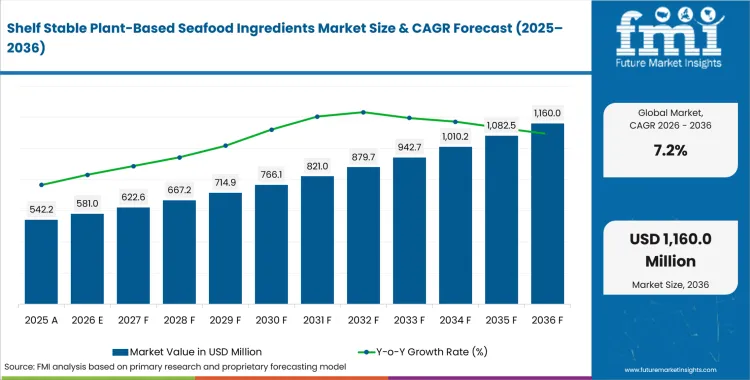
- Market Size (2026)
- USD 581.0 Mn
- Forecast (2036)
- USD 1160.0 Mn
- CAGR (2026 to 2036)
- 7.2%
How big is Shelf Stable Plant-Based Seafood Ingredients Market in 2026?
USD 581.0 million in 2026 and USD 1,160.0 million by 2036 at a 7.2% CAGR.
Demand for shelf stable plant-based seafood ingredients is projected to expand at 7.2% CAGR between 2026 and 2036, increasing valuation from USD 581.0 million in 2026 to USD 1160.0 million by 2036. Shelf stable recipes require plant-based protein systems that hold water and oil through thermal processing without losing a seafood-like bite during ambient storage. The U.S. Food and Drug Administration issued draft guidance in January 2025 that specifically addressed labeling for plant-based alternatives to seafood. The guidance connects ingredient selection with truthful product identity and clear package language across commercial launches. Manufacturers gain repeat orders from systems that transfer across tuna-style spreads and ready meals without repeating every stability and labeling review.
European and United States development routes create different review burdens even if one formulation meets the same thermal target. The European Parliament reported in June 2025 that plant-based seafood substitutes faced potentially noncompliant marketing practices and varied national initiatives. European manufacturers therefore need country-level naming checks during formulation and final package approval across retail channels. United States teams use federal recommendations that remain nonbinding and case-specific, so major retailers can request further support for individual claims. Natural flavors become more valuable through marine notes that support a truthful product description without overstating similarity to conventional fish. Technical teams reduce rework by reviewing flavor intensity and product identity during the first retort pilot.
Key Takeaways of Shelf Stable Plant-Based Seafood Ingredients Market
- Ambient seafood alternatives require coordinated texture and flavor systems that remain dependable through heat treatment and extended storage.
- By product type, proteins are estimated to hold 20.0% share in 2026 owing to their combined structural and nutritional role.
- Plant is projected to hold 27.0% share in 2026 within the source category, supported by broad availability across several plant-based recipe systems.
- In 2026, bakery is expected to lead application with 28.0% share attributable to familiar savory formats that already support ambient distribution.
- Product naming and allergen controls can extend development schedules whenever an ingredient change alters package language or cross-contact duties.
- Cargill, Kerry, IFF, Roquette, Tate & Lyle, Givaudan, Lallemand, and Ingredion compete through different combinations of protein, texture, taste, and application support.
Analyst Perspective
"Commercial success depends on whether one ingredient system preserves seafood-like bite and marine flavor through retort processing and ambient storage. Protein and texture choices must control water and oil without muting delicate marine notes during storage. The practical advantage comes from a formulation that transfers across several recipes with limited package or process rework. Application support matters most during factory validation and prevents technical failures from restarting formulation and labeling work."
- Nandini Roy Choudhury, Principal Analyst, Future Market Insights
How is the Shelf Stable Plant-Based Seafood Ingredients Market segmented?
The shelf stable plant-based seafood ingredients industry is segmented by product type, source, application, end user, and region.
Product type separates proteins, fibers, sweeteners, cultures, and flavors by the function each ingredient performs in the recipe. Source distinguishes plant, microbial, dairy analog, upcycled, and mineral inputs through their origin and labeling effect. Application compares bakery, beverages, snacks, infant nutrition, and ready meals under different heat and storage conditions. End user identifies food manufacturers, beverage manufacturers, foodservice operators, contract manufacturers, and retail brands according to who controls formulation and purchasing. Regional analysis compares naming rules, allergen duties, processing support, and ingredient availability across national markets. The taxonomy shows how food texturing agents and sensory inputs enter separate commercial routes without assuming that every factory uses the same retort process or approval sequence.
Why do proteins retain the clearest product type position in the shelf stable plant-based seafood ingredients market?
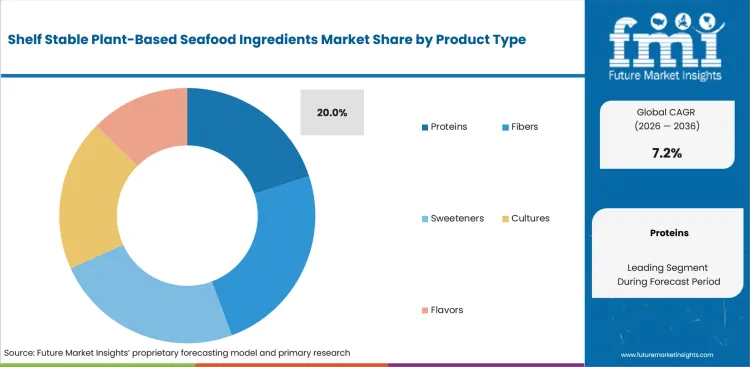
Protein systems establish bite and water retention in seafood-style foods that undergo retort processing and ambient storage. Ingredion presented its Texture Equation framework in July 2025 and connected technical expertise with tailored ingredients and defined eating experiences. The framework gives pea protein development teams a practical basis for comparing firmness and moisture control during factory trials. Formulators must also confirm that flavor release remains consistent through the intended package and heat schedule.
- By product type, proteins are forecast to represent 20.0% share in 2026 driven by their combined structural and nutritional role. They bind water and oil through storage while giving brands a clear protein claim across several seafood-style recipes. The combined function reduces reliance on separate structuring systems during early commercial development and recipe transfer.
- Food manufacturers evaluate protein systems through retort trials that measure firmness and water release in the intended package. One stable laboratory sample cannot establish commercial reliability across full processing and normal consumer reheating conditions. Application teams also need evidence that flavor release and oil retention remain consistent across several production batches and commercial storage periods.
What supports plant demand within the source category?
Plant sources give formulators access to pea and wheat or soy combinations with different hydration and bite profiles. Roquette added new textured wheat and pea proteins in June 2025 for plant-based ready meals and savory applications. One pea format was designed to retain bite through cooking and reheating across ready meals. The broader textured vegetable protein choice gives seafood-style filling teams stronger thermal options, although each source needs separate allergen review and flavor correction.
- The source category is forecast to be led by plant at 27.0% share in 2026 due to familiar processing routes and broad ingredient availability. Formulators can combine pea with wheat or soy according to texture and label priorities during early development. The flexible mix lets technical teams adjust firmness without rebuilding the entire flavor system across related recipes.
- Manufacturers favor plant sources that hydrate predictably and retain a neutral color through commercial processing. Wheat and soy create different declarations and cross-contact plans, so adoption requires source-specific allergen controls. Technical teams must confirm supply continuity across factories during approval for several related commercial recipes. Repeated source changes can reopen sensory testing and package review during the same launch program.
How does bakery shape demand within the application category?
Bakery formats can carry seafood-style fillings through ambient distribution in savory pastries and filled crackers. Tate & Lyle introduced its Mouthfeel Lab in July 2025 and demonstrated texture systems for cracker applications. The development gives plant-based snacks teams a practical route for comparing crunch with filling stability under commercial processing. A stable filling can soften the surrounding dough during storage, so shelf-life trials must measure oil migration.
- Bakery is set to lead the application category with 28.0% share in 2026 due to familiar savory formats and established ambient packaging. Filled pastries and crackers can carry seafood-style profiles without chilled distribution across every sales channel. Their commercial position depends on fillings that limit oil migration through extended storage and normal retail handling.
- Commercial bakeries test deposit accuracy and bake tolerance independently of moisture movement across the finished package. A filling loses appeal if oil softens the dough or marine flavor spreads beyond the intended center. Production teams also need stable viscosity that supports accurate depositing through long line runs and repeated temperature changes.
What makes food manufacturers central to the end user category?
Food manufacturers coordinate ingredient screening with recipe approval and pilot production across several technical functions. Cargill reopened its Singapore Innovation Center in April 2025 with expanded test-kitchen and product-development spaces for ready-made meals. The upgraded center gives manufacturing teams a place to compare pea protein ingredients with texture and flavor systems ahead of factory validation. Shared performance targets help technical functions isolate production failures without reopening every part of the commercial recipe review.
- Food manufacturers are projected to hold 14.0% share in 2026 owing to direct control over formulation budgets and factory scale decisions. Their technical teams connect recipe approval with pilot production and package validation across the complete launch process. Direct control over factory trials helps them compare ingredient cost with expected production consistency during commercial production.
- Food manufacturers expand orders once a formula passes heat treatment and storage testing in the intended package. Each new protein or flavor combination can change process limits and label declarations across the same recipe. Ingredient partners gain repeat business by resolving technical questions without restarting the complete pilot and package approval program.
What are the drivers, restraints, and opportunities in the Shelf Stable Plant-Based Seafood Ingredients Market?
A measured plant-based seafood base supports repeat formulation work, while naming and allergen duties slow launches and integrated ingredient systems can reduce repeated trials.
- Driver: A measurable base of plant-based seafood sales gives manufacturers a reason to extend proven formulations into new shelf stable formats.
- Restraint: Allergen declarations and product naming rules can reopen technical and package review across multi-ingredient seafood alternatives.
- Opportunity: Coordinated protein and texture systems can reduce repeated trials across ambient prepared foods that share similar processing conditions.
Plant-based fish products operate within a measured retail base that gives manufacturers reasons to extend proven recipes into ambient formats. The Good Food Institute reported in January 2026 that global plant-based meat and seafood retail sales reached USD 6.6 billion in 2025. The figure confirms a commercial product base that needs repeated texture and flavor work, although it does not measure ingredient demand. Yeast extract can deepen marine savoriness inside a transferable system that spreads development cost across several related formats.
Allergen management creates a material restraint across seafood alternatives that combine proteins with flavors and texturizers from several regulated sources. The U.S. Food and Drug Administration issued updated allergen labeling guidance in January 2025 for major allergen sources and declarations. A revised protein blend can change cross-contact controls and package language across the same product. Manufacturers need regulatory review early enough to prevent printed packaging from becoming unusable near national distribution.
Integrated formulation creates a practical opening for ingredient groups that coordinate texture with flavor carriers and label-friendly functionality. Roquette introduced AMYSTA L 123 thermally soluble pea starch in October 2025 through an enzyme-free and chemical-free process. The starch supports smooth mouthfeel and carrier functionality in dried soup or sauce and condiment mixes. Seafood-style teams can reduce separate trials by testing one coordinated system under retort treatment and ambient storage. Commercial gains require measured processing performance instead of a broad clean-label claim without supporting production evidence.
Which country CAGRs are profiled in the Shelf Stable Plant-Based Seafood Ingredients Market?
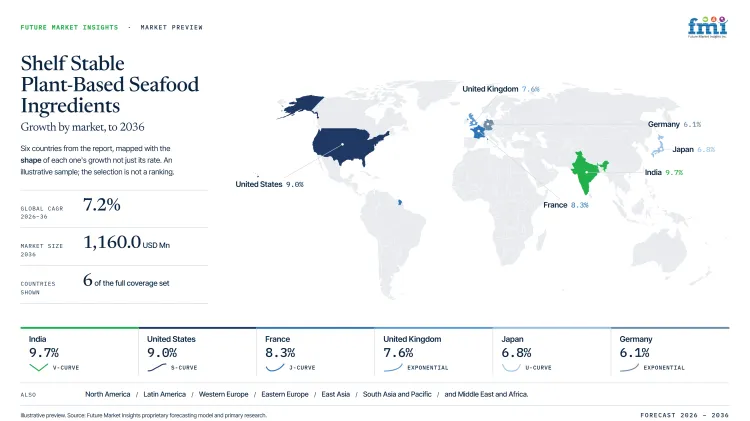
| Country | CAGR |
|---|---|
| India | 9.7% |
| United States | 9.0% |
| France | 8.3% |
| United Kingdom | 7.6% |
| Japan | 6.8% |
| Germany | 6.1% |
How do country-level CAGRs compare in the Shelf Stable Plant-Based Seafood Ingredients Market?
The country forecasts show a gradual progression across the shelf stable plant-based seafood ingredients market, reflecting different stages of alternative seafood development instead of sharply separated growth tiers. India and the United States define the upper end of the comparison as manufacturers expand shelf-stable product portfolios that address protein diversification and convenience-driven consumption. France occupies an intermediate position and creates a transition between the higher-growth markets and the remaining European and Asian countries.
- India benefits from increasing interest in plant-based proteins and growing demand for affordable shelf-stable food products that can support wider consumer access and distribution.
- The United States reflects an active alternative protein ecosystem where ingredient suppliers and food manufacturers continue to develop seafood alternatives with improved texture, flavor, and nutritional profiles.
- France supports market growth through consumer interest in sustainable food choices and continued innovation in premium plant-based formulations.
- The United Kingdom continues to encourage adoption through expanding retail availability of alternative protein products and growing awareness of environmental considerations associated with food choices.
- Japan's outlook is influenced by established seafood consumption patterns, creating opportunities for plant-based alternatives that can closely replicate familiar taste and product characteristics.
- Germany maintains steady momentum as manufacturers incorporate plant-based seafood ingredients into broader strategies focused on sustainable and clean-label food innovation.
Similar CAGRs do not necessarily translate into identical market opportunities. Differences in retail distribution, consumer perceptions of seafood alternatives, ingredient sourcing and product formulation requirements can significantly influence commercialization pathways. As a result, companies may encounter distinct market entry conditions even where forecast growth rates appear relatively comparable. The full report provides country-level CAGR analysis across North America, Latin America, Europe, East Asia, South Asia, Oceania and the Middle East and Africa.
Country-wise Analysis
- India’s food-processing base combines national manufacturers with regional plants that use different retort equipment and validation routines. Shelf stable plant-based seafood ingredient sales in India are forecast to expand at 9.7% CAGR by 2036, supported by a growing food-processing skills base. The Press Information Bureau reported in December 2025 that the national skills framework covered more than 60 approved food-processing job roles and included plant-based proteins. The framework can strengthen recipe transfer across factories that maintain documented packaged-food controls and traceable quality routines. Smaller processors can face limited sensory support and uneven retort capacity across regional production sites. Ingredient companies need local application partners that can adapt one formula without weakening texture or marine flavor.
- United States manufacturers can access domestic taste facilities and established technical teams across major food-production regions. Givaudan began constructing a new Taste & Wellbeing liquids facility near Cincinnati in October 2025 through an initial USD 215 million investment. The United States shelf stable plant-based seafood ingredients sector is estimated to post 9.0% CAGR over the forecast period, aided by local formulation support. The planned liquids site can shorten supply routes for taste systems used during regional scale-up. Retailers can request product-specific claims support beyond federal guidance during individual package reviews and assortment decisions. Commercial contracts should separate sensory development from final label approval so responsibility remains clear through launch revisions.
- French manufacturers work within detailed food-labeling rules that establish accepted commercial names for conventional seafood products. France’s competition and consumer protection authority updated its fish and aquaculture denomination list in May 2025. France’s shelf stable plant-based seafood ingredients outlook is anticipated to advance at 8.3% CAGR over the assessment period, shaped by detailed identity review. The official list gives legal teams a defined conventional reference during package assessment and claims review. Alternative products need wording that prevents confusion with listed fish species and remains understandable in French. Ingredient groups must connect flavor descriptions with truthful product identity across retail and foodservice formats.
- Manufacturers serving England, Wales, and Northern Ireland operate across grocery and foodservice channels with detailed allergen communication requirements. United Kingdom demand for shelf stable plant-based seafood ingredients is forecast to rise at 7.6% CAGR over the forecast period, underpinned by established formulation and foodservice channels. Out-of-home launches in those three nations add a separate documentation route for menu descriptions and written allergen information. The Food Standards Agency issued updated industry guidance in March 2025 for written allergen information and staff conversations in foodservice settings. Ingredient companies need channel-specific files that remain usable through staff turnover and seasonal menu changes. Operational friction increases if contract kitchens change recipes without synchronized ingredient documentation across each affected location.
- Japanese retail launches require package language that clearly distinguishes alternative fish products from conventional seafood choices. Nippon Ham described its plant-based tuna development in January 2025 and detailed work on mild sweetness and red-meat flavor. The development team also refined surface appearance and fat behavior to reproduce familiar tuna eating qualities. The Japanese shelf stable plant-based seafood ingredients sector is projected to record 6.8% CAGR during the assessment period, reinforced by local seafood formulation expertise. The development shows that Japanese sensory standards extend beyond a generic marine note and require several linked eating cues. The reported product was designed for raw-style use, so shelf stable manufacturers must rebuild those cues for retort processing. Commercial programs therefore need separate ambient stability evidence and precise non-fish wording across national retail formats.
- German manufacturers operate within a mature ingredient sector and a national strategy that supports more diverse protein consumption. The Federal Ministry of Food and Agriculture published consumer-environment actions and protein-strategy measures in January 2025. Adoption of shelf stable plant-based seafood ingredients in Germany is estimated to expand at 6.1% CAGR through 2036, influenced by policy attention and established application capability. The measures give food companies a clearer national context for alternative-protein development and innovation funding. Established competition restricts generic recipes that lack a measurable sensory or processing advantage during commercial evaluation. Ingredient groups need commercial heat-treatment evidence and dependable local application support across regional manufacturing locations.
Who are the notable companies in the Shelf Stable Plant-Based Seafood Ingredients Market?
Cargill, Kerry, IFF, Roquette, Tate & Lyle, Givaudan, Lallemand, and Ingredion are notable companies in this market.
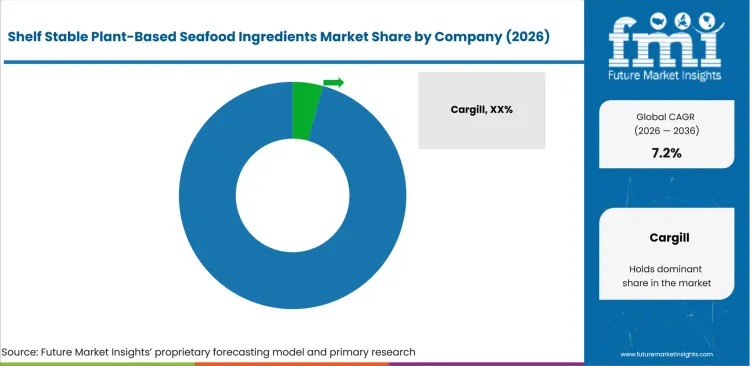
Competition separates broad protein and texturizer portfolios from taste and fermentation specialists that solve narrower parts of the same shelf stable workflow. IFF opened an immersive experience hub in Singapore in July 2025 to help food companies test and refine concepts in simulated commercial settings. The hub demonstrates a service model that differs from companies centered on plant proteins or starch systems. Specialty yeast providers address savory depth and process consistency without replacing the main structural protein system. Food manufacturers compare retort evidence and application response time beside geographic coverage during final company selection. Technical teams create value from broad portfolios by transferring one formula across several ambient formats without losing texture or flavor.
- Cargill and Roquette provide plant protein and texture platforms for seafood-style fillings and prepared meals. Ingredion adds starch and protein systems with application laboratories that can compare formulation performance under defined factory conditions. Manufacturers assess these broad platforms through supply reliability and documented processing results across related recipes.
- Kerry and Givaudan focus on taste creation and masking systems for marine notes and plant-protein off-tastes. Their commercial value depends on local sensory teams adjusting flavor intensity without extending factory trials across every target format. Food manufacturers compare reformulation response times and access to regional application specialists during planned launches.
- IFF combines sensory and hydrocolloid capabilities, while Tate & Lyle contributes mouthfeel and texturizer systems across plant-based foods. Lallemand adds microbial and enzyme expertise for narrower process problems that require targeted technical validation. Specialist companies compete through problem-specific performance instead of offering one complete platform for every seafood-style recipe.
Competitive Benchmarking: Shelf Stable Plant-Based Seafood Ingredients Market
| Company | Protein and Texture Systems | Sensory and Mouthfeel Support | Application and Scale-Up Support | Geographic Reach |
|---|---|---|---|---|
| Cargill | High | Medium | High | Global |
| Kerry | High | High | High | Global |
| IFF | High | High | High | Global |
| Roquette | High | Medium | High | Global |
| Tate & Lyle | High | High | High | Global |
| Givaudan | Medium | High | High | Global |
| Lallemand | Medium | High | Medium | Global |
| Ingredion | High | Medium | High | Global |
Key Developments in the Shelf Stable Plant-Based Seafood Ingredients Market
- In September 2025, Kerry launched Smart Taste as a proprietary range that combines flavor expertise with food science for supply and regulatory challenges. The platform gives seafood-style teams a route for managing plant notes and protecting marine flavor during ingredient substitutions. Its relevance increases across shelf stable recipes that face heat treatment and extended ambient storage requirements. Manufacturers can compare one flavor framework across related formats without rebuilding every sensory brief during commercial reformulation.
- In July 2025, Lallemand completed the acquisition of enzyme specialist Solyve through its Bio-Ingredients business unit. The transaction added enzyme capabilities for plant-based foods and broadened Lallemand’s application support across several commercial food categories. Seafood-style manufacturers can evaluate those enzymes for texture and process consistency across ambient fillings and prepared meals. Commercial use requires application evidence that connects each enzyme treatment with measurable performance under the intended production route.
- In July 2026, Givaudan inaugurated a new production facility in Cikarang and added capacity for savory flavor powders across several food applications. The site expands regional availability for flavor systems that can support seafood-style formulations across Southeast Asia. Shorter supply and application routes can help manufacturers adjust marine profiles during scale-up across several regional factories. Each recipe requires local package review and stability testing under the intended ambient production process.
- In February 2026, Roquette launched NUTRALYS Pea 850F with a cleaner neutral taste and functional performance for plant-based formulations. The isolate reduces the masking burden that can interfere with delicate marine flavor profiles during thermal processing. Its high emulsion capacity and moderate gelling performance provide a technical option for seafood-style formula screening. Commercial trials must confirm firmness and flavor release through the selected retort process and package.
Key Players in the Shelf Stable Plant-Based Seafood Ingredients Market
Broad Ingredient and Protein Platforms
- Cargill
- Roquette
- Ingredion
Taste and Sensory Systems
- Kerry
- IFF
- Givaudan
Texture and Bio-Ingredient Specialists
- Tate & Lyle
- Lallemand
Shelf Stable Plant-Based Seafood Ingredients Market - Report Scope
| Coverage field | Report scope |
|---|---|
| Market breakdown | Product type, source, application, end user, and region. |
| Quantitative Units | Revenue in USD Million and CAGR in %. |
| Market Definition | Commercial demand for ingredients used to formulate shelf stable plant-based seafood products across the listed product types and end uses. |
| Regions Covered | North America, Latin America, Western Europe, Eastern Europe, East Asia, South Asia and Pacific, and Middle East and Africa. |
| Countries Covered | India, United States, France, United Kingdom, Japan, Germany, and 30+ countries. |
| Key Companies Profiled | Cargill, Kerry, IFF, Roquette, Tate & Lyle, Givaudan, Lallemand, and Ingredion. |
| Forecast Period | 2026 to 2036. |
| Approach | Hybrid bottom-up and top-down market sizing supported by primary interviews and official desk research. |
Shelf Stable Plant-Based Seafood Ingredients Market - Research Methodology
| Method | Approach |
|---|---|
| Primary Research | FMI analysts gathered input from manufacturers, service providers, technology developers, distributors, end users, procurement teams, and subject-matter experts. Interviews examined purchasing decisions, product or service evaluation, adoption barriers, approval requirements, pricing considerations, and expectations for technical or commercial support. Respondents were also asked what evidence is required before a trial, pilot, or initial order develops into regular purchasing. |
| Desk Research | Desk research covered government statistics, regulatory publications, trade data, industry associations, technical literature, standards, company filings, product information, and official corporate announcements. Sources were reviewed for relevance, publication date, geographic coverage, and consistency with the defined market scope. Claims relating to performance, applications, approvals, capacity, investment, and commercial activity were retained only when supported by credible public evidence. |
| Market Sizing and Forecasting | The market model combined the baseline value with historical performance, segment structure, pricing and volume indicators, adoption levels, company participation, and country-level demand conditions. Forecast assumptions considered economic activity, investment trends, regulatory developments, technology adoption, purchasing cycles, supply availability, and barriers to wider market use. Segment and regional estimates were reconciled before the final market total was calculated. |
| Data Validation | Estimates were checked against multiple independent indicators, including public data, company activity, trade patterns, industry developments, and findings from primary interviews. Validation also tested whether products, services, applications, and company revenues fell within the defined market boundaries. Adjacent categories, unsupported claims, overlapping revenues, and activities without direct market relevance were excluded to reduce double counting and maintain consistency across segments and countries. |
Shelf Stable Plant-Based Seafood Ingredients Market by Segments
Shelf Stable Plant-Based Seafood Ingredients Market segmented by Product Type:
- Proteins
- Fibers
- Sweeteners
- Cultures
- Flavors
Shelf Stable Plant-Based Seafood Ingredients Market segmented by Source:
- Plant
- Microbial
- Dairy Analog
- Upcycled
- Mineral
Shelf Stable Plant-Based Seafood Ingredients Market segmented by Application:
- Bakery
- Beverages
- Snacks
- Infant Nutrition
- Ready Meals
Shelf Stable Plant-Based Seafood Ingredients Market segmented by End User:
- Food Manufacturers
- Beverage Manufacturers
- Foodservice Operators
- Contract Manufacturers
- Retail Brands
Shelf Stable Plant-Based Seafood Ingredients Market by Region:
- North America
- United States
- Canada
- Mexico
- Latin America
- Brazil
- Chile
- Rest of Latin America
- Western Europe
- Germany
- United Kingdom
- Italy
- Spain
- France
- Nordic
- BENELUX
- Rest of Western Europe
- Eastern Europe
- Russia
- Poland
- Hungary
- Balkan and Baltic
- Rest of Eastern Europe
- East Asia
- China
- Japan
- South Korea
- South Asia and Pacific
- India
- ASEAN
- Australia and New Zealand
- Rest of South Asia and Pacific
- Middle East and Africa
- Kingdom of Saudi Arabia
- Other GCC Countries
- Turkiye
- South Africa
- Other African Union
- Rest of Middle East and Africa
Research Sources and Bibliography
- U.S. Food and Drug Administration. (2025, January 6). Draft Guidance for Industry: Labeling of Plant-Based Alternatives to Animal-Derived Foods.
- European Parliament. (2025, June 5). Research for PECH Committee - Labelling of plant-based seafood substitutes - Scope and issues at stake.
- Ingredion. (2025, July 22). Ingredion at IFT FIRST 2025 - Connecting texture, health and innovation.
- Roquette. (2025, June 17). NUTRALYS® Portfolio: New Textured Wheat and Pea Proteins.
- Tate & Lyle. (2025, July 7). Tate & Lyle debuts expanded portfolio and mouthfeel leadership at IFT FIRST 2025.
- Cargill. (2025, April 10). Cargill unveils transformed Innovation Center in Singapore to advance food innovation, for Asia from Asia.
- Good Food Institute. (2026, January 28). State of the Industry: Plant-based meat, seafood, eggs, dairy, and ingredients.
- U.S. Food and Drug Administration. (2025, January 6). Guidance for Industry: Questions and Answers Regarding Food Allergen Labeling (Edition 5).
- Roquette. (2025, October 31). AMYSTA™ L 123, the New Label-Friendly Soluble Pea Starch.
- Press Information Bureau. (2025, December 4). Initiatives to Bridge Skills Gap in Food Processing Sector.
- Givaudan. (2025, October 8). Givaudan Taste & Wellbeing breaks ground on new production facility near Cincinnati, Ohio.
- Direction générale de la concurrence, de la consommation et de la répression des fraudes. (2025, May 6). Dénominations commerciales des produits de la pêche et de l’aquaculture.
- Food Standards Agency. (2025, March 5). Updated industry guidance issued for food allergen information in the out-of-home sector.
- Nippon Ham Co., Ltd. (2025, January 9).
- Federal Ministry of Food and Agriculture. (2025, January 15). Konsumlandschaften.
- International Flavors & Fragrances. (2025, July 10). IFF Expands Innovation Center in Singapore with New Immersive Experience Hub.
- Kerry. (2025, September 30). Kerry Launches Smart TasteTM to Help Customers Navigate Market Complexities Without Compromising on Taste.
- Lallemand. (2025, July 17). Lallemand acquires enzyme specialist Solyve.
- Givaudan. (2026, July 3). Givaudan inaugurates new production facility in Indonesia.
- Roquette. (2026, February 23). Launch of Breakthrough Clean-Tasting Pea Protein Isolate.
This bibliography is provided for reader reference and is not exhaustive. The full report contains the complete reference list and detailed citations
This Report Answers
- How large is the shelf stable plant-based seafood ingredients market in 2026 and 2036?
- Which formulation requirements support demand for proteins and sensory systems across ambient seafood alternatives?
- Why do proteins account for a notable product type share in 2026?
- How does plant influence ingredient selection within the source category?
- Why does bakery account for the selected application share in 2026?
- How do country growth rates differ across India and the United States or France and Germany?
- Which companies provide protein and taste or texture systems for shelf stable seafood-style products?
- What labeling and allergen requirements restrict commercialization across several countries?
- How can integrated ingredient systems reduce reformulation time across prepared meals and savory snacks?
Frequently Asked Questions
How big is the Shelf Stable Plant-Based Seafood Ingredients Market in 2026?
The shelf stable plant-based seafood ingredients market is valued at USD 581.0 million in 2026 and is forecast to reach USD 1160.0 million by 2036, driven by demand for plant-based protein systems that hold water and oil through thermal processing while preserving a seafood-like bite during ambient storage and distribution.
What is the CAGR of the Shelf Stable Plant-Based Seafood Ingredients Market from 2026 to 2036?
The shelf stable plant-based seafood ingredients market is projected to grow at a CAGR of 7.2% between 2026 and 2036, supported by an expanding commercial base for plant-based seafood alternatives, integrated protein and texture systems that reduce repeated trials, and growing regulatory guidance on labeling across major launch markets.
Which application leads the Shelf Stable Plant-Based Seafood Ingredients Market?
Bakery accounts for 28.0% of the shelf stable plant-based seafood ingredients market by application in 2026, driven by familiar savory formats including filled pastries and crackers that carry seafood-style profiles through ambient packaging without requiring chilled distribution across every retail and foodservice channel.
Which country is growing fastest in the Shelf Stable Plant-Based Seafood Ingredients Market?
The shelf stable plant-based seafood ingredients market in India is projected to grow at a CAGR of 9.7% through 2036, supported by a growing food-processing skills base covering plant-based proteins across more than 60 approved job roles, expanding retort manufacturing capacity, and increasing demand for affordable shelf-stable protein products.
Who are the leading companies in the Shelf Stable Plant-Based Seafood Ingredients Market?
Leading companies in the shelf stable plant-based seafood ingredients market include Cargill, Kerry, IFF, Roquette, Tate & Lyle, Givaudan, Lallemand, and Ingredion, spanning plant protein and texture platforms, marine flavor creation and masking systems, mouthfeel expertise, and enzyme-based process support for ambient seafood-style formulations.
Preview the report firsthand - request a free sample
Get SampleGet the brochure for pricing and purchase details.
Get PDFTable of Content
- Key Takeaways
- Market Size and CAGR
- Top Growth Driver
- Fastest Growing Segment
- Leading Region
- Key Companies
- Emerging Opportunities
- Executive Summary
- Global Market Outlook
- Demand-side Trends
- Supply-side Trends
- Technology Roadmap Analysis
- Analysis and Recommendations
- Analyst Perspective (What is happening? Why now? What should investors know?)
- Key Questions Answered
- How large is the market?
- What is the CAGR?
- What are key trends?
- Which region dominates?
- Who are the leaders?
- Market Overview
- Market Coverage / Taxonomy
- Market Definition / Scope / Limitations
- Research Methodology
- Chapter Orientation
- Analytical Lens and Working Hypotheses
- Market Structure, Signals, and Trend Drivers
- Benchmarking and Cross-market Comparability
- Market Sizing, Forecasting, and Opportunity Mapping
- Research Design and Evidence Framework
- Desk Research Programme (Secondary Evidence)
- Expert Input and Fieldwork (Primary Evidence)
- Tooling, Models, and Reference Databases
- Data Engineering and Model Build
- Quality Assurance and Audit Trail
- Market Background
- Market Dynamics (Drivers, Restraints, Opportunity, Trends)
- Scenario Forecast (Optimistic, Likely, Conservative)
- Impact Analysis
- AI Impact
- Sustainability Impact
- Regulatory Impact
- Technology Impact
- Consumer / Buyer Analysis
- Purchase Drivers
- Adoption Barriers
- Buyer Journey
- Opportunity Map Analysis
- Product Life Cycle Analysis
- Supply Chain Analysis
- Investment Feasibility Matrix
- Value Chain Analysis
- PESTLE and Porter's Analysis
- Regulatory Landscape
- Regional Parent Market Outlook
- Production and Consumption Statistics
- Import and Export Statistics
- Global Market Analysis and Forecast, 2021 to 2036
- Historical Market Size Value (USD Million) Analysis, 2021 to 2025
- Current and Future Market Size Value (USD Million) Projections, 2026 to 2036
- Y-o-Y Growth Trend Analysis
- Absolute $ Opportunity Analysis
- Global Market Pricing Analysis, 2021 to 2036
- Global Market Analysis and Forecast, By Product Type, 2021 to 2036
- Introduction / Key Findings
- Historical Market Size Value (USD Million) Analysis By Product Type, 2021 to 2025
- Current and Future Market Size Value (USD Million) Analysis and Forecast By Product Type, 2026 to 2036
- Proteins
- Fibers
- Sweeteners
- Cultures
- Flavors
- Proteins
- Y-o-Y Growth Trend Analysis By Product Type, 2021 to 2025
- Absolute $ Opportunity Analysis By Product Type, 2026 to 2036
- Global Market Analysis and Forecast, By Source, 2021 to 2036
- Introduction / Key Findings
- Historical Market Size Value (USD Million) Analysis By Source, 2021 to 2025
- Current and Future Market Size Value (USD Million) Analysis and Forecast By Source, 2026 to 2036
- Plant
- Microbial
- Dairy Analog
- Upcycled
- Mineral
- Plant
- Y-o-Y Growth Trend Analysis By Source, 2021 to 2025
- Absolute $ Opportunity Analysis By Source, 2026 to 2036
- Global Market Analysis and Forecast, By Application, 2021 to 2036
- Introduction / Key Findings
- Historical Market Size Value (USD Million) Analysis By Application, 2021 to 2025
- Current and Future Market Size Value (USD Million) Analysis and Forecast By Application, 2026 to 2036
- Bakery
- Beverages
- Snacks
- Infant Nutrition
- Ready Meals
- Bakery
- Y-o-Y Growth Trend Analysis By Application, 2021 to 2025
- Absolute $ Opportunity Analysis By Application, 2026 to 2036
- Global Market Analysis and Forecast, By End User, 2021 to 2036
- Introduction / Key Findings
- Historical Market Size Value (USD Million) Analysis By End User, 2021 to 2025
- Current and Future Market Size Value (USD Million) Analysis and Forecast By End User, 2026 to 2036
- Food Manufacturers
- Ingredient Blenders
- Private Label
- Foodservice
- Nutraceutical Brands
- Food Manufacturers
- Y-o-Y Growth Trend Analysis By End User, 2021 to 2025
- Absolute $ Opportunity Analysis By End User, 2026 to 2036
- Global Market Analysis and Forecast, By Region, 2021 to 2036
- Introduction
- Historical Market Size Value (USD Million) Analysis By Region, 2021 to 2025
- Current Market Size Value (USD Million) Analysis and Forecast By Region, 2026 to 2036
- North America
- Latin America
- Western Europe
- Eastern Europe
- East Asia
- South Asia and Pacific
- Middle East & Africa
- Market Attractiveness Analysis By Region
- North America Market Analysis and Forecast, By Country, 2021 to 2036
- Historical Market Size Value (USD Million) Trend Analysis By Market Taxonomy, 2021 to 2025
- Market Size Value (USD Million) Forecast By Market Taxonomy, 2026 to 2036
- By Country
- USA
- Canada
- By Product Type
- By Source
- By Application
- By End User
- By Country
- Market Attractiveness Analysis
- By Country
- By Product Type
- By Source
- By Application
- By End User
- Key Takeaways
- Latin America Market Analysis and Forecast, By Country
- Historical Market Size Value (USD Million) Trend Analysis By Market Taxonomy, 2021 to 2025
- Market Size Value (USD Million) Forecast By Market Taxonomy, 2026 to 2036
- By Country
- Brazil
- Mexico
- Chile
- Rest of Latin America
- By Product Type
- By Source
- By Application
- By End User
- By Country
- Market Attractiveness Analysis
- By Country
- By Product Type
- By Source
- By Application
- By End User
- Key Takeaways
- Western Europe Market Analysis and Forecast, By Country
- Historical Market Size Value (USD Million) Trend Analysis By Market Taxonomy, 2021 to 2025
- Market Size Value (USD Million) Forecast By Market Taxonomy, 2026 to 2036
- By Country
- Germany
- UK
- Italy
- Spain
- France
- Nordic
- BENELUX
- Rest of Western Europe
- By Product Type
- By Source
- By Application
- By End User
- By Country
- Market Attractiveness Analysis
- By Country
- By Product Type
- By Source
- By Application
- By End User
- Key Takeaways
- Eastern Europe Market Analysis and Forecast, By Country
- Historical Market Size Value (USD Million) Trend Analysis By Market Taxonomy, 2021 to 2025
- Market Size Value (USD Million) Forecast By Market Taxonomy, 2026 to 2036
- By Country
- Russia
- Poland
- Hungary
- Balkan & Baltic
- Rest of Eastern Europe
- By Product Type
- By Source
- By Application
- By End User
- By Country
- Market Attractiveness Analysis
- By Country
- By Product Type
- By Source
- By Application
- By End User
- Key Takeaways
- East Asia Market Analysis and Forecast, By Country
- Historical Market Size Value (USD Million) Trend Analysis By Market Taxonomy, 2021 to 2025
- Market Size Value (USD Million) Forecast By Market Taxonomy, 2026 to 2036
- By Country
- China
- Japan
- South Korea
- By Product Type
- By Source
- By Application
- By End User
- By Country
- Market Attractiveness Analysis
- By Country
- By Product Type
- By Source
- By Application
- By End User
- Key Takeaways
- South Asia and Pacific Market Analysis and Forecast, By Country
- Historical Market Size Value (USD Million) Trend Analysis By Market Taxonomy, 2021 to 2025
- Market Size Value (USD Million) Forecast By Market Taxonomy, 2026 to 2036
- By Country
- India
- ASEAN
- Australia & New Zealand
- Rest of South Asia and Pacific
- By Product Type
- By Source
- By Application
- By End User
- By Country
- Market Attractiveness Analysis
- By Country
- By Product Type
- By Source
- By Application
- By End User
- Key Takeaways
- Middle East & Africa Market Analysis and Forecast, By Country
- Historical Market Size Value (USD Million) Trend Analysis By Market Taxonomy, 2021 to 2025
- Market Size Value (USD Million) Forecast By Market Taxonomy, 2026 to 2036
- By Country
- Kingdom of Saudi Arabia
- Other GCC Countries
- Türkiye
- South Africa
- Other African Union
- Rest of Middle East & Africa
- By Product Type
- By Source
- By Application
- By End User
- By Country
- Market Attractiveness Analysis
- By Country
- By Product Type
- By Source
- By Application
- By End User
- Key Takeaways
- Key Countries Market Analysis
- USA
- Pricing Analysis
- Market Share Analysis, 2025
- By Product Type
- By Source
- By Application
- By End User
- Canada
- Pricing Analysis
- Market Share Analysis, 2025
- By Product Type
- By Source
- By Application
- By End User
- Mexico
- Pricing Analysis
- Market Share Analysis, 2025
- By Product Type
- By Source
- By Application
- By End User
- Brazil
- Pricing Analysis
- Market Share Analysis, 2025
- By Product Type
- By Source
- By Application
- By End User
- Chile
- Pricing Analysis
- Market Share Analysis, 2025
- By Product Type
- By Source
- By Application
- By End User
- Germany
- Pricing Analysis
- Market Share Analysis, 2025
- By Product Type
- By Source
- By Application
- By End User
- UK
- Pricing Analysis
- Market Share Analysis, 2025
- By Product Type
- By Source
- By Application
- By End User
- Italy
- Pricing Analysis
- Market Share Analysis, 2025
- By Product Type
- By Source
- By Application
- By End User
- Spain
- Pricing Analysis
- Market Share Analysis, 2025
- By Product Type
- By Source
- By Application
- By End User
- France
- Pricing Analysis
- Market Share Analysis, 2025
- By Product Type
- By Source
- By Application
- By End User
- India
- Pricing Analysis
- Market Share Analysis, 2025
- By Product Type
- By Source
- By Application
- By End User
- ASEAN
- Pricing Analysis
- Market Share Analysis, 2025
- By Product Type
- By Source
- By Application
- By End User
- Australia & New Zealand
- Pricing Analysis
- Market Share Analysis, 2025
- By Product Type
- By Source
- By Application
- By End User
- China
- Pricing Analysis
- Market Share Analysis, 2025
- By Product Type
- By Source
- By Application
- By End User
- Japan
- Pricing Analysis
- Market Share Analysis, 2025
- By Product Type
- By Source
- By Application
- By End User
- South Korea
- Pricing Analysis
- Market Share Analysis, 2025
- By Product Type
- By Source
- By Application
- By End User
- Russia
- Pricing Analysis
- Market Share Analysis, 2025
- By Product Type
- By Source
- By Application
- By End User
- Poland
- Pricing Analysis
- Market Share Analysis, 2025
- By Product Type
- By Source
- By Application
- By End User
- Hungary
- Pricing Analysis
- Market Share Analysis, 2025
- By Product Type
- By Source
- By Application
- By End User
- Kingdom of Saudi Arabia
- Pricing Analysis
- Market Share Analysis, 2025
- By Product Type
- By Source
- By Application
- By End User
- Türkiye
- Pricing Analysis
- Market Share Analysis, 2025
- By Product Type
- By Source
- By Application
- By End User
- South Africa
- Pricing Analysis
- Market Share Analysis, 2025
- By Product Type
- By Source
- By Application
- By End User
- USA
- Market Structure Analysis
- Competition Dashboard
- Competition Benchmarking
- Market Share Analysis of Top Players
- By Regional
- By Product Type
- By Source
- By Application
- By End User
- Emerging Startups
- Innovation Benchmarking
- Competition Analysis
- Competition Deep Dive
- Cargill
- Overview
- Product Portfolio
- Profitability by Market Segments
- Sales Footprint
- Strategy Overview
- Marketing Strategy
- Product Strategy
- Channel Strategy
- Kerry
- IFF
- Roquette
- Tate & Lyle
- Givaudan
- Lallemand
- Ingredion
- Cargill
- Case Studies
- Success Stories
- Recent Developments
- Competition Deep Dive
- Assumptions & Acronyms Used


