

- Market Size (2026)
- USD 3.2 Bn
- Forecast (2036)
- USD 5.6 Bn
- CAGR (2026 to 2036)
- 5.6%
How big is the Silicon Carbide Abrasives Market in 2026?
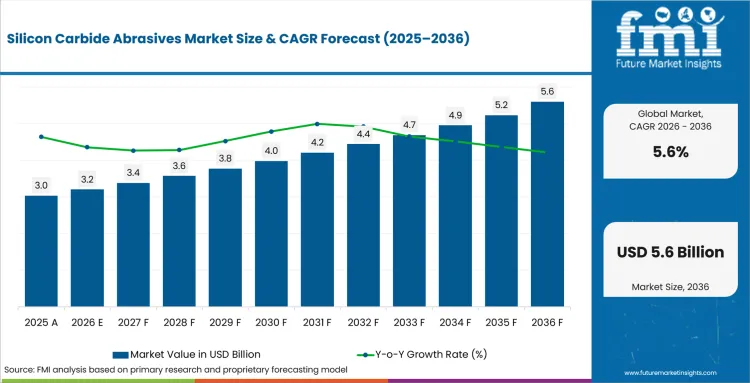
USD 3.2 billion in 2026 and USD 5.6 billion by 2036 at a 5.6% CAGR.
The silicon carbide abrasives market was valued at USD 3.0 billion in 2025. It is expected to rise from USD 3.2 billion in 2026 to USD 5.6 billion by 2036, representing a 5.6% CAGR. Coated and bonded product makers consume classified grain through recurring production, while metalworking, stone finishing, blasting and ceramics distribute demand across several industries.
Abrasive-grade silicon carbide begins with a high-temperature furnace reaction between silica and carbon-bearing feedstock. The resulting material is crushed, purified and separated into controlled particle sizes before it enters belts, discs, wheels, loose powders and blasting products. USGS Open-File Report 2026-1018 states that China holds roughly 45% of global annual production capacity for abrasive-grade silicon carbide, which makes regional supply, power costs and freight important purchasing considerations.
Key Takeaways of Silicon Carbide Abrasives Market
- Coated and bonded abrasive manufacturers create recurring demand for classified silicon carbide grain across production runs.
- Coated Abrasives lead the Abrasive Form category with 31.0% share in 2026 because flexible backings support belts, sheets and discs across machine sanding, hand finishing and continuous belt work.
- Black Silicon Carbide accounts for 46.0% of grade demand in 2026 due to its broad production base, general-purpose fit and availability across coated, bonded, blasting, lapping and loose-grain applications.
- Medium grit represents 34.0% of 2026 demand because it balances useful cutting speed with a more manageable scratch pattern than coarse grain.
- Electricity, petroleum coke and freight costs can alter furnace economics and disrupt converter supply.
- Notable companies include Saint-Gobain, Washington Mills, Fiven, Imerys, ESD-SIC, Navarro SiC, Futong Industry, Pacific Rundum, CUMI and Henan Yicheng.
What is the analyst perspective on the Silicon Carbide Abrasives Market?
“Approve supply on chemistry and particle distribution, along with lot repeatability, then test removal rate and scratch pattern together. Keep electronic-grade and abrasive-grade pricing separate, and include power, freight and regional stock in long-term supply reviews.”
- Nikhil Kaitwade, Principal Analyst, Future Market Insights
Source: Future Market Insights' proprietary forecasting model and primary research
How is the Silicon Carbide Abrasives Market segmented?
The market is segmented by abrasive form, grade, grit size, application, end use and region.
By Abrasive Form, the market includes Coated Abrasives, Bonded Abrasives, Loose Grains or Powders, Nonwoven Abrasives and Blasting Media. Grade covers Black Silicon Carbide, Green Silicon Carbide, Metallurgical Grade and Microgrit Grade. Grit Size includes Medium, Coarse, Fine and Microfine. Application is divided into Metalworking, Stone Grinding or Polishing, Ceramics or Refractories, Electronics or Semiconductors, and Automotive Components. End Use includes Abrasive Product Makers, Stone Fabrication, Foundries, Ceramics Producers and Electronics.
Why does metalworking lead the application category?
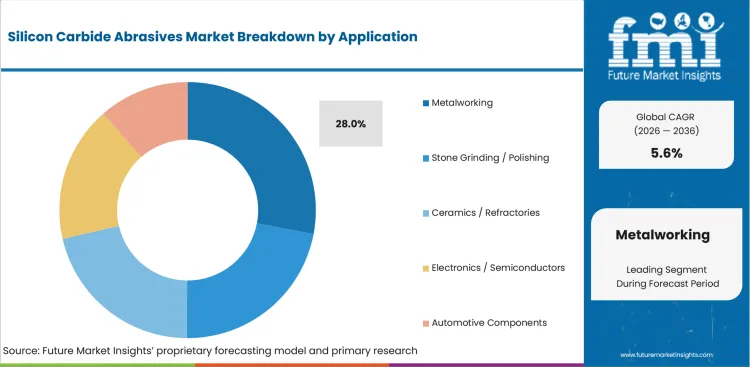
Silicon carbide abrasives are used for scale removal, shaping, deburring and surface preparation across belts, discs and bonded tools. The grain's hardness and heat resistance support cutting on hard surfaces, but the finished result still depends on the backing, bond and machine conditions.
- In 2026, Metalworking is expected to lead the Application category with 28.0% share because the installed base of grinding and finishing equipment creates recurring consumption across industrial users.
- Stone Grinding or Polishing, Ceramics or Refractories, Electronics or Semiconductors, and Automotive Components remain important applications. Buyers should evaluate the complete abrasive product because a strong grain cannot compensate for a weak bond, backing or wheel design.
Why do coated abrasives lead the abrasive form category?
Coated abrasives fix silicon carbide grain to paper, cloth or another flexible backing to create belts, sheets and discs. The format can move between machine sanding, hand finishing and continuous belt work without changing the basic abrasive grain.
- By Abrasive Form, Coated Abrasives are forecast to represent 31.0% of market sales in 2026 because one flexible-backed format serves several grinding and finishing workflows.
- FEPA coated-abrasive grades extend from coarse P12 material to very fine P5000 products. Converters should verify oversize particles and grit distribution because a small number of large grains can leave visible scratches.
Why does black slicon carbide lead the grade category?
Black silicon carbide is produced across a broad industrial range and is used in coated products, bonded wheels, blasting, lapping and loose-grain applications. Its larger production base and wider general-purpose fit give it a cost and availability advantage over higher-purity green grades.
- Black Silicon Carbide is set to lead the Grade category with 46.0% share in 2026 because it suits high-volume industrial work where hardness and cutting action matter more than the highest available purity.
- Buyers should specify chemistry and particle distribution rather than use colour as a substitute for a technical grade. Green Silicon Carbide remains relevant where higher purity is required, while Metallurgical Grade and Microgrit Grade serve narrower specifications.
What makes medium the leading grit size?
Medium grit sits between heavy stock removal and fine surface preparation. It provides a useful cutting rate without leaving the deeper scratch pattern associated with coarse grain.
- By Grit Size, Medium is estimated to hold 34.0% of demand in 2026 because it supports common metal, stone and coated-abrasive finishing steps.
- A change in grit system should be tested on both removal rate and the scratch pattern left for the next process stage. Coarse grades favour heavier removal, while Fine and Microfine grades support tighter finishing requirements.
Why do abrasive product makers lead the end use category?
Abrasive product makers buy classified grain and convert it into belts, wheels, discs, powders and other finished products. Their priority extends beyond nominal grit size to repeatable chemistry and particle distribution across large production lots.
- Abrasive Product Makers are expected to consume 34.0% of market output in 2026 because they connect furnace production with finished abrasives used by metalworking, stone, ceramic and industrial customers.
- Stone Fabrication, Foundries, Ceramics Producers and Electronics create direct end-use demand. Long-term supply contracts can reduce exposure to inconsistent feedstock, long freight routes and abrupt changes in furnace availability.
What are the drivers, restraints and opportunities in the Silicon Carbide Abrasives Market?
Broad converter demand supports recurring sales. Furnace energy and supply concentration create risk. Fine classification and traceable lots provide the clearest premium route.
- Driver: Coated and bonded abrasive manufacturers consume classified grain through recurring production runs.
- Restraint: Electricity, petroleum coke and freight costs can change furnace economics and disrupt converter supply.
- Opportunity: Tighter classification and lot traceability can support premium pricing in fine finishing and microgrit applications.
Demand is spread across several downstream products rather than tied to one machine cycle. Coated belts, bonded wheels, loose powders and blasting products all consume classified grain. FEPA standards give converters common particle-size references, which supports qualification across product forms and industrial customers.
Primary production remains the main cost and supply risk. The furnace route requires high temperature, stable electricity and carbon-bearing feedstock. Fiven has identified power, petroleum coke and silica sand as material operating dependencies. When energy or trade conditions tighten, converters can face price increases, longer lead times or fewer qualified supply options.
Fine and microfine grades provide the clearest premium route. FEPA specifications extend to F2000 for bonded microgrits and P5000 for coated products. Suppliers can add value through narrower particle distribution, contamination control, lot records and support for converting one standard into another. The buyer benefit is a more predictable scratch pattern and fewer finish defects.
Which country CAGRs are profiled in the Silicon Carbide Abrasives Market?
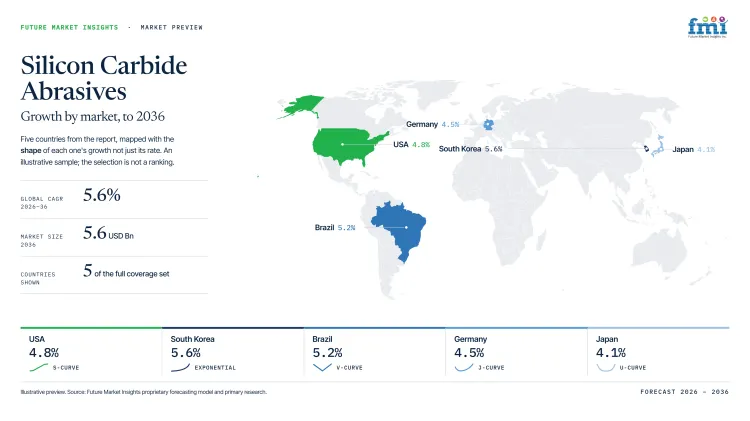
| Country | CAGR |
|---|---|
| USA | 4.8% |
| Germany | 4.5% |
| Japan | 4.1% |
| South Korea | 5.6% |
| Brazil | 5.2% |
How do country-level CAGRs compare in the Silicon Carbide Abrasives Market?
The country outlook spans 1.5 percentage points across five markets. South Korea is projected to grow fastest at 5.6%, followed by Brazil at 5.2% and the USA at 4.8%. Germany and Japan are forecast at 4.5% and 4.1%. These rates describe forecast pace and do not measure current revenue or installed volume.
- South Korea's forecast reflects demand from named abrasive converters and high-specification manufacturers, rather than semiconductor investment in general.
- Brazil combines metalworking, stone processing and construction-related finishing, supporting a broad medium-grit and coated-product base.
- The USA benefits from direct USGS reporting on manufactured abrasives and a large group of industrial end users.
- Germany remains important for higher-specification supply where converters value European stock, stable lots and technical conversion support.
- Japan places greater weight on fine-grit control and repeatable particle distribution, which supports quality-sensitive supply relationships.
Comparable CAGRs can produce different market entry conditions. The full report provides country-level analysis across North America, Latin America, Western Europe, Eastern Europe, South Asia & Pacific, East Asia, Central Asia, Russia & Belarus, and Middle East & Africa.
What does the country-wise analysis show?
- USA: The US market is projected to grow at a 4.8% CAGR from 2026 to 2036. USGS provides direct reporting on manufactured abrasives, giving suppliers a clearer view of production, trade and market conditions. The strongest offers combine stable grade quality with dependable delivery to abrasive-product makers.
- Germany: Germany is forecast to expand at a 4.5% CAGR through 2036. Its established machinery and metalworking base supports recurring use of coated and bonded abrasives. European stock, traceable lots and conversion support are stronger differentiators than broad volume claims.
- Japan: Japan is expected to record a 4.1% CAGR over the forecast period. Precision-oriented manufacturing places more weight on fine-grit control and repeatable particle distribution. Suppliers should prove lot-to-lot consistency rather than rely on a general high-purity claim.
- South Korea: South Korea is projected to lead the five countries at a 5.6% CAGR. The relevant opportunity comes from abrasive converters and high-specification manufacturing processes that need controlled grinding and finishing. Semiconductor capacity should remain outside the demand case unless the abrasive use is directly documented.
- Brazil: Brazil is forecast to grow at a 5.2% CAGR from 2026 to 2036. Metalworking, stone processing and construction finishing create a varied customer base. Local inventory can reduce freight exposure and help converters avoid interruptions caused by imported-grain lead times.
Who are the notable companies in the Silicon Carbide Abrasives Market?
Saint-Gobain, Washington Mills, Fiven, Imerys, ESD-SIC, Navarro SiC, Futong Industry, Pacific Rundum, CUMI and Henan Yicheng are the notable companies serving this market.
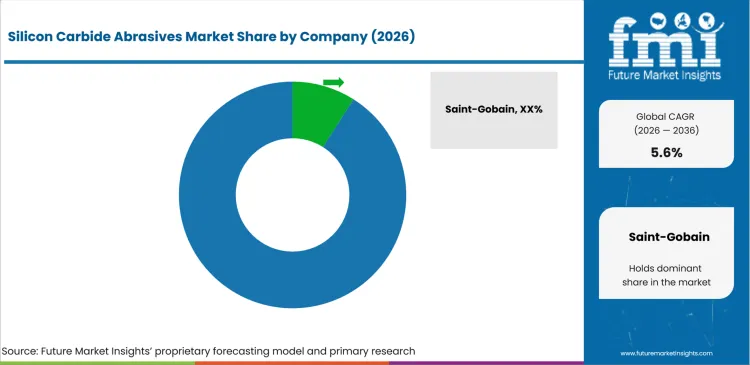
Competition includes global abrasive groups, specialist silicon carbide producers and export-oriented regional suppliers. Buyers compare more than stated purity. Furnace position, classification capability, lot records, technical conversion support and delivery resilience determine whether a producer can serve a converter consistently.
- Saint-Gobain, Imerys and CUMI compete through broad abrasive or industrial-material channels. Their value is strongest where buyers want silicon carbide alongside other grain, bond and finished-abrasive options.
- Washington Mills, Fiven, ESD-SIC and Navarro SiC bring direct silicon carbide production and classification experience. Washington Mills publishes FEPA conversion guidance, while Fiven supplies separate black and green abrasive families across coated, bonded, lapping and blasting uses.
- Futong Industry, Pacific Rundum and Henan Yicheng add regional production and export capacity. Their commercial position depends on consistent grading, shipment reliability and support for customers outside the home market.
How do notable suppliers compare in the Silicon Carbide Abrasives Market?
| Company | Abrasive-Grade Breadth | Fine-Grit Capability | Converter Support | Geographic Reach |
|---|---|---|---|---|
| Saint-Gobain | High | High | High | Global |
| Washington Mills | High | High | High | Global |
| Fiven | High | High | High | Global |
| Imerys | Medium | Medium | High | Global |
| ESD-SIC | High | Medium | Medium | Europe and Export |
| Navarro SiC | High | Medium | Medium | Europe and Export |
| Futong Industry | High | Medium | Medium | Global Export |
| Pacific Rundum | High | High | Medium | Asia and Export |
Scoring basis: High indicates broad documented capability within the criterion, Medium indicates narrower or partial documented capability, and Low indicates limited documented coverage. Geographic reach records the active regions stated in the supporting company material. The table is not a market-share ranking.
What key developments have shaped the Silicon Carbide Abrasives Market?
In August 2024, OpenGate Capital completed the sale of Fiven to Kymera International. The transaction moved a major silicon carbide grains and powders producer into a wider specialty-materials group and strengthened Kymera's position in advanced silicon carbide materials.
What is covered in the Silicon Carbide Abrasives Market report?
| Coverage field | Report scope |
|---|---|
| Market breakdown | By abrasive form, grade, grit size, application, end use and region. |
| Quantitative Units | Revenue in USD Billion, CAGR in %. |
| Market Definition | Silicon carbide grains and abrasive products used in coated, bonded, loose-grain, nonwoven and blasting applications. Semiconductor wafers and power devices are excluded unless the source directly concerns abrasive-grade material or finishing use. |
| Regions Covered | North America, Latin America, Western Europe, Eastern Europe, South Asia & Pacific, East Asia, Central Asia, Russia & Belarus, and Middle East & Africa. |
| Countries Covered | USA, Germany, Japan, South Korea and Brazil, with wider regional coverage in the full report. |
| Key Companies Profiled | Saint-Gobain, Washington Mills, Fiven, Imerys, ESD-SIC, Navarro SiC, Futong Industry, Pacific Rundum, CUMI and Henan Yicheng. |
| Forecast Period | 2026 to 2036. |
| Approach | Hybrid bottom-up and top-down market sizing supported by primary interviews and official desk research. |
How was the Silicon Carbide Abrasives Market researched?
| Method | Approach |
|---|---|
| Primary Research | FMI analysts gathered input from manufacturers, service providers, technology developers, distributors, end users, procurement teams and subject-matter experts. Interviews examined purchasing decisions, product or service evaluation, adoption barriers, approval requirements, pricing considerations and expectations for technical or commercial support. Respondents were also asked what evidence is required before a trial, pilot or initial order develops into regular purchasing. |
| Desk Research | Desk research covered government statistics, regulatory publications, trade data, industry associations, technical literature, standards, company filings, product information and official corporate announcements. Sources were reviewed for relevance, publication date, geographic coverage and consistency with the defined market scope. Claims relating to performance, applications, approvals, capacity, investment and commercial activity were retained only when supported by credible public evidence. |
| Market Sizing and Forecasting | The market model combined the baseline value with historical performance, segment structure, pricing and volume indicators, adoption levels, company participation and country-level demand conditions. Forecast assumptions considered economic activity, investment trends, regulatory developments, technology adoption, purchasing cycles, supply availability and barriers to wider market use. Segment and regional estimates were reconciled before the final market total was calculated. |
| Data Validation | Estimates were checked against multiple independent indicators, including public data, company activity, trade patterns, industry developments and findings from primary interviews. Validation also tested whether products, services, applications and company revenues fell within the defined market boundaries. Adjacent categories, unsupported claims, overlapping revenues and activities without direct market relevance were excluded to reduce double counting and maintain consistency across segments and countries. |
What is the segmentation taxonomy for the Silicon Carbide Abrasives Market?
Silicon Carbide Abrasives Market segmented by Abrasive Form:
- Coated Abrasives
- Bonded Abrasives
- Loose Grains / Powders
- Nonwoven Abrasives
- Blasting Media
Silicon Carbide Abrasives Market segmented by Grade:
- Black Silicon Carbide
- Green Silicon Carbide
- Metallurgical Grade
- Microgrit Grade
Silicon Carbide Abrasives Market segmented by Grit Size:
- Medium
- Coarse
- Fine
- Microfine
Silicon Carbide Abrasives Market segmented by Application:
- Metalworking
- Stone Grinding / Polishing
- Ceramics / Refractories
- Electronics / Semiconductors
- Automotive Components
Silicon Carbide Abrasives Market segmented by End Use:
- Abrasive Product Makers
- Stone Fabrication
- Foundries
- Ceramics Producers
- Electronics
Which sources support the Silicon Carbide Abrasives Market analysis?
- USA Geological Survey, current. USGS maintains a dedicated statistical series for manufactured abrasives, including silicon carbide. https://www.usgs.gov/centers/national-minerals-information-center/manufactured-abrasives-statistics-and-information
- USGS Mineral Commodity Summaries 2025. The US Mineral Commodity Summary treats abrasive-grade silicon carbide separately from high-purity electronic material. https://pubs.usgs.gov/periodicals/mcs2025/mcs2025.pdf
- USGS Mineral Commodity Summaries 2026. The latest USGS summary provides the most current official view of abrasive SiC supply and trade. https://pubs.usgs.gov/periodicals/mcs2026/mcs2026.pdf
- USGS Open-File Report 2026-1018. China holds roughly 45% of global annual production capacity for abrasive-grade silicon carbide. https://pubs.usgs.gov/of/2026/1018/ofr20261018_pamphlet.pdf
- FEPA, current. FEPA standards define particle-size distributions and terminology used across bonded and coated abrasives. https://fepa-abrasives.org/abrasives/standards/
- FEPA, current. Abrasive SiC is produced from silica and carbonaceous feedstock in an energy-intensive furnace process. https://fepa-abrasives.org/abrasives/
- FEPA technical standard. FEPA F4-F220 covers coarse through fine macrogrits for bonded abrasive products. https://fepa-abrasives.org/produit/grains-for-bonded-abrasives-f4-to-f220-english/
- FEPA technical standard. FEPA F230-F2000 defines microgrits used in fine grinding and precision finishing. https://fepa-abrasives.org/produit/grains-for-bonded-abrasives-f-230-to-f-2000/
- FEPA technical standard. P12-P220 is the standard macrogrit range for coated abrasives. https://fepa-abrasives.org/produit/grains-for-coated-abrasives-p12-to-p220/
- FEPA technical standard. P240-P5000 covers fine and ultra-fine coated-abrasive grades. https://fepa-abrasives.org/produit/grains-for-coated-abrasives-p240-to-p5000/
- Washington Mills, accessed 2026. Supplier conversion charts map FEPA grades to approximate particle sizes and other standards. https://www.washingtonmills.com/resources/guides/fepa-particle-size-conversion-chart
- Fiven, accessed 2026. Black and green silicon carbide are sold as distinct abrasive families. https://www.fiven.com/products/sikar-abrasives/
- Fiven abrasive brochure, 2023. Industrial abrasive SiC combines very high hardness and heat resistance with FEPA grit ranges spanning coarse to ultra-fine. https://www.fiven.com/fileadmin/users/redakteur/redakteur_upload/Downloads/230224_Fiven-Flyer-ABR.pdf
- Fiven, accessed 2026. The Acheson route reacts silica or quartz with petroleum coke at roughly 1,700-2,500 degrees C before crushing, purification and sizing. https://www.fiven.com/world-of-silicon-carbide/sic-production-process/
- Fiven, accessed 2026. Abrasive SiC serves grinding, polishing, lapping, coated and bonded products. https://www.fiven.com/markets-applications/abrasives/
- Fiven annual report 2020. Electricity, petroleum coke and silica sand are material cost and supply dependencies for SiC producers. https://www.fiven.com/fileadmin/users/redakteur/redakteur_upload/Downloads/IR/Fiven_Annual_report_2020_Final.pdf
- USGS Mineral Commodity Summaries 2015. Bonded and coated products have historically accounted for most abrasive use of manufactured SiC. https://apps.usgs.gov/minerals-information-archives/mcs/mcs2015.pdf
- Destatis, current. Germany provides official manufacturing and construction indicators for downstream abrasive demand. https://www.destatis.de/EN/Themes/Economic-Sectors-Enterprises/Industry-Manufacturing/_node.html
- Saint-Gobain, 2020 consolidated financial statements. Saint-Gobain completed the sale of its silicon carbide grains and powders business to OpenGate Capital on 14 May 2019. https://www.saint-gobain.com/sites/saint-gobain.com/files/comptes_conso_31-12-2020_eng_.pdf
- Fiven, 2 September 2022. Fiven announced a temporary reduction of furnace operations at the Lillesand plant and reported NOK 120 million invested in its emissions-reduction programme. https://www.fiven.com/company-information/investor-relations/press-releases/
- OpenGate Capital, 1 August 2024. OpenGate completed the sale of Fiven to Kymera International. https://opengatecapital.com/news/opengate-capital-sells-fiven-to-kymera-international/
- Kymera International, 2024. Kymera announced the completed acquisition of Fiven, adding advanced silicon carbide materials to its specialty-materials portfolio. https://kymerainternational.com/kymera-international-acquires-fiven-asa/
This bibliography is provided for reader reference and is not exhaustive. The full report contains the complete reference list and detailed citations.
What questions does this report answer?
- How large is the silicon carbide abrasives market in 2026 and 2036?
- Which industrial applications support demand for abrasive-grade SiC?
- Why do Coated Abrasives hold 31.0% share in 2026?
- Why does Black Silicon Carbide lead the grade category?
- What makes Medium grit the largest particle-size segment?
- How do the USA, Germany, Japan, South Korea and Brazil compare?
- Which companies combine furnace capability with converter support?
- How do energy use and supply concentration limit the market?
- Where can fine-grit classification create higher-value opportunities?
Frequently Asked Questions
How big is the Silicon Carbide Abrasives Market in 2026?
The silicon carbide abrasives market is valued at USD 3.2 billion in 2026 and is forecast to reach USD 5.6 billion by 2036. Growth is supported by coated and bonded abrasive manufacturers consuming classified grain through recurring production runs across metalworking, stone finishing and ceramics industries.
What is the CAGR of the Silicon Carbide Abrasives Market from 2026 to 2036?
The silicon carbide abrasives market grows at a CAGR of 5.6% between 2026 and 2036, supported by recurring converter demand across coated belts, bonded wheels, loose powders and blasting products that consume classified grain through repeated production cycles.
Which abrasive form leads the Silicon Carbide Abrasives Market?
Coated abrasives account for 31.0% of the silicon carbide abrasives market by abrasive form in 2026, driven by flexible backings that support belts, sheets and discs across machine sanding, hand finishing and continuous belt work in one format.
How much will the Silicon Carbide Abrasives Market add between 2026 and 2036?
The silicon carbide abrasives market is set to add USD 2.4 billion between 2026 and 2036, growing from USD 3.2 billion to USD 5.6 billion as classified grain consumption expands across coated, bonded, blasting and loose-grain product lines worldwide.
Who are the leading companies in the Silicon Carbide Abrasives Market?
Ten companies lead the silicon carbide abrasives market consistently, including Saint-Gobain, Washington Mills, Fiven, Imerys, ESD-SIC, Navarro SiC, Futong Industry, Pacific Rundum, CUMI and Henan Yicheng, competing through abrasive-grade breadth, fine-grit capability and converter support worldwide.
Preview the report firsthand - request a free sample
Get SampleGet the brochure for pricing and purchase details.
Get PDFTable of Content
- Key Takeaways
- Market Size and CAGR
- Top Growth Driver
- Fastest Growing Segment
- Leading Region
- Key Companies
- Emerging Opportunities
- Executive Summary
- Global Market Outlook
- Demand-side Trends
- Supply-side Trends
- Technology Roadmap Analysis
- Analysis and Recommendations
- Analyst Perspective (What is happening? Why now? What should investors know?)
- Key Questions Answered
- How large is the market?
- What is the CAGR?
- What are key trends?
- Which region dominates?
- Who are the leaders?
- Market Overview
- Market Coverage / Taxonomy
- Market Definition / Scope / Limitations
- Research Methodology
- Chapter Orientation
- Analytical Lens and Working Hypotheses
- Market Structure, Signals, and Trend Drivers
- Benchmarking and Cross-market Comparability
- Market Sizing, Forecasting, and Opportunity Mapping
- Research Design and Evidence Framework
- Desk Research Programme (Secondary Evidence)
- Expert Input and Fieldwork (Primary Evidence)
- Tooling, Models, and Reference Databases
- Data Engineering and Model Build
- Quality Assurance and Audit Trail
- Market Background
- Market Dynamics (Drivers, Restraints, Opportunity, Trends)
- Scenario Forecast (Optimistic, Likely, Conservative)
- Impact Analysis
- AI Impact
- Sustainability Impact
- Regulatory Impact
- Technology Impact
- Consumer / Buyer Analysis
- Purchase Drivers
- Adoption Barriers
- Buyer Journey
- Opportunity Map Analysis
- Product Life Cycle Analysis
- Supply Chain Analysis
- Investment Feasibility Matrix
- Value Chain Analysis
- PESTLE and Porter's Analysis
- Regulatory Landscape
- Regional Parent Market Outlook
- Production and Consumption Statistics
- Import and Export Statistics
- Global Market Analysis and Forecast, 2021 to 2036
- Historical Market Size Value (USD Billion) Analysis, 2021 to 2025
- Current and Future Market Size Value (USD Billion) Projections, 2026 to 2036
- Y-o-Y Growth Trend Analysis
- Absolute $ Opportunity Analysis
- Global Market Pricing Analysis, 2021 to 2036
- Global Market Analysis and Forecast, By Abrasive Form, 2021 to 2036
- Introduction / Key Findings
- Historical Market Size Value (USD Billion) Analysis By Abrasive Form, 2021 to 2025
- Current and Future Market Size Value (USD Billion) Analysis and Forecast By Abrasive Form, 2026 to 2036
- Coated Abrasives
- Bonded Abrasives
- Loose Grains / Powders
- Nonwoven Abrasives
- Blasting Media
- Coated Abrasives
- Y-o-Y Growth Trend Analysis By Abrasive Form, 2021 to 2025
- Absolute $ Opportunity Analysis By Abrasive Form, 2026 to 2036
- Global Market Analysis and Forecast, By Grade, 2021 to 2036
- Introduction / Key Findings
- Historical Market Size Value (USD Billion) Analysis By Grade, 2021 to 2025
- Current and Future Market Size Value (USD Billion) Analysis and Forecast By Grade, 2026 to 2036
- Black Silicon Carbide
- Green Silicon Carbide
- Metallurgical Grade
- Microgrit Grade
- Black Silicon Carbide
- Y-o-Y Growth Trend Analysis By Grade, 2021 to 2025
- Absolute $ Opportunity Analysis By Grade, 2026 to 2036
- Global Market Analysis and Forecast, By Grit Size, 2021 to 2036
- Introduction / Key Findings
- Historical Market Size Value (USD Billion) Analysis By Grit Size, 2021 to 2025
- Current and Future Market Size Value (USD Billion) Analysis and Forecast By Grit Size, 2026 to 2036
- Medium
- Coarse
- Fine
- Microfine
- Medium
- Y-o-Y Growth Trend Analysis By Grit Size, 2021 to 2025
- Absolute $ Opportunity Analysis By Grit Size, 2026 to 2036
- Global Market Analysis and Forecast, By Application, 2021 to 2036
- Introduction / Key Findings
- Historical Market Size Value (USD Billion) Analysis By Application, 2021 to 2025
- Current and Future Market Size Value (USD Billion) Analysis and Forecast By Application, 2026 to 2036
- Metalworking
- Stone Grinding / Polishing
- Ceramics / Refractories
- Electronics / Semiconductors
- Automotive Components
- Metalworking
- Y-o-Y Growth Trend Analysis By Application, 2021 to 2025
- Absolute $ Opportunity Analysis By Application, 2026 to 2036
- Global Market Analysis and Forecast, By End Use, 2021 to 2036
- Introduction / Key Findings
- Historical Market Size Value (USD Billion) Analysis By End Use, 2021 to 2025
- Current and Future Market Size Value (USD Billion) Analysis and Forecast By End Use, 2026 to 2036
- Abrasive Product Makers
- Stone Fabrication
- Foundries
- Ceramics Producers
- Electronics
- Abrasive Product Makers
- Y-o-Y Growth Trend Analysis By End Use, 2021 to 2025
- Absolute $ Opportunity Analysis By End Use, 2026 to 2036
- Global Market Analysis and Forecast, By Region, 2021 to 2036
- Introduction
- Historical Market Size Value (USD Billion) Analysis By Region, 2021 to 2025
- Current Market Size Value (USD Billion) Analysis and Forecast By Region, 2026 to 2036
- North America
- Latin America
- Western Europe
- Eastern Europe
- East Asia
- South Asia and Pacific
- Middle East & Africa
- Market Attractiveness Analysis By Region
- North America Market Analysis and Forecast, By Country, 2021 to 2036
- Historical Market Size Value (USD Billion) Trend Analysis By Market Taxonomy, 2021 to 2025
- Market Size Value (USD Billion) Forecast By Market Taxonomy, 2026 to 2036
- By Country
- USA
- Canada
- By Abrasive Form
- By Grade
- By Grit Size
- By Application
- By End Use
- By Country
- Market Attractiveness Analysis
- By Country
- By Abrasive Form
- By Grade
- By Grit Size
- By Application
- By End Use
- Key Takeaways
- Latin America Market Analysis and Forecast, By Country
- Historical Market Size Value (USD Billion) Trend Analysis By Market Taxonomy, 2021 to 2025
- Market Size Value (USD Billion) Forecast By Market Taxonomy, 2026 to 2036
- By Country
- Brazil
- Mexico
- Chile
- Rest of Latin America
- By Abrasive Form
- By Grade
- By Grit Size
- By Application
- By End Use
- By Country
- Market Attractiveness Analysis
- By Country
- By Abrasive Form
- By Grade
- By Grit Size
- By Application
- By End Use
- Key Takeaways
- Western Europe Market Analysis and Forecast, By Country
- Historical Market Size Value (USD Billion) Trend Analysis By Market Taxonomy, 2021 to 2025
- Market Size Value (USD Billion) Forecast By Market Taxonomy, 2026 to 2036
- By Country
- Germany
- UK
- Italy
- Spain
- France
- Nordic
- BENELUX
- Rest of Western Europe
- By Abrasive Form
- By Grade
- By Grit Size
- By Application
- By End Use
- By Country
- Market Attractiveness Analysis
- By Country
- By Abrasive Form
- By Grade
- By Grit Size
- By Application
- By End Use
- Key Takeaways
- Eastern Europe Market Analysis and Forecast, By Country
- Historical Market Size Value (USD Billion) Trend Analysis By Market Taxonomy, 2021 to 2025
- Market Size Value (USD Billion) Forecast By Market Taxonomy, 2026 to 2036
- By Country
- Russia
- Poland
- Hungary
- Balkan & Baltic
- Rest of Eastern Europe
- By Abrasive Form
- By Grade
- By Grit Size
- By Application
- By End Use
- By Country
- Market Attractiveness Analysis
- By Country
- By Abrasive Form
- By Grade
- By Grit Size
- By Application
- By End Use
- Key Takeaways
- East Asia Market Analysis and Forecast, By Country
- Historical Market Size Value (USD Billion) Trend Analysis By Market Taxonomy, 2021 to 2025
- Market Size Value (USD Billion) Forecast By Market Taxonomy, 2026 to 2036
- By Country
- China
- Japan
- South Korea
- By Abrasive Form
- By Grade
- By Grit Size
- By Application
- By End Use
- By Country
- Market Attractiveness Analysis
- By Country
- By Abrasive Form
- By Grade
- By Grit Size
- By Application
- By End Use
- Key Takeaways
- South Asia and Pacific Market Analysis and Forecast, By Country
- Historical Market Size Value (USD Billion) Trend Analysis By Market Taxonomy, 2021 to 2025
- Market Size Value (USD Billion) Forecast By Market Taxonomy, 2026 to 2036
- By Country
- India
- ASEAN
- Australia & New Zealand
- Rest of South Asia and Pacific
- By Abrasive Form
- By Grade
- By Grit Size
- By Application
- By End Use
- By Country
- Market Attractiveness Analysis
- By Country
- By Abrasive Form
- By Grade
- By Grit Size
- By Application
- By End Use
- Key Takeaways
- Middle East & Africa Market Analysis and Forecast, By Country
- Historical Market Size Value (USD Billion) Trend Analysis By Market Taxonomy, 2021 to 2025
- Market Size Value (USD Billion) Forecast By Market Taxonomy, 2026 to 2036
- By Country
- Kingdom of Saudi Arabia
- Other GCC Countries
- Türkiye
- South Africa
- Other African Union
- Rest of Middle East & Africa
- By Abrasive Form
- By Grade
- By Grit Size
- By Application
- By End Use
- By Country
- Market Attractiveness Analysis
- By Country
- By Abrasive Form
- By Grade
- By Grit Size
- By Application
- By End Use
- Key Takeaways
- Key Countries Market Analysis
- USA
- Pricing Analysis
- Market Share Analysis, 2025
- By Abrasive Form
- By Grade
- By Grit Size
- By Application
- By End Use
- Canada
- Pricing Analysis
- Market Share Analysis, 2025
- By Abrasive Form
- By Grade
- By Grit Size
- By Application
- By End Use
- Mexico
- Pricing Analysis
- Market Share Analysis, 2025
- By Abrasive Form
- By Grade
- By Grit Size
- By Application
- By End Use
- Brazil
- Pricing Analysis
- Market Share Analysis, 2025
- By Abrasive Form
- By Grade
- By Grit Size
- By Application
- By End Use
- Chile
- Pricing Analysis
- Market Share Analysis, 2025
- By Abrasive Form
- By Grade
- By Grit Size
- By Application
- By End Use
- Germany
- Pricing Analysis
- Market Share Analysis, 2025
- By Abrasive Form
- By Grade
- By Grit Size
- By Application
- By End Use
- UK
- Pricing Analysis
- Market Share Analysis, 2025
- By Abrasive Form
- By Grade
- By Grit Size
- By Application
- By End Use
- Italy
- Pricing Analysis
- Market Share Analysis, 2025
- By Abrasive Form
- By Grade
- By Grit Size
- By Application
- By End Use
- Spain
- Pricing Analysis
- Market Share Analysis, 2025
- By Abrasive Form
- By Grade
- By Grit Size
- By Application
- By End Use
- France
- Pricing Analysis
- Market Share Analysis, 2025
- By Abrasive Form
- By Grade
- By Grit Size
- By Application
- By End Use
- India
- Pricing Analysis
- Market Share Analysis, 2025
- By Abrasive Form
- By Grade
- By Grit Size
- By Application
- By End Use
- ASEAN
- Pricing Analysis
- Market Share Analysis, 2025
- By Abrasive Form
- By Grade
- By Grit Size
- By Application
- By End Use
- Australia & New Zealand
- Pricing Analysis
- Market Share Analysis, 2025
- By Abrasive Form
- By Grade
- By Grit Size
- By Application
- By End Use
- China
- Pricing Analysis
- Market Share Analysis, 2025
- By Abrasive Form
- By Grade
- By Grit Size
- By Application
- By End Use
- Japan
- Pricing Analysis
- Market Share Analysis, 2025
- By Abrasive Form
- By Grade
- By Grit Size
- By Application
- By End Use
- South Korea
- Pricing Analysis
- Market Share Analysis, 2025
- By Abrasive Form
- By Grade
- By Grit Size
- By Application
- By End Use
- Russia
- Pricing Analysis
- Market Share Analysis, 2025
- By Abrasive Form
- By Grade
- By Grit Size
- By Application
- By End Use
- Poland
- Pricing Analysis
- Market Share Analysis, 2025
- By Abrasive Form
- By Grade
- By Grit Size
- By Application
- By End Use
- Hungary
- Pricing Analysis
- Market Share Analysis, 2025
- By Abrasive Form
- By Grade
- By Grit Size
- By Application
- By End Use
- Kingdom of Saudi Arabia
- Pricing Analysis
- Market Share Analysis, 2025
- By Abrasive Form
- By Grade
- By Grit Size
- By Application
- By End Use
- Türkiye
- Pricing Analysis
- Market Share Analysis, 2025
- By Abrasive Form
- By Grade
- By Grit Size
- By Application
- By End Use
- South Africa
- Pricing Analysis
- Market Share Analysis, 2025
- By Abrasive Form
- By Grade
- By Grit Size
- By Application
- By End Use
- USA
- Market Structure Analysis
- Competition Dashboard
- Competition Benchmarking
- Market Share Analysis of Top Players
- By Regional
- By Abrasive Form
- By Grade
- By Grit Size
- By Application
- By End Use
- Emerging Startups
- Innovation Benchmarking
- Competition Analysis
- Competition Deep Dive
- Saint-Gobain
- Overview
- Product Portfolio
- Profitability by Market Segments
- Sales Footprint
- Strategy Overview
- Marketing Strategy
- Product Strategy
- Channel Strategy
- Washington Mills
- Fiven
- Imerys
- ESD-SIC
- Navarro SiC
- Futong Industry
- Pacific Rundum
- CUMI
- Henan Yicheng
- Saint-Gobain
- Case Studies
- Success Stories
- Recent Developments
- Competition Deep Dive
- Assumptions & Acronyms Used


