

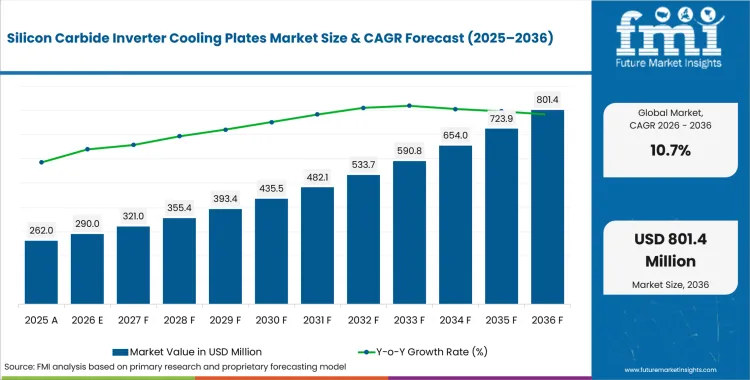
- Market Size (2026)
- USD 290.0 Mn
- Forecast (2036)
- USD 801.4 Mn
- CAGR (2026 to 2036)
- 10.7%
How big is the Silicon Carbide Inverter Cooling Plates Market in 2026?
USD 290.0 million in 2026 and USD 801.4 million by 2036 at a 10.7% CAGR.
Sales of silicon carbide inverter cooling plates are estimated to rise at 10.7% CAGR through 2036, increasing valuation from USD 290.0 million in 2026 to USD 801.4 million by 2036. Compact SiC packages create concentrated heat near EV traction inverters and require low-resistance coolant paths beside the power modules. The International Energy Agency reported in May 2026 that electric car sales exceeded 20 million during 2025 and represented 25% of global car sales. Greater vehicle output expands the number of inverter platforms requiring controlled junction temperatures without excessive pumping demand. Cooling-plate manufacturers gain program access through stable flatness and leak performance across complete vehicle duty cycles.
China combines high electric vehicle output with short platform cycles that require cooling-plate tooling near inverter assembly plants. The International Energy Agency reported in May 2026 that China produced 16 million electric cars during 2025 and represented nearly 75% of global output. Concentrated production supports repeat tooling utilization yet frequent model revisions shorten the useful life of dedicated fixtures. German programs apply formal thermal documentation across automotive electronics and require stable evidence for each new coolant interface. United States commercial platforms place greater weight on service access across long operating shifts and dispersed fleet locations. Japanese programs favor compact assemblies supported by detailed thermal models and local application engineering throughout formal vehicle validation. Successful vehicle programs prove pressure-drop control and interface durability across every rated operating condition and production batch.
Key Takeaways of Silicon Carbide Inverter Cooling Plates Market
- Higher SiC power density concentrates heat near inverter switches, making cooling-plate flatness and coolant distribution central to reliable vehicle operation.
- Thermal system is projected to account for 44.0% share in 2026, owing to direct control over heat transfer between SiC modules and coolant circuits.
- Passenger car is expected to capture 28.0% share in 2026 within vehicle type demand, supported by concentrated platform volumes and tight packaging targets.
- Battery electric is forecast to represent 25.0% share in 2026, attributable to continuous traction-inverter use across repeated high-voltage driving cycles.
- Complex channels and vehicle-specific leak validation raise development cost, slowing adoption among programs with limited engineering resources or uncertain production volume.
- Modine and MAHLE integrate vehicle thermal circuits; Dana and Eaton provide dedicated plates; Schaeffler and Hanon Systems support integrated cooling; Valeo and Semikron Danfoss connect thermal design with inverter production.
Analyst Perspective
"Silicon carbide raises inverter efficiency but its compact package leaves less area for removing heat during repeated acceleration and high-load operation. Engineering teams should compare plate flatness with pressure drop and coolant compatibility across the complete vehicle duty cycle. The strongest production case combines repeatable brazing quality with nearby application support that resolves interface changes without delaying platform approval."
- Nikhil Kaitwade, Principal Analyst, Future Market Insights
How is the Silicon Carbide Inverter Cooling Plates Market segmented?
The silicon carbide inverter cooling plates industry is segmented by component type and vehicle type with additional analysis by propulsion, sales channel and region.
Component type covers sensors, modules, connectors, software and thermal systems that manage heat across the complete inverter assembly. Vehicle type separates passenger cars, light commercial vehicles, heavy trucks, two-wheelers and buses according to package space and operating load. Propulsion distinguishes battery electric, plug-in hybrid, fuel-cell, hybrid and ICE retrofit platforms with different inverter duty cycles. Sales channel identifies OEM and aftermarket routes alongside fleet-operator, distributor and direct-sales routes for distinct purchasing responsibilities. Regional analysis compares production access and qualification capacity across automotive clusters with different engineering-service networks. The taxonomy includes silicon carbide components that directly affect cooling-plate design and excludes battery or cabin thermal hardware outside the defined market.
Why does thermal system account for the largest component type share?
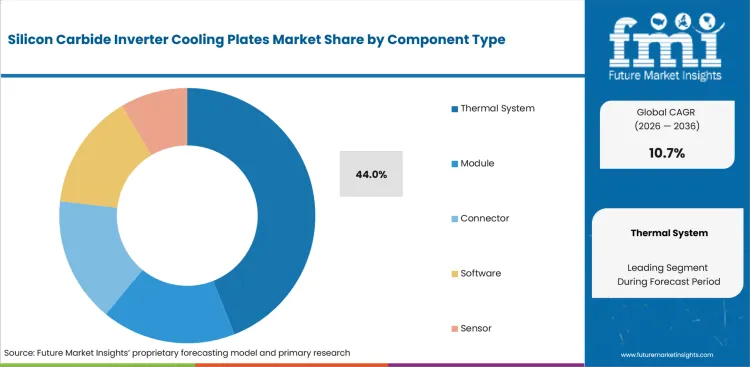
SiC switches concentrate heat within a small footprint and require cooling plates that spread thermal load without excessive pressure loss. MAHLE announced in September 2025 that its compact thermal management module combined a heat pump with pumps and sensors inside one unit. The integrated architecture supports EV thermal systems that reduce hose length around power electronics and raise the value of closely matched coolant interfaces. Plate designers therefore balance flatness and channel geometry against the inverter heat map throughout vehicle validation.
- In 2026, thermal system is expected to lead component type with 44.0% share, supported by direct control over heat transfer between SiC modules and coolant circuits. The segment also carries plate machining and sealing costs that support repeatable temperature control and leak performance across approved vehicle programs during production ramp-up and field service.
- Automakers favor modular thermal assemblies that combine plates with pumps and controls across shared coolant loops. A coordinated package gives validation teams one defined route for leak testing and temperature monitoring across repeated vehicle duty cycles. The coordinated approach also reduces interface disputes during field investigations and later platform revisions across several vehicle programs.
How does passenger car shape vehicle type demand?
Passenger vehicles place inverter cooling inside tight underbody or e-axle packages that reward thin plates with predictable flow distribution. High production volume supports reuse across several trims and limits new tooling for each power rating. Coolant temperature across the shared loop is also shaped by automotive heat exchangers, which alter plate inlet conditions during demanding operation. Manufacturers must balance thermal performance with assembly time and warranty exposure across every approved passenger platform.
- Passenger car is set to lead the vehicle type category with 28.0% share in 2026, attributable to concentrated platform volumes and strict packaging limits. onsemi reported in July 2025 that Schaeffler selected EliteSiC for a thermally efficient PHEV traction inverter designed for global automaker programs. The platform demonstrates how compact inverter packaging raises the value of precise coolant interfaces across high-volume vehicle programs.
- Automakers adopt common channel geometry across related passenger platforms and revise mounting interfaces for each inverter package. Shared designs protect tooling investment and preserve pressure-drop limits together with leak-test requirements established during vehicle validation. One proven plate architecture then supports repeatable production across several trims without rebuilding the complete coolant path.
What supports battery electric demand within the propulsion category?
Battery-electric drivetrains use the traction inverter throughout propulsion and regenerative braking, creating sustained thermal loads across urban and highway duty cycles. Compact automotive inverter assemblies use silicon carbide components to improve switching efficiency while placing more power inside a smaller thermal interface. Cooling plates must control local hotspots without adding pump energy that reduces vehicle range during demanding operation. Engineering teams therefore assess heat transfer and hydraulic resistance as one vehicle-level design problem throughout platform validation.
- Battery electric is projected to hold 25.0% share in 2026, reflecting continuous traction-inverter use across propulsion and regenerative braking. Sustained inverter activity makes thermal performance material to vehicle range and repeatable power during acceleration or high-temperature operation. Dedicated validation budgets therefore cover plate geometry and coolant distribution across complete vehicle duty cycles.
- ROHM announced in April 2026 that its fifth-generation SiC MOSFETs reduced high-temperature on-resistance by about 30% from the previous generation. Lower device losses reduce part of the thermal burden yet compact power density preserves demand for precise cold-plate channels. Vehicle programs adopt advanced plates to stabilize coolant distribution across repeated high-load operation and extended temperature cycles.
Why does OEM remain central to sales channel demand?
OEM program awards place cooling plates inside the inverter design alongside fixed mounting points and coolant connections. MAHLE reported in May 2025 that its locally produced thermal system entered series production for Mahindra battery-electric vehicles following a 24-month development program. The timeline shows why electric powertrain systems require early automaker involvement and local production readiness. Late interface changes repeat leak and durability validation across the complete inverter assembly and vehicle coolant circuit.
- By sales channel, OEM is estimated to hold 52.0% in 2026 owing to automakers’ control over inverter architecture and vehicle qualification. Direct program awards align tooling and traceability with planned production volumes rather than uncertain replacement demand. The channel also gives engineering teams access to vehicle-level duty cycles during cooling-plate validation and production qualification.
- Vehicle manufacturers favor engineering teams that provide thermal simulation and rapid interface revisions during prototype validation. Repeatable brazing quality supports documented leak durability across every production batch and limits warranty exposure throughout field operation. Clear service records also assign responsibility for cooling failures across active vehicle programs and complete warranty investigations.
What are the drivers, restraints, and opportunities in the Silicon Carbide Inverter Cooling Plates Market?
Rising SiC heat flux supports demand for cooling plates that control temperature without excessive pumping energy. Complex channel geometry and vehicle-specific validation limit programs with uncertain production volumes or restricted engineering budgets.
- Driver: Higher SiC power density raises heat flux at the inverter interface and increases demand for cooling plates with repeatable thermal contact.
- Restraint: Complex channel geometry and leak validation increase tooling expense across vehicle programs with limited production scale or frequent design changes.
- Opportunity: Integrated plate and thermal-control designs reduce vehicle assembly interfaces and improve manufacturer accountability across the complete coolant circuit.
Higher output from automotive semiconductors is expected to drive demand due to greater heat transfer from a smaller inverter contact area. ROHM reported in September 2025 that Schaeffler began mass production of an inverter brick containing SiC chips and an integrated cooler. The architecture links cooler geometry with module packaging and establishes thermal performance during inverter development. Cooling-plate manufacturers gain program value through co-design support that protects sustained output without excessive coolant flow.
Manufacturing complexity creates a restraint across plates that require thin walls and uniform coolant distribution. In March 2026, ROHM introduced reference designs that addressed the peripheral-circuit and thermal-design work associated with SiC devices. Cooling-plate teams must coordinate flatness and sealing with semiconductor packaging rather than optimize the metal component independently. Limited production volume makes tooling and validation costs difficult to recover across smaller vehicle programs.
Integrated thermal architecture offers an opportunity for cooling-plate manufacturers to support complete coolant-loop design instead of selling machined hardware alone. Hanon Systems announced in March 2026 that its compact cooling module combined several refrigerant components and sensors within one module for the BMW iX3. Comparable thermal management technologies reduce connection points and assign clearer responsibility for system performance across the complete coolant circuit. Plate manufacturers capture greater program value through channel simulation and vehicle-level validation support throughout formal platform approval.
Which country CAGRs are profiled in the Silicon Carbide Inverter Cooling Plates Market?
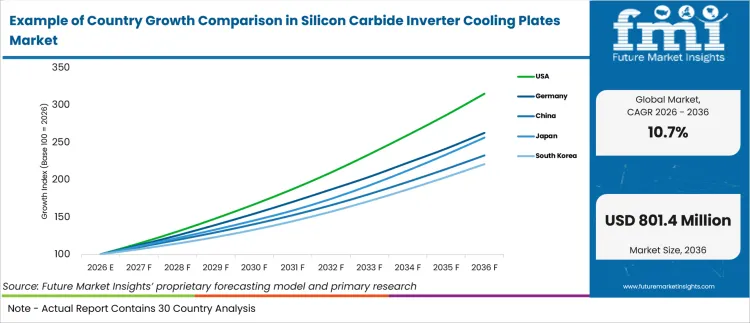
| Country | CAGR |
|---|---|
| India | 14.4% |
| South Korea | 13.4% |
| China | 12.3% |
| United States | 11.2% |
| Japan | 10.2% |
| Germany | 9.1% |
How do country-level CAGRs compare in the Silicon Carbide Inverter Cooling Plates Market?
The country forecasts show a clear progression across the silicon carbide inverter cooling plates market, reflecting differences in electric vehicle production growth, power electronics adoption and thermal management requirements across major automotive and industrial economies. India, South Korea and China form a closely connected upper group, supported by rising deployment of silicon carbide (SiC) power electronics in electric drivetrains and high-efficiency power conversion systems. The United States creates a transition between this group and the more mature automotive markets of Japan and Germany.
- India benefits from expanding electric vehicle manufacturing and growing investment in local power electronics supply chains, which is increasing demand for advanced thermal management components.
- South Korea's outlook is supported by its strong position in automotive technology, battery manufacturing and next-generation vehicle platforms that increasingly utilize silicon carbide inverters.
- China continues to drive demand through large-scale electric vehicle production and ongoing integration of high-efficiency power electronics across passenger and commercial vehicle segments.
- The United States reflects growing adoption of SiC-based powertrains as automakers focus on improving vehicle range, charging performance and energy efficiency.
- Japan maintains steady market development through continued advancement of power semiconductor technologies and the incorporation of high-performance thermal management systems into electrified vehicles.
- Germany's position is influenced by the transition of established automotive manufacturers toward electrified platforms, where thermal control remains critical to inverter performance and reliability.
Similar CAGRs do not necessarily create identical supplier opportunities across countries. Differences in EV production volumes, semiconductor ecosystems, thermal management design preferences and localization strategies can significantly influence demand for silicon carbide inverter cooling plates. Commercialization pathways may vary even among markets pursuing similar electrification objectives. The full report provides country-level CAGR analysis across North America, Latin America, Europe, East Asia, South Asia, Oceania and the Middle East and Africa.
Country-wise Analysis
- India links new electric powertrain production with cost-sensitive passenger platforms that require local cooling-component support. Valeo announced in March 2026 that its Pune line would manufacture a three-in-one e-axle containing the motor and inverter for Mahindra vehicles. Cooling-plate sales in India are forecast to expand at 14.4% CAGR by 2036, supported by localized electric powertrain production and new battery-electric programs. Local inverter assembly reduces engineering travel and gives plate manufacturers faster access to interface revisions during validation. Every plate must meet leak and durability requirements across repeated duty cycles despite persistent price pressure. Successful market entry therefore requires regional brazing capability and coolant-compatibility support throughout formal production qualification.
- South Korea concentrates vehicle engineering and inverter validation within a compact manufacturing network that supports rapid prototype review. South Korea’s trade ministry reported in January 2026 that domestic EV sales grew approximately 52% during 2025. Nearby engineering centers help plate manufacturers resolve interface and leak-test issues within compressed vehicle launch schedules. The silicon carbide inverter cooling plates market in South Korea is estimated to post 13.4% CAGR over the forecast period, reinforced by larger domestic electric vehicle programs. Compressed approvals create material friction through narrow tooling windows and limited time for coolant-compatibility retesting. Commercial entry therefore favors local technical teams that document thermal performance and respond quickly to revised inverter interfaces.
- China combines extensive inverter manufacturing with vehicle programs that advance through compressed development cycles and frequent model revisions. China’s silicon carbide inverter cooling plates outlook is anticipated to advance at 12.3% CAGR over the assessment period, strengthened by localized SiC inverter production and concentrated vehicle assembly. Valeo reported in April 2026 that localized SiC inverter production supported about 5% powertrain efficiency gains for Chinese automakers. Concentrated vehicle output improves tooling utilization across cooling-plate lines located near major assembly plants and inverter factories. Rapid platform changes shorten fixture life and increase the cost of late interface revisions during production launch. Manufacturers need local engineers who verify pressure drop and coolant cleanliness without delaying revised vehicle programs. Successful entry combines production scale with flexible tooling and controlled interface quality across the inverter manufacturing process.
- United States vehicle programs span passenger models and commercial fleets that impose different thermal loads across dispersed operating routes. The Alternative Fuels Data Center reported in June 2026 that electric-vehicle registrations increased 21.0% from 2024 to 2025. The United States silicon carbide inverter cooling plates sector is projected to record 11.2% CAGR during the assessment period, aided by diversified vehicle platforms and domestic engineering capacity. The broader installed base creates varied duty cycles and service needs across several vehicle classes. Nationwide service distance adds diagnostic costs for commercial fleets and complicates rapid replacement access across remote operating locations. Manufacturers therefore need traceable leak records and regional application support prior to approval of a new plate architecture.
- Japan favors compact vehicle systems and formal component evaluation across passenger platforms with limited packaging space. By 2036 cooling-plate demand in Japan is projected to grow at 10.2% CAGR, shaped by gradual electrification and demanding thermal qualification. Detailed validation practices support stable pressure-drop testing and careful documentation across local inverter programs and approved vehicle platforms. The Japan Automobile Importers Association reported in February 2026 that imported BEV registrations reached 30,513 during 2025 and the available lineup expanded to 174 models. Broader model choice expands inverter interfaces requiring local engineering yet limited private charging access constrains immediate production volume. Commercial entry favors compact plates that maintain stable flow across complete operating temperature ranges and repeated vehicle duty cycles.
- Germany combines established automotive engineering with formal qualification processes across premium and high-volume vehicle programs. The Federal Ministry for Economic Affairs and Energy reported in January 2026 that battery-electric vehicles represented 19.1% of new car registrations during 2025. Experienced integrators support coolant-loop testing and align plate interfaces with European vehicle safety requirements and production standards. In Germany cooling-plate demand is predicted to advance at 9.1% CAGR through 2036, influenced by mature supply networks and continued inverter development. Automakers require stable quality records for changes to proven thermal architectures and extend qualification timelines accordingly. Local finishing capacity reduces transport risk for plates requiring controlled cleanliness and precise interface flatness. Entry strategies therefore depend on documented durability and responsive engineering throughout European vehicle programs and production qualification.
Who are the notable companies in the Silicon Carbide Inverter Cooling Plates Market?
Modine, Dana, MAHLE, Eaton (Boyd Thermal), Schaeffler, Hanon Systems, Valeo and Semikron Danfoss are notable companies in this market.
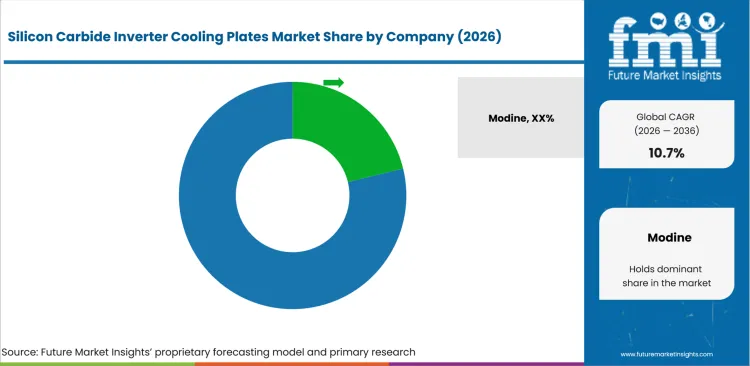
Competition separates cold-plate manufacturers from vehicle thermal integrators and inverter-platform companies with different program responsibilities. Dana offers inverter coolers for power electronics, and Eaton completed the Boyd Thermal acquisition in March 2026 to add liquid-cooling capability across data center and power electronics applications. Primarily targeting data center applications.Schaeffler supplies an inverter brick with an integrated cooler that links plate geometry directly with SiC module packaging. Modine and MAHLE connect cooling hardware with vehicle coolant circuits across passenger and commercial platforms. Hanon Systems combines several thermal functions within vehicle modules and supports system-level coolant control across production programs. Valeo combines inverter production with electric powertrain engineering across regional manufacturing and local validation programs.
- Modine and MAHLE connect cooling hardware with pumps and complete vehicle coolant circuits across passenger or commercial platforms. Hanon Systems adds compact thermal modules that combine several control functions inside one vehicle architecture. Automakers evaluate these companies through system integration and application support rather than an individual plate specification.
- Dana and Eaton compete through dedicated inverter or power-electronics cooling hardware with documented liquid-cooling capability. Schaeffler integrates the cooler inside a production inverter brick and therefore controls the plate interface alongside module packaging. Vehicle programs select among these models according to required design ownership and local engineering access.
- Valeo connects inverter manufacturing with electric powertrain engineering across regional vehicle programs and local production networks. Semikron Danfoss supplies SiC power modules with flexible cooler arrangements for automotive inverter developers and shared platform programs. Their commercial position depends on early coordination between module geometry and coolant-interface design across the complete inverter platform.
Competitive Benchmarking: Silicon Carbide Inverter Cooling Plates Market
| Company | Dedicated Cooling Plate Evidence | Vehicle Thermal Integration | Inverter Engineering Support | Geographic Reach |
|---|---|---|---|---|
| Modine | Medium | High | Medium | Global |
| Dana | High | Medium | High | Global |
| MAHLE | Medium | High | Medium | Global |
| Eaton (Boyd Thermal) | High | Medium | High | North America, Europe and Asia |
| Schaeffler | High | Medium | High | Global |
| Hanon Systems | Low | High | Medium | Global |
| Valeo | Medium | High | High | Global |
| Semikron Danfoss | Medium | Medium | High | Europe, Americas and Asia |
Key Developments in the Silicon Carbide Inverter Cooling Plates Market
- In August 2025, onsemi announced that selected Xiaomi YU7 electric SUVs used an 800V drive platform powered by EliteSiC M3e technology. The production program combined high power density with enhanced thermal performance across demanding traction-inverter duty cycles. Cooling-plate manufacturers must therefore control interface flatness and coolant distribution without adding excessive flow resistance or packaging volume across the complete vehicle platform during production.
- In October 2025, Valeo secured serial-production contracts from two Chinese automakers for its next-generation dual inverter platform. Production was scheduled for 2026 across plug-in hybrid vehicles using 400V to 800V architectures and several power-module configurations in China. Silicon and SiC options require adaptable cooling interfaces that preserve efficiency across different module choices and vehicle cost targets throughout series production and vehicle validation.
- In November 2025, Hyundai Motor Group detailed a two-stage motor system that integrated nine inverter modules into three units and used double-sided cooling. The architecture improved heat dissipation within a compact inverter package designed for mass production across high-volume vehicle programs. Direct thermal paths on both module sides support higher power density without increasing the complete inverter envelope or vehicle packaging burden.
- In June 2026, Semikron Danfoss and Nexperia signed a memorandum to explore SiC power modules for automotive traction inverters. The companies planned joint engineering across semiconductor design and module packaging during early integration and automotive validation. Cooling-plate requirements therefore enter the program earlier as module geometry and cooler arrangements develop together under shared thermal targets and later production qualification testing.
Key Players in the Silicon Carbide Inverter Cooling Plates Market
Vehicle Thermal-System Providers
- Modine
- MAHLE
- Hanon Systems
Cooling-Plate and Inverter Specialists
- Dana
- Eaton (Boyd Thermal)
- Schaeffler
Integrated Inverter and Power-Module Companies
- Valeo
- Semikron Danfoss
Silicon Carbide Inverter Cooling Plates Market - Report Scope
| Coverage field | Report scope |
|---|---|
| Market breakdown | Component type, vehicle type, propulsion, sales channel and region. |
| Quantitative Units | Revenue in USD Million, CAGR in %. |
| Market Definition | Commercially tracked demand for cooling plates and directly integrated thermal hardware used to manage silicon carbide inverter heat across automotive applications. |
| Regions Covered | North America, Latin America, Western Europe, Eastern Europe, East Asia, South Asia and Pacific and Middle East and Africa. |
| Countries Covered | United States, Germany, China, Japan, South Korea, India and 30+ countries. |
| Key Companies Profiled | Modine, Dana, MAHLE, Eaton (Boyd Thermal), Schaeffler, Hanon Systems, Valeo and Semikron Danfoss. |
| Forecast Period | 2026 to 2036. |
| Approach | Hybrid bottom-up and top-down market sizing supported by primary interviews and official desk research. |
Silicon Carbide Inverter Cooling Plates Market - Research Methodology
| Method | Approach |
|---|---|
| Primary Research | FMI analysts gathered input from manufacturers, service providers, technology developers, distributors, end users, procurement teams, and subject-matter experts. Interviews examined purchasing decisions, product or service evaluation, adoption barriers, approval requirements, pricing considerations, and expectations for technical or commercial support. Respondents were also asked what evidence is required before a trial, pilot, or initial order develops into regular purchasing. |
| Desk Research | Desk research covered government statistics, regulatory publications, trade data, industry associations, technical literature, standards, company filings, product information, and official corporate announcements. Sources were reviewed for relevance, publication date, geographic coverage, and consistency with the defined market scope. Claims relating to performance, applications, approvals, capacity, investment, and commercial activity were retained only when supported by credible public evidence. |
| Market Sizing and Forecasting | The market model combined the baseline value with historical performance, segment structure, pricing and volume indicators, adoption levels, company participation, and country-level demand conditions. Forecast assumptions considered economic activity, investment trends, regulatory developments, technology adoption, purchasing cycles, supply availability, and barriers to wider market use. Segment and regional estimates were reconciled before the final market total was calculated. |
| Data Validation | Estimates were checked against multiple independent indicators, including public data, company activity, trade patterns, industry developments, and findings from primary interviews. Validation also tested whether products, services, applications, and company revenues fell within the defined market boundaries. Adjacent categories, unsupported claims, overlapping revenues, and activities without direct market relevance were excluded to reduce double counting and maintain consistency across segments and countries. |
Silicon Carbide Inverter Cooling Plates Market by Segments
Silicon Carbide Inverter Cooling Plates Market segmented by Component Type:
- Sensor
- Module
- Connector
- Software
- Thermal System
Silicon Carbide Inverter Cooling Plates Market segmented by Vehicle Type:
- Passenger Car
- Light Commercial Vehicle
- Heavy Truck
- Two Wheeler
- Bus
Silicon Carbide Inverter Cooling Plates Market segmented by Propulsion:
- Battery Electric
- Plug-in Hybrid
- Fuel Cell
- Hybrid
- ICE Retrofit
Silicon Carbide Inverter Cooling Plates Market segmented by Sales Channel:
- OEM
- Aftermarket
- Fleet Operators
- Distributors
- Direct Sales
Silicon Carbide Inverter Cooling Plates Market by Region:
- North America
- United States
- Canada
- Mexico
- Latin America
- Brazil
- Chile
- Rest of Latin America
- Western Europe
- Germany
- UK
- Italy
- Spain
- France
- Nordic
- BENELUX
- Rest of Western Europe
- Eastern Europe
- Russia
- Poland
- Hungary
- Balkan and Baltic
- Rest of Eastern Europe
- East Asia
- China
- Japan
- South Korea
- South Asia and Pacific
- India
- ASEAN
- Australia and New Zealand
- Rest of South Asia and Pacific
- Middle East and Africa
- Kingdom of Saudi Arabia
- Other GCC Countries
- Turkiye
- South Africa
- Other African Union
- Rest of Middle East and Africa
Research Sources and Bibliography
- International Energy Agency. (2026, May 20). Trends in electric cars.
- International Energy Agency. (2026, May 20). Manufacturing and trade.
- MAHLE Group. (2025, September 8). MAHLE is Set for the Future: Production-Ready Innovations for Sustainable Mobility.
- onsemi. (2025, July 24). onsemi and Schaeffler Expand Collaboration with New EliteSiC-based PHEV Platform.
- ROHM Co., Ltd. (2026, April 21). ROHM Develops 5th Generation SiC MOSFETs with Approx. 30% Lower On-Resistance at High Temperatures.
- MAHLE Group. (2025, May 15). MAHLE India Receives Award for Intelligent Thermal Management System.
- Schaeffler AG. (2025, November 7). Schaeffler wins major order to supply dual inverters for the North American market.
- ROHM Co., Ltd. (2025, September 4). ROHM’s SiC MOSFETs Adopted in Schaeffler’s Inverter Brick, Now in Mass Production.
- ROHM Co., Ltd. (2026, March 17). ROHM has Introduced Reference Designs for Three-Phase Inverters Featuring New SiC Power Modules.
- Hanon Systems. (2026, March 31). Hanon Systems Supplies Highly Integrated Cooling Entity for Electric Vehicles.
- Valeo. (2026, March 30). Valeo Inaugurates New Electric Powertrain Manufacturing Line in Pune.
- Ministry of Trade, Industry and Resources. (2026, January 15). Automobile Exports Hit Record High of $72 Billion in 2025.
- Valeo. (2026, April 22). Valeo at Auto China 2026: Leading the Era of Technology Expansion with High-Tech Solutions.
- USA Department of Energy, Alternative Fuels Data Center. (2026, June). Change in USA Light-Duty Vehicle Registration Counts.
- Japan Automobile Importers Association. (2026, February 2). January 29, 2026 JAIA Chairman’s Press Conference Keynote Speech.
- Federal Ministry for Economic Affairs and Energy. (2026, January 27). Great prospects for electric mobility.
- Eaton. (2026, March 12). Eaton completes acquisition of leading liquid-cooling solutions provider Boyd Thermal, creating an industry-leading grid-to-chip solution for data centers.
- onsemi. (2025, August 4). onsemi Powers Xiaomi’s YU7 Electric SUV Line-Up.
- Valeo. (2025, October 20). Valeo is awarded contracts to supply its new generation Dual Inverter solution to two leading Chinese automakers.
- Hyundai Motor Group. (2025, November 13). Innovation in Motion: The Story Behind Hyundai Motor Group’s 2-Stage Motor System.
- Semikron Danfoss. (2026, June 9). Strategic Collaboration (MoU) with Nexperia on SiC Power Modules.
- Danfoss. (2026, March 9). Danfoss strengthens its electrification business with full ownership of Semikron Danfoss.
- Modine. (2023, January 27). How It Works: Electronics Cooling Package.
- Dana Incorporated. (2021, April 19). Dana Demonstrates Alignment with China’s 14th Five-Year Plan through Vehicle Electrification, Corporate Sustainability.
- Eaton. (2026). Inverter cooling.
- Semikron Danfoss. (2026). eMPack®.
This bibliography is provided for reader reference and is not exhaustive. The full report contains the complete reference list and detailed citations
This Report Answers
- How large is the silicon carbide inverter cooling plates market in 2026 and 2036?
- Which thermal condition supports cooling-plate investment across vehicle inverter programs?
- Why does thermal system account for the largest approved component-type share?
- How do passenger car and battery electric requirements shape plate design?
- Why does the OEM channel capture the largest approved sales-channel share?
- How do country growth rates differ across the six profiled countries?
- Which companies provide dedicated plate engineering or broader vehicle thermal integration?
- What manufacturing and validation barriers limit wider cooling-plate adoption?
- Which evidence should automakers review prior to approving a new cooling architecture?
Frequently Asked Questions
How big is the Silicon Carbide Inverter Cooling Plates Market in 2026?
The silicon carbide inverter cooling plates market is valued at USD 290.0 million in 2026 and is forecast to reach USD 801.4 million by 2036, supported by rising SiC power density in electric vehicle traction inverters and growing demand for cooling plates that control junction temperatures without excessive pumping energy across repeated high-voltage duty cycles.
What is the CAGR of the Silicon Carbide Inverter Cooling Plates Market from 2026 to 2036?
The silicon carbide inverter cooling plates market is projected to grow at a CAGR of 10.7% between 2026 and 2036, supported by expanding electric vehicle production and increasing integration of high-efficiency SiC power electronics across passenger car and commercial vehicle inverter platforms globally.
Which component type leads the Silicon Carbide Inverter Cooling Plates Market?
Thermal system accounts for 44.0% of the silicon carbide inverter cooling plates market by component type in 2026, driven by its direct control over heat transfer between SiC modules and coolant circuits, carrying plate machining and sealing costs that support repeatable temperature control and leak performance across approved vehicle programs.
How much will the Silicon Carbide Inverter Cooling Plates Market add between 2026 and 2036?
The silicon carbide inverter cooling plates market is set to add USD 511.4 million between 2026 and 2036, growing from USD 290.0 million to USD 801.4 million as higher SiC power density, expanding electric vehicle production, and integrated thermal architecture programs drive broader cooling-plate adoption across global automotive inverter platforms.
Who are the leading companies in the Silicon Carbide Inverter Cooling Plates Market?
Leading companies in the silicon carbide inverter cooling plates market include Modine, MAHLE, Hanon Systems, Dana, Eaton (Boyd Thermal), Schaeffler, Valeo, and Semikron Danfoss, competing across vehicle thermal-system integration, dedicated cooling-plate and inverter engineering, and integrated inverter and power-module development with global manufacturing reach.
Preview the report firsthand - request a free sample
Get SampleGet the brochure for pricing and purchase details.
Get PDFTable of Content
- Key Takeaways
- Market Size and CAGR
- Top Growth Driver
- Fastest Growing Segment
- Leading Region
- Key Companies
- Emerging Opportunities
- Executive Summary
- Global Market Outlook
- Demand-side Trends
- Supply-side Trends
- Technology Roadmap Analysis
- Analysis and Recommendations
- Analyst Perspective (What is happening? Why now? What should investors know?)
- Key Questions Answered
- How large is the market?
- What is the CAGR?
- What are key trends?
- Which region dominates?
- Who are the leaders?
- Market Overview
- Market Coverage / Taxonomy
- Market Definition / Scope / Limitations
- Research Methodology
- Chapter Orientation
- Analytical Lens and Working Hypotheses
- Market Structure, Signals, and Trend Drivers
- Benchmarking and Cross-market Comparability
- Market Sizing, Forecasting, and Opportunity Mapping
- Research Design and Evidence Framework
- Desk Research Programme (Secondary Evidence)
- Expert Input and Fieldwork (Primary Evidence)
- Tooling, Models, and Reference Databases
- Data Engineering and Model Build
- Quality Assurance and Audit Trail
- Market Background
- Market Dynamics (Drivers, Restraints, Opportunity, Trends)
- Scenario Forecast (Optimistic, Likely, Conservative)
- Impact Analysis
- AI Impact
- Sustainability Impact
- Regulatory Impact
- Technology Impact
- Consumer / Buyer Analysis
- Purchase Drivers
- Adoption Barriers
- Buyer Journey
- Opportunity Map Analysis
- Product Life Cycle Analysis
- Supply Chain Analysis
- Investment Feasibility Matrix
- Value Chain Analysis
- PESTLE and Porter's Analysis
- Regulatory Landscape
- Regional Parent Market Outlook
- Production and Consumption Statistics
- Import and Export Statistics
- Global Market Analysis and Forecast, 2021 to 2036
- Historical Market Size Value (USD Million) Analysis, 2021 to 2025
- Current and Future Market Size Value (USD Million) Projections, 2026 to 2036
- Y-o-Y Growth Trend Analysis
- Absolute $ Opportunity Analysis
- Global Market Pricing Analysis, 2021 to 2036
- Global Market Analysis and Forecast, By Component Type, 2021 to 2036
- Introduction / Key Findings
- Historical Market Size Value (USD Million) Analysis By Component Type, 2021 to 2025
- Current and Future Market Size Value (USD Million) Analysis and Forecast By Component Type, 2026 to 2036
- Thermal System
- Module
- Connector
- Software
- Sensor
- Thermal System
- Y-o-Y Growth Trend Analysis By Component Type, 2021 to 2025
- Absolute $ Opportunity Analysis By Component Type, 2026 to 2036
- Global Market Analysis and Forecast, By Vehicle Type, 2021 to 2036
- Introduction / Key Findings
- Historical Market Size Value (USD Million) Analysis By Vehicle Type, 2021 to 2025
- Current and Future Market Size Value (USD Million) Analysis and Forecast By Vehicle Type, 2026 to 2036
- Passenger Car
- Light Commercial Vehicle
- Heavy Truck
- Two Wheeler
- Bus
- Passenger Car
- Y-o-Y Growth Trend Analysis By Vehicle Type, 2021 to 2025
- Absolute $ Opportunity Analysis By Vehicle Type, 2026 to 2036
- Global Market Analysis and Forecast, By Propulsion, 2021 to 2036
- Introduction / Key Findings
- Historical Market Size Value (USD Million) Analysis By Propulsion, 2021 to 2025
- Current and Future Market Size Value (USD Million) Analysis and Forecast By Propulsion, 2026 to 2036
- Battery Electric
- Plug-In Hybrid
- Fuel Cell
- Hybrid
- Ice Retrofit
- Battery Electric
- Y-o-Y Growth Trend Analysis By Propulsion, 2021 to 2025
- Absolute $ Opportunity Analysis By Propulsion, 2026 to 2036
- Global Market Analysis and Forecast, By Sales Channel, 2021 to 2036
- Introduction / Key Findings
- Historical Market Size Value (USD Million) Analysis By Sales Channel, 2021 to 2025
- Current and Future Market Size Value (USD Million) Analysis and Forecast By Sales Channel, 2026 to 2036
- Oem
- Tier 1
- Aftermarket
- Fleet Retrofit
- Charging Network
- Oem
- Y-o-Y Growth Trend Analysis By Sales Channel, 2021 to 2025
- Absolute $ Opportunity Analysis By Sales Channel, 2026 to 2036
- Global Market Analysis and Forecast, By Region, 2021 to 2036
- Introduction
- Historical Market Size Value (USD Million) Analysis By Region, 2021 to 2025
- Current Market Size Value (USD Million) Analysis and Forecast By Region, 2026 to 2036
- North America
- Latin America
- Western Europe
- Eastern Europe
- East Asia
- South Asia and Pacific
- Middle East & Africa
- Market Attractiveness Analysis By Region
- North America Market Analysis and Forecast, By Country, 2021 to 2036
- Historical Market Size Value (USD Million) Trend Analysis By Market Taxonomy, 2021 to 2025
- Market Size Value (USD Million) Forecast By Market Taxonomy, 2026 to 2036
- By Country
- USA
- Canada
- By Component Type
- By Vehicle Type
- By Propulsion
- By Sales Channel
- By Country
- Market Attractiveness Analysis
- By Country
- By Component Type
- By Vehicle Type
- By Propulsion
- By Sales Channel
- Key Takeaways
- Latin America Market Analysis and Forecast, By Country
- Historical Market Size Value (USD Million) Trend Analysis By Market Taxonomy, 2021 to 2025
- Market Size Value (USD Million) Forecast By Market Taxonomy, 2026 to 2036
- By Country
- Brazil
- Mexico
- Chile
- Rest of Latin America
- By Component Type
- By Vehicle Type
- By Propulsion
- By Sales Channel
- By Country
- Market Attractiveness Analysis
- By Country
- By Component Type
- By Vehicle Type
- By Propulsion
- By Sales Channel
- Key Takeaways
- Western Europe Market Analysis and Forecast, By Country
- Historical Market Size Value (USD Million) Trend Analysis By Market Taxonomy, 2021 to 2025
- Market Size Value (USD Million) Forecast By Market Taxonomy, 2026 to 2036
- By Country
- Germany
- UK
- Italy
- Spain
- France
- Nordic
- BENELUX
- Rest of Western Europe
- By Component Type
- By Vehicle Type
- By Propulsion
- By Sales Channel
- By Country
- Market Attractiveness Analysis
- By Country
- By Component Type
- By Vehicle Type
- By Propulsion
- By Sales Channel
- Key Takeaways
- Eastern Europe Market Analysis and Forecast, By Country
- Historical Market Size Value (USD Million) Trend Analysis By Market Taxonomy, 2021 to 2025
- Market Size Value (USD Million) Forecast By Market Taxonomy, 2026 to 2036
- By Country
- Russia
- Poland
- Hungary
- Balkan & Baltic
- Rest of Eastern Europe
- By Component Type
- By Vehicle Type
- By Propulsion
- By Sales Channel
- By Country
- Market Attractiveness Analysis
- By Country
- By Component Type
- By Vehicle Type
- By Propulsion
- By Sales Channel
- Key Takeaways
- East Asia Market Analysis and Forecast, By Country
- Historical Market Size Value (USD Million) Trend Analysis By Market Taxonomy, 2021 to 2025
- Market Size Value (USD Million) Forecast By Market Taxonomy, 2026 to 2036
- By Country
- China
- Japan
- South Korea
- By Component Type
- By Vehicle Type
- By Propulsion
- By Sales Channel
- By Country
- Market Attractiveness Analysis
- By Country
- By Component Type
- By Vehicle Type
- By Propulsion
- By Sales Channel
- Key Takeaways
- South Asia and Pacific Market Analysis and Forecast, By Country
- Historical Market Size Value (USD Million) Trend Analysis By Market Taxonomy, 2021 to 2025
- Market Size Value (USD Million) Forecast By Market Taxonomy, 2026 to 2036
- By Country
- India
- ASEAN
- Australia & New Zealand
- Rest of South Asia and Pacific
- By Component Type
- By Vehicle Type
- By Propulsion
- By Sales Channel
- By Country
- Market Attractiveness Analysis
- By Country
- By Component Type
- By Vehicle Type
- By Propulsion
- By Sales Channel
- Key Takeaways
- Middle East & Africa Market Analysis and Forecast, By Country
- Historical Market Size Value (USD Million) Trend Analysis By Market Taxonomy, 2021 to 2025
- Market Size Value (USD Million) Forecast By Market Taxonomy, 2026 to 2036
- By Country
- Kingdom of Saudi Arabia
- Other GCC Countries
- Türkiye
- South Africa
- Other African Union
- Rest of Middle East & Africa
- By Component Type
- By Vehicle Type
- By Propulsion
- By Sales Channel
- By Country
- Market Attractiveness Analysis
- By Country
- By Component Type
- By Vehicle Type
- By Propulsion
- By Sales Channel
- Key Takeaways
- Key Countries Market Analysis
- USA
- Pricing Analysis
- Market Share Analysis, 2025
- By Component Type
- By Vehicle Type
- By Propulsion
- By Sales Channel
- Canada
- Pricing Analysis
- Market Share Analysis, 2025
- By Component Type
- By Vehicle Type
- By Propulsion
- By Sales Channel
- Mexico
- Pricing Analysis
- Market Share Analysis, 2025
- By Component Type
- By Vehicle Type
- By Propulsion
- By Sales Channel
- Brazil
- Pricing Analysis
- Market Share Analysis, 2025
- By Component Type
- By Vehicle Type
- By Propulsion
- By Sales Channel
- Chile
- Pricing Analysis
- Market Share Analysis, 2025
- By Component Type
- By Vehicle Type
- By Propulsion
- By Sales Channel
- Germany
- Pricing Analysis
- Market Share Analysis, 2025
- By Component Type
- By Vehicle Type
- By Propulsion
- By Sales Channel
- UK
- Pricing Analysis
- Market Share Analysis, 2025
- By Component Type
- By Vehicle Type
- By Propulsion
- By Sales Channel
- Italy
- Pricing Analysis
- Market Share Analysis, 2025
- By Component Type
- By Vehicle Type
- By Propulsion
- By Sales Channel
- Spain
- Pricing Analysis
- Market Share Analysis, 2025
- By Component Type
- By Vehicle Type
- By Propulsion
- By Sales Channel
- France
- Pricing Analysis
- Market Share Analysis, 2025
- By Component Type
- By Vehicle Type
- By Propulsion
- By Sales Channel
- India
- Pricing Analysis
- Market Share Analysis, 2025
- By Component Type
- By Vehicle Type
- By Propulsion
- By Sales Channel
- ASEAN
- Pricing Analysis
- Market Share Analysis, 2025
- By Component Type
- By Vehicle Type
- By Propulsion
- By Sales Channel
- Australia & New Zealand
- Pricing Analysis
- Market Share Analysis, 2025
- By Component Type
- By Vehicle Type
- By Propulsion
- By Sales Channel
- China
- Pricing Analysis
- Market Share Analysis, 2025
- By Component Type
- By Vehicle Type
- By Propulsion
- By Sales Channel
- Japan
- Pricing Analysis
- Market Share Analysis, 2025
- By Component Type
- By Vehicle Type
- By Propulsion
- By Sales Channel
- South Korea
- Pricing Analysis
- Market Share Analysis, 2025
- By Component Type
- By Vehicle Type
- By Propulsion
- By Sales Channel
- Russia
- Pricing Analysis
- Market Share Analysis, 2025
- By Component Type
- By Vehicle Type
- By Propulsion
- By Sales Channel
- Poland
- Pricing Analysis
- Market Share Analysis, 2025
- By Component Type
- By Vehicle Type
- By Propulsion
- By Sales Channel
- Hungary
- Pricing Analysis
- Market Share Analysis, 2025
- By Component Type
- By Vehicle Type
- By Propulsion
- By Sales Channel
- Kingdom of Saudi Arabia
- Pricing Analysis
- Market Share Analysis, 2025
- By Component Type
- By Vehicle Type
- By Propulsion
- By Sales Channel
- Türkiye
- Pricing Analysis
- Market Share Analysis, 2025
- By Component Type
- By Vehicle Type
- By Propulsion
- By Sales Channel
- South Africa
- Pricing Analysis
- Market Share Analysis, 2025
- By Component Type
- By Vehicle Type
- By Propulsion
- By Sales Channel
- USA
- Market Structure Analysis
- Competition Dashboard
- Competition Benchmarking
- Market Share Analysis of Top Players
- By Regional
- By Component Type
- By Vehicle Type
- By Propulsion
- By Sales Channel
- Emerging Startups
- Innovation Benchmarking
- Competition Analysis
- Competition Deep Dive
- Modine
- Overview
- Product Portfolio
- Profitability by Market Segments
- Sales Footprint
- Strategy Overview
- Marketing Strategy
- Product Strategy
- Channel Strategy
- Dana
- MAHLE
- Boyd
- Mikros Technologies
- Hanon Systems
- Valeo
- Semikron Danfoss
- Modine
- Case Studies
- Success Stories
- Recent Developments
- Competition Deep Dive
- Assumptions & Acronyms Used


