

- Market Size (2026)
- USD 1255.8 Mn
- Forecast (2036)
- USD 3028.0 Mn
- CAGR (2026 to 2036)
- 9.2%
How big is the Skin Lipids Market in 2026?
USD 1,255.8 million in 2026 and USD 3,028.0 million by 2036 at a 9.2% CAGR.
Demand for skin lipids stood at USD 1,255.8 million in 2026, with the market on track to reach USD 3,028.0 million by 2036 on the back of a 9.2% CAGR. Growth is being pulled along by brand owners and formulators chasing barrier-repair and dermatology-positioned claims that consumers increasingly expect from moisturizers, serums, and medical skincare lines. Ceramides, phospholipids, and fatty acid blends sit at the center of that shift, since they let a formulation move from generic emollient to a product that can credibly claim to rebuild or protect the skin barrier. That claim strength, paired with how a lipid performs on skin feel and stability, tends to decide whether a supplier moves from sample to long-term contract.
Cost and consistency work against faster uptake. Plant, animal, and biotech-derived lipid sources carry different price points and supply reliability, and oxidation or stability issues can undercut a formulation's shelf claims if sourcing isn't tightly controlled. Regulatory scrutiny around cosmetic and dermo-cosmetic claims adds another layer of friction before a product reaches shelf. The clearer opportunities sit in vegan and biotech-derived lipid sourcing, microbiome-supportive formulations, and the growing overlap between skincare and nutricosmetics. By lipid type, application, and source, the segment mix varies enough in cost and claim strength to warrant separate treatment. Regionally, manufacturing and raw-material sourcing concentrate in Asia Pacific, while premium dermocosmetic demand skews toward North America and Europe.
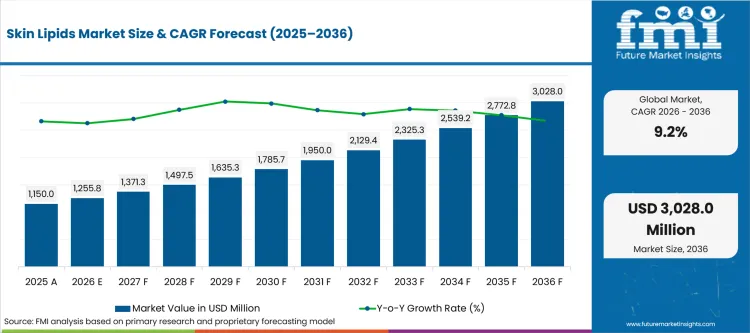
Key Takeaways of Skin Lipids Market
- Demand for skin lipids is driven by barrier-function claims and dermatology-positioned formulation, with buyers requiring measurable operating proof before expanding procurement.
- By source, plant is expected to lead with 32.2% share in 2026 (USD 404.4 million), valued for its support of product consistency and regulatory confidence.
- Ceramides are the dominant product type segment, projected to hold 32.0% share in 2026 (USD 401.9 million), with procurement decisions depending on suppliers maintaining consistent product performance.
- Nutricosmetics is estimated to lead the application category with 32.0% share in 2026 (USD 401.9 million), with commercial success depending on repeatable and scalable use cases.
- Documentation quality and technical support remain key factors shaping supplier selection, as buyers assess whether suppliers can consistently maintain barrier-function claims after approval to avoid launch failures.
- India and China are expected to form the higher-growth country tier, advancing at 11.45% and 10.45% CAGR respectively through 2036, supported by expanding procurement activity and large-scale commercial operations.
- Competition centers on BASF, Croda, Evonik, Ashland, Lubrizol, Seppic, Givaudan, Symrise, Clariant, Stepan, and Wacker Chemie, with vendors differentiating through product fit, documentation quality, and technical service support.
Analyst Opinion
"The skin lipids market is advancing as personal care brands focus on ingredients that strengthen the skin barrier, improve moisture retention, and support clinically relevant performance claims. Product selection is influenced by formulation compatibility, consistent ingredient quality, and the ability to deliver reliable results across a range of skincare applications. Suppliers that combine scientific expertise with regulatory knowledge, formulation support, and dependable supply are likely to build enduring partnerships with beauty and skincare manufacturers."
How is the Skin Lipids Market segmented?
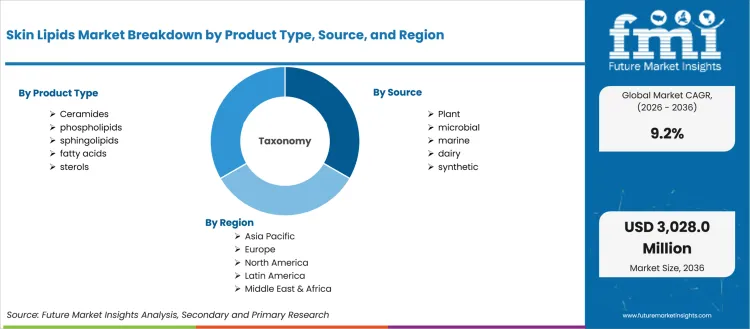
The skin lipids industry is segmented by Product Type, Source and Application; End User and Region complete the forecast structure.
In skin lipids market, segmentation starts with Product Type, Source and Application. End User and Region then show where use case, channel role, and geography change the buying case. Shares stay in the segment questions, so this view stays focused on how the market is organized.
How does Plant influence buying within Source?
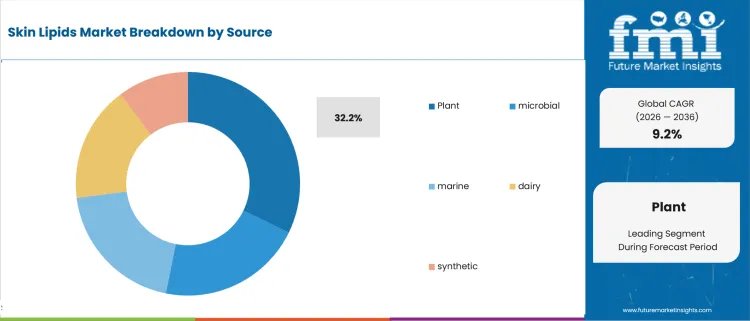
Plant matters within Source because origin affects approval comfort and supply continuity. Buyers use this lens to judge whether the sourcing route can stay consistent after qualification.
- Plant represents 32.2% of Source in 2026, equal to USD 404.4 million. The segment rises from USD 370.3 million in 2025 to USD 975.0 million by 2036. The number matters when buyers can link source choice with consistency and approval comfort.
- Senior buyers should test source reliability before approving Skin Lipids Market. Repeat orders depend on batch consistency and a supply route that protects barrier-function claims and dermatology-positioned formulation.
Where does Ceramides create value in the Product Type category?
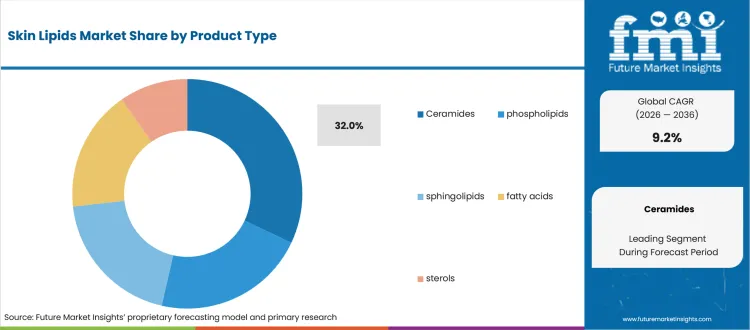
Ceramides matters within Product Type when product performance matches the specification buyers must defend. The segment is useful only when the supplier can keep that fit stable.
- At USD 401.9 million in 2026, Ceramides holds 32% of Product Type. The value moves from USD 368.0 million in 2025 to USD 969.0 million by 2036. Sourcing value depends on whether suppliers can keep the product fit stable.
- Sourcing should test Skin Lipids Market against the use case it must serve. Weak quality control makes repeat approval harder when barrier-function claims and dermatology-positioned formulation is exposed.
What keeps Nutricosmetics relevant within Application?
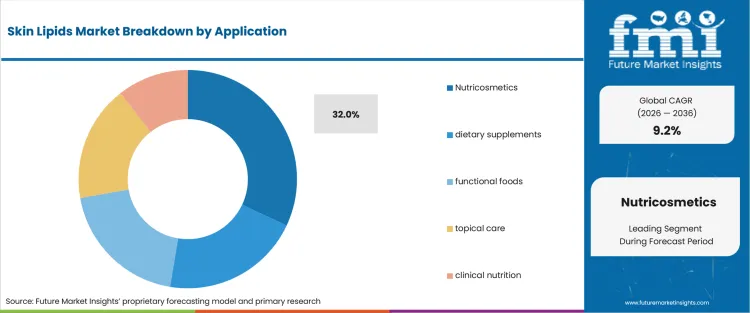
Nutricosmetics should be read through application fit. Buyers compare the segment with the problem it solves in daily operations, with the support needed after approval.
- Nutricosmetics contributes USD 401.9 million in 2026, or 32% of Application, after a 2025 base of USD 368.0 million. By 2036, the segment is projected at USD 969.0 million. Commercial value depends on whether the application supports a repeatable use case.
- Sourcing should ask what changes for the Skin Lipids Market user after adoption. Supplier advantage is clearer when barrier-function claims and dermatology-positioned formulation reduces a specific burden.
How should buyers read Supplement brands demand within End User?
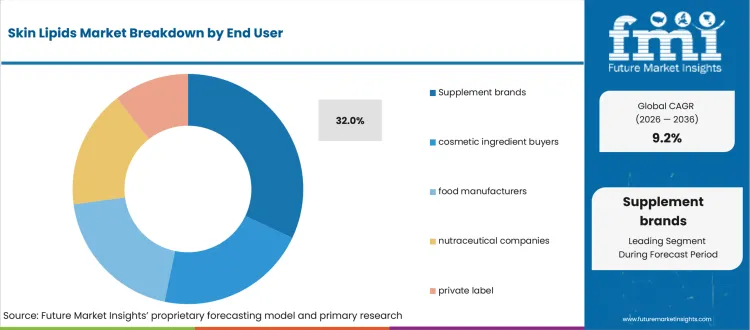
Supplement brands creates value within End User when it fits the economics and operating routine of that buyer group. Sourcing usually depends on production stage and the support needed after approval.
- Supplement brands accounts for 32% of End User in 2026. Its value increases from USD 368.0 million in 2025 to USD 401.9 million in 2026. By 2036, the value is projected at USD 969.0 million. The number matters when the product fits the buyer group's operating economics.
- The Skin Lipids Market buying test is tied to operating economics. Suppliers need to show how barrier-function claims and dermatology-positioned formulation fits the buyer group before sourcing expands orders.
Why is North America still important in Region?
North America should be read through local Skin Lipids Market buying conditions. Service access and buyer maturity matter when barrier-function claims and dermatology-positioned formulation decides repeat orders.
- North America in Skin Lipids Market stands at USD 369.2 million in 2026, equal to 29.4% of Region. It moves from USD 338.1 million in 2025 to USD 890.2 million by 2036. Skin Lipids Market regional value depends on local service access and channel coverage.
- Management teams should test whether the segment changes Skin Lipids Market risk or cost. Share alone is weak guidance unless it connects to barrier-function claims and dermatology-positioned formulation.
What factors shape the Skin Lipids Market?
Skin Lipids Market purchases are being shaped by claim credibility, formulation performance, repeat purchase; and channel fit.
- Driver: barrier-function claims and dermatology-positioned formulation. Demand strengthens when buyers can connect the purchase to a measurable operating, formulation, compliance; or cost outcome in Skin Lipids Market.
- Restraint: proof burden and implementation risk. Adoption slows when Skin Lipids Market buyers cannot validate barrier-function claims and dermatology-positioned formulation under their own operating conditions.
- Opportunity: supplier programs built around barrier-function claims and dermatology-positioned formulation. The better opening is with vendors that make approval easier through field support, clear proof, and repeatable execution.
Skin Lipids Market demand is strongest where the product solves a real formulation or consumer-repeat problem. Brand teams need evidence that the ingredient, format, or claim can survive taste; label; cost; and retail review.
Buyer and supplier pressure shows up in how Skin Lipids Market is trialed, serviced, and scaled. Some buyers can evaluate technical proof internally, while others need distributor or field support before switching.
Implementation friction remains buyer-side. Skin Lipids Market adoption slows when ownership for trials, service, or rollout is unclear after approval.
Which country CAGRs are profiled in the Skin Lipids Market?
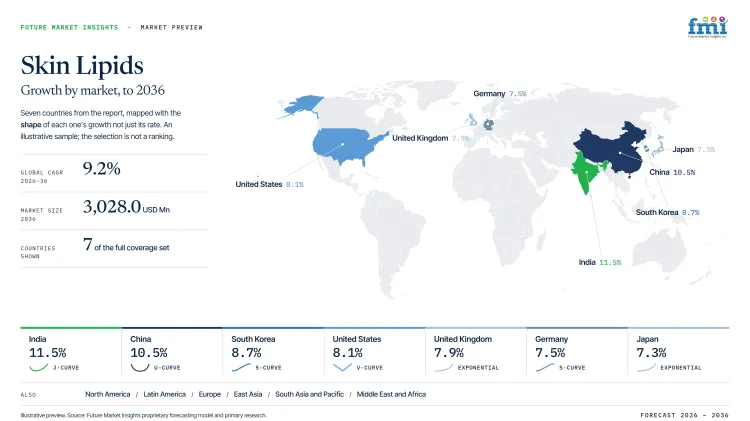
| Country | CAGR |
|---|---|
| United States | 8.1% |
| China | 10.5% |
| India | 11.5% |
| Germany | 7.5% |
| United Kingdom | 7.9% |
| Japan | 7.3% |
| South Korea | 8.7% |
| Rest of World | 9.9% |
How do country-level CAGRs compare in the Skin Lipids Market?
The country comparison spans 4.2 percentage points and reveals four distinct growth groups across the Skin Lipids Market. India, China and the Rest of World form the highest-growth cluster with 1.6 percentage points separating the three markets. South Korea creates the next tier, positioned 1.2 percentage points below the Rest of World. The United States and the United Kingdom remain closely aligned with only a 0.2-point difference, while Germany and Japan are separated by just 0.2 percentage points. Countries with expanding premium skincare consumption, greater awareness of skin barrier health and increasing demand for lipid-based formulations generally demonstrate stronger market growth.
- India records the highest CAGR at 11.5% as rising disposable incomes, expanding dermocosmetic awareness and increasing preference for barrier-repair skincare products continue to drive demand for skin lipid ingredients.
- China follows 1.0 percentage point behind India. Premium beauty brands, growing interest in science-backed skincare and rapid expansion of functional cosmetic products continue to strengthen consumption of ceramides, fatty acids and cholesterol-based formulations.
- The Rest of World reaches a CAGR of 9.9%, standing 0.6 percentage points below China. Growth reflects wider availability of advanced skincare products and increasing consumer focus on hydration, skin repair and long-term skin health across emerging markets.
- South Korea sits 1.2 percentage points below the Rest of World, supported by continuous innovation in K-beauty formulations and strong demand for products that restore and protect the skin barrier using lipid-rich ingredients.
- The United States posts a CAGR of 8.1%, remaining 0.6 percentage points below South Korea. Market expansion is fueled by increasing adoption of dermatologist-recommended skincare, premium moisturizers and products formulated for sensitive and compromised skin.
- The United Kingdom trails the United States by only 0.2 percentage points as consumers increasingly seek clinically validated skincare ingredients that strengthen the skin barrier while addressing dryness and environmental stress.
- Germany records a CAGR of 7.5%, placing it 0.4 percentage points below the United Kingdom. Demand is supported by established dermocosmetic brands, preference for efficacy-driven skincare and growing interest in formulations containing physiologically compatible lipids.
- Japan registers a CAGR of 7.3%, only 0.2 percentage points below Germany. Product innovation continues to focus on skin hydration, anti-aging care and gentle formulations that maintain the skin's natural lipid balance.
Comparable CAGRs can still produce different market entry conditions. Differences in consumer skincare preferences, premium beauty spending, regulatory frameworks and innovation in barrier-repair formulations influence commercialization opportunities and long-term market development. The full report provides country-level CAGR analysis across North America, Latin America, Europe, East Asia, South Asia, Oceania and the Middle East and Africa.
Country-wise Analysis
- United States rises from USD 276.0 million in 2025 to USD 301.4 million in 2026. By 2036, it is projected at USD 653.7 million at a 8.1% CAGR. United States buyers treat Skin Lipids Market as a barrier-function claims and dermatology-positioned formulation decision. Approval usually needs measurable operating proof before volume moves from existing suppliers.
- For Skin Lipids Market, China moves from USD 172.5 million in 2025 to USD 188.4 million in 2026. The 2036 value is USD 509.0 million, supported by an 10.5% CAGR. China's buying condition is scale plus execution discipline in Skin Lipids Market. Suppliers need availability, channel control, and proof that barrier-function claims and dermatology-positioned formulation can hold across fast-ramping accounts.
- For Skin Lipids Market, India is estimated at USD 115.0 million in 2025 and USD 125.6 million in 2026. It is projected at USD 371.3 million by 2036, with a 11.5% CAGR. India demand is tied to formal sourcing and wider production activity in Skin Lipids Market. Cost remains a hard filter, so suppliers need a price case that still supports barrier-function claims and dermatology-positioned formulation.
- Germany stands at USD 92.00 million in 2025 and USD 100.5 million in 2026. By 2036, the value is projected at USD 206.1 million at a 7.5% CAGR. Germany is qualification-led for Skin Lipids Market. Technical review focuses on whether barrier-function claims and dermatology-positioned formulation can be proven before commercial negotiation.
- United Kingdom rises from USD 69.00 million in 2025 to USD 75.35 million in 2026. By 2036, it is projected at USD 160.4 million at a 7.9% CAGR. United Kingdom buyers in Skin Lipids Market place more weight on vendor accountability and delivery reliability. Switching costs rise when barrier-function claims and dermatology-positioned formulation is not supported after purchase.
- Japan moves from USD 80.50 million in 2025 to USD 87.91 million in 2026. The 2036 value is USD 177.0 million, supported by an 7.3% CAGR. Japan's approval cycle for Skin Lipids Market favors suppliers that reduce inspection work and keep barrier-function claims and dermatology-positioned formulation consistent across repeat orders.
- South Korea is estimated at USD 46.00 million in 2025 and USD 50.23 million in 2026. It is projected at USD 115.1 million by 2036, with a 8.7% CAGR. South Korea's compact supply chains make Skin Lipids Market feedback fast. Suppliers need responsive support because weak execution on barrier-function claims and dermatology-positioned formulation can affect production schedules.
- Rest of World stands at USD 299.0 million in 2025 and USD 326.5 million in 2026. By 2036, the value is projected at USD 835.4 million at a 9.9% CAGR. Rest of World demand for Skin Lipids Market is uneven. Local service access and import reliability matter where buyers need help proving barrier-function claims and dermatology-positioned formulation without mature support networks.
Who are the notable companies in the Skin Lipids Market?
BASF; Croda; Evonik; Ashland; Lubrizol; Seppic; Givaudan; Symrise; Clariant; Stepan and Wacker Chemie are the notable companies assessed in this market.
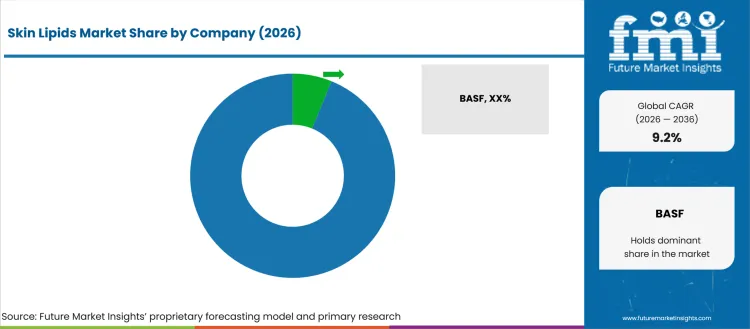
Skin Lipids Market competition is strongest where suppliers can connect ingredient function with launch economics. Buyers compare who can help brands protect taste, label credibility, shelf stability; and repeat purchase after launch.
- Cosmetic lipid and emollient suppliers such as BASF, Croda, Evonik and Ashland matter when buyers compare supplier fit against the approval burden. Their value depends on evidence quality and service response after selection.
- Specialty personal-care ingredient suppliers such as Lubrizol, Seppic, Givaudan and Symrise are useful when the purchase depends on technical fit. Buyers rely on them when a standard catalogue answer is not enough for approval.
- Polymer and active ingredient suppliers such as Clariant, Stepan and Wacker Chemie matter where the buyer needs deeper application guidance or specification fit. Their advantage is narrower expertise that can shorten review after a trial.
Competitive Benchmarking: Skin Lipids Market
| Company | Brand or Ingredient Fit | Application Support | Channel Reach | Geographic Footprint |
|---|---|---|---|---|
| BASF | High | High | Strong | Global |
| Croda | High | Medium | Strong | Global |
| Evonik | Strong | High | Medium | Global or regional |
| Ashland | Medium | High | Medium | Regional |
| Lubrizol | Strong | Medium | Medium | Regional or global |
| Seppic | High | High | Strong | Global |
| Givaudan | High | Medium | Strong | Global |
| Symrise | Strong | High | Medium | Global or regional |
| Clariant | Medium | High | Medium | Regional |
| Stepan | Strong | Medium | Medium | Regional or global |
Source: Future Market Insights competitive analysis, 2026. Ratings for Skin Lipids Market reflect formulation support, claim credibility, ingredient availability; channel fit; and relevance to branded food or nutrition launches.
Key Players in the Skin Lipids Market
Cosmetic lipid and emollient suppliers
- BASF
- Croda
- Evonik
- Ashland
Specialty personal-care ingredient suppliers
- Lubrizol
- Seppic
- Givaudan
- Symrise
Polymer and active ingredient suppliers
- Clariant
- Stepan
- Wacker Chemie
Skin Lipids Market - Report Scope
| Coverage field | Report scope |
|---|---|
| Market breakdown | Skin Lipids Market Breakdown By Product Type, Source and Application; End User and Region |
| Market Definition | Commercial demand for products; services covered under Skin Lipids Market; including country demand; segment demand; and supplier-selection context |
| Regions Covered | North America; Latin America; Europe; East Asia; South Asia and Pacific; Middle East and Africa |
| Countries Covered | United States; United Kingdom; Germany; France; Japan; China; South Korea; India; and 30+ countries |
| Key Companies Profiled | BASF; Croda; Evonik; Ashland; Lubrizol; Seppic; Givaudan; Symrise; Clariant; Stepan; and Wacker Chemie |
| Forecast Period | 2026 to 2036 |
| Approach | Skin Lipids Market: Ingredient demand, product-format use, retail and formulation signals; country channel readiness; and supplier relevance were used to build the sizing approach. |
Skin Lipids Market - Research Methodology
| Method | Approach |
|---|---|
| Primary Research | FMI analysts gathered input from manufacturers, service providers, technology developers, distributors, end users, sourcing teams, and subject-matter experts. Interviews examined purchasing decisions, product or service evaluation, adoption barriers, approval requirements, pricing considerations, and expectations for technical or commercial support. Respondents were also asked what evidence is required before a trial, pilot, or initial order develops into regular purchasing. |
| Desk Research | Desk research covered government statistics, regulatory publications, trade data, industry associations, technical literature, standards, company filings, product information, and official corporate announcements. Sources were reviewed for relevance, publication date, geographic coverage, and consistency with the defined market scope. Claims relating to performance, applications, approvals, capacity, investment, and commercial activity were retained only when supported by credible public evidence. |
| Market Sizing and Forecasting | The market model combined the baseline value with historical performance, segment structure, pricing and volume indicators, adoption levels, company participation, and country-level demand conditions. Forecast assumptions considered economic activity, investment trends, regulatory developments, technology adoption, purchasing cycles, supply availability, and barriers to wider market use. Segment and regional estimates were reconciled before the final market total was calculated. |
| Data Validation | Estimates were checked against multiple independent indicators, including public data, company activity, trade patterns, industry developments, and findings from primary interviews. Validation also tested whether products, services, applications, and company revenues fell within the defined market boundaries. Adjacent categories, unsupported claims, overlapping revenues, and activities without direct market relevance were excluded to reduce double counting and maintain consistency across segments and countries. |
Skin Lipids Market by Segments
Skin Lipids Market segmented by Product Type:
- Ceramides
- phospholipids
- sphingolipids
- fatty acids
- sterols
Skin Lipids Market segmented by Source:
- Plant
- microbial
- marine
- dairy
- synthetic
Skin Lipids Market segmented by Application:
- Nutricosmetics
- dietary supplements
- functional foods
- topical care
- clinical nutrition
Skin Lipids Market segmented by End User:
- Supplement brands
- cosmetic ingredient buyers
- food manufacturers
- nutraceutical companies
- private label
Skin Lipids Market segmented by Region:
- North America
- Europe
- East Asia
- South Asia
- Latin America
Research Sources and Bibliography
Secondary validation for Skin Lipids Market uses food consumption data, ingredient oversight, safety references and trade exposure together. Consumption sources frame the demand base, FDA/Codex/EFSA help define what can be sold or claimed, and trade data tests whether ingredient availability supports the forecast story.
- 1. FAOSTAT.
- 2. USDA ERS Food Availability Data System.
- 3. FDA Food Ingredients and Packaging.
- 4. Codex Alimentarius.
- 5. EFSA Food Ingredients and Packaging.
- 6. WHO Food Safety.
- 7. UN Comtrade.
- 8. BASF.
- 9. Croda.
- 10. Evonik.
- 11. Ashland.
- 12. Lubrizol.
- 13. Seppic.
- 14. Givaudan.
This Report Answers
- What value is forecast for the Skin Lipids Market in 2026 and by 2036?
- What CAGR is forecast for the Skin Lipids Market during the 2026 to 2036 period?
- Which segment groups are used to assess demand across Skin Lipids Market?
- Which buyer problems are creating procurement interest in Skin Lipids Market?
- How do the main segment shares shape Skin Lipids Market decisions in the 2026 base?
- Which countries are profiled in the Skin Lipids Market forecast and how do their CAGRs differ?
- Which companies are assessed in this market?
- What should Skin Lipids Market buyers evaluate before changing suppliers?
- How does FMI size and validate Skin Lipids Market country and segment demand?
- What risks could delay Skin Lipids Market adoption, qualification, or repeat purchasing?
Frequently Asked Questions
Why should executives track the Skin Lipids Market?
Executives should track Skin Lipids Market because barrier-function claims and dermatology-positioned formulation affects procurement risk and operating performance. The value is in knowing where the purchase can reduce cost, avoid disruption, or improve buyer confidence.
What business problem does the Skin Lipids Market address?
Skin Lipids Market addresses barrier-function claims and dermatology-positioned formulation. Buyers use the category when routine procurement cannot protect launch quality, channel fit, or repeat purchase.
What should Skin Lipids Market procurement leaders evaluate before selecting suppliers?
Skin Lipids Market procurement leaders should test ingredient reliability, formulation fit, label risk; sensory impact; and production scalability. A low-cost input is weak if it damages repeat purchase or slows launch approval.
What can limit return on investment for buyers?
Skin Lipids Market payback depends on whether the product supports repeat purchase, price realization, cleaner label positioning; or channel acceptance. Buyers reduce risk by testing taste, stability, claim support; and supply continuity before launch.
How can suppliers build executive confidence?
Skin Lipids Market suppliers build confidence when they can support formulation work, claim discipline, batch consistency; and post-launch troubleshooting. Brand teams value partners that reduce launch risk, not just ingredient cost.
Preview the report firsthand - request a free sample
Get SampleGet the brochure for pricing and purchase details.
Get PDFTable of Content
- Key Takeaways
- Market Size and CAGR
- Top Growth Driver
- Fastest Growing Segment
- Leading Region
- Key Companies
- Emerging Opportunities
- Executive Summary
- Global Market Outlook
- Demand-side Trends
- Supply-side Trends
- Technology Roadmap Analysis
- Analysis and Recommendations
- Analyst Perspective (What is happening? Why now? What should investors know?)
- Key Questions Answered
- How large is the market?
- What is the CAGR?
- What are key trends?
- Which region dominates?
- Who are the leaders?
- Market Overview
- Market Coverage / Taxonomy
- Market Definition / Scope / Limitations
- Research Methodology
- Chapter Orientation
- Analytical Lens and Working Hypotheses
- Market Structure, Signals, and Trend Drivers
- Benchmarking and Cross-market Comparability
- Market Sizing, Forecasting, and Opportunity Mapping
- Research Design and Evidence Framework
- Desk Research Programme (Secondary Evidence)
- Expert Input and Fieldwork (Primary Evidence)
- Tooling, Models, and Reference Databases
- Data Engineering and Model Build
- Quality Assurance and Audit Trail
- Market Background
- Market Dynamics (Drivers, Restraints, Opportunity, Trends)
- Scenario Forecast (Optimistic, Likely, Conservative)
- Impact Analysis
- AI Impact
- Sustainability Impact
- Regulatory Impact
- Technology Impact
- Consumer / Buyer Analysis
- Purchase Drivers
- Adoption Barriers
- Buyer Journey
- Opportunity Map Analysis
- Product Life Cycle Analysis
- Supply Chain Analysis
- Investment Feasibility Matrix
- Value Chain Analysis
- PESTLE and Porter's Analysis
- Regulatory Landscape
- Regional Parent Market Outlook
- Production and Consumption Statistics
- Import and Export Statistics
- Global Market Analysis and Forecast, 2021 to 2036
- Historical Market Size Value (USD Million) Analysis, 2021 to 2025
- Current and Future Market Size Value (USD Million) Projections, 2026 to 2036
- Y-o-Y Growth Trend Analysis
- Absolute $ Opportunity Analysis
- Global Market Pricing Analysis, 2021 to 2036
- Global Market Analysis and Forecast, By Product Type, 2021 to 2036
- Introduction / Key Findings
- Historical Market Size Value (USD Million) Analysis By Product Type, 2021 to 2025
- Current and Future Market Size Value (USD Million) Analysis and Forecast By Product Type, 2026 to 2036
- Ceramides
- phospholipids
- sphingolipids
- fatty acids
- sterols
- Ceramides
- Y-o-Y Growth Trend Analysis By Product Type, 2021 to 2025
- Absolute $ Opportunity Analysis By Product Type, 2026 to 2036
- Global Market Analysis and Forecast, By Source, 2021 to 2036
- Introduction / Key Findings
- Historical Market Size Value (USD Million) Analysis By Source, 2021 to 2025
- Current and Future Market Size Value (USD Million) Analysis and Forecast By Source, 2026 to 2036
- Plant
- microbial
- marine
- dairy
- synthetic
- Plant
- Y-o-Y Growth Trend Analysis By Source, 2021 to 2025
- Absolute $ Opportunity Analysis By Source, 2026 to 2036
- Global Market Analysis and Forecast, By Application, 2021 to 2036
- Introduction / Key Findings
- Historical Market Size Value (USD Million) Analysis By Application, 2021 to 2025
- Current and Future Market Size Value (USD Million) Analysis and Forecast By Application, 2026 to 2036
- Nutricosmetics
- dietary supplements
- functional foods
- topical care
- clinical nutrition
- Nutricosmetics
- Y-o-Y Growth Trend Analysis By Application, 2021 to 2025
- Absolute $ Opportunity Analysis By Application, 2026 to 2036
- Global Market Analysis and Forecast, By End User, 2021 to 2036
- Introduction / Key Findings
- Historical Market Size Value (USD Million) Analysis By End User, 2021 to 2025
- Current and Future Market Size Value (USD Million) Analysis and Forecast By End User, 2026 to 2036
- Supplement brands
- cosmetic ingredient buyers
- food manufacturers
- nutraceutical companies
- private label
- Supplement brands
- Y-o-Y Growth Trend Analysis By End User, 2021 to 2025
- Absolute $ Opportunity Analysis By End User, 2026 to 2036
- Global Market Analysis and Forecast, By Region, 2021 to 2036
- Introduction
- Historical Market Size Value (USD Million) Analysis By Region, 2021 to 2025
- Current Market Size Value (USD Million) Analysis and Forecast By Region, 2026 to 2036
- North America
- Latin America
- Western Europe
- Eastern Europe
- East Asia
- South Asia and Pacific
- Middle East & Africa
- Market Attractiveness Analysis By Region
- North America Market Analysis and Forecast, By Country, 2021 to 2036
- Historical Market Size Value (USD Million) Trend Analysis By Market Taxonomy, 2021 to 2025
- Market Size Value (USD Million) Forecast By Market Taxonomy, 2026 to 2036
- By Country
- USA
- Canada
- By Product Type
- By Source
- By Application
- By End User
- By Country
- Market Attractiveness Analysis
- By Country
- By Product Type
- By Source
- By Application
- By End User
- Key Takeaways
- Latin America Market Analysis and Forecast, By Country
- Historical Market Size Value (USD Million) Trend Analysis By Market Taxonomy, 2021 to 2025
- Market Size Value (USD Million) Forecast By Market Taxonomy, 2026 to 2036
- By Country
- Brazil
- Mexico
- Chile
- Rest of Latin America
- By Product Type
- By Source
- By Application
- By End User
- By Country
- Market Attractiveness Analysis
- By Country
- By Product Type
- By Source
- By Application
- By End User
- Key Takeaways
- Western Europe Market Analysis and Forecast, By Country
- Historical Market Size Value (USD Million) Trend Analysis By Market Taxonomy, 2021 to 2025
- Market Size Value (USD Million) Forecast By Market Taxonomy, 2026 to 2036
- By Country
- Germany
- UK
- Italy
- Spain
- France
- Nordic
- BENELUX
- Rest of Western Europe
- By Product Type
- By Source
- By Application
- By End User
- By Country
- Market Attractiveness Analysis
- By Country
- By Product Type
- By Source
- By Application
- By End User
- Key Takeaways
- Eastern Europe Market Analysis and Forecast, By Country
- Historical Market Size Value (USD Million) Trend Analysis By Market Taxonomy, 2021 to 2025
- Market Size Value (USD Million) Forecast By Market Taxonomy, 2026 to 2036
- By Country
- Russia
- Poland
- Hungary
- Balkan & Baltic
- Rest of Eastern Europe
- By Product Type
- By Source
- By Application
- By End User
- By Country
- Market Attractiveness Analysis
- By Country
- By Product Type
- By Source
- By Application
- By End User
- Key Takeaways
- East Asia Market Analysis and Forecast, By Country
- Historical Market Size Value (USD Million) Trend Analysis By Market Taxonomy, 2021 to 2025
- Market Size Value (USD Million) Forecast By Market Taxonomy, 2026 to 2036
- By Country
- China
- Japan
- South Korea
- By Product Type
- By Source
- By Application
- By End User
- By Country
- Market Attractiveness Analysis
- By Country
- By Product Type
- By Source
- By Application
- By End User
- Key Takeaways
- South Asia and Pacific Market Analysis and Forecast, By Country
- Historical Market Size Value (USD Million) Trend Analysis By Market Taxonomy, 2021 to 2025
- Market Size Value (USD Million) Forecast By Market Taxonomy, 2026 to 2036
- By Country
- India
- ASEAN
- Australia & New Zealand
- Rest of South Asia and Pacific
- By Product Type
- By Source
- By Application
- By End User
- By Country
- Market Attractiveness Analysis
- By Country
- By Product Type
- By Source
- By Application
- By End User
- Key Takeaways
- Middle East & Africa Market Analysis and Forecast, By Country
- Historical Market Size Value (USD Million) Trend Analysis By Market Taxonomy, 2021 to 2025
- Market Size Value (USD Million) Forecast By Market Taxonomy, 2026 to 2036
- By Country
- Kingdom of Saudi Arabia
- Other GCC Countries
- Türkiye
- South Africa
- Other African Union
- Rest of Middle East & Africa
- By Product Type
- By Source
- By Application
- By End User
- By Country
- Market Attractiveness Analysis
- By Country
- By Product Type
- By Source
- By Application
- By End User
- Key Takeaways
- Key Countries Market Analysis
- USA
- Pricing Analysis
- Market Share Analysis, 2025
- By Product Type
- By Source
- By Application
- By End User
- Canada
- Pricing Analysis
- Market Share Analysis, 2025
- By Product Type
- By Source
- By Application
- By End User
- Mexico
- Pricing Analysis
- Market Share Analysis, 2025
- By Product Type
- By Source
- By Application
- By End User
- Brazil
- Pricing Analysis
- Market Share Analysis, 2025
- By Product Type
- By Source
- By Application
- By End User
- Chile
- Pricing Analysis
- Market Share Analysis, 2025
- By Product Type
- By Source
- By Application
- By End User
- Germany
- Pricing Analysis
- Market Share Analysis, 2025
- By Product Type
- By Source
- By Application
- By End User
- UK
- Pricing Analysis
- Market Share Analysis, 2025
- By Product Type
- By Source
- By Application
- By End User
- Italy
- Pricing Analysis
- Market Share Analysis, 2025
- By Product Type
- By Source
- By Application
- By End User
- Spain
- Pricing Analysis
- Market Share Analysis, 2025
- By Product Type
- By Source
- By Application
- By End User
- France
- Pricing Analysis
- Market Share Analysis, 2025
- By Product Type
- By Source
- By Application
- By End User
- India
- Pricing Analysis
- Market Share Analysis, 2025
- By Product Type
- By Source
- By Application
- By End User
- ASEAN
- Pricing Analysis
- Market Share Analysis, 2025
- By Product Type
- By Source
- By Application
- By End User
- Australia & New Zealand
- Pricing Analysis
- Market Share Analysis, 2025
- By Product Type
- By Source
- By Application
- By End User
- China
- Pricing Analysis
- Market Share Analysis, 2025
- By Product Type
- By Source
- By Application
- By End User
- Japan
- Pricing Analysis
- Market Share Analysis, 2025
- By Product Type
- By Source
- By Application
- By End User
- South Korea
- Pricing Analysis
- Market Share Analysis, 2025
- By Product Type
- By Source
- By Application
- By End User
- Russia
- Pricing Analysis
- Market Share Analysis, 2025
- By Product Type
- By Source
- By Application
- By End User
- Poland
- Pricing Analysis
- Market Share Analysis, 2025
- By Product Type
- By Source
- By Application
- By End User
- Hungary
- Pricing Analysis
- Market Share Analysis, 2025
- By Product Type
- By Source
- By Application
- By End User
- Kingdom of Saudi Arabia
- Pricing Analysis
- Market Share Analysis, 2025
- By Product Type
- By Source
- By Application
- By End User
- Türkiye
- Pricing Analysis
- Market Share Analysis, 2025
- By Product Type
- By Source
- By Application
- By End User
- South Africa
- Pricing Analysis
- Market Share Analysis, 2025
- By Product Type
- By Source
- By Application
- By End User
- USA
- Market Structure Analysis
- Competition Dashboard
- Competition Benchmarking
- Market Share Analysis of Top Players
- By Regional
- By Product Type
- By Source
- By Application
- By End User
- Emerging Startups
- Innovation Benchmarking
- Competition Analysis
- Competition Deep Dive
- BASF
- Overview
- Product Portfolio
- Profitability by Market Segments
- Sales Footprint
- Strategy Overview
- Marketing Strategy
- Product Strategy
- Channel Strategy
- Croda
- Evonik
- Ashland
- Lubrizol
- Seppic
- Givaudan
- Symrise
- Clariant
- Stepan
- Wacker Chemie
- BASF
- Case Studies
- Success Stories
- Recent Developments
- Competition Deep Dive
- Assumptions & Acronyms Used


