

- Market Size (2026)
- USD 753.2 Mn
- Forecast (2036)
- USD 1374.5 Mn
- CAGR (2026 to 2036)
- 6.2%
How big is the Sleeping Masks Market in 2026?
The Sleeping Masks Market is valued at USD 753.2 Million in 2026, compared with USD 709.2 Million in 2025.
FMI values the sleeping masks market at USD 753.2 Million in 2026 and forecasts it to reach USD 1,374.5 Million by 2036 at a 6.2% CAGR. The market was valued at USD 709.2 Million in 2025. Sleeping masks are moving beyond basic hydration as brands add barrier care and more specific overnight treatment. This puts the category closer to the wider skincare products market.
Online retail is key in this market as many sleeping-mask brands reach buyers outside their home markets before they get broad store distribution. U.S. e-commerce represented 17.1% of total retail sales in Q2 2026 [1]. South Korean cross-border online cosmetics sales increased 20.4% in 2025 [8]. Physical beauty retail therefore remains more important there than in more digital markets.
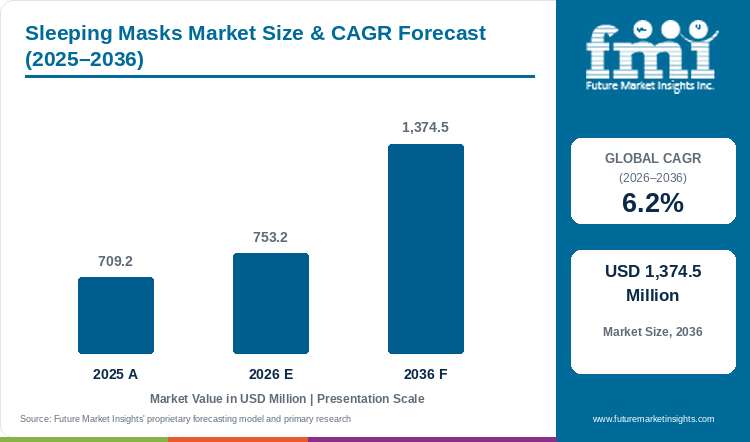
Key Takeaways
- Core / classic lines are projected to account for 34.0% of Product Type demand in 2026.
- Conventional products are expected to represent 60.0% of Nature demand in 2026.
- Cream & balm is projected to account for 30.0% of Format demand in 2026. The familiar texture fits the final step of a nighttime routine.
- Mass is expected to represent 30.0% of Price Positioning demand in 2026.
- E-commerce & DTC is projected to account for 32.0% of Sales Channel demand in 2026. Online stores give imported sleeping-mask ranges access before they gain wide shelf space.
- UAE is expected to record brisk CAGR at 7.5% through 2036, whereas Saudi Arabia follows at 7.2% CAGR.
Analyst Perspective
“Over the next few years sleeping masks will split into two clear groups. Hydration and barrier masks will keep the broadest customer base. Firming and brightening masks will grow when they offer something that a normal night cream does not. Lighter textures and sensitive-skin formulas should also bring more buyers into the category.”
- Rahul Pandita, Principal Consultant, Future Market Insights
How is the sleeping masks market segmented?
The market is segmented by Product Type, Nature, Format, Price Positioning, Sales Channel, and Region.
By Product Type, the market includes Core / classic lines, Targeted treatment lines, Sensitive & gentle lines, Premium & clinical lines, and Kits & sets. Nature covers Conventional, Vegan & cruelty-free, Natural & organic, Dermocosmetic / clinical, and Fragrance-free & sensitive products. Format includes Cream & balm, Liquid & serum, Stick & solid, Spray & mist, Sheet & patch, and Powder. Price Positioning is divided into Mass, Masstige, Premium, and Professional. Sales Channel covers E-commerce & DTC, Specialty beauty retail, Pharmacies & drugstores, Supermarkets & hypermarkets, and Salons & spas.
Why do Core / classic lines lead demand within the Product Type category?
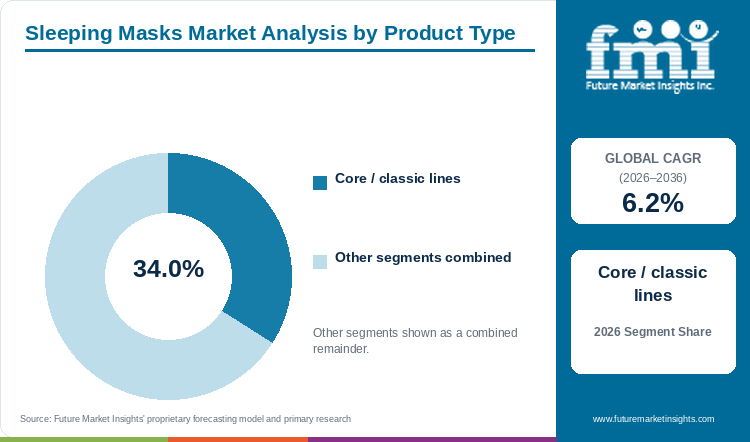
Core / classic lines are projected to account for 34.0% of Product Type demand in 2026.
Core / classic lines lead because most sleeping masks are still bought for hydration and barrier care. These benefits are easy to understand and fit into an existing night routine without much change.
Targeted masks for firmness or brightening should grow faster from a smaller base. They also compete with night creams and serums that already make similar claims. Core lines should therefore remain the largest segment through the forecast period.
- Core / classic lines are projected to account for 34.0% of Product Type demand in 2026.
- Targeted treatment lines are expected to gain demand where buyers want firming or brightening from the overnight step.
Why does Conventional lead demand within the Nature category?
Conventional is projected to account for 60.0% of Nature demand in 2026.
Conventional products lead because manufacturers have more flexibility when choosing preservatives and texture systems. This matters for a product that stays on the skin for several hours and is often used from the same pack many times.
Natural and vegan products should continue to grow among buyers who prefer these claims. Fragrance-free and dermocosmetic products are also likely to gain demand from sensitive-skin users. Conventional products should still remain the largest segment because they cover the widest range of prices and formulations.
- Conventional is projected to account for 60.0% of Nature demand in 2026.
- Fragrance-free and dermocosmetic lines are expected to gain demand among sensitive-skin buyers.
Why does Cream & balm lead demand within the Format category?
Cream & balm is projected to account for 30.0% of Format demand in 2026.
Cream and balm formats lead because they stay in place during overnight use. They also feel familiar to buyers who already use a night moisturizer. This makes the format easy to add to an existing routine.
Gel and cream-gel masks should continue to gain demand among buyers who prefer lighter textures. Heavy or sticky creams can lose repeat use if they feel uncomfortable during sleep. Texture will therefore remain an important buying factor.
- Cream & balm is projected to account for 30.0% of Format demand in 2026.
- Gel and cream-gel formats are expected to gain demand among buyers who prefer a lighter finish.
Why does Mass lead demand within the Price Positioning category?
Mass is projected to account for 30.0% of Price Positioning demand in 2026.
Mass products lead because sleeping masks are still an extra skincare purchase for many buyers. A lower price makes it easier to try the product and continue using it alongside moisturizer or serum.
Premium masks can support higher prices when they offer a clear treatment benefit such as firmness or brightening. Products built mainly around basic hydration face more price pressure because buyers can get the same benefit from other nighttime products.
- Mass is projected to account for 30.0% of Price Positioning demand in 2026.
- Premium demand is likely to be stronger where the mask offers a clear treatment benefit.
Why does E-commerce & DTC lead demand within the Sales Channel category?
E-commerce & DTC is projected to account for 32.0% of Sales Channel demand in 2026.
Many sleeping masks reach buyers through online beauty stores before they get wide physical distribution. South Korean cross-border online cosmetics sales grew 20.4% in 2025 [8]. This gives K-beauty sleeping masks access to markets where the category still has limited shelf space.
Online sales also work well for repeat purchase once the buyer knows the product. Specialty beauty stores will remain important for premium products because buyers can compare texture and finish before purchase. E-commerce should remain the largest channel while online assortments stay wider than local store ranges.
- E-commerce & DTC is projected to account for 32.0% of Sales Channel demand in 2026.
- Specialty beauty retail remains important for premium products where texture and finish affect purchase.
What are the drivers, restraints, and opportunities in the Sleeping Masks Market?
Demand is supported by overnight hydration and barrier care. Overlap with night creams and serums limits repeat purchase. Lighter and more targeted formulas can bring new buyers into the category.
- Driver: Sleeping masks give buyers a simple way to add hydration or barrier care at night.
- Restraint: The category loses repeat purchase when the product feels too similar to a night cream or serum.
- Opportunity: Lighter textures and more specific treatment claims can bring more users into the category.
Sleeping masks are easy to add at the end of a nighttime routine. The product stays on the skin until morning and does not need to be washed off after a few minutes. Hydration and barrier care are likely to remain the main reasons for use. This also connects the category with healing skin care products where dryness and skin recovery are already common purchase needs.
The main challenge is that buyers may already use a night cream or serum for the same purpose. A rich sleeping mask can feel too close to a night cream while an active formula can compete with serum. EU Regulation 2024/996 limits retinol equivalents to 0.3% in most leave-on products [9]. This adds another formulation issue for active sleeping masks. It also increases competition with retinoid night creams.
The next area of growth is likely to be lighter and more targeted products. Cream-gel and fragrance-free masks can appeal to buyers who dislike heavy overnight products. Firming and brightening masks can support higher prices when the benefit is easy to understand. Sensitive-skin formulas can also benefit from demand in soothing skin care products
Which country CAGRs are profiled in the Sleeping Masks Market?
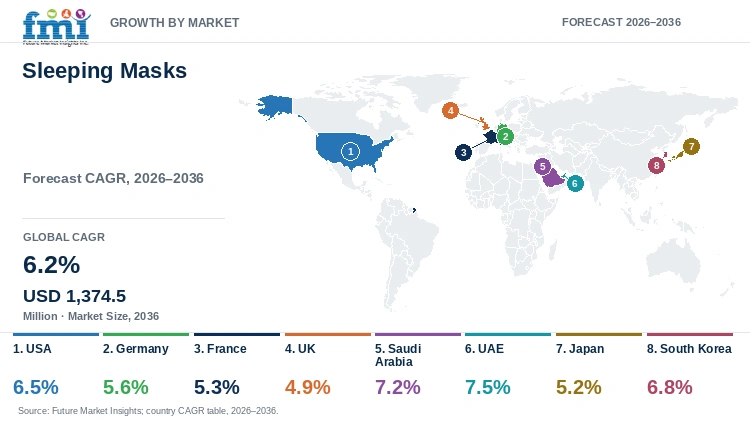
| Country | CAGR |
|---|---|
| USA | 6.5% |
| Germany | 5.6% |
| France | 5.3% |
| UK | 4.9% |
| Saudi Arabia | 7.2% |
| UAE | 7.5% |
| Japan | 5.2% |
| South Korea | 6.8% |
Country-wise Analysis
- USA: The USA is expected to grow at a 6.5% CAGR through 2036. E-commerce represented 17.1% of total retail sales in Q2 2026 [1]. FDA had more than 1.29 million active cosmetic product listings by June 2026 [10]. That gives sleeping masks strong online access but also puts them in a crowded face-care market. Products that look too similar to a moisturizer or serum will find it harder to build repeat use.
- Germany: Germany is projected to grow at a 5.6% CAGR through 2036. Destatis reported that 83% of people aged 16 to 74 had bought online in 2024 [2]. This makes it easy for buyers to compare prices across many skincare products. Mass and masstige masks are likely to do better when the benefit is simple to understand. Premium products need more than basic hydration to support a higher price.
- France: France is expected to grow at a 5.3% CAGR through 2036. Insee reported that 63% of people aged 15+ bought online in the prior three months in 2024 [3]. The rate reached 83% among women aged 15 to 44. Younger buyers can be reached online but the market is not fully digital. Beauty stores and pharmacies will still matter for brands that want to reach a wider age group.
- UK: The UK is forecast to grow at a 4.9% CAGR through 2036. Internet sales represented 27.4% of total retail sales in 2025 according to ONS [4]. This makes price comparison a normal part of the buying process. Sleeping masks sold at premium prices need a clear reason to cost more than a night cream or serum.
- Saudi Arabia: Saudi Arabia is forecast to grow at a 7.2% CAGR through 2036. Electronic payments accounted for 85% of retail payments in 2025 and national systems processed 14.6 billion electronic transactions [5]. This makes online beauty shopping easier and supports repeat ordering. Brands still need to complete cosmetic notification before expanding distribution.
- UAE: UAE is expected to record the highest profiled CAGR at 7.5% through 2036. Eleven e-commerce platforms signed the Ministry of Industry and Advanced Technology Compliance Pledge in August 2024 [6]. Digital distribution is growing but product checks remain important. Brands need their registration and documentation in place before pushing sleeping masks across major online platforms.
- Japan: Japan is forecast to grow at a 5.2% CAGR through 2036. B2C e-commerce reached JPY 26.1 trillion in 2024 but accounted for only 9.8% of consumer commerce [7]. Online sales matter but physical retail still carries most spending. Sleeping-mask brands therefore need store presence as well as DTC if they want broad reach.
- South Korea: South Korea is expected to grow at a 6.8% CAGR through 2036. Cross-border online purchases of Korean goods reached KRW 3.02 trillion in 2025 and cosmetics sales in that channel rose 20.4% [8]. Amorepacific renewed two Laneige sleeping masks in 2025 [11] and added a new Sulwhasoo overnight mask in 2026 [12]. Buyers already know the category well, so brands have to keep improving texture or treatment benefits rather than depend on the sleeping-mask format itself.
Who are the notable companies in the Sleeping Masks Market?
Notable companies include Unilever and Amorepacific. Estee Lauder Companies and e.l.f. Beauty are also profiled. Coty and Shiseido are included with Beiersdorf and Procter & Gamble. L'Oreal and Kao Corporation are also covered.
Amorepacific has the strongest sleeping-mask range among the companies listed here. Laneige already has established sleeping masks and Sulwhasoo added its Overnight Recharging Mask in 2026 [12]. Shiseido launched the HAKU Night Cream Mask in 2026 [13]. Both companies have products made specifically for overnight use.
Estee Lauder Companies sells overnight masks through Clinique. Unilever has overnight skincare through Tatcha. L'Oreal has a large night-treatment range but sleeping masks are only one part of that business. e.l.f. Beauty, Coty and Beiersdorf are more broadly exposed to face care. Procter & Gamble and Kao Corporation also have large skincare portfolios.
- Sleeping-mask specialists: Amorepacific has established sleeping-mask lines through Laneige and Sulwhasoo. Shiseido added a new overnight mask in 2026.
- Night skincare brands: Estee Lauder Companies has overnight masks through Clinique. Unilever has overnight products through Tatcha while L'Oreal has a wider night-treatment range.
- Broader skincare companies: e.l.f. Beauty, Coty, Beiersdorf, Procter & Gamble and Kao Corporation are stronger across wider face-care portfolios than in sleeping masks specifically.
Competitive Benchmarking: Sleeping Masks Market
| Company | Sleeping-Mask Portfolio | Overnight Benefit Range | Omnichannel Reach | Current Category Position |
|---|---|---|---|---|
| Amorepacific | High | High | High | Laneige and Sulwhasoo |
| Estee Lauder Companies | High | High | High | Clinique overnight masks |
| L'Oreal | High | High | High | Broad night-treatment skincare |
| Unilever | Medium | High | High | Tatcha overnight care |
| Shiseido | Medium | High | High | HAKU and d program |
| e.l.f. Beauty | Medium | Medium | High | Broader skincare portfolio |
| Coty | Medium | Medium | High | Broader prestige skincare |
| Beiersdorf | Low | Medium | High | Broader face-care portfolio |
| Procter & Gamble | Low | Medium | High | Broader skincare portfolio |
| Kao Corporation | Low | Medium | Medium | Japan-led skincare portfolio |
Scoring basis: Sleeping-Mask Portfolio looks at direct overnight-mask products. Overnight Benefit Range looks at hydration and targeted treatment depth. Omnichannel Reach looks at digital and physical distribution. High means broad capability while Medium means a narrower role. Low means the current sleeping-mask role is limited.
Key Developments in the Sleeping Masks Market
- In August 2025 Amorepacific renewed two Laneige sleeping masks. The company said the line had reached 58.3 million units in cumulative sales [11].
- In May 2026 Sulwhasoo launched the Overnight Recharging Mask. The product uses a creamy texture and targets visible sleep lines as well as overnight barrier support [12].
- In July 2026 Shiseido launched the HAKU Medicated Brightening Night Cream Mask in Japan. The product uses the highest 4MSK concentration in HAKU at launch [13].
Key Players in the Sleeping Masks Market
Established Sleeping-Mask Platforms
- Amorepacific
- Estee Lauder Companies
- Shiseido
Global Skincare Groups
- L'Oreal
- Unilever
- Procter & Gamble
- Kao Corporation
Broader Beauty Portfolios
- e.l.f. Beauty
- Coty
- Beiersdorf
Sleeping Masks Market - Report Scope
| Coverage field | Report scope |
|---|---|
| Market breakdown | Product Type; Nature; Format; Price Positioning; Sales Channel; Region |
| Quantitative Units | USD Million |
| Market Definition | Leave-on facial products marketed for overnight or sleeping use. Ordinary night creams and serums not marketed as sleeping masks are excluded. Rinse-off masks and sleep accessories are also excluded. |
| Regions Covered | North America; Latin America; Western Europe; Eastern Europe; East Asia; South Asia and Pacific; Middle East and Africa |
| Countries Covered | USA; Germany; France; UK; Saudi Arabia; UAE; Japan; South Korea; and more than 25 additional countries in the full report |
| Key Companies Profiled | Unilever; Amorepacific; Estee Lauder Companies; e.l.f. Beauty; Coty; Shiseido; Beiersdorf; Procter & Gamble; L'Oreal; Kao Corporation |
| Forecast Period | 2026 to 2036 |
| Approach | Primary and desk research with market triangulation |
Sleeping Masks Market - Research Methodology
| Method | Approach |
|---|---|
| Primary Research | FMI gathers input from brand owners and manufacturers. Distributors and beauty retailers also provide views on pricing and repeat purchase. |
| Desk Research | Research uses government statistics and cosmetic regulations. Company filings and official product information are also reviewed. |
| Market Sizing and Forecasting | Market values are reviewed against country conditions and channel structure. Price positioning and segment mix are also considered. |
| Data Validation | Product definitions and company roles are checked across sources. Ordinary night creams are kept outside scope unless they are marketed as sleeping masks. |
Sleeping Masks Market by Segments
Sleeping Masks Market Segmented by Product Type
- Core / classic lines
- Targeted treatment lines
- Sensitive & gentle lines
- Premium & clinical lines
- Kits & sets
Sleeping Masks Market Segmented by Nature
- Conventional
- Vegan & cruelty-free
- Natural & organic
- Dermocosmetic / clinical
- Fragrance-free & sensitive
Sleeping Masks Market Segmented by Format
- Cream & balm
- Liquid & serum
- Stick & solid
- Spray & mist
- Sheet & patch
- Powder
Sleeping Masks Market Segmented by Price Positioning
- Mass
- Masstige
- Premium
- Professional
Sleeping Masks Market Segmented by Sales Channel
- E-commerce & DTC
- Specialty beauty retail
- Pharmacies & drugstores
- Supermarkets & hypermarkets
- Salons & spas
Sleeping Masks Market by Region
- North America
- United States
- Canada
- Latin America
- Brazil
- Mexico
- Argentina
- Chile
- Western Europe
- Germany
- France
- United Kingdom
- Italy
- Spain
- Benelux
- Nordics
- Eastern Europe
- Poland
- Czech Republic
- Romania
- Hungary
- East Asia
- China
- Japan
- South Korea
- South Asia and Pacific
- India
- ASEAN
- Australia and New Zealand
- Middle East and Africa
- GCC Countries
- South Africa
- Türkiye
- Israel
Research Sources and Bibliography
- [1] U.S. Census Bureau (2026, August). Quarterly Retail E-Commerce Sales, Second Quarter 2026. U.S. e-commerce data
- [2] Destatis (2024, November 28). 83% of people aged 16 to 74 shop online. German online shopping data
- [3] Insee (2025, October 14). Achats de produits et de services en ligne. French online shopping data
- [4] Office for National Statistics (2026, August). Internet sales as a percentage of total retail sales. UK internet retail data
- [5] Saudi Central Bank (SAMA) (2026, April 12). E-Payments Account for 85% of Total Retail Payments in 2025.
- [6] UAE Ministry of Industry and Advanced Technology (2024, August 19). Eleven e-commerce retailers sign the Compliance Pledge.
- [7] Japan Ministry of Economy, Trade and Industry (2025, August 26). Results of FY2024 E-Commerce Market Survey Compiled.
- [8] Korea.net (2026, February 19). International online purchases of domestic goods in 2025 break KRW 3 trillion.
- [9] European Commission (2024). Commission Regulation (EU) 2024/996 on cosmetic ingredients including vitamin A restrictions.
- [10] U.S. Food and Drug Administration (2026). Registration and Listing of Cosmetic Product Facilities and Products under MoCRA.
- [11] Amorepacific (2025, August 4). LANEIGE renews and launches two sleeping masks.
- [12] Amorepacific (2026, May 6). Sulwhasoo launches Overnight Recharging Mask.
- [13] Shiseido (2026, June 9). HAKU Medicated Brightening Night Cream Mask launch announcement.
This bibliography is provided for reader reference. The full report contains the complete reference list and supporting research.
This Report Answers
- What is the Sleeping Masks Market size in 2026 and what value is forecast for 2036?
- Why do Core / classic lines hold the leading Product Type share?
- Why does Conventional remain the largest Nature segment?
- Why does Cream & balm lead the Format category?
- What is limiting wider sleeping-mask adoption?
- Which countries have the highest profiled growth rates through 2036?
- Which companies have the strongest direct sleeping-mask positions?
- What should beauty category teams watch as sleeping masks move closer to night creams and serums?
Frequently Asked Questions
How large is the Sleeping Masks Market in 2026?
FMI values the market at USD 753.2 Million in 2026. Sales are forecast to reach USD 1,374.5 Million by 2036.
What is the market CAGR from 2026 to 2036?
The Sleeping Masks Market is forecast to grow at a 6.2% CAGR from 2026 to 2036.
Which Product Type leads the Sleeping Masks Market?
Core / classic lines lead Product Type with a 34.0% share in 2026. Hydration and barrier care keep these products relevant to the broadest group of buyers.
Which Nature segment holds the largest share?
Conventional leads Nature with a 60.0% share in 2026. The segment gives brands the widest formulation choice for texture and overnight stability.
Which country has the highest profiled growth rate?
UAE has the highest profiled CAGR at 7.5% through 2036. Saudi Arabia follows at 7.2% while South Korea is at 6.8%.
What is the main restraint in the Sleeping Masks Market?
The main restraint is overlap with night creams and serums. Repeat purchase becomes harder when the sleeping mask does not offer a separate overnight benefit.
Preview the report firsthand - request a free sample
Get SampleGet the brochure for pricing and purchase details.
Get PDFTable of Content
- Key Takeaways
- Market Size and CAGR
- Top Growth Driver
- Fastest Growing Segment
- Leading Region
- Key Companies
- Emerging Opportunities
- Executive Summary
- Global Market Outlook
- Demand-side Trends
- Supply-side Trends
- Technology Roadmap Analysis
- Analysis and Recommendations
- Analyst Perspective (What is happening? Why now? What should investors know?)
- Key Questions Answered
- How large is the market?
- What is the CAGR?
- What are key trends?
- Which region dominates?
- Who are the leaders?
- Market Overview
- Market Coverage / Taxonomy
- Market Definition / Scope / Limitations
- Research Methodology
- Chapter Orientation
- Analytical Lens and Working Hypotheses
- Market Structure, Signals, and Trend Drivers
- Benchmarking and Cross-market Comparability
- Market Sizing, Forecasting, and Opportunity Mapping
- Research Design and Evidence Framework
- Desk Research Programme (Secondary Evidence)
- Expert Input and Fieldwork (Primary Evidence)
- Tooling, Models, and Reference Databases
- Data Engineering and Model Build
- Quality Assurance and Audit Trail
- Market Background
- Market Dynamics (Drivers, Restraints, Opportunity, Trends)
- Scenario Forecast (Optimistic, Likely, Conservative)
- Impact Analysis
- AI Impact
- Sustainability Impact
- Regulatory Impact
- Technology Impact
- Consumer / Buyer Analysis
- Purchase Drivers
- Adoption Barriers
- Buyer Journey
- Opportunity Map Analysis
- Product Life Cycle Analysis
- Supply Chain Analysis
- Investment Feasibility Matrix
- Value Chain Analysis
- PESTLE and Porter's Analysis
- Regulatory Landscape
- Regional Parent Market Outlook
- Production and Consumption Statistics
- Import and Export Statistics
- Global Market Analysis and Forecast, 2021 to 2036
- Historical Market Size Value (USD Million) Analysis, 2021 to 2025
- Current and Future Market Size Value (USD Million) Projections, 2026 to 2036
- Y-o-Y Growth Trend Analysis
- Absolute $ Opportunity Analysis
- Global Market Pricing Analysis, 2021 to 2036
- Global Market Analysis and Forecast, By Product Type, 2021 to 2036
- Introduction / Key Findings
- Historical Market Size Value (USD Million) Analysis By Product Type, 2021 to 2025
- Current and Future Market Size Value (USD Million) Analysis and Forecast By Product Type, 2026 to 2036
- Core / classic lines
- Targeted treatment lines
- Sensitive & gentle lines
- Premium & clinical lines
- Kits & sets
- Y-o-Y Growth Trend Analysis By Product Type, 2021 to 2025
- Absolute $ Opportunity Analysis By Product Type, 2026 to 2036
- Global Market Analysis and Forecast, By Nature, 2021 to 2036
- Introduction / Key Findings
- Historical Market Size Value (USD Million) Analysis By Nature, 2021 to 2025
- Current and Future Market Size Value (USD Million) Analysis and Forecast By Nature, 2026 to 2036
- Conventional
- Vegan & cruelty-free
- Natural & organic
- Dermocosmetic / clinical
- Fragrance-free & sensitive
- Y-o-Y Growth Trend Analysis By Nature, 2021 to 2025
- Absolute $ Opportunity Analysis By Nature, 2026 to 2036
- Global Market Analysis and Forecast, By Format, 2021 to 2036
- Introduction / Key Findings
- Historical Market Size Value (USD Million) Analysis By Format, 2021 to 2025
- Current and Future Market Size Value (USD Million) Analysis and Forecast By Format, 2026 to 2036
- Cream & balm
- Liquid & serum
- Stick & solid
- Spray & mist
- Sheet & patch
- Powder
- Y-o-Y Growth Trend Analysis By Format, 2021 to 2025
- Absolute $ Opportunity Analysis By Format, 2026 to 2036
- Global Market Analysis and Forecast, By Price Positioning, 2021 to 2036
- Introduction / Key Findings
- Historical Market Size Value (USD Million) Analysis By Price Positioning, 2021 to 2025
- Current and Future Market Size Value (USD Million) Analysis and Forecast By Price Positioning, 2026 to 2036
- Mass
- Masstige
- Premium
- Professional
- Y-o-Y Growth Trend Analysis By Price Positioning, 2021 to 2025
- Absolute $ Opportunity Analysis By Price Positioning, 2026 to 2036
- Global Market Analysis and Forecast, By Sales Channel, 2021 to 2036
- Introduction / Key Findings
- Historical Market Size Value (USD Million) Analysis By Sales Channel, 2021 to 2025
- Current and Future Market Size Value (USD Million) Analysis and Forecast By Sales Channel, 2026 to 2036
- E-commerce & DTC
- Specialty beauty retail
- Pharmacies & drugstores
- Supermarkets & hypermarkets
- Salons & spas
- Y-o-Y Growth Trend Analysis By Sales Channel, 2021 to 2025
- Absolute $ Opportunity Analysis By Sales Channel, 2026 to 2036
- Global Market Analysis and Forecast, By Region, 2021 to 2036
- Introduction
- Historical Market Size Value (USD Million) Analysis By Region, 2021 to 2025
- Current Market Size Value (USD Million) Analysis and Forecast By Region, 2026 to 2036
- North America
- Latin America
- Western Europe
- Eastern Europe
- East Asia
- South Asia and Pacific
- Middle East and Africa
- Market Attractiveness Analysis By Region
- North America Market Analysis and Forecast, By Country, 2021 to 2036
- Historical Market Size Value (USD Million) Trend Analysis By Market Taxonomy, 2021 to 2025
- Market Size Value (USD Million) Forecast By Market Taxonomy, 2026 to 2036
- By Country
- United States
- Canada
- By Product Type
- By Nature
- By Format
- By Price Positioning
- By Sales Channel
- By Country
- Market Attractiveness Analysis
- By Country
- By Product Type
- By Nature
- By Format
- By Price Positioning
- By Sales Channel
- Key Takeaways
- Latin America Market Analysis and Forecast, By Country
- Historical Market Size Value (USD Million) Trend Analysis By Market Taxonomy, 2021 to 2025
- Market Size Value (USD Million) Forecast By Market Taxonomy, 2026 to 2036
- By Country
- Brazil
- Mexico
- Argentina
- Chile
- By Product Type
- By Nature
- By Format
- By Price Positioning
- By Sales Channel
- By Country
- Market Attractiveness Analysis
- By Country
- By Product Type
- By Nature
- By Format
- By Price Positioning
- By Sales Channel
- Key Takeaways
- Western Europe Market Analysis and Forecast, By Country
- Historical Market Size Value (USD Million) Trend Analysis By Market Taxonomy, 2021 to 2025
- Market Size Value (USD Million) Forecast By Market Taxonomy, 2026 to 2036
- By Country
- Germany
- France
- United Kingdom
- Italy
- Spain
- Benelux
- Nordics
- By Product Type
- By Nature
- By Format
- By Price Positioning
- By Sales Channel
- By Country
- Market Attractiveness Analysis
- By Country
- By Product Type
- By Nature
- By Format
- By Price Positioning
- By Sales Channel
- Key Takeaways
- Eastern Europe Market Analysis and Forecast, By Country
- Historical Market Size Value (USD Million) Trend Analysis By Market Taxonomy, 2021 to 2025
- Market Size Value (USD Million) Forecast By Market Taxonomy, 2026 to 2036
- By Country
- Poland
- Czech Republic
- Romania
- Hungary
- By Product Type
- By Nature
- By Format
- By Price Positioning
- By Sales Channel
- By Country
- Market Attractiveness Analysis
- By Country
- By Product Type
- By Nature
- By Format
- By Price Positioning
- By Sales Channel
- Key Takeaways
- East Asia Market Analysis and Forecast, By Country
- Historical Market Size Value (USD Million) Trend Analysis By Market Taxonomy, 2021 to 2025
- Market Size Value (USD Million) Forecast By Market Taxonomy, 2026 to 2036
- By Country
- China
- Japan
- South Korea
- By Product Type
- By Nature
- By Format
- By Price Positioning
- By Sales Channel
- By Country
- Market Attractiveness Analysis
- By Country
- By Product Type
- By Nature
- By Format
- By Price Positioning
- By Sales Channel
- Key Takeaways
- South Asia and Pacific Market Analysis and Forecast, By Country
- Historical Market Size Value (USD Million) Trend Analysis By Market Taxonomy, 2021 to 2025
- Market Size Value (USD Million) Forecast By Market Taxonomy, 2026 to 2036
- By Country
- India
- ASEAN
- Australia and New Zealand
- By Product Type
- By Nature
- By Format
- By Price Positioning
- By Sales Channel
- By Country
- Market Attractiveness Analysis
- By Country
- By Product Type
- By Nature
- By Format
- By Price Positioning
- By Sales Channel
- Key Takeaways
- Middle East and Africa Market Analysis and Forecast, By Country
- Historical Market Size Value (USD Million) Trend Analysis By Market Taxonomy, 2021 to 2025
- Market Size Value (USD Million) Forecast By Market Taxonomy, 2026 to 2036
- By Country
- GCC Countries
- South Africa
- Türkiye
- Israel
- By Product Type
- By Nature
- By Format
- By Price Positioning
- By Sales Channel
- By Country
- Market Attractiveness Analysis
- By Country
- By Product Type
- By Nature
- By Format
- By Price Positioning
- By Sales Channel
- Key Takeaways
- Key Countries Market Analysis
- United States
- Pricing Analysis
- Market Share Analysis, 2025
- By Product Type
- By Nature
- By Format
- By Price Positioning
- By Sales Channel
- Canada
- Pricing Analysis
- Market Share Analysis, 2025
- By Product Type
- By Nature
- By Format
- By Price Positioning
- By Sales Channel
- Mexico
- Pricing Analysis
- Market Share Analysis, 2025
- By Product Type
- By Nature
- By Format
- By Price Positioning
- By Sales Channel
- Brazil
- Pricing Analysis
- Market Share Analysis, 2025
- By Product Type
- By Nature
- By Format
- By Price Positioning
- By Sales Channel
- Chile
- Pricing Analysis
- Market Share Analysis, 2025
- By Product Type
- By Nature
- By Format
- By Price Positioning
- By Sales Channel
- Germany
- Pricing Analysis
- Market Share Analysis, 2025
- By Product Type
- By Nature
- By Format
- By Price Positioning
- By Sales Channel
- United Kingdom
- Pricing Analysis
- Market Share Analysis, 2025
- By Product Type
- By Nature
- By Format
- By Price Positioning
- By Sales Channel
- Italy
- Pricing Analysis
- Market Share Analysis, 2025
- By Product Type
- By Nature
- By Format
- By Price Positioning
- By Sales Channel
- Spain
- Pricing Analysis
- Market Share Analysis, 2025
- By Product Type
- By Nature
- By Format
- By Price Positioning
- By Sales Channel
- France
- Pricing Analysis
- Market Share Analysis, 2025
- By Product Type
- By Nature
- By Format
- By Price Positioning
- By Sales Channel
- India
- Pricing Analysis
- Market Share Analysis, 2025
- By Product Type
- By Nature
- By Format
- By Price Positioning
- By Sales Channel
- ASEAN
- Pricing Analysis
- Market Share Analysis, 2025
- By Product Type
- By Nature
- By Format
- By Price Positioning
- By Sales Channel
- Australia and New Zealand
- Pricing Analysis
- Market Share Analysis, 2025
- By Product Type
- By Nature
- By Format
- By Price Positioning
- By Sales Channel
- China
- Pricing Analysis
- Market Share Analysis, 2025
- By Product Type
- By Nature
- By Format
- By Price Positioning
- By Sales Channel
- Japan
- Pricing Analysis
- Market Share Analysis, 2025
- By Product Type
- By Nature
- By Format
- By Price Positioning
- By Sales Channel
- South Korea
- Pricing Analysis
- Market Share Analysis, 2025
- By Product Type
- By Nature
- By Format
- By Price Positioning
- By Sales Channel
- Poland
- Pricing Analysis
- Market Share Analysis, 2025
- By Product Type
- By Nature
- By Format
- By Price Positioning
- By Sales Channel
- Hungary
- Pricing Analysis
- Market Share Analysis, 2025
- By Product Type
- By Nature
- By Format
- By Price Positioning
- By Sales Channel
- Türkiye
- Pricing Analysis
- Market Share Analysis, 2025
- By Product Type
- By Nature
- By Format
- By Price Positioning
- By Sales Channel
- South Africa
- Pricing Analysis
- Market Share Analysis, 2025
- By Product Type
- By Nature
- By Format
- By Price Positioning
- By Sales Channel
- Saudi Arabia
- Pricing Analysis
- Market Share Analysis, 2025
- By Product Type
- By Nature
- By Format
- By Price Positioning
- By Sales Channel
- UAE
- Pricing Analysis
- Market Share Analysis, 2025
- By Product Type
- By Nature
- By Format
- By Price Positioning
- By Sales Channel
- United States
- Market Structure Analysis
- Competition Dashboard
- Competition Benchmarking
- Market Share Analysis of Top Players
- By Regional
- By Product Type
- By Nature
- By Format
- By Price Positioning
- By Sales Channel
- Emerging Startups
- Innovation Benchmarking
- Competition Analysis
- Competition Deep Dive
- Amorepacific
- Overview
- Product Portfolio
- Profitability by Market Segments
- Sales Footprint
- Strategy Overview
- Marketing Strategy
- Product Strategy
- Channel Strategy
- Estee Lauder Companies
- L'Oreal
- Unilever
- Shiseido
- e.l.f. Beauty
- Coty
- Beiersdorf
- Procter & Gamble
- Kao Corporation
- Amorepacific
- Case Studies
- Success Stories
- Recent Developments
- Competition Deep Dive
- Assumptions & Acronyms Used


