

- Market Size (2026)
- USD 6.7 Bn
- Forecast (2036)
- USD 14.1 Bn
- CAGR (2026 to 2036)
- 7.7%
How big is Small Modular Reactor Market in 2026?
USD 6.7 billion in 2026 and USD 14.1 billion by 2036 at a 7.7% CAGR.
Demand for small modular reactors is projected to grow at 7.7% CAGR from 2026 to 2036, increasing from USD 6.7 billion to USD 14.1 billion. The market is expected to add USD 7.5 billion during the forecast period. The International Atomic Energy Agency lists more than 80 SMR designs and concepts worldwide, although commercial activity remains concentrated among a smaller group of licensed or construction-stage projects.
Utilities and public nuclear delivery bodies form the main route to bankable demand because they combine site control with grid planning and regulatory capability. Water-cooled designs have the clearest near-term path into construction. High-temperature systems and microreactors extend the market toward industrial heat or remote power, but their schedules remain sensitive to fuel supply and site-specific licensing.
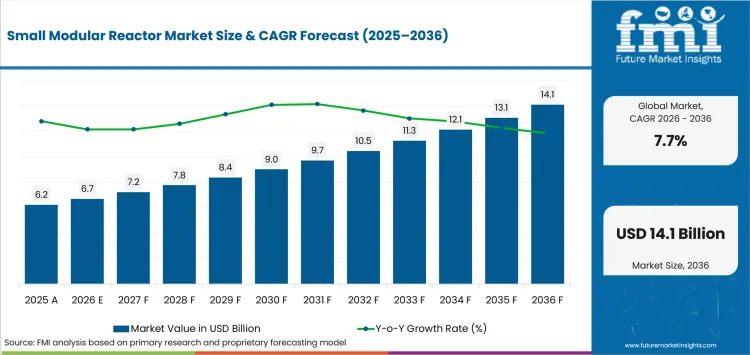
Key Takeaways of Small Modular Reactor Market
- Commercial demand is moving from design studies toward owner-backed projects with construction licences and site-specific contracts.
- Light Water Reactors are projected to represent 48.0% share in 2026 because they build on established operating experience, fuel systems and supply chains.
- Multi-Module Systems are estimated to account for 57.0% share in 2026 as shared site infrastructure and later-unit learning support phased capacity additions.
- Up to 100 MW systems are forecast to hold 32.0% share in 2026, supported by smaller grids, industrial loads and repeat-unit capacity planning.
- First-of-a-kind capital requirements, fuel qualification and regulatory capacity remain the main checks on deployment timing.
- GE Hitachi Nuclear Energy, China National Nuclear Corporation, Rolls-Royce SMR Ltd, Rosatom, NuScale Power Corporation, TerraPower, X-energy, Westinghouse Electric Company, Korea Hydro & Nuclear Power and Électricité de France are active across construction, licensing or reactor development.
Analyst Perspective
"Small modular reactors become commercially credible when one licensed design can be repeated without major redesign. Buyers should test the owner's financing plan, the fuel pathway and supplier readiness before treating factory fabrication as a cost advantage."
- Anurag Sharma, Principal Consultant, Future Market Insights
How is the Small Modular Reactor Market segmented?
The Small Modular Reactor Market is segmented by product type, module, power output, application, end user and region.
The market is organized by product type, module, power output, application, end user and region because each category changes licensing scope, project size and buyer requirements. Product types cover light water reactors, high-temperature reactors, heavy water reactors and molten salt reactors. Module structures include multi-module and single-module systems. Power output spans up to 100 MW, 101 to 200 MW and 201 to 300 MW. Applications include power generation, industrial applications, desalination and hydrogen production. End users include electric utilities, industrial companies, government and defense organizations, plus remote and commercial users.
Why do Light Water Reactors lead demand within the Product type category?
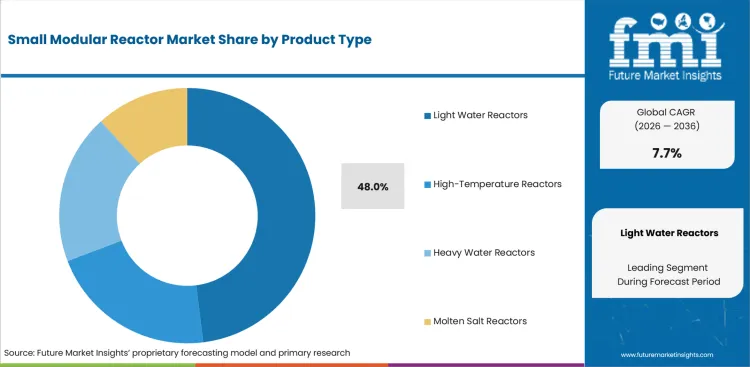
Light-water platforms use reactor physics, fuel systems and operating practices that regulators and utilities already understand. Pressurized-water and boiling-water variants therefore have the most direct route into grid projects and national licensing reviews.
- Light Water Reactors are set to lead the product type category with 48.0% share in 2026, supported by established operating bases and qualified supply chains.
- Pressurized Water Reactors and Boiling Water Reactors anchor near-term procurement. The 77 MWe NuScale module received USA design approval in May 2025, while construction of the first GE Hitachi BWRX-300 is underway at Darlington in Canada.
- High-Temperature Gas-Cooled Reactors and Pebble Bed Reactors combine electricity with high-grade process heat. Heavy-water and molten-salt concepts retain application potential, although most remain at earlier commercial or licensing stages.
Why do Multi-Module Systems lead demand within the Module category?
Multi-module deployment lets owners add capacity in stages while using common site infrastructure. It also creates a repeatable construction and operating model at one licensed location.
- Multi-Module Systems are projected to hold 57.0% share in 2026 because two-module systems and multi-unit plants can align investment with demand growth.
- A shared site can concentrate security functions and grid interconnection while later units use established construction teams. The Darlington program allows for up to four BWRX-300 units, while NuScale offers multi-module plant configurations.
- Single-Module Systems remain important for first projects, isolated loads and sites with limited grid capacity. Their lower initial complexity is offset by a larger share of first-of-a-kind engineering cost per unit.
Why does the Up to 100 MW category lead by Power Output?
Lower-output designs fit smaller grids and industrial sites where a 300 MW block may exceed local demand. They also support repeat-unit models that can be matched to changing load requirements.
- Up to 100 MW systems are estimated to lead the power output category with 32.0% share in 2026, covering up to 50 MW and 51 to 100 MW configurations.
- The category includes the 77 MWe NuScale module and the 80 MWe Xe-100, alongside microreactors designed for remote or dedicated loads. These platforms are built around modular deployment instead of one large generating block.
- The 101 to 200 MW category addresses mid-sized utility and industrial demand, while 201 to 300 MW designs suit larger grid-connected projects. Selection depends on local load, grid capacity and the number of planned units.
Why does Power Generation lead within the Application category?
Electricity sales provide a defined offtake structure and an established regulatory purpose for nuclear projects. Grid projects therefore remain the first commercial target for most SMR developers.
- Power Generation is forecast to capture 61.0% share in 2026, led by grid-connected electricity and distributed power generation.
- Utility procurement can combine long-duration generation planning with regulated cost recovery or government support. Current Canadian and British programs are structured around dependable grid electricity.
- Industrial applications cover process heat and steam, while desalination and hydrogen production can improve plant utilization where local offtake exists. These uses require additional heat-delivery systems and separate commercial agreements.
Why do Electric Utilities lead within the End-User category?
Electric utilities control licensed sites and grid access, which places them at the center of early deployment. They can also plan multi-decade operation and coordinate emergency preparedness with national regulators.
- Electric Utilities are projected to hold 48.0% share in 2026, including national utilities and independent power producers.
- Industrial Companies are assessing SMRs for heavy-industry heat and manufacturing steam. Government and defense users focus on resilient power for strategic installations and public energy programs.
- Other end users include remote communities, data centers and commercial facilities. Their demand can support smaller systems, but project bankability depends on long-term power terms and a workable licensing route.
What are the drivers, restraints and opportunities in the Small Modular Reactor Market?
Owner-backed deployment programs are moving selected designs toward construction, while first-of-a-kind capital needs and fuel readiness continue to slow investment. Repeat projects create the main route to lower delivery cost.
- Driver: Public funding and utility programs are moving selected designs from engineering work into licensing, site preparation and construction.
- Restraint: First-unit economics remain sensitive to safety-case completion, fuel readiness and qualification of nuclear-grade suppliers.
- Opportunity: Repeat units and shared sites can reduce redesign while creating a stable manufacturing and service base.
Energy security and demand for firm electricity are supporting national SMR programs. The USA Department of Energy reissued a USD 900 million Generation III+ SMR solicitation in March 2025 and later selected the Tennessee Valley Authority and Holtec for up to USD 800 million in first-mover support. Canada has one BWRX-300 under construction, while the United Kingdom has contracted Rolls-Royce SMR for its first three units.
Modular design does not remove nuclear project risk. Developers still need a complete safety case, qualified component suppliers and a reliable fuel pathway. Owners must also secure long-term financing before the expected benefit from factory fabrication can be demonstrated.
The commercial opportunity expands when a standard platform is deployed several times. Shared engineering and a stable supplier base can reduce redesign between projects. Beyond grid electricity, high-temperature systems and microreactors can serve process heat or remote power where customers accept long contracts and regulators have a clear licensing path.
Which country CAGRs are included in the Small Modular Reactor Market?
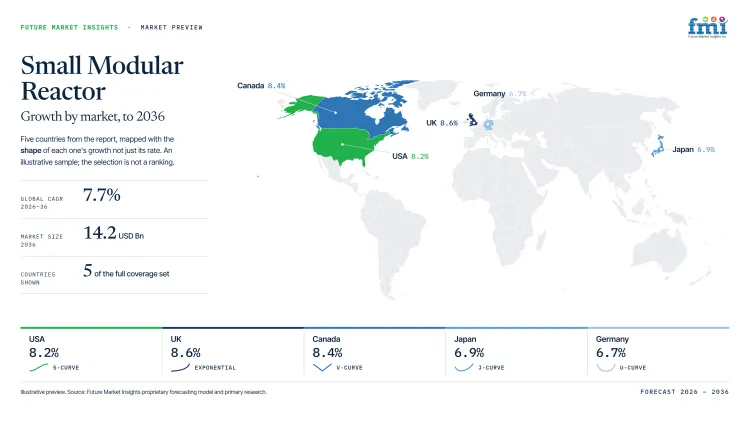
| Country | CAGR |
|---|---|
| United Kingdom | 8.6% |
| Canada | 8.4% |
| United States | 8.2% |
| South Korea | 7.9% |
| Australia | 7.1% |
| Japan | 6.9% |
| Germany | 6.7% |
How do country-level CAGRs compare in the Small Modular Reactor Market?
The seven country CAGRs span 1.9 percentage points. Growth is strongest where a national program has selected a technology or moved into construction, while legal and policy constraints reduce the near-term domestic build pipeline elsewhere.
- The United Kingdom leads at 8.6%, 0.2 percentage point above Canada, supported by the contracted three-unit program at Wylfa.
- Canada records 8.4%, 0.2 percentage point above the United States, with the first BWRX-300 under construction at Darlington.
- The United States reaches 8.2%, 0.3 percentage point above South Korea, as federal funding supports several light-water SMR projects and advanced-reactor licensing continues.
- South Korea records 7.9%, 0.8 percentage point above Australia, with SMART100 design approval strengthening export readiness.
- Australia reaches 7.1%, 0.2 percentage point above Japan, although federal law prevents licensing a domestic nuclear power plant.
- Japan records 6.9%, 0.2 percentage point above Germany. Its energy plan supports next-generation reactors, but a dedicated domestic SMR project has not reached the same stage as programs in Canada or the United Kingdom.
- Germany records 6.7%, the lowest rate in the comparison. Domestic power generation has ended, so activity is concentrated in research, engineering and international supply work.
Country-wise Analysis
- United Kingdom: Great British Energy, Nuclear signed a contract with Rolls-Royce SMR on 13 April 2026, starting site-specific design, regulatory engagement and planning for three units at Wylfa. The United Kingdom is forecast to expand at 8.6% CAGR through 2036. Progress now depends on milestone delivery before a final investment decision.
- Canada: The Canadian Nuclear Safety Commission issued Ontario Power Generation a licence in April 2025 to construct one BWRX-300 at Darlington and lifted the first regulatory hold point on 30 March 2026. Canada is projected to grow at 8.4% CAGR through 2036. Experience from the first unit can support up to three additional reactors at the site.
- United States: The Department of Energy reissued a USD 900 million Generation III+ SMR solicitation in March 2025 and selected TVA and Holtec for up to USD 800 million in first-mover support. The United States is forecast to rise at 8.2% CAGR through 2036. NuScale design approval and TerraPower's construction permit broaden the project pipeline, while fuel supply and financing remain material constraints.
- South Korea: KAERI, KHNP and K.A.CARE received Standard Design Approval for SMART100 in September 2024. South Korea is expected to grow at 7.9% CAGR through 2036. The approval strengthens export readiness, although commercial momentum still depends on a reference project and signed deployment agreement.
- Australia: ARPANSA states that it cannot issue a licence for the construction or operation of a nuclear power plant under current federal law. Australia is forecast to grow at 7.1% CAGR through 2036, reflecting policy work and international vendor engagement rather than near-term domestic construction. Deployment would require legislative change followed by a complete regulatory framework.
- Japan: The Seventh Strategic Energy Plan, published in February 2025, supports next-generation advanced reactors at existing nuclear sites where older units are decommissioned. Japan is projected to expand at 6.9% CAGR through 2036. Domestic engineering capability supports participation, although project selection remains less advanced than in Canada or the United Kingdom.
- Germany: Germany ended commercial nuclear electricity generation on 15 April 2023 under its Atomic Energy Act. The market is forecast to grow at 6.7% CAGR through 2036, with activity concentrated in research, engineering exports and supply-chain work outside domestic generation. A domestic SMR build would require a substantial policy change.
Who are the notable companies in the Small Modular Reactor Market?
GE Hitachi Nuclear Energy, China National Nuclear Corporation (CNNC), Rolls-Royce SMR Ltd, Rosatom, NuScale Power Corporation, TerraPower, X-energy, Westinghouse Electric Company, Korea Hydro & Nuclear Power (KHNP) and Électricité de France (EDF) are the notable companies serving the Small Modular Reactor Market.
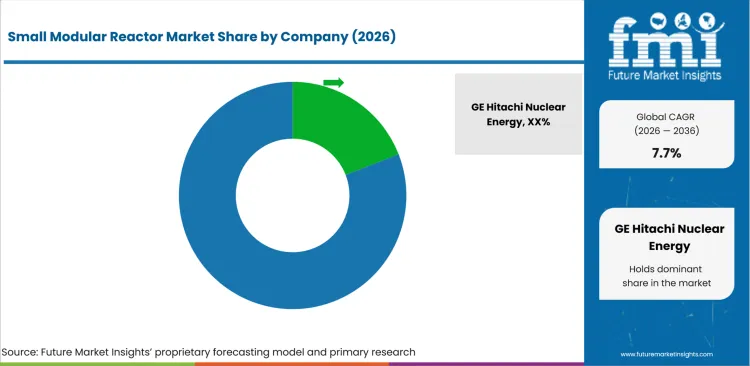
The competitive field includes state-backed reactor organizations and private developers at different stages of licensing and construction. GE Hitachi and CNNC have construction-stage light-water projects. Rolls-Royce SMR has a signed British delivery contract, while NuScale and KHNP hold design approvals. TerraPower and X-energy are advancing non-light-water systems. Westinghouse is developing a transportable microreactor, Rosatom has operating modular reactor experience and EDF is progressing the NUWARD program through European partnerships.
- Construction or contracted delivery: GE Hitachi Nuclear Energy, China National Nuclear Corporation, Rolls-Royce SMR Ltd and Rosatom.
- Design-approved or active licensing programs: NuScale Power Corporation, TerraPower, X-energy and Korea Hydro & Nuclear Power.
- Advanced reactor, microreactor and portfolio programs: Westinghouse Electric Company and Électricité de France.
Competitive Benchmarking: Small Modular Reactor Market
| Company | Project and Licensing Maturity | Fleet or Replication Readiness | Application Breadth | Geographic Reach |
|---|---|---|---|---|
| GE Hitachi Nuclear Energy | High | High | Low | North America, Europe and Asia |
| China National Nuclear Corporation (CNNC) | High | Medium | High | China and selected overseas markets |
| Rolls-Royce SMR Ltd | High | High | Low | United Kingdom and Europe |
| Rosatom | High | High | High | Russia and international markets |
| NuScale Power Corporation | High | High | High | United States, Europe and Asia |
| TerraPower | High | High | Medium | United States and selected international markets |
| X-energy | Medium | High | High | United States, Canada and United Kingdom |
| Westinghouse Electric Company | Medium | Medium | High | North America and Europe |
| Korea Hydro & Nuclear Power (KHNP) | High | Medium | High | South Korea and export markets |
| Électricité de France (EDF) | Medium | Medium | High | Europe and selected export markets |
Scoring basis: Project and Licensing Maturity is High where an operating unit, construction project, construction permit, standard design approval or signed national delivery contract is verified. Medium indicates an active licensing application or structured demonstration program. Fleet or Replication Readiness is High where public evidence supports multi-unit deployment, Medium for one defined project with stated replication intent and Low where repeat deployment is not verified. Application Breadth is High when official material covers electricity plus at least two additional uses, Medium for one additional use and Low for electricity-focused evidence. Geographic Reach records verified project or market activity.
Key Developments in the Small Modular Reactor Market
- In April 2026, Great British Energy - Nuclear and Rolls-Royce SMR signed a contract that started site-specific work for three units at Wylfa.
- In March 2026, the USA Nuclear Regulatory Commission issued a construction permit for TerraPower's Kemmerer Power Station Unit 1.
- In March 2026, the Canadian Nuclear Safety Commission lifted the first regulatory hold point for Ontario Power Generation's BWRX-300 project at Darlington.
Key Players in the Small Modular Reactor Market
Light-Water Reactor Deployment Platforms
- GE Hitachi Nuclear Energy
- Rolls-Royce SMR Ltd
- NuScale Power Corporation
- Korea Hydro & Nuclear Power (KHNP)
- Électricité de France (EDF)
State-Backed Construction and Operating Platforms
- China National Nuclear Corporation (CNNC)
- Rosatom
Advanced Reactor and Microreactor Developers
- TerraPower
- X-energy
- Westinghouse Electric Company
Small Modular Reactor Market - Report Scope
| Coverage field | Report scope |
|---|---|
| Market breakdown | By product type, module, power output, application, end user and region. |
| Quantitative Units | USD billion. |
| Market Definition | Commercial small modular reactor systems, modular plant configurations and related project deployment within the stated applications and regional supply routes. |
| Regions Covered | North America, Latin America, Europe, East Asia, South Asia and Pacific, and Middle East and Africa. |
| Countries Covered | United States, Japan, Germany, United Kingdom, Canada, Australia and South Korea. |
| Key Companies | GE Hitachi Nuclear Energy, China National Nuclear Corporation, Rolls-Royce SMR Ltd, Rosatom, NuScale Power Corporation, TerraPower, X-energy, Westinghouse Electric Company, Korea Hydro & Nuclear Power and Électricité de France. |
| Forecast Period | 2026 to 2036. |
| Approach | Primary and secondary research with market triangulation. |
Small Modular Reactor Market - Research Methodology
| Method | Approach |
|---|---|
| Primary Research | FMI analysts gathered input from reactor developers, utilities, engineering contractors, fuel-cycle participants, project owners and subject-matter experts. Interviews examined technology selection, licensing progress, financing barriers, fuel readiness, supplier qualification and the evidence required before a planned unit advances into procurement or construction. |
| Desk Research | Desk research covered regulator decisions, government programs, technical publications, company filings, project announcements and nuclear-industry sources. Claims relating to design status, construction, approvals, capacity and commercial activity were retained only when supported by credible public evidence. |
| Market Sizing and Forecasting | The market model combined the baseline value with segment structure, project pipelines, licensing maturity, policy support, construction timing and country-level demand conditions. Segment and regional estimates were reconciled before the final market total was calculated. |
| Data Validation | Estimates were checked against multiple independent indicators, including regulatory actions, government funding, owner commitments, supplier activity and findings from primary interviews. Adjacent reactor categories and unsupported project claims were excluded to maintain the stated market boundaries. |
Small Modular Reactor Market by Segments
Small Modular Reactor Market segmented by Product Type:
- Light Water Reactors
- Pressurized Water Reactors
- Boiling Water Reactors
- High-Temperature Reactors
- High-Temperature Gas-Cooled Reactors
- Pebble Bed Reactors
- Heavy Water Reactors
- Pressurized Heavy Water Reactors
- Advanced Heavy Water Reactors
- Molten Salt Reactors
- Fluoride-Salt Reactors
- Liquid-Fuel Molten Salt Reactors
Small Modular Reactor Market segmented by Module:
- Multi-Module Systems
- Two-Module Systems
- Multi-Unit Reactor Plants
- Single-Module Systems
- Single Reactor Units
- Standalone SMR Plants
Small Modular Reactor Market segmented by Power Output:
- Up to 100 MW
- Up to 50 MW
- 51-100 MW
- 101-200 MW
- 101-150 MW
- 151-200 MW
- 201-300 MW
- 201-250 MW
- 251-300 MW
Small Modular Reactor Market segmented by Application:
- Power Generation
- Grid-Connected Electricity
- Distributed Power Generation
- Industrial Applications
- Process Heat
- Industrial Steam
- Desalination
- Seawater Desalination
- Cogeneration Desalination
- Hydrogen Production
- Electrolytic Hydrogen
- High-Temperature Hydrogen Production
Small Modular Reactor Market segmented by End User:
- Electric Utilities
- National Utilities
- Independent Power Producers
- Industrial Companies
- Heavy Industries
- Manufacturing Facilities
- Government & Defense
- Defense Installations
- Government Energy Programs
- Others
- Remote Communities
- Data Centers & Commercial Facilities
Small Modular Reactor Market by Region:
- North America
- United States
- Canada
- Mexico
- Latin America
- Brazil
- Chile
- Rest of Latin America
- Western Europe
- Germany
- United Kingdom
- Italy
- Spain
- France
- Nordics
- Benelux
- Rest of Western Europe
- Eastern Europe
- Russia
- Poland
- Hungary
- Balkan and Baltic States
- Rest of Eastern Europe
- East Asia
- China
- Japan
- South Korea
- South Asia and Pacific
- India
- ASEAN
- Australia and New Zealand
- Rest of South Asia and Pacific
- Middle East and Africa
- Kingdom of Saudi Arabia
- Other GCC Countries
- Türkiye
- South Africa
- Other African Union Countries
- Rest of Middle East and Africa
Research Sources and Bibliography
- International Atomic Energy Agency. (2024). Advances in Small Modular Reactor Technology Developments 2024.
- International Atomic Energy Agency. (2026). Small modular reactors (SMR).
- USA Department of Energy. (2026). Generation III+ Small Modular Reactor Program.
- Canadian Nuclear Safety Commission. (2026). Darlington New Nuclear Project.
- Great British Energy - Nuclear. (2026, April 13). Great British Energy - Nuclear and Rolls-Royce SMR sign contract.
- Agency for Natural Resources and Energy, Japan. (2025). The 7th Strategic Energy Plan.
- Federal Ministry for the Environment, Germany. (2024, November 13). Constitution and laws.
- Australian Radiation Protection and Nuclear Safety Agency. (2026). Do I need a licence?
- Korea Atomic Energy Research Institute. (2024, September 27). Korea's SMART100 Achieves Standard Design Approval.
- GE Vernova Hitachi Nuclear Energy. (2025, May 8). BWRX-300 approved for construction in Ontario.
- China National Nuclear Corporation. (2025, April 27). Main pump installed on Linglong One at Changjiang Nuclear Power Plant.
- USA Nuclear Regulatory Commission. (2026, March 9). NRC Issues Construction Permit to US SFR Owner.
- USA Department of Energy. (2025). NRC Approves NuScale Power's Uprated Small Modular Reactor Design.
- X-energy. (2026, June 4). X-energy Reports First Quarter 2026 Results.
- Westinghouse Electric Company. (2025, June 3). eVinci Test Reactor First to Receive Approval for Preliminary Safety Design Report.
- Électricité de France. (2025, November 6). EDF advances the NUWARD SMR program through European agreements.
- Rosatom. (2024). Floating nuclear power plant operating update.
- Future Market Insights. (2026). Rahul Pandita: Principal Consultant.
This bibliography is provided for reader reference and is not exhaustive. The full report contains the complete reference list and detailed citations.
This Report Answers
- How large is the Small Modular Reactor Market in 2026 and 2036?
- Which product type holds the leading share in 2026?
- How does module configuration affect commercial deployment?
- Which power-output category leads the market?
- Why does power generation remain the main application?
- How do country growth rates differ across the included markets?
- Which companies are active in construction, licensing and advanced-reactor development?
- What currently limits Small Modular Reactor Market adoption?
- How should utilities compare competing reactor platforms?
Frequently Asked Questions
How big is the Small Modular Reactor Market in 2026?
USD 6.7 billion represents the market value in 2026. Demand is forecast to reach USD 14.1 billion by 2036 as licensed designs move into owner-backed projects.
What is the CAGR of the Small Modular Reactor Market from 2026 to 2036?
The market is projected to expand at 7.7% CAGR from 2026 to 2036. Progress depends on construction performance, fuel availability and the ability to repeat a standard design across several sites.
Which product type is projected to account for 48.0% of the Small Modular Reactor Market?
Light Water Reactors are projected to account for 48.0% of product-type demand in 2026. Established fuel systems, operating experience and regulatory familiarity support their near-term position.
How much will the Small Modular Reactor Market add between 2026 and 2036?
USD 7.5 billion is expected to be added between 2026 and 2036. Realization of this increase depends on first projects creating a repeatable licensing and delivery model.
Which companies are active in the Small Modular Reactor Market?
GE Hitachi Nuclear Energy, China National Nuclear Corporation, Rolls-Royce SMR Ltd, Rosatom, NuScale Power Corporation, TerraPower, X-energy, Westinghouse Electric Company, Korea Hydro & Nuclear Power and Électricité de France are active across construction, design approval, licensing or reactor development.
Preview the report firsthand - request a free sample
Get SampleGet the brochure for pricing and purchase details.
Get PDFTable of Content
- Key Takeaways
- Market Size and CAGR
- Top Growth Driver
- Fastest Growing Segment
- Leading Region
- Key Companies
- Emerging Opportunities
- Executive Summary
- Global Market Outlook
- Demand-side Trends
- Supply-side Trends
- Technology Roadmap Analysis
- Analysis and Recommendations
- Analyst Perspective (What is happening? Why now? What should investors know?)
- Key Questions Answered
- How large is the market?
- What is the CAGR?
- What are key trends?
- Which region dominates?
- Who are the leaders?
- Market Overview
- Market Coverage / Taxonomy
- Market Definition / Scope / Limitations
- Research Methodology
- Chapter Orientation
- Analytical Lens and Working Hypotheses
- Market Structure, Signals, and Trend Drivers
- Benchmarking and Cross-market Comparability
- Market Sizing, Forecasting, and Opportunity Mapping
- Research Design and Evidence Framework
- Desk Research Programme (Secondary Evidence)
- Expert Input and Fieldwork (Primary Evidence)
- Tooling, Models, and Reference Databases
- Data Engineering and Model Build
- Quality Assurance and Audit Trail
- Market Background
- Market Dynamics (Drivers, Restraints, Opportunity, Trends)
- Scenario Forecast (Optimistic, Likely, Conservative)
- Impact Analysis
- AI Impact
- Sustainability Impact
- Regulatory Impact
- Technology Impact
- Consumer / Buyer Analysis
- Purchase Drivers
- Adoption Barriers
- Buyer Journey
- Opportunity Map Analysis
- Product Life Cycle Analysis
- Supply Chain Analysis
- Investment Feasibility Matrix
- Value Chain Analysis
- PESTLE and Porter's Analysis
- Regulatory Landscape
- Regional Parent Market Outlook
- Production and Consumption Statistics
- Import and Export Statistics
- Global Market Analysis and Forecast, 2021 to 2036
- Historical Market Size Value (USD Billion) Analysis, 2021 to 2025
- Current and Future Market Size Value (USD Billion) Projections, 2026 to 2036
- Y-o-Y Growth Trend Analysis
- Absolute $ Opportunity Analysis
- Global Market Pricing Analysis, 2021 to 2036
- Global Market Analysis and Forecast, By Product Type, 2021 to 2036
- Introduction / Key Findings
- Historical Market Size Value (USD Billion) Analysis By Product Type, 2021 to 2025
- Current and Future Market Size Value (USD Billion) Analysis and Forecast By Product Type, 2026 to 2036
- Light Water Reactors
- Pressurized Water Reactors
- Boiling Water Reactors
- High-Temperature Reactors
- High-Temperature Gas-Cooled Reactors
- Pebble Bed Reactors
- Heavy Water Reactors
- Pressurized Heavy Water Reactors
- Advanced Heavy Water Reactors
- Molten Salt Reactors
- Fluoride-Salt Reactors
- Liquid-Fuel Molten Salt Reactors
- Light Water Reactors
- Y-o-Y Growth Trend Analysis By Product Type, 2021 to 2025
- Absolute $ Opportunity Analysis By Product Type, 2026 to 2036
- Global Market Analysis and Forecast, By Module, 2021 to 2036
- Introduction / Key Findings
- Historical Market Size Value (USD Billion) Analysis By Module, 2021 to 2025
- Current and Future Market Size Value (USD Billion) Analysis and Forecast By Module, 2026 to 2036
- Multi-Module Systems
- Two-Module Systems
- Multi-Unit Reactor Plants
- Single-Module Systems
- Single Reactor Units
- Standalone SMR Plants
- Multi-Module Systems
- Y-o-Y Growth Trend Analysis By Module, 2021 to 2025
- Absolute $ Opportunity Analysis By Module, 2026 to 2036
- Global Market Analysis and Forecast, By Power Output, 2021 to 2036
- Introduction / Key Findings
- Historical Market Size Value (USD Billion) Analysis By Power Output, 2021 to 2025
- Current and Future Market Size Value (USD Billion) Analysis and Forecast By Power Output, 2026 to 2036
- Up to 100 MW
- Up to 50 MW
- 51-100 MW
- 101-200 MW
- 101-150 MW
- 151-200 MW
- 201-300 MW
- 201-250 MW
- 251-300 MW
- Up to 100 MW
- Y-o-Y Growth Trend Analysis By Power Output, 2021 to 2025
- Absolute $ Opportunity Analysis By Power Output, 2026 to 2036
- Global Market Analysis and Forecast, By Application, 2021 to 2036
- Introduction / Key Findings
- Historical Market Size Value (USD Billion) Analysis By Application, 2021 to 2025
- Current and Future Market Size Value (USD Billion) Analysis and Forecast By Application, 2026 to 2036
- Power Generation
- Grid-Connected Electricity
- Distributed Power Generation
- Industrial Applications
- Process Heat
- Industrial Steam
- Desalination
- Seawater Desalination
- Cogeneration Desalination
- Hydrogen Production
- Electrolytic Hydrogen
- High-Temperature Hydrogen Production
- Power Generation
- Y-o-Y Growth Trend Analysis By Application, 2021 to 2025
- Absolute $ Opportunity Analysis By Application, 2026 to 2036
- Global Market Analysis and Forecast, By End User, 2021 to 2036
- Introduction / Key Findings
- Historical Market Size Value (USD Billion) Analysis By End User, 2021 to 2025
- Current and Future Market Size Value (USD Billion) Analysis and Forecast By End User, 2026 to 2036
- Electric Utilities
- National Utilities
- Independent Power Producers
- Industrial Companies
- Heavy Industries
- Manufacturing Facilities
- Government & Defense
- Defense Installations
- Government Energy Programs
- Others
- Remote Communities
- Data Centers & Commercial Facilities
- Electric Utilities
- Y-o-Y Growth Trend Analysis By End User, 2021 to 2025
- Absolute $ Opportunity Analysis By End User, 2026 to 2036
- Global Market Analysis and Forecast, By Region, 2021 to 2036
- Introduction
- Historical Market Size Value (USD Billion) Analysis By Region, 2021 to 2025
- Current Market Size Value (USD Billion) Analysis and Forecast By Region, 2026 to 2036
- North America
- Latin America
- Western Europe
- Eastern Europe
- East Asia
- South Asia and Pacific
- Middle East & Africa
- Market Attractiveness Analysis By Region
- North America Market Analysis and Forecast, By Country, 2021 to 2036
- Historical Market Size Value (USD Billion) Trend Analysis By Market Taxonomy, 2021 to 2025
- Market Size Value (USD Billion) Forecast By Market Taxonomy, 2026 to 2036
- By Country
- USA
- Canada
- By Product Type
- By Module
- By Power Output
- By Application
- By End User
- By Country
- Market Attractiveness Analysis
- By Country
- By Product Type
- By Module
- By Power Output
- By Application
- By End User
- Key Takeaways
- Latin America Market Analysis and Forecast, By Country
- Historical Market Size Value (USD Billion) Trend Analysis By Market Taxonomy, 2021 to 2025
- Market Size Value (USD Billion) Forecast By Market Taxonomy, 2026 to 2036
- By Country
- Brazil
- Mexico
- Chile
- Rest of Latin America
- By Product Type
- By Module
- By Power Output
- By Application
- By End User
- By Country
- Market Attractiveness Analysis
- By Country
- By Product Type
- By Module
- By Power Output
- By Application
- By End User
- Key Takeaways
- Western Europe Market Analysis and Forecast, By Country
- Historical Market Size Value (USD Billion) Trend Analysis By Market Taxonomy, 2021 to 2025
- Market Size Value (USD Billion) Forecast By Market Taxonomy, 2026 to 2036
- By Country
- Germany
- UK
- Italy
- Spain
- France
- Nordic
- BENELUX
- Rest of Western Europe
- By Product Type
- By Module
- By Power Output
- By Application
- By End User
- By Country
- Market Attractiveness Analysis
- By Country
- By Product Type
- By Module
- By Power Output
- By Application
- By End User
- Key Takeaways
- Eastern Europe Market Analysis and Forecast, By Country
- Historical Market Size Value (USD Billion) Trend Analysis By Market Taxonomy, 2021 to 2025
- Market Size Value (USD Billion) Forecast By Market Taxonomy, 2026 to 2036
- By Country
- Russia
- Poland
- Hungary
- Balkan & Baltic
- Rest of Eastern Europe
- By Product Type
- By Module
- By Power Output
- By Application
- By End User
- By Country
- Market Attractiveness Analysis
- By Country
- By Product Type
- By Module
- By Power Output
- By Application
- By End User
- Key Takeaways
- East Asia Market Analysis and Forecast, By Country
- Historical Market Size Value (USD Billion) Trend Analysis By Market Taxonomy, 2021 to 2025
- Market Size Value (USD Billion) Forecast By Market Taxonomy, 2026 to 2036
- By Country
- China
- Japan
- South Korea
- By Product Type
- By Module
- By Power Output
- By Application
- By End User
- By Country
- Market Attractiveness Analysis
- By Country
- By Product Type
- By Module
- By Power Output
- By Application
- By End User
- Key Takeaways
- South Asia and Pacific Market Analysis and Forecast, By Country
- Historical Market Size Value (USD Billion) Trend Analysis By Market Taxonomy, 2021 to 2025
- Market Size Value (USD Billion) Forecast By Market Taxonomy, 2026 to 2036
- By Country
- India
- ASEAN
- Australia & New Zealand
- Rest of South Asia and Pacific
- By Product Type
- By Module
- By Power Output
- By Application
- By End User
- By Country
- Market Attractiveness Analysis
- By Country
- By Product Type
- By Module
- By Power Output
- By Application
- By End User
- Key Takeaways
- Middle East & Africa Market Analysis and Forecast, By Country
- Historical Market Size Value (USD Billion) Trend Analysis By Market Taxonomy, 2021 to 2025
- Market Size Value (USD Billion) Forecast By Market Taxonomy, 2026 to 2036
- By Country
- Kingdom of Saudi Arabia
- Other GCC Countries
- Türkiye
- South Africa
- Other African Union
- Rest of Middle East & Africa
- By Product Type
- By Module
- By Power Output
- By Application
- By End User
- By Country
- Market Attractiveness Analysis
- By Country
- By Product Type
- By Module
- By Power Output
- By Application
- By End User
- Key Takeaways
- Key Countries Market Analysis
- USA
- Pricing Analysis
- Market Share Analysis, 2025
- By Product Type
- By Module
- By Power Output
- By Application
- By End User
- Canada
- Pricing Analysis
- Market Share Analysis, 2025
- By Product Type
- By Module
- By Power Output
- By Application
- By End User
- Mexico
- Pricing Analysis
- Market Share Analysis, 2025
- By Product Type
- By Module
- By Power Output
- By Application
- By End User
- Brazil
- Pricing Analysis
- Market Share Analysis, 2025
- By Product Type
- By Module
- By Power Output
- By Application
- By End User
- Chile
- Pricing Analysis
- Market Share Analysis, 2025
- By Product Type
- By Module
- By Power Output
- By Application
- By End User
- Germany
- Pricing Analysis
- Market Share Analysis, 2025
- By Product Type
- By Module
- By Power Output
- By Application
- By End User
- UK
- Pricing Analysis
- Market Share Analysis, 2025
- By Product Type
- By Module
- By Power Output
- By Application
- By End User
- Italy
- Pricing Analysis
- Market Share Analysis, 2025
- By Product Type
- By Module
- By Power Output
- By Application
- By End User
- Spain
- Pricing Analysis
- Market Share Analysis, 2025
- By Product Type
- By Module
- By Power Output
- By Application
- By End User
- France
- Pricing Analysis
- Market Share Analysis, 2025
- By Product Type
- By Module
- By Power Output
- By Application
- By End User
- India
- Pricing Analysis
- Market Share Analysis, 2025
- By Product Type
- By Module
- By Power Output
- By Application
- By End User
- ASEAN
- Pricing Analysis
- Market Share Analysis, 2025
- By Product Type
- By Module
- By Power Output
- By Application
- By End User
- Australia & New Zealand
- Pricing Analysis
- Market Share Analysis, 2025
- By Product Type
- By Module
- By Power Output
- By Application
- By End User
- China
- Pricing Analysis
- Market Share Analysis, 2025
- By Product Type
- By Module
- By Power Output
- By Application
- By End User
- Japan
- Pricing Analysis
- Market Share Analysis, 2025
- By Product Type
- By Module
- By Power Output
- By Application
- By End User
- South Korea
- Pricing Analysis
- Market Share Analysis, 2025
- By Product Type
- By Module
- By Power Output
- By Application
- By End User
- Russia
- Pricing Analysis
- Market Share Analysis, 2025
- By Product Type
- By Module
- By Power Output
- By Application
- By End User
- Poland
- Pricing Analysis
- Market Share Analysis, 2025
- By Product Type
- By Module
- By Power Output
- By Application
- By End User
- Hungary
- Pricing Analysis
- Market Share Analysis, 2025
- By Product Type
- By Module
- By Power Output
- By Application
- By End User
- Kingdom of Saudi Arabia
- Pricing Analysis
- Market Share Analysis, 2025
- By Product Type
- By Module
- By Power Output
- By Application
- By End User
- Türkiye
- Pricing Analysis
- Market Share Analysis, 2025
- By Product Type
- By Module
- By Power Output
- By Application
- By End User
- South Africa
- Pricing Analysis
- Market Share Analysis, 2025
- By Product Type
- By Module
- By Power Output
- By Application
- By End User
- USA
- Market Structure Analysis
- Competition Dashboard
- Competition Benchmarking
- Market Share Analysis of Top Players
- By Regional
- By Product Type
- By Module
- By Power Output
- By Application
- By End User
- Emerging Startups
- Innovation Benchmarking
- Competition Analysis
- Competition Deep Dive
- GE Hitachi Nuclear Energy
- Overview
- Product Portfolio
- Profitability by Market Segments
- Sales Footprint
- Strategy Overview
- Marketing Strategy
- Product Strategy
- Channel Strategy
- China National Nuclear Corporation (CNNC)
- Rolls-Royce SMR Ltd
- Rosatom
- NuScale Power Corporation
- TerraPower
- X-energy
- Westinghouse Electric Company
- Korea Hydro & Nuclear Power (KHNP)
- Électricité de France (EDF)
- Others
- GE Hitachi Nuclear Energy
- Case Studies
- Success Stories
- Recent Developments
- Competition Deep Dive
- Assumptions & Acronyms Used


