

- Market Size (2026)
- USD 7.5 Bn
- Forecast (2036)
- USD 24.8 Bn
- CAGR (2026 to 2036)
- 12.7%
Small Satellite Market Size, Market Forecast and Outlook By FMI
The small satellite market was valued at USD 6.7 billion in 2025 and is expected to reach USD 7.5 billion in 2026. Industry revenue is forecast to reach USD 24.8 billion by 2036 at 12.7% CAGR. By orbit type, low earth orbit (LEO) is estimated to account for 79.6% share in 2026. Government and defense are anticipated to represent 54.3% share of end use in 2026.
Summary of the Small Satellite Market
- Demand and Growth Drivers
- LEO constellation renewal is turning one-time spacecraft supply into planned replacement work.
- Defense programs are adding small satellites for surveillance and secure communication missions.
- Earth observation operators need shorter revisit intervals for weather and disaster response tasks.
- Product and Segment View
- Low earth orbit (LEO) is projected to account for 79.6% share in 2026, led by broadband and imaging fleet needs.
- Government and defense are anticipated to capture 54.3% share in 2026 through funded surveillance missions.
- Minisatellite is forecast to account for 28.0% share in 2026 as heavier payloads need larger small satellite buses.
- Geography and Competitive Outlook
- China is projected to record 16.3% CAGR by 2036, driven by state constellation programs raising domestic spacecraft output.
- India is expected to expand at 15.1% CAGR by 2036, reflected by local launch and docking mission progress.
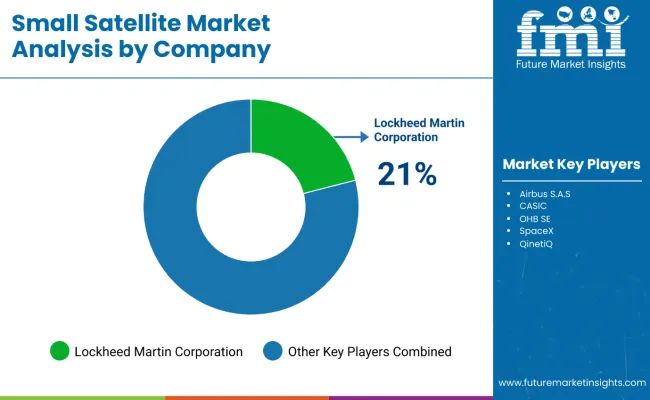
- Airbus S.A.S. and Lockheed Martin Corporation shape high-volume constellation supply through repeatable satellite bus programs.
- Analyst Opinion
- Sudip saha, Principal Consultant for Technology, FMI, opines, “Small satellites are moving from low-cost experiments into repeat spacecraft orders. Revenue is shifting toward LEO fleet renewal and defense imaging programs. Suppliers gain share once they prove payload fit and launch readiness inside short production cycles. Country growth is stronger in markets with funded state missions and reliable launch access. Long-term value will depend on replenishment orders and clear orbital safety planning.”
- Small Satellite Market Value Analysis
- Repeatable bus platforms are shifting small satellite value away from single mission spacecraft.
- Launch timing and orbit placement now guide operator spending as mission owners compare cost with service life.
- Payload flexibility is becoming central to satellite design as imaging and communication programs need faster refresh cycles.
- Government and defense operators influence demand for lower mission cost with repeatable spacecraft performance.
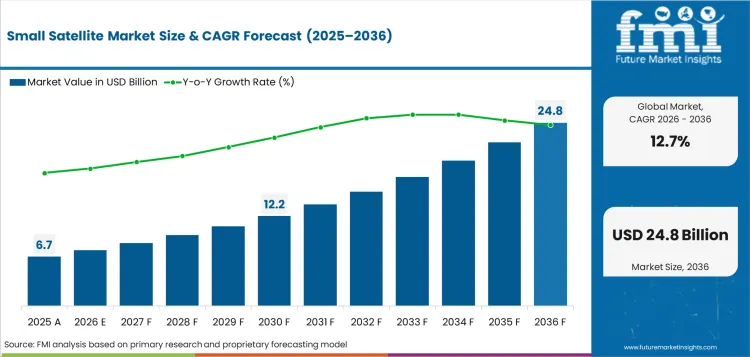
Key Takeaways, Market Size, and Forecast
| Metric | Value |
|---|---|
| Market Size (2025) | USD 6.7 Billion |
| Market Size (2036) | USD 24.8 Billion |
| CAGR (2026–2036) | 12.7% |
| Incremental Opportunity (2026–2036) | USD 17.3 Billion |
| Leading Orbit Type (2026) | Low Earth Orbit (LEO) |
| Low Earth Orbit (LEO) Share (2026) | 79.6% |
| Leading Application (2026) | Government And Defense |
| Government And Defense Share (2026) | 54.3% |
| Fastest-Growing Country | India |
| India CAGR | 15.1% |
Satellite operators use small spacecraft to keep imaging and communications missions within tighter launch budgets. Regulatory pressure is pushing suppliers toward spacecraft packages with verified disposal planning and documented mission-end controls. For example, the Federal Communications Commission reiterated in May 2024 that low earth orbit satellites must be disposed of within five years after mission end, making deorbit hardware and licence evidence important for suppliers. NASA’s 2024 small spacecraft review also shows CubeSat formats extending up to 16U, while mini-class spacecraft fall in the 201 kg to 600 kg range.
Small Satellite Market Definition
Small satellites cover mission-ready spacecraft with lower mass than traditional large satellites. Scope includes minisatellites and microsatellites used for communication and Earth observation. CubeSats and smaller spacecraft are included if commercial or public mission value is recorded. Revenue covers satellite hardware and mission-ready platform value. Launch service revenue is excluded unless spacecraft supply value is identifiable.
Small Satellite Market Inclusions
Scope includes satellite buses and payload-ready spacecraft sold to government and commercial operators. Constellation spacecraft and single-mission satellites are included. Propulsion hardware is counted only as part of the satellite platform. Earth observation and communication satellites are included. Academic spacecraft are covered if mission-ready value is recorded through funded programs.
Small Satellite Market Exclusions
Scope excludes standalone launch vehicle revenue and ground station service fees. Satellite data subscription revenue is outside the core value view unless hardware sale value is recorded. General component sales are excluded if they are not sold as part of a spacecraft platform. Space debris removal services and satellite insurance revenue are excluded from market sizing.
Small Satellite Market Research Methodology
- Primary Research: FMI analysts reviewed satellite manufacturer order patterns and payload integration needs across major space programs.
- Desk Research: Official space agency releases and supplier announcements supported country mission review and competitive mapping.
- Market Sizing and Forecasting: Forecast values used market value anchors, country launch signals and segment share checks against mission demand.
- Data Validation: Checks compared 2026 value with 2036 value, and country growth patterns against mission funding.
Why is the Small Satellite Market Growing?
- Low earth orbit constellation replenishment is creating repeat spacecraft orders as broadband and imaging fleets need planned replacement.
- Payload hosting is widening small satellite adoption as operators test sensors and communication systems without building large spacecraft.
- Rideshare and dedicated launch access are giving universities and commercial operators a clearer route from design to flight.
Small satellite growth is tied to repeat orbital traffic and mission renewal. Federal Aviation Administration stated in April 2025, Amazon Kuiper rollout was expected to start in 2025 and reach full rollout by 2031. Starlink was expected to finish its first network rollout by the end of 2025 and begin replenishment in the same year. Replenishment changes spacecraft supply from a one-time build into recurring production work. Satellite manufacturers therefore need repeatable bus designs and launch-ready integration processes.
Technology readiness is expanding the mission case for smaller spacecraft. National Aeronautics and Space Administration stated in February 2025, its small spacecraft technology review updated hosted payload services and free-space optical communications. Payload hosting allows operators to test mission hardware on smaller platforms before scaling fleets. Free-space optical communication supports higher data transfer needs for imaging and broadband missions. Suppliers with proven power control and payload packaging can turn trial missions into repeat orders.
Market Segmentation Analysis
- Low earth orbit (LEO) is projected to capture 79.6% share in 2026 as broadband and imaging fleets favour shorter signal paths.
- Government and defense are anticipated to hold 54.3% share in 2026, led by funded surveillance and secure communication missions.
- Standalone satellites are forecast to garner 47.6% share in 2026 since dedicated missions often need direct control.
- Electric propulsion systems are expected to account for 43.9% share in 2026 as operators use efficient station-keeping to extend mission life.
- Military intelligence is projected to hold 38.2% share in 2026 due to defense users needing repeat imaging assets.
- Minisatellite is forecast to secure 28.0% share in 2026 with small spacecraft carrying heavier payloads.
Market segmentation is divided into six parent groups based on how spacecraft are designed and used. Satellite type separates spacecraft mass and mission class. Orbit type explains altitude band and service behavior. Application shows the payload task each satellite serves. End use shows the funding owner and mission operator. Platform identifies whether spacecraft work alone or inside a constellation. Propulsion technology shows how each satellite manages orbit position and mission life. The full segmentation also covers picosatellites, femtosatellites, GEO satellites, hosted payload systems, chemical and hybrid propulsion, and scientific research missions where these categories fit funded programs.
Insights into Small Satellite Market by Satellite Type
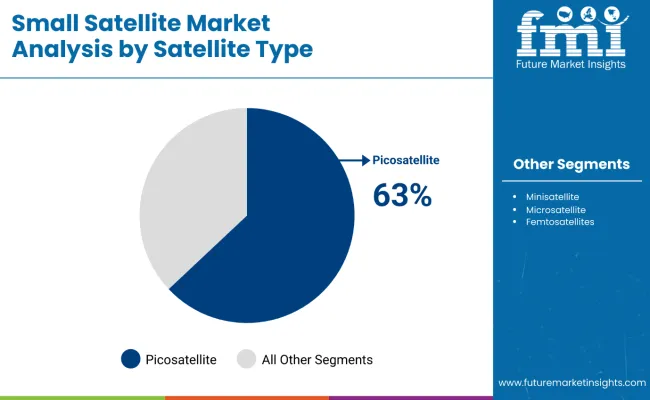
- Minisatellite is projected to account for 28.0% share in 2026 as heavier payloads need more power and thermal margin.
- CubeSats retain a clear role in low-cost missions as standard form factors shorten design time for education and research flights.
Insights into Small Satellite Market by Orbit Type
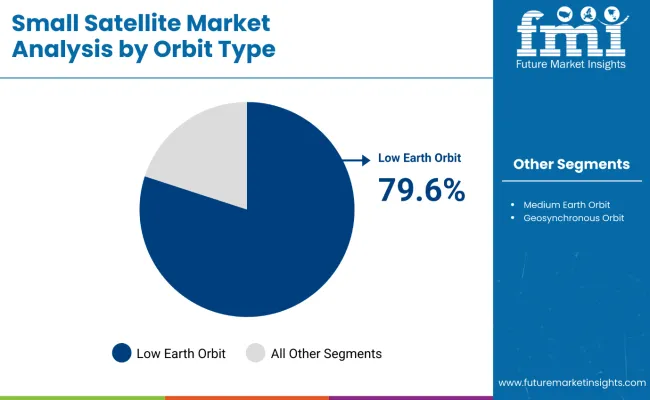
- Low earth orbit (LEO) is anticipated to account for 79.6% share in 2026 due to operators prioritizing low latency and frequent revisit capability.
- Medium earth orbit (MEO) keeps a smaller role in navigation work as fewer missions need higher-altitude coverage.
Insights into Small Satellite Market by Application
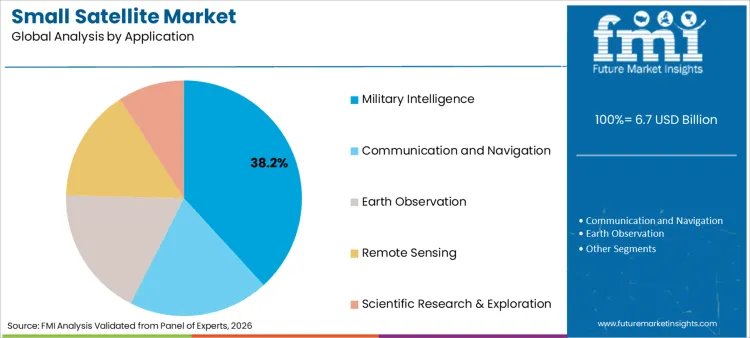
- Military intelligence is forecast to account for 38.2% share in 2026, led by defense users needing shorter imagery refresh cycles.
- Earth observation gains from climate and disaster monitoring as compact sensors improve the case for smaller spacecraft.
Insights into Small Satellite Market by End Use
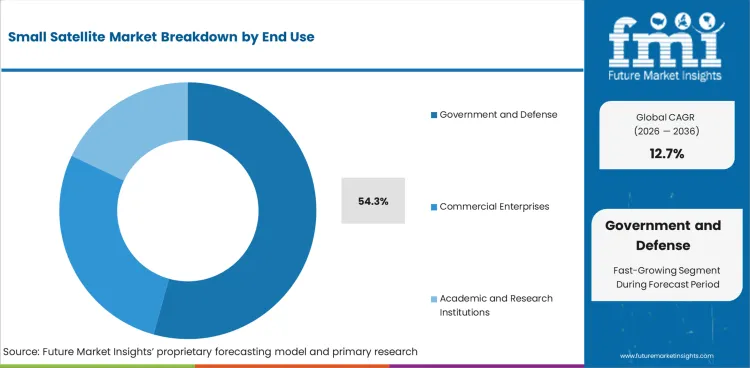
- Government and defense are expected to account for 54.3% share in 2026, reflecting public budgets funding surveillance and secure communication missions.
- Commercial enterprises are gaining significance as broadband and geospatial service operators need reliable fleet renewal.
Insights into Small Satellite Market by Platform
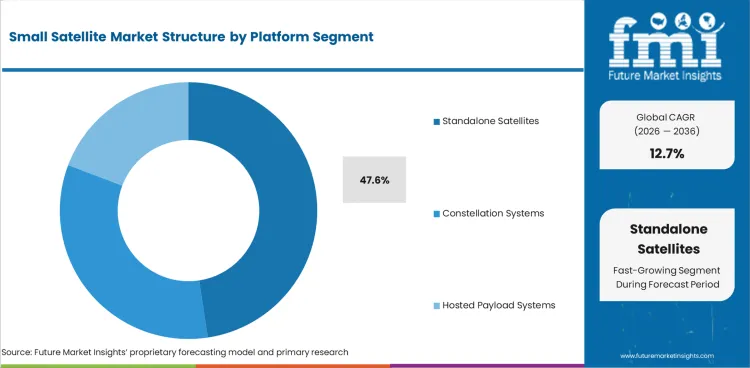
- Standalone satellites are projected to account for 47.6% share in 2026 with dedicated spacecraft suiting defense and single-customer imaging tasks.
- Constellation systems gain attention as operators seek wider coverage and higher revisit frequency from repeat spacecraft batches.
Insights into Small Satellite Market by Propulsion Technology
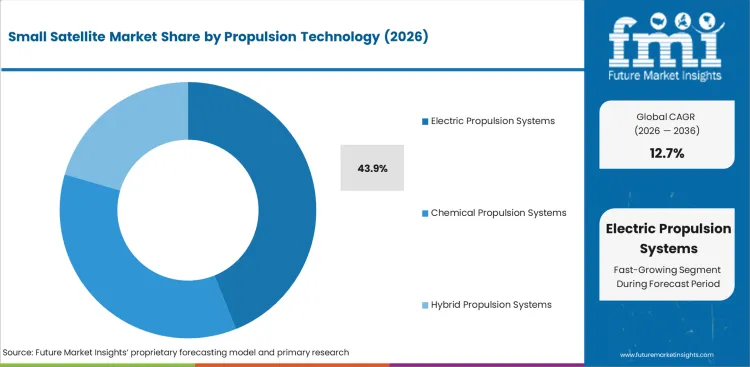
- Electric propulsion systems are expected to account for 43.9% share in 2026 through efficient station-keeping and extended mission life.
- Chemical propulsion systems keep demand in missions requiring faster maneuvers or simpler proven designs.
Small Satellite Market Drivers, Restraints, and Opportunities
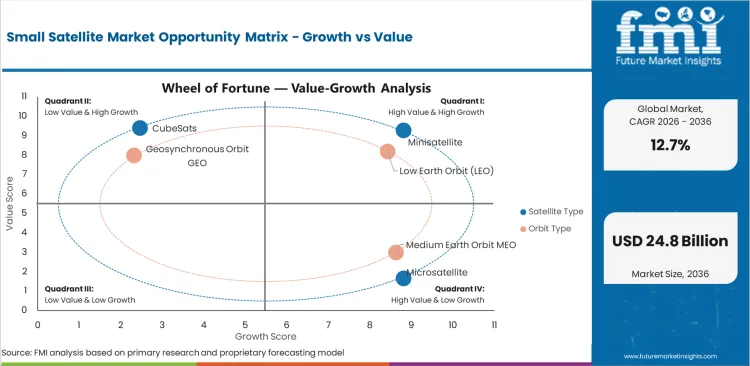
- Low earth orbit constellation replenishment is making repeat spacecraft orders more visible for broadband and imaging operators.
- Licensing fees and debris rules are raising the planning burden for new small satellite fleets.
- Hosted payload missions create opportunity for suppliers able to combine platform capacity with reliable mission testing.
Low earth orbit fleet planning is the main growth driver as satellite networks move from first rollout into planned replacement cycles. Federal Aviation Administration forecast says Amazon Kuiper deployment is expected to start in 2025 and reach full deployment by 2031, with replenishment starting in the same year. Starlink’s low earth orbit network is expected to reach full deployment by end-2025 and begin replenishment in 2025. Replenishment turns spacecraft supply into repeat bus production and launch-ready integration work. Licensing cost is the main restraint as FCC created separate 2025 fee classes for small and large non-geostationary constellations. NASA’s small spacecraft review supports the opportunity side as hosted payload services and free-space optical communications were updated in the 2024 edition.
Trade Flow and Import-Export Analysis
Small satellite trade flows center on spacecraft buses and payload modules. Launch integration paperwork now carries greater weight as more missions move across allied manufacturing and launch networks. In October 2024, the Bureau of Industry and Security removed license requirements for certain spacecraft and related items exported or reexported to Australia along with Canada and the United Kingdom. Covered items include remote sensing spacecraft and space-based servicing items. Export-control relief supports allied supply routes with defense and dual-use payloads still needing early documentation. Suppliers preparing classification records and payload data before contract award can reduce shipment delays.
Mission-wise Demand and Order Pattern Analysis
Mission-wise demand is expected to stay concentrated in low earth orbit communication and tracking work. Commercial orders are moving toward repeat batches as broadband constellations enter replacement cycles. Government missions are adding another order path through defense space layers. In April 2025, the Space Development Agency sought proposals for about 54 Tranche 3 Tracking Layer space vehicles across 6 orbital planes. Mission owners will judge suppliers on bus repeatability and payload accommodation. Manufacturers with proven test discipline and clear launch integration support are better placed to convert funded missions into recurring orders.
Analysis of Small Satellite Market by Key Countries
.webp "Top Country Growth Comparison Small Satellite Market Cagr (2026 2036)")
| Country | CAGR |
|---|---|
| China | 16.3% |
| India | 15.1% |
| Germany | 13.9% |
| Brazil | 12.7% |
| United States | 11.5% |
| United Kingdom | 10.3% |
| Japan | 9.1% |
Source: Future Market Insights, 2026.
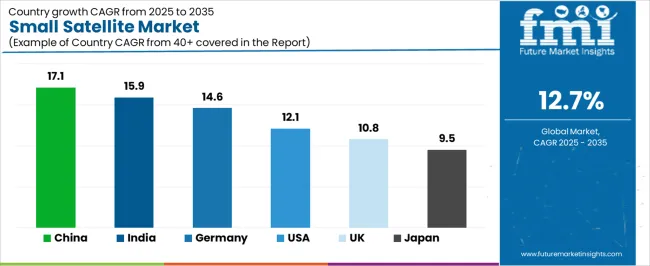
Small Satellite Market CAGR Analysis by Country
- China is projected to record 16.3% CAGR by 2036, driven by state constellation programs increasing domestic spacecraft demand.
- India is expected to expand at 15.1% CAGR by 2036 as small spacecraft missions and local launch capability improve.
- Germany is forecast to grow at 13.9% CAGR by 2036, led by public programs and European launch access supporting local suppliers.
- Brazil is expected to advance at 12.7% CAGR by 2036 due to remote sensing and environmental monitoring keeping demand significant.
- United States is projected to rise at 11.5% CAGR by 2036 since LEO fleet replacement and defense programs sustain orders.
- United Kingdom is forecast at 10.3% CAGR by 2036 through sovereign intelligence satellites creating a clear defense route.
- Japan is expected to post 9.1% CAGR by 2036 as CubeSat release programs and public funds support smaller missions.
Country performance differs by launch cadence and mission funding. China and India track above the global line as national programs move from tests toward fleet use. Germany and Brazil stay near or above the global average as public programs support observation missions. United States and United Kingdom grow through defense and commercial fleet renewal. Japan expands at a measured rate as CubeSat release activity and public funds build flight heritage.
Growth Outlook for Small Satellites in China
Sector in China is projected to record 16.3% CAGR by 2036, driven by state constellation programs pushing repeated satellite production. China launched 18 Spacesail commercial satellites in January 2025 after official network construction began in August 2024. Batch placement gives local suppliers a clearer route from demonstration missions to repeat spacecraft orders. Domestic launch vehicle upgrades support higher-volume small satellite campaigns. State agencies and commercial operators will need satellite buses and payload integration as LEO fleets grow.
- State-backed constellation work supports batch orders favoring domestic satellite primes with repeat manufacturing capacity.
- Commercial broadband and remote sensing missions raise demand for compact payloads suited to standard satellite buses.
- Launch capacity improvements can reduce scheduling delays for operators placing many satellites into similar orbits.
Demand Outlook for Small Satellites in India
Demand in India is expected to expand at 15.1% CAGR by 2036, influenced by national programs improving confidence in small spacecraft operations. Indian Space Research Organisation described SpaDeX as two small spacecraft of about 220 kg each flying in a 470 km orbit in December 2024. Docking and proximity work builds skills needed for complex small satellite missions. Domestic suppliers can benefit as public missions create reference designs. Private operators gain confidence once local launch access becomes routine.
- National demonstration missions give suppliers proof points before larger communication and observation programs scale.
- Local launch capability improves schedule control for spacecraft owners needing short mission timelines.
- Docking and proximity missions widen technical learning for future servicing and formation-flying spacecraft.
Sales Analysis of Small Satellites in Germany
Sales in Germany are forecast to grow at 13.9% CAGR by 2036, led by public funding and microlauncher links supporting small satellite suppliers. German Aerospace Center awarded an Exolaunch contract worth almost EUR 18 million in June 2025 for 12 small satellite and payload competition winners. Funded access gives universities and firms a lower-cost route to flight. Domestic demand is tied to technology demonstrations and European launch capacity. Engineering depth in payload design keeps Germany important in European spacecraft programs.
- Public mission work gives smaller suppliers flight heritage before they pursue larger institutional programs.
- Microlauncher access is important as satellite builders need predictable launch slots for short demonstration timelines.
- Payload and mission design capability supports Germany’s role in European small spacecraft work.
Opportunity Analysis of Small Satellites in Brazil
The market in Brazil is expected to advance at 12.7% CAGR by 2036 through remote sensing needs supporting small satellite use. Brazilian Space Agency listed Carcará III and Carcará IV as remote sensing satellites launched in August 2024 and operating in orbit. Environmental monitoring and land observation are practical mission needs across the country. Local demand will depend on public programs converting observation needs into funded spacecraft. Data-service contracts can extend value beyond the satellite build.
- Remote sensing missions support disaster monitoring and land-use review across large geographic areas.
- Public agency demand can move local space programs from education missions toward operational spacecraft.
- International launch access is important as domestic satellite use depends on reliable orbital placement.
Future Outlook for Small Satellites in the United States
Demand in the United States is projected to rise at 11.5% CAGR by 2036 as LEO fleet replacement and defense space programs sustain orders. Federal Aviation Administration described a launch-service market with 12 United States providers at the start of 2024 in its April 2025 forecast. Supplier breadth gives satellite operators more launch planning options. Fleet owners need strong licensing and debris plans as constellation size increases. Manufacturing demand should favor firms with repeat bus production and defense qualification experience.
- Large LEO operators need replenishment satellites to keep broadband and imaging services available over time.
- Defense agencies favor dispersed spacecraft layers as mission continuity improves across many satellites.
- Regulatory filings and orbital safety plans separate qualified suppliers from entrants with limited compliance depth.
Demand Analysis of Small Satellites in the United Kingdom
Industry in United Kingdom is forecast at 10.3% CAGR by 2036 since sovereign defense satellite use becomes more visible. Ministry of Defence said Tyche was the first satellite under its intelligence surveillance and reconnaissance program in August 2024. GBP 22 million contract value gave the country a defense reference mission. Follow-on spacecraft can strengthen domestic supply for imaging payloads and satellite operations. Program visibility should keep demand tied to defense-grade mission assurance.
- Sovereign imaging missions raise domestic demand for small satellites with defense-grade mission assurance.
- Defense imaging needs connect spacecraft design with secure data handling and long-term mission operations.
- National program visibility can strengthen local supply planning for later surveillance spacecraft.
Opportunity Analysis of Small Satellites in Japan
Sales in Japan are expected to post 9.1% CAGR by 2036, driven by CubeSat release services and public funds supporting smaller missions. Japan Aerospace Exploration Agency deployed five CubeSats from the Kibo module in December 2024. Regular station release services give universities and private firms a route from experiments into applied missions. Funding routes can help suppliers move beyond one-off projects. Commercial scale should build gradually as flight heritage improves.
- Kibo release services give universities and startups a recurring route to prove small spacecraft concepts.
- Public funds can improve continuity for small satellite hardware and mission software suppliers.
- Commercial demand is expected to build around observation and technology demonstration missions before wider fleet orders expand.
Competitive Landscape and Strategic Positioning
- Repeat manufacturing depth is becoming a core differentiator as constellation operators place spacecraft orders in batches.
- Payload integration skill separates defense imaging suppliers from companies focused mainly on academic and civil missions.
- Orbital safety documentation gives established primes an advantage during licensing review and funded program approval.
Competition in the small satellite market is shaped by repeat production and mission assurance. Airbus S.A.S. competes based on OneWeb constellation work and European production capacity. Lockheed Martin Corporation and Northrop Grumman Corporation serve defense programs needing secure payload integration. China Aerospace Science and Industry Corporation holds a China-centered position tied to national launch and spacecraft programs. Boeing participates through communication satellite programs and mission system experience.
Focused specialists can win mission-specific work, but scale pressure rises as constellation orders move in batches. OHB SE and Surrey Satellite Technology Ltd. bring small satellite heritage across civil and defense missions. Thales Alenia Space and Planet Labs PBC compete around observation payloads and data use. BAE Systems Space & Mission Systems holds the former Ball Aerospace position after the 2024 acquisition. Manufacturers with repeat production strength and proven mission assurance are better placed to defend share in funded programs.
Key Companies in the Small Satellite Market
Competitive structure is easier to assess by grouping companies around spacecraft manufacturing capacity and mission assurance depth.
- Global Space Primes: Airbus S.A.S., Lockheed Martin Corporation and Northrop Grumman Corporation support constellation and defense missions through satellite bus engineering and secure payload integration.
- Regional Space Specialists: OHB SE, Surrey Satellite Technology Ltd. and Thales Alenia Space compete through small satellite heritage and European program access.
- Data and Mission Participants: Planet Labs PBC influences demand through observation missions. BAE Systems Space & Mission Systems supports defense payload and spacecraft manufacturing work.
Competitive Benchmarking: Small Satellite Market
| Company | Bus Production Depth | Payload Integration Depth | Mission Assurance Support | Geographic Footprint |
|---|---|---|---|---|
| Airbus S.A.S. | High | Strong | Strong | Global |
| Lockheed Martin Corporation | High | Strong | Strong | United States and allied programs |
| Northrop Grumman Corporation | High | Strong | Strong | United States defense reach |
| Thales Alenia Space | Medium | Strong | Strong | Europe and global programs |
| OHB SE | Medium | Strong | Medium | Europe centered |
| Surrey Satellite Technology Ltd. | Medium | Strong | Medium | United Kingdom and export reach |
| Planet Labs PBC | Medium | Medium | Medium | Global imaging operator |
| BAE Systems Space & Mission Systems | Medium | Strong | Strong | United States defense reach |
Source: Future Market Insights competitive analysis, 2026. Ratings reflect relative positioning based on bus production depth, payload integration depth and mission assurance support.
Key Developments in Small Satellite Market
- In February 2024, BAE Systems completed its acquisition of Ball Aerospace and formed Space & Mission Systems under BAE Systems Inc.
- In December 2024, Airbus secured an Eutelsat contract to build the first 100 satellites for the OneWeb low earth orbit constellation extension.
- In December 2025, Space Development Agency awarded four agreements worth about USD 3.5 billion to build 72 Tranche 3 Tracking Layer satellites.
Key Players in the Small Satellite Market
Major Global Players:
- Airbus Defence and Space
- Lockheed Martin Corporation
- Northrop Grumman Corporation
- Boeing
- Thales Alenia Space
Specialist and Regional Players:
- OHB SE
- Planet Labs PBC
- BAE Systems Space & Mission Systems
- Surrey Satellite Technology Ltd.
- China Aerospace Science and Industry Corporation
Report Scope and Coverage
| Parameter | Details |
|---|---|
| Quantitative Units | USD 7.5 billion to USD 24.8 billion at 12.7% CAGR |
| Market Definition | Mission-ready small spacecraft used for commercial and government missions |
| Satellite Type | Minisatellite, microsatellite, CubeSats, picosatellites, femtosatellites |
| Orbit Type | Low Earth Orbit LEO, Medium Earth Orbit MEO, Geosynchronous Orbit GEO |
| Application | Military Intelligence, Communication and Navigation, Earth Observation, Remote Sensing |
| End Use | Government and Defense, Commercial Enterprises, Academic and Research Institutions |
| Platform | Standalone Satellites, Constellation Systems, Hosted Payload Systems |
| Propulsion Technology | Electric Propulsion Systems, Chemical Propulsion Systems, Hybrid Propulsion Systems |
| Regions Covered | North America, Latin America, Europe, East Asia, South Asia and Pacific, Middle East and Africa |
| Countries Covered | China, India, Germany, Brazil, United States, United Kingdom, Japan |
| Key Companies Profiled | Airbus S.A.S. and Lockheed Martin Corporation. Northrop Grumman Corporation and Thales Alenia Space. OHB SE and BAE Systems Space & Mission Systems |
| Forecast Period | 2026 to 2036 |
| Approach | Supplied value anchors and mission review. Country launch signals and segment share modeling |
Source: Future Market Insights, 2026.
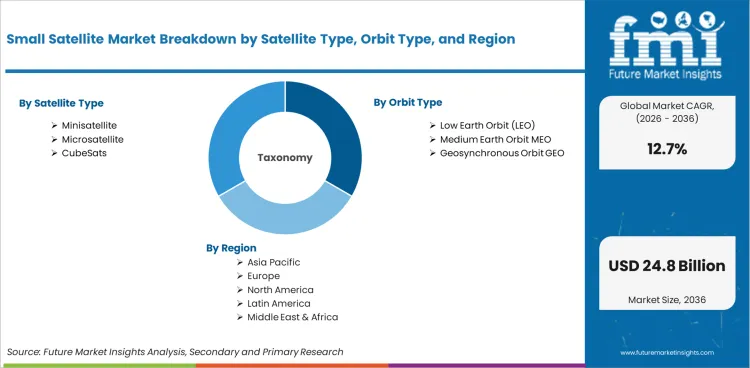
Small Satellite Market Breakdown by Satellite Type, Orbit Type, Application, End Use, Platform, Propulsion Technology, and Region.
By Satellite Type:
- Minisatellite
- Microsatellite
- CubeSats
- Picosatellites
- Femtosatellites
By Orbit Type:
- Low Earth Orbit LEO
- Medium Earth Orbit MEO
- Geosynchronous Orbit GEO
By Application:
- Military Intelligence
- Communication and Navigation
- Earth Observation
- Remote Sensing
- Scientific Research and Exploration
By End Use:
- Government and Defense
- Commercial Enterprises
- Academic and Research Institutions
Small Satellite Market Segmented by Platform:
- Standalone Satellites
- Constellation Systems
- Hosted Payload Systems
Small Satellite Market Segmented by Propulsion Technology:
- Electric Propulsion Systems
- Chemical Propulsion Systems
- Hybrid Propulsion Systems
Small Satellite Market Segmented by Region:
- North America
- Latin America
- Europe
- East Asia
- South Asia and Pacific
- Middle East and Africa
Research Sources and Bibliography
- Airbus. (2024, December 17). Airbus awarded Eutelsat contract to build OneWeb low orbit constellation extension.
- BAE Systems. (2024, February 16). BAE Systems completes acquisition of Ball Aerospace.
- Brazilian Space Agency. (2026, March 6). Brazilian spatial objects.
- Costa, J. (2024, June 4). Rocket Lab’s Electron rocket “go” for launch! National Aeronautics and Space Administration.
- Federal Aviation Administration. (2025). FAA aerospace forecast fiscal years 2025-2045: Commercial space. USA Department of Transportation.
- Federal Communications Commission, Space Bureau. (2024, May 2). Space Bureau seeks to refresh the record on proposed rules pertaining to orbital debris mitigation (DA 24-412).
- Federal Communications Commission. (2025, June 9). Assessment and collection of space and earth station regulatory fees for fiscal year 2024 (FCC 25-31; MD Docket No. 24-85) [Third report and order].
- Federal Communications Commission. (2025, August 29). Review of the Commission’s assessment and collection of regulatory fees for fiscal year 2025; Assessment and collection of space and earth station regulatory fees for fiscal year 2025 (FCC 25-52; MD Docket Nos. 25-190 and 24-85) [Report and order].
- German Aerospace Center. (2025, December 1). Small satellite for observing activities at sea.
- Indian Space Research Organisation. (2024, December 21). SpaDeX mission.
- Japan Aerospace Exploration Agency. (2024, December 10). Five CubeSats successfully deployed from “Kibo”!
- National Aeronautics and Space Administration. (2025, February 14). 2024 State-of-the-Art Small Spacecraft Technology report is released.
- Space Development Agency. (2025, April 7). SDA seeks proposals for Tranche 3 Tracking Layer (T3TRK) of the Proliferated Warfighter Space Architecture (PWSA).
- Space Development Agency. (2025, December 19). Space Development Agency makes awards to build 72 Tracking Layer satellites for Tranche 3.
- USA Department of Commerce, Bureau of Industry and Security. (2024, October 23). Export Administration Regulations: Removal of license requirements for certain spacecraft and related items for Australia, Canada, and the United Kingdom (89 Fed. Reg. 84766). Federal Register.
- USA Government Accountability Office. (2025, July 10). In-space servicing, assembly, and manufacturing: Benefits, challenges, and policy options (GAO-25-107555).
- United Kingdom Ministry of Defence. (2024, August 17). UK Space Command successfully launches first military satellite. GOV.UK.
Bibliography uses government sources, official company evidence and non-commercial trade data.
This Report Answers
- What is the current and future size of the small satellite market?
- How fast is the small satellite market projected to expand between 2026 and 2036?
- Which orbit type is expected to account for the leading small satellite share in 2026?
- Which end use is projected to account for the leading small satellite share in 2026?
- Why does low earth orbit (LEO) account for a high small satellite share?
- How does government and defense support small satellite adoption?
- Which countries are projected to record faster expansion during the forecast period?
- Who are the main companies active in small satellite supply?
- How does FMI define the small satellite market scope?
- How does FMI estimate and validate the small satellite forecast?
Frequently Asked Questions
What is the global market demand for small satellites in 2026?
In 2026, small satellite market value is projected to reach USD 7.5 billion as LEO renewal supports defense imaging missions.
How big will the small satellite market be in 2036?
By 2036, small satellite industry revenue is forecast to scale to USD 24.8 billion as repeat fleet replacement becomes common.
How much is demand for small satellites projected to expand between 2026 and 2036?
Between 2026 and 2036, small satellite sector is anticipated to expand at 12.7% CAGR as constellation supply rises.
Which orbit type is expected to lead the small satellite market by 2026?
Low earth orbit (LEO) is projected to represent 79.6% share in 2026 since low latency and frequent revisit needs guide adoption.
Which end use is expected to lead small satellite demand in 2026?
Government and defense are anticipated to account for 54.3% share in 2026 as security missions support funded spacecraft programs.
Which country is forecast to grow fastest in the small satellite market?
China is projected to record 16.3% CAGR by 2036 as state-backed constellations and commercial fleets expand production needs.
What does the small satellite market include?
Scope includes minisatellites and microsatellites. CubeSats, picosatellites and femtosatellites are counted as mission-ready spacecraft classes.
How does FMI estimate the small satellite market forecast?
FMI uses supplied value anchors and segment share checks. Government program signals and verified supplier activity validate the forecast view.
Why are electric propulsion systems important in the small satellite market?
Electric propulsion systems are projected at 43.9% share in 2026 since efficient orbit control can extend useful mission life.
Who uses small satellites?
Main users include defense agencies and commercial operators. Research institutions use small satellites for imaging and technology demonstration missions.
Preview the report firsthand - request a free sample
Get SampleGet the brochure for pricing and purchase details.
Get PDFTable of Content
- Executive Summary
- Global Market Outlook
- Demand-side Trends
- Supply-side Trends
- Technology Roadmap Analysis
- Analysis and Recommendations
- Market Overview
- Market Coverage / Taxonomy
- Market Definition / Scope / Limitations
- Research Methodology
- Chapter Orientation
- Analytical Lens and Working Hypotheses
- Market Structure, Signals, and Trend Drivers
- Benchmarking and Cross-market Comparability
- Market Sizing, Forecasting, and Opportunity Mapping
- Research Design and Evidence Framework
- Desk Research Programme (Secondary Evidence)
- Company Annual and Sustainability Reports
- Peer-reviewed Journals and Academic Literature
- Corporate Websites, Product Literature, and Technical Notes
- Earnings Decks and Investor Briefings
- Statutory Filings and Regulatory Disclosures
- Technical White Papers and Standards Notes
- Trade Journals, Industry Magazines, and Analyst Briefs
- Conference Proceedings, Webinars, and Seminar Materials
- Government Statistics Portals and Public Data Releases
- Press Releases and Reputable Media Coverage
- Specialist Newsletters and Curated Briefings
- Sector Databases and Reference Repositories
- FMI Internal Proprietary Databases and Historical Market Datasets
- Subscription Datasets and Paid Sources
- Social Channels, Communities, and Digital Listening Inputs
- Additional Desk Sources
- Expert Input and Fieldwork (Primary Evidence)
- Primary Modes
- Qualitative Interviews and Expert Elicitation
- Quantitative Surveys and Structured Data Capture
- Blended Approach
- Why Primary Evidence is Used
- Field Techniques
- Interviews
- Surveys
- Focus Groups
- Observational and In-context Research
- Social and Community Interactions
- Stakeholder Universe Engaged
- C-suite Leaders
- Board Members
- Presidents and Vice Presidents
- R&D and Innovation Heads
- Technical Specialists
- Domain Subject-matter Experts
- Scientists
- Physicians and Other Healthcare Professionals
- Governance, Ethics, and Data Stewardship
- Research Ethics
- Data Integrity and Handling
- Primary Modes
- Tooling, Models, and Reference Databases
- Desk Research Programme (Secondary Evidence)
- Data Engineering and Model Build
- Data Acquisition and Ingestion
- Cleaning, Normalisation, and Verification
- Synthesis, Triangulation, and Analysis
- Quality Assurance and Audit Trail
- Market Background
- Market Dynamics
- Drivers
- Restraints
- Opportunity
- Trends
- Scenario Forecast
- Demand in Optimistic Scenario
- Demand in Likely Scenario
- Demand in Conservative Scenario
- Opportunity Map Analysis
- Product Life Cycle Analysis
- Supply Chain Analysis
- Investment Feasibility Matrix
- Value Chain Analysis
- PESTLE and Porter’s Analysis
- Regulatory Landscape
- Regional Parent Market Outlook
- Market Dynamics
- Global Market Analysis 2021 to 2025 and Forecast, 2026 to 2036
- Historical Market Size Value (USD Million) Analysis, 2021 to 2025
- Current and Future Market Size Value (USD Million) Projections, 2026 to 2036
- Y-o-Y Growth Trend Analysis
- Absolute $ Opportunity Analysis
- Global Market Pricing Analysis 2021 to 2025 and Forecast 2026 to 2036
- Global Market Analysis 2021 to 2025 and Forecast 2026 to 2036, By Satellite Type
- Introduction / Key Findings
- Historical Market Size Value (USD Million) Analysis By Satellite Type , 2021 to 2025
- Current and Future Market Size Value (USD Million) Analysis and Forecast By Satellite Type , 2026 to 2036
- Minisatellite
- Microsatellite
- CubeSats
- Minisatellite
- Y-o-Y Growth Trend Analysis By Satellite Type , 2021 to 2025
- Absolute $ Opportunity Analysis By Satellite Type , 2026 to 2036
- Global Market Analysis 2021 to 2025 and Forecast 2026 to 2036, By Orbit Type
- Introduction / Key Findings
- Historical Market Size Value (USD Million) Analysis By Orbit Type, 2021 to 2025
- Current and Future Market Size Value (USD Million) Analysis and Forecast By Orbit Type, 2026 to 2036
- Low Earth Orbit (LEO)
- Medium Earth Orbit MEO
- Geosynchronous Orbit GEO
- Low Earth Orbit (LEO)
- Y-o-Y Growth Trend Analysis By Orbit Type, 2021 to 2025
- Absolute $ Opportunity Analysis By Orbit Type, 2026 to 2036
- Global Market Analysis 2021 to 2025 and Forecast 2026 to 2036, By Application
- Introduction / Key Findings
- Historical Market Size Value (USD Million) Analysis By Application, 2021 to 2025
- Current and Future Market Size Value (USD Million) Analysis and Forecast By Application, 2026 to 2036
- Military Intelligence
- Communication and Navigation
- Earth Observation
- Military Intelligence
- Y-o-Y Growth Trend Analysis By Application, 2021 to 2025
- Absolute $ Opportunity Analysis By Application, 2026 to 2036
- Global Market Analysis 2021 to 2025 and Forecast 2026 to 2036, By End Use
- Introduction / Key Findings
- Historical Market Size Value (USD Million) Analysis By End Use, 2021 to 2025
- Current and Future Market Size Value (USD Million) Analysis and Forecast By End Use, 2026 to 2036
- Government and Defense
- Commercial Enterprises
- Academic and Research Institutions
- Government and Defense
- Y-o-Y Growth Trend Analysis By End Use, 2021 to 2025
- Absolute $ Opportunity Analysis By End Use, 2026 to 2036
- Global Market Analysis 2021 to 2025 and Forecast 2026 to 2036, By Platform
- Introduction / Key Findings
- Historical Market Size Value (USD Million) Analysis By Platform, 2021 to 2025
- Current and Future Market Size Value (USD Million) Analysis and Forecast By Platform, 2026 to 2036
- Standalone Satellites
- Constellation Systems
- Hosted Payload Systems
- Standalone Satellites
- Y-o-Y Growth Trend Analysis By Platform, 2021 to 2025
- Absolute $ Opportunity Analysis By Platform, 2026 to 2036
- Global Market Analysis 2021 to 2025 and Forecast 2026 to 2036, By Propulsion Technology
- Introduction / Key Findings
- Historical Market Size Value (USD Million) Analysis By Propulsion Technology, 2021 to 2025
- Current and Future Market Size Value (USD Million) Analysis and Forecast By Propulsion Technology, 2026 to 2036
- Electric Propulsion Systems
- Chemical Propulsion Systems
- Hybrid Propulsion Systems
- Electric Propulsion Systems
- Y-o-Y Growth Trend Analysis By Propulsion Technology, 2021 to 2025
- Absolute $ Opportunity Analysis By Propulsion Technology, 2026 to 2036
- Global Market Analysis 2021 to 2025 and Forecast 2026 to 2036, By Region
- Introduction
- Historical Market Size Value (USD Million) Analysis By Region, 2021 to 2025
- Current Market Size Value (USD Million) Analysis and Forecast By Region, 2026 to 2036
- North America
- Latin America
- Western Europe
- Eastern Europe
- East Asia
- South Asia and Pacific
- Middle East & Africa
- Market Attractiveness Analysis By Region
- North America Market Analysis 2021 to 2025 and Forecast 2026 to 2036, By Country
- Historical Market Size Value (USD Million) Trend Analysis By Market Taxonomy, 2021 to 2025
- Market Size Value (USD Million) Forecast By Market Taxonomy, 2026 to 2036
- By Country
- USA
- Canada
- Mexico
- By Satellite Type
- By Orbit Type
- By Application
- By End Use
- By Platform
- By Propulsion Technology
- By Country
- Market Attractiveness Analysis
- By Country
- By Satellite Type
- By Orbit Type
- By Application
- By End Use
- By Platform
- By Propulsion Technology
- Key Takeaways
- Latin America Market Analysis 2021 to 2025 and Forecast 2026 to 2036, By Country
- Historical Market Size Value (USD Million) Trend Analysis By Market Taxonomy, 2021 to 2025
- Market Size Value (USD Million) Forecast By Market Taxonomy, 2026 to 2036
- By Country
- Brazil
- Chile
- Rest of Latin America
- By Satellite Type
- By Orbit Type
- By Application
- By End Use
- By Platform
- By Propulsion Technology
- By Country
- Market Attractiveness Analysis
- By Country
- By Satellite Type
- By Orbit Type
- By Application
- By End Use
- By Platform
- By Propulsion Technology
- Key Takeaways
- Western Europe Market Analysis 2021 to 2025 and Forecast 2026 to 2036, By Country
- Historical Market Size Value (USD Million) Trend Analysis By Market Taxonomy, 2021 to 2025
- Market Size Value (USD Million) Forecast By Market Taxonomy, 2026 to 2036
- By Country
- Germany
- UK
- Italy
- Spain
- France
- Nordic
- BENELUX
- Rest of Western Europe
- By Satellite Type
- By Orbit Type
- By Application
- By End Use
- By Platform
- By Propulsion Technology
- By Country
- Market Attractiveness Analysis
- By Country
- By Satellite Type
- By Orbit Type
- By Application
- By End Use
- By Platform
- By Propulsion Technology
- Key Takeaways
- Eastern Europe Market Analysis 2021 to 2025 and Forecast 2026 to 2036, By Country
- Historical Market Size Value (USD Million) Trend Analysis By Market Taxonomy, 2021 to 2025
- Market Size Value (USD Million) Forecast By Market Taxonomy, 2026 to 2036
- By Country
- Russia
- Poland
- Hungary
- Balkan & Baltic
- Rest of Eastern Europe
- By Satellite Type
- By Orbit Type
- By Application
- By End Use
- By Platform
- By Propulsion Technology
- By Country
- Market Attractiveness Analysis
- By Country
- By Satellite Type
- By Orbit Type
- By Application
- By End Use
- By Platform
- By Propulsion Technology
- Key Takeaways
- East Asia Market Analysis 2021 to 2025 and Forecast 2026 to 2036, By Country
- Historical Market Size Value (USD Million) Trend Analysis By Market Taxonomy, 2021 to 2025
- Market Size Value (USD Million) Forecast By Market Taxonomy, 2026 to 2036
- By Country
- China
- Japan
- South Korea
- By Satellite Type
- By Orbit Type
- By Application
- By End Use
- By Platform
- By Propulsion Technology
- By Country
- Market Attractiveness Analysis
- By Country
- By Satellite Type
- By Orbit Type
- By Application
- By End Use
- By Platform
- By Propulsion Technology
- Key Takeaways
- South Asia and Pacific Market Analysis 2021 to 2025 and Forecast 2026 to 2036, By Country
- Historical Market Size Value (USD Million) Trend Analysis By Market Taxonomy, 2021 to 2025
- Market Size Value (USD Million) Forecast By Market Taxonomy, 2026 to 2036
- By Country
- India
- ASEAN
- Australia & New Zealand
- Rest of South Asia and Pacific
- By Satellite Type
- By Orbit Type
- By Application
- By End Use
- By Platform
- By Propulsion Technology
- By Country
- Market Attractiveness Analysis
- By Country
- By Satellite Type
- By Orbit Type
- By Application
- By End Use
- By Platform
- By Propulsion Technology
- Key Takeaways
- Middle East & Africa Market Analysis 2021 to 2025 and Forecast 2026 to 2036, By Country
- Historical Market Size Value (USD Million) Trend Analysis By Market Taxonomy, 2021 to 2025
- Market Size Value (USD Million) Forecast By Market Taxonomy, 2026 to 2036
- By Country
- Kingdom of Saudi Arabia
- Other GCC Countries
- Turkiye
- South Africa
- Other African Union
- Rest of Middle East & Africa
- By Satellite Type
- By Orbit Type
- By Application
- By End Use
- By Platform
- By Propulsion Technology
- By Country
- Market Attractiveness Analysis
- By Country
- By Satellite Type
- By Orbit Type
- By Application
- By End Use
- By Platform
- By Propulsion Technology
- Key Takeaways
- Key Countries Market Analysis
- USA
- Pricing Analysis
- Market Share Analysis, 2025
- By Satellite Type
- By Orbit Type
- By Application
- By End Use
- By Platform
- By Propulsion Technology
- Canada
- Pricing Analysis
- Market Share Analysis, 2025
- By Satellite Type
- By Orbit Type
- By Application
- By End Use
- By Platform
- By Propulsion Technology
- Mexico
- Pricing Analysis
- Market Share Analysis, 2025
- By Satellite Type
- By Orbit Type
- By Application
- By End Use
- By Platform
- By Propulsion Technology
- Brazil
- Pricing Analysis
- Market Share Analysis, 2025
- By Satellite Type
- By Orbit Type
- By Application
- By End Use
- By Platform
- By Propulsion Technology
- Chile
- Pricing Analysis
- Market Share Analysis, 2025
- By Satellite Type
- By Orbit Type
- By Application
- By End Use
- By Platform
- By Propulsion Technology
- Germany
- Pricing Analysis
- Market Share Analysis, 2025
- By Satellite Type
- By Orbit Type
- By Application
- By End Use
- By Platform
- By Propulsion Technology
- UK
- Pricing Analysis
- Market Share Analysis, 2025
- By Satellite Type
- By Orbit Type
- By Application
- By End Use
- By Platform
- By Propulsion Technology
- Italy
- Pricing Analysis
- Market Share Analysis, 2025
- By Satellite Type
- By Orbit Type
- By Application
- By End Use
- By Platform
- By Propulsion Technology
- Spain
- Pricing Analysis
- Market Share Analysis, 2025
- By Satellite Type
- By Orbit Type
- By Application
- By End Use
- By Platform
- By Propulsion Technology
- France
- Pricing Analysis
- Market Share Analysis, 2025
- By Satellite Type
- By Orbit Type
- By Application
- By End Use
- By Platform
- By Propulsion Technology
- India
- Pricing Analysis
- Market Share Analysis, 2025
- By Satellite Type
- By Orbit Type
- By Application
- By End Use
- By Platform
- By Propulsion Technology
- ASEAN
- Pricing Analysis
- Market Share Analysis, 2025
- By Satellite Type
- By Orbit Type
- By Application
- By End Use
- By Platform
- By Propulsion Technology
- Australia & New Zealand
- Pricing Analysis
- Market Share Analysis, 2025
- By Satellite Type
- By Orbit Type
- By Application
- By End Use
- By Platform
- By Propulsion Technology
- China
- Pricing Analysis
- Market Share Analysis, 2025
- By Satellite Type
- By Orbit Type
- By Application
- By End Use
- By Platform
- By Propulsion Technology
- Japan
- Pricing Analysis
- Market Share Analysis, 2025
- By Satellite Type
- By Orbit Type
- By Application
- By End Use
- By Platform
- By Propulsion Technology
- South Korea
- Pricing Analysis
- Market Share Analysis, 2025
- By Satellite Type
- By Orbit Type
- By Application
- By End Use
- By Platform
- By Propulsion Technology
- Russia
- Pricing Analysis
- Market Share Analysis, 2025
- By Satellite Type
- By Orbit Type
- By Application
- By End Use
- By Platform
- By Propulsion Technology
- Poland
- Pricing Analysis
- Market Share Analysis, 2025
- By Satellite Type
- By Orbit Type
- By Application
- By End Use
- By Platform
- By Propulsion Technology
- Hungary
- Pricing Analysis
- Market Share Analysis, 2025
- By Satellite Type
- By Orbit Type
- By Application
- By End Use
- By Platform
- By Propulsion Technology
- Kingdom of Saudi Arabia
- Pricing Analysis
- Market Share Analysis, 2025
- By Satellite Type
- By Orbit Type
- By Application
- By End Use
- By Platform
- By Propulsion Technology
- Turkiye
- Pricing Analysis
- Market Share Analysis, 2025
- By Satellite Type
- By Orbit Type
- By Application
- By End Use
- By Platform
- By Propulsion Technology
- South Africa
- Pricing Analysis
- Market Share Analysis, 2025
- By Satellite Type
- By Orbit Type
- By Application
- By End Use
- By Platform
- By Propulsion Technology
- USA
- Market Structure Analysis
- Competition Dashboard
- Competition Benchmarking
- Market Share Analysis of Top Players
- By Regional
- By Satellite Type
- By Orbit Type
- By Application
- By End Use
- By Platform
- By Propulsion Technology
- Competition Analysis
- Competition Deep Dive
- Airbus Defence and Space
- Overview
- Product Portfolio
- Profitability by Market Segments (Product/Age /Sales Channel/Region)
- Sales Footprint
- Strategy Overview
- Marketing Strategy
- Product Strategy
- Channel Strategy
- Lockheed Martin Corporation
- Northrop Grumman Corporation
- Boeing
- Thales Alenia Space
- Airbus Defence and Space
- Competition Deep Dive
- Assumptions & Acronyms Used


