

Small Satellite Market Size and Share Forecast Outlook from 2025 to 2035
The small satellite market is rapidly expanding due to the increasing demand from commercial, government, and defense sectors for low-cost, high-performance space solutions. Dominating the industry are SpaceX (via Starlink), Lockheed Martin, and Northrop Grumman, holding 50% of the market. These leaders drive innovation with reusable launch systems, satellite constellations, and advanced communication technologies.
Mid-tier vendors include Planet Labs, Sierra Space, and Blue Canyon Technologies, with 25% of the market share, concentrating on earth observation, remote sensing, and data analytics. The emerging providers such as Rocket Lab, Astroscale, and NanoAvionics capture 15% of the market share in innovative propulsion systems, satellite servicing, and in-orbit debris removal. Niche vendors, which include AAC Clyde Space, Tyvak, and GomSpace, also make up 10%, with niche applications in scientific research, IoT connectivity, and deep space exploration.
Global Market Share Distribution by Leading Small Satellite Launch and Manufacturing Firms (2025)
| Category | Industry Share (%) |
|---|---|
| Top 3 (SpaceX, Lockheed Martin, Northrop Grumman) | 50% |
| Rest of Top 5 (Planet Labs, Sierra Space) | 25% |
| Emerging Players (Rocket Lab, Astroscale, NanoAvionics) | 15% |
| Niche Providers (AAC Clyde Space, Tyvak, GomSpace) | 10% |
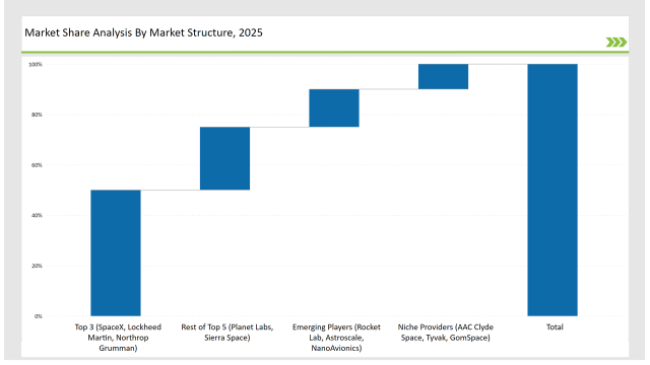
Market Concentration Outlook for 2025 by Satellite Mass Class, Orbit Type, and Mission Category
The small satellite market remains moderately consolidated, with top firms controlling 60% to 70% of the market. Leading players like SpaceX, Lockheed Martin, and Northrop Grumman set pricing and technology standards, creating high entry barriers for new competitors.
Small Satellite Market by Platform Type, Payload Application, End Use, Launch Frequency, and Region
By Satellite Type
The small satellite industry includes minisatellites, microsatellites, cubesats, picosatellites, and femtosatellites.
- Minisatellites (100 to 500 kg) lead with a 45% market share, as demand for high-resolution imaging, scientific research, and commercial broadband services rises. Lockheed Martin and Northrop Grumman develop cost-effective minisatellite solutions.
- Microsatellites (10 to 100 kg) hold 25%, supporting Earth observation, remote sensing, and disaster monitoring. Planet Labs and Blue Canyon Technologies dominate this category.
- Cubesats (1 to 10 kg) take up 20%, and are increasingly more popular, as they are low cost and more suited to academic research. Rocket Lab as well as NanoAvionics are related companies that launch cubesats for commercial and government customers
- Picosatellites (100 to 1000g) and femtosatellites (<100g) together occupy 10%, targeting mostly experimental missions, IoT connectivity, and swarm satellite constellations. GomSpace and AAC Clyde Space are now leading in this segment.
By Orbit Type
- Low Earth Orbit commands 75% of the market due to cost efficiency and the suitability for communication, Earth observation, and scientific research. Leading players in launching large satellite constellations into LEO include SpaceX, Planet Labs, and Rocket Lab.
- Medium Earth Orbit accounts for 15%. MEO primarily services navigation and communications satellites. Dominant players include Northrop Grumman and Lockheed Martin.
- Geostationary Orbit (GEO) is 10%, used for telecommunications and weather monitoring. Sierra Space and AAC Clyde Space offer small GEO satellites for specific niches.
Key Companies That Shaped the Year Through Innovation in LEO Deployment and Mission Agility (2024)
- SpaceX Starlink expanded its global broadband network with new LEO satellite launches.
- Lockheed Martin introduced next-generation minisatellites featuring AI-driven imaging and secure communication.
- Northrop Grumman enhanced space sustainability by developing satellite servicing solutions.
- Advanced microsatellites fleet was launched by Planet Labs for Earth observation and environmental monitoring.
- Rocket Lab demonstrated a launch of cubesats into accurate orbits using the Electron rocket, growing its customer base.
Forecast Highlights on Miniaturization, In-Orbit Servicing, and Commercial Constellation Growth
Key Trends Shaping the Future of the Small Satellite Market
AI Drives Satellite Operations, Enhancing Data Processing and Autonomy
Companies employ artificial intelligence, such as machine learning, to enable automatic data analysis, optimize satellite performance, and improve predictive maintenance. AI-powered algorithms mean that satellites can process valuable data in real-time, instead of relying so much on Earth-bound operations.
All these technologies improve mission efficiency across defense, climate monitoring, and disaster response sectors. AI-powered autonomous satellite constellations bring decreased operational costs with reduced human input, enhancing system reliability.
Mega-Constellations Accelerate Market Growth in Low Earth Orbit (LEO)
SpaceX, Amazon’s Project Kuiper, and other satellite providers deploy mega-constellations to expand global broadband coverage, driving the demand for small satellites. These companies invest heavily in LEO networks, increasing the need for high-throughput, cost-efficient satellites.
They provide seamless global internet access, especially in remote and underserved regions, by launching thousands of interconnected satellites. Manufacturers rapidly produce small satellites with advanced communication technologies, lower latency, and higher bandwidth to support these networks. The increasing commercial viability of LEO mega-constellations attracts significant investments from private and government sectors, further accelerating market expansion.
Public-Private Partnerships Boost Space Commercialization
Governments and space agencies are partnering with private companies to develop cost-effective small satellite solutions. NASA, the ESA, and the ISRO engage in commercial cooperation to expand its space-based communications, weather forecast, remote sensing, and scientific research.
Such collaboration enables an agency to pool the expertise in the private sector on satellite building, launch service, and data analytics, making the whole program cheaper and moving at a greater pace. Collaboration also stimulates more technological advancements as well as gives birth to business opportunities in such a dynamic industry. With increased commercialization, small satellite companies become important in delivering critical services, making possible new business models, and integrating space technologies into everyday applications.
Tier-Wise Company Classification Based on Payload Capacity, Launch Partnerships, and Integration Speed (2025)
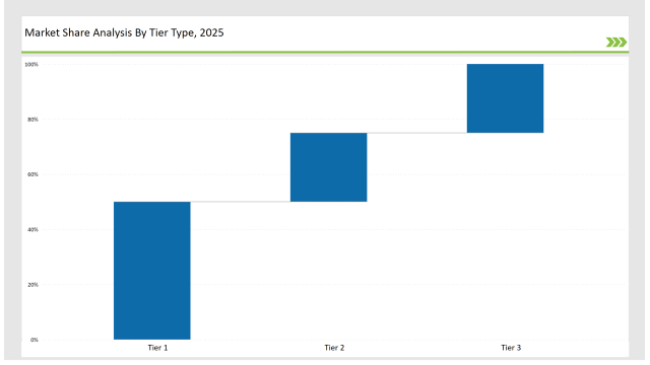
| Tier | Tier 1 |
|---|---|
| Vendors | SpaceX, Lockheed Martin, Northrop Grumman |
| Consolidated Market Share (%) | 50% |
| Tier | Tier 2 |
|---|---|
| Vendors | Planet Labs, Sierra Space, Rocket Lab |
| Consolidated Market Share (%) | 25% |
| Tier | Tier 3 |
|---|---|
| Vendors | NanoAvionics, AAC Clyde Space, GomSpace, Tyvak |
| Consolidated Market Share (%) | 25% |
Key Company Initiatives in Optical Comms, Onboard AI, and Solar Efficiency
| Vendor | Key Focus |
|---|---|
| SpaceX | Expanding Starlink’s satellite constellation for global internet connectivity. |
| Lockheed Martin | Developing AI-powered imaging and secure communication satellites. |
| Northrop Grumman | Advancing satellite servicing and in-orbit sustainability solutions. |
Strategic Recommendations for Vendors Targeting Earth Observation, IoT, and Academic Missions
- Invest in AI and Autonomous Satellite Operations: to enhance efficiency and reduce mission costs.
- Expand Space Debris Mitigation Solutions: to address growing regulatory concerns.
- Enhance Miniaturization Technologies: for deep-space exploration and high-throughput applications.
- Strengthen Public-Private Partnerships: to leverage government contracts and funding.
- Increase Focus on Emerging Markets: with tailored solutions for space communication and IoT connectivity.
Future Roadmap for Small Satellites with Emphasis on Reusability, Mass Production, and Spectrum Management
The vendors are improving the AI algorithms for predictive satellite analytics, which enhance data processing and the making of decisions autonomously in satellites. The optimization of the satellite by integrating advanced models of machine learning contributes to the early detection of anomalies and executing corrective actions without human intervention.
Satellites can predict system failures, assess environmental conditions, and manage the energy consumption to further extend the operational lifespan. Besides, real-time decision-making capabilities can empower satellites to autonomously alter their orbits, perform on-demand imaging, and respond to emerging threats such as space debris or cybersecurity risks. As AI technology advances, operators rely less on ground stations to operate, thereby improving the efficiency of the entire mission, thus making autonomous satellite operations more reliable.
Top Segments Studied in the Small Satellite Market: Mission Type, Satellite Class, Payload Type, Launch Mode, and Region
By Satellite Type:
- Minisatellites (100 to 500 kg)
- Microsatellites (10 to 100 kg)
- Cubesats (1 to 10 kg)
- Picosatellites (100 to 1000g)
- Femtosatellites (<100g)
By Orbit Type:
- Low Earth Orbit (LEO)
- Medium Earth Orbit (MEO)
- Geostationary Orbit (GEO)
Frequently Asked Questions
Which companies hold the largest market share in the small satellite industry?
SpaceX, Lockheed Martin, and Northrop Grumman collectively hold 50% of the market.
What is the market share of emerging players in the small satellite sector?
Emerging players like Rocket Lab and Astroscale hold 15% of the market.
How much market share do niche providers hold?
Niche providers such as AAC Clyde Space and GomSpace hold 10%.
What percentage of the market do the top 5 vendors control?
The top 5 vendors control 75% of the market.
Which orbit type dominates the small satellite market?
Low Earth Orbit (LEO) dominates with 75% market share due to the increasing deployment of mega-constellations.
Preview the report firsthand - request a free sample
Get SampleGet the brochure for pricing and purchase details.
Get PDFTable of Content
- Executive Summary
- Market Overview
- Competitive Landscape
- Market Concentration
- Segment Analysis
- Who Shaped the Year
- Key Highlights from the Forecast
- Tier-Wise Company Classification
- Key Company Initiatives
- Recommendations for Vendors
- Future Roadmap
- Frequently Asked Questions


