

- Industry Size (2026)
- USD 380.32 Mn
- Forecast (2036)
- USD 762.26 Mn
- CAGR (2026 to 2036)
- 7.2%
Sodium Stearoyl Lactylate Market Size, Market Forecast and Outlook By FMI
In 2025, the sodium stearoyl lactylate market was valued at USD 354.78 million. Based on Future Market Insights' analysis, demand for sodium stearoyl lactylate is estimated to grow to USD 380.32 million in 2026 and USD 762.26 million by 2036. FMI projects a CAGR of 7.2% during the forecast period.
The absolute dollar expansion of approximately USD 381.94 million reflects persistent bakery and food processing industry demand for cost-effective emulsification and dough conditioning functionality that sodium stearoyl lactylate delivers in bread, pastry, tortilla, and extruded food manufacturing operations. Natural variant preference at 59.2% share reflects clean-label reformulation pressure from retail grocery buyers and food manufacturers reformulating product ingredient declarations to reduce synthetic additive content. The ingredient's multifunctional performance profile combining emulsification, starch complexation, protein interaction, and shelf life extension functionality reduces the need for multiple separate functional additives in commercial baking formulations.
Summary of Sodium Stearoyl Lactylate Market
- Sodium Stearoyl Lactylate Market Definition
- The Sodium Stearoyl Lactylate Market encompasses the commercial supply of SSL, an ionic surfactant and food emulsifier produced by the esterification of stearic acid and lactic acid reacted with sodium hydroxide, used as a dough conditioner, crumb softener, emulsification agent, and shelf life extender in bakery products, tortillas, extruded snacks, dairy-based fillings, and cosmetic emulsion formulations.
- Demand Drivers in the Market
- Industrial bakery manufacturers require consistent dough rheology improvement and crumb structure optimization performance that SSL delivers across high-speed automated bread production lines where formulation variability tolerance is minimal
- Clean-label reformulation pressure from major retail grocery chains drives food manufacturers toward natural-source SSL variants from non-GMO feedstocks that maintain identical functional performance while supporting cleaner ingredient declaration positioning
- Tortilla and flatbread manufacturing expansion across North American, Latin American, and Asian markets creates incremental SSL demand as wrap and flatbread product categories require consistent dough extensibility and bake-tolerance performance characteristics
- Key Segments Analyzed in the FMI Report
- Natural: 59.2% share in 2026 as the leading Nature segment, reflecting structural demand advantages and established procurement preference across key end-use applications.
- Oil in Water: 35.0% share in 2026 as the dominant Formulation Type segment, supported by established channel relationships and high-volume purchasing activity from primary end-use operators.
- India: 7.8% CAGR through 2036, the fastest-growing geographic market driven by regulatory advancement, capacity investment, and accelerating consumer or industrial demand adoption.
- Analyst Opinion at FMI
- Nandini Roy Choudhury, Principal Consultant for Food & Beverage analysts assess the sodium stearoyl lactylate sector as positioned at a structural inflection where supply chain maturation, regulatory clarity, and consumer awareness convergence creates conditions for sustained above-market-average growth. As per FMI's analysis, market participants aligning product development, compliance infrastructure, and distribution investment with regional growth trajectories will capture disproportionate value share across the forecast period. FMI is of the opinion that differentiation through application-specific formulation expertise and validated quality credentials will determine competitive positioning in premium end-use segments.
- Strategic Implications / Executive Takeaways
- SSL suppliers should develop natural-source certified variants with non-GMO and Roundtable on Sustainable Palm Oil supply chain documentation to qualify for clean-label bakery manufacturer preferred ingredient programs that command 15 to 25 percent price premiums
- Technical application teams should generate validated SSL usage level data across target bakery formulation matrices including high-fiber, whole grain, and reduced-sugar bread formulations to support manufacturer reformulation program adoption
- Commercial teams should target industrial tortilla and flatbread manufacturers in high-growth Asian and Latin American markets as expanding organized bakery sector investment creates new procurement relationships for internationally qualified food additive suppliers
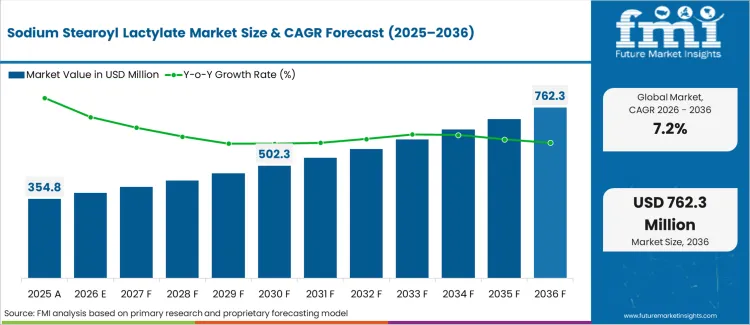
Sodium Stearoyl Lactylate Market Key Takeaways
| Metric | Details |
|---|---|
| Industry Size (2026) | USD 380.32 Million |
| Industry Value (2036) | USD 762.26 Million |
| CAGR (2026-2036) | 7.2% |
| Source | Future Market Insights, 2026 |
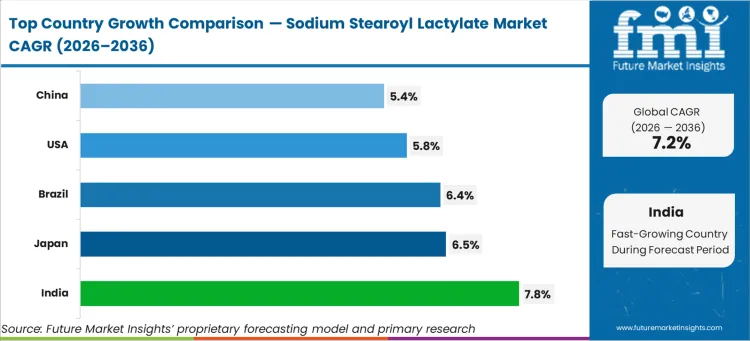
India leads growth at 7.8% CAGR as rapidly expanding organized bakery manufacturing sector investment, growing bread and processed grain food consumption, and food additive regulatory harmonization with international Codex standards drive sodium stearoyl lactylate adoption. Brazil advances at 6.4% driven by large-scale industrial bread manufacturing expansion and growing bakery chain proliferation that demands consistent dough performance ingredients across standardized production facilities. Japan sustains 6.5% growth anchored by precision bakery ingredient quality standards and pharmaceutical-grade excipient applications in topical formulation manufacturing. The United States registers 5.8% growth as mature industrial bakery operations sustain stable procurement volumes for standardized bread improver formulations. China advances at 5.4% driven by expanding Western-style bakery format adoption and growing packaged bread manufacturing capacity.
Sodium Stearoyl Lactylate Market Definition
The Sodium Stearoyl Lactylate Market encompasses the commercial supply of SSL, an ionic surfactant and food emulsifier produced by the esterification of stearic acid and lactic acid reacted with sodium hydroxide, used as a dough conditioner, crumb softener, emulsification agent, and shelf life extender in bakery products, tortillas, extruded snacks, dairy-based fillings, and cosmetic emulsion formulations.
Sodium Stearoyl Lactylate Market Inclusions
Market scope includes food-grade SSL in powder and flake formats supplied to industrial bakery manufacturers, tortilla producers, dairy ingredient processors, sauce and condiment manufacturers, and cosmetic formulation companies. Both natural-source SSL derived from non-GMO feedstocks and synthetic SSL from petrochemical stearic acid sources are within scope. Premix bakery improver formulations containing SSL as a primary active ingredient component are incorporated.
Sodium Stearoyl Lactylate Market Exclusions
Calcium stearoyl lactylate and other lactylate ester variants are excluded and valued within separate emulsifier sub-categories. Pure stearic acid and lactic acid raw material supply chains upstream of SSL synthesis are outside the defined market boundaries. Finished bakery consumer products containing SSL as an ingredient additive are not independently captured within the market valuation.
Sodium Stearoyl Lactylate Market Research Methodology
- Primary Research: Primary analysts conducted structured interviews with procurement directors, product development leads, regulatory affairs specialists, and distribution channel managers across key geographies to validate market sizing assumptions and identify emerging demand drivers.
- Desk Research: Publicly available regulatory filings, government statistical publications, trade association reports, company annual reports, investor presentations, and peer-reviewed scientific literature formed the secondary data foundation for market characterization and growth driver analysis.
- Market-Sizing and Forecasting: Forecasting applies a bottom-up methodology combining industrial bakery production volume data per geography with SSL usage rate assumptions per product category, cross-referenced with clean-label reformulation adoption rates driving natural SSL variant share shifts within total market volumes.
- Data Validation and Update Cycle: Forecast model outputs are cross-validated against company earnings disclosures, trade flow data, and regional regulatory adoption timelines. Models are reviewed and updated on a defined cycle to incorporate material market developments.
Category-wise Insights in the Sodium Stearoyl Lactylate Market
Increasing Consumer Shift towards Health and Sustainability Driving Natural Ingredient Segment for Higher Sales
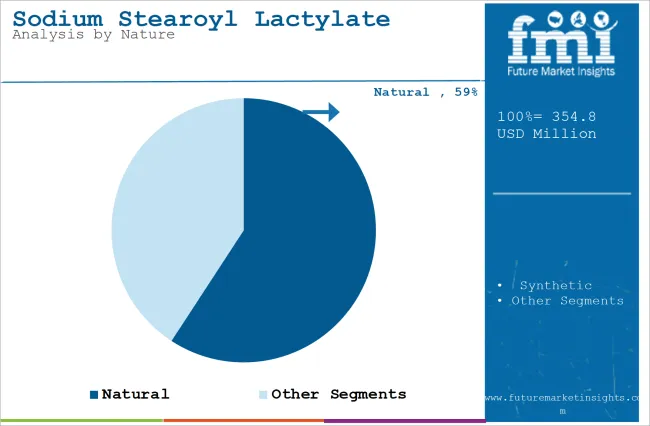
| Segment | Natural (By Nature) |
|---|---|
| Value Share (2026) | 59.2% |
With the development of chronic health issues, allergies, and chemical sensitivities, people are actively seeking safer and cleaner options. Natural skin care, hair care, and cosmetics have gained in popularity as a result of the availability of safer alternatives to toxic synthetic chemicals.
Consumers choose goods that are plant-based, organic, and organically derived, rather than those that contain parabens, sulfates, and phthalates. This trend reflects a broader societal change toward holistic well-being, in which customers value the use of effective but gentle and nutritious goods.
Environmental sustainability is another important concern for customers. People are becoming more interested in sustainable source items that are biodegradable and have less environmental impact as a result of developing issues such as climate change, pollution, and natural resource depletion.
Natural components sourced from renewable resources are often more environmentally friendly than synthetic compounds, which require a lot of energy to produce and have substantial environmental consequences. Natural oils, extracts, and botanicals, for instance, are considered to be more environmentally friendly than synthetic chemicals, which are made through petrochemical-based processes that release carbon dioxide and waste.
Key Industry Highlights in the Global Sodium Stearoyl Lactylate Market
Increasing Adoption of Gluten-Free and Low-Fat Products Boosting the Global Market
Gluten-free and low-fat diets are on the rise, owing to an increase in health-conscious customers with varying dietary requirements. This trend has resulted in an increased desire for innovative goods that can replicate the flavor, attractiveness, and texture of traditional cuisine. Sodium Stearoyl Lactylate (SSL) plays an essential role in overcoming the challenges of creating gluten-free and low-fat choices that match the health-conscious customers' expectations.
In gluten-free products, SSL is essential for compensating for the absence of gluten, the protein that gives wheat-based foods their stretch and structure. Gluten-free bread, cakes, and cookies typically have a rougher texture, less volume, and a shorter shelf life. SSL examines these issues by enhancing the dough's elasticity and hardness and creating a network that stores moisture and air, resulting in a softer, more voluminous crumb structure.
This ensures that gluten-free goods provide a similar sensory experience to their gluten-containing counterparts, which is critical for customer acceptability. Another notable development is the inclusion of SSL into low-fat dairy products and frozen desserts. Another significant advancement is the utilization of SSL in low-fat dairy products including frozen desserts.
For instance, SSL creaminess and thickens low-fat yogurts, increasing their attractiveness to people who wish to enjoy them without consuming as many calories. SSL increases stability and homogeneity in gluten-free recipes by enhancing protein and starch binding. Consider the bread without gluten. SSL helps create a sturdy structure that prolongs the food's shelf life, enhances its flavor, and prevents it from collapsing.
Plant-Based and Vegan Food Applications Propelling the Sodium Stearoyl Lactylate Market Growth
SSL is utilized in plant-based and vegan culinary applications primarily for its emulsifying and texturizing properties. SSL is important in manufacturing homogeneous and shelf-stable goods since plant-based proteins, oils, and other non-dairy ingredients commonly generate instability issues in food formulations.
SSL aids in the emulsification of the fat and water phases in plant-based dairy substitutes like almond milk, oat milk, or vegan cheese, guaranteeing a smooth and creamy texture that closely resembles that of conventional dairy products. SSL also helps achieve the right consistency and avoid phase separation in vegan spreads and margarine, enhancing the consumer attractiveness of these products.
Another significant use for SSL in the industry is through plant-based meat alternatives. These products utilize mixtures of various plant proteins, fibers, and fats to more closely approximate taste and texture conditions found in comparable animal-based alternatives.
SSL plays a role by cross-linking these individual components to more effectively provide additional strength and a more desirable mouth feel. Furthermore, SSL stabilizes foams and emulsions that also comprise parts of a plant-based formulation of meat-type products to manufacture products that feature juicier and more succulent textures for consumers.
Expansion into Organic and Natural Food Formulations Augments the Market
The increasing customer demand for organic and natural food products is quite an opportunity through which Sodium Stearoyl Lactylate (SSL) can stake its place in these formulations. The organic food market is seeing rapid growth under the pressures of health and wellness, environmentalism, and ethics related to consumption habits.
Customers show a growing penchant for food without artificial additives as much as possible, clean label certifications, and ingredients sourced directly from nature. Though SSL is manufactured, its two primary ingredients are derived from natural materials acid and stearic acid-so SSL can be formulated to meet the requirements for compatibility with natural and organic foods. This unique advantage makes SSL an excellent ingredient in this emerging market.
Organic and natural food products typically are difficult to formulate to match their conventional counterparts in terms of sensory attributes, shelf life, and quality. Because of the lack of traditional additives and synthetic preservatives, such products have a high potential for phase separation, texture, and decreased shelf life.
SSL combats this problem since it can work as an excellent emulsifier and stabilizer for homogeneous mixtures, ensuring the appearance, texture, and life of organic and natural products are increased. For instance, the stabilization of oil and water emulsions for organic dressings, sauces, and spreads is very essential. It prevents separation and brings a creamy consistency thus making it appealing.
Comparison of Sales Outlook 2021 to 2025 vs Forecast from 2026 to 2036
Global sales increased at a CAGR of 6.4% from 2021 to 2025. For the next ten years 2026 to 2036, projections are that expenditure on such products will rise at 7.2% CAGR.
Between 2021 and 2025 sodium stearoyl lactylate’s functional versatility as an emulsifier, stabilizer, and dough conditioner has made it a staple ingredient in processed foods, baked goods, and dairy alternatives. Merck KGaA and BASF SE leveraged Sodium Stearoyl Lactylate for its emulsifying properties.
Increasing demand for personal care products in emerging nations has led to an overstock of cosmetic-grade components. Sodium stearoyl lactylates can be found in scrubs, shaving creams, perfumed pomades, and moisturizers. Sodium stearoyl lactylates are utilized as an emulsion, emollient, and lubricant in a wide range of cosmetics and beauty products.
From the year 2026 to 2036, the increased popularity of plant-based and vegan diets is expected to considerably increase SSL demand. Its capacity to stabilize and enhance the texture of plant-based dairy and meat replacements renders it significant in plant-based and vegan food products.
Market Concentration in the Sodium Stearoyl Lactylate Market
Tier 1 companies in Sodium Stearoyl Lactylate, account for a significant share of the global market. BASF SE, Merck KgaA, and Cargill, Inc., these companies account for a major share of the global market and are at the forefront of innovation.
They are constantly driving innovation in Sodium Stearoyl Lactylate applications and emphasizing removing artificial additives aligns with the increasing consumer demand for safe and trustworthy solutions. Their enormous global presence, as well as their ability to propel advancements in product quality and sustainability, maintain their position as industry leaders.
Tier 2 Companies are the regional players focused on specialized products and adjust their offers to local consumer tastes, assuring competitiveness and adaptability within their territories. These companies frequently bridge the gap between global leaders and regional leaders.
Tier 3 Companies are smaller players who are usually limited to the local or regional areas. They tend to service localized areas and do not possess the same level of research & development as bigger companies but are nonetheless helpful in satisfying local needs. These companies are smaller in size but remain strong in their target industries which produce Sodium Stearoyl Lactylate tailored to the specific needs of niche producers.
Country-wise Insights in the Sodium Stearoyl Lactylate Industry
The following table shows the estimated growth rates of the top three territories. China and Japan are set to exhibit high consumption, recording CAGRs of 5.4% and 6.5%, respectively, through 2036.
.webp "Top Country Growth Comparison Sodium Stearoyl Lactylate Market Cagr (2026 2036)")
| Country | CAGR, 2026 to 2036 |
|---|---|
| The USA | 5.8% |
| Brazil | 6.4% |
| India | 7.8% |
| Japan | 6.5% |
| China | 5.4% |
Increasing Consumer Preference for Clean Label and Health-Conscious Food is Augmenting the Market Growth in the USA
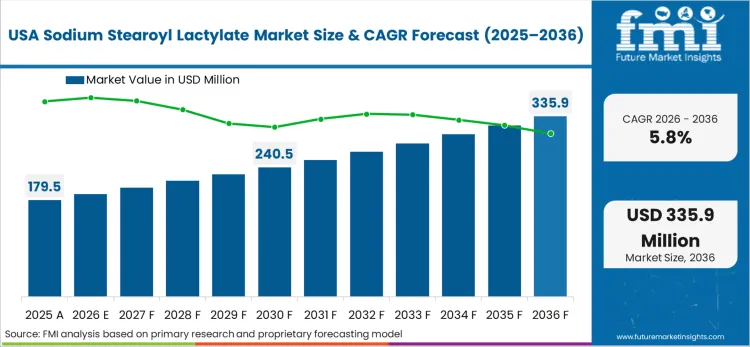
The rising demand for Sodium Stearoyl Lactylate (SSL) in the United States corresponds to an increasing demand from consumers for clean-label food products with transparent, simple, and easily recognized ingredients.
As consumers' health awareness grows, there is a definite demand for food items that do not include synthetic chemicals or preservatives, with clean-label alternatives gaining popularity. In this context, SSL stands out as a flexible emulsifier that fits the demands of producers looking to comply with the clean-label movement.
SSL, while being synthetically created, is an appealing alternative since it is formed from naturally occurring components such as lactic acid and stearic acid, which are frequently acquired from plant-based sources. This provides SSL an advantage over other emulsifiers, which may be seen as too processed or chemically manipulated. For many Americans, knowing that the emulsifier in their food is organically derived and has a simple chemical makeup makes SSL an acceptable component in clean-label products.
Emerging Applications of Sodium Stearoyl Lactylate in Skin Care is Augmenting Market in the UK
Sodium Stearoyl Lactylate is becoming an increasingly important component for UK-based enterprises as they use it in skin care products. The product's multipurpose characteristics meet the growing consumer demand for high-performance, safe, and effective products. SSL's emulsifier, stabilizer, and skin-conditioning agent qualities are in great demand as the cosmetics industry seeks clean-label, sustainable, and naturally derived compounds.
This movement coincides with a larger shift in the UK toward using eco-friendly, cruelty-free, and dermatologically-tested personal care products.
SSL has emulsifying properties to improve the texture of, spreadability of, and stability within skin care formulations. The components blended by SSL include oil and water-based, which ensure that the products will be smoothly consistent as a result. SSL gives it contributes towards better delivering the active ingredients, so the overall effectiveness of the products will increase, thus making skin care products more attractive to consumers willing to use targeted results products. Furthermore, the gentle and non-irritative nature of SSL makes it a good choice for sensitive skin formulations, an increasingly important concern for consumers in the UK
Competitive Outlook of the Sodium Stearoyl Lactylate Market
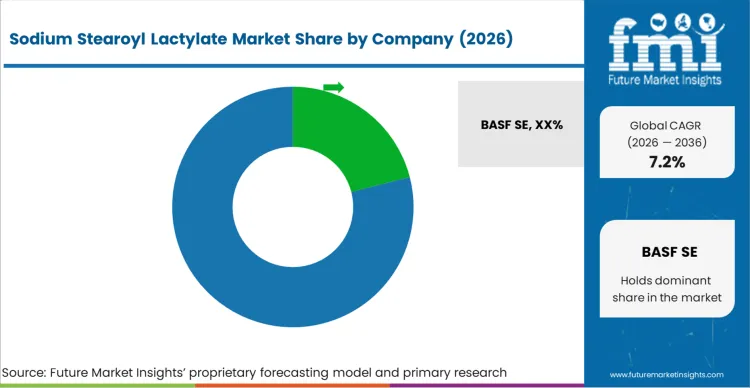
The competition landscape of the Sodium Stearoyl Lactylate market is intense. BASF SE, Cargill, Inc., and Merck KGaA are some of the major market players and contribute significantly in terms of research & development investment and emphasizing the development of sustainability and availability of Sodium Stearoyl Lactylate formulations to meet the requirements of the food, and cosmetics industry.
To expand their sales, producers are implementing numerous strategies including strategic and vertical acquisitions. Strategic collaborations between cosmetics, food industry producers, and technology manufacturers are becoming more widespread and promoting high-product innovation in Sodium Stearoyl Lactylate solutions. Furthermore, sustainability trends and growing regulatory constraints are motivating players to develop and distinguish their products while fostering a culture of continual innovation.
For instance:
- Cargill has strengthened its position in the SSL industry by expanding its manufacturing capacity to meet rising demand in the food and beverage sector. The firm has concentrated on enhancing the quality and functionality of its SSL products, ensuring that they satisfy the changing demands of customers looking for clean-label and natural components.
- Evonik has invested in cutting-edge manufacturing facilities to boost SSL production capacity, providing a consistent supply to satisfy growing demand in the European market. Their emphasis on research and development has resulted in the development of SSL products with expanded functionality that cater to a wide range of industrial requirements.
Top Brands in the Global Sodium Stearoyl Lactylate Market
- BASF SE
- Merck KGaA
- Adani Wilmar Limited
- Archer Daniels Midland Company
- Cargill, Inc.
- Dow DuPont
- Essential Ingredients, Inc.
- Evonik Industries AG
- Koninklijke DSM N.V.
- Kerry Group Plc
- Others
Scope of the Report
| Metric | Value |
|---|---|
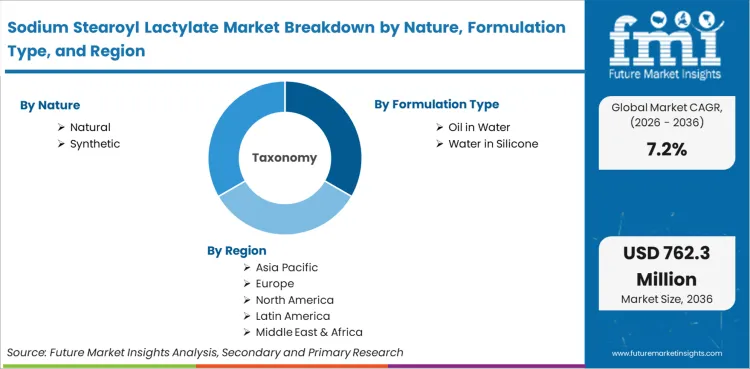
| Quantitative Units | USD 380.32 Million to USD 762.26 Million, at a CAGR of 7.2% |
| Market Definition | The Sodium Stearoyl Lactylate Market encompasses the commercial supply of SSL, an ionic surfactant and food emulsifier produced by the esterification of stearic acid and lactic acid reacted with sodium hydroxide. |
| Nature Segmentation | Natural, Synthetic |
| Formulation Type Segmentation | Oil in Water, Water in Silicone |
| Regions Covered | North America, Latin America, Europe, East Asia, South Asia, Oceania, Middle East & Africa |
| Countries Covered | India, Brazil, Japan, USA, China, and 40 plus countries |
| Key Companies Profiled | BASF SE, Merck KGaA, Adani Wilmar Limited, Archer Daniels Midland Company, Cargill Inc., Dow DuPont, Essential Ingredients Inc., Evonik Industries AG |
| Forecast Period | 2026 to 2036 |
| Approach | Forecasting applies a bottom-up methodology combining industrial bakery production volume data per geography with SSL usage rate assumptions per product category, cross-referenced with clean-label reformulation adoption rates driving natural SSL variant share shifts within total market volumes. |
Top Segments Studied in the Sodium Stearoyl Lactylate Market Report
By Nature:
As per Nature, the industry has been categorized into Natural and Synthetic.
By Formulation Type:
As per Formulation Type, the industry has been categorized into Oil in Water, and Water in Silicone.
By Form Type:
As per Form Type, the industry has been categorized into Fine Powder, and Hydrate.
By End Use:
As per End Use, the industry has been categorized into Bakery & Confectionery, Dairy Industry, Meat & Poultry, and Cosmetic Industry, among others.
By Region:
Industry analysis has been carried out in key countries of North America, Latin America, Western Europe, Eastern Europe, East Asia, South Asia & Pacific, Central Asia, Russia and Belarus, Balkan & Baltics, and the Middle East & Africa.
Bibliography
- 1. European Food Safety Authority. (2024). Re-evaluation of sodium stearoyl-2-lactylate (E481) as a food additive. EFSA Journal.
- 2. Codex Alimentarius Commission. (2024). General standard for food additives: emulsifiers and stabilizers. FAO/WHO.
- 3. United States Food and Drug Administration. (2024). Code of Federal Regulations Title 21: sodium stearoyl lactylate GRAS status. FDA.
- 4. Food Safety and Standards Authority of India. (2024). Food additives regulations: permitted emulsifiers and stabilizers. FSSAI.
- 5. Ministry of Health, Labour and Welfare Japan. (2024). Food additive standards: emulsifier specifications and usage conditions. MHLW.
This bibliography is provided for reader reference. The full FMI report contains the complete reference list with primary research documentation.
Frequently Asked Questions
How large is the demand for Sodium Stearoyl Lactylate Market in the global market in 2026?
Demand for sodium stearoyl lactylate market in the global market is estimated to be valued at USD 380.32 Million in 2026.
What will be the market size of Sodium Stearoyl Lactylate Market in the global market by 2036?
Market size for sodium stearoyl lactylate market is projected to reach USD 762.26 Million by 2036.
What is the expected demand growth for Sodium Stearoyl Lactylate Market between 2026 and 2036?
Demand for sodium stearoyl lactylate market is expected to grow at a CAGR of 7.2% between 2026 and 2036.
What is Sodium Stearoyl Lactylate Market and what is it mainly used for?
The Sodium Stearoyl Lactylate Market encompasses the commercial supply of SSL, an ionic surfactant and food emulsifier produced by the esterification of stearic acid and lactic acid reacted with sodium hydroxide, used as a dough conditioner, crumb softener, emulsification agent, and shelf life extender in bakery products, tortillas, extruded snacks, dairy-based fillings, and cosmetic emulsion formulations.
What is included in the scope of this Sodium Stearoyl Lactylate Market report?
Market scope includes food-grade SSL in powder and flake formats supplied to industrial bakery manufacturers, tortilla producers, dairy ingredient processors, sauce and condiment manufacturers, and cosmetic formulation companies. Both natural-source SSL derived from non-GMO feedstocks and synthetic SSL from petrochemical stearic acid sources are within scope. Premix bakery improver formulations containing SSL as a primary active ingredient component are incorporated.
What is excluded from the scope of this report?
Calcium stearoyl lactylate and other lactylate ester variants are excluded and valued within separate emulsifier sub-categories. Pure stearic acid and lactic acid raw material supply chains upstream of SSL synthesis are outside the defined market boundaries. Finished bakery consumer products containing SSL as an ingredient additive are not independently captured within the market valuation.
How does FMI build and validate the Sodium Stearoyl Lactylate Market forecast?
Forecasting applies a bottom-up methodology combining industrial bakery production volume data per geography with SSL usage rate assumptions per product category, cross-referenced with clean-label reformulation adoption rates driving natural SSL variant share shifts within total market volumes.
Which Nature segment leads the Sodium Stearoyl Lactylate Market in 2026?
Natural SSL commands 59.2% share in 2026, as clean-label reformulation programs at major food manufacturers prioritize non-GMO certified and naturally derived SSL variants that maintain functional performance while supporting cleaner ingredient declaration positioning.
Which Formulation Type dominates Sodium Stearoyl Lactylate Market demand?
Oil in water formulations hold 35.0% share in 2026, as aqueous phase emulsification requirements in bread dough, dairy filling, and sauce applications represent the largest volume application category for SSL emulsifier functionality.
What is driving demand in Brazil?
Brazil's 6.4% CAGR reflects rapid industrial bakery chain expansion across major urban centers, growing packaged bread consumption substituting traditional artisan bakery, and food additive regulatory harmonization with Codex Alimentarius standards enabling SSL adoption by domestic food manufacturers.
Preview the report firsthand - request a free sample
Get SampleGet the brochure for pricing and purchase details.
Get PDFTable of Content
- Executive Summary
- Global Market Outlook
- Demand-side Trends
- Supply-side Trends
- Technology Roadmap Analysis
- Analysis and Recommendations
- Market Overview
- Market Coverage / Taxonomy
- Market Definition / Scope / Limitations
- Research Methodology
- Chapter Orientation
- Analytical Lens and Working Hypotheses
- Market Structure, Signals, and Trend Drivers
- Benchmarking and Cross-market Comparability
- Market Sizing, Forecasting, and Opportunity Mapping
- Research Design and Evidence Framework
- Desk Research Programme (Secondary Evidence)
- Company Annual and Sustainability Reports
- Peer-reviewed Journals and Academic Literature
- Corporate Websites, Product Literature, and Technical Notes
- Earnings Decks and Investor Briefings
- Statutory Filings and Regulatory Disclosures
- Technical White Papers and Standards Notes
- Trade Journals, Industry Magazines, and Analyst Briefs
- Conference Proceedings, Webinars, and Seminar Materials
- Government Statistics Portals and Public Data Releases
- Press Releases and Reputable Media Coverage
- Specialist Newsletters and Curated Briefings
- Sector Databases and Reference Repositories
- FMI Internal Proprietary Databases and Historical Market Datasets
- Subscription Datasets and Paid Sources
- Social Channels, Communities, and Digital Listening Inputs
- Additional Desk Sources
- Expert Input and Fieldwork (Primary Evidence)
- Primary Modes
- Qualitative Interviews and Expert Elicitation
- Quantitative Surveys and Structured Data Capture
- Blended Approach
- Why Primary Evidence is Used
- Field Techniques
- Interviews
- Surveys
- Focus Groups
- Observational and In-context Research
- Social and Community Interactions
- Stakeholder Universe Engaged
- C-suite Leaders
- Board Members
- Presidents and Vice Presidents
- R&D and Innovation Heads
- Technical Specialists
- Domain Subject-matter Experts
- Scientists
- Physicians and Other Healthcare Professionals
- Governance, Ethics, and Data Stewardship
- Research Ethics
- Data Integrity and Handling
- Primary Modes
- Tooling, Models, and Reference Databases
- Desk Research Programme (Secondary Evidence)
- Data Engineering and Model Build
- Data Acquisition and Ingestion
- Cleaning, Normalisation, and Verification
- Synthesis, Triangulation, and Analysis
- Quality Assurance and Audit Trail
- Market Background
- Market Dynamics
- Drivers
- Restraints
- Opportunity
- Trends
- Scenario Forecast
- Demand in Optimistic Scenario
- Demand in Likely Scenario
- Demand in Conservative Scenario
- Opportunity Map Analysis
- Product Life Cycle Analysis
- Supply Chain Analysis
- Investment Feasibility Matrix
- Value Chain Analysis
- PESTLE and Porter’s Analysis
- Regulatory Landscape
- Regional Parent Market Outlook
- Production and Consumption Statistics
- Import and Export Statistics
- Market Dynamics
- Global Market Analysis 2021 to 2025 and Forecast, 2026 to 2036
- Historical Market Size Value (USD Million) Analysis, 2021 to 2025
- Current and Future Market Size Value (USD Million) Projections, 2026 to 2036
- Y-o-Y Growth Trend Analysis
- Absolute $ Opportunity Analysis
- Global Market Pricing Analysis 2021 to 2025 and Forecast 2026 to 2036
- Global Market Analysis 2021 to 2025 and Forecast 2026 to 2036, By Nature
- Introduction / Key Findings
- Historical Market Size Value (USD Million) Analysis By Nature , 2021 to 2025
- Current and Future Market Size Value (USD Million) Analysis and Forecast By Nature , 2026 to 2036
- Natural
- Synthetic
- Natural
- Y-o-Y Growth Trend Analysis By Nature , 2021 to 2025
- Absolute $ Opportunity Analysis By Nature , 2026 to 2036
- Global Market Analysis 2021 to 2025 and Forecast 2026 to 2036, By Formulation Type
- Introduction / Key Findings
- Historical Market Size Value (USD Million) Analysis By Formulation Type, 2021 to 2025
- Current and Future Market Size Value (USD Million) Analysis and Forecast By Formulation Type, 2026 to 2036
- Oil in Water
- Water in Silicone
- Oil in Water
- Y-o-Y Growth Trend Analysis By Formulation Type, 2021 to 2025
- Absolute $ Opportunity Analysis By Formulation Type, 2026 to 2036
- Global Market Analysis 2021 to 2025 and Forecast 2026 to 2036, By Region
- Introduction
- Historical Market Size Value (USD Million) Analysis By Region, 2021 to 2025
- Current Market Size Value (USD Million) Analysis and Forecast By Region, 2026 to 2036
- North America
- Latin America
- Western Europe
- Eastern Europe
- East Asia
- South Asia and Pacific
- Middle East & Africa
- Market Attractiveness Analysis By Region
- North America Market Analysis 2021 to 2025 and Forecast 2026 to 2036, By Country
- Historical Market Size Value (USD Million) Trend Analysis By Market Taxonomy, 2021 to 2025
- Market Size Value (USD Million) Forecast By Market Taxonomy, 2026 to 2036
- By Country
- USA
- Canada
- Mexico
- By Nature
- By Formulation Type
- By Country
- Market Attractiveness Analysis
- By Country
- By Nature
- By Formulation Type
- Key Takeaways
- Latin America Market Analysis 2021 to 2025 and Forecast 2026 to 2036, By Country
- Historical Market Size Value (USD Million) Trend Analysis By Market Taxonomy, 2021 to 2025
- Market Size Value (USD Million) Forecast By Market Taxonomy, 2026 to 2036
- By Country
- Brazil
- Chile
- Rest of Latin America
- By Nature
- By Formulation Type
- By Country
- Market Attractiveness Analysis
- By Country
- By Nature
- By Formulation Type
- Key Takeaways
- Western Europe Market Analysis 2021 to 2025 and Forecast 2026 to 2036, By Country
- Historical Market Size Value (USD Million) Trend Analysis By Market Taxonomy, 2021 to 2025
- Market Size Value (USD Million) Forecast By Market Taxonomy, 2026 to 2036
- By Country
- Germany
- UK
- Italy
- Spain
- France
- Nordic
- BENELUX
- Rest of Western Europe
- By Nature
- By Formulation Type
- By Country
- Market Attractiveness Analysis
- By Country
- By Nature
- By Formulation Type
- Key Takeaways
- Eastern Europe Market Analysis 2021 to 2025 and Forecast 2026 to 2036, By Country
- Historical Market Size Value (USD Million) Trend Analysis By Market Taxonomy, 2021 to 2025
- Market Size Value (USD Million) Forecast By Market Taxonomy, 2026 to 2036
- By Country
- Russia
- Poland
- Hungary
- Balkan & Baltic
- Rest of Eastern Europe
- By Nature
- By Formulation Type
- By Country
- Market Attractiveness Analysis
- By Country
- By Nature
- By Formulation Type
- Key Takeaways
- East Asia Market Analysis 2021 to 2025 and Forecast 2026 to 2036, By Country
- Historical Market Size Value (USD Million) Trend Analysis By Market Taxonomy, 2021 to 2025
- Market Size Value (USD Million) Forecast By Market Taxonomy, 2026 to 2036
- By Country
- China
- Japan
- South Korea
- By Nature
- By Formulation Type
- By Country
- Market Attractiveness Analysis
- By Country
- By Nature
- By Formulation Type
- Key Takeaways
- South Asia and Pacific Market Analysis 2021 to 2025 and Forecast 2026 to 2036, By Country
- Historical Market Size Value (USD Million) Trend Analysis By Market Taxonomy, 2021 to 2025
- Market Size Value (USD Million) Forecast By Market Taxonomy, 2026 to 2036
- By Country
- India
- ASEAN
- Australia & New Zealand
- Rest of South Asia and Pacific
- By Nature
- By Formulation Type
- By Country
- Market Attractiveness Analysis
- By Country
- By Nature
- By Formulation Type
- Key Takeaways
- Middle East & Africa Market Analysis 2021 to 2025 and Forecast 2026 to 2036, By Country
- Historical Market Size Value (USD Million) Trend Analysis By Market Taxonomy, 2021 to 2025
- Market Size Value (USD Million) Forecast By Market Taxonomy, 2026 to 2036
- By Country
- Kingdom of Saudi Arabia
- Other GCC Countries
- Turkiye
- South Africa
- Other African Union
- Rest of Middle East & Africa
- By Nature
- By Formulation Type
- By Country
- Market Attractiveness Analysis
- By Country
- By Nature
- By Formulation Type
- Key Takeaways
- Key Countries Market Analysis
- USA
- Pricing Analysis
- Market Share Analysis, 2025
- By Nature
- By Formulation Type
- Canada
- Pricing Analysis
- Market Share Analysis, 2025
- By Nature
- By Formulation Type
- Mexico
- Pricing Analysis
- Market Share Analysis, 2025
- By Nature
- By Formulation Type
- Brazil
- Pricing Analysis
- Market Share Analysis, 2025
- By Nature
- By Formulation Type
- Chile
- Pricing Analysis
- Market Share Analysis, 2025
- By Nature
- By Formulation Type
- Germany
- Pricing Analysis
- Market Share Analysis, 2025
- By Nature
- By Formulation Type
- UK
- Pricing Analysis
- Market Share Analysis, 2025
- By Nature
- By Formulation Type
- Italy
- Pricing Analysis
- Market Share Analysis, 2025
- By Nature
- By Formulation Type
- Spain
- Pricing Analysis
- Market Share Analysis, 2025
- By Nature
- By Formulation Type
- France
- Pricing Analysis
- Market Share Analysis, 2025
- By Nature
- By Formulation Type
- India
- Pricing Analysis
- Market Share Analysis, 2025
- By Nature
- By Formulation Type
- ASEAN
- Pricing Analysis
- Market Share Analysis, 2025
- By Nature
- By Formulation Type
- Australia & New Zealand
- Pricing Analysis
- Market Share Analysis, 2025
- By Nature
- By Formulation Type
- China
- Pricing Analysis
- Market Share Analysis, 2025
- By Nature
- By Formulation Type
- Japan
- Pricing Analysis
- Market Share Analysis, 2025
- By Nature
- By Formulation Type
- South Korea
- Pricing Analysis
- Market Share Analysis, 2025
- By Nature
- By Formulation Type
- Russia
- Pricing Analysis
- Market Share Analysis, 2025
- By Nature
- By Formulation Type
- Poland
- Pricing Analysis
- Market Share Analysis, 2025
- By Nature
- By Formulation Type
- Hungary
- Pricing Analysis
- Market Share Analysis, 2025
- By Nature
- By Formulation Type
- Kingdom of Saudi Arabia
- Pricing Analysis
- Market Share Analysis, 2025
- By Nature
- By Formulation Type
- Turkiye
- Pricing Analysis
- Market Share Analysis, 2025
- By Nature
- By Formulation Type
- South Africa
- Pricing Analysis
- Market Share Analysis, 2025
- By Nature
- By Formulation Type
- USA
- Market Structure Analysis
- Competition Dashboard
- Competition Benchmarking
- Market Share Analysis of Top Players
- By Regional
- By Nature
- By Formulation Type
- Competition Analysis
- Competition Deep Dive
- BASF SE
- Overview
- Product Portfolio
- Profitability by Market Segments (Product/Age /Sales Channel/Region)
- Sales Footprint
- Strategy Overview
- Marketing Strategy
- Product Strategy
- Channel Strategy
- Merck KGaA
- Adani Wilmar Limited
- Archer Daniels Midland Company
- Cargill, Inc.
- Dow DuPont
- Essential Ingredients, Inc.
- Evonik Industries AG
- Koninklijke DSM N.V.
- Kerry Group Plc
- Others
- BASF SE
- Competition Deep Dive
- Assumptions & Acronyms Used


