

- Market Size (2026)
- USD 55.0 Mn
- Forecast (2036)
- USD 130.0 Mn
- CAGR (2026 to 2036)
- 9.0%
How big is the software defined vehicle test automation tools market in 2026?
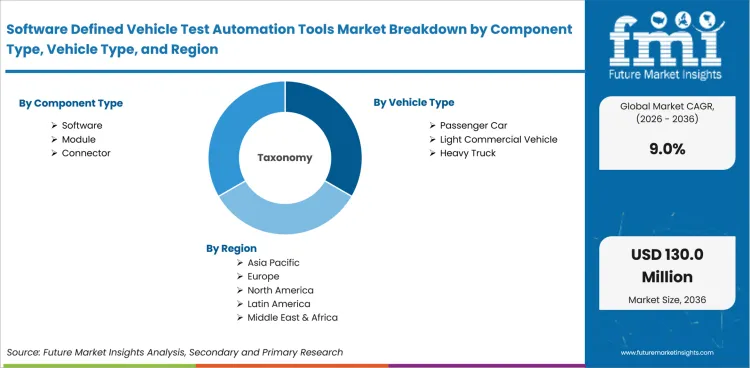
USD 55.0 million in 2026 and USD 130.0 million by 2036 at a 9.0% CAGR.
The software defined vehicle test automation tools industry value is forecast to grow from USD 50.5 million in 2025 to USD 130.0 million by 2036 at 9.0% CAGR as OEMs shift validation into virtual ECUs, HIL benches, cybersecurity labs, and release-traceability pipelines. Passenger car programs are forecast to represent 58.0% share in 2026 because cockpit, ADAS, connectivity, and software-update functions create the largest validation workload. OEM channels are expected to secure 52.0% share in 2026, led by platform owners qualifying common tool stacks across global software-defined vehicle programs.
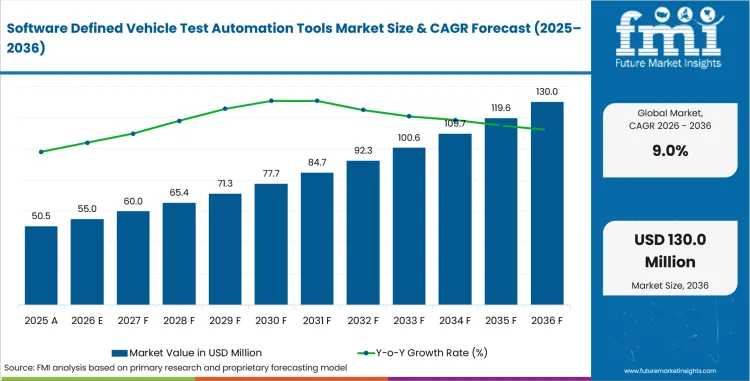
Software Defined Vehicle Test Automation Tools Market Overview: Size and Forecast
- 2026 Market Size: USD 55.0 million
- 2036 Market Size: USD 130.0 million
- Forecast CAGR: 9.0% from 2026 to 2036
- Leading Vehicle Type: Passenger Car
- Passenger Car Share in 2026: 58.0%
- Leading Sales Channel: OEM
- OEM Share in 2026: 52.0%
- Fastest-growing Country: India
- India CAGR: 10.4% by 2036
Summary of the Software Defined Vehicle Test Automation Tools Market
The software defined vehicle test automation tools market is expected to witness steady growth through 2036, driven by demand from OEMs and Tier 1 suppliers seeking reusable validation evidence across virtual ECUs, hardware benches, cybersecurity testing, and vehicle network conformance.
- Demand and Growth Drivers
- OEM software factories are shifting test execution earlier so defects are found before hardware benches are fully available.
- Cybersecurity validation is becoming a release requirement as connected vehicles expose more interfaces to controlled attack testing.
- Engineering service centers are standardizing reusable scripts and virtual models across global software-defined vehicle programs.
- Product and Segment View
- Passenger car programs are forecast to represent 58.0% share in 2026, led by ADAS, infotainment, cockpit, and connected-service software complexity.
- OEM channels are projected to hold 52.0% share in 2026, influenced by direct tool qualification and common release-evidence requirements.
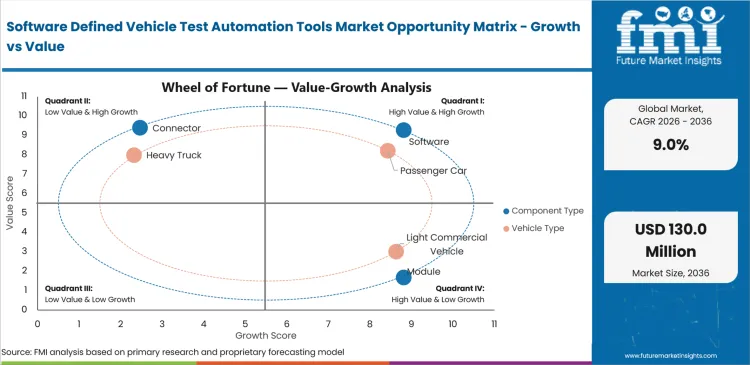
- Software is expected to secure 46.0% share in 2026, supported by virtual test execution, traceability management, and reusable automation assets.
- Geography and Competitive Outlook
- India is projected to record 10.4% CAGR by 2036, backed by engineering-service exports and virtual ECU validation work.
- China is expected to expand at 10.1% CAGR by 2036 through EV scale, fast model refresh cycles, and cockpit software testing.
- Vector Informatik and dSPACE compete through mature SIL, HIL, ECU, and network validation environments.
- ETAS, Keysight, Synopsys, MathWorks, and Elektrobit focus on cybersecurity, virtualization, embedded software, and digital twin workflows.
- Analyst Opinion
- Nikhil Kaitwade, Principal Consultant at Future Market Insights, observes, “Software defined vehicle test automation tools are moving from bench support into release governance. OEMs need reusable test intent across cloud simulation, HIL systems, vehicle networks, and cybersecurity checks. Suppliers with open interfaces and audit-ready evidence should gain stronger buyer confidence.”
Validation demand is becoming more structured as electrification and connected-vehicle software expand test-case volume. The International Energy Agency reported that global electric car sales exceeded 20 million in 2025, representing 25.0% of all new cars sold. It also reported that nearly 22 million electric cars were produced globally in 2025, up more than 25.0% from the previous year. dSPACE stated in December 2024 that its XSG Power Electronics Systems software supports simulation of switching frequencies up to 1.5 MHz, showing how validation suppliers are extending capability for electric and software-defined platforms.
Which factors support expansion in the software defined vehicle test automation tools market?
Finished SDV validation software revenue and traceable release evidence support market value across OEM, Tier 1, and engineering-service channels.
- Market value is supported by tool license revenue before cloud simulation and integration services add incremental spending.
- Supplier pricing reflects protocol coverage, traceability depth, and support for SIL and HIL reuse before seat expansion improves account value.
- Revenue improves as OEMs move repetitive validation from manual bench checks into automated pipelines.
- Buyer trust rises as test artifacts connect requirements, virtual ECUs, cybersecurity checks, and release documentation.
Why is the software defined vehicle test automation tools market growing?
SDV programs need repeatable test evidence as over-the-air updates turn vehicle software into a continuing release process.
Software teams are shifting validation earlier because hardware benches can no longer carry the full test load alone. The IEA reported that electric car sales in Europe reached 4.2 million in 2025, accounting for 28.0% of new cars sold across the region. Electric platforms carry battery controls, charging logic, safety functions, and connected services that require repeated verification before release. ASAM XIL enables communication between test automation tools and test benches across MIL, SIL, and HIL stages. This strengthens buyer interest in interoperable SDV network conformance test solutions and automotive network testing tools that can work inside release pipelines.
How is the software defined vehicle test automation tools market segmented?
The software defined vehicle test automation tools industry is segmented by component type, vehicle type, propulsion, sales channel, and test workflow.
- Software is projected to secure 46.0% share in 2026, led by reusable test scripts, virtual ECU support, traceability dashboards, and automated regression execution.
- Passenger car programs are anticipated to hold 58.0% share in 2026 since cockpit, ADAS, connectivity, and OTA functions create the largest software test-case volume.
- Battery electric programs are expected to capture 41.0% share in 2026 due to charging controls, battery management systems, thermal safeguards, and high-voltage safety logic.
- OEM channels are forecast to represent 52.0% share in 2026, guided by vehicle platform owners approving common validation stacks across global programs.
- SIL and HIL validation workflows are projected to account for 44.0% share in 2026, reflected by test teams needing reusable assets between virtual simulation and physical benches.
Why does software dominate the software defined vehicle test automation tools market?
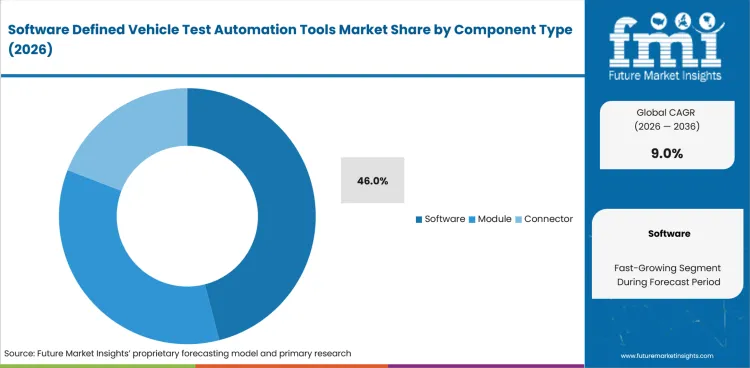
- Software is projected to account for 46.0% share in 2026, influenced by reusable scripts, virtual models, traceability records, and automated regression workflows.
- Hardware modules gain value when they connect directly with software-led validation environments and reduce manual bench setup effort.
Which vehicle type leads the software defined vehicle test automation tools market?
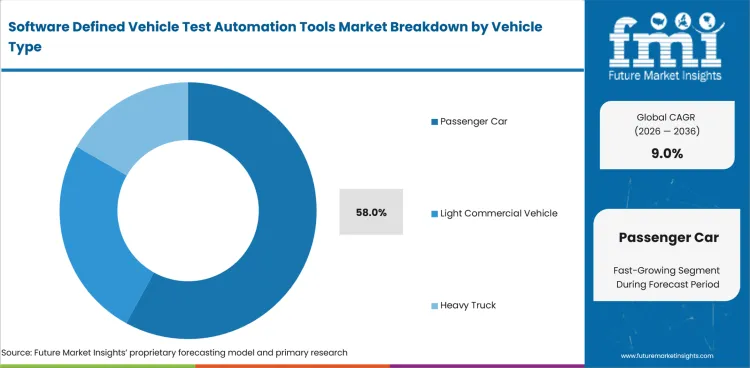
- Passenger car programs are estimated to hold 58.0% share in 2026 through dense cockpit, ADAS, connected-service, and OTA update validation needs.
- Heavy trucks gain importance as fleet connectivity, battery controls, and driver-assistance features increase test complexity in commercial platforms.
Which propulsion segment leads the software defined vehicle test automation tools market?
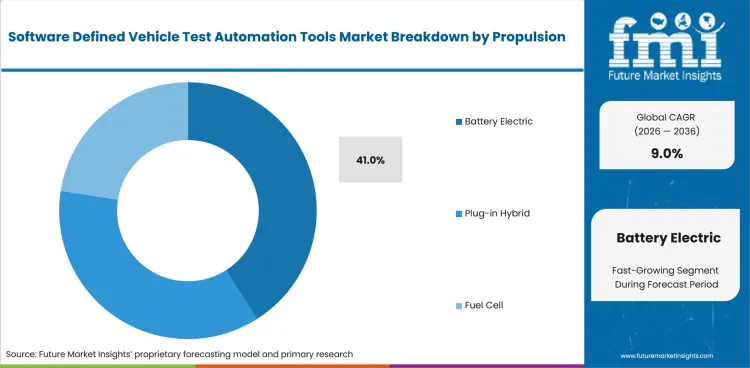
- Battery electric programs are anticipated to represent 41.0% share in 2026 as charging software, battery management, and power electronics require repeated test coverage.
- Hybrid programs continue to use validation tools where engine control, electric drive logic, and diagnostics must be tested together.
Which sales channel leads the software defined vehicle test automation tools market?
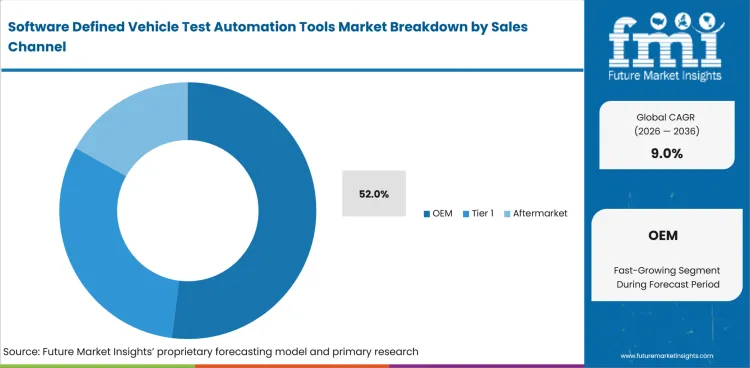
- OEM channels are expected to account for 52.0% share in 2026, shaped by platform-level tool approval and internal release governance.
- Tier 1 channels gain importance when suppliers must align software evidence with OEM safety, cybersecurity, and homologation requirements.
Which test workflow leads the software defined vehicle test automation tools market?
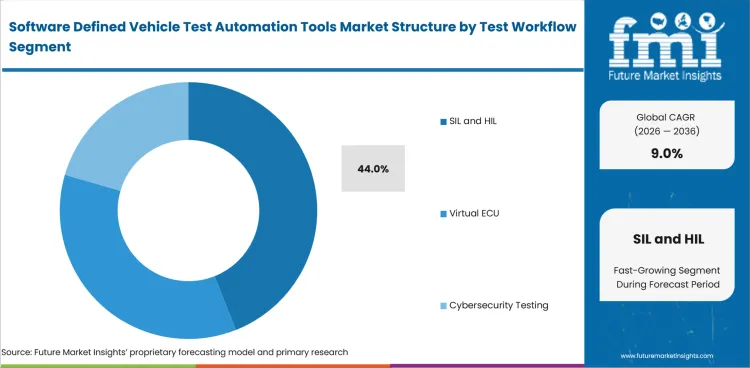
- SIL and HIL validation workflows are projected to hold 44.0% share in 2026, supported by reusable test cases moving between virtual simulation and lab benches.
- Cybersecurity testing gains faster adoption as connected vehicle interfaces require fuzzing, threat simulation, and audit-ready evidence.
What are the driver, restraints, and opportunities in the software defined vehicle test automation tools market?
SDV validation demand is rising while toolchain fragmentation and integration cost can slow wider adoption.
- Driver: OEMs are moving validation earlier so software defects are detected before vehicle hardware is finalized.
- Restraint: Toolchain fragmentation can create duplicate scripts across SIL, HIL, cloud, and vehicle-level test environments.
- Opportunity: Open standards and virtual ECU workflows can support reusable test evidence across global software teams.
Virtual ECU and Shift-left Validation Demand Outlook
Virtual ECU validation is becoming a core driver because software teams need testable environments before final control hardware is available. ASAM states that XIL supports communication between automation tools and test benches across three main stages, including MIL, SIL, and HIL. This directly supports test reuse when functions move from model simulation into lab hardware. Suppliers that connect virtual execution with traceability records can defend value against script-only tools.
Toolchain Fragmentation and Release Evidence Pressure
Fragmented tool environments restrain adoption because OEMs do not want repeated test-case rebuilding across simulation, bench, and vehicle stages. UNECE’s software update framework defines a Software Update Management System as an organizational process used to comply with vehicle software-update requirements. This increases documentation pressure and makes poorly connected tool stacks harder to justify in regulated release programs.
Engineering Service Centers and EV Program Opportunities
Engineering-service centers create an opportunity because large test teams can reuse validation assets across multiple customer programs. India’s PM E-DRIVE scheme has an outlay of ₹10,900 crore over its implementation period, supporting EV ecosystem development and domestic testing demand. This gives validation tool suppliers a stronger route into training-heavy software teams and virtual ECU projects.
Which countries are growing fastest in the software defined vehicle test automation tools market?
India 10.4% CAGR, China 10.1% CAGR, South Korea 9.7% CAGR, Germany 9.6% CAGR, United Kingdom 9.4% CAGR, France 8.8% CAGR, United States 8.2% CAGR, and Japan 7.2% CAGR through 2036.
.webp "Top Country Growth Comparison Software Defined Vehicle Test Automation Tools Market Cagr (2026 2036)")
| Country | CAGR |
|---|---|
| United States | 8.2% |
| United Kingdom | 9.4% |
| Germany | 9.6% |
| France | 8.8% |
| Japan | 7.2% |
| China | 10.1% |
| South Korea | 9.7% |
| India | 10.4% |
Source: Future Market Insights, 2026.
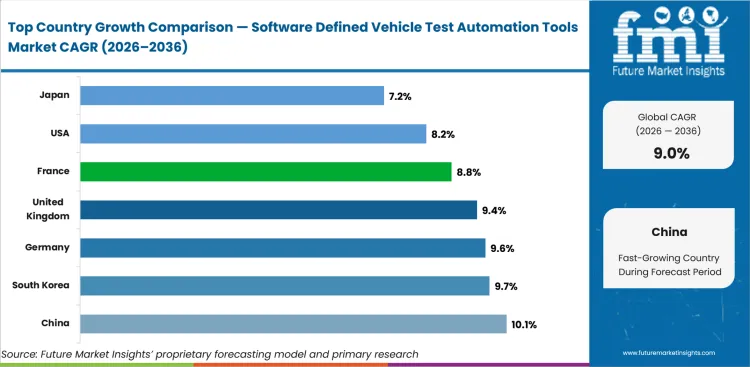
How do country-level CAGRs compare in the software defined vehicle test automation tools market?
India leads country growth while Japan records the most cautious expansion outlook among profiled markets.
- India is forecast to record 10.4% CAGR by 2036 as engineering-service centers support global SDV validation work.
- China is expected to expand at 10.1% CAGR from 2026 to 2036 due to EV platform scale and rapid cockpit software updates.
- South Korea is projected to grow at 9.7% CAGR through 2036 as export-oriented OEM programs need repeatable validation evidence.
- Germany is estimated to rise at 9.6% CAGR by 2036 with premium OEM SDV programs and local test-tool suppliers.
- The United Kingdom is expected to advance at 9.4% CAGR over the forecast period as engineering consultancies influence validation pilots.
- France is forecast to grow at 8.8% CAGR through 2036 as European platform sharing supports common tool qualification.
- The United States is projected to post 8.2% CAGR by 2036 as cybersecurity and network conformance remain buyer priorities.
- Japan is expected to record 7.2% CAGR by 2036 as hybrid-heavy programs keep validation steady but BEV test demand grows slowly.
What is the software defined vehicle test automation tools market outlook in the United States?
An 8.2% CAGR through 2036 reflects cybersecurity testing, network conformance, and OEM software-factory demand.
Country Market Snapshot Table
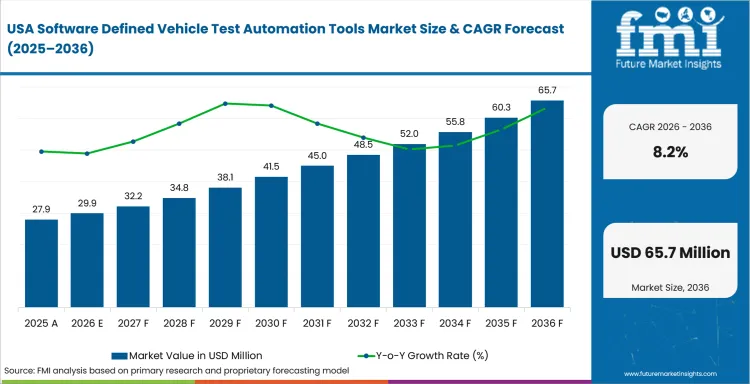
| Parameter | Value |
|---|---|
| Market Size in 2025 (Value) | USD 12.5 million |
| Market Size in 2026 (Value) | USD 13.5 million |
| Market Forecast in 2036 (Value) | USD 29.7 million |
| CAGR (2026 to 2036) | 8.2% |
| Years Considered | 2021 to 2036 |
| Base Year | 2025 |
| Forecast Period | 2026 to 2036 |
| Units Considered | Value (USD million) |
| Leading Sub-Region | California, Michigan, and major OEM software clusters |
United States Software Defined Vehicle Test Automation Tools Market Outlook
United States demand is shaped by tool qualification inside large OEM and Tier 1 software programs. Buyers prioritize cybersecurity validation, virtual ECU workflows, and automotive Ethernet conformance as SDV programs become more software intensive.
The country also acts as a supplier base for network testing, simulation, and virtual prototyping tools. Vendors with local application engineering, cloud integration, and security-test depth should gain stronger account access.
Key Growth Drivers
- EV program volume gives validation suppliers a wide test base. IEA reported United States electric car sales at around 1.5 million in 2025.
- Hybrid and electrified software work supports adjacent validation demand. Argonne reported 209,456 U.S. hybrid electric vehicles sold in April 2026.
- OEM software factories in Michigan and California need reusable suites that connect requirements, simulation, cybersecurity, and release evidence.
- Local suppliers support direct technical buying through cybersecurity platforms, virtual prototyping tools, and model-based development workflows.
Key Restraints
- Incentive uncertainty can slow electrified platform schedules. IRS stated the New Clean Vehicle Credit was available only for vehicles acquired on or before September 30, 2025, with a credit of up to USD 7,500.
- Tool approval cycles remain long when safety evidence must satisfy several OEM engineering groups.
- Legacy validation environments can limit faster migration into cloud-based SDV test automation.
What makes United States unique
United States is unique due to its strong mix of SDV software suppliers, cybersecurity testing vendors, and large OEM software-factory programs.
Key Companies
- Keysight Technologies
- Synopsys
- MathWorks
- NI Emerson
- Vector North America
- dSPACE Inc.
- ETAS Inc.
Sales & Marketing Channels
- Direct OEM enterprise sales
- Tier 1 engineering accounts
- Cloud marketplace partnerships
- Systems integrator channels
- University and test-lab programs
- Cybersecurity validation partners
Country Segment Breakdown Table
| Segment | Sub-Segments |
|---|---|
| By Component Type | Sensor · Module · Connector · Software · Thermal System |
| By Vehicle Type | Passenger Car · Light Commercial Vehicle · Heavy Truck · Two Wheeler · Bus |
| By Propulsion | Battery Electric · Plug-in Hybrid · Fuel Cell · Hybrid · ICE Retrofit |
| By Sales Channel | OEM · Tier 1 · Aftermarket · Fleet Retrofit · Charging Network |
| By Test Workflow | SIL · HIL · Virtual ECU · Cybersecurity Testing · Network Conformance |
| Key Sub-Regions Covered, OEM and Software Clusters | California · Michigan · Texas · Ohio · Massachusetts · Georgia |
Frequently Asked Questions
How fast is United States software defined vehicle test automation tools market growing?
Sales in the United States are ready to scale at 8.2% CAGR from 2026 to 2036, guided by cybersecurity validation and OEM software programs.
Who leads United States software defined vehicle test automation tools market?
Keysight, Synopsys, MathWorks, Vector, dSPACE, and ETAS compete based on cybersecurity, simulation, and ECU validation depth.
What is driving adoption in United States software defined vehicle test automation tools market?
Cybersecurity testing, automotive Ethernet validation, and OEM software-factory programs are moving buyers toward automated SDV test environments.
What is the software defined vehicle test automation tools market outlook in the United Kingdom?
A 9.4% CAGR through 2036 is supported by zero-emission policy pressure and engineering-service validation channels.
Country Market Snapshot Table
| Parameter | Value |
|---|---|
| Market Size in 2025 (Value) | USD 3.7 million |
| Market Size in 2026 (Value) | USD 4.1 million |
| Market Forecast in 2036 (Value) | USD 10.1 million |
| CAGR (2026 to 2036) | 9.4% |
| Years Considered | 2021 to 2036 |
| Base Year | 2025 |
| Forecast Period | 2026 to 2036 |
| Units Considered | Value (USD million) |
| Leading Sub-Region | Midlands, London, and proving-ground engineering corridors |
United Kingdom Software Defined Vehicle Test Automation Tools Market Outlook
United Kingdom demand is shaped by specialist engineering channels and regulatory pressure on zero-emission vehicles. Engineering consultancies and proving-ground operators influence test-stack selection before wider OEM rollout.
The market supports validation pilots across battery electric platforms, fleet software, ADAS testing, and connected service workflows. Tool suppliers need integration support because many buyers work across mixed customer programs.
Key Growth Drivers
- Electric passenger programs create immediate battery and connected-software validation needs. IEA reported United Kingdom electric car sales increased by more than 25.0% in 2025 and accounted for over one in three new cars sold.
- Zero-emission vehicle stock expands the validation base for charging, diagnostics, fleet, and connected-service software. UK DfT reported 2,012,000 licensed zero-emission vehicles at the end of 2025, an increase of 31.2% from the end of 2024.
- Engineering consultancies can pilot SIL, HIL, and cybersecurity workflows before OEM-wide procurement decisions.
- Proving-ground services help vendors demonstrate test automation value across ADAS, fleet, and connected-vehicle programs.
Key Restraints
- BEV demand remains below policy ambition and can make some validation investments more cautious. SMMT reported new car registrations reached 2.02 million in 2025, while almost half a million new BEVs joined the road with around one in four buyers going electric.
- Smaller OEM scale limits very large license bundles compared with Germany, China, or the United States.
- Procurement can be fragmented across consultancies, test facilities, and customer-specific validation programs.
What makes United Kingdom unique
United Kingdom is unique because engineering firms and proving-ground services influence validation tool choice before broader OEM deployment.
Key Companies
- Vector Great Britain
- MathWorks UK
- dSPACE UK
- ETAS UK
- Keysight Technologies UK
- AVL UK
- Horiba MIRA
Sales & Marketing Channels
- Engineering consultancy partnerships
- OEM software teams
- Proving-ground service channels
- Tier 1 technical sales
- Compliance advisory networks
- Training-led sales programs
Country Segment Breakdown Table
| Segment | Sub-Segments |
|---|---|
| By Component Type | Sensor · Module · Connector · Software · Thermal System |
| By Vehicle Type | Passenger Car · Light Commercial Vehicle · Heavy Truck · Two Wheeler · Bus |
| By Propulsion | Battery Electric · Plug-in Hybrid · Fuel Cell · Hybrid · ICE Retrofit |
| By Sales Channel | OEM · Tier 1 · Aftermarket · Fleet Retrofit · Charging Network |
| By Test Workflow | SIL · HIL · Virtual ECU · Cybersecurity Testing · Network Conformance |
| Key Sub-Regions Covered, Engineering and Proving-ground Corridors | Midlands · London · Oxfordshire · Warwickshire · Bristol · Surrey |
Frequently Asked Questions
How fast is United Kingdom software defined vehicle test automation tools market growing?
Industry in the United Kingdom is projected to increase at 9.4% CAGR from 2026 to 2036 through software validation and engineering-service channels.
Who leads United Kingdom software defined vehicle test automation tools market?
Vector Great Britain, MathWorks UK, dSPACE UK, ETAS UK, and Horiba MIRA compete through validation support and engineering-service access.
What is driving adoption in United Kingdom software defined vehicle test automation tools market?
Zero-emission programs, proving-ground validation, and consulting-led SDV pilots are moving buyers toward reusable test automation tools.
What is the software defined vehicle test automation tools market outlook in Germany?
A 9.6% CAGR through 2036 reflects premium OEM SDV complexity and a dense local validation-tool ecosystem.
Country Market Snapshot Table
| Parameter | Value |
|---|---|
| Market Size in 2025 (Value) | USD 6.9 million |
| Market Size in 2026 (Value) | USD 7.6 million |
| Market Forecast in 2036 (Value) | USD 19.0 million |
| CAGR (2026 to 2036) | 9.6% |
| Years Considered | 2021 to 2036 |
| Base Year | 2025 |
| Forecast Period | 2026 to 2036 |
| Units Considered | Value (USD million) |
| Leading Sub-Region | Stuttgart, Munich, Wolfsburg, and Rhine-Main engineering clusters |
Germany Software Defined Vehicle Test Automation Tools Market Outlook
Germany demand is shaped by premium vehicle software complexity and strong local supplier depth. Buyers focus on traceable SIL and HIL pipelines, AUTOSAR workflows, cybersecurity evidence, and vehicle network validation.
Germany is also a reference market for global OEM tool decisions because test suppliers and vehicle platform teams operate close together. Vendors that support deep customization while preserving standard interfaces should perform well.
Key Growth Drivers
- Premium EV programs expand software test-case volume. IEA reported around 30.0% of cars sold in Germany in 2025 were electric.
- BEV expansion strengthens battery and charging validation. ACEA reported Germany battery-electric registrations increased 43.2% in 2025.
- Local tool suppliers shorten technical support cycles for OEM and Tier 1 validation teams.
- EU cybersecurity and software-update expectations increase demand for audit-ready release evidence.
Key Restraints
- Fleet transition gaps can slow some validation investments. Clean Energy Wire reported Germany BEV share reached 19.1% of new registrations in 2025.
- Deep legacy toolchains make migration slow when OEMs have brand-specific test environments.
- Large automakers often require extensive customization before scaling a common SDV tool stack.
What makes Germany unique
Germany is unique because premium OEMs, Tier 1 suppliers, and specialized validation-tool vendors form a dense SDV test ecosystem.
Key Companies
- Vector Informatik
- dSPACE GmbH
- ETAS GmbH
- Elektrobit
- AVL Germany
- IPG Automotive
- Continental Engineering Services
Sales & Marketing Channels
- Direct OEM platform sales
- Tier 1 validation teams
- AUTOSAR engineering programs
- Toolchain integration partners
- Standards and working-group networks
- Technical training centers
Country Segment Breakdown Table
| Segment | Sub-Segments |
|---|---|
| By Component Type | Sensor · Module · Connector · Software · Thermal System |
| By Vehicle Type | Passenger Car · Light Commercial Vehicle · Heavy Truck · Two Wheeler · Bus |
| By Propulsion | Battery Electric · Plug-in Hybrid · Fuel Cell · Hybrid · ICE Retrofit |
| By Sales Channel | OEM · Tier 1 · Aftermarket · Fleet Retrofit · Charging Network |
| By Test Workflow | SIL · HIL · Virtual ECU · Cybersecurity Testing · Network Conformance |
| Key Sub-Regions Covered, Premium OEM and Tool Supplier Clusters | Stuttgart · Munich · Wolfsburg · Ingolstadt · Cologne · Frankfurt |
Frequently Asked Questions
How fast is Germany software defined vehicle test automation tools market growing?
Demand in Germany is ready to rise at 9.6% CAGR from 2026 to 2036 with premium SDV engineering and local supplier depth.
Who leads Germany software defined vehicle test automation tools market?
Vector Informatik, dSPACE, ETAS, Elektrobit, AVL, and IPG Automotive compete through validation platforms and embedded software workflows.
What is driving adoption in Germany software defined vehicle test automation tools market?
Premium vehicle programs, EU compliance pressure, and local test-tool expertise are moving buyers toward traceable SDV validation stacks.
What is the software defined vehicle test automation tools market outlook in France?
An 8.8% CAGR through 2036 is supported by European platform sharing and regulated EV software programs.
Country Market Snapshot Table
| Parameter | Value |
|---|---|
| Market Size in 2025 (Value) | USD 3.7 million |
| Market Size in 2026 (Value) | USD 4.0 million |
| Market Forecast in 2036 (Value) | USD 9.3 million |
| CAGR (2026 to 2036) | 8.8% |
| Years Considered | 2021 to 2036 |
| Base Year | 2025 |
| Forecast Period | 2026 to 2036 |
| Units Considered | Value (USD million) |
| Leading Sub-Region | Paris, Île-de-France, Lyon, and major OEM engineering networks |
France Software Defined Vehicle Test Automation Tools Market Outlook
France demand is shaped by regulated vehicle programs and European platform-sharing strategies. OEM engineering teams and Tier 1 validation groups remain the main buying route for SDV test automation.
The country supports validation work across passenger cars, light commercial vehicles, fleet software updates, and connected services. Vendors need European compliance familiarity and French-language engineering support to build durable relationships.
Key Growth Drivers
- EV platform work supports software release testing. IEA reported that electric cars represented around 25.0% of total French car sales in 2025.
- Social leasing supports BEV access and future software test demand. EAFO reported more than 41,500 French households had taken up the 2025 social leasing scheme by late October.
- European OEM platform sharing can scale common tool qualification across multiple brands.
- Fleet and light commercial vehicle programs create repeat validation work for diagnostics, updates, and connected services.
Key Restraints
- BEV growth is positive but less scale-driven than Germany. ACEA reported France battery-electric registrations increased 12.5% in 2025.
- Enterprise software purchasing can remain conservative when budgets are controlled at group level.
- Some validation decisions are made outside France through European procurement frameworks.
What makes France unique
France is unique because platform-sharing programs can scale validation tools after local engineering proof is accepted by group buyers.
Key Companies
- Vector France
- dSPACE France
- ETAS France
- AVL France
- Siemens Digital Industries Software France
- Renault Software Labs
- Capgemini Engineering
Sales & Marketing Channels
- OEM engineering accounts
- Tier 1 validation teams
- Compliance consulting partners
- European framework agreements
- Distributor-supported technical sales
- Fleet software project channels
Country Segment Breakdown Table
| Segment | Sub-Segments |
|---|---|
| By Component Type | Sensor · Module · Connector · Software · Thermal System |
| By Vehicle Type | Passenger Car · Light Commercial Vehicle · Heavy Truck · Two Wheeler · Bus |
| By Propulsion | Battery Electric · Plug-in Hybrid · Fuel Cell · Hybrid · ICE Retrofit |
| By Sales Channel | OEM · Tier 1 · Aftermarket · Fleet Retrofit · Charging Network |
| By Test Workflow | SIL · HIL · Virtual ECU · Cybersecurity Testing · Network Conformance |
| Key Sub-Regions Covered, OEM and Engineering Corridors | Paris · Île-de-France · Lyon · Toulouse · Rennes · Hauts-de-France |
Frequently Asked Questions
How fast is France software defined vehicle test automation tools market growing?
Sector in France is anticipated to grow at 8.8% CAGR from 2026 to 2036 reflecting European platform validation demand.
Who leads France software defined vehicle test automation tools market?
Vector France, dSPACE France, ETAS France, AVL France, and Capgemini Engineering compete through OEM and Tier 1 channels.
What is driving adoption in France software defined vehicle test automation tools market?
European software platforms, fleet connectivity, and regulated EV programs are moving buyers toward reusable SDV validation environments.
What is the software defined vehicle test automation tools market forecast for Japan?
A 7.2% CAGR through 2036 reflects hybrid control complexity and disciplined validation practices.
Country Market Snapshot Table
| Parameter | Value |
|---|---|
| Market Size in 2025 (Value) | USD 3.0 million |
| Market Size in 2026 (Value) | USD 3.2 million |
| Market Forecast in 2036 (Value) | USD 6.4 million |
| CAGR (2026 to 2036) | 7.2% |
| Years Considered | 2021 to 2036 |
| Base Year | 2025 |
| Forecast Period | 2026 to 2036 |
| Units Considered | Value (USD million) |
| Leading Sub-Region | Tokyo, Nagoya, Yokohama, and major OEM engineering corridors |
Japan Software Defined Vehicle Test Automation Tools Market Outlook
Japan demand grows through software quality discipline, hybrid powertrain complexity, and careful tool qualification. Buyers often run long proof cycles before replacing established embedded validation workflows.
Local OEMs require strong documentation and trusted engineering support. Vendors that provide Japanese-language support, model-based workflows, and ECU testing depth should gain better acceptance.
Key Growth Drivers
- Hybrid control validation remains important. IEA reported conventional hybrids accounted for around one-third of Japan car sales in 2025.
- EV software testing remains selective but growing. IEA reported Japan electric car sales were just above 100,000 in 2025.
- Local engineering teams favor proven validation tools with strong documentation and long support cycles.
- ADAS and connected cockpit features raise test automation needs even when BEV penetration remains moderate.
Key Restraints
- BEV-specific validation spend is limited by low penetration. IEA reported electric cars accounted for less than 3.0% of Japan car sales in 2025.
- Qualification cycles are long because OEMs carefully evaluate toolchain changes before wider rollout.
- Conservative change management can slow migration from legacy embedded software validation setups.
What makes Japan unique
Japan is unique because hybrid system complexity and high quality expectations create steady validation demand despite slower BEV adoption.
Key Companies
- Vector Japan
- MathWorks Japan
- dSPACE Japan
- ETAS Japan
- Ansys Japan
- Toyota Connected
- Hitachi Astemo
Sales & Marketing Channels
- Direct OEM technical sales
- Long-term Tier 1 accounts
- Local distributor support
- Engineering training programs
- Standards-based tool evaluation
- Embedded software support channels
Country Segment Breakdown Table
| Segment | Sub-Segments |
|---|---|
| By Component Type | Sensor · Module · Connector · Software · Thermal System |
| By Vehicle Type | Passenger Car · Light Commercial Vehicle · Heavy Truck · Two Wheeler · Bus |
| By Propulsion | Battery Electric · Plug-in Hybrid · Fuel Cell · Hybrid · ICE Retrofit |
| By Sales Channel | OEM · Tier 1 · Aftermarket · Fleet Retrofit · Charging Network |
| By Test Workflow | SIL · HIL · Virtual ECU · Cybersecurity Testing · Network Conformance |
| Key Sub-Regions Covered, OEM and Supplier Corridors | Tokyo · Nagoya · Yokohama · Osaka · Toyota City · Kanagawa |
Frequently Asked Questions
How fast is Japan software defined vehicle test automation tools market growing?
Demand in Japan is projected to increase at 7.2% CAGR from 2026 to 2036 through hybrid control and software-quality validation.
Who leads Japan software defined vehicle test automation tools market?
Vector Japan, MathWorks Japan, dSPACE Japan, ETAS Japan, and Ansys Japan compete through OEM and Tier 1 workflows.
What is driving adoption in Japan software defined vehicle test automation tools market?
Hybrid control complexity, ADAS validation, and disciplined embedded software testing are moving buyers toward automated validation tools.
What is the software defined vehicle test automation tools market outlook in China?
A 10.1% CAGR through 2036 reflects EV scale, fast model refresh cycles, and cockpit software validation demand.
Country Market Snapshot Table
| Parameter | Value |
|---|---|
| Market Size in 2025 (Value) | USD 10.4 million |
| Market Size in 2026 (Value) | USD 11.5 million |
| Market Forecast in 2036 (Value) | USD 30.1 million |
| CAGR (2026 to 2036) | 10.1% |
| Years Considered | 2021 to 2036 |
| Base Year | 2025 |
| Forecast Period | 2026 to 2036 |
| Units Considered | Value (USD million) |
| Leading Sub-Region | Shanghai, Shenzhen, Guangzhou, and Yangtze River Delta EV clusters |
China Software Defined Vehicle Test Automation Tools Market Outlook
China demand is shaped by EV scale and fast software refresh cycles. Local OEMs need validation automation to test many variants across battery control, cockpit software, and zonal network domains.
Tool suppliers must prove speed, localization, and compatibility with domestic workflows. Global vendors compete with local engineering service firms that move quickly and price aggressively.
Key Growth Drivers
- EV scale creates high test-case volume. IEA reported China sold more than 13 million electric cars in 2025.
- Production scale strengthens software validation needs. IEA reported China captured nearly 75.0% of global electric car production in 2025.
- Fast model refresh cycles reward reusable regression suites that can support frequent cockpit and battery-control updates.
- Local SDV cockpit programs need virtual development tools and release automation for feature-rich domestic models.
Key Restraints
- Domestic competition can compress premium tool pricing as local engineering firms compete aggressively for software validation programs.
- Data governance and localization requirements can slow cloud-based test automation workflows.
- Global vendors need local integration support to compete against domestic engineering service firms.
What makes China unique
China is unique because EV scale and fast product cycles turn validation speed into a primary purchase driver.
Key Companies
- Vector China
- ETAS China
- Keysight Technologies China
- Elektrobit China
- MathWorks China
- Huawei Intelligent Automotive Solutions
- Neusoft Reach
Sales & Marketing Channels
- Direct OEM engineering sales
- Local technical support teams
- Auto show demonstrations
- Tier 1 software accounts
- Cloud and embedded platform partners
- Domestic engineering service channels
Country Segment Breakdown Table
| Segment | Sub-Segments |
|---|---|
| By Component Type | Sensor · Module · Connector · Software · Thermal System |
| By Vehicle Type | Passenger Car · Light Commercial Vehicle · Heavy Truck · Two Wheeler · Bus |
| By Propulsion | Battery Electric · Plug-in Hybrid · Fuel Cell · Hybrid · ICE Retrofit |
| By Sales Channel | OEM · Tier 1 · Aftermarket · Fleet Retrofit · Charging Network |
| By Test Workflow | SIL · HIL · Virtual ECU · Cybersecurity Testing · Network Conformance |
| Key Sub-Regions Covered, EV and SDV Engineering Clusters | Shanghai · Shenzhen · Guangzhou · Beijing · Hefei · Wuhan |
Frequently Asked Questions
How fast is China software defined vehicle test automation tools market growing?
China demand is ready to grow at 10.1% CAGR from 2026 to 2036 through EV platform scale and fast software cycles.
Who leads China software defined vehicle test automation tools market?
Vector China, ETAS China, Keysight China, Elektrobit China, MathWorks China, Huawei, and Neusoft Reach compete through localized SDV workflows.
What is driving adoption in China software defined vehicle test automation tools market?
EV scale, cockpit software intensity, and frequent model refresh cycles are moving buyers toward automated SDV validation tools.
What is the software defined vehicle test automation tools market outlook in South Korea?
A 9.7% CAGR through 2036 reflects export-quality requirements and concentrated OEM software programs.
Country Market Snapshot Table
| Parameter | Value |
|---|---|
| Market Size in 2025 (Value) | USD 2.6 million |
| Market Size in 2026 (Value) | USD 2.8 million |
| Market Forecast in 2036 (Value) | USD 7.1 million |
| CAGR (2026 to 2036) | 9.7% |
| Years Considered | 2021 to 2036 |
| Base Year | 2025 |
| Forecast Period | 2026 to 2036 |
| Units Considered | Value (USD million) |
| Leading Sub-Region | Seoul, Ulsan, Hwaseong, and major OEM engineering corridors |
South Korea Software Defined Vehicle Test Automation Tools Market Outlook
South Korea demand follows national OEM platform strategies and export-oriented software quality needs. Validation tools are used where battery software, ADAS, infotainment, and cybersecurity evidence must support global vehicle programs.
The supplier route is relationship-driven and technically strict. Vendors must show integration with embedded software processes before wider adoption.
Key Growth Drivers
- Export-oriented vehicle platforms require repeatable release evidence. Invest Korea reported automobile exports reached USD 54.1 billion from January to September 2025.
- Electrified platforms increase battery and charging test needs. IEA reported Korea electric car sales reached more than 200,000 in 2025.
- Local electronics strength supports cockpit, infotainment, and connected-service validation.
- OEM ecosystem concentration helps successful tools scale across related supplier programs.
Key Restraints
- Supplier access can be selective inside major OEM ecosystems. Korea electric car share reached around 11.0% in 2025, keeping some BEV-specific tool spending below China or Europe.
- Local teams often prefer established tools with Korean support and proven integration history.
- Smaller independent suppliers can face budget pressure when adopting premium validation platforms.
What makes South Korea unique
South Korea is unique because export quality requirements and concentrated OEM ecosystems shape tool selection faster than broad market fragmentation.
Key Companies
- Vector Korea
- MathWorks Korea
- dSPACE Korea
- ETAS Korea
- Hyundai AutoEver
- LG CNS
- KPIT Korea
Sales & Marketing Channels
- Direct OEM account sales
- Tier 1 supplier programs
- Local engineering support channels
- University and lab partnerships
- Compliance-focused technical workshops
- Export program validation support
Country Segment Breakdown Table
| Segment | Sub-Segments |
|---|---|
| By Component Type | Sensor · Module · Connector · Software · Thermal System |
| By Vehicle Type | Passenger Car · Light Commercial Vehicle · Heavy Truck · Two Wheeler · Bus |
| By Propulsion | Battery Electric · Plug-in Hybrid · Fuel Cell · Hybrid · ICE Retrofit |
| By Sales Channel | OEM · Tier 1 · Aftermarket · Fleet Retrofit · Charging Network |
| By Test Workflow | SIL · HIL · Virtual ECU · Cybersecurity Testing · Network Conformance |
| Key Sub-Regions Covered, OEM and Electronics Corridors | Seoul · Ulsan · Hwaseong · Gwangmyeong · Incheon · Daegu |
Frequently Asked Questions
How fast is South Korea software defined vehicle test automation tools market growing?
South Korea is projected to rise at 9.7% CAGR from 2026 to 2036 through EV software and export-quality validation.
Who leads South Korea software defined vehicle test automation tools market?
Vector Korea, MathWorks Korea, dSPACE Korea, ETAS Korea, Hyundai AutoEver, and LG CNS compete through OEM ecosystem access.
What is driving adoption in South Korea software defined vehicle test automation tools market?
Export programs, EV platforms, and connected cockpit software are moving validation teams toward repeatable SDV test automation.
What is the software defined vehicle test automation tools market outlook in India?
A 10.4% CAGR through 2036 reflects engineering-service exports and growing virtual ECU validation work.
Country Market Snapshot Table
| Parameter | Value |
|---|---|
| Market Size in 2025 (Value) | USD 2.3 million |
| Market Size in 2026 (Value) | USD 2.5 million |
| Market Forecast in 2036 (Value) | USD 6.7 million |
| CAGR (2026 to 2036) | 10.4% |
| Years Considered | 2021 to 2036 |
| Base Year | 2025 |
| Forecast Period | 2026 to 2036 |
| Units Considered | Value (USD million) |
| Leading Sub-Region | Bengaluru, Pune, Chennai, Hyderabad, and NCR engineering centers |
India Software Defined Vehicle Test Automation Tools Market Outlook
India demand is driven by engineering-service scale and rising domestic EV programs. Global OEMs use local teams for software validation, virtual ECU work, diagnostics, and regression testing.
India channel structure differs from mature OEM markets because engineering service providers often influence tool selection. Vendors that package training, enterprise licenses, and reusable assets should gain stronger adoption.
Key Growth Drivers
- Domestic EV programs create local validation needs. IEA reported India electric car sales rose 75.0% year-on-year to about 165,000 units in 2025.
- Policy support strengthens EV ecosystem development. PIB stated the PM E-DRIVE scheme has an outlay of ₹10,900 crore over its implementation period.
- Bengaluru and Pune software teams support global SDV workflows through virtual ECU and embedded software validation.
- Engineering-service exports create recurring projects where reusable scripts and training-led deployment improve tool utilization.
Key Restraints
- Budget sensitivity can slow premium tool adoption. SIAM reported passenger vehicle sales of 4,37,312 units in April 2026, showing large automotive demand but not always immediate premium tool spending.
- Skilled SDV test automation engineers remain uneven across smaller suppliers and regional service firms.
- Enterprise license buying can take longer when tools must be mapped across multiple customer programs.
What makes India unique
India is unique because global OEMs and suppliers use local engineering teams for virtual ECU validation, software testing, and repeatable SDV release work.
Key Companies
- Tata Elxsi
- KPIT Technologies
- Vector India
- Synopsys India
- MathWorks India
- dSPACE India
- L&T Technology Services
Sales & Marketing Channels
- Engineering service provider partnerships
- Direct OEM captive center sales
- Tier 1 development centers
- Training and certification programs
- Cloud marketplace routes
- Embedded software delivery teams
Country Segment Breakdown Table
| Segment | Sub-Segments |
|---|---|
| By Component Type | Sensor · Module · Connector · Software · Thermal System |
| By Vehicle Type | Passenger Car · Light Commercial Vehicle · Heavy Truck · Two Wheeler · Bus |
| By Propulsion | Battery Electric · Plug-in Hybrid · Fuel Cell · Hybrid · ICE Retrofit |
| By Sales Channel | OEM · Tier 1 · Aftermarket · Fleet Retrofit · Charging Network |
| By Test Workflow | SIL · HIL · Virtual ECU · Cybersecurity Testing · Network Conformance |
| Key Sub-Regions Covered, Engineering-service and OEM Corridors | Bengaluru · Pune · Chennai · Hyderabad · NCR · Coimbatore |
Frequently Asked Questions
How fast is India software defined vehicle test automation tools market growing?
Sales in India are forecast to rise at 10.4% CAGR from 2026 to 2036, guided by engineering-service validation and EV software programs.
Who leads India software defined vehicle test automation tools market?
Tata Elxsi, KPIT Technologies, Vector India, Synopsys India, MathWorks India, dSPACE India, and L&T Technology Services compete through software engineering and validation delivery.
What is driving adoption in India software defined vehicle test automation tools market?
Engineering-service exports, virtual ECU projects, and domestic EV programs are moving buyers toward reusable SDV validation tools.
Who are the leading companies in the software defined vehicle test automation tools market?
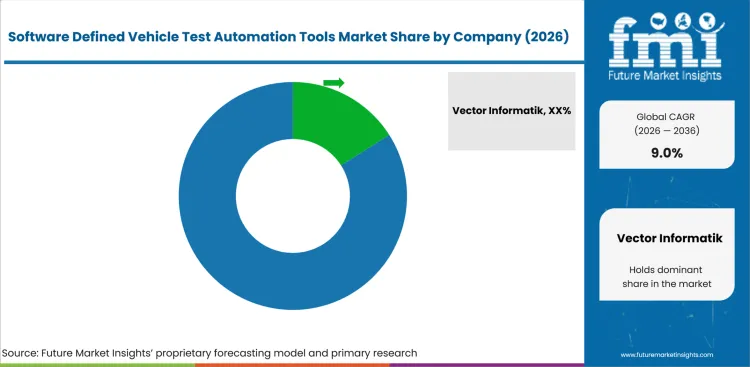
Vector Informatik, dSPACE, ETAS, Keysight, Synopsys, and MathWorks.
- Established automotive validation companies hold an advantage through ECU protocol coverage and long-standing OEM tool qualification.
- Simulation and virtual ECU specialists gain account access as software teams move validation earlier in the vehicle program.
- Cybersecurity and network testing vendors gain stronger relevance as SDV platforms expose more connected interfaces.
- Engineering-service firms gain value when they package reusable validation assets for global OEM programs.
Software defined vehicle test automation suppliers compete by linking test execution with release evidence. Vector Informatik and dSPACE have strong positions because OEMs already use their tools across ECU, HIL, network, and system-level workflows. ETAS benefits from embedded software and cybersecurity relevance through Bosch-linked automotive programs. Keysight competes where automotive Ethernet, fuzz testing, and conformance checks need specialized test systems. These suppliers are best positioned when buyers need evidence that a function has passed simulation, bench, and vehicle-level release checks.
Virtualization is changing competitive positioning as SDV teams try to validate software before final hardware arrives. Synopsys and MathWorks gain from virtual ECU, model-based design, and digital twin workflows. Elektrobit adds value where operating systems, middleware, and SDV software platforms must connect with validation routines. AVL and IPG Automotive support vehicle simulation and powertrain-linked test cases. Vendors that connect their tools into open standards and CI/CD workflows can reduce migration work for OEM software teams.
Smaller and regional players can win through local support, training, and engineering-service delivery. India-based and Korea-based software engineering firms can influence tool decisions when they manage validation work for global OEM customers. Germany remains the strongest reference environment because suppliers and OEM engineering centers are close together. China creates the fastest scale test, although local price pressure can limit premium license value. Companies with reusable test assets and clear standards coverage should gain more durable supplier positions.
How do top software defined vehicle test automation tools companies compare?
Vector and dSPACE score strongest on validation workflow depth while Synopsys and MathWorks lead virtual development relevance.
| Company | Relevance to Market Title | SIL/HIL Workflow Depth | Virtual ECU Fit | Cybersecurity and Network Testing | Channel Reach | Geographic Footprint |
|---|---|---|---|---|---|---|
| Vector Informatik | Very High | Very Strong | Strong | Strong | Very Strong | Global |
| dSPACE | Very High | Very Strong | Strong | Moderate to Strong | Very Strong | Global |
| ETAS | High | Strong | Moderate | Strong | Strong | Global |
| Keysight Technologies | High | Moderate | Moderate | Very Strong | Strong | Global |
| Synopsys | High | Moderate | Very Strong | Strong | Strong | Global |
| MathWorks | High | Strong | Very Strong | Moderate | Very Strong | Global |
| Elektrobit | High | Moderate | Strong | Moderate | Strong | Europe and Global |
| AVL List GmbH | Moderate to High | Strong | Moderate | Moderate | Strong | Global |
| NI Emerson | Moderate to High | Strong | Moderate | Moderate | Strong | Global |
| IPG Automotive | Moderate | Moderate | Strong | Low to Moderate | Moderate | Europe and North America |
Source: Future Market Insights competitive analysis, 2026.
Who are the key players in the software defined vehicle test automation tools market?
Vector Informatik, dSPACE, ETAS, Keysight Technologies, Synopsys, and MathWorks are listed with Elektrobit, AVL, NI Emerson, and IPG Automotive among other suppliers.
Key global companies leading the software defined vehicle test automation tools market include:
- Vector Informatik
- dSPACE
- ETAS
- Keysight Technologies
- Synopsys
- MathWorks
- Elektrobit
- AVL List GmbH
- NI Emerson
- IPG Automotive
Key Developments in Software Defined Vehicle Test Automation Tools Market
- In December 2024, dSPACE announced that it would showcase end-to-end SIL and HIL validation for electric, autonomous, and software-defined vehicles at CES 2025.
- In March 2025, ETAS joined the SDVerse ecosystem to expand access to software-defined vehicle development buyers across OEM and Tier 1 programs.
- In March 2025, Vector Informatik and Synopsys announced a strategic collaboration combining Vector software-factory expertise with Synopsys electronics digital twin capabilities.
Key Players in the Software Defined Vehicle Test Automation Tools Market
Automotive Test Automation Platforms
- Vector Informatik
- dSPACE
- Keysight Technologies
- NI Emerson
- AVL List GmbH
Virtualization and Model-Based Toolchain Suppliers
- Synopsys
- MathWorks
- IPG Automotive
- Ansys
Embedded Software and SDV Platform Specialists
- ETAS
- Elektrobit
- QNX
- KPIT Technologies
- Tata Elxsi
Software Defined Vehicle Test Automation Tools Market - Report Scope
| Parameter | Details |
|---|---|
| Market size by 2036 | USD 130.0 million |
| Growth rate | 9.0% CAGR from 2026 to 2036 |
| Forecast period | 2026 to 2036 |
| Base year value (2025) | USD 50.5 million |
| By component type | Sensor, module, connector, software, thermal system |
| By vehicle type | Passenger car, light commercial vehicle, heavy truck, two wheeler, bus |
| By propulsion | Battery electric, plug-in hybrid, fuel cell, hybrid, ICE retrofit |
| By sales channel | OEM, Tier 1, aftermarket, fleet retrofit, charging network |
| By test workflow | SIL, HIL, virtual ECU, cybersecurity testing, network conformance |
| Regions covered | North America, Europe, East Asia, South Asia, Latin America |
| Countries covered | United States, United Kingdom, Germany, France, Japan, China, South Korea, India |
| Key companies profiled | Vector Informatik, dSPACE, ETAS, Keysight, Synopsys, MathWorks, Elektrobit, AVL, NI Emerson, IPG Automotive |
| Approach | Bottom-up tool-boundary approach using license revenue, validation workflow exposure, vehicle program intensity, regional EV mix, and supplier portfolio relevance |
Source: Future Market Insights, 2026.
Software Defined Vehicle Test Automation Tools Market Breakdown by Component Type, Vehicle Type, Propulsion, Sales Channel, Test Workflow, and Region
Software Defined Vehicle Test Automation Tools Market Segmented by Component Type:
- Sensor
- Module
- Connector
- Software
- Thermal System
Software Defined Vehicle Test Automation Tools Market Segmented by Vehicle Type:
- Passenger Car
- Light Commercial Vehicle
- Heavy Truck
- Two Wheeler
- Bus
Software Defined Vehicle Test Automation Tools Market Segmented by Propulsion:
- Battery Electric
- Plug-in Hybrid
- Fuel Cell
- Hybrid
- ICE Retrofit
Software Defined Vehicle Test Automation Tools Market Segmented by Sales Channel:
- OEM
- Tier 1
- Aftermarket
- Fleet Retrofit
- Charging Network
Software Defined Vehicle Test Automation Tools Market Segmented by Test Workflow:
- SIL
- HIL
- Virtual ECU
- Cybersecurity Testing
- Network Conformance
Software Defined Vehicle Test Automation Tools Market by Region:
- North America
- Europe
- East Asia
- South Asia
- Latin America
Research Sources and Bibliography
- Argonne National Laboratory. (2026, April). Light-duty electric-drive vehicles monthly sales updates. Argonne National Laboratory.
- ASAM e.V. (2026). ASAM XIL. ASAM e.V.
- Clean Energy Wire. (2026, January 6). Electric car registrations in Germany rise in 2025. Clean Energy Wire.
- Department for Transport. (2025, November 19). The vehicle emissions trading schemes: How to comply. Government of the United Kingdom.
- Department for Transport. (2026, April 29). Vehicle licensing statistics, United Kingdom: 2025. Government of the United Kingdom.
- dSPACE GmbH. (2024, December 12). dSPACE at CES 2025: How seamless SIL/HIL validation accelerates automotive software development. dSPACE GmbH.
- ETAS GmbH. (2025, March 10). ETAS accelerates software-defined vehicle development by joining SDVerse ecosystem. ETAS GmbH.
- European Alternative Fuels Observatory. (2025, October 31). France’s 2025 social leasing electric car scheme hits 41,500 homes. European Alternative Fuels Observatory.
- European Automobile Manufacturers’ Association. (2026, January 27). New car registrations: +1.8% in 2025; battery-electric 17.4% market share. ACEA.
- International Energy Agency. (2026, May 20). Global EV Outlook 2026. International Energy Agency.
- International Energy Agency. (2026, May 20). Manufacturing and trade: Global EV Outlook 2026. International Energy Agency.
- Internal Revenue Service. (2026). Clean vehicle tax credits. Internal Revenue Service.
- Invest Korea. (2025, December 5). Korea’s future mobility industry: Advancing through electrification, autonomous driving, and software-defined vehicles. Invest Korea.
- Japan Automobile Manufacturers Association. (2025, September 26). The motor industry of Japan 2025. JAMA.
- Ministry of Economy, Trade and Industry. (2024, June 24). Subsidies upgraded for the purchase of clean energy vehicles. METI.
- Press Information Bureau. (2025, February 11). PM E-DRIVE scheme for electric vehicle adoption. Government of India.
- Society of Indian Automobile Manufacturers. (2026, April 28). Auto industry performance of April 2026. SIAM.
- Society of Motor Manufacturers and Traders. (2026, January 6). UK new car market breaches two million as almost one in four buyers go electric. SMMT.
- Synopsys, Inc. (2025, March 10). Vector Informatik and Synopsys announce strategic collaboration to advance software-defined vehicle development. Synopsys, Inc.
- United Nations Economic Commission for Europe. (2024, March). UN Regulation No. 156: Software update and software update management system. UNECE.
- Vector Informatik GmbH. (2025, July 1). QNX and Vector sign memorandum of understanding to launch foundational vehicle software platform. Vector Informatik GmbH.
This bibliography is provided for reader reference and is not exhaustive. The full report contains the complete reference list and detailed citations.
Software Defined Vehicle Test Automation Tools Market - Scope & Definition
| Attribute | Detail |
|---|---|
| Market Definition | Software and integrated toolchains used to automate validation across virtual ECUs, HIL benches, vehicle networks, cybersecurity checks, diagnostics, traceability, and release evidence workflows for software-defined vehicles. |
| Functions Covered | Test scripting, software-in-the-loop validation, hardware-in-the-loop validation, virtual ECU execution, cybersecurity testing, diagnostic validation, network conformance, and release-traceability management. |
| Applications Covered | Passenger car SDV validation, battery management testing, charging software checks, ADAS software validation, cockpit software testing, OTA release evidence, and connected-service verification. |
| End-Use Industries | Automotive OEMs, Tier 1 suppliers, engineering service providers, test laboratories, fleet software teams, charging network operators, and embedded software vendors. |
| Tool Types Covered | Software licenses, virtual ECU tools, protocol test systems, cybersecurity test platforms, HIL-linked automation tools, simulation environments, and test management systems. |
| Inclusions | All commercially relevant SDV test automation tools across component type, vehicle type, propulsion, sales channel, test workflow, and regional demand clusters. |
| Exclusions | Generic enterprise software testing tools, manual engineering services without reusable automation software, physical crash test systems, workshop-only scan tools, and consulting-only cybersecurity services. |
Software Defined Vehicle Test Automation Tools Market - Research Methodology
| Method | Description |
|---|---|
| Primary Research | FMI analyst interviews with automotive OEM software teams, Tier 1 validation groups, engineering service providers, test-bench integrators, and SDV software suppliers across key markets. |
| Desk Research | Review of EV data, software-defined vehicle activity, official vehicle statistics, standards-body material, cybersecurity requirements, company product literature, and validation workflow evidence. |
| Market Sizing & Forecasting | Bottom-up tool-boundary approach using license revenue, validation workflow exposure, engineering seat adoption, vehicle program counts, EV mix, and country-level software engineering intensity. |
| Data Validation | Cross-verification using supplier portfolios, standards coverage, EV production scale, country software engineering signals, HIL and SIL tool adoption, and competitive product relevance checks. |
This Report Answers
- Market size estimates for 2026 and forecasts through 2036 for the software defined vehicle test automation tools market.
- Insights across key country-level markets including the United States, United Kingdom, Germany, France, Japan, China, South Korea, and India.
- Analysis of demand drivers, validation workflow shifts, software release evidence needs, and buyer decision patterns.
- Evaluation of key component types and test workflows, including software, SIL, HIL, virtual ECU, cybersecurity testing, and network conformance.
- Assessment of regional adoption patterns across North America, Europe, East Asia, South Asia, and Latin America.
- Identification of growth opportunities across virtual ECU validation, cybersecurity testing, engineering-service delivery, and OEM software factories.
- Evaluation of competitive dynamics among test automation platforms, virtualization suppliers, embedded software firms, and engineering-service companies.
- Country-level growth analysis covering India, China, South Korea, Germany, the United Kingdom, France, the United States, and Japan.
- Assessment of the competitive landscape, including leading SDV test automation tool suppliers and other market participants.
- Analysis of validation tool purchasing behavior, standards alignment, release evidence requirements, and toolchain integration barriers.
- Regional outlooks across North America, Europe, East Asia, South Asia, and Latin America.
- Delivery of market data, forecasts, and supporting analysis in PDF and Excel formats.
Frequently Asked Questions
What is the software defined vehicle test automation tools market size in 2026?
The software defined vehicle test automation tools market size is anticipated to cross USD 55.0 million in 2026.
What is the software defined vehicle test automation tools market forecast for 2036?
The software defined vehicle test automation tools industry revenue is predicted to reach USD 130.0 million by 2036 as virtual validation and release evidence expand.
What is the software defined vehicle test automation tools market CAGR?
The software defined vehicle test automation tools sector is projected to expand at 9.0% CAGR from 2026 to 2036.
What segment leads the software defined vehicle test automation tools market?
Passenger car programs are likely to capture 58.0% share in 2026 due to ADAS, cockpit, connectivity, and OTA software complexity.
What country grows fastest in the software defined vehicle test automation tools market?
India is set to record 10.4% CAGR by 2036, driven by engineering-service validation and virtual ECU project demand.
Preview the report firsthand - request a free sample
Get SampleGet the brochure for pricing and purchase details.
Get PDFTable of Content
- Executive Summary
- Global Market Outlook
- Demand to side Trends
- Supply to side Trends
- Technology Roadmap Analysis
- Analysis and Recommendations
- Market Overview
- Market Coverage / Taxonomy
- Market Definition / Scope / Limitations
- Research Methodology
- Chapter Orientation
- Analytical Lens and Working Hypotheses
- Market Structure, Signals, and Trend Drivers
- Benchmarking and Cross-market Comparability
- Market Sizing, Forecasting, and Opportunity Mapping
- Research Design and Evidence Framework
- Desk Research Programme (Secondary Evidence)
- Company Annual and Sustainability Reports
- Peer-reviewed Journals and Academic Literature
- Corporate Websites, Product Literature, and Technical Notes
- Earnings Decks and Investor Briefings
- Statutory Filings and Regulatory Disclosures
- Technical White Papers and Standards Notes
- Trade Journals, Industry Magazines, and Analyst Briefs
- Conference Proceedings, Webinars, and Seminar Materials
- Government Statistics Portals and Public Data Releases
- Press Releases and Reputable Media Coverage
- Specialist Newsletters and Curated Briefings
- Sector Databases and Reference Repositories
- FMI Internal Proprietary Databases and Historical Market Datasets
- Subscription Datasets and Paid Sources
- Social Channels, Communities, and Digital Listening Inputs
- Additional Desk Sources
- Expert Input and Fieldwork (Primary Evidence)
- Primary Modes
- Qualitative Interviews and Expert Elicitation
- Quantitative Surveys and Structured Data Capture
- Blended Approach
- Why Primary Evidence is Used
- Field Techniques
- Interviews
- Surveys
- Focus Groups
- Observational and In-context Research
- Social and Community Interactions
- Stakeholder Universe Engaged
- C-suite Leaders
- Board Members
- Presidents and Vice Presidents
- R&D and Innovation Heads
- Technical Specialists
- Domain Subject-matter Experts
- Scientists
- Physicians and Other Healthcare Professionals
- Governance, Ethics, and Data Stewardship
- Research Ethics
- Data Integrity and Handling
- Primary Modes
- Tooling, Models, and Reference Databases
- Desk Research Programme (Secondary Evidence)
- Data Engineering and Model Build
- Data Acquisition and Ingestion
- Cleaning, Normalisation, and Verification
- Synthesis, Triangulation, and Analysis
- Quality Assurance and Audit Trail
- Market Background
- Market Dynamics
- Drivers
- Restraints
- Opportunity
- Trends
- Scenario Forecast
- Demand in Optimistic Scenario
- Demand in Likely Scenario
- Demand in Conservative Scenario
- Opportunity Map Analysis
- Product Life Cycle Analysis
- Supply Chain Analysis
- Investment Feasibility Matrix
- Value Chain Analysis
- PESTLE and Porter’s Analysis
- Regulatory Landscape
- Regional Parent Market Outlook
- Production and Consumption Statistics
- Import and Export Statistics
- Market Dynamics
- Global Market Analysis 2021 to 2025 and Forecast, 2026 to 2036
- Historical Market Size Value (USD Million) Analysis, 2021 to 2025
- Current and Future Market Size Value (USD Million) Projections, 2026 to 2036
- Y to o to Y Growth Trend Analysis
- Absolute $ Opportunity Analysis
- Global Market Pricing Analysis 2021 to 2025 and Forecast 2026 to 2036
- Global Market Analysis 2021 to 2025 and Forecast 2026 to 2036, By Component Type
- Introduction / Key Findings
- Historical Market Size Value (USD Million) Analysis By Component Type , 2021 to 2025
- Current and Future Market Size Value (USD Million) Analysis and Forecast By Component Type , 2026 to 2036
- Software
- Module
- Connector
- Software
- Y to o to Y Growth Trend Analysis By Component Type , 2021 to 2025
- Absolute $ Opportunity Analysis By Component Type , 2026 to 2036
- Global Market Analysis 2021 to 2025 and Forecast 2026 to 2036, By Vehicle Type
- Introduction / Key Findings
- Historical Market Size Value (USD Million) Analysis By Vehicle Type, 2021 to 2025
- Current and Future Market Size Value (USD Million) Analysis and Forecast By Vehicle Type, 2026 to 2036
- Passenger Car
- Light Commercial Vehicle
- Heavy Truck
- Passenger Car
- Y to o to Y Growth Trend Analysis By Vehicle Type, 2021 to 2025
- Absolute $ Opportunity Analysis By Vehicle Type, 2026 to 2036
- Global Market Analysis 2021 to 2025 and Forecast 2026 to 2036, By Propulsion
- Introduction / Key Findings
- Historical Market Size Value (USD Million) Analysis By Propulsion, 2021 to 2025
- Current and Future Market Size Value (USD Million) Analysis and Forecast By Propulsion, 2026 to 2036
- Battery Electric
- Plug-in Hybrid
- Fuel Cell
- Battery Electric
- Y to o to Y Growth Trend Analysis By Propulsion, 2021 to 2025
- Absolute $ Opportunity Analysis By Propulsion, 2026 to 2036
- Global Market Analysis 2021 to 2025 and Forecast 2026 to 2036, By Sales Channel
- Introduction / Key Findings
- Historical Market Size Value (USD Million) Analysis By Sales Channel, 2021 to 2025
- Current and Future Market Size Value (USD Million) Analysis and Forecast By Sales Channel, 2026 to 2036
- OEM
- Tier 1
- Aftermarket
- OEM
- Y to o to Y Growth Trend Analysis By Sales Channel, 2021 to 2025
- Absolute $ Opportunity Analysis By Sales Channel, 2026 to 2036
- Global Market Analysis 2021 to 2025 and Forecast 2026 to 2036, By Test Workflow
- Introduction / Key Findings
- Historical Market Size Value (USD Million) Analysis By Test Workflow, 2021 to 2025
- Current and Future Market Size Value (USD Million) Analysis and Forecast By Test Workflow, 2026 to 2036
- SIL and HIL
- Virtual ECU
- Cybersecurity Testing
- SIL and HIL
- Y to o to Y Growth Trend Analysis By Test Workflow, 2021 to 2025
- Absolute $ Opportunity Analysis By Test Workflow, 2026 to 2036
- Global Market Analysis 2021 to 2025 and Forecast 2026 to 2036, By Region
- Introduction
- Historical Market Size Value (USD Million) Analysis By Region, 2021 to 2025
- Current Market Size Value (USD Million) Analysis and Forecast By Region, 2026 to 2036
- North America
- Latin America
- Western Europe
- Eastern Europe
- East Asia
- South Asia and Pacific
- Middle East & Africa
- Market Attractiveness Analysis By Region
- North America Market Analysis 2021 to 2025 and Forecast 2026 to 2036, By Country
- Historical Market Size Value (USD Million) Trend Analysis By Market Taxonomy, 2021 to 2025
- Market Size Value (USD Million) Forecast By Market Taxonomy, 2026 to 2036
- By Country
- USA
- Canada
- Mexico
- By Component Type
- By Vehicle Type
- By Propulsion
- By Sales Channel
- By Test Workflow
- By Country
- Market Attractiveness Analysis
- By Country
- By Component Type
- By Vehicle Type
- By Propulsion
- By Sales Channel
- By Test Workflow
- Key Takeaways
- Latin America Market Analysis 2021 to 2025 and Forecast 2026 to 2036, By Country
- Historical Market Size Value (USD Million) Trend Analysis By Market Taxonomy, 2021 to 2025
- Market Size Value (USD Million) Forecast By Market Taxonomy, 2026 to 2036
- By Country
- Brazil
- Chile
- Rest of Latin America
- By Component Type
- By Vehicle Type
- By Propulsion
- By Sales Channel
- By Test Workflow
- By Country
- Market Attractiveness Analysis
- By Country
- By Component Type
- By Vehicle Type
- By Propulsion
- By Sales Channel
- By Test Workflow
- Key Takeaways
- Western Europe Market Analysis 2021 to 2025 and Forecast 2026 to 2036, By Country
- Historical Market Size Value (USD Million) Trend Analysis By Market Taxonomy, 2021 to 2025
- Market Size Value (USD Million) Forecast By Market Taxonomy, 2026 to 2036
- By Country
- Germany
- UK
- Italy
- Spain
- France
- Nordic
- BENELUX
- Rest of Western Europe
- By Component Type
- By Vehicle Type
- By Propulsion
- By Sales Channel
- By Test Workflow
- By Country
- Market Attractiveness Analysis
- By Country
- By Component Type
- By Vehicle Type
- By Propulsion
- By Sales Channel
- By Test Workflow
- Key Takeaways
- Eastern Europe Market Analysis 2021 to 2025 and Forecast 2026 to 2036, By Country
- Historical Market Size Value (USD Million) Trend Analysis By Market Taxonomy, 2021 to 2025
- Market Size Value (USD Million) Forecast By Market Taxonomy, 2026 to 2036
- By Country
- Russia
- Poland
- Hungary
- Balkan & Baltic
- Rest of Eastern Europe
- By Component Type
- By Vehicle Type
- By Propulsion
- By Sales Channel
- By Test Workflow
- By Country
- Market Attractiveness Analysis
- By Country
- By Component Type
- By Vehicle Type
- By Propulsion
- By Sales Channel
- By Test Workflow
- Key Takeaways
- East Asia Market Analysis 2021 to 2025 and Forecast 2026 to 2036, By Country
- Historical Market Size Value (USD Million) Trend Analysis By Market Taxonomy, 2021 to 2025
- Market Size Value (USD Million) Forecast By Market Taxonomy, 2026 to 2036
- By Country
- China
- Japan
- South Korea
- By Component Type
- By Vehicle Type
- By Propulsion
- By Sales Channel
- By Test Workflow
- By Country
- Market Attractiveness Analysis
- By Country
- By Component Type
- By Vehicle Type
- By Propulsion
- By Sales Channel
- By Test Workflow
- Key Takeaways
- South Asia and Pacific Market Analysis 2021 to 2025 and Forecast 2026 to 2036, By Country
- Historical Market Size Value (USD Million) Trend Analysis By Market Taxonomy, 2021 to 2025
- Market Size Value (USD Million) Forecast By Market Taxonomy, 2026 to 2036
- By Country
- India
- ASEAN
- Australia & New Zealand
- Rest of South Asia and Pacific
- By Component Type
- By Vehicle Type
- By Propulsion
- By Sales Channel
- By Test Workflow
- By Country
- Market Attractiveness Analysis
- By Country
- By Component Type
- By Vehicle Type
- By Propulsion
- By Sales Channel
- By Test Workflow
- Key Takeaways
- Middle East & Africa Market Analysis 2021 to 2025 and Forecast 2026 to 2036, By Country
- Historical Market Size Value (USD Million) Trend Analysis By Market Taxonomy, 2021 to 2025
- Market Size Value (USD Million) Forecast By Market Taxonomy, 2026 to 2036
- By Country
- Kingdom of Saudi Arabia
- Other GCC Countries
- Turkiye
- South Africa
- Other African Union
- Rest of Middle East & Africa
- By Component Type
- By Vehicle Type
- By Propulsion
- By Sales Channel
- By Test Workflow
- By Country
- Market Attractiveness Analysis
- By Country
- By Component Type
- By Vehicle Type
- By Propulsion
- By Sales Channel
- By Test Workflow
- Key Takeaways
- Key Countries Market Analysis
- USA
- Pricing Analysis
- Market Share Analysis, 2025
- By Component Type
- By Vehicle Type
- By Propulsion
- By Sales Channel
- By Test Workflow
- Canada
- Pricing Analysis
- Market Share Analysis, 2025
- By Component Type
- By Vehicle Type
- By Propulsion
- By Sales Channel
- By Test Workflow
- Mexico
- Pricing Analysis
- Market Share Analysis, 2025
- By Component Type
- By Vehicle Type
- By Propulsion
- By Sales Channel
- By Test Workflow
- Brazil
- Pricing Analysis
- Market Share Analysis, 2025
- By Component Type
- By Vehicle Type
- By Propulsion
- By Sales Channel
- By Test Workflow
- Chile
- Pricing Analysis
- Market Share Analysis, 2025
- By Component Type
- By Vehicle Type
- By Propulsion
- By Sales Channel
- By Test Workflow
- Germany
- Pricing Analysis
- Market Share Analysis, 2025
- By Component Type
- By Vehicle Type
- By Propulsion
- By Sales Channel
- By Test Workflow
- UK
- Pricing Analysis
- Market Share Analysis, 2025
- By Component Type
- By Vehicle Type
- By Propulsion
- By Sales Channel
- By Test Workflow
- Italy
- Pricing Analysis
- Market Share Analysis, 2025
- By Component Type
- By Vehicle Type
- By Propulsion
- By Sales Channel
- By Test Workflow
- Spain
- Pricing Analysis
- Market Share Analysis, 2025
- By Component Type
- By Vehicle Type
- By Propulsion
- By Sales Channel
- By Test Workflow
- France
- Pricing Analysis
- Market Share Analysis, 2025
- By Component Type
- By Vehicle Type
- By Propulsion
- By Sales Channel
- By Test Workflow
- India
- Pricing Analysis
- Market Share Analysis, 2025
- By Component Type
- By Vehicle Type
- By Propulsion
- By Sales Channel
- By Test Workflow
- ASEAN
- Pricing Analysis
- Market Share Analysis, 2025
- By Component Type
- By Vehicle Type
- By Propulsion
- By Sales Channel
- By Test Workflow
- Australia & New Zealand
- Pricing Analysis
- Market Share Analysis, 2025
- By Component Type
- By Vehicle Type
- By Propulsion
- By Sales Channel
- By Test Workflow
- China
- Pricing Analysis
- Market Share Analysis, 2025
- By Component Type
- By Vehicle Type
- By Propulsion
- By Sales Channel
- By Test Workflow
- Japan
- Pricing Analysis
- Market Share Analysis, 2025
- By Component Type
- By Vehicle Type
- By Propulsion
- By Sales Channel
- By Test Workflow
- South Korea
- Pricing Analysis
- Market Share Analysis, 2025
- By Component Type
- By Vehicle Type
- By Propulsion
- By Sales Channel
- By Test Workflow
- Russia
- Pricing Analysis
- Market Share Analysis, 2025
- By Component Type
- By Vehicle Type
- By Propulsion
- By Sales Channel
- By Test Workflow
- Poland
- Pricing Analysis
- Market Share Analysis, 2025
- By Component Type
- By Vehicle Type
- By Propulsion
- By Sales Channel
- By Test Workflow
- Hungary
- Pricing Analysis
- Market Share Analysis, 2025
- By Component Type
- By Vehicle Type
- By Propulsion
- By Sales Channel
- By Test Workflow
- Kingdom of Saudi Arabia
- Pricing Analysis
- Market Share Analysis, 2025
- By Component Type
- By Vehicle Type
- By Propulsion
- By Sales Channel
- By Test Workflow
- Turkiye
- Pricing Analysis
- Market Share Analysis, 2025
- By Component Type
- By Vehicle Type
- By Propulsion
- By Sales Channel
- By Test Workflow
- South Africa
- Pricing Analysis
- Market Share Analysis, 2025
- By Component Type
- By Vehicle Type
- By Propulsion
- By Sales Channel
- By Test Workflow
- USA
- Market Structure Analysis
- Competition Dashboard
- Competition Benchmarking
- Market Share Analysis of Top Players
- By Regional
- By Component Type
- By Vehicle Type
- By Propulsion
- By Sales Channel
- By Test Workflow
- Competition Analysis
- Competition Deep Dive
- Vector Informatik
- Overview
- Product Portfolio
- Profitability by Market Segments (Product/Age /Sales Channel/Region)
- Sales Footprint
- Strategy Overview
- Marketing Strategy
- Product Strategy
- Channel Strategy
- dSPACE
- ETAS
- Keysight Technologies
- Synopsys
- MathWorks
- Vector Informatik
- Competition Deep Dive
- Assumptions & Acronyms Used


