

- Industry Size (2026)
- USD 8.4 Mn
- Forecast (2036)
- USD 12.5 Mn
- CAGR (2026 to 2036)
- 4.1%
Demand for Direct Thermal Printing Film in South Korea Forecast and Outlook 2026 to 2036
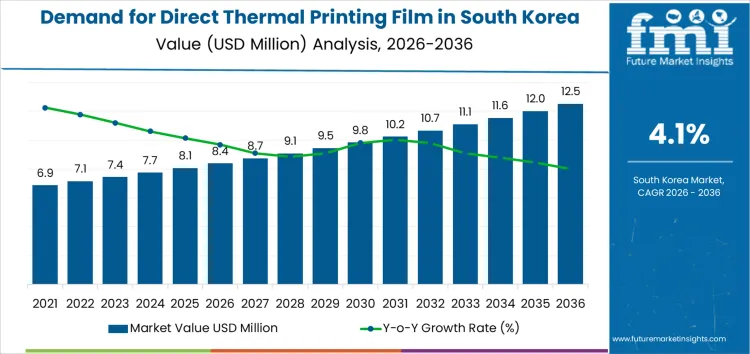
The demand for direct thermal printing film in South Korea is projected to reach USD 8.4 million in 2026 and grow to USD 12.5 million by 2036, reflecting a 4.1% CAGR. While steady growth offers upside potential, execution risk looms as manufacturers must align production with fluctuating demand patterns in retail, logistics, and healthcare. Adoption friction may arise as businesses weigh the switch from traditional printing methods to more efficient thermal solutions, balancing operational disruption against potential savings. Economic sensitivity will remain a key constraint, particularly as shifts in consumer spending and supply chain pressures could affect demand for non-essential packaging and labeling solutions. This volatility may also amplify risks tied to raw material cost fluctuations, further complicating supplier positioning. Companies in this space will need to navigate these risks with careful strategy, ensuring that their value propositions remain resilient amid external pressures and evolving market conditions.
Quick Stats for the Demand for Direct Thermal Printing Film in South Korea
- Direct Thermal Printing Film in South Korea Value (2026): USD 8.4 million
- Direct Thermal Printing Film in South Korea Forecast Value (2036): USD 12.5 million
- Direct Thermal Printing Film in South Korea Forecast CAGR (2026 to 2036): 4.1%
- Direct Thermal Printing Film in South Korea Leading Segment: Polypropylene (PP) (71%)
- Key Growth Regions of Direct Thermal Printing Film in South Korea: Jeju (leading CAGR ~4.9%)
- Top Players of Direct Thermal Printing Film in South Korea: UPM Raflatac, Inc., Ricoh Company, Ltd, Diversified Labeling Solutions, Inc., McCourt Label Company, Stylerite Label Corporation
What is the Growth Forecast for the Demand for Direct Thermal Printing Film in South Korea through 2036?
The demand for direct thermal printing film in South Korea is projected to grow at a steady pace, with the market reaching USD 12.5 million by 2036. The growth contribution index for this market reveals a consistent, incremental increase in demand as various industries embrace direct thermal printing solutions. The early years of the forecast period show gradual growth as end-users in retail and logistics sectors adjust to the efficiency and cost benefits of thermal printing. This steady uptake indicates that the product is gaining traction across a wide range of applications, such as inventory labeling, ticketing, and product packaging.
The growth contribution index shows a stable rise, with retail and logistics sectors contributing significantly to the demand for thermal printing films, followed by healthcare and other industries gradually adopting these solutions. The cumulative growth over the forecast period demonstrates a sustained trend toward broader adoption, supported by the increasing need for fast, reliable, and cost-effective printing options. By 2036, the market will reach USD 12.5 million, with direct thermal printing films becoming an integral part of operational workflows in South Korea's key industries.
Key Takeaways for Demand for Direct Thermal Printing Film in South Korea
| Metric | Value |
|---|---|
| Industry Sales Value (2026) | USD 8.4 million |
| Industry Forecast Value (2036) | USD 12.5 million |
| Industry Forecast CAGR (2026 to 2036) | 4.1% |
Why is the Demand for Direct Thermal Printing Film Growing in South Korea?
Demand for direct thermal printing film in South Korea arises from how businesses and logistics operations prioritize efficiency and clarity in label printing. Retailers use direct thermal labels at points of sale and inventory control because these films support straightforward printing without ribbons, reducing material handling. Logistics and warehousing operations also value direct thermal printing film for shipment labels where legibility is critical during sorting and delivery. Manufacturers of packaged goods specify this film type for barcodes and product information that must remain clear throughout transport and shelf display. Healthcare providers deploy direct thermal labels for patient identification and specimen tracking to reduce errors and support procedural documentation. Procurement specialists evaluate film performance based on print contrast, resistance to environmental factors like humidity, and compatibility with mobile and desktop printers. These operational criteria shape ongoing purchases as organizations balance cost and reliability in their label solutions.
Demand for direct thermal printing film in South Korea is expected to expand with continued growth in sectors that depend on fast, accurate data capture and traceability. Expansion of e-commerce increases demand for reliable shipment and return labels that maintain readability across diverse transit conditions. Food and beverage producers require labels that can endure refrigeration and handling without loss of information, driving interest in higher-performance thermal films. Compliance requirements for product tracking and safety documentation motivate adoption of printing methods that support audit trails without complex consumable inventories. Investments in automated identification systems, including scanners and mobile terminals, further reinforce the use of direct thermal film because of its ease of integration into digital workflows. Advances in film coatings that improve resistance to abrasion and fading expand potential use cases beyond traditional retail and logistics applications. These factors contribute to sustained interest in direct thermal printing film across industries in South Korea.
What Shapes the Demand for Direct Thermal Printing Film in South Korea?
The demand for direct thermal printing film in South Korea is influenced by two primary factors: material type and film thickness. Polypropylene (PP) leads the material category with a 71% share, while the 76 to 100 microns thickness range holds the largest share at 37.2%. These segments are critical to the overall demand dynamics, as industries requiring high-quality, cost-effective printing solutions, such as retail, logistics, and packaging, increasingly rely on direct thermal printing technologies for efficient labeling and barcoding.
Why Does Polypropylene (PP) Dominate the Material Type Segment?
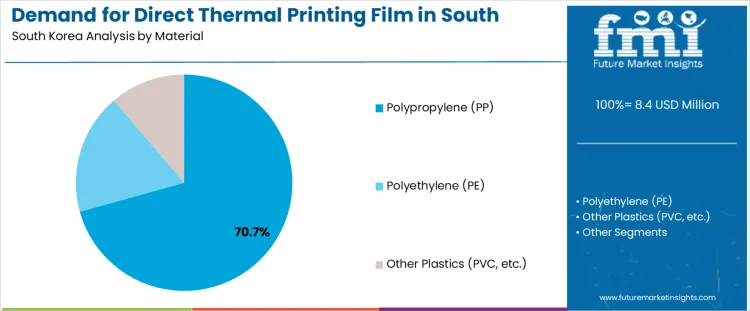
Polypropylene (PP) accounts for 71% of the direct thermal printing film market in South Korea due to its excellent printability, durability, and cost-efficiency. PP films are widely used in the retail and logistics sectors, where labels must withstand handling, exposure to moisture, and variable temperatures without compromising legibility. The material’s resistance to tearing and flexibility makes it suitable for high-volume applications such as price tags, shipping labels, and product packaging, which require high-quality printing for both short-term and long-term use. PP films also provide superior adhesion, ensuring that printed information remains intact throughout the product lifecycle. Additionally, PP’s recyclability aligns with increasing consumer demand for sustainable packaging solutions. As South Korean industries continue to expand their e-commerce, logistics, and retail operations, the preference for PP-based thermal printing films is expected to continue growing due to its balance of functionality, environmental benefits, and affordability.
Why Does the 76 to 100 Microns Thickness Range Lead Demand?
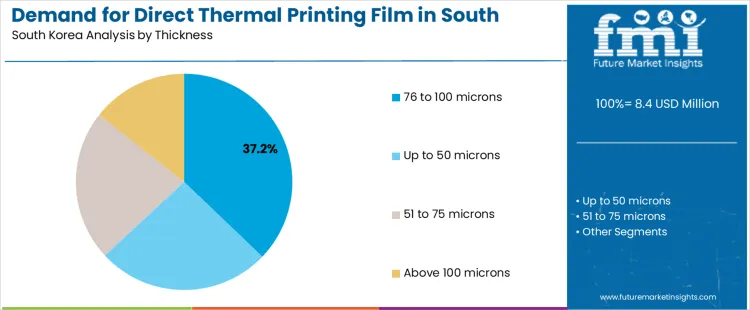
The 76 to 100 microns thickness range holds a 37.2% share of the direct thermal printing film market in South Korea, reflecting its suitability for a wide range of applications in both industrial and consumer goods packaging. This thickness offers a balance between flexibility and durability, providing enough material strength to withstand the demands of high-speed printing while ensuring the printed labels remain intact during transportation and storage. Films in this thickness range are ideal for printing product labels, barcode tags, and shipping labels, where both the quality of print and the durability of the label are important. Additionally, the 76 to 100 microns thickness is commonly used in industries requiring medium-weight films for a variety of surfaces, including corrugated boxes and plastic containers, making it a preferred choice for packaging and logistics applications. As industries continue to prioritize efficiency in labeling systems, the demand for thermal printing films within this thickness range is expected to remain strong, particularly in sectors where both performance and cost-effectiveness are key factors.
What Is the Current Demand for Direct Thermal Printing Film in South Korea?
Demand for direct thermal printing film in South Korea is anchored in uses where inkless printing and rapid output are priorities, such as logistics labels, retail tags, ticketing, and barcode printing. Businesses in distribution, warehousing, and point-of-sale operations procure direct thermal film for applications requiring quick, low-cost print solutions without ribbon or toner. Uptake corresponds with activity in e-commerce, transportation, and inventory management systems that depend on durable, scannable labels. Demand patterns also reflect investment in automated printing equipment and integration with enterprise systems for tracking and identification tasks.
What Factors Are Driving Demand for Direct Thermal Printing Film in South Korea?
Several forces drive demand for direct thermal printing film in South Korea. Expansion of the e-commerce sector heightens requirements for efficient labeling throughout order fulfillment and return processes, where direct thermal solutions deliver rapid output with minimal maintenance. Retail and hospitality businesses use direct thermal film for receipts and price tags, favouring simplicity and cost-effectiveness. Logistics and courier services adopt thermal labels to support high-volume sorting, tracking, and shipment identification. Consolidation of supply chains and adoption of automated inventory systems place a premium on printing technologies that deliver reliable legibility and barcode quality. Regulatory emphasis on traceability and product tracking further reinforces demand for standardized thermal labeling in industries such as healthcare and food distribution.
What Are the Constraints on Demand for Direct Thermal Printing Film in South Korea?
Despite ongoing use in key segments, some constraints temper demand for direct thermal printing film in South Korea. The limited durability of direct thermal prints when exposed to heat, sunlight, or friction constrains use in environments requiring long-term label stability, steering some users toward thermal transfer or laser alternatives. Cost-sensitive buyers may consider competing technologies that deliver longer life spans for labels, particularly where archival quality or outdoor exposure is critical. Fluctuations in raw material costs for thermal coating substrates can influence pricing and procurement decisions. Environmental concerns about disposability and recycling of coated films also shape corporate preferences and procurement strategies in sustainability-focused organizations.
What Trends Are Emerging in South Korea’s Direct Thermal Printing Film Market?
Emerging trends in South Korea’s direct thermal printing film market reflect technological adaptation and shifts in application requirements. There is increasing interest in enhanced direct thermal films that offer improved resistance to heat and abrasion, expanding their suitability beyond short-term indoor uses. Integration with smart logistics systems and real-time data capture drives adoption of films optimized for high-resolution barcodes and QR codes, supporting digital tracking and verification. Sustainability initiatives are influencing demand for films with eco-friendly coatings and materials designed for easier recycling or reduced environmental impact. Growth in sectors such as healthcare and cold chain logistics is also shaping specifications for thermal printing solutions that maintain performance in varied temperature conditions.
What is the Regional Outlook for the Demand for Direct Thermal Printing Film in South Korea?
The demand for direct thermal printing film in South Korea is influenced by the growth of industries such as retail, logistics, healthcare, and manufacturing, which rely heavily on label printing and receipt generation. Jeju leads the demand, driven by the region’s tourism and retail sectors. South Gyeongsang and South Jeolla follow with moderate growth, supported by logistics, retail, and industrial applications. North Jeolla, while showing steady demand, grows at a slower pace due to its relatively smaller retail and logistics sectors. As industries adopt more advanced printing technologies to improve operational efficiency, the demand for direct thermal printing film across these regions is expected to rise, particularly with the increasing need for barcodes, tags, and labels in various sectors.
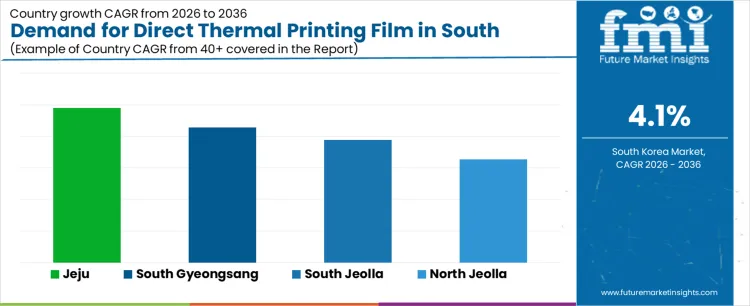
| Province | CAGR (2026 to 2036) |
|---|---|
| South Gyeongsang | 4.3% |
| North Jeolla | 3.3% |
| South Jeolla | 3.9% |
| Jeju | 4.9% |
What drives the demand for Direct Thermal Printing Film in South Gyeongsang?
South Gyeongsang is projected to experience a CAGR of 4.3% in direct thermal printing film demand from 2026 to 2036. The region’s diverse industries, particularly retail, logistics, and manufacturing, contribute to this growth. As the retail and logistics sectors expand, the demand for labels, barcodes, and receipts increases. The growing e-commerce industry in South Gyeongsang further drives the need for efficient packaging and labeling solutions. Additionally, the region’s manufacturing base, including the food and pharmaceutical industries, relies on thermal printing for product labeling and packaging. As industries focus on reducing operational costs and improving labeling accuracy, the adoption of direct thermal printing film, known for its cost-effectiveness and ease of use, is expected to rise steadily.
What influences the growth of Direct Thermal Printing Film demand in North Jeolla?
North Jeolla is expected to see a steady CAGR of 3.3% in direct thermal printing film demand from 2026 to 2036. The region's demand is driven by smaller but growing retail and logistics sectors. As North Jeolla continues to modernize its retail and supply chain infrastructure, the adoption of thermal printing technologies for product labels, receipts, and shipping tags increases. The food and beverage industry in the region also contributes to this demand, as labeling is a critical part of packaging for both domestic sales and exports. Additionally, North Jeolla’s commitment to enhancing its manufacturing and logistics capabilities, alongside the growing preference for efficient, no-ink solutions for product labeling, boosts the demand for direct thermal printing films. While the growth is steady, the increasing use of automated and streamlined processes in the retail and manufacturing sectors is expected to drive continued adoption.
What drives the demand for Direct Thermal Printing Film in South Jeolla?
South Jeolla’s demand for direct thermal printing film is expected to grow at a CAGR of 3.9% from 2026 to 2036. The region's robust manufacturing and agricultural sectors, along with its expanding retail base, significantly contribute to this growth. As industries in South Jeolla, particularly in food processing and packaging, adopt thermal printing technologies, the need for direct thermal printing film rises. The region’s agricultural industry, which requires efficient labeling for both local and export markets, also drives demand. South Jeolla’s focus on improving supply chain efficiency and packaging standards, as well as its growing adoption of digital technologies in retail and logistics, further accelerates the need for direct thermal printing solutions. As more businesses in South Jeolla embrace thermal printing for its durability and ease of use, demand for these films is expected to grow consistently.
Why is Jeju projected to have the highest demand growth for Direct Thermal Printing Film?
Jeju is projected to experience the highest growth in direct thermal printing film demand, with a CAGR of 4.9% from 2026 to 2036. The region’s tourism-driven economy, with its booming retail and hospitality industries, plays a key role in this demand. As Jeju continues to expand its tourism infrastructure, the need for thermal printing solutions for receipts, entry tickets, and product labeling grows. The retail sector in Jeju, catering to both local consumers and international visitors, increasingly adopts thermal printing for labels, ensuring efficient stock management and sales tracking. Additionally, Jeju’s increasing adoption of smart technologies and its commitment to sustainable solutions in packaging and labeling also support the rising demand for direct thermal printing film. As the region’s tourism and retail sectors grow, so does the need for efficient and cost-effective labeling systems, making Jeju the fastest-growing region for this product.
How are Competitors Differentiating in the Direct Thermal Printing Film Market in South Korea?
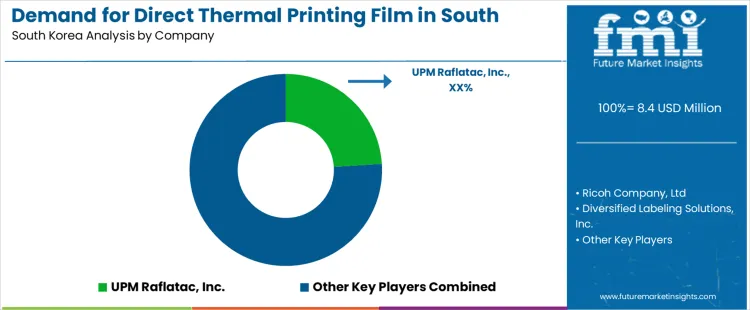
The demand for direct thermal printing film in South Korea is rising due to the increasing use of thermal labels in industries such as retail, logistics, and food labeling. UPM Raflatac, Inc., the leading player, positions itself by offering high-performance direct thermal films known for their superior print clarity, long-lasting durability, and environmental sustainability. Their product portfolio includes a wide range of customizable options, catering to both small and large-scale label printing operations in diverse industries. Ricoh Company, Ltd. competes by focusing on providing reliable, high-quality thermal printing solutions that prioritize quick, efficient printing for high-volume applications. Their solutions are recognized for compatibility with various thermal printers and offer consistent results.
Diversified Labeling Solutions, Inc. and McCourt Label Company focus on meeting specific market needs by offering a variety of direct thermal film products designed for durability and cost-effectiveness in different labeling applications. Stylerite Label Corporation specializes in providing niche products tailored to sectors like food and healthcare, offering direct thermal films that meet specific regulatory and compliance requirements for those industries. These companies rely heavily on product brochures to communicate the advantages of their thermal films, focusing on print quality, durability, temperature resistance, and compatibility with printing equipment. The brochures also highlight their commitment to sustainability, providing detailed information on recyclable and eco-friendly product options, making it easier for South Korean businesses to assess their offerings and align with local needs.
Key Players of the Demand for Direct Thermal Printing Film in South Korea
- UPM Raflatac, Inc.
- Ricoh Company, Ltd
- Diversified Labeling Solutions, Inc.
- McCourt Label Company
- Stylerite Label Corporation
Scope of the Report
| Items | Values |
|---|---|
| Quantitative Units (2026) | USD Million |
| Material | Polypropylene (PP), Polyethylene (PE), Other Plastics (PVC, etc.) |
| Thickness | 76 to 100 microns, Up to 50 microns, 51 to 75 microns, Above 100 microns |
| Product Type | Labels, Tags |
| End Use | Food & Beverages, Healthcare, Electronics, Cosmetics & Personal Care, Homecare, Other (Travel, Logistics, etc.) |
| Companies | UPM Raflatac, Inc., Ricoh Company, Ltd, Diversified Labeling Solutions, Inc., McCourt Label Company, Stylerite Label Corporation |
| Region Covered | South Korea |
| Provinces Covered | South Gyeongsang, North Jeolla, South Jeolla, Jeju |
| Additional Attributes | Dollar sales by material, thickness, product type, and end use. Demand is driven by applications in food & beverage labeling, healthcare tags, and electronics identification. Advancements in direct thermal printing technology and material versatility continue to support growth across various industries, including cosmetics, homecare, and logistics. |
Demand for Direct Thermal Printing Film in South Korea
Material
- Polypropylene (PP)
- Polyethylene (PE)
- Other Plastics (PVC, etc.)
- Other
Thickness
- 76 to 100 microns
- Up to 50 microns
- 51 to 75 microns
- Above 100 microns
Product Type
- Labels
- Tags
- Other
End Use
- Food & Beverages
- Healthcare
- Electronics
- Cosmetics & Personal Care
- Homecare
- Other (Travel, Logistics, etc.)
Provinces
- South Gyeongsang
- North Jeolla
- South Jeolla
- Jeju
Bibliography
- Ministry of Trade, Industry and Energy (Republic of Korea). (2023). Labeling and marking requirements for products entering the South Korean market. Government of South Korea. (This covers product and packaging labeling/marking norms applicable to thermal printing films.)
- Korean Ministry of Environment (Republic of Korea). (2023). Act on the Promotion of Saving and Recycling of Resources: Packaging material standards and recyclability grading. Government of South Korea. (Legal framework applicable to packaging materials including labels.)
- National Agricultural Products Quality Management Service (Republic of Korea). (2023). Country of origin labeling standards for packaged goods. Government of South Korea. (Official country-of-origin labeling guidance affecting printed labels.)
Frequently Asked Questions
How big is the demand for direct thermal printing film in south korea in 2026?
The demand for direct thermal printing film in south korea is estimated to be valued at USD 8.4 million in 2026.
What will be the size of direct thermal printing film in south korea in 2036?
The market size for the direct thermal printing film in south korea is projected to reach USD 12.5 million by 2036.
How much will be the demand for direct thermal printing film in south korea growth between 2026 and 2036?
The demand for direct thermal printing film in south korea is expected to grow at a 4.1% CAGR between 2026 and 2036.
What are the key product types in the direct thermal printing film in south korea?
The key product types in direct thermal printing film in south korea are polypropylene (pp), polyethylene (pe) and other plastics (pvc, etc.).
Which thickness segment is expected to contribute significant share in the direct thermal printing film in south korea in 2026?
In terms of thickness, 76 to 100 microns segment is expected to command 37.2% share in the direct thermal printing film in south korea in 2026.
Preview the report firsthand - request a free sample
Get SampleGet the brochure for pricing and purchase details.
Get PDFTable of Content
- Executive Summary
- South Korea Market Outlook
- Demand-side Trends
- Supply-side Trends
- Technology Roadmap Analysis
- Analysis and Recommendations
- Market Overview
- Market Coverage / Taxonomy
- Market Definition / Scope / Limitations
- Market Background
- Market Dynamics
- Drivers
- Restraints
- Opportunity
- Trends
- Scenario Forecast
- Demand in Optimistic Scenario
- Demand in Likely Scenario
- Demand in Conservative Scenario
- Opportunity Map Analysis
- Product Life Cycle Analysis
- Supply Chain Analysis
- Investment Feasibility Matrix
- Value Chain Analysis
- PESTLE and Porter’s Analysis
- Regulatory Landscape
- Regional Parent Market Outlook
- Production and Consumption Statistics
- Import and Export Statistics
- Market Dynamics
- South Korea Market Analysis 2021 to 2025 and Forecast, 2026 to 2036
- Historical Market Size Value (USD Million) Analysis, 2021 to 2025
- Current and Future Market Size Value (USD Million) Projections, 2026 to 2036
- Y-o-Y Growth Trend Analysis
- Absolute $ Opportunity Analysis
- South Korea Market Pricing Analysis 2021 to 2025 and Forecast 2026 to 2036
- South Korea Market Analysis 2021 to 2025 and Forecast 2026 to 2036, By Material
- Introduction / Key Findings
- Historical Market Size Value (USD Million) Analysis By Material , 2021 to 2025
- Current and Future Market Size Value (USD Million) Analysis and Forecast By Material , 2026 to 2036
- Polypropylene (PP)
- Polyethylene (PE)
- Other Plastics (PVC, etc.)
- Polypropylene (PP)
- Y-o-Y Growth Trend Analysis By Material , 2021 to 2025
- Absolute $ Opportunity Analysis By Material , 2026 to 2036
- South Korea Market Analysis 2021 to 2025 and Forecast 2026 to 2036, By Thickness
- Introduction / Key Findings
- Historical Market Size Value (USD Million) Analysis By Thickness, 2021 to 2025
- Current and Future Market Size Value (USD Million) Analysis and Forecast By Thickness, 2026 to 2036
- 76 to 100 microns
- Up to 50 microns
- 51 to 75 microns
- Above 100 microns
- 76 to 100 microns
- Y-o-Y Growth Trend Analysis By Thickness, 2021 to 2025
- Absolute $ Opportunity Analysis By Thickness, 2026 to 2036
- South Korea Market Analysis 2021 to 2025 and Forecast 2026 to 2036, By Product Type
- Introduction / Key Findings
- Historical Market Size Value (USD Million) Analysis By Product Type, 2021 to 2025
- Current and Future Market Size Value (USD Million) Analysis and Forecast By Product Type, 2026 to 2036
- Labels
- Tags
- Labels
- Y-o-Y Growth Trend Analysis By Product Type, 2021 to 2025
- Absolute $ Opportunity Analysis By Product Type, 2026 to 2036
- South Korea Market Analysis 2021 to 2025 and Forecast 2026 to 2036, By End Use
- Introduction / Key Findings
- Historical Market Size Value (USD Million) Analysis By End Use, 2021 to 2025
- Current and Future Market Size Value (USD Million) Analysis and Forecast By End Use, 2026 to 2036
- Food & Beverages
- Healthcare
- Electronics
- Cosmetics & Personal Care
- Homecare
- Other (Travel, Logistics, etc.)
- Food & Beverages
- Y-o-Y Growth Trend Analysis By End Use, 2021 to 2025
- Absolute $ Opportunity Analysis By End Use, 2026 to 2036
- Market Structure Analysis
- Competition Dashboard
- Competition Benchmarking
- Market Share Analysis of Top Players
- By Regional
- By Material
- By Thickness
- By Product Type
- By End Use
- Competition Analysis
- Competition Deep Dive
- UPM Raflatac, Inc.
- Overview
- Product Portfolio
- Profitability by Market Segments (Product/Age /Sales Channel/Region)
- Sales Footprint
- Strategy Overview
- Marketing Strategy
- Product Strategy
- Channel Strategy
- Ricoh Company, Ltd
- Diversified Labeling Solutions, Inc.
- McCourt Label Company
- Stylerite Label Corporation
- UPM Raflatac, Inc.
- Competition Deep Dive
- Assumptions & Acronyms Used
- Research Methodology


