

- Industry Size (2026)
- USD 11.2 Mn
- Forecast (2036)
- USD 17.4 Mn
- CAGR (2026 to 2036)
- 4.5%
Demand for Direct Thermal Printing Film in United Kingdom Forecast and Outlook 2026 to 2036
The direct thermal printing film market in the United Kingdom is forecast to grow from USD 11.2 million in 2026 to USD 17.4 million by 2036, at a CAGR of 4.5%. The upward trajectory is underpinned by the expanding use of direct thermal labels and tags across retail, logistics, and healthcare, where fast, ink‑free printing supports high transaction volumes and time‑critical operations. The rise of e‑commerce and parcel distribution is particularly important, as it drives sustained demand for shipping labels, barcodes, and tracking IDs that can be generated quickly and reliably at scale. At the same time, growing focus on cost efficiency encourages businesses to adopt thermal technologies that reduce consumables like ribbons and cartridges, thereby lowering maintenance and downtime in busy printing environments.
Future growth is poised to be supported by advances in film materials and coatings that enhance durability, legibility, and performance under varied temperature and humidity conditions. As supply chains digitize and automation deepens in warehouses, cold‑chain logistics, and pharmaceuticals, the need for robust, on‑demand labeling will increase, reinforcing the role of direct thermal printing films in modern inventory and asset management systems. Sustainability initiatives are further stimulating adoption, since direct thermal solutions eliminate inks and ribbons and can be paired with BPA‑free and more environmentally preferable substrates, aligning with corporate ESG goals while maintaining high‑quality print output.
Quick Stats for the Demand for Direct Thermal Printing Film in United Kingdom:
- Direct Thermal Printing Film in United Kingdom Value (2026): USD 11.2 million
- Direct Thermal Printing Film in United Kingdom Forecast Value (2036): USD 17.4 million
- Direct Thermal Printing Film in United Kingdom Global Forecast CAGR (2026 to 2036): 4.5%
- Direct Thermal Printing Film in United Kingdom Leading Segment: Polypropylene (PP) (67% share)
- Key Growth Regions of Direct Thermal Printing Film in United Kingdom: England
- Top Players of Direct Thermal Printing Film in United Kingdom: UPM Raflatac, Inc., Ricoh Company, Ltd, Diversified Labeling Solutions, Inc., McCourt Label Company, Stylerite Label Corporation
What is the Growth Forecast for Direct Thermal Printing Film in United Kingdom through 2036?
The demand for direct thermal printing film in the United Kingdom is expected to increase from USD 11.2 million in 2026 to USD 17.4 million by 2036, reflecting a compound annual growth rate (CAGR) of 4.5%. From 2026 to 2031, the market will experience gradual growth, with values increasing from USD 11.2 million to the growth will continue, reaching USD 17.4 million by the end of the forecast period.
The growth contribution index suggests a steady rise in demand, with the largest contribution from sectors such as retail and logistics, where direct thermal printing is integral to operations. As businesses increasingly adopt direct thermal printing solutions for efficient labeling, the market for printing films will expand. Additionally, the increasing focus on cost reduction and sustainability in packaging solutions will further boost the demand for direct thermal printing films.
Key Takeaways for Demand for Direct Thermal Printing Film in United Kingdom
| Metric | Value |
|---|---|
| Industry Sales Value (2026) | USD 11.2 million |
| Industry Forecast Value (2036) | USD 17.4 million |
| Industry Forecast CAGR (2026 to 2036) | 4.5% |
Why is Demand for Direct Thermal Printing Film in United Kingdom Growing?
Demand for direct thermal printing film in the United Kingdom has risen from earlier levels as retail, logistics, and healthcare sectors adopted the technology for efficient label printing. Historically, direct thermal film found use in point of sale and shipping label applications where simplicity and speed were primary requirements. The process eliminates the need for ink or ribbons, which reduced operational complexity for many UK businesses that handle high label volumes. Retailers moved toward direct thermal solutions to support inventory tracking, price marking, and receipt printing. Logistics and courier services also utilized direct thermal film for shipping labels to improve throughput in sorting and delivery processes. In healthcare settings, the ability to produce durable patient identification and specimen labels with minimal maintenance supported adoption in hospitals and clinics. These practical benefits underpinned steady uptake in environments where quick, reliable label production was necessary.
Looking ahead, demand for direct thermal printing film in the United Kingdom is expected to continue expanding as digital transformation and automation shape supply chain operations and customer interactions. Evolving requirements for traceability across e commerce fulfilment, asset management, and product authentication will sustain need for on demand label printing. Growth in sectors such as cold chain logistics and pharmaceuticals will reinforce demand because direct thermal film performs well under varied temperature conditions. Advances in film coatings that enhance print longevity and resistance to abrasion may attract broader use in harsh or outdoor environments. Adoption of compact, networked printing solutions in small and medium enterprises will support incremental growth as well. Rising volumes of packaged goods moving through UK distribution networks will keep pressure on efficient label production, sustaining demand for direct thermal printing film.
What Are the Key Segments in the Demand for Direct Thermal Printing Film in the United Kingdom?
Demand for direct thermal printing film in the United Kingdom is primarily influenced by material type and thickness. Polypropylene (PP) leads the material segment with 67% of the market share, while the 76 to 100 microns thickness category dominates with 35.3%. Other materials such as polyethylene (PE) and plastics like PVC, as well as thickness ranges like up to 50 microns, 51 to 75 microns, and above 100 microns, also contribute significantly to the market, driven by specific application needs in industries such as retail, logistics, and labeling.
What Is the Material Segment of Demand for Direct Thermal Printing Film in the United Kingdom?
The material segment for direct thermal printing film in the United Kingdom is primarily dominated by polypropylene (PP), which captures 67% of the market share. Polypropylene is favored in direct thermal printing applications due to its durability, resistance to environmental factors, and cost-effectiveness. PP film provides a stable and long-lasting printing surface that is ideal for labels, tags, and barcodes, particularly in sectors like retail, logistics, and transportation. Its chemical resistance and ability to withstand high temperatures make it a preferred choice for applications where product longevity and clear labeling are essential. Polyethylene (PE), while representing a smaller share, is also widely used, particularly in applications requiring flexible and resilient packaging materials.
PE film is often used in industries where lightweight, high-moisture resistance, and chemical durability are needed. Other plastics, such as PVC, are used in specialized applications that require enhanced rigidity and a higher degree of chemical resistance. Despite the smaller market share of PE and other plastics, they remain integral in niche applications like flexible packaging and specialized industrial labeling. The dominance of PP in the market highlights the material's balance of performance and cost efficiency, while the demand for other plastics reflects the need for specific properties in targeted applications.
What Is the Thickness Segment of Demand for Direct Thermal Printing Film in the United Kingdom?
The thickness segment for direct thermal printing film in the United Kingdom is primarily led by the 76 to 100 microns category, which holds 35.3% of the market share. This thickness range is ideal for applications that require a balance between durability and flexibility. Films in this thickness range are commonly used for labels, tags, and barcodes in industries such as retail, logistics, and packaging, where medium-duty performance is needed without excessive material costs. The 76 to 100 microns thickness offers a durable printing surface, ensuring clear and long-lasting prints for various applications, from product labeling to shipment tracking. The demand for films in this range is driven by the versatility they provide, as they are suitable for both high-volume applications and smaller, more specialized print jobs. The up to 50 microns category follows, serving industries where lightweight, flexible films are needed for applications such as price tags, receipts, and temporary labels.
These thinner films are less durable but offer cost advantages for short-term or disposable use cases. Films in the 51 to 75 microns and above 100 microns ranges cater to niche demands where either enhanced strength or thicker material is required for high-end, durable labeling solutions. Thicker films provide greater resistance to abrasion, tearing, and environmental exposure, making them suitable for more robust applications, such as industrial and outdoor labeling. The varying thickness requirements reflect the diverse needs of the market, with the 76 to 100 microns range continuing to dominate due to its balanced performance.
What are the Key Dynamics in the Demand for Direct Thermal Printing Film in the United Kingdom?
Demand for direct thermal printing film in the United Kingdom is driven by its role in labelling and ticketing applications across retail, logistics, healthcare, and transport sectors. This material is used in point of sale receipts, shipping labels, asset tags, and barcodes due to its ability to produce images without ink, ribbon, or toner. The volume of transactions in retail and parcel delivery services sustains steady uptake of thermal paper substrates. Procurement patterns reflect inventory cycles, seasonal peaks in consumer activity, and investment in automated labelling systems by supply chain operators. Energy and sustainability considerations also influence material selection criteria.
What are the Key Drivers for Direct Thermal Printing Film Demand in the United Kingdom?
Several factors support demand for direct thermal printing film in the United Kingdom. Growth in e commerce and parcel distribution increases the need for shipping labels that can be generated efficiently at scale. Retail environments continue to use thermal receipt media because it offers fast printing speeds and low maintenance costs. Healthcare providers and laboratories require reliable, smudge resistant labels for specimen tracking and patient identification. Investment in automated warehouse systems and mobile printing devices amplifies film usage as businesses seek high volume, low downtime solutions. The ongoing adoption of barcode and RFID labelling for inventory control further sustains market activity across sectors.
What are the Restraints on Direct Thermal Printing Film Demand in the United Kingdom?
Despite broad application, the direct thermal printing film market in the United Kingdom faces restraints. Concerns about the recyclability and environmental impact of thermal paper, especially when coated with bisphenol based chemistries, influence procurement decisions and restrict uptake in sustainability focused organizations. Fluctuating costs of base paper and chemical coatings can affect pricing and purchasing cycles for converters and end users. Substitution pressure from alternative printing technologies, such as laser and inkjet labels, limits demand where high durability prints are required. Regulatory scrutiny on chemical additives used in thermal films adds compliance complexity for manufacturers and buyers.
What are the Key Trends in Direct Thermal Printing Film Demand in the United Kingdom?
Key trends influencing demand for direct thermal printing film in the United Kingdom include an industrywide shift toward BPA free and environmentally preferable thermal materials that meet corporate sustainability commitments. Adoption of advanced coatings that improve print durability and resistance to heat and moisture supports broader use in logistics and field operations. Integration of mobile point of sale and handheld printing solutions in retail and warehousing drives demand for compatible film stocks. Consolidation of label and media suppliers streamlines procurement for large scale users. Automated inventory and asset tracking systems that rely on barcode and QR code printing continue to reinforce the role of thermal films in digital supply chains.
What is the Country-Wise Demand for Direct Thermal Printing Film in the United Kingdom?
The country-wise demand for direct thermal printing film in the United Kingdom shows significant regional variation. England leads the market, driven by its strong retail, logistics, and labeling sectors, where direct thermal printing is widely used for labels, receipts, and barcodes. Scotland, Wales, and Northern Ireland also experience steady demand, supported by the growing adoption of direct thermal printing solutions in retail, healthcare, and logistics. As industries increasingly seek efficient, cost-effective printing solutions, the demand for direct thermal printing films is expected to rise. While England maintains dominance, steady growth is anticipated across the other regions, driven by the expansion of retail and logistics sectors and the push for more sustainable printing methods.
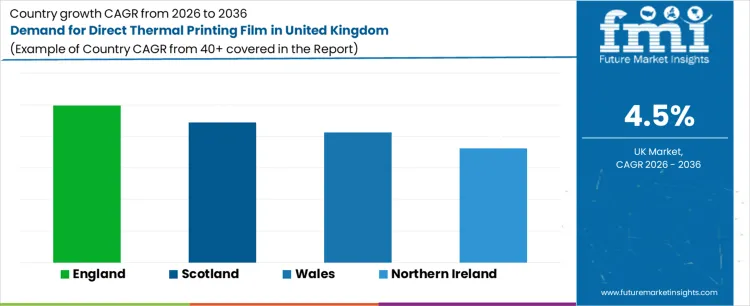
| Country | CAGR (2026 to 2036) |
|---|---|
| England | 5.0% |
| Scotland | 4.4% |
| Wales | 4.1% |
| Northern Ireland | 3.6% |
What is Driving the Demand for Direct Thermal Printing Film in England?
The demand for direct thermal printing film in England is projected to grow at a CAGR of 5.0% from 2026 to 2036. England remains the largest market, driven by the country’s significant retail, logistics, and healthcare sectors. Direct thermal printing technology is increasingly being used for labeling products, printing receipts, and creating barcodes due to its efficiency and cost-effectiveness. The rise of e-commerce and logistics services in England is a major driver for demand, as businesses require high-volume, high-quality printing solutions for product packaging and shipping. Additionally, as sustainability becomes more important, the demand for direct thermal printing films, which do not require ink or ribbons, is expected to increase. England’s strong retail infrastructure, coupled with its commitment to adopting efficient and eco-friendly technologies, ensures that the demand for direct thermal printing films will continue to grow.
How is the Demand for Direct Thermal Printing Film Performing in Scotland?
In Scotland, the demand for direct thermal printing film is expected to grow at a CAGR of 4.4% from 2026 to 2036. Scotland’s retail and logistics sectors, which are experiencing steady growth, are key drivers of demand for direct thermal printing solutions. The need for efficient labeling systems, particularly in retail and transportation, is pushing companies to adopt thermal printing solutions, which offer benefits such as faster printing speeds and lower operational costs. Additionally, as businesses across Scotland focus on improving efficiency and sustainability, direct thermal printing technology is becoming an increasingly popular choice. The healthcare sector in Scotland is also contributing to this demand, as thermal printing is used for labels, medical records, and patient identification. This growing adoption of direct thermal printing solutions is expected to drive steady growth in demand for printing films in Scotland.
What Are the Growth Drivers for Direct Thermal Printing Film in Wales?
The demand for direct thermal printing film in Wales is projected to grow at a CAGR of 4.1% through 2036. Similar to other regions, Wales’ retail, logistics, and healthcare sectors are the main contributors to the demand for direct thermal printing solutions. As the retail industry expands, the need for cost-effective and efficient labeling solutions is rising. Direct thermal printing is increasingly used for labels, receipts, and shipping information, making it a preferred choice in retail and logistics operations. In the healthcare industry, the technology is used for patient labels and pharmaceutical packaging. Furthermore, the push for more sustainable and ink-free printing methods is driving the adoption of direct thermal printing films in Wales. As these sectors continue to grow and seek more efficient solutions, the demand for direct thermal printing films is expected to increase steadily in Wales.
What is the Outlook for Direct Thermal Printing Film Demand in Northern Ireland?
Northern Ireland’s demand for direct thermal printing film is projected to grow at a CAGR of 3.6% from 2026 to 2036. While Northern Ireland represents the smallest market in the United Kingdom, the demand for direct thermal printing films is gradually increasing. The retail and logistics sectors in the region are adopting thermal printing technology for more efficient and cost-effective labeling solutions. The healthcare industry in Northern Ireland is also contributing to the demand, particularly for patient and medication labels. As sustainability becomes a key consideration for Northern Ireland’s industries, the demand for direct thermal printing solutions is expected to grow. Although the market is smaller than in other parts of the UK, the steady rise in e-commerce, retail, and healthcare operations ensures that demand for direct thermal printing films will continue to expand in Northern Ireland.
What is the Competitive Landscape for Demand for Direct Thermal Printing Film in the United Kingdom?
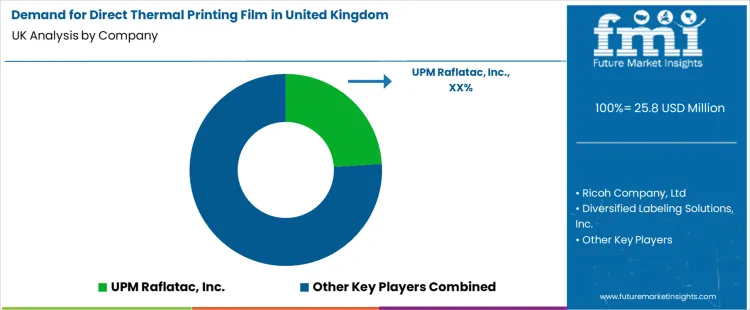
Demand for direct thermal printing film in the United Kingdom is shaped by requirements from logistics, retail labeling, healthcare, and ticketing applications. Procurement teams specify films that deliver consistent thermal response, adequate sensitivity for print heads, and durability for end use conditions. Buyers consult product brochures to compare documented performance metrics such as coating uniformity, adhesion to cores, and recommended operating temperatures. UPM Raflatac, Inc. is positioned as a leading supplier, with brochures detailing grade options, liner characteristics, and documented print compatibility with major thermal printers. Specification sheets from UPM Raflatac inform choices by highlighting measured run lengths, recommended storage conditions, and documented quality test results. Ricoh Company, Ltd. participates with direct thermal films that are supported by technical literature listing thermal sensitivity profiles and media handling notes, used by specification engineers to align material selection with printer models and throughput demands.
Diversified Labeling Solutions, Inc. competes with a range of direct thermal constructions described in product literature that outlines tensile strength, elongation data, and barrier properties relevant to specific labeling environments. McCourt Label Company’s documentation includes grade charts that assist buyers in matching film properties to application needs such as shelf labels or shipping tags. Stylerite Label Corporation supplies films with brochures that describe performance under varied humidity and temperature conditions, providing reference data for purchasers who require assured print quality in challenging ambient environments. In the United Kingdom, demand patterns reflect inventory management strategies and label yield expectations, with procurement cycles aligning with peak shipping periods. Buyers evaluate supplier materials to ensure compliance with quality and durability standards, and lead times are assessed against documented distribution capabilities. Product brochures serve as reference artifacts during tender evaluations, capturing documented specifications and documented use cases that support selection decisions. Technical teams often review documented adhesion charts and documented handling guidelines before finalizing contracts, anchoring selection in measurable material attributes.
Key Players of the Demand for Direct Thermal Printing Film in United Kingdom
- UPM Raflatac, Inc.
- Ricoh Company, Ltd
- Diversified Labeling Solutions, Inc.
- McCourt Label Company
- Stylerite Label Corporation
Scope of the Report
| Items | Values |
|---|---|
| Quantitative Units (2026) | USD Million |
| Material | Polypropylene (PP), Polyethylene (PE), Other Plastics (PVC, etc.) |
| Thickness | 76 to 100 microns, Up to 50 microns, 51 to 75 microns, Above 100 microns |
| Product Type | Labels, Tags |
| End Use | Food & Beverages, Healthcare, Electronics, Cosmetics & Personal Care, Homecare, Other (Travel, Logistics, etc.) |
| Companies | UPM Raflatac, Inc., Ricoh Company, Ltd, Diversified Labeling Solutions, Inc., McCourt Label Company, Stylerite Label Corporation |
| Regions Covered | United Kingdom |
| Countries Covered | England, Scotland, Wales, Northern Ireland |
| Additional Attributes | Dollar by sales by material, thickness, product type, end use, and region. Includes market trends towards sustainability, efficiency, and the role of direct thermal printing film in packaging and labeling industries. |
Demand for Direct Thermal Printing Film in United Kingdom
Material:
- Polypropylene (PP)
- Polyethylene (PE)
- Other Plastics (PVC, etc.)
Thickness:
- 76 to 100 microns
- Up to 50 microns
- 51 to 75 microns
- Above 100 microns
Product Type:
- Labels
- Tags
End Use:
- Food & Beverages
- Healthcare
- Electronics
- Cosmetics & Personal Care
- Homecare
- Other (Travel, Logistics, etc.)
Countries:
- England
- Scotland
- Wales
- Northern Ireland
Bibliography
- UK Warehousing Association (UKWA). (2024). Digital Logistics and Label Automation Adoption in the United Kingdom.
- GS1 UK. (2023). Barcode & Labeling Trends in UK Retail and Healthcare.
- Department for Business & Trade (UK). (2024). Industrial Digitisation and Packaging Sustainability Report.
- Office for National Statistics (ONS). (2024). UK E‑commerce, Retail Logistics, and Parcel Volumes Report.
- Royal Mail Group. (2024). UK Parcel Distribution Trends and Labeling Infrastructure Review.
- Plastics Europe. (2023). Polypropylene (PP) Film Market Trends and Applications Report.
- European Federation of Corrugated Board Manufacturers. (2024). Direct Thermal Label Innovations in Sustainable Packaging.
Frequently Asked Questions
How big is the demand for direct thermal printing film in United Kingdom in 2026?
The demand for direct thermal printing film in United Kingdom is estimated to be valued at USD 11.2 million in 2026.
What will be the size of direct thermal printing film in United Kingdom in 2036?
The market size for the direct thermal printing film in United Kingdom is projected to reach USD 17.4 million by 2036.
How much will be the demand for direct thermal printing film in United Kingdom growth between 2026 and 2036?
The demand for direct thermal printing film in United Kingdom is expected to grow at a 4.5% CAGR between 2026 and 2036.
What are the key product types in the direct thermal printing film in United Kingdom?
The key product types in direct thermal printing film in United Kingdom are polypropylene (pp), polyethylene (pe) and other plastics (pvc, etc.).
Which thickness segment is expected to contribute significant share in the direct thermal printing film in United Kingdom in 2026?
In terms of thickness, 76 to 100 microns segment is expected to command 35.3% share in the direct thermal printing film in United Kingdom in 2026.
Preview the report firsthand - request a free sample
Get SampleGet the brochure for pricing and purchase details.
Get PDFTable of Content
- Executive Summary
- UK Market Outlook
- Demand-side Trends
- Supply-side Trends
- Technology Roadmap Analysis
- Analysis and Recommendations
- Market Overview
- Market Coverage / Taxonomy
- Market Definition / Scope / Limitations
- Market Background
- Market Dynamics
- Drivers
- Restraints
- Opportunity
- Trends
- Scenario Forecast
- Demand in Optimistic Scenario
- Demand in Likely Scenario
- Demand in Conservative Scenario
- Opportunity Map Analysis
- Product Life Cycle Analysis
- Supply Chain Analysis
- Investment Feasibility Matrix
- Value Chain Analysis
- PESTLE and Porter’s Analysis
- Regulatory Landscape
- Regional Parent Market Outlook
- Production and Consumption Statistics
- Import and Export Statistics
- Market Dynamics
- UK Market Analysis 2021 to 2025 and Forecast, 2026 to 2036
- Historical Market Size Value (USD Million) Analysis, 2021 to 2025
- Current and Future Market Size Value (USD Million) Projections, 2026 to 2036
- Y-o-Y Growth Trend Analysis
- Absolute $ Opportunity Analysis
- UK Market Pricing Analysis 2021 to 2025 and Forecast 2026 to 2036
- UK Market Analysis 2021 to 2025 and Forecast 2026 to 2036, By Material
- Introduction / Key Findings
- Historical Market Size Value (USD Million) Analysis By Material , 2021 to 2025
- Current and Future Market Size Value (USD Million) Analysis and Forecast By Material , 2026 to 2036
- Polypropylene (PP)
- Polyethylene (PE)
- Other Plastics (PVC, etc.)
- Polypropylene (PP)
- Y-o-Y Growth Trend Analysis By Material , 2021 to 2025
- Absolute $ Opportunity Analysis By Material , 2026 to 2036
- UK Market Analysis 2021 to 2025 and Forecast 2026 to 2036, By Thickness
- Introduction / Key Findings
- Historical Market Size Value (USD Million) Analysis By Thickness, 2021 to 2025
- Current and Future Market Size Value (USD Million) Analysis and Forecast By Thickness, 2026 to 2036
- 76 to 100 microns
- Up to 50 microns
- 51 to 75 microns
- Above 100 microns
- 76 to 100 microns
- Y-o-Y Growth Trend Analysis By Thickness, 2021 to 2025
- Absolute $ Opportunity Analysis By Thickness, 2026 to 2036
- UK Market Analysis 2021 to 2025 and Forecast 2026 to 2036, By Product Type
- Introduction / Key Findings
- Historical Market Size Value (USD Million) Analysis By Product Type, 2021 to 2025
- Current and Future Market Size Value (USD Million) Analysis and Forecast By Product Type, 2026 to 2036
- Labels
- Tags
- Labels
- Y-o-Y Growth Trend Analysis By Product Type, 2021 to 2025
- Absolute $ Opportunity Analysis By Product Type, 2026 to 2036
- UK Market Analysis 2021 to 2025 and Forecast 2026 to 2036, By End Use
- Introduction / Key Findings
- Historical Market Size Value (USD Million) Analysis By End Use, 2021 to 2025
- Current and Future Market Size Value (USD Million) Analysis and Forecast By End Use, 2026 to 2036
- Food & Beverages
- Healthcare
- Electronics
- Cosmetics & Personal Care
- Homecare
- Other (Travel, Logistics, etc.)
- Food & Beverages
- Y-o-Y Growth Trend Analysis By End Use, 2021 to 2025
- Absolute $ Opportunity Analysis By End Use, 2026 to 2036
- Market Structure Analysis
- Competition Dashboard
- Competition Benchmarking
- Market Share Analysis of Top Players
- By Regional
- By Material
- By Thickness
- By Product Type
- By End Use
- Competition Analysis
- Competition Deep Dive
- UPM Raflatac, Inc.
- Overview
- Product Portfolio
- Profitability by Market Segments (Product/Age /Sales Channel/Region)
- Sales Footprint
- Strategy Overview
- Marketing Strategy
- Product Strategy
- Channel Strategy
- Ricoh Company, Ltd
- Diversified Labeling Solutions, Inc.
- McCourt Label Company
- Stylerite Label Corporation
- UPM Raflatac, Inc.
- Competition Deep Dive
- Assumptions & Acronyms Used
- Research Methodology


