

- Industry Size (2026)
- USD 10.8 Mn
- Forecast (2036)
- USD 16.1 Mn
- CAGR (2026 to 2036)
- 4.1%
Demand for Thermostatic Radiator Valves in South Korea Forecast and Outlook 2026 to 2036
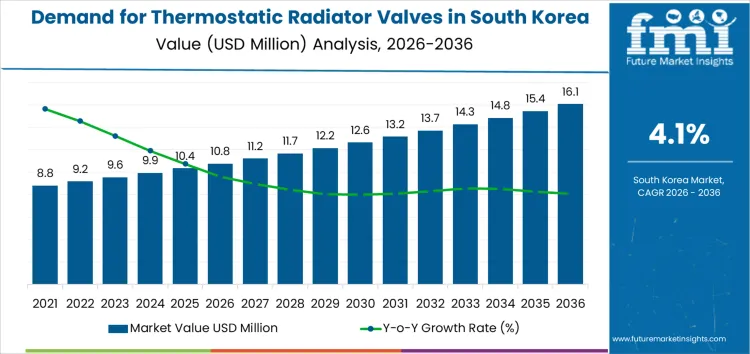
The demand for thermostatic radiator valves in South Korea is projected at USD 10.8 million in 2026 and is expected to rise to USD 16.1 million by 2036, reflecting a 4.1% CAGR. This category carries strategic weight because it sits at the intersection of energy management, building efficiency standards, and long-term operational planning. Control points emerge through the way these valves influence heating system performance, giving facility managers a lever to manage consumption and stabilize utility costs. Dependency factors also surface, as adoption often hinges on alignment with building codes, retrofit cycles, and the willingness of property owners to prioritize efficiency upgrades. Strategic trade-offs will shape outcomes, with stakeholders weighing upfront installation costs against lifetime energy savings, maintenance requirements, and compliance benefits. As energy optimization moves higher on corporate and municipal agendas, thermostatic radiator valves become part of a broader decision framework where cost discipline, regulatory pressure, and operational predictability converge.
Quick Stats for the Demand for Thermostatic Radiator Valves in South Korea
- Thermostatic Radiator Valves in South Korea Value (2026): USD 10.8 million
- Thermostatic Radiator Valves in South Korea Forecast Value (2036): USD 16.1 million
- Thermostatic Radiator Valves in South Korea Global Forecast CAGR (2026 to 2036): 4.1%
- Thermostatic Radiator Valves in South Korea Leading Segment: Offline (64.6%)
- Key Growth Regions of Thermostatic Radiator Valves in South Korea: Jeju (leading CAGR ~4.9%)
- Top Players of Thermostatic Radiator Valves in South Korea: Danfoss A/S, Honeywell International Inc., Schneider Electric SE, IMI Hydronic Engineering, Siemens AG
What is the Growth Forecast for the Demand for Thermostatic Radiator Valves in South Korea through 2036?
Growth rate volatility for thermostatic radiator valves in South Korea remains low through the forecast window, creating a steady demand rhythm. Early-period readings from 2026 to 2030 show narrow variations as building activity and heating system upgrades proceed at a controlled pace. Annual changes fall within a tight band due to consistent adoption across residential units and moderate replacement cycles in commercial buildings. Each early-year fluctuation stays aligned with typical installation patterns, indicating a stable underlying demand base.
From 2031 onwards, volatility remains contained as installations progress more through routine building maintenance rather than expansion surges. The upward movement toward USD 16.1 million in 2036 reflects predictable year-to-year adjustments rather than sharp deviations. Rolling changes in consumption correspond to incremental energy-efficiency actions and internal compliance requirements across older buildings. This pattern keeps volatility subdued, forming a durable profile suitable for long-range supply commitments and production scheduling across the South Korean building hardware ecosystem.
Key Takeaways for Demand for Thermostatic Radiator Valves in South Korea
| Metric | Value |
|---|---|
| Industry Sales Value (2026) | USD 10.8 million |
| Industry Forecast Value (2036) | USD 16.1 million |
| Industry Forecast CAGR (2026 to 2036) | 4.1% |
Why is the Demand for Thermostatic Radiator Valves Growing in South Korea?
Demand for thermostatic radiator valves in South Korea reflects structural changes in building design, energy policy, and heating system upgrades. Residential and commercial developers are replacing legacy heating systems with units that offer greater temperature control and energy performance. Thermostatic radiator valves help regulate heat output in individual rooms, which aligns with occupant preferences for comfort and with goals to use energy more efficiently. South Korea’s climate, with cold winters in inland and northern regions, makes hydronic heating systems widespread, and the addition of automatic valves improves responsiveness to changing indoor conditions. Procurement professionals in construction and mechanical services specify these valves to meet performance criteria for new builds and retrofit projects. Maintenance teams value their ease of integration into existing radiator networks and the potential to reduce wear on boilers or heat sources by limiting unnecessary heat distribution. These technical and operational factors sustain interest in thermostatic radiator valves across multiple building segments.
Looking ahead, growth in demand for thermostatic radiator valves in South Korea is supported by regulatory focus on energy efficiency and sustainability in the built environment. National and local standards increasingly encourage heat management technologies that contribute to lower energy consumption and reduced greenhouse gas emissions. Builders and facility managers incorporate automatic control components to comply with evolving codes and to optimize lifecycle costs of heating systems. The expansion of multi-unit residential developments and refurbishment of aging building stock create consistent opportunities for product adoption. Advances in valve design, such as improved sensor accuracy and compatibility with digital control systems, make installation and operation more attractive for modern heating networks. Rising awareness among end users regarding indoor comfort and utility cost reduction contributes to specification decisions that include thermostatic radiator valves. Taken together, these trends support continued demand for these components in South Korea’s construction and heating sectors.
What Shapes the Demand for Thermostatic Radiator Valves in South Korea?
Demand for thermostatic radiator valves in South Korea is structured around application and distribution channel. Residential installations hold a 60% share, while offline channels account for 64.6%. These two segments anchor consumption patterns across the country, reflecting established heating system preferences, procurement habits, and the scale of housing-driven upgrades. Their combined influence outlines how valves are selected, purchased, and integrated into domestic and commercial heating systems.
Why Does the Residential Segment Hold the Largest Share?
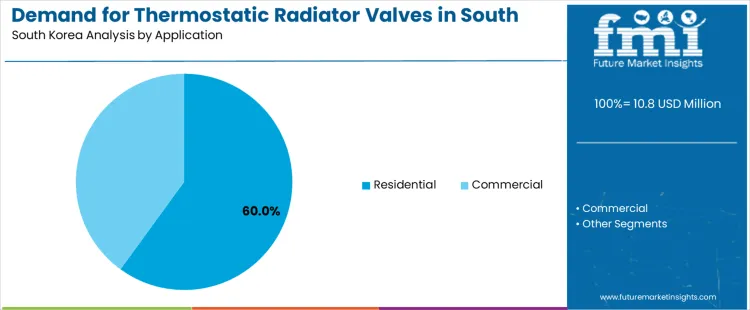
Residential use maintains a 60% share because housing developments in South Korea rely on stable temperature control solutions that support energy-efficient heating. Apartments and single-family homes incorporate thermostatic radiator valves to manage room-level heat output, reduce fuel usage, and prevent overheating in compact living spaces. Valves with simple manual or programmable controls appeal to homeowners seeking predictable performance without complex automation. Heating system contractors working on renovation cycles and district-heating upgrades frequently specify these valves for predictable balancing and improved comfort. Local building practices favor products that integrate cleanly with hydronic radiators and underfloor heating circuits, both common in residential environments. The steady pace of urban redevelopment sustains installation volumes, as older homes transition to systems that require more accurate thermal regulation. Growing interest in energy savings strengthens adoption across new and existing dwellings. Residential demand also benefits from replacement cycles, since valves are switched out during radiator maintenance and seasonal servicing. These conditions reinforce the segment’s position as the primary driver of thermostatic radiator valve demand across South Korea’s housing landscape.
Why Do Offline Channels Hold the Largest Share?
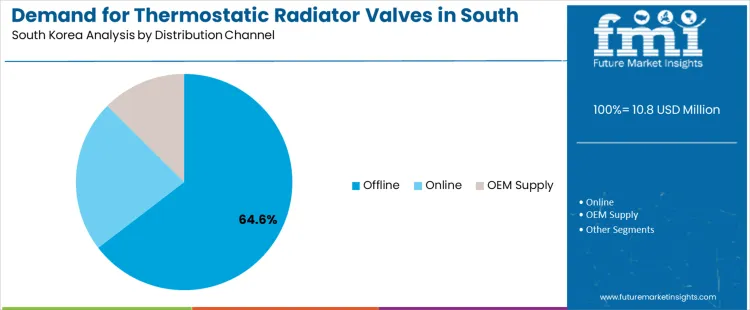
Offline channels maintain a 64.6% share due to purchasing patterns shaped by contractor networks, distributor relationships, and the technical nature of heating components. Installers and mechanical service firms source thermostatic radiator valves through established wholesalers that carry certified models compatible with local heating standards. Offline procurement ensures product verification, demonstrations, and technical guidance during system selection. Retail hardware outlets also support residential buyers seeking replacement valves that match existing radiators, reinforcing foot-traffic driven sales. Distributors maintain inventory suitable for both small-scale home projects and larger commercial fit-outs, which helps prevent delays during heating system installation. OEM supply plays a smaller role, as radiator manufacturers integrate specific valve models during production runs, while online channels remain limited due to installation requirements that favor professional involvement. Offline distribution continues to dominate because heating components require performance assurance, compatibility checks, and access to specialist support that aligns with South Korea’s installer-driven purchasing structure.
What Is the Current Demand for Thermostatic Radiator Valves in South Korea?
Demand for thermostatic radiator valves (TRVs) in South Korea is linked to heating system upgrades, energy efficiency improvements, and building renovations. TRVs regulate heat output at individual radiators, making them relevant in residential and commercial buildings that use hydronic heating. Growth in urban residential developments and retrofits in older apartment complexes has supported procurement of TRVs. The emphasis on controlling indoor temperatures and reducing heating costs has also influenced purchasing decisions by building owners and property managers. Demand patterns are tied to broader construction activity and policies encouraging efficient energy use.
What Factors Are Driving Demand for Thermostatic Radiator Valves in South Korea?
Several structural forces support TRV demand in South Korea. Government initiatives that encourage energy efficiency in buildings and lower greenhouse gas emissions have increased interest in devices that control heat distribution. Builders and developers upgrading heating systems in new high-rise apartments and office buildings seek components that improve occupant comfort and reduce utility expenses. Rising awareness of energy bills among consumers encourages installation of TRVs in existing properties. Technical specifications in building codes that favor heat control and zoning solutions further bolster adoption. The availability of advanced TRVs with digital or smart features aligns with broader trends in connected home systems.
What Are the Constraints on Demand for Thermostatic Radiator Valves in South Korea?
Despite ongoing uptake, certain constraints affect TRV demand in South Korea. The predominant use of centralized heating systems and district heat in many urban areas limits TRV relevance, as the potential for individual radiator control is reduced. Cost considerations also play a role, particularly in retrofit projects where replacing entire heating systems is expensive compared to incremental valve upgrades. Awareness of TRV benefits remains uneven among building owners and residents, which can slow adoption rates. Supply chain issues, including lead times for imported components or pricing volatility, may influence procurement planning and inventory decisions for suppliers and installers.
What Trends Are Emerging in South Korea’s Thermostatic Radiator Valve Market?
Emerging trends in South Korea’s TRV market include a shift toward smart and electronically controlled valves that integrate with building management and home automation systems. These products enable remote temperature adjustments and data-driven control, appealing to tech-oriented consumers and property managers focused on efficiency. There is also a movement toward higher-precision valves that improve responsiveness and stability in temperature control, especially in premium residential projects. Sustainability considerations are shaping preferences for components that support reduced energy consumption and lower carbon emissions. Finally, partnerships between local HVAC firms and international TRV manufacturers are influencing product availability and technical support networks.
What is the Regional Outlook for the Demand for Thermostatic Radiator Valves in South Korea?
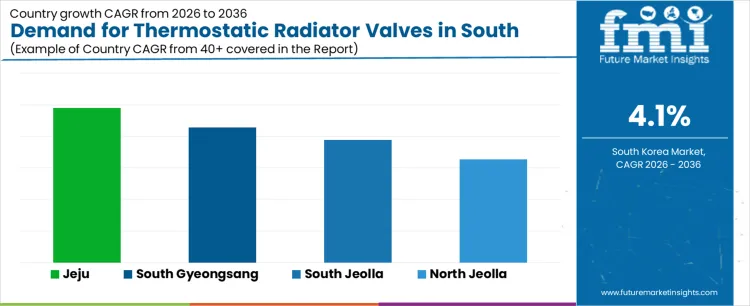
Demand for thermostatic radiator valves (TRVs) across South Korea reflects the spread of residential heating upgrades, building retrofits, and energy-efficiency initiatives. Growth is strongest in regions with active construction activity or a rising focus on smart-heating controls. Jeju records the highest projected CAGR, supported by sustained tourism-driven infrastructure growth and expanding adoption of energy-efficient systems. South Gyeongsang and South Jeolla show solid demand linked to mixed residential and commercial development, while North Jeolla grows more moderately as heating-efficiency retrofits progress at a steadier pace. As South Korea continues to strengthen building-energy standards and shift toward more adaptive heating controls, regional TRV demand is expected to broaden.
| Province | CAGR (2026-2036) |
|---|---|
| South Gyeongsang | 4.3% |
| North Jeolla | 3.3% |
| South Jeolla | 3.9% |
| Jeju | 4.9% |
What drives the demand for Thermostatic Radiator Valves in South Gyeongsang?
South Gyeongsang is projected to record a CAGR of 4.3% in thermostatic radiator valve demand from 2026 to 2036. The province’s mix of residential expansion, small-to-mid sized commercial buildings, and industrial facilities creates steady need for energy-efficient heating controls. TRVs are increasingly used in housing developments and retrofit projects that aim to reduce heating costs and enhance room-level temperature control. Local authorities have been expanding energy-efficiency programs focused on reducing building emissions, which encourages wider use of automated or semi-automated radiator systems. Manufacturers and institutional buildings in the province are also adopting TRVs to improve heating consistency and lower operating costs in larger facilities. The region’s construction pipeline, along with steady modernization of older housing stock, sustains long-term TRV demand.
What influences the demand for Thermostatic Radiator Valves in North Jeolla?
North Jeolla is expected to grow at a moderate CAGR of 3.3% through 2036. The province’s TRV demand is shaped by gradual residential modernization and selective adoption of heating-efficiency solutions across its cities. While large-scale construction is more limited compared to coastal provinces, ongoing upgrades in public housing, schools, and government buildings contribute to TRV use. North Jeolla’s focus on improving indoor heating efficiency during colder months also supports uptake. Local industries with process-related heating requirements are adopting TRVs for better temperature regulation in worker areas and ancillary facilities. Growth remains steady rather than accelerated, reflecting the province’s moderate construction activity and measured pace of retrofit adoption.
What drives the demand for Thermostatic Radiator Valves in South Jeolla?
South Jeolla is projected to see a CAGR of 3.9% in demand for thermostatic radiator valves between 2026 and 2036. The province’s steady construction activity, combined with government-backed energy-efficiency initiatives, supports rising interest in TRVs. Residential developments, tourism-related buildings, and institutional facilities increasingly incorporate heating-control systems to manage energy use and maintain consistent indoor comfort. South Jeolla’s industrial activity also contributes to TRV demand, as facilities adopt more precise heating control systems to improve energy performance. As older heating infrastructure is upgraded, building owners prioritize TRVs due to their low installation complexity and strong impact on reducing unnecessary fuel use. Continued expansion of mixed-use developments reinforces the province’s healthy growth rate.
Why is Jeju projected to have the highest growth in Thermostatic Radiator Valve demand?
Jeju leads with a projected CAGR of 4.9% from 2026 to 2036. The island’s robust tourism sector and continuous development of hospitality, retail, and residential facilities create strong demand for modern heating controls. TRVs align with Jeju’s sustainability agenda, which emphasizes reducing building-energy consumption and improving climate-control systems across hotels, public buildings, and premium housing. The region’s variable climate conditions prompt building operators to adopt more adaptive heating mechanisms, increasing TRV uptake. Infrastructure upgrades linked to population growth and tourism expansion further stimulate demand. As Jeju invests in smart-building technologies and energy-efficient construction standards, thermostatic radiator valves are becoming a standard feature across new and renovated structures, reinforcing its position as the fastest-growing region for TRV demand.
How are Competitors Differentiating in the Thermostatic Radiator Valve Market in South Korea?
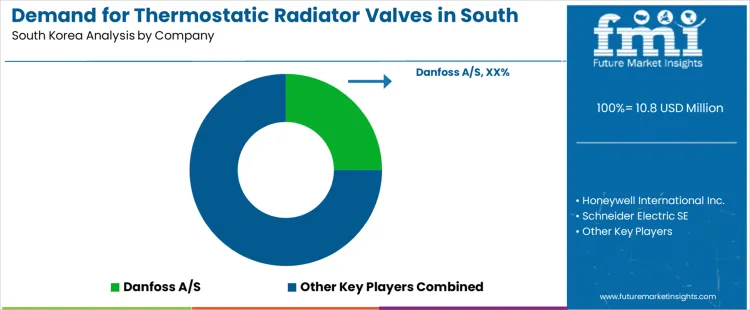
Competitive positioning in South Korea’s thermostatic radiator valve market is shaped by product reliability, control precision, and compatibility with modern heating systems. Danfoss A/S, the leading supplier, secures its position through durable valve designs, stable temperature-control performance, and a broad range of sensor and actuator configurations. Their product strategy focuses on consistent regulation, easy installation, and dependable performance in varied building environments. Honeywell International Inc. competes through programmable and mechanically precise valve solutions designed to support energy-efficient heating, appealing to residential and commercial users seeking predictable operation. Schneider Electric SE offers valves integrated with building-automation platforms, enabling users to align radiator control with broader energy-management systems.
Competition expands as IMI Hydronic Engineering and Siemens AG emphasize system-level performance and hydraulic balance. IMI Hydronic Engineering differentiates through valves designed to maintain steady flow characteristics and stable room temperatures, supporting South Korea’s growing focus on energy-efficient building operations. Siemens AG reinforces its position with valves that prioritize sensor accuracy and interoperability with modern control systems, serving facilities that require precise thermal management across multiple zones. Across all competitors, product brochures serve as the key communication tool, presenting valve specifications, flow curves, sensor types, material options, and installation guidelines. These documents assist engineers and procurement teams in evaluating suitability for heating configurations common in South Korean buildings, ensuring alignment with efficiency goals and operational requirements.
Key Players of the Demand for Thermostatic Radiator Valves in South Korea
- Danfoss A/S
- Honeywell International Inc.
- Schneider Electric SE
- IMI Hydronic Engineering
- Siemens AG
Scope of the Report
| Items | Values |
|---|---|
| Quantitative Units (2026) | USD Million |
| Product Type | Electric Operated, Manually Operated |
| Application | Residential, Commercial |
| Distribution Channel | Offline, Online, OEM Supply |
| Companies | Danfoss A/S, Honeywell International Inc., Schneider Electric SE, IMI Hydronic Engineering, Siemens AG |
| Region Covered | South Korea |
| Provinces Covered | South Gyeongsang, North Jeolla, South Jeolla, Jeju |
| Additional Attributes | Dollar sales by product type, application, and distribution channel. Demand is influenced by rising building retrofits, heating efficiency requirements, and adoption of automation-ready valves, with both manual and electric variants used across residential and commercial heating systems. |
Demand for Thermostatic Radiator Valves in South Korea
Product Type:
- Electric Operated
- Manually Operated
Application:
- Residential
- Commercial
Distribution Channel:
- Offline
- Online
- OEM Supply
Provinces:
- South Gyeongsang
- North Jeolla
- South Jeolla
- Jeju
Bibliography
- Korea Energy Agency. (2024). Updated building energy efficiency standards and heating-system performance optimization guidelines. Korea Energy Agency.
- Ministry of Land, Infrastructure and Transport (Republic of Korea). (2024). Korean building codes and heating-system energy efficiency regulations. Government of South Korea.
- Ministry of Trade, Industry and Energy (Republic of Korea). (2024). National energy-efficiency programs and low-carbon heating modernization initiatives. Government of South Korea.
Frequently Asked Questions
How big is the demand for thermostatic radiator valves in south korea in 2026?
The demand for thermostatic radiator valves in south korea is estimated to be valued at USD 10.8 million in 2026.
What will be the size of thermostatic radiator valves in south korea in 2036?
The market size for the thermostatic radiator valves in south korea is projected to reach USD 16.1 million by 2036.
How much will be the demand for thermostatic radiator valves in south korea growth between 2026 and 2036?
The demand for thermostatic radiator valves in south korea is expected to grow at a 4.1% CAGR between 2026 and 2036.
What are the key product types in the thermostatic radiator valves in south korea?
The key product types in thermostatic radiator valves in south korea are electric operated and manually operated.
Which application segment is expected to contribute significant share in the thermostatic radiator valves in south korea in 2026?
In terms of application, residential segment is expected to command 60.0% share in the thermostatic radiator valves in south korea in 2026.
Preview the report firsthand - request a free sample
Get SampleGet the brochure for pricing and purchase details.
Get PDFTable of Content
- Executive Summary
- South Korea Market Outlook
- Demand-side Trends
- Supply-side Trends
- Technology Roadmap Analysis
- Analysis and Recommendations
- Market Overview
- Market Coverage / Taxonomy
- Market Definition / Scope / Limitations
- Market Background
- Market Dynamics
- Drivers
- Restraints
- Opportunity
- Trends
- Scenario Forecast
- Demand in Optimistic Scenario
- Demand in Likely Scenario
- Demand in Conservative Scenario
- Opportunity Map Analysis
- Product Life Cycle Analysis
- Supply Chain Analysis
- Investment Feasibility Matrix
- Value Chain Analysis
- PESTLE and Porter’s Analysis
- Regulatory Landscape
- Regional Parent Market Outlook
- Production and Consumption Statistics
- Import and Export Statistics
- Market Dynamics
- South Korea Market Analysis 2021 to 2025 and Forecast, 2026 to 2036
- Historical Market Size Value (USD Million) Analysis, 2021 to 2025
- Current and Future Market Size Value (USD Million) Projections, 2026 to 2036
- Y-o-Y Growth Trend Analysis
- Absolute $ Opportunity Analysis
- South Korea Market Pricing Analysis 2021 to 2025 and Forecast 2026 to 2036
- South Korea Market Analysis 2021 to 2025 and Forecast 2026 to 2036, By Product Type
- Introduction / Key Findings
- Historical Market Size Value (USD Million) Analysis By Product Type , 2021 to 2025
- Current and Future Market Size Value (USD Million) Analysis and Forecast By Product Type , 2026 to 2036
- Electric Operated
- Manually Operated
- Electric Operated
- Y-o-Y Growth Trend Analysis By Product Type , 2021 to 2025
- Absolute $ Opportunity Analysis By Product Type , 2026 to 2036
- South Korea Market Analysis 2021 to 2025 and Forecast 2026 to 2036, By Application
- Introduction / Key Findings
- Historical Market Size Value (USD Million) Analysis By Application, 2021 to 2025
- Current and Future Market Size Value (USD Million) Analysis and Forecast By Application, 2026 to 2036
- Residential
- Commercial
- Residential
- Y-o-Y Growth Trend Analysis By Application, 2021 to 2025
- Absolute $ Opportunity Analysis By Application, 2026 to 2036
- South Korea Market Analysis 2021 to 2025 and Forecast 2026 to 2036, By Distribution Channel
- Introduction / Key Findings
- Historical Market Size Value (USD Million) Analysis By Distribution Channel, 2021 to 2025
- Current and Future Market Size Value (USD Million) Analysis and Forecast By Distribution Channel, 2026 to 2036
- Offline
- Online
- OEM Supply
- Offline
- Y-o-Y Growth Trend Analysis By Distribution Channel, 2021 to 2025
- Absolute $ Opportunity Analysis By Distribution Channel, 2026 to 2036
- Market Structure Analysis
- Competition Dashboard
- Competition Benchmarking
- Market Share Analysis of Top Players
- By Regional
- By Product Type
- By Application
- By Distribution Channel
- Competition Analysis
- Competition Deep Dive
- Danfoss A/S
- Overview
- Product Portfolio
- Profitability by Market Segments (Product/Age /Sales Channel/Region)
- Sales Footprint
- Strategy Overview
- Marketing Strategy
- Product Strategy
- Channel Strategy
- Honeywell International Inc.
- Schneider Electric SE
- IMI Hydronic Engineering
- Siemens AG
- Danfoss A/S
- Competition Deep Dive
- Assumptions & Acronyms Used
- Research Methodology


