

- Market Size (2026)
- USD 720.6 Mn
- Forecast (2036)
- USD 1219.3 Mn
- CAGR (2026 to 2036)
- 5.4%
How big is the Stone Block Lifters Market in 2026?
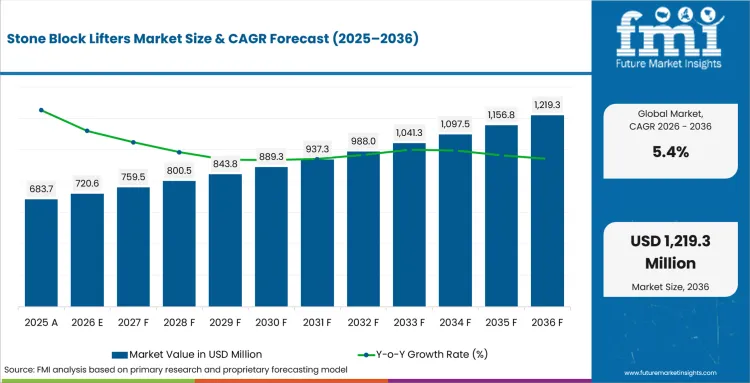
USD 720.6 million in 2026 and USD 1219.3 million by 2036 at a 5.4% CAGR.
The Stone Block Lifters Market was valued at USD 683.7 million in 2025 and is forecast to increase from USD 720.6 million in 2026 to USD 1219.3 million by 2036, representing a 5.4% CAGR. The category covers gravity-assisted scissor grabs and mechanical clamps, along with forklift attachments, crane-mounted devices and powered vacuum systems used between quarry faces, yards, storage racks, saws, CNC machines and installation points.
A lifter must control the buyer's actual load without exposing workers to suspended or unstable stone. Rated capacity is one part of the decision. Surface roughness, block dimensions, centre of gravity, jaw opening, pad condition, vacuum reserve and compatibility with the host crane or forklift also affect the lift. OSHA has documented fatal incidents involving large stone slabs, while ASME B30.20 and EN 13155 set expectations for marking, inspection, testing and operation of below-the-hook attachments.
Key Takeaways of Stone Block Lifters Market
- Demand is forecast to rise from USD 720.6 million in 2026 to USD 1219.3 million by 2036 at a 5.4% CAGR.
- Scissor Grab Lifters lead the Lifter Type category with a 28.0% share in 2026 because their linkage converts load weight into gripping force without a separate power supply.
- The 1-5 Ton range accounts for 37.0% of demand in 2026 and serves common quarry, yard, slab and monument lifts without the size of the heaviest extraction equipment.
- Hydraulic systems represent 33.0% of Power or Actuation sales in 2026 because they integrate with host equipment and support repeated heavy lifts.
- Quarry Block Handling leads Application with 36.0% of demand, while Lifting Equipment Dealers handle 39.0% of sales in 2026.
- Load mismatch, weak inspection, poor contact geometry and vacuum loss can turn one lift into a dropped-load or crushing event.
- Aardwolf, Manzelli, Weha, Abaco Machines, Woods Powr-Grip, Vacuworx, Caldwell Group, Kenco and Gorbel are the notable companies serving this market.
Analyst Perspective
“Approve the device against the actual weight and dimensions, then account for surface condition and centre of gravity. Test the roughest expected load, verify reserve and pad condition, confirm host-equipment compatibility, and treat dealer service as part of the lifting system.”
- Nikhil Kaitwade, Principal Analyst at Future Market Insights
Source: Future Market Insights' proprietary forecasting model and primary research
How is the Stone Block Lifters Market segmented?
The market is segmented by Lifter Type, Load Capacity, Power or Actuation, Application, Sales Channel and Region.
The stone block lifters market is segmented by Lifter Type into Scissor Grab Lifters, Vacuum Block Lifters, Clamp Lifters, Forklift-mounted Lifters and Crane Hook Lifters. By Load Capacity, the market includes 1-5 Ton, <1 Ton, 5-20 Ton and >20 Ton. Power or Actuation covers Hydraulic, Manual Mechanical, Pneumatic / Vacuum and Electric systems. By Application, the market is divided into Quarry Block Handling, Stone Yard Handling, Slab / Monument Handling and Construction Site Placement. Sales Channel includes Lifting Equipment Dealers, Direct Manufacturer and Rental / Service Providers.
Why does quarry block handling lead the application category?
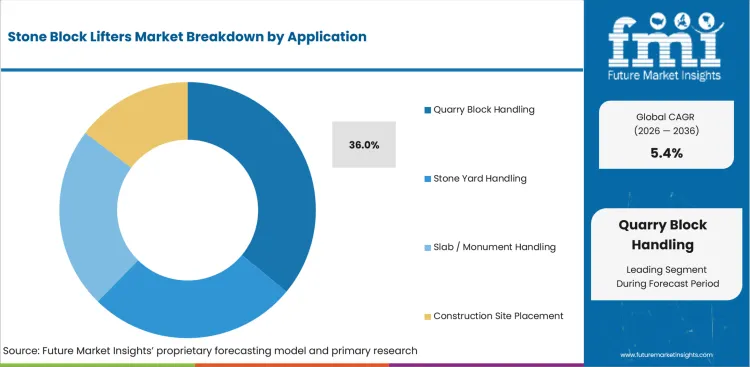
Quarry block handling begins soon after extraction, when surfaces can be rough and dimensions irregular. Blocks must move into the yard and later into cutting or processing without placing workers beside an unstable suspended load. Stone Yard Handling supports storage and transfer. Slab / Monument Handling focuses on processed pieces, while Construction Site Placement requires control at the final location.
- By Application, Quarry Block Handling is projected to account for 36.0% of demand in 2026 because it contains the heaviest and most frequent primary moves.
- Trials should use the roughest surface, the widest expected dimension spread and the most difficult centre-of-gravity condition found in normal quarry work.
Why do scissor grab lifters lead the lifter type category?
Scissor grab lifters use the weight of the block to increase gripping force as the load rises. They do not require a vacuum seal or a separate power supply, which makes them practical for repeated yard moves when block dimensions remain within a defined jaw range. Vacuum Block Lifters suit surfaces that can maintain a seal. Clamp Lifters, Forklift-mounted Lifters and Crane Hook Lifters address different load shapes and host equipment.
- By Lifter Type, Scissor Grab Lifters are forecast to represent 28.0% of market sales in 2026 because the linkage provides a simple gravity-assisted grip.
- High-friction pads, guide rollers and automatic lock or release features can stabilise the block and reduce manual contact during attachment.
- Approval should cover jaw opening, pad wear and load dimensions across the lightest and heaviest expected blocks because grip behaviour changes across the range.
What makes 1-5 Ton the leading load capacity category?
The 1-5 Ton range covers many blocks, large slabs and monuments moved by forklifts, cranes and compact carriers. It gives buyers enough capacity for quarry and fabrication work without the size or cost of the heaviest extraction equipment. The <1 Ton range serves lighter slab and placement work, while 5-20 Ton and >20 Ton equipment addresses larger quarry blocks and specialised heavy handling.
- By Load Capacity, 1-5 Ton equipment is projected to represent 37.0% of demand in 2026 because one stocked capacity band can serve several customer types.
- Each attachment still requires a defined load-shape and contact-area limit. Weight capacity alone does not make a lift safe when the block is too wide, too narrow or poorly balanced for the gripping geometry.
Why does hydraulic lead the power or actuation category?
Hydraulic systems use the host machine or a dedicated circuit to provide controlled gripping or vacuum-pump power. The format fits quarry, construction and yard equipment that already carries hydraulic services and performs repeated heavy lifts. Manual Mechanical systems remain relevant where simplicity matters, while Pneumatic / Vacuum and Electric systems suit applications that need suction control or powered handling without a hydraulic connection.
- By Power or Actuation, Hydraulic systems are expected to account for 33.0% of market sales in 2026 because they reduce repeated manual tightening and support larger or more frequent lifts.
- Maintenance must treat hoses, pressure, controls, reserve functions and the gripping attachment as one lifting system.
Why do lifting equipment dealers lead the sales channel category?
Lifting equipment dealers can check crane or forklift compatibility, select the correct capacity and gripping range, and support inspection records, replacement pads and vacuum components. Direct Manufacturer sales remain important for engineered fleets or unusual loads. Rental / Service Providers serve project-specific lifts and buyers with low utilisation.
- By Sales Channel, Lifting Equipment Dealers are expected to handle 39.0% of market sales in 2026 because technical selection and after-sales inspection affect the safety of the complete lift.
- The purchase should include rated-capacity markings, permitted load dimensions, inspection intervals and a clear service route for wear parts.
What are the drivers, restraints and opportunities in the Stone Block Lifters Market?
Heavy stone and worker separation support demand. Load variation and inspection failure create risk. Monitoring and service provide the clearest premium route.
- Driver: Quarries, yards and fabrication shops need controlled movement between extraction, storage and processing stages.
- Restraint: Poor contact geometry, vacuum loss or weak inspection can turn one mismatch into a dropped-load or crushing event.
- Opportunity: Vacuum reserve monitoring, load-condition indicators and digital inspection records can make lift approval more visible and repeatable.
Heavy stone creates recurring handling demand because every block or slab moves through several work stages. Mechanical assistance can keep workers away from pinch and crush zones while improving flow between racks, saws and CNC machines. OSHA has documented fatal incidents involving large slabs, which makes worker separation and controlled storage or unloading commercially important.
Load variation is the main qualification problem. Rough, honed and saw-cut surfaces may not seal like polished stone, while mechanical clamps depend on friction and contact position. UK Health and Safety Executive guidance warns about suction loss and inadequate reserve. A buyer should not approve a lifter on one clean showroom slab when normal work includes wet, dusty, uneven or irregular loads.
The premium opportunity is to make the lift condition easier to verify. Vacuum gauges, reserve alarms, pad-condition checks and digital inspection records can show whether the device is ready before the load leaves its support. Suppliers can also offer application testing, operator training and scheduled inspection, creating service revenue after the equipment sale.
Which country CAGRs are profiled in the Stone Block Lifters Market?
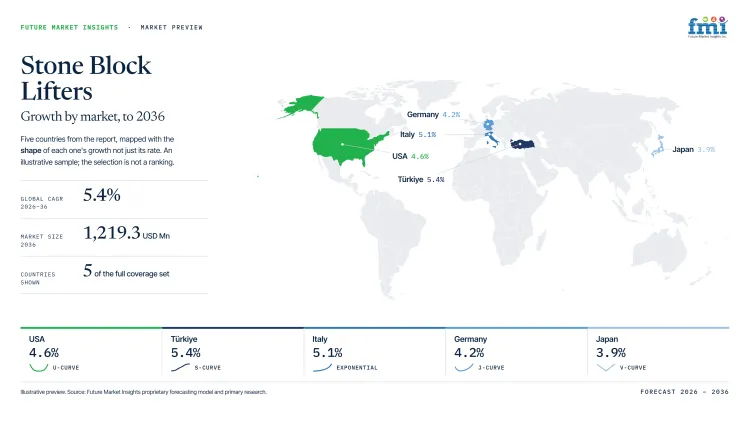
| Country | CAGR |
|---|---|
| USA | 4.6% |
| Germany | 4.2% |
| Japan | 3.9% |
| Italy | 5.1% |
| Türkiye | 5.4% |
How do country-level CAGRs compare in the Stone Block Lifters Market?
The five country CAGRs range from 3.9% to 5.4%. Türkiye is projected to grow fastest at 5.4%, followed by Italy at 5.1% and the USA at 4.6%. Germany and Japan are forecast at 4.2% and 3.9%. These rates describe forecast pace rather than current revenue or installed volume.
- Türkiye offers the strongest quarry-led expansion case, although remote sites increase the value of dealer service and broad capacity coverage.
- Italy combines quarry handling with slab movement in cutting and finishing shops, supporting mechanical clamps and vacuum systems.
- The USA has a formal standards and safety framework, which raises expectations for markings, testing, inspection and operator procedures.
- Germany relies more on replacement and documented inspection within established industrial channels.
- Japan favours documented compatibility and service support for upgrades to an installed crane or forklift base.
Comparable CAGRs can produce different market-entry conditions. Country potential depends on qualified lifting channels and compatibility with the installed crane, forklift and carrier base, not stone output alone.
What does the Country-wise Analysis show for the Stone Block Lifters Market?
- USA: The US market is projected to grow at a 4.6% CAGR from 2026 to 2036. OSHA records show the severity of slab-handling failures, while ASME B30.20 provides a formal framework for mechanical and vacuum lifters. Suppliers need clear capacity markings, load limits, inspection support and trained dealer networks.
- Germany: Germany is forecast to expand at a 4.2% CAGR through 2036. A mature industrial-equipment market supports replacement and professional service. European-standard compliance, documented inspection and local spare parts are stronger differentiators than broad claims about lifting speed.
- Japan: Japan is expected to record a 3.9% CAGR over the forecast period. Compact equipment, disciplined maintenance and clear operating records suit organised stone and construction handling. Products that integrate cleanly with existing cranes or forklifts have an advantage over oversized standalone systems.
- Italy: Italy is projected to grow at a 5.1% CAGR from 2026 to 2036. Quarrying, cutting and finishing create several lifting points from rough blocks to processed slabs. The market can support mechanical clamps for yards and vacuum systems for cleaner fabrication environments.
- Türkiye: Türkiye is forecast to lead the group at a 5.4% CAGR. Active quarrying creates demand for attachments that handle irregular blocks and operate away from major service centres. Dealer stock, field repair and capacity ranges matched to local quarry fleets are important entry conditions.
Who are the notable companies in the Stone Block Lifters Market?
Aardwolf, Manzelli, Weha, Abaco Machines, Woods Powr-Grip, Vacuworx, Caldwell Group, Kenco and Gorbel are the notable companies serving this market.
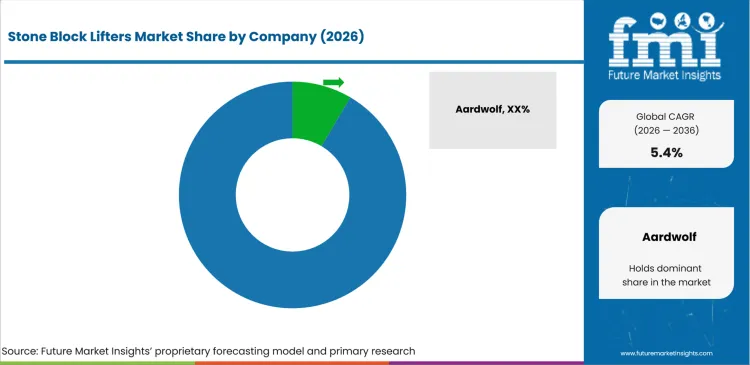
Competition spans stone-specific clamp makers, vacuum-lifting specialists and broader below-the-hook engineering companies. Buyers should not treat their offers as interchangeable. Rough quarry blocks, polished slabs and installed architectural stone require different contact methods, pad materials, reserve systems and host-equipment interfaces.
- Aardwolf, Manzelli, Weha, Abaco Machines and Kenco compete through stone-focused clamps and handling attachments. Their ranges cover scissor grabs, monument clamps and forklift attachments designed around common yard or fabrication tasks.
- Woods Powr-Grip, Vacuworx compete through vacuum technology. Their relevance rises where the buyer needs remote handling, protected finished surfaces or specialised pads for rough and honed stone.
- Caldwell Group and Gorbel add broader lifting engineering, standards knowledge and dealer reach. These suppliers are more relevant when the stone attachment sits inside a wider below-the-hook, crane or material-handling programme.
How do notable companies compare in the Stone Block Lifters Market?
| Company | Mechanical Clamp Breadth | Vacuum-System Breadth | Quarry and Slab Fit | Geographic Reach |
|---|---|---|---|---|
| Aardwolf | High | Medium | High | Global |
| Manzelli | High | High | High | Global |
| Weha | High | Medium | High | North America and Europe |
| Abaco Machines | High | Medium | High | Global |
| Woods Powr-Grip | Low | High | High | Global |
| Vacuworx | Low | High | High | Global |
| Caldwell Group | High | High | Medium | North America |
Scoring basis: High indicates broad documented coverage within the criterion, Medium indicates partial coverage and Low indicates limited coverage. Geographic reach records active regions. The table is not a market-share ranking.
What does the Stone Block Lifters Market report cover?
| Coverage field | Report scope |
|---|---|
| Market breakdown | Lifter Type, Load Capacity, Power / Actuation, Application, Sales Channel and Region. |
| Quantitative Units | Revenue in USD Million, CAGR in %. |
| Market Definition | Mechanical clamps, scissor grabs, vacuum lifters, forklift attachments and crane-mounted devices used to handle stone blocks or slabs in quarries, yards, fabrication shops and construction work. |
| Regions Covered | North America, Latin America, Western Europe, Eastern Europe, South Asia & Pacific, East Asia, Central Asia, Russia & Belarus, and Middle East & Africa. |
| Countries Covered | USA, Germany, Japan, Italy, Türkiye and more than 30 markets included in the full report. |
| Key Companies Profiled | Aardwolf, Manzelli, Weha, Abaco Machines, Woods Powr-Grip, Vacuworx, Caldwell Group, Kenco, Gorbel |
| Forecast Period | 2026 to 2036. |
| Approach | Hybrid bottom-up and top-down market sizing supported by primary interviews and official desk research. |
How was the Stone Block Lifters Market assessed?
| Method | Approach |
|---|---|
| Primary Research | FMI analysts gathered input from manufacturers, service providers, technology developers, distributors, end users, procurement teams and subject-matter experts. Interviews examined purchasing decisions, product or service evaluation, adoption barriers, approval requirements, pricing considerations and expectations for technical or commercial support. Respondents were also asked what evidence is required before a trial, pilot or initial order develops into regular purchasing. |
| Desk Research | Desk research covered government statistics, regulatory publications, trade data, industry associations, technical literature, standards, company filings, product information and official corporate announcements. Sources were reviewed for relevance, publication date, geographic coverage and consistency with the defined market scope. Claims relating to performance, applications, approvals, capacity, investment and commercial activity were retained only when supported by credible public evidence. |
| Market Sizing and Forecasting | The market model combined the baseline value with historical performance, segment structure, pricing and volume indicators, adoption levels, company participation and country-level demand conditions. Forecast assumptions considered economic activity, investment trends, regulatory developments, technology adoption, purchasing cycles, supply availability and barriers to wider market use. Segment and regional estimates were reconciled before the final market total was calculated. |
| Data Validation | Estimates were checked against multiple independent indicators, including public data, company activity, trade patterns, industry developments and findings from primary interviews. Validation also tested whether products, services, applications and company revenues fell within the defined market boundaries. Adjacent categories, unsupported claims, overlapping revenues and activities without direct market relevance were excluded to reduce double counting and maintain consistency across segments and countries. |
How is the Stone Block Lifters Market classified by segment?
Stone Block Lifters Market segmented by Lifter Type:
- Scissor Grab Lifters
- Vacuum Block Lifters
- Clamp Lifters
- Forklift-mounted Lifters
- Crane Hook Lifters
Stone Block Lifters Market segmented by Load Capacity:
- 1-5 Ton
- <1 Ton
- 5-20 Ton
- >20 Ton
Stone Block Lifters Market segmented by Power / Actuation:
- Hydraulic
- Manual Mechanical
- Pneumatic / Vacuum
- Electric
Stone Block Lifters Market segmented by Application:
- Quarry Block Handling
- Stone Yard Handling
- Slab / Monument Handling
- Construction Site Placement
Stone Block Lifters Market segmented by Sales Channel:
- Lifting Equipment Dealers
- Direct Manufacturer
- Rental / Service Providers
Which sources support the Stone Block Lifters Market analysis?
- Aardwolf, accessed 2026. Horizontal clamps lift natural-stone and concrete blocks using gravity locking and high-friction pads. https://www.aardwolf.com.au/en/product/horizontal-stone-lifting-clamp-ahlc-730
- Aardwolf, accessed 2026. Scissor lifters use the load's weight to generate gripping force and automate lock/release. https://www.aardwolf.com.au/en/product/scissor-clamp-lifter-asl300
- Aardwolf, accessed 2026. High-friction rubber pads and guide rollers stabilise stone during scissor lifting. https://www.aardwolf.com.au/en/product/scissor-clamp-lifter-asl105
- Aardwolf, accessed 2026. Stone clamps are offered with openings above two metres while retaining a 1,500 kg rated capacity. https://www.aardwolf.com.au/en/product/horizontal-stone-lifting-clamp-ahlc-2010
- Aardwolf, accessed 2026. Versatile block clamps can be suspended from cranes or carried by forklifts. https://www.aardwolf.com.au/en/product/versa-block-clamp-avbc-600
- Aardwolf, accessed 2026. Narrow clamps are designed for precise placement of grave markers, monuments and fascia stone. https://www.aardwolf.com.au/en/product/monument-clamp-gpm1000a
- Vacuworx, accessed 2026. Vacuum lifting systems for construction span battery, hydraulic and diesel power and capacities from under one tonne to about 25 tonnes. https://vacuworx.com/industries/general-construction/
- Vacuworx case study. Vacuum equipment has been used to place large stone elements in a high-profile restoration project. https://vacuworx.com/news/vacuum-lifting-used-at-the-white-house/
- Vacuworx, accessed 2026. A skid-steer vacuum system with roughly 4,400 lb capacity is marketed for granite, marble slabs, concrete and pavers. https://vacuworx.com/news/sl-2-vacuum-lifting-system-offers-solution-for-skid-steers/
- Woods Powr-Grip, accessed 2026. Vacuum lifters move stone slabs between storage racks, CNC machines, saws and cutting tables. https://www.wpg.com/powr-grip-vacuum-lifters-improve-stone-handling
- GGR Group/Woods product page. Special vacuum pads are designed to seal on honed, flame-cut and saw-cut rough stone. https://www.ggrgroup.com/products/glass-vacuum-lifters/woods-stone-pads/
- US Occupational Safety and Health Administration, 2008. Large stone slabs weigh hundreds to thousands of pounds and have caused fatal crushing incidents during unloading, storage and handling. https://www.osha.gov/publications/shib081208
- UK Health and Safety Executive, current. Vacuum lifting needs safeguards against loss of suction, inadequate reserve and poor operating practice. https://www.hse.gov.uk/work-equipment-machinery/vacuum-lifting-equipment.htm
- ASME B30.20 public guide. ASME B30.20 covers mechanical lifters, vacuum lifters, magnets, grapples and clamps, including marking, inspection, testing and operation. https://www.asme.org/getmedia/2bd246bc-3884-4eeb-b540-ff219adec42d/35433.pdf
- Caldwell, accessed 2026. Rated capacity, load dimensions and vacuum-reserve information are important markings and qualification checks. https://www.caldwellinc.com/asme_standards
- BSI/NBS index, current. EN 13155 covers non-fixed load-lifting attachments including clamps, vacuum lifters and lifting forks. https://www.thenbs.com/publicationindex/documents/details?DocId=349295&Pub=BSI
- NBN standards catalogue. The 2025 edition of EN 13155 provides the current European reference for non-fixed load-lifting attachments. https://app.nbn.be/data/r/platform/frontend/detail?p40_id=3332315&p_lang=en
- arXiv research paper, 2022. Robotic vacuum lifting research models suction force and allowable pose for large, heavy, flat objects. https://arxiv.org/abs/2203.10585
- Government of Espírito Santo, 2024. Brazil's worked-stone export cluster creates intensive quarry, yard and fabrication handling demand. https://www.es.gov.br/Noticia/espirito-santo-se-consolida-como-maior-exportador-de-rochas-ornamentais-do-brasil
This bibliography is provided for reader reference and is not exhaustive. The full report contains the complete reference list and detailed citations.
What questions does the Stone Block Lifters Market report answer?
- How large is the Stone Block Lifters Market in 2026 and 2036?
- Which quarry and fabrication handling needs support demand?
- Why do Scissor Grab Lifters hold 28.0% share in 2026?
- What makes the 1-5 Ton range the leading Load Capacity band?
- Why does Hydraulic actuation account for 33.0% share?
- How do the USA, Germany, Japan, Italy and Türkiye compare?
- Which companies provide stone clamps and vacuum systems?
- How do surface condition and vacuum risk limit adoption?
- Where can monitoring and digital qualification add value?
Frequently Asked Questions
How big is the Stone Block Lifters Market in 2026?
The stone block lifters market is valued at USD 720.6 million in 2026 and is forecast to reach USD 1219.3 million by 2036. Growth is supported by controlled movement of heavy stone between quarry faces, yards, saws, CNC machines and installation points across fabrication workflows.
What is the CAGR of the Stone Block Lifters Market from 2026 to 2036?
The stone block lifters market grows at a CAGR of 5.4% between 2026 and 2036, supported by worker-separation requirements and mechanical assistance that keep operators away from pinch and crush zones during recurring stone-handling stages worldwide.
Which lifter type leads the Stone Block Lifters Market?
Scissor grab lifters account for 28.0% of the stone block lifters market by lifter type in 2026, driven by a linkage that converts load weight into gripping force without requiring a vacuum seal or separate power supply for repeated yard moves.
How much will the Stone Block Lifters Market add between 2026 and 2036?
The stone block lifters market is set to add USD 498.7 million between 2026 and 2036, growing from USD 720.6 million to USD 1,219.3 million as mechanical clamps and vacuum systems extend across quarry, yard and fabrication handling points worldwide.
Who are the leading companies in the Stone Block Lifters Market?
Ten companies lead the stone block lifters market consistently, including Aardwolf, Manzelli, Weha, Abaco Machines, Woods Powr-Grip, Vacuworx, Caldwell Group, Pannkoke Flachglastechnik, Kenco and Gorbel, competing through mechanical clamp breadth, vacuum-system breadth and quarry and slab fit worldwide.
Preview the report firsthand - request a free sample
Get SampleGet the brochure for pricing and purchase details.
Get PDFTable of Content
- Key Takeaways
- Market Size and CAGR
- Top Growth Driver
- Fastest Growing Segment
- Leading Region
- Key Companies
- Emerging Opportunities
- Executive Summary
- Global Market Outlook
- Demand-side Trends
- Supply-side Trends
- Technology Roadmap Analysis
- Analysis and Recommendations
- Analyst Perspective (What is happening? Why now? What should investors know?)
- Key Questions Answered
- How large is the market?
- What is the CAGR?
- What are key trends?
- Which region dominates?
- Who are the leaders?
- Market Overview
- Market Coverage / Taxonomy
- Market Definition / Scope / Limitations
- Research Methodology
- Chapter Orientation
- Analytical Lens and Working Hypotheses
- Market Structure, Signals, and Trend Drivers
- Benchmarking and Cross-market Comparability
- Market Sizing, Forecasting, and Opportunity Mapping
- Research Design and Evidence Framework
- Desk Research Programme (Secondary Evidence)
- Expert Input and Fieldwork (Primary Evidence)
- Tooling, Models, and Reference Databases
- Data Engineering and Model Build
- Quality Assurance and Audit Trail
- Market Background
- Market Dynamics (Drivers, Restraints, Opportunity, Trends)
- Scenario Forecast (Optimistic, Likely, Conservative)
- Impact Analysis
- AI Impact
- Sustainability Impact
- Regulatory Impact
- Technology Impact
- Consumer / Buyer Analysis
- Purchase Drivers
- Adoption Barriers
- Buyer Journey
- Opportunity Map Analysis
- Product Life Cycle Analysis
- Supply Chain Analysis
- Investment Feasibility Matrix
- Value Chain Analysis
- PESTLE and Porter's Analysis
- Regulatory Landscape
- Regional Parent Market Outlook
- Production and Consumption Statistics
- Import and Export Statistics
- Global Market Analysis and Forecast, 2021 to 2036
- Historical Market Size Value (USD Million) Analysis, 2021 to 2025
- Current and Future Market Size Value (USD Million) Projections, 2026 to 2036
- Y-o-Y Growth Trend Analysis
- Absolute $ Opportunity Analysis
- Global Market Pricing Analysis, 2021 to 2036
- Global Market Analysis and Forecast, By Lifter Type, 2021 to 2036
- Introduction / Key Findings
- Historical Market Size Value (USD Million) Analysis By Lifter Type, 2021 to 2025
- Current and Future Market Size Value (USD Million) Analysis and Forecast By Lifter Type, 2026 to 2036
- Scissor Grab Lifters
- Vacuum Block Lifters
- Clamp Lifters
- Forklift-mounted Lifters
- Crane Hook Lifters
- Scissor Grab Lifters
- Y-o-Y Growth Trend Analysis By Lifter Type, 2021 to 2025
- Absolute $ Opportunity Analysis By Lifter Type, 2026 to 2036
- Global Market Analysis and Forecast, By Load Capacity, 2021 to 2036
- Introduction / Key Findings
- Historical Market Size Value (USD Million) Analysis By Load Capacity, 2021 to 2025
- Current and Future Market Size Value (USD Million) Analysis and Forecast By Load Capacity, 2026 to 2036
- 1–5 Ton
- <1 Ton
- 5–20 Ton
- >20 Ton
- 1–5 Ton
- Y-o-Y Growth Trend Analysis By Load Capacity, 2021 to 2025
- Absolute $ Opportunity Analysis By Load Capacity, 2026 to 2036
- Global Market Analysis and Forecast, By Power / Actuation, 2021 to 2036
- Introduction / Key Findings
- Historical Market Size Value (USD Million) Analysis By Power / Actuation, 2021 to 2025
- Current and Future Market Size Value (USD Million) Analysis and Forecast By Power / Actuation, 2026 to 2036
- Hydraulic
- Manual Mechanical
- Pneumatic / Vacuum
- Electric
- Hydraulic
- Y-o-Y Growth Trend Analysis By Power / Actuation, 2021 to 2025
- Absolute $ Opportunity Analysis By Power / Actuation, 2026 to 2036
- Global Market Analysis and Forecast, By Application, 2021 to 2036
- Introduction / Key Findings
- Historical Market Size Value (USD Million) Analysis By Application, 2021 to 2025
- Current and Future Market Size Value (USD Million) Analysis and Forecast By Application, 2026 to 2036
- Quarry Block Handling
- Stone Yard Handling
- Slab / Monument Handling
- Construction Site Placement
- Quarry Block Handling
- Y-o-Y Growth Trend Analysis By Application, 2021 to 2025
- Absolute $ Opportunity Analysis By Application, 2026 to 2036
- Global Market Analysis and Forecast, By Sales Channel, 2021 to 2036
- Introduction / Key Findings
- Historical Market Size Value (USD Million) Analysis By Sales Channel, 2021 to 2025
- Current and Future Market Size Value (USD Million) Analysis and Forecast By Sales Channel, 2026 to 2036
- Lifting Equipment Dealers
- Direct Manufacturer
- Rental / Service Providers
- Lifting Equipment Dealers
- Y-o-Y Growth Trend Analysis By Sales Channel, 2021 to 2025
- Absolute $ Opportunity Analysis By Sales Channel, 2026 to 2036
- Global Market Analysis and Forecast, By Region, 2021 to 2036
- Introduction
- Historical Market Size Value (USD Million) Analysis By Region, 2021 to 2025
- Current Market Size Value (USD Million) Analysis and Forecast By Region, 2026 to 2036
- North America
- Latin America
- Western Europe
- Eastern Europe
- East Asia
- South Asia and Pacific
- Middle East & Africa
- Market Attractiveness Analysis By Region
- North America Market Analysis and Forecast, By Country, 2021 to 2036
- Historical Market Size Value (USD Million) Trend Analysis By Market Taxonomy, 2021 to 2025
- Market Size Value (USD Million) Forecast By Market Taxonomy, 2026 to 2036
- By Country
- USA
- Canada
- By Lifter Type
- By Load Capacity
- By Power / Actuation
- By Application
- By Sales Channel
- By Country
- Market Attractiveness Analysis
- By Country
- By Lifter Type
- By Load Capacity
- By Power / Actuation
- By Application
- By Sales Channel
- Key Takeaways
- Latin America Market Analysis and Forecast, By Country
- Historical Market Size Value (USD Million) Trend Analysis By Market Taxonomy, 2021 to 2025
- Market Size Value (USD Million) Forecast By Market Taxonomy, 2026 to 2036
- By Country
- Brazil
- Mexico
- Chile
- Rest of Latin America
- By Lifter Type
- By Load Capacity
- By Power / Actuation
- By Application
- By Sales Channel
- By Country
- Market Attractiveness Analysis
- By Country
- By Lifter Type
- By Load Capacity
- By Power / Actuation
- By Application
- By Sales Channel
- Key Takeaways
- Western Europe Market Analysis and Forecast, By Country
- Historical Market Size Value (USD Million) Trend Analysis By Market Taxonomy, 2021 to 2025
- Market Size Value (USD Million) Forecast By Market Taxonomy, 2026 to 2036
- By Country
- Germany
- UK
- Italy
- Spain
- France
- Nordic
- BENELUX
- Rest of Western Europe
- By Lifter Type
- By Load Capacity
- By Power / Actuation
- By Application
- By Sales Channel
- By Country
- Market Attractiveness Analysis
- By Country
- By Lifter Type
- By Load Capacity
- By Power / Actuation
- By Application
- By Sales Channel
- Key Takeaways
- Eastern Europe Market Analysis and Forecast, By Country
- Historical Market Size Value (USD Million) Trend Analysis By Market Taxonomy, 2021 to 2025
- Market Size Value (USD Million) Forecast By Market Taxonomy, 2026 to 2036
- By Country
- Russia
- Poland
- Hungary
- Balkan & Baltic
- Rest of Eastern Europe
- By Lifter Type
- By Load Capacity
- By Power / Actuation
- By Application
- By Sales Channel
- By Country
- Market Attractiveness Analysis
- By Country
- By Lifter Type
- By Load Capacity
- By Power / Actuation
- By Application
- By Sales Channel
- Key Takeaways
- East Asia Market Analysis and Forecast, By Country
- Historical Market Size Value (USD Million) Trend Analysis By Market Taxonomy, 2021 to 2025
- Market Size Value (USD Million) Forecast By Market Taxonomy, 2026 to 2036
- By Country
- China
- Japan
- South Korea
- By Lifter Type
- By Load Capacity
- By Power / Actuation
- By Application
- By Sales Channel
- By Country
- Market Attractiveness Analysis
- By Country
- By Lifter Type
- By Load Capacity
- By Power / Actuation
- By Application
- By Sales Channel
- Key Takeaways
- South Asia and Pacific Market Analysis and Forecast, By Country
- Historical Market Size Value (USD Million) Trend Analysis By Market Taxonomy, 2021 to 2025
- Market Size Value (USD Million) Forecast By Market Taxonomy, 2026 to 2036
- By Country
- India
- ASEAN
- Australia & New Zealand
- Rest of South Asia and Pacific
- By Lifter Type
- By Load Capacity
- By Power / Actuation
- By Application
- By Sales Channel
- By Country
- Market Attractiveness Analysis
- By Country
- By Lifter Type
- By Load Capacity
- By Power / Actuation
- By Application
- By Sales Channel
- Key Takeaways
- Middle East & Africa Market Analysis and Forecast, By Country
- Historical Market Size Value (USD Million) Trend Analysis By Market Taxonomy, 2021 to 2025
- Market Size Value (USD Million) Forecast By Market Taxonomy, 2026 to 2036
- By Country
- Kingdom of Saudi Arabia
- Other GCC Countries
- Türkiye
- South Africa
- Other African Union
- Rest of Middle East & Africa
- By Lifter Type
- By Load Capacity
- By Power / Actuation
- By Application
- By Sales Channel
- By Country
- Market Attractiveness Analysis
- By Country
- By Lifter Type
- By Load Capacity
- By Power / Actuation
- By Application
- By Sales Channel
- Key Takeaways
- Key Countries Market Analysis
- USA
- Pricing Analysis
- Market Share Analysis, 2025
- By Lifter Type
- By Load Capacity
- By Power / Actuation
- By Application
- By Sales Channel
- Canada
- Pricing Analysis
- Market Share Analysis, 2025
- By Lifter Type
- By Load Capacity
- By Power / Actuation
- By Application
- By Sales Channel
- Mexico
- Pricing Analysis
- Market Share Analysis, 2025
- By Lifter Type
- By Load Capacity
- By Power / Actuation
- By Application
- By Sales Channel
- Brazil
- Pricing Analysis
- Market Share Analysis, 2025
- By Lifter Type
- By Load Capacity
- By Power / Actuation
- By Application
- By Sales Channel
- Chile
- Pricing Analysis
- Market Share Analysis, 2025
- By Lifter Type
- By Load Capacity
- By Power / Actuation
- By Application
- By Sales Channel
- Germany
- Pricing Analysis
- Market Share Analysis, 2025
- By Lifter Type
- By Load Capacity
- By Power / Actuation
- By Application
- By Sales Channel
- UK
- Pricing Analysis
- Market Share Analysis, 2025
- By Lifter Type
- By Load Capacity
- By Power / Actuation
- By Application
- By Sales Channel
- Italy
- Pricing Analysis
- Market Share Analysis, 2025
- By Lifter Type
- By Load Capacity
- By Power / Actuation
- By Application
- By Sales Channel
- Spain
- Pricing Analysis
- Market Share Analysis, 2025
- By Lifter Type
- By Load Capacity
- By Power / Actuation
- By Application
- By Sales Channel
- France
- Pricing Analysis
- Market Share Analysis, 2025
- By Lifter Type
- By Load Capacity
- By Power / Actuation
- By Application
- By Sales Channel
- India
- Pricing Analysis
- Market Share Analysis, 2025
- By Lifter Type
- By Load Capacity
- By Power / Actuation
- By Application
- By Sales Channel
- ASEAN
- Pricing Analysis
- Market Share Analysis, 2025
- By Lifter Type
- By Load Capacity
- By Power / Actuation
- By Application
- By Sales Channel
- Australia & New Zealand
- Pricing Analysis
- Market Share Analysis, 2025
- By Lifter Type
- By Load Capacity
- By Power / Actuation
- By Application
- By Sales Channel
- China
- Pricing Analysis
- Market Share Analysis, 2025
- By Lifter Type
- By Load Capacity
- By Power / Actuation
- By Application
- By Sales Channel
- Japan
- Pricing Analysis
- Market Share Analysis, 2025
- By Lifter Type
- By Load Capacity
- By Power / Actuation
- By Application
- By Sales Channel
- South Korea
- Pricing Analysis
- Market Share Analysis, 2025
- By Lifter Type
- By Load Capacity
- By Power / Actuation
- By Application
- By Sales Channel
- Russia
- Pricing Analysis
- Market Share Analysis, 2025
- By Lifter Type
- By Load Capacity
- By Power / Actuation
- By Application
- By Sales Channel
- Poland
- Pricing Analysis
- Market Share Analysis, 2025
- By Lifter Type
- By Load Capacity
- By Power / Actuation
- By Application
- By Sales Channel
- Hungary
- Pricing Analysis
- Market Share Analysis, 2025
- By Lifter Type
- By Load Capacity
- By Power / Actuation
- By Application
- By Sales Channel
- Kingdom of Saudi Arabia
- Pricing Analysis
- Market Share Analysis, 2025
- By Lifter Type
- By Load Capacity
- By Power / Actuation
- By Application
- By Sales Channel
- Türkiye
- Pricing Analysis
- Market Share Analysis, 2025
- By Lifter Type
- By Load Capacity
- By Power / Actuation
- By Application
- By Sales Channel
- South Africa
- Pricing Analysis
- Market Share Analysis, 2025
- By Lifter Type
- By Load Capacity
- By Power / Actuation
- By Application
- By Sales Channel
- USA
- Market Structure Analysis
- Competition Dashboard
- Competition Benchmarking
- Market Share Analysis of Top Players
- By Regional
- By Lifter Type
- By Load Capacity
- By Power / Actuation
- By Application
- By Sales Channel
- Emerging Startups
- Innovation Benchmarking
- Competition Analysis
- Competition Deep Dive
- Aardwolf
- Overview
- Product Portfolio
- Profitability by Market Segments
- Sales Footprint
- Strategy Overview
- Marketing Strategy
- Product Strategy
- Channel Strategy
- Manzelli
- Weha
- Abaco Machines
- Woods Powr-Grip
- Vacuworx
- Caldwell Group
- Kenco
- Gorbel
- Aardwolf
- Case Studies
- Success Stories
- Recent Developments
- Competition Deep Dive
- Assumptions & Acronyms Used


