

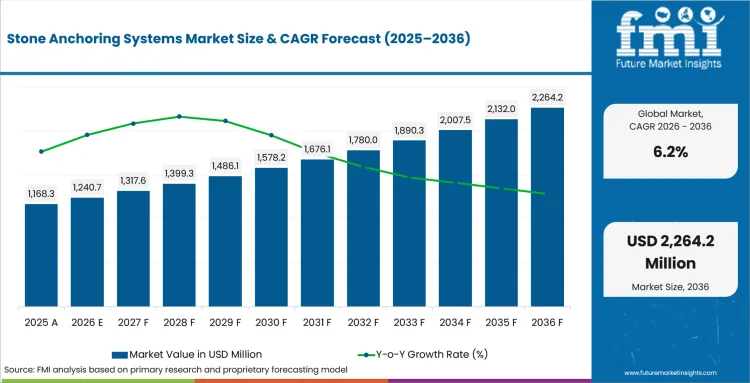
- Market Size (2026)
- USD 1240.7 Mn
- Forecast (2036)
- USD 2264.2 Mn
- CAGR (2026 to 2036)
- 6.2%
How big is Stone Anchoring Systems Market in 2026?
USD 1240.7 million in 2026 and USD 2264.2 million by 2036 at a 6.2% CAGR.
Sales of stone anchoring systems are estimated to rise globally at 6.2% CAGR through 2036. Market valuation is projected to increase from USD 1240.7 million in 2026 to USD 2264.2 million by 2036. Project documentation now determines whether engineers can carry a fixing detail into formal approval on commercial building projects. Regulation (EU) 2024/3110 established harmonized rules for construction product performance and market placement in December 2024. That framework makes traceable test files commercially necessary across facade systems that combine stone panels with structural backups. Manufacturers with tested connection ranges can reduce specification delays and protect repeat orders across complex exterior renovation work.
Market access also depends on panel material and the approval route used for each concealed connection. German regulators maintain a route for rear-fixed facade panels that use stainless fasteners inside drilled or undercut holes. Their register covers natural stone and other mineral panels through national approvals or European technical assessments. The route gives project engineers a defined basis for checking geometry and declared performance across the building envelope. Contractors require trained drilling crews because a valid approval cannot correct poor hole preparation on complex facades. Commercial success therefore depends on documented compatibility and reliable support throughout fabrication and installation workflows.
Key Takeaways of Stone Anchoring Systems Market
- Specification pressure favors anchors that connect verified load transfer with panel thickness and structural backup conditions.
- Dowel anchors are expected to hold 22.0% share in 2026 due to familiar detailing across repeated stone panels.
- Stainless steel is projected to represent 52.0% share in 2026 owing to dependable corrosion resistance in exterior assemblies.
- Mechanical anchoring is anticipated to capture 43.0% share in 2026 supported by inspectable placement and defined load paths.
- Panel drilling accuracy and specialist installation capacity remain material barriers across facades with variable stone properties.
- Competition centers on documented stone expertise and field engineering rather than broad construction fastener catalogs alone.
Analyst Perspective
"Stone anchor selection starts with panel condition and drilled geometry rather than catalog breadth alone. Fabricators earn repeat specifications by matching stone strength with movement allowances, verified load transfer and replacement access for concealed connections."
- Nikhil Kaitwade, Principal Analyst, Future Market Insights
How is the Stone Anchoring Systems Market segmented?
The stone anchoring systems market is segmented by anchor type, material, installation, application, end use, sales channel, and region.
The framework separates anchor type by connection geometry, while material tracks corrosion exposure during service. Installation distinguishes mechanical and adhesive-assisted routes with preparation controls, and application identifies panel settings and expected load paths. Material choice and installation route directly determine which evidence must accompany each proposed facade detail. End use separates commercial buildings from residential and restoration projects with distinct local approval needs. Sales channel distinguishes system-led packages from contractor or distributor routes, while regional analysis compares how approvals and installation capacity shape commercial entry. Together these dimensions place construction anchors within a stone connection workflow rather than a broad fastener category.
What makes dowel anchors central to the anchor type category?
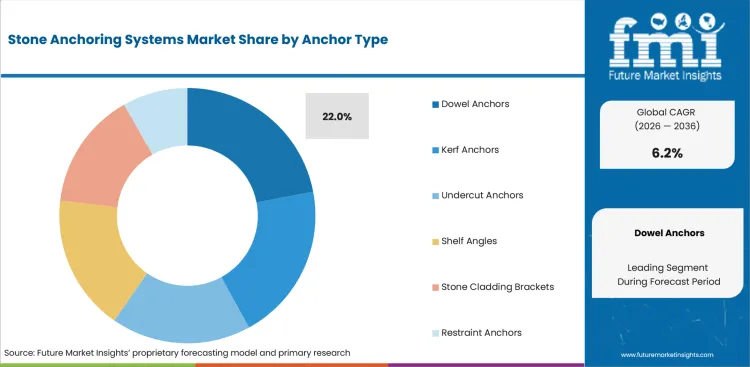
Dowel anchors transfer panel loads through drilled bearing points that fabricators can adapt for repeated stone dimensions. Hohmann & Barnard documents custom 304 and 316 stainless forms for demanding details across varied structural backups. That flexibility suits projects requiring localized adjustment without changing the calculated connection route across commercial elevations.
- By anchor type, dowel anchors are estimated to hold 22.0% share in 2026 owing to familiar bearing details across repeated panels. Established fabrication routes let engineers adjust rod dimensions without redesigning the supporting frame across each elevation.
- Stone contractors favor dowels on panels with sufficient thickness for controlled hole geometry and visible alignment checks. Thin or brittle units reduce edge distance and raise rejection risk during fabrication or final site adjustment.
Why does stainless steel remain central within the material category?
Exterior connections face moisture and temperature cycles that make corrosion control part of long-term facade reliability. Traceable material grades simplify complex project submittals and replacement decisions during later facade repair programs. KEIL specifies stainless steel for its undercut anchor through a controlled installation route that gives project teams a documented material path across panel assemblies.
- The material category is forecast to be led by stainless steel at 52.0% share in 2026 due to persistent exterior corrosion exposure. Recognized grades and traceable batches support consistent specifications across large commercial elevations and long service periods.
- Facade contractors select stainless steel for concealed parts that remain difficult to inspect or replace during normal building use. The material avoids recurring coating maintenance and supports durable connections inside drained cavities or exposed joints.
How does mechanical anchoring support the installation category?
Mechanical anchoring provides a load path that installers can inspect through hole geometry and component placement. Hilti documents its HSU-R undercut system for natural stone panels with gauges and controlled preparation procedures. That inspection route helps engineers separate drilling quality from later panel movement within the same facade assembly.
- In 2026, mechanical anchoring is expected to lead installation with 43.0% share because engineers can inspect each load path. Fixed and sliding points also support documented movement control across ventilated facade assemblies over time.
- Installers use mechanical systems on facades requiring drainage space and controlled panel movement across temperature changes. Adhesive-assisted routes need separate surface controls and provide less immediate evidence of correct onsite preparation.
What supports natural stone facades within the application category?
Natural stone facades require concealed connections that transfer self-weight and wind loads without disturbing visible surfaces. Repeatable drilling geometry supports consistent detailing across different panel thicknesses and formats on commercial projects. fischer provides assessed FZP II variants for natural stone panels with defined drilling dimensions and anchor geometry that connect the visible finish to a documented concealed load path.
- Based on application, natural stone facades are projected to account for 38.0% share in 2026 due to direct anchor use across exterior assemblies. The application concentrates engineering effort around panel strength and wind zones alongside future replacement planning.
- Architects specify anchored stone for durable finishes that preserve natural texture across prominent building elevations. Contractors need coordinated shop drawings and future replacement access before fabrication begins for repeated facade materials and panel modules.
Why are commercial buildings central to the end-use category?
Commercial buildings combine broad facade areas with geometry changes that place many anchors under formal design review. Heckmann supplies custom stone anchor forms that support repeated details across curtain wall interfaces and structural backups. Large schedules also justify dedicated engineering and batch documentation through construction and final handover records.
- Commercial buildings are projected to hold 42.0% share in 2026 owing to large elevations and formal review requirements. Major projects justify engineering support and batch documentation that smaller jobs rarely purchase as separate services.
- Developers use stone anchoring systems to deliver durable exterior finishes across offices and hospitality properties with complex elevations. Standardized panel modules support repeat purchasing across phased buildings and related property portfolios over time.
How do facade system suppliers shape the sales channel category?
Facade system suppliers coordinate brackets and rails with anchor selection through one design package across complex elevations. Coordinated design responsibility reduces interface disputes throughout fabrication and the final installation schedule on complex projects. SFS combines subframe components with calculation support for rainscreen cladding systems across several panel materials, giving facade teams one documented route for brackets and anchors.
- The facade system supplier channel is likely to capture 36.0% share in 2026 attributable to coordinated subframes and calculations. The route resolves interface questions early and limits redesign across rails or brackets during project delivery.
- Architects and facade contractors use system suppliers for approved component combinations across irregular elevations during design. Coordinated packages align anchor positions with project tolerances and clarify responsibility during fabrication or installation support.
What are the drivers, restraints, and opportunities in the Stone Anchoring Systems Market?
Documented facade performance supports demand while installation complexity restricts conversion and surveyed renewal supports targeted replacement work.
- Driver: Construction product rules increase demand for traceable load data across stone anchoring and facade approval routes.
- Restraint: Drilling errors and uncertain stone properties materially delay approvals by changing safe bearing geometry.
- Opportunity: Surveyed facade renewal supports replacement anchors that preserve serviceable stone panels during targeted repairs.
Formal product files now guide stone anchor approval by linking tested performance with the proposed panel and structural backup. Multidisciplinary facade reviews rely on one assessment structure that aligns evidence across several envelope interfaces. In February 2026 the European Commission established a standard format for European technical assessments under Regulation (EU) 2024/3110. Consistent files reduce repeated clarification across anchoring and sealant interfaces while precise declarations help engineers carry application evidence into project approval.
Small drilling errors reduce bearing area inside brittle stone and make preparation quality a material restraint. Dust controls also add equipment and trained supervision to each onsite cutting or drilling sequence. A July 2025 OSHA citation documented incomplete engineering controls during concrete masonry cutting, which confirms the need for supervised silica procedures. Weak preparation discipline delays approval and can force panel replacement before handover on complex commercial elevations.
Facade renewal gives engineered restraint systems a practical route into occupied buildings with serviceable stone panels. Survey findings must first identify loose finishes and structural backups that can accept a replacement detail. In March 2026 the Ministry of Culture published facade maintenance and safety work for the Church of the Gesuiti in Venice. The project illustrates how staged access and protected substrates shape anchor design during restoration work. Specialist teams can pair custom restraints with mixed-material repairs without replacing sound panels across the complete elevation.
Which country CAGRs are profiled in the Stone Anchoring Systems Market?
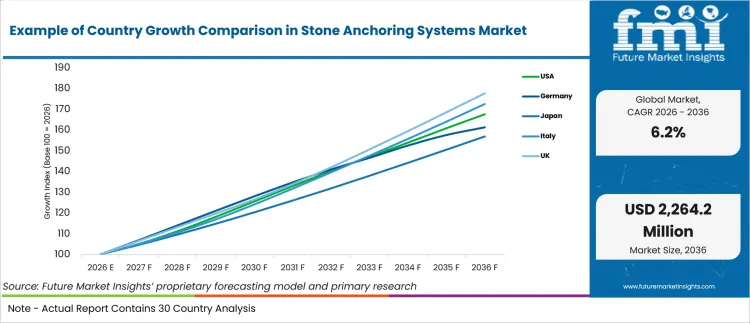
| Country | CAGR |
|---|---|
| United Kingdom | 5.9% |
| Italy | 5.6% |
| United States | 5.3% |
| Germany | 4.9% |
| Japan | 4.6% |
How do country-level CAGRs compare in the Stone Anchoring Systems Market?
The displayed forecasts span 1.3 percentage points across mature construction markets with different approval and service conditions.
- The United Kingdom sits 0.3 percentage point above Italy as remediation demand offsets limited specialist capacity.
- Italy remains 0.3 percentage point above the United States through restoration work and established stone fabrication.
- The United States stays 0.4 percentage point above Germany despite fragmented municipal review across major cities.
- Germany edges 0.3 percentage point above Japan because formal approvals support specifications but extend qualification periods.
- Japan closes the displayed range through precise installation practices and local testing requirements for unfamiliar systems.
Comparable CAGRs can produce different entry requirements because approval routes and technical support vary across countries. The full report covers North America, Latin America, Europe, East Asia, South Asia, Oceania, and the Middle East and Africa.
Country-wise Analysis
- United Kingdom facade work operates under strict building safety review and a large external wall remediation pipeline. Stone anchoring system sales in the United Kingdom are forecast to expand at 5.9% CAGR by 2036, aided by continuing repair requirements. The housing ministry reported 4,411 residential buildings at least 11 metres tall with unsafe cladding in June 2026. Specialist access contractors support replacement detailing across occupied urban buildings, while limited technical capacity and formal gateway review constrain complex projects.
- Italian stone projects benefit from experienced fabricators and a large base of protected religious or civic buildings. Italy's stone anchoring outlook is anticipated to advance at 5.6% CAGR over the assessment period, reinforced by restoration work and established stone trades. The Ministry of Culture expanded the funded FEC restoration list to 297 interventions in January 2026. Specialist workshops support custom metalwork across irregular historic masonry, while municipal approvals and variable substrates restrict staged projects with limited access.
- United States facade work combines dense urban building stocks with inspection rules that vary across municipal jurisdictions. Stone anchoring demand in the United States is predicted to advance at 5.3% CAGR through 2036, supported by recurring facade examinations. New York City began FISP Cycle 10 in February 2025 for buildings taller than six stories. Formal technical reports sustain repair work, while separate local approvals restrict tested details entering additional municipal projects.
- German ventilated facade projects require formal technical documentation for concealed panel fixings before installation begins. Stone anchoring systems demand in Germany is forecast to rise at 4.9% CAGR over the forecast period, linked to approval-led specification and renovation work. DIBt published MVV TB 2025/1 in May 2025 with an annex covering rear-ventilated exterior wall cladding. Technical distributors provide calculation review, while qualification periods restrict unfamiliar systems without German-language engineering support.
- Japanese building owners use detailed exterior inspection practices that emphasize falling-material prevention and documented maintenance. Japan is estimated to post 4.6% CAGR over the forecast period, influenced by precise installation and urban renewal needs. MLIT published revised technical advice in June 2025 for exterior wall tiles equipped with fall-prevention measures. Specialist installers support constrained urban projects, while local qualification requirements and limited service coverage restrict unfamiliar systems outside major cities.
Who are the notable companies in the Stone Anchoring Systems Market?
Hohmann & Barnard, Heckmann Building Products, Wire-Bond, KEIL Befestigungstechnik, fischer group, Hilti, SFS Group, and Cintec International are notable companies shaping the stone anchoring systems market.
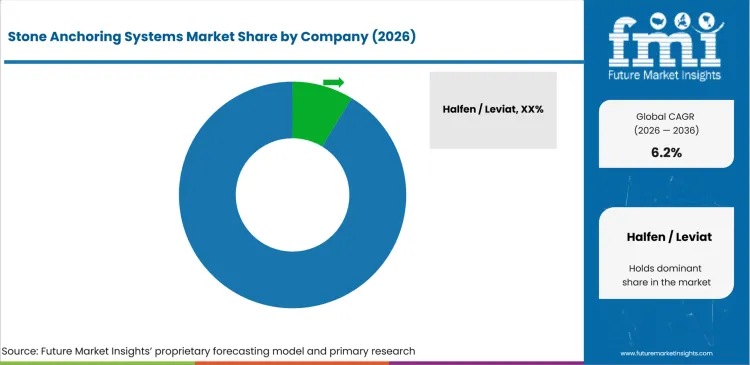
The competitive field combines traditional stone-anchor fabricators with undercut specialists and facade engineering groups whose selection depends on verified application fit.
- Hohmann & Barnard and Heckmann Building Products provide custom stainless forms, while Wire-Bond adds masonry backup systems for documented renovation and new-build installation.
- KEIL and fischer supply concealed undercut systems with controlled drilling, while Hilti adds gauges and application guidance for natural stone panels.
- SFS coordinates subframes with calculation services for ventilated facades, while Cintec supports irregular masonry stabilization through survey and staged installation engineering.
Competitive Benchmarking: Stone Anchoring Systems Market
| Company | Dedicated Stone Anchoring | Concealed / Undercut Fixing | Facade Engineering Support | Geographic Reach |
|---|---|---|---|---|
| Hohmann & Barnard | High | Medium | High | Global |
| Heckmann Building Products | High | Medium | Medium | North America |
| Wire-Bond | High | Medium | Medium | North America and export markets |
| KEIL Befestigungstechnik | High | High | High | Europe and international distributors |
| fischer group | High | High | High | Global |
| Hilti | High | High | High | Global |
| SFS Group | Medium | Medium | High | Global |
| Cintec International | Medium | Low | High | Global |
Scoring basis: Dedicated stone anchoring rates High for several direct systems, Medium for one narrow offer and Low for verified limited coverage. Concealed fixing rates High for assessed undercut systems, Medium for direct concealed support and Low for indirect support. Facade engineering rates High for calculation services, Medium for technical guidance and Low for standard-data support, geographic reach records documented operating regions.
Key Developments in the Stone Anchoring Systems Market
- In January 2025, KEIL Befestigungstechnik received German approval for its KH undercut anchor used with stoneware facade panels under defined design conditions.
- In March 2025, SFS consolidated its coating specialist and German ventilated facade unit to align fastener finishing with facade technical support.
- In March 2025, fischer documented 81,750 FZP II anchors across the 16,000-square-meter Solitaire Mall facade in Riyadh.
- In January 2025, fischer presented a facade portfolio combining subframes with exposed fixings and concealed FZP II undercut anchors.
Stone Anchoring Systems Market - Report Scope
| Coverage field | Report scope |
|---|---|
| Market breakdown | By anchor type, material, installation, application, end use, sales channel, and region. |
| Market Definition | Engineered anchors, brackets, rails, and related connection components used to secure natural stone panels or masonry elements to structural backups across facade, interior, monument, and restoration applications. |
| Regions Covered | North America, Latin America, Europe, East Asia, South Asia, Oceania, and Middle East and Africa. |
| Countries Covered | United Kingdom, Italy, United States, Germany, and Japan. |
| Key Companies Profiled | Hohmann & Barnard, Heckmann Building Products, Wire-Bond, KEIL Befestigungstechnik, fischer group, Hilti, SFS Group, and Cintec International. |
| Forecast Period | 2026 to 2036. |
| Approach | Hybrid bottom-up and top-down market sizing supported by primary interviews and official desk research. |
Stone Anchoring Systems Market - Research Methodology
| Method | Approach |
|---|---|
| Primary Research | FMI analysts gathered input from manufacturers, service providers, technology developers, distributors, end users, procurement teams, and subject-matter experts. Interviews examined purchasing decisions, product or service evaluation, adoption barriers, approval requirements, pricing considerations, and expectations for technical or commercial support. Respondents were also asked what evidence is required before a trial, pilot, or initial order develops into regular purchasing. |
| Desk Research | Desk research covered government statistics, regulatory publications, trade data, industry associations, technical literature, standards, company filings, product information, and official corporate announcements. Sources were reviewed for relevance, publication date, geographic coverage, and consistency with the defined market scope. Claims relating to performance, applications, approvals, capacity, investment, and commercial activity were retained only when supported by credible public evidence. |
| Market Sizing and Forecasting | The market model combined the baseline value with historical performance, segment structure, pricing and volume indicators, adoption levels, company participation, and country-level demand conditions. Forecast assumptions considered economic activity, investment trends, regulatory developments, technology adoption, purchasing cycles, supply availability, and barriers to wider market use. Segment and regional estimates were reconciled before the final market total was calculated. |
| Data Validation | Estimates were checked against multiple independent indicators, including public data, company activity, trade patterns, industry developments, and findings from primary interviews. Validation also tested whether products, services, applications, and company revenues fell within the defined market boundaries. Adjacent categories, unsupported claims, overlapping revenues, and activities without direct market relevance were excluded to reduce double counting and maintain consistency across segments and countries. |
Stone Anchoring Systems Market by Segments
Stone Anchoring Systems Market segmented by Anchor Type:
- Dowel Anchors
- Kerf Anchors
- Undercut Anchors
- Shelf Angles
- Stone Cladding Brackets
- Restraint Anchors
Stone Anchoring Systems Market segmented by Material:
- Stainless Steel
- Galvanized Steel
- Aluminum
- Composite - Specialty
Stone Anchoring Systems Market segmented by Installation:
- Mechanical Anchoring
- Adhesive-assisted Anchoring
- Ventilated Facade Systems
- Precast Stone Attachment
Stone Anchoring Systems Market segmented by Application:
- Natural Stone Facades
- Interior Stone Cladding
- Monument - Architectural Stone
- Retrofit - Restoration
- Thin Stone Panels
Stone Anchoring Systems Market segmented by End Use:
- Commercial Buildings
- Residential Buildings
- Infrastructure - Civic
- Restoration Projects
Stone Anchoring Systems Market segmented by Sales Channel:
- Facade System Suppliers
- Stone Contractors
- Direct Manufacturer
- Construction Distributors
Stone Anchoring Systems Market by Region:
- North America
- United States
- Canada
- Latin America
- Brazil
- Mexico
- Argentina
- Chile
- Western Europe
- Germany
- France
- United Kingdom
- Italy
- Spain
- Benelux
- Nordics
- Eastern Europe
- Poland
- Czech Republic
- Romania
- Hungary
- East Asia
- China
- Japan
- South Korea
- South Asia and Pacific
- India
- ASEAN
- Australia and New Zealand
- Middle East and Africa
- GCC Countries
- South Africa
- Türkiye
- Israel
Research Sources and Bibliography
- European Union. (2024, December 18). Regulation (EU) 2024/3110 of the European Parliament and of the Council of 27 November 2024 laying down harmonised rules for the marketing of construction products and repealing Regulation (EU) No 305/2011 (Text with EEA relevance).
- European Commission. (2026, February 24). Commission Implementing Regulation (EU) 2026/387 of 23 February 2026 establishing the format of the European technical assessment pursuant to Regulation (EU) 2024/3110 of the European Parliament and of the Council.
- New York City Department of Buildings. (2025, February 27). Buildings news update - February 27, 2025.
- Deutsches Institut für Bautechnik. (2026, July). Fasteners for rear fixing of facade panels.
- Deutsches Institut für Bautechnik. (2025, May 20). Muster-Verwaltungsvorschrift Technische Baubestimmungen (MVV TB) 2025/1.
- Ministry of Land, Infrastructure, Transport and Tourism. (2025, June 30).
- Ministry of Culture. (2026, January 26). Ulteriore modifica assegnazione risorse e integrazione interventi - Decreto DiAG n. 2115 22/12/25 - M1C3|2.4 Sicurezza sismica nei luoghi di culto, restauro del patrimonio FEC e siti di ricovero per le opere d’arte (Recovery Art).
- Ministry of Culture. (2026, March 6). INTERVENTI PNRR - FEC Cultura 4.0 Investimento 2.4 - Restauro del patrimonio Fondo Edifici di culto (FEC) Chiesa dei Gesuiti - Venezia, Sestiere Cannaregio - Intervento di restauro delle superfici decorate interne, messa in sicurezza e manutenzione della facciata e impianti di sicurezza.
- Ministry of Housing, Communities and Local Government. (2026, June 24). Building safety remediation: Monthly data release - May 2026.
- Occupational Safety and Health Administration. (2025, July 23). Morris & Associates Masonry Inc. violation detail.
- Hohmann & Barnard. (2026, July). Stone anchors.
- KEIL Befestigungstechnik. (2026, July). KEIL undercut anchor.
- Hilti. (2026, July 16). HSU-R Hilti stone undercut anchor.
- fischer group. (2026, July). Zykon panel anchors FZP II for natural stone panels.
- Heckmann Building Products. (2026, July). Stone anchors.
- Wire-Bond. (2026, July). Stone anchors.
- SFS Group. (2026, July). NVELOPE cladding support brackets.
- Cintec International. (2026, July). Structural anchoring systems services.
- fischer group. (2025, March 6). Concealed fastenings for a crystal geode, ‘Solitaire mall’ the Jewel of Riyadh.
- fischer group. (2025, January 9). Advances in façades.
This bibliography is provided for reader reference and is not exhaustive. The full report contains the complete reference list and detailed citations.
This Report Answers
- What is the 2026 market value?
- What supports stone anchoring demand?
- Why do dowel anchors retain share?
- Why does stainless steel retain share?
- How does mechanical anchoring perform?
- How do country routes differ?
- Which companies provide exact-market systems?
- What limits project conversion?
- How does facade renewal support demand?
Frequently Asked Questions
How big is the Stone Anchoring Systems Market in 2026?
The stone anchoring systems market is valued at USD 1240.7 million in 2026 and is forecast to reach USD 2264.2 million by 2036. Growth is supported by harmonized construction product rules that make traceable test files commercially necessary across facade systems combining stone panels with structural backups.
What is the CAGR of the Stone Anchoring Systems Market from 2026 to 2036?
The stone anchoring systems market grows at a CAGR of 6.2% between 2026 and 2036, supported by construction product regulations that increase demand for traceable load data across anchoring and facade approval routes, alongside surveyed renewal programs that target serviceable stone panels for replacement.
Which material leads the Stone Anchoring Systems Market?
Stainless steel accounts for 52.0% of the stone anchoring systems market by material in 2026, driven by dependable corrosion resistance in exterior assemblies where recognized grades and traceable batches support consistent specifications across large commercial elevations and long service periods.
How much will the Stone Anchoring Systems Market add between 2026 and 2036?
The stone anchoring systems market is set to add USD 1023.5 million between 2026 and 2036, growing from USD 1240.7 million to USD 2264.2 million as traceable performance documentation and facade approval rules expand demand across commercial, restoration, and renovation projects worldwide.
Who are the leading companies in the Stone Anchoring Systems Market?
Eight companies lead the stone anchoring systems market, including Hohmann & Barnard, Heckmann Building Products, Wire-Bond, KEIL Befestigungstechnik, fischer group, Hilti, SFS Group, and Cintec International, competing through dedicated stone anchoring, concealed fixing, and facade engineering support across global networks.
Preview the report firsthand - request a free sample
Get SampleGet the brochure for pricing and purchase details.
Get PDFTable of Content
- Key Takeaways
- Market Size and CAGR
- Top Growth Driver
- Fastest Growing Segment
- Leading Region
- Key Companies
- Emerging Opportunities
- Executive Summary
- Global Market Outlook
- Demand-side Trends
- Supply-side Trends
- Technology Roadmap Analysis
- Analysis and Recommendations
- Analyst Perspective (What is happening? Why now? What should investors know?)
- Key Questions Answered
- How large is the market?
- What is the CAGR?
- What are key trends?
- Which region dominates?
- Who are the leaders?
- Market Overview
- Market Coverage / Taxonomy
- Market Definition / Scope / Limitations
- Research Methodology
- Chapter Orientation
- Analytical Lens and Working Hypotheses
- Market Structure, Signals, and Trend Drivers
- Benchmarking and Cross-market Comparability
- Market Sizing, Forecasting, and Opportunity Mapping
- Research Design and Evidence Framework
- Desk Research Programme (Secondary Evidence)
- Expert Input and Fieldwork (Primary Evidence)
- Tooling, Models, and Reference Databases
- Data Engineering and Model Build
- Quality Assurance and Audit Trail
- Market Background
- Market Dynamics (Drivers, Restraints, Opportunity, Trends)
- Scenario Forecast (Optimistic, Likely, Conservative)
- Impact Analysis
- AI Impact
- Sustainability Impact
- Regulatory Impact
- Technology Impact
- Consumer / Buyer Analysis
- Purchase Drivers
- Adoption Barriers
- Buyer Journey
- Opportunity Map Analysis
- Product Life Cycle Analysis
- Supply Chain Analysis
- Investment Feasibility Matrix
- Value Chain Analysis
- PESTLE and Porter's Analysis
- Regulatory Landscape
- Regional Parent Market Outlook
- Production and Consumption Statistics
- Import and Export Statistics
- Global Market Analysis and Forecast, 2021 to 2036
- Historical Market Size Value (USD Million) Analysis, 2021 to 2025
- Current and Future Market Size Value (USD Million) Projections, 2026 to 2036
- Y-o-Y Growth Trend Analysis
- Absolute $ Opportunity Analysis
- Global Market Pricing Analysis, 2021 to 2036
- Global Market Analysis and Forecast, By Anchor Type, 2021 to 2036
- Introduction / Key Findings
- Historical Market Size Value (USD Million) Analysis By Anchor Type, 2021 to 2025
- Current and Future Market Size Value (USD Million) Analysis and Forecast By Anchor Type, 2026 to 2036
- Dowel Anchors
- Kerf Anchors
- Undercut Anchors
- Shelf Angles
- Stone Cladding Brackets
- Restraint Anchors
- Dowel Anchors
- Y-o-Y Growth Trend Analysis By Anchor Type, 2021 to 2025
- Absolute $ Opportunity Analysis By Anchor Type, 2026 to 2036
- Global Market Analysis and Forecast, By Material, 2021 to 2036
- Introduction / Key Findings
- Historical Market Size Value (USD Million) Analysis By Material, 2021 to 2025
- Current and Future Market Size Value (USD Million) Analysis and Forecast By Material, 2026 to 2036
- Stainless Steel
- Galvanized Steel
- Aluminum
- Composite / Specialty
- Stainless Steel
- Y-o-Y Growth Trend Analysis By Material, 2021 to 2025
- Absolute $ Opportunity Analysis By Material, 2026 to 2036
- Global Market Analysis and Forecast, By Installation, 2021 to 2036
- Introduction / Key Findings
- Historical Market Size Value (USD Million) Analysis By Installation, 2021 to 2025
- Current and Future Market Size Value (USD Million) Analysis and Forecast By Installation, 2026 to 2036
- Mechanical Anchoring
- Adhesive-assisted Anchoring
- Ventilated Facade Systems
- Precast Stone Attachment
- Mechanical Anchoring
- Y-o-Y Growth Trend Analysis By Installation, 2021 to 2025
- Absolute $ Opportunity Analysis By Installation, 2026 to 2036
- Global Market Analysis and Forecast, By Application, 2021 to 2036
- Introduction / Key Findings
- Historical Market Size Value (USD Million) Analysis By Application, 2021 to 2025
- Current and Future Market Size Value (USD Million) Analysis and Forecast By Application, 2026 to 2036
- Natural Stone Facades
- Interior Stone Cladding
- Monument / Architectural Stone
- Retrofit / Restoration
- Thin Stone Panels
- Natural Stone Facades
- Y-o-Y Growth Trend Analysis By Application, 2021 to 2025
- Absolute $ Opportunity Analysis By Application, 2026 to 2036
- Global Market Analysis and Forecast, By End Use, 2021 to 2036
- Introduction / Key Findings
- Historical Market Size Value (USD Million) Analysis By End Use, 2021 to 2025
- Current and Future Market Size Value (USD Million) Analysis and Forecast By End Use, 2026 to 2036
- Commercial Buildings
- Residential Buildings
- Infrastructure / Civic
- Restoration Projects
- Commercial Buildings
- Y-o-Y Growth Trend Analysis By End Use, 2021 to 2025
- Absolute $ Opportunity Analysis By End Use, 2026 to 2036
- Global Market Analysis and Forecast, By Sales Channel
- Introduction / Key Findings
- Historical Market Size Value (USD Million) Analysis By Sales Channel, 2021 to 2025
- Current and Future Market Size Value (USD Million) Analysis and Forecast By Sales Channel, 2026 to 2036
- Facade System Suppliers
- Stone Contractors
- Direct Manufacturer
- Construction Distributors
- Facade System Suppliers
- Y-o-Y Growth Trend Analysis By Sales Channel, 2021 to 2025
- Absolute $ Opportunity Analysis By Sales Channel, 2026 to 2036
- Global Market Analysis and Forecast, By Region, 2021 to 2036
- Introduction
- Historical Market Size Value (USD Million) Analysis By Region, 2021 to 2025
- Current Market Size Value (USD Million) Analysis and Forecast By Region, 2026 to 2036
- North America
- Latin America
- Western Europe
- Eastern Europe
- East Asia
- South Asia and Pacific
- Middle East & Africa
- Market Attractiveness Analysis By Region
- North America Market Analysis and Forecast, By Country, 2021 to 2036
- Historical Market Size Value (USD Million) Trend Analysis By Market Taxonomy, 2021 to 2025
- Market Size Value (USD Million) Forecast By Market Taxonomy, 2026 to 2036
- By Country
- USA
- Canada
- By Anchor Type
- By Material
- By Installation
- By Application
- By End Use
- By Sales Channel
- By Country
- Market Attractiveness Analysis
- By Country
- By Anchor Type
- By Material
- By Installation
- By Application
- By End Use
- By Sales Channel
- Key Takeaways
- Latin America Market Analysis and Forecast, By Country
- Historical Market Size Value (USD Million) Trend Analysis By Market Taxonomy, 2021 to 2025
- Market Size Value (USD Million) Forecast By Market Taxonomy, 2026 to 2036
- By Country
- Brazil
- Mexico
- Chile
- Rest of Latin America
- By Anchor Type
- By Material
- By Installation
- By Application
- By End Use
- By Sales Channel
- By Country
- Market Attractiveness Analysis
- By Country
- By Anchor Type
- By Material
- By Installation
- By Application
- By End Use
- By Sales Channel
- Key Takeaways
- Western Europe Market Analysis and Forecast, By Country
- Historical Market Size Value (USD Million) Trend Analysis By Market Taxonomy, 2021 to 2025
- Market Size Value (USD Million) Forecast By Market Taxonomy, 2026 to 2036
- By Country
- Germany
- UK
- Italy
- Spain
- France
- Nordic
- BENELUX
- Rest of Western Europe
- By Anchor Type
- By Material
- By Installation
- By Application
- By End Use
- By Sales Channel
- By Country
- Market Attractiveness Analysis
- By Country
- By Anchor Type
- By Material
- By Installation
- By Application
- By End Use
- By Sales Channel
- Key Takeaways
- Eastern Europe Market Analysis and Forecast, By Country
- Historical Market Size Value (USD Million) Trend Analysis By Market Taxonomy, 2021 to 2025
- Market Size Value (USD Million) Forecast By Market Taxonomy, 2026 to 2036
- By Country
- Russia
- Poland
- Hungary
- Balkan & Baltic
- Rest of Eastern Europe
- By Anchor Type
- By Material
- By Installation
- By Application
- By End Use
- By Sales Channel
- By Country
- Market Attractiveness Analysis
- By Country
- By Anchor Type
- By Material
- By Installation
- By Application
- By End Use
- By Sales Channel
- Key Takeaways
- East Asia Market Analysis and Forecast, By Country
- Historical Market Size Value (USD Million) Trend Analysis By Market Taxonomy, 2021 to 2025
- Market Size Value (USD Million) Forecast By Market Taxonomy, 2026 to 2036
- By Country
- China
- Japan
- South Korea
- By Anchor Type
- By Material
- By Installation
- By Application
- By End Use
- By Sales Channel
- By Country
- Market Attractiveness Analysis
- By Country
- By Anchor Type
- By Material
- By Installation
- By Application
- By End Use
- By Sales Channel
- Key Takeaways
- South Asia and Pacific Market Analysis and Forecast, By Country
- Historical Market Size Value (USD Million) Trend Analysis By Market Taxonomy, 2021 to 2025
- Market Size Value (USD Million) Forecast By Market Taxonomy, 2026 to 2036
- By Country
- India
- ASEAN
- Australia & New Zealand
- Rest of South Asia and Pacific
- By Anchor Type
- By Material
- By Installation
- By Application
- By End Use
- By Sales Channel
- By Country
- Market Attractiveness Analysis
- By Country
- By Anchor Type
- By Material
- By Installation
- By Application
- By End Use
- By Sales Channel
- Key Takeaways
- Middle East & Africa Market Analysis and Forecast, By Country
- Historical Market Size Value (USD Million) Trend Analysis By Market Taxonomy, 2021 to 2025
- Market Size Value (USD Million) Forecast By Market Taxonomy, 2026 to 2036
- By Country
- Kingdom of Saudi Arabia
- Other GCC Countries
- Türkiye
- South Africa
- Other African Union
- Rest of Middle East & Africa
- By Anchor Type
- By Material
- By Installation
- By Application
- By End Use
- By Sales Channel
- By Country
- Market Attractiveness Analysis
- By Country
- By Anchor Type
- By Material
- By Installation
- By Application
- By End Use
- By Sales Channel
- Key Takeaways
- Key Countries Market Analysis
- USA
- Pricing Analysis
- Market Share Analysis, 2025
- By Anchor Type
- By Material
- By Installation
- By Application
- By End Use
- By Sales Channel
- Canada
- Pricing Analysis
- Market Share Analysis, 2025
- By Anchor Type
- By Material
- By Installation
- By Application
- By End Use
- By Sales Channel
- Mexico
- Pricing Analysis
- Market Share Analysis, 2025
- By Anchor Type
- By Material
- By Installation
- By Application
- By End Use
- By Sales Channel
- Brazil
- Pricing Analysis
- Market Share Analysis, 2025
- By Anchor Type
- By Material
- By Installation
- By Application
- By End Use
- By Sales Channel
- Chile
- Pricing Analysis
- Market Share Analysis, 2025
- By Anchor Type
- By Material
- By Installation
- By Application
- By End Use
- By Sales Channel
- Germany
- Pricing Analysis
- Market Share Analysis, 2025
- By Anchor Type
- By Material
- By Installation
- By Application
- By End Use
- By Sales Channel
- UK
- Pricing Analysis
- Market Share Analysis, 2025
- By Anchor Type
- By Material
- By Installation
- By Application
- By End Use
- By Sales Channel
- Italy
- Pricing Analysis
- Market Share Analysis, 2025
- By Anchor Type
- By Material
- By Installation
- By Application
- By End Use
- By Sales Channel
- Spain
- Pricing Analysis
- Market Share Analysis, 2025
- By Anchor Type
- By Material
- By Installation
- By Application
- By End Use
- By Sales Channel
- France
- Pricing Analysis
- Market Share Analysis, 2025
- By Anchor Type
- By Material
- By Installation
- By Application
- By End Use
- By Sales Channel
- India
- Pricing Analysis
- Market Share Analysis, 2025
- By Anchor Type
- By Material
- By Installation
- By Application
- By End Use
- By Sales Channel
- ASEAN
- Pricing Analysis
- Market Share Analysis, 2025
- By Anchor Type
- By Material
- By Installation
- By Application
- By End Use
- By Sales Channel
- Australia & New Zealand
- Pricing Analysis
- Market Share Analysis, 2025
- By Anchor Type
- By Material
- By Installation
- By Application
- By End Use
- By Sales Channel
- China
- Pricing Analysis
- Market Share Analysis, 2025
- By Anchor Type
- By Material
- By Installation
- By Application
- By End Use
- By Sales Channel
- Japan
- Pricing Analysis
- Market Share Analysis, 2025
- By Anchor Type
- By Material
- By Installation
- By Application
- By End Use
- By Sales Channel
- South Korea
- Pricing Analysis
- Market Share Analysis, 2025
- By Anchor Type
- By Material
- By Installation
- By Application
- By End Use
- By Sales Channel
- Russia
- Pricing Analysis
- Market Share Analysis, 2025
- By Anchor Type
- By Material
- By Installation
- By Application
- By End Use
- By Sales Channel
- Poland
- Pricing Analysis
- Market Share Analysis, 2025
- By Anchor Type
- By Material
- By Installation
- By Application
- By End Use
- By Sales Channel
- Hungary
- Pricing Analysis
- Market Share Analysis, 2025
- By Anchor Type
- By Material
- By Installation
- By Application
- By End Use
- By Sales Channel
- Kingdom of Saudi Arabia
- Pricing Analysis
- Market Share Analysis, 2025
- By Anchor Type
- By Material
- By Installation
- By Application
- By End Use
- By Sales Channel
- Türkiye
- Pricing Analysis
- Market Share Analysis, 2025
- By Anchor Type
- By Material
- By Installation
- By Application
- By End Use
- By Sales Channel
- South Africa
- Pricing Analysis
- Market Share Analysis, 2025
- By Anchor Type
- By Material
- By Installation
- By Application
- By End Use
- By Sales Channel
- USA
- Market Structure Analysis
- Competition Dashboard
- Competition Benchmarking
- Market Share Analysis of Top Players
- By Regional
- By Anchor Type
- By Material
- By Installation
- By Application
- By End Use
- By Sales Channel
- Emerging Startups
- Innovation Benchmarking
- Competition Analysis
- Competition Deep Dive
- Halfen / Leviat
- Overview
- Product Portfolio
- Profitability by Market Segments
- Sales Footprint
- Strategy Overview
- Marketing Strategy
- Product Strategy
- Channel Strategy
- Hohmann & Barnard
- Keil Befestigungstechnik
- Fischer Group
- Hilti
- SFS Group
- EJOT
- PROSOCO
- Cintec International
- NVELOPE
- Halfen / Leviat
- Case Studies
- Success Stories
- Recent Developments
- Competition Deep Dive
- Assumptions & Acronyms Used


