

- Industry Size (2025)
- USD 284.8 Mn
- Forecast (2035)
- USD 535.0 Mn
- CAGR (2025 to 2035)
- 6.5%
Sucrose Stearate Market Forecast and Outlook 2025 to 2035
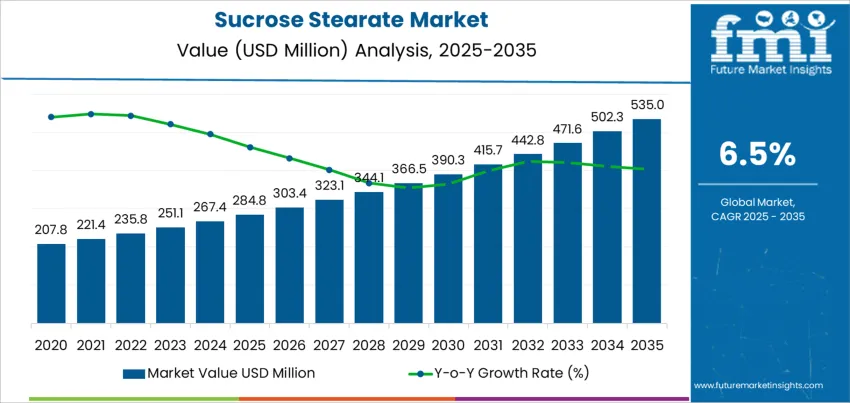
The global demand for sucrose stearate is expected to grow from USD 284.8 million in 2025 to USD 535.0 million by 2035, reflecting a compound annual growth rate (CAGR) of 6.5%. Sucrose stearate, a sugar ester widely used as an emulsifier in food, cosmetics, and personal care products, is gaining popularity due to its ability to stabilize formulations and enhance product performance. The growing consumer demand for natural, plant-based ingredients in food and skincare, combined with the increasing adoption of sucrose stearate in sustainable and clean-label products, is expected to drive market expansion. As more industries seek eco-friendly emulsifiers, sucrose stearate's versatile applications in both food and personal care products will contribute to its growing market share.
The market will experience steady growth, starting at USD 284.8 million in 2025 and rising to USD 303.4 million in 2026, USD 323.1 million in 2027, and USD 344.1 million in 2028. By 2029, demand for sucrose stearate will rise to USD 366.5 million, continuing its upward trajectory through the 2030s. By 2035, the demand for sucrose stearate is projected to reach USD 535.0 million, driven by the increasing trend of clean-label and sustainable product formulations in food and personal care industries.
Quick Stats of the Sucrose Stearate Market
- Sucrose Stearate Market Value (2025): USD 284.8 million
- Sucrose Stearate Market Forecast Value (2035): USD 535.0 million
- Sucrose Stearate Market Forecast CAGR (2025-2035): 6.5%
- Sucrose Stearate Market Leading Product Form: Powder (15.1%)
- Sucrose Stearate Market Key Growth Regions: India, China, Japan, UK, Germany, USA
- Sucrose Stearate Market Key Players: BASF SE, Croda International, Evonik Industries, Symrise (incl. IFF/Givaudan actives), Dow / Dow Inc., Ashland, Clariant, Seppic
What is the Growth Forecast for the Global Sucrose Stearate Industry through 2035?
The peak-to-trough analysis of the sucrose stearate market highlights consistent, stable growth with relatively low fluctuations in demand over the forecast period. Starting at USD 284.8 million in 2025, the market is expected to rise gradually, peaking at USD 535.0 million by 2035.
The initial growth phase (2025–2029) will see the market increase from USD 284.8 million to USD 366.5 million. This phase will be characterized by steady, incremental growth, primarily driven by increasing adoption of sucrose stearate in clean-label and natural formulations. After 2029, the market will experience a steady rise, with demand growing from USD 366.5 million in 2029 to USD 535.0 million in 2035. The troughs (slower growth years) in this analysis will be minimal, indicating that the market will not face significant downturns, and the growth will be sustained across the entire period. The gradual but consistent demand increase across both the food and personal care industries will ensure that sucrose stearate maintains a stable growth pattern throughout the forecast period.
Sucrose Stearate Market Key Takeaways
| Metric | Value |
|---|---|
| Industry Sales Value (2025) | USD 284.8 million |
| Industry Forecast Value (2035) | USD 535 million |
| Industry Forecast CAGR (2025-2035) | 6.5% |
Why is the Demand for Sucrose Stearate Growing Globally?
Demand for sucrose stearate is increasing globally as manufacturers across food, cosmetics, personal care, and pharmaceutical industries shift toward more natural, bio based, non toxic emulsifiers and stabilizers. Sucrose stearate, a sucrose fatty acid ester, is valued for its ability to blend oil and water based ingredients effectively, enabling stable emulsions in creams, lotions, dairy products, confections, bakery items, and other consumer goods. Its biodegradable, non ionic, and skin friendly properties make it particularly attractive in clean label formulations, where consumers prefer minimal synthetic additives and gentler ingredient lists. As awareness grows about allergenicity, sustainability, and ingredient safety, sucrose based esters have become preferred over more synthetic surfactants and emulsifiers.
At the same time, broader market trends and industrial demand dynamics support expansion of the sucrose ester market. The global market for sucrose esters was valued in recent years and is forecast to grow at a steady rate, driven by rising demand in processed foods, beverages, personal care products, and pharmaceuticals that require emulsifiers, stabilizers, or texture modifiers. Advances in manufacturing and formulation technologies have improved the consistency, safety, and scalability of sucrose stearate production, which enables both mass market and premium brands to adopt it. As demand for natural, multifunctional, and regulatory compliant ingredients continues to rise globally, the sucrose stearate segment is likely to maintain strong growth in coming years.
What Drives the Global Demand for Sucrose Stearate in Terms of Application and Product Form?
The global demand for sucrose stearate is primarily driven by application and product form. The leading end-use application is skin care, which accounts for 11.6% of the market share, while powder holds the largest share in the product form segment, capturing 15.1%. Sucrose stearate is known for its ability to enhance the texture, stability, and efficacy of personal care products, acting as an emulsifier and stabilizer. As consumer interest in natural and effective ingredients grows, sucrose stearate continues to see increasing adoption in the global personal care market.
Why Is Skin Care the Leading Application for Sucrose Stearate?
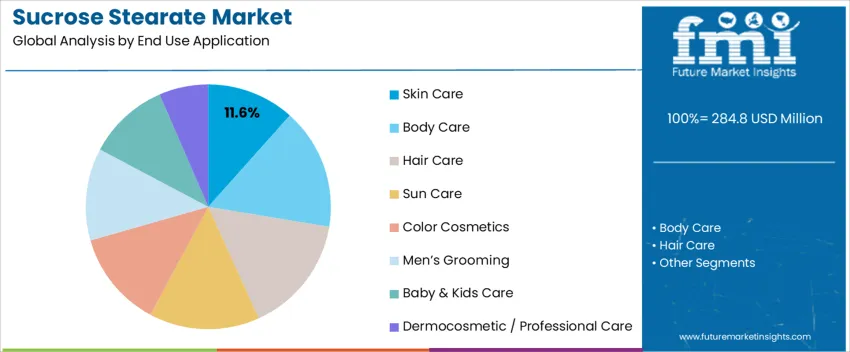
Skin care is the leading application for sucrose stearate, capturing 11.6% of the market share. Sucrose stearate is highly valued in skincare formulations for its ability to act as a gentle emulsifier and stabilizer, improving the texture of creams, lotions, and serums. It helps ensure that oil and water-based ingredients mix effectively, enhancing the sensory experience of personal care products while maintaining product consistency and stability.
The demand for sucrose stearate in skin care is driven by the increasing preference for natural ingredients in beauty products. As consumers become more conscious of the ingredients in their skincare products, sucrose stearate, derived from natural sources, offers a clean, effective solution. Its mild and non-irritating properties make it especially suitable for sensitive skin formulations, which further boosts its use in products aimed at soothing and moisturizing the skin. As the trend toward clean and green beauty continues to grow, sucrose stearate’s role in enhancing skin care formulations is expected to expand globally.
Why Is Powder the Leading Product Form for Sucrose Stearate?

Powder is the leading product form for sucrose stearate globally, holding 15.1% of the market share. The powdered form is preferred for its ease of handling, stability, and versatility in various formulations. It allows for precise ingredient dosing and is easy to incorporate into both consumer and professional-grade personal care products.
The demand for powdered sucrose stearate is driven by its effectiveness in maintaining the stability and texture of emulsions, particularly in formulations like moisturizers, lotions, and creams. Powders also have a longer shelf life and are more efficient for large-scale production compared to liquids or gels. As manufacturers continue to develop high-performance, stable, and sustainable skincare products, powdered sucrose stearate will likely remain a favored choice in the global market.
What is the Demand Outlook for Sucrose Stearate Globally?
Demand for sucrose stearate is growing worldwide as manufacturers in cosmetics, personal care, food, and pharmaceutical sectors increasingly seek mild, multifunctional, and plant derived emulsifiers and surfactants. Sucrose stearate, a sucrose fatty acid ester, is widely used to stabilize emulsions, improve texture, and impart moisturizing or skin conditioning effects in creams, lotions, cleansers, and body care products. As consumers globally favor formulations that are gentle, non irritating, and compatible with sensitive skin, sucrose stearate has gained traction. The broader market for sucrose esters, within which sucrose stearate is a key variant, is expanding with rising demand in food, personal care, and specialty applications across regions.
What are the Drivers of Global Demand for Sucrose Stearate?
Several factors drive the global demand for sucrose stearate. Increasing consumer preference for natural, clean label, and plant based cosmetics leads formulators to choose sugar derived emulsifiers rather than synthetic surfactants. Growth in skincare and personal care consumption globally, driven by rising disposable incomes, urbanization, and greater awareness of skin health, boosts demand for lotion, cream, cleanser, and body-care products that often use sucrose stearate. The versatile emulsifying and emollient properties of sucrose stearate allow stable oil in water or water in oil formulations that deliver smooth skin feel, light texture, and good stability, making it especially attractive for products targeting sensitive skin or clean-ingredient positioning. In parallel, demand from food, beverage, and pharmaceutical sectors, where sucrose esters are used as emulsifiers, stabilizers, or fat replacement agents, supports the overall growth of the sucrose ester market, lifting demand for sucrose stearate as part of that trend.
What are the Restraints on Global Demand for Sucrose Stearate?
Despite favorable demand drivers, several restraints may curtail widespread adoption of sucrose stearate. First, cost considerations—high purity sucrose fatty acid esters can be more expensive than simpler or synthetic emulsifiers, making them less attractive for low cost or mass market products in price sensitive regions. Second, competition from other emulsifiers or moisturizers such as glycerin, synthetic surfactants, mineral oils, or silicone based emollients, which may offer similar performance at lower cost or with simpler supply chains, can limit sucrose stearate uptake. Third, formulation challenges-lipids like sucrose esters require careful balancing to ensure emulsion stability, shelf life, and compatibility with other actives; poor formulation can lead to separation or performance issues, discouraging use. Finally, regulatory and supply chain variations across regions, such as availability of plant derived fatty acids and purity standards, may restrict consistent global scaling.
What are the Key Trends Influencing Global Demand for Sucrose Stearate?
A major trend is the shift toward clean label and “green” personal care formulations. As consumers increasingly seek natural, vegan friendly, biodegradable, and skin compatible products, sucrose stearate and other sugar esters are preferred over petrochemical surfactants. Another trend is rising demand for sensitive skin and barrier friendly skincare. Sucrose stearate is often used in creams and cleansers designed for gentle cleansing or moisturization without irritation, aligning with this growing consumer segment. In the food and beverage industry, sucrose esters, including sucrose stearate, continue to be used to stabilize emulsions, improve texture, and support low fat or reduced fat formulations, especially as clean label and “better for you” foods grow in popularity. Advances in formulation science and emulsification technology, enabling stable, effective, and pleasant feeling emulsions using natural ester surfactants, make sucrose stearate more attractive for global brands. Finally, growth in emerging markets with rising disposable income and expanding personal care and processed food demand, such as in Asia Pacific, Latin America, and the Middle East, supports global expansion of sucrose stearate use.
What is the Regional Demand Outlook for the Sucrose Stearate Market?
The global Sucrose Stearate market is projected to grow steadily, with India at a projected CAGR of 8.8%. China follows at 8.1%, while Japan is expected to grow at 7.5%. The UK, Germany, and the USA show more moderate growth, with CAGRs of 6.8%, 6.2%, and 5.5%, respectively. Sucrose Stearate, known for its emulsifying properties and ability to stabilize formulations in food, cosmetics, and pharmaceuticals, is in increasing demand due to its ability to enhance product performance and texture. Rising consumer interest in clean-label products and natural emulsifiers contributes to the growth of this market globally.
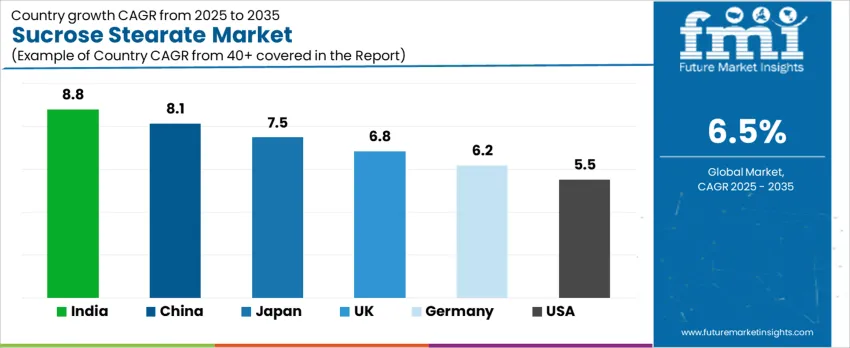
| Country | CAGR (%) |
|---|---|
| India | 8.8 |
| China | 8.1 |
| Japan | 7.5 |
| UK | 6.8 |
| Germany | 6.2 |
| USA | 5.5 |
What is Driving the Growth of Sucrose Stearate in India?
In India, the projected 8.8% CAGR for Sucrose Stearate reflects growing demand for emulsifiers and stabilizers in food, cosmetics, and pharmaceutical formulations. As India’s food and beverage industry continues to expand, particularly in packaged and processed goods, the demand for emulsifiers like Sucrose Stearate is increasing. This ingredient’s natural properties make it highly desirable as the country’s consumer base shifts towards clean-label and more natural food products. Furthermore, the growth of India’s personal care market, with consumers increasingly seeking high-quality, safe, and effective skincare and cosmetic products, drives further adoption of Sucrose Stearate. The ingredient’s versatility in stabilizing emulsions and improving texture makes it a preferred choice across various industries. The expanding availability of Sucrose Stearate through e-commerce platforms also helps reach a wider consumer base, further supporting market growth in India.
Why is Sucrose Stearate Demand Rising in China?
In China, the demand for Sucrose Stearate is expected to grow at a CAGR of 8.1%. China’s robust and growing food industry, combined with rising consumer preferences for natural and clean-label products, is driving the market for emulsifiers like Sucrose Stearate. The ingredient is increasingly used in food and beverage formulations to enhance texture and stability. Additionally, China’s rapidly expanding personal care and cosmetics market contributes significantly to the demand for Sucrose Stearate. With increasing disposable incomes and a growing middle class, Chinese consumers are becoming more concerned with the quality and safety of personal care products, further boosting the demand for natural emulsifiers in skincare and cosmetics. The shift toward sustainable and environmentally friendly ingredients also supports the growth of Sucrose Stearate in both food and cosmetic applications.
What Supports the Growth of Sucrose Stearate in Japan?
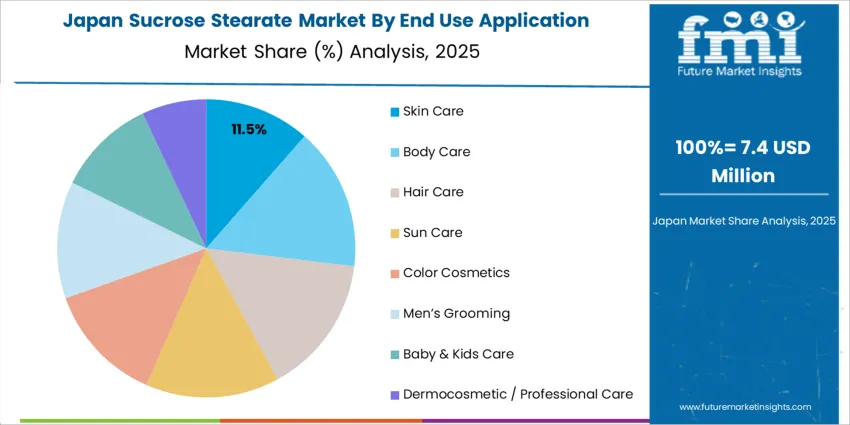
Japan’s projected 7.5% CAGR for Sucrose Stearate reflects the country’s well-established demand for high-quality ingredients in food, pharmaceuticals, and cosmetics. Japanese consumers are highly selective about the products they use, particularly in cosmetics, where there is strong demand for emulsifiers that enhance product performance without compromising on safety or texture. Sucrose Stearate is valued for its ability to stabilize emulsions in a variety of formulations, from skincare products to functional foods. The growing trend toward natural and clean-label products, especially in personal care, further supports the adoption of Sucrose Stearate in Japan. Additionally, the Japanese market’s focus on advanced and effective formulations in the pharmaceutical sector drives the need for high-performance emulsifiers like Sucrose Stearate.
What Drives the Demand for Sucrose Stearate in the UK?
In the UK, the projected 6.8% CAGR for Sucrose Stearate is driven by increasing consumer demand for natural ingredients and clean-label products. As UK consumers become more ingredient-conscious, there is a growing preference for products that feature emulsifiers derived from natural sources, such as Sucrose Stearate. This ingredient is commonly used in food and cosmetics to improve texture, stability, and emulsification. The UK’s thriving personal care market, where consumers seek high-quality, safe, and environmentally-friendly products, has further boosted the adoption of Sucrose Stearate in cosmetics. The rise in demand for plant-based and sustainable ingredients in both food and beauty products aligns with the growth of Sucrose Stearate, making it an ideal choice for manufacturers looking to meet consumer demands for natural and clean-label formulations.
What is Supporting the Growth of Sucrose Stearate in Germany?
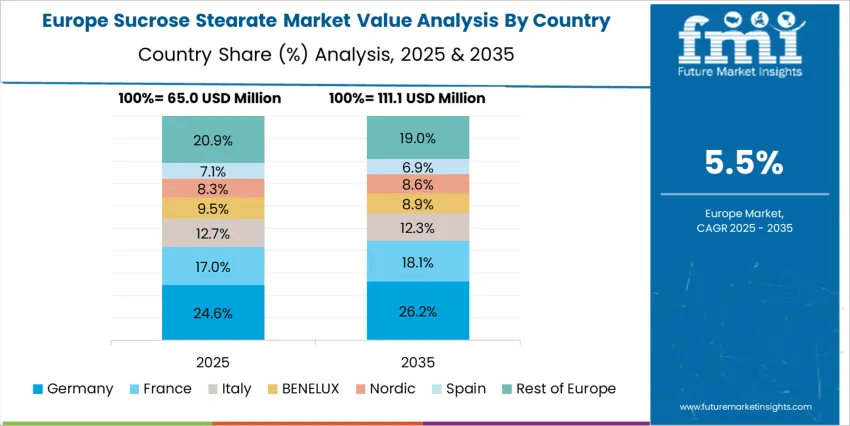
Germany’s projected 6.2% CAGR for Sucrose Stearate reflects the country’s strong demand for high-quality emulsifiers and stabilizers in food, cosmetics, and pharmaceuticals. As Germany’s food and beverage market increasingly shifts toward natural and clean-label products, the demand for natural emulsifiers like Sucrose Stearate is expected to rise. The personal care industry, which is one of the largest in Europe, also contributes to the demand for Sucrose Stearate as an effective and safe emulsifying agent in skincare and cosmetic products. With increasing consumer awareness of the importance of natural ingredients, manufacturers in Germany are turning to Sucrose Stearate to enhance the stability and texture of their formulations while meeting the growing demand for eco-friendly and clean-label products.
Why is Sucrose Stearate Growing in the USA?
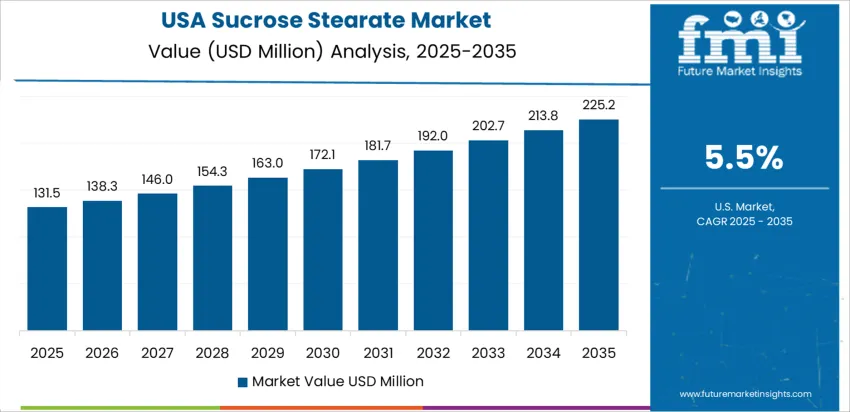
In the USA, the demand for Sucrose Stearate is projected to grow at a CAGR of 5.5%. The U.S. market for food, cosmetics, and pharmaceuticals continues to grow, driven by increasing consumer awareness of ingredient safety and performance. As consumers increasingly seek natural, plant-based products, the demand for Sucrose Stearate in both food and personal care formulations is rising. In food products, Sucrose Stearate helps stabilize emulsions and improve texture, while in cosmetics, it contributes to smooth, well-formulated products. The rise of clean beauty and the preference for natural ingredients in skincare products support the demand for Sucrose Stearate in personal care. As consumers continue to seek sustainable, non-toxic alternatives to synthetic ingredients, the market for Sucrose Stearate is expected to grow steadily in the U.S.
What is the Competitive Landscape for the Global Sucrose Stearate Market?
Global demand for sucrose stearate is rising as cosmetic, personal care, and industrial formulators seek biodegradable, skin friendly emulsifiers and surfactants. Sucrose stearate serves as a gentle, non ionic emulsifier derived from sugar and stearic acid that supports stable oil in water formulations. Its attributes include compatibility with sensitive skin, biodegradability, and clean label appeal. Rising consumer preference for “green,” natural, and skin safe ingredients across regions including North America, Europe, and Asia Pacific is driving expansion of demand for sucrose stearate in moisturizers, creams, lotions, cleansers, hair care products, and other personal care formulations.
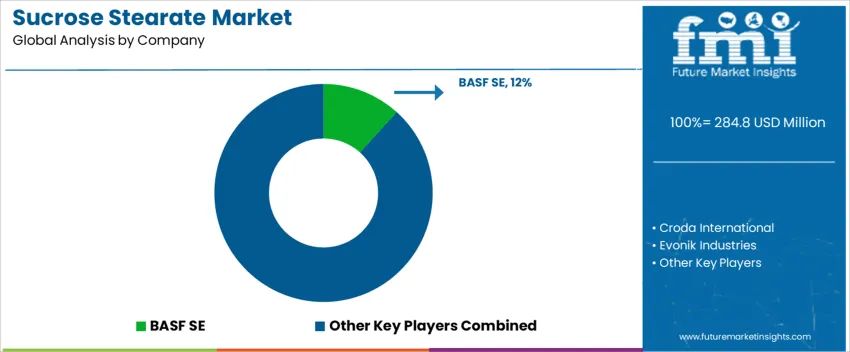
On the supply side, several global specialty ingredient firms compete for market share. Among them are BASF SE, Croda International, Evonik Industries, Symrise (including IFF/Givaudan actives), Dow / Dow Inc., Ashland, Clariant, and Seppic. BASF SE holds a notable share among these suppliers. Competition centers on factors such as emulsifier purity, consistency, regulatory compliance for cosmetic or food applications, supply chain reliability, and flexibility to meet production volumes. Some firms differentiate by offering broader portfolios of surfactants and formulation support ingredients that combine sucrose stearate with other actives to enable multifunctional product formulations. Others focus on cost effective supply for high volume mass market brands. Suppliers that deliver high quality, stable, regulatory compliant sucrose stearate with robust manufacturing and supply chain practices are positioned to benefit most as demand grows for clean label, skin friendly and eco conscious formulations.
Key Players of the Sucrose Stearate Market
- BASF SE
- Croda International
- Evonik Industries
- Symrise (incl. IFF/Givaudan actives)
- Dow / Dow Inc.
- Ashland
- Clariant
- Seppic
Scope of the Report
| Items | Details |
|---|---|
| Quantitative Units | USD Million |
| Regions Covered | North America, Europe, Asia Pacific, The Middle East & Africa, Latin America |
| Countries Covered | United States, Canada, United Kingdom, Germany, France, China, Japan, South Korea, Brazil, Australia |
| End Use Application | Skin Care, Body Care, Hair Care, Sun Care, Color Cosmetics, Men’s Grooming, Baby & Kids Care, Dermocosmetic / Professional Care |
| Product Form | Powder, Granules / Agglomerates, Flakes, Pellets / Prills, Liquid (Solution), Concentrate (High-active Liquid), Dispersion / Suspension, Emulsion, Paste, Gel, Wax / Solid Block, Oil |
| Key Companies Profiled | BASF SE, Croda International, Evonik Industries, Symrise (incl. IFF/Givaudan actives), Dow / Dow Inc., Ashland, Clariant, Seppic |
| Additional Attributes | Dollar sales by end-use application and product form show strong demand for inulin, particularly in skin care and body care products. Powder and liquid forms dominate, with concentrate and emulsion forms also growing in demand. Major companies like BASF, Evonik, and Ashland are key players, providing a wide range of inulin-based products for the cosmetic and dermocosmetic industries. The market is expected to grow with increasing demand for natural ingredients and innovative skincare solutions. |
Key Segments in the Sucrose Stearate Market
End Use Application
- Skin Care
- Body Care
- Hair Care
- Sun Care
- Color Cosmetics
- Men’s Grooming
- Baby & Kids Care
- Dermocosmetic / Professional Care
Product Form
- Powder
- Granules / Agglomerates
- Flakes
- Pellets / Prills
- Liquid (Solution)
- Concentrate (High-active Liquid)
- Dispersion / Suspension
- Emulsion
- Paste
- Gel
- Wax / Solid Block
- Oil
Region
- Asia Pacific
- China
- Japan
- South Korea
- India
- Australia & New Zealand
- ASEAN
- Rest of Asia Pacific
- Europe
- Germany
- United Kingdom
- France
- Italy
- Spain
- Nordic
- BENELUX
- Rest of Europe
- North America
- United States
- Canada
- Mexico
- Latin America
- Brazil
- Chile
- Rest of Latin America
- Middle East & Africa
- Kingdom of Saudi Arabia
- Other GCC Countries
- Turkey
- South Africa
- Other African Union
- Rest of Middle East & Africa
Frequently Asked Questions
How big is the sucrose stearate market in 2025?
The global sucrose stearate market is estimated to be valued at USD 284.8 million in 2025.
What will be the size of sucrose stearate market in 2035?
The market size for the sucrose stearate market is projected to reach USD 535.0 million by 2035.
How much will be the sucrose stearate market growth between 2025 and 2035?
The sucrose stearate market is expected to grow at a 6.5% CAGR between 2025 and 2035.
What are the key product types in the sucrose stearate market?
The key product types in sucrose stearate market are skin care, body care, hair care, sun care, color cosmetics, men’s grooming, baby & kids care and dermocosmetic / professional care.
Which product form segment to contribute significant share in the sucrose stearate market in 2025?
In terms of product form , powder segment to command 15.1% share in the sucrose stearate market in 2025.
Preview the report firsthand - request a free sample
Get SampleGet the brochure for pricing and purchase details.
Get PDFTable of Content
- Executive Summary
- Global Market Outlook
- Demand-side Trends
- Supply-side Trends
- Technology Roadmap Analysis
- Analysis and Recommendations
- Market Overview
- Market Coverage / Taxonomy
- Market Definition / Scope / Limitations
- Market Background
- Market Dynamics
- Drivers
- Restraints
- Opportunity
- Trends
- Scenario Forecast
- Demand in Optimistic Scenario
- Demand in Likely Scenario
- Demand in Conservative Scenario
- Opportunity Map Analysis
- Product Life Cycle Analysis
- Supply Chain Analysis
- Investment Feasibility Matrix
- Value Chain Analysis
- PESTLE and Porter’s Analysis
- Regulatory Landscape
- Regional Parent Market Outlook
- Production and Consumption Statistics
- Import and Export Statistics
- Market Dynamics
- Global Market Analysis 2020 to 2024 and Forecast, 2025 to 2035
- Historical Market Size Value (USD Million) Analysis, 2020 to 2024
- Current and Future Market Size Value (USD Million) Projections, 2025 to 2035
- Y-o-Y Growth Trend Analysis
- Absolute $ Opportunity Analysis
- Global Market Pricing Analysis 2020 to 2024 and Forecast 2025 to 2035
- Global Market Analysis 2020 to 2024 and Forecast 2025 to 2035, By End Use Application
- Introduction / Key Findings
- Historical Market Size Value (USD Million) Analysis By End Use Application , 2020 to 2024
- Current and Future Market Size Value (USD Million) Analysis and Forecast By End Use Application , 2025 to 2035
- Skin Care
- Body Care
- Hair Care
- Sun Care
- Color Cosmetics
- Men’s Grooming
- Baby & Kids Care
- Dermocosmetic / Professional Care
- Y-o-Y Growth Trend Analysis By End Use Application , 2020 to 2024
- Absolute $ Opportunity Analysis By End Use Application , 2025 to 2035
- Global Market Analysis 2020 to 2024 and Forecast 2025 to 2035, By Product Form
- Introduction / Key Findings
- Historical Market Size Value (USD Million) Analysis By Product Form, 2020 to 2024
- Current and Future Market Size Value (USD Million) Analysis and Forecast By Product Form, 2025 to 2035
- Powder
- Granules / Agglomerates
- Flakes
- Pellets / Prills
- Liquid (Solution)
- Concentrate (High-active Liquid)
- Dispersion / Suspension
- Emulsion
- Paste
- Gel
- Wax / Solid Block
- Y-o-Y Growth Trend Analysis By Product Form, 2020 to 2024
- Absolute $ Opportunity Analysis By Product Form, 2025 to 2035
- Global Market Analysis 2020 to 2024 and Forecast 2025 to 2035, By Region
- Introduction
- Historical Market Size Value (USD Million) Analysis By Region, 2020 to 2024
- Current Market Size Value (USD Million) Analysis and Forecast By Region, 2025 to 2035
- North America
- Latin America
- Western Europe
- Eastern Europe
- East Asia
- South Asia and Pacific
- Middle East & Africa
- Market Attractiveness Analysis By Region
- North America Market Analysis 2020 to 2024 and Forecast 2025 to 2035, By Country
- Historical Market Size Value (USD Million) Trend Analysis By Market Taxonomy, 2020 to 2024
- Market Size Value (USD Million) Forecast By Market Taxonomy, 2025 to 2035
- By Country
- USA
- Canada
- Mexico
- By End Use Application
- By Product Form
- By Country
- Market Attractiveness Analysis
- By Country
- By End Use Application
- By Product Form
- Key Takeaways
- Latin America Market Analysis 2020 to 2024 and Forecast 2025 to 2035, By Country
- Historical Market Size Value (USD Million) Trend Analysis By Market Taxonomy, 2020 to 2024
- Market Size Value (USD Million) Forecast By Market Taxonomy, 2025 to 2035
- By Country
- Brazil
- Chile
- Rest of Latin America
- By End Use Application
- By Product Form
- By Country
- Market Attractiveness Analysis
- By Country
- By End Use Application
- By Product Form
- Key Takeaways
- Western Europe Market Analysis 2020 to 2024 and Forecast 2025 to 2035, By Country
- Historical Market Size Value (USD Million) Trend Analysis By Market Taxonomy, 2020 to 2024
- Market Size Value (USD Million) Forecast By Market Taxonomy, 2025 to 2035
- By Country
- Germany
- UK
- Italy
- Spain
- France
- Nordic
- BENELUX
- Rest of Western Europe
- By End Use Application
- By Product Form
- By Country
- Market Attractiveness Analysis
- By Country
- By End Use Application
- By Product Form
- Key Takeaways
- Eastern Europe Market Analysis 2020 to 2024 and Forecast 2025 to 2035, By Country
- Historical Market Size Value (USD Million) Trend Analysis By Market Taxonomy, 2020 to 2024
- Market Size Value (USD Million) Forecast By Market Taxonomy, 2025 to 2035
- By Country
- Russia
- Poland
- Hungary
- Balkan & Baltic
- Rest of Eastern Europe
- By End Use Application
- By Product Form
- By Country
- Market Attractiveness Analysis
- By Country
- By End Use Application
- By Product Form
- Key Takeaways
- East Asia Market Analysis 2020 to 2024 and Forecast 2025 to 2035, By Country
- Historical Market Size Value (USD Million) Trend Analysis By Market Taxonomy, 2020 to 2024
- Market Size Value (USD Million) Forecast By Market Taxonomy, 2025 to 2035
- By Country
- China
- Japan
- South Korea
- By End Use Application
- By Product Form
- By Country
- Market Attractiveness Analysis
- By Country
- By End Use Application
- By Product Form
- Key Takeaways
- South Asia and Pacific Market Analysis 2020 to 2024 and Forecast 2025 to 2035, By Country
- Historical Market Size Value (USD Million) Trend Analysis By Market Taxonomy, 2020 to 2024
- Market Size Value (USD Million) Forecast By Market Taxonomy, 2025 to 2035
- By Country
- India
- ASEAN
- Australia & New Zealand
- Rest of South Asia and Pacific
- By End Use Application
- By Product Form
- By Country
- Market Attractiveness Analysis
- By Country
- By End Use Application
- By Product Form
- Key Takeaways
- Middle East & Africa Market Analysis 2020 to 2024 and Forecast 2025 to 2035, By Country
- Historical Market Size Value (USD Million) Trend Analysis By Market Taxonomy, 2020 to 2024
- Market Size Value (USD Million) Forecast By Market Taxonomy, 2025 to 2035
- By Country
- Kingdom of Saudi Arabia
- Other GCC Countries
- Turkiye
- South Africa
- Other African Union
- Rest of Middle East & Africa
- By End Use Application
- By Product Form
- By Country
- Market Attractiveness Analysis
- By Country
- By End Use Application
- By Product Form
- Key Takeaways
- Key Countries Market Analysis
- USA
- Pricing Analysis
- Market Share Analysis, 2024
- By End Use Application
- By Product Form
- Canada
- Pricing Analysis
- Market Share Analysis, 2024
- By End Use Application
- By Product Form
- Mexico
- Pricing Analysis
- Market Share Analysis, 2024
- By End Use Application
- By Product Form
- Brazil
- Pricing Analysis
- Market Share Analysis, 2024
- By End Use Application
- By Product Form
- Chile
- Pricing Analysis
- Market Share Analysis, 2024
- By End Use Application
- By Product Form
- Germany
- Pricing Analysis
- Market Share Analysis, 2024
- By End Use Application
- By Product Form
- UK
- Pricing Analysis
- Market Share Analysis, 2024
- By End Use Application
- By Product Form
- Italy
- Pricing Analysis
- Market Share Analysis, 2024
- By End Use Application
- By Product Form
- Spain
- Pricing Analysis
- Market Share Analysis, 2024
- By End Use Application
- By Product Form
- France
- Pricing Analysis
- Market Share Analysis, 2024
- By End Use Application
- By Product Form
- India
- Pricing Analysis
- Market Share Analysis, 2024
- By End Use Application
- By Product Form
- ASEAN
- Pricing Analysis
- Market Share Analysis, 2024
- By End Use Application
- By Product Form
- Australia & New Zealand
- Pricing Analysis
- Market Share Analysis, 2024
- By End Use Application
- By Product Form
- China
- Pricing Analysis
- Market Share Analysis, 2024
- By End Use Application
- By Product Form
- Japan
- Pricing Analysis
- Market Share Analysis, 2024
- By End Use Application
- By Product Form
- South Korea
- Pricing Analysis
- Market Share Analysis, 2024
- By End Use Application
- By Product Form
- Russia
- Pricing Analysis
- Market Share Analysis, 2024
- By End Use Application
- By Product Form
- Poland
- Pricing Analysis
- Market Share Analysis, 2024
- By End Use Application
- By Product Form
- Hungary
- Pricing Analysis
- Market Share Analysis, 2024
- By End Use Application
- By Product Form
- Kingdom of Saudi Arabia
- Pricing Analysis
- Market Share Analysis, 2024
- By End Use Application
- By Product Form
- Turkiye
- Pricing Analysis
- Market Share Analysis, 2024
- By End Use Application
- By Product Form
- South Africa
- Pricing Analysis
- Market Share Analysis, 2024
- By End Use Application
- By Product Form
- USA
- Market Structure Analysis
- Competition Dashboard
- Competition Benchmarking
- Market Share Analysis of Top Players
- By Regional
- By End Use Application
- By Product Form
- Competition Analysis
- Competition Deep Dive
- BASF SE
- Overview
- Product Portfolio
- Profitability by Market Segments (Product/Age /Sales Channel/Region)
- Sales Footprint
- Strategy Overview
- Marketing Strategy
- Product Strategy
- Channel Strategy
- Croda International
- Evonik Industries
- Symrise (incl. IFF/Givaudan actives)
- Dow / Dow Inc.
- Ashland
- Clariant
- Seppic
- BASF SE
- Competition Deep Dive
- Assumptions & Acronyms Used
- Research Methodology


