
- Market Size (2026)
- USD 179.1 Mn
- Forecast (2036)
- USD 308.8 Mn
- CAGR (2026 to 2036)
- 5.6%
How big is the Syntactic Foam Market in 2026?
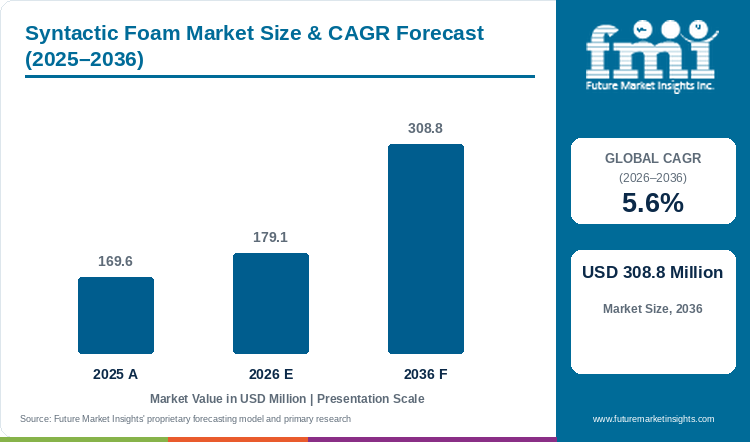
The Syntactic Foam Market is projected to reach USD 308.8 million by 2036, growing at a 5.6% CAGR from 2026 to 2036. The market reaches USD 179.1 million in 2026. The market was valued at USD 169.6 million in 2025. Syntactic foam is a lightweight composite of hollow spheres bound in a matrix. The epoxy and hollow glass microsphere version is used in aerospace, marine and defence [23]. Offshore Mexico is the nearest large demand event. Woodside started drilling at the Trion field on 9 March 2026, with 24 subsea wells tied back to a floating production unit and first oil targeted for 2028 [19].
Price in this market follows depth rating, certification and sphere supply more than raw resin cost. Trelleborg's metric Eccofloat range shows the trade-off. TG6000 has 513 kg/m3 and 0.51 litres of upthrust per litre, while TG11500 has 639 kg/m3 and 0.37 [1]. Qualification adds cost, because no standard exists for testing foam under pure hydrostatic pressure, and deep-sea foams are expected to last at least 20 years [22]. The binder is usually epoxy resin, but approvals and test time shape lead times as much as resin cost does.
Key Market Trends & Insights
- Buoyancy suppliers are moving into larger industrial groups. Freudenberg Flow Technologies bought Balmoral Comtec, an Aberdeen company with about 400 employees at three UK sites, with effect from 19 May 2026 [15]. Tiflex, part of the James Walker Group, announced its purchase of Acoustic Polymers on 6 October 2023 [12]. Globe Composite Solutions closed its acquisition of CMT Materials and Engineered Syntactic Systems on 1 February 2023 [7].
- Floating offshore wind is a named end use for foam suppliers. Trelleborg lists buoyancy that keeps cables that move with the floating structure in shape [2]. DeepWater Buoyancy lists floating offshore wind cable buoyancy on its website [9]. Freudenberg said the Balmoral Comtec deal adds fixed and floating offshore wind to its offer [15].
- Deep-ocean vehicles keep pushing depth ratings. Trelleborg built Eccofloat TG11500 modules rated to 11,500 metres for the Triton 36000/2 submersible. The submersible was used in the Five Deeps Expedition, which made 39 dives over 10 months [3]. Ifremer put its 6,000-metre Ulyx autonomous vehicle into service with the French Oceanographic Fleet in 2024 [21].
Regional Highlights
- North America: Engineered Syntactic Systems operates from Stoughton, Massachusetts [5]. SynFoam is based in Livingston, New Jersey [10]. Trelleborg lists its imperial-unit Eccofloat grades as North American materials [1].
- United Kingdom: Balmoral Comtec in Aberdeen won a multi-million-pound order from TechnipFMC in April 2024 for more than 600 buoyancy modules for the Rosebank field [18]. Advanced Insulation, Acoustic Polymers and Balmoral Comtec are all UK-based [13][12][15].
- Continental Europe: Freudenberg, headquartered in Weinheim, owns Balmoral Comtec [15]. Ifremer runs the 6,000-metre Ulyx vehicle in France [21]. Saipem is supplying a work-class ROV to Italy's ISPRA research vessel Arcadia [20].
Syntactic Foam Market Size and Forecast
Table 1: Syntactic Foam Market Size and Forecast
| Market size and forecast | Value |
|---|---|
| Market size in 2025 | USD 169.6 million |
| Market size in 2026 | USD 179.1 million |
| Projected market size by 2036 | USD 308.8 million |
| CAGR from 2026 to 2036 | 5.6% |
Source: Future Market Insights analysis of the syntactic foam market, 2026.
Analyst Perspective
“Syntactic foam is bought on depth rating, test record and a named approval body, not on price per cubic metre. Marine and subsea work sets the volume, but the most useful signals are vehicle programmes, deepwater field start-ups and the pace of floating wind cable orders. Buyers who lock in a block supplier with a certified testing route, and keep a second source for sheet and rod, will manage delivery risk better than those who buy on first quotation.”
- Nikhil Kaitwade, Principal Consultant, FMI
How is the Syntactic Foam Market segmented?
- By matrix: Polymer Matrix, Metal Matrix, Ceramic Matrix and Other Matrix
- By form: Block and Sheet & Rod
- By application: Marine & Subsea, Aerospace & Defense, Sports & Leisure, Automotive & Transportation and Others
- By region: North America and Europe
Why does Polymer Matrix lead by Matrix in the Syntactic Foam Market in 2026?
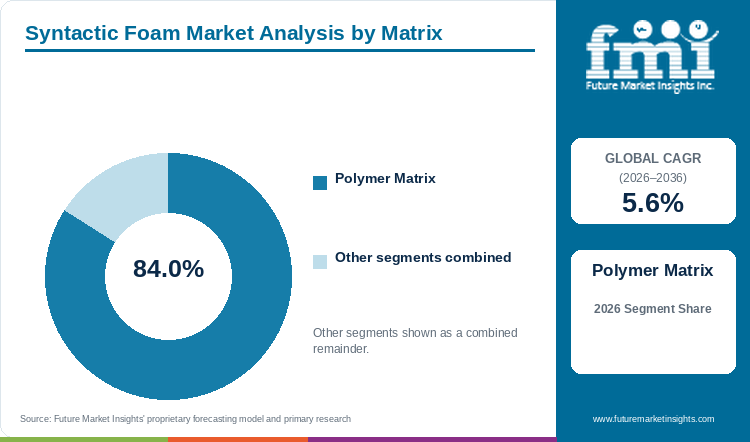
Polymer Matrix accounts for 84.0% of the Syntactic Foam Market by matrix in 2026. The matrix is the continuous binder that holds the hollow spheres, not the spheres themselves. Commercial buoyancy and acoustic foams use thermoset resin binders. Trelleborg's Eccofloat is made of hollow glass microspheres in a rigid resin [1][2]. Acoustic Polymers' AptFlex F50 is a glass-sphere foam with an epoxy binder [11]. Balmoral Comtec describes its flexible riser modules as microspheres and macrospheres in a polymer syntactic foam matrix [16]. Sphere material and sphere size do not change the matrix class. Metal matrix foams remain small. A 2020 review of aluminium matrix syntactic foams found that most work has used small samples at laboratory scale [24]. Ceramic matrix grades serve high-temperature niches.
Table 2: Matrix, 2026 Share
| Leading Share | 2026 market share |
|---|---|
| Polymer Matrix | 84.0% |
| All Other Segments Combined Share | 16.0% |
Source: Future Market Insights analysis of the syntactic foam market, 2026.
Why does Block lead by Form in the Syntactic Foam Market in 2026?
Block accounts for 63.0% of the Syntactic Foam Market by form in 2026. Buoyancy is bought as cast stock that the vehicle or riser builder machines to shape. Trelleborg says Eccofloat is typically cast into standard blocks, with custom shapes available [1]. For the Triton 36000/2 submersible, its team built modules from individual raw-material blocks, each tested in-house for water absorption and hydrostatic crush pressure [3]. Sheet and rod take the rest. Acoustic Polymers supplies AptFlex F50 as a two-part liquid kit for casting detailed shapes, or as a moulded product in rod or sheet form [11]. SynFoam lists castable foams for radomes, antennas and sonar windows, plus machining, assembly and finishing services [10]. Those buyers need smaller parts and tighter tolerances than a riser module does. They overlap with the wider structural foam market.
Table 3: Form, 2026 Share
| Leading Share | 2026 market share |
|---|---|
| Block | 63.0% |
| All Other Segments Combined Share | 37.0% |
Source: Future Market Insights analysis of the syntactic foam market, 2026.
Why does Marine & Subsea lead by Application in the Syntactic Foam Market in 2026?
Marine & Subsea accounts for 38.0% of the Syntactic Foam Market by application in 2026. Seawater pressure is the problem syntactic foam solves, because the foam gives uplift that does not collapse at depth. Trelleborg names underwater vehicles, oceanography instruments and floating wind cables among its buoyancy markets [2]. DeepWater Buoyancy says its products have been used from the ocean surface to depths exceeding six thousand metres [9]. Oil and gas adds a second, steadier layer. Balmoral Comtec describes syntactic foam buoyancy elements for flexible risers and umbilicals, with standardised modules for 0 to 3,000 metres of seawater and deepwater modules for over 3,000 metres [16]. The same company's April 2024 order from TechnipFMC covered more than 600 modules for Rosebank [18]. Diab states that syntactic foam from Subsea Composite Solutions is used where operating depth goes beyond 700 metres, while its PVC foams serve shallower and mid-depth work [14].
Table 4: Application, 2026 Share
| Leading Share | 2026 market share |
|---|---|
| Marine & Subsea | 38.0% |
| All Other Segments Combined Share | 62.0% |
Source: Future Market Insights analysis of the syntactic foam market, 2026.
What are the key drivers, restraints and opportunities?
Driver
Deepwater field work. Each new subsea tie-back needs buoyancy for risers, umbilicals and jumpers. Woodside began drilling Trion in ultra-deepwater Mexican waters on 9 March 2026, with first oil targeted for 2028 [19]. Balmoral Comtec's modules for flexible risers are rated over 3,000 metres of seawater for deepwater service [16]. Foam is a small cost beside a riser failure. That keeps specification conservative and favours suppliers with a test record.
Ocean science and unmanned vehicles. Public research fleets and defence programmes buy deep-rated foam in small, qualified lots. Ifremer's Ulyx can map to 6,000 metres and entered the French Oceanographic Fleet in 2024 [21]. The ROPOS system in Canada offers a deep configuration to 5,000 metres [25]. Trelleborg describes buoyancy as a key part of the overall system for remotely operated, autonomous and human-occupied vehicles [2]. Globe Composite Solutions said its 2023 purchase of CMT Materials and Engineered Syntactic Systems strengthens its position in unmanned underwater vehicles [7].
Restraint
Qualification burden. Hydrostatic testing has no single standard, and the foams are expected to last at least 20 years in service [22]. Approvals such as DNV type approval and API 16F add time before a new grade can be sold [5][17]. Ratings are stated product by product: Balmoral's low-drag DURAFLOAT LDV module is described as operational to 4,500 metres of seawater [17].
Weight penalty at depth and limited filler routes. Trelleborg's metric list shows density rising from 385 kg/m3 for TG2000 to 639 kg/m3 for TG11500, while upthrust per litre falls from 0.64 to 0.37 [1]. Acoustic Polymers says AptFlex F50 gives the greatest crush strength in its range only with reduced buoyancy and higher acoustic impedance [11]. Metal matrix alternatives are still mostly laboratory scale [24].
Opportunity
Floating wind cable buoyancy. Trelleborg and DeepWater Buoyancy both list floating wind cable buoyancy [2][9]. Freudenberg expects the Balmoral Comtec acquisition to bring it into the fixed and floating wind market [15]. Foam suppliers with moulded, certified modules are positioned to follow the build-out of offshore wind farms that need cables able to move with the structure.
Acoustic and defence parts. Trelleborg describes its TG grades as lightweight, with zero magnetic signature. It says their acoustic signature is comparable to seawater, and the grades serve mine neutralisation, sonar domes and acoustic windows [1]. SynFoam lists an acoustically transparent castable foam for sonar domes. It also lists a castable foam for radomes and antennas [10]. AptFlex F50 is quoted at an acoustic impedance of 1.7 MRayls [11]. Readers who follow marine composites can compare how vessel builders use other lightweight materials.
Syntactic Foam Market by Country (2026 to 2036)
Table 5: Syntactic Foam Market Country Growth Forecast
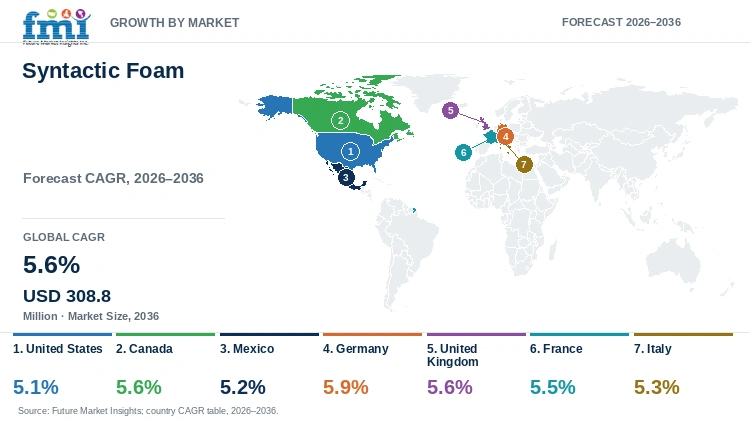
| Country | CAGR, 2026 to 2036 |
|---|---|
| United States | 5.1% |
| Canada | 5.6% |
| Mexico | 5.2% |
| Germany | 5.9% |
| United Kingdom | 5.6% |
| France | 5.5% |
| Italy | 5.3% |
Source: Future Market Insights analysis of the syntactic foam market, 2026.
United States
Globe Composite Solutions, a subsidiary of ESCO Technologies, acquired CMT Materials and its affiliate Engineered Syntactic Systems. The deal closed on 1 February 2023 [7]. Engineered Syntactic Systems is based in Stoughton, Massachusetts. It lists DNV type approval to 6,000 metres of seawater depth for its HZ-34-6k material [5]. Its parent describes ESS as an ESCO Defense company [5].
DeepWater Buoyancy is a Biddeford, Maine maker of syntactic foam products for oceanographic, oil and gas and industrial markets [8]. It makes spherical ADCP buoys from its DeepTec syntactic foam, with 316L stainless steel and titanium hardware [9]. On 8 October 2026 it announced the Anchor Recovery Spool as a new product [9]. SynFoam, in Livingston, New Jersey, was founded in 1966 and offers more than 50 off-the-shelf syntactic foams [10]. Among them are HP-20 for deep-water vehicles and buoyancy modules, and two epoxy void fillers for subsea use [10]. SynFoam also serves automotive and transportation markets, a wider base than the ocean-instrument customers of DeepWater Buoyancy.
Trelleborg lists its imperial-unit Eccofloat grades, such as TG30 at 30 lb/ft3 and 7,307 psi, as North American materials. It says the metric range is not offered in North America [1]. A buyer in the United States therefore specifies against a different grade list from a European buyer. That matters when a programme spans both regions. Several domestic makers already serve the market.
Canada
The Canadian Scientific Submersible Facility operates ROPOS from North Saanich, British Columbia [25]. It offers 1,000, 4,000 and 5,000 metre configurations [25]. The facility describes ROPOS as a remotely operated vehicle for ocean science and exploration, and notes support for cabled ocean observatories [25].
Moored and bottom-mounted instruments add another source of demand in Canada. DeepWater Buoyancy markets ADCP buoys and bottom mounts to oceanographic customers. It states that its products have been used to depths exceeding six thousand metres [9]. A 5,000 metre buoyancy package in Trelleborg's metric range is TG5000, with 480 kg/m3 and 0.55 litres of upthrust per litre [1].
Scientific facilities and observatory operators buy in small, qualified lots and rely on the foam maker's test record. Suppliers that can machine and certify a block to a stated depth win these orders more readily than those quoting on volume.
Mexico
Woodside began drilling at the Trion field in ultra-deepwater Mexican waters on 9 March 2026, using Transocean's Deepwater Thalassa drillship [19]. The drillship reached Mexican waters on 5 March [19]. The campaign covers 24 subsea wells, with first oil targeted for 2028 [19].
Woodside operates Trion with a 60% interest, and Petroleos Mexicanos holds 40%. The project reached final investment decision in 2023 [19]. Production passes through the Tlaloc floating production unit, which has a nameplate capacity of about 100,000 barrels a day. Production then goes to the Chalchi storage vessel, with about 950,000 barrels of storage [19].
Subsea tie-backs of this kind need riser and umbilical buoyancy in the deepwater class, which Balmoral Comtec states for depths over 3,000 metres of seawater [16]. Timing matters more than volume here. Mexico's 5.2% rate rests on a few project windows, not a broad industrial base.
Germany
Freudenberg, headquartered in Weinheim, completed its acquisition of Balmoral Comtec with effect from 19 May 2026 [15]. Balmoral Comtec supplies engineered buoyancy, cable protection and thermal insulation to the oil and gas and wind industries [15]. The deal sits in Freudenberg's Connectors and Sealing Solutions unit [15].
The Helmholtz Centre for Ocean Research Kiel (GEOMAR) lists ROV KIEL 6000, ROV PHOCA, AUV POSEIDON and the autonomous vehicle BELUGA among its seagoing infrastructure [26]. Vehicles of this kind are a source of German research demand for deep-rated buoyancy.
Germany has the highest rate of the seven profiled countries at 5.9%. Ownership is the commercial change here. A German group now controls Balmoral Comtec, a UK buoyancy supplier with about 400 employees [15]. German industrial buyers and offshore wind contractors should check whether framework terms and certification routes stay with the Balmoral Comtec entity.
United Kingdom
Balmoral Comtec is based in Aberdeen with about 400 employees across three UK locations [15]. In April 2024 it won a multi-million-pound contract from TechnipFMC for more than 600 buoyancy modules for flexible risers and umbilicals at Equinor's Rosebank field [18]. The contract brought more than 50 new hires to its Aberdeen base [18].
Advanced Insulation is headquartered in Gloucester. Its ContraTherm C25 is a silicone-based subsea insulation rated for about 3,000 metres [13]. Its ContraFlame C50 and MS400 products are phenolic syntactic foam for lightweight fire protection [13]. Its Manuplas brand covers buoyancy, floats and cable protection [13].
Acoustic Polymers, based at Churcham in Gloucestershire, was acquired by Tiflex, part of the James Walker Group. The announcement is dated 6 October 2023 [12]. The company continues to operate as an independent business under managing director Malcolm Norris [12]. Its AptFlex F50 foam is quoted at 720 kg/m3, with a hydrostatic crush strength of 69 MPa and thermal conductivity of 0.120 W/m/K [11]. Three of the nine named makers are based in the UK. Trelleborg tested the Triton modules at its Rochdale site [3].
France
Ifremer's Ulyx autonomous vehicle is designed to survey and observe to 6,000 metres. It weighs 2.7 tonnes and has endurance of 16 to 21 hours on the bottom in real conditions. It entered service with the French Oceanographic Fleet in 2024 [21].
Ifremer researchers have also worked on how to qualify the material. In a 2014 paper in Polymer Testing, Le Gall, Choqueuse, Le Gac, Davies and Perreux proposed measuring buoyancy loss under hydrostatic pressure [22]. They validated the method on one brittle and one ductile syntactic foam [22]. The paper notes that no standard exists for testing under pure hydrostatic pressure [22].
French demand is small in volume but specification-led. Buyers and vehicle builders in the public fleet ask for test evidence as well as a depth label. Suppliers that share buoyancy-loss data are better placed to win them.
Italy
Saipem was awarded a contract by the T. Mariotti shipyard in Genoa to supply its Hydrone-W work-class ROV for ISPRA's new oceanographic vessel Arcadia. EcoMagazine reported this on 12 February 2026 [20]. The vehicle is described as working to depths of up to 3,000 metres [20]. The vessel is funded under Italy's National Recovery and Resilience Plan, within its marine restoration programme [20].
At 3,000 metres the buoyancy choice is syntactic foam, not PVC foam. Diab states that its PVC foams cover shallower service and that syntactic foam is used beyond 700 metres [14]. Balmoral Comtec's standardised modules are rated from 0 to 3,000 metres of seawater [16], which brackets the Hydrone-W rating.
Italy's demand comes from research and subsea services, not from a domestic foam industry. Italian buyers should specify depth class and supplier approval early, before a vessel or vehicle contract is signed.
Who are the notable companies in the Syntactic Foam Market?
Notable companies in the Syntactic Foam Market include Trelleborg AB, SynFoam, Diab International AB, Acoustic Polymers Limited, Advanced Insulation, DeepWater Buoyancy, Inc, CMT Materials LLC, Engineered Syntactic Systems and Balmoral Comtec.
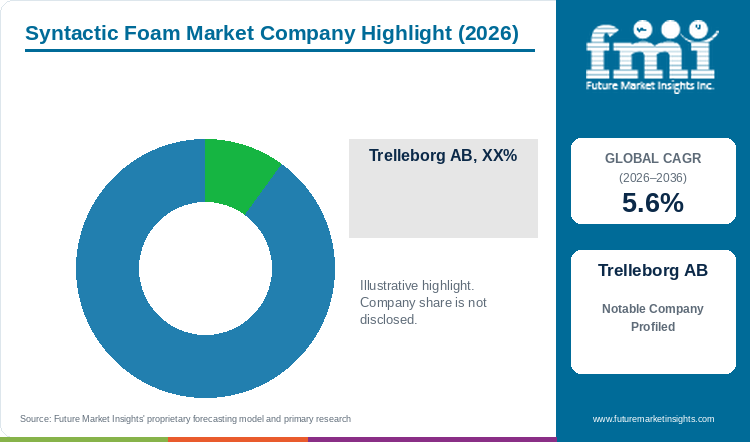
Control of the spheres and of the depth ladder separates the leaders. Trelleborg AB holds 11.5% and lists Eccofloat grades from TG2000 to TG11500 and DS and DG families, built on hollow glass microspheres in resin [1]. Ocean News reported in 2017 that Trelleborg makes the Eccospheres at its Boston, Massachusetts facility and tests them in-house [4]. SynFoam, at 10.1%, sells more than 50 off-the-shelf grades and custom formulations [10]. The nine named companies together hold 65.4%, which leaves 34.6% with other makers.
Certification and test records decide who is invited to bid on vehicles and risers. Trelleborg's Triton modules were certified by DNVGL after block tests at Rochdale [3]. Engineered Syntactic Systems lists DNV type approval for HZ-34-6k [5], and Balmoral Comtec states that its DURAFLOAT RIS module is made and tested to API 16F [17]. CMT Materials (5.3%) and Engineered Syntactic Systems (4.7%) share a parent, and together they account for 10.0%. Globe said the purchase gives the group naval and unmanned vehicle strength [7].
Product form and application focus split the rest. DeepWater Buoyancy, at 6.1%, sells moored instrument buoys and cable buoyancy [9]. Acoustic Polymers, at 7.8%, sells epoxy-bound glass-sphere foams as two-part kits, rod or sheet for acoustic and thermal uses [11]. Advanced Insulation, at 6.9%, puts phenolic syntactic foam into fire protection and sells subsea insulation [13]. Diab, at 8.9%, draws on syntactic foam from Subsea Composite Solutions for deeper service [14]. Balmoral Comtec, at 4.1%, makes riser and umbilical buoyancy modules [16]. CMT Materials is best known for syntactic foam plug assists used in thermoforming [6].
Key Developments in the Syntactic Foam Market
- On 19 May 2026, Freudenberg Flow Technologies completed its acquisition of Balmoral Comtec [15]. The business supplies engineered buoyancy, cable protection and thermal insulation to oil and gas and wind customers, and it joined Freudenberg's Connectors and Sealing Solutions unit [15].
- On 8 October 2026, DeepWater Buoyancy announced a new product, the Anchor Recovery Spool, on its website [9].
- On 6 October 2023, Tiflex, part of the James Walker Group, announced that it had acquired Acoustic Polymers Ltd, which continues to operate as an independent business [12].
- On 10 February 2023, Globe Composite Solutions announced the acquisition of CMT Materials and Engineered Syntactic Systems, which closed on 1 February 2023 [7].
Key Players in the Syntactic Foam Market
- Trelleborg AB
- SynFoam
- Diab International AB
- Acoustic Polymers Limited
- Advanced Insulation
- DeepWater Buoyancy, Inc
- CMT Materials LLC
- Engineered Syntactic Systems
- Balmoral Comtec
Syntactic Foam Market Report Scope
Table 6: Syntactic Foam Market Report Scope
| Coverage field | Report scope |
|---|---|
| Market definition | Syntactic foam: lightweight composite of hollow spheres bound in a matrix, used for buoyancy, insulation, acoustic and structural parts, measured by value of sales |
| Matrix | Polymer Matrix, Metal Matrix, Ceramic Matrix, Other Matrix |
| Form | Block, Sheet & Rod |
| Application | Marine & Subsea, Aerospace & Defense, Sports & Leisure, Automotive & Transportation, Others |
| Regions and profiled countries | North America and Europe, United States, Canada, Mexico, Germany, United Kingdom, France, Italy |
| Companies covered | Trelleborg AB, SynFoam, Diab International AB, Acoustic Polymers Limited, Advanced Insulation, DeepWater Buoyancy, Inc, CMT Materials LLC, Engineered Syntactic Systems, Balmoral Comtec |
| Forecast period | 2026 to 2036, with 2025 as the historical base year |
| Quantitative Units | USD million |
Source: Future Market Insights analysis of the syntactic foam market, 2026.
Syntactic Foam Market by Segments
Syntactic Foam Market segmented by Matrix:
- Polymer Matrix
- Metal Matrix
- Ceramic Matrix
- Other Matrix
Syntactic Foam Market segmented by Form:
- Block
- Sheet & Rod
Syntactic Foam Market segmented by Application:
- Marine & Subsea
- Aerospace & Defense
- Sports & Leisure
- Automotive & Transportation
- Others
Syntactic Foam Market by Region
- North America
- Europe
- United States
- Canada
- Mexico
- Germany
- United Kingdom
- France
- Italy
Research Sources and Bibliography
- [1] Trelleborg Applied Technologies. (n.d.). Eccofloat. https://www.trelleborg.com/en/applied-technologies/products-and-solutions/buoyancy/eccofloat
- [2] Trelleborg Applied Technologies. (n.d.). Buoyancy. https://www.trelleborg.com/en/applied-technologies/products-and-solutions/buoyancy
- [3] Trelleborg Applied Technologies. (2020, October 20). Ultra Deep Water Foam. https://www.trelleborg.com/en/applied-technologies/news-and-events/feature-articles/ultra-deep-water-foam
- [4] Ocean News & Technology. (2017, February 22). Trelleborg Exhibits New Materials at Underwater Intervention. https://oceannews.com/?p=44162
- [5] Engineered Syntactic Systems. (n.d.). About. https://ess.globecomposite.com/about
- [6] CMT Materials. (n.d.). About. https://cmt.globecomposite.com/about
- [7] Globe Composite Solutions. (2023, February 10). Globe announces acquisition of CMT Materials and Engineered Syntactic Systems. https://www.globecomposite.com/news/globe-announces-acquisition-of-cmt-materials-and-engineered-syntactic-systems
- [8] Area Development. (2014, June 2). DeepWater Buoyancy invests in Biddeford, Maine. https://www.areadevelopment.com/Print/newsitems/6-2-2014/deepwater-buoyancy-invests-biddeford-maine892332.shtml
- [9] DeepWater Buoyancy. (2026, October 8). DeepWater Buoyancy company website and news. https://deepwaterbuoyancy.com/
- [10] SynFoam. (n.d.). SynFoam company and product profile (Knowde). https://knowde.com/stores/synfoam
- [11] Precision Acoustics Ltd. (n.d.). AptFlex F50 technical data sheet (Acoustic Polymers Ltd). https://www.acoustics.co.uk/wp-content/uploads/2026/01/F50-TDS-V2.2-0126.pdf
- [12] ADS Group. (2023, October 6). James Walker Group acquires acoustic polymer technology. https://www.adsgroup.org.uk/knowledge/industry-member-news/james-walker-group-acquires-acoustic-polymer-technology/
- [13] Offshore Technology. (n.d.). Advanced Insulation: company profile. https://www.offshore-technology.com/contractors/fire_protection/advanced-insulation-ot
- [14] Diab Group. (n.d.). Buoyancy for floats and tooling. https://www.diabgroup.com/markets/subsea/buoyancy-for-floats-and-tooling/
- [15] Balmoral Comtec. (2026, May 20). Freudenberg Flow Technologies acquires Balmoral Comtec. https://www.balmoraloffshore.com/media-centre/news/freudenberg-flow-technologies-acquires-balmoral-comtec
- [16] Balmoral Comtec. (n.d.). Umbilical, flexible and riser buoyancy. https://www.balmoraloffshore.com/solutions/buoyancy/flexible-riser-buoyancy
- [17] Balmoral Comtec. (n.d.). Drill riser buoyancy. https://www.balmoraloffshore.com/solutions/buoyancy/drill-riser-buoyancy
- [18] Offshore Energy. (2024, April 18). TechnipFMC orders buoyancy modules for Equinor's giant UK oil and gas field. https://www.offshore-energy.biz/technipfmc-orders-buoyancy-modules-for-equinors-giant-uk-oil-gas-field/
- [19] World Oil. (2026, March 9). Woodside launches Trion drilling campaign in ultra-deepwater Gulf of Mexico. https://worldoil.com/news/2026/3/9/woodside-launches-trion-drilling-campaign-in-ultra-deepwater-gulf-of-mexico/
- [20] EcoMagazine. (2026, February 12). Saipem to supply Hydrone-W underwater ROV to new oceanographic vessel. https://ecomagazine.com/news/research/saipem-to-supply-hydrone-w-underwater-rov-to-new-oceanographic-vessel/
- [21] Flotte oceanographique francaise (Ifremer). (n.d.). Ulyx, un nouvel AUV 6000: fiche technique. https://flotteoceanographique.fr/content/download/177266/file/Plaquette%20Ulyx%202025%20DFO.pdf
- [22] Le Gall, M., Choqueuse, D., Le Gac, P.-Y., Davies, P., & Perreux, D. (2014, October). Novel mechanical characterization method for deep sea buoyancy material under hydrostatic pressure. Polymer Testing, 39, 36-44. https://archimer.ifremer.fr/doc/00201/31191
- [23] Anirudh, S., Jayalakshmi, C. G., Anand, A., Kandasubramanian, B., & Ismail, S. O. (2022). Epoxy/hollow glass microsphere syntactic foams for structural and functional application: A review. European Polymer Journal, 171, 111163. https://uhra.herts.ac.uk/handle/2299/25468
- [24] Bolat, C., Akgun, I. C., & Goksenli, A. (2020, September 20). On the way to real applications: Aluminum matrix syntactic foams. European Mechanical Science, 4(3), 131-141. https://dergipark.org.tr/tr/pub/ems/article/703619
- [25] Canadian Scientific Submersible Facility. (n.d.). ROPOS. https://www.ropos.com/
- [26] GEOMAR Helmholtz Centre for Ocean Research Kiel. (n.d.). Ocean Research Technology Centre. https://www.geomar.de/en/ortc
Table of Content
Table of Content
- Key Takeaways
- Market Size and CAGR
- Top Growth Driver
- Fastest Growing Segment
- Leading Region
- Key Companies
- Emerging Opportunities
- Executive Summary
- Global Market Outlook
- Demand-side Trends
- Supply-side Trends
- Technology Roadmap Analysis
- Analysis and Recommendations
- Analyst Perspective (What is happening? Why now? What should investors know?)
- Key Questions Answered
- How large is the market?
- What is the CAGR?
- What are key trends?
- Which region dominates?
- Who are the leaders?
Read More...
- Market Overview
- Market Coverage / Taxonomy
- Market Definition / Scope / Limitations
- Research Methodology
- Chapter Orientation
- Analytical Lens and Working Hypotheses
- Market Structure, Signals, and Trend Drivers
- Benchmarking and Cross-market Comparability
- Market Sizing, Forecasting, and Opportunity Mapping
- Research Design and Evidence Framework
- Desk Research Programme (Secondary Evidence)
- Expert Input and Fieldwork (Primary Evidence)
- Tooling, Models, and Reference Databases
- Data Engineering and Model Build
- Quality Assurance and Audit Trail
- Market Background
- Market Dynamics (Drivers, Restraints, Opportunity, Trends)
- Scenario Forecast (Optimistic, Likely, Conservative)
- Impact Analysis
- AI Impact
- Sustainability Impact
- Regulatory Impact
- Technology Impact
- Consumer / Buyer Analysis
- Purchase Drivers
- Adoption Barriers
- Buyer Journey
- Opportunity Map Analysis
- Product Life Cycle Analysis
- Supply Chain Analysis
- Investment Feasibility Matrix
- Value Chain Analysis
- PESTLE and Porter's Analysis
- Regulatory Landscape
- Regional Parent Market Outlook
- Production and Consumption Statistics
- Import and Export Statistics
- Global Market Analysis and Forecast, 2021 to 2036
- Historical Market Size Value (USD Million) Analysis, 2021 to 2025
- Current and Future Market Size Value (USD Million) Projections, 2026 to 2036
- Y-o-Y Growth Trend Analysis
- Absolute $ Opportunity Analysis
- Global Market Pricing Analysis, 2021 to 2036
- Global Market Analysis and Forecast, By Matrix, 2021 to 2036
- Introduction / Key Findings
- Historical Market Size Value (USD Million) Analysis By Matrix, 2021 to 2025
- Current and Future Market Size Value (USD Million) Analysis and Forecast By Matrix, 2026 to 2036
- Polymer Matrix
- Metal Matrix
- Ceramic Matrix
- Other Matrix
- Y-o-Y Growth Trend Analysis By Matrix, 2021 to 2025
- Absolute $ Opportunity Analysis By Matrix, 2026 to 2036
- Global Market Analysis and Forecast, By Form, 2021 to 2036
- Introduction / Key Findings
- Historical Market Size Value (USD Million) Analysis By Form, 2021 to 2025
- Current and Future Market Size Value (USD Million) Analysis and Forecast By Form, 2026 to 2036
- Block
- Sheet & Rod
- Y-o-Y Growth Trend Analysis By Form, 2021 to 2025
- Absolute $ Opportunity Analysis By Form, 2026 to 2036
- Global Market Analysis and Forecast, By Application, 2021 to 2036
- Introduction / Key Findings
- Historical Market Size Value (USD Million) Analysis By Application, 2021 to 2025
- Current and Future Market Size Value (USD Million) Analysis and Forecast By Application, 2026 to 2036
- Marine & Subsea
- Aerospace & Defense
- Sports & Leisure
- Automotive & Transportation
- Others
- Y-o-Y Growth Trend Analysis By Application, 2021 to 2025
- Absolute $ Opportunity Analysis By Application, 2026 to 2036
- Global Market Analysis and Forecast, By Region, 2021 to 2036
- Introduction
- Historical Market Size Value (USD Million) Analysis By Region, 2021 to 2025
- Current Market Size Value (USD Million) Analysis and Forecast By Region, 2026 to 2036
- North America
- Europe
- Market Attractiveness Analysis By Region
- North America Market Analysis and Forecast, By Country, 2021 to 2036
- Historical Market Size Value (USD Million) Trend Analysis By Market Taxonomy, 2021 to 2025
- Market Size Value (USD Million) Forecast By Market Taxonomy, 2026 to 2036
- By Country
- By Matrix
- By Form
- By Application
- Market Attractiveness Analysis
- By Country
- By Matrix
- By Form
- By Application
- Key Takeaways
- Europe Market Analysis and Forecast, By Country
- Historical Market Size Value (USD Million) Trend Analysis By Market Taxonomy, 2021 to 2025
- Market Size Value (USD Million) Forecast By Market Taxonomy, 2026 to 2036
- By Country
- United States
- Canada
- Mexico
- Germany
- United Kingdom
- France
- Italy
- By Matrix
- By Form
- By Application
- By Country
- Market Attractiveness Analysis
- By Country
- By Matrix
- By Form
- By Application
- Key Takeaways
- Key Countries Market Analysis
- United States
- Pricing Analysis
- Market Share Analysis, 2025
- By Matrix
- By Form
- By Application
- Canada
- Pricing Analysis
- Market Share Analysis, 2025
- By Matrix
- By Form
- By Application
- Mexico
- Pricing Analysis
- Market Share Analysis, 2025
- By Matrix
- By Form
- By Application
- Germany
- Pricing Analysis
- Market Share Analysis, 2025
- By Matrix
- By Form
- By Application
- United Kingdom
- Pricing Analysis
- Market Share Analysis, 2025
- By Matrix
- By Form
- By Application
- Italy
- Pricing Analysis
- Market Share Analysis, 2025
- By Matrix
- By Form
- By Application
- France
- Pricing Analysis
- Market Share Analysis, 2025
- By Matrix
- By Form
- By Application
- United States
- Market Structure Analysis
- Competition Dashboard
- Competition Benchmarking
- Market Share Analysis of Top Players
- By Regional
- By Matrix
- By Form
- By Application
- Emerging Startups
- Innovation Benchmarking
- Competition Analysis
- Competition Deep Dive
- Trelleborg AB
- Overview
- Product Portfolio
- Profitability by Market Segments
- Sales Footprint
- Strategy Overview
- Marketing Strategy
- Product Strategy
- Channel Strategy
- SynFoam
- Diab International AB
- Acoustic Polymers Limited
- Advanced Insulation
- DeepWater Buoyancy, Inc
- Engineered Syntactic Systems
- Balmoral Comtec
- CMT Materials LLC
- Trelleborg AB
- Case Studies
- Success Stories
- Recent Developments
- Competition Deep Dive
- Assumptions & Acronyms Used
List of Tables
- Table 1: Global Market Value (USD Million) Forecast by Region, 2021 to 2036
- Table 2: Global Market Value (USD Million) Forecast by Matrix, 2021 to 2036
- Table 3: Global Market Value (USD Million) Forecast by Form, 2021 to 2036
- Table 4: Global Market Value (USD Million) Forecast by Application, 2021 to 2036
- Table 5: North America Market Value (USD Million) Forecast by Country, 2021 to 2036
- Table 6: North America Market Value (USD Million) Forecast by Matrix, 2021 to 2036
- Table 7: North America Market Value (USD Million) Forecast by Form, 2021 to 2036
- Table 8: North America Market Value (USD Million) Forecast by Application, 2021 to 2036
- Table 9: Europe Market Value (USD Million) Forecast by Country, 2021 to 2036
- Table 10: Europe Market Value (USD Million) Forecast by Matrix, 2021 to 2036
- Table 11: Europe Market Value (USD Million) Forecast by Form, 2021 to 2036
- Table 12: Europe Market Value (USD Million) Forecast by Application, 2021 to 2036
List of Figures
- Figure 1: Global Market Pricing Analysis
- Figure 2: Global Market Value (USD Million) Forecast 2021-2036
- Figure 3: Global Market Value Share and BPS Analysis by Matrix, 2026 and 2036
- Figure 4: Global Market Y-o-Y Growth Comparison by Matrix, 2026-2036
- Figure 5: Global Market Attractiveness Analysis by Matrix
- Figure 6: Global Market Value Share and BPS Analysis by Form, 2026 and 2036
- Figure 7: Global Market Y-o-Y Growth Comparison by Form, 2026-2036
- Figure 8: Global Market Attractiveness Analysis by Form
- Figure 9: Global Market Value Share and BPS Analysis by Application, 2026 and 2036
- Figure 10: Global Market Y-o-Y Growth Comparison by Application, 2026-2036
- Figure 11: Global Market Attractiveness Analysis by Application
- Figure 12: Global Market Value (USD Million) Share and BPS Analysis by Region, 2026 and 2036
- Figure 13: Global Market Y-o-Y Growth Comparison by Region, 2026-2036
- Figure 14: Global Market Attractiveness Analysis by Region
- Figure 15: North America Market Incremental Dollar Opportunity, 2026-2036
- Figure 16: Europe Market Incremental Dollar Opportunity, 2026-2036
- Figure 17: North America Market Value Share and BPS Analysis by Country, 2026 and 2036
- Figure 18: North America Market Value Share and BPS Analysis by Matrix, 2026 and 2036
- Figure 19: North America Market Y-o-Y Growth Comparison by Matrix, 2026-2036
- Figure 20: North America Market Attractiveness Analysis by Matrix
- Figure 21: North America Market Value Share and BPS Analysis by Form, 2026 and 2036
- Figure 22: North America Market Y-o-Y Growth Comparison by Form, 2026-2036
- Figure 23: North America Market Attractiveness Analysis by Form
- Figure 24: North America Market Value Share and BPS Analysis by Application, 2026 and 2036
- Figure 25: North America Market Y-o-Y Growth Comparison by Application, 2026-2036
- Figure 26: North America Market Attractiveness Analysis by Application
- Figure 27: Europe Market Value Share and BPS Analysis by Country, 2026 and 2036
- Figure 28: Europe Market Value Share and BPS Analysis by Matrix, 2026 and 2036
- Figure 29: Europe Market Y-o-Y Growth Comparison by Matrix, 2026-2036
- Figure 30: Europe Market Attractiveness Analysis by Matrix
- Figure 31: Europe Market Value Share and BPS Analysis by Form, 2026 and 2036
- Figure 32: Europe Market Y-o-Y Growth Comparison by Form, 2026-2036
- Figure 33: Europe Market Attractiveness Analysis by Form
- Figure 34: Europe Market Value Share and BPS Analysis by Application, 2026 and 2036
- Figure 35: Europe Market Y-o-Y Growth Comparison by Application, 2026-2036
- Figure 36: Europe Market Attractiveness Analysis by Application
- Figure 37: Global Market - Tier Structure Analysis
- Figure 38: Global Market - Company Share Analysis
Frequently Asked Questions
How big is the syntactic foam market in 2026?
The Syntactic Foam Market reaches USD 179.1 million in 2026, up from USD 169.6 million in 2025. It is projected to reach USD 308.8 million by 2036, a 5.6% CAGR from 2026 to 2036.
Which application leads the syntactic foam market?
Marine & Subsea leads with 38.0% of the market in 2026. Trelleborg names underwater vehicles, oceanography and floating wind cables among its buoyancy markets [2]. Balmoral Comtec describes syntactic foam modules for flexible risers and umbilicals [16].
Which other applications, matrices and forms matter?
By application, Aerospace & Defense holds 22.0%, Sports & Leisure 16.0%, Automotive & Transportation 13.0% and Others 11.0%. By matrix, Polymer Matrix holds 84.0%, Metal Matrix 7.0%, Ceramic Matrix 5.0% and Other Matrix 4.0%. By form, Block holds 63.0% and Sheet & Rod 37.0%. SynFoam lists castable foams for radomes and sonar windows [10]. A review of the aluminium matrix versions reports interest from automotive, aviation and aerospace users [24].
Which profiled country is forecast to grow fastest?
Germany has the highest forecast CAGR of the seven profiled countries, at 5.9% from 2026 to 2036. Canada and the United Kingdom follow at 5.6% each, and France at 5.5%. Italy is at 5.3%, Mexico at 5.2% and the United States at 5.1%. Ownership changed in Germany too. Freudenberg, based in Weinheim, took ownership of Balmoral Comtec with effect from 19 May 2026 [15].
What approvals and events are affecting demand?
Approvals matter because deep-sea foam has no single standard for pure hydrostatic testing [22]. Engineered Syntactic Systems lists DNV type approval for HZ-34-6k to 6,000 metres of seawater depth [5]. Balmoral Comtec lists API 16F for its DURAFLOAT RIS riser buoyancy [17]. On the demand side, Woodside began drilling Trion on 9 March 2026, with first oil targeted for 2028 [19].
What should a buyer check when choosing a syntactic foam?
Check the depth rating, density and the test record for the exact grade. Trelleborg's metric list gives density and upthrust for each Eccofloat grade [1]. Acoustic Polymers states density, crush strength and thermal conductivity for AptFlex F50 [11]. Then confirm form: Trelleborg casts standard blocks, while AptFlex is offered as a two-part kit, rod or sheet [1][11].
Preview the report firsthand - request a free sample
Get SampleGet the brochure for pricing and purchase details.
Get PDF
