

- Market Size (2026)
- USD 2.0 Bn
- Forecast (2036)
- USD 6.2 Bn
- CAGR (2026 to 2036)
- 12.1%
How big is Targeted RNAi Molecule Platform Market in 2026?
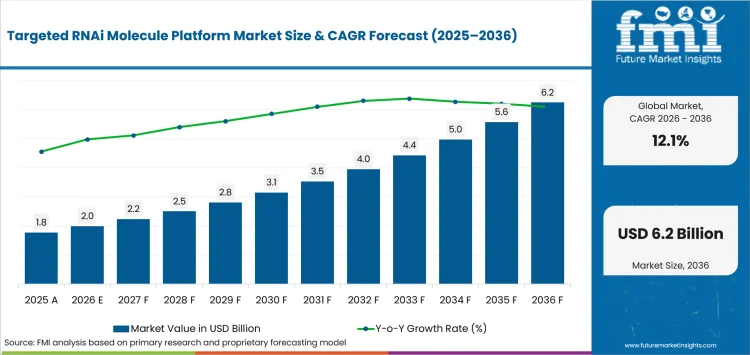
USD 2.0 billion in 2026 and USD 6.2 billion by 2036 at a 12.1% CAGR.
Sales of targeted RNAi molecule platforms are projected to expand at 12.1% CAGR from 2026 to 2036. The industry valuation is expected to rise from USD 2.0 billion in 2026 to USD 6.2 billion by 2036. Demand is expected to be driven by liver-targeted delivery and easier dosing schedules. Drug developers are expected to favor platforms that connect gene silencing with clear trial planning and manufacturing readiness.
Platform competition is expected to move beyond gene-silencing chemistry. Developers now compare delivery reach with dosing convenience and manufacturing readiness. Commercial value is expected to improve when a platform gives clear target selection and enough evidence for later regulatory review.
Key Takeaways of Targeted RNAi Molecule Platform Market
- The targeted RNAi molecule platform market is expanding as drug developers leverage RNA interference to silence disease-causing genes through validated delivery routes, with commercial adoption contingent on clear patient benefit, repeatable manufacturing quality, and regulatory experience.
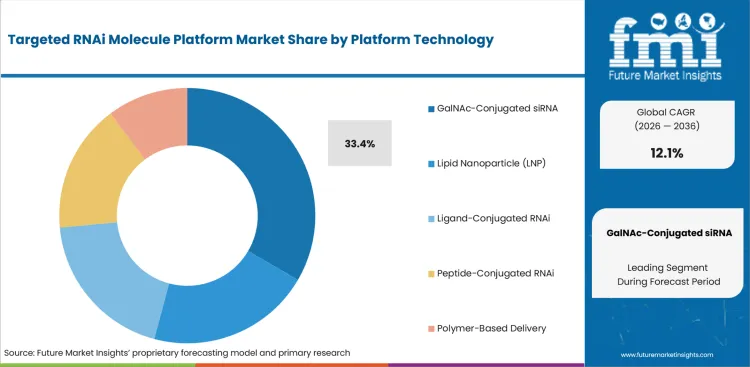
- By platform technology, GalNAc-Conjugated siRNA is projected to hold 33.4% share in 2026 for its liver-targeting precision and late-stage clinical validation; by target type, Hepatic Targets are forecast at 33.0% share in 2026 as the liver's accessibility and biomarker clarity make it the preferred RNAi development entry point.
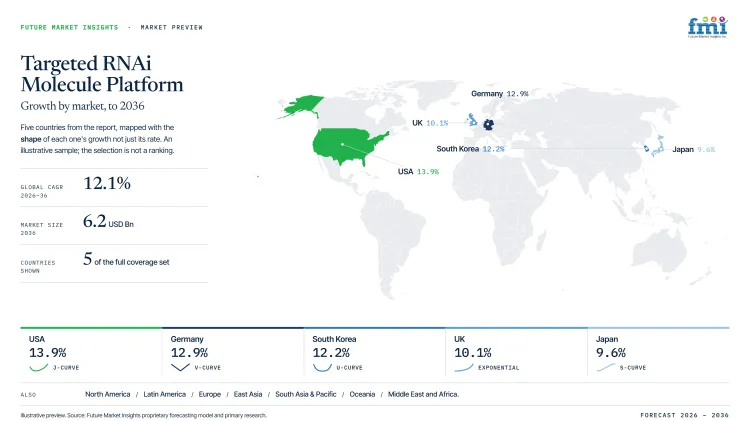
- The USA leads growth at 13.9% CAGR through 2036, followed by Germany at 12.9% and South Korea at 12.2%, each supported by biotechnology investment, biomedical research infrastructure, and regulatory maturity.
- Cardiometabolic Diseases are estimated at 30.4% share in 2026, driven by high global prevalence, measurable lipid and lipoprotein endpoints, and extended-dosing differentiation versus conventional daily therapies.
- Alnylam, Arrowhead, Silence Therapeutics, Dicerna (Novo Nordisk), OliX, and Sirnaomics compete through delivery evidence, clinical-stage depth, and geographic development coverage across siRNA and metabolic-disease programs.
- Biopharmaceutical companies are projected at 33.7% end-user share in 2026, retaining primary responsibility for late-stage development, manufacturing scale-up, and global commercialization as partnership advantage increasingly hinges on delivery proof and manufacturing control.
Analyst Perspective
"The targeted RNAi molecule platform market is increasingly shaped by delivery performance, target specificity, and reproducible manufacturing rather than RNAi activity alone. Developers are evaluating whether platforms translate biological effects into meaningful patient outcomes while maintaining safety and production consistency. Companies with strong delivery evidence, clear patient-selection strategies, and scalable manufacturing capabilities will be better positioned to advance partnerships and clinical adoption."
— Anurag Sharma, Principal Analyst at Future Market Insights
Source: FMI's proprietary forecasting model and primary research
How is the Targeted RNAi Molecule Platform Market segmented?
The targeted RNAi molecule platform industry is segmented by platform technology, target type, application, end user, and region.
The segmentation framework separates delivery chemistry from target biology and customer type. Platform technology covers GalNAc-conjugated siRNA and lipid nanoparticles. It covers ligand-conjugated RNAi with peptide-conjugated RNAi and polymer delivery. Target analysis follows hepatic programs and cardiometabolic programs. It tracks oncology, rare-disease and central nervous system programs separately. End-user analysis separates biopharmaceutical companies from CROs and research institutes. This keeps commercial ownership clear across the forecast period.
What supports demand for GalNAc-Conjugated siRNA within the platform technology category?
RNA interference development increasingly depends on delivery systems that transport therapeutic molecules to the intended tissue with consistent efficacy and safety. GalNAc conjugation has become a preferred approach because it enables targeted delivery to hepatocytes through subcutaneous administration. The platform has accumulated regulatory and commercial experience, giving developers greater confidence when advancing late-stage RNAi programs.
- GalNAc-Conjugated siRNA is expected to hold 33.4% share in 2026, driven by its established liver-targeting capability and growing acceptance across chronic disease development programs. Its ability to deliver predictable gene silencing while supporting convenient dosing strengthens its position as the leading RNAi delivery platform.
- Biopharmaceutical developers continue to prioritize GalNAc-based technologies because they simplify dose optimization and safety evaluation during clinical development. The platform also provides a reliable benchmark for comparing therapeutic performance before expanding into more complex delivery strategies.
How do hepatic targets shape demand within the target type category?
The liver remains the most mature organ for systemic RNAi therapies because of its accessibility and well-understood biological pathways. Developers frequently select hepatic targets when seeking measurable biomarkers and efficient drug delivery during clinical studies. Continued progress in liver-focused RNAi medicines reinforces confidence in this target category for future therapeutic expansion.
- Hepatic Targets are projected to account for 33.0% share in 2026, supported by their proven compatibility with RNAi delivery technologies and established clinical evidence. Strong biomarker availability and predictable pharmacodynamic responses further strengthen adoption across development programs.
- Drug developers often use liver-focused programs to validate delivery chemistry, safety profiles, and manufacturing consistency before extending RNAi research into more challenging tissues such as the central nervous system or skeletal muscle.
What makes cardiometabolic diseases central to the application category?
Cardiometabolic disorders represent a major therapeutic opportunity because of their high global prevalence and the availability of measurable clinical endpoints. RNAi therapies are increasingly being evaluated for lipid metabolism and cardiovascular risk reduction, where long-lasting gene silencing can provide sustained therapeutic benefit. This combination of large patient populations and quantifiable outcomes continues to attract investment.
- Cardiometabolic Diseases are anticipated to capture 30.4% share in 2026, attributable to expanding development programs targeting triglyceride metabolism and lipoprotein pathways. These applications offer clearly defined clinical endpoints that support efficient evaluation throughout drug development.
- Clinical researchers increasingly favor cardiometabolic RNAi therapies because extended dosing intervals may improve treatment adherence while providing durable therapeutic effects. Such characteristics help differentiate RNAi medicines from conventional daily treatment approaches.
How are biopharmaceutical companies positioned within the end user category?
Biopharmaceutical companies play a leading role in RNAi commercialization by integrating discovery, clinical development, regulatory strategy, and large-scale manufacturing. Their financial resources and technical expertise enable them to manage complex development pathways while advancing multiple therapeutic candidates through clinical trials.
- By end user, biopharmaceutical companies are estimated to hold 33.7% share in 2026, reflecting their leadership in clinical development, regulatory submissions, and commercial product launches. Their investments continue to accelerate innovation across RNAi therapeutic platforms.
- Contract research organizations and academic institutions contribute significantly during early discovery and validation, while biopharmaceutical companies retain primary responsibility for late-stage clinical programs, manufacturing scale-up, and global commercialization strategies.
What are the drivers, restraints, and opportunities in the Targeted RNAi Molecule Platform Market?
Regulatory approvals and late-stage cardiometabolic programs are expected to increase demand for RNAi platforms with verifiable tissue reach.
- Driver: Commercial RNAi approvals are expected to raise confidence in durable knockdown for selected therapeutic targets.
- Restraint: Extrahepatic delivery and payer evidence requirements are expected to limit expansion beyond liver-focused use cases.
- Opportunity: Platform companies are expected to gain value when chemistry and biomarker evidence fit within one development path.
Regulatory approval is expected to support growth by turning RNAi into a repeatable drug-development route. Recent commercial use has made subcutaneous RNAi easier to discuss with physicians and payers. Developers are expected to focus on programs where target biology and biomarkers make the treatment case easier to measure.
Delivery breadth remains the main restraint. Liver-directed programs have the strongest record. Extrahepatic tissues still require stronger proof on uptake and dose control. Commercial teams are expected to look for payer evidence that connects biomarker change with patient outcomes. Adoption is expected to slow when clinical benefit is hard to explain at specialty-drug prices.
The primary opportunity is concentrated in programs where target biology and measurable biomarkers align. Cardiometabolic and rare-disease programs are expected to offer clearer endpoints than many broad therapeutic areas. Platform companies gain value when delivery route and safety monitoring fit into one clinical plan. Wider use is expected when clinical teams are able to explain both dosing value and outcome relevance.
Which country CAGRs are profiled in the Targeted RNAi Molecule Platform Market?
| Country | CAGR |
|---|---|
| USA | 13.9% |
| Germany | 12.9% |
| South Korea | 12.2% |
| UK | 10.1% |
| Japan | 9.6% |
How do country-level CAGRs compare in the Targeted RNAi Molecule Platform Market?
The country comparison shows a gradual step-down across the five profiled markets. USA and Germany form the upper band. South Korea follows closely through its biologics quality base. UK and Japan remain measured but important regulated markets. The spread shows different entry conditions for the same platform category.
- USA leads the comparison and sets the fastest growth marker among the disclosed countries.
- Germany and South Korea form the next group and show strong regulated-development support.
- UK and Japan record lower CAGRs in this comparison because local evidence and access review take longer.
- The pattern resembles a steady slope instead of a sharp divide between high-growth and low-growth markets.
Markets with similar CAGRs still present different entry conditions due to local approval pathways and clinical-trial readiness. The full report provides country-level analysis across North America; Latin America; Europe; East Asia; South Asia & Pacific; Oceania; and the Middle East and Africa.
Country-wise Analysis
- The USA has one of the world's most advanced RNA therapeutics ecosystems, supported by extensive clinical research networks and strong biotechnology investment. The market is expected to remain the fastest-growing among the profiled countries at 13.9% CAGR from 2026 to 2036. Commercial development continues to emphasize RNAi programs with well-defined target biology, measurable biomarkers, and differentiated dosing profiles. Drug developers increasingly seek clinical evidence that demonstrates a direct relationship between biomarker improvement and long-term patient outcomes before large-scale commercialization.
- Germany's RNAi therapeutics landscape is strengthened by its established research institutions and an evolving regulatory framework that supports clinical innovation. The country is projected to expand at 12.9% CAGR through 2036. The Paul-Ehrlich-Institut states that the Medical Research Act integrates radiation protection requirements into clinical trial approval procedures, helping simplify regulatory processes for sponsors. Companies are expected to strengthen local clinical evidence packages early to support reimbursement negotiations and health technology assessments.
- South Korea continues to build its position as a biopharmaceutical manufacturing hub with strong quality management systems and advanced biologics capabilities. The market is forecast to grow at 12.2% CAGR from 2026 to 2036 as developers benefit from manufacturing processes that align with stringent quality standards and well-documented production records.
- A well-established life sciences sector supports continued RNAi therapeutics development in the United Kingdom, where the market is estimated to advance at 10.1% CAGR over the forecast period. The Office for Life Sciences published the Life Sciences Competitiveness Indicators 2026 on 19 March 2026, benchmarking research capability, investment, and domestic market conditions. Future adoption is expected to improve where efficient clinical trial execution is matched with timely reimbursement planning and market access strategies.
- Japan's pharmaceutical market is characterized by rigorous regulatory review processes and strong emphasis on locally generated clinical evidence. The country is forecast to grow at 9.6% CAGR through 2036. RNAi developers are expected to prioritize country-specific safety, efficacy, and dosing data before broader commercialization. Adoption is likely to progress steadily as additional local clinical evidence strengthens physician confidence and supports regulatory decision-making.
Which companies are the key providers in the Targeted RNAi Molecule Platform Market?
Alnylam Pharmaceuticals, Inc., Arrowhead Pharmaceuticals, Inc., Silence Therapeutics plc, Dicerna Pharmaceuticals (Novo Nordisk), OliX Pharmaceuticals, Inc., and Sirnaomics Ltd. are the notable companies shaping this market.
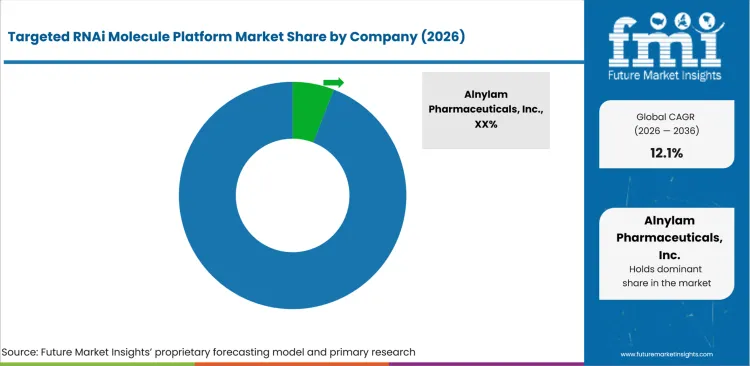
Competition is concentrated around companies with delivery know-how and clinical RNAi assets. Alnylam and Arrowhead provide the clearest commercial references through approved RNAi medicines. Silence Therapeutics and Dicerna Pharmaceuticals (Novo Nordisk) add clinical-stage depth across siRNA and metabolic-disease programs. OliX and Sirnaomics add Asia-based platform coverage.
Company assessment is expected to stay tied to the defined platform boundary. A broad drug portfolio is not enough on its own. The strongest companies show delivery clarity, target fit and a credible path from discovery into clinical use.
Competitive Benchmarking: Targeted RNAi Molecule Platform Market
| Company | Commercial Stage | Platform Clarity | Therapeutic Fit | Clinical Depth | Market Relevance |
|---|---|---|---|---|---|
| Alnylam Pharmaceuticals, Inc. | High | High | High | High | Commercial RNAi provider |
| Arrowhead Pharmaceuticals, Inc. | High | High | High | High | Targeted RNAi platform provider |
| Silence Therapeutics plc | Medium | High | Medium | Medium | Clinical-stage siRNA developer |
| Dicerna Pharmaceuticals (Novo Nordisk) | Medium | Medium | High | Medium | Metabolic disease pipeline participant |
| OliX Pharmaceuticals, Inc. | Medium | Medium | Medium | Medium | Asymmetric siRNA platform developer |
| Sirnaomics Ltd. | Medium | Medium | Medium | Medium | RNAi delivery platform developer |
Scoring basis: High indicates documented capability within RNAi delivery or direct clinical platform use. Medium indicates relevant activity through a pipeline program or collaboration. Low indicates limited direct evidence within targeted RNAi platforms.
Key Developments in the Targeted RNAi Molecule Platform Market
- In March 2025, Alnylam announced USA FDA approval of AMVUTTRA for ATTR-CM. The approval broadened the commercial RNAi reference base for cardiomyopathy care.
- In November 2025, Arrowhead announced FDA approval of REDEMPLO for adults with FCS. The medicine uses the company's Targeted RNAi Molecule platform.
Key Players in the Targeted RNAi Molecule Platform Market
Commercial RNAi Providers
- Alnylam Pharmaceuticals, Inc.
- Arrowhead Pharmaceuticals, Inc.
Clinical and Large-Pharma RNAi Participants
- Silence Therapeutics plc
- Dicerna Pharmaceuticals (Novo Nordisk)
Asia-Based Platform Developers
- OliX Pharmaceuticals, Inc.
- Sirnaomics Ltd.
Targeted RNAi Molecule Platform Market - Report Scope
| Coverage field | Report scope |
|---|---|
| Market breakdown | Platform technology; target type; application; end user; region. |
| Quantitative Units | Revenue in USD Million, CAGR in %. |
| Market Definition | Platform technologies and development workflows used to design and deliver targeted RNAi molecules through validation and commercialization. |
| Regions Covered | North America; Latin America; Europe; East Asia; South Asia & Pacific; Oceania; Middle East and Africa. |
| Countries Covered | USA; Germany; South Korea; UK; Japan; 30+ countries in the full report. |
| Key Companies Profiled | Alnylam Pharmaceuticals, Inc., Arrowhead Pharmaceuticals, Inc., Silence Therapeutics plc, Dicerna Pharmaceuticals (Novo Nordisk), OliX Pharmaceuticals, Inc., and Sirnaomics Ltd. |
| Forecast Period | 2026 to 2036. |
| Approach | Hybrid bottom-up and top-down market sizing supported by primary interviews and official desk research. |
Targeted RNAi Molecule Platform Market - Research Methodology
| Method | Approach |
|---|---|
| Primary Research | FMI analysts gathered input from manufacturers, service providers, technology developers, distributors, end users, procurement teams, and subject-matter experts. Interviews examined purchasing decisions, product or service evaluation, adoption barriers, approval requirements, pricing considerations, and expectations for technical or commercial support. Respondents were also asked what evidence is required before a trial, pilot, or initial order develops into regular purchasing. |
| Desk Research | Desk research covered government statistics, regulatory publications, trade data, industry associations, technical literature, standards, company filings, product information, and official corporate announcements. Sources were reviewed for relevance, publication date, geographic coverage, and consistency with the defined market scope. Claims relating to performance, applications, approvals, capacity, investment, and commercial activity were retained only when supported by credible public evidence. |
| Market Sizing and Forecasting | The market model combined the baseline value with historical performance, segment structure, pricing and volume indicators, adoption levels, company participation, and country-level demand conditions. Forecast assumptions considered economic activity, investment trends, regulatory developments, technology adoption, purchasing cycles, supply availability, and barriers to wider market use. Segment and regional estimates were reconciled before the final market total was calculated. |
| Data Validation | Estimates were checked against multiple independent indicators, including public data, company activity, trade patterns, industry developments, and findings from primary interviews. Validation also tested whether products, services, applications, and company revenues fell within the defined market boundaries. Adjacent categories, unsupported claims, overlapping revenues, and activities without direct market relevance were excluded to reduce double counting and maintain consistency across segments and countries. |
Targeted RNAi Molecule Platform Market by Segments
Targeted RNAi Molecule Platform Market segmented by Platform Technology:
- GalNAc-Conjugated siRNA
- Lipid Nanoparticle RNAi
- Ligand-Conjugated RNAi
- Peptide-Conjugated RNAi
- Polymer-Based RNAi Delivery
Targeted RNAi Molecule Platform Market segmented by Target Type:
- Hepatic Targets
- Cardiometabolic Targets
- Oncology Targets
- Rare-Disease Targets
- CNS Targets
Targeted RNAi Molecule Platform Market segmented by Application:
- Cardiometabolic Diseases
- Oncology
- Rare Genetic Disorders
- Infectious Diseases
- Neurological Disorders
Targeted RNAi Molecule Platform Market segmented by End User:
- Biopharmaceutical Companies
- Contract Research Organizations
- Academic and Research Institutes
- Hospitals
Targeted RNAi Molecule Platform Market by Region:
- North America
- United States
- Canada
- Latin America
- Brazil
- Mexico
- Argentina
- Chile
- Western Europe
- Germany
- France
- United Kingdom
- Italy
- Spain
- Benelux
- Nordics
- Eastern Europe
- Poland
- Czech Republic
- Romania
- Hungary
- East Asia
- China
- Japan
- South Korea
- South Asia & Pacific
- India
- ASEAN
- Australia and New Zealand
- Middle East and Africa
- GCC Countries
- South Africa
- Türkiye
- Israel
Research Sources and Bibliography
- Alnylam Pharmaceuticals, Inc. (2025, March 20). Alnylam announces FDA approval of AMVUTTRA® for ATTR amyloidosis with cardiomyopathy.
- Arrowhead Pharmaceuticals, Inc. (2025, November 18). Arrowhead Pharmaceuticals announces FDA approval of REDEMPLO® (plozasiran) to reduce triglycerides in adults with familial chylomicronemia syndrome (FCS).
- Office for Life Sciences. (2026, March 19). Life sciences competitiveness indicators 2026.
- Paul-Ehrlich-Institut. (2026, January 15). Medical Research Act.
- Ministry of Food and Drug Safety. (2025, September). Biopharmaceutical pre-GMP evaluation guideline.
This bibliography is provided for reader reference and is not exhaustive. The full report contains the complete reference list and detailed citations.
This Report Answers
- How large is the targeted RNAi molecule platform market in 2026 and 2036?
- Which delivery and approval signals support targeted RNAi platform demand?
- Why does GalNAc-Conjugated siRNA hold the leading Platform Technology share in 2026?
- How do Hepatic Targets influence platform selection?
- Why do Cardiometabolic Diseases lead the Application category?
- How do country growth rates differ across USA and Germany with South Korea, UK and Japan?
- Which companies provide commercial or clinical RNAi platform evidence?
- What limits expansion beyond liver-targeted programs?
- What supports long-term confidence in targeted RNAi platforms through 2036?
Frequently Asked Questions
How big is the Targeted RNAi Molecule Platform Market in 2026?
The targeted RNAi molecule platform market is valued at USD 2.0 billion in 2026 and is forecast to reach USD 6.2 billion by 2036, reflecting growing demand from drug developers seeking liver-targeted gene silencing platforms with validated delivery chemistry, convenient dosing schedules, and manufacturing readiness for late-stage clinical programs.
What is the CAGR of the Targeted RNAi Molecule Platform Market from 2026 to 2036?
The targeted RNAi molecule platform market is projected to grow at a CAGR of 12.1% between 2026 and 2036, supported by commercial RNAi approvals that raise developer confidence in durable gene knockdown and expanding cardiometabolic programs with measurable lipid and lipoprotein endpoints.
Which application leads the Targeted RNAi Molecule Platform Market?
Cardiometabolic diseases account for 30.4% of the targeted RNAi molecule platform market by application in 2026, driven by high global patient prevalence, clearly defined lipid and lipoprotein endpoints, and extended dosing intervals that differentiate RNAi therapies from conventional daily treatment approaches.
Which country is growing fastest in the Targeted RNAi Molecule Platform Market?
The targeted RNAi molecule platform market in the USA is projected to expand at a CAGR of 13.9% through 2036, ahead of Germany at 12.9%, South Korea at 12.2%, the UK at 10.1%, and Japan at 9.6%, reflecting one of the world's most advanced RNA therapeutics ecosystems with extensive clinical research networks and strong biotechnology investment.
Who are the leading companies in the Targeted RNAi Molecule Platform Market?
Leading companies in the targeted RNAi molecule platform market include Alnylam Pharmaceuticals Inc., Arrowhead Pharmaceuticals Inc., Silence Therapeutics plc, Dicerna Pharmaceuticals through Novo Nordisk, OliX Pharmaceuticals Inc., and Sirnaomics Ltd., spanning commercial RNAi providers with approved medicines, clinical-stage siRNA developers, and Asia-based platform developers across hepatic and metabolic disease programs.
Preview the report firsthand - request a free sample
Get SampleGet the brochure for pricing and purchase details.
Get PDFTable of Content
- Key Takeaways
- Market Size and CAGR
- Top Growth Driver
- Fastest Growing Segment
- Leading Region
- Key Companies
- Emerging Opportunities
- Executive Summary
- Global Market Outlook
- Demand-side Trends
- Supply-side Trends
- Technology Roadmap Analysis
- Analysis and Recommendations
- Analyst Perspective (What is happening? Why now? What should investors know?)
- Key Questions Answered
- How large is the market?
- What is the CAGR?
- What are key trends?
- Which region dominates?
- Who are the leaders?
- Market Overview
- Market Coverage / Taxonomy
- Market Definition / Scope / Limitations
- Research Methodology
- Chapter Orientation
- Analytical Lens and Working Hypotheses
- Market Structure, Signals, and Trend Drivers
- Benchmarking and Cross-market Comparability
- Market Sizing, Forecasting, and Opportunity Mapping
- Research Design and Evidence Framework
- Desk Research Programme (Secondary Evidence)
- Expert Input and Fieldwork (Primary Evidence)
- Tooling, Models, and Reference Databases
- Data Engineering and Model Build
- Quality Assurance and Audit Trail
- Market Background
- Market Dynamics (Drivers, Restraints, Opportunity, Trends)
- Scenario Forecast (Optimistic, Likely, Conservative)
- Impact Analysis
- AI Impact
- Sustainability Impact
- Regulatory Impact
- Technology Impact
- Consumer / Buyer Analysis
- Purchase Drivers
- Adoption Barriers
- Buyer Journey
- Opportunity Map Analysis
- Product Life Cycle Analysis
- Supply Chain Analysis
- Investment Feasibility Matrix
- Value Chain Analysis
- PESTLE and Porter's Analysis
- Regulatory Landscape
- Regional Parent Market Outlook
- Production and Consumption Statistics
- Import and Export Statistics
- Global Market Analysis and Forecast, 2021 to 2036
- Historical Market Size Value (USD Billion) Analysis, 2021 to 2025
- Current and Future Market Size Value (USD Billion) Projections, 2026 to 2036
- Y-o-Y Growth Trend Analysis
- Absolute $ Opportunity Analysis
- Global Market Pricing Analysis, 2021 to 2036
- Global Market Analysis and Forecast, By Platform Technology, 2021 to 2036
- Introduction / Key Findings
- Historical Market Size Value (USD Billion) Analysis By Platform Technology, 2021 to 2025
- Current and Future Market Size Value (USD Billion) Analysis and Forecast By Platform Technology, 2026 to 2036
- GalNAc-Conjugated siRNA
- Lipid Nanoparticle (LNP)
- Ligand-Conjugated RNAi
- Peptide-Conjugated RNAi
- Polymer-Based Delivery
- GalNAc-Conjugated siRNA
- Y-o-Y Growth Trend Analysis By Platform Technology, 2021 to 2025
- Absolute $ Opportunity Analysis By Platform Technology, 2026 to 2036
- Global Market Analysis and Forecast, By Target Type, 2021 to 2036
- Introduction / Key Findings
- Historical Market Size Value (USD Billion) Analysis By Target Type, 2021 to 2025
- Current and Future Market Size Value (USD Billion) Analysis and Forecast By Target Type, 2026 to 2036
- Hepatic Targets
- Cardiometabolic Targets
- Oncology Targets
- Rare Disease Targets
- CNS Targets
- Hepatic Targets
- Y-o-Y Growth Trend Analysis By Target Type, 2021 to 2025
- Absolute $ Opportunity Analysis By Target Type, 2026 to 2036
- Global Market Analysis and Forecast, By Application, 2021 to 2036
- Introduction / Key Findings
- Historical Market Size Value (USD Billion) Analysis By Application, 2021 to 2025
- Current and Future Market Size Value (USD Billion) Analysis and Forecast By Application, 2026 to 2036
- Cardiometabolic Diseases
- Rare Genetic Disorders
- Oncology
- Infectious Diseases
- Neurological Disorders
- Cardiometabolic Diseases
- Y-o-Y Growth Trend Analysis By Application, 2021 to 2025
- Absolute $ Opportunity Analysis By Application, 2026 to 2036
- Global Market Analysis and Forecast, By End User, 2021 to 2036
- Introduction / Key Findings
- Historical Market Size Value (USD Billion) Analysis By End User, 2021 to 2025
- Current and Future Market Size Value (USD Billion) Analysis and Forecast By End User, 2026 to 2036
- Biopharmaceutical Companies
- Contract Research Organizations (CROs)
- Academic & Research Institutes
- Hospitals
- Biopharmaceutical Companies
- Y-o-Y Growth Trend Analysis By End User, 2021 to 2025
- Absolute $ Opportunity Analysis By End User, 2026 to 2036
- Global Market Analysis and Forecast, By Region, 2021 to 2036
- Introduction
- Historical Market Size Value (USD Billion) Analysis By Region, 2021 to 2025
- Current Market Size Value (USD Billion) Analysis and Forecast By Region, 2026 to 2036
- North America
- Latin America
- Western Europe
- Eastern Europe
- East Asia
- South Asia and Pacific
- Middle East & Africa
- Market Attractiveness Analysis By Region
- North America Market Analysis and Forecast, By Country, 2021 to 2036
- Historical Market Size Value (USD Billion) Trend Analysis By Market Taxonomy, 2021 to 2025
- Market Size Value (USD Billion) Forecast By Market Taxonomy, 2026 to 2036
- By Country
- USA
- Canada
- By Platform Technology
- By Target Type
- By Application
- By End User
- By Country
- Market Attractiveness Analysis
- By Country
- By Platform Technology
- By Target Type
- By Application
- By End User
- Key Takeaways
- Latin America Market Analysis and Forecast, By Country
- Historical Market Size Value (USD Billion) Trend Analysis By Market Taxonomy, 2021 to 2025
- Market Size Value (USD Billion) Forecast By Market Taxonomy, 2026 to 2036
- By Country
- Brazil
- Mexico
- Chile
- Rest of Latin America
- By Platform Technology
- By Target Type
- By Application
- By End User
- By Country
- Market Attractiveness Analysis
- By Country
- By Platform Technology
- By Target Type
- By Application
- By End User
- Key Takeaways
- Western Europe Market Analysis and Forecast, By Country
- Historical Market Size Value (USD Billion) Trend Analysis By Market Taxonomy, 2021 to 2025
- Market Size Value (USD Billion) Forecast By Market Taxonomy, 2026 to 2036
- By Country
- Germany
- UK
- Italy
- Spain
- France
- Nordic
- BENELUX
- Rest of Western Europe
- By Platform Technology
- By Target Type
- By Application
- By End User
- By Country
- Market Attractiveness Analysis
- By Country
- By Platform Technology
- By Target Type
- By Application
- By End User
- Key Takeaways
- Eastern Europe Market Analysis and Forecast, By Country
- Historical Market Size Value (USD Billion) Trend Analysis By Market Taxonomy, 2021 to 2025
- Market Size Value (USD Billion) Forecast By Market Taxonomy, 2026 to 2036
- By Country
- Russia
- Poland
- Hungary
- Balkan & Baltic
- Rest of Eastern Europe
- By Platform Technology
- By Target Type
- By Application
- By End User
- By Country
- Market Attractiveness Analysis
- By Country
- By Platform Technology
- By Target Type
- By Application
- By End User
- Key Takeaways
- East Asia Market Analysis and Forecast, By Country
- Historical Market Size Value (USD Billion) Trend Analysis By Market Taxonomy, 2021 to 2025
- Market Size Value (USD Billion) Forecast By Market Taxonomy, 2026 to 2036
- By Country
- China
- Japan
- South Korea
- By Platform Technology
- By Target Type
- By Application
- By End User
- By Country
- Market Attractiveness Analysis
- By Country
- By Platform Technology
- By Target Type
- By Application
- By End User
- Key Takeaways
- South Asia and Pacific Market Analysis and Forecast, By Country
- Historical Market Size Value (USD Billion) Trend Analysis By Market Taxonomy, 2021 to 2025
- Market Size Value (USD Billion) Forecast By Market Taxonomy, 2026 to 2036
- By Country
- India
- ASEAN
- Australia & New Zealand
- Rest of South Asia and Pacific
- By Platform Technology
- By Target Type
- By Application
- By End User
- By Country
- Market Attractiveness Analysis
- By Country
- By Platform Technology
- By Target Type
- By Application
- By End User
- Key Takeaways
- Middle East & Africa Market Analysis and Forecast, By Country
- Historical Market Size Value (USD Billion) Trend Analysis By Market Taxonomy, 2021 to 2025
- Market Size Value (USD Billion) Forecast By Market Taxonomy, 2026 to 2036
- By Country
- Kingdom of Saudi Arabia
- Other GCC Countries
- Türkiye
- South Africa
- Other African Union
- Rest of Middle East & Africa
- By Platform Technology
- By Target Type
- By Application
- By End User
- By Country
- Market Attractiveness Analysis
- By Country
- By Platform Technology
- By Target Type
- By Application
- By End User
- Key Takeaways
- Key Countries Market Analysis
- USA
- Pricing Analysis
- Market Share Analysis, 2025
- By Platform Technology
- By Target Type
- By Application
- By End User
- Canada
- Pricing Analysis
- Market Share Analysis, 2025
- By Platform Technology
- By Target Type
- By Application
- By End User
- Mexico
- Pricing Analysis
- Market Share Analysis, 2025
- By Platform Technology
- By Target Type
- By Application
- By End User
- Brazil
- Pricing Analysis
- Market Share Analysis, 2025
- By Platform Technology
- By Target Type
- By Application
- By End User
- Chile
- Pricing Analysis
- Market Share Analysis, 2025
- By Platform Technology
- By Target Type
- By Application
- By End User
- Germany
- Pricing Analysis
- Market Share Analysis, 2025
- By Platform Technology
- By Target Type
- By Application
- By End User
- UK
- Pricing Analysis
- Market Share Analysis, 2025
- By Platform Technology
- By Target Type
- By Application
- By End User
- Italy
- Pricing Analysis
- Market Share Analysis, 2025
- By Platform Technology
- By Target Type
- By Application
- By End User
- Spain
- Pricing Analysis
- Market Share Analysis, 2025
- By Platform Technology
- By Target Type
- By Application
- By End User
- France
- Pricing Analysis
- Market Share Analysis, 2025
- By Platform Technology
- By Target Type
- By Application
- By End User
- India
- Pricing Analysis
- Market Share Analysis, 2025
- By Platform Technology
- By Target Type
- By Application
- By End User
- ASEAN
- Pricing Analysis
- Market Share Analysis, 2025
- By Platform Technology
- By Target Type
- By Application
- By End User
- Australia & New Zealand
- Pricing Analysis
- Market Share Analysis, 2025
- By Platform Technology
- By Target Type
- By Application
- By End User
- China
- Pricing Analysis
- Market Share Analysis, 2025
- By Platform Technology
- By Target Type
- By Application
- By End User
- Japan
- Pricing Analysis
- Market Share Analysis, 2025
- By Platform Technology
- By Target Type
- By Application
- By End User
- South Korea
- Pricing Analysis
- Market Share Analysis, 2025
- By Platform Technology
- By Target Type
- By Application
- By End User
- Russia
- Pricing Analysis
- Market Share Analysis, 2025
- By Platform Technology
- By Target Type
- By Application
- By End User
- Poland
- Pricing Analysis
- Market Share Analysis, 2025
- By Platform Technology
- By Target Type
- By Application
- By End User
- Hungary
- Pricing Analysis
- Market Share Analysis, 2025
- By Platform Technology
- By Target Type
- By Application
- By End User
- Kingdom of Saudi Arabia
- Pricing Analysis
- Market Share Analysis, 2025
- By Platform Technology
- By Target Type
- By Application
- By End User
- Türkiye
- Pricing Analysis
- Market Share Analysis, 2025
- By Platform Technology
- By Target Type
- By Application
- By End User
- South Africa
- Pricing Analysis
- Market Share Analysis, 2025
- By Platform Technology
- By Target Type
- By Application
- By End User
- USA
- Market Structure Analysis
- Competition Dashboard
- Competition Benchmarking
- Market Share Analysis of Top Players
- By Regional
- By Platform Technology
- By Target Type
- By Application
- By End User
- Emerging Startups
- Innovation Benchmarking
- Competition Analysis
- Competition Deep Dive
- Alnylam Pharmaceuticals, Inc.
- Overview
- Product Portfolio
- Profitability by Market Segments
- Sales Footprint
- Strategy Overview
- Marketing Strategy
- Product Strategy
- Channel Strategy
- Arrowhead Pharmaceuticals, Inc.
- Silence Therapeutics plc
- Novo Nordisk A/S
- Eli Lilly and Company
- Roche Holding AG
- AstraZeneca PLC
- OliX Pharmaceuticals, Inc.
- Sirnaomics Ltd.
- Arrowhead Research Corporation
- Alnylam Pharmaceuticals, Inc.
- Case Studies
- Success Stories
- Recent Developments
- Competition Deep Dive
- Assumptions & Acronyms Used


