

- Industry Size (2026)
- USD 32.09 Bn
- Forecast (2036)
- USD v
- CAGR (2026 to 2036)
- 18.4%
Telepsychiatry Market Size, Market Forecast and Outlook By FMI
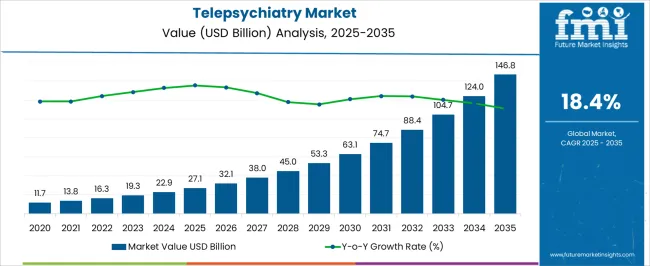
The telepsychiatry market was valued at USD 27.17 billion in 2025, projected to reach USD 32.09 billion in 2026, and is forecast to expand to USD 173.72 billion by 2036 at an 18.4% CAGR. Permanent telehealth reimbursement legislation enacted in the USA, EU member states, and major Asia Pacific economies has converted telepsychiatry from an emergency-period accommodation into a covered benefit with defined clinical pathways, enabling health system procurement teams to invest in purpose-built platform infrastructure rather than extending temporary general-purpose video solutions.
The global shortage of psychiatrists, estimated by the World Health Organization at fewer than one specialist per 100,000 population in most low- and middle-income countries, is making telepsychiatry the only viable mechanism for extending specialist access to non-metropolitan populations.
Summary of Telepsychiatry Market
- Market Snapshot
- The market is valued at USD 27.17 Billion in 2025 and is projected to reach USD 173.72 Billion by 2036.
- The industry is expected to grow at a 18.4% CAGR from 2026 to 2036, creating an incremental opportunity of USD 141.63 Billion.
- This is a high-growth, technology-driven market where regulatory alignment and platform certification define competitive positioning for long-term contract capture.
- Demand and Growth Drivers
- Regulatory mandates and compliance frameworks in key end-use sectors are converting discretionary adoption into structured procurement obligations across the telepsychiatry value chain.
- Technology advancement in platform integration, data connectivity, and certified system performance is broadening addressable applications and increasing per-deployment contract values.
- Government-backed infrastructure and digital transformation programmes are generating funded procurement pipelines that provide multi-year revenue visibility for established market participants.
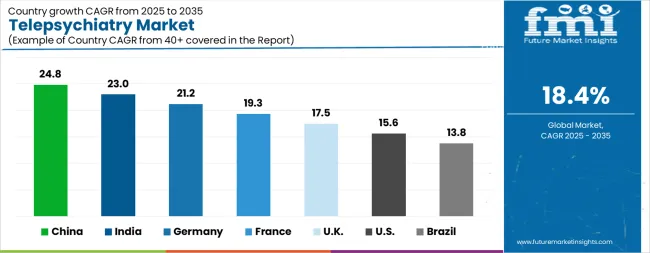
- Among key countries, China leads at 24.8% CAGR, followed by India at 23.0%, Germany at 21.2%, and France at 19.3%.
- Product and Segment View
- The market includes In-Home Solutions, Forensic Solutions, Routine Solutions, Crisis Solutions, Others as core product categories.
- Age Group sub-segments include Adult, Pediatric and Adolescent, Geriatric.
- In-Home Solutions leads by product with 26.4% share in 2026.
- Adult leads by age group with 44.7% share in 2026.
- The scope includes certified and integrated platform configurations while excluding general-purpose systems without specialised functional capabilities specific to this market.
- Geography and Competitive Outlook
- China and India represent the fastest-growing markets, supported by government investment programmes and regulatory mandates driving accelerated adoption.
- North America and Europe represent established procurement markets where upgrade cycles and compliance-driven replacement purchasing sustain consistent demand volumes.
- Competition is shaped by regulatory certification credentials, platform integration breadth, and service network depth, with leading positions held by vendors who have secured multi-year institutional supply agreements.
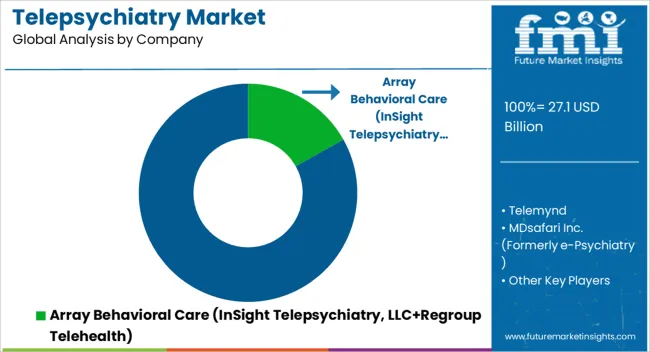
- Key companies include Array Behavioral Care, Telemynd, MDsafari Inc., Advanced Telemed Services, American Telepsychiatrists, Iris Telehealth Inc..
Telepsychiatry Market Key Takeaways
| Metric | Details |
|---|---|
| Industry Size (2026) | USD 32.09 Billion |
| Industry Value (2036) | USD 173.72 Billion |
| CAGR (2026-2036) | 18.4% |
| Source | Future Market Insights, 2026 |
Source: Future Market Insights, 2026
The incremental revenue opportunity of USD 141.63 billion over the forecast period reflects the convergence of three structural forces: parity legislation requiring mental health benefits to match physical health coverage in insurance frameworks, school and employer-based mental health programme mandates expanding the non-clinical care access point network, and AI-assisted psychiatric assessment tools enabling community health workers to conduct preliminary evaluations that reduce specialist consultation time per patient episode. Platforms that achieve integration with electronic health record systems and demonstrate outcome measurement capability aligned with HEDIS and similar quality reporting standards are winning multi-year health system contracts that command significantly higher average revenue per user than consumer direct subscription models.
China leads at a 24.8% CAGR through 2036, driven by the National Mental Health Work Plan's mandate to integrate psychiatric teleconsultation into the tiered diagnosis and treatment system across all county-level hospitals and urban community health stations. India advances at 23.0%, supported by the National Tele Mental Health Programme operating 53 NIMHANS-anchored telepsychiatry hubs providing free consultation to citizens through the iCall and Vandrevala Foundation service networks. Germany registers 21.2% growth driven by DiGA-listed digital psychiatric tools available on statutory insurer prescription and reimbursed under the Social Health Insurance system. France at 19.3%, the UK at 17.5%, the USA at 15.6%, and Brazil at 13.8% each demonstrate established reimbursement infrastructure supporting accelerating platform adoption through the forecast horizon.
Telepsychiatry Market Definition
The telepsychiatry market encompasses digital platforms, video consultation systems, and AI-assisted mental health assessment tools that enable licensed psychiatrists and mental health professionals to deliver diagnosis, therapy, medication management, crisis intervention, and forensic evaluation services remotely to patients in home, community, and institutional settings. The market covers synchronous real-time video consultations, asynchronous store-and-forward case review, crisis intervention platforms, and specialist-to-specialist consultation services serving all age groups across community mental health, clinical, and homecare delivery environments.
Telepsychiatry Market Inclusions
The scope covers global and regional revenue from telepsychiatry platform software licences, psychiatric consultation service subscriptions, crisis intervention platform deployments, digital therapy tool licences, and implementation service contracts across all product categories, age groups, and end-use settings. Forecast includes in-home solutions, routine and forensic consultation platforms, and crisis telepsychiatry systems serving community mental health centres, hospitals, skilled nursing facilities, and homecare networks through 2036.
Telepsychiatry Market Exclusions
The scope excludes general telemedicine platforms that offer incidental mental health consultation without dedicated psychiatric workflow functionality, consumer wellness applications and meditation tools without licensed psychiatric oversight, general behavioural therapy mobile applications not connected to licensed professional consultation, and in-patient psychiatric facility revenues not attributable to telepsychiatry delivery modalities.
Telepsychiatry Market Research Methodology
- Primary Research: Analysts engaged with procurement leads, operations directors, and technical specialists across the telepsychiatry value chain to identify adoption drivers, specification requirements, and contract structures that govern purchasing decisions.
- Desk Research: Data collection phases aggregated regulatory filings, government programme announcements, standards body publications, company investor presentations, and trade association reports to establish the policy and commercial context framing demand trajectories.
- Market-Sizing and Forecasting: Baseline values derive from a bottom-up aggregation of segment-level deployment volumes calibrated against publicly disclosed procurement data, with region-specific adoption velocity curves applied to project demand through 2036.
- Data Validation and Update Cycle: Projections are cross-validated against quarterly publicly reported revenue guidance from leading market participants and retested against regulatory calendar milestones that structurally alter adoption timelines within each geographic segment.
Why is the Telepsychiatry Market Growing?
The Telepsychiatry market is experiencing significant growth, driven by increasing demand for remote mental healthcare services and improved access to psychiatric care. Rising prevalence of mental health disorders, particularly anxiety, depression, and stress-related conditions, has amplified the need for scalable and accessible solutions. Telepsychiatry offers real-time consultations, remote monitoring, and continuity of care, addressing challenges related to geographical barriers and clinician shortages.
Adoption is further supported by advancements in secure video conferencing platforms, AI-enabled patient monitoring, and electronic health record integration. Increasing awareness among patients and healthcare providers regarding the effectiveness and convenience of remote psychiatric care is fueling market expansion. Government initiatives, reimbursement policies, and digital health infrastructure investments are also supporting adoption in both developed and emerging markets.
As organizations and healthcare systems prioritize mental health accessibility, Telepsychiatry is expected to maintain strong growth The integration of digital tools with personalized care approaches is enhancing patient engagement and outcomes, positioning the market for sustained expansion over the coming decade.
Segmental Analysis
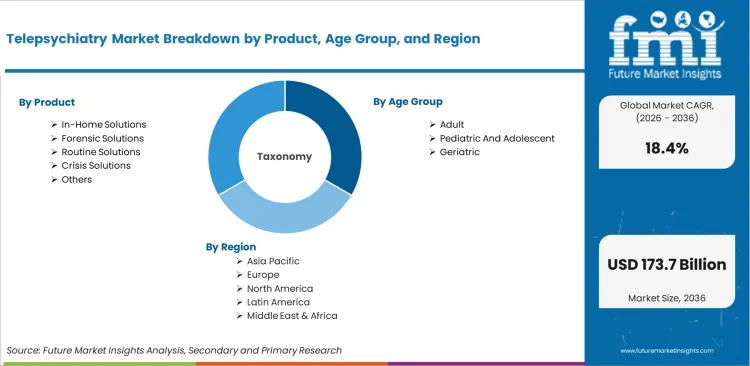
The telepsychiatry market is segmented by product, age group, end use, and geographic regions. By product, telepsychiatry market is divided into In-Home Solutions, Forensic Solutions, Routine Solutions, Crisis Solutions, and Others. In terms of age group, telepsychiatry market is classified into Adult, Pediatric And Adolescent, and Geriatric. Based on end use, telepsychiatry market is segmented into Community Mental Health Centers, Specialty Care Settings, Skilled Nursing Facilities, Homecare, and Others. Regionally, the telepsychiatry industry is classified into North America, Latin America, Western Europe, Eastern Europe, Balkan & Baltic Countries, Russia & Belarus, Central Asia, East Asia, South Asia & Pacific, and the Middle East & Africa.
Insights into the In-Home Solutions Product Segment
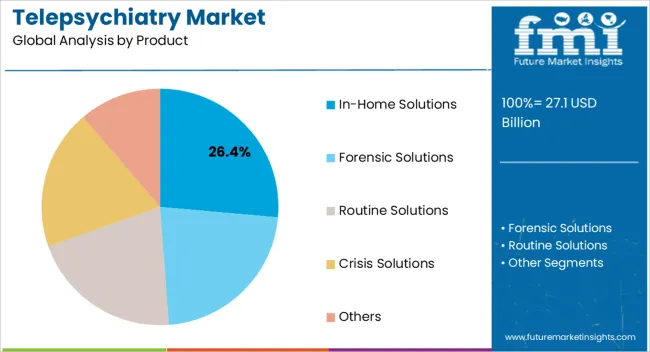
The in-home solutions product segment is projected to hold 26.4% of the market revenue in 2026, establishing it as the leading product type. Its growth is being driven by the increasing demand for convenient and personalized mental healthcare services delivered directly to patients’ residences. These solutions allow individuals to access psychiatric consultations without travel, reducing barriers to care and improving adherence to treatment plans.
Secure telehealth platforms, mobile applications, and remote monitoring tools enhance the quality of care and enable continuous interaction between patients and clinicians. Adoption is further supported by technological advancements that ensure privacy, data security, and seamless integration with electronic health records.
The ability to deliver mental health services efficiently while minimizing costs and logistical challenges reinforces market preference for in-home solutions As the demand for patient-centric and accessible psychiatric care rises globally, this segment is expected to maintain its leadership, supported by scalable platforms and growing acceptance among patients and healthcare providers.
Insights into the Adult Age Group Segment
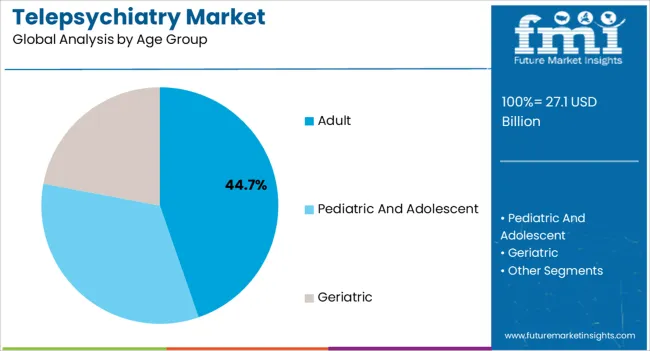
The adult age group segment is anticipated to account for 44.7% of the market revenue in 2026, making it the leading age category. Growth in this segment is driven by the rising incidence of mental health conditions among adults, including depression, anxiety, and stress-related disorders, which require timely intervention and continuous care. Telepsychiatry enables convenient access to psychiatric consultations, therapy sessions, and follow-up appointments, reducing the burden on healthcare facilities and enhancing treatment adherence.
Adults increasingly rely on digital health solutions for flexible scheduling and privacy, which has reinforced adoption. Integration with electronic health records, AI-enabled monitoring, and personalized care plans further enhance the effectiveness of interventions.
Government programs and workplace mental health initiatives are also contributing to the segment’s expansion As mental health awareness grows and demand for accessible, high-quality care increases, the adult age group segment is expected to remain the primary driver of market growth, supported by technological innovation and patient-centric delivery models.
Insights into the Community Mental Health Centers End-Use Segment
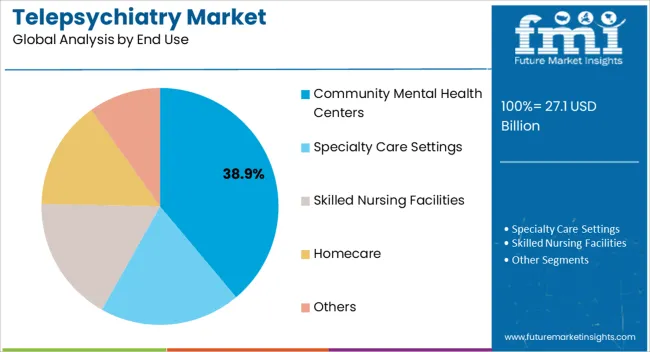
The community mental health centers end-use segment is projected to hold 38.9% of the market revenue in 2026, positioning it as the leading end-use category. Growth is being driven by the increasing reliance on these centers to provide accessible, affordable, and scalable psychiatric care to underserved populations. Telepsychiatry enables centers to extend reach, reduce wait times, and offer continuous care without the constraints of physical infrastructure.
Integration of secure video conferencing, remote monitoring, and electronic health record systems has enhanced operational efficiency and patient management. The ability to provide flexible scheduling, multi-disciplinary care, and personalized interventions further strengthens adoption.
Government funding and policy support for community mental health initiatives are accelerating deployment As the need for accessible mental health services continues to rise, community mental health centers are expected to remain a key growth driver, supported by digital health platforms and the expanding acceptance of telepsychiatry as a standard of care.
Market Overview
Telepsychiatry Market Overview
The arrival of telecommunication technology in the 20th century truly revolutionised a number of fields. National boundaries become irrelevant and the world became one big global village. It also led to the advent of telemedicine which would have been unthinkable fifty years ago.
Telemedicine is taking the help of Information Technology and telecommunication equipment to provide medical diagnoses from a distance. It helps eliminate the barriers of distance and is vital in serving far-flung rural communities with medical care.
One of the main constituents of telemedicine is the telepsychiatry market. At its core, it is about using telecommunications equipment to provide psychiatric assessment and also care. It relies on video conferencing technology to connect psychiatrists to their patients.
Telepsychiatry can be offered through intermediary companies or even individual specialists. The telepsychiatry market has truly come of age in the 21st century and is poised to have a very bright future.
Analysis of Telepsychiatry Market By Key Countries
.webp "Top Country Growth Comparison Telepsychiatry Market Cagr (2026 2036)")
| Country | CAGR |
|---|---|
| China | 24.8% |
| India | 23.0% |
| Germany | 21.2% |
| France | 19.3% |
| UK | 17.5% |
| USA | 15.6% |
| Brazil | 13.8% |
Source: FMI analysis based on primary research and proprietary forecasting model
Country-wise Analysis
The Telepsychiatry Market is expected to register a CAGR of 18.4% during the forecast period, exhibiting varied country level momentum. China leads with the highest CAGR of 24.8%, followed by India at 23.0%. Developed markets such as Germany, France, and the UK continue to expand steadily, while the USA is likely to grow at consistent rates. Brazil posts the lowest CAGR at 13.8%, yet still underscores a broadly positive trajectory for the global Telepsychiatry Market. In 2026, Germany held a dominant revenue in the Western Europe market and is expected to grow with a CAGR of 21.2%. The USA Telepsychiatry Market is estimated to be valued at USD 9.9 billion in 2026 and is anticipated to reach a valuation of USD 42.4 billion by 2036. Sales are projected to rise at a CAGR of 15.6% over the forecast period between 2026 and 2036. While Japan and South Korea markets are estimated to be valued at USD 1.3 billion and USD 924.3 million respectively in 2026.
Key Players in the Telepsychiatry Market
- Array Behavioral Care (InSight Telepsychiatry, LLC+Regroup Telehealth)
- Telemynd
- MDsafari Inc. (Formerly e-Psychiatry )
- Advanced Telemed Services
- American Telepsychiatrists
- Iris Telehealth Inc.
- MDLIVE (Evernorth Company)
- innovaTel
- Access TeleCare, LLC (Formerly SOC Telemed)
- Encounter Telehealth
Scope of the Report
| Metric | Value |
|---|---|
| Quantitative Units | USD 32.09 Billion to USD 173.72 Billion, at a CAGR of 18.4% |
| Market Definition | The telepsychiatry market encompasses digital platforms, video consultation systems, and AI-assisted mental health assessment tools that enable licensed psychiatrists and mental health professionals to deliver diagnosis,... |
| Product Segmentation | In-Home Solutions, Forensic Solutions, Routine Solutions, Crisis Solutions, Others |
| Age Group Segmentation | Adult, Pediatric and Adolescent, Geriatric |
| Regions Covered | North America, Latin America, Europe, East Asia, South Asia, Oceania, Middle East and Africa |
| Countries Covered | India, China, USA, Germany, France, UK, Japan, Brazil, and 40 plus countries |
| Key Companies Profiled | Array Behavioral Care, Telemynd, MDsafari Inc., Advanced Telemed Services, American Telepsychiatrists, Iris Telehealth Inc., MDLIVE (Evernorth Company), innovaTel |
| Forecast Period | 2026 to 2036 |
| Approach | Bottom-up methodology applied to segment-level deployment data, cross-validated against publicly reported operator and manufacturer revenue disclosures |
Telepsychiatry Market by Segments
Product:
- In-Home Solutions
- Forensic Solutions
- Routine Solutions
- Crisis Solutions
- Others
Age Group:
- Adult
- Pediatric And Adolescent
- Geriatric
End Use:
- Community Mental Health Centers
- Specialty Care Settings
- Skilled Nursing Facilities
- Homecare
- Others
Region:
- North America
- USA
- Canada
- Mexico
- Latin America
- Brazil
- Chile
- Rest of Latin America
- Western Europe
- Germany
- UK
- Italy
- Spain
- France
- Nordic
- BENELUX
- Rest of Western Europe
- Eastern Europe
- Russia
- Poland
- Hungary
- Balkan & Baltic
- Rest of Eastern Europe
- East Asia
- China
- Japan
- South Korea
- South Asia and Pacific
- India
- ASEAN
- Australia & New Zealand
- Rest of South Asia and Pacific
- Middle East & Africa
- Kingdom of Saudi Arabia
- Other GCC Countries
- Turkiye
- South Africa
- Other African Union
- Rest of Middle East & Africa
Bibliography
- World Health Organization. (2025, June). Mental health atlas 2023: Global psychiatric workforce and service capacity data. WHO. https://www.who.int/publications/i/item/9789240084063
- Centers for Medicare and Medicaid Services. (2025, November). Mental health telehealth reimbursement: Final rule update for Medicare coverage. CMS. https://www.cms.gov/medicare/coverage/telehealth
- National Health Service England. (2025, August). NHS talking therapies annual report 2023-24: Digital access metrics. NHS England. https://www.england.nhs.uk/mental-health
- Ministry of Health and Family Welfare, Government of India. (2025, March). National tele mental health programme: Operational report 2023-24. MoHFW. https://nhm.gov.in
- Bundesinstitut fuer Arzneimittel und Medizinprodukte. (2025, October). DiGA directory 2025: Digital mental health applications and reimbursement status. BfArM. https://diga.bfarm.de
- National Institute of Mental Health and Neurosciences. (2025, May). Tele-mental health in India: Coverage, outcomes, and scale-up report. NIMHANS. https://nimhans.ac.in
This bibliography is provided for reader reference. The full Future Market Insights report contains the complete reference list with primary research documentation.
Frequently Asked Questions
How large is the Telepsychiatry Market in 2026?
The telepsychiatry is estimated to be valued at USD 32.09 Billion in 2026.
What will the Telepsychiatry Market size be by 2036?
The market is projected to reach USD 173.72 Billion by 2036.
What is the expected CAGR for the Telepsychiatry Market between 2026 and 2036?
The market is expected to grow at a CAGR of 18.4% between 2026 and 2036.
Which product segment leads the Telepsychiatry Market?
In-Home Solutions accounts for 26.4% in 2026 and leads the market due to its broad deployment across primary end-use applications.
Which country is projected to record the fastest growth?
China leads with a 24.8% CAGR through 2036, driven by National Mental Health Work Plan mandating digital psychiatric service integration in county-level hospitals and community mental health stations.
What is driving demand in India?
India is advancing at 23.0% CAGR, supported by National Mental Health Programme expansion through iCall and NIMHANS telepsychiatry nodes under National Tele Mental Health Programme.
Who are the key players in the Telepsychiatry Market?
Key companies include Array Behavioral Care, Telemynd, MDsafari Inc., Advanced Telemed Services, American Telepsychiatrists, and others detailed in the competitive landscape section.
What is the incremental opportunity in the Telepsychiatry Market through 2036?
FMI analysts project an incremental market opportunity of USD 141.63 Billion over the 2026 to 2036 forecast period.
Preview the report firsthand - request a free sample
Get SampleGet the brochure for pricing and purchase details.
Get PDFTable of Content
- Executive Summary
- Global Market Outlook
- Demand-side Trends
- Supply-side Trends
- Technology Roadmap Analysis
- Analysis and Recommendations
- Market Overview
- Market Coverage / Taxonomy
- Market Definition / Scope / Limitations
- Research Methodology
- Chapter Orientation
- Analytical Lens and Working Hypotheses
- Market Structure, Signals, and Trend Drivers
- Benchmarking and Cross-market Comparability
- Market Sizing, Forecasting, and Opportunity Mapping
- Research Design and Evidence Framework
- Desk Research Programme (Secondary Evidence)
- Company Annual and Sustainability Reports
- Peer-reviewed Journals and Academic Literature
- Corporate Websites, Product Literature, and Technical Notes
- Earnings Decks and Investor Briefings
- Statutory Filings and Regulatory Disclosures
- Technical White Papers and Standards Notes
- Trade Journals, Industry Magazines, and Analyst Briefs
- Conference Proceedings, Webinars, and Seminar Materials
- Government Statistics Portals and Public Data Releases
- Press Releases and Reputable Media Coverage
- Specialist Newsletters and Curated Briefings
- Sector Databases and Reference Repositories
- FMI Internal Proprietary Databases and Historical Market Datasets
- Subscription Datasets and Paid Sources
- Social Channels, Communities, and Digital Listening Inputs
- Additional Desk Sources
- Expert Input and Fieldwork (Primary Evidence)
- Primary Modes
- Qualitative Interviews and Expert Elicitation
- Quantitative Surveys and Structured Data Capture
- Blended Approach
- Why Primary Evidence is Used
- Field Techniques
- Interviews
- Surveys
- Focus Groups
- Observational and In-context Research
- Social and Community Interactions
- Stakeholder Universe Engaged
- C-suite Leaders
- Board Members
- Presidents and Vice Presidents
- R&D and Innovation Heads
- Technical Specialists
- Domain Subject-matter Experts
- Scientists
- Physicians and Other Healthcare Professionals
- Governance, Ethics, and Data Stewardship
- Research Ethics
- Data Integrity and Handling
- Primary Modes
- Tooling, Models, and Reference Databases
- Desk Research Programme (Secondary Evidence)
- Data Engineering and Model Build
- Data Acquisition and Ingestion
- Cleaning, Normalisation, and Verification
- Synthesis, Triangulation, and Analysis
- Quality Assurance and Audit Trail
- Market Background
- Market Dynamics
- Drivers
- Restraints
- Opportunity
- Trends
- Scenario Forecast
- Demand in Optimistic Scenario
- Demand in Likely Scenario
- Demand in Conservative Scenario
- Opportunity Map Analysis
- Product Life Cycle Analysis
- Supply Chain Analysis
- Investment Feasibility Matrix
- Value Chain Analysis
- PESTLE and Porter’s Analysis
- Regulatory Landscape
- Regional Parent Market Outlook
- Production and Consumption Statistics
- Import and Export Statistics
- Market Dynamics
- Global Market Analysis 2021 to 2025 and Forecast, 2026 to 2036
- Historical Market Size Value (USD Million) Analysis, 2021 to 2025
- Current and Future Market Size Value (USD Million) Projections, 2026 to 2036
- Y-o-Y Growth Trend Analysis
- Absolute $ Opportunity Analysis
- Global Market Pricing Analysis 2021 to 2025 and Forecast 2026 to 2036
- Global Market Analysis 2021 to 2025 and Forecast 2026 to 2036, By Product
- Introduction / Key Findings
- Historical Market Size Value (USD Million) Analysis By Product , 2021 to 2025
- Current and Future Market Size Value (USD Million) Analysis and Forecast By Product , 2026 to 2036
- In-Home Solutions
- Forensic Solutions
- Routine Solutions
- Crisis Solutions
- Others
- In-Home Solutions
- Y-o-Y Growth Trend Analysis By Product , 2021 to 2025
- Absolute $ Opportunity Analysis By Product , 2026 to 2036
- Global Market Analysis 2021 to 2025 and Forecast 2026 to 2036, By Age Group
- Introduction / Key Findings
- Historical Market Size Value (USD Million) Analysis By Age Group, 2021 to 2025
- Current and Future Market Size Value (USD Million) Analysis and Forecast By Age Group, 2026 to 2036
- Adult
- Pediatric And Adolescent
- Geriatric
- Adult
- Y-o-Y Growth Trend Analysis By Age Group, 2021 to 2025
- Absolute $ Opportunity Analysis By Age Group, 2026 to 2036
- Global Market Analysis 2021 to 2025 and Forecast 2026 to 2036, By End Use
- Introduction / Key Findings
- Historical Market Size Value (USD Million) Analysis By End Use, 2021 to 2025
- Current and Future Market Size Value (USD Million) Analysis and Forecast By End Use, 2026 to 2036
- Community Mental Health Centers
- Specialty Care Settings
- Skilled Nursing Facilities
- Homecare
- Others
- Community Mental Health Centers
- Y-o-Y Growth Trend Analysis By End Use, 2021 to 2025
- Absolute $ Opportunity Analysis By End Use, 2026 to 2036
- Global Market Analysis 2021 to 2025 and Forecast 2026 to 2036, By Region
- Introduction
- Historical Market Size Value (USD Million) Analysis By Region, 2021 to 2025
- Current Market Size Value (USD Million) Analysis and Forecast By Region, 2026 to 2036
- North America
- Latin America
- Western Europe
- Eastern Europe
- East Asia
- South Asia and Pacific
- Middle East & Africa
- Market Attractiveness Analysis By Region
- North America Market Analysis 2021 to 2025 and Forecast 2026 to 2036, By Country
- Historical Market Size Value (USD Million) Trend Analysis By Market Taxonomy, 2021 to 2025
- Market Size Value (USD Million) Forecast By Market Taxonomy, 2026 to 2036
- By Country
- USA
- Canada
- Mexico
- By Product
- By Age Group
- By End Use
- By Country
- Market Attractiveness Analysis
- By Country
- By Product
- By Age Group
- By End Use
- Key Takeaways
- Latin America Market Analysis 2021 to 2025 and Forecast 2026 to 2036, By Country
- Historical Market Size Value (USD Million) Trend Analysis By Market Taxonomy, 2021 to 2025
- Market Size Value (USD Million) Forecast By Market Taxonomy, 2026 to 2036
- By Country
- Brazil
- Chile
- Rest of Latin America
- By Product
- By Age Group
- By End Use
- By Country
- Market Attractiveness Analysis
- By Country
- By Product
- By Age Group
- By End Use
- Key Takeaways
- Western Europe Market Analysis 2021 to 2025 and Forecast 2026 to 2036, By Country
- Historical Market Size Value (USD Million) Trend Analysis By Market Taxonomy, 2021 to 2025
- Market Size Value (USD Million) Forecast By Market Taxonomy, 2026 to 2036
- By Country
- Germany
- UK
- Italy
- Spain
- France
- Nordic
- BENELUX
- Rest of Western Europe
- By Product
- By Age Group
- By End Use
- By Country
- Market Attractiveness Analysis
- By Country
- By Product
- By Age Group
- By End Use
- Key Takeaways
- Eastern Europe Market Analysis 2021 to 2025 and Forecast 2026 to 2036, By Country
- Historical Market Size Value (USD Million) Trend Analysis By Market Taxonomy, 2021 to 2025
- Market Size Value (USD Million) Forecast By Market Taxonomy, 2026 to 2036
- By Country
- Russia
- Poland
- Hungary
- Balkan & Baltic
- Rest of Eastern Europe
- By Product
- By Age Group
- By End Use
- By Country
- Market Attractiveness Analysis
- By Country
- By Product
- By Age Group
- By End Use
- Key Takeaways
- East Asia Market Analysis 2021 to 2025 and Forecast 2026 to 2036, By Country
- Historical Market Size Value (USD Million) Trend Analysis By Market Taxonomy, 2021 to 2025
- Market Size Value (USD Million) Forecast By Market Taxonomy, 2026 to 2036
- By Country
- China
- Japan
- South Korea
- By Product
- By Age Group
- By End Use
- By Country
- Market Attractiveness Analysis
- By Country
- By Product
- By Age Group
- By End Use
- Key Takeaways
- South Asia and Pacific Market Analysis 2021 to 2025 and Forecast 2026 to 2036, By Country
- Historical Market Size Value (USD Million) Trend Analysis By Market Taxonomy, 2021 to 2025
- Market Size Value (USD Million) Forecast By Market Taxonomy, 2026 to 2036
- By Country
- India
- ASEAN
- Australia & New Zealand
- Rest of South Asia and Pacific
- By Product
- By Age Group
- By End Use
- By Country
- Market Attractiveness Analysis
- By Country
- By Product
- By Age Group
- By End Use
- Key Takeaways
- Middle East & Africa Market Analysis 2021 to 2025 and Forecast 2026 to 2036, By Country
- Historical Market Size Value (USD Million) Trend Analysis By Market Taxonomy, 2021 to 2025
- Market Size Value (USD Million) Forecast By Market Taxonomy, 2026 to 2036
- By Country
- Kingdom of Saudi Arabia
- Other GCC Countries
- Turkiye
- South Africa
- Other African Union
- Rest of Middle East & Africa
- By Product
- By Age Group
- By End Use
- By Country
- Market Attractiveness Analysis
- By Country
- By Product
- By Age Group
- By End Use
- Key Takeaways
- Key Countries Market Analysis
- USA
- Pricing Analysis
- Market Share Analysis, 2025
- By Product
- By Age Group
- By End Use
- Canada
- Pricing Analysis
- Market Share Analysis, 2025
- By Product
- By Age Group
- By End Use
- Mexico
- Pricing Analysis
- Market Share Analysis, 2025
- By Product
- By Age Group
- By End Use
- Brazil
- Pricing Analysis
- Market Share Analysis, 2025
- By Product
- By Age Group
- By End Use
- Chile
- Pricing Analysis
- Market Share Analysis, 2025
- By Product
- By Age Group
- By End Use
- Germany
- Pricing Analysis
- Market Share Analysis, 2025
- By Product
- By Age Group
- By End Use
- UK
- Pricing Analysis
- Market Share Analysis, 2025
- By Product
- By Age Group
- By End Use
- Italy
- Pricing Analysis
- Market Share Analysis, 2025
- By Product
- By Age Group
- By End Use
- Spain
- Pricing Analysis
- Market Share Analysis, 2025
- By Product
- By Age Group
- By End Use
- France
- Pricing Analysis
- Market Share Analysis, 2025
- By Product
- By Age Group
- By End Use
- India
- Pricing Analysis
- Market Share Analysis, 2025
- By Product
- By Age Group
- By End Use
- ASEAN
- Pricing Analysis
- Market Share Analysis, 2025
- By Product
- By Age Group
- By End Use
- Australia & New Zealand
- Pricing Analysis
- Market Share Analysis, 2025
- By Product
- By Age Group
- By End Use
- China
- Pricing Analysis
- Market Share Analysis, 2025
- By Product
- By Age Group
- By End Use
- Japan
- Pricing Analysis
- Market Share Analysis, 2025
- By Product
- By Age Group
- By End Use
- South Korea
- Pricing Analysis
- Market Share Analysis, 2025
- By Product
- By Age Group
- By End Use
- Russia
- Pricing Analysis
- Market Share Analysis, 2025
- By Product
- By Age Group
- By End Use
- Poland
- Pricing Analysis
- Market Share Analysis, 2025
- By Product
- By Age Group
- By End Use
- Hungary
- Pricing Analysis
- Market Share Analysis, 2025
- By Product
- By Age Group
- By End Use
- Kingdom of Saudi Arabia
- Pricing Analysis
- Market Share Analysis, 2025
- By Product
- By Age Group
- By End Use
- Turkiye
- Pricing Analysis
- Market Share Analysis, 2025
- By Product
- By Age Group
- By End Use
- South Africa
- Pricing Analysis
- Market Share Analysis, 2025
- By Product
- By Age Group
- By End Use
- USA
- Market Structure Analysis
- Competition Dashboard
- Competition Benchmarking
- Market Share Analysis of Top Players
- By Regional
- By Product
- By Age Group
- By End Use
- Competition Analysis
- Competition Deep Dive
- Array Behavioral Care (InSight Telepsychiatry, LLC+Regroup Telehealth)
- Overview
- Product Portfolio
- Profitability by Market Segments (Product/Age /Sales Channel/Region)
- Sales Footprint
- Strategy Overview
- Marketing Strategy
- Product Strategy
- Channel Strategy
- Telemynd
- MDsafari Inc. (Formerly e-Psychiatry )
- Advanced Telemed Services
- American Telepsychiatrists
- Iris Telehealth Inc.
- MDLIVE (Evernorth Company)
- innovaTel
- Access TeleCare, LLC (Formerly SOC Telemed)
- Encounter Telehealth
- Array Behavioral Care (InSight Telepsychiatry, LLC+Regroup Telehealth)
- Competition Deep Dive
- Assumptions & Acronyms Used


