

- Industry Size (2026)
- USD 2.8 Bn
- Forecast (2036)
- USD 17.5 Bn
- CAGR (2026 to 2036)
- 20.1%
Chatbot Based Mental Health Apps Market Forecast and Outlook 2026 to 2036
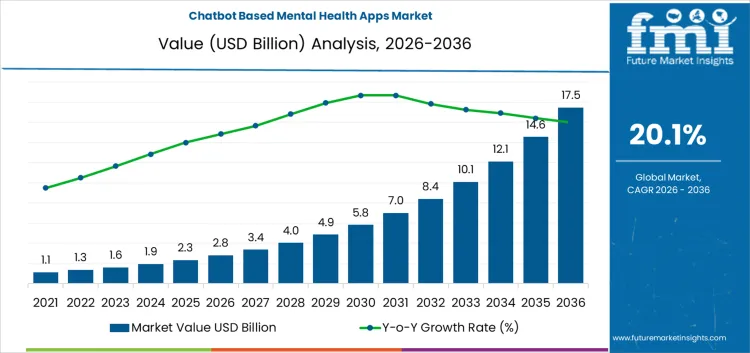
A rise from USD 2.8 billion in 2026 to USD 17.5 billion by 2036 places the chatbot based mental health apps market on a 20.10% CAGR path. Spending remains concentrated in a small group of countries where digital mental health tools are already tied into insurance coverage, employer benefit programs, or public health systems. Adoption differs widely because many health systems still require clinician mediated care for diagnosis and treatment pathways. Cost advantages sit with regions that combine large software engineering workforces and scalable cloud infrastructure. This shapes where platforms are developed, maintained, and operated, even when end users are located elsewhere.
Across the period, growth patterns continue to reflect policy choices and institutional purchasing behavior rather than simple consumer download trends. Markets with clear reimbursement codes, workplace mental health mandates, or university health contracts expand faster than those relying on out of pocket spending. Language adaptation, data residency rules, and clinical governance frameworks influence how quickly products are localized and approved. Distribution depends more on partnerships with insurers, employers, and care networks than on app store rankings. The market expands through formal inclusion in care pathways and benefit schemes, not through uniform global acceptance of automated mental health support.
Quick Stats of the Chatbot Based Mental Health Apps Market
- Chatbot Based Mental Health Apps Market Value (2026): USD 2.8 billion
- Chatbot Based Mental Health Apps Forecast Value (2036): USD 17.5 billion
- Chatbot Based Mental Health Apps Forecast CAGR 2026 to 2036: 20.1%
- Leading Product Format in Chatbot-Based Mental Health Apps Market: Standalone Chatbot Apps (46 % share)
- Leading User Group in Chatbot-Based Mental Health Apps Market: Adults (41 % share)
- Key Growth Regions in Chatbot-Based Mental Health Apps Market: India, China, Brazil, USA, UK
- Top Players in Chatbot-Based Mental Health Apps Market: Woebot Health, Wysa, Youper, Replika, Talkspace, Ginger, Sanvello
What is the Growth Forecast for Chatbot-Based Mental Health Apps Market through 2036?
Between 2026 and 2031, the chatbot-based mental health apps market is projected to expand from USD 2.8 billion along a steep path consistent with a 20.1% CAGR, driven by access economics rather than by clinical staffing expansion. In this phase, chatbots are adopted as a first-contact layer that absorbs demand which traditional therapy channels cannot serve at scale. Standalone apps and AI-assisted conversational tools gain traction among adults and workplace programs because they offer immediate, anonymous, and low-friction engagement. Growth is shaped by onboarding volume, daily active use, and retention mechanics rather than by one-time downloads. Employers, insurers, and universities begin to treat these tools as baseline support infrastructure, which shifts procurement from consumer choice to institutional deployment.
From 2031 to 2036, the market is expected to reach USD 17.5 billion, with expansion tied to deeper embedding of conversational systems into broader care pathways. Chatbots increasingly function as triage, monitoring, and adherence layers that sit alongside human therapists and telehealth platforms. Value growth comes from higher engagement intensity and longer subscription durations, not only from new user acquisition. Products evolve toward condition-specific programs, multilingual support, and risk detection workflows, raising average revenue per user. Competitive positioning depends on clinical validation, engagement outcomes, and data governance credibility. This favors platforms such as Woebot Health, Wysa, Youper, Replika, Talkspace, Ginger, and Sanvello as buyers prioritize trust, scale reliability, and measurable impact.
Chatbot-Based Mental Health Apps Market Key Takeaways
| Metric | Value |
|---|---|
| Market Value (2026) | USD 2.8 billion |
| Forecast Value (2036) | USD 17.5 billion |
| Forecast CAGR 2026 to 2036 | 20.1% |
How Are Chatbot-Based Mental Health Apps Transforming Access to Care?
Chatbot-based mental health apps are increasingly adopted to provide accessible, scalable, and personalized mental health support for individuals experiencing stress, anxiety, or depression. Historically, mental health services relied on in-person consultations, which faced limitations in accessibility, cost, and stigma. Modern apps integrate AI-driven conversational agents, cognitive behavioral therapy (CBT) frameworks, and real-time mood tracking to deliver interactive guidance, coping strategies, and early intervention support. Healthcare providers, wellness companies, and digital therapeutics developers prioritize evidence-based content, user engagement, and data privacy compliance. Early adoption focused on tech-savvy users and pilot programs, while current demand spans general consumers, corporate wellness initiatives, and telehealth platforms, driven by rising mental health awareness, digital health adoption, and workforce stress. App usability, AI response accuracy, and clinical validation influence adoption and retention.
Increasing prevalence of mental health conditions, demand for remote support, and integration with healthcare ecosystems are shaping market growth. Compared with traditional therapy models, chatbot-based apps emphasize 24/7 availability, interactive guidance, and scalable support for large populations. Cost structures depend on AI development, user interface design, and privacy safeguards, concentrating margins among providers delivering reliable, clinically validated platforms. Individuals and organizations adopt these apps to improve mental well-being, facilitate early intervention, and complement traditional therapy. By 2036, chatbot-based mental health apps are expected to become a standard component of digital healthcare, supporting accessible, personalized, and scalable mental health management.
What Factors Are Shaping the Demand for Chatbot Based Mental Health Apps by Product Format and User Group in 2026?
The chatbot based mental health apps market in 2026 is segmented by product type and by primary user group. By product format, demand is divided into standalone chatbot apps, integrated chatbot modules within broader platforms, AI assisted conversational support systems, and text only interfaces, each offering different levels of functionality, oversight, and integration. By user group, demand is organized around adults, adolescents and teens, seniors, and workplace or employee wellness programs, which differ in access patterns, privacy expectations, and support needs. These segments reflect how digital mental health tools are positioned across care pathways that range from self-guided support to supervised programs.
Why Do Standalone Chatbot Apps Lead Adoption Among Product Formats?
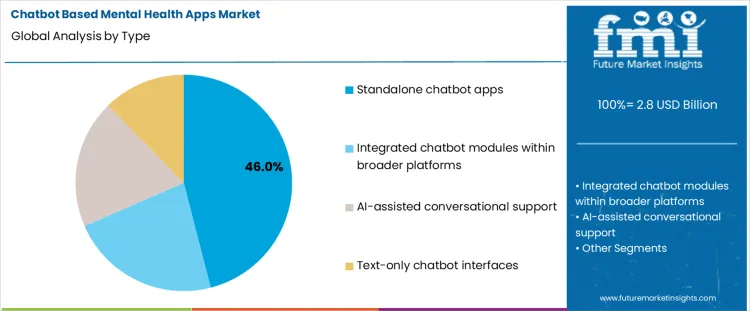
Standalone chatbot apps account for about 46% of demand in 2026, reflecting their low barrier to entry and direct to consumer distribution model. Users can download and begin using these tools without employer enrollment, clinical referral, or complex onboarding. This suits individuals seeking immediate, private support without committing to a broader program. Developers also favor this format because it allows rapid iteration and clear usage analytics. Monetization often relies on subscriptions, which benefits from large user pools even if engagement varies. The simplicity of the product scope reduces integration work and compliance overhead. This combination of accessibility, speed to market, and scalable distribution keeps standalone apps as the most common entry point for chatbot based mental health support.
Integrated modules, AI assisted systems, and text only interfaces serve more specific roles. Integrated chatbots are embedded in broader therapy or wellness platforms, which limits their addressable audience to existing users of those systems. AI assisted conversational support with richer features requires more governance, testing, and clinical oversight, which slows deployment. Text only interfaces focus on simplicity and low data use, yet they offer fewer interaction modes. These formats are chosen based on institutional partnerships, risk management, or technical constraints rather than pure reach. Their adoption grows through enterprise or clinical channels, while standalone apps continue to dominate because they rely on individual user choice rather than organizational purchasing decisions.
Why Do Adults Represent the Largest User Group for Chatbot Mental Health Apps?
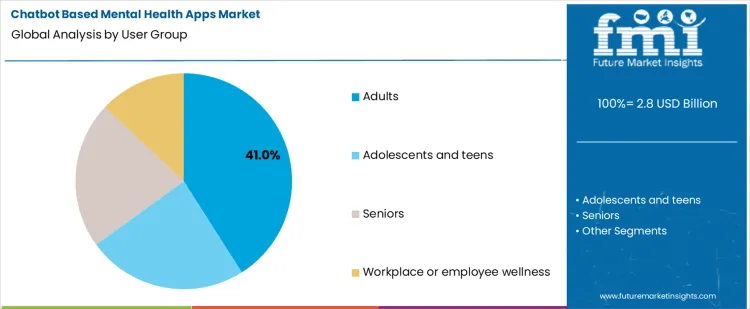
Adults represent about 41% of demand in 2026 because they combine high smartphone usage with independent decision making about mental health support. This group often seeks tools that can be used privately, outside formal healthcare settings, and on flexible schedules. Work stress, family responsibilities, and time constraints make short, on demand interactions attractive. Adults are also more likely to pay for subscriptions or accept app based self-care as a supplement to traditional therapy. This purchasing power and autonomy concentrate early and ongoing adoption in this age group, which explains their leading share among users of chatbot based mental health applications.
Adolescents, seniors, and workplace programs show different adoption dynamics. Teen use is shaped by parental consent, school policies, and platform restrictions, which slows independent uptake. Seniors face barriers related to digital literacy and trust in automated support, though usage grows where caregiver involvement exists. Workplace programs depend on employer decisions and rollout schedules rather than individual choice. These groups represent important growth areas, yet their access is mediated by institutions or support networks. This keeps adult direct to consumer use as the primary volume driver, with other segments expanding more gradually through structured channels.
Why Are Access Bottlenecks and Service Delivery Economics, Not App Novelty, Driving the Chatbot Based Mental Health Apps Market through 2036?
Demand is anchored in gaps between need and clinical capacity. Waiting times for therapy, uneven geographic coverage, and workforce shortages push health systems and employers to seek scalable first line support. Chatbots offer immediate interaction at marginal cost and can absorb large volumes of low acuity users who would otherwise remain untreated. Organizations also use them as triage tools to route severe cases to clinicians more efficiently. Once embedded into employee assistance programs or insurer care pathways, usage becomes routine rather than discretionary. This makes growth depend on institutional adoption and access strategy rather than on consumer app store cycles or feature releases.
What Clinical Risk, Trust Barriers, and Regulatory Scrutiny Are Limiting Deeper Adoption?
Constraints arise from responsibility and liability. Mental health interventions carry risk, and mistakes can have serious consequences, which makes providers cautious about automated tools. Evidence standards for efficacy are rising, and many products lack long term, peer reviewed outcome data. Users also vary in trust, especially for sensitive disclosures. Data protection and crisis handling obligations increase compliance cost and design complexity. Integration into clinical governance frameworks is slow. These factors keep chatbots positioned as support or screening layers rather than as substitutes for therapy, and they lengthen sales cycles with public systems, insurers, and large employers.
How Are Care Pathway Integration and Payment Models Reshaping the Role of These Tools?
The category is moving away from standalone consumer apps. Buyers increasingly want chatbot functions embedded inside broader mental health platforms that include human care, scheduling, and records. Payment is shifting from subscriptions to per member or per covered life contracts tied to utilization and outcomes reporting. Chatbots are being specified as entry points, follow up tools, or adherence supports rather than as the whole service. Procurement focuses on interoperability, auditability, and escalation workflows. Over time, these tools become part of structured care pathways and population health programs, judged on their ability to manage flow and documentation rather than on conversational sophistication.
What is the Demand for Chatbot-Based Mental Health Apps by Country?
| Country | CAGR (%) |
|---|---|
| USA | 19.0% |
| UK | 18.5% |
| China | 21.5% |
| India | 23.0% |
| Brazil | 19.5% |
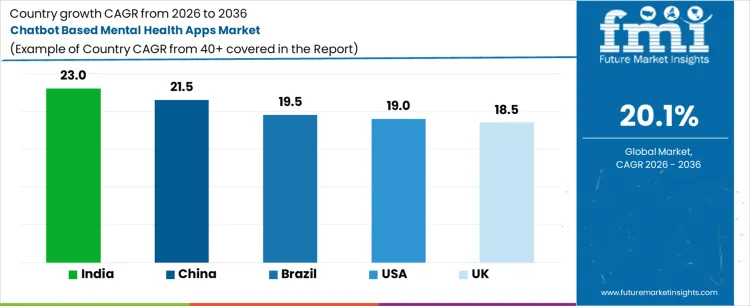
Demand for chatbot-based mental health apps is rising as healthcare providers, technology companies, and consumers adopt AI-driven digital tools for mental wellness, stress management, and remote psychological support. India leads with a 23.0% CAGR, driven by increasing awareness of mental health, widespread smartphone penetration, and demand for accessible, cost-effective digital solutions. China follows at 21.5%, supported by rapid digital healthcare adoption, government initiatives, and urban population growth. Brazil records 19.5% growth, shaped by rising mental health concerns and adoption of mobile health technologies. The USA grows at 19.0%, influenced by telehealth integration and AI-powered mental health platforms. The UK shows 18.5% CAGR, reflecting steady adoption of digital mental health interventions and chatbot-based solutions.
How is the United States experiencing growth in the chatbot-based mental health apps market?
United States is experiencing growth at a CAGR of 19%, driven by increasing awareness of mental health, rising smartphone penetration, and integration of AI in healthcare platforms. Chatbot-based mental health apps provide cognitive behavioral therapy, mood tracking, and guided self-help, optimized for user engagement, data privacy, and HIPAA compliance. Demand is concentrated in urban centers such as New York, Los Angeles, and San Francisco, where mental health awareness and digital adoption are high. Investments focus on app reliability, AI personalization, and integration with telehealth services. Growth reflects rising mental health concerns, digital-first therapy adoption, and expansion of remote healthcare platforms.
- Mental health awareness drives adoption.
- Apps optimize user engagement and AI personalization.
- Urban healthcare hubs concentrate demand.
- App reliability and regulatory compliance guide investment.
How is the United Kingdom witnessing growth in the chatbot-based mental health apps market?
United Kingdom is witnessing growth at a CAGR of 18.5%, supported by public and private mental health initiatives and widespread smartphone use. Chatbot-based apps offer guided therapy, mood tracking, and crisis support, optimized for NHS integration and GDPR-compliant data handling. Demand is concentrated in London, Manchester, and Birmingham, where digital mental health adoption is highest. Investments prioritize AI-driven personalization, user experience, and adherence to national healthcare regulations. Growth reflects increasing adoption of remote mental health interventions, emphasis on preventive care, and expansion of digital therapy programs.
- Digital therapy initiatives drive adoption.
- Apps enhance mood tracking and guided self-help.
- Major cities concentrate demand.
- AI personalization and regulatory compliance guide investment.
How is China experiencing growth in the chatbot-based mental health apps market?
China is experiencing growth at a CAGR of 21.5%, fueled by rising urban stress levels, increasing smartphone penetration, and government-supported digital health initiatives. Chatbot-based apps provide AI-guided counseling, mood monitoring, and cognitive behavioral interventions, optimized for Mandarin language support and integration with popular mobile platforms. Demand is concentrated in metropolitan areas such as Beijing, Shanghai, and Shenzhen, where mental health awareness and digital adoption are high. Investments focus on AI algorithm accuracy, user engagement, and compliance with national health regulations. Growth reflects urbanization-driven mental health challenges, adoption of digital therapy, and expansion of telehealth infrastructure.
- Urban stress and digital adoption drive growth.
- Apps optimize AI-guided counseling and mood monitoring.
- Major cities concentrate demand.
- AI accuracy and regulatory compliance guide investment.
How is India witnessing growth in the chatbot-based mental health apps market?
India is witnessing growth at a CAGR of 23%, driven by rising awareness of mental health issues, increasing smartphone penetration, and demand for accessible therapy options. Chatbot-based apps provide guided self-help, cognitive behavioral therapy, and mood tracking, optimized for local languages and culturally relevant interventions. Demand is concentrated in urban centers such as Mumbai, Bengaluru, and Delhi, where digital healthcare adoption is high. Investments focus on app reliability, AI personalization, and compliance with Indian healthcare regulations. Growth reflects the need for scalable mental health solutions, expanding telemedicine infrastructure, and increased focus on preventive and remote care.
- Mental health awareness drives adoption.
- Apps enhance self-help, CBT, and mood tracking.
- Metro cities concentrate demand.
- App reliability and regulatory compliance guide investment.
How is Brazil experiencing growth in the chatbot-based mental health apps market?
Brazil is experiencing growth at a CAGR of 19.5%, supported by rising awareness of mental health, government initiatives, and adoption of mobile digital solutions. Chatbot-based apps provide AI-guided counseling, mood tracking, and cognitive behavioral therapy, optimized for Portuguese language support and integration with local telehealth platforms. Demand is concentrated in São Paulo, Rio de Janeiro, and Brasília, where urban stress and digital healthcare adoption are highest. Investments prioritize app reliability, AI accuracy, and compliance with Brazilian health and data protection regulations. Growth reflects urban mental health challenges, expansion of digital therapy, and increased remote healthcare adoption.
- Urban mental health concerns drive adoption.
- Apps optimize AI-guided therapy and mood tracking.
- Metropolitan centers concentrate demand.
- App reliability and regulatory compliance guide investment.
Who Competes in the Chatbot Based Mental Health Apps Market and What Defines Their Capabilities?
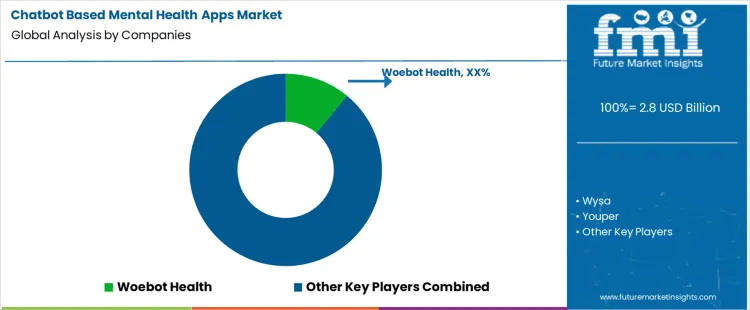
Competition in the chatbot based mental health apps market is shaped by conversational AI quality, clinical grounding, and capability to support self management of mood, stress, and related concerns. Woebot Health offers a mobile app that uses automated conversations grounded in cognitive behavioral techniques, paired with periodic check ins to track mood trends. Wysa delivers an AI chat interface with toolkits for coping skills and optional human coaching, focusing on evidence informed strategies. Youper provides an AI assisted emotional health companion that uses brief dialogues and mood tracking to support self awareness. Replika emphasizes conversational engagement with an AI persona to reduce loneliness and encourage reflection rather than structured therapy. Talkspace and Ginger integrate chatbot features within broader digital mental health services, combining automated support with access to licensed professionals when appropriate.
Platforms in this market differ in therapeutic orientation, data integration, and human support pathways. Woebot Health emphasizes psychological frameworks and research partnerships to validate dialogues. Wysa integrates structured exercises and optional human coaches for users seeking guided self help. Youper’s interface combines AI dialogues with symptom tracking and personalized insights. Replika focuses on ongoing conversational engagement and emotional expression rather than clinical intervention. Talkspace and Ginger embed chatbot interactions within broader care models that connect users to clinicians or care teams. Sanvello provides mood tracking, coping tools, and community features alongside chatbot interactions. Competitive differentiation arises from clinical oversight, evidence base, user engagement mechanisms, privacy practices, and platform interoperability with health data systems or clinician workflows. Adoption reflects user comfort with AI, perceived usefulness of conversational support, and alignment with personal mental health goals.
Key Players in the Chatbot Based Mental Health Apps Market
- Woebot Health
- Wysa
- Youper
- Replika
- Talkspace
- Ginger
- Sanvello
Scope of the Report
| Items | Values |
|---|---|
| Quantitative Units (2026) | USD billion |
| Type | Standalone Chatbot Apps, Integrated Chatbot Modules within Broader Platforms, AI-Assisted Conversational Support, Text-Only Chatbot Interfaces |
| User Group | Adults, Adolescents and Teens, Seniors, Workplace or Employee Wellness |
| Regions Covered | Asia Pacific, Europe, North America, Latin America, Middle East & Africa |
| Countries Covered | China, Japan, South Korea, India, Australia & New Zealand, ASEAN, Germany, United Kingdom, France, Italy, Spain, Nordic, BENELUX, United States, Canada, Mexico, Brazil, Chile, Saudi Arabia, Turkey, South Africa, and other regional markets |
| Key Companies Profiled | Woebot Health, Wysa, Youper, Replika, Talkspace, Ginger, Sanvello |
| Additional Attributes | Dollar sales by product type and user group, standalone chatbot apps forming the largest share due to low barrier direct-to-consumer access, adults representing the largest user segment because of independent purchasing behavior and high smartphone usage, demand driven by access bottlenecks and clinical capacity constraints rather than app novelty, procurement increasingly routed through employers, insurers, and care networks instead of app stores, products embedded into care pathways as triage, monitoring, and adherence layers, growth driven by engagement intensity and subscription duration rather than downloads, and competitive positioning shaped by clinical validation, engagement outcomes, data governance, and integration with broader mental health platforms. |
Chatbot Based Mental Health Apps Market Segmentation
Type:
- Standalone chatbot apps
- Integrated chatbot modules within broader platforms
- AI-assisted conversational support
- Text-only chatbot interfaces
User Group:
- Adults
- Adolescents and teens
- Seniors
- Workplace or employee wellness
Region:
- Asia Pacific
- China
- Japan
- South Korea
- India
- Australia & New Zealand
- ASEAN
- Rest of Asia Pacific
- Europe
- Germany
- United Kingdom
- France
- Italy
- Spain
- Nordic
- BENELUX
- Rest of Europe
- North America
- United States
- Canada
- Mexico
- Latin America
- Brazil
- Chile
- Rest of Latin America
- Middle East & Africa
- Kingdom of Saudi Arabia
- Other GCC Countries
- Turkey
- South Africa
- Other African Union
- Rest of Middle East & Africa
Bibliography
- World Health Organization. (2023). Guidance on digital mental health interventions and AI-enabled support systems.
- World Health Organization. (2024). Global mental health at work: Policy and systems guidance.
- National Institute of Mental Health. (2024). Technology and the future of mental health treatment.
- Organisation for Economic Co-operation and Development. (2024). Fostering the digital transformation of mental health services.
- National Health Service (UK). (2023). NHS digital mental health services and AI safety framework.
Frequently Asked Questions
How big is the chatbot based mental health apps market in 2026?
The global chatbot based mental health apps market is estimated to be valued at USD 2.8 billion in 2026.
What will be the size of chatbot based mental health apps market in 2036?
The market size for the chatbot based mental health apps market is projected to reach USD 17.5 billion by 2036.
How much will be the chatbot based mental health apps market growth between 2026 and 2036?
The chatbot based mental health apps market is expected to grow at a 20.1% CAGR between 2026 and 2036.
What are the key product types in the chatbot based mental health apps market?
The key product types in chatbot based mental health apps market are standalone chatbot apps, integrated chatbot modules within broader platforms, ai-assisted conversational support and text-only chatbot interfaces.
Which user group segment to contribute significant share in the chatbot based mental health apps market in 2026?
In terms of user group, adults segment to command 41.0% share in the chatbot based mental health apps market in 2026.
Preview the report firsthand - request a free sample
Get SampleGet the brochure for pricing and purchase details.
Get PDFTable of Content
- Executive Summary
- Global Market Outlook
- Demand-side Trends
- Supply-side Trends
- Technology Roadmap Analysis
- Analysis and Recommendations
- Market Overview
- Market Coverage / Taxonomy
- Market Definition / Scope / Limitations
- Market Background
- Market Dynamics
- Drivers
- Restraints
- Opportunity
- Trends
- Scenario Forecast
- Demand in Optimistic Scenario
- Demand in Likely Scenario
- Demand in Conservative Scenario
- Opportunity Map Analysis
- Product Life Cycle Analysis
- Supply Chain Analysis
- Investment Feasibility Matrix
- Value Chain Analysis
- PESTLE and Porter’s Analysis
- Regulatory Landscape
- Regional Parent Market Outlook
- Production and Consumption Statistics
- Import and Export Statistics
- Market Dynamics
- Global Market Analysis 2021 to 2025 and Forecast, 2026 to 2036
- Historical Market Size Value (USD Million) Analysis, 2021 to 2025
- Current and Future Market Size Value (USD Million) Projections, 2026 to 2036
- Y-o-Y Growth Trend Analysis
- Absolute $ Opportunity Analysis
- Global Market Pricing Analysis 2021 to 2025 and Forecast 2026 to 2036
- Global Market Analysis 2021 to 2025 and Forecast 2026 to 2036, By Type
- Introduction / Key Findings
- Historical Market Size Value (USD Million) Analysis By Type, 2021 to 2025
- Current and Future Market Size Value (USD Million) Analysis and Forecast By Type, 2026 to 2036
- Standalone chatbot apps
- Integrated chatbot modules within broader platforms
- AI-assisted conversational support
- Text-only chatbot interfaces
- Standalone chatbot apps
- Y-o-Y Growth Trend Analysis By Type, 2021 to 2025
- Absolute $ Opportunity Analysis By Type, 2026 to 2036
- Global Market Analysis 2021 to 2025 and Forecast 2026 to 2036, By User Group
- Introduction / Key Findings
- Historical Market Size Value (USD Million) Analysis By User Group, 2021 to 2025
- Current and Future Market Size Value (USD Million) Analysis and Forecast By User Group, 2026 to 2036
- Adults
- Adolescents and teens
- Seniors
- Workplace or employee wellness
- Adults
- Y-o-Y Growth Trend Analysis By User Group, 2021 to 2025
- Absolute $ Opportunity Analysis By User Group, 2026 to 2036
- Global Market Analysis 2021 to 2025 and Forecast 2026 to 2036, By Region
- Introduction
- Historical Market Size Value (USD Million) Analysis By Region, 2021 to 2025
- Current Market Size Value (USD Million) Analysis and Forecast By Region, 2026 to 2036
- North America
- Latin America
- Western Europe
- Eastern Europe
- East Asia
- South Asia and Pacific
- Middle East & Africa
- Market Attractiveness Analysis By Region
- North America Market Analysis 2021 to 2025 and Forecast 2026 to 2036, By Country
- Historical Market Size Value (USD Million) Trend Analysis By Market Taxonomy, 2021 to 2025
- Market Size Value (USD Million) Forecast By Market Taxonomy, 2026 to 2036
- By Country
- USA
- Canada
- Mexico
- By Type
- By User Group
- By Country
- Market Attractiveness Analysis
- By Country
- By Type
- By User Group
- Key Takeaways
- Latin America Market Analysis 2021 to 2025 and Forecast 2026 to 2036, By Country
- Historical Market Size Value (USD Million) Trend Analysis By Market Taxonomy, 2021 to 2025
- Market Size Value (USD Million) Forecast By Market Taxonomy, 2026 to 2036
- By Country
- Brazil
- Chile
- Rest of Latin America
- By Type
- By User Group
- By Country
- Market Attractiveness Analysis
- By Country
- By Type
- By User Group
- Key Takeaways
- Western Europe Market Analysis 2021 to 2025 and Forecast 2026 to 2036, By Country
- Historical Market Size Value (USD Million) Trend Analysis By Market Taxonomy, 2021 to 2025
- Market Size Value (USD Million) Forecast By Market Taxonomy, 2026 to 2036
- By Country
- Germany
- UK
- Italy
- Spain
- France
- Nordic
- BENELUX
- Rest of Western Europe
- By Type
- By User Group
- By Country
- Market Attractiveness Analysis
- By Country
- By Type
- By User Group
- Key Takeaways
- Eastern Europe Market Analysis 2021 to 2025 and Forecast 2026 to 2036, By Country
- Historical Market Size Value (USD Million) Trend Analysis By Market Taxonomy, 2021 to 2025
- Market Size Value (USD Million) Forecast By Market Taxonomy, 2026 to 2036
- By Country
- Russia
- Poland
- Hungary
- Balkan & Baltic
- Rest of Eastern Europe
- By Type
- By User Group
- By Country
- Market Attractiveness Analysis
- By Country
- By Type
- By User Group
- Key Takeaways
- East Asia Market Analysis 2021 to 2025 and Forecast 2026 to 2036, By Country
- Historical Market Size Value (USD Million) Trend Analysis By Market Taxonomy, 2021 to 2025
- Market Size Value (USD Million) Forecast By Market Taxonomy, 2026 to 2036
- By Country
- China
- Japan
- South Korea
- By Type
- By User Group
- By Country
- Market Attractiveness Analysis
- By Country
- By Type
- By User Group
- Key Takeaways
- South Asia and Pacific Market Analysis 2021 to 2025 and Forecast 2026 to 2036, By Country
- Historical Market Size Value (USD Million) Trend Analysis By Market Taxonomy, 2021 to 2025
- Market Size Value (USD Million) Forecast By Market Taxonomy, 2026 to 2036
- By Country
- India
- ASEAN
- Australia & New Zealand
- Rest of South Asia and Pacific
- By Type
- By User Group
- By Country
- Market Attractiveness Analysis
- By Country
- By Type
- By User Group
- Key Takeaways
- Middle East & Africa Market Analysis 2021 to 2025 and Forecast 2026 to 2036, By Country
- Historical Market Size Value (USD Million) Trend Analysis By Market Taxonomy, 2021 to 2025
- Market Size Value (USD Million) Forecast By Market Taxonomy, 2026 to 2036
- By Country
- Kingdom of Saudi Arabia
- Other GCC Countries
- Turkiye
- South Africa
- Other African Union
- Rest of Middle East & Africa
- By Type
- By User Group
- By Country
- Market Attractiveness Analysis
- By Country
- By Type
- By User Group
- Key Takeaways
- Key Countries Market Analysis
- USA
- Pricing Analysis
- Market Share Analysis, 2025
- By Type
- By User Group
- Canada
- Pricing Analysis
- Market Share Analysis, 2025
- By Type
- By User Group
- Mexico
- Pricing Analysis
- Market Share Analysis, 2025
- By Type
- By User Group
- Brazil
- Pricing Analysis
- Market Share Analysis, 2025
- By Type
- By User Group
- Chile
- Pricing Analysis
- Market Share Analysis, 2025
- By Type
- By User Group
- Germany
- Pricing Analysis
- Market Share Analysis, 2025
- By Type
- By User Group
- UK
- Pricing Analysis
- Market Share Analysis, 2025
- By Type
- By User Group
- Italy
- Pricing Analysis
- Market Share Analysis, 2025
- By Type
- By User Group
- Spain
- Pricing Analysis
- Market Share Analysis, 2025
- By Type
- By User Group
- France
- Pricing Analysis
- Market Share Analysis, 2025
- By Type
- By User Group
- India
- Pricing Analysis
- Market Share Analysis, 2025
- By Type
- By User Group
- ASEAN
- Pricing Analysis
- Market Share Analysis, 2025
- By Type
- By User Group
- Australia & New Zealand
- Pricing Analysis
- Market Share Analysis, 2025
- By Type
- By User Group
- China
- Pricing Analysis
- Market Share Analysis, 2025
- By Type
- By User Group
- Japan
- Pricing Analysis
- Market Share Analysis, 2025
- By Type
- By User Group
- South Korea
- Pricing Analysis
- Market Share Analysis, 2025
- By Type
- By User Group
- Russia
- Pricing Analysis
- Market Share Analysis, 2025
- By Type
- By User Group
- Poland
- Pricing Analysis
- Market Share Analysis, 2025
- By Type
- By User Group
- Hungary
- Pricing Analysis
- Market Share Analysis, 2025
- By Type
- By User Group
- Kingdom of Saudi Arabia
- Pricing Analysis
- Market Share Analysis, 2025
- By Type
- By User Group
- Turkiye
- Pricing Analysis
- Market Share Analysis, 2025
- By Type
- By User Group
- South Africa
- Pricing Analysis
- Market Share Analysis, 2025
- By Type
- By User Group
- USA
- Market Structure Analysis
- Competition Dashboard
- Competition Benchmarking
- Market Share Analysis of Top Players
- By Regional
- By Type
- By User Group
- Competition Analysis
- Competition Deep Dive
- Woebot Health
- Overview
- Product Portfolio
- Profitability by Market Segments (Product/Age /Sales Channel/Region)
- Sales Footprint
- Strategy Overview
- Marketing Strategy
- Product Strategy
- Channel Strategy
- Wysa
- Youper
- Replika
- Talkspace (chatbot integration)
- Ginger (chatbot features)
- Sanvello
- Woebot Health
- Competition Deep Dive
- Assumptions & Acronyms Used
- Research Methodology


