

- Market Size (2026)
- USD 1120.7 Mn
- Forecast (2036)
- USD 2397.2 Mn
- CAGR (2026 to 2036)
- 7.9%
How big is the Textile Odor Control Finishes Market?
The Textile Odor Control Finishes Market is projected to grow from USD 1120.7 million in 2026 to USD 2397.2 million by 2036, at a CAGR of 7.9%.
The Textile Odor Control Finishes Market was valued at USD 1,038.6 million in 2025 and is expected to reach USD 1120.7 million in 2026. The market is projected to reach USD 2397.2 million by 2036 at a CAGR of 7.9% from 2026 to 2036. Antimicrobial Finishes are projected to account for a 46.0% share by Finish Type in 2026. Apparel Fabrics are expected to represent a 54.0% share by Textile Type in 2026.
In January 2026, Archroma and HeiQ entered a co-marketing agreement for antimicrobial and odor-control textile technologies. The agreement improves access to brands, retailers, and textile mills worldwide. In April 2024, HeiQ launched Fresh for Feather & Down as a bio-based anti-odor technology for jackets, duvets, and pillows. The launch extends odor control into home and insulation textiles.
These methods give brands a clearer basis for comparing finish systems before mill approval.
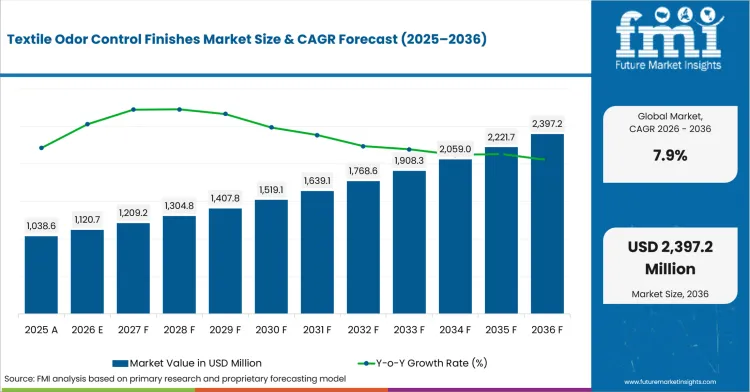
| Metric | Value |
|---|---|
| 2025 Market Size | USD 1,038.6 million |
| 2026 Market Size | USD 1,120.7 million |
| 2036 Market Size | USD 2,397.2 million |
| Forecast CAGR (2026-2036) | 7.9% |
| Leading Finish Type | Antimicrobial Finishes |
| Antimicrobial Finishes Share (2026) | 46.0% |
| Leading Textile Type | Apparel Fabrics |
| Apparel Fabrics Share (2026) | 54.0% |
| Fastest-growing Country | India |
| India CAGR by 2036 | 8.9% |
Summary of the Textile Odor Control Finishes Market
| Market Signal | Commercial Impact |
|---|---|
| Demand and Growth Drivers | Demand for textile odor control finishes is increasing as apparel manufacturers develop performance fabrics that provide long-lasting freshness, durability, and consumer comfort.
|
| Product and Segment View | Antimicrobial finishes, apparel fabrics, and sportswear applications continue to represent the leading commercial opportunities across the market.
|
| Geography and Growth Outlook | Asia continues to drive market expansion through technical textile manufacturing, apparel exports, and growing demand for functional performance fabrics.
|
| Competitive Landscape | Competition increasingly focuses on odor-control performance, regulatory compliance, textile compatibility, and formulation innovation.
|
| Analyst Perspective | Textile odor control finishes are evolving from simple fragrance-enhancing treatments into measurable performance technologies that improve garment functionality, durability, and consumer satisfaction.
- Nikhil Kaitwade, Principal Consultant at Future Market Insights |
Why is the Textile Odor Control Finishes Market growing?
Synthetic activewear creates persistent body odor problems as polyester and polyamide hold sweat-derived volatile compounds. Workwear buyers need longer freshness between washes as uniforms face extended wear across industrial and service jobs.
- Synthetic activewear creates persistent body odor problems as polyester and polyamide hold sweat-derived volatile compounds.
- Workwear buyers need longer freshness between washes as uniforms face extended wear across industrial and service jobs.
- Healthcare and hospitality users specify odor control when reusable textiles face repeat laundering and high-contact use.
Performance apparel is the first major adoption pocket for odor control finishes as repeated wear exposes the limits of untreated synthetics. HeiQ describes HeiQ Fresh as a silver-free odor-control family using bio-based or mineral-based ingredients that adsorb volatile odor compounds on textiles. That approach suits activewear buyers who want odor reduction without changing breathability, color, hand feel, or wicking. This means suppliers must sell performance evidence and fabric compatibility together. For adjacent demand in sweat-resistant apparel, odor control is now part of the same comfort bundle as moisture movement and quick drying. Compliance is another growth lever as odor control claims can cross into regulated antimicrobial territory.
How is the Textile Odor Control Finishes Market segmented?
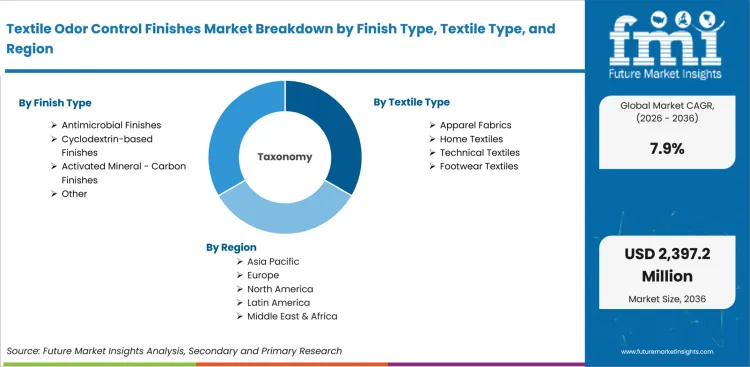
The Textile Odor Control Finishes Market is segmented by finish type, textile type, application, durability, sales channel, and region.
- Antimicrobial Finishes are projected to account for a 46.0% share by Finish Type in 2026 as microbial control remains a familiar odor-prevention route.
- With an estimated 54.0% share in 2026, Apparel Fabrics is expected to lead the textile type category because activewear and dailywear scale.
- Sportswear buyers are projected to account for a 38.0% share of the application category in 2026 as sweat odor affects repeat wear and returns.
How does Antimicrobial Finishes contribute to the finish type category?
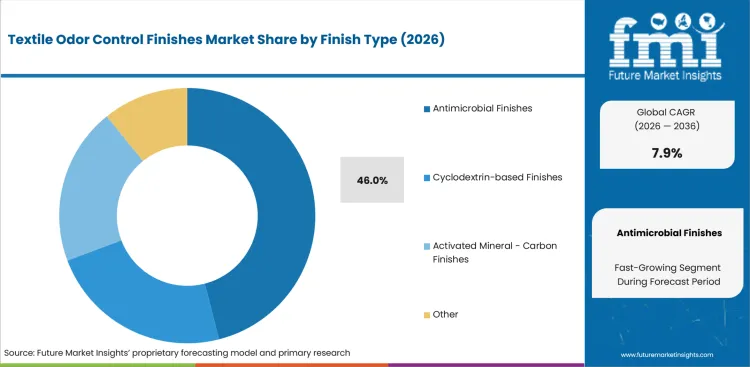
- Antimicrobial Finishes are projected to account for a 46.0% share in 2026 as buyers use bacteria control to slow sweat breakdown on apparel and workwear fabrics.
- Buyers compare antimicrobial finishes by claim limits and wash durability, since EPA guidance restricts public health language for treated articles unless registration requirements are met.
What supports demand for Apparel Fabrics?
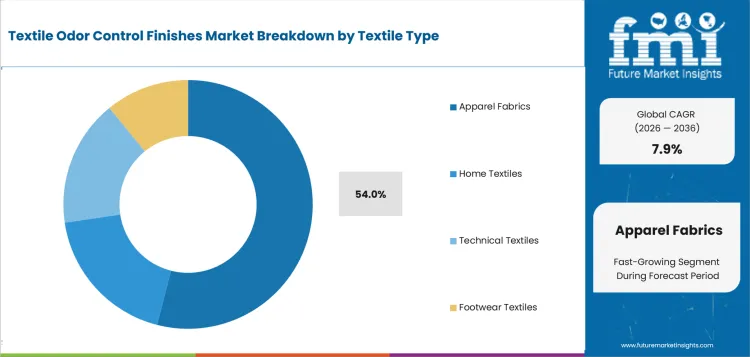
- Apparel Fabrics are expected to represent a 54.0% share in 2026 as activewear, innerwear, uniforms, and travel garments carry the elevated odor complaint exposure.
- Fabric buyers reject odor systems that change hand feel or moisture movement, which makes compatibility testing as important as odor reduction itself.
How do buyers evaluate Sportswear within the application category?
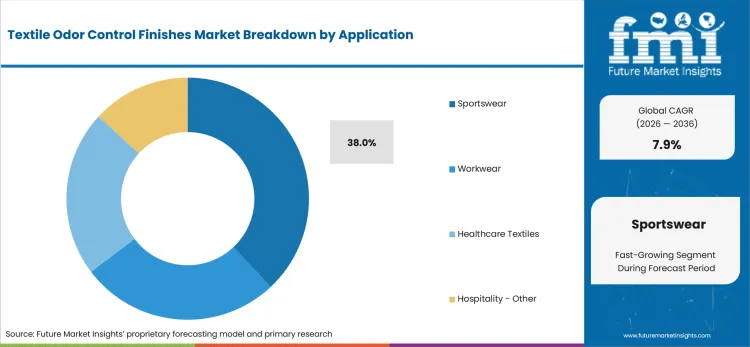
- Sportswear is anticipated to account for a 38.0% share in 2026 as polyester-rich garments face persistent odor after sweat exposure and repeated washing.
- Brand teams often test odor finishes alongside soil-release functional polymers, since activewear care performance affects returns and repeat purchase.
What market factors influence demand for Wash Durable?
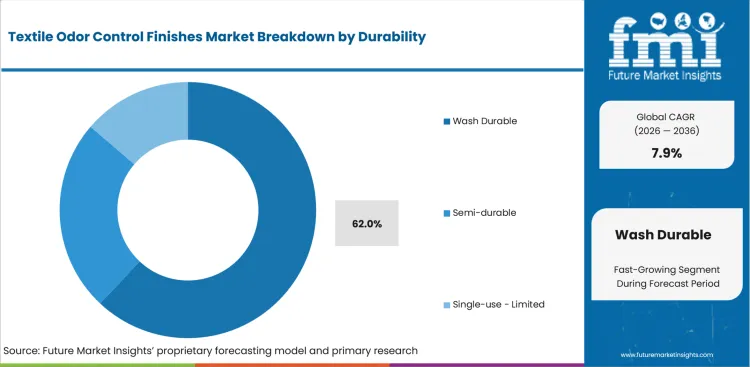
- Wash Durable finishes are projected to hold a 62.0% share in 2026 as buyers need freshness claims that survive repeated home or industrial laundering.
- AATCC odor methods create a common test language for durability claims, which reduces disputes between finish suppliers and brand quality teams.
How does Direct to Mills affect the sales channel outlook?
- Direct to Mills is estimated to account for a 66.0% share in 2026 as finish suppliers must tune application rates with dyeing and finishing recipes.
- Chemical distributors serve smaller mills and regional programs, but direct supply wins larger orders when brand approval includes lab support and claim paperwork.
What drives and restrains the market?
Driver: Persistent synthetic-fabric odor drives finish use as activewear buyers need freshness performance across repeated wear cycles; restraint: Treated-article compliance restrains antimicrobial claims as suppliers must separate fabric protection from health protection; opportunity: biocide-free odor capture opens an opportunity as brands seek freshness claims with fewer active-substance concerns.
The market reflects a balance between the identified demand driver, adoption constraints, and the supplier opportunity outlined below.
- Driver: Persistent synthetic-fabric odor drives finish use as activewear buyers need freshness performance across repeated wear cycles.
- Restraint: Treated-article compliance restrains antimicrobial claims as suppliers must separate fabric protection from health protection.
- Opportunity: biocide-free odor capture opens an opportunity as brands seek freshness claims with fewer active-substance concerns.
Synthetic Odor Retention: Synthetic-fabric odor is a direct driver because polyester and polyamide garments often retain sweat-derived compounds after washing. HeiQ states that its Fresh range targets body odors, environmental odors, fabric odors, and accumulated “permastink” effects on synthetic fibers. That product language reflects a real buyer problem in activewear and travel apparel. Odor control finishes are not only added for hygiene perception but for repeat-wear confidence. Suppliers that show strong performance on synthetics gain better access to premium apparel programs. This supports antimicrobial additives demand in adjacent material applications.
Treated-Article Claim Control: Regulation affects formulation choice as brands must know whether their odor claim is a product-protection claim or a public health claim. UK Health and Safety Executive guidance defines treated articles as substances, mixtures, or articles intentionally incorporating biocidal products. Swedish Chemicals Agency guidance cites odorless sports shirts as an example of a biocidal treated article. These examples show why European buyers ask for compliance support before approving antimicrobial finishes. Suppliers with clear claim language can reduce approval delays. Those without regulatory support face weaker access to EU-facing textile programs.
Which factors support expansion?
Commercial expansion is reinforced by the value, workflow, and recurring-demand factors below.
- Market value is rising as sportswear brands turn odor control into a repeat-wear feature that protects garment satisfaction.
- Durable finishes support higher selling prices as buyers compare laundry-cycle proof before approving premium performance claims.
- Activated mineral and carbon systems are gaining attention as brands seek odor capture without broad antimicrobial label risk.
Which country markets are included in the CAGR comparison?
The selected CAGR comparison covers India (8.9%), China (8.6%), South Korea (8.0%), United States (7.5%), and Germany (7.2%) through 2036.
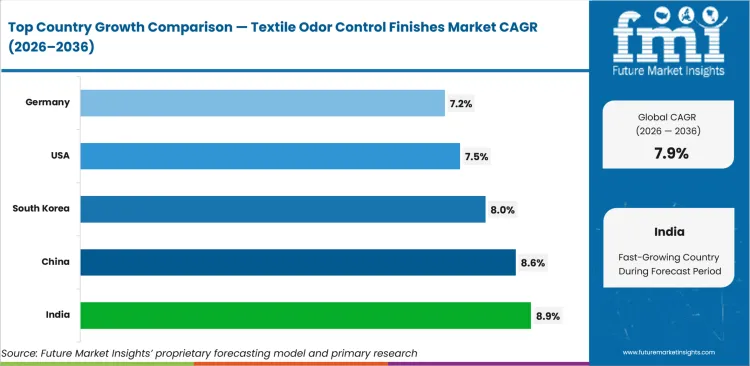
| Country | CAGR |
|---|---|
| India | 8.9% |
| China | 8.6% |
| South Korea | 8.0% |
| United States | 7.5% |
| Germany | 7.2% |
Source: Future Market Insights analysis.
How do country-level CAGRs compare?
- India (CAGR: 8.9%): Export mills are adding functional finishes to raise value per garment.
- China (CAGR: 8.6%): China’s fabric and garment processing scale supports fast recipe conversion.
- South Korea (CAGR: 8.0%): Functional apparel and industrial textile suppliers support premium finishing use.
- United States (CAGR: 7.5%): Performance apparel and uniform buyers use odor claims to reduce complaints on synthetic garments.
- Germany (CAGR: 7.2%): Germany combines technical textiles, apparel brands, and specialty chemical capability.
The global Textile Odor Control Finishes Market is forecast to record a CAGR of 7.9% from 2026 to 2036. The study covers 30+ countries across the report regions.
How is the Textile Odor Control Finishes Market developing in India?
India is projected to record a CAGR of 8.9% through 2036. The country outlook identifies this demand signal: Export mills are adding functional finishes to raise value per garment.
Country Market Snapshot
| Country | India |
|---|---|
| Forecast CAGR | 8.9% |
| Demand anchor | Export mills are adding functional finishes to raise value per garment. |
| Trade signal | India’s textile and apparel exports reached USD 37.8 billion in 2025. |
| Policy context | Integrated textile parks and production-linked programs support value-added processing. |
| Application mix | Sportswear, workwear, home textiles, and technical textiles support finish use. |
| Channel behavior | Direct mill selling works well in clusters such as Gujarat, Tamil Nadu, and Maharashtra. |
| Restraint | Cost sensitivity can limit adoption outside export and premium domestic programs. |
| Company context | Companies active in or serving this market include Archroma India, HeiQ, RUDOLF Atul Chemicals, Sarex Chemicals, and Rossari Biotech. |
Market Outlook
India is projected to record a CAGR of 8.9% through 2036 as export mills use odor control to move into higher-value apparel. India’s Ministry of Textiles reported that textile and apparel exports reached USD 37.8 billion in 2025. This export scale supports mill interest in finishes that help win brand programs. Indian demand is notable where mills serve activewear, workwear, and home textile buyers with clear performance specifications. Public programs for textile parks can improve integrated processing capacity.
Key Growth Drivers
- Export mills use odor control to differentiate sportswear and workwear orders.
- Textile park investments improve the case for integrated wet processing and finishing.
- Domestic activewear brands create demand for freshness claims at mid-market price points.
- Export mills are adding functional finishes to raise value per garment.
Key Restraints
- Price-sensitive buyers may accept semi-durable finishes over wash-durable systems.
- Smaller mills can lack lab capacity for odor testing and claim validation.
- Cost sensitivity can limit adoption outside export and premium domestic programs.
Country Market FAQs
What should C-suite teams prioritize in India?
C-suite teams should prioritize qualification requirements, procurement routes, local service coverage, and implementation economics before committing capital or supplier volume.
How should suppliers approach the India market?
Suppliers should align technical evidence, local channel support, and account-specific commercial terms with the buying process used by major customers in India.
What can weaken the business case in India?
Cost sensitivity can limit adoption outside export and premium domestic programs. Executives should test this exposure during supplier, investment, and rollout reviews.
How is the Textile Odor Control Finishes Market developing in China?
China is projected to record a CAGR of 8.6% through 2036. The country outlook identifies this demand signal: China’s fabric and garment processing scale supports fast recipe conversion.
Country Market Snapshot
| Country | China |
|---|---|
| Forecast CAGR | 8.6% |
| Demand anchor | China’s fabric and garment processing scale supports fast recipe conversion. |
| Production signal | China’s textile industry value added rose 4.6% year on year in December 2024. |
| Supply structure | Large mills can apply odor finishes at scale after buyer approval. |
| Application mix | Sportswear, socks, footwear textiles, and export apparel support finishing demand. |
| Channel behavior | Direct mill selling and local technical service shape supplier success. |
| Restraint | Price pressure remains strong in export programs with tight garment margins. |
| Company context | Companies active in or serving this market include Archroma, HeiQ, RUDOLF, Sciessent, and SANITIZED. |
Market Outlook
China is forecast to grow at a CAGR of 8.6% through 2036 as large-scale processing capacity supports faster adoption after brand approval. China’s National Bureau of Statistics reported that textile industry value added rose 4.6% year on year in December 2024. This production base gives odor-control suppliers a large mill conversion pool. Chinese demand is practical and scale-sensitive. Brands may specify odor-control technology, but mills decide whether the finish can run reliably through high-volume finishing lines.
Key Growth Drivers
- Large fabric output supports rapid scale-up once finish recipes pass buyer trials.
- Export activewear programs create recurring demand for durable odor-control packages.
- Local technical service teams can convert mill trials into multi-season supply agreements.
- China’s fabric and garment processing scale supports fast recipe conversion.
Key Restraints
- Strong price competition can push mills toward lower-dosage or semi-durable systems.
- Export buyer audits raise documentation pressure for smaller finish suppliers.
- Price pressure remains strong in export programs with tight garment margins.
Country Market FAQs
What should C-suite teams prioritize in China?
C-suite teams should prioritize qualification requirements, procurement routes, local service coverage, and implementation economics before committing capital or supplier volume.
How should suppliers approach the China market?
Suppliers should align technical evidence, local channel support, and account-specific commercial terms with the buying process used by major customers in China.
What can weaken the business case in China?
Price pressure remains strong in export programs with tight garment margins. Executives should test this exposure during supplier, investment, and rollout reviews.
How is the Textile Odor Control Finishes Market developing in South Korea?
South Korea is projected to record a CAGR of 8.0% through 2036. The country outlook identifies this demand signal: Functional apparel and industrial textile suppliers support premium finishing use.
Country Market Snapshot
| Country | South Korea |
|---|---|
| Forecast CAGR | 8.0% |
| Demand anchor | Functional apparel and industrial textile suppliers support premium finishing use. |
| Industry structure | Sewing and clothing account for 40% of Korean textile and fashion output. |
| Processing signal | Dyeing, processing, and printing form a dedicated midstream textile layer. |
| Application mix | Sportswear, uniforms, footwear textiles, and performance fabrics support odor control. |
| Channel behavior | Supplier access often depends on converters tied to brand and export programs. |
| Restraint | Midstream processors must balance finish cost with tight fabric conversion margins. |
| Company context | Companies active in or serving this market include Archroma, HeiQ, RUDOLF, NICCA Chemical, and Microban International. |
Market Outlook
South Korea is expected to record a CAGR of 8.0% through 2036 as performance textiles and brand-driven fabrics support higher-value finishing. Invest Korea describes the textile and fashion structure across upstream yarn, midstream fabric processing, and downstream clothing. It reports that sewing and clothing account for 40% of total output. South Korean demand is shaped by converters that serve both domestic brands and export buyers. Odor control finishes must match fabric innovation without slowing processing speed.
Key Growth Drivers
- Functional apparel makers use odor control to support comfort claims in premium garments.
- Footwear textile suppliers need freshness functions for liners and upper materials.
- Midstream processors can add odor finishes during dyeing and finishing stages.
- Functional apparel and industrial textile suppliers support premium finishing use.
Key Restraints
- High buyer expectations can require extra validation across stretch and synthetic fabrics.
- Smaller processors may avoid finish changes that disrupt yield or production timing.
- Midstream processors must balance finish cost with tight fabric conversion margins.
Country Market FAQs
What should C-suite teams prioritize in South Korea?
C-suite teams should prioritize qualification requirements, procurement routes, local service coverage, and implementation economics before committing capital or supplier volume.
How should suppliers approach the South Korea market?
Suppliers should align technical evidence, local channel support, and account-specific commercial terms with the buying process used by major customers in South Korea.
What can weaken the business case in South Korea?
Midstream processors must balance finish cost with tight fabric conversion margins. Executives should test this exposure during supplier, investment, and rollout reviews.
How is the Textile Odor Control Finishes Market developing in the United States?
The United States is projected to record a CAGR of 7.5% through 2036. The country outlook identifies this demand signal: Performance apparel and uniform buyers use odor claims to reduce complaints on synthetic garments.
Country Market Snapshot
| Country | United States |
|---|---|
| Forecast CAGR | 7.5% |
| Demand anchor | Performance apparel and uniform buyers use odor claims to reduce complaints on synthetic garments. |
| Regulatory context | EPA treated-article rules limit claims to product protection unless public health registration applies. |
| Testing signal | AATCC odor methods give U.S. brands a recognized way to compare finish performance. |
| Supply structure | Microban and Sciessent provide U.S.-based odor-control and antimicrobial textile technologies. |
| Application mix | Sportswear, socks, bedding, and institutional textiles carry the clearest odor-control use cases. |
| Restraint | Overstated antimicrobial claims can trigger regulatory risk and retail label revisions. |
| Company context | Companies active in or serving this market include Microban International, Sciessent, HeiQ, Archroma, and Noble Biomaterials. |
Market Outlook
The United States is projected to record a CAGR of 7.5% through 2036 as brands link odor control with activewear quality and claims control. EPA guidance makes the market more disciplined since treated articles must avoid public health claims unless registration rules apply. This pushes buyers toward suppliers that provide claim wording and test support. U.S. demand behaves like a brand-led specification market rather than a commodity finishing market.
Key Growth Drivers
- Sportswear brands need odor proof on polyester garments sold through national retail chains.
- Uniform programs value freshness between laundry cycles in healthcare, logistics, and foodservice jobs.
- U.S. testing labs support adoption by translating finish claims into comparable performance evidence.
- Performance apparel and uniform buyers use odor claims to reduce complaints on synthetic garments.
Key Restraints
- Public health claim restrictions can delay launches when marketing language exceeds product-protection rules.
- Retailers often demand proof across fabric blends, which raises testing cost for smaller suppliers.
- Overstated antimicrobial claims can trigger regulatory risk and retail label revisions.
Country Market FAQs
What should C-suite teams prioritize in the United States?
C-suite teams should prioritize qualification requirements, procurement routes, local service coverage, and implementation economics before committing capital or supplier volume.
How should suppliers approach the United States market?
Suppliers should align technical evidence, local channel support, and account-specific commercial terms with the buying process used by major customers in the United States.
What can weaken the business case in the United States?
Overstated antimicrobial claims can trigger regulatory risk and retail label revisions. Executives should test this exposure during supplier, investment, and rollout reviews.
How is the Textile Odor Control Finishes Market developing in Germany?
Germany is projected to record a CAGR of 7.2% through 2036. The country outlook identifies this demand signal: Germany combines technical textiles, apparel brands, and specialty chemical capability.
Country Market Snapshot
| Country | Germany |
|---|---|
| Forecast CAGR | 7.2% |
| Demand anchor | Germany combines technical textiles, apparel brands, and specialty chemical capability. |
| Industry signal | Textil+Mode cites 32 billion euros in annual turnover and 1,400 companies. |
| Supply structure | RUDOLF and Pulcra Chemicals are Germany-based textile chemical specialists. |
| Regulatory context | EU treated-article rules shape antimicrobial and odor-control claim language. |
| Application mix | Workwear, technical textiles, sportswear, and transport textiles support higher-value finishes. |
| Restraint | Compliance cost is higher for smaller suppliers serving EU-facing programs. |
| Company context | Companies active in or serving this market include RUDOLF, Archroma, SANITIZED, Schill+Seilacher, and Pulcra Chemicals. |
Market Outlook
Germany is forecast to grow at a CAGR of 7.2% through 2036 as technical textile buyers specify higher durability and documentation. Textil+Mode reports that the German textile and fashion industry includes 1,400 companies and 120,000 employees. This creates a strong base for mill support and specialty finishing expertise. German demand favors suppliers that can prove environmental compliance and application reliability. RUDOLF lists odor management for textiles with direct skin contact, including polyester, polyamide, cotton, and blends.
Key Growth Drivers
- Technical textile converters need odor control for reusable workwear and protective fabric systems.
- German chemical expertise supports advanced finish trials with durability and comfort testing.
- EU compliance pressure favors suppliers with documented active-substance and claim support.
- Germany combines technical textiles, apparel brands, and specialty chemical capability.
Key Restraints
- High testing expectations can slow approval for new odor-control chemistries.
- EU restricted-substance rules can limit certain antimicrobial routes in consumer textiles.
- Compliance cost is higher for smaller suppliers serving EU-facing programs.
Country Market FAQs
What should C-suite teams prioritize in Germany?
C-suite teams should prioritize qualification requirements, procurement routes, local service coverage, and implementation economics before committing capital or supplier volume.
How should suppliers approach the Germany market?
Suppliers should align technical evidence, local channel support, and account-specific commercial terms with the buying process used by major customers in Germany.
What can weaken the business case in Germany?
Compliance cost is higher for smaller suppliers serving EU-facing programs. Executives should test this exposure during supplier, investment, and rollout reviews.
Which companies are discussed in the Textile Odor Control Finishes Market?
The preview discusses HeiQ, Archroma, RUDOLF, Microban, and SANITIZED among the companies active in this market.
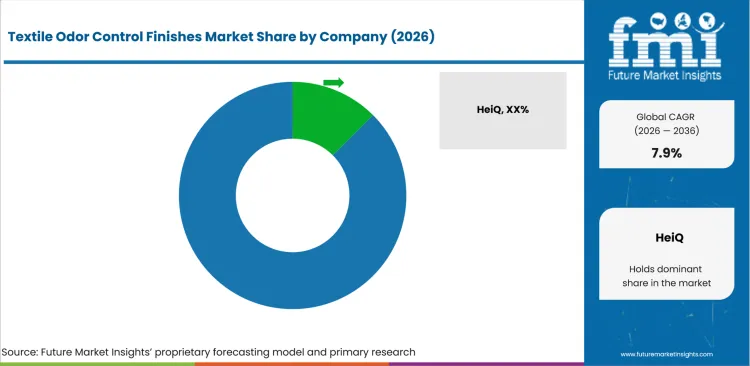
The market is moderately concentrated as global chemical suppliers hold stronger brand access and testing support. Specialist firms compete with biocide-free systems, patent-backed odor capture, and textile-specific claim support. Smaller suppliers win regional programs when they provide fast mill troubleshooting and flexible batch sizes.
Entry barriers include wash durability proof, restricted-substance compliance, and fabric compatibility across blends. Direct relationships with mills and brands create a service barrier that price-only entrants struggle to cross. Established companies compete on more than chemistry choice. They win by proving odor reduction, wash life, skin-contact safety, and compatibility with other finishing agents.
How is competition structured?
Competition reflects differences in specialization, portfolio scope, geographic reach, evidence, and customer access.
Competition is organized around formulation depth, application support, and claim documentation.
- Global Technology Suppliers: HeiQ, Archroma, Microban, SANITIZED, and Sciessent compete with branded odor-control platforms, antimicrobial technologies, and test-backed claim support. HeiQ brings bio-based and mineral-based VOC adsorption systems. Archroma adds global textile chemical reach.
- Textile Chemical Specialists: RUDOLF, Devan Chemicals, TANATEX Chemicals, and Pulcra Chemicals support mills with finishing know-how, recipe compatibility, and regional service. Rudolf lists odor management for direct skin-contact textiles. Tanatex lists QuatLock as a bio-based antimicrobial textile finish.
- Application and Channel Specialists: Regional distributors, testing laboratories, and mill service teams influence adoption by proving durability and claim suitability. These players do not always own the core chemistry, but they convert technologies into approved mill recipes.
How do selected companies compare?
The selected companies differ in portfolio focus, geographic reach, evidence depth, and channel strength.
| Company | Competitive position |
|---|---|
| HeiQ | HeiQ is assessed for formulation or material technology, technical support, qualification evidence, and regional channel reach. |
| Archroma | Archroma is assessed for formulation or material technology, technical support, qualification evidence, and regional channel reach. |
| RUDOLF | RUDOLF is assessed for formulation or material technology, technical support, qualification evidence, and regional channel reach. |
| Microban International | Microban International is assessed for formulation or material technology, technical support, qualification evidence, and regional channel reach. |
| SANITIZED | SANITIZED is assessed for formulation or material technology, technical support, qualification evidence, and regional channel reach. |
What are the key developments in the Textile Odor Control Finishes Market?
- In January 2026, Archroma and HeiQ entered a co-marketing agreement for antimicrobial and odor-control textile technologies. The agreement improves access to brands, retailers, and textile mills worldwide.
- In April 2024, HeiQ launched Fresh for Feather & Down as a bio-based anti-odor technology for jackets, duvets, and pillows. The launch extends odor control into home and insulation textiles.
- In October 2025, Sciessent received U.S. Patent No. 12,435,295 covering NOBO anti-odor technology for fabrics and textiles. The patent supports durable aqueous odor-control finishes.
Selected Companies in the Textile Odor Control Finishes Market
Companies referenced in this preview
- HeiQ.
- Archroma.
- RUDOLF.
- Microban International.
- SANITIZED.
- Sciessent.
- Sarex Chemicals.
- Rossari Biotech.
Market Scope & Definition
| Metric | Value |
|---|---|
| Market definition | Textile odor control finishes are chemical or material treatments applied to fabrics, yarns, or finished textile surfaces to reduce malodor during use. The scope includes antimicrobial finishes, cyclodextrin finishes, activated mineral systems, carbon-based systems, and other odor adsorbing or odor neutralizing treatments. |
| Functions covered | Antimicrobial Finishes, Cyclodextrin-based Finishes, Activated Mineral / Carbon Finishes, Other |
| Applications covered | Sportswear, Workwear, Healthcare Textiles, Hospitality / Other |
| End-use industries | Sportswear, Workwear, Healthcare Textiles, Hospitality / Other |
| Inclusions | Market scope covers antimicrobial finishes, cyclodextrin-based finishes, activated mineral and carbon finishes, other odor-control chemistries, apparel fabrics, home textiles, technical textiles, footwear textiles, sportswear, workwear, healthcare textiles, hospitality uses, wash-durable systems, semi-durable systems, limited-use systems, direct mill supply, and chemical distributor sales across 30+ countries. |
| Exclusions | Market scope excludes finished garments without a dedicated odor-control finish, laundry additives, air fresheners, antibacterial soaps, hard-surface disinfectants, fragrance-only textile sprays, and non-textile polymer additives. |
Research Methodology
| Metric | Value |
|---|---|
| Primary Research | FMI analysts reviewed mill buyers, chemical formulators, textile testing labs, brand sourcing teams, and distributors serving apparel and technical textile finishing. Discussions focused on wash durability, fabric compatibility, claim support, and recipe approval time. |
| Desk Research | The desk review covered textile test methods, treated-article rules, company product information, sustainability claims, and national textile industry indicators. AATCC odor methods and regulatory guidance helped define the addressable product pool. |
| Market Sizing and Forecasting | The model combined textile finishing volumes, average chemical pricing, application intensity, country-level mill structure, and durability mix. Growth assumptions were adjusted for sportswear penetration, export mill upgrading, and compliance-related substitution. |
| Data Validation | Forecasts were checked against functional finishing portfolios, trade-body textile indicators, country processing scale, and buyer behavior in activewear and workwear. Company portfolios were cross-checked before inclusion in the competitive assessment. |
What does the report cover?
The report covers finish type, textile type, application, durability, sales channel, and region across the 2026-2036 forecast period in 30+ countries.
| Metric | Value |
|---|---|
| Periods | Base year 2025; estimated year 2026; forecast period 2026-2036 |
| Segment axes | finish type, textile type, application, durability, sales channel, and region |
| Regions | North America, Latin America, Europe, East Asia, South Asia and Pacific, Middle East and Africa |
| Countries | United States, United Kingdom, Germany, France, Japan, China, South Korea, India and 30+ countries |
| Companies | HeiQ, Archroma, RUDOLF, Microban International, SANITIZED, Sciessent, Sarex Chemicals, Rossari Biotech, and others |
| Approach | Hybrid bottom-up and top-down approach using textile finishing volumes, country processing scale, segment use rates, and supplier portfolio checks. |
Market Segmentation Analysis
Segmented by Finish Type
- Antimicrobial Finishes.
- Cyclodextrin-based Finishes.
- Activated Mineral / Carbon Finishes.
- Other.
Segmented by Textile Type
- Apparel Fabrics.
- Home Textiles.
- Technical Textiles.
- Footwear Textiles.
Segmented by Application
- Sportswear.
- Workwear.
- Healthcare Textiles.
- Hospitality / Other.
Segmented by Durability
- Wash Durable.
- Semi-durable.
- Single-use / Limited.
Segmented by Sales Channel
- Direct to Mills.
- Chemical Distributors.
By Region
- North America.
- United States.
- Canada.
- Mexico.
- Latin America.
- Brazil.
- Chile.
- Rest of Latin America.
- Western Europe.
- Germany.
- UK.
- Italy.
- Spain.
- France.
- Nordic.
- BENELUX.
- Rest of Western Europe.
- Eastern Europe.
- Russia.
- Poland.
- Hungary.
- Balkan & Baltic.
- Rest of Eastern Europe.
- East Asia.
- China.
- Japan.
- South Korea.
- South Asia and Pacific.
- India.
- ASEAN.
- Australia & New Zealand.
- Rest of South Asia and Pacific.
- Middle East & Africa.
- Kingdom of Saudi Arabia.
- Other GCC Countries.
- Turkiye.
- South Africa.
- Other African Union.
- Rest of Middle East & Africa.
Research Sources and Bibliography
- American Association of Textile Chemists and Colorists. (2026). AATCC standard test methods and procedures. AATCC.
- American Association of Textile Chemists and Colorists. (2026). AATCC TM211-2021, Test Method for the Reduction of Bacterial Odor on Antibacterial-Treated Textiles. AATCC.
- United States Environmental Protection Agency. (2026, May 5). Consumer products treated with pesticides. EPA.
- Health and Safety Executive. (2025, April 10). Treated articles. HSE.
- HeiQ. (2026). HeiQ Fresh. HeiQ.
- Archroma. (2026, January 14). Archroma and HeiQ partner to bring revolutionary antimicrobial and odor-control solutions to textile industry. Archroma.
- Sciessent. (2025, October 26). Sciessent’s NOBO anti-odor technology awarded U.S. patent. Sciessent.
- United Kingdom Fashion and Textile Association. (2026). Industry reports and statistics. UKFT.
- Gesamtverband der deutschen Textil- und Modeindustrie. (2026). Textil+Mode. Textil+Mode.
- Press Information Bureau. (2025, December 24). Year end review 2025 of Ministry of Textiles. Government of India.
- National Bureau of Statistics of China. (2025, January 24). Industrial production operation in December 2024. Government of China.
- Invest Korea. (2026). Fashion. Invest Korea.
The bibliography is provided for reader reference and uses primary, official company, government, trade body, or standards-based sources.
This Report Answers
- What is the projected value of the Textile Odor Control Finishes Market in 2026?
- What value is forecast for the Textile Odor Control Finishes Market by 2036?
- What CAGR is forecast for the Textile Odor Control Finishes Market from 2026 to 2036?
- What 2026 share is projected for Antimicrobial Finishes within the finish type category?
- What 2026 share is projected for Apparel Fabrics within the textile type category?
- Which demand factors support the Textile Odor Control Finishes Market outlook?
- Which restraints and opportunities affect adoption in the Textile Odor Control Finishes Market?
- How are country CAGR outlooks, including India at 8.9%, compared?
- Which companies and product developments are covered in the competitive analysis?
- What is included in the market scope, and how is the forecast validated?
Frequently Asked Questions
Why should executives track the Textile Odor Control Finishes Market?
Executives should track this market because it can affect capital allocation, supplier strategy, operating risk, and competitive positioning across commercial planning cycles.
What business problem does the Textile Odor Control Finishes Market address?
It helps executive teams judge where customer pain, supplier capability, compliance exposure, and implementation economics justify investment, procurement, or portfolio action.
What should procurement leaders evaluate before selecting suppliers?
Procurement leaders should assess evidence quality, integration fit, service coverage, compliance readiness, total cost of ownership, and supplier execution capability.
What can limit return on investment for buyers?
Return on investment can be limited by low utilization, integration delays, training gaps, unclear ownership, pricing pressure, or weak fit with existing workflows.
How can suppliers build executive confidence?
Suppliers can build confidence by proving implementation speed, risk reduction, support depth, reference use cases, and measurable outcomes for budget owners.
Preview the report firsthand - request a free sample
Get SampleGet the brochure for pricing and purchase details.
Get PDFTable of Content
- Key Takeaways
- Market Size and CAGR
- Top Growth Driver
- Fastest Growing Segment
- Leading Region
- Key Companies
- Emerging Opportunities
- Executive Summary
- Global Market Outlook
- Demand-side Trends
- Supply-side Trends
- Technology Roadmap Analysis
- Analysis and Recommendations
- Analyst Perspective (What is happening? Why now? What should investors know?)
- Key Questions Answered
- How large is the market?
- What is the CAGR?
- What are key trends?
- Which region dominates?
- Who are the leaders?
- Market Overview
- Market Coverage / Taxonomy
- Market Definition / Scope / Limitations
- Research Methodology
- Chapter Orientation
- Analytical Lens and Working Hypotheses
- Market Structure, Signals, and Trend Drivers
- Benchmarking and Cross-market Comparability
- Market Sizing, Forecasting, and Opportunity Mapping
- Research Design and Evidence Framework
- Desk Research Programme (Secondary Evidence)
- Expert Input and Fieldwork (Primary Evidence)
- Tooling, Models, and Reference Databases
- Data Engineering and Model Build
- Quality Assurance and Audit Trail
- Market Background
- Market Dynamics (Drivers, Restraints, Opportunity, Trends)
- Scenario Forecast (Optimistic, Likely, Conservative)
- Impact Analysis
- AI Impact
- Sustainability Impact
- Regulatory Impact
- Technology Impact
- Consumer / Buyer Analysis
- Purchase Drivers
- Adoption Barriers
- Buyer Journey
- Opportunity Map Analysis
- Product Life Cycle Analysis
- Supply Chain Analysis
- Investment Feasibility Matrix
- Value Chain Analysis
- PESTLE and Porter's Analysis
- Regulatory Landscape
- Regional Parent Market Outlook
- Production and Consumption Statistics
- Import and Export Statistics
- Global Market Analysis and Forecast, 2021 to 2036
- Historical Market Size Value (USD Million) & Volume (Unit) Analysis, 2021 to 2025
- Current and Future Market Size Value (USD Million) & Volume (Unit) Projections, 2026 to 2036
- Y-o-Y Growth Trend Analysis
- Absolute $ Opportunity Analysis
- Global Market Pricing Analysis, 2021 to 2036
- Global Market Analysis and Forecast, By Finish Type, 2021 to 2036
- Introduction / Key Findings
- Historical Market Size Value (USD Million) & Volume (Unit) Analysis By Finish Type, 2021 to 2025
- Current and Future Market Size Value (USD Million) & Volume (Unit) Analysis and Forecast By Finish Type, 2026 to 2036
- Antimicrobial Finishes
- Cyclodextrin-based Finishes
- Activated Mineral - Carbon Finishes
- Other
- Antimicrobial Finishes
- Y-o-Y Growth Trend Analysis By Finish Type, 2021 to 2025
- Absolute $ Opportunity Analysis By Finish Type, 2026 to 2036
- Global Market Analysis and Forecast, By Textile Type, 2021 to 2036
- Introduction / Key Findings
- Historical Market Size Value (USD Million) & Volume (Unit) Analysis By Textile Type, 2021 to 2025
- Current and Future Market Size Value (USD Million) & Volume (Unit) Analysis and Forecast By Textile Type, 2026 to 2036
- Apparel Fabrics
- Home Textiles
- Technical Textiles
- Footwear Textiles
- Apparel Fabrics
- Y-o-Y Growth Trend Analysis By Textile Type, 2021 to 2025
- Absolute $ Opportunity Analysis By Textile Type, 2026 to 2036
- Global Market Analysis and Forecast, By Application, 2021 to 2036
- Introduction / Key Findings
- Historical Market Size Value (USD Million) & Volume (Unit) Analysis By Application, 2021 to 2025
- Current and Future Market Size Value (USD Million) & Volume (Unit) Analysis and Forecast By Application, 2026 to 2036
- Sportswear
- Workwear
- Healthcare Textiles
- Hospitality - Other
- Sportswear
- Y-o-Y Growth Trend Analysis By Application, 2021 to 2025
- Absolute $ Opportunity Analysis By Application, 2026 to 2036
- Global Market Analysis and Forecast, By Durability, 2021 to 2036
- Introduction / Key Findings
- Historical Market Size Value (USD Million) & Volume (Unit) Analysis By Durability, 2021 to 2025
- Current and Future Market Size Value (USD Million) & Volume (Unit) Analysis and Forecast By Durability, 2026 to 2036
- Wash Durable
- Semi-durable
- Single-use - Limited
- Wash Durable
- Y-o-Y Growth Trend Analysis By Durability, 2021 to 2025
- Absolute $ Opportunity Analysis By Durability, 2026 to 2036
- Global Market Analysis and Forecast, By Sales Channel, 2021 to 2036
- Introduction / Key Findings
- Historical Market Size Value (USD Million) & Volume (Unit) Analysis By Sales Channel, 2021 to 2025
- Current and Future Market Size Value (USD Million) & Volume (Unit) Analysis and Forecast By Sales Channel, 2026 to 2036
- Direct to Mills
- Chemical Distributors
- Direct to Mills
- Y-o-Y Growth Trend Analysis By Sales Channel, 2021 to 2025
- Absolute $ Opportunity Analysis By Sales Channel, 2026 to 2036
- Global Market Analysis and Forecast, By Region, 2021 to 2036
- Introduction
- Historical Market Size Value (USD Million) & Volume (Unit) Analysis By Region, 2021 to 2025
- Current Market Size Value (USD Million) & Volume (Unit) Analysis and Forecast By Region, 2026 to 2036
- North America
- Latin America
- Western Europe
- Eastern Europe
- East Asia
- South Asia and Pacific
- Middle East & Africa
- Market Attractiveness Analysis By Region
- North America Market Analysis and Forecast, By Country, 2021 to 2036
- Historical Market Size Value (USD Million) & Volume (Unit) Trend Analysis By Market Taxonomy, 2021 to 2025
- Market Size Value (USD Million) & Volume (Unit) Forecast By Market Taxonomy, 2026 to 2036
- By Country
- USA
- Canada
- Mexico
- By Finish Type
- By Textile Type
- By Application
- By Durability
- By Sales Channel
- By Country
- Market Attractiveness Analysis
- By Country
- By Finish Type
- By Textile Type
- By Application
- By Durability
- By Sales Channel
- Key Takeaways
- Latin America Market Analysis and Forecast, By Country
- Historical Market Size Value (USD Million) & Volume (Unit) Trend Analysis By Market Taxonomy, 2021 to 2025
- Market Size Value (USD Million) & Volume (Unit) Forecast By Market Taxonomy, 2026 to 2036
- By Country
- Brazil
- Chile
- Rest of Latin America
- By Finish Type
- By Textile Type
- By Application
- By Durability
- By Sales Channel
- By Country
- Market Attractiveness Analysis
- By Country
- By Finish Type
- By Textile Type
- By Application
- By Durability
- By Sales Channel
- Key Takeaways
- Western Europe Market Analysis and Forecast, By Country
- Historical Market Size Value (USD Million) & Volume (Unit) Trend Analysis By Market Taxonomy, 2021 to 2025
- Market Size Value (USD Million) & Volume (Unit) Forecast By Market Taxonomy, 2026 to 2036
- By Country
- Germany
- UK
- Italy
- Spain
- France
- Nordic
- BENELUX
- Rest of Western Europe
- By Finish Type
- By Textile Type
- By Application
- By Durability
- By Sales Channel
- By Country
- Market Attractiveness Analysis
- By Country
- By Finish Type
- By Textile Type
- By Application
- By Durability
- By Sales Channel
- Key Takeaways
- Eastern Europe Market Analysis and Forecast, By Country
- Historical Market Size Value (USD Million) & Volume (Unit) Trend Analysis By Market Taxonomy, 2021 to 2025
- Market Size Value (USD Million) & Volume (Unit) Forecast By Market Taxonomy, 2026 to 2036
- By Country
- Russia
- Poland
- Hungary
- Balkan & Baltic
- Rest of Eastern Europe
- By Finish Type
- By Textile Type
- By Application
- By Durability
- By Sales Channel
- By Country
- Market Attractiveness Analysis
- By Country
- By Finish Type
- By Textile Type
- By Application
- By Durability
- By Sales Channel
- Key Takeaways
- East Asia Market Analysis and Forecast, By Country
- Historical Market Size Value (USD Million) & Volume (Unit) Trend Analysis By Market Taxonomy, 2021 to 2025
- Market Size Value (USD Million) & Volume (Unit) Forecast By Market Taxonomy, 2026 to 2036
- By Country
- China
- Japan
- South Korea
- By Finish Type
- By Textile Type
- By Application
- By Durability
- By Sales Channel
- By Country
- Market Attractiveness Analysis
- By Country
- By Finish Type
- By Textile Type
- By Application
- By Durability
- By Sales Channel
- Key Takeaways
- South Asia and Pacific Market Analysis and Forecast, By Country
- Historical Market Size Value (USD Million) & Volume (Unit) Trend Analysis By Market Taxonomy, 2021 to 2025
- Market Size Value (USD Million) & Volume (Unit) Forecast By Market Taxonomy, 2026 to 2036
- By Country
- India
- ASEAN
- Australia & New Zealand
- Rest of South Asia and Pacific
- By Finish Type
- By Textile Type
- By Application
- By Durability
- By Sales Channel
- By Country
- Market Attractiveness Analysis
- By Country
- By Finish Type
- By Textile Type
- By Application
- By Durability
- By Sales Channel
- Key Takeaways
- Middle East & Africa Market Analysis and Forecast, By Country
- Historical Market Size Value (USD Million) & Volume (Unit) Trend Analysis By Market Taxonomy, 2021 to 2025
- Market Size Value (USD Million) & Volume (Unit) Forecast By Market Taxonomy, 2026 to 2036
- By Country
- Kingdom of Saudi Arabia
- Other GCC Countries
- Türkiye
- South Africa
- Other African Union
- Rest of Middle East & Africa
- By Finish Type
- By Textile Type
- By Application
- By Durability
- By Sales Channel
- By Country
- Market Attractiveness Analysis
- By Country
- By Finish Type
- By Textile Type
- By Application
- By Durability
- By Sales Channel
- Key Takeaways
- Key Countries Market Analysis
- USA
- Pricing Analysis
- Market Share Analysis, 2025
- By Finish Type
- By Textile Type
- By Application
- By Durability
- By Sales Channel
- Canada
- Pricing Analysis
- Market Share Analysis, 2025
- By Finish Type
- By Textile Type
- By Application
- By Durability
- By Sales Channel
- Mexico
- Pricing Analysis
- Market Share Analysis, 2025
- By Finish Type
- By Textile Type
- By Application
- By Durability
- By Sales Channel
- Brazil
- Pricing Analysis
- Market Share Analysis, 2025
- By Finish Type
- By Textile Type
- By Application
- By Durability
- By Sales Channel
- Chile
- Pricing Analysis
- Market Share Analysis, 2025
- By Finish Type
- By Textile Type
- By Application
- By Durability
- By Sales Channel
- Germany
- Pricing Analysis
- Market Share Analysis, 2025
- By Finish Type
- By Textile Type
- By Application
- By Durability
- By Sales Channel
- UK
- Pricing Analysis
- Market Share Analysis, 2025
- By Finish Type
- By Textile Type
- By Application
- By Durability
- By Sales Channel
- Italy
- Pricing Analysis
- Market Share Analysis, 2025
- By Finish Type
- By Textile Type
- By Application
- By Durability
- By Sales Channel
- Spain
- Pricing Analysis
- Market Share Analysis, 2025
- By Finish Type
- By Textile Type
- By Application
- By Durability
- By Sales Channel
- France
- Pricing Analysis
- Market Share Analysis, 2025
- By Finish Type
- By Textile Type
- By Application
- By Durability
- By Sales Channel
- India
- Pricing Analysis
- Market Share Analysis, 2025
- By Finish Type
- By Textile Type
- By Application
- By Durability
- By Sales Channel
- ASEAN
- Pricing Analysis
- Market Share Analysis, 2025
- By Finish Type
- By Textile Type
- By Application
- By Durability
- By Sales Channel
- Australia & New Zealand
- Pricing Analysis
- Market Share Analysis, 2025
- By Finish Type
- By Textile Type
- By Application
- By Durability
- By Sales Channel
- China
- Pricing Analysis
- Market Share Analysis, 2025
- By Finish Type
- By Textile Type
- By Application
- By Durability
- By Sales Channel
- Japan
- Pricing Analysis
- Market Share Analysis, 2025
- By Finish Type
- By Textile Type
- By Application
- By Durability
- By Sales Channel
- South Korea
- Pricing Analysis
- Market Share Analysis, 2025
- By Finish Type
- By Textile Type
- By Application
- By Durability
- By Sales Channel
- Russia
- Pricing Analysis
- Market Share Analysis, 2025
- By Finish Type
- By Textile Type
- By Application
- By Durability
- By Sales Channel
- Poland
- Pricing Analysis
- Market Share Analysis, 2025
- By Finish Type
- By Textile Type
- By Application
- By Durability
- By Sales Channel
- Hungary
- Pricing Analysis
- Market Share Analysis, 2025
- By Finish Type
- By Textile Type
- By Application
- By Durability
- By Sales Channel
- Kingdom of Saudi Arabia
- Pricing Analysis
- Market Share Analysis, 2025
- By Finish Type
- By Textile Type
- By Application
- By Durability
- By Sales Channel
- Türkiye
- Pricing Analysis
- Market Share Analysis, 2025
- By Finish Type
- By Textile Type
- By Application
- By Durability
- By Sales Channel
- South Africa
- Pricing Analysis
- Market Share Analysis, 2025
- By Finish Type
- By Textile Type
- By Application
- By Durability
- By Sales Channel
- USA
- Market Structure Analysis
- Competition Dashboard
- Competition Benchmarking
- Market Share Analysis of Top Players
- By Region
- By Finish Type
- By Textile Type
- By Application
- By Durability
- By Sales Channel
- Emerging Startups
- Innovation Benchmarking
- Competition Analysis
- Competition Deep Dive
- HeiQ
- Overview
- Product Portfolio
- Profitability by Market Segments (Product/Region/Sales Channel)
- Sales Footprint
- Strategy Overview
- Marketing Strategy
- Product Strategy
- Channel Strategy
- Archroma
- RUDOLF
- Microban International
- SANITIZED
- Sciessent
- Sarex Chemicals
- Rossari Biotech
- HeiQ
- Case Studies
- Success Stories
- Recent Developments
- Competition Deep Dive
- Assumptions & Acronyms Used


